


Abstract
The generation of biomass residues and biowaste is both a challenge to the environment and to resource management worldwide but is also a significant renewable resource for energy and material recovery. Biomass residues are utilised along multiple pathways such as direct use for energy production, anaerobic digestion and biogas production, biofuel generation, composting, soil amendment, and conversion into value-added products at a global scale. On the other hand, many lignocellulosic and other biomass residues are characterized by low bulk density, heterogeneous characteristics, and seasonal availability, thus complicating collection, handling, storage, and transportation. Densification into solid fuel pellets is a viable solution for transforming these low-density residues into a compact, handleable, and transportable form with increased energy density. Although biomass residues have global potential, past pelletisation studies in Punjab, Pakistan, have generally considered only a few of two to three seasonal feedstocks that do not cover the uncertainty of potential feedstock availability in several seasons of the year, alongside the judgment of suitable biomass input. This study was, therefore, designed to explore nine agro-residues with different seasons in Punjab, e.g., tree residues, grass clippings, animal waste, crop residues, and herb biomass, for robust conversion into solid fuel pellets. Gate-to-gate Life Cycle Assessment (LCA) and Life Cycle Costing (LCC) methods were used to evaluate the production system of the pellets from biomass residues. A functional unit of 1 tonne of biomass solid fuel pellets was defined, and the resulting environmental impacts were modelled using GaBi software and the ReCiPe 2016 methodology. Process performance and production hotspots were assessed by attributing the environmental impacts that occurred at individual pellet-production stages to the overall impacts, while LCC was used to evaluate economic costs, both internal and external, from pellet production. The results of hotspot analysis indicated that flash/pneumatic drying represented the most important contributor for all investigated impact categories, followed by the pellet-milling and packaging stages. The total estimated cost of the pellets was USD 72.6 t−1, with an internal cost of USD 51.7 t−1 and an environmental cost of USD 20.9 t−1. Two other energy scenarios provided evidence through which to understand the potential for reductions in GHG emissions linked to the production of pellets. These findings suggest that differing and seasonally accessible biomass residues in Punjab can be converted into solid biofuels to concurrently aid sustainable waste management, energy security, climate-change amelioration, and rural economic growth. This study is novel because it compares nine heterogeneous biomass residues in a seasonal common-pellet production framework, using an integrated environmental and economic approach to provide stakeholders with practical evidence they can use to select the biomass feedstock that is most environmentally and economically preferable. These results help achieve the Sustainable Development Goals 7, 11, 12, and 13.
1. Introduction
As the world’s population has increased, the demand for a continuous energy supply has also risen. Energy has now become a basic necessity for human beings. To fulfil this requirement, nations are struggling to adopt different energy scenarios. The exhaustion of fossil fuels and uncontrolled fuel prices are due to geopolitical situations, leading to energy insecurity. Researchers are now exploring options for more reliable, cheaper, and locally available energy sources. Several renewable resource options have been identified, and more are set to emerge. For the last couple of decades, solar and wind energy techniques have evolved, but physical force-driven energy has limitations. Photovoltaic cells work in daylight, while wind turbines require continuous wind speed [1].
Reliance on fossil fuels for energy production tends to increase fuel prices, create import deficits for developing countries, and increase emissions leading to global warming. It is urgent that we shift to renewable energy resources, which are eco-friendlier, cleaner, and cheaper, in order to reduce the emission footprints of the energy sector. In this case, biomass-based fuel provides a promising technique that is a more efficient and commercially viable option. The technique involves the conversion of biodegradable material to a densified pellet through mechanical value addition [2]. Conversion of biomass residue into pellets is now gaining attention all over the world. During the year 2021, about a 7% increase in biomass fuel pellets was reported, of which 9% of the whole production was from the European Union [3]. The global wood pellet sector resumed its growth, with worldwide production estimated at 53.5 million tonnes in 2025, a 10% increase versus 2024 [4]. In that same year, the EU produced around 20.5 million tonnes of wood pellets, which is about 38.3% of global production [5]. Through pelletisation, the loose form of biomass is converted into a solid, homogeneous fuel that is small, cylindrical in structure, and flows like liquid fuel in combustion chambers [6].
Unlike areas where open-field burning is still practiced as one of the methods for crop-residue disposal, the European Union has developed regulations to control open-field burning, as it causes problems for air quality, climate change, and soil. Good Agricultural and Environmental Condition (GAEC) 3 forbids arable stubble burning under the Common Agricultural Policy (CAP) conditionality framework for farmers, with the specific aim of preserving soil organic matter and soil structure [7]. This restriction is part of more general environmental new-climate goals such as decreasing emissions from open-source biomass combustion and preserving the long-term production capability of agricultural soils. The practice can also release particulate matter and other air polluters in significant quantities, contribute to the disposal of the inherent organic material, and remove nutrients that soil can provide.
The EU framework does not mean that burning can never happen under any circumstances; there may be certain national provisions or particular phytosanitary or plant-health situations that justify targeted burning where deemed necessary and properly authorised. The European regulatory approach therefore provides an insightful comparison to regions such as South Asia, where crop-residue burning is still frequently used, leading to high particulate matter and other emissions [8,9]. Assessing open-field burning is a crucial way of addressing how we might minimize environmental issues arising from the open-field disposal of crop residues and designing economically feasible alternatives that convert agricultural waste into value-added products, including solid biofuels, thus promoting resource recovery principles and the circular bioeconomy.
In Pakistan, fossil fuels may play a major role in the energy sector, where more than 70% of the electricity is generated by non-renewable resources. Pakistan has been facing difficulties in the energy sector for a long time. The problems in the sector include the production and distribution of energy, its availability to low-income areas, and expensive electricity because of dependency on fossil fuels and exchange rates. Punjab, as the largest province, demands more energy for both the industrial and agricultural sectors, and it feeds more than half the population of Pakistan. It therefore faces more energy challenges than other provinces [10].
The agriculture sector in Pakistan plays an important role in its economic strength. Agriculture in Pakistan engages about 40% of the manpower and contributes 23% of GDP. In major export items, about 70% of Pakistan’s exports are agricultural goods. Some 47% of the total area of Pakistan is used for crop cultivation, which reflects its strength. There are two seasons for crop growing, including Kharif and Rabi. Irrigation channels in Pakistan irrigate more than 80% of the agricultural area, and the remaining area is covered by rainfall. More than half of the area is cultivated in the winter seasons. The most common crops of this area include rice, staple food crops, wheat, barley, lentils, mustard, and gram [11].
The province of Punjab is the largest cultivated area of Pakistan. More than half of the total population of Pakistan resides in this area, and it is a commercially active zone. Crop burning is now becoming an emerging threat in Punjab. These practices have intensified over the past decade. Previously, farmers used crop residues for their livestock; now, setting them on fire has become a common practice. The main reason for this major shift is the limited time span between rice harvesting and wheat sowing (from mid-November to early December). Farmers have to remove rice crops from the ground rapidly, which is expensive (US$41/acre) and time-consuming. Thus, burning remains the most economical approach for them [12]. Another common belief among farmers is that stubble burning not only helps in the early removal of crop residue but also helps in the addition of essential nutrients in the field, with the eradication of plant pathogens and pests. Through crop residue burning, farmers aim to sterilize the soil surface, reducing the risk of infestations that could affect the next crop cycle [13].
The air quality index (AQI) of Lahore has been a rising concern in recent years because of higher air emissions. Recent trends reflect the alarming AQI values of Lahore in the years 2022–2024, where the air quality value is constantly high throughout the year, but significantly high values were observed in December and January because of stubble burning practices [13]. The south-westerly flowing wind carries particulate matter and other air pollution content towards central Punjab, including Lahore. This area is highly populated (population/sq. ft.), with highly commercial activities being performed in it. The air of Lahore is already polluted because of automobile emissions, high-rise buildings, and industrial emissions, with very limited green spaces. Furthermore, the relatively low wind speed of less than 5 km/h does not allow the air to disperse and concentrates these emissions over Lahore city in the winter season [14].
The total biomass waste generation in Pakistan is about 230 million tons per year [15]. Nutrients that are embedded in biomass residues, moisture content, and travelling distance combine to determine the characteristics of biomass and its associated emissions. Energy accessibility at a low cost, with a reduction in transport emissions, can be achieved by establishing the feedstock supply chain networks across rural areas. These residues are readily available as farm residues [16]. This biomass waste is being dumped only to decompose in the environment and release GHGs into the air. Similarly, in Southeast Asia, crop residues are set on fire to avoid labour-intensive cutting practices during the short harvesting season and over the cultivation season. Stubble burning, leading to winter smog formation, causes respiratory diseases. Conversion of biomass waste into pellets not only provides a sustainable source of energy but also provides a solution for the abatement of smog with no land use change.
Crop residue, combined with other biomass options, has the potential to produce energy that is cheaper, greener, and locally available. Cultivation activities produce more than 230,000 tons of biomass residue per day [17]. These biomass waste types can be used for the production of electricity as well as heat generation because of their combustion properties [18]. The energy generation from the biomass feedstock is a carbon-neutral energy source. The amount of carbon dioxide (CO2) released during combustion of biomass material is equal to the amount of CO2 utilized by the plant during photosynthesis. Biomass residue becomes an ideal feedstock for eco-friendly energy production. Globally, the contribution of biomass-based energy is expected to increase by about 313 EJ by 2050 [19]. These alternative energy options also create new job opportunities with rural development.
The seasonal availability and low density of biomass feedstock are the limitations that restrict stakeholders from moving towards biomass-based energy production. The low density of biomass increases fuel expenditure and emissions in the air. In this scenario, solid fuel pellets are a groundbreaking option through which to convert the less dense material into compact solid fuel. These pellets increase energy density, with easy collection, management, and transportation. Establishing the biomass residue supply chain and densification process not only provides a native, sustainable solution for rural development; rural development helps in engaging people by creating new job opportunities and energy security [20].
The literature indicates that biomass residues are a promising raw material for pellet production, but some gaps remain to be addressed. In particular, previously established studies on the pelletisation of biomass have largely neglected the seasonal and spatial availability of biomass feedstocks, especially with regard to the maintenance of a sustainable, dependable, and year-round feedstock supply. Secondly, alternative feedstocks require comparative environmental and economic assessment within an identical pellet-production system in order to understand the sustainability and cost implications of these feedstocks. This limitation particularly affects regions like Punjab, Pakistan, where large amounts of biomass residue are generated in different seasons and localities but the systematic conversion of diverse biomass resources into solid fuel pellets has not been fully established.
Therefore, the objective of the current work was to assess nine different biomass residues from different seasons and regions of Punjab for solid fuel pellet production and compare their environmental and economic feasibility. A gate-to-gate Life Cycle Assessment (LCA) was adopted to quantify environmental impacts and hot spots along the process, and Life Cycle Costing (LCC) was used to assess the corresponding internal and external cost effects. Thus, by utilising heterogeneous biomass feedstocks with environmental and economic assessment, this study aims to deliver tangible evidence to stakeholders on the merits of relevant biomass residues for pellet production in terms of seasonal supply and environmental and economic performance. It also bridges the research gaps identified and constitutes a basis for the more sustainable and informed use of biomass residues for solid fuel production.
2. Materials and Methods
The current study involved environmental and economic assessments of nine (9) different types of biomass residue material through Life Cycle Assessment (LCA) and Life Cycle Costing (LCC). The selection of biomass was made according to its availability in the study area. The first part of the study consists of an LCA of biomass fuel pellets, in which all the associated environmental impacts were quantified, whereas the LCC concluded the financial burden of the production of pellets. Both the internal (IC) and external (EC) impacts were considered for the whole gate-to-gate life cycle. The primary data were collected directly from the study area, while the secondary data were collected from the existing literature. However, the grid mix data of the study area were collected from the Pakistan Energy Outlook Report 2021–23 [21]. This section also describes the calculations used in the present study to ensure the transparency and reproducibility of the material, energy, emission, and economic assessments. All associated material flows and energy flows were quantified within the gate-to-gate system boundary, with respect to the production of this functional unit.
2.1. Study Area
The study area of this work was selected based on the availability and variety of biomass residues. For this study, Phool Nagar, Tehsil Pattoki, District Kasur, was selected because it fulfils this requirement. The study area is located at 31.0202° N latitude and 73.8533° E longitude. Phool Nagar is a highly cultivated area, and rice, sugarcane, cotton, fodder, and wheat are the main crops being cultivated there. Furthermore, several commercial nurseries have been established to meet the horticultural needs of adjacent metropolitan cities, including Lahore. According to the Local Government’s data, Tehsil Pattoki produces more than 60 tons/day of municipal waste, in line with its proportion of the population. The waste characteristics show that biomass makes up more than 60% of the waste composition; thus, it is another potential source of biomass.
2.2. Goal and Scope
The main objective of this study was to evaluate the whole life cycle of pellet production with its associated environmental and economic impacts. The pneumatic drying or flash-drying step was considered a potential stage of the whole cycle. The findings of this study will help to address sustainable energy supplies through a variety of biomass feedstocks available in the province of Punjab, Pakistan. This research work integrated all the inflows and outflows of the entire life cycle, both in the form of quality and quantities.
2.3. Fuel Pellet Production
The manufacturing of biomass solid fuel pellets involves several steps, from raw material collection, transportation, drying, shredding, pelletisation, and packaging of the finished product. Initially, nine (9) biomass feedstocks were identified and collected (Table 1). These biomass residue types were selected according to their diverse availability in different seasons. The purpose of this selection was to identify the potential of different biomass types for pellet production, so that production would not stop due to the unavailability of a desired type of biomass.
Table 1.
Biomass materials used for the current study and their sources.
Mass balance was used to determine the amount of raw biomass that needed to be produced to meet the functional unit. The calculation considered the initial moisture content of the feedstock, the moisture content after pelleting, and material lost during processing. One tonne of packed pellets was the target for this mass balance and was used to quantify the feedstock requirements and material flows between different processes. The required quantity of raw biomass was calculated as follows:
where Mass (raw) is the required mass of raw biomass (kg), Mass (pellet) is the mass of finished pellets per the functional unit (kg), and L is the fractional material loss during processing. The overall material balance was subsequently expressed as
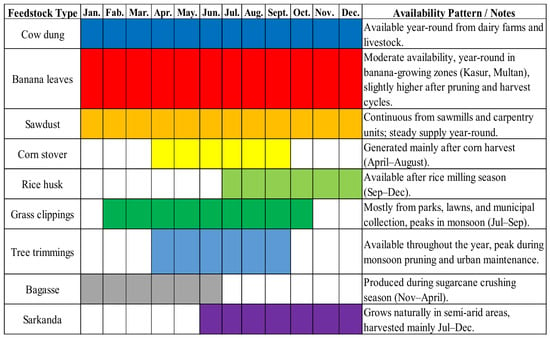
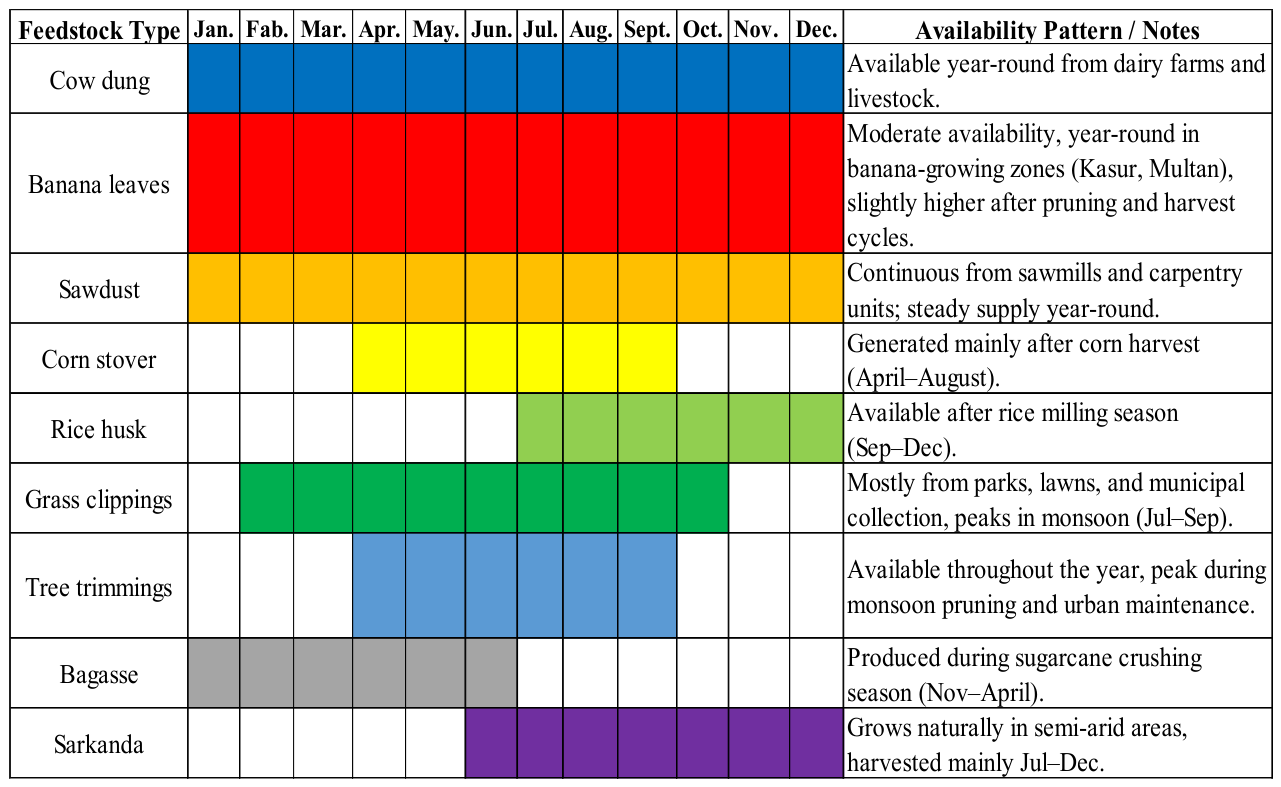
The biomass types with their availability throughout the year are presented in Figure 1. The preliminary characteristics, including moisture content and particle sizes, were evaluated. After this, the biomass feedstocks were sorted manually for the removal of unwanted waste types for effective operational activities. Drying of biomass involved two steps, both using sunlight and pneumatic drying (flash-drying). During natural drying, a screw press squeezes water out, reducing the moisture content to 50–60%. This was then followed by solar drying based on biomass feedstock types and drying in sunlight under ambient conditions (temperature 40 °C, 10% humidity, wind speed 5 km/h, and high solar radiation) over 1 day (effective sunlight 10 h) of sun-drying, with a 2-inch-thick biomass layer to ensure high porosity.
Figure 1.
Biomass residue options and their seasonal availability.
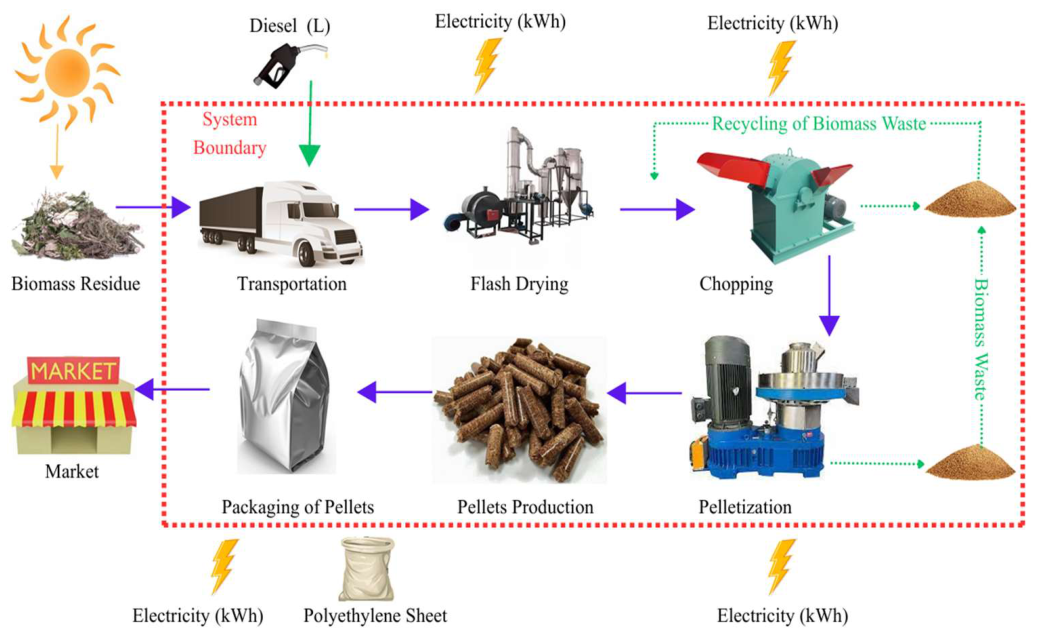
During the second drying step, flash-drying, the biomass was exposed to a high temperature of 300–400 °C for the removal of another 30% of moisture content. An optimized moisture level is required to strengthen and bind particles in pellets. After drying, the biomass was chopped to improve compaction and uniformity. The whole process of pellet production, from raw material acquisition to packing, is elaborated upon in Figure 2.
Figure 2.
Process flow diagram of pellet production.
After crushing, the biomass was transferred to a pellet mill where the excessive pressure and heat softened the lignin from the cell wall of the plant. The lignin acted as a binder and could bind the particles together on cooling. The pellet length of 10–30 mm was maintained to optimize the energy consumption and pellet strength. The horizontal blade cut the pellets after leaving the press channel. The newly formed pellets were left open at room temperature for the removal of excessive heat. The cooling of the pellets helped in solidifying the lignin material and hence improving the pellet strength. On cooling, the newly formed pellets were packed with plastic packing to avoid disintegration in a humid environment. The remaining fine particles of biomass were incorporated again into the pellet machine with a new intake of chopped material.
2.4. Life Cycle Assessment (LCA)
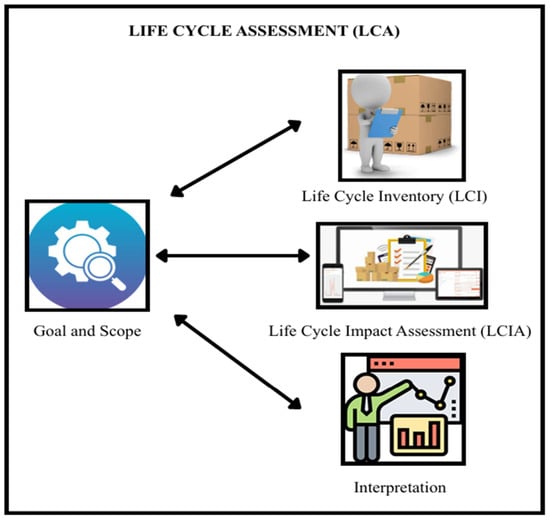
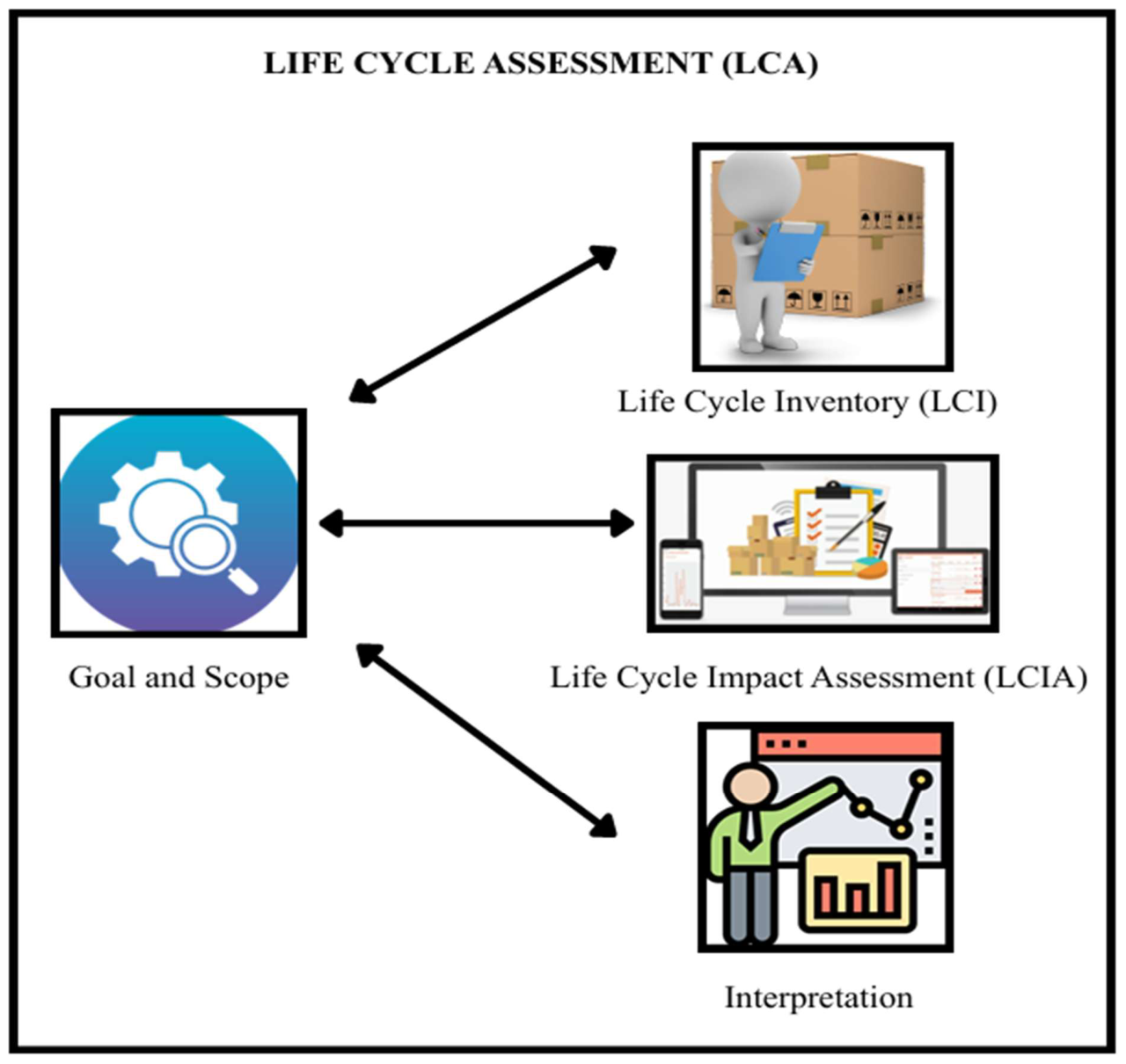
To evaluate the environmental performance of a product/system, LCA is a good choice as a sustainability tool. LCA can help in evaluating the entire life cycle of the product by quantifying the environmental burdens associated with it. GaBi (Version 10.0.0.71) LCA software, following ISO 14040 guidelines [22], was selected for this study. LCA in this study involves four steps, including goal and scope, building and collecting the Life Cycle Inventory (LCI), Life Cycle Impact Assessment (LCIA), and the interpretation of results (Figure 3).
Figure 3.
Life Cycle Assessment framework.
2.4.1. System Boundary and Functional Unit
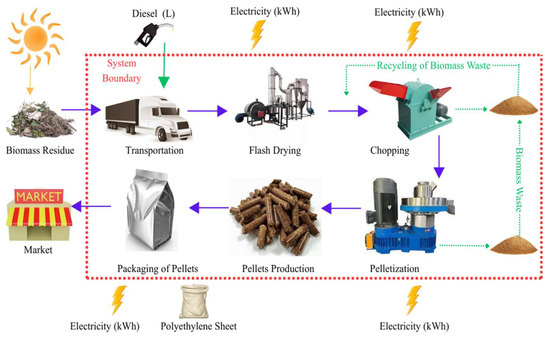
The functional unit of a system presents a specific quantity of that system, using a reference quantity, used for the assessment of the system’s performance [23]. The quantity of the system remained the same during the evaluation of the whole life cycle. For this study, 1 tonne (1000 kg) of pellet production was considered the functional unit, while the gate-to-gate system boundary was defined. The whole process comprised raw material collection, its transportation, flash-drying, chopping, palletization process, and finally the packaging of the product. The whole process with the system boundary is presented in Figure 4.
Figure 4.
Representation of the scope of the work and the system boundaries of the fuel pellet process.
2.4.2. Life Cycle Inventory (LCI)
During this stage, all the quantitative data, including inputs (biomass consumed, power consumption, and other resources required) and outputs (product, emissions, and waste generation), were collected [24]. The quantitative data for this study are presented in Table 2. The input data consist of different biomass quantities required for the production of 1 tonne of pellets with different biomasses, variations in energy consumption during the processing of different biomass materials with varying moisture content, transportation data with different raw material resources, and polyethylene sheets. On the other hand, the output data include product quantity, all the emissions (CO2, CO, NOx, SOx, PMs, VOCs, and moisture releases) associated with the whole life cycle, and waste of packaging material. The emissions of the system were collected from the GaBi program, while the secondary data (emission factors) were collected from previously published papers.
The electricity consumption was estimated for each piece of electrically powered equipment identified as part of the pellet production process. Electricity consumption was calculated for individual equipment as follows:
where E is the electricity consumed during each step; P is the power demand of the equipment (i) (kWh); and ti is the time taken using the equipment (h). The total electricity demand required for the pellet production process was determined by the sum of electrical energy consumption for all relevant processing and auxiliary equipment:
where E(total) is the total electricity consumption (kWh), and (n) is the total number of electricity-consuming process units in the system boundary. The electricity demand was then standardised based on the functional unit:
E(FU) is the electricity (kWh t−1) consumed to manufacture 1 tonne of packed pellets.
2.4.3. Life Cycle Impact Assessment (LCIA)
The next stage of LCA is an important stage of the study: Life Cycle Impact Assessment (LCIA) helps in the conversion of Life Cycle Inventory (LCI) data into different impact categories. In GaBi software, ReCiPe 2016 was employed for the impact assessment of this study. Both the midpoint and endpoint, followed by normalization methods, were applied. Environmental quantities of ReCiPe 2016 are widely used because of its diverse and more comprehensive frameworks. These dual methods of ReCiPe 2016 deal with a wide-ranging evaluation of impacts linked with the product, allowing policy makers to make informed choices together with specific environmental flows (midpoint) and their impact categories on ecosystem quality, resource diminution, and human health (endpoint). The ten (10) most significant environmental flows from midpoint analyses were selected and evaluated.
2.4.4. Scenario Assessment
Scenario analysis in Life Cycle Assessment (LCA) is another useful tool that can help in identifying the associated environmental burdens of a product with two or more different available technologies, feedstocks, and policies, while the system boundary remains the same. This tool provides realistic quantities when choosing the exact technologies before execution of a project or while shifting towards different technologies. During this study, two electricity scenarios were utilized, including electricity from a grid mix and a photovoltaic solar system. Pakistan’s electricity grid mix is based on thermal energy (59.4%), hydropower (22.8%), nuclear energy (8.4%), and a 6.8% contribution of renewable resources [25]. The environmental impacts of both scenarios were evaluated and compared in this study, which will help in reducing the environmental impacts associated with the pellet production stage.
Table 2.
Inventory data of 1 tonne of biomass waste [21,26].
2.4.5. Interpretation
The last stage of LCA is interpretation, which helps in converting all the results into a more presentable format. During this phase, the most hazardous stage of the production process can be easily identified; hence, any improvements or alternative steps can be implemented more effectively [24].
2.5. Life Cycle Costing (LCC)
In the second part of this research, the economic burden of producing 1 tonne of biomass solid fuel pellets was evaluated using Life Cycle Costing (LCC). This method provides information on all the costs involved in the production of a product. These expenditures include the purchase of equipment, transportation, installation, operation, maintenance, and end-of-life disposal [27].
The economic impacts of a product can be visualized through a systematic Life Cycle Costing [28]. The functional unit for LCC calculation for this study was similar to the LCA: a 1-tonne biomass solid fuel pellet. Life Cycle Costing can be calculated through direct and internal costing (directly linked with production) and indirect and external costing (environmental burden in the form of cost). This is summarized as follows.
LCC = IC + EC
In this formula, the symbol IC is internal cost, while on the other hand, the symbol EC shows external cost. This method helps provide a comprehensive evaluation of the whole costing involved, with the aim of reducing capital investment and creating a higher profit margin for producers.
2.5.1. Internal Cost
During the Life Cycle Costing (LCC), all the costs involved in the production activities, e.g., equipment cost, installation, raw material costing, utilities, labour, maintenance, insurance, and depreciation, were considered. Overall, 3.5% of the initial investment was allocated for insurance, while 2.5% of the initial investment was considered for maintenance work. As the facility was working in two consecutive shifts, ten (10) people were hired. The deployment plan per shift includes one (1) supervisor, three (3) workers, and a driver for the transportation of the biomass residue. The salary details of the labourers were collected directly from the plant owner. Internal costing can be presented through a simple formula.
IC = Cl + Cu + Cr + Cd+ CM + Cm + Ct
Cl, Cu, Cr, Cd, CM, Cm, and Ct are labour, utility, raw material, depreciation, management, maintenance, and transport costs, respectively. The depreciation cost of the unit was calculated using the following equation [29]:
Cd = ICI (1 − 5%)/20
In this equation, Cd represents the depreciation cost, and ICI is the initial capital investment. It was considered that, on average, the life of this facility will be 20 years with a salvage value ratio of 5% of the full ICI value, which will remain as residual value upon completion of the project.
The annual production capacity of the pellet production system was calculated from the production rate and annual operating hours as follows;
where Q(annual) is annual pellet production, Q(hourly) is the pellet production rate, and H(annual) is the total annual operating time. Annual revenue from pellet production was modelled based on the annual production value and the selling price of the pellets:
where R(annual) is annual revenue (USD yr−1), Q(annual) is annual pellet production, and P(pellet) is the selling price of the pellets (USD t−1). Annual profit was calculated by subtracting the production cost from annual revenue:
where Profit(annual) is annual profit (USD yr−1), R(annual) is annual revenue (USD yr−1), and C(annual) is total annual production cost (USD yr−1). The profit margin (PM) was calculated, where applicable, as a percentage:
The payback period for this project was also calculated according to the following equation:
2.5.2. External Costs
Similar to the internal cost, the external costing of the project is an essential component in the assessment of LCC. External costing refers to the impacts imposed by a product on the environment, resources, and society. These types of costing are not being incorporated into the overall price of a product. The external costs of a product cannot be calculated using a conventional method. These values are related to the emissions of a product throughout its life cycle. Electricity and other energy input emissions were estimated with their corresponding emission factors. Emissions from each energy source were calculated as
where E(mj) is the quantity of pollutant/greenhouse gas (j) emitted, and E is energy consumed, while EFj is the emission factor of such an element (j). Additionally, for cases where more than one energy source or emission-generating activity was assessed, total emissions were summed according to the following method [30]:
In the equation, Ek represents the amount of emissions to air and water per unit, and Ck is the emission coefficient. These quantified estimates were then included in the Life Cycle Inventory and fed into the environmental impact assessment.
3. Results
3.1. Midpoint Assessment
In LCA, environmental impacts are identified as environmental flows and can be quantified and assessed based on evidence in a specific impact category. These categories are grouped according to their linkage and similar environmental impact contribution, and these categories are grouped with midpoint analysis [31]. A detailed summary of the midpoint analysis of this study is shown in Table 3. A list of 18 different impact categories were studied with GaBi software, but only 10 categories, with more significant results, were selected. The results of 9 different types of biomass feedstock reflect a range of contributions of GWP (2.12 × 101 to 3.29 × 101), FPMFP (6.05 × 10⁻² to 8.52 × 10⁻²), and FDP (5.07 × 100 to 8.94 × 100). The differences among these values of various biomass feedstocks depend on diesel consumption during transportation and pretreatment processes.
Table 3.
Midpoint assessment results of fuel pellet production.
These impact types can be mitigated by using other renewable energy resources as well as by employing locally available feedstocks to optimize the whole process. Similarly, the fluctuating values of FWCP (5.49 × 10⁻² to 8.77 × 10⁻²) reflect the substantial use of water, particularly for washing animal dung to remove metallic oxides. Efficient water consumption practices during pretreatment help in making the pelletisation process sustainable. These results—HTP (1.55 × 100 to 2.27 × 100), IRP (2.91 × 10⁻² to 4.66 × 10⁻²), and LUP (3.01 × 10⁻¹ to 4.83 × 10⁻¹)—provide an avenue for the selection of biomass type with proper management. Additionally, the POFP (1.21 × 1−1 to 3.29 × 10⁻¹) demands optimal process conditions throughout the life cycle of pellet production to reduce the emissions of volatile organic compounds. Last but not least, the outcome ranges of the TAP (1.72 × 10⁻¹ to 2.49 × 10⁻¹) and the TETP ranges (1.32 × 101 to 2.06 × 101) underscore the importance of effective neutralization approaches.
Overall, this study identified substantial variations between nine (9) different types of biomass. The biomass residue, including corn stover, bagasse, tree trimmings, and sarkanda, stands out with the least environmental impact across selected midpoint categories, particularly GWP, FDP, and FPMFP. The lower values against these feedstocks indicate lower energy inputs during pretreatment as well as local availability, which would reduce transportation emissions. On the other hand, raw materials like sawdust and rice husk outscore in the impact categories of GWP, FDP, and POFP. These higher values are mainly because of the transportation emissions. The midpoint values of remaining feedstocks, including cow dung, banana leaves, and grass clippings, reflect moderate to higher levels of emissions. For instance, the higher values of toxicity (in HTP and TETP) are mainly because of their higher moisture content, which demands additional energy inputs within the pelletisation process.
3.2. Normalized Results
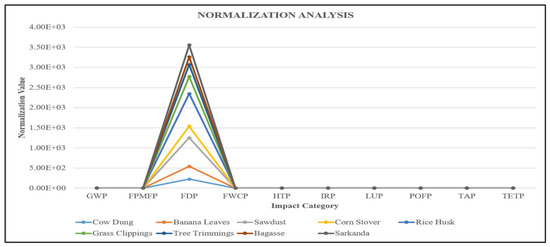
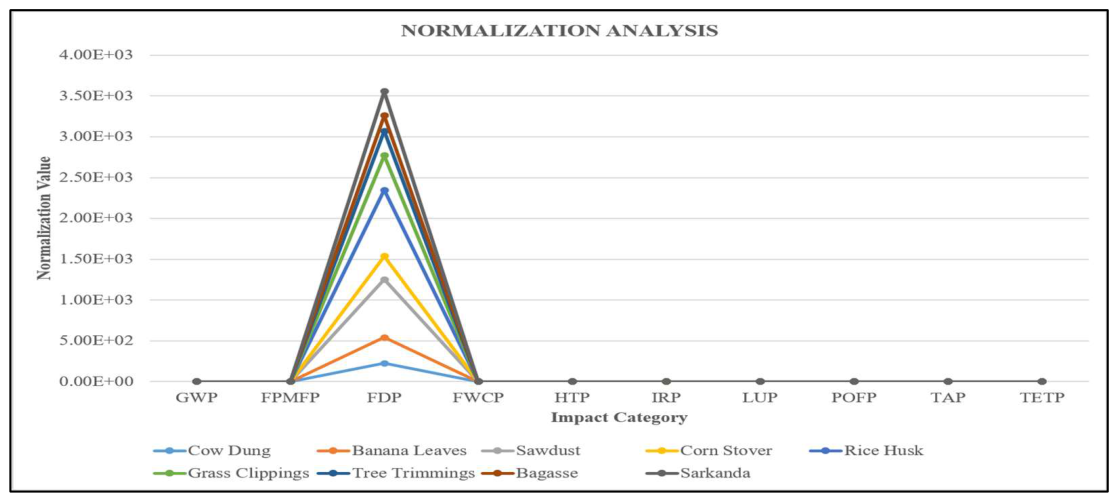
The midpoint results were normalized using a normalization factor, represented by the integration of different impact categories into per capita damage. The normalization feature of LCA aids in interpreting various impact categories based on a reference value. For this study, the normalization factor from ReCiPe 2016 v1.1 (H) global, excluding biogenic carbon, was employed with midpoint normalization in GaBi software. Figure 5 illustrates the normalization data in a line chart, showing that the FDP range (1.93 × 10² to 8.11 × 10²) was the main impact category across all types of biomass. Higher FDP values indicate significant fossil fuel use during transportation and upstream stages of pelletisation. Similarly, the FPMFP range (1.14 × 10⁻² to 1.66 × 10⁻²) was the second-highest impact category, associated with emissions from biomass pretreatment (chopping) and fuel consumption during transportation and electricity generation. Following that, POFP (8.91 × 10⁻⁶ to 1.10 × 10⁻⁵) represented another substantial impact category linked to the direct emissions of VOCs, particulate matter, and PAHs during drying and pelletisation. The remaining impact categories (GWP, FWCP, HTP, IRP, LUP, TAP, and TETP) offer promising opportunities to transition to renewable energy sources.
Figure 5.
Normalized results of fuel pellet production (person-equivalent).
In GaBi, the person-equivalent weighted evaluation with the normalization indicator ReCiPe indicates that corn stover, bagasse, and tree trimmings were grouped with low-impact categories because of their lower environmental contribution across the whole pelletisation process. These biomass residues are positioned as the top candidates because of their lower energy demand during early treatment and lower fuel consumption during commuting. On the other hand, the normalization values of rice husk and sawdust reflect higher environmental impacts caused by their remote sources, away from the facility. However, biomass wastes like cow dung, banana leaves, and sarkanda placed in the middle because of their average environmental burdens.
3.3. Endpoint Assessment
The conversion of midpoint results into endpoint impacts (the LCIA) develops a more comprehensive understanding of impacts in three tiers, including human health, ecosystem damages, and resource utilization [32]. All the endpoint evaluations of this study with all feedstock residues are presented in Table 4. The results indicate that bagasse, tree trimmings, and corn stovers have a lower impact on the environment, human health, and resource utilization, causing the lowest resource consumption during transportation and subsequent stages. After these, banana leaves, rice husk, and sarkanda placed in the middle because of their average utilization of resources during the whole life cycle of pellet formation. This study identified that biomass waste materials like cow dung, grass clippings, and sawdust have the highest impact because of energy utilization during the flash-drying process, elevated fuel consumption during transportation, and particulate matter formation during fossil fuel burning. These residues carry high value across ecotoxicity, acidification, and human health impacts, providing insightful information for careful pretreatment processes and controlled combustion. These characteristics make this residue complex; it brings both opportunities and challenges.
Table 4.
Endpoint assessment results of fuel pellet production from biomass.
3.4. Contribution Analysis
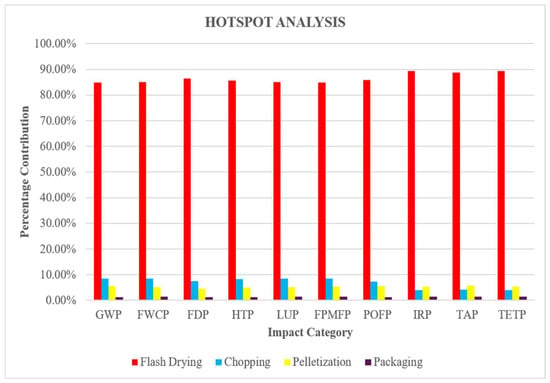
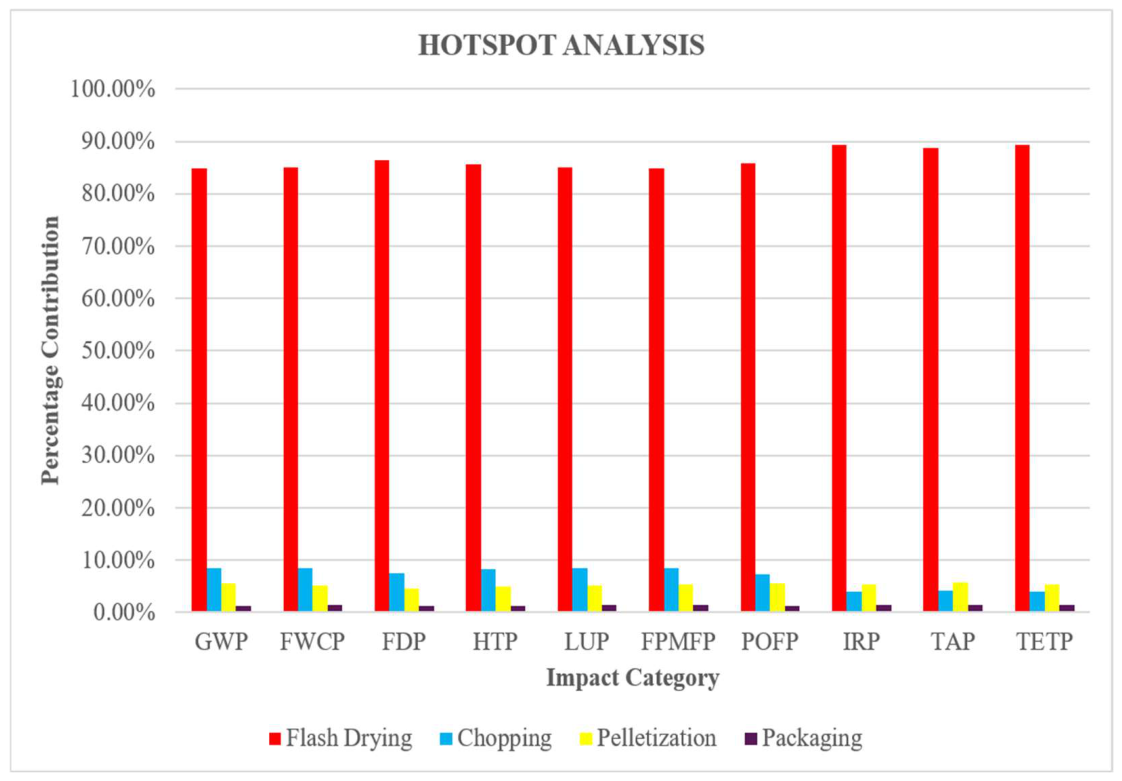
Hotspot analysis (or contribution analysis) allows for the identification of the particular steps within the overall pellet production process that are most responsible for environmental impacts. The individual production stages’ (i.e., transportation, drying, crushing, and pelletising phase) contributions to the overall environmental impacts linked to pellet production are displayed in Figure 6. It was found that flash-drying (or pneumatic drying) is the principal environmental hotspot, and it contributes the most to all calculated impact categories. More specifically, the stage of flash-drying contributed 84.76%, 85.00%, 86.40%, 85.60%, 85.10%, 84.90%, 85.80%, 89.30%, 88.70%, and 89.40% of the impact of GWP, FWCP, FDP, HTP, LUP, FPMFP, POFP, IRP, TAP, and TETP, respectively. This phase accounts for the most significant contribution due to a highly energy-consuming factor, namely, the thermal energy needed to evaporate moisture from the biomass during drying.
Figure 6.
Contribution of baseline impact categories.
Crushing was recognized as the second most significant contributor to the cumulative environmental impacts of pellet production. It contributed significantly to a total of eight impact categories: GWP (8.40%), FWCP (8.50%), FDP (7.50%), HTP (8.20%), LUP (8.50%), FPMFP (8.40%), and POFP (7.40%). On the other hand, the contributions in IRP, TAP, and TETP at the pelletisation stage are relatively higher at 5.30%, 5.70%, and 5.30%, respectively. The stage associated with packaging was the least environmentally intensive process in the pellet production system, generally resulting in contributions of <2% across all evaluated impact categories. In conclusion, these situations suggest that post-drying, crushing and pelletisation, and packaging are the most pertinent stages at which targeted environmental improvement can take place, leaving packaging as one of the least impactful contributors to the overall environmental footprint.
3.5. Scenario Modelling Based on Energy Consumption
Comparison of Midpoint Results
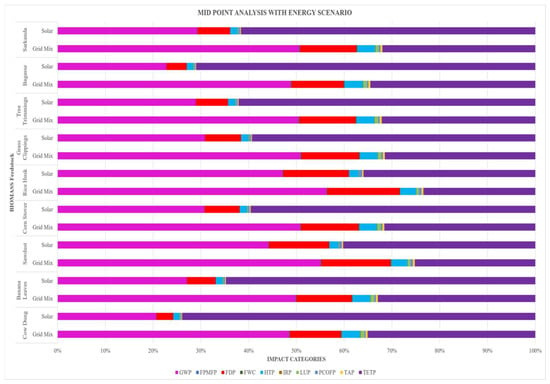
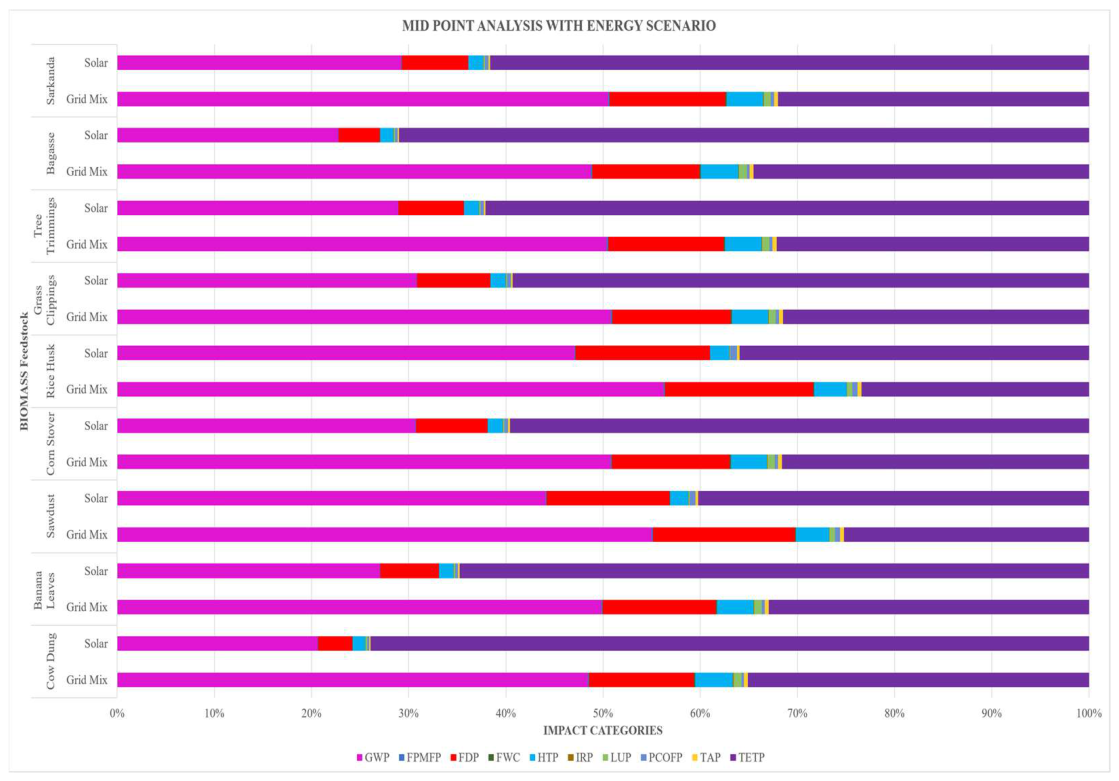
The whole system of converting biomass residue into pellets was analysed by considering two different energy supplies: grid-mix electricity and on-site photovoltaic-based solar electricity. The results indicate that the shifting of the system to solar energy can reduce overall impact values. Figure 7 shows that a significant reduction was observed in each impact category except Terrestrial Eco-toxicity Potential (TETP). Different selected impact categories, including GWP, FPMFP, FDP, FWC, HTP, IRP, LUP, PCOFP, and TAP, represent a decline, per functional unit, in contributing impact percentages of 64.5%, 75.4%, 65.1%, 90.8%, 74.4%, 70.3%, 89.8%, 38.6%, and 73.6%, respectively. However, the value of TETP increased by about 8.76%, suggesting that in the solar scenario, renewable energy incorporation can alter impacts between categories, such as embodied supplies or secondary processes linked with the solar system. Therefore, mitigation strategies should be considered accordingly. The outcomes of this study show that shifting to renewable resources with lower emissions is an efficient technique through which to reduce the overall impact.
Figure 7.
Scenario modelling of midpoint impact categories.
3.6. Life Cycle Costing
To evaluate the economic assessments of biomass solid fuel pellets, a Life Cycle Cost (LCC) analysis was conducted. Both the internal and external costing were considered for a detailed and comprehensive evaluation. The internal cost (IC) of the project includes capital investments, raw materials, utilities expenditures, operational costs, labour costs, depreciation, management, and insurance costs. The details of the internal cost are presented in Table 5. The total initial investment of the project, including machinery costs and installation charges, was USD 88,422.81, with machinery costs accounting for USD 75,892.61. About 85.8% of the capital investment was contributed by the equipment cost, while the remaining 14.2% was made up by installation charges.
Table 5.
Internal cost analysis.
Other expenses include raw material cost, transportation cost, and energy used in the pretreatment and conversion steps, which were estimated at USD 1,250,106.18. The cost of the biomass material was taken as the mean cost per tonne for all nine (9) biomass residues and was considered to be USD 30.92 per tonne. The operational cost was dominated by the biomass residue amount (92.7%), followed by diesel and electricity consumption costs. Thus, the total internal cost was USD 0.052 per Kg pellet or USD 51.7 t−1. The average production was 2200 t/month, with an average of 26,400 t/yr.
The external (EC) cost of the system was calculated by multiplying the emission quantities (generated through GaBi software) by the monetization coefficient of that particular emission and summing up all the amounts to calculate the whole EC Value. Table 6 and Formula no. 4 were utilized for the calculation of external costs. The pollutants selected for EC are CO2, CO, SOx, NOx, CH4, NMVOC, and PM. The total external cost was calculated on average at USD 20.86 t−1, equal to 0.0208 kg−1. Sulphur dioxide (SO2) and particulate matter (PMx) were the main contributing pollutants, with average values exceeded in about 44% and 43.4% of the cases, respectively. The rest of the pollutants contributed minimally to the overall EC value. Hence, the total LCC (IC + EC) of 1 tonne (functional unit) of pellet production was USD 72.6.
Table 6.
External cost analysis of the process.
Based on the annual production of the biomass fuel pellet (26,400 t), the total revenue was calculated as USD 2,795,919.08. The financial viability of the project is reflected by the revenue generated from the sale of pellets exceeding its total cost. The payback period, 1.20 months, demonstrates insightful information about the project’s feasibility. However, the associated environmental cost requires mitigation measures for the effective management of pollution. Overall, the conversion of biomass residue into solid fuel pellets highlights groundbreaking renewable energy options that are very much related to the sustainability goals of energy accessibility, carbon reduction, and effective waste management practice.
4. Discussion
Punjab has a diverse range of biomass residues as it is an agriculturally rich area of Pakistan. Plants utilize energy at different stages of their life and can be converted into useful energy options like heat generation and electricity production. However, it is necessary to evaluate these feedstocks on environmental grounds, as the physical and chemical properties of biomass differ according to the area of cultivation, soil nature, moisture composition of the plant body, and crop management practices. Different biomass residues, including cow dung, banana leaves, sawdust, corn stover, rice husk, grass clippings, tree trimmings, bagasse, and sarkanda, were selected. Studies have confirmed that combustion efficiency and reduced environmental impacts can be achieved through the study of different biomass residues, resulting in the selection of better feedstock with an informed choice [33]. The current study provides an insightful understanding of the environmental impacts of different biomass wastes in pellet production processes. Midpoint analysis was used for this study, and the ten (10) most significant environmental impact categories were selected to differentiate nine (9) different biomass types. GWP, FDP, TETP, FPMFP, LUP, FWCP, IRP, HTP non-cancer, POFP, and TAP were selected for the environmental studies.
The global warming potential (GWP) values derived in the present analysis varied between 2.12 × 101 and 3.29 × 101 kg CO2-eq per tonne of packed pellets, with the minimum values for corn stover (21.2 kg CO2-eq t−1) and bagasse (21.6 kg CO2-eq t−1) and the maximum values for rice husk (32.9 kg CO2-eq t−1) and sawdust (31.6 kg CO2-eq t−1). These results indicate that choices in the type of feedstock and associated logistics can have a significant impact on greenhouse gas emissions for pellet production. Direct comparison with another recent study [33] is particularly relevant, as that research also incorporated numerous non-woody biomass feedstocks with an LCA of biofuel pellet systems. The study provided a GWP ranging from 29.11 to 21.64 and up to 22.01 kg CO2-eq per functional unit for single-crop maize, fibrous hemp, and faba bean and a range of 18.20 to 24.99 kg CO2-eq per functional unit for the mixed-crop scenarios. However, their functional unit corresponded to 1 GJ of thermal energy, and the system was composed of biomass cultivation, transport, pellet production, combustion, and ash use. A previous study [25] assessed environmental benefits on a larger portion of the pellet production chain; they found fossil fuel consumption to be the dominant driver of environmental impacts. The results of their GWP were from 0.172 to 0.266 kg CO2-eq kg−1 of pellets or 172–266 kg CO2-eq t−1, respectively. These values are much higher than the 21.2–32.9 kg CO2-eq t−1 estimated in this study.
Recent data from Thailand also serve as a valuable benchmark for process hotspots. A cradle-to-grave LCA (life cycle assessment) of corncob pellets and rubberwood pellets was reported by [24]. Corncob pellets had 316.34 kg CO2-eq per functional unit, and rubberwood pellets had 434.84 kg CO2-eq. They found that even within pellet production, the stage itself was extremely major, as close to 99% of the impacts within the pellet production process came from electricity consumption. These results corroborate the current finding that the energy-demanding pelletisation process is a major environmental hotspot. However, the much larger absolute values relating to that study include processes beyond upstream pellet production, i.e., steps related to raw material sourcing and steam generation/end-use. The present study identified that hotspots in impact categories were mainly caused by flash/pneumatic drying rather than biomass crushing and pelletisation. This result is also consistent with the general LCA work on biomass densification [34]. Moreover, the energy consumption of pellet production was one of the most significant contributors to environmental impact, as long as the feedstock was associated with high moisture content and a considerable drying process. The factory in high-energy configuration used around 610 MJ per tonne of pellets, while the lower energy configuration only demanded 46 MJ per tonne. The authors also suggest enhancing energy efficiency and choosing feedstocks with lower moisture contents to minimize environmental impacts. Similarly, results from [33] point out that biomass type and processing requirements impact the sustainability profile of pellet systems.
Among the nine feedstocks analysed in the present study, transportation was identified as an important factor for differentiation between them. In general, rice husk and sawdust were found to have higher GWP, fossil depletion potential, and photochemical ozone formation potential than locally available feedstocks. This finding is especially important for Punjab, as the main goal of this study is not only to find feedstocks with the required intrinsic properties but to find feedstocks which could be feasibly integrated into the physically diverse and seasonally sensitive biomass supply chain across a geographic region. A feedstock with ideal physicochemical characteristics may nevertheless be associated with greater environmental burdens if it needs to be transported over long distances. In this regard, as well as the impact of biomass resources on environmental and production costs, the proximity of feedstock should also be considered an important factor when selecting biomass resources for the production of pellets. This interpretation is further supported by the Mexican literature [28], which reported wide variation in GWP results in a systematic review and exploratory LCA of biomass pellets and briquettes in Mexico and declared that the variability in results could be explained by transportation, biomass sourcing, system configuration, and allocation procedures. Their harmonised assessment showed that the GWP values for the production of pellets varied from negative values to almost 1.33 g (CO2-eq) per MJ for the scenarios examined, demonstrating the importance of the type of modelling and the biomass source on the environmental performance. The same result was reported by Karka [35]: the emissions of biomass-based fuels can be reduced by shortening the distance of biomass residues’ transportation or employing locally available options. The higher emissions value associated with the biomass is related to the emissions incurred during long transportation [36]. Another reason for the higher values of rice husk is its silica content, which increases abrasion during the conversion process and increases energy consumption.
The fine particulate matter formation potential (FPMFP) also differed significantly between the investigated feedstocks. Corn stover and bagasse showed relatively low values of 6.05 × 10⁻² and 6.43 × 10⁻² kg PM2.5-eq. Grass clippings, cow dung, and banana leaves demonstrated adequately greater values. A link between energy use by pellet production and particulate-derived damage outcomes has been similarly described in other LCA studies. Study [37] indicated that dust and air emissions from the production line and drying process are significant environmental impacts, emphasising that cyclones, scrubbers, filters, and other types of pollution control technologies are critical. The assessment of solid biofuels in Mexico [28] reached the same conclusion as for biomass in general; the composition of the pellet systems also varies widely according to the biomasses and production configuration, which generate very different patterns of particulate matter damage. In particular, the particulate matter damage from production was lower for residual wood and peanut residue pellet systems than for charcoal briquette production, highlighting the importance of feedstock selection and process configuration.
The results of freshwater consumption (FWC) show that water-related impacts can be significantly affected by feedstock-specific pretreatment needs. Application of cow dung had the highest freshwater consumption potential (8.77 × 10⁻² m3), owing to the use of a washing pretreatment method to remove metallic oxides and to minimize clogging for further utilization. Rice husk, corn stover, and sawdust consumed less water, but as a result of comparatively low pretreatment demand. This finding illustrates an important difference among different types of biomass residues: while a feedstock is a plentiful and low-cost resource, the additional environmental burden of taking further steps to pretreat it may outweigh its greater theoretical sustainability advantage. Other biomass LCA assessments have likewise identified trade-offs, where feedstock preparation and water demands can offset some of the environmental benefits obtained from biomass. In the Thai study [24], for instance, impacts related to water were reported to be higher for acacia than leucaena.
In the current study, the land use potential (LUP) of crop residues such as rice husk, corn stover, and sarkanda was lower than that of cow dung and grass clippings. However, this result should be treated with caution because these residues are co-products of agricultural and livestock systems rather than dedicated energy crops. Land-use burdens for residues depend on the allocation procedure and co-product treatment. Previous LCA studies performed on biomass pellets have shown that the environmental profile of the pellets is strongly dependent on the assumptions made regarding their allocation. One of the most recent LCA studies [37] divided environmental burdens from para-rubber wood and latex on the basis of economic value, leading to drastically varied impacts for residual wood compared to dedicated tree feedstock.
The study analysis with alternative energy scenarios reveals that the electricity source is an important parameter for the environmental performance assessment of pellet production. The substitution of grid-mixed electricity with photovoltaic electricity resulted in a reduction of 64.5%, 75.4%, 65.1%, 90.8%, 74.4%, 70.3%, 89.8%, 38.6%, and 73.6% in GWP, FPMFP, FDP, freshwater consumption, human toxicity, ionising radiation, land use, photochemical ozone formation, and terrestrial acidification, respectively. The 8.76% increase in TETP confirms that substituting renewable electricity does not necessarily reduce each impact category at the same time. The results indicate that the use of fossil resources for the generation of electricity and thermal energy can greatly influence the environmental profile of densification efforts, which corresponds well with results of other pellet LCAs in the literature. The results also indicate that energy consumption during pellet production is one of the main contributors to its environmental impacts, and substituting fossil-based energy with renewables could change these results [37]. Likewise, the recent Thai study [24] again determined that 99% of the environmental impacts of the pellet production process are attributable to electricity consumption.
The photochemical ozone formation potential (POFP) of rice husk (3.29 × 10⁻¹ kg NOx eq.) and sawdust (2.97 × 10⁻¹ kg NOx eq.) showed high potential for ozone formation. The higher POFP values of these feedstocks are due to the air emissions associated with their transportation. One study [38] confirmed that locally available and cost-effective biomass waste indicated low emissions as compared to long-distance and costly feedstocks. On the contrary, bagasse (1.21 × 10⁻¹ kg NOx eq.), corn stover (1.46 × 10⁻¹ kg NOx eq.), cow dung (1.50 × 10⁻¹ kg NOx eq.), sarkanda (1.54 × 10⁻¹ kg NOx eq.), and tree trimmings (1.57 × 10⁻¹ kg NOx eq.) exhibited lower POFP values because of their widespread availability in the study area.
While the calorific values of the pellets produced in the present study were not measured directly, it was useful to compare them with data available from the literature for an understanding of the energetics of biomass relative to more conventional fossil-based fuels. Biomass pellets tend to have lower heating values relative to liquid and gaseous fossil fuels but sufficient energy density for thermal energy-related applications. For example, typical energy conversion information reveals standard calorific [39] values for diesel (about 43.31 MJ kg−1), liquefied petroleum gas (LPG) (approx. 47.16 MJ kg−1), and bituminous coal (27.84 MJ kg−1). In contrast, wood pellets generally give around 17.28 MJ kg−1. Likewise, agricultural residue pellets usually present heating values between 15 and 17 MJ kg−1, but they also depend on features of feedstocks such as moisture content, ash content, and lignocellulosic composition [40]. Biomass chemical composition—especially ratios of lignin, cellulose, hemicellulose, and extractives—plays a significant role in biomass energy content [41]. Thus, while biomass pellets have a low energy content per unit mass compared to traditional fossil fuels, biomass pellets can still be a viable renewable thermal-energy alternative. Accordingly, one should not consider concurrent comparisons of production economics of various biomass pellet systems as a direct economic valuation of their energy-equivalent basis due to differences in the production characteristics of various biomass-based solid fuel pellets.
Therefore, the main contribution of the current study is not just the identification of biomass residues that are environmentally sound. Instead, it shows that a diverse feedstock mix can lessen reliance on one season-dependent biomass source, while allowing users to analyse environmental performance, geographic source location, transportation, and production costs at the same time. This is especially important for Punjab, which has biomass residues scattered among agriculture, livestock, forestry, horticulture, and urban sources. The results indicate that feedstocks with greater moisture content, short transportation distances, and low processing energy demand should be emphasized, while renewable electricity and more efficient drying technologies provide significant opportunities for more sustainably decreasing the environmental burden of pellet manufacturing.
5. Conclusions
This study evaluated biomass residue materials for the production of solid fuel pellets according to their environmental performance, seasonal availability, and costing. Biomass residues are not available in all seasons for continual supply. Therefore, this work identifies the potential of different types of biomass to sustain the system with other available options. Nine feedstocks were selected for this study: cow dung, rice husk, sawdust, banana leaves, grass clippings, tree trimmings, sarkanda, corn stover, and bagasse. Both Life Cycle Assessment (LCA) and Life Cycle Cost (LCC) were employed for this evaluation. This study outlines the feasibility of pelletisation in Punjab, via both environmental and economic parameters, in alignment with seasonal change.
The LCA-based study of these biomass feedstocks was designed for a gate-to-gate approach. The results were calculated using different approaches, including midpoint analysis, endpoint analysis, normalization, hotspot analysis, and scenario analysis, using GaBi software. The outcomes of these evaluations reflect that the environmental performance of pellets entirely depends upon the physico-chemical nature of the biomass feedstocks, the energy inputs for the pretreatment processes, and the distance of biomass transport. The biomass types with less environmental burden were corn stovers, bagasse, and tree trimming, according to their chemical properties. Rice husk and sawdust also have lower environmental profiles, but the emissions related to their transportation are higher, placing these feedstocks in second place in this study. Cow dung, banana leaves, and sarkanda have moderate to high levels of environmental impact because of their fibrous structure and metallic or heavy element composition, causing abrasive forces during the conversion process and thereby increasing energy demand. The total external cost was calculated on average at USD 20.86 t−1, equal to 0.0208 kg−1. Sulphur dioxide (SO2) and particulate matter (PMx) were the main contributing pollutants, with average values exceeding about 44% and 43.4%, respectively.
Life Cycle Costing (LCC) favours this project as economically viable. The payback period, 1.20 months, demonstrates insightful information about the project’s feasibility. Based on the annual production of the biomass fuel pellet (26,400 t), the total revenue was calculated as USD 2,795,919.08. The total initial investment of the project, including machinery costs and installation charges, was USD 88,422.81, with machinery costs accounting for USD 75,892.61. The total internal cost per kg of pellets was calculated as USD 51.7 t−1. The total average production was 2200 t/month and 26,400 t/yr. The external (EC) cost of the system (USD 20.86 t−1) was calculated by multiplying the emission quantities (generated through GaBi software) by the monetization coefficient of that particular emission and summing up all the amounts to calculate the total EC value. The total LCC (IC + EC) of 1 tonne (functional unit) of pellet production was calculated as USD 72.6.
5.1. Research Implications
This research work will help in the identification and selection of different biomass residues for pellet production, as biomass is not uniform in nature and has different body compositions and moisture contents. This work can also help in the selection of biomass types according to their local availability and for switching to other types of biomass when one is not available in a certain season.
5.2. Limitation
The limitation of the current research is the gate-to-gate system boundary adopted, which only considers the environmental and economic performance of the biomass pellet production process. Biomass production, collection, transport and distribution, and combustion or use, as well as end-of-life management of pellets, were not considered. Hence, the reported results are the impact of the pellet production phase and are not a measure of the total life cycle environmental performance of the pellets.
5.3. Future Recommendations
A cradle-to-grave life cycle should be considered in future studies to include upstream feedstock supply, transportation, pellet production, distribution, end use, and end-of-life processes. Including such an expanded assessment would give a more complete picture of the overall environmental performance of biomass pellets. Special consideration also needs to be given to site-specific combustion conditions and transportation distances to ensure the accuracy and usability of future assessments.
This study shows that some biomass residues contain higher moisture content and embedded heavy metal compositions. Blending two or more biomass wastes with different compositions and in opposition to each other can optimize fuel pellets. Another major biomass residue source for pellets is municipal waste. The characterization of waste in rural or semi-rural areas reflects that more than 60% of waste is organic. This waste is locally available at low cost, so research in this field may start to overcome problems related to waste management and landfill sites.
Author Contributions
Conceptualization, A.R., A.-S.N. and M.R.; methodology, A.R., A.-S.N. and M.W.A.; software, A.R. and M.W.A.; validation, A.-S.N., M.R. and M.I.; formal analysis, A.R., M.W.A. and M.I.; investigation, A.R.; resources, A.-S.N. and M.R.; data curation, A.R. and M.W.A.; writing—original draft preparation, A.R.; writing—review and editing, A.-S.N., M.R., M.W.A. and M.I.; visualization, A.R. and M.W.A.; supervision, A.-S.N. and M.R.; project administration, A.-S.N.; funding acquisition, A.-S.N. and M.R. All authors have read and agreed to the published version of the manuscript.
Funding
The successful conclusion of this research work was made possible through the financial support provided by the Office of Research, Innovation, and Commercialization (ORIC), Government College University Lahore vide letter No. 507/ORIC/24.
Data Availability Statement
All data generated or analysed during this study are included in this published article.
Conflicts of Interest
This work has no ethical issues. This manuscript is neither under review nor published elsewhere. The authors have no relevant financial or non-financial interests to disclose.
Abbreviations
The following abbreviations are used in this manuscript:
| FDP | Fossil Depletion Potential |
| FPMFP | Fine Particulate Matter Formulation Potential |
| FWC | Freshwater Consumption |
| GHG’s | Greenhouse Gases |
| GWP | Global Warming Potential |
| HTP | Human Toxicity (Non-cancer) Potential |
| IRP | Ionising Radiation Potential |
| LCA | Life Cycle Assessment |
| LCC | Life Cycle Cost |
| LUP | Land Use Potential |
| POFP | Photochemical Ozone Formation Potential |
| TAP | Terrestrial Acidification |
| TETP | Terrestrial Eco-toxicity |
References
- Aflaki, S.; Netessine, S. Strategic Investment in Renewable Energy Sources: The Effect of Supply Intermittency. Manuf. Serv. Oper. Manag. 2017, 19, 489–507. [Google Scholar] [CrossRef] [Scilit]
- Li, W.; Wang, M.; Meng, F.; Zhang, Y.; Zhang, B. A Review on the Effects of Pretreatment and Process Parameters on Properties of Pellets. Energies 2022, 15, 7303. [Google Scholar] [CrossRef] [Scilit]
- Stolarski, M.J.; Krzyżaniak, M.; Olba-Zięty, E. Properties of Pellets from Forest and Agricultural Biomass and Their Mixtures. Energies 2025, 18, 3137. [Google Scholar] [CrossRef] [Scilit]
- Brussels, 24 June 2026—Bioenergy Europe Has Published Its Latest Pellet Statistical Report, Providing a Detailed Overview of Global and European Pellet Market Trends and Their Role in the Clean Heat Transition. Available online: https://bioenergyeurope.org/global-pellet-market-hits-new-high-as-europe-weighs-its-clean-heat-options/?utm (accessed on 1 September 2026).
- United Nations Department of Agriculture, Foreign Agricultural Service. Wood Pellet Annual Report 2025. Available online: https://apps.fas.usda.gov/newgainapi/api/Report/DownloadReportByFileName?fileName=Wood+Pellets+Annual_The+Hague_European+Union_E42025-0004&utm (accessed on 1 September 2026).
- Țîței, V. The Evaluation of the Biomass Quality of Cardoon, Cynara cardunculus, and Prospects of Its Use in Moldova. Agron. Ser. Sci. Res./Lucr. Ştiinţ. Ser. Agron. 2019, 61, 159–166. [Google Scholar]
- European Commission. Conditionality. Directorate-General for Agriculture and Rural Development. 2026. Available online: https://agriculture.ec.europa.eu/common-agricultural-policy/income-support/conditionality_en (accessed on 1 September 2026).
- Downing, A.S.; Kumar, M.; Andersson, A.; Causevic, A.; Gustafsson, Ö.; Joshi, N.U.; Krishnamurthy, C.K.B.; Scholtens, B.; Crona, B. Unlocking the unsustainable rice-wheat system of Indian Punjab: Assessing alternatives to crop-residue burning from a systems perspective. Ecol. Econ. 2022, 195, 107364. [Google Scholar] [CrossRef] [Scilit]
- Raza, M.H.; Abid, M.; Faisal, M.; Yan, T.; Akhtar, S.; Adnan, K.M.M. Environmental and Health Impacts of Crop Residue Burning: Scope of Sustainable Crop Residue Management Practices. Int. J. Environ. Res. Public Health 2022, 19, 4753. [Google Scholar] [CrossRef] [Scilit]
- Usman, M.; Kousar, R.; Makhdum, M.S.A.; Yaseen, M.R.; Nadeem, A.M. Do financial development, economic growth, energy consumption, and trade openness contribute to increasing carbon emissions in Pakistan? An insight based on the ARDL bound testing approach. Environ. Dev. Sustain. 2023, 25, 444–473. [Google Scholar] [CrossRef] [Scilit]
- Food and Agriculture Organization (FAO) of the United Nations. Pakistan at a Glance. 2025. Available online: https://www.fao.org/pakistan/our-office/pakistan-at-a-glance/en/ (accessed on 21 November 2025).
- Ahmed, T.; Ahmad, B. Why Do Farmers Burn Rice Residue? Examining Farmers’ Choices in Punjab, Pakistan; SANDEE Working Paper 76-13; South Asian Network for Development and Environmental Economics: Kathmandu, Nepal, 2015; Available online: https://www.sandeeonline.org/uploads/documents/publication/1006_PUB_Working_Paper_76_Tanvir.pdf (accessed on 12 October 2025).
- Babar, Z.B.; Kamil, I.; Latif, M.H. Situational Analysis of Air Quality in Lahore. WWF-Pakistan. 2024. Available online: https://wwfasia.awsassets.panda.org/downloads/situational-analysis-of-air-quality-of-lahore_1_1.pdf (accessed on 12 October 2025).
- The Urban Unit. Emission Inventory of Lahore 2023. 2023. Available online: https://urbanunit.gov.pk/Download/publications/Files/8/2023/Emission%20Inventory%20of%20Lahore%202023.pdf (accessed on 21 November 2025).
- Asif, M.; Salman, M.U.; Anwar, S.; Gul, M.; Aslam, R. Renewable and non-renewable energy resources of Pakistan and their applicability under the current scenario in Pakistan. OPEC Energy Rev. 2022, 46, 310–339. [Google Scholar] [CrossRef] [Scilit]
- Picchio, R.; Di Marzio, N.; Cozzolino, L.; Venanzi, R.; Stefanoni, W.; Bianchini, L.; Pari, L.; Latterini, F. Pellet Production from Pruning and Alternative Forest Biomass: A Review of the Most Recent Research Findings. Materials 2023, 16, 4689. [Google Scholar] [CrossRef] [Scilit]
- Ali, Y.; Sabir, M.; Afridi, S.; Ullah, Z. Pakistan’s circular bio-economy: Potential, opportunities and sustainable development. Environ. Dev. Sustain. 2025, 27, 30839–30865. [Google Scholar] [CrossRef] [Scilit]
- Ahmed, S.; Ali, A.; Ciocia, A.; D’angola, A. Technological Elements behind the Renewable Energy Community: Current Status, Existing Gap, Necessity, and Future Perspective—Overview. Energies 2024, 17, 3100. [Google Scholar] [CrossRef] [Scilit]
- Searle, S.; Malins, C. A reassessment of global bioenergy potential in 2050. GCB Bioenergy 2015, 7, 328–336. [Google Scholar] [CrossRef] [Scilit]
- Hassan, M.; Usman, N.; Hussain, M.; Yousaf, A.; Khattak, M.A.; Yousaf, S.; Mishr, R.S.; Ahmad, S.; Rehman, F.; Rashedi, A. Environmental and Socio-Economic Assessment of Biomass Pellets Biofuel in Hazara Division, Pakistan. Sustainability 2023, 15, 12089. [Google Scholar] [CrossRef] [Scilit]
- Janjua, J.I.; Anwer, O.; Saber, A. Management Framework for Energy Crisis & Shaping Future Energy Outlook in Pakistan. In Proceedings of the 2023 IEEE Jordan International Joint Conference on Electrical Engineering and Information Technology (JEEIT), Amman, Jordan, 22–24 May 2023; pp. 312–317. [Google Scholar] [CrossRef] [Scilit]
- ISO 14040; International Standard. Environmental Management—Life Cycle Assessment—Principles and Framework. ISO: Geneva, Switzerland, 2006. Available online: https://www.iso.org/obp/ui/en/#iso:std:iso:14040:ed-2:v1:en (accessed on 21 November 2025).
- Furberg, A.; Arvidsson, R.; Molander, S. A practice-based framework for defining functional units in comparative life cycle assessments of materials. J. Ind. Ecol. 2022, 26, 718–730. [Google Scholar] [CrossRef] [Scilit]
- Phrommarat, B.; Arromdee, P. Comparative life cycle assessment of pelletized biomass fuels from corncobs and rubberwood sawdust. Int. J. Renew. Energy Dev. 2025, 14, 740–750. [Google Scholar] [CrossRef] [Scilit]
- Khan, N.S.; Iftikhar, M.Z.; Kazmi, S.A.A.; Ullah, K.; Imran, K.; Batool, S.; Alghamdi, T.A.; Alenezi, M. A comprehensive composite analysis of regulatory governance and substance in the power sector for enhanced performance: A case study of a developing country. Energy Strategy Rev. 2026, 65, 102231. [Google Scholar] [CrossRef] [Scilit]
- Intergovernmental Panel on Climate Change (IPCC). Expert Meeting on Carbon Dioxide Removal Technologies and Carbon Dioxide Capture, Use and Storage: Supporting Material. 2024. Available online: https://www.ipcc.ch/publication/em-on-cdr-technologies-and-ccus/ (accessed on 29 December 2025).
- Angelakoglou, K.; Lampropoulos, I.; Chatzigeorgiou, E.; Giourka, P.; Martinopoulos, G.; Skembris, A.-S.; Seitaridis, A.; Kousovista, G.; Nikolopoulos, N. Advancing Energy-Efficient Renovation Through Dynamic Life Cycle Assessment and Costing: Insights and Experiences from VERIFY Tool Deployment. Energies 2025, 18, 3736. [Google Scholar] [CrossRef] [Scilit]
- Silva, D.A.L.; Vásquez-Ibarra, L.; Farrapo Junior, A.C.; Musule Lagunes, R. Comparative social hotpots analysis of biomass pellets in Brazil, Chile, and Mexico in a circular bioeconomy context. Int. J. Life Cycle Assess. 2025, 30, 1363–1378. [Google Scholar] [CrossRef] [Scilit]
- Javed, M.H.; Ahmad, A.; Rehan, M.; Musharavati, F.; Nizami, A.-S.; Khan, M.I. Advancing Sustainable Energy: Environmental and Economic Assessment of Plastic Waste Gasification for Syngas and Electricity Generation Using Life Cycle Modeling. Sustainability 2025, 17, 1277. [Google Scholar] [CrossRef] [Scilit]
- Hou, L.; Basem, A.; Shami, H.O.; Sabri, L.S.; Farqad, R.O.; Hussein, A.H.A.; Alhaidry, W.A.A.L.H.; Idan, A.H.; Fooladi, H. Sustainability and life cycle analyses of different biofuels from municipal solid waste processes: An effective environmental guidance. Int. J. Low-Carbon Technol. 2024, 19, 1610–1622. [Google Scholar] [CrossRef] [Scilit]
- Santillán-Saldivar, J.; Beylot, A.; Cor, E.; Monnier, E.; Muller, S. Economic value dissipation potential (EVDP): An improved method to estimate the potential economic value loss due to resource dissipation in life cycle assessment. Int. J. Life Cycle Assess. 2023, 28, 1400–1418. [Google Scholar] [CrossRef] [Scilit]
- Jegen, M. Life cycle assessment: From industry to policy to politics. Int. J. Life Cycle Assess. 2024, 29, 597–606. [Google Scholar] [CrossRef] [Scilit]
- Petlickaitė, R.; Jasinskas, A.; Venslauskas, K.; Navickas, K.; Praspaliauskas, M.; Lemanas, E. Evaluation of multi-crop biofuel pellet properties and the life cycle assessment. Agriculture 2024, 14, 1162. [Google Scholar] [CrossRef] [Scilit]
- Rashedi, A.; Gul, N.; Hussain, M.; Hadi, R.; Khan, N.; Nadeem, S.G.; Khanam, T.; Asyraf, M.R.M.; Kumar, V. Life cycle environmental sustainability and cumulative energy assessment of biomass pellets biofuel derived from agroforest residues. PLoS ONE 2022, 17, e0275005. [Google Scholar] [CrossRef] [Scilit]
- Karka, P.; Papadokonstantakis, S.; Kokossis, A. Cradle-to-gate assessment of environmental impacts for a broad set of biomass-to-product process chains. Int. J. Life Cycle Assess. 2017, 22, 1418–1440. [Google Scholar] [CrossRef] [Scilit]
- Ravi, K.; Matheswaran, M. Optimizing biomass fuel utilization for GHG emission reduction: An action plan for efficient fuel blending and sustainable practices. J. Therm. Eng. 2026, 12, 408–425. [Google Scholar] [CrossRef] [Scilit]
- Saosee, P.; Sajjakulnukit, B.; Gheewala, S.H. Life cycle assessment of wood pellet production in Thailand. Sustainability 2020, 12, 6996. [Google Scholar] [CrossRef] [Scilit]
- Zafar, U.; Sarwar, A.; Safdar, M.; Sabir, R.M.; Majeed, M.D.; Raza, A. Development and Characterization of Biomass Pellets Using Yard Waste. Eng. Proc. 2023, 56, 323. [Google Scholar] [CrossRef] [Scilit]
- Sustainable Energy Authority of Ireland (SEAI). Conversion Factors. SEAI Statistics. SEAI Conversion Factors. 2025. Available online: https://www.seai.ie/data-and-insights/seai-statistics/conversion-factors (accessed on 1 September 2026).
- Jasinskas, A.; Kleiza, V.; Minajeva, A.; Mieldažys, R.; Vaiciukevičius, E. Utilization of Agricultural Residues and Their Mixtures for Energy Conversion and Creation of Empirical Model for Determination of Biofuel Pellet Characteristics. Processes 2026, 14, 1189. [Google Scholar] [CrossRef] [Scilit]
- Ogueri, D.I.; Dhairiyasamy, R.; Chan, C.K.; Gabiriel, D. Circular economy pathways for energy efficiency: Co-combustion of household plastic pyrolysis oil and biodiesel in diesel engines. Circ. Econ. Sustain. 2026, 6, 303. [Google Scholar] [CrossRef] [Scilit]



Disclaimer/Publisher’s Note: The statements, opinions and data contained in all publications are solely those of the individual author(s) and contributor(s) and not of MDPI and/or the editor(s). MDPI and/or the editor(s) disclaim responsibility for any injury to people or property resulting from any ideas, methods, instructions or products referred to in the content. |
© 2026 by the authors. Licensee MDPI, Basel, Switzerland. This article is an open access article distributed under the terms and conditions of the Creative Commons Attribution (CC BY) license.