


Abstract
On-demand data sensing and Wireless Power Transfer (WPT) enable sustainable operation in large-scale Industrial Internet of Things (IIoT) networks. Existing scheduling frameworks are inherently reactive, initiating charging only after an IoT node’s residual energy falls below a predefined threshold, which increases the risk of energy outages and service disruption. This paper proposes a Digital Twin (DT)-enabled proactive scheduling framework for self-sustainable IIoT networks under stochastic operating conditions. The proposed framework integrates three key components. First, a DT layer continuously mirrors IoT node states and predicts future energy availability over a finite prediction horizon. Second, a predictive charging strategy proactively schedules WPT before energy depletion occurs. Third, physical-layer security and DT-based anomaly detection protect the network against eavesdropping, false-data injection, and energy depletion attacks. Fourth, the scheduling framework is reformulated using chance constraints to explicitly account for uncertainty in wireless channels, energy consumption, and DT prediction errors while providing probabilistic reliability guarantees. The resulting sensing and WPT scheduling problems are formulated as multi-slot integer optimization problems and solved using branch-and-bound, with a low-complexity greedy heuristic for latency-sensitive deployments. Simulation results show that the proposed framework reduces energy outage events to below 1%, maintains reliable operation under increasing energy uncertainty with only a modest sensing-utility reduction, and incurs negligible computational overhead compared with the deterministic formulation.
1. Introduction
Advanced digital technologies are transforming modern industrial systems by enabling intelligent automation, real-time monitoring, and efficient resource management. The Industrial Internet of Things (IIoT) has emerged as a fundamental technology for connecting heterogeneous sensing devices to support continuous monitoring and control of industrial processes, thereby improving productivity, reliability, and operational efficiency [1]. By combining distributed sensing with Mobile Edge Computing (MEC), computationally intensive tasks can be processed closer to end devices, significantly reducing communication latency and supporting delay-sensitive industrial applications [2,3,4].
Future beyond-5G/6G wireless networks are expected to integrate terrestrial and aerial communication platforms, enabling ubiquitous connectivity for large-scale IIoT deployments [5]. Meanwhile, the growing demand for continuous industrial operation has accelerated the development of self-sustainable networks (SSNs), where IoT devices operate with minimal human intervention through the integration of energy-efficient communications, energy harvesting, Wireless Power Transfer (WPT), and edge computing [6,7,8]. Among these technologies, WPT has become a promising solution for maintaining uninterrupted operation of battery-powered IoT devices by replenishing their energy without manual intervention.
Despite these advances, existing IIoT scheduling frameworks remain predominantly reactive, initiating WPT only after an IoT node’s residual energy falls below a predefined threshold . Such reactive scheduling often fails to prevent imminent energy depletion, leading to avoidable outages, increased latency, and reduced sensing reliability. Recently, Digital Twins (DTs) have emerged as an effective solution for enabling proactive resource management by maintaining a continuously updated virtual representation of each physical IoT device [9,10]. DT-assisted scheduling enables future network states to be predicted before scheduling decisions are applied to the physical network, thereby significantly improving energy management compared with purely reactive approaches [11]. Furthermore, secure operation of DT-enabled IIoT networks requires protection against eavesdropping, false-data injection (FDI), and energy depletion attacks, motivating the integration of physical-layer security (PLS) and DT-assisted anomaly detection [12,13].
Although DT-enabled proactive scheduling substantially improves network performance, existing frameworks remain fundamentally deterministic. Scheduling decisions are derived using nominal estimates of channel quality, energy consumption, harvested energy, and DT predictions, implicitly assuming perfect knowledge of system dynamics. In practical IIoT deployments, however, wireless channel fading, stochastic sensing workloads, imperfect WPT efficiency, and prediction errors accumulated by the DT introduce significant uncertainty into the scheduling process. Consequently, deterministic resource allocation cannot guarantee reliable operation, often leading to energy shortages, charging failures, and security constraint violations. On the other hand, robust optimisation techniques optimise against worst-case uncertainty and therefore produce overly conservative schedules that unnecessarily reduce system utility.
Chance-constrained optimisation [14,15] provides an effective compromise by explicitly incorporating uncertainty into the optimisation process while ensuring that system constraints are satisfied with a prescribed probability. Instead of enforcing constraints only under nominal conditions or pessimistic worst-case assumptions, chance constraints provide probabilistic reliability guarantees that naturally balance resource utilisation and operational robustness. Despite their successful application in several wireless optimisation problems, chance-constrained formulations have not been fully explored for DT-enabled proactive sensing and WPT scheduling in self-sustainable IIoT networks.
Motivated by these observations, this paper extends a deterministic DT-enabled proactive scheduling framework into a stochastic chance-constrained optimisation framework for self-sustainable IIoT networks. The proposed framework explicitly models uncertainty in wireless channels, energy consumption, and DT prediction errors while jointly optimising proactive sensing, WPT scheduling, communication security, and DT synchronisation. By incorporating probabilistic reliability guarantees into the scheduling process, the proposed framework improves energy sustainability and system robustness under the simulated stochastic operating conditions considered in this study.
Research Contributions
The major contributions of this paper are summarised as follows:
- We extend deterministic DT-enabled proactive scheduling into a stochastic chance-constrained optimisation framework for self-sustainable IIoT networks. The proposed formulation explicitly captures uncertainty in wireless channels, energy consumption, and DT prediction errors, enabling probabilistic guarantees on sensing, WPT, and secure communication.
- We derive tractable deterministic equivalents for the proposed chance-constrained scheduling problem under Gaussian uncertainty and develop a Bernstein-based safe approximation for non-Gaussian uncertainty, allowing for efficient optimisation while avoiding the excessive conservatism of worst-case robust optimisation.
- We integrate predictive charging, physical-layer security, and DT-assisted anomaly detection into the chance-constrained scheduling framework to proactively prevent energy depletion while protecting the network against eavesdropping, false-data injection, and energy depletion attacks.
- We formulate the sensing and WPT scheduling problems as multi-slot integer optimisation problems and develop an optimal branch-and-bound algorithm together with a computationally efficient greedy heuristic suitable for latency-sensitive IIoT deployments.
- The simulation results indicate that the proposed framework maintains the observed energy outage rate below over the tested uncertainty range, incorporates DT-based anomaly screening and secrecy-outage constraints into the scheduling process, maintains reliable operation under uncertainty with only an approximately reduction in sensing utility, and incurs negligible computational overhead compared with the deterministic framework.
The remainder of this paper is organised as follows: Section 2 reviews related works. Section 3 presents the system model. Section 4 describes the Digital Twin layer. Section 5 presents the uncertainty model and chance-constraint formulation. Section 6 presents the proposed scheduling schemes and algorithm descriptions. Section 7 presents the PLS and anomaly detection framework. Section 8 presents the simulation results. Section 9 concludes this paper.
2. Related Work
Resource scheduling for self-sustainable Industrial Internet of Things (IIoT) networks has attracted considerable attention due to the increasing demand for energy-efficient sensing, Wireless Power Transfer (WPT), and intelligent resource management. Existing studies have mainly focused on improving energy efficiency, communication performance, and computational offloading. However, most of these approaches rely on deterministic resource allocation and therefore cannot effectively cope with the uncertainty encountered in practical IIoT environments.
Several studies have investigated self-sustainable networks (SSNs) that jointly exploit energy harvesting and WPT to prolong network lifetime. The work in [1] proposes an energy-aware resource scheduling framework that maximises sensing utility by jointly considering throughput and fairness without requiring prior knowledge of future network states. Multi-source energy harvesting combined with wireless charging is investigated in [16], where an approximation algorithm is developed for mobile charger scheduling. Closed-form resource allocation for simultaneous wireless information and power transfer in multi-hop relay systems is presented in [17], while RF energy harvesting for self-sustainable wireless communications is analysed in [18]. Although these studies significantly improve network lifetime and energy utilisation, they adopt reactive scheduling strategies that initiate charging only after energy levels become critical and therefore cannot proactively prevent energy outages.
Another important research direction considers UAV-assisted WPT and MEC. Joint optimisation of computation offloading and communication resources for UAV-assisted MEC is studied in [19], whereas reliable load balancing for self-organising IIoT networks is investigated in [20]. UAV trajectory optimisation for time-constrained IoT data collection is presented in [21], while UAV-enabled wireless-powered MEC systems are investigated in [22] to maximise computation rate. More recently, joint UAV trajectory and energy beamforming for WPT networks have been optimised in [23]. Despite their effectiveness, these studies mainly optimise communication or trajectory design and do not consider DT-enabled predictive scheduling, multi-slot optimisation, or secure WPT scheduling under uncertainty.
DT-assisted resource management has recently emerged as a promising approach for proactive IIoT scheduling. Adaptive edge intelligence using DTs for self-sustainable IIoT networks is proposed in [9], demonstrating the advantages of proactive resource allocation over conventional reactive scheduling. DT-assisted online learning for proactive resource allocation in 6G IIoT networks is investigated in [11], while a comprehensive overview of DT technologies for future wireless systems is presented in [10]. DT-driven network slicing has also been explored in [24]. Although these studies demonstrate the effectiveness of predictive scheduling, they assume deterministic system models and do not explicitly consider uncertainty in wireless channels, energy consumption, or DT prediction errors during resource allocation.
Security has become another important challenge for DT-enabled IIoT systems. The survey in [12] identifies eavesdropping, energy depletion, and false-data injection (FDI) attacks as major threats to industrial wireless networks. Physical-layer security for wireless-powered communication systems is studied in [25], while FDI attacks against IoT systems are comprehensively reviewed in [13]. Kalman filter-based predictive energy management for IoT-WPT networks is investigated in [26], demonstrating the effectiveness of state estimation for proactive scheduling. Predictive resource management through joint communication and learning has also been explored in [27]. Nevertheless, existing studies mainly address communication security, anomaly detection, or predictive scheduling independently rather than integrating them into a unified DT-enabled scheduling framework.
Chance-constrained optimisation has recently attracted considerable attention as an effective approach for resource allocation under uncertainty. The theoretical foundations of probabilistic optimisation were established in [14], providing a tractable alternative to conservative worst-case robust optimisation. The application of chance constraints to wireless resource allocation is presented in [15], where Gaussian chance constraints are transformed into deterministic equivalents suitable for practical optimisation. Stochastic resource allocation for energy-harvesting systems under uncertain channel conditions is investigated in [28], demonstrating that probabilistic energy constraints achieve a better balance between system reliability and resource utilisation than deterministic or worst-case formulations. Robust WPT scheduling under imperfect channel state information is studied in [29], where outage probability constraints are incorporated into charging decisions. Although these studies demonstrate the effectiveness of chance-constrained optimisation, their focus is limited to specific optimisation problems and they do not exploit DT-enabled predictive scheduling or jointly address WPT, physical layer security, DT prediction uncertainty, and anomaly detection within a unified stochastic optimisation framework.
From the above discussion, it is evident that existing studies have addressed individual aspects of energy-aware scheduling, UAV-assisted communication, Digital Twins, physical-layer security, and chance-constrained optimisation. However, no existing work simultaneously integrates: (i) DT-enabled proactive WPT scheduling with predictive state estimation, (ii) multi-slot optimisation with DT synchronisation cost, (iii) physical-layer security and DT-assisted anomaly detection, (iv) proactive sensing and charging decisions under a unified optimisation framework, and (v) chance-constrained optimisation that provides probabilistic guarantees on energy, charging, and secrecy constraints under realistic stochastic uncertainty. These research gaps are summarised in Table 1, where the proposed framework is the only approach that addresses all of these requirements within a unified DT-enabled scheduling architecture.
Table 1.
Comparison of existing IIoT resource scheduling frameworks with the proposed chance-constrained DT-enabled scheduling framework.
3. System Model
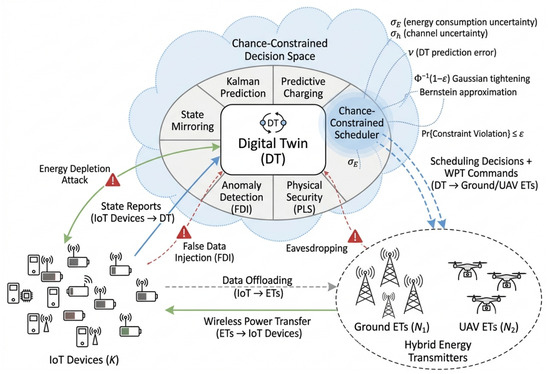
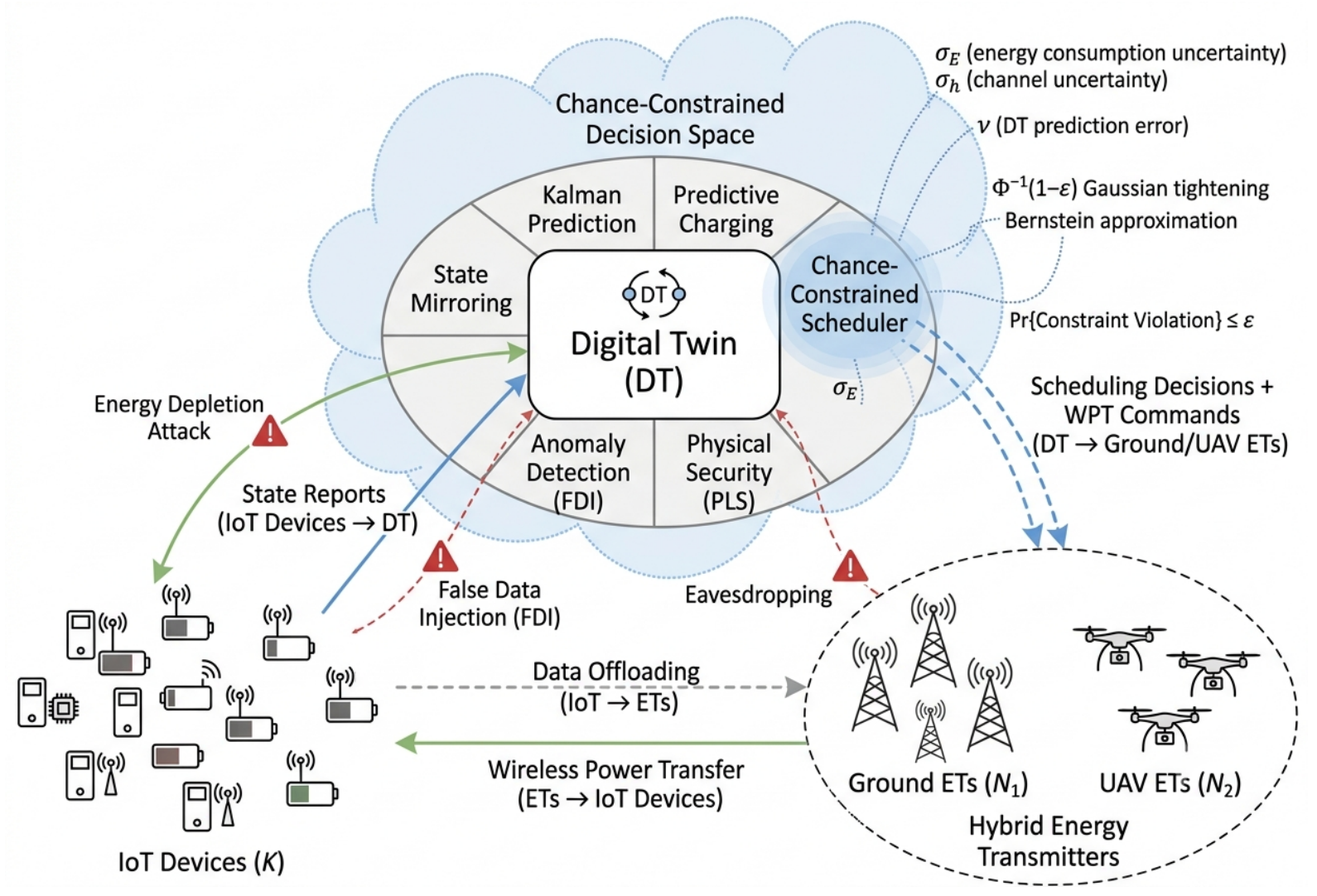
We consider a self-sustainable IIoT network consisting of K IoT nodes, N mobile hybrid energy transmitters, and a control center, as illustrated in Figure 1. The IoT nodes are equipped with heterogeneous sensors and execute M monitoring tasks requested by the control center. Owing to their limited battery capacity, sensing and communication operations are sustained through WPT provided by hybrid energy transmitters that also offer MEC services [3]. To enable proactive network management, a DT layer is integrated with the control center. The DT continuously maintains a virtual representation of the physical network and supports predictive resource management. Furthermore, the proposed architecture considers uncertainties in wireless channels, energy consumption, and DT prediction, which are incorporated into the chance-constrained optimization framework developed in Section 5.
Figure 1.
System architecture of the proposed DT-enabled chance-constrained energy-aware scheduling framework. IoT nodes periodically update their DT replicas at the control center, where uncertainty-aware prediction, chance-constraint evaluation, scheduling, and physical-layer security modules jointly determine sensing and WPT decisions for ground and UAV energy transmitters.
Figure 1 illustrates the overall architecture of the proposed framework. IoT nodes periodically report their operational states to the control center, where the DT maintains a synchronised virtual representation of the physical network. Based on this information, the control center models system uncertainty and computes resource allocation decisions using the proposed chance-constrained optimisation framework before dispatching sensing and WPT schedules to ground and UAV-based hybrid energy transmitters. The detailed DT synchronisation process, uncertainty model, scheduling formulation, and physical-layer security mechanisms are presented in Section 4, Section 5, Section 6, and Section 7, respectively.
The energy transmitter set N is split into ground transmitters and UAV-based transmitters . Ground transmitters have a reliable power supply; UAVs may have intermittent supply. The system operates in frame-based time-division multiplex with slot duration [1]. The transmit power of the n-th transmitter is ; the control center knows the location of each transmitter ( for ground units). UAV energy transmitters are assumed to follow a predetermined waypoint trajectory planned at the start of each scheduling frame [23]. The trajectory is optimised offline to maximise aggregate coverage, and the resulting ground projections are treated as known to the DT. Within each slot T, UAV position is assumed stationary (hover). Hovering power is deducted from the UAV’s available transmit power, giving an effective transmit power . IoT nodes periodically report their state to the DT at the control center; the DT authenticates WPT requests before they reach the scheduler. Table 2 defines all variables used in this paper.
Table 2.
Major notation used throughout this paper.
Each IoT node switches between sensing and charging mode based on residual energy:
Energy consumed per slot:
where , , are sensing, transmit, and WPT setup powers; if the controller has requested data; if the node decides to charge. The residual energy evolves as follows:
Here, denotes the energy consumed by node k during slot t, whereas denotes the energy harvested from transmitter n. Thus, energy consumption decreases the battery level, while harvested energy increases it. The outer and operators enforce the physical battery limits.
Path loss in the terrestrial environment: , where models shadowing. Energy charged from ground transmitter n:
where is the end-to-end WPT efficiency and is the received RF power in the linear domain.
Path loss in the aerial environment [30]:
The present formulation adopts a slot-based scheduling abstraction and accounts for sensing, data-transmission, and WPT setup durations through and . However, end-to-end (ETE) communication delay, packet transmission duration, queueing delay, propagation delay, and DT synchronisation delay are not explicitly modelled. These effects depend on the underlying communication and hardware implementation and are therefore outside the scope of the present scheduling formulation. Their explicit incorporation, together with hardware measurements, is left for future latency-aware validation.
4. Digital Twin (DT) Layer and Synchronisation Model
The DT layer is deployed at the control center to maintain a synchronised virtual representation of the physical IIoT network. At every scheduling slot t, IoT node k reports its current operational state through the uplink control channel. Based on the received state information, the DT continuously synchronises the virtual replica with the physical network and predicts future system states over a finite prediction horizon . These predictions provide the scheduler with timely information for proactive resource allocation, while the detailed uncertainty modelling and chance-constrained optimisation are presented in Section 5.
The proposed framework operates in a receding-horizon manner. At the beginning of each scheduling slot t, the DT receives the latest node states, updates the Kalman estimates, and predicts the system state over the horizon. The optimisation problem is then solved using these predictions, but only the decisions corresponding to the current slot t are implemented. At the beginning of the next slot, , the DT is synchronised with the newly reported physical states and the optimisation is repeated. Thus, the prediction horizon is used for proactive decision making, whereas sensing and WPT decisions are implemented within the current scheduling slot.
4.1. State Prediction via Kalman Filter
The DT predicts each node’s residual energy using a discrete-time Kalman filter [26], which accounts for both process noise (bursty sensing workloads, variable channel conditions) and measurement noise (reporting errors, quantisation). The state at slot t is (posterior estimate). The prediction step for ℓ slots ahead is:
where is the per-slot energy consumption estimate.
The prediction error covariance propagates as follows:
where is the process noise variance and is the energy consumption noise variance from (32), contributing an additional to the prediction uncertainty at horizon ℓ. The update step, performed when node k’s report arrives, is:
where is the measurement noise variance. When an anomalous report is detected (), the update step is skipped and the prior prediction is retained. The full DT state transition for all components of follows the general linear model:
where is the state transition matrix and .
4.2. DT Synchronisation Cost
Maintaining an accurate DT requires periodic uplink state synchronisation, which incurs communication overhead. The synchronisation cost for node k per slot is:
where is the per-bit bandwidth price and is the state-report size in bits. The total synchronisation cost is:
4.3. DT Anomaly Detection
After receiving report , the DT computes the normalised deviation from its Kalman prediction:
Setting controls the false alarm rate . In the simulations, , giving .
4.4. Deterministic Equivalents for Gaussian Uncertainty
Under the Gaussian model for , the energy sufficiency constraint C2 of (42), which in deterministic form reads , becomes the chance constraint:
where and models random sensing cost perturbation. Since the left-hand argument is a Gaussian random variable with mean and variance , the chance constraint (29) is equivalent to:
where is the inverse standard normal CDF. This is a second-order cone constraint in continuous variables; for binary , it reduces to a standard linear constraint since .
Proposition 1
(Deterministic Equivalent for C2). Under Gaussian energy consumption uncertainty with per-task variance , the chance-constrained C2 at level is equivalent to the deterministic constraint (31), which is linear in and preserves the integer programming structure.
Chance-constrained secrecy rate (C5). The secrecy rate in (65) depends on the random channel gains and . The deterministic PLS constraint is replaced by the secrecy outage probability constraint:
i.e., the secrecy rate may fall below the threshold with probability at most . Under the Rayleigh fading model with and , the secrecy outage probability admits the closed-form expression:
which can be pre-computed for each node k and used as a screening criterion: node k is excluded from the schedule if .
Chance-constrained minimum charging (C3 of WPT problem). The harvested energy in (5) depends on the random path loss. Replacing the deterministic minimum charging constraint with a probabilistic version:
and using the log-normal approximation for the total path loss variability, the deterministic equivalent is:
where is the standard deviation of (derived from the shadowing variance of the path loss model). The effective minimum charging threshold replaces in C3 of (53).
4.5. Bernstein Approximation for Non-Gaussian Uncertainty
When the uncertainty in channel gains or energy consumption is not well-modelled by a Gaussian distribution (e.g., heavy-tailed fading or bursty interference), we apply the Bernstein approximation [31] to obtain a safe (inner) approximation of the chance constraint. For a constraint where has sub-Gaussian components, the Bernstein safe approximation is:
where is the mean vector, , and is the covariance matrix of . This approximation is conservative but guarantees the desired violation probability and is computationally tractable.
4.6. Joint Chance Constraints and Bonferroni Decomposition
When multiple constraints must simultaneously hold with probability , we use the Bonferroni inequality to decompose the joint chance constraint into individual ones. Specifically, if constraints C2, C3, and C5 must jointly hold with probability , we assign individual tolerances such that . The optimal allocation minimises total utility loss and can be solved as a one-dimensional line search over given . In the simulations, we allocate the overall budget as , while the secrecy outage tolerance is set independently to to reflect the different reliability requirements of the PLS constraint.
5. Uncertainty Modelling and Chance-Constrained Optimisation
The deterministic scheduling formulation assumes that channel gains, energy consumption, and DT state predictions are known perfectly. Such an assumption is rarely satisfied in practical IIoT deployments because wireless channels fluctuate due to fading and shadowing, sensing workloads vary over time, and DT predictions accumulate modelling errors over the prediction horizon. Consequently, resource allocation decisions obtained from deterministic optimisation may violate energy, charging, or security constraints after deployment.
To explicitly account for these uncertainties while avoiding the excessive conservatism of worst-case robust optimisation, this paper adopts a chance-constrained optimisation framework. Instead of forcing every constraint to hold for all possible uncertainty realisations, each constraint is required to be satisfied with a prescribed probability. This enables a controllable trade-off between scheduling performance and reliability.
5.1. Uncertainty Model
Three principal sources of uncertainty are considered in the proposed framework: wireless-channel uncertainty, energy-consumption uncertainty, and DT prediction uncertainty. The channel coefficient is represented as follows:
where is the nominal channel coefficient and represents channel-estimation and fading uncertainty. The corresponding channel power gain is modelled using the random perturbation introduced in the system model.
Similarly, the actual energy consumption is expressed as follows:
where is the nominal consumption and represents stochastic variations caused by sensing complexity, communication traffic, and interference.
Finally, the DT prediction contains an error,
which is characterised by the prediction covariance obtained from the Kalman recursion in Section 4. These three uncertainty sources are subsequently incorporated into the chance-constrained scheduling formulation.
5.2. Chance-Constrained Scheduling
Let
represent a generic scheduling constraint containing uncertain parameters .
Instead of enforcing
for every uncertainty realisation, we require
where
is the allowable violation probability.
A smaller value of provides higher reliability but produces more conservative schedules, whereas larger values improve resource utilisation at the expense of occasional constraint violations.
5.3. Chance-Constrained Energy Sufficiency
The deterministic residual-energy constraint requires
Considering random energy consumption, the corresponding chance constraint becomes
where
Since each IoT node is restricted to at most one sensing task, we impose
Hence, when for task m, the uncertainty variance associated with node k is and the chance-constrained energy requirement reduces to the linear form
Therefore, under the one-task-per-node restriction, the deterministic equivalent is linear in the binary assignment variables and preserves the mixed-integer linear programming structure.
Proposition 2
(Deterministic Equivalent for C2). Under Gaussian energy-consumption uncertainty and the one-task-per-node restriction in (30), the chance-constrained energy-sufficiency condition at reliability level is equivalent to the linear constraint (31). Hence, the resulting scheduling problem retains a mixed-integer linear programming structure.
5.4. Chance-Constrained Charging Reliability
The harvested energy depends on stochastic propagation conditions. Therefore:
Using the log-normal approximation of shadow fading,
which replaces the deterministic charging threshold in the scheduling problem.
5.5. Chance-Constrained Physical Layer Security
The secrecy rate depends on random legitimate and eavesdropping channels. Therefore:
Equivalently,
Under Rayleigh fading, the secrecy outage probability is:
which is evaluated prior to scheduling.
5.6. Bernstein Approximation for General Uncertainty
Although Gaussian uncertainty accurately models many IIoT scenarios, bursty interference and heavy-tailed fading may violate this assumption. For general sub-Gaussian uncertainty, the chance constraint,
is conservatively approximated by
where
The Bernstein approximation guarantees the prescribed reliability while remaining computationally tractable.
5.7. Joint Energy and Charging Reliability
The energy-sufficiency and minimum-charging constraints are jointly controlled through a Bonferroni reliability budget. Let denote the overall violation budget allocated to these two constraints. We select and such that
By the Bonferroni inequality, satisfying the individual chance constraints with these violation tolerances guarantees:
The secrecy requirement is treated separately through the per-node secrecy-outage constraint:
rather than being included in the Bonferroni budget of the energy and charging constraints. This separation reflects the closed-form Rayleigh-fading outage screening used by the scheduler.
In the simulations, the energy/charging budget is set to , with
so that . The secrecy-outage tolerance is independently set to . Therefore, the simulation results should not be interpreted as establishing a single joint probability bound simultaneously over C2, C3, and C5; instead, they provide a Bonferroni guarantee for the jointly considered energy and charging events, together with the separately enforced per-node secrecy-outage requirement.
When the uncertainty variances approach zero, the stochastic quantities converge to their nominal values. In this limiting zero-variance case, the probabilistic constraints coincide with the corresponding nominal constraints, provided the violation tolerances remain fixed and the random perturbations vanish. Therefore, the proposed framework naturally generalises the deterministic scheduling formulation without altering its structure.
5.8. Chance-Constrained Sensing Mode Scheduling
The control center schedules IoT nodes for efficient sensing and offloading. Let indicate whether node k is scheduled to sense target m. The energy utility of assigning node k to task m is , where is the sensing energy cost. The reliability requirement specifies the minimum number of distinct IoT nodes that must independently sense each target m. The multi-slot chance-constrained sensing scheduling problem is:
where C2 is the chance-constrained energy sufficiency constraint derived in (31), C3 guarantees reliability , C4 excludes anomaly-flagged nodes, and C5 is the secrecy outage probability constraint from (20) replacing the deterministic secrecy rate constraint. C1 ensures ET coverage.
The individual chance constraints are defined separately for energy sufficiency, charging reliability, and secrecy reliability. For the energy and charging constraints, the Bonferroni inequality provides the sufficient condition:
Hence, the jointly considered energy and charging events satisfy:
The secrecy constraint is treated separately through the per-node secrecy-outage requirement .
6. Energy-Aware Mode-Switching Scheduling
This section develops the proposed predictive scheduling framework for self-sustainable IIoT networks. Unlike conventional reactive approaches that initiate charging only after an IoT node reaches a predefined energy threshold, the proposed scheduler exploits the DT predictions developed in Section 4 together with the probabilistic uncertainty model presented in Section 5. Consequently, scheduling decisions are made proactively while explicitly accounting for channel uncertainty, stochastic energy consumption, and DT prediction errors. The resulting optimisation problems are formulated as chance-constrained mixed-integer programs that provide probabilistic guarantees on energy availability, charging adequacy, and scheduling reliability.
6.1. Predictive Mode Switching
Conventional threshold-based scheduling determines the operating mode of node k solely from its instantaneous residual energy. Such a reactive policy may fail whenever the available energy becomes insufficient before the next charging opportunity. To avoid this problem, the DT continuously predicts the future battery evolution over a prediction horizon of H slots. Using these predictions, the proposed scheduler introduces a Predictive Charging Mode, whereby node k is proactively switched into charging mode whenever an energy shortage is forecast within the prediction horizon:
Consequently, charging requests are generated before battery depletion occurs, reducing emergency charging events and maintaining continuous sensing operation.
6.2. Chance-Constrained IoT Node Scheduling
Based on the DT predictions, the scheduler determines which IoT nodes should remain in sensing mode while satisfying the sensing coverage requirements and preserving sufficient residual energy with high probability. The optimisation objective is:
where denotes the sensing utility associated with assigning task m to node k, and controls the trade-off between network utility and DT synchronisation overhead. The optimisation is subject to:
Constraint (47) guarantees that every sensing task is allocated to exactly one IoT node. Constraint (48) replaces the conventional deterministic energy constraint with the proposed chance constraint, ensuring that the residual energy remains above the threshold with probability at least . Constraint (49) restricts task allocation to nodes capable of covering the corresponding sensing region, while Constraint (50) defines the binary scheduling variables. Using the deterministic equivalent derived in Section 5, Constraint (48) is replaced by (31), yielding a deterministic mixed-integer formulation without sacrificing the desired probabilistic reliability.
6.3. Chance-Constrained Charging Mode Scheduling
When , node k sends a Power Transfer Request (PTR). With the DT layer, PTRs from flagged nodes () are rejected by the scheduler, while the predictive charging mode adds eligible nodes in to the PTR queue. Using the quadratic cost model [32]:
the multi-slot chance-constrained WPT scheduling problem is:
Here,
and C3 is the chance-constrained minimum charging requirement from (23), where is the tightened threshold that guarantees harvested energy meets with probability .
6.4. Chance-Constrained Hybrid Energy Transmitter Scheduling
After determining the IoT nodes requiring charging, the second-stage scheduler allocates hybrid energy transmitters to maximise charging efficiency while guaranteeing reliable wireless power delivery. The optimisation objective is:
where denotes the WPT assignment implemented during the current scheduling slot t. The DT prediction horizon is used to construct the predictive charging pool but future WPT assignments are not fixed in advance. The WPT problem is therefore solved for the current slot and recomputed at each subsequent slot using the updated DT state.
The optimisation is subject to:
Constraint (54) guarantees that each IoT node is assigned to at most one hybrid energy transmitter during each scheduling period. Constraint (55) prevents simultaneous allocation of a single transmitter to multiple IoT nodes. Constraint (56) introduces the proposed probabilistic charging guarantee, ensuring that the harvested energy satisfies the required charging threshold with probability at least . Finally, Constraint (57) defines the binary charging assignment variables. Applying the deterministic equivalent derived in Section 5, Constraint (56) is replaced by (23), allowing the optimisation to be solved using conventional branch-and-bound techniques.
6.5. Algorithm 1: Benchmark Chance-Constrained Branch-and-Bound Scheduler
The sensing scheduling problem (42) involves binary variables and five classes of linear constraints (with C2 now incorporating the tightened energy threshold from the chance-constraint deterministic equivalent). We solve it using branch-and-bound [33] with the reliability branching rule [34].
Node feasibility preprocessing: Before invoking the B&B solver, every node k is classified as feasible if and only if and , and
is the total sensing cost uncertainty for node k. The feasibility indicator is:
Branch-and-bound execution: The B&B solver maintains a list of sub-problems. At each tree node, the continuous relaxation is solved using the simplex method. The reliability branching rule selects the variable for which the estimated gain from forcing it to 0 or 1 is most reliably predicted from historical pseudo-cost information.
| Algorithm 1 Benchmark B&B (Chance-Constrained). |
| Require: , , , , , , , , , |
| 1: Compute tightened threshold: |
| 2: Screen nodes by secrecy outage: |
| 3: for each k do |
| 4: if and and then |
| 5: |
| 6: else |
| 7: ; fix |
| 8: end if |
| 9: end for |
| 10: for all |
| 11: Build C2 using as the effective threshold |
| 12: ; |
| 13: while do |
| 14: Solve LP relaxation; branch on |
| 15: Update , ; prune infeasible nodes |
| 16: end while |
| 17: return ; Utility |
6.6. Scheduling Algorithms
Two scheduling strategies are considered for the proposed framework. The first is a low-complexity greedy heuristic intended for latency-sensitive deployments, while the second is the proposed DT-enabled chance-constrained branch-and-bound scheduler. The greedy method uses the tightened energy threshold and the secrecy-outage screening condition when constructing its priority list. The proposed DT-enabled scheduler further incorporates the predicted residual energy and its associated uncertainty over the prediction horizon to determine the proactive charging pool and solve the sensing and WPT scheduling problems. The corresponding procedures are given in Algorithms 2–4.
| Algorithm 2 Greedy Heuristic (Chance-Constrained). |
| Require: , , , , , , , , |
| 1: ; for all |
| 2: |
| 3: Screen: |
| 4: while true do |
| 5: for to K do |
| 6: for to M do |
| 7: if and and and and then |
| 8: if then |
| 9: Update best, |
| 10: end if |
| 11: end if |
| 12: end for |
| 13: end for |
| 14: if then |
| 15: terminate |
| 16: end if |
| 17: Update , , |
| 18: end while |
| 19: return |
| Algorithm 3 Proposed DT B&B for Multi-Slot Sensing (CC). |
| Require: , , , , , , , , , H, , , , , , |
| 1: |
| 2: for each k do |
| 3: if and then |
| 4: |
| 5: else |
| 6: |
| 7: end if |
| 8: end for |
| 9: for each k with do |
| 10: if then |
| 11: |
| 12: |
| 13: end if |
| 14: end for |
| 15: for do |
| 16: for each do |
| 17: |
| 18: |
| 19: end for |
| 20: end for |
| 21: |
| 22: |
| 23: |
| 24: |
| 25: |
| 26: |
| 27: return |
| Algorithm 4 Predictive Charging Scheduler for Single-Slot WPT. |
| Require: , , , , , , , , , , |
| 1: |
| 2: |
| 3: |
| 4: Build C1 (single-ET assignment), C2 (WPT budget), and C3 using |
| 5: for each with a feasible ET do |
| 6: Add C5: |
| 7: end for |
| 8: denotes the WPT assignment implemented in the current slot |
| 9: while do |
| 10: Solve LP relaxation; branch; update , |
| 11: end while |
| 12: return |
The greedy algorithm provides a fast near-optimal solution for delay-sensitive deployments. Under the chance-constraint formulation, the energy feasibility check in the priority score uses the tightened threshold :
and the assignment condition becomes . All other steps of Algorithm 2 remain unchanged.
The prediction horizon does not imply that all future scheduling decisions are fixed in advance. Instead, future states are used to evaluate the feasibility and expected utility of candidate decisions. Only the first-slot decision vector is applied to the physical network; the remaining decisions are discarded and recomputed after the next DT synchronisation. This receding-horizon implementation allows the framework to respond to newly observed energy, channel, task, and security states at every scheduling slot.
Receding-horizon implementation: At the beginning of each scheduling slot t, the DT is synchronised with the latest physical-network states and predicts the node states over the horizon . The resulting multi-slot optimisation problem evaluates candidate sensing and WPT decisions over this horizon; however, only the decisions for the current slot are implemented. At slot , newly reported states are used to update the DT and the optimisation is solved again. Therefore, the horizon provides foresight for proactive scheduling rather than fixing future actions in advance, and all operational decisions are implemented within their corresponding scheduling slots.
The proposed algorithm builds on the benchmark and introduces DT-specific enhancements. Under the chance-constraint formulation, the DT pre-filtering additionally uses the prediction uncertainty from (9) to tighten the predictive charging threshold.
DT pre-filtering: The DT-feasible and chance-constrained feasible set is:
Chance-constrained predictive charging: The predictive charging condition (45) is extended to account for DT prediction uncertainty:
where is the predictive charging violation tolerance. This condition triggers preemptive charging whenever there is a probability greater than that the node will deplete within the horizon, which is strictly more conservative (and protective) than the deterministic condition (45).
Let denote whether node k is scheduled to sense task m during slot t. The residual battery state is explicitly propagated between consecutive slots according to (3). Hence, a decision at slot t affects the feasible state available at slot .
Multi-slot objective:
The battery state is propagated recursively using (3); so, scheduling decisions at earlier slots constrain the feasible decisions at subsequent slots. The predictive charging pool is obtained from the DT prediction horizon, whereas the WPT allocation is optimised only for the current slot t. Thus, represents the actual WPT assignment in the current slot, and Algorithm 4 is re-executed at each subsequent slot using the updated DT state.
Algorithm 4 uses the DT prediction horizon to construct the predictive charging pool, but the DT prediction horizon is used only to identify the predictive charging pool. The WPT assignment itself is solved for the current slot and recomputed at each subsequent slot using the latest DT state. Thus, Algorithm 4 performs single-slot WPT optimisation within the overall receding-horizon DT scheduling framework. Thus, the horizon provides foresight for identifying nodes that are likely to require charging, whereas the actual WPT assignment is recomputed at each slot using the latest DT state. This receding-horizon implementation avoids fixing future WPT decisions in advance.
6.7. Deterministic Reformulation
Although the scheduling problems are formulated as chance-constrained optimisation problems, the probabilistic constraints derived in Section 5 admit tractable deterministic equivalents under Gaussian uncertainty. Under the one-task-per-node restriction (30), the energy-sufficiency constraint reduces to the linear deterministic equivalent (31). Consequently, the resulting scheduling formulation remains a mixed-integer linear program and can be solved using branch-and-bound optimisation. For non-Gaussian uncertainty, the Bernstein approximation in Section 5 provides a conservative safe approximation.
Furthermore, when non-Gaussian uncertainty is considered, the Bernstein approximation developed in Section 5 provides a computationally tractable safe approximation that preserves the desired violation probability. Therefore, the proposed scheduling framework is applicable to both Gaussian and non-Gaussian uncertainty models while maintaining computational tractability.
6.8. Energy Depletion and Anomaly-Based Defence
The proposed framework does not implement a cryptographic authentication protocol. Instead, it performs scheduler-side validation of WPT requests using the DT state and anomaly indicator. A WPT request from node k is admitted only when the predicted battery state remains within the physical battery limits and the corresponding DT report is not flagged as anomalous:
This mechanism is therefore interpreted as anomaly-based request screening rather than cryptographic authentication.
7. Physical-Layer Security and DT-Assisted Defence
This section presents the security mechanisms incorporated into the proposed DT-enabled chance-constrained scheduling framework. In addition to providing reliable energy-aware scheduling, the proposed framework protects the IIoT network against wireless eavesdropping, false-data injection (FDI), and malicious energy depletion attacks. Unlike conventional approaches that treat security independently from resource allocation, the proposed scheduler jointly considers communication reliability, energy sustainability, and physical-layer security during the scheduling process.
7.1. Secrecy Rate and Attack Defence
During data offloading, the wireless transmission between IoT node k and its scheduled hybrid energy transmitter may be intercepted by a passive eavesdropper. Following the standard physical-layer security model [12,25], the achievable secrecy rate is:
Instead of enforcing a deterministic secrecy threshold, the proposed framework adopts the chance-constrained secrecy requirement developed in Section 5. Specifically, the secrecy outage probability is constrained according to:
where denotes the maximum acceptable secrecy outage probability. The corresponding deterministic equivalent derived in Section 5 is evaluated before scheduling. Consequently, nodes whose secrecy outage probability exceeds the specified reliability requirement are excluded from the sensing schedule. In the zero-channel-uncertainty limit, the secrecy-outage condition reduces to the corresponding nominal deterministic secrecy constraint.
An adversary may intentionally generate fraudulent charging requests to waste the available wireless power resources or prevent legitimate IoT nodes from receiving energy. To mitigate this attack, every power transfer request (PTR) undergoes anomaly-based screening by the DT before being forwarded to the scheduling engine.
where denotes the anomaly flag produced by the DT. Therefore, charging requests associated with nodes flagged as anomalous are discarded before hybrid energy transmitters are assigned, thereby reducing the risk of malicious energy depletion and improving the utilisation of available wireless charging resources.
False-data Injection (FDI) attacks attempt to manipulate the reported state information of IoT nodes, thereby corrupting DT predictions and leading to incorrect scheduling decisions. The proposed framework detects such attacks using the Kalman filter innovation developed in Section 4. After receiving the reported residual energy , the DT evaluates the innovation metric in (16). Whenever the corresponding anomaly indicator defined in (17) satisfies
the received measurement is regarded as malicious and is excluded from the Kalman update process. Instead, the scheduler continues to use the predicted state generated from the previous trusted estimate. Since the proposed chance-constrained scheduler relies on the DT predictions when constructing the probabilistic energy constraints, discarding compromised measurements prevents falsified state information from propagating into the optimisation process. As a result, the probabilistic guarantees established in Section 5 remain valid even in the presence of malicious state manipulation.
7.2. Integrated DT-Assisted Security
The proposed framework jointly integrates DT prediction, chance-constrained optimisation, and physical-layer security within a unified scheduling architecture. The DT provides proactive state prediction and anomaly detection, the chance-constrained formulation ensures probabilistic reliability under stochastic uncertainty, and the PLS mechanism guarantees secure wireless data offloading. Consequently, the proposed scheduler simultaneously achieves energy sustainability, secure communication, and resilient operation against eavesdropping, energy depletion, and false-data-injection attacks.
8. Simulation Results
We evaluate the proposed chance-constrained DT-assisted scheduling framework through MATLAB R2023b simulations. The simulation parameters are selected to represent a range of small-to-large self-sustainable IIoT deployments while remaining consistent with the normalised system model. Unless stated otherwise, K varies from 5 to 100, , , , and of . The ranges of K and M are used to evaluate scalability with respect to network size and sensing demand, while the number of energy transmitters is fixed to provide a common charging infrastructure across the experiments. Energy-related parameters such as and are normalised with respect to , making the results independent of a particular battery capacity. For the DT extension, slots, , and b/s/Hz. The Kalman-filter parameters are selected to represent nonzero process and measurement uncertainty, while the chance-constraint parameters are chosen to provide a controlled trade-off between reliability and sensing utility. Specifically, with overall budget , , and . The energy-consumption uncertainty is systematically swept from to in the uncertainty-focused experiments to evaluate the sensitivity of utility and outage behaviour to increasing stochastic variability. Table 3 summarises the resulting simulation parameters and their roles in the evaluation.
Table 3.
Simulation parameters used in the evaluation.
For the chance-constraint parameters, we set the energy and charging violation tolerances to , with . Thus, , providing the specified Bonferroni reliability budget for the energy and charging constraints. The secrecy outage tolerance is treated separately and set to , reflecting the per-node Rayleigh-fading secrecy-outage screening described in Section 7.
- Optimal (BILP): exact branch-and-bound solution with only coverage and the deterministic energy threshold enforced (no PLS, no DT, no chance constraints). This provides the loosest feasible set and therefore an achievable upper bound on sensing utility.
- Greedy Heuristic: a fast utility-priority assignment over the same feasible set as Optimal, included to quantify the value of exact optimisation over a low-complexity rule.
- Proposed-Det: the DT-enabled multi-slot B&B of Algorithm 3 with the deterministic secrecy-rate constraint and DT anomaly exclusion, but without chance-constraint tightening; the nominal deterministic energy and charging constraints are enforced directly. This isolates the cost of physical-layer security and DT-based exclusion from the cost of robustness to uncertainty.
By construction, the feasible set of Proposed-CC is a subset of Proposed-Det’s, which is, in turn, a subset of Optimal’s; so, Optimal ≥ Proposed-Det ≥ Proposed-CC holds for sensing utility in every Monte Carlo trial; the WPT charging utility shows the opposite ordering, since Proposed-CC’s wider predictive charging pool dispatches more nodes proactively than the reactive baselines.
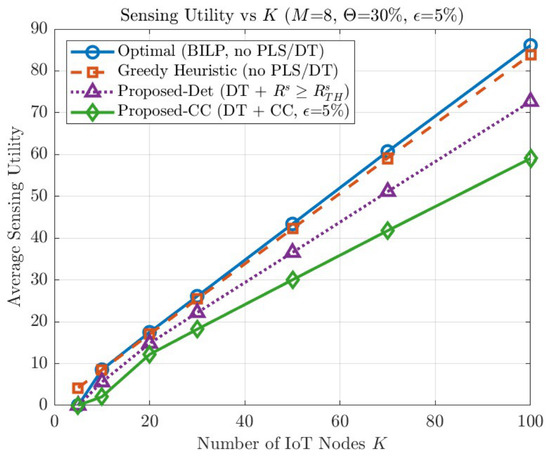
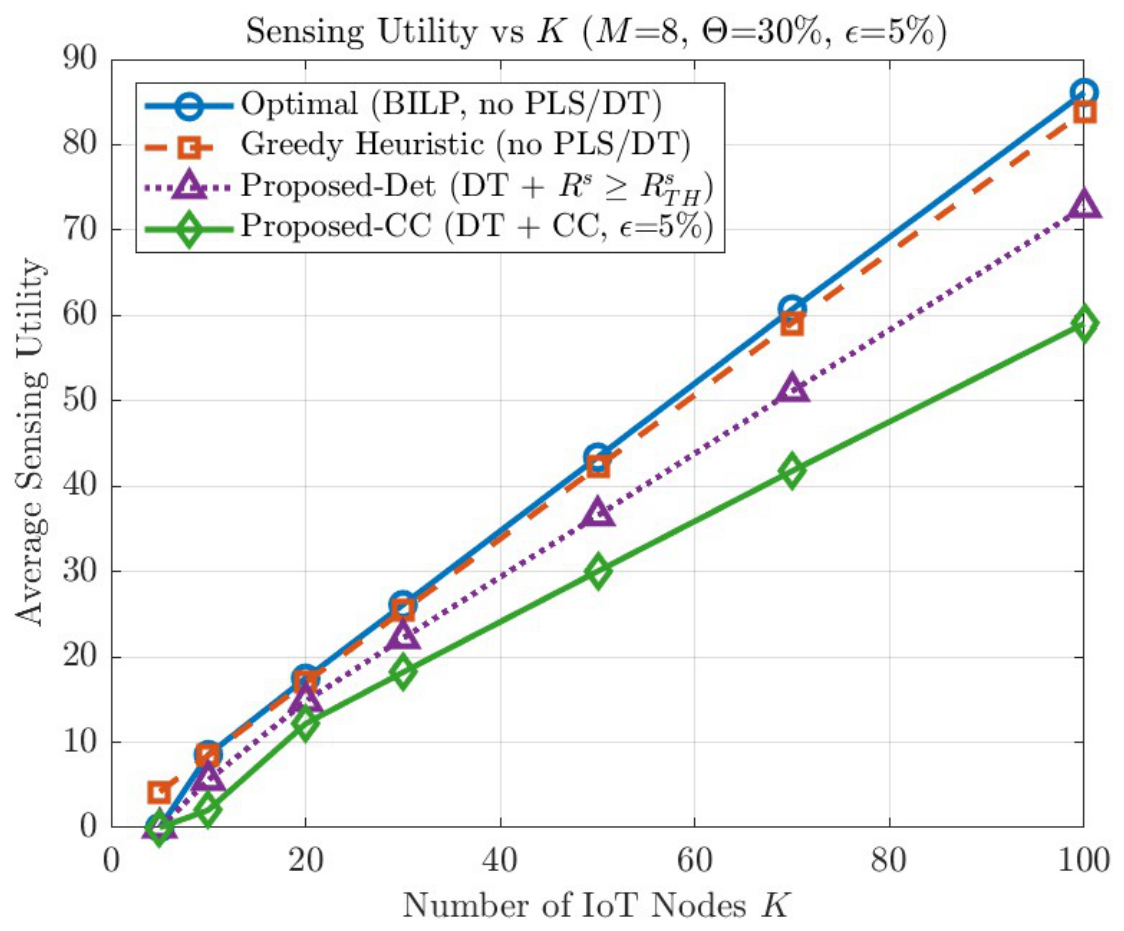
Sensing utility vs. number of IoT nodes: Figure 2 shows the sensing utility as a function of K. The ordering Optimal ≥ Greedy ≥ Proposed-Det ≥ Proposed-CC holds at every tested K. The result shows a progressive reduction in sensing utility as additional DT, security, and uncertainty-aware constraints are introduced. The difference between the configurations should be interpreted as the aggregate effect of the additional constraints and mechanisms rather than as a strict one-factor attribution, since the present experiments do not constitute a fully matched factorial ablation.
Figure 2.
Sensing utility vs. K (, , ). The ordering Optimal ≥ Greedy ≥ Proposed-Det ≥ Proposed-CC holds throughout, with the Optimal-Det gap attributable to the deterministic PLS constraint and the Det-CC gap attributable to chance-constraint tightening.
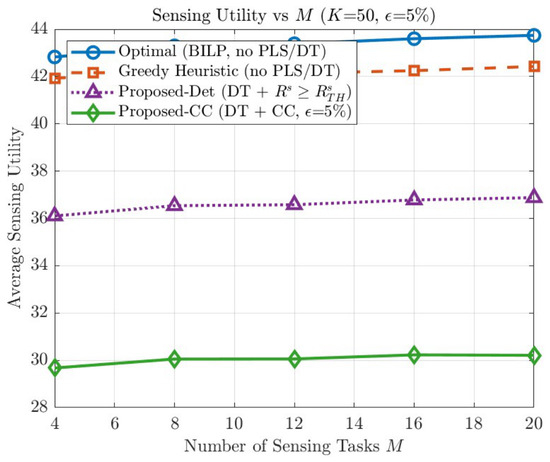
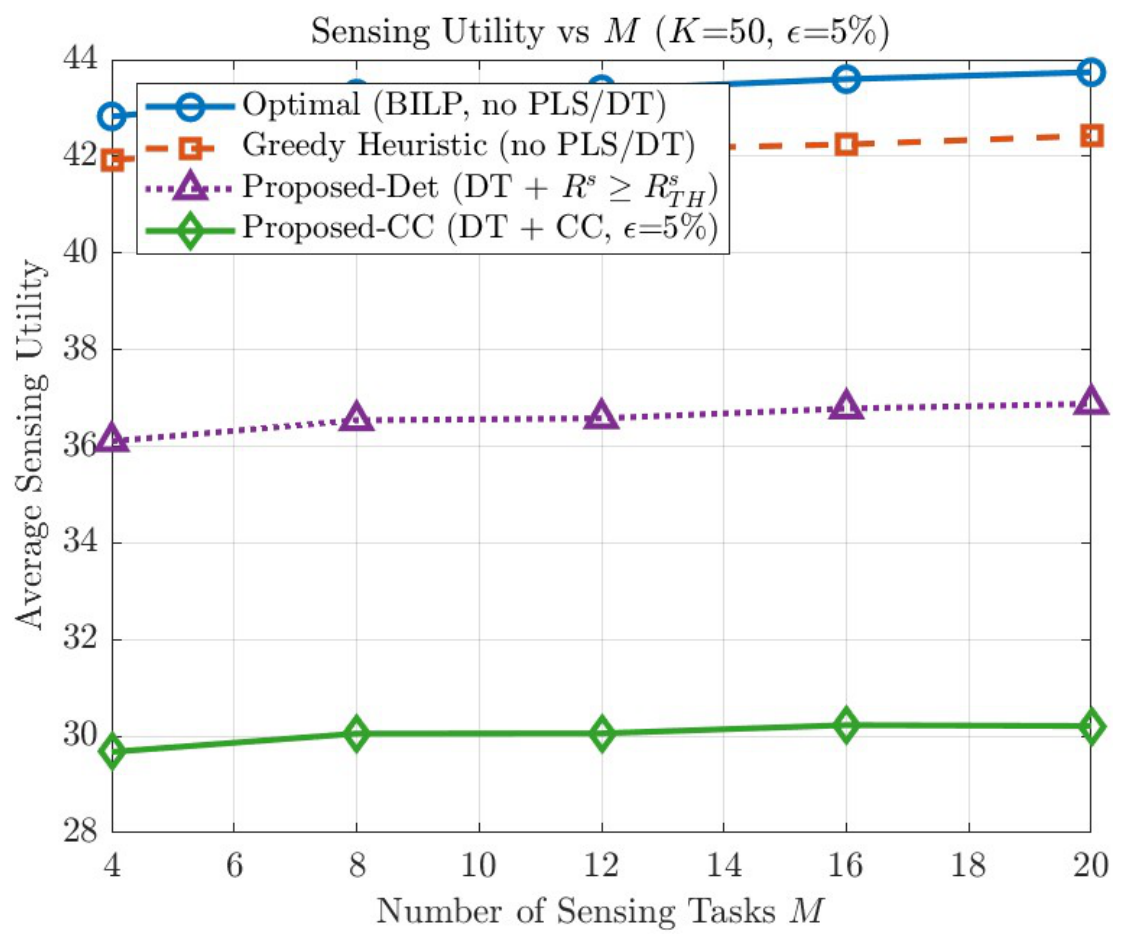
Sensing utility vs. number of tasks: Figure 3 shows the sensing utility versus M for . The same hierarchical trend is observed as the number of sensing tasks increases. These results indicate that the additional reliability and security requirements impose a moderate utility cost over the nominal reference configuration. All four algorithms exhibit the same relative ordering observed in Figure 2, and the gaps between Optimal, Proposed-Det, and Proposed-CC remain approximately proportional to total utility as M grows, confirming that the PLS and chance-constraint costs scale consistently with the number of sensing tasks rather than being an artefact of a particular K.
Figure 3.
Sensing utility vs. M for , . The same Optimal ≥ Greedy ≥ Proposed-Det ≥ Proposed-CC ordering observed in Figure 2 holds consistently as the number of sensing tasks increases.
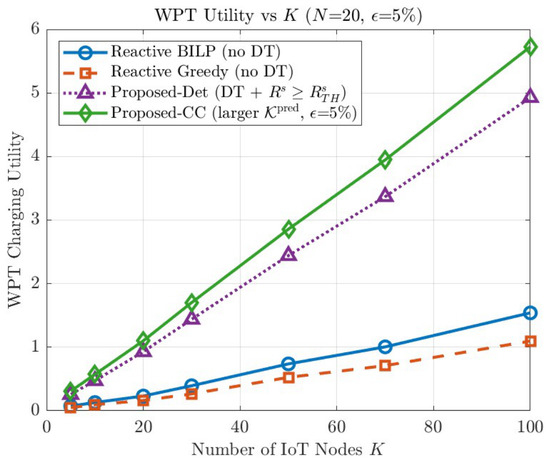
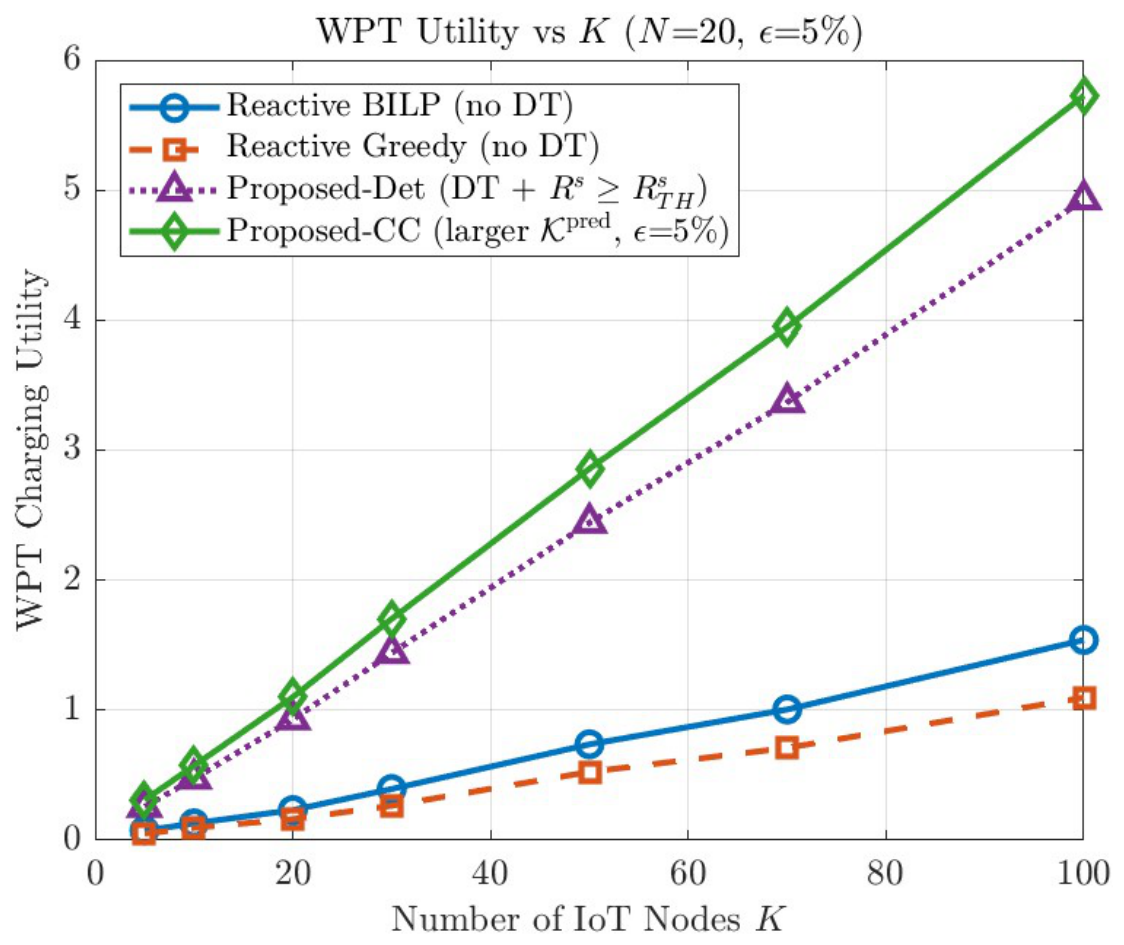
WPT charging utility: Figure 4 shows the WPT charging utility vs. K. Here, the ordering reverses relative to the sensing results: Proposed-CC ≥ Proposed-Det > Reactive BILP ≈ Reactive Greedy. The two reactive baselines dispatch a node for WPT only after its residual energy falls below , whereas Proposed-Det and Proposed-CC use the DT-based predictive charging rules (45) and (62), respectively, to dispatch nodes before they deplete. The chance-constrained trigger (62) requires only a probability greater than of future depletion, which is satisfied earlier in a node’s discharge trajectory than the deterministic trigger (45); consequently the predictive charging pool is larger than , and Proposed-CC accumulates more WPT utility. This is a genuine benefit of the chance-constrained formulation beyond its role in constraint satisfaction.
Figure 4.
WPT charging utility vs. K (, ). Proposed-CC’s larger predictive charging pool yields higher WPT utility than Proposed-Det, both of which substantially outperform the reactive baselines.
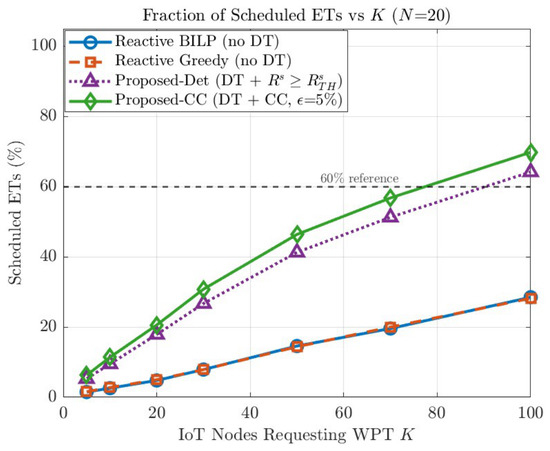
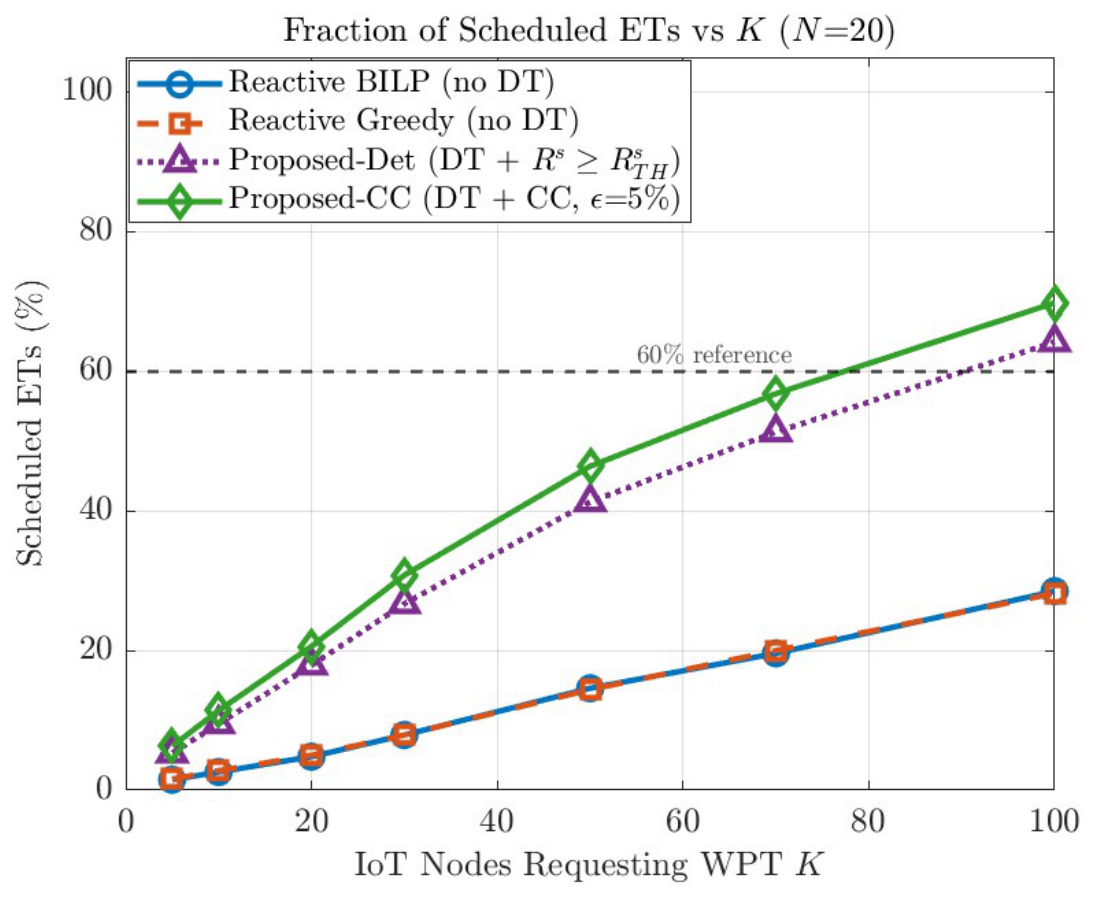
Fraction of scheduled ETs: Figure 5 shows the fraction of energy transmitters activated to serve WPT requests. Both the Reactive BILP and Reactive Greedy baselines remain below the reference line across the tested range, requiring fewer than of ETs even at , while Proposed-Det and Proposed-CC scale up ET utilisation smoothly with K, crossing the reference near –100. This confirms that the predictive charging mechanism, rather than merely shifting which nodes are charged, genuinely increases the volume of WPT activity needed to keep pace with proactive dispatch.
Figure 5.
Fraction of scheduled ETs vs. K (). Proposed-CC and Proposed-Det require substantially more active ETs than the reactive baselines, consistent with their larger predictive charging pools.
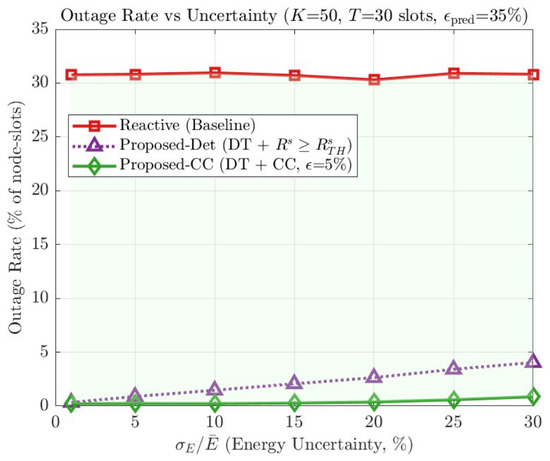
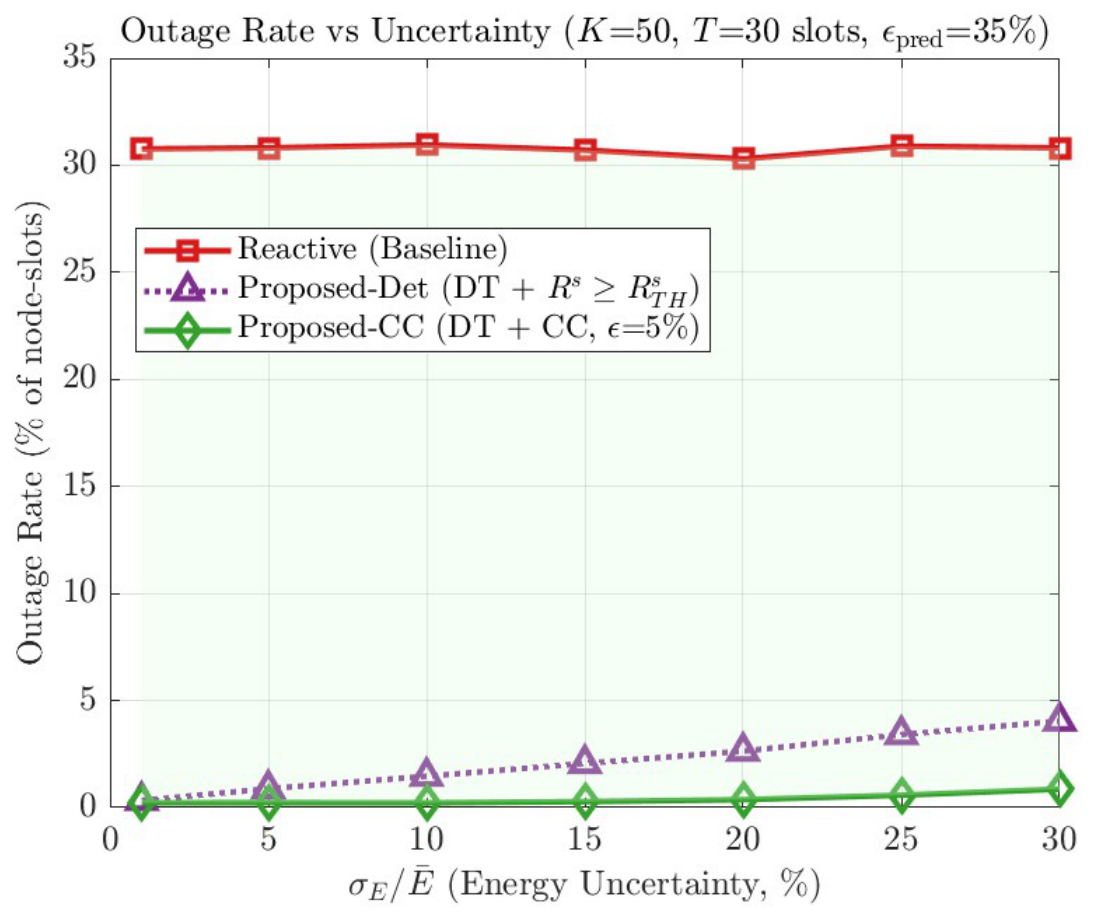
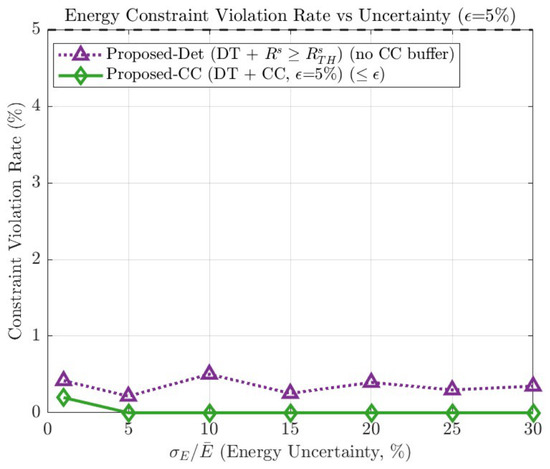
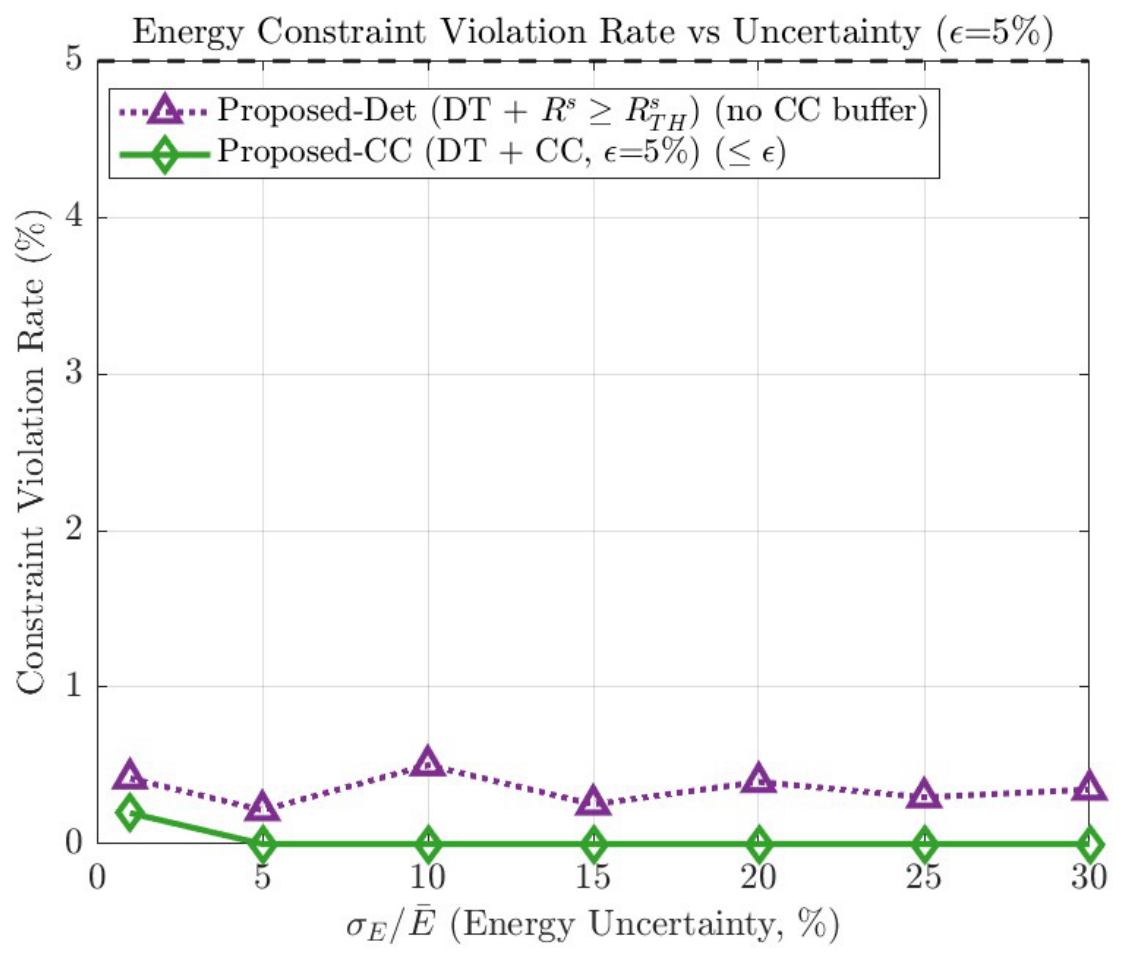
Outage rate vs. energy uncertainty: Figure 6 reports the outage rate-the fraction of node-slots in which a node’s residual energy falls below in a -slot trajectory simulation—as a function of the energy consumption uncertainty , for . The Reactive baseline, which charges only after crossing , exhibits a high and essentially uncertainty-independent outage rate of approximately , since its trigger condition does not depend on at all. Proposed-Det, which checks a one-slot-ahead nominal forecast each scheduling interval, keeps the outage rate low at small but degrades steadily as uncertainty grows, reaching approximately at : realised energy consumption can exceed the noise-free forecast used for the proactive-charging decision, allowing the node to cross between consecutive decision points. Proposed-CC, whose trigger condition (62) subtracts the chance-constraint margin from the forecast, anticipates this gap and dispatches charging earlier, yielding an empirical outage rate below 1% across the full uncertainty range tested. These results provide empirical evidence of the robustness of the proposed scheduler under the simulated conditions; they should not be interpreted as a statistical proof of a universal outage probability below 1%. The formal reliability requirement is instead established through the analytical chance-constraint formulation in Section 5. The results presented in Figure 6 demonstrate the principal benefit of the proposed chance-constrained scheduling framework. Unlike the deterministic predictor, the proposed scheduler explicitly accounts for prediction uncertainty when making charging decisions, thereby maintaining a consistently low outage probability even under significant energy uncertainty.
Figure 6.
Empirical outage rate vs. energy uncertainty (, slots, ). The Reactive baseline is essentially flat near since its trigger ignores forecasting altogether; Proposed-Det degrades from near-zero to as uncertainty grows, whereas Proposed-CC exhibits an empirical outage rate below throughout the tested range by explicitly incorporating the prediction-uncertainty margin into its charging trigger.
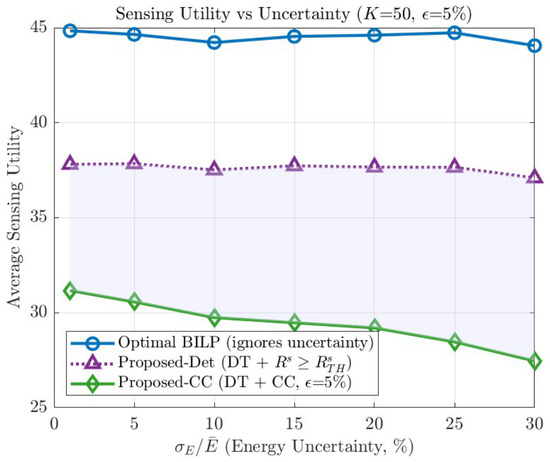
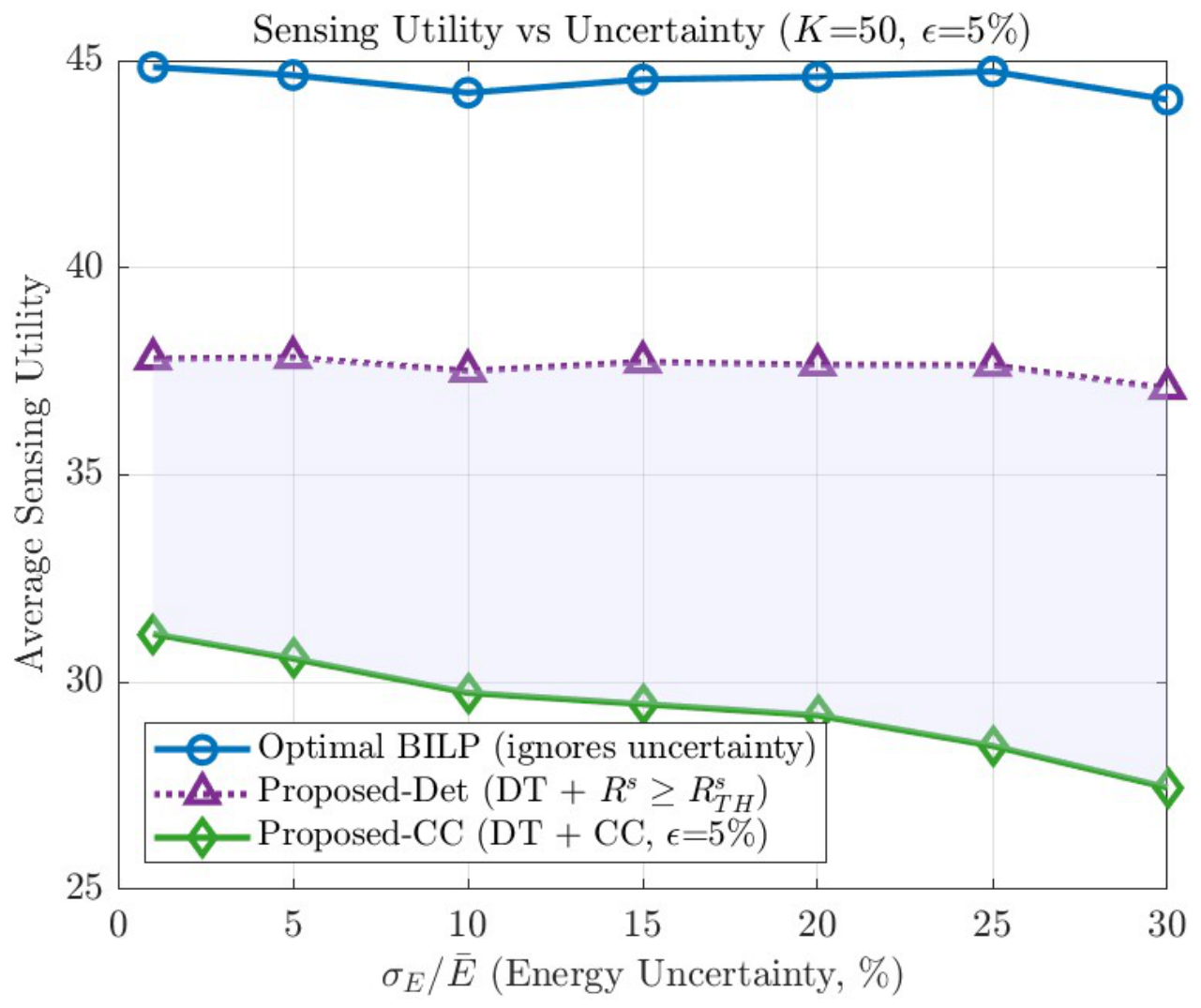
Sensing utility vs. energy uncertainty: Figure 7 illustrates the utility cost of robustness by sweeping at fixed and . The Optimal BILP curve remains flat because its formulation does not explicitly account for uncertainty, serving as an uncertainty-blind reference. Proposed-Det is likewise largely insensitive to in terms of sensing utility since its feasible set depends only on the deterministic thresholds and . However, as shown in Figure 6, this apparent utility stability is accompanied by an increasing outage rate as uncertainty grows. In contrast, Proposed-CC exhibits a gradual reduction in sensing utility from approximately 30 at to approximately 28 at (about ), reflecting the increasing chance-constraint margin incorporated into . Together with the outage results in Figure 6, these results demonstrate that the proposed chance-constrained framework achieves a desirable robustness-performance trade-off by accepting a modest reduction in sensing utility to substantially improve network reliability under increasing uncertainty.
Figure 7.
Sensing utility vs. energy uncertainty (, ). The Optimal BILP curve is flat by construction (uncertainty-blind reference). Proposed-CC’s utility decreases by approximately over the tested range as the chance-constraint margin grows, trading a modest, quantified utility cost for the outage robustness shown in Figure 6.
CC tightening margin vs. energy uncertainty: Figure 8 plots the average chance-constraint tightening margin as a function of , directly validating the closed-form deterministic equivalent derived in Proposition 2. The margin grows linearly with , exactly as predicted by the analytical expression, reaching approximately of at with . Figure 8 provides numerical validation of the analytical chance-constrained formulation developed in Section 5. The observed linear increase in the tightening margin agrees with the deterministic equivalent derived in Proposition 2, thereby confirming the correctness of the proposed formulation. The margin plotted here is precisely the quantity subtracted from each node’s energy budget in Figure 2 and Figure 3 and from the predictive-charging trigger in Figure 6.
Figure 8.
Average chance-constraint tightening margin versus energy uncertainty (, ). The margin increases approximately linearly with the uncertainty level, consistent with the analytical deterministic equivalent.
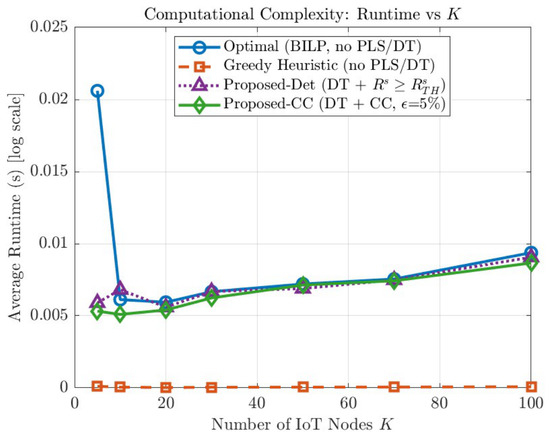
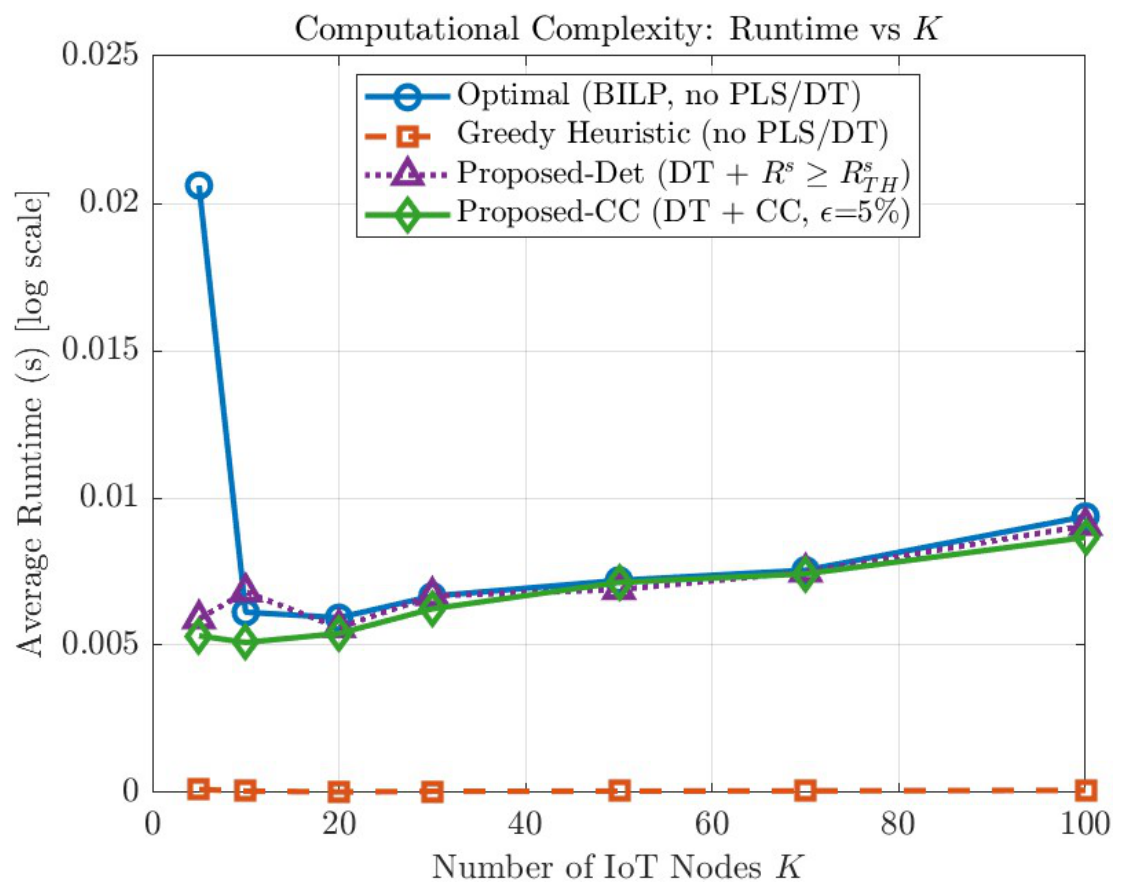
Computational complexity: Figure 9 shows the average runtime versus K on a logarithmic scale. The greedy heuristic is substantially faster than the branch-and-bound (B&B) approaches, completing in well under 1 ms across the tested network sizes. The B&B-based methods exhibit generally similar runtime trends, although an isolated deviation is visible for the optimal formulation. This variation results from the instance-dependent behaviour of integer-programming branch-and-bound: the number and structure of feasible assignments can change with the network instance, leading to a different search-tree size even for neighbouring values of K. Thus, the isolated deviation should not be interpreted as a systematic increase in the computational cost of the optimal formulation.
Figure 9.
Average runtime versus the number of IoT nodes K. The greedy heuristic has substantially lower runtime than the branch-and-bound configurations, while the additional preprocessing required by the chance-constrained formulation introduces relatively small computational overhead.
More importantly, the proposed chance-constraint preprocessing (computing and the secrecy-outage screen for the K nodes) is performed before the B&B search and has complexity. The Proposed-CC runtime therefore remains comparable to the underlying integer-programming solve, indicating that the uncertainty-handling stage introduces only limited computational overhead.
This confirms that the additional chance-constraint preprocessing, which primarily consists of computing and the secrecy outage probability for the K nodes, introduces negligible overhead compared with the underlying integer programme. Thus, although the framework integrates several functional modules, the proposed stochastic extensions do not substantially increase the computational burden of the scheduling solver. The main computational cost remains associated with the underlying branch-and-bound optimisation.
Implementation Scope and Limitations
The present evaluation is simulation-based and focuses on the proposed DT-assisted, uncertainty-aware scheduling and resource-allocation framework under a fixed UAV/ET trajectory. UAV energy-transmitter trajectories are predetermined within each scheduling frame, and the current chance-constraint model does not propagate UAV position uncertainty into the wireless channel and harvested-energy models. This study also does not include a hardware or hardware-in-the-loop testbed; consequently, nonlinear hardware effects, implementation-specific processing delays, and packet-level communication behaviour are not explicitly validated. These assumptions isolate the contribution of the proposed scheduling framework from the additional computational complexity of joint trajectory and resource optimisation. Jointly optimising UAV trajectories, propagating position uncertainty into the chance constraints, enabling online trajectory adaptation, and pursuing experimental (hardware-in-the-loop) validation are important directions for future work.
9. Conclusions
This paper presented a Digital Twin-assisted chance-constrained energy-aware scheduling framework for self-sustainable IIoT networks. The proposed framework integrates Digital Twin-based state prediction, chance-constrained optimisation, and physical-layer security to support reliable on-demand sensing and wireless power transfer under uncertain operating conditions. Unlike deterministic scheduling approaches, the proposed formulation explicitly accounts for channel, energy consumption, and prediction uncertainties while maintaining computational efficiency through closed-form deterministic equivalents. The simulation results demonstrated that the proposed framework significantly improves network reliability with only a modest loss in sensing utility. Specifically, the chance-constrained predictive charging strategy achieved an empirical outage rate below 1% under the tested high-uncertainty conditions, while incurring an approximately 9% utility reduction compared with the deterministic formulation. This empirical result supports the robustness of the proposed strategy under the simulated conditions while the formal reliability requirement is provided by the underlying chance-constrained formulation. Moreover, the chance-constraint preprocessing introduced negligible computational overhead, with runtimes remaining comparable to the underlying branch-and-bound optimisation. Although the proposed stochastic formulation captures channel, energy-consumption, and Digital Twin prediction uncertainties, the current model does not explicitly represent nonlinear hardware effects, such as nonlinear RF-to-DC conversion, battery charging and discharging characteristics, hardware impairments, or nonlinear UAV dynamics. Accordingly, the reported results should be interpreted as simulation-based validation of the scheduling framework rather than as a complete hardware-level performance assessment. Hardware experiments incorporating these nonlinear characteristics constitute an important direction for future work. Hardware-based network validation lies outside the scope of this study, though it remains an important direction for future work, alongside joint UAV trajectory optimisation, adaptive online uncertainty estimation, and federated Digital Twin-assisted anomaly detection for large-scale privacy-preserving IIoT deployments. The simulation experiments here are intended specifically to evaluate the scheduling, energy, security, and computational behaviour of the proposed framework, rather than to reproduce every characteristic of a physical IIoT deployment.
Funding
This research was funded by the Deanship of Scientific Research at Northern Border University, Arar, KSA, through project number NBU-FFR-2026-2159-05. The APC was funded by the Deanship of Scientific Research at Northern Border University, Arar, KSA.
Data Availability Statement
No new data were created or analyzed in this study. The results presented in this work are based on simulations and the simulation parameters are provided in the manuscript.
Conflicts of Interest
The author declares no conflicts of interest. The funder had no role in the design of the study; in the collection, analysis, or interpretation of data; in the writing of the manuscript; or in the decision to publish the results.
References
- Ejaz, W.; Naeem, M.; Zeadally, S. On-Demand Sensing and Wireless Power Transfer for Self-Sustainable Industrial Internet of Things Networks. IEEE Trans. Ind. Inform. 2020, 17, 7075–7084. [Google Scholar] [CrossRef] [Scilit]
- Bisio, I.; Garibotto, C.; Grattarola, A.; Lavagetto, F.; Sciarrone, A. Exploiting Context-Aware Capabilities over the Internet of Things for Industry 4.0 Applications. IEEE Netw. 2018, 32, 101–107. [Google Scholar] [CrossRef] [Scilit]
- Aazam, M.; Zeadally, S.; Harras, K.A. Deploying Fog Computing in Industrial Internet of Things and Industry 4.0. IEEE Trans. Ind. Inform. 2018, 14, 4674–4682. [Google Scholar] [CrossRef] [Scilit]
- Kaur, K.; Garg, S.; Aujla, G.S.; Kumar, N.; Rodrigues, J.J.P.C.; Guizani, M. Edge Computing in the Industrial Internet of Things Environment: Software-Defined-Networks-Based Edge-Cloud Interplay. IEEE Commun. Mag. 2018, 56, 44–51. [Google Scholar] [CrossRef] [Scilit]
- Lu, N.; Zhou, Y.; Shi, C.; Cheng, N.; Cai, L.; Li, B. Planning While Flying: A Measurement-Aided Dynamic Planning of Drone Small Cells. IEEE Internet Things J. 2019, 6, 2693–2705. [Google Scholar] [CrossRef] [Scilit]
- Saad, W.; Bennis, M.; Chen, M. A Vision of 6G Wireless Systems: Applications, Trends, Technologies, and Open Research Problems. IEEE Netw. 2019, 34, 134–142. [Google Scholar] [CrossRef] [Scilit]
- Zeadally, S.; Shaikh, F.K.; Talpur, A.; Sheng, Q.Z. Design Architectures for Energy Harvesting in the Internet of Things. Renew. Sustain. Energy Rev. 2020, 128, 109901. [Google Scholar] [CrossRef] [Scilit]
- Ejaz, W.; Naeem, M.; Basharat, M.; Anpalagan, A.; Kandeepan, S. Efficient Wireless Power Transfer in Software-Defined Wireless Sensor Networks. IEEE Sens. J. 2016, 16, 7409–7420. [Google Scholar] [CrossRef] [Scilit]
- Yang, B.; Wu, B.; You, Y.; Guo, C.; Qiao, L.; Lv, Z. Edge Intelligence Based Digital Twins for Internet of Autonomous Unmanned Vehicles. Softw. Pract. Exp. 2024, 54, 1833–1851. [Google Scholar] [CrossRef] [Scilit]
- Shu, M.; Sun, W.; Zhang, J.; Duan, X.; Ai, M. Digital-Twin-Enabled 6G Network Autonomy and Generative Intelligence: Architecture, Technologies and Applications. Digit. Twin 2025, 2, 16. [Google Scholar] [CrossRef] [Scilit]
- Li, T.; Zhang, J.; Yu, L.; Zhang, Y.; Cai, Y.; Xu, F.; Liu, G. Digital Twin Channel-Enabled Online Resource Allocation for 6G: Principle, Architecture and Application. arXiv 2025, arXiv:2507.19974. [Google Scholar]
- Mitev, M.; Pham, T.M.; Chorti, A.; Barreto, A.N.; Fettweis, G. Physical Layer Security—From Theory to Practice. IEEE BITS Inf. Theory Mag. 2023, 3, 67–79. [Google Scholar] [CrossRef] [Scilit]
- Fantacci, R.; Nizzi, F.; Pecorella, T.; Pierucci, L.; Roveri, M. False Data Detection for Fog and Internet of Things Networks. Sensors 2019, 19, 4235. [Google Scholar] [CrossRef] [Scilit] [PubMed]
- Ben-Tal, A.; Nemirovski, A. Robust Optimization—Methodology and Applications. Math. Program. 2002, 92, 453–480. [Google Scholar] [CrossRef] [Scilit]
- Ardakani, F.F.; Mozafari, S.B.; Soleymani, S. Scheduling Energy and Spinning Reserve Based on Linear Chance Constrained Optimization for a Wind Integrated Power System. Ain Shams Eng. J. 2022, 13, 101582. [Google Scholar] [CrossRef] [Scilit]
- Zhou, P.; Wang, C.; Yang, Y. Self-Sustainable Sensor Networks with Multi-Source Energy Harvesting and Wireless Charging. In Proceedings of the IEEE INFOCOM 2019-IEEE Conference on Computer Communications, Paris, France, 29 April–2 May 2019; pp. 1828–1836. [Google Scholar]
- Asiedu, D.K.P.; Lee, H.; Lee, K.-J. Simultaneous Wireless Information and Power Transfer for Decode-and-Forward Multihop Relay Systems in Energy-Constrained IoT Networks. IEEE Internet Things J. 2019, 6, 9413–9426. [Google Scholar] [CrossRef] [Scilit]
- Lu, X.; Flint, I.; Niyato, D.; Privault, N.; Wang, P. Self-Sustainable Communications with RF Energy Harvesting: Ginibre Point Process Modeling and Analysis. IEEE J. Sel. Areas Commun. 2016, 34, 1518–1535. [Google Scholar] [CrossRef] [Scilit]
- Zhang, T.; Xu, Y.; Loo, J.; Yang, D.; Xiao, L. Joint Computation and Communication Design for UAV-Assisted Mobile Edge Computing in IoT. IEEE Trans. Ind. Inform. 2020, 16, 5505–5516. [Google Scholar] [CrossRef] [Scilit]
- Lucas-Estañ, M.C.; Gozalvez, J. Load Balancing for Reliable Self-Organizing Industrial IoT Networks. IEEE Trans. Ind. Inform. 2019, 15, 5052–5063. [Google Scholar] [CrossRef]
- Samir, M.; Sharafeddine, S.; Assi, C.M.; Nguyen, T.M.; Ghrayeb, A. UAV Trajectory Planning for Data Collection from Time-Constrained IoT Devices. IEEE Trans. Wirel. Commun. 2020, 19, 34–46. [Google Scholar] [CrossRef] [Scilit]
- Wang, F. Computation Rate Maximization for Wireless Powered Mobile Edge Computing. In Proceedings of the 2017 23rd Asia-Pacific Conference on Communications (APCC), Perth, Australia, 11–13 December 2017; pp. 1–6. [Google Scholar]
- Yu, H.; Ju, M.; Yang, H.-C. Aggregate Throughput Maximization for UAV-Enabled Relay Networks with Wireless Power Transfer: Joint Trajectory and Power Optimization. IEEE Trans. Veh. Technol. 2024, 73, 8253–8265. [Google Scholar] [CrossRef] [Scilit]
- Tang, L.; Pu, Z.; Hou, Q.; Fang, D.; Chen, Q. Deterministic Delay of Digital-Twin-Assisted End-to-End Network Slicing in Industrial IoT via Multiagent Deep Reinforcement Learning. IEEE Internet Things J. 2024, 12, 1064–1080. [Google Scholar] [CrossRef] [Scilit]
- Cao, K.; Ding, H.; Lv, L.; Su, Z.; Tao, J.; Gong, F.; Wang, B. Physical-Layer Security for Intelligent-Reflecting-Surface-Aided Wireless-Powered Communication Systems. IEEE Internet Things J. 2023, 10, 18097–18110. [Google Scholar] [CrossRef] [Scilit]
- Rana, M.M.; Xiang, W.; Wang, E.; Li, X.; Choi, B.J. Internet of Things Infrastructure for Wireless Power Transfer Systems. IEEE Access 2018, 6, 19295–19303. [Google Scholar] [CrossRef] [Scilit]
- Park, J.; Samarakoon, S.; Elgabli, A.; Kim, J.; Bennis, M.; Kim, S.-L.; Debbah, M. Communication-Efficient and Distributed Learning over Wireless Networks: Principles and Applications. Proc. IEEE 2021, 109, 796–819. [Google Scholar] [CrossRef] [Scilit]
- Ku, M.-L.; Li, W.; Chen, Y.; Liu, K.J.R. Advances in Energy Harvesting Communications: Past, Present, and Future Challenges. IEEE Commun. Surv. Tutor. 2016, 18, 1384–1412. [Google Scholar] [CrossRef] [Scilit]
- Le, T.A.; Vien, Q.-T.; Nguyen, H.X.; Ng, D.W.K.; Schober, R. Robust Chance-Constrained Optimization for Power-Efficient and Secure SWIPT Systems. IEEE Trans. Green Commun. Netw. 2017, 1, 333–346. [Google Scholar] [CrossRef] [Scilit]
- Al-Hourani, A.; Kandeepan, S.; Lardner, S. Optimal LAP Altitude for Maximum Coverage. IEEE Wirel. Commun. Lett. 2014, 3, 569–572. [Google Scholar] [CrossRef] [Scilit]
- Nemirovski, A.; Shapiro, A. Convex Approximations of Chance Constrained Programs. SIAM J. Optim. 2007, 17, 969–996. [Google Scholar] [CrossRef] [Scilit]
- Maharjan, S.; Zhang, Y.; Gjessing, S.; Tsang, D.H.K. User-Centric Demand Response Management in the Smart Grid with Multiple Providers. IEEE Trans. Emerg. Top. Comput. 2017, 5, 494–505. [Google Scholar] [CrossRef] [Scilit]
- Tuy, H.; Al-Khayyal, F.; Thach, P.T. Monotonic Optimization: Branch and Cut Methods. In Essays and Surveys in Global Optimization; Springer: Boston, MA, USA, 2005; pp. 39–78. [Google Scholar]
- Achterberg, T.; Koch, T.; Martin, A. Branching Rules Revisited. Oper. Res. Lett. 2005, 33, 42–54. [Google Scholar] [CrossRef] [Scilit]

Disclaimer/Publisher’s Note: The statements, opinions and data contained in all publications are solely those of the individual author(s) and contributor(s) and not of MDPI and/or the editor(s). MDPI and/or the editor(s) disclaim responsibility for any injury to people or property resulting from any ideas, methods, instructions or products referred to in the content. |
© 2026 by the author. Licensee MDPI, Basel, Switzerland. This article is an open access article distributed under the terms and conditions of the Creative Commons Attribution (CC BY) license.