


Abstract
This study investigates real-time model predictive energy management for portable air-cooled fuel cell/lithium-ion battery hybrid power systems. To capture the coupled electrical and thermal behavior of the system while maintaining computational efficiency for online control, a control-oriented lumped-parameter model is developed. The model describes the fuel cell voltage characteristics and thermal dynamics, the lithium-ion battery state of charge (SOC), and the level of hydrogen (LOH) in the hydrogen tank. Based on this model, a model predictive control (MPC)-based energy management strategy is proposed to coordinate the power distribution between the fuel cell and lithium-ion battery subject to power, ramp-rate, SOC, and LOH constraints. The proposed strategy is compared with a conventional rule-based strategy under rated-power, short-duration load variation, and long-duration load variation conditions. Simulation results show that the proposed strategy smooths fuel cell power, maintains the battery SOC within a reasonable range, and improves coordinated energy utilization. Hardware-in-the-loop experiments using STM32 controllers further verify its real-time feasibility. Compared with the rule-based strategy, the proposed method reduces the maximum fuel cell power variation rate by 85.7% in the HIL test, demonstrating improved fuel cell power stability.
1. Introduction
1.1. Background and Motivation
In recent years, portable power generation devices have become a focal point in the fields of energy and electrical engineering. Conventional portable generators primarily rely on diesel or gasoline as fuel; however, their operation produces significant carbon emissions, leading to environmental pollution and raising concerns regarding energy sustainability. Proton exchange membrane fuel cells (PEMFCs) are considered suitable for portable power applications due to their compact structure, low operating temperature, and high energy density. Compared with lithium-ion batteries, PEMFCs offer faster and more convenient energy replenishment and possess higher volumetric energy density. Consequently, air-cooled PEMFCs demonstrate significant advantages in portable power generation and have been widely applied in individual soldier power supplies, mobile device chargers, and emergency field power sources.
1.2. Necessity of Air-Cooled Fuel Cell/Lithium-Ion Battery Hybrid Power System Energy Management
In air-cooled fuel cell/lithium-ion battery hybrid power systems, the load profile frequently exhibits complex and rapid fluctuations, thereby imposing substantial dynamic stress on the fuel cell subsystem, which accelerates internal degradation mechanisms and shortens fuel cell lifetime [1,2]. To safeguard component longevity and ensure system stability, it is essential to apply an energy management strategy that explicitly limits the fuel cell power variation rate and simultaneously manages the lithium-ion battery state of charge (SOC) within upper and lower bounds so that the battery can buffer transient load changes and relieve the fuel cell from abrupt demands [3,4]. By smoothing the power output profile through hybridization and admissible operational limits, the hybrid system promotes operational continuity, avoids repeated excursions into aggressive operating zones, and enhances both component life and overall reliability [5,6]. Hence, energy management is not simply a matter of efficiency optimization but a necessary measure to maintain the long-term stability, durability and reliable operation of air-cooled hybrid power systems.
1.3. Literature Review of Fuel Cell/Lithium-Ion Battery Hybrid Power System Modeling
The modeling approach for fuel cell/lithium-ion battery hybrid power systems can be broadly classified into three categories: a distributed-parameter model, a lumped-parameter model, and a data-driven model. The distributed-parameter model captures spatial variations in physicochemical states and provides high-resolution insight into multi-phase transport and electrochemical dynamics. In contrast, the lumped-parameter model represents the system using spatially averaged variables, enabling fast computation for control design. The data-driven model learns system behavior directly from operational or experimental data, offering a flexible alternative when detailed mechanistic modeling is impractical.
- Distributed-parameter model: A novel hybrid continuum/discrete model was developed for PEMFCs at the rib/channel scale, integrating continuum formulations for channels and discrete pore-network approaches for the gas diffusion layer (GDL), microporous layer (MPL), and catalyst layer (CL) [7]. This model investigated the effects of relative humidity (RH) and temperature on performance and two-phase transport. Results indicated optimal conditions around 80 °C and a relative humidity of 0.8, balancing ionomer hydration and flooding, with enhanced performance via adjusted GDL thermal conductivity and thermal contact resistance, promoting a homogeneous CL temperature and higher peak power density. A real-time capable nonlinear distributed-parameter observer framework was established for PEMFCs [8], leveraging an Unscented Kalman Filter and a physio-chemically consistent model considering two-phase flow, gas crossover, and membrane water dynamics. The study focused on observing spatially resolved intra-FC states using lumped voltage and current as inputs. Findings demonstrated high accuracy against segmented PEMFC experiments, enabling the virtual sensing of liquid/vapor water dynamics and mixed potentials for advanced control and degradation mitigation. A high-fidelity multi-domain and multi-scale model of a fuel cell electric vehicle (FCEV) was constructed, coupling mechanical, electrical, electrochemical, gas flow, thermal, and control domains from vehicle to intra-FC levels with mechanistic equations and empirical degradation models [9]. Research examined operating conditions and component sizing impacts on FC degradation via multi-objective genetic algorithm optimization. Outcomes revealed optimal configurations for efficiency and lifetime, emphasizing drive cycle influences and front-loading in powertrain design to minimize costs and degradation under transient loads.
- Lumped-parameter model: A lumped-parameter model for PEMFC systems was developed in [10] based on a hybrid vessel propulsion system to investigate dynamic characteristics under typical sailing conditions. Simulations revealed hysteresis in the stack operating temperature with a 25 s delay, leading to overvoltage and gas pressure fluctuations. Ref. [11] proposed a lumped-electrical-characteristic model for vehicle lithium-ion batteries, considering multi-time-scale effects, incorporating hysteresis into open-circuit voltage. An adaptive asynchronous parameter identification strategy combining FFRLS and EKF was proposed to address data saturation and distinguish fast/slow parameter changes. Under complex charge–discharge and mixed discharge pulses, the strategy improved the terminal voltage precision by 0.420% and 1.114%, respectively, while reducing the maximum parameter consistency error by 158.300%, enhancing reliability for electric vehicle management. A lumped-parameter approach was utilized to design and study a hybrid electric vehicle minibus with a 40 kW electric motor powered by a 20 kW PEM fuel cell and 70 kWh lithium-ion battery system [12]. Evaluations focused on powertrain configuration and energy management strategies under varying conditions. Road tests demonstrated optimized efficiency, reduced energy losses, and extended range by overcoming battery and fuel cell limitations, with logged data showing balanced energy production and consumption for urban applications.
- Data-driven model: Zeng et al. [13] established a data-driven predictive-feedback optimization model for proton exchange membrane fuel cell (PEMFC)–lithium-ion battery hybrid power systems, combining a long short-term memory–convolutional neural network (LSTM-CNN) for prediction, grey wolf optimizer–particle swarm optimization (GWO-PSO) for rapid strategy, and an attention-enhanced fuzzy neural network for control. The study investigated electrochemical surface area (ECSA) degradation and carbon corrosion impacts on system lifespan under multimodal information. Results demonstrated maximized energy efficiency, minimized hydrogen consumption and costs, and extended system lifespan through postponed deterioration. Ref. [14] developed a data-driven artificial neural network (ANN)-based surrogate model (SM) for predicting the electro-thermal behavior of a 20 Ah lithium-ion pouch cell under varying ambient temperatures (10–40 °C) and discharge rates (1C–4C). The model co-estimated the cell voltage and maximum surface temperature using experimental data, validated against pseudo-two-dimensional (P2D) physics-based benchmarks. Results showed superior prediction with <5% error in the voltage and <10% in the temperature for most cases, achieving R2 values of 0.9904 (voltage) and 0.9898 (temperature), highlighting computational efficiency over traditional models. Jin et al. [15] proposed a data-driven framework for lithium-ion battery RUL prediction using LSTM for health indicator (HI) forecasting and XGBoost for state-of-health (SOH) estimation, with the binary firefly algorithm (BFA) for feature selection. The study extracted 16 HIs from NASA PCoE datasets, modeling RUL indirectly via SOH to explore degradation patterns. Results indicated a 23% improvement in the RMSE and MAPE compared to direct RUL modeling, with transferable accuracy across similar batteries under consistent conditions.
1.4. Literature Review of Fuel Cell/Lithium-Ion Battery Hybrid Power System Energy Management
Energy management strategies for fuel cell/lithium-ion battery hybrid power systems can generally be classified into three main categories [16]: rule-based, optimization-based, and learning-based methods. Rule-based methods rely on predefined operating logic derived from expert knowledge or heuristic principles, offering simplicity, transparency, and high reliability for real-time implementation. Optimization-based methods determine the power distribution by solving an optimization problem subject to system operating constraints, with representative approaches including dynamic programming (DP), the equivalent consumption minimization strategy (ECMS), and model predictive control (MPC). Learning-based methods leverage data-driven or reinforcement learning techniques to determine energy distribution policies under dynamic operating conditions.
Yuan et al. [17] established a genetic algorithm (GA)-optimized rule-based EMS for PEMFC/battery hybrid systems, conducting simulation and experimental verification under different driving conditions, and the results showed that it achieved near-optimal fuel consumption compared to dynamic programming (DP) EMSs. Wu et al. [18] designed three online real-time EMSs, including a rule-based strategy, investigating their performances under short, long, and commuter driving cycles, and found that the rule-optimization combined strategy outperformed the others in reducing total running costs. In terms of optimization-based methods, DP, the ECMS, and MPC are commonly used to determine the power distribution by solving optimization problems under system operating constraints. In particular, MPC can explicitly incorporate prediction information, power constraints, ramp-rate limits, and energy-state constraints, making it suitable for real-time power allocation in fuel cell hybrid power systems. In terms of learning-based methods, Zhu et al. [19] proposed a deep Q-learning (DQL)-based multi-objective EMS for fuel cell hybrid ships, optimizing action space and reward function design, and simulation results indicated that it achieved 92.6% of voyage economy compared to DP while maintaining fuel cell durability and battery SOC. Li et al. [20] presented a comprehensive review on reinforcement learning (RL)-based EMSs for FCHEVs, exploring the reformulation of EMSs into a Markov decision process (MDP) and analyzing algorithm applicability, providing guidance for practical implementation. Zhou et al. [21] developed an improved twin-delayed deep deterministic policy gradient (TD3) EMS integrated with hindsight-prioritized experience replay and learning-rate annealing, testing it under multiple driving cycles and demonstrating a superior performance in SOC maintenance and total cost reduction compared to traditional DRL algorithms.
1.5. Comments on the Existing Research
Based on the above literature review, the following limitations can be identified:
Comment 1: Existing studies on fuel cell/lithium-ion battery hybrid power systems mainly focus on vehicle, ship, or high-power traction applications, whereas research on portable air-cooled fuel cell/lithium-ion battery hybrid power systems remains limited. Compared with liquid-cooled or high-power fuel cell systems, air-cooled fuel cell systems exhibit stronger coupling among electrochemical output, thermal behavior, fan operation, and load variation. Therefore, a control-oriented model that simultaneously considers electrical characteristics, thermal dynamics, and hybrid energy states is still required for real-time energy management.
Comment 2: Rule-based energy management strategies are simple and reliable, but their performance strongly depends on predefined thresholds and empirical tuning. Once the load profile changes, the rule set may need to be redesigned or re-calibrated. Learning-based strategies can improve adaptability, but they usually require large amounts of training data, long training times, and careful reward function design. These characteristics make their direct implementation difficult for small-scale portable hybrid power systems with limited computational resources.
Comment 3: Many existing energy management strategies mainly aim to satisfy the load power demand or reduce hydrogen consumption, while insufficient attention is paid to fuel cell power fluctuation, battery SOC regulation, and physical operating constraints. For air-cooled fuel cell/lithium-ion battery hybrid power systems, abrupt fuel cell power changes may increase dynamic operating stress, while improper battery SOC management may weaken the buffering capability of the lithium-ion battery. Therefore, an energy management strategy that explicitly considers fuel cell power smoothing, battery SOC regulation, LOH management, and real-time implementation is necessary.
1.6. Main Contributions
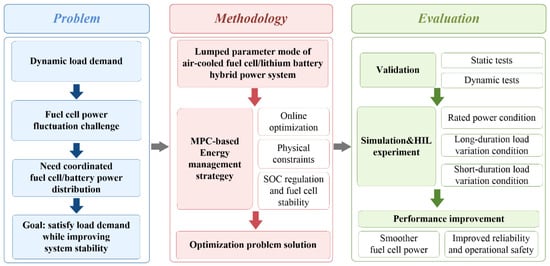
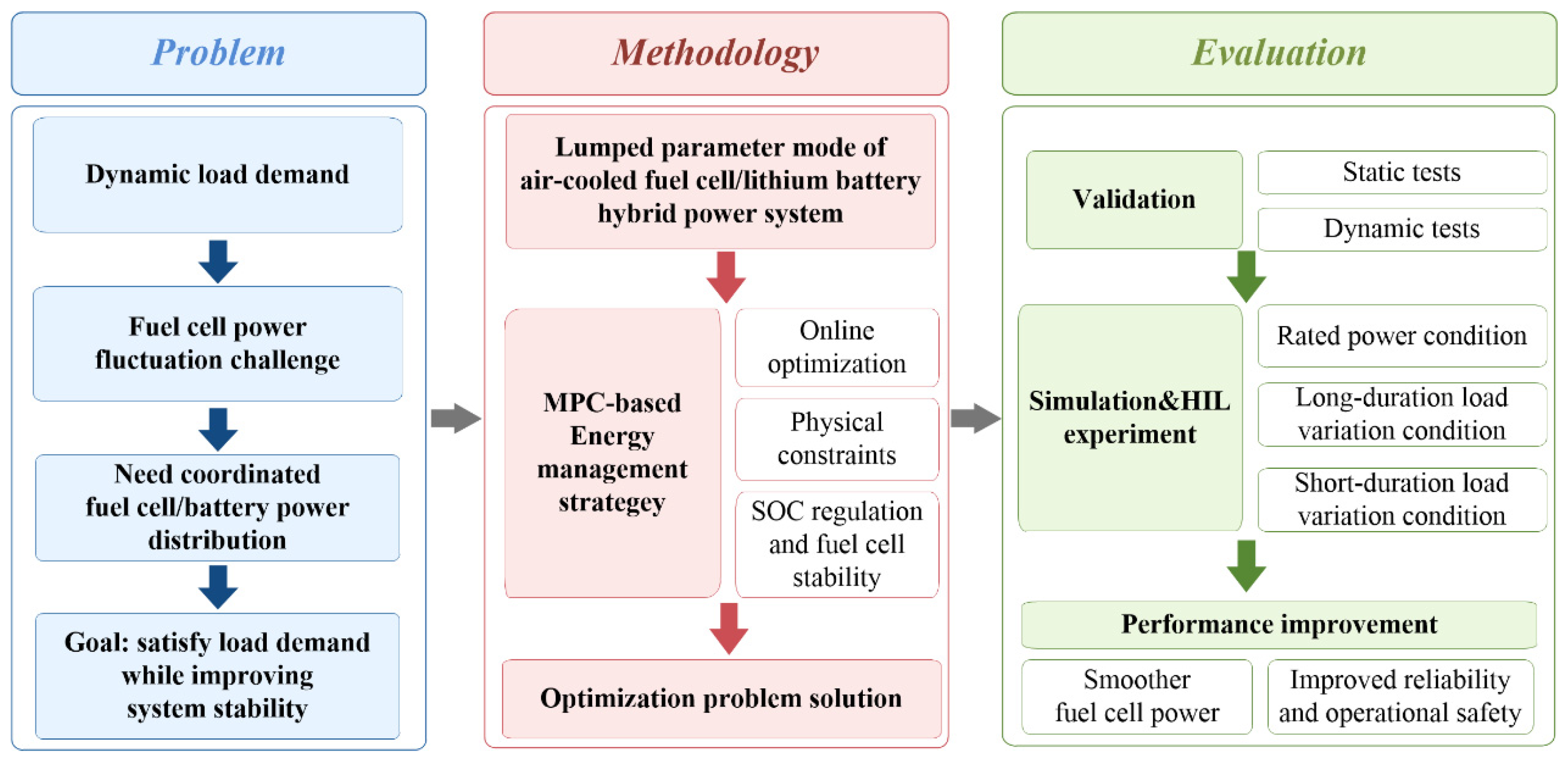
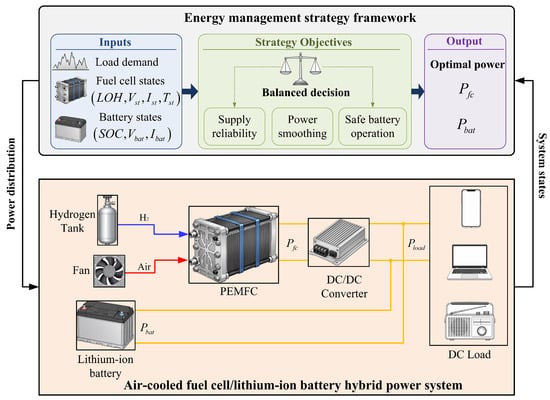
To address the challenges caused by the dynamic load demand and fuel cell power fluctuations in portable air-cooled fuel cell/lithium-ion battery hybrid power systems, an MPC-based energy management strategy for coordinated power distribution between the fuel cell and lithium-ion battery was proposed in this study. The overall research framework is illustrated in Figure 1. In this framework, dynamic load demand, fuel cell power fluctuation, and battery SOC regulation are regarded as the main problems. A control-oriented lumped-parameter model and a predictive energy management strategy were then developed as the proposed methodology. Finally, simulation and hardware-in-the-loop experiments were conducted to evaluate the effectiveness and real-time feasibility of the proposed strategy.
Figure 1.
Research framework of MPC-based energy management strategy for portable air-cooled fuel cell/lithium-ion battery hybrid power system.
In this paper, a control-oriented lumped-parameter model of a portable air-cooled fuel cell/lithium-ion battery hybrid power system is established, including the fuel cell electrical model, fuel cell thermal model, lithium-ion battery SOC model, and hydrogen tank LOH model. Based on this model, an MPC-based energy management strategy is designed to realize online power distribution under practical physical constraints.
The main contributions of this study can be summarized as follows:
- A control-oriented lumped-parameter model is developed for portable air-cooled fuel cell/lithium-ion battery hybrid power systems. The model integrates fuel cell voltage characteristics, stack temperature dynamics, lithium-ion battery SOC dynamics, and hydrogen tank LOH dynamics. Compared with models that only focus on electrical output or battery SOC, the proposed model provides a more complete basis for analyzing the coupled electrical, thermal, and energy-state behavior of portable hybrid power systems under dynamic load conditions.
- An MPC-based energy management strategy is proposed for coordinated power distribution between the fuel cell and lithium-ion battery. In the proposed strategy, the battery SOC and hydrogen tank LOH are incorporated into the prediction model, while fuel cell power variation, battery power variation, SOC limits, LOH limits, and power bounds are explicitly considered in the optimization problem. Therefore, the strategy can smooth the fuel cell power, regulate the battery SOC, and satisfy the load demand within the prediction horizon.
- The proposed strategy was implemented and verified through both simulation and hardware-in-the-loop experiments. Comparative results under rated-power, short-duration load variation, and long-duration load variation conditions demonstrate that the MPC-based strategy can reduce fuel cell power fluctuations, maintain the battery SOC within a reasonable range, and improve the coordinated operation of hybrid power systems. The STM32-based HIL experiment further verifies the real-time feasibility and embedded implementation potential of the proposed strategy.
2. Problem Formulation
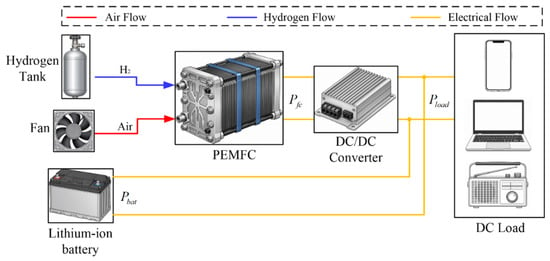
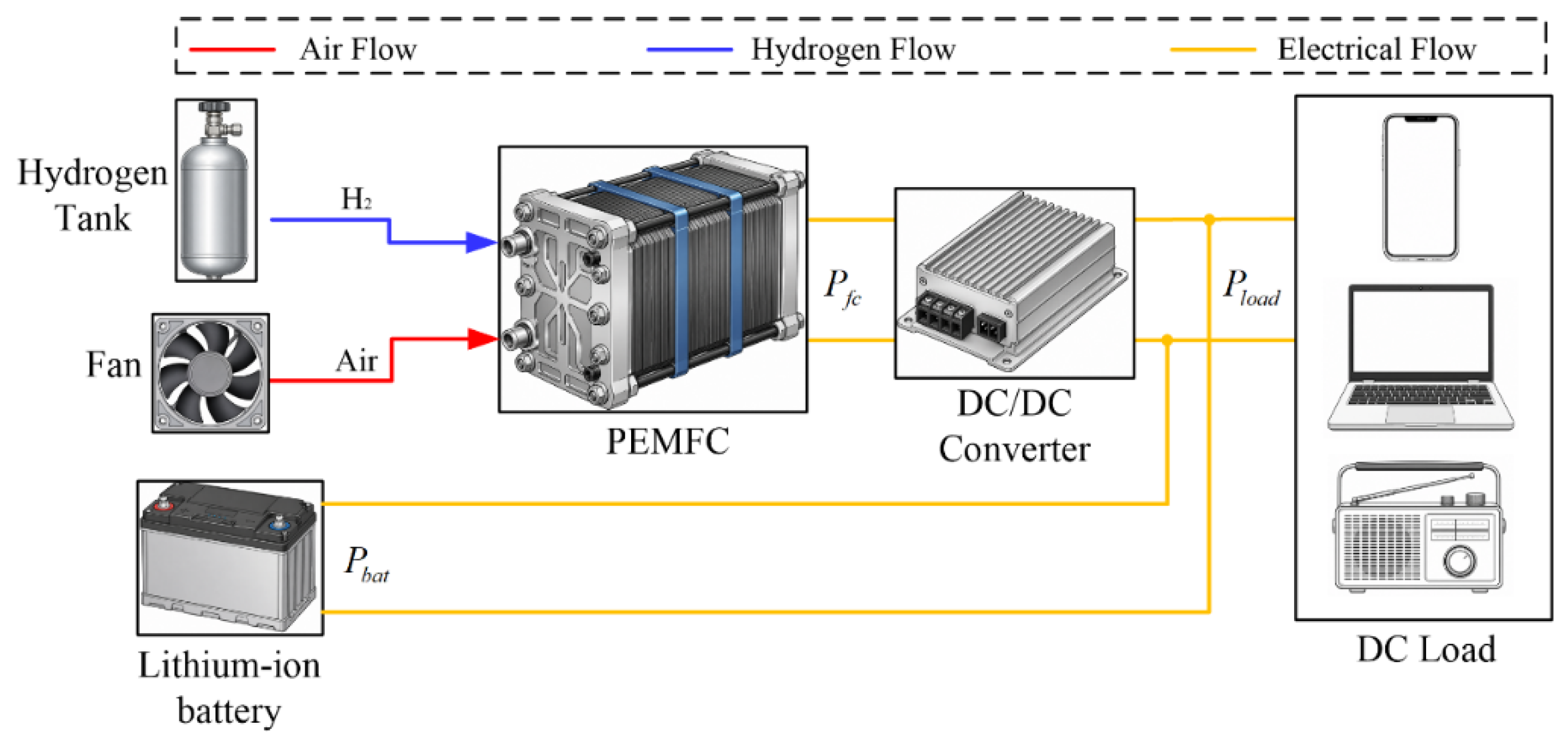
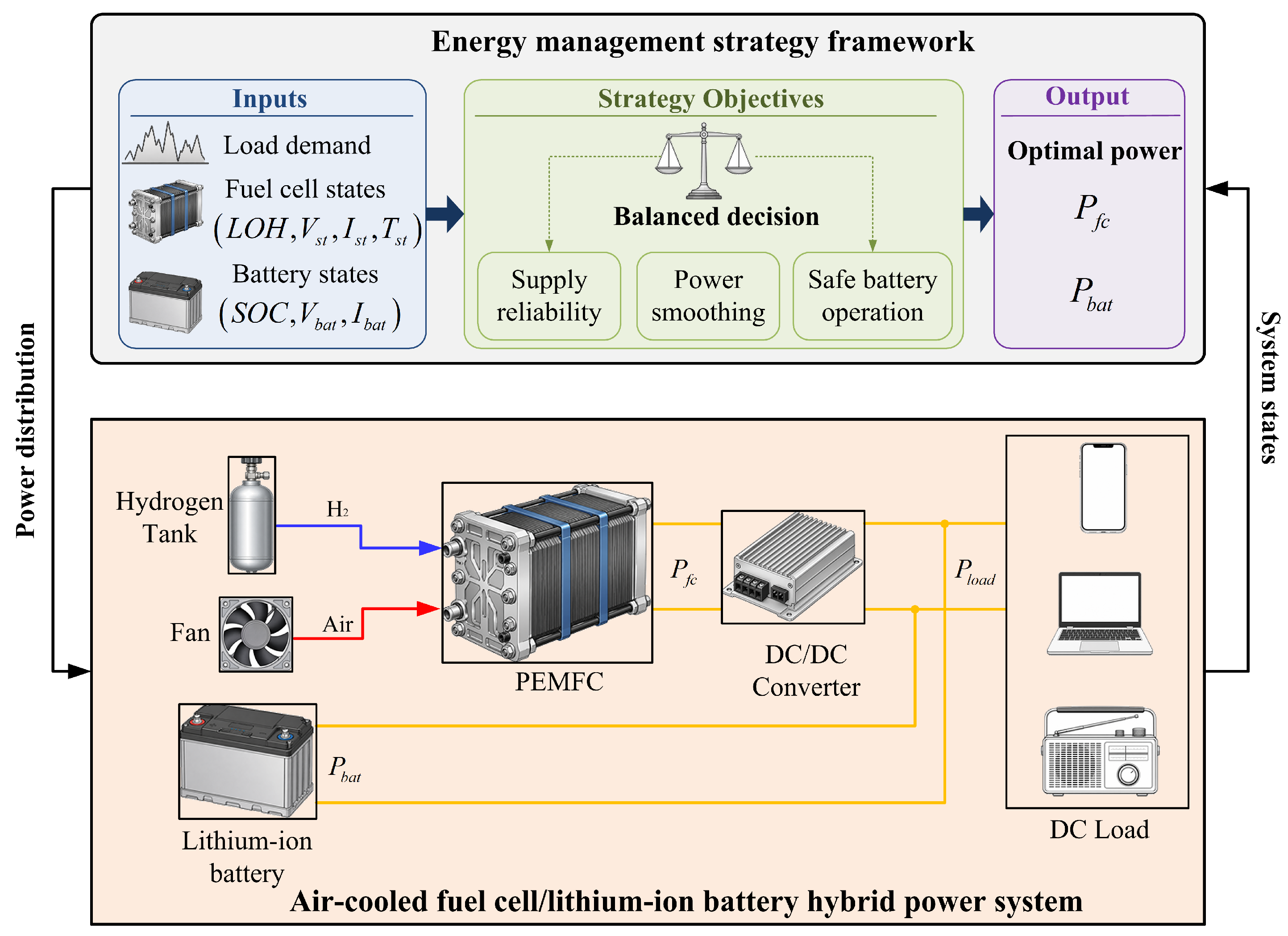
The topology of the portable air-cooled fuel cell/lithium-ion battery hybrid power system is illustrated in Figure 2. The system consists of a proton exchange membrane fuel cell stack, a lithium-ion battery pack, a DC/DC converter, a compressed-hydrogen tank, and auxiliary components. The component sizing is selected according to both the required power level and the functional roles of the two energy sources. The investigated fuel cell is a Horizon H-100 open-cathode air-cooled PEMFC stack with a rated power of 100 W and 20 cells. It serves as the primary energy source and is suitable for portable or off-grid equipment with power demands ranging from several tens of watts to approximately 100 W. At this power level, continuous operation for several hours requires several hundred watt-hours of energy, which is mainly supplied by the fuel cell through the onboard hydrogen storage. The LiFePO4 battery pack adopts a 4S1P configuration with four 3.2 V/5 Ah cells connected in series, giving a nominal voltage of 12.8 V and an energy capacity of approximately 64 Wh. If used independently for a 100 W load, its theoretical operating duration is only about 0.64 h. Therefore, the battery is mainly used as a transient power buffer to compensate for rapid load variations and peak power demand rather than as the dominant energy source. A 35 MPa, 2 L compressed-hydrogen cylinder is adopted to provide the main stored energy for multi-hour operation. Thus, the 100 W PEMFC determines the sustained power capability, the hydrogen tank determines the operating duration, and the 64 Wh battery provides short-term dynamic support. This configuration is suitable for portable communication, field monitoring, emergency power supply, and other off-grid applications requiring both endurance and fast load response.
Figure 2.
Topology of portable air-cooled fuel cell/lithium-ion battery hybrid power system.
The power balance equation of the hybrid power system is shown as
where , , and are the powers of the fuel cell, lithium-ion battery, cooling fan, and load. During operation, to meet the varying load demand (), the energy distribution between the fuel cell () and lithium-ion battery () must be determined. denotes the efficiency of the DC/DC converter. Since the fan speed varies during operation, its parasitic power consumption is not treated as a constant. Based on the experimental measurements reported in [22], the fan power consumption is represented as a function of the normalized fan operating command (uf).
The energy distribution should take the following factors into account:
- The power fluctuations of the fuel cell should not be too frequent, as this could affect its lifespan.
- The state of charge (SOC) of the lithium-ion battery must be maintained within a reasonable range, and overcharging or over-discharging should be avoided, as either condition may lead to battery damage.
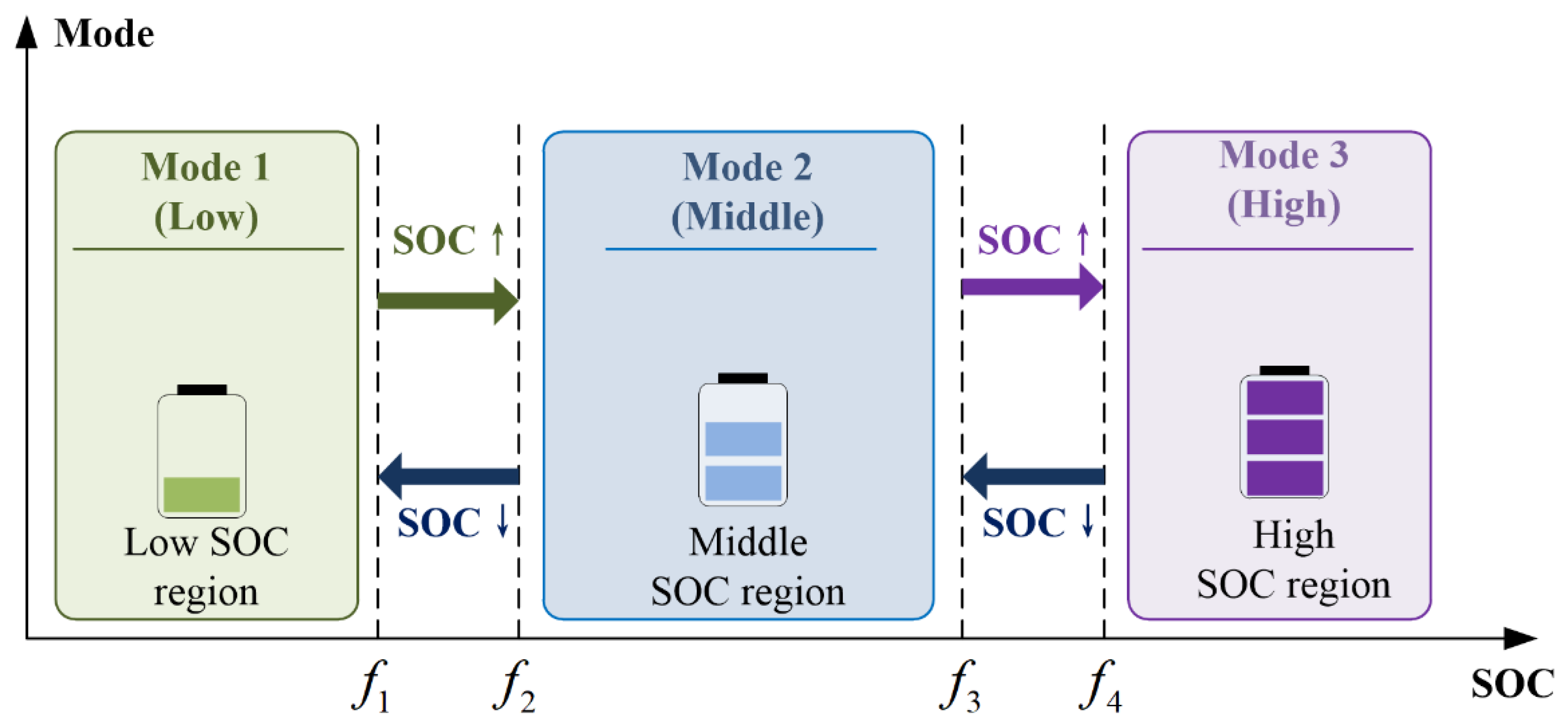
To address the aforementioned issues, an energy management strategy is developed for fuel cell/lithium-ion battery hybrid power systems, as illustrated in Figure 3. According to the load power demand and system states, the energy management strategy determines the power distribution between the lithium-ion battery and fuel cell, thereby ensuring that the system meets the power requirements under different operating conditions.
Figure 3.
Energy management strategy architecture of portable air-cooled fuel cell/lithium-ion battery hybrid power system.
3. PEMFC System Modeling
The fuel cell system model mainly consists of an electrochemical model and a thermal model. The development of these two components provides a physical modeling basis for analyzing the electrochemical and thermal behavior of the fuel cell system and for designing the energy management strategy.
3.1. Electrochemical Model
The fuel cell voltage () can be expressed as the sum of the Nernst voltage () and polarization losses, which can be written as follows [23]:
where , , , and denote the Nernst voltage, ohmic loss, concentration loss, and activation loss represented by an equivalent capacitance, respectively. represents the number of cells in the stack.
The Nernst voltage is related to temperature and the partial pressures of hydrogen and oxygen and can be expressed as follows [24]:
where is the stack temperature, is the hydrogen partial pressure at the anode, is the oxygen molar fraction in dry air, is the ambient pressure, is the ambient relative humidity, and is the saturation vapor pressure of water at the ambient temperature (). Therefore, represents the effective oxygen partial pressure in the humid cathode inlet air.
During the conduction of protons and electrons, resistances are encountered, which can be expressed as follows [25]:
where is the stack current, is the membrane protonic resistance, is the equivalent protonic resistance of the cathode catalyst layer, which can be calculated according to Ref. [25], and is the equivalent electronic and contact resistance.
is calculated as follows [26]:
where , , and represent the effective area of the membrane, thickness of the membrane, and water content of the membrane, respectively.
The concentration loss can be calculated as follows [26]:
where is the maximum current of the stack, is the universal gas constant, and is the Faraday constant.
The dynamic of the activation loss can be represented by an equivalent capacitance and an equivalent resistance. Accordingly, the voltage of the equivalent capacitance representing the activation loss can be modeled as
where is a constant value, is the equivalent capacitance voltage, and is the activation loss, which can be expressed as follows [26]:
where , , , and are the model parameters. denotes the oxygen concentration, which can be determined as follows [26]:
3.2. Thermal Model
According to energy conservation, the dynamics of the stack temperature can be expressed as
where is the heat power generated by the chemical reaction, is the stack electrical power, is the radiative heat power, and is the convective heat transfer power. represents the sensible heat carried away by the unreacted hydrogen discharged during periodic anode purging.
Therefore, the total hydrogen consumption rate () is expressed as
can be calculated by
where , , and are the mass flow rates. , , and are the mass specific enthalpies of hydrogen, oxygen, and water, respectively. , , and are the specific heat capacities of hydrogen, oxygen, and water, respectively. is the ambient temperature, and T0 = 273.15 K.
can be calculated by
can be calculated by
where and are constant parameters.
can be calculated by
where and represent the areas for natural convection and forced convection heat transfer, respectively. and represent the natural convection heat transfer coefficient and the forced convection heat transfer coefficient, which can be calculated as
where and are constant values. represents the fan opening degree.
3.3. Lithium-Ion Battery Model
In a hybrid power system, the battery serves to meet rapid and high-power demands and to store surplus energy generated by the PEMFC. The state of charge (SOC) is a critical parameter that reflects the operational condition of the battery and affects both its open-circuit voltage and internal resistance [27]. During the operation of a hybrid system, the SOC of the lithium-ion battery can be represented as
where is the capacity of the lithium-ion battery, and is the battery current.
The voltage of the battery can be calculated according to its equivalent circuit as follows [27]:
where is the battery open-circuit voltage, which is a function of the SOC, and is the battery resistance.
4. Energy Management Strategy Design
4.1. Rule-Based Energy Management Strategy
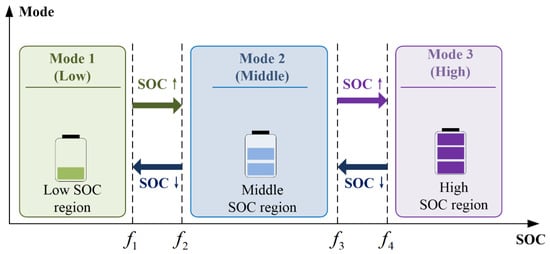
A rule-based energy management strategy is proposed according to the SOC of the lithium-ion battery, which is relatively simple in design and relies primarily on empirical knowledge. As shown in Figure 4, the rule-based energy management strategy is divided into three modes: Mode 1 (Low), Mode 2 (Middle), and Mode 3 (High) on the SOC of the lithium-ion battery. Transitions between these modes are primarily determined by the current SOC. For instance, a shift to Mode 2 occurs when the SOC rises to f2, while switching back to Mode 1 from Mode 2 happens when the SOC drops to f1. Similarly, the transition from Mode 2 to Mode 3 occurs when the SOC increases to f4, whereas the transition from Mode 3 back to Mode 2 occurs when the SOC decreases to f3.
Figure 4.
Rule-based energy management strategy for air-cooled fuel cell/lithium-ion battery hybrid power system.
4.2. Model Predictive Control-Based Energy Management Strategy
The rule-based energy management strategy described above determines the operating mode mainly according to the battery SOC. Although this strategy is simple and easy to implement, its power distribution performance depends strongly on empirical thresholds and cannot explicitly predict the future evolution of system states. To improve the coordination between the fuel cell and lithium-ion battery under dynamic load demand, an MPC-based energy management strategy is developed in this section.
The proposed MPC-based strategy consists of three main procedures: state prediction, constrained optimization, and receding-horizon implementation. At each sampling instant, the current system states and load power demand are first obtained. Then, the future evolutions of the battery SOC and hydrogen tank LOH are predicted over the prediction horizon using a discrete-time state-space model. Based on the predicted states, an optimization problem is solved to determine the fuel cell power command and battery power command under physical constraints. Finally, only the first element of the optimized control sequence is applied to the hybrid power system, and the optimization process is repeated at the next sampling instant.
To satisfy the real-time implementation requirement of the embedded controller, a reduced-order linear discrete-time model is adopted for online prediction. The battery SOC and hydrogen tank LOH are selected as the main energy states, representing the electrical energy-buffering capability of the lithium-ion battery and the remaining hydrogen-energy state, respectively. The prediction model is expressed as
where and .
The system matrices are given by
where is the sampling period, denotes the equivalent fuel cell energy conversion efficiency, and denotes the equivalent battery charge/discharge efficiency used in the SOC prediction model. represents the initial available hydrogen energy in the storage tank, while denotes the nominal energy capacity of the lithium-ion battery and is calculated as
Since the lithium-ion battery is directly connected to the DC bus, is defined as the battery power exchanged with the DC bus. Therefore, the load demand is introduced through the system power balance constraint rather than as an additive disturbance in the state equation:
denotes the initial available hydrogen energy in the storage tank. In this study, a 35 MPa, 2 L compressed gaseous hydrogen cylinder is adopted. Considering the non-ideal behavior of hydrogen under high-pressure conditions, the initial hydrogen amount is determined using the Van der Waals equation:
where , , and denote the pressure, volume, and temperature of the hydrogen storage cylinder, respectively; is the initial amount of hydrogen; and a and b are the Van der Waals constants of hydrogen. The initial hydrogen mass is calculated as , and the corresponding available hydrogen energy is expressed as
The objective function of the MPC-based energy management strategy is designed to achieve the coordinated operation of the hybrid power system. First, the battery SOC is regulated to maintain sufficient energy-buffering capability for transient load variations. Second, the LOH is considered to limit excessive hydrogen-energy depletion over the prediction horizon. Third, the power variations in the fuel cell and lithium-ion battery are penalized to suppress abrupt power changes. Based on these considerations, the objective function is formulated as
subject to
where and denote the prediction horizon and control horizon, respectively. The weighting coefficients () correspond to different terms in the objective function. and represent the reference values of the battery SOC and hydrogen level, respectively. and indicate the power variations in the fuel cell and lithium-ion battery, respectively.
To solve the above optimization problem subject to the operating constraints, it is reformulated as a constrained quadratic programming problem:
where denotes the upper bound of , represents the coefficient vector of the linear term, and is a positive-definite Hessian matrix. Since the Hessian matrix (H) is positive-definite and the constraints are linear, the formulated quadratic programming problem is strictly convex over a convex feasible set. Therefore, if the feasible set is nonempty, the optimization problem admits a unique optimal solution within the prediction horizon. The active-set algorithm is adopted to solve the constrained quadratic programming problem by iteratively estimating the active constraints and solving the corresponding equality-constrained subproblems. At each sampling instant, the current system states are updated, the quadratic programming problem is solved, and the first element of the optimized control sequence is applied to the hybrid power system in a receding-horizon manner. The overall solution procedure is summarized as follows (Algorithm 1).
| Algorithm 1: Active-Set Method |
| 1. Reformulate the optimization problem as a constrained quadratic programming problem |
| 2. Initialize |
| 3. Repeat steps , At each time step , update and solve the optimization problem |
| 3.1. Define , |
| 3.2. Transform into , |
| 3.3. Define |
| 3.4. If , |
| 3.5. Calculate , If , return to Step 3.3; If , calculate |
| 3.6. If , , return to Step 3.5; If , the optimal solution is obtained. |
5. Results and Discussion
In this section, the proposed MPC-based energy management strategy is evaluated on a 100 W air-cooled fuel cell/lithium-ion battery hybrid power system. The modeling parameters of the hybrid power system are listed in Table 1, and the designed parameters of the energy management strategies are given in Table 2. To verify the effectiveness of the proposed strategy, comparative studies are conducted between the MPC-based strategy and the conventional rule-based strategy. The evaluation includes three simulation conditions and one hardware-in-the-loop experimental condition.
Table 1.
Modeling parameters for 100 W fuel cell/lithium-ion battery hybrid power system.
Table 2.
Designed parameters for energy management strategy.
5.1. Simulation Results and Discussion
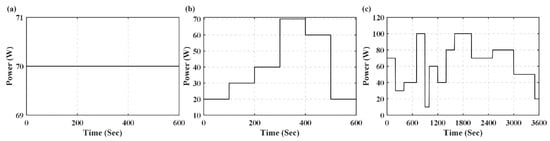
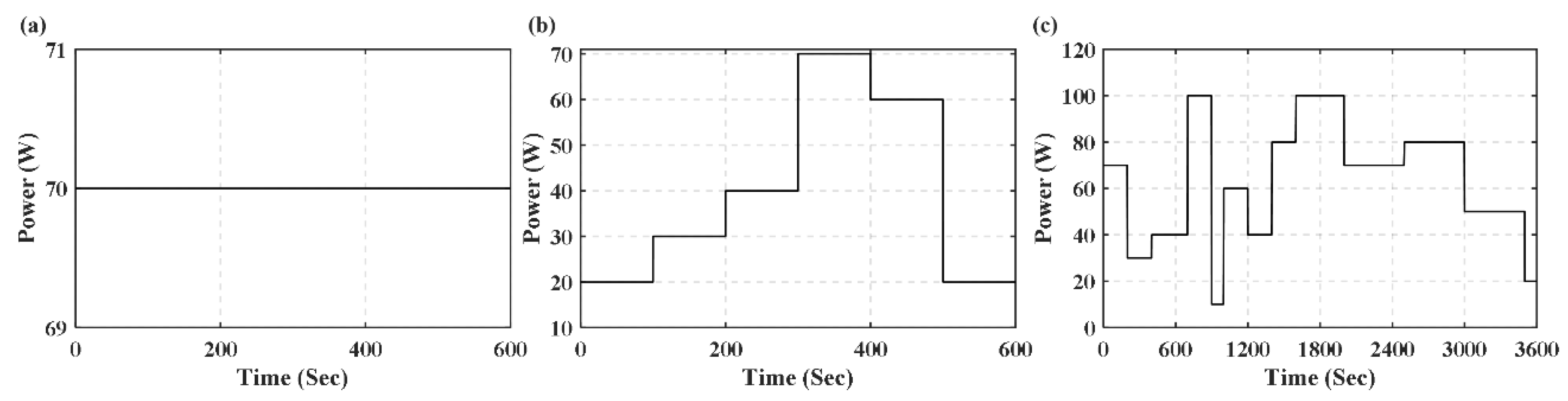
To evaluate the performance of the proposed strategy under different load characteristics, three typical operating conditions are considered—Condition 1, the rated-power condition; Condition 2, the short-duration load variation condition; and Condition 3, the long-duration load variation condition—as shown in Figure 5. These conditions are used to examine the power distribution behavior, fuel cell power smoothing effect, hydrogen consumption, and battery SOC regulation capability of the two energy management strategies.
Figure 5.
Load power profiles under different operating conditions: (a) rated-power condition; (b) short-duration load variation condition; (c) long-duration load variation condition.
Condition 1: Rated-power condition
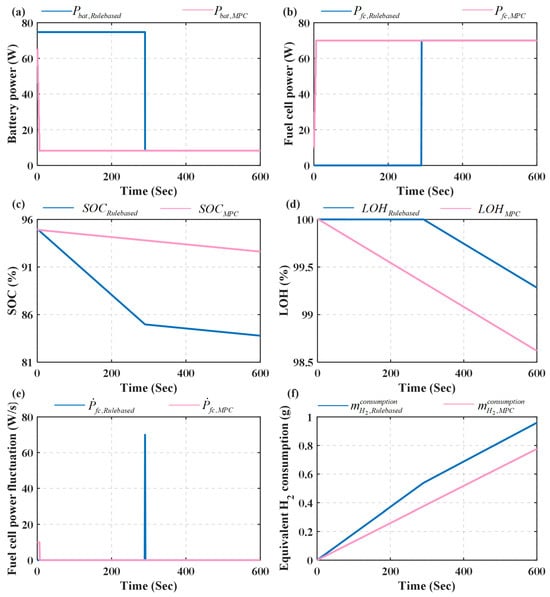
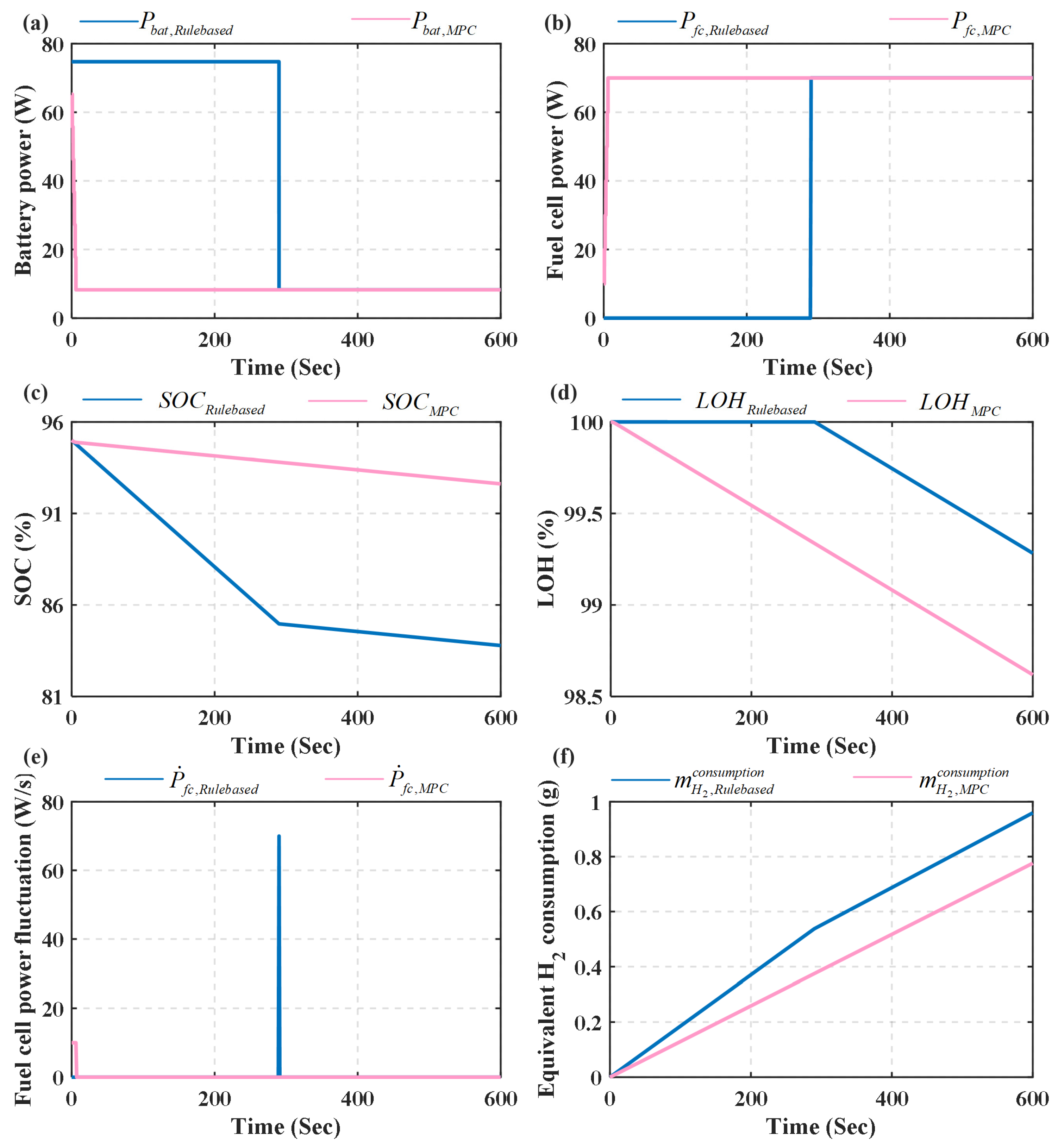
To evaluate the performances of the two energy management strategies under the rated-load condition, comparative simulations were conducted, and the results are presented in Figure 6. As shown in Figure 6a,b, the rule-based strategy delays fuel cell participation until the switching condition is reached, causing the battery to supply most of the load during the initial stage. This results in a pronounced SOC decrease, as shown in Figure 6c, while the LOH remains relatively high because less hydrogen is consumed during this period, as shown in Figure 6d. In contrast, the MPC strategy activates the fuel cell earlier and coordinates the fuel cell and battery powers throughout the operating period. As a result, the battery SOC remains at a higher level, while the fuel cell output varies much more smoothly. Figure 6e further shows that the maximum fuel cell power fluctuation under the MPC strategy is limited to approximately 10 W/s, whereas the rule-based strategy produces a much larger fluctuation of about 70 W/s during mode switching.
Figure 6.
Simulation results under Condition 1: (a) battery power; (b) fuel cell power; (c) battery SOC; (d) LOH of hydrogen tank; (e) fuel cell power fluctuation; (f) equivalent hydrogen consumption.
The smoother power response and lower equivalent hydrogen consumption arise from the internal optimization mechanism of MPC. Over the prediction horizon, MPC anticipates the future evolution of the SOC and LOH and penalizes the excessive deviation of these states from their reference values. At the same time, the penalty on fuel cell power variation and the explicit ramp-rate constraint suppress abrupt changes in the Pfc, thereby shaping a more gradual and coordinated power allocation between the fuel cell and battery. Although the earlier use of the fuel cell leads to greater direct hydrogen consumption, the battery is discharged much less deeply. When the depleted battery energy is converted into equivalent hydrogen consumption, the reduction in battery-derived equivalent hydrogen exceeds the additional direct hydrogen consumption. Consequently, as shown in Figure 6f, the MPC strategy achieves a lower total equivalent hydrogen consumption while simultaneously reducing fuel cell power fluctuation and maintaining a higher battery SOC.
Condition 2: Short-duration load variation condition
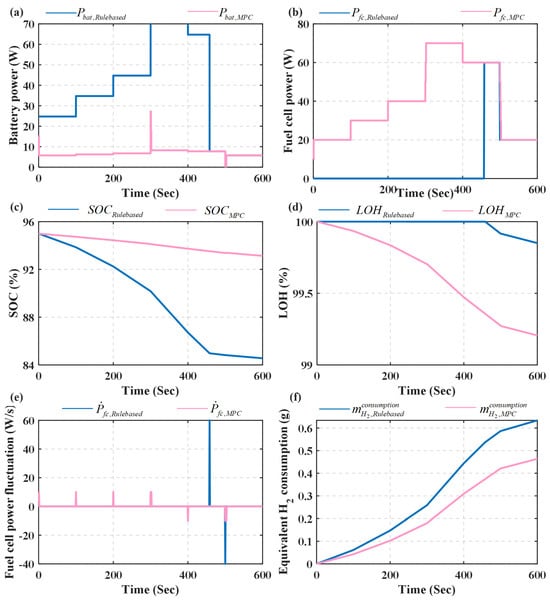
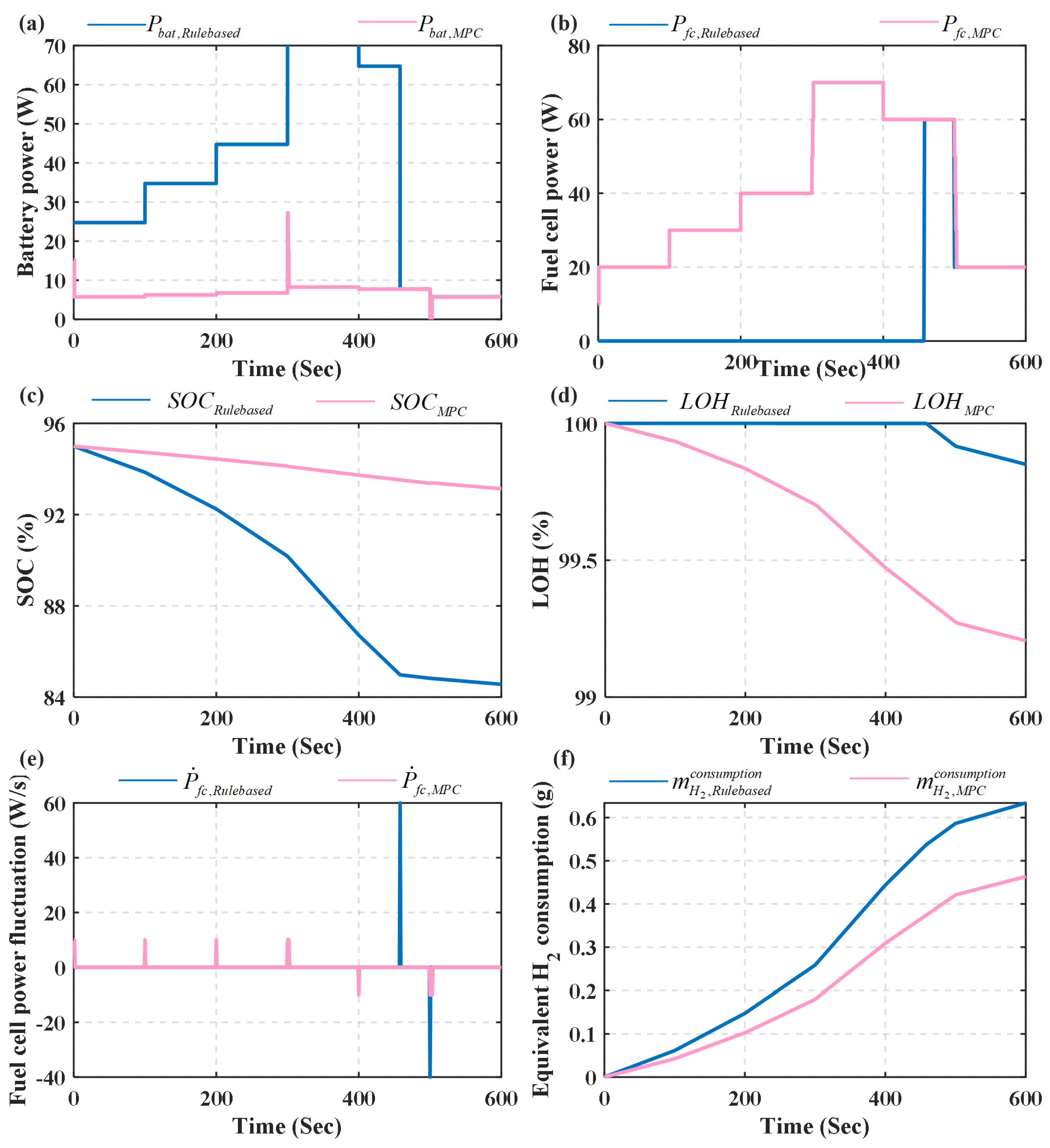
Figure 7 presents the comparative results under the short-duration load variation condition. As shown in Figure 7a,b, the rule-based strategy relies heavily on the battery during most of the operating period, while the fuel cell remains inactive until approximately 480 s. Consequently, the battery power increases continuously with the load demand, resulting in a pronounced SOC decrease from approximately 95% to 84.5%, as shown in Figure 7c. In contrast, the MPC strategy adjusts the fuel cell output in advance according to the varying load demand and maintains the battery power at a relatively low level so that the final SOC remains above 93%. The corresponding LOH evolution in Figure 7d shows that MPC consumes more hydrogen directly because of the earlier and more sustained participation of the fuel cell. However, Figure 7e demonstrates that the fuel cell power variation under MPC is generally limited to approximately ±10 W/s during load transitions, whereas the rule-based strategy produces much larger power changes of approximately 60 W/s and −40 W/s during mode switching.
Figure 7.
Simulation results under Condition 2: (a) battery power; (b) fuel cell power; (c) battery SOC; (d) LOH of hydrogen tank; (e) fuel cell power fluctuation; (f) equivalent hydrogen consumption.
The above behavior originates from the predictive and constrained optimization mechanism of MPC. Within the prediction horizon, future SOC depletion caused by excessive battery utilization is anticipated in advance, which drives the optimizer to allocate a larger proportion of the sustained load to the fuel cell. Meanwhile, the penalty on the ΔPfc and the explicit ramp-rate constraint prevent the fuel cell power from following abrupt load variations directly, leaving the battery to compensate only for short-term transient power mismatch. This coordinated allocation explains both the smoother fuel cell response and the higher remaining SOC. Although the direct hydrogen consumption under MPC is higher, the reduced battery energy depletion substantially decreases the battery-derived equivalent hydrogen consumption. As a result, the total equivalent hydrogen consumption at 600 s is reduced from approximately 0.63 g under the rule-based strategy to approximately 0.46 g under MPC, as shown in Figure 7f, indicating improved system-level energy utilization under short-duration load variations.
Condition 3: Long-duration load variation condition
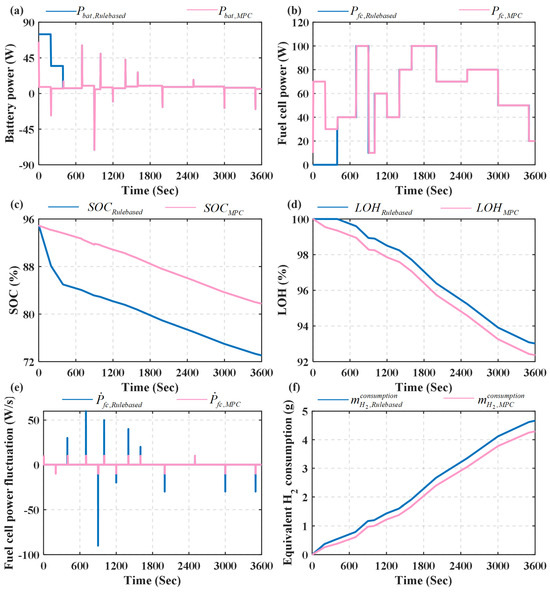
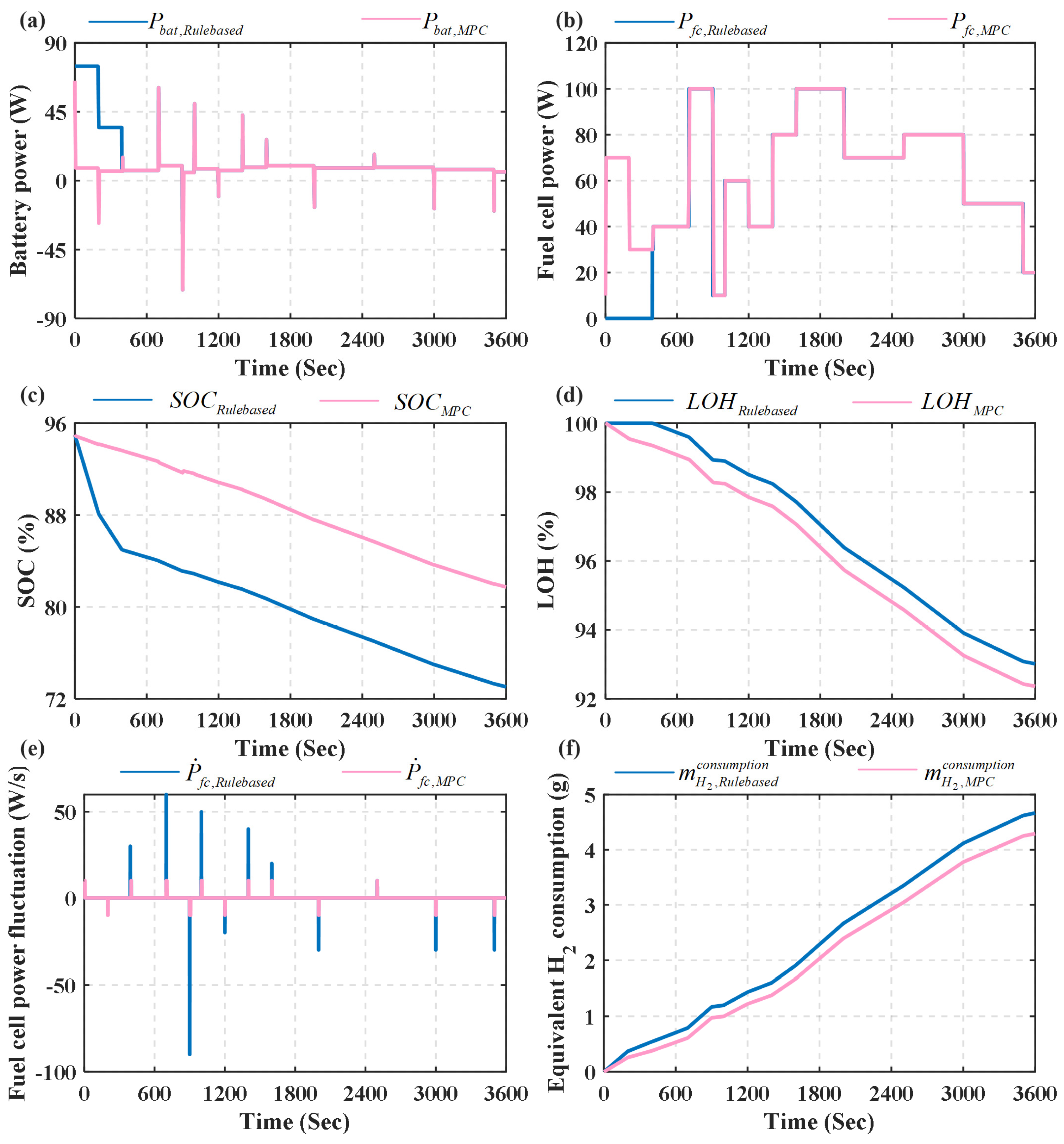
Figure 8 presents the comparative results under the long-duration load variation condition. As shown in Figure 8a,b, the rule-based strategy exhibits pronounced switching behavior between the fuel cell and battery as the load changes, resulting in large transient battery power excursions and abrupt fuel cell power variations. Consequently, the battery SOC decreases substantially from approximately 95% to 73%, as shown in Figure 8c. In comparison, the MPC strategy continuously coordinates the fuel cell and battery powers over the entire operating period. The fuel cell supplies most of the sustained load demand, while the battery mainly compensates for transient power mismatches, thereby maintaining the final SOC at approximately 81%. Figure 8d shows that the MPC strategy consumes slightly more hydrogen directly, as reflected by the slightly lower remaining LOH. However, the fuel cell power fluctuation in Figure 8e is significantly suppressed. The rule-based strategy produces several large positive and negative power variations, with peak values approaching +60 W/s and −90 W/s, whereas the MPC strategy generally limits the fluctuation to a much narrower range.
Figure 8.
Simulation results under Condition 3: (a) battery power; (b) fuel cell power; (c) battery SOC; (d) LOH of hydrogen tank; (e) fuel cell power fluctuation; (f) equivalent hydrogen consumption.
The improved behavior under MPC results from the combined effect of future-state prediction, SOC regulation, and fuel cell ramp-rate constraints. Over the prediction horizon, MPC anticipates the cumulative SOC depletion caused by repeated battery-dominated operation and therefore reallocates more of the sustained energy demand to the fuel cell before excessive battery discharge occurs. Meanwhile, the penalty on the ΔPfc and the explicit ramp-rate constraint prevent the fuel cell from directly tracking rapid load changes, so the battery is used primarily as a short-term buffer rather than as the main energy source. This mechanism reduces both long-term battery depletion and abrupt fuel cell power changes. As shown in Figure 8f, although the MPC strategy uses slightly more direct hydrogen, the reduction in battery energy depletion leads to a lower total equivalent hydrogen consumption, decreasing from approximately 4.7 g under the rule-based strategy to about 4.3 g under MPC. This indicates that the MPC strategy provides better system-level energy utilization and power smoothing under long-duration and highly variable load conditions.
The performance of the proposed MPC strategy is affected by the selection of the prediction horizon, weighting coefficients, fuel cell ramp-rate limits, and battery transient power capability. An excessively short prediction horizon may weaken the capability of MPC to anticipate future SOC evolution, whereas an overly restrictive fuel cell ramp-rate constraint may transfer excessive transient power demand to the battery and accelerate SOC depletion. In addition, increasing the prediction horizon increases the computational burden of the online optimization. Therefore, the MPC parameters should be selected according to the amplitude and frequency characteristics of the load variation and the available transient power capability of the battery.
5.2. Experimental Results and Discussion
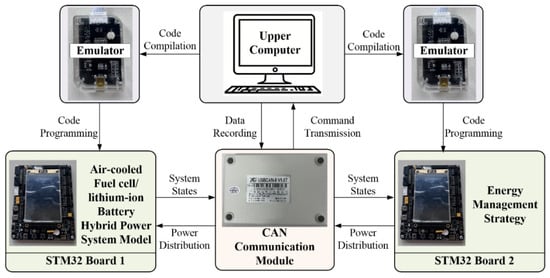
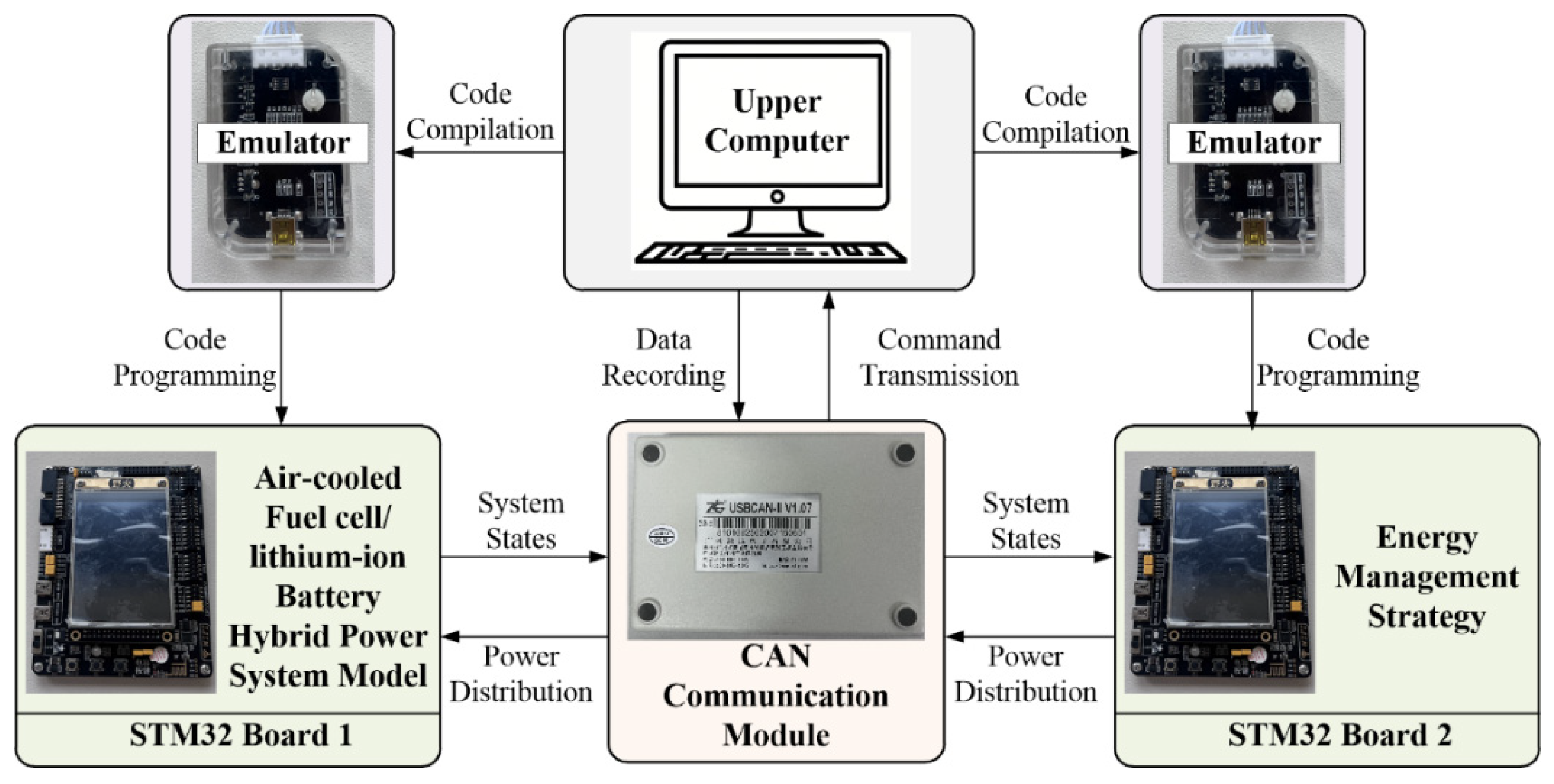
To verify the real-time feasibility of the proposed energy management strategy, hardware-in-the-loop experiments were conducted. The experimental validation platform is shown in Figure 9. Two STM32F417IG development boards are used in the experiment. The STM32F417IG is based on a 32-bit Arm Cortex-M4 core, with a maximum operating frequency of 168 MHz, 1 MB Flash memory, and up to 192 KB SRAM. One board runs the air-cooled fuel cell/lithium-ion battery hybrid power system model, while the other board executes the MPC-based energy management strategy. The base sampling period is set to 0.01 s. For the MPC implementation, the prediction horizon and control horizon are selected as 10 and 2, respectively. The two boards exchange system states and power distribution commands through the CAN communication module. The host computer is used for code generation, data recording, and communication monitoring. Under this embedded configuration, the controller operates continuously during the HIL experiments, which provided a practical platform for evaluating the real-time implementation capability of the proposed energy management strategy.
Figure 9.
Hardware-in-the-loop experiment platform.
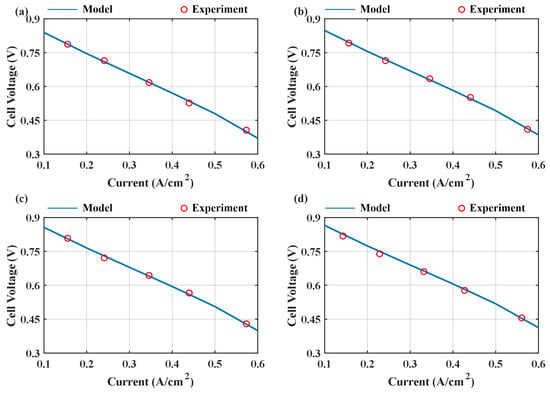
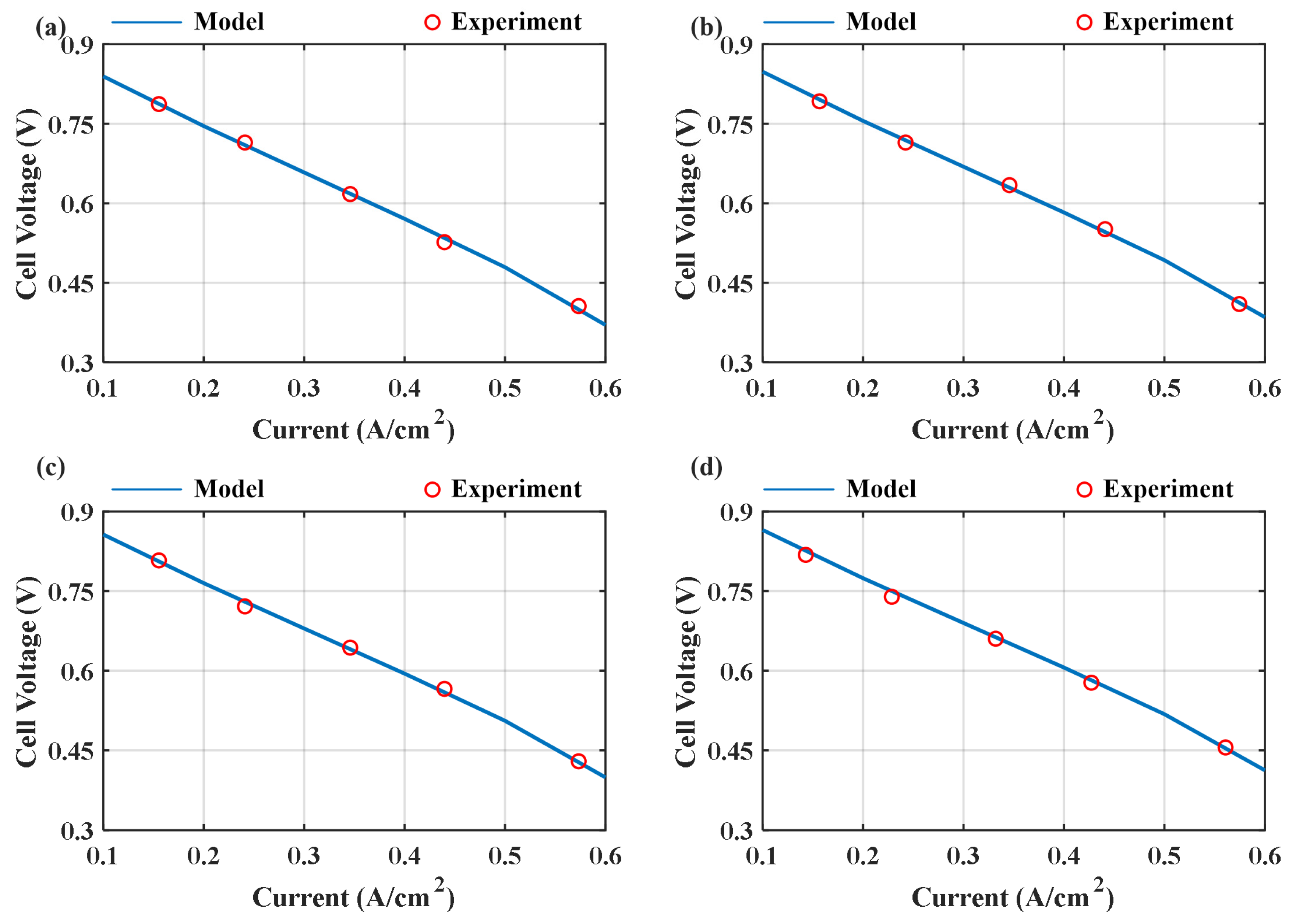
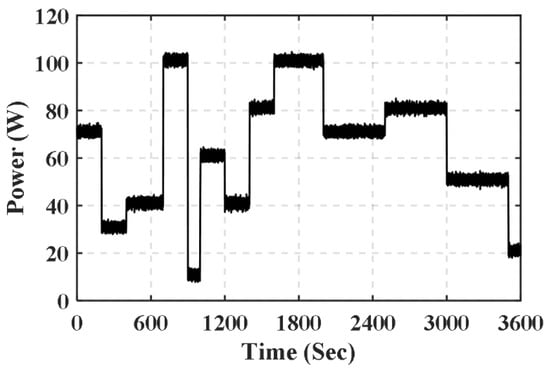
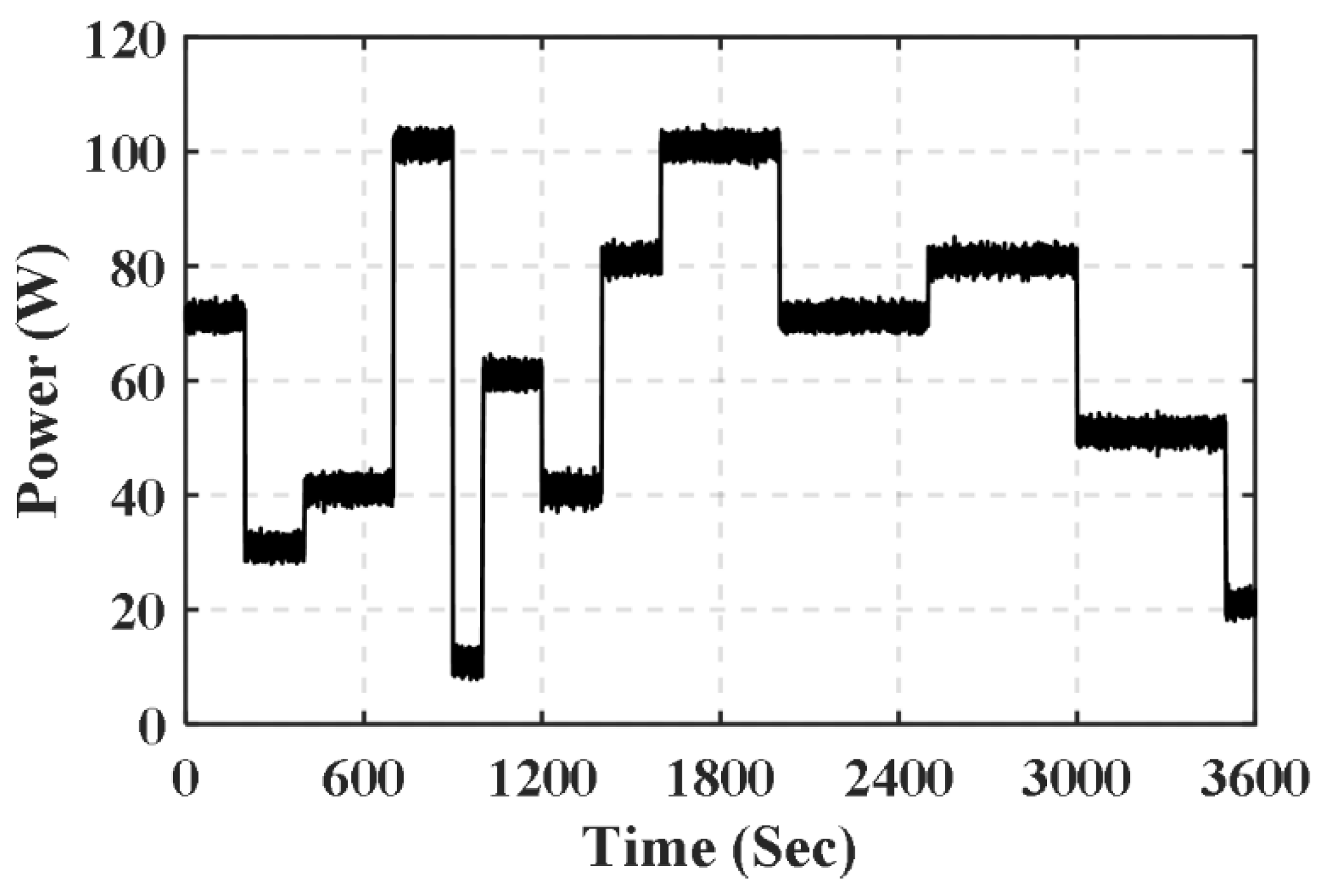
Before evaluating the energy management strategies, the established cell voltage model was validated under different stack temperature conditions, as shown in Figure 10. Specifically, the model predictions were compared with the experimental data at Tst = 333.15 K, 338.15 K, 343.15 K, and 348.15 K. The results show that the model was able to accurately reproduce the variation in the cell voltage with the current density over the tested temperature range, and good agreement was achieved between the calculated and experimental values under all four conditions. This indicates that the established electrochemical model can reasonably capture the temperature-dependent voltage characteristics of the PEMFC and is suitable for subsequent control-oriented simulation and HIL implementation. Considering that the load power in practical applications is usually affected by fluctuations and noise disturbances, the experimental load condition is designed as shown in Figure 11. The experiments were conducted under normal laboratory ambient conditions without active humidity control, and a representative ambient relative humidity of RHamb = 50% was adopted in the model calculations.
Figure 10.
Model validation of cell voltage under different stack temperatures: (a) Tst = 333.15 K; (b) Tst = 338.15 K; (c) Tst = 343.15 K; (d) Tst = 348.15 K.
Figure 11.
Experimental load condition.
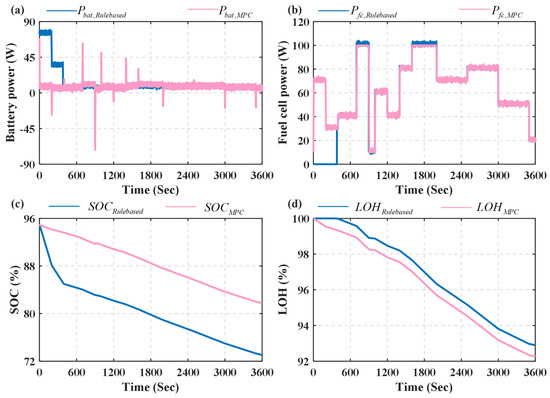
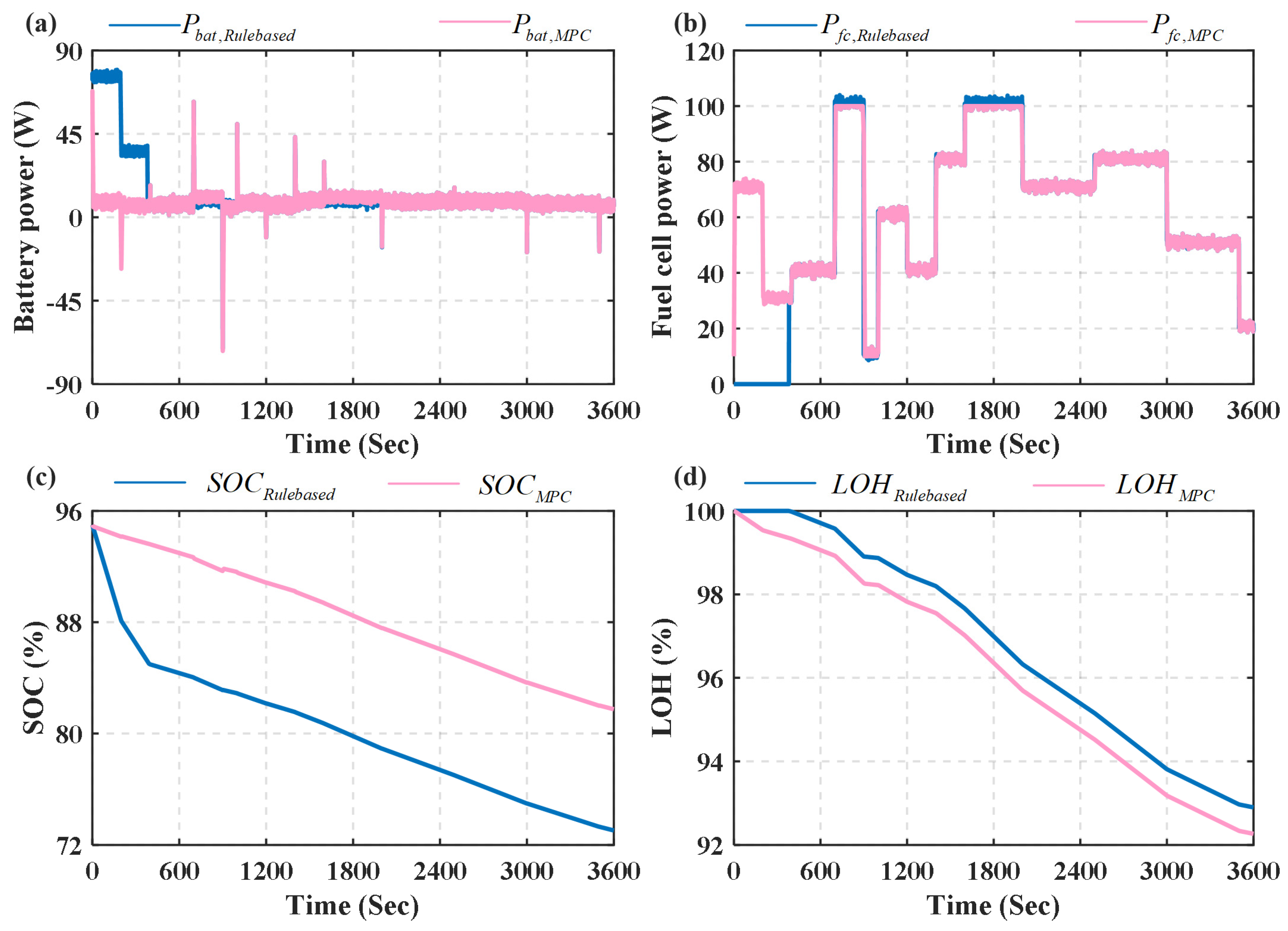
Experimental validation under the same operating condition is presented in Figure 12. As shown in Figure 12a,b, both the MPC-based and rule-based energy management strategies were successfully implemented on the practical control board and operated continuously for 1 h, demonstrating the real-time feasibility of the proposed implementation. Despite load fluctuations and measurement noise, the MPC-based strategy maintained stable operation throughout the test. Compared with the rule-based strategy, the MPC-based strategy produced a markedly smoother fuel cell power trajectory during load variations. In particular, abrupt fuel cell power changes were effectively suppressed, which is consistent with the power variation penalty and ramp-rate constraint incorporated into the MPC formulation.
Figure 12.
Experimental results of different energy management strategies: (a) battery power; (b) fuel cell power; (c) battery SOC; (d) LOH of hydrogen tank.
The corresponding battery SOC and hydrogen level evolutions are shown in Figure 12c and Figure 12d, respectively. The MPC-based strategy maintained a higher battery SOC over the 1 h test, while the LOH decreased continuously as hydrogen was consumed. These experimental trends are consistent with the simulation results, indicating that the proposed MPC can coordinate fuel cell and battery power allocation while maintaining the system energy states within the prescribed operating range. Overall, the HIL results confirm the real-time implementability of the proposed strategy and its effectiveness at smoothing fuel cell power under long-duration variable-load conditions.
6. Conclusions
In this paper, a control-oriented lumped-parameter model and an MPC-based energy management strategy are developed for portable air-cooled fuel cell/lithium-ion battery hybrid power systems. The established model considers the fuel cell voltage characteristics, stack temperature dynamics, lithium-ion battery SOC, and hydrogen tank LOH, providing a physical modeling basis for the analysis of the electrical, thermal, and energy-state characteristics of the hybrid system. Based on this model, the MPC-based strategy was designed to coordinate the power distribution between the fuel cell and lithium-ion battery while satisfying physical constraints, including SOC bounds, LOH bounds, power limits, and fuel cell ramp-rate limits.
Simulation studies were conducted under rated-power, short-duration load variation, and long-duration load variation conditions. Compared with the conventional rule-based strategy, the proposed MPC-based strategy achieved smoother fuel cell power regulation and more coordinated energy distribution. In particular, the fuel cell power variation rate was generally constrained to approximately 10 W/s under the investigated conditions, which was significantly lower than that obtained with the rule-based strategy. The MPC-based strategy also maintained the battery SOC at a higher level and reduced the total equivalent hydrogen consumption under the tested operating conditions, indicating improved system-level energy utilization while preserving the battery energy-buffering capability.
Hardware-in-the-loop experiments were further carried out on an STM32-based validation platform to evaluate the real-time feasibility of the proposed strategy. The experimental results showed that the MPC-based strategy could operate continuously for 1 h on the practical controller. Compared with the rule-based strategy, the proposed method reduced the maximum fuel cell power variation rate by 85.7%, confirming its effectiveness at suppressing rapid fuel cell power variations under practical load disturbances. These results indicate that the proposed strategy provides a favorable balance among load power satisfaction, fuel cell power smoothing, battery SOC regulation, energy utilization, and embedded implementation feasibility.
Author Contributions
Conceptualization, Q.L.; methodology, W.C.; software, W.C. and J.C.; validation, W.C., L.S. and B.H.; formal analysis, W.C. and Q.Z.; investigation, L.S. and B.H.; resources, Q.L. and Q.Z.; data curation, L.S. and J.C.; writing—original draft preparation, W.C.; writing—review and editing, W.C., Q.L., Q.Z. and B.H.; visualization, W.C. and J.C.; supervision, Q.L.; funding acquisition, Q.L. All authors have read and agreed to the published version of the manuscript.
Funding
This research was funded by the Key Research and Development Program of Shandong Province, grant number 2019GGX104107.
Data Availability Statement
The data supporting the findings of this study are available from the corresponding author upon reasonable request.
Conflicts of Interest
Author Jianhui Chen was employed by the company 21C Innovation Laboratory, Contemporary Amperex Technology Co. Author Binbin He was employed by the company Contemporary Amperex Technology Co. The remaining authors declare that the research was conducted in the absence of any commercial or financial relationships that could be construed as potential conflicts of interest.
Nomenclature
| Component | Abbreviation | Description | Unit |
| General | PEMFC | Proton exchange membrane fuel cell | |
| EMS | Energy management strategy | ||
| MPC | Model predictive control | ||
| HIL | Hardware-in-the-loop | ||
| Fuel cell | Pfc | Fuel cell power | W |
| Vst | Fuel cell stack voltage | V | |
| Ist | Fuel cell stack current | A | |
| Tst | Fuel cell stack temperature | K | |
| ENernst | Nernst voltage | V | |
| Vohm | Ohmic voltage loss | V | |
| Vcon | Concentration voltage loss | V | |
| Vact | Activation voltage loss | V | |
| RM | Membrane protonic resistance | Ω | |
| RCL | Cathode catalyst-layer protonic resistance | Ω | |
| RC | Electronic and contact resistance | Ω | |
| pH2 | Hydrogen partial pressure at anode | Pa | |
| yO2 | Oxygen molar fraction in dry air | - | |
| pamb | Ambient pressure | Pa | |
| RHamb | Ambient relative humidity | - | |
| psat | Saturation vapor pressure of water | Pa | |
| Pfan | Cooling fan parasitic power | W | |
| uf | Fan operating command | - | |
| ηfc | Fuel cell energy conversion efficiency | - | |
| Battery | SOC | State of charge | |
| Pbat | Battery power | W | |
| Vbat | Battery voltage | V | |
| Ibat | Battery current | A | |
| Cbat | Battery rated capacity | Ah | |
| Ebat | Nominal battery energy capacity | J | |
| ηbat | Battery charge/discharge efficiency | - | |
| Hydrogen tank | LOH | Level of hydrogen | - |
| ptank | Hydrogen tank pressure | MPa | |
| Vtank | Hydrogen tank volume | L | |
| Ttank | Hydrogen tank temperature | K | |
| nH2,0 | Initial amount of hydrogen | mol | |
| mH2,0 | Initial hydrogen mass | kg | |
| MH2 | Molar mass of hydrogen | kg/mol | |
| LHVH2 | Lower heating value of hydrogen | J/kg | |
| EH2 | Initial available hydrogen energy | J | |
| Power electronics | Pload | Load power | W |
| ηdc | DC/DC converter efficiency | - |
References
- Sulaiman, N.; Hannan, M.A.; Mohamed, A.; Majlan, E.H.; Wan Daud, W.R. A review on energy management system for fuel cell hybrid electric vehicle: Issues and challenges. Renew. Sustain. Energy Rev. 2015, 52, 802–814. [Google Scholar] [CrossRef] [Scilit]
- Vichard, L.; Steiner, N.Y.; Zerhouni, N.; Hissel, D. Hybrid fuel cell system degradation modeling methods: A comprehensive review. J. Power Sources 2021, 506, 230071. [Google Scholar] [CrossRef] [Scilit]
- Pan, M.; Fu, C.; Cao, X.; Guan, W.; Liang, L.; Li, D.; Gu, J.; Tan, D.; Zhang, Z.; Man, X.; et al. An energy management strategy for fuel cell hybrid electric vehicle based on HHO-BiLSTM-TCN-self attention speed prediction. Energy 2024, 307, 132734. [Google Scholar] [CrossRef] [Scilit]
- Zhao, X.; Wang, L.; Zhou, Y.; Pan, B.; Wang, R.; Wang, L.; Yan, X. Energy management strategies for fuel cell hybrid electric vehicles: Classification, comparison, and outlook. Energy Convers. Manag. 2022, 270, 116179. [Google Scholar] [CrossRef] [Scilit]
- Min, H.; Wu, H.; Zhao, H.; Sun, W.; Yu, Y. Research on energy management strategy for fuel cell hybrid electric vehicles based on multi-scale information fusion. Appl. Energy 2024, 368, 123486. [Google Scholar] [CrossRef] [Scilit]
- Zuo, J.; Steiner, N.Y.; Li, Z.; Hissel, D. Health management review for fuel cells: Focus on action phase. Renew. Sustain. Energy Rev. 2024, 201, 114613. [Google Scholar] [CrossRef] [Scilit]
- García-Salaberri, P.A.; Sánchez-Ramos, A. Modeling of a polymer electrolyte membrane fuel cell with a hybrid continuum/discrete formulation at the rib/channel scale: Effect of relative humidity and temperature on performance and two-phase transport. Appl. Energy 2024, 367, 123332. [Google Scholar] [CrossRef] [Scilit]
- Kravos, A.; Vrlić, M.; Hametner, C.; Jakubek, S.; Katrašnik, T. Real-time capable nonlinear distributed parameter observer considering two-phase flow in PEM fuel cells. Int. J. Hydrogen Energy 2025, 134, 181–197. [Google Scholar] [CrossRef] [Scilit]
- Rašić, D.; Katrašnik, T. Multi-domain and Multi-scale model of a fuel cell electric vehicle to predict the effect of the operating conditions and component sizing on fuel cell degradation. Energy Convers. Manag. 2022, 268, 116024. [Google Scholar] [CrossRef] [Scilit]
- Xiong, Z.; Yuan, Y.; Tong, L.; Li, X.; Shen, B. Dynamic performance analysis of proton exchange membrane fuel cell in marine applications. Energy 2024, 310, 133218. [Google Scholar] [CrossRef] [Scilit]
- Shi, H.; Wang, S.; Wang, L.; Xu, W.; Fernandez, C.; Dablu, B.E.; Zhang, Y. On-line adaptive asynchronous parameter identification of lumped electrical characteristic model for vehicle lithium-ion battery considering multi-time scale effects. J. Power Sources 2022, 517, 230725. [Google Scholar] [CrossRef] [Scilit]
- Andaloro, L.; Arista, A.; Agnello, G.; Napoli, G.; Sergi, F.; Antonucci, V. Study and design of a hybrid electric vehicle (Lithium Batteries-PEM FC). Int. J. Hydrogen Energy 2017, 42, 3166–3184. [Google Scholar] [CrossRef] [Scilit]
- Zeng, L.; Fu, J.; Sheng, C.; Li, B.; Guo, Z.; Xiang, Q.; Wang, J.; Shan, X.; Fu, X.; Deng, Z.; et al. Energy management for proton exchange membrane fuel cell-lithium battery hybrid power systems based on real-time prediction and optimization under multimodal information. J. Clean. Prod. 2024, 434, 140225. [Google Scholar] [CrossRef] [Scilit]
- Odungat, A.; Chanda, S. Data-driven model for predicting the electro-thermal behavior of lithium-ion pouch cell under varying ambient temperature conditions. Appl. Therm. Eng. 2025, 265, 125367. [Google Scholar] [CrossRef] [Scilit]
- Jin, Z.; Li, X.; Qiu, Z.; Li, F.; Kong, E.; Li, B. A data-driven framework for lithium-ion battery RUL using LSTM and XGBoost with feature selection via Binary Firefly Algorithm. Energy 2025, 314, 134229. [Google Scholar] [CrossRef] [Scilit]
- Mei, J.; Li, Z.; Song, K.; Meng, X.; Wu, H.; Tang, X. SOH-Disparity-Aware Energy Management for Multi-Stack Fuel Cells Using Enhanced Soft Actor-Critic Reinforcement Learning. In IEEE Transactions on Transportation Electrification; IEEE: New York, NY, USA, 2026. [Google Scholar]
- Yuan, H.-B.; Zou, W.-J.; Jung, S.; Kim, Y.-B. Optimized rule-based energy management for a polymer electrolyte membrane fuel cell/battery hybrid power system using a genetic algorithm. Int. J. Hydrogen Energy 2022, 47, 7932–7948. [Google Scholar] [CrossRef] [Scilit]
- Wu, J.; Zhang, Y.; Ruan, J.; Liang, Z.; Liu, K. Rule and optimization combined real-time energy management strategy for minimizing cost of fuel cell hybrid electric vehicles. Energy 2023, 285, 129442. [Google Scholar] [CrossRef] [Scilit]
- Zhu, L.; Liu, Y.; Zeng, Y.; Guo, H.; Ma, K.; Liu, S.; Zhang, Q. Energy management strategy for fuel cell hybrid ships based on deep reinforcement learning with multi-optimization objectives. Int. J. Hydrogen Energy 2024, 93, 1258–1267. [Google Scholar] [CrossRef] [Scilit]
- Li, J.; Liu, J.; Yang, Q.; Wang, T.; He, H.; Wang, H.; Sun, F. Reinforcement learning based energy management for fuel cell hybrid electric vehicles: A comprehensive review on decision process reformulation and strategy implementation. Renew. Sustain. Energy Rev. 2025, 213, 115450. [Google Scholar] [CrossRef] [Scilit]
- Zhou, Y.; Huang, Y.; Mao, X.; Kang, Z.; Huang, X.; Xuan, D. Research on energy management strategy of fuel cell hybrid power via an improved TD3 deep reinforcement learning. Energy 2024, 293, 130564. [Google Scholar] [CrossRef] [Scilit]
- Moreira, M.N.; Falcão, D.S.; Santos, D.F.M.; Pinto, A.M.F.R.; Ferreira, R.B. Impact of fan selection and multi-fan arrangements on open-cathode proton exchange membrane fuel cell thermal management and system performance. Appl. Therm. Eng. 2026, 303, 132143. [Google Scholar] [CrossRef] [Scilit]
- Xu, K.; Chen, D.; Mao, Z.; Ding, Y.; Hu, S.; Xu, X.; Pei, P. Comprehensive review of proton exchange membrane fuel cell air supply system: Configuration, modeling, and control. J. Power Sources 2025, 659, 238396. [Google Scholar] [CrossRef] [Scilit]
- Chen, F.; Tong, G.; Chi, X.; Zhang, B. An adjustable molar fraction of oxygen structure for cathode gas supply system and its economic analysis based on lifecycle electricity generation cost. Renew. Energy 2026, 256, 124221. [Google Scholar] [CrossRef] [Scilit]
- Nóbrega, P.H.A.; Jacob, A.; Beauger, C. A New 0D Physics-Based Model for Proton-Exchange Membrane Fuel Cell Performance Simulation. J. Electrochem. Soc. 2026, 173, 114503. [Google Scholar] [CrossRef] [Scilit]
- Zhang, B.; Lin, F.; Zhang, C.; Liao, R.; Wang, Y.-X. Design and implementation of model predictive control for an open-cathode fuel cell thermal management system. Renew. Energy 2020, 154, 1014–1024. [Google Scholar] [CrossRef] [Scilit]
- He, H.; Quan, S.; Sun, F.; Wang, Y.-X. Model Predictive Control with Lifetime Constraints Based Energy Management Strategy for Proton Exchange Membrane Fuel Cell Hybrid Power Systems. IEEE Trans. Ind. Electron. 2020, 67, 9012–9023. [Google Scholar] [CrossRef] [Scilit]
- Do, T.-T.; Vi, T.-K.; Doan, P.-D. Optimization of energy efficiency and purge strategy of an open-cathode PEMFC stack with a dead-end anode configuration. Int. J. Renew. Energy Dev. 2026, 15, 693–707. [Google Scholar] [CrossRef] [Scilit]

Disclaimer/Publisher’s Note: The statements, opinions and data contained in all publications are solely those of the individual author(s) and contributor(s) and not of MDPI and/or the editor(s). MDPI and/or the editor(s) disclaim responsibility for any injury to people or property resulting from any ideas, methods, instructions or products referred to in the content. |
© 2026 by the authors. Licensee MDPI, Basel, Switzerland. This article is an open access article distributed under the terms and conditions of the Creative Commons Attribution (CC BY) license.