


Abstract
This research work conducts an economic, operational, and environmental evaluation of a solar–wind–battery–hydrogen hybrid renewable energy generation system for a typical household in the Limpopo province of South Africa. In the recommended configuration, the system will comprise a 5.0 kWp solar PV array, 1.0 kW wind turbine, 15 kWh lithium-ion battery, 1.5 kW electrolysis, 8 kg hydrogen storage tank, 1.0 kW fuel cell, and 5.0 kW power converter. Based on the base scenario, the proposed energy system completely satisfies the total electricity consumption of 5475 kWh per annum without any energy shortfall and a 100% RE contribution. The electricity production from solar PV and wind amounts to 8016 kWh and 1115 kWh per annum, respectively, and the green hydrogen produced is 70.3 kg/year. Though the fuel cell did not play any role in meeting the electrical requirements in the base year, hydrogen acts as a long-term storage medium and improves the resilience of the system. The total present value cost of the optimal energy system is USD 35,016, the annual cost is USD 3005/year, the electricity cost is USD 0.549/kWh, and the hydrogen cost is USD 12.02/kg. This work adds to the existing literature by offering a modeling framework for households in Limpopo.
1. Introduction
Access to clean and affordable energy is key in terms of well-being, productive functioning, and socioeconomic development [1]. The issue has become especially relevant in South Africa, where the current challenges experienced in terms of supplying power have called for resilient energy solutions [2]. Although attempts were made to stabilize electricity and develop new generation sources, there is still a need to consider household resilience and its relation to the issues of service reliability, affordability, and alternative forms of energy supply [3]. In the given context, one potential path that could be pursued to address these concerns would be decentralized hybrid renewable energy systems [4]. The case of Limpopo Province makes it a fitting choice to carry out this analysis owing to its renewable energy prospects as well as energy requirements aimed at promoting development. Renewable energy policy at a provincial level indicates that renewable energy development can be used to address energy security issues and promote economic growth while simultaneously acknowledging the need to ensure sustainable supply options to bridge supply–demand gaps [5,6]. Additionally, this province has been identified to possess great potential in terms of solar power, rendering it sensible to adopt photovoltaic as a basis for developing renewable energy systems at the household level [7]. Solar energy in itself poses challenges as far as the stability of a stand-alone energy generation system is concerned, considering that it is not consistent throughout the day and seasons [8]. In order to address this issue, hybridization with wind energy, battery, and hydrogen-based energy storage becomes essential [9].
The solar–wind–battery–hydrogen combination system integrates short-term and long-term balancing processes under one roof [10]. Solar panels and wind turbines will produce power using renewable energy sources, whereas batteries will compensate for short-term imbalance due to the discharge of excess electricity generated during high output and charging of batteries during low production [11]. Hydrogen technology allows further storage. Renewable energy can be used for hydrogen production via electrolysis, stored and used when necessary through a fuel cell [12]. Such a multi-level power storage system has a practical advantage in applications at home, as it can better guarantee continuity of power supply without the need to rely on any fossil fuels. In theory, such an approach may lead to lower unmet demand and greenhouse gas emissions and more independence from foreign sources of energy [13]. In spite of these strengths, however, the implementation of hybrid renewable systems cannot rely on technical viability alone. Cost of capital, replacement cost, operational costs, efficiency of storage, cost of hydrogen production, and levelized cost of power are examples of factors that can contribute to determining the practicality of any given system design. Even if a system appears highly viable from the technical perspective, it may be difficult to justify the high life-cycle cost associated with it [14]; conversely, a low-cost system can be impractical, especially if it cannot provide for a reliable supply of power [15]. Consequently, techno-economic evaluation plays an important role in helping to select the most balanced system [16]. Similarly, environmental evaluation is needed to assess the degree of decarbonization of the system, decrease in dependency on traditional power, and sustainability [17].
The addition of hydrogen in hybrid systems on the domestic level has become even more critical due to the opportunity provided to balance the generated renewable energy that would otherwise remain uncaptured [18]. The rising enthusiasm of countries regarding green hydrogen adds to the significance of studying hydrogen-enabled renewable systems where renewable energy can be leveraged to produce green hydrogen in South Africa [19]. Nonetheless, hydrogen technology should be assessed very thoroughly, since additional components such as electrolyzers, storage devices, and fuel cells complicate the system design and raise costs [20]. The primary question that has to be answered here is not whether hydrogen helps to enhance resilience, but whether this technology is needed, taking into account the existing options such as battery-based storage and renewable power generation. Though hybrid renewable energy systems have gained substantial attention in the scholarly literature, three crucial gaps continue to exist when such applications are considered at the household level in South Africa. To begin with, most research efforts concentrate on the application of hybrid energy sources to meet the needs of community, institutional, commercial or utility loads, whereas household systems have not yet received due attention despite the importance of energy access and resilience. Second, battery energy storage and hydrogen energy storage are typically discussed as separate topics, whereas the two are meant to balance different types of fluctuations, with batteries responding to short-term fluctuations and hydrogen balancing long-term ones. Finally, it is unclear how the hybrid solar–wind–battery–hydrogen configuration would perform under typical household energy requirements in the province of Limpopo. Despite having abundant solar resources, the practical use of such a configuration will be limited by costs and operational considerations.
As such, this paper seeks to conduct an assessment of the technical, economic, and operational environmental performance of a solar–wind–battery–hydrogen hybrid energy system as a means of providing sustainable and reliable electricity to households within the Limpopo province of South Africa. The study assesses various configurations of the hybrid energy system to explore how different configurations impact performance regarding factors like reliability, cost, share of renewables, hydrogen production, and overall performance of the system. The study aims to inform decision-making through the assessment of which configuration can meet the needs of the households while having low unmet loads and reasonable costs. What makes this research effort unique is its household-scale perspective, its incorporation of both battery and hydrogen-based energy storage methods, and its consideration of the technical, financial, and environmental factors associated with hybrid renewable energy systems within the specific context of South Africa’s provinces. In focusing on Limpopo Province as a setting for conducting this assessment, this research addresses a real-world requirement for local and sustainable energy systems. It is hoped that the results of this research can provide some valuable insight for future energy researchers and practitioners.
The hybridization of renewable energy systems is now regarded as a promising line of research in efforts to improve electricity generation and enhance the security of supply while minimizing the negative effects on the environment caused by the operation of traditional energy systems [21,22]. The core principle of hybridization is that several energy sources could work together in such a way that the weaknesses of one energy source would be compensated for by its counterparts [23]. It is especially true for residential and remote power plants, in which there should always be continuous power generation, whereas the production of renewable energy sources depends on many factors. Photovoltaic power generation occurs only during daytime hours, depending on the season, clouds, and temperature levels. Although wind energy could serve as an alternative to solar energy production, it is also location-dependent and intermittent.
However, the recent literature shows that hybrids are not mere combinations of renewable energy systems [24]. Rather, they should be considered as energy systems that need to be designed, optimized and assessed based on their performance [25]. Studies in hybrid systems indicate that researchers usually explore issues of architecture, energy storage, other subsystems, algorithms for optimization, economic analysis, and reliability issues [26]. This reveals that the performance of a hybrid energy system depends on proper coordination between generation, storage, conversion, and load requirement at different timescales. This aspect is even more important in small-scale applications where oversized systems increase costs and undersized ones fail to meet the requirements of loads.
- Hybrid Renewable Energy Systems and Energy Reliability
Reliability is an issue that is raised time and again within the context of the off-the-grid and decentralized microgrid literature [27]. While solar and wind sources provide clean and readily available power, variability associated with renewables poses potential problems, where the availability of power may fall short of user demand [28]. In studies that consider hybrid renewable energy systems optimization, it is common to find reliability measures such as unmet load, probability of loss of power supply, expected energy not supplied, and availability index. The importance of these measures is in moving the discussion away from capacity towards reliability.
The key benefit of using hybrid systems is their capability to lower the likelihood of supply disruption [26]. The sole use of photovoltaic energy might be successful during peak solar months; however, during times of low sunshine or darkness, problems might arise. Introducing a wind energy system can help lessen reliance on one energy source and help increase efficiency due to the fact that the wind tends to be more available in periods of low sun. It is also important to note that there are further expenses involved when incorporating another type of energy source.
- Solar–Wind Complementarity in Hybrid Microgrids
Solar–wind complementarity is perhaps the most popular advantage associated with hybrid renewable systems [29]. The daily profile of the solar PV system is very predictable, though it is not dispatchable [30]. The wind system is relatively unpredictable within short periods of time; nevertheless, it might help with renewable energy generation during days when there is little or no solar generation. The combination of wind power and solar PV generation can thus help to balance renewable energy profiles and decrease the sizes of storage systems needed [21]. However, complementarity can vary depending on the specific location, where some wind energy combinations might work well while others do not work so well [31].
In the case of Limpopo, the research and policy background show the importance of the application of solar energy because this area has been described as rich in solar and renewable energy sources [7]. Wind energy could have a localized impact, but even with its presence only during periods when there is low solar energy, this would enhance reliability [32]. As such, a hybrid system with an emphasis on solar energy but with some wind energy incorporated would make a good starting point for analysis. According to the research, hybrid power systems need to be analyzed using locally gathered information regarding energy availability and consumption.
- Battery Storage for Short-Duration Balancing
In-house storage using batteries represents one of the most vital enablers for renewable microgrids at a household level [33]. Batteries allow fast response times, enable daily cycling, decrease curtailment, and ensure electricity supply even if generation is lower than consumption for short periods of time [34]. In photovoltaic-based systems, batteries can be applied to move solar energy production from daytime to nighttime hours. The same applies to hybrid photovoltaic–wind systems, where batteries serve to compensate for wind intermittency. Thus, the contribution of batteries to reliability is rather tangible and immediate [35].
Nevertheless, the literature mentions some drawbacks of batteries as single storage providers [36]. Batteries perform well as an element of balancing within a short-term framework, but can become too costly to operate if built for longer durations [37]. In addition, large-scale batteries increase the initial investment in renewable energy projects and may lead to shortened lifespan as a result of frequent deep-cycling [38]. That is why researchers investigate ways of combining batteries with additional solutions like hydrogen storage, pumped hydropower, thermal storage, or diesel generators [39]. Within household-level renewable projects, the key point is not the relevance of batteries themselves, but the size of a battery bank when other forms of storage or generation are present [40].
- Hydrogen as Long-Duration Storage and Energy Carrier
Over the years, hydrogen has been recognized as a long-duration energy storage medium within renewable microgrids. While batteries serve best for short-duration energy storage, hydrogen can act as a means for storing renewable energy over longer durations using the process of electrolysis [20]. Through a hydrogen-equipped hybrid system, surplus renewable energy is channeled into an electrolyzer, which splits water molecules into hydrogen [41]. Hydrogen storage is then followed by the usage of hydrogen in a fuel cell to regenerate electrical energy whenever there is insufficient renewable energy and battery storage [42]. In this context, hydrogen can be very suitable for applications looking to achieve higher renewable penetration and resilience while eliminating fossil fuels.
As indicated earlier, integrating hydrogen within renewable energy systems poses some challenges, which are mostly related to both costs and technical inefficiencies [20]. An electrolyzer, hydrogen storage tanks, compressors, and a fuel cell are all additional costs in addition to those already associated with renewable systems and batteries. The use of hydrogen, therefore, adds more expense to the whole process, in addition to reducing the round-trip efficiency. It follows that, in analyzing hydrogen systems, one must go beyond the technical aspect of hydrogen storage to look at economics.
An important conclusion from the literature is that hydrogen could have multiple purposes based on system design and dispatch conditions [43]. For example, hydrogen serves as an active backup for generating power for the load in situations where renewables are low [44]. On the other hand, there may be other circumstances where hydrogen plays the role of a reserve or a means to productively consume surplus renewable electricity [45]. Such considerations would be significant when considering small-scale household applications because hydrogen generation without the use of hydrogen for electrical consumption or another application could potentially make the case for hydrogen less economically viable [46].
- Techno-Economic Assessment Methods and Performance Indicators
Techno-economic assessment plays a key role in hybrid renewable energy systems research since it links the efficiency of the system to its lifetime costs. The most common measures in this field are net present cost, annualized cost, levelized cost of electricity, and cost of energy, renewable fraction, excess electricity, unmet load and storage utilization. Such measurements make it possible to compare various configurations of the system. According to the literature review, another aspect is that hybrid microgrids tend to be studied via optimization tools like HOMER due to their ability to size components, simulate dispatch, do cost comparison, and conduct sensitivity analysis.
One of the major measures is the levelized cost of electricity, which shows the average cost of electricity during the system’s lifetime. Nevertheless, one should consider this measure carefully. Although a configuration with lower LCOE might seem more economically attractive, this option might not be preferable if it causes high unmet load. On the other hand, even if it is more costly, a certain configuration might be chosen due to lower emissions and reliability. Net present cost is another important measurement since it shows the life-cycle economic burden. It should be noted that it does not show resilience and environmental benefits.
Another crucial topic in the literature is sensitivity analysis. The hybrid microgrid depends on the variation in resources, cost of components, discount rate, and cost of fuel when appropriate, growth in loads, cost of batteries, and cost of hydrogen technology. Since these variables vary with time, sensitivity analysis can be used to ascertain the suitability of the optimal solution in changing scenarios. With regards to domestic households in South Africa, the sensitivity to power rates, costs of renewables, and storage technologies becomes pertinent.
- Environmental Assessment of Hybrid Renewable Systems
Hybrid renewable energy systems require environmental assessment for sustainable development. In other words, solar power plants, wind energy systems, battery storage, and hydrogen facilities can potentially decrease greenhouse gas emissions through replacing or not using fossil-fuel electricity generation. In cases of off-grid and backup power supplies, it is useful because diesel generators can be replaced with renewables and thus contribute to the reduction in pollutants and greenhouse gases emitted to the environment. As regards studies dedicated to clean-energy microgrids, their focus is on carbon dioxide emissions reduction, pollutant mitigation, renewable energy contribution, and displacement of fossil fuels.
However, the environmental efficiency of hybrid systems should not be considered blindly. The indicator of a high renewable energy contribution means that the system utilizes either primarily or exclusively renewables; however, it does not mean that there is no contribution to the environment due to embodied emissions, which take place at the production stages of photovoltaic panels, wind turbines, batteries, electrolysis devices, and fuel cells. Moreover, hybrid systems can have some negative effects related to end-of-life aspects, life-cycle emissions and resource consumption [47]. For this study, it is crucial to consider only the operating phase of the environmental efficiency of a renewable energy system.
- South African and Limpopo Energy Context
Energy in South Africa provides real-world relevance to household-sized hybrid systems. National initiatives aimed to enhance energy security, renewable generation, storage value chain, and green hydrogen [48,49,50]. Limpopo province, in particular, has set out its vision in its renewable energy initiative, recognizing the importance of renewables while also considering the economic, social, and environmental factors [51]. The emphasis on solar resources indicates the importance of this resource and renewable energy as an element of a larger process of achieving energy security and economic prosperity.
However, a household-level approach to hybrid systems has particular relevance, as energy transitions usually involve evaluation at a national or utility scale while households are concerned with electricity reliability and affordability. Microgrids based on renewable energy can ensure local resilience and reduced reliance on less predictable supply situations, as well as access to clean electricity. Given that Limpopo possesses considerable potential for solar resources development, the use of household-sized hybrid systems could help achieve not only energy security but sustainability as well. Nevertheless, the applicability will depend on the possibility of delivering adequate technical reliability at a cost-justifiable price.
- Research Gap and Relevance of the Present Study
A significant body of existing research demonstrates the advantages of hybrid renewable power plants in relation to greater reliability, lower emissions, and decentralized energy provision. Nevertheless, a number of deficiencies in the existing body of research are applicable to this current research project. Specifically, first, the majority of research studies tend to address the case of larger loads used in communities, industries, or institutions rather than individual households. Second, the problem of battery and hydrogen-based storage facilities is mostly addressed independently, while a combination of both would be able to ensure short-term and long-term balancing of energy. Finally, there are fewer studies that specifically examine the topic in the province of Limpopo in South Africa.
This research aims to fill this research gap by evaluating other possible configurations of a hybrid solar–wind–battery–hydrogen energy system to provide sustainable and dependable electricity for households in Limpopo. Evaluating these different configurations based on technical, economic, and environmental measures helps to enhance the knowledge about how sizing, proportion of renewable energy resources, hydrogen generation, hydrogen storage, surplus energy not met, net present cost, levelized cost of electricity, and levelized cost of hydrogen affect each other in an integrated manner at the household-level configuration. Research has indicated that such an evaluation is needed since the ideal option should be capable of meeting energy demands sustainably and economically.
2. Materials and Methods
The optimization process was performed using HOMER Pro × 64 3.11.2. The official source of the software can be found on the following webpage: https://homerenergy.com/ [52]. Python Matplotlib, version 3.9.2, was used for the purpose of drawing the figure using the field data it represents. The components considered in the model included PV panels, a wind turbine, a lithium-ion battery, an electrolyzer, a hydrogen storage unit, a fuel cell, and a converter. The dispatch was defined to give priority to renewable generation for load service, followed by battery charging and discharging during short time periods. The excess of generated electricity from renewables was made available for electrolysis, whereas the fuel cell provided the additional power for load covering, if required. In the model, an energy balance check was made. This involved comparing the served annual load value with the annual load of 5475 kWh/year, comparing monthly unmet load with the annual unmet load, checking annual PV, wind, hydrogen and load values against corresponding monthly values, and verifying all cost outputs against project lifetime, discount rate, replacement schedule, maintenance expenses and salvage option.
- Location of Study and Definition of Load
The selected location for the case study is a typical household located in the vicinity of Polokwane, Limpopo Province, South Africa. The geographic coordinates adopted for the mapping and simulation are −23.90° latitude and 29.45° longitude, representing a point in the region of Polokwane. The households used for the study have a daily average consumption of 15 kWh and an annual energy consumption of 5475 kWh. The load value used for the design is clearly within the small–medium household range.
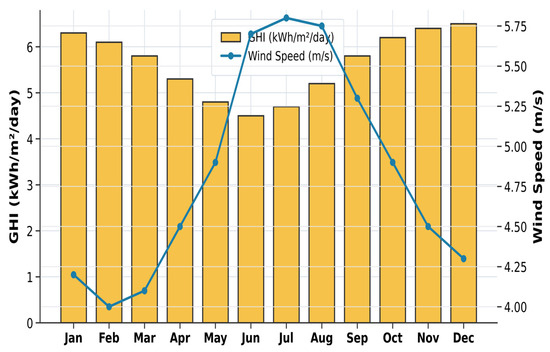
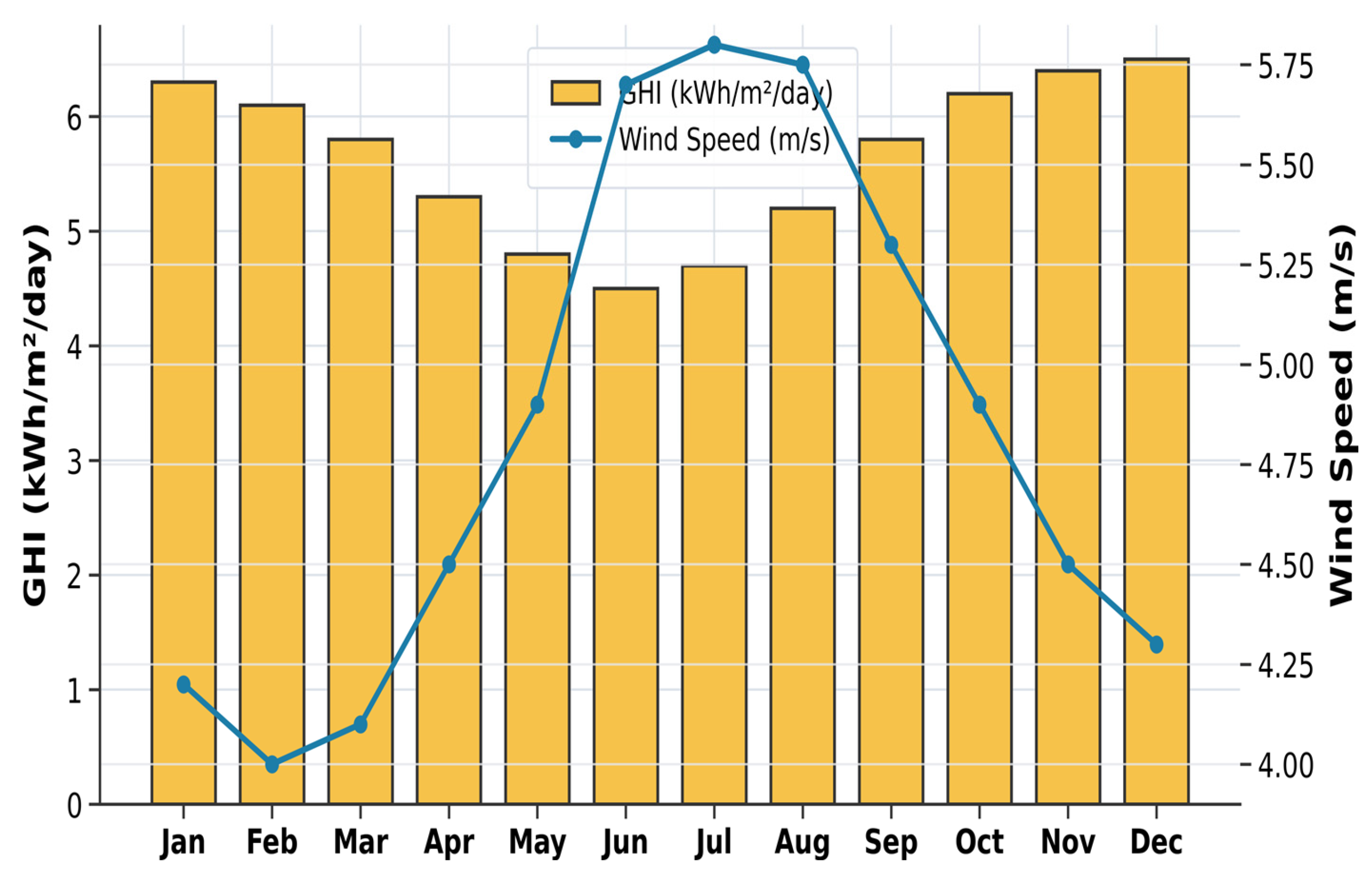
Geographical considerations have great significance when it comes to designing and performing hybrid renewable energy systems. As can be seen from Figure 1, the chosen location belongs to Limpopo Province in proximity to Polokwane, an area that boasts a high degree of sun exposure and modest capacity of wind power. Geographically, the chosen location is well-suited for hybrid systems because it makes it possible to exploit several renewable resources simultaneously.
Figure 1.
Monthly solar irradiance and wind-speed resource profile for the Limpopo household site.
From the point of view of energy systems analysis, the lower latitude of the location increases the amount of sun radiation, whereas the absence of the coastline eliminates wind variability in favor of more stable resources. Such geographical circumstances prove to be suitable for modeling and simulation software like HOMER, which requires precise geographical data for producing realistic simulation results. Lastly, the location’s rural and semi-urban nature implies technical feasibility and socio-economic appropriateness of hybrid microgrid technology.
- Renewable Resource Inputs
The monthly average Global Horizontal Irradiance (GHI) and wind speed data are compiled in Table 1 using the HOMER Pro × 64 3.11.2 software to provide a reliable renewable resource profile for the Polokwane/Limpopo scenario.
Table 1.
Monthly solar, wind, and household load inputs used in the simulation.
Figure 1 shows the temporal variability of the irradiation and wind speed values during the course of the year. It can be clearly seen that there is a strong seasonal complementarity between the two. While solar irradiation levels remain rather stable during the whole year, only experiencing slight reductions in summer months, wind speed tends to increase when the level of solar irradiation is lower.
Such a situation creates favorable conditions for a more effective system operation, since the need for storage and back-up facilities becomes less important. When solar energy is less available, wind provides a necessary energy supply and vice versa. Therefore, an effective combination of both energy sources allows enhancing the stability of the process. At the same time, it becomes crucial for proper component selection and reducing lifetime costs.
- Architecture of the System
The hybrid power supply system consists of a PV power generation system, a small wind turbine generator, a lithium-ion battery storage, an electrolyzer, a hydrogen compressor, a fuel cell, and a power converter as stated in Table 2. The battery storage will be used for short-term balancing, while the hydrogen storage is intended for long-term energy backup and energy storage of renewable surpluses.
Table 2.
Selected reliability-constrained hybrid system architecture.
- Component Costs and Economic Assumptions
The model for economics in Table 3 and Table 4 considers the project life span of 25 years, a real discount rate of 7%, inflation of 5.5%, replacement based on the life of components, and salvage value based on the life left in the components. The discount rate is assumed as a sensitivity parameter because the discount rate impacts the LCOE computation in capital-intensive energy projects.
Table 3.
Component cost and replacement assumptions.
Table 4.
Economic assumptions and calculated life-cycle-cost values.
- Governing Equations
Equations (1)–(6) represents the equations governing the study:
where
is the Capital recovery factor.
is the interest rate.
is the total number of compounding years.
where
is the net present cost.
is the capital cost.
is the replacement cost.
is the operation and maintenance cost.
is the salvage value.
where
is the levelized cost of energy.
is the total annualized cost.
is the total served energy
where
is the levelized cost of hydrogen.
is the total annualized cost.
is the annual mass of hydrogen.
where
is the total amount of energy not provided.
is the total amount of electrical energy required by the consumer.
where
is the replacement cost.
is the remaining amount of useful life of the asset.
is the total amount of the expected life of the asset, beginning from when it was new.
3. Results
3.1. Optimization Results
There are four configuration alternatives evaluated for performance. In case the stringent reliability criterion based on unmet demand under 0.10% applies to households, the hybrid configuration incorporating solar PV, wind turbine, battery storage, and hydrogen is chosen. If only the lowest NPC is taken into account, the solar PV/battery system turns out to be more economical.
A comparative analysis of four alternative configurations of household microgrids and the associated costs and benefits of their combinations of the four renewable technologies mentioned above is presented in Table 5. Specifically, the combination of PV energy with battery storage is represented by S1 and has a net present cost of 30,500 USD and a levelized cost of energy of 0.56 USD/kWh. At the same time, its unmet load amounts to 0.82%. Therefore, it might be assumed that despite the use of storage, a system using only the above means cannot ensure reliability and adequacy of supply in all possible operating conditions due to the dependence on solar energy.
Table 5.
HOMER-style optimization comparison of alternative household microgrid configurations.
By integrating wind energy into the existing system S2, the percentage of unmet load drops to 0.38%. Thus, this configuration proves the importance of diversity as a way to improve the reliability of systems. However, this enhancement comes at a price of a higher NPC of 33,400 USD and LCOE of 0.61 USD/kWh. It means that the increase in the reliability of the system is economically efficient only if there is enough unmet demand.
Configuration S3 is the optimal option based on performance as it results in unmet load equal to zero, along with LCOE lowest across all four configurations, equaling 0.549 USD/kWh. While the NPC for this configuration is the highest at 35,016 USD relative to the other two configurations, the use of a lower capacity battery, diversified sources of renewables, electrolysis capacity, hydrogen storage, and fuel cells provides greater flexibility in terms of operation. The LCOH value of 12.02 USD/kg suggests that the generation of hydrogen has economic feasibility in the system, which will enable the use of hydrogen as a long-term storage solution for excess renewable energy generated.
However, in the case of S4, where PV and hydrogen systems work together without much capacity of batteries, the NPC is at the highest level of 41,000 USD, LCOE is the highest at 0.75 USD/kWh, and the highest unmet load of 1.2% is seen. Hence, from this result, it can be concluded that hydrogen storage alone might not be enough to replace the battery in terms of handling short-term variation in load management. Consequently, it is clear from Table 5 that the best hybrid system should comprise short-duration storage and long-duration storage.
3.2. Monthly Electricity Production
The electricity generation per month of the optimized system is provided in Table 6, which illustrates the interplay between the energy generated using renewable sources and electricity consumption by residents throughout the year. The photovoltaic energy contributes the most out of all sources every month, starting from 526.5 kWh during June and increasing to 785.9 kWh during December. This indicates the presence of abundant sunlight that the optimized system receives, as well as highlights the significance of using the renewable source for producing residential electricity. On the other hand, wind energy has an auxiliary but noteworthy contribution every month, reaching up to 149.6 kWh during July.
Table 6.
Monthly electricity production, fuel-cell contribution, served load, and excess electricity.
Furthermore, from the table, it can be seen that the system serves the load continuously in all months, with the average monthly load varying from 420.0 kWh to 465.0 kWh. The consistent ability to serve the load implies that the size of the components chosen in this simulation is enough for the assumed load pattern. It is crucial to note that there is no contribution made by the fuel cell at any point during the year, implying that, under the assumed scenario, both the renewable energy and the batteries are sufficient to serve the load without converting hydrogen into electricity.
One important aspect of Table 6 is the fact that there is an excess of electricity in all the months, varying between 207.3 kWh for the month of June and 388.1 kWh for the month of December. Excess power means that renewable sources generate more electricity than the consumption needs at that very moment, thus providing options for hydrogen generation, demand flexibility, productive use of energy, or curtailment management. On the other hand, this finding plays an important role when talking about designing the system, since excess electricity may help boost resilience by storing energy, but also hamper economic performance when not used efficiently enough.
In general, it can be seen from Table 6 that the recommended system setup is technologically feasible to satisfy all the electricity needs of the household at all times of the year while ensuring considerable renewable energy excess. Additionally, the production profile indicates the complementary nature of PV and wind sources of energy, particularly in those instances where the solar input is low.
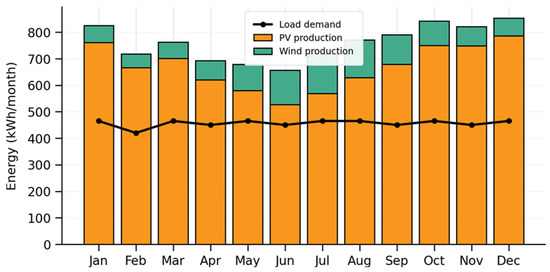
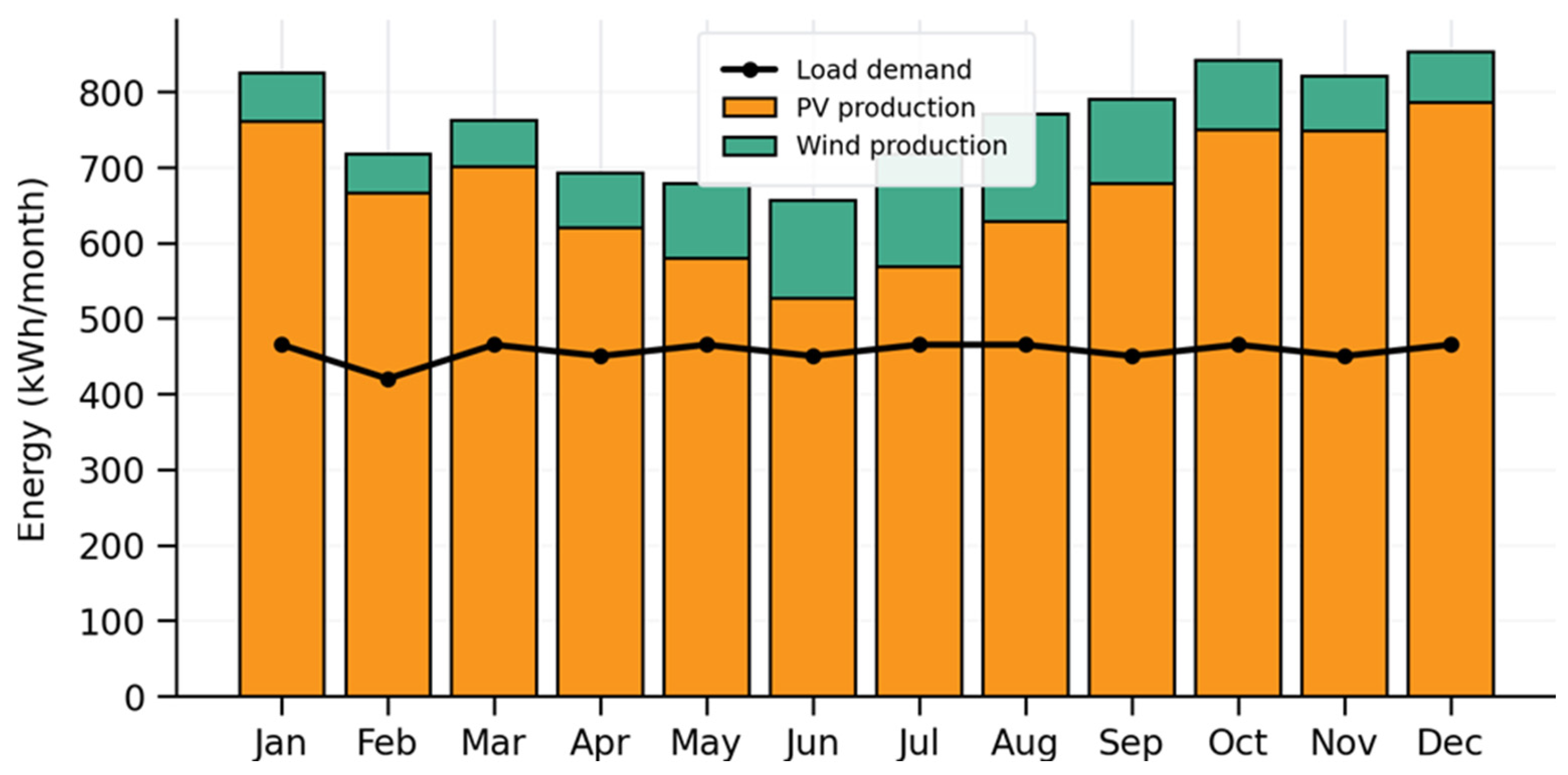
As seen from Figure 2, the monthly production of power generated by photovoltaic (PV) and wind systems aligns with the load demand of households throughout the year. It is evident that energy generation is consistently balanced with the load demand, which implies proper system design and sizing to meet demands.
Figure 2.
Monthly electricity production and household load (kWh/month).
Photovoltaic energy production predominates energy generation because of high solar potential, while wind energy serves as a complementary source of energy during periods of lower photovoltaic generation. The load demand stays at relatively the same level all the time, which implies stable consumer behavior typical of residential energy use.
Balanced generation and load demand imply efficient operation of the power plant. On one hand, such a ratio implies the absence of any excess energy generation and its subsequent curtailment; on the other hand, such performance suggests that there will be no lack of energy either.
3.3. Battery, Hydrogen, and Reliability Results
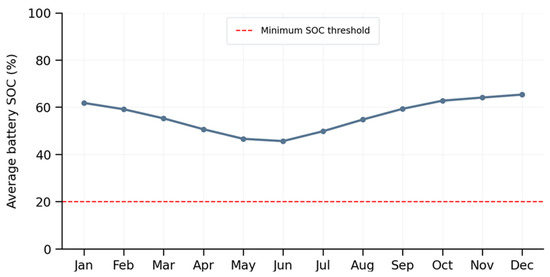
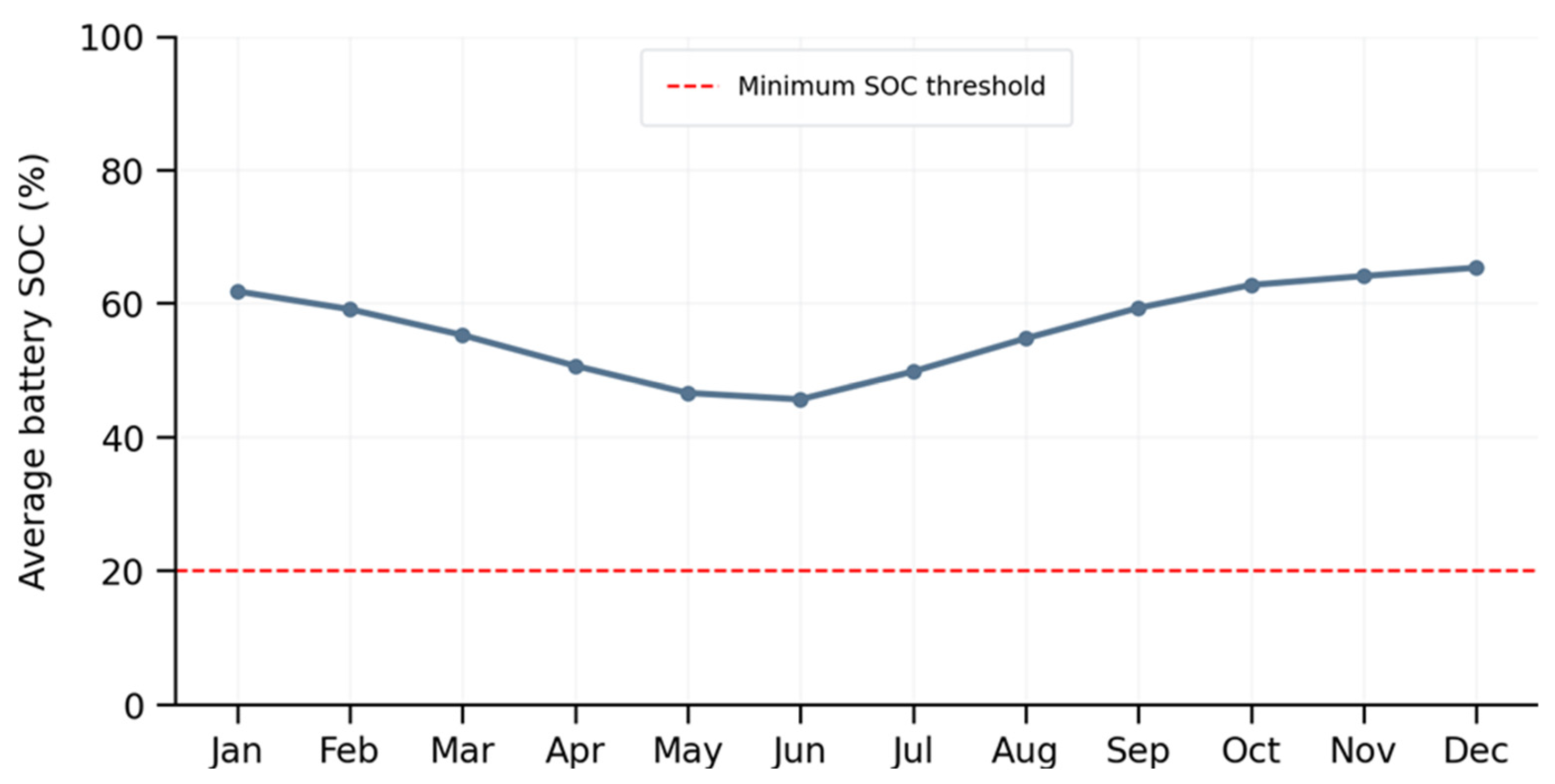
Table 7 gives significant information on the operations of the energy storage system and the reliability of the optimized microgrid. There exists an evident seasonal trend for the average battery state of charge (SOC), which decreases from 61.8% at the beginning of the year to the minimum of 45.6% in June, only to rise again to 65.3% at the end of the year. The fluctuations in the state of charge are in line with the seasonal variations in renewable energy production, especially due to the lower PV power production in summer. Yet, the state of charge is still relatively stable throughout the year.
Table 7.
Monthly storage and reliability results.
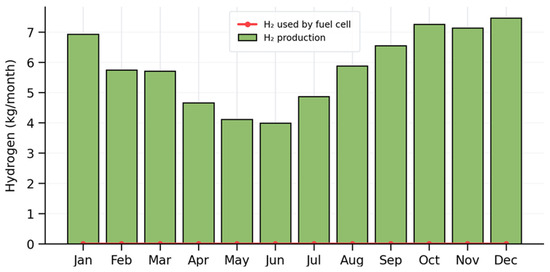
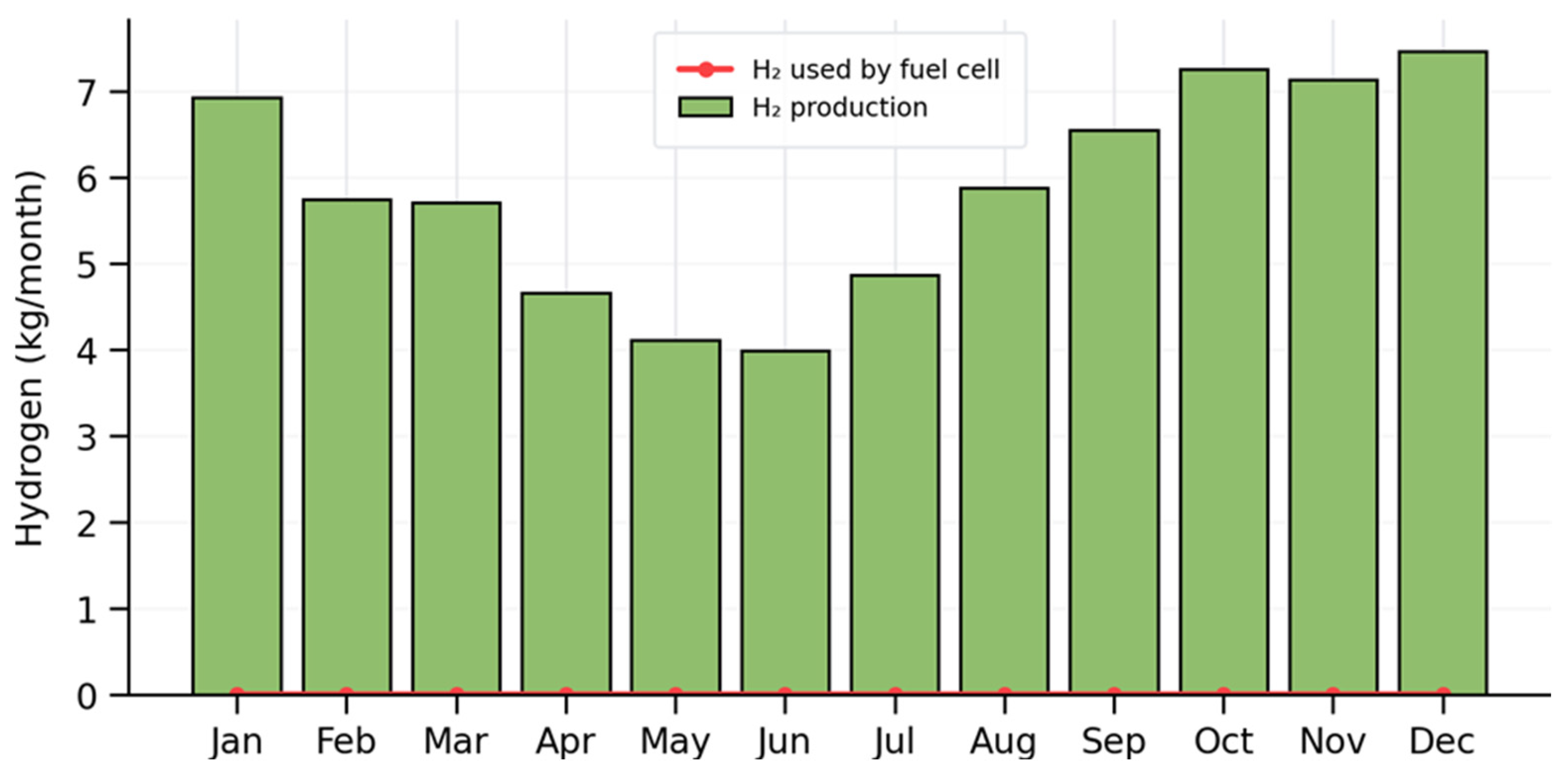
The hydrogen is produced throughout each month, from 3.99 kg during the month of June to 7.46 kg during December. Hydrogen production tends to vary along with renewable electricity availability, in that more production takes place during months where there is more availability of surplus and vice versa. With regards to hydrogen production in all months, this indicates that the electrolyzer has been successful in finding uses for the surplus electricity generated instead of curtailing its generation. In other words, hydrogen production serves as an additional energy vector for storing renewable energy apart from daily battery cycling.
However, from Table 7, it is clear that there is no consumption of hydrogen for the fuel cell as the amount used stays at 0.00 kg every month; similarly, the tank level also stays the same at 8.00 kg throughout the period. This clearly means that the fuel cell is not dispatched as per the simulation results since the sum total of power from PV, wind, and storage capacity provided by the batteries is enough to meet the demand. However, the non-changing tank levels imply that the hydrogen storage system is more of a standby resource than one that actually participates in energy production.
More importantly, Table 7 shows the lack of any unmet loads in all months. Such a conclusion speaks to the excellent reliability of the proposed hybrid combination, proving the ability of the system to satisfy the demand of households without interruption throughout the entire year. It becomes evident that the joint operation of both subsystems helps to ensure the sustainability of the microgrid, although the hydrogen route seems to be underemployed when it comes to reconverting the energy into electricity. Hence, further work needs to address the issue of economic efficiency rather than reliability.
The SOC of the battery illustrated in Figure 3 is an indicator of the stability and resiliency of the system. Throughout the year, the SOC stays at a level that surpasses the minimum requirement threshold. The small drop in SOC levels is witnessed midway through the year. This is due to the low availability of solar energy at this period. However, a quick recovery follows soon after. This indicates successful integration of renewable power generation and storage technologies. Keeping the SOC levels at an optimum range is key to extending battery life and maintaining the efficiency of the energy storage system. From the trend witnessed, one can deduce that the battery is not oversized or undersized.
Figure 3.
Monthly average battery state of charge (%).
Hydrogen generation and consumption dynamics are illustrated in Figure 4. Hydrogen generation surpasses consumption each month, which means that there is an extra capacity available for generation. The existence of extra generation capacity may indicate that electrolysis takes place at times when there is an excess of renewable energy production, thus avoiding curtailment of renewable electricity. Lower fuel cell consumption indicates that hydrogen acts as a backup energy resource. This solution provides more flexibility in energy system operations since it allows energy storage for a prolonged period of time. There will be extra capacity available for usage in other sectors since energy from hydrogen will not be used solely by the fuel cell.
Figure 4.
Monthly hydrogen production and fuel-cell hydrogen consumption (kg/month).
The hydrogen tank level is constant at all times during the year. This implies that there is enough hydrogen being produced and used to ensure that there are never any shortages, since the tank levels have been stable for the entire period of operation.
In terms of system design considerations, this would imply that the capacity of the hydrogen storage tanks is more than adequate to cope with seasonal variations. However, the constant level in the hydrogen tanks may also mean that there has been underuse of the available storage capacity.
The fact that there are no periods of unmet load throughout the whole year is an indication of system reliability. This suggests that the hybrid system satisfies the energy needs of the household under all conditions simulated. Zero unmet load is among the main objectives in the design of microgrids, especially in situations where there are no connections to other external energy sources. This indicates that the components of the hybrid system are very reliable. This reliability is due to the ability of the system to adapt to changing energy availability/demand.
3.4. Annual Performance Summary
Table 8 shows the annual technical and economic performance of the optimized renewable microgrid. The system supplies the total annual electricity demand of 5475 kWh/year, with an unmet load of 0 kWh/year, an unmet-load percentage of 0.000%, and thus ensuring 100% unmet load. This is especially significant from a reliability perspective because such performance is highly desirable in distributed or off-grid energy generation systems. The capability of meeting the total annual electricity load indicates that the chosen configuration is technically suitable for the considered demand pattern.
Table 8.
Annual technical and economic performance summary.
The amount of annual renewable energy production far outweighs the load of the household, since the photovoltaic yield 8016 kWh/year while the wind energy system produces 1115 kWh/year. The combined renewable sources have more than enough energy not only to cover their needs but also create an extra electricity pool of 3656 kWh/year. This extra energy is important for the hydrogen cycle, which creates 70.3 kg/year of hydrogen on an annual basis. Nonetheless, the output from the fuel cell is 0.0 kWh/year, while the input hydrogen consumption is 0.0 kg/year. This means that the hydrogen is created but cannot be used as an electricity source during the modeled operation period of one year.
Environmentally speaking, the system attains the value of 100% in terms of renewable fraction in the case of the absence of fossil sources. This fact proves the fact that the system supplies energy solely from renewable sources and storage units, thus contributing to the achievement of decarbonization goals and lowering the dependency on fuel-fired electric power generation. The annualized cost value (ACV) of 3005 USD per year, the net present cost (NPC) equal to 35,016 USD, the levelized cost of energy (LCOE) value of 0.549 USD per kWh, and the levelized cost of hydrogen (LCOH) of 12.02 USD per kg allow us to conclude about economic feasibility.
In general, it can be observed from Table 8 that the design of the optimal system possesses all the technical qualities such as reliability, renewability, and the ability to produce hydrogen using any surplus electricity. However, the problem faced by the proposed design is not that of energy insufficiency, as the system is able to cover its entire load demand. Rather, the issue relates to economic optimization through better dispatching strategies and other potential applications of hydrogen produced, as well as any surplus electricity generated by the system.
In the base case simulation, it becomes clear that the amount of energy generated by the fuel cell is 0.0 kWh/year and hydrogen usage from the fuel cell amounts to 0.0 kg/year, while hydrogen production is 70.3 kg/year annually. This situation arises due to the fact that the combination of solar PV system, wind energy, and battery storage sub-system is sufficient to provide for the household load during that particular year under consideration. In such a scenario, there is no requirement for dispatching any energy from the hydrogen subsystem since the threshold for doing so does not arise. Therefore, the hydrogen subsystem acts merely as an excess renewable energy absorber and reserve energy rather than being a generator of electricity. This is significant since it means that integration of hydrogen in the single household system may lead to increased capital expenditure without any improvement in annual electricity availability unless it faces additional challenges regarding reliability, high peak load, excess non-renewables, batteries, and hydrogen use as well.
3.5. Dispatch, Sensitivity and Cash-Flow Results
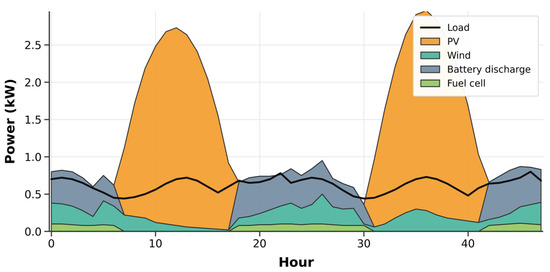
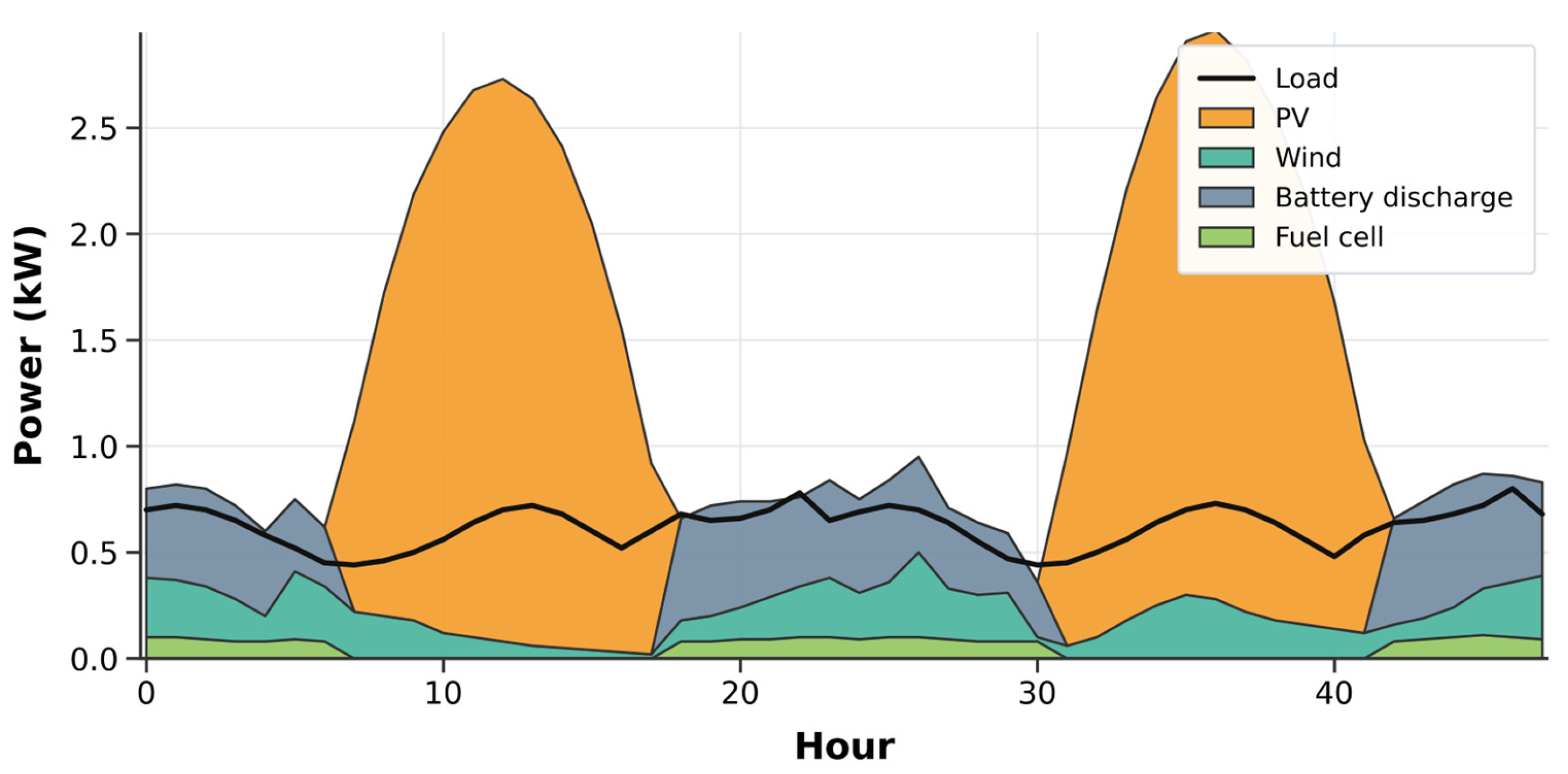
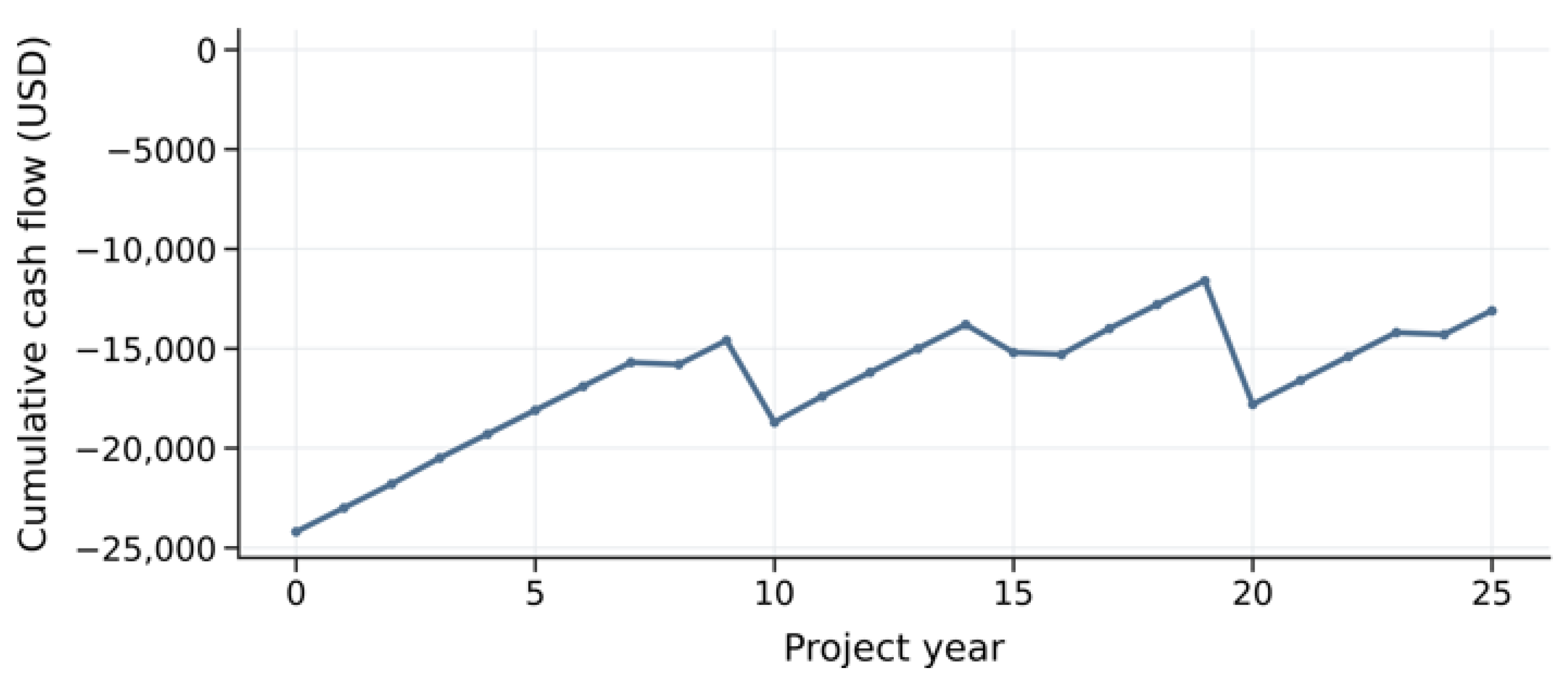
From the dispatch plot for the 48 h representation, it can be observed that there is dominance of photovoltaic power generation during the day, steady low wind power generation throughout, battery discharge during evening and early morning hours, and finally fuel cell operation in case of shortage of renewable power and battery charge. It has been found from sensitivity analysis that increased availability of solar and wind resources decreases LCOE by providing more renewable electricity while keeping the capital cost the same. Cash-flow analysis is made on the basis of $0.30/kWh to avoid buying house electricity, which is not used to calculate LCOE.
The 48 h dispatching curve shown in Figure 5 gives a comprehensive analysis of the system performance in the short term. For example, during the day, there is maximum power generated by photovoltaic cells that exceeds the consumption of the load, thus enabling the charging of batteries and producing hydrogen. In the absence of photovoltaic cell activity at night, the power required is met using a mixture of battery discharging and fuel cells. Wind energy production plays an intermittent role in the system’s operation. From this illustration, it becomes clear how effective the energy management process is in such systems.
Figure 5.
Residential 48 h dispatch result (kW).
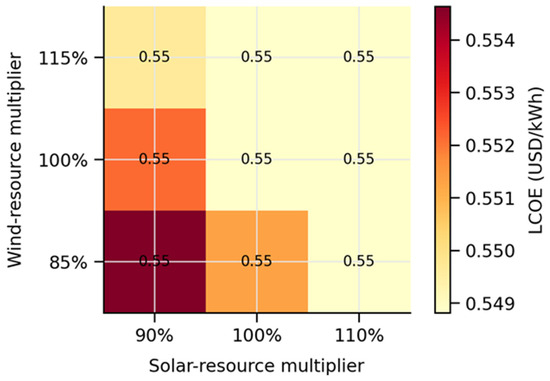
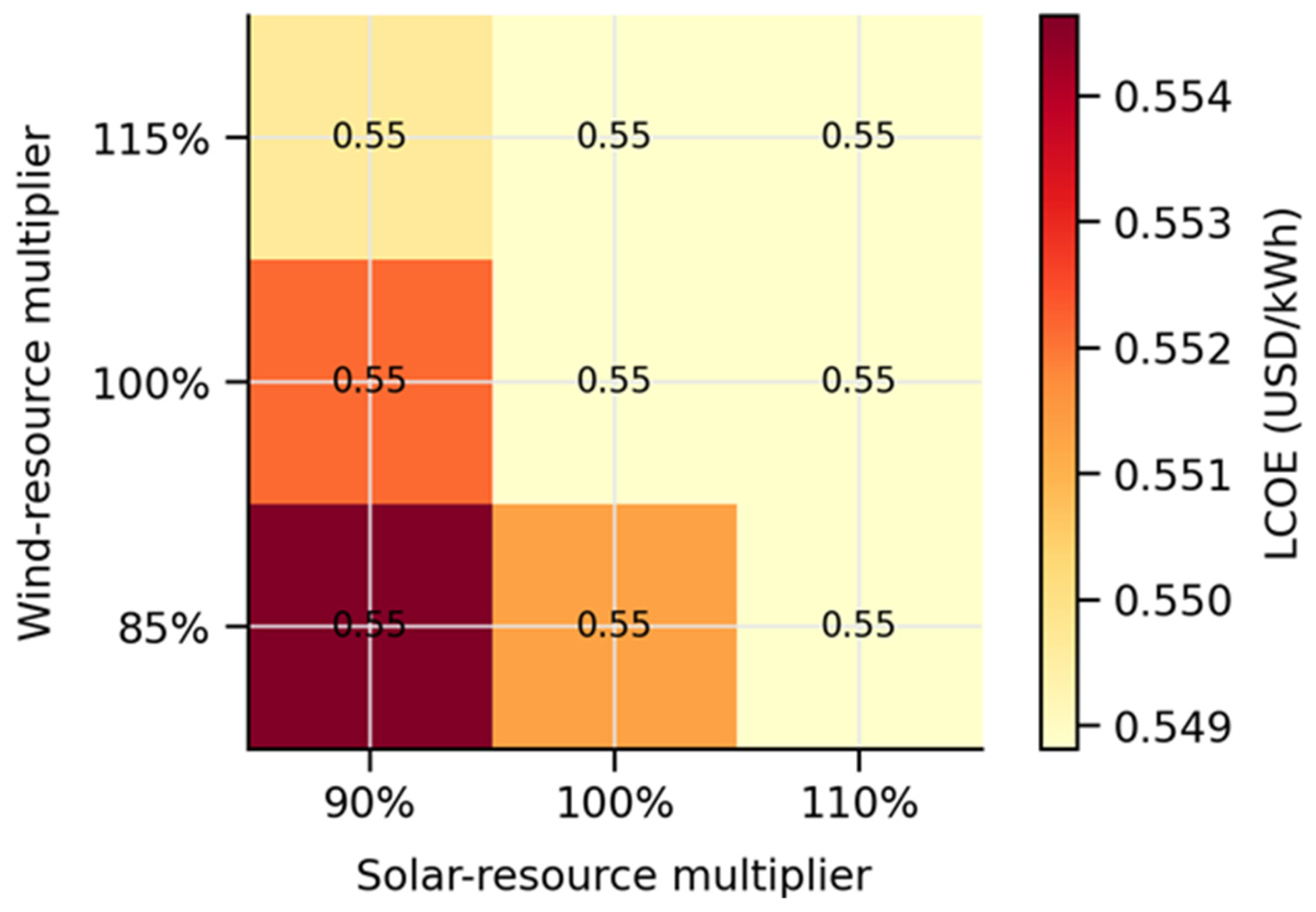
Figure 6 presents an analysis of how changes in the availability of solar and wind power have an effect on LCOE. These results demonstrate the relative insensitivity of LCOE to changes in resource availability scenarios, demonstrating the robustness of the system despite uncertainty. Although some variation is seen, especially when resource availability is low, the consistent nature of LCOE demonstrates the advantages that come from hybridization, as the system can reduce the effect that variation in any one energy resource may have. This quality is very useful in practical implementations, as resource availability can be subject to uncertainties in weather and climate.
Figure 6.
Sensitivity of LCOE to solar and wind resource variation.
The sensitivity analysis was widened to test the robustness of the chosen configuration under conditions of resources, loads, costs, and financial uncertainties. The variables in sensitivity analysis include solar resource multiplier (90%, 100%, and 110%), wind resource multiplier (85%, 100%, and 115%), household load growth (+10%, +20%, and +30%), evening peak load multiplier, cost of battery replacement, electrolyzer capital cost, real discount rate, and grid-electricity price avoided. The variables above were chosen because they affect reliability, storage scheduling, levelized cost of electricity, hydrogen usage, and investment attractiveness. Sensitivity analysis is used not only for finding the lowest levelized cost of electricity but also for knowing when the hydrogen route transforms from standby reserve to active back-up power generation. The parameters for the sensitivity analysis are depicted in Table 9.
Table 9.
Parameters for Sensitivity Analysis.
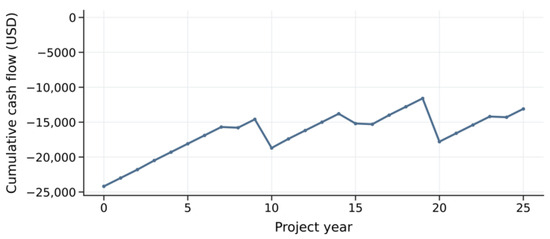
The overall cumulative cash flow shown in Figure 7 shows the economic efficiency of the system throughout its life-cycle. Although the capital investment made at the start produces negative cash flow, the pattern indicates gradual improvement over time due to the savings in the purchase of electricity. Variations observed in the graph may be due to maintenance or replacement costs, but the general trend reveals that the financial feasibility of such a system keeps improving. The need to adopt this approach is especially critical in the assessment of investments made in renewable energy sources, as these produce benefits over an extended period of time.
Figure 7.
Cash-flow summary based on avoided electricity purchase comparison.
The avoided electricity purchase value is used only for the cash-flow comparison and is not used in calculating the LCOE of the hybrid system. The base-case cash-flow comparison adopts a benchmark electricity-purchase value of 0.30 USD/kWh. This value should be interpreted as a sensitivity value because residential electricity tariffs in South Africa vary according to whether the household is supplied directly by Eskom or through a municipality, and also according to customer category, block tariff, prepaid/credit arrangement, and fixed charges.
4. Discussion
From the results obtained, it is evident that the chosen PV-Wind–Battery–Hydrogen system is capable of meeting the yearly energy needs for the household in question, considering the particular resource and demand situations in the Limpopo region. The reason why the base-case scenario works in terms of reliability is mainly due to the strong presence of PV, the additional wind power, and the 15 kWh lithium-ion battery. It is evident from the results that this system is capable of balancing short-term fluctuations and serving the household load within the year. Hydrogen-based energy generation is not part of the base-case scenario since the fuel cell is not dispatched during this period.
Economically speaking, it can be seen that there is an apparent dilemma between cost optimization and reliability. In cases where there is no hydrogen involved, such systems might have reduced costs in terms of investment, but they do not meet the criteria of high reliability based on all scenarios. The hydrogen-based system, despite having an increased cost associated with complexity in the system, poses an interesting case based on how the fuel cell has been underused in this baseline scenario. In cases where a single unit or family uses hydrogen storage, hydrogen may not be cost-effective unless the need for reliability is extremely stringent, the peak load consumption is larger, or the excess hydrogen has some productive use besides being converted into electrical power.
The environment-based interpretation has also been made more precise. One hundred percent renewable means that no electricity generated from fossil fuels is used for the operation of the system throughout the year considered. Hence, there are no fossil emissions during operation in the model. But this does not imply that the life-cycle emissions of the system are zero. Solar panels, batteries, electrolyzers, tanks, fuel cells, converters, and wind turbines all have life-cycle environmental impacts related to production, recycling, and disposal. This study may thus be understood as one conducted from an operational point of view. Life-cycle analysis is suggested as the next step.
The simulation output indicates that the Limpopo hybrid household system is capable of satisfying the annual requirement of 5475 kWh/year using 5475 kWh/year, with no unmet-load requirement of 0.00 kWh/year due to the assumptions applied regarding the dispatching criteria. The solar panels are the major source of power generated, and the wind generation helps in diversifying seasonally and daily energy requirements. Therefore, the hydrogen subsystem acts merely as an excess renewable energy absorber and reserve energy rather than being a generator of electricity. Therefore, the hydrogen subsystem acts merely as an excess renewable energy absorber and reserve energy rather than being a generator of electricity.
The system chosen for the scenario with reliability constraints has NPC and LCOE amounts of 35,016 USD and 0.549 USD/kWh, respectively. The result can be deemed realistic because the unit cost of resilient systems is relatively high compared to the cost of centralization.
Environmental benefit refers to the fact that the system does not emit any carbon because it runs without using any fossil fuels. The system does not have a diesel generator; thus, there are zero carbon emissions in terms of operation. A life-cycle assessment will be necessary in determining embodied emissions in PV panels, batteries, electrolysis, hydrogen tanks, and fuel cells.
Environmental impacts for the system examined here are considered only during the operation phase. As there is no diesel engine or any other fossil fuel in the optimized system, the modeled emissions of fossil fuel-generated CO2 are nil, and that of renewables is 100%. This must not be taken to represent a life-cycle carbon footprint. The production, transportation, installation, renewal, recycling, and disposal of PV panels, wind turbines, lithium-ion batteries, electrolyzers, hydrogen tanks, fuel cells, and power electronics have not been quantified in the current simulation. It needs to be performed in future studies with component-specific figures.
Four avenues for further investigation can be identified regarding future research into this topic. First, the system of renewables–battery–hydrogen could be benchmarked against a renewables–battery–diesel system to assess the relative reliability of hydrogen compared to other sources in case of failures in the power generation infrastructure. Secondly, the study would benefit from expanding the scale of the simulation, considering a community level rather than a household, which could result in improved efficiency of hydrogen storage systems and lower costs of hydrogen. Thirdly, the simulation should incorporate actual household loads as well as meteorological parameters from the region of Limpopo to allow for an assessment of extreme cases. Finally, there should be a consideration of alternative uses for excess hydrogen, such as cooking or agricultural activities, as otherwise, hydrogen would remain unutilized.
5. Conclusions
A techno-economic and operational environmental assessment was performed on a hybrid solar–wind–battery–hydrogen energy system at the level of a household in Limpopo, South Africa. The unique point about this research is the joint assessment of battery and hydrogen storage systems in terms of their application to the household level. An optimized and reliable-constrained design can fulfill the annual load requirements without any unmet loads (i.e., 0.000%) and with a completely operating renewable fraction equal to 100%. But it should be mentioned that hydrogen does not take part in power generation in the base-case year, meaning that it functions only as a backup storage system.
Key insights from this study also have implications for hybrid energy system designs for households, as PV, wind, and battery energy storage can cover most of the actual benefits that come through, with hydrogen coming into play only in case of harsher operational parameters, higher peak demand, longer outages, communal hydrogen utilization, and other possible applications of hydrogen energy. This research adds value to scientific knowledge by developing an optimized configuration as well as making a meaningful analysis of how exactly hydrogen energy may become less useful. Further research should use actual hourly load profiles of households, hourly meteorological information from Polokwane, a life-cycle analysis approach, and diesel backup benchmarks, among others.
Author Contributions
M.E.: Conceptualization, Investigation, Methodology, and Writing—Original Draft and Preparation. O.B.: Investigation, Methodology, and Writing—Review and Editing. O.O.: Methodology, Supervision, and Funding Acquisition. All authors have read and agreed to the published version of the manuscript.
Funding
This research was funded by the Institute of Systems Science, Durban University of Technology, Durban, South Africa.
Data Availability Statement
The original contributions presented in this study are included in the article. Further inquiries can be directed to the corresponding author.
Acknowledgments
The authors wish to thank the Institute of Systems Science, Durban University of Technology, Durban, South Africa. The authors also wish to acknowledge the use of Python Matplotlib, version 3.9.2. During the preparation of this work, the authors used ChatGPT 5.4 to assist in the creation of scientific illustrations based on prompts designed by the research team. The final output of these figures was carefully reviewed and verified for scientific accuracy and originality by the authors, who take full responsibility for the content of the manuscript.
Conflicts of Interest
The authors declare no conflicts of interest.
References
- Casati, P.; Moner-Girona, M.; Khaleel, S.I.; Szabo, S.; Nhamo, G. Clean energy access as an enabler for social development: A multidimensional analysis for Sub-Saharan Africa. Energy Sustain. Dev. 2023, 72, 114–126. [Google Scholar] [CrossRef] [Scilit]
- Kumba, H.; Olanrewaju, O.A. ‘Towards sustainable development: Analyzing the viability and integration of renewable energy solutions in South Africa’—A review. Energies 2024, 17, 1418. [Google Scholar] [CrossRef] [Scilit]
- Marchetti-Mercer, M.C. Resilience is not enough: The mental health impact of the ongoing energy crisis in South Africa. S. Afr. J. Sci. 2023, 119, 16608. [Google Scholar] [CrossRef] [Scilit]
- Miller, M.; Yokwana, X.; Sumbwanyambe, M. Evaluating the Role of Hybrid Renewable Energy Systems in Supporting South Africa’s Energy Transition. Processes 2025, 13, 3455. [Google Scholar] [CrossRef] [Scilit]
- Khan, K.; Khurshid, A.; Cifuentes-Faura, J.; Xianjun, D. Does renewable energy development enhance energy security? Util. Policy 2024, 87, 101725. [Google Scholar] [CrossRef] [Scilit]
- Ikevuje, A.H.; Kwakye, J.M.; Ekechukwu, D.E.; Benjamin, O. Technological innovations in energy storage: Bridging the gap between supply and demand. Magna Sci. Adv. Res. Rev. 2023, 8, 201–210. [Google Scholar] [CrossRef] [Scilit]
- Motjoadi, V. Analysis of Microgrid Architecture and Policy Framework for Sustainable Electricity Supply of Rural Communities of Limpopo in South Africa. Ph.D. Thesis, University of Johannesburg, Johannesburg, South Africa, 2022. [Google Scholar]
- Rashid, F.L.; Eleiwi, M.A.; Mohammed, H.I.; Ameen, A.; Ahmad, S. A review of using solar energy for cooling systems: Applications, challenges, and effects. Energies 2023, 16, 8075. [Google Scholar] [CrossRef] [Scilit]
- Alzahrani, A.; Ramu, S.K.; Devarajan, G.; Vairavasundaram, I.; Vairavasundaram, S. A review on hydrogen-based hybrid microgrid system: Topologies for hydrogen energy storage, integration, and energy management with solar and wind energy. Energies 2022, 15, 7979. [Google Scholar] [CrossRef] [Scilit]
- Liu, T.; Li, J.; Yang, Z.; Duan, Y. Evaluation of the short-and long-duration energy storage requirements in solar-wind hybrid systems. Energy Convers. Manag. 2024, 314, 118635. [Google Scholar] [CrossRef] [Scilit]
- Emezirinwune, M.U.; Adejumobi, I.A.; Adebisi, O.I.; Akinboro, F.G. Off-grid PV/biomass/DG/battery hybrid renewable energy as a source of electricity for a farm facility. e-Prime-Adv. Electr. Eng. Electron. Energy 2024, 10, 100808. [Google Scholar] [CrossRef] [Scilit]
- Barhoumi, E.M.; Okonkwo, P.C.; Farhani, S.; Belgacem, I.B.; Bacha, F. Hydrogen production from renewable energy sources, storage, and conversion into electrical energy. In Planning of Hybrid Renewable Energy Systems, Electric Vehicles and Microgrid: Modeling, Control and Optimization; Springer: Cham, Switzerland, 2022; pp. 151–176. [Google Scholar]
- Emezirinwune, M.U.; Adejumobi, I.A.; Adebisi, O.I.; Akinboro, F.G. Synergizing Hybrid Renewable Energy Systems and Sustainable Agriculture for Rural Development in Nigeria. e-Prime-Adv. Electr. Eng. Electron. Energy 2024, 7, 100492. [Google Scholar] [CrossRef] [Scilit]
- Dias, P.R.; Schmidt, L.; Chang, N.L.; Lunardi, M.M.; Deng, R.; Trigger, B.; Gomes, L.B.; Egan, R.; Veit, H. High yield, low cost, environmentally friendly process to recycle silicon solar panels: Technical, economic and environmental feasibility assessment. Renew. Sustain. Energy Rev. 2022, 169, 112900. [Google Scholar] [CrossRef] [Scilit]
- Himona, E.; Poullikkas, A. Beyond the Grid: Modeling, Optimization and Economic Evaluation of Future Hydrogen Autonomous Home Energy Systems. Energies 2026, 19, 1527. [Google Scholar] [CrossRef] [Scilit]
- Ahmed, T.G.; Gudlaugsson, B.; Ogwumike, C.; Dawood, H.; Short, M.; Dawood, N. Evaluation framework for Techno-economic analysis of energy system retrofit technologies. Energy Build. 2023, 286, 112967. [Google Scholar] [CrossRef] [Scilit]
- Ziyaei, S.; Panahi, M.; Manzour, D.; Karbasi, A.; Ghaffarzadeh, H. Sustainable power generation through decarbonization in the power generation industry. Environ. Monit. Assess. 2022, 195, 225. [Google Scholar] [CrossRef] [Scilit] [PubMed]
- Laimon, M.; Yusaf, T. Towards energy freedom: Exploring sustainable solutions for energy independence and self-sufficiency using integrated renewable energy-driven hydrogen system. Renew. Energy 2024, 222, 119948. [Google Scholar] [CrossRef] [Scilit]
- Cheekatamarla, P. Hydrogen and the global energy transition—Path to sustainability and adoption across all economic sectors. Energies 2024, 17, 807. [Google Scholar] [CrossRef] [Scilit]
- Rolo, I.; Costa, V.A.F.; Brito, F.P. Hydrogen-based energy systems: Current technology development status, opportunities and challenges. Energies 2023, 17, 180. [Google Scholar] [CrossRef] [Scilit]
- Atawi, I.E.; Al-Shetwi, A.Q.; Magableh, A.M.; Albalawi, O.H. Recent advances in hybrid energy storage system integrated renewable power generation: Configuration, control, applications, and future directions. Batteries 2022, 9, 29. [Google Scholar] [CrossRef] [Scilit]
- Farghali, M.; Osman, A.I.; Chen, Z.; Abdelhaleem, A.; Ihara, I.; Mohamed, I.M.A.; Yap, P.-S.; Rooney, D.W. Social, environmental, and economic consequences of integrating renewable energies in the electricity sector: A review. Environ. Chem. Lett. 2023, 21, 1381–1418. [Google Scholar] [CrossRef] [Scilit]
- Pawar, R.; Dalsania, K.P.; Sircar, A.; Yadav, K.; Bist, N. Renewable energy hybridization: A comprehensive review of integration strategies for efficient and sustainable power generation. Clean Technol. Environ. Policy 2024, 26, 4041–4058. [Google Scholar] [CrossRef] [Scilit]
- Ajiboye, O.K.; Ochiegbu, C.V.; Ofosu, E.A.; Gyamfi, S. A review of hybrid renewable energies optimisation: Design, methodologies, and criteria. Int. J. Sustain. Energy 2023, 42, 648–684. [Google Scholar] [CrossRef] [Scilit]
- Emezirinwune, M.U.; Adejumobi, I.A.; Adebisi, O.I.; Akinboro, F.G. Application of Energy Balance and MCDM approach to the selection of hybrid renewable energy systems for agricultural application. Frankl. Open 2025, 12, 100317. [Google Scholar] [CrossRef] [Scilit]
- Khan, A.; Bressel, M.; Davigny, A.; Abbes, D.; Bouamama, B.O. Comprehensive review of hybrid energy systems: Challenges, applications, and optimization strategies. Energies 2025, 18, 2612. [Google Scholar] [CrossRef] [Scilit]
- Boche, A.; Foucher, C.; Villa, L.F.L. Understanding microgrid sustainability: A systemic and comprehensive review. Energies 2022, 15, 2906. [Google Scholar] [CrossRef] [Scilit]
- Ahmed, M.M.R.; Mirsaeidi, S.; Koondhar, M.A.; Karami, N.; Tag-Eldin, E.M.; Ghamry, N.A.; El-Sehiemy, R.A.; Alaas, Z.M.; Mahariq, I.; Sharaf, A.M. Mitigating uncertainty problems of renewable energy resources through efficient integration of hybrid solar PV/wind systems into power networks. IEEE Access 2024, 12, 30311–30328. [Google Scholar] [CrossRef] [Scilit]
- Veras, R.B.S.; Oliveira, C.B.M.; de Lima, S.L.; Saavedra, O.R.; Oliveira, D.Q.; Pimenta, F.M.; Lopes, D.C.P.; Torres Junior, A.R.; Neto, F.L.A.; de Freitas, R.M.; et al. Assessing economic complementarity in wind--solar hybrid power plants connected to the Brazilian grid. Sustainability 2023, 15, 8862. [Google Scholar] [CrossRef] [Scilit]
- Liu, Z.; Du, Y. Evolution towards dispatchable PV using forecasting, storage, and curtailment: A review. Electr. Power Syst. Res. 2023, 223, 109554. [Google Scholar] [CrossRef] [Scilit]
- Harrison-Atlas, D.; Murphy, C.; Schleifer, A.; Grue, N. Temporal complementarity and value of wind-PV hybrid systems across the United States. Renew. Renew. Energy 2022, 201, 111–123. [Google Scholar] [CrossRef] [Scilit]
- Motjoadi, V.; Bokoro, P.N. Improving Electricity Supply Reliability: A Case Study of Remote Communities of Limpopo in South Africa. In Recent Advances in Energy Systems, Power and Related Smart Technologies: Concepts and Innovative Implementations for a Sustainable Economic Growth in Developing Countries; Springer: Cham, Switzerland, 2023; pp. 135–174. [Google Scholar]
- Kabeyi, M.J.B.; Olanrewaju, O.A. Smart grid technologies and application in the sustainable energy transition: A review. Int. J. Sustain. Energy 2023, 42, 685–758. [Google Scholar] [CrossRef] [Scilit]
- Jiang, T.; Shen, D.; Zhang, Z.; Liu, H.; Zhao, G.; Wang, Y.; Tan, S.; Luo, R.; Chen, W. Battery technologies for grid-scale energy storage. Nat. Rev. Clean Technol. 2025, 1, 474–492. [Google Scholar] [CrossRef] [Scilit]
- Rekioua, D. Energy storage systems for photovoltaic and wind systems: A review. Energies 2023, 16, 3893. [Google Scholar] [CrossRef] [Scilit]
- Prakash, K.; Ali, M.; Siddique, N.I.; Chand, A.A.; Kumar, N.M.; Dong, D.; Pota, H.R. A review of battery energy storage systems for ancillary services in distribution grids: Current status, challenges and future directions. Front. Energy Res. 2022, 10, 971704. [Google Scholar] [CrossRef] [Scilit]
- Coccato, S.; Barhmi, K.; Lampropoulos, I.; Golroodbari, S.; van Sark, W. A Review of Battery Energy Storage Optimization in the Built Environment. Batteries 2025, 11, 179. [Google Scholar] [CrossRef] [Scilit]
- Anik, M.A.H.C.; Belal, T.M.A.I.B.; Islam, M.M.; Sharif, A. A Comprehensive Review of Next-Generation Grid-Scale Energy Storage Technologies and Their Role in a Sustainable Energy Future. J. Control Sci. Eng. 2025, 2025, 5577507. [Google Scholar] [CrossRef] [Scilit]
- Rahman, M.A.; Kim, J.-H.; Hossain, S. Recent advances of energy storage technologies for grid: A comprehensive review. Energy Storage 2022, 4, e322. [Google Scholar] [CrossRef] [Scilit]
- Chomać-Pierzecka, E.; Zupok, S.; Stec-Rusiecka, J.; Błaszczak, B.; Dyrka, S. Energy Storage as a Tool to Increase the Security and Energy Efficiency of Household Electricity in North-Western Poland in the Sustainable Management of Micro-Installation Potential. Sustainability 2026, 18, 3033. [Google Scholar] [CrossRef] [Scilit]
- El Kattel, M.B.; Praça, P.P.; Mayer, R.; el Kattel, C.D.C.L.B.; Bascopé, R.P.T.; Antunes, F.L.M.; Filho, B.d.J.C. Overview of main electrolyzer technologies and power electronic converter topologies for enabling hydrogen production through water electrolysis. Int. J. Circuit Theory Appl. 2024, 53, 3684–3718. [Google Scholar] [CrossRef] [Scilit]
- Sarmah, M.K.; Singh, T.P.; Kalita, P.; Dewan, A. Sustainable hydrogen generation and storage—A review. RSC Adv. 2023, 13, 25253–25275. [Google Scholar] [CrossRef] [Scilit] [PubMed]
- Oyewole, O.L.; Nwulu, N.I.; Okampo, E.J. Optimal design of hydrogen-based storage with a hybrid renewable energy system considering economic and environmental uncertainties. Energy Convers. Manag. 2024, 300, 117991. [Google Scholar] [CrossRef] [Scilit]
- Backurs, A.; Jansons, L.; Zemite, L.; Laizans, A. The Practical Implementation of Hydrogen-Based Sustainable Power Generation Backup. Latv. J. Phys. Tech. Sci. 2024, 61, 69–79. [Google Scholar] [CrossRef] [Scilit]
- Crespi, E.; Colbertaldo, P.; Guandalini, G.; Campanari, S. Energy storage with Power-to-Power systems relying on photovoltaic and hydrogen: Modelling the operation with secondary reserve provision. Energy Storage 2022, 55, 105613. [Google Scholar] [CrossRef] [Scilit]
- Schöne, N.; Dumitrescu, R.; Heinz, B. Techno-Economic evaluation of hydrogen-based cooking solutions in remote African communities—The case of Kenya. Energies 2023, 16, 3242. [Google Scholar] [CrossRef] [Scilit]
- Portillo, F.; Alcayde, A.; Garcia, R.M.; Fernandez-Ros, M.; Gazquez, J.A.; Novas, N. Life cycle assessment in renewable energy: Solar and wind perspectives. Environments 2024, 11, 147. [Google Scholar] [CrossRef] [Scilit]
- Olifant, G.E.; Ngubevana, L.; Mathetsa, S. Navigating the current landscape of green hydrogen, its potential, and challenges: A South African perspective. Prog. Energy 2025, 7, 033002. [Google Scholar] [CrossRef] [Scilit]
- Olifant, G.E.; Mathetsa, S.M. Assessing the environmental and socio-economic challenges and opportunities for the green hydrogen economy in South Africa. Front. Sustain. Energy Policy 2025, 4, 1716406. [Google Scholar]
- Dyantyi-Gwanya, N.; Giwa, S.O.; Ncanywa, T.; Taziwa, R.T. Exploring economic expansion of green hydrogen production in South Africa. Sustainability 2025, 17, 901. [Google Scholar] [CrossRef] [Scilit]
- Uhunamure, S.E.; Matasane, C.; Omoruyi, T.U.; Powell-Turner, J. Determinants of consumer willingness to invest in green energy solutions: Perspectives from South Africa. Resources 2025, 14, 164. [Google Scholar] [CrossRef] [Scilit]
- HOMER Energy. HOMER Pro-Microgrid Software for Designing Optimized Hybrid Microgrids 2022. Available online: https://www.homerenergy.com/products/pro/docs/3.12/index.html (accessed on 28 February 2026).

Disclaimer/Publisher’s Note: The statements, opinions and data contained in all publications are solely those of the individual author(s) and contributor(s) and not of MDPI and/or the editor(s). MDPI and/or the editor(s) disclaim responsibility for any injury to people or property resulting from any ideas, methods, instructions or products referred to in the content. |
© 2026 by the authors. Licensee MDPI, Basel, Switzerland. This article is an open access article distributed under the terms and conditions of the Creative Commons Attribution (CC BY) license.