


Abstract
Heating and cooling account for roughly half of EU final energy demand, yet the decarbonisation of community-led district heating remains underrepresented in the finance literature. This paper examines the financial viability of heat cooperative business models through a three-model typology (administrative, leasing, asset) developed within the HeatCOOP project, applied to a financial feasibility analysis of two Slovenian biomass district heating projects. Both adopt the asset model via a public–private concession framework; capital expenditures range from €617,000 to €1.87 million and annual heat delivery from 1100 to 3300 MWh. Sensitivity analysis across grant rates of 0–65% shows that the subsidy rate is the dominant financial viability determinant: all four variants achieve positive net present value and internal rate of return of 7.3–7.8% at approximately 45% subsidy, while none are viable without public co-financing. The levelised cost of heat ranges from 85–97 €/MWh on a private basis to 114–134 €/MWh on an unsubsidised full-cost basis. Comparison with fourteen European benchmark cases shows that public subsidy functions not as a market-failure correction but as a structural substitute for cooperative member capital in environments where the cooperative tradition is nascent—with direct implications for subsidy programme design targeting cooperative district heating.
1. Introduction
Heating and cooling account for roughly half of the European Union’s final energy demand, and the majority of this demand is still met by fossil fuels [1]. Decarbonising the heat sector is therefore a precondition for meeting the EU’s climate-neutrality objectives, yet it has consistently lagged behind the electricity sector. District heating (DH) is widely regarded as one of the central instruments for closing this gap, because a centralised network can integrate renewable and waste-heat sources that are not accessible to individual buildings. According to the Heat Roadmap Europe analyses, district heating and cooling would need to expand from roughly 13% of the heating and cooling market today to about 55% by 2050 for the sector to be decarbonised cost-effectively [2]. The scale of the existing infrastructure is substantial—there are approximately 10,000 district heating systems in the EU serving around 70 million people—and modernising it towards renewable sources requires considerable investment [3]. Importantly, the effectiveness of any given decarbonisation strategy is not uniform across Europe: it depends strongly on national system characteristics, such as the carbon intensity of the power mix and the age of the building stock, so that no single technical pathway is optimal everywhere [4]. The Renewable Energy Directive (RED III) reinforces this trajectory by obliging Member States to increase the renewable share of heating annually [5].
In Slovenia, heating and cooling account for approximately 40% of final energy consumption [6]; district heating is delivered by more than 100 systems supplying around 2 TWh of useful heat annually, with biomass-fuelled district heating systems (BDH) predominating in smaller settlements. The national Heating and Cooling Strategy identifies further district heating development as a strategic priority and estimates that district heating could economically supply 23–31% of building heat needs—roughly double the current share [6].
The technical feasibility of decarbonised heat supply, however, does not by itself guarantee that a project will be built and sustained. A viable organisational and financial vehicle is equally decisive. In this context, energy cooperatives have attracted growing attention as a model in which citizens jointly own and democratically control an enterprise dedicated to renewable energy or energy efficiency; such cooperatives are now formally recognised within the EU’s Clean Energy Package as “renewable” and “citizen” energy communities [7]. Compared with purely commercial or municipal arrangements, the cooperative form is argued to combine access to citizen capital with a non-profit, locally rooted governance orientation, and a range of business models for community-led district energy—from public–private joint ventures to fully community-owned, not-for-profit structures—have been documented in the literature [8,9].
Whether a cooperative can actually carry a heat project depends heavily on the legal and regulatory environment into which it is transposed. The Internal Electricity Market Directive (IEMD) and RED II define energy communities primarily through requirements on their internal organisation—permissible purposes, membership, and governance—but they do not directly alter national private law, which leaves Member States considerable latitude in how the models are actually implemented [10]. This latitude produces marked cross-country variation in the enabling frameworks for renewable energy communities, as comparative analyses of RED II transposition have shown [11,12]. A further provision is particularly consequential for heat: in most jurisdictions, members of an energy community may not share energy among themselves unless the community operates its own network—such as a local heating network—or the members occupy the same or physically connected buildings [9]. The legal feasibility of a heat cooperative is therefore conditioned on infrastructural and tenure arrangements that differ substantially between national contexts.
Against this background, two aspects remain comparatively under-examined. First, although the social, environmental and governance dimensions of energy cooperatives have been studied extensively, their financial viability—the capital structure, the cost-recovery logic, and the conditions under which revenues cover operating and capital costs—has received less systematic attention, even as access to finance is repeatedly identified as a principal barrier to community energy projects [13,14]. Second, the organisational form of cooperatives is not static. A recurring finding is that initiatives launched bottom-up by volunteers tend to encounter capacity and skill constraints and to move, over time, towards professionalised management [13,15]. This professionalisation is widely regarded as advantageous for long-term sustainability, and several authors emphasise that durable projects typically combine bottom-up mobilisation with top-down or public support rather than relying on either alone [15,16]. These organisational dynamics have direct financial implications—for administrative cost, for borrowing capacity, and ultimately for the choice of business model—that have not been fully connected to the financial analysis of heat cooperatives.
This paper addresses that intersection. Drawing on the HeatCOOP project [17], which develops and tests cooperative models for heat decarbonisation across Living Labs in Austria, Slovenia and Czechia, this paper takes the project’s three-model typology of heat cooperatives—administrative (operating), leasing, and asset (ownership)—as an analytical framework that links each organisational form to a distinct cost-recovery structure and capital requirement. This study grounds this framework empirically in a financial feasibility analysis of two Slovenian biomass district heating projects prepared under the national uniform methodology for investment documentation. The aim is to move the discussion of heat cooperatives from a primarily organisational register to a financial one, and to examine the financing conditions under which the asset ownership model—the organisational form adopted by both Slovenian Living Lab cases—becomes financially viable, and to situate these conditions within a broader European typology of cooperative heat models. The central argument of this paper is that the financial viability of a heat cooperative is determined less by the intrinsic merits of any single legal form than by the fit between the business model, the scope of heat demand, the financing structure, and the national legal-institutional framework—with the latter, in practice, frequently overriding the question of which form would be technically optimal. The paper is organised as follows: Section 2 sets out the materials and methods, including the three-model framework, the levelised-cost-of-heat (LCOH) metric, and the financial feasibility methodology, together with an explicit statement of the study’s limitations. Section 3 presents the typology and the empirical Living Lab case results. Section 4 discusses the findings in the light of the comparative evidence, and Section 5 draws policy conclusions.
2. Materials and Methods
2.1. Research Design
This study combines a conceptual framework with an embedded multiple-case analysis of two locations. The framework—a three-model typology of heat cooperatives developed within the HeatCOOP project—is first set out and linked to the cost-recovery logic of each organisational form. It is then applied to, and tested against, the financial appraisal of two BDH Living Lab projects in Slovenia (the municipalities of Vipava and Lovrenc). Qualitative evidence from a set of European best-practice cases compiled in the project provides comparative context, while the quantitative core rests on financial feasibility analyses prepared under the Slovenian uniform investment-appraisal methodology. The design is explanatory rather than statistical: the aim is not to rank cases but to trace how organisational form, demand scope, financing structure and the national legal-institutional setting jointly determine financial viability. The scientific contribution of this paper is distinct from the HeatCOOP project deliverables [17] and further research ([16,18]), which document the typology and present qualitative case descriptions: this paper applies quantitative investment-appraisal data to test the typology empirically and to derive the specific financing conditions—subsidy rates, discount rates, capital structures—under which the asset model becomes financially viable in a nascent cooperative context.
2.2. Conceptual Framework: Three Cooperative Business Models
Following the HeatCOOP analytical framework [17], the financial architecture of a community heat project is described along two complementary layers. The first layer concerns the business model, distinguished by the asset basis of the operating entity—operation, lease, or ownership—each implying a different revenue requirement. In the administrative (operating) model, the entity operates a system owned by a third party (a municipality, an owners’ association, an investor or a service provider) and must recover only its management and operating costs. In the leasing model, it operates the system as lessee and must collect revenues sufficient to cover operating expenses plus a lease fee corresponding to the owner’s interest and debt repayment. In the asset (ownership) model, the entity owns the assets outright, so its revenues must cover both operating and capital costs and it thereby also performs the project’s financing and repayment function.
The second layer concerns the financing instruments through which capital is raised. The HeatCOOP handbook [19] identifies four recurring pillars: member equity contributions (deposits and shares), which typically fund preparatory phases and part of the investment [20]; public subsidies, which reduce initial capital expenditure (CAPEX) and shorten payback; bank loans, which provide capital for larger investments; and loans from members or local businesses, which keep capital within the community. A given business model can be financed by different combinations of these instruments; the asset model in particular depends on assembling sufficient equity, subsidy and debt to cover the full capital cost. These two layers—business model and financing structure—provide the axes along which the empirical BDH Living Lab cases are classified in Section 3.1.
2.3. The Levelised Cost of Heat and Total Project Cost
The LCOH is used as the common metric for comparing supply options. Adapting the levelised-cost-of-heat approach widely used in the power sector, the LCOH expresses the cost per unit of delivered heat over the lifetime of the system as the sum of discounted capital (CAPEX) and operating (OPEX) expenditures divided by the sum of annual heat deliveries, discounted at the same rate over the same period [21,22]. A single-output formulation appropriate to heat-only generation is used; several established formulations exist, including approaches that allocate costs between heat and electricity in combined heat-and-power configurations [22].
Formally, for a heat-only system with constant annual heat delivery Q and levelised annual costs, the LCOH is given by:
where AN = CAPEX × r(1 + r)N/[(1 + r)N − 1] is the capital recovery factor (annuity factor) applied over project lifetime N at calculatory interest rate r, and OPEXannual is the sum of annual maintenance, energy and operating costs. This formulation is consistent with the VDI 2067 annuity method described in Section 2.4 and with the IEA-SHC Task 54 treatment [22]. When the investment subsidy reduces the capital base, AN is computed on the subsidised CAPEX share, yielding the private LCOH; when computed on full CAPEX it yields the unsubsidised LCOH.
LCOH = (AN + OPEXannual)/Q
Consistent with the HeatCOOP framework and with the International Energy Agency Solar Heating and Cooling Technology Collaboration (IEA-SHC) treatment that computes separate levelised costs for parts of a heating system [23], a distinction is drawn between the LCOH of the active generation asset and the total project cost. Where the building fabric (envelope insulation, windows, roof) also requires thermal-performance improvements, those costs are not part of the LCOH but must be reflected in a total project cost calculation that aggregates all CAPEX and OPEX over the project lifetime [17]. A project is judged to have positive economic value when, relative to the counterfactual of continued supply from the existing system, the discounted benefits over the lifetime exceed the discounted expenditures; the same inputs yield the amortisation (payback) time [20]. For each BDH Living Lab case variant, the LCOH is reported on two bases: a private LCOH that reflects the capital cost actually borne by the operator after the investment subsidy, and an unsubsidised LCOH computed on the full CAPEX without subsidy, so that the effect of public co-financing on unit heat cost is made explicit.
2.4. Financial Feasibility Analysis of the Cases
The empirical appraisal draws on the investment-identification documents (IID; Slovene acronym DIIP) prepared for the two BDH Living Lab cases under the Slovenian Regulation on the Uniform Methodology for the Preparation and Evaluation of Investment Documentation in the Field of Public Finance [24], the national decree that prescribes the structure and content of public-investment appraisal. The DIIP is an early-stage document whose figures are estimates rather than final design calculations, a point elaborated on in Section 2.6.
Annual system costs are determined using the annuity method of VDI 2067 [22], the established guideline for the economic efficiency of building-services systems, which annuitises each investment component over its technical service life and adds annual maintenance, energy and operating costs to obtain a total annual cost [23]. Three rates are used in the appraisal and should be distinguished. First, the bank loan interest rate—at which the non-subsidised CAPEX share is financed—is 5% for Vipava and 6% for Lovrenc, reflecting lender conditions at the time of the IID. Second, the calculatory interest rate used in the VDI 2067 annuitisation is set equal to the bank loan rate in each IID, so that the annuitised capital cost directly represents the annual loan-repayment burden; in the Vipava appraisal, for example, components are annuitised over service lives ranging from 30 years (plant, mechanical and electrical equipment, substations) to 45–50 years (network piping and civil works) at this 5% calculatory rate over a 15-year observation period, with the investment subsidy treated as reducing the capital base on which the annuity is computed. Third, the NPV discount rate—applied to discount the resulting annual net cash flows—is 4% for Vipava and 7% for Lovrenc, values specified in the respective IIDs in accordance with the national investment-appraisal methodology [23]. Because these NPV discount rates differ between cases, absolute NPVs are not directly comparable across the two locations; IRR and simple payback period—both discount-rate-independent—therefore serve as the primary cross-case comparison metrics. The annual cost comprises the annuitised capital cost, maintenance, energy (wood chips and electricity) and operating costs (personnel, administration, insurance).
On the benefit side, the appraisal adopts the perspective of the system operator (the prospective concessionaire or cooperative): revenues consist of heat sales, split into a fixed (capacity) component and a variable (consumption) component, rather than of a societal avoided-cost calculation. The financial performance of each variant is expressed through standard indicators—net present value (NPV), internal rate of return (IRR), relative NPV (NPV/CAPEX), and simple payback period—computed over the 15-year horizon at the case-specific NPV discount rates described above. From the same inputs the LCOH is derived as described in Section 2.3.
Because the level of public co-financing is decided through a competitive concession tender, and the eligible subsidy rate depends on the size of the successful bidder, each BDH Living Lab case is analysed not at a single subsidy level but across a range of subsidy rates (for Vipava: 0%, 45%, 55% and 65% of eligible costs; for Lovrenc: 0%, 35%, 45% and 55%, the 55% rate corresponding to the base-case assumption under the applicable national co-financing programme for renewable energy investments). This sensitivity analysis is treated as a core part of the method rather than an appendix, because the financing structure is precisely the variable through which the study examines the financial viability of each business model variant.
Each variant is finally mapped onto the three-model typology of Section 2.2 by associating its capital structure and cost-recovery requirement with the administrative, leasing or asset model, so that the financial indicators can be read in organisational terms.
2.5. Case Selection and Data Sources
The two cases were selected purposively rather than randomly: both are Slovenian BDH projects with completed investment-identification documents—uncommon at this stage of comparable projects—and both concern genuine district heating networks rather than building-level or demand-reduction interventions. Three categories of source material are used. First, the HeatCOOP project deliverables provide the conceptual framework and qualitative context: the business-model and statute analyses [17] and the compilation of European best-practice cases of community-led heating initiatives. Second, the two IIDs provide the quantitative CBA inputs and results, prepared under the national methodology [24]. The 15-year observation period adopted throughout the analysis is prescribed by this methodology [21] for investment appraisals of concession-based public infrastructure. Third, the peer-reviewed and policy literature situates the cases methodologically and comparatively (Section 1 and Section 4).
2.6. Limitations
Five limitations should be stated at the outset. First, the analysis rests on two locations in a single country, and its findings are analytically, not statistically, generalisable. Caution is warranted in applying the conclusions to countries with mature energy cooperative traditions—such as Germany, Austria, or Switzerland, where member capital is assembled before project commitment and the cooperative form itself confers access to that capital layer—or to the Danish model of municipal ownership, in which the institutional logic and risk-sharing arrangements differ fundamentally from the Slovenian concession framework.
Second, the IIDs represent an early investment phase, so their cost and revenue figures are estimates prepared at an early project stage; while internally consistent and methodologically sound, they may be revised as the design progresses to greater engineering detail. The analysis is supply-side: it takes the projected heat sales volumes (1100–3300 MWh per year) as given, without independently validating demand assumptions such as heat density, network connection rates, or consumer behaviour. Demand risks—including progressive building renovation reducing heat offtake—are not modelled, and cost overruns or revenue shortfalls beyond the subsidy-sensitivity range presented would alter the viability thresholds correspondingly.
Third, the technology examined is BDH; while this is representative of one important cooperative pathway, it does not capture the anergy-network and heat-pump configurations also emphasised in the broader HeatCOOP framework. Related to this, the environmental dimension of the two projects—CO2 emission reductions, biomass supply chain emissions, and sustainability considerations—is outside the scope of this financial feasibility study and would require a separate lifecycle or environmental impact assessment.
Fourth, in the Slovenian context, the cooperative is to a significant extent a normative project objective rather than an established practice, with municipalities acting as the principal carriers and the operator selected through a concession tender; the financial analysis is therefore best read as applying to a municipal–cooperative or concession hybrid as much as to a private cooperative in the strict sense.
Fifth, in the Lovrenc cases the NPV is sensitive to the terminal book value of the concession infrastructure, which is transferred to the municipality at the end of the concession period and is treated as a cash inflow in the appraisal. Whether this transfer value is realistically realisable depends on asset condition and the terms of the concession agreement—contingencies that cannot be resolved at the IID stage. These limitations are addressed directly in the discussion.
3. Results
3.1. A Landscape of Business Models and Financing Structures
To situate the two Slovenian BDH Living Lab cases within the wider field, the study classified the community-energy projects compiled in the HeatCOOP best-practice review, together with the two Slovenian BDH projects, along the two axes introduced in Section 2.2: the business model and the observed financing structure. The study additionally recorded the country and the legal form of each project, because national legal norms condition which organisational forms are available in practice. The classification is descriptive: with sixteen heterogeneous projects spanning different countries, technologies, scales, and institutional contexts, it supports the identification of patterns, not statistical inference. Several cases for which financial details were not reported are marked accordingly (Table 1), and cross-case comparisons should be read as illustrative rather than as a systematic comparative analysis. The resulting matrix is shown in Table 1.
Table 1.
Classification of HeatCOOP best-practice and Living Lab projects by country, legal form, business model and observed financing structure. ‘x’ = technology not reported in available project documentation; ‘n/r’ = financing structure not reported in available project documentation 1.
Two patterns emerge from the matrix that motivate the case analysis that follows. First, almost all projects that own and finance their generation and network infrastructure operate under the asset model; the administrative and leasing models appear mainly as transitional or partial arrangements (for example, Iglaseegasse, where a leasing cooperative was abandoned in favour of a tenancy arrangement after legal obstacles). The asset model is thus the configuration in which the financing question is most acute, because revenues must recover the full capital cost.
Second, and more importantly for the argument of this paper, the legal form through which the asset model is realised varies systematically with the country rather than with the technical task. In Austria, Germany and Switzerland the asset-owning entity is typically a cooperative (or, for smaller schemes, an association), reflecting a mature cooperative tradition; in Czechia, where the cooperative form is less established, the same function is carried by municipally owned companies; in Belgium it is a cooperative embedded in a public agreement. This pattern is consistent with the HeatCOOP observation that the choice of legal form is determined primarily by national norms and the degree of establishment of each form, rather than by which form would be technically optimal. The pattern carries a direct financial consequence: where the cooperative form is well established, it confers auditability and access to credit that ease the financing of capital-intensive district heating; where it is not, the financing and ownership function is instead assumed by the municipality, typically through public subsidy and a concession arrangement.
Slovenia occupies an intermediate position in this landscape. While the cooperative form has a long tradition in Slovenia—particularly in agriculture and housing—energy cooperatives are only beginning to appear in the heating sector. In the two Living Lab projects, the asset-owning, financing function is carried by a municipal–cooperative or concession hybrid rather than by a private cooperative in the strict sense. The two Slovenian BDH Living Lab cases analysed in Section 3.2 are therefore best understood not as isolated examples but as the concrete form that the asset model takes when it is implemented within the Slovenian legal-institutional setting—which makes them an informative test of how financing structure determines financial viability under that setting.
3.2. Empirical Financial Feasibility Analysis
The two Slovenian BDH projects share the same national regulatory framework, the same concession-based organisational model and the same VDI 2067 cost-appraisal structure. They differ in system scale: DOLB Vipava is assessed in two variants—Variant 1 (core public and residential supply area, CAPEX €1475k) and Variant 2 (public, CAPEX €1872k); DOLB Lovrenc presents a smaller Variant 1 (€617k) and a larger Variant 2 (€1000k). In both IIDs, the annual capital cost is the repayment annuity on the bank loan covering the non-subsidised CAPEX share, computed at 5% interest for 15 years (Vipava) or 6% over the concession term (Lovrenc). The discount rate applied to NPV calculations differs: 4% for Vipava and 7% for Lovrenc, a divergence that originates from the respective consultants. Absolute NPVs are therefore not directly comparable across cases; IRR and simple payback—both discount-rate-independent—provide the basis for cross-case comparison, and the LCOH is computed on harmonised parameters as described below.
Financing structure. The capital structure in all four variants is a two-pillar model: a capital investment subsidy under the national renewable district heating programme (Vipava: EKP DO OVE 2025; Lovrenc: JR DO OVE 2017, both administered through EKO sklad and funded from the EU Cohesion Fund), and a bank loan at the case-specific rate covering the remaining share. The subsidy reduces the eligible CAPEX on which the annual capital cost is computed and thereby acts directly on the fixed cost structure; operating costs (maintenance, fuel, administration) are entirely subsidy-independent. The eligible subsidy rate depends on enterprise size: 55% for micro and small enterprises, 45% for medium-sized and 35% for large enterprises under the JR DO OVE 2017 call; the EKP DO OVE 2025 call additionally permits a 65% tier. There are no member deposits, equity contributions or member loans in either appraisal. The financing architecture consists entirely of public grant and private bank debt, distinguishing both cases from the cooperative asset models in Germany, Switzerland or Belgium (Table 1) where member capital typically accounts for 20–30% of investment. The resulting annual cost and revenue structure for each variant, computed on this financing basis, is summarised in Table 2.
Table 2.
Slovene BDH Living Lab cases variants annual cost and revenue structure at the steady-state operating year (VDI 2067 method, credit-annuity capital costs) 2.
The dominant cost item in all variants is fuel (biomass and electricity), ranging from €41k/year (Lovrenc V1) to €137k/year (Vipava V2), and is fully subsidy-independent. It constitutes the binding floor below which the variable tariff cannot be set without accumulating operating losses. The capital cost—the credit annuity on the non-subsidised CAPEX fraction—is the item most sensitive to public co-financing: for Lovrenc V1, application of a 55% subsidy reduces the annual capital charge from €63k to €29k, a saving of €34k per year sustained over the entire 15-year concession term; for Vipava V1 the corresponding reduction is from €142k to €64k, a saving of €78k/year. Both IIDs calibrate the variable tariff to recover energy costs and network losses (set at 45 €/MWh for Vipava and 40 €/MWh for Lovrenc) and the fixed capacity tariff to recover the remaining annual costs at the 55% subsidy base case, producing intentionally near-zero operating surpluses of €9k/year (Vipava V1), €11k/year (Vipava V2), €3k/year (Lovrenc V1) and €3k/year (Lovrenc V2). This near-breakeven calibration is consistent with the public-service pricing logic of a municipal investment appraisal rather than commercial profit maximisation.
Sensitivity to public co-financing. Table 3 presents the NPV, IRR and simple payback across the subsidy range examined for each BDH Living Lab case variant. Simple payback is computed as net investment (CAPEX after subsidy) divided by annual revenues less all operating costs excluding the capital annuity.
Table 3.
Financial viability indicators (NPV, IRR, simple payback) by subsidy rate. NPV in €k, rounded to nearest thousand; “—” = not assessed or not applicable. Vipava d = 4%; Lovrenc d = 7%; cross-case NPV comparison is indicative only.
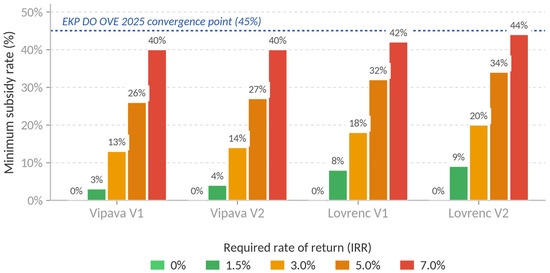
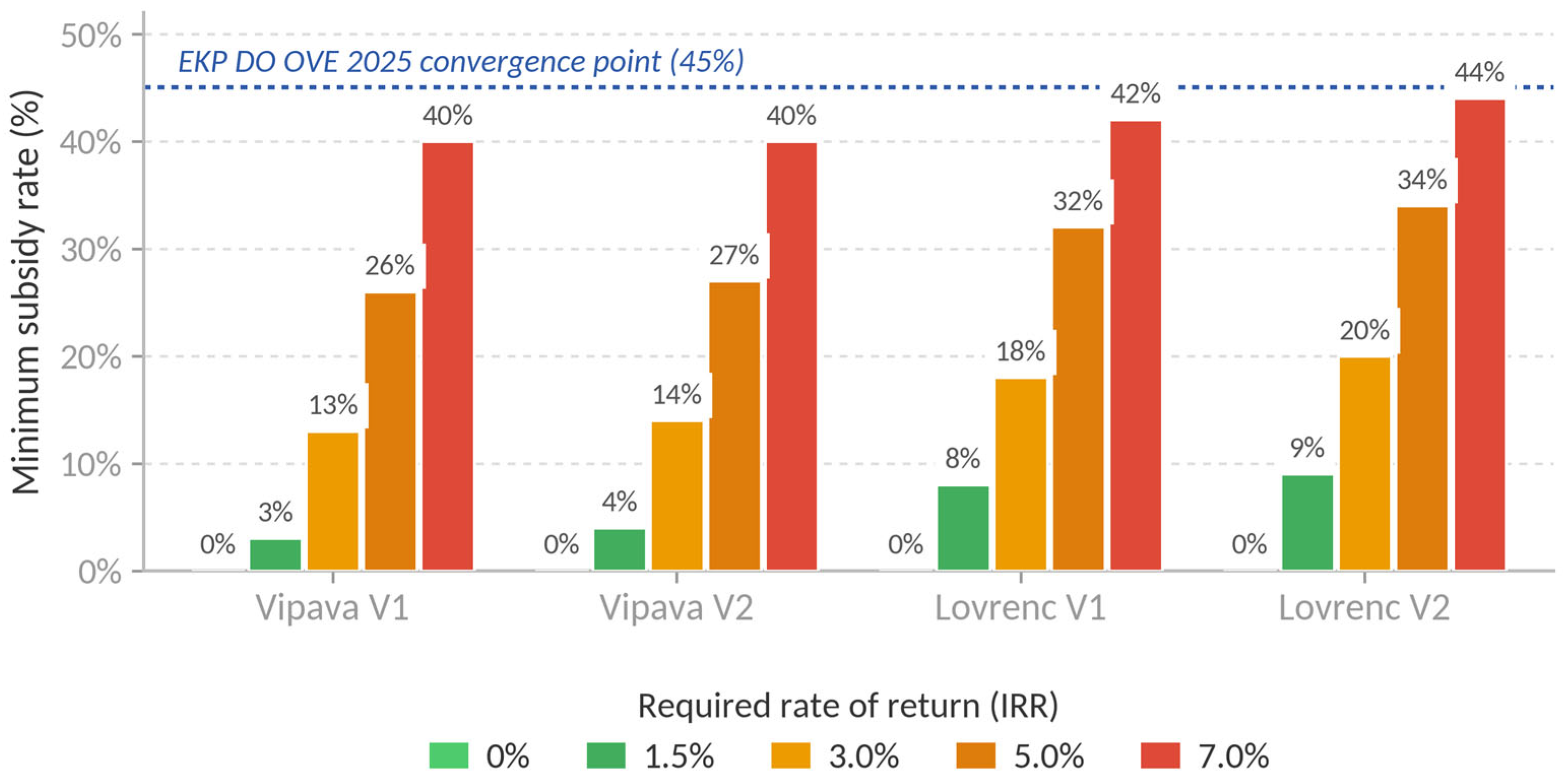
The sensitivity to the required rate of return reveals a structural dimension of the viability problem that the subsidy-rate analysis alone does not capture. Figure 1 shows the minimum subsidy rate necessary to achieve a given target return for each of the four variants. At a commercial bank financing threshold of 7%, the minimum viable subsidy lies in the range of 40–44%, consistent with the convergence finding reported above. However, the minimum subsidy requirement falls sharply as the required return declines: at a social discount rate of 3%—the rate applied by the European Commission to cohesion-region public investments—the minimum subsidy drops to 12–20%; at 1.5%, to 3–9%; and at 0%, all four variants achieve positive net present value without any subsidy, as each already generates a small positive IRR in the range of 0.2–1.0% under unsubsidised conditions. This pattern implies that the financial non-viability of these projects at zero subsidy is an artefact of the private cost of capital, not of their underlying economic performance: under a social valuation of time consistent with public investment appraisal practice, cooperative district heating is economically self-sustaining. The finding also suggests that access to concessional financing instruments—such as EIB Climate Bank loans or KfW green energy programmes at interest rates of 1–2%—could substantially reduce the subsidy burden required for viability, with implications for the design of future support programmes.
Figure 1.
Minimum subsidy rate required to achieve financial viability as a function of the required rate of return, for all four project variants. The dashed blue reference line marks the EKP DO OVE 2025 convergence point identified in Section 3.2.
Three findings are consistent across all variants. First, without any public co-financing, every scenario returns a strongly negative NPV and an IRR below 1%, confirming that BDH in this cost and tariff range is not commercially self-financing. This result holds across a threefold range of CAPEX (€617k–€1872k) and is structurally robust: it is not attributable to project-specific cost overruns. Subsidy is a structural enabling condition, not an optional enhancement. Second, at the 35% subsidy tier (large enterprise ceiling under JR DO OVE), the positive NPV for Lovrenc arises only because the terminal book value of the concession infrastructure—€227k for Variant 1 and €367k for Variant 2, transferred to the municipality at the end of year 15—is counted as cash inflow. The annual operating cash flow at 35% is marginally negative (−€10k/year for V1 and −€17k/year for V2), meaning the operator would not cover costs on a running basis and could recoup its investment only through the terminal asset transfer. The 35% tier is therefore operationally fragile. Third, at the 45% subsidy rate, the IRR converges to approximately 7.3–7.8% across all four variants regardless of scale—a result that points to a broadly common cost structure per unit of heat delivered once the credit-annuity capital methodology is applied consistently. At 55% subsidy—the micro/small enterprise ceiling and the most plausible operating scenario given the economics of local biomass supply chains—IRR reaches 10.3–10.8% in all variants, and the simple payback falls to 9 years across the board. These thresholds make 15-year commercial bank financing feasible. The EKP DO OVE 2025 call for Vipava additionally permits a 65% tier at which IRR rises to approximately 14.6–14.7% and payback falls to 7 years.
Levelised cost of heat. Table 4 presents the LCOH on the economic basis (full CAPEX, 0% subsidy) and the private basis (i.e., from the operator’s financial perspective, after applying the investment subsidy; 55% subsidy) for all four variants, together with the implied per-unit subsidy transfer.
Table 4.
Levelised cost of heat (LCOH) by BDH Living Lab case and subsidy basis. Economic basis = full CAPEX credit annuity (0% subsidy). Private basis = 55% subsidy applied. Rounded to nearest €1/MWh.
Three patterns are visible in Table 4. First, the Vipava variants have a lower LCOH than the Lovrenc variants on both bases. The 5–9 €/MWh gap between Vipava and Lovrenc V1 (at comparable specific CAPEX of roughly €550–560/MWh of annual heat delivered) is explained by the 1 percentage point difference in credit interest rate (5% versus 6%), which raises the Lovrenc capital annuity relative to Vipava for the same asset base. Second, the scale within each case barely affects the LCOH: Vipava V1 and V2 show identical private-basis costs (85 €/MWh) because the system scales approximately proportionally, while Lovrenc V2 is notably more expensive (97 versus 89 €/MWh private) because its extended network entails higher specific CAPEX (€677/MWh versus €560/MWh for Lovrenc V1). Third, the subsidy transfer column reveals the per-unit public contribution embedded in the private tariff: between 29 and 37 €/MWh, representing 25–28% of the unsubsidised LCOH. This is the extent to which the heat price paid by connected consumers is supported by public co-financing at the 55% tier.
Typology mapping. All four BDH variants occupy the same position in the three-model typology: the asset model, financed by a two-pillar combination of public capital subsidy and commercial bank debt. The absence of a member-capital pillar is not a design choice of the operator but a structural consequence of the concession sequence: the operator is selected through a public tender whose outcome is determined after the investment scope is defined, and no legal mechanism exists through which a prospective concessionaire could pre-mobilise cooperative member equity before the tender result is known. The Vipava BDH Living Lab case explicitly discusses the cooperative form as one of three eligible concessionaire types—alongside a private company and a municipal entity—but notes that the cooperative must in all cases satisfy the same technical and financial criteria as any other bidder, and must secure its financing independently before or alongside the tender process. The financing architecture is therefore institutionally imposed, irrespective of whether the winning operator is ultimately organised as a cooperative in its internal statutes. This makes the Slovenian asset model categorically distinct from the cooperative asset model observed in Austria, Germany and Switzerland, where member capital is assembled before the project is committed, and the cooperative form itself confers access to that capital pillar. The finding extends the cross-country pattern from Section 3.1: the national legal-institutional framework shapes not only the legal form available to a community energy initiative but, through the concession-tender sequence, the set of accessible financing instruments—a constraint that no choice of cooperative statute can overcome and that makes public subsidy availability the single most decisive determinant of financial viability.
3.3. Comparative Context
Both Slovenian BDH Living Lab cases map unambiguously to the asset model in Table 1, yet within that category they occupy a distinct structural position. In the North-West European cooperatives—Nah-Wärme-West (Berlin), ADEV (Switzerland), and DuCoop (Belgium)—the asset-owning entity is an independent, member-funded cooperative that raises its own equity layer through member entrance fees, shares, or subordinated member loans, and then finances the remaining capital requirement through bank debt. In the Czech cases (Přeštice, Kněžice) and the Danish case (Holbæk), no cooperative equity exists; the owning entity is instead a municipally owned company financed from public budgets. The two Slovenian BDH cases sit between these poles. The operative entity is legally a cooperative, yet it does not own the infrastructure outright: under the public–private–partnership (PPP) framework, the municipality retains residual ownership and the cooperative acts as concessionaire-operator. This hybrid is the institutional form through which the asset model is realised when the cooperative tradition is nascent and municipal liability cannot be fully assumed by the private sector.
The financing comparison across Table 1 reveals a functional equivalence that has direct implications for policy. In the asset model, the equity layer—whatever its source—serves a single financial purpose: it reduces the debt base and thereby lowers the annual debt-service obligation, bringing the revenue threshold for financial viability within reach of a public-service tariff. In the German, Swiss, and Belgian cases this equity layer is provided by citizens through cooperative shares; in the Czech and Danish cases it is provided by the public balance sheet; in the Slovenian cases it is provided by a national competitive subsidy (EKP DO OVE 2025) that covers up to 55% of eligible capital expenditure. The sensitivity analysis of Section 3.2 confirms this mechanism directly: removing the subsidy (0% scenario) renders all four variants financially unviable, while increasing it to 65% yields IRRs of 14.6–14.7%. Public subsidy is thus not a supplementary instrument in the Slovenian model but the structural substitute for member capital—the mechanism by which the equity layer is assembled without a cooperative tradition capable of mobilising citizen investment.
The scale of the two Slovenian BDH systems—CAPEX of €617,000 to €1.87 million, delivering 1100 to 3300 MWh per year—is smaller than most of the Austrian and German benchmark cases in the HeatCOOP compilation. This scale penalty is visible in the LCOH. On a private basis (55% subsidy), the four variants LCOH range from 85 to 97 €/MWh; on an unsubsidised full-cost basis (0% subsidy), from 114 to 134 €/MWh. These figures place the Slovenian projects in the upper segment of published European benchmarks for small-scale BDH, which—depending on fuel prices, system scale, and network density—typically span 60–120 €/MWh for comparable biomass-based systems [3,18]. Vipava is cheaper than Lovrenc across all variants: the primary drivers are a one-percentage-point lower credit rate (5% vs. 6%), which reduces the annual capital cost, and a lower specific CAPEX per unit of annual heat delivered (approximately 556 €/MWh for Vipava V1 vs. 677 €/MWh for Lovrenc V2). The unsubsidised LCOH gap between Vipava V1 and Lovrenc V2—114 vs. 134 €/MWh—is thus attributable to financing conditions and project sizing rather than to differences in technology or fuel.
A cross-case comparison across the sensitivity scenarios of Table 3 reveals that the subsidy rate is a more powerful determinant of financial viability than either the choice between V1 and V2 within a location or the comparison between the two locations. The NPV spread between Vipava V1 and Lovrenc V2 at any given subsidy level is substantially smaller than the NPV spread between the 35% and 55% subsidy scenarios within either case. At approximately 45% subsidy, all four BDH variants achieve positive NPV and IRRs in the range of 7.3–7.8%, a convergence that would not occur if site-specific cost structures were the dominant factor. This pattern is a direct consequence of the two-pillar financing architecture: because both BDH cases rely exclusively on subsidy and bank debt—with no member equity contribution—the ratio of subsidy to total capital is the single most important variable determining the residual debt burden and thus the annual cost of capital. In the North-West European cooperatives, by contrast, the member-capital contribution varies across projects, so site-specific equity mobilisation differentiates financial outcomes even when subsidy rates are held constant.
Taken together, three structural features define the Slovenian variant of the asset model: (i) the concession-hybrid legal form, (ii) the substitution of public subsidy for member capital, and (iii) the resulting convergence of viability thresholds that makes the subsidy rate—rather than project-specific characteristics—the decisive policy variable. These features are not deficiencies measured against a North-West European norm but the necessary form that the asset model takes in a legal-institutional environment where cooperative ownership of energy infrastructure lacks a settled organisational and financial tradition. The comparison with the Czech municipal model is also instructive: Slovenia has not adopted the fully public ownership solution, but has instead designed a hybrid that preserves cooperative operation while routing the equity function through the public budget via competitive grant allocation. Section 4 returns to the implications of this institutional mediation for the design of financing support mechanisms and for the conditions under which the three-model typology of Section 2.2 can be expected to generalise across European legal contexts.
4. Discussion
The three empirical findings reported in Section 3.2 and Section 3.3 converge on a single organising claim: the financial viability of a heat cooperative is not determined by the technical or economic characteristics of the project in isolation, but by the fit between the business model, the financing structure, and the national legal-institutional context in which both are embedded. The two Slovenian BDH Living Lab cases achieve viability not because they are technically superior to unviable alternatives, but because a specific combination of public subsidy, concession-based legal architecture, and bank debt assembles a capital structure that covers the full cost of an asset-model project. Each element of this combination reflects a national institutional condition rather than a technical optimum. The following discussion develops three implications of this finding for the design of support mechanisms, for the understanding of cooperative energy finance, and for the application of the HeatCOOP typology beyond the cases examined here.
The conventional framing of renewable energy subsidies casts them as corrections for market failures: they internalise externalities or bridge a competitiveness gap between fossil and renewable technologies. The present analysis suggests a different reading for the cooperative context. The EKP DO OVE 2025 subsidy does not primarily improve the competitive position of biomass heat relative to individual gas boilers, nor does it correct a pricing externality. Its financial function is to supply the equity layer of an asset-model capital structure that the cooperative cannot self-fund through member contributions. In a well-established cooperative tradition—such as that supporting ADEV in Switzerland or DuCoop in Belgium—this equity layer is provided by citizens who purchase shares or make subordinated loans, accepting a capped dividend in exchange for local energy security and co-ownership. In Slovenia, where cooperative ownership of energy infrastructure lacks institutional track record and the legal framework does not yet incentivise citizen investment of this kind, no comparable equity mobilisation is possible. It should be noted that higher heat tariffs—were they socially or politically acceptable—would improve the return on cooperative shares and could in principle make citizen-capital mobilisation viable even in the current Slovenian setting; the barrier is therefore not purely institutional but also a function of the tariff level that local authorities and users are willing to accept.
This “equity-substitute” characterisation describes the financial function of the subsidy—its role in completing the capital structure—rather than asserting full equivalence between public grants and member capital. The two instruments differ substantially in their governance implications. Cooperative shares create aligned incentives: shareholders bear residual risk, expect a return, and have standing to monitor management decisions; these ownership-based accountability mechanisms are widely regarded as a governance advantage of the cooperative form [18]. Public subsidy, by contrast, does not transfer residual risk or decision rights to the funder: the granting authority monitors compliance with programme conditions rather than financial performance, and the absence of member capital removes a source of peer-monitoring that cooperative governance theory associates with efficiency. In the Slovenian model, accountability rests instead on concession contract terms, tariff regulation, and the municipality’s role as a residual asset owner—a different governance architecture, but one whose long-run efficiency characteristics differ from full cooperative ownership and whose suitability for the cooperative sector warrants explicit consideration in programme design.
The subsidy fills this structural gap: it reduces the capital base on which the credit annuity is computed, bringing annual costs within reach of a socially acceptable tariff. Designing subsidy policy as an equity-equivalent intervention—calibrated to the residual debt burden after member capital is exhausted—rather than as a technology cost-gap payment has distinct implications. It implies that the subsidy rate should be sensitive to the cooperative’s equity-mobilisation capacity, and that reducing subsidy dependency over time requires building that capacity rather than improving the cost competitiveness of alternative individual heating systems (gas boilers, individual heat pumps). Figure 1 confirms this from a complementary angle: at social discount rates of 0–1.5%, consistent with public investment appraisal practice in EU cohesion regions [26], the equity-substitution function of the subsidy becomes unnecessary—all four variants generate positive returns without public co-financing—implying that the financial non-viability observed at zero subsidy is an artefact of the private cost of capital rather than an inherent characteristic of the projects themselves.
The PPP concession model that both Slovenian cases employ is best understood not as a permanent institutional solution but as a transitional form suited to an early phase of cooperative energy development. Under this arrangement, the municipality retains residual infrastructure ownership and the cooperative operates under a time-limited concession; the public guarantee implicit in municipal backing allows the project to access bank credit at terms unavailable to a nascent cooperative acting alone. The analogy with the history of cooperative energy in Northern and Western Europe is instructive. In Germany, the first wave of energy cooperatives in the 1990s and 2000s also relied heavily on public co-financing and was often embedded in municipal frameworks before accumulating the organisational credibility needed to raise member capital independently. The PPP model creates the conditions—operating experience, auditable track records, and local trust—under which a cooperative might eventually graduate to fuller asset ownership and direct citizen-capital financing. However, this developmental trajectory is not automatic. If public subsidies remain permanently available at rates sufficient to replace member capital entirely, the incentive to build cooperative equity capacity disappears; the cooperative remains a publicly subsidised operator rather than evolving into an autonomous financially self-sustaining entity. Policy design should therefore consider whether subsidy programmes include mechanisms—declining subsidy rates across successive project generations, or co-financing requirements linked to member-capital thresholds—that actively encourage the transition from the concession hybrid toward fuller cooperative ownership.
The three-model typology—administrative (operating), leasing, and asset (ownership)—proves descriptively robust across all sixteen observed cases in Table 1: every project can be assigned to one of the three categories based on the asset basis of the operating entity and the resulting revenue requirement. The cases also confirm the typology’s core prediction that the asset model generates the most acute financing challenge, because its revenues must cover both operating and capital costs. Where the typology requires qualification is in its prescriptive application: it cannot directly prescribe a legal form, because the same organisational function is realised through different legal vehicles depending on national tradition. The asset model is implemented through a private cooperative in Germany and Switzerland, through a cooperative–concession hybrid in Slovenia, and through a municipally owned company in the Czech Republic and Denmark. The financial instruments that fund each implementation differ correspondingly. This observation does not undermine the typology but clarifies its level of abstraction: it classifies organisational functions, not legal forms, and should be applied accordingly when transferred to policy contexts outside the HeatCOOP partner countries. Practitioners adapting the framework to a new national context should first identify which legal vehicle is available to perform the asset-ownership function before mapping it to the typology—rather than assuming that “cooperative” in the typology implies the specific cooperative statute of any given jurisdiction.
Two limitations bear emphasis before the conclusions are drawn. First, as noted in Section 2.6, the financial figures underlying all four case variants are drawn from early-stage investment-identification documents; the IRR and NPV estimates carry material uncertainty and should not be treated as project-finance appraisals. Second, the analysis rests on two cases in a single country (Slovenia) and a single technology (BDH); the relationships identified—between subsidy rate, capital structure, and financial viability—are analytically rather than statistically generalisable, and their applicability to other technologies, fuels, or national contexts requires further empirical testing.
5. Conclusions
This paper has examined the financial viability of heat cooperatives through a comparative financial feasibility analysis of two BDH projects in Slovenia, interpreted within a cross-European framework of sixteen cooperative and community heating cases. Three findings stand out. First, the subsidy rate—not the choice of technical variant or the specific project location—is the dominant determinant of financial viability in both Slovenian cases: at approximately 45% subsidy all four variants achieve positive NPV and converge to IRRs of 7.3–7.8%, while without subsidy none is viable. Second, the mechanism through which subsidy determines financial viability is structural rather than corrective: it supplies the equity layer of an asset-model capital structure that the cooperative cannot fund through member contributions in the current Slovenian legal-institutional environment. Third, the PPP concession model represents a nationally specific hybrid form of the asset model—positioned between the private cooperative ownership prevalent in North-West Europe and the full municipal ownership of the Czech and Danish cases—in which public infrastructure logic and cooperative operation are combined to achieve financial viability under local institutional constraints.
These findings carry three policy implications. Subsidy programmes for cooperative DH in institutionally nascent cooperative environments should be explicitly designed as equity-equivalent instruments, with rates calibrated to the residual debt burden after available member capital is exhausted rather than to technology cost gaps. Concession frameworks, such as the PPP model, are a valuable transitional mechanism but should incorporate incentives—such as declining subsidy rates across successive project generations or co-financing requirements linked to member capital—to encourage the gradual transition toward fuller cooperative ownership and citizen investment. Finally, applying European cooperative energy typologies to new national contexts requires first identifying which legal vehicle is locally available to perform the asset-ownership function, rather than assuming that a single cooperative statute is universally available.
Several research directions follow from this analysis. Longitudinal tracking of the two Slovenian Living Lab projects through construction and initial operation will allow the IID estimates to be validated against observed costs and revenues, providing empirical calibration of the cost and subsidy-rate assumptions embedded in early-stage investment appraisals and thereby informing the design of future IID-based grant allocation under comparable programmes. Critically, such tracking will also enable monitoring of whether and how the concession–hybrid model evolves toward fuller cooperative asset ownership and direct member-capital mobilisation—the developmental trajectory whose enabling conditions are identified in Section 4. Comparative analysis across the other HeatCOOP partner countries—particularly those with more established cooperative traditions—would allow the relationship between member-capital mobilisation capacity and subsidy dependency to be examined empirically across a larger sample. More broadly, a systematic mapping of national cooperative legal frameworks to the financing structures they enable would provide the institutional foundation for an evidence-based transferability assessment of the HeatCOOP typology across the EU. A priority strand within this agenda is the design of graduated support mechanisms—for instance, declining subsidy rates across successive project generations linked to growing member-capital requirements—that could actively encourage the transition from grant-dependent concession models toward fully cooperative ownership and citizen investment.
Author Contributions
Conceptualization, G.S., D.S. and K.T.; methodology, G.S.; formal analysis, G.S. and K.T.; investigation, G.S. and K.T.; resources, G.S.; data curation, D.S.; writing—original draft preparation, G.S. and K.T.; writing—review and editing, G.S. and D.S.; visualisation, G.S.; supervision, D.S.; project administration, G.S.; funding acquisition, G.S. All authors have read and agreed to the published version of the manuscript.
Funding
This research was partially funded by EU LIFE IP CARE4CLIMATE (LIFE17 IPC/SI/000007) and DUT HeatCOOP (F-DUT-2022-0156) projects.
Data Availability Statement
The original contributions presented in this study are included in the article. Further inquiries can be directed to the corresponding author.
Acknowledgments
The authors thank the Local Energy Agency of the Goriška Region (GOLEA) and the Energy Agency of Podravje–Maribor Region (ENERGAP) for their support in the preparation of this study. During the preparation of this manuscript, the authors used ChatGPT (OpenAI, model GPT-5.6 Sol) for the purposes of English language editing and the improvement of grammar, readability and overall clarity of the text. No generative AI tool was used to produce or analyse scientific content, and all analyses, interpretations and conclusions were developed and verified by the authors. The authors have reviewed and edited the output and take full responsibility for the content of this publication.
Conflicts of Interest
The authors declare no conflicts of interest.
Abbreviations
The following abbreviations are used in this manuscript:
| BDH | Biomass district heating |
| CAPEX | Capital expenditure |
| FFA | Financial feasibility analysis |
| DH | District heating |
| DIIP | Investment project identification document (Sln. Dokument identifikacije investicijskega projekta) |
| DO | District heating (Sln. Daljinsko ogrevanje) |
| DOLB | Wood-biomass district heating (Sln. Daljinsko ogrevanje na lesno biomaso) |
| EKP | European Cohesion Policy (Sln. Evropska kohezijska politika) |
| EU | European Union |
| IEA | International Energy Agency |
| IID | Investment-identification document |
| IRR | Internal rate of return |
| JR | Public tender (Sln. Javni razpis) |
| LCOH | Levelised cost of heat |
| NPV | Net present value |
| OPEX | Operating expenditure |
| OVE | Renewable energy sources (Sln. Obnovljivi viri energije) |
| PPP | Public–private partnership |
| RED | Renewable Energy Directive |
| SHC | Solar Heating and Cooling Programme |
References
- European Commission. An EU Strategy on Heating and Cooling. Available online: https://energy.ec.europa.eu/topics/energy-efficiency/heating-and-cooling_en (accessed on 1 July 2026).
- Paardekooper, S.; Lund, R.S.; Vad Mathiesen, B.; Chang, M.; Petersen, U.R.; Grundahl, L.; David, A.; Dahlbæk, J.; Kapetanakis, I.A.; Lund, K.; et al. Heat Roadmap Europe 4: Quantifying the Impact of Low-Carbon Heating and Cooling Roadmaps. Aalborg Universitetsforlag. 5 October 2018. Available online: https://vbn.aau.dk/en/publications/heat-roadmap-europe-4-quantifying-the-impact-of-low-carbon-heatin/ (accessed on 5 June 2026).
- JASPERS. JASPERS Guide to Decarbonisation of District Heating Systems. European Investment Bank–JASPERS. Available online: https://jaspers.eib.org/knowledge/publications/jaspers-guide-to-decarbonisation-of-district-heating-systems (accessed on 5 June 2026).
- Malcher, X.; Gonzalez-Salazar, M. Strategies for decarbonizing European district heating: Evaluation of their effectiveness in Sweden, France, Germany, and Poland. Energy 2024, 306, 132457. [Google Scholar] [CrossRef] [Scilit]
- European Commission. Directive (EU) 2023/2413 of the European Parliament and of the Council of 18 October 2023 Amending Directive (EU) 2018/2001, Regulation (EU) 2018/1999 and Directive 98/70/EC as Regards the Promotion of Energy from Renewable Sources, and Repealing Council Directive (EU) 2015/652. 18 October 2023. Available online: http://data.europa.eu/eli/dir/2023/2413/oj (accessed on 5 June 2026).
- Čižman, J.; Merše, S.; Staničić, D.; Pušnik, M.; Stegnar, G. Heating and Cooling Strategy of Slovenia. Ljubljana, 2024. Available online: https://www.samo1planet.si/wp-content/uploads/2024/04/SOH_Izrocek_IJS_C4.3_koncni_lektorirani_urejen.pdf (accessed on 5 June 2026).
- The REScoop Model-REScoop. Available online: https://www.rescoop.eu/the-rescoop-model (accessed on 5 June 2026).
- Mohammadi, N. Investigation of Community Energy Business Models from an Institutional Perspective: Intermediaries and Policy Instruments in Selected Cases of Developing and Developed Countries. Sustainability 2023, 15, 8423. [Google Scholar] [CrossRef] [Scilit]
- NYSERDA. Business Models for District Energy (Section 3, Community Heat Pump Systems). Available online: https://www.nyserda.ny.gov/-/media/Project/Nyserda/Files/Programs/Community-Heat-Pump-Systems/03-District-Energy-Chapter-3_print.pdf (accessed on 5 June 2026).
- Hoops, B. EU Directives on the internal governance of energy communities and their exclusionary effects. J. World Energy Law Bus. 2024, 17, 147–167. [Google Scholar] [CrossRef] [Scilit]
- Koltunov, M.; De Vidovich, L. Energy communities in social sciences: A bibliometric analysis and systematic literature review. Renew. Sustain. Energy Rev. 2025, 220, 115871. [Google Scholar] [CrossRef] [Scilit]
- Krug, M.; Di Nucci, M.R.; Schwarz, L.; Alonso, I.; Azevedo, I.; Bastiani, M.; Dyląg, A.; Laes, E.; Hinsch, A.; Klāvs, G.; et al. Implementing European Union Provisions and Enabling Frameworks for Renewable Energy Communities in Nine Countries: Progress, Delays, and Gaps. Sustainability 2023, 15, 8861. [Google Scholar] [CrossRef] [Scilit]
- Smith, A.; Hargreaves, T.; Hielscher, S.; Martiskainen, M.; Seyfang, G. Making the most of community energies: Three perspectives on grassroots innovation. Environ. Plan. A 2016, 48, 407–432. [Google Scholar] [CrossRef] [Scilit]
- Wierling, A.; Schwanitz, V.J.; Zeiß, J.P.; Bout, C.; Candelise, C.; Gilcrease, W.; Gregg, J.S. Statistical Evidence on the Role of Energy Cooperatives for the Energy Transition in European Countries. Sustainability 2018, 10, 3339. [Google Scholar] [CrossRef] [Scilit]
- Neij, L.; Palm, J.; Busch, H.; Bauwens, T.; Becker, S.; Bergek, A.; Buzogány, A.; Candelise, C.; Coenen, F.; Devine-Wright, P.; et al. Energy communities—Lessons learnt, challenges, and policy recommendations. Oxf. Open Energy 2025, 4, oiaf002. [Google Scholar] [CrossRef] [Scilit]
- Haggett, C.; Aitken, M. Grassroots Energy Innovations: The Role of Community Ownership and Investment. Curr. Sustain. Renew. Energy Rep. 2015, 2, 98–104. [Google Scholar] [CrossRef] [Scilit]
- Heatcoop Project. Available online: https://commoning.net/gem/projekte/ (accessed on 5 June 2026).
- Bauwens, T.; Defourny, J. Social Capital and Mutual Versus Public Benefit: The Case of Renewable Energy Cooperatives. Ann. Public Coop. Econ. 2017, 88, 203–232. [Google Scholar] [CrossRef] [Scilit]
- Handbook: Description of the Administrative Model of a Heating Cooperative & How to Develop a Business Model for a Heating Cooperative. 2026. Available online: https://dutpartnership.eu/projects/heatcoop (accessed on 5 June 2026).
- Braunholtz-Speight, T.; Sharmina, M.; Manderson, E.; McLachlan, C.; Hannon, M.; Hardy, J.; Mander, S. Business models and financial characteristics of community energy in the UK. Nat. Energy 2020, 5, 169–177. [Google Scholar] [CrossRef] [Scilit]
- Gilbert, T.; Menon, A.K.; Dames, C.; Prasher, R. Heat source and application-dependent levelized cost of decarbonized heat. Joule 2023, 7, 128–149. [Google Scholar] [CrossRef] [Scilit]
- Nian, V.; Sun, Q.; Ma, Z.; Li, H. A Comparative Cost Assessment of Energy Production from Central Heating Plant or Combined Heat and Power Plant. Energy Procedia 2016, 104, 556–561. [Google Scholar] [CrossRef] [Scilit]
- International Energy Agency, Solar Heating and Cooling Programme. IEA-SHC Task 54. LCoH for Solar Thermal Applications —Info Sheet A01 (Separate Levelised Costs for the Solar, Conventional and Overall Parts of a Heating System). 2026. Available online: https://task54.iea-shc.org (accessed on 5 June 2026).
- Republic of Slovenia. Regulation on the Uniform Methodology for the Preparation and Evaluation of Investment Documentation in the Field of Public Finance. Available online: https://pisrs.si/pregledPredpisa?id=URED3708 (accessed on 5 June 2026).
- Eurostat. Gas Prices for Household Consumers-bi-Annual Data (from 2007 Onwards); Eurostat: Luxembourg, 2022. [Google Scholar] [CrossRef]
- Directorate-General for Regional and Urban Policy (European Commission). Guide to Cost-Benefit Analysis of Investment Projects: Economic Appraisal Tool for Cohesion Policy 2014 2020; Publications Office of the European Union: Luxembourg, 2015. Available online: https://data.europa.eu/doi/10.2769/97516 (accessed on 5 June 2026).

Disclaimer/Publisher’s Note: The statements, opinions and data contained in all publications are solely those of the individual author(s) and contributor(s) and not of MDPI and/or the editor(s). MDPI and/or the editor(s) disclaim responsibility for any injury to people or property resulting from any ideas, methods, instructions or products referred to in the content. |
© 2026 by the authors. Licensee MDPI, Basel, Switzerland. This article is an open access article distributed under the terms and conditions of the Creative Commons Attribution (CC BY) license.