


Abstract
Modern energy systems, including those supporting transportation electrification, are increasingly exposed to volatile market conditions and external events. Effective decision-making therefore requires the integration of structured operational data with unstructured contextual information. Existing studies on Large Language Model (LLM)-assisted energy systems have mainly applied LLMs to individual tasks such as forecasting, scheduling, or decision support, while forecasting and control are typically treated separately. As a result, semantic information extracted from external events is not consistently propagated from market prediction to operational decision-making. This paper proposes a unified dual-stage framework in which the LLM functions as a shared semantic information processor, converting raw event data into structured representations used by both forecasting and control modules. In the forecasting stage, these representations improve price prediction under non-stationary conditions. In the control stage, the same information provides an event-aware contextual action prior for reinforcement learning-based energy management. This design allows external event information to inform both future-state estimation and subsequent control decisions, establishing a consistent connection between prediction and decision-making. The framework is evaluated using real-world electricity market data and a battery energy management environment. The results show that the proposed framework achieves the highest average cumulative reward among the evaluated methods while maintaining greater robustness than the forecasting-only LLM configuration. Overall, this work demonstrates the benefit of consistently propagating structured semantic information across forecasting and control and provides a viable approach to event-aware intelligent energy management, with potential extensions to multi-energy transportation systems and electrified mobility applications.
1. Introduction
1.1. Background
Traditionally, the energy market consisted of two primary participants: generators and retailers, corresponding to supply and demand. Later, vertically integrated companies, such as AGL, Origin Energy, and Energy Australia, operating across both generation and retail, became dominant, driven by the need to hedge risks and balance exposures.
The recent rise of Distributed Energy Resources (DERs) has reshaped market profit models. Aggregators have emerged as a new participant. Unlike traditional utilities, they own few generation assets, instead aggregating third-party resources and partnering with retailers. This asset-light model shifts value from asset ownership to the effective optimization and monetization of DER performance, introducing new challenges around delivering measurable value to distributed energy owners.
On the demand side, consumers, particularly in commercial and industrial facilities, are increasingly prioritizing peak reduction, cost savings, efficiency improvements, and renewable adoption.
However, as DER portfolios grow more heterogeneous and decentralized, effective decision-making depends on both structured operational data and unstructured external information, including grid announcements, regulatory updates, weather alerts, and market news. These sources often contain critical signals but are rarely integrated into pipelines designed primarily for numerical data. Much valuable contextual information thus remains underutilized in current systems.
This paper addresses these challenges within the framework of Energy Decision Systems, which provide a unified view of trading and management tasks. Despite different application contexts, these systems share a two-stage structure: forecasting infers future conditions, and control determines optimal actions based on those forecasts. This prediction-to-decision workflow underpins energy intelligence under uncertainty and will be explored in the chapters that follow.
1.2. Literature Review
Recent deep learning advancements have driven substantial progress in energy forecasting, particularly within distributed and renewable systems. Convolutional Neural Network (CNN)-based and Deep Neural Network (DNN)-based models remain foundational in this field. The study in [1] reviews DNNs and their hybrid solutions for short-term energy forecasting (STEF), highlighting their strength in modeling nonlinear patterns in solar and wind data. Similarly, the authors in [2] employ an Enhanced DNN to assess residential building energy efficiency, underscoring the role of feature selection and architectural design in improving accuracy.
Building on these foundations, Transformer-based approaches have gained prominence for their ability to capture long-range temporal dependencies. In ref. [3], transformer models are applied to hybrid solar–wind generation forecasting, while ref. [4] integrates transformers into Generalized Energy Models for building-level energy consumption analysis. These studies demonstrate the effectiveness of attention mechanisms in handling multi-scale energy dynamics.
To further enhance adaptability, researchers have explored hybrid and ensemble frameworks that combine multiple learning paradigms. For example, the authors in [5] integrate clustering, CNN, LSTM, and attention mechanisms for photovoltaic (PV) forecasting; the article in [6] introduces a Physical–Statistical Hybrid Model incorporating building characteristics; and ref. [7] proposes an Attention-Driven Hybrid Ensemble Framework addressing both demand and supply forecasting. Collectively, these studies indicate a clear shift toward hybridized architectures that fuse physical insights with data-driven learning to manage the increasing complexity of DER systems.
Moving into the fields of energy trading and management, the work in [8] employs RL to integrate variable energy resources into the grid and participate in market bidding. In ref. [9], RL is also applied to maximize profits by participating not only in the wholesale market but also in ancillary services. To leverage batteries’ fast response capabilities in energy markets, the RL agent in [10] is trained to operate a battery system in real time. Meanwhile, a Deep Q-Network (DQN)-based RL agent with Long Short-Term Delayed Reward is used in [11] to enable prosumers to trade electricity through peer-to-peer (P2P) energy trading. In ref. [12], Deep Reinforcement Learning (DRL) with the Deep Deterministic Policy Gradient (DDPG) algorithm is adopted to reduce the operating costs of distribution networks and, in turn, lower carbon emissions. Notably, in ref. [13], an RL approach is integrated with a blockchain network to enhance privacy protection and establish mutual trust among participants.
Meanwhile, energy storage flexibility has become increasingly important for managing uncertainty in modern power systems. The study in [14] highlighted the role of energy storage systems in improving grid reliability, renewable integration, and operational flexibility under uncertain operating conditions. In parallel, ref. [15] investigated machine learning-based energy price forecasting and demonstrated the importance of informative predictors for capturing complex market dynamics. However, these approaches primarily rely on structured operational variables and do not explicitly incorporate heterogeneous external information, such as market announcements, policy changes, and operational events, which may introduce additional uncertainty and influence energy system decisions.
Beyond isolated forecasting or control applications, recent research emphasizes the integration of forecasting and control for intelligent decision-making in energy systems. For instance, the study in [16] introduces a multi-modal data-driven forecasting framework that captures unstructured information and complex nonlinear feature relationships, and subsequently designs an interval-constrained trading strategy based on the forecasts. Similarly, the authors in [17] leverage a Transformer Network to model complex patterns and long-term dependencies in the input data, followed by a Deep Deterministic Policy Gradient (DDPG) algorithm for optimal continuous control decisions. In the context of carbon trading, the paper in [18] addresses uncertainty using a data-driven distributionally robust optimization (DRO) model and implements a ladder-type carbon trading mechanism as the trading strategy. These studies support the integration of forecasting with downstream decision-making. However, the information transferred between the two stages is primarily represented by numerical predictions or uncertainty estimates, while heterogeneous external events and their semantic implications are not consistently represented across both forecasting and control.
The evolution of LLMs, from transformer-based architectures to instruction-tuned and domain-specific variants, has opened new opportunities for intelligent energy systems. In forecasting, for instance, ref. [19] combines LSTM-based forecasting with LLM reasoning to improve energy management decisions. Similarly, the paper [20] introduces an Energy Forecasting Large Language Model (EF-LLM) that integrates domain information with temporal data from sensors, while LLMs are used to align textual data sources for improving energy consumption forecasting in natural gas networks in [21]. For control applications, the article [22] explores LLMs within hybrid scheduling frameworks for energy systems that coordinate high-level decisions with physics-based constraints. In distributed manufacturing energy systems [23], LLMs are integrated with blockchain to enhance energy-efficient scheduling, coordination transparency and system trust. Recent work in [24] applies knowledge-driven LLMs to building retrofit decision support, generating interpretable recommendations by combining domain knowledge with fine-tuned language models. Lastly, refs. [25,26] employ LLM-based topic modeling to understand user behavior and preferences for adaptive building energy control, leading to recommendation-driven frameworks that guide users towards more energy-efficient energy use.
Although these studies demonstrate the growing applicability of LLMs in intelligent energy systems, the use of LLMs remains largely task-specific: forecasting-oriented studies use LLM-derived information to improve prediction, whereas decision-oriented studies employ LLMs for scheduling, recommendation, or operational guidance. Therefore, there remains a need to bridge the gap between semantic event understanding and the forecasting-to-control process, so that external information can be utilized consistently throughout energy management. By contrast, this work treats the LLM as a semantic information processor that converts diverse event information into a shared representation. This representation is then used across forecasting and reinforcement learning control, serving a distinct computational role in each stage. With this design, external event knowledge can be integrated throughout the forecasting-to-control pipeline rather than being used independently within isolated modules.
1.3. Problem Statement
Recent advances in LLMs have enabled energy systems to incorporate unstructured information sources, such as market announcements, operational reports, policy documents, and news events, into forecasting and decision-making pipelines. Existing studies have demonstrated the value of such information in both tasks: LLMs extract semantic signals from text to improve forecast accuracy, and similarly, they provide high-level guidance for operational decisions.
However, most of these efforts remain task-specific. Forecasting methods focus on prediction accuracy, while control-oriented approaches use unstructured data primarily for policy support. As a result, event information tends to be processed within separate modules rather than integrated across the entire workflow.
This division is problematic because many external events, policy changes, transmission outages, extreme weather, and market announcements simultaneously affect future system states and optimal control actions. Existing frameworks typically handle such information independently for forecasting and control, producing fragmented representations and potentially inconsistent interpretations of the same event.
A key challenge therefore lies in propagating knowledge from unstructured event information consistently from prediction to decision, so that the same external event can inform both state forecasting and operational policy optimization. For example, a generation outage event may simultaneously alter expected market supply and price dynamics in the forecasting stage, while requiring different battery dispatch decisions in the control stage. Similarly, policy or regulatory changes may modify future market regimes and consequently influence optimal energy management strategies. Treating such information independently may lead to inconsistent interpretations, where forecasting models capture event-induced state transitions while control policies remain unaware of the corresponding operational implications.
1.4. Proposed Solution and Contribution
To address this limitation, a unified dual-stage framework is proposed that integrates unstructured event information into both forecasting and control layers. The core idea is to employ LLMs as a semantic interface, translating heterogeneous event data into structured representations compatible with downstream prediction and decision-making models.
The main contributions are summarized as follows:
- Unified Event Representation Propagation across the Forecasting-to-Control PipelineUnlike existing LLM-assisted forecasting and energy management approaches that utilize external information within individual tasks, this study proposes a unified dual-stage framework that consistently propagates LLM-derived event representations throughout the forecasting-to-control pipeline. This enables the same semantic understanding of external events to enhance both future state prediction and reinforcement learning-based decision-making, ensuring consistent event interpretation across the entire energy management process.
- LLM-augmented Forecasting for Event-Aware Market PredictionThe proposed framework converts heterogeneous external events into structured predictive features, enabling supervised forecasting models to better capture non-stationary market dynamics and event-driven price fluctuations.
- LLM-informed Policy Optimization for Adaptive Energy ManagementRather than replacing the controller, LLM-derived event interpretations are incorporated as contextual action priors to guide RL action selection, allowing the agent to adapt its decisions under uncertain external conditions.
The proposed framework thus maintains consistency between prediction and decision-making while making full use of both unstructured and structured data.
2. System Model
2.1. System Overview
This study considers an electricity market trading and management system for an energy storage unit operating in a stochastic and partially observable environment. The system is designed to jointly handle structured market data and unstructured external event information for improved forecasting and decision-making.
The overall framework consists of three main components: a structured market environment, an unstructured event processing module based on LLMs, and a dual-stage decision system consisting of a forecasting layer and a control layer.
2.1.1. Structured Market Environment
At each time step , the system interacts with a structured electricity market environment. The observable market state is represented as:
where denotes electricity price, denotes demand, denotes available supply, and denotes the state of charge of the energy storage unit. These structured states define the baseline operational context of the system.
The agent selects an action:
which determines the energy flow of the storage system and directly affects reward through market interaction.
2.1.2. Unstructured Event Information
In addition to structured variables, the system receives a stream of unstructured external event data:
These events represent market-relevant information such as system reports, operational updates, renewable generation changes, or unexpected outages. Unlike structured numerical inputs, these signals are heterogeneous and cannot be directly incorporated into traditional forecasting and reinforcement learning models.
2.1.3. Event Interpretation Module
To bridge structured and unstructured information, an event interpretation module is introduced. This module transforms raw event data in Formula (3) into a structured semantic representation:
where denotes the time-aligned event representation at market interval t. Instead of directly using high-dimensional textual embeddings, the proposed framework extracts a compact event feature vector:
where severity represents the potential magnitude of the event impact, confidence indicates the reliability of the extracted event interpretation, price_impact describes the expected influence on market conditions, duration represents the expected persistence of the event effect, and category identifies the event type.
Therefore, the LLM-derived event representation is defined as:
Before aggregation, the numerical semantic attributes (severity, confidence, and price_impact) are normalized using statistics computed from the training dataset:
where and denote the mean and standard deviation of the corresponding numerical event attribute estimated from the training data.
Since electricity markets operate under discrete settlement intervals, temporal alignment is required to associate external events with corresponding market observations. For an event e occurring at time , the starting settlement interval is defined as:
where represents the market settlement interval (30 min in this study). The influence of each event is propagated to subsequent settlement intervals according to its estimated duration:
where represents the duration of the event effect.
To capture the decreasing impact of an event over time, an exponential decay function is introduced:
where controls the decay rate of event influence. The aggregated event representation is obtained by combining all active events at each settlement interval:
where is an activation indicator that determines whether event affects the current settlement interval, and denotes the normalized representation of the corresponding event.
The aggregated semantic representation provides a unified description of the external event information and serves as the basis for the downstream feature construction. For forecasting, a compact scalar event score is further derived to quantify the overall event intensity:
where represents the time-dependent event intensity. Together with the activation indicator , the resulting event_score and event_active constitute the event features integrated into the downstream forecasting model.
To further provide directional contextual information for the control stage, an event pressure signal is constructed. Unlike event_score, which quantifies the overall magnitude of event influence for forecasting, event_pressure captures the directional and category-aware operational impact used by the RL module.
The event pressure at settlement interval t is defined as:
where denotes the event direction determined by the sign of price_impact, represents the event strength, is the temporal decay function, and is the category-based impact factor.
The event strength is calculated as:
where severity, confidence, and price_impact are extracted from the LLM-based event interpretation module. Therefore, event_score is used by the forecasting model to quantify event intensity, whereas event_pressure provides directional and category-aware contextual information for RL-based decision making.
2.1.4. Dual-Stage Decision Architecture
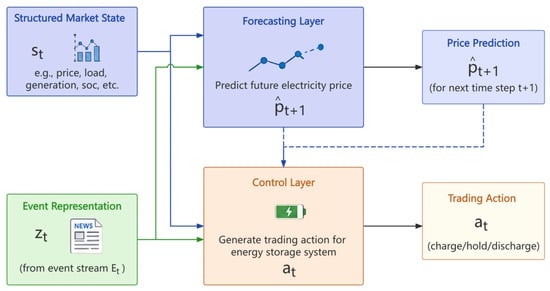
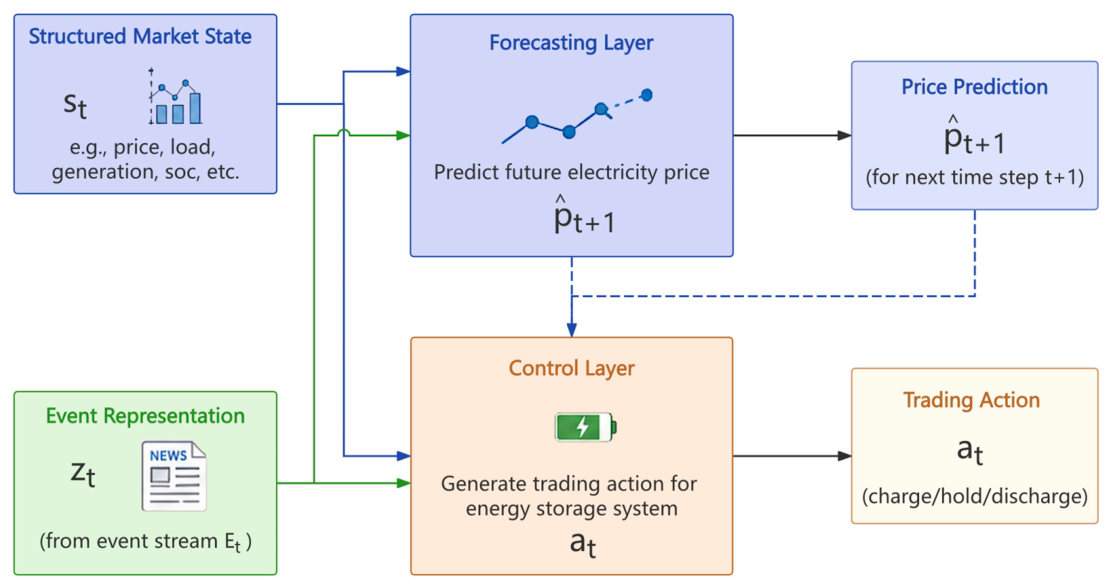
The system adopts a dual-stage decision architecture consisting of a forecasting layer and a control layer. At each time step, both layers receive inputs derived from the structured market state and the event representation . The forecasting layer produces a prediction of future electricity price, while the control layer generates the energy management action for the energy storage system, as illustrated in Figure 1.
Figure 1.
Unified Forecasting and Decision Architecture.
This design enables coordinated decision-making under uncertainty, where both structured market signals and unstructured event information are processed in a unified framework.
2.1.5. System Interaction Flow
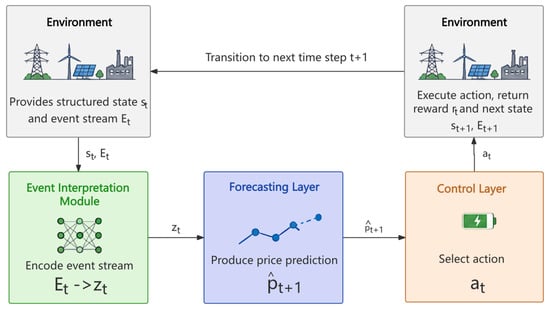
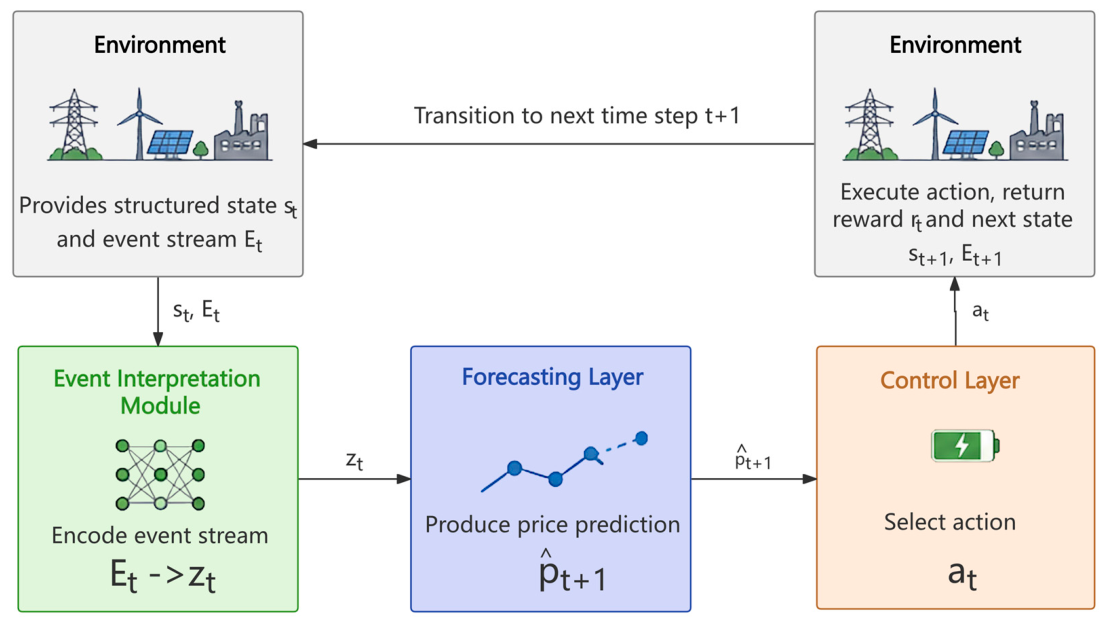
The overall system interaction can be summarized as follows:
- The environment provides structured state and event stream ;
- The event interpretation module encodes ;
- The forecasting layer produces price prediction ;
- The control layer selects action ;
- The environment returns reward and transitions to the next state.
As illustrated in Figure 2, this forms a closed-loop decision system operating under stochastic market dynamics with partial observability.
Figure 2.
Information Flow and Module Interaction.
2.2. Forecasting Layer
The forecasting layer aims to predict future electricity prices by jointly leveraging structured market information and event representations extracted from unstructured external information. While standard forecasting approaches rely solely on historical numerical observations, the proposed forecasting layer incorporates event-level semantic signals to capture market disturbances that may not be reflected in structured variables alone.
2.2.1. Problem Formulation
At time step t, the forecasting layer receives the structured state , as defined in (1), and the event representation generated by the event interpretation module in Formula (4).
The forecasting objective is to estimate the conditional distribution of future electricity prices:
or equivalently produce a point prediction:
where denotes the forecasting model parameterized by θ.
2.2.2. Probabilistic Forecasting
To capture uncertainty in electricity markets, the future price is modeled as a random variable:
where
denotes the expected future price and represents the conditional price estimate given historical market observations and event representations, and represents the associated forecasting uncertainty.
The uncertainty term reflects the prediction error caused by market volatility, incomplete information, and external disturbances. It does not impose a specific distributional assumption on electricity prices. This consideration is particularly important for the Australian National Electricity Market (NEM), where prices may exhibit non-stationarity, negative values, extreme spikes, and heavy-tailed behavior.
In this study, uncertainty estimation can be obtained through machine learning-based approaches, including ensemble methods, residual-based estimation, and quantile forecasting techniques. The proposed framework is designed to capture uncertainty through the forecasting process and event-aware representation learning, rather than assuming a predefined statistical distribution of electricity prices.
2.2.3. Event Information Augmentation
The forecasting layer augments structured market observations with semantic event representations extracted from unstructured textual information. Conventional forecasting models primarily rely on historical numerical variables, such as electricity price, demand, and supply, which may not fully capture external factors affecting market dynamics. In contrast, the proposed framework incorporates event-aware representations derived from policy announcements, operational incidents, and other market-related communications to provide complementary contextual information. The extracted event features are transformed into structured numerical representations through the event interpretation module and integrated with conventional forecasting features. This information augmentation enables the forecasting model to better capture external disturbances and evolving market conditions that are difficult to infer solely from historical observations. Consequently, the proposed framework can, to some extent, enhance market state representation by combining structured operational data with semantically interpreted event information before forecasting [27].
2.3. Control Layer
The control layer constitutes the second stage of the proposed dual-stage decision architecture. Its objective is to determine the optimal energy management action for the energy storage system by integrating the current market state, event information, and future price expectations generated by the forecasting layer.
2.3.1. Markov Decision Process Formulation
The battery decision problem is formulated as a Markov Decision Process (MDP) [28]:
where S is the state space, A stands for the action space, P is the state-transition probability, R denotes the reward function, and represents the discount factor.
At time step t, the agent observes an augmented state:
where is the structured market state, is the event representation, and represents the predicted future electricity price.
The action space is defined as:
representing charging, holding, and discharging decisions, respectively.
2.3.2. Policy Learning
Based on the augmented state , the control policy selects an action according to
where denotes the policy learned by the RL agent. In the DQN implementation, the RL policy is implicitly represented by the estimated action-value function , with actions selected greedily according to the maximum Q-value.
The policy aims to optimize the long-term cumulative discounted reward:
where denotes the reward obtained from market participation and is the discount factor balancing immediate and future rewards.
The reward function reflects the reward stability of battery operation and is generally expressed as
where the reward depends on electricity prices, selected action, and battery operating conditions.
2.3.3. LLM-Derived Contextual Action Prior
In parallel, the LLM produces a context-dependent prior distribution over actions:
where contains semantic information extracted from external events.
The action prior represents high-level operational preferences inferred from external market conditions. For example:
- High demand conditions may increase the preference for battery discharge;
- Low price periods or stable market conditions may favor charging opportunities;
- Supply outage events may encourage more aggressive discharge strategies.
Unlike rule-based controllers, the LLM prior does not directly determine the final action. Instead, it provides a soft inductive bias that can complement the RL policy when external information becomes valuable.
To avoid excessive reliance on semantic guidance, the LLM prior is activated only through an event-aware uncertainty mechanism. Specifically, the activation condition is determined by both external event intensity and RL decision uncertainty:
where denotes the event pressure signal defined with Formula (13), represents the confidence margin of the RL policy, and and are activation thresholds. The Q-value gap is defined as:
A smaller indicates that the RL agent has similar preferences among available actions and therefore exhibits higher uncertainty.
2.3.4. Policy Integration
The proposed framework can be viewed as integrating the RL policy with the LLM-derived contextual prior. Since the RL controller is implemented using DQN, the RL policy is implicitly represented by the estimated action-value function . Accordingly, the policy integration is realized through action-value adjustment during action selection rather than explicit probability fusion.
Specifically, when the event-aware uncertainty mechanism is triggered (), the RL policy and LLM-derived prior are combined to adjust action preferences:
where denotes the action value estimated by the DQN agent, represents the LLM-derived contextual action prior, controls the contribution of the contextual guidance, and is a small positive constant introduced to ensure numerical stability.
The final action is selected according to:
Otherwise, when event impact is limited, or the RL policy exhibits sufficient confidence (), the agent follows the original RL action selection:
This mechanism can be interpreted as an adaptive policy adjustment mechanism that incorporates contextual guidance during action selection. The RL policy provides data-driven decision preferences through the learned action-value function, while the LLM-derived prior introduces external contextual knowledge only when it is informative. Since the proposed integration modifies only the action selection process, without changing the DQN learning objective or temporal-difference update, the learning dynamics remain consistent with the original value-based reinforcement learning framework. Furthermore, the event-aware activation mechanism introduces LLM guidance only when significant event conditions coincide with uncertain policy states, thereby preserving policy consistency while reducing the potential bias caused by inaccurate LLM interpretations. Consequently, the proposed approach avoids continuously imposing semantic constraints while improving decision robustness under uncertain market conditions.
2.4. Unified Event Representation Across Forecasting and Control
The proposed framework adopts a shared event representation to ensure consistency between forecasting and control.
The event interpretation module transforms raw event information into a semantic representation:
In the forecasting path, is combined with the market state to predict future electricity prices:
In the control path, the same representation is used to construct an event-aware action prior:
and contributes to the final action selection process.
Consequently, serves as a unified semantic interface between forecasting and control, enabling consistent utilization of external event information throughout the decision-making pipeline.
The overall information flow can be summarized as:
This shared representation improves information reuse across layers and ensures that both prediction and control are conditioned on the same event understanding.
3. Methodology and Simulation Setup
3.1. Dataset and Market Environment
Historical data from the Australian National Electricity Market (NEM), comprising half-hourly settlement observations from April 2025 to April 2026, are employed for framework evaluation. Structured inputs, including market demand, supply, and price data, are drawn from the AEMO DispatchIS report [29], with the simulation environment configured to reproduce actual settlement intervals and price dynamics.
For incorporation of unstructured information, an event dataset was constructed from AEMO Media Releases [30,31] issued across the same period. These releases serve as authoritative sources of market announcements, operational updates, and policy communications. Such official documents offer contextual signals for supply-demand shocks, regulatory interventions, and latent dynamics beyond what structured data alone can capture.
Table 1 categorizes these AEMO media releases by the explicitness of their market impact signals.
Table 1.
Classifications of AEMO Media Releases (2025–2026) by Market Impact Explicitness.
As shown in Table 1, more than half of AEMO media releases exhibit implicit or contextual market impact signals, requiring semantic interpretation rather than direct rule-based extraction. This highlights the importance of leveraging LLM-based event understanding to capture latent market information embedded in textual communications, which is often not explicitly reflected in structured market variables.
To improve the reliability of the event dataset, all LLM-extracted event attributes were manually verified against the original AEMO media releases to ensure semantic and temporal consistency before inclusion in the event dataset. The validated dataset was subsequently used throughout the forecasting and control experiments.
Table 2 summarizes the distribution of event categories and their temporal characteristics. Although the number of individual media releases is limited, different event types exhibit varying durations, allowing their impacts to propagate across multiple subsequent settlement intervals. Particularly, policy-related events demonstrate longer persistence, while operational events such as demand surges and generation outages introduce shorter but potentially high-impact disturbances.
Table 2.
Event Category Statistics of AEMO Media Releases.
Furthermore, the overall temporal coverage of event information is evaluated. As presented in Table 3, the identified events collectively affect 212.97 unique days within the 525-day dataset period, corresponding to a coverage ratio of 40.57%. This demonstrates that the manually validated event dataset provides meaningful temporal exposure for assessing event-aware forecasting and control performance, despite the relatively small number of source documents.
Table 3.
Temporal Coverage of Event Information.
The dataset is then divided chronologically into training, validation, and testing subsets to evaluate generalization performance and prevent information leakage. The training split supports model learning, the validation split guides hyperparameter tuning and early stopping, while the testing split remains exclusively for out-of-sample evaluation. Specifically, a 70%/15%/15% temporal split is adopted to preserve the time-series structure of market data. All feature engineering procedures follow a causal setting. In particular, rolling statistics (e.g., rolling mean and rolling standard deviation) are computed using only historical observations available before each forecasting timestamp. No future information from validation or testing periods is used during feature construction. For LLM-derived event features, normalization statistics are obtained from the training set only and subsequently applied to validation and testing samples without additional fitting.
3.2. Battery Simulation Environment
A virtual Battery Energy Storage System (BESS) is implemented in the NEM environment to evaluate the proposed framework under historical market conditions while abstracting detailed battery operational characteristics. The simulation follows the state and action formulations (1) and (2), with SoC constrained by:
At each step, energy is transferred at a fixed step size, and SoC is updated according to the selected action. The reward function evaluates relative decision effectiveness rather than absolute economic revenue, as detailed battery characteristics such as capacity, degradation, efficiency losses, and transaction costs are not explicitly modeled. The entire pipeline operates sequentially over historical market data.
3.3. LLM Event Extraction Module Configuration
An LLM-based module performs event extraction from raw textual inputs, producing structured event representations. For each document, the model assumes the role of an energy market analyst and extracts a predefined set of attributes: event time, type, severity, duration, expected price impact, confidence level, and associated metadata. Outputs are formatted as JSON according to a fixed schema, ensuring consistency and reliable parsing. The implementation details of the event extraction module, including the model configuration, prompting strategy, and decoding parameters, are summarized in Table 4.
Table 4.
Configuration Settings for the LLM Event Extraction Module.
To evaluate the reliability of the LLM-based event extraction module, a reference-based consistency assessment is conducted. GPT-4 (gpt-4-turbo) is employed to generate auxiliary reference outputs for the same set of 35 AEMO media releases. To ensure fair comparison, GPT-4 is prompted using the same template as GPT-3.5 in Table 4, and its outputs are treated as a higher-capacity model-based reference rather than ground truth labels. Agreement between GPT-3.5 and GPT-4 is then measured on two key fields: event_type and price_impact. This consistency-based evaluation serves as a proxy for extraction plausibility and semantic coherence rather than an objective ground-truth assessment.
As an additional verification step, all extracted event attributes were manually checked against the original AEMO media releases. The validation covered event category, severity, confidence, price impact, duration, and temporal boundaries to verify that the extracted semantic interpretations were consistent with the reported market conditions and operational context. The manually validated attributes were then transformed into the unified event representations and downstream forecasting and control features following the procedure described in Section 2.1.3.
3.4. Forecasting Model Configuration
LightGBM is chosen as the primary forecasting model, in preference to sequence-based approaches such as LSTM. This selection reflects the structured representation of the input features, as well as the need for interpretability and training stability in these experiments.
The forecasting task is structured as a regression problem for next-step price prediction and a classification problem for spike identification. Both models share the same engineered feature space derived from historical market observations.
Table 5.
Feature Construction for LightGBM Forecasting.
Table 6.
LightGBM Training Configuration.
The LLM event features are optional and included only in certain experimental settings. Random seeds are initialized at 42 as a baseline, with variations applied across experiments to ensure robustness to different data splits and input configurations.
3.5. RL Decision Model Configuration
The decision-making component is formulated as an RL problem, in which the agent learns an optimal trading policy for battery charging and discharging under volatile and uncertain market conditions. The Deep Q-Network (DQN) is adopted as the baseline RL algorithm for its stability in discrete action spaces, sample efficiency, and suitability for value-based decision tasks.
The DQN is built as a multi-layer perceptron (MLP) that maps the market state to Q-values over discrete actions. The state representation comprises structured market variables and, optionally, LLM-derived event features; when the latter are included, the input dimension expands accordingly. Table 7 summarizes the network configuration.
Table 7.
DQN Network Configuration.
To improve robustness under uncertainty, the DQN policy is augmented with an LLM-derived action prior. Under high market stress and a small Q-value gap, the final action score combines Q-values and log-prior probabilities via a weighted sum. A random seed of 42 is used for reproducibility, with additional sensitivity runs under varying seeds to assess robustness.
3.6. Unified Implementation Pipeline and Algorithm’s Pseudo-Code
The framework is organized as a dual-stage pipeline that integrates forecasting, event-driven representation learning, and RL-based control. The overall procedure is given in the pseudo-code below:
3.6.1. Input
- Structured market observations
- Event representations
- Forecasting model
- DQN policy network
- Replay buffer
3.6.2. Stage I: Event-Aware Forecasting
- Augment market observations with event representations ;
- Train forecasting model ;
- Generate one-step-ahead price forecast ;
3.6.3. Stage II: Event-Aware Decision Making
- 1.
- Initialize battery simulation environment;
- 2.
- For each decision epoch t, do;
- a.
- Construct State ;
- b.
- Estimate action values ;
- c.
- Generate event-aware action prior ;
- d.
- Select action;if event pressure is high and policy uncertainty is high, thenelse
- e.
- Execute action ;
- f.
- Observe reward and next state ;
- g.
- Save transition ( in replay buffer B;
- h.
- Sample mini batch from B;
- i.
- Update DQN parameters using TD loss;
- j.
- Periodically synchronize target network;
- 3.
- end for.
3.6.4. Output
- Trained forecasting model
- Trained decision policy
From the above workflow, the two stages are tightly coupled. In the forecasting stage, structured market data are augmented with event representations to improve price prediction. The resulting forecasts, along with market variables and event features, are passed to the decision stage, where a DQN agent optimizes battery management decisions. This unified architecture allows both forecasting and decision-making to benefit from the same event-aware representation. The LLM prior is adaptively gated. It is activated only when event signals are strong and the RL policy exhibits sufficient uncertainty, and its weight decays as the policy matures. This design avoids sensitivity to fixed weighting while enhancing decision stability.
4. Experimental Results
4.1. Overall Performance Comparison
To evaluate the contribution of each component in the proposed framework, five configurations are designed that progressively isolate their individual contributions:
- Rule-based strategy (Rule-based): A heuristic battery arbitrage strategy based on rolling percentile thresholds. The battery is charged when the current price falls below the 30th percentile of recent historical prices, discharged when it exceeds the 70th percentile, and otherwise remains idle;
- RL baseline without LLM integration (RL Baseline): A reinforcement learning agent trained using historical electricity prices without any LLM-enhanced forecasting or policy guidance;
- LLM-enhanced forecasting only (LLM Prediction): The RL agent receives electricity price forecasts generated by the proposed LLM-enhanced forecasting module, while the control policy remains identical to the RL baseline;
- LLM-enhanced control only (LLM Control): The RL agent uses the original forecasting module, but incorporates LLM-derived policy guidance during decision-making;
- Dual-stage LLM framework (Dual-stage LLM): The complete proposed framework integrating both the LLM-enhanced forecasting module and the LLM-guided control strategy.
This ablation setup allows a controlled evaluation of the benefits from forecasting enhancement, policy-level guidance, and their combined effect.
All experiments are run with 10 independent random seeds (40–49) to ensure robustness under stochastic initialization. Results are reported as means and standard deviations across seeds.
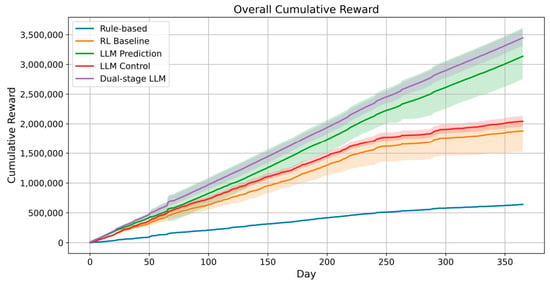
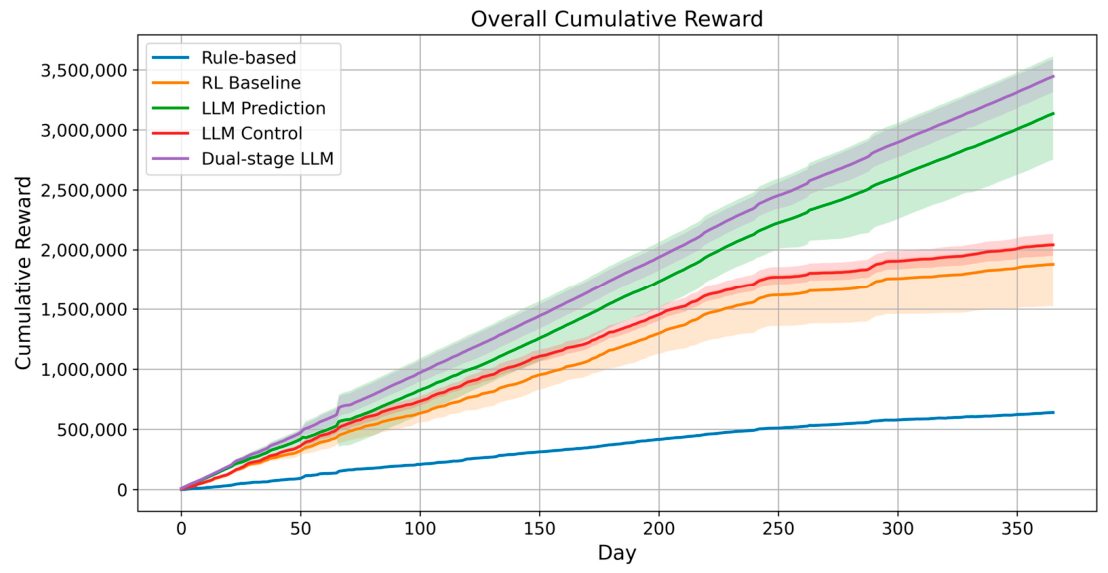
Figure 3 shows the cumulative reward over the evaluation horizon for all methods, revealing distinct learning dynamics under each configuration. The cumulative reward is used as a relative evaluation metric for policy effectiveness rather than a direct measurement of economic revenue.
Figure 3.
Overall Cumulative Reward. The shaded areas represent the 10th–90th percentile ranges across the experimental seeds.
The Dual-stage LLM follows a steady upward trend with relatively smooth growth, indicating stable policy execution under stochastic conditions. By contrast, the RL baseline exhibits greater fluctuation, reflecting higher sensitivity to market uncertainty. The 10th–90th percentile bands remain relatively narrow for the proposed method, suggesting consistent performance across different initializations.
Table 8 reports the final performance of all compared methods, showing mean cumulative reward and improvement relative to the rule-based baseline. A clear performance ranking emerges across configurations.
Table 8.
Comparison of Cumulative Reward and Improvement across Models.
LLM Control raises the mean cumulative reward from 1,878,628.52 to 2,041,712.44, compared with the RL baseline, an increase from 193.46% to 218.94% over the rule-based strategy. Thus, LLM-derived policy selection improves decision quality even when the forecasting module remains unchanged.
Replacing the baseline forecaster with LLM Prediction yields a substantially larger gain: the mean cumulative reward reaches 3,135,741.97 (389.84% improvement). Better price estimation provides more informative state representations, thereby improving sequential decisions.
Finally, the dual-stage LLM achieves the highest mean cumulative reward of 3,445,467.22 (438.22% improvement over rule-based). Relative to the forecasting-only configuration, the dual-stage framework adds approximately 309,700 in cumulative reward, suggesting that joint integration of LLM-enhanced forecasting and LLM-guided control produces complementary gains beyond either component individually.
Table 9 shows the dual-stage framework significantly outperforms both the RL Baseline and the LLM Control variant (p = 0.000183 in each case). Against LLM Prediction, the difference is not significant (p = 0.121225). This suggests that forecasting enhancement alone captures most of the performance gain; the addition of control-layer semantic information primarily improves consistency rather than mean return.
Table 9.
Statistical Significance Test Result.
4.2. Risk-Adjusted Performance
A risk-adjusted evaluation assesses stability and downside exposure across methods. Maximum drawdown is calculated from the cumulative reward trajectory and quantifies the largest peak-to-trough decline during the evaluation period, while the negative-reward days ratio measures the frequency of days with negative daily reward.
Table 10 reports three complementary metrics: Worst Seed Reward, Maximum Drawdown, and Negative-Reward Days Ratio. The proposed dual-stage LLM framework achieves the highest worst-case reward (2,886,826.86) and outperforms all competitors by a substantial margin. Even under the least favorable random initialization, it remains highly performance-effective, demonstrating strong robustness to training variability. Although LLM Prediction achieves a mean cumulative reward (3,135,741.97) comparable to that of the proposed dual-stage LLM (3,445,467.22) in Table 8, its worst-seed reward drops substantially to 1,982,644.79, indicating considerably higher sensitivity to random initialization. This result suggests that enhanced forecasting alone is insufficient to ensure robust decision-making, whereas coupling LLM-enhanced forecasting with LLM-guided RL control leads to more consistent performance across different training seeds.
Table 10.
Risk and Stability Analysis.
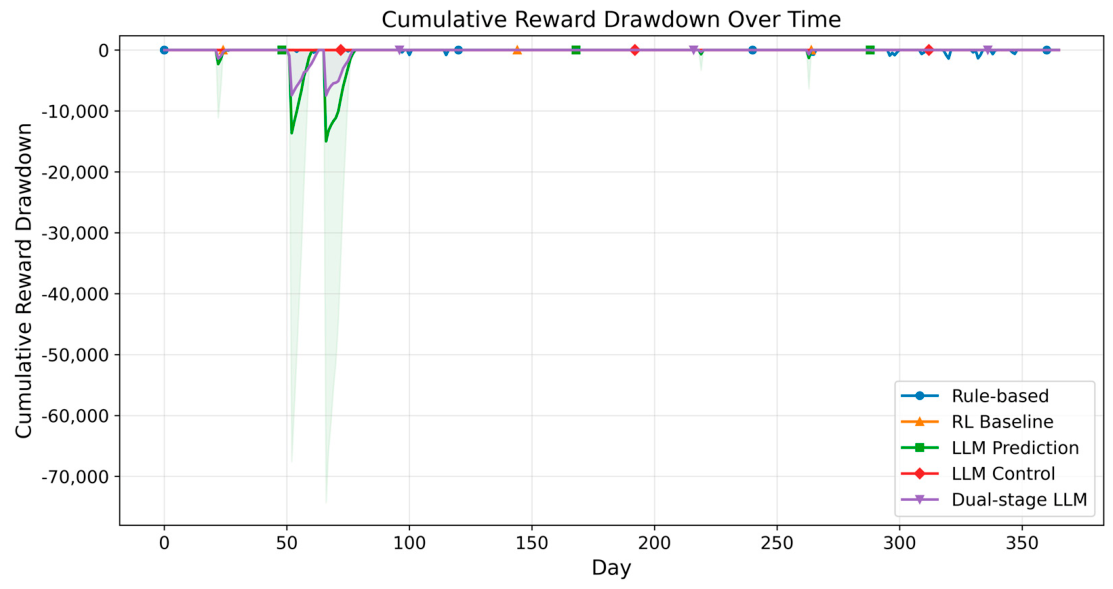
Among all configurations, LLM Prediction exhibits the largest maximum drawdown (−14,997.37), suggesting greater exposure to temporary cumulative losses despite maintaining a relatively low negative-reward days ratio (2.08%). Dual-stage LLM also experiences a noticeable drawdown (−7460.44), but this is accompanied by the highest worst-case reward and the lowest negative-reward days ratio (0.19%), indicating that short-term fluctuations do not compromise its overall benefits or operational stability.
The rule-based strategy produces the lowest worst-case reward (640,160.00), a moderate drawdown (−1398.03), and the highest negative-reward days ratio (5.74%). The RL baseline substantially improves worst-case reward (1,190,382.97) with negligible drawdown (−30.65), yet its negative-reward days ratio (5.27%) remains close to that of the rule-based approach, indicating that higher cumulative returns do not guarantee more consistent daily performance.
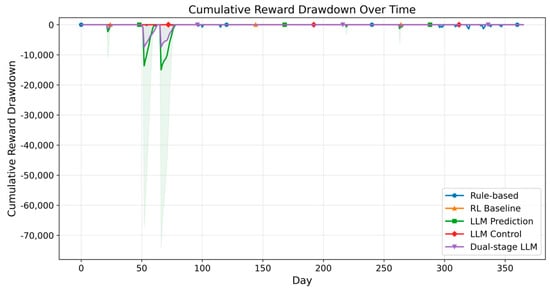
Figure 4 plots the drawdown profiles for all methods, where drawdown is calculated from the cumulative reward trajectory and represents the decline from the running peak reward. LLM Prediction shows the deepest drawdown (−14,997.37), with greater exposure to extreme downside risk. Dual-stage LLM also experiences notable drawdowns (−7460.44), but its daily performance is substantially more stable. The rule-based strategy exhibits moderate risk (−1398.03), while RL Baseline reduces drawdown almost entirely (−30.65). LLM Control maintains a nearly flat drawdown profile (≈0) and shows the most stable risk behavior overall.
Figure 4.
Cumulative Reward Drawdown Over Time. The shaded areas represent the 10–90th percentile ranges of cumulative reward drawdown across the experimental seeds.
4.3. Robustness Analysis
Robustness performance is estimated in terms of mean final reward, standard deviation, and coefficient of variation (CV), as reported in Table 11. Here, robustness is defined as the ability to maintain high decision performance under stochastic initialization, rather than simply reducing action variability or avoiding risky decisions.
Table 11.
Statistical Assessment of Robustness across Models.
The rule-based strategy achieves a fixed return of 640,160 with zero variance, reflecting its deterministic nature but limited adaptability. The RL baseline raises mean performance to 1,878,628.52 but exhibits higher variability due to stochastic policy exploration.
LLM Prediction and Dual-stage LLM achieve the highest mean returns: 3,135,741.97 and 3,445,467.22, respectively. Although LLM Prediction improves decision performance through enhanced market state estimation, it also exhibits the largest variability among learning-based strategies (CV = 0.156), indicating that forecasting uncertainty may propagate into sequential decision-making. In contrast, Dual-stage LLM achieves higher reward stability while maintaining substantially lower variability (CV = 0.062). This demonstrates that the proposed framework does not improve robustness by avoiding higher reward actions, but by regulating uncertainty through coordinated forecasting and event-aware policy guidance.
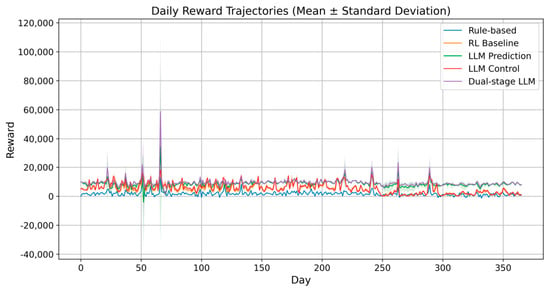
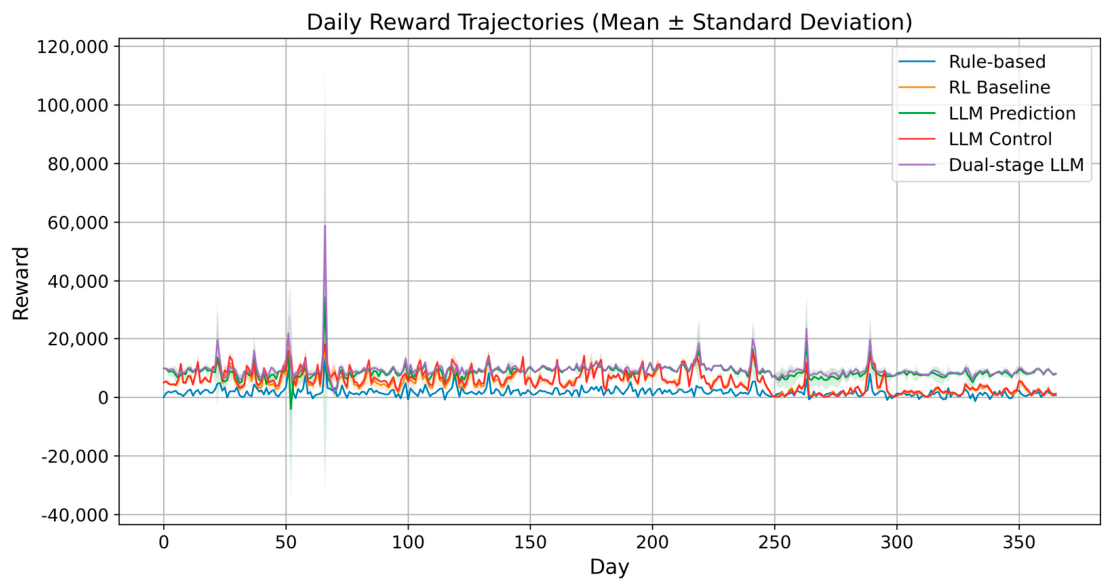
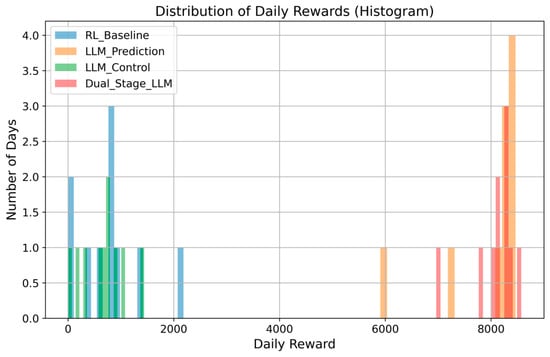
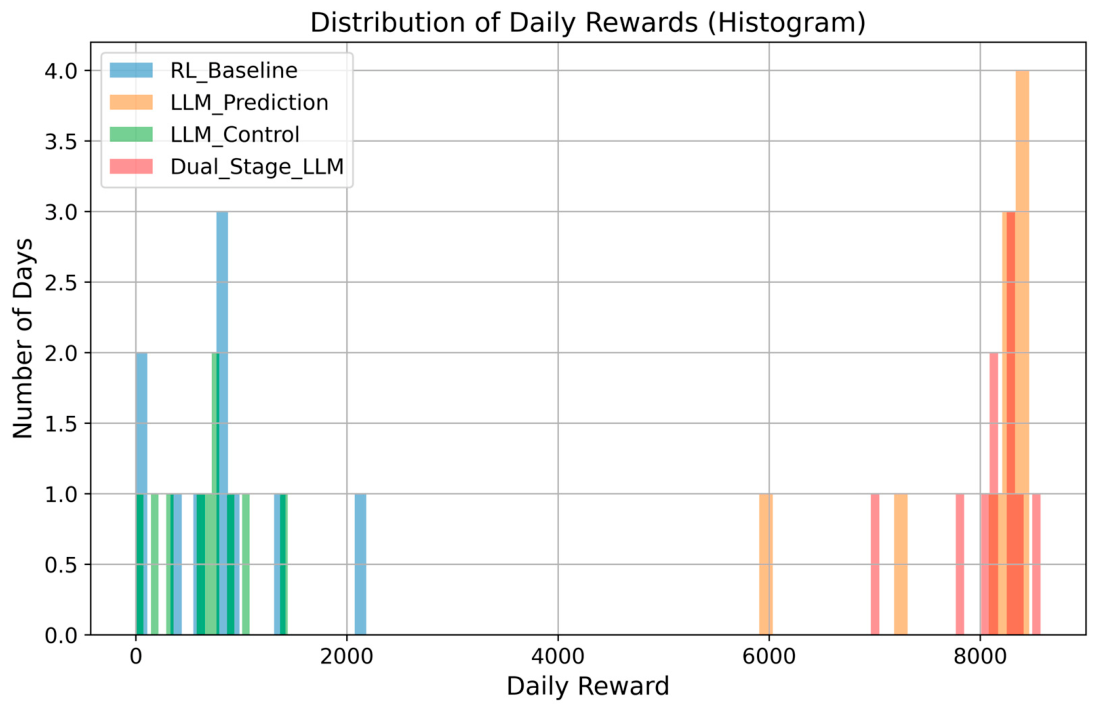
Figure 5 plots daily reward trajectories. LLM-based methods generally exhibit more stable daily reward trajectories than the RL baseline. Figure 6 shows daily reward distributions of the four learning-based configurations. Dual-stage LLM has the most concentrated high-return distribution, indicating more consistent daily performance.
Figure 5.
Daily Reward Trajectories (Mean ± Standard Deviation). The shaded areas represent ±1 standard deviation across the experimental seeds.
Figure 6.
Distribution of Daily Rewards (Histogram).
Overall, the results suggest that the proposed framework achieves a better reward–robustness balance by integrating predictive information and adaptive control, rather than simply trading reward for robustness.
4.4. Algorithmic Compatibility Analysis
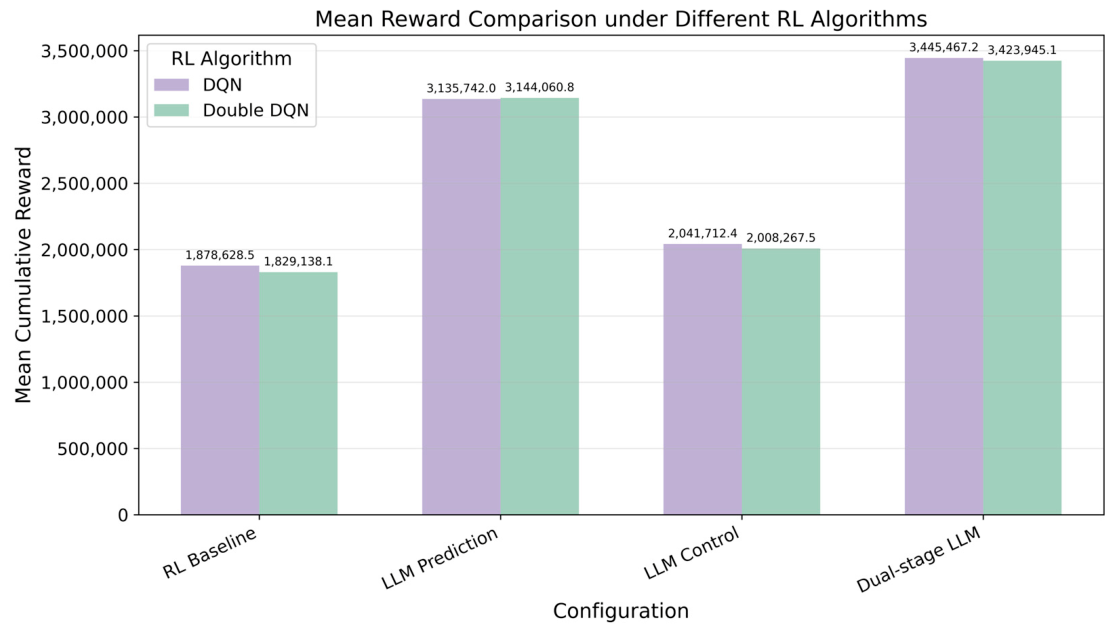
To evaluate whether the proposed framework is dependent on a specific RL algorithm, an additional compatibility experiment is conducted by replacing DQN with Double DQN. Double DQN is selected because it mitigates the overestimation bias of standard DQN and provides more reliable value estimation. Rather than identifying the optimal RL controller, this experiment examines whether the effectiveness of the proposed LLM-driven framework is preserved when the underlying value-based RL algorithm is replaced. Four configurations, including RL Baseline, LLM Prediction, LLM Control, and Dual-stage LLM, are evaluated using both DQN and Double DQN.
Table 12 presents the performance comparison. The results show that replacing DQN with Double DQN leads to only minor changes in cumulative reward, with variations ranging from −2.63% to 0.27% across different configurations. In particular, the LLM Prediction and Dual-stage LLM frameworks maintain comparable performance, indicating that the proposed dual-stage framework maintains consistent performance after replacing the underlying value-based RL algorithm.
Table 12.
Performance Comparison between DQN and Double DQN under Different Framework Configurations.
Statistical analysis is further conducted using paired comparisons between DQN and Double DQN. As shown in Table 13, all comparisons yield p-values greater than 0.05, suggesting that the performance differences are not statistically significant. These results suggest that the proposed framework is not tightly coupled to a specific DQN implementation. The effectiveness of the LLM-derived event representation and contextual policy guidance is preserved after replacing the underlying value-based RL algorithm.
Table 13.
Statistical Significance Analysis of DQN and Double DQN Comparison.
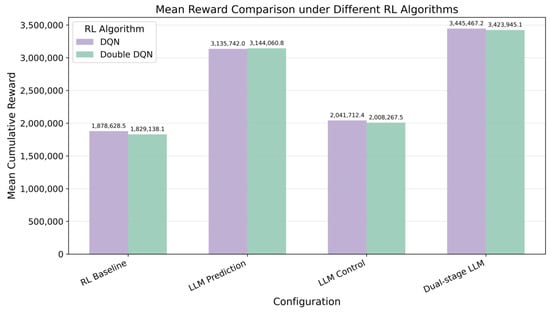
Figure 7 provides a visual comparison of mean reward under different RL algorithms. The consistent performance trends further confirm the algorithmic compatibility of the proposed framework and indicate its potential extensibility to other value-based RL algorithms.
Figure 7.
Mean Reward Comparison under Different RL Algorithms.
4.5. Ablation and Mechanism Analysis
Let J denote the expected cumulative reward.
The contributions of forecasting and control components can be explained as follows:
- Forecasting contribution
LLM-enhanced forecasting reduces price estimation uncertainty, improving state representation and action timing. The forecasting-only variant yields the largest single-component gain, indicating that improved state representation has higher marginal value than policy prior modification.
- Control contribution
LLM-enhanced control incorporates domain-aware priors into action selection, improving policy consistency under regime shifts. Since it does not directly affect predictive accuracy, its main role is stability rather than peak performance.
- Dual-stage interaction
The full model exhibits a complementary interaction between forecasting and control components, with the interaction term J computed based on the performance improvements reported in Table 8:
This indicates that forecasting and control provide complementary benefits: improved forecasts enhance state representation, while event-informed control improves decision consistency under changing market conditions. However, the improvement over the forecasting-only variant is not statistically significant, suggesting that the primary benefit of the dual-stage framework lies in the complementary interaction between improved state estimation and event-aware policy guidance.
4.6. Reward-Robustness Trade-Off Analysis
Although the dual-stage framework achieves the highest cumulative reward, practical energy management systems also require consistent performance under varying operating conditions. Therefore, a reward-robustness trade-off analysis is conducted. Table 14 combines the cumulative reward from Table 8 and variability metrics from Table 11, where the CV is used to measure reward fluctuations.
Table 14.
Reward–Robustness Trade-off Analysis.
The LLM Prediction approach achieves high reward performance by improving market state estimation, but it also introduces higher variability due to prediction uncertainty. In contrast, LLM Control provides more stable performance by incorporating event-based guidance into policy decisions, although with reduced reward potential.
From an operational perspective, the proposed framework provides a favorable balance between reward maximization and robustness, suggesting that integrating forecasting and contextual decision guidance can improve the operational reliability of sequential energy management under uncertain market conditions.
5. Conclusions
This paper proposes a dual-stage LLM-driven framework that handles both electricity market forecasting and battery storage control. Unlike prior studies that treat LLMs as standalone predictors or auxiliary feature extractors, the present design embeds LLMs as structured information processors within the pipeline.
In the forecasting stage, LLM-extracted event semantics are transformed into structured market signals and incorporated into a predictive model, allowing the system to better capture external shocks such as policy changes and demand fluctuations. In the control stage, LLM-derived contextual knowledge is embedded as a contextual action prior for reinforcement learning, which improves stability and decision quality under volatile market regimes.
Experiments across multiple random seeds show that each layer contributes gains, and the full two-stage setup achieves the best reward-stability trade-off. More importantly, LLM integration improves not only prediction performance but also the consistency of sequential decision-making. The ablation studies suggest that structured semantic signals are the key factor driving improvements in both stages, highlighting the value of unstructured textual data in energy system optimization.
Taken together, these findings suggest that, in the context of NEM battery trading, LLMs can serve as structured information processors bridging unstructured knowledge and sequential decision-making, rather than acting solely as predictive or conversational tools. The proposed framework offers a flexible architecture for integrating language intelligence into forecasting and control systems.
One limitation is that the current implementation is evaluated mainly with value-based discrete-action controllers. Future studies will investigate continuous-control algorithms, such as PPO and SAC, and optimization-based battery management strategies. Decoupling the framework to accommodate alternative forecasting models and policy optimization methods would improve its generalizability. Multi-agent extensions, where multiple participants interact strategically, also warrant further investigation for more realistic market simulation. Additionally, the event dataset is limited to 35 AEMO releases over one year. Future work should extend the evaluation to longer time windows, incorporate diverse unstructured sources (e.g., social media, weather alerts, regulatory filings), evaluate the framework in other electricity market regions with different event characteristics, and establish expert-annotated event datasets with inter-annotator agreement to further validate LLM-based event extraction.
Moreover, the current battery simulation focuses on evaluating decision-making effectiveness under market dynamics. Therefore, the reward formulation is designed to measure relative decision quality rather than represent project-level economic revenue. Future studies will incorporate degradation-aware battery models, charging/discharging efficiency losses, operational power constraints, and transaction costs to provide a more realistic assessment of decision benefits.
Furthermore, the proposed framework could be extended to transportation electrification scenarios, including electric vehicle energy management and vehicle-to-grid (V2G) coordination. Recent studies have shown that RL-based energy management strategies can benefit from additional contextual information, such as future terrain conditions and passenger requirements [32,33]. In these applications, transportation-related variables, including vehicle state-of-charge, charging demand, vehicle availability, traffic conditions, and charging infrastructure status, can be incorporated into the system state. Meanwhile, the LLM module can process heterogeneous information, such as traffic incidents, weather conditions, and mobility-related events, and transform them into semantic representations for forecasting and decision-making. These developments suggest that integrating LLM-based semantic event interpretation with vehicle energy management can extend the proposed unified forecasting-to-control framework toward context-aware and adaptive energy decision systems for EV charging and V2G applications.
Author Contributions
Conceptualization, Y.C.; Methodology, Y.C.; Software, Y.C.; Validation, Y.C.; Formal analysis, Y.C.; Investigation, Y.C.; Resources, Y.C.; Data curation, Y.C.; Writing—original draft, Y.C.; Writing—review and editing, Y.C., G.C. and F.Y.; Visualization, Y.C.; Supervision, G.C. All authors have read and agreed to the published version of the manuscript.
Funding
This research received no external funding.
Data Availability Statement
The raw data supporting the conclusions of this article will be made available by the authors on request.
Conflicts of Interest
The authors declare no conflicts of interest.
References
- Tsegaye, S.; Sanjeevikumar, P.; Tjernberg, L.B.; Fante, K.A. Short-term energy forecasting using deep neural networks: Prospects and challenges. J. Eng. 2024, 2024, e70022. [Google Scholar] [CrossRef] [Scilit]
- Rani, U.; Dahiya, N.; Kundu, S.; Kanungo, S.; Kathuria, S.; Rakesh, S.K.; Sharma, A.; Singh, P. Deep learning-based urban energy forecasting model for residential building energy efficiency. Energy Explor. Exploit. 2024, 42, 1799–1828. [Google Scholar] [CrossRef] [Scilit]
- Javaid, A.; Sajid, M.; Uddin, E.; Waqas, A.; Ayaz, Y. Sustainable urban energy solutions: Forecasting energy production for hybrid solar-wind systems. Energy Convers. Manag. 2024, 302, 118120. [Google Scholar] [CrossRef] [Scilit]
- Gu, Y.; Jazizadeh, F.; Wang, X. Toward Large Energy Models: A comparative study of Transformers’ efficacy for energy forecasting. Appl. Energy 2025, 384, 125358. [Google Scholar] [CrossRef] [Scilit]
- Zhou, H.; Liu, Q.; Yan, K.; Du, Y. Deep Learning Enhanced Solar Energy Forecasting with AI-Driven IoT. Wirel. Commun. Mob. Comput. 2021, 2021, 9249387. [Google Scholar] [CrossRef] [Scilit]
- Lü, X.; Lu, T.; Kibert, C.J.; Viljanen, M. Modeling and forecasting energy consumption for heterogeneous buildings using a physical–statistical approach. Appl. Energy 2015, 144, 261–275. [Google Scholar] [CrossRef] [Scilit]
- Iqbal, M.A.; Gil, J.M.; Kim, S.K. Attention-Driven Hybrid Ensemble Approach with Bayesian Optimization for Accurate Energy Forecasting in Jeju Island’s Renewable Energy System. IEEE Access 2025, 13, 7986–8010. [Google Scholar] [CrossRef] [Scilit]
- Boukas, I.; Ernst, D.; Théate, T.; Bolland, A.; Huynen, A.; Buchwald, M.; Wynants, C.; Cornélusse, B. A deep reinforcement learning framework for continuous intraday market bidding. Mach. Learn. 2021, 110, 2335–2387. [Google Scholar] [CrossRef] [Scilit]
- Li, J.; Wang, C.; Wang, H. Deep reinforcement learning for wind and energy storage coordination in wholesale energy and ancillary service markets. Energy AI 2023, 14, 100280. [Google Scholar] [CrossRef] [Scilit]
- Aaltonen, H.; Sierla, S.; Subramanya, R.; Vyatkin, V. A Simulation Environment for Training a Reinforcement Learning Agent Trading a Battery Storage. Energies 2021, 14, 5587. [Google Scholar] [CrossRef] [Scilit]
- Kim, J.; Lee, B. Automatic P2P Energy Trading Model Based on Reinforcement Learning Using Long Short-Term Delayed Reward. Energies 2020, 13, 5359. [Google Scholar] [CrossRef] [Scilit]
- Zhong, L.; Ye, T.; Yang, Y.; Pan, F.; Feng, L.; Qi, S.; Huang, Y. Deep Reinforcement Learning-Based Joint Low-Carbon Optimization for User-Side Shared Energy Storage-Distribution Networks. Processes 2024, 12, 1791. [Google Scholar] [CrossRef] [Scilit]
- Wang, R.; Chen, Y.; Li, E.; Che, L.; Xin, H.; Li, J.; Zhang, X. Joint optimization of energy trading and consensus mechanism in blockchain-empowered smart grids: A reinforcement learning approach. J. Cloud Comput. 2023, 12, 121. [Google Scholar] [CrossRef] [Scilit]
- Islam, M.M.; Yu, T.; Giannoccaro, G.; Mi, Y.; La Scala, M.; Rajabi Nasab, M.; Wang, J. Improving Reliability and Stability of the Power Systems: A Comprehensive Review on the Role of Energy Storage Systems to Enhance Flexibility. IEEE Access 2024, 12, 152738–152765. [Google Scholar] [CrossRef] [Scilit]
- Ibebuchi, C.C. Day-ahead energy price forecasting with machine learning: Role of endogenous predictors. Forecasting 2025, 7, 18. [Google Scholar] [CrossRef] [Scilit]
- Liu, S.; Li, M.; Yang, K.; Wei, Y.; Wang, S. From forecasting to trading: A multimodal-data-driven approach to reversing carbon market losses. Energy Econ. 2025, 144, 108350. [Google Scholar] [CrossRef] [Scilit]
- Zhang, B.; Hu, W.; Xu, X.; Zhang, Z.; Chen, Z. Hybrid data-driven method for low-carbon economic energy management strategy in electricity-gas coupled energy systems based on transformer network and deep reinforcement learning. Energy 2023, 273, 127183. [Google Scholar] [CrossRef] [Scilit]
- Chen, Y.; Niu, Y.; Qu, C.; Du, M.; Wang, J. Data-driven-based distributionally robust optimization approach for a virtual power plant considering the responsiveness of electric vehicles and Ladder-type carbon trading. Int. J. Electr. Power Energy Syst. 2024, 157, 109893. [Google Scholar] [CrossRef] [Scilit]
- Almeida, F.; Castelli, M.; Côrte-Real, N.; Fallarino, C.; Manzoni, L. Smart energy strategies: Leveraging LSTM and LLMs for advanced energy management. Energy AI 2025, 22, 100642. [Google Scholar] [CrossRef] [Scilit]
- Qiu, Z.; Li, C.; Wang, Z.; Xie, R.; Zhang, B.; Mo, H.; Chen, G.; Dong, Z. EF-LLM: Energy Forecasting LLM with AI-assisted Automation, Enhanced Sparse Prediction, Hallucination Detection. arXiv 2024, arXiv:2411.00852. [Google Scholar]
- Wang, C.; Zhou, D.; Shao, T.; Wang, X.; Liu, S.; Wang, B.; Huang, D. Multi-stage cross-modal alignment with LLMs for energy consumption prediction in natural gas networks. Neurocomputing 2026, 677, 133087. [Google Scholar] [CrossRef] [Scilit]
- Chen, H.; Xu, M.; Shi, C.; Wang, Z.; Xie, D. Data-model hybrid hierarchical scheduling for grid-connected PEM green hydrogen production in multi-energy systems with LLM-aided coordination. J. Renew. Sustain. Energy 2026, 18, 024701. [Google Scholar] [CrossRef] [Scilit]
- Liu, C.; Nie, Q. A blockchain-based LLM-driven energy-efficient scheduling system towards distributed multi-agent manufacturing scenario of new energy vehicles within the circular economy. Comput. Ind. Eng. 2025, 201, 110889. [Google Scholar] [CrossRef] [Scilit]
- Tang, C.; Huang, Z.; Liao, X.; Xu, X.; Li, N. A knowledge-driven and interpretable fine-tuning LLMs framework for energy retrofit decision support in commercial buildings. Energy Build. 2026, 361, 117486. [Google Scholar] [CrossRef] [Scilit]
- Han, J.; Mo, Y. Human-building interaction in energy management systems: A systematic review with LLM-based topic modeling for user-responsive and adaptive energy systems. Appl. Energy 2026, 403, 127079. [Google Scholar] [CrossRef] [Scilit]
- Papaioannou, A.; Dimara, A.; Krinidis, S. GUIDE: A prescriptive hybrid AI framework for energy-efficient appliances usage through behavioral modeling and LLM guidance. Energy Build. 2025, 348, 116463. [Google Scholar] [CrossRef] [Scilit]
- Cover, T.M.; Thomas, J.A. Elements of Information Theory, 2nd ed.; Wiley-Interscience: Hoboken, NJ, USA, 2006. [Google Scholar]
- Sutton, R.S.; Barto, A.G. Reinforcement Learning: An Introduction, 2nd ed.; MIT Press: Cambridge, MA, USA, 2018. [Google Scholar]
- Australian Energy Market Operator (AEMO). DispatchIS Reports. Available online: https://nemweb.com.au/Reports/Current/DispatchIS_Reports/ (accessed on 15 June 2026).
- Australian Energy Market Operator (AEMO). Media Releases. 2025. Available online: https://www.aemo.com.au/newsroom/media-release#year=2025 (accessed on 15 June 2026).
- Australian Energy Market Operator (AEMO). Media Releases. 2026. Available online: https://www.aemo.com.au/newsroom/media-release#year=2026 (accessed on 15 June 2026).
- Li, K.; Zhou, J.; Jia, C.; Yi, F.; Zhang, C. Energy sources durability energy management for fuel cell hybrid electric bus based on deep reinforcement learning considering future terrain information. Int. J. Hydrogen Energy 2024, 52, 821–833. [Google Scholar] [CrossRef] [Scilit]
- Jia, C.; Liu, W.; Chau, K.T.; He, H.; Zhou, J.; Niu, S. Passenger-aware reinforcement learning for efficient and robust energy management of fuel cell buses. eTransportation 2026, 27, 100537. [Google Scholar] [CrossRef] [Scilit]

Disclaimer/Publisher’s Note: The statements, opinions and data contained in all publications are solely those of the individual author(s) and contributor(s) and not of MDPI and/or the editor(s). MDPI and/or the editor(s) disclaim responsibility for any injury to people or property resulting from any ideas, methods, instructions or products referred to in the content. |
© 2026 by the authors. Licensee MDPI, Basel, Switzerland. This article is an open access article distributed under the terms and conditions of the Creative Commons Attribution (CC BY) license.