


Abstract
The growing demand for electric traction batteries, together with their high content of Critical Raw Materials (CRMs), necessitates comprehensive life cycle environmental assessments. Limited attention in the literature has been devoted to explicitly disentangling the role of individual CRMs in shaping both environmental burdens and potential end-of-life benefits. This study presents a “cradle-to-grave” life cycle assessment (LCA) of a Lithium Iron Phosphate battery for electric vehicle applications, aiming to identify the contributions of individual life cycle phases and quantify the role of CRMs. The life cycle inventory was developed using data from the literature and the Ecoinvent database, with impacts assessed using the ReCiPe 2016 midpoint hierarchist (H) method. LCA results indicate that the material manufacturing phase dominates most impact categories. A gravity analysis demonstrates that a limited set of CRMs (aluminium, copper, and lithium) structurally governs both environmental burdens and recycling benefits. Monte Carlo analysis indicates low uncertainty for most impact categories. A first sensitivity analysis reveals that improvements in round-trip efficiency exert the strongest influence on environmental performance. A second sensitivity analysis assesses the effect of different energy mixes used to model electricity consumption during the use phase.
1. Introduction
National and international targets aim to mitigate climate change by reducing anthropogenic greenhouse gas (GHG) emissions. This objective aligns with the European Union’s (EU) commitment to achieving climate neutrality by 2050, as outlined in the 2019 European Green Deal [1]. Batteries represent a key technology for the energy transition and electric mobility, facilitating GHG reductions in the transport sector [2]. They are widely adopted for energy storage due to their performance, lifetime, and durability [3]. However, the use of critical materials and the environmental impacts of production are increasingly identified as disadvantages of widespread battery adoption [4]. The growth of the electric vehicle (EV) sector has increased the demand for traction batteries. Lithium iron phosphate (LFP) batteries are utilized in this sector due to their safety, low cost, and the absence of cobalt [5]. Assessing the environmental impacts associated with the entire battery life cycle remains a challenge, as the production, use, and end-of-life stages are linked to multiple environmental burdens. These include impacts from raw material extraction, the energy demand of manufacturing processes, and the treatment of final waste streams.
The production of EV batteries involves several Critical Raw Materials (CRMs). The EU defines CRMs as raw materials characterized by high economic importance for Europe and a significant supply risk [6]. Examples include cobalt, lithium, natural graphite, and rare earth elements, all indispensable for battery manufacturing. The EU periodically updates the CRM list; the 2023 version identifies 34 elements [7]. The sustainability challenge associated with CRMs is complex, encompassing environmental, social, geopolitical, and economic concerns, particularly during the extraction and refining stages [8].
In this context, the Life Cycle Assessment (LCA) methodology enables the evaluation of the environmental performance across the entire battery life cycle [9,10]. LCA identifies the process stages contributing the most to impacts or benefits and determines their underlying causes [11]. Consequently, LCA is essential in the design phase of new products, as it identifies the hotspots necessary to improve their environmental profile [12].
Several authors have adopted the LCA methodology to evaluate the environmental impacts of batteries across their entire life cycle, focusing on the end-of-life phase. Quan et al. [13] indicate that the most substantial impacts occur during the production and use phases. Recycling strategies—including hydrometallurgy, pyrometallurgy, and direct recycling—reduce both raw material extraction and the overall environmental burden of the battery life cycle [14]. Specifically, lithium recovery from spent batteries decreases atmospheric emissions and water consumption compared to the use of virgin materials [15]. However, most LCA studies on Li-ion battery recycling rely on secondary data due to the limited availability of industrial-scale primary data [16].
The current state of the art in battery LCA studies, covering the value chain from mining to recycling, has been synthesized in the recent literature. These works outline opportunities derived from LCA results and identify future trends [17,18,19,20,21].
Despite increasing LCA research on LFP batteries, few studies explicitly quantify the contribution of individual materials—such as aluminium, copper, and lithium—to specific environmental impact categories across the full life cycle. Furthermore, the existing literature rarely integrates material-focused analysis with uncertainty quantification and sensitivity assessment, which limits actionable insights for battery design and recycling.
To contribute to the scientific discussion on LFP battery environmental impacts, this research quantifies the life cycle impacts of an LFP battery pack for EVs. The study highlights the sensitivity of results based on various life cycle parameters and aims to: (i) identify the contribution of each life cycle stage; (ii) define how key materials drive both environmental burdens and end-of-life benefits; and (iii) investigate how the environmental profile varies with different parameters. This approach provides design-oriented guidance for developing sustainable LFP batteries. To achieve these objectives, a comprehensive LCA was conducted. Environmental impacts were investigated through gravity analysis, results were validated via uncertainty analysis, and sensitivity analyses were performed to identify parameters with the greatest potential for impact minimization.
2. Materials and Methods
2.1. Goal and Scope Definition
The goal of the study is to evaluate the environmental profile of the entire life cycle of an LFP battery pack used in an EV, identifying critical hotspots and their causes. The LCA methodology was applied according to ISO 14040 [22] and ISO 14044 [23] standards, comprising the four mandatory phases: Goal and Scope Definition, Life Cycle Inventory Analysis, Life Cycle Impact Assessment, and Interpretation.
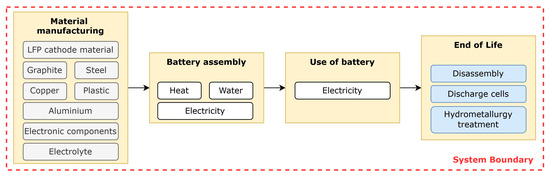
The system function is to provide energy to the EV for 200,000 km. The functional unit (FU) is defined as the nominal capacity of a 1 kWh battery pack, which serves as the reference value for the impact assessment across the life cycle. A cradle-to-grave approach defines the system boundaries. Figure 1 illustrates the phases of the LFP battery life cycle, namely material manufacturing, battery assembly, use, and end of life (EoL), where
Figure 1.
System boundary of the LCA study applied to the LFP battery.
- Material manufacturing covers the entire upstream chain of battery production, including the extraction and processing of raw materials, as well as the manufacture of individual components.
- Battery assembly involves the integration of all components into a complete battery pack.
- Use of battery includes driving energy consumption due to battery mass and electricity losses from charging and discharging efficiency.
- EoL is divided into three stages: disassembly, cell discharge, and hydrometallurgical treatment [24]. This EoL option is selected based on the technical characteristics of the battery [25]. Recovered materials were treated as substitutes for primary materials to avoid the impacts associated with their production [26].
Although battery assembly and use of battery phases were included to ensure a comprehensive life cycle assessment, CRMs are directly relevant mainly to material manufacturing and EoL stages.
2.2. Life Cycle Inventory Analysis
Data for this study are primarily sourced from the Ecoinvent database [27] and scientific literature, with specific references detailed in the following sections. These data define the input and output flows for each life cycle stage. All processes are assumed to occur in the United Kingdom. The full inventory is set out in Tables S1–S6 in the Supplementary Materials.
Material manufacturing: The battery pack comprises three main components: cells, modules, and pack-level hardware. The bill of materials for the reference LFP battery is derived from the Argonne National Laboratory Battery Performance and Cost (BatPaC) model [28]. The LFP battery has a total weight of 203.1 kg and a nominal capacity of 23.5 kWh. Table 1 sets out some key information on the composition of the battery.
Table 1.
Material composition of LFP battery.
Battery assembly: This stage includes the assembly of all components into the final battery pack. Assumptions for this phase include an electricity consumption of 8.33 kWh/FU, 140 MJ/FU of natural gas for heat production, and 22.3 L/FU of water [13].
Use phase: This stage models battery operation within EVs in the UK, utilizing the national grid for charging. Electricity losses comprise two factors [29]: the average charge and discharge efficiency and the energy consumption attributed to the battery mass. The Round-Trip Efficiency (RTE), representing the ratio of energy retrieved to energy input during a full cycle, is determined by the chemical composition and operating conditions. Electricity losses due to the average charge and discharge efficiency (Ecd, kWh) are defined by Equation (1) [13]:
where Fv refers to the amount of electricity consumed by the electric vehicle per 100 km travelled (kWh/100 km), Dv is the distance covered during the use phase by the EV (km) and ηk1 is RTE. Based on previous studies, it was assumed that ηk1 was 90% over the entire battery life [30,31].
Electricity losses due to battery weight (Em, kWh) are defined by Equation (2) [13]:
where m is the mass of the LFP battery (kg) and M is the mass of the EV (kg). The mass of the EV is 922 kg, Fv was assumed to be 13.1 kWh/100 km and the value of k was set at 0.49 [13]. The parameter k indicates the powertrain distribution factor, which denotes the ratio between the energy consumption of the vehicle and the weight of the car [32]. Dv was hypothesized to be 200,000 km with reference to other studies [33,34]. Substituting the parameters in Equations (1) and (2), the total electricity losses during the use phase were calculated.
End of life: Battery collection and initial selection phases were excluded from the system boundaries. The first stage involves disassembling cells from the battery pack using automated robotic systems, modeled on data from Choux et al. [35]. The second stage consists of cell discharge via immersion in a FeSO4 solution [36]. Subsequently, the discharged cells undergo a hydrometallurgical recycling process. This process was modeled using Ecoinvent databases and literature data adapted to the specific battery characteristics of this study. The hydrometallurgical process recovers aluminium, copper, and lithium (as hydroxide) from the battery cells, with an overall recovery rate of 93.8%. Additionally, recovery rates for aluminium, steel, and copper from the module and pack components—including the Battery Management System and electronic components—were assumed to be 95.5%, 86.8%, and 76.3%, respectively [37].
2.3. Life Cycle Impact Assessment and Interpretation
SimaPro 9.1 software [38] was utilized to convert inventory data into potential environmental impacts, employing the ReCiPe 2016 midpoint hierarchist (H) method [39]. ReCiPe 2016 is a harmonized life cycle impact assessment method that translates life cycle inventory flows, including emissions and resource extractions, into environmental impact scores through characterization factors [40,41]. The ReCiPe method was adopted for the impact assessment phase, as it is widely used in the literature in LCA studies on batteries [20]. This method comprises 18 midpoint impact categories: global warming potential (GWP), stratospheric ozone depletion (SOD), ionizing radiation (IR), ozone formation—human health (OFHH), fine particulate matter formation (FPMF), ozone formation—terrestrial ecosystems (OFTE), terrestrial acidification (TA), freshwater eutrophication (FE), marine eutrophication (ME), terrestrial ecotoxicity (TET), freshwater ecotoxicity (FET), marine ecotoxicity (MET), human carcinogenic toxicity (HCT), human non-carcinogenic toxicity (HNCT), land use (LU), mineral resource scarcity (MRS), fossil resource scarcity (FRS), and water consumption (WC).
Furthermore, a gravity analysis was conducted to determine the contribution of CRMs to selected impact categories. According to ISO 14044, this procedure identifies the data points that contribute most significantly to the indicator results, allowing for prioritized examination. The robustness of the results was verified through an uncertainty analysis using Monte Carlo simulations. Additionally, an initial sensitivity analysis was performed on a subset of input parameters, modified individually to assess their influence on the final results [42]. The parameters identified for this analysis include: battery capacity, charge/discharge energy efficiency, driving energy consumption, and material recovery rates in the recycling process. Finally, a second sensitivity analysis was performed to assess how country-specific electricity generation mixes used for charging the electric vehicle battery affect the environmental profile of the battery.
3. Results
3.1. Life Cycle Impact Assessment Results
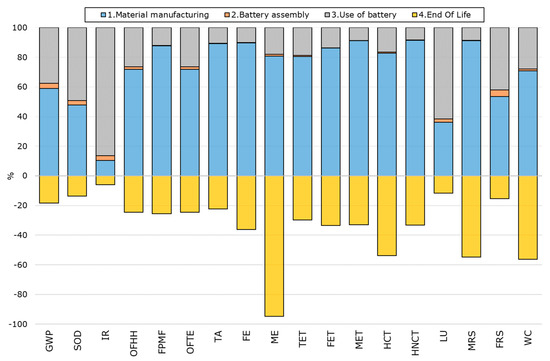
The impact assessment results, expressed in relative terms, are illustrated in Figure 2. Detailed absolute values for each category are reported in Table S7, while the normalized results are provided in Figure S1 in Supplementary Materials.
Figure 2.
Life Cycle Impact Assessment results of 1 kWh of LFP battery.
Material manufacturing represents the primary driver of environmental impacts across most categories. This phase contributes most significantly to HNCT (91.52%), MRS (91.21%), FE (89.74%), and TA (89.17%). These percentages reflect the environmental burden of material manufacturing relative to the total life cycle impact of the battery pack. The battery use phase exerts the greatest influence on IR (86.37%) and LU (61.56%). As shown in Figure 2, the high contribution to the IR category is particularly prominent. This is attributed to the electricity consumption required for charging, modeled on the UK grid mix; the impact originates from the nuclear energy component, which involves the release of radionuclides during the nuclear fuel cycle (extraction, processing, and power generation), rather than from the battery unit itself. The battery assembly phase consistently shows the lowest environmental impact across all analyzed categories. Conversely, the EoL phase generates substantial environmental benefits through the recovery of aluminium, lithium, copper, and steel. These avoided impacts, represented by negative values in Figure 2, are most pronounced in ME (−94.59%), WC (−56.21%), MRS (−54.85%), and HCT (−53.69%). The specific role of CRMs is discussed in detail in the following section, where a gravity analysis provides a detailed assessment of their contribution to certain impact categories, particularly during the material manufacturing and EoL stages.
3.2. Gravity Analysis Results
A gravity analysis was conducted to identify which inputs and outputs are responsible for the impacts generated or avoided in the analyzed phases, specifically to observe the contribution of CRMs used in the battery. The method employed by the EU to define raw materials criticality involves two factors: Supply Risk (SR), indicating the potential for supply chain disruption, and Economic Importance (EI), reflecting the material’s significance to the European industry. The CRM list is established based on materials that exceed the thresholds for both parameters: SR ≥ 1 and EI ≥ 2.8 [43]. The most recent list, published in 2023, includes the following materials present in the analyzed LFP battery: lithium (SR = 1.9, EI = 3.9), graphite (SR = 1.8, EI = 3.4), aluminium (SR = 1.2, EI = 5.8) and copper (SR = 0.1, EI = 4.0). Although copper falls below the SR threshold, it is included in the CRM list as a strategic raw material—a category essential for the EU’s objectives regarding the green transition, digital transformation, defense, and aerospace [44]. The analysis was carried out for the GWP category, given its prominent relevance in the literature [45]. Furthermore, GWP is analyzed because reducing greenhouse gas emissions in transport is a key driver for the development of the EV market. Other categories studied in detail are those that emerge most significantly in the normalized results: FET, MET, and HCT. Table 2 shows the results of this analysis.
Table 2.
Gravity analysis results for the impact categories of: GWP, FET, MET, HCT.
The GWP category quantifies the increase in infrared radiative forcing caused by greenhouse gas emissions and is expressed in kg CO2eq. The FET, MET, and HCT categories measure the effects of chemical emissions expressed in kg 1.4-dichlorobenzene-equivalents (kg 1.4-DCB) [39]. The analysis highlights that the contribution of CRMs is particularly significant during the material manufacturing phase. In fact, for the GWP category, aluminium represents the highest source of emissions (25.74 kg CO2eq), partly due to the high quantity used; specifically, in this case study, 46.86 kg of aluminium is utilized out of a total battery weight of 203.01 kg. High values are also associated with the lithium used in the battery cathode, as well as the copper and graphite used in the anode. A further significant contribution is provided by the electronic components, including the Battery Management System. Regarding the process stage providing avoided impacts—battery recycling—the environmental benefits derive from the recovered CRMs: aluminium, copper, and lithium (the latter in the form of lithium hydroxide). For the FET and MET categories, the copper used in the batteries represents the dominant contribution, with values of 35.28 kg 1.4-DCB and 44.27 kg 1.4-DCB, respectively. Similarly, the end-of-life recovery of this material constitutes the most significant avoided impact, with values of −21.63 kg 1.4-DCB and −27.15 kg 1.4-DCB. For the HCT category, the main contribution is attributable to aluminium (18.32 kg 1.4-DCB) and copper (9.14 kg 1.4-DCB). Likewise, at the end of life, the greatest avoided impacts come from these two materials, amounting to −14.90 kg 1.4-DCB and −5.60 kg 1.4-DCB. These results demonstrate that the environmental profile of the LFP battery is structurally driven by a small set of high-mass, high-impact CRMs. Aluminium and lithium contribute most significantly to GWP, copper dominates FET and MET, and aluminium plays a major role in HCT.
4. Discussion
The results are analyzed using a dual analytical approach. Firstly, uncertainty is quantified through Monte Carlo analysis. Secondly, a sensitivity analysis is conducted to assess the variance in results by modifying four selected parameters.
4.1. Uncertainty Analysis
To assess the reliability of Life Cycle Impact Assessment results, an uncertainty analysis was conducted using Monte Carlo simulation [46], a numerical method that determines the uncertainty range of the calculated outcomes. Performing an uncertainty analysis is crucial in LCA, as the variability of process parameters directly affects the robustness of the results [47,48]. The simulation was performed with 1000 iterations and accounts for the variability of all model inputs. Figure S2 presents a bar chart with a 95% confidence interval for each impact category, while Table S8 reports the key results of the uncertainty analysis, including the mean, median, standard deviation, coefficient of variation, and the 2.5th and 97.5th percentiles. The relative uncertainty is highest for the ME category, with a coefficient of variation of 172%. This high value stems from the input parameters that most influence this category, which are characterized by significant variability. In contrast, all other categories exhibit low variability, with CVs below 9%, indicating high reliability. Regarding the categories analyzed in detail in the gravity analysis: for the GWP category, the 95% confidence interval ranges from 133.6 kg CO2eq to 143.5 kg CO2eq; for FET, from 43.6 kg 1.4-DCB to 44.54 kg 1.4-DCB; for MET, from 56.61 kg 1.4-DCB to 57.9 kg 1.4-DCB; and for HCT, from 22.60 kg 1.4-DCB to 26.00 kg 1.4-DCB. Overall, the limited variability observed for most categories suggests that the dominance of specific life cycle phases and CRMs is not driven by parameter uncertainty, thereby strengthening the validity of the study’s findings.
4.2. Scenario Analysis
Scenario analysis allows for the observation of how the environmental profile of the LFP battery shifts in response to variations in key parameters. Four scenarios were identified to evaluate the following variables:
- Battery Capacity: An increase was hypothesized, resulting from improvements in cell chemistry or design. This was modeled assuming enhanced energy density without a proportional increase in material inputs, reflecting technological advancements in cell architecture.
- Round Trip Efficiency (ηk1): A variation of ±5% relative to the baseline case was selected. This range represents plausible incremental improvements in pack-level efficiency achievable through advancements in thermal management, power electronics, and cell design.
- Energy for Driving (Fv): An improvement relative to the baseline case was assumed, reflecting enhanced vehicle design, improved drivetrain efficiency, or more energy-efficient driving behavior.
- Recovery Rate: Improvements in the battery recycling process were modeled to meet the material recovery targets set by the European Battery Regulation by the end of 2027 (90% for cobalt, copper, lead, and nickel; 50% for lithium) and by the end of 2031 (95% for cobalt, copper, lead, and nickel; 80% for lithium) [49]. Additionally, two further scenarios were analyzed, characterized by a subsequent increase in recovery efficiency to 98%.
Each modification for each scenario compared to the baseline case is specified in Table 3.
Table 3.
Description of each scenario analysis.
The results of the sensitivity analysis, expressed as percentage variations, are reported in Table 4. The data indicate that the environmental performance of the LFP battery responds differently depending on the modified parameter. Increasing battery capacity leads to a relative but modest improvement across all impact categories. The most favorable results are associated with Case A2, which shows a reduction in impacts of approximately 5% across all categories. This suggests that capacity enhancement distributes manufacturing impacts over a larger functional output, yielding moderate but consistent benefits. In contrast, in the Efficiency scenario, the RTE ηk1 exerts a significantly stronger influence. In Case B1, a 5% decrease in ηk1 increases impacts in all categories compared to the baseline, confirming the system’s strong dependence on operational electricity demand. Conversely, in Case B2, a 5% improvement in average RTE produces substantial reductions in all categories, particularly for ME (−80.40%), IR (−22.10%), and LU (−16.77%). These pronounced changes highlight the dominant role of electricity consumption during the use phase, especially for impact categories closely linked to the electricity mix. Improvements in energy consumption for driving generate moderate reductions; in Case C2, the most relevant effects are observed for ME (−16.70%) and IR (−4.59%). This indicates that vehicle-level efficiency improvements contribute positively, although their influence remains lower than that of battery-specific efficiency. Increasing material recovery rates produces comparatively limited benefits, even under the most ambitious scenario, Case D3. While noticeable reductions are observed in D3—particularly for the categories ME (−7.85%), HCT (−5.74%), and FET (−5.69%)—the overall influence of an enhanced recovery rate is smaller than that of operational efficiency improvements.
Table 4.
Results of sensitivity from Base case to Capacity scenario; Efficiency scenario; Energy for driving scenario; Recovery scenario.
These findings suggest that, within the modeled conditions, performance optimization during the use phase represents a more effective lever for environmental improvement than marginal increases in recovery efficiency beyond current regulatory targets.
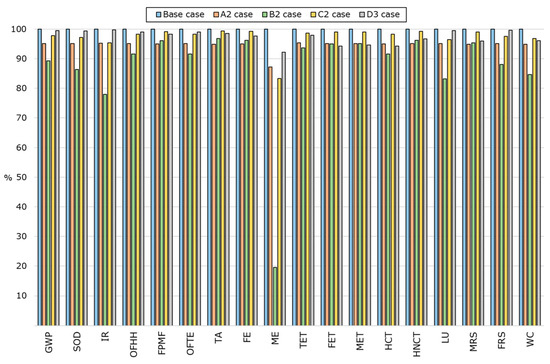
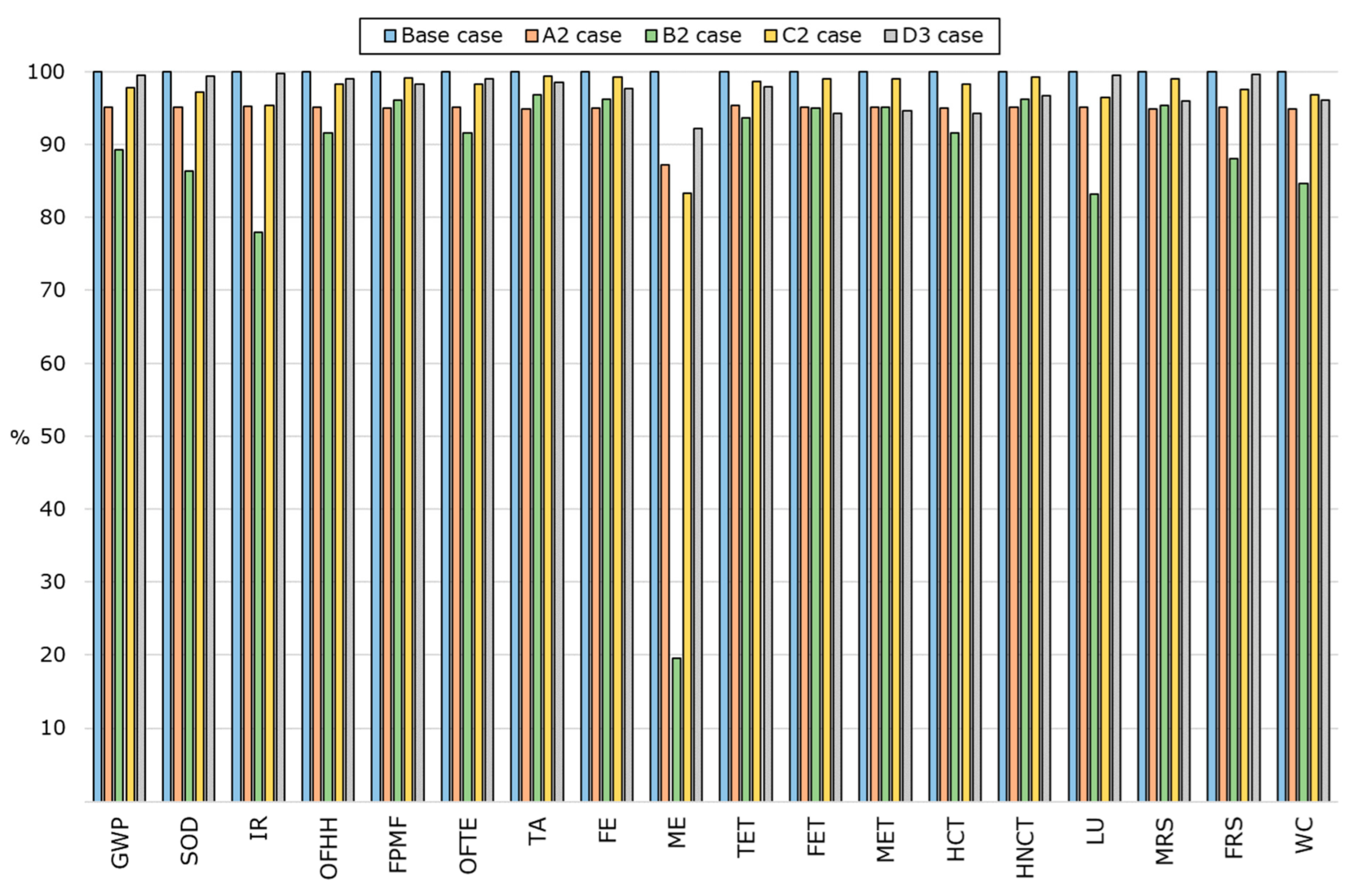
The most optimized cases from each scenario were compared, and the results are presented in Figure 3. The best scenarios were:
Figure 3.
Graphical results of the sensitivity analysis comparing the base case with cases: A2, B2, C2, D3.
- A2: 5% increase in capacity of battery;
- B2: 5% increase in RTE (ηk1);
- C2: 5% decrease in energy for driving (Fv);
- D3: increase in the recovery rate up to 98% for copper, aluminium, and steel.
The comparison indicates that Case B2 is the most favorable across nearly all analyzed categories. Only for the FPMF, TA, FET, MET, and HCT categories does Case A2 yield the best performance. In contrast, Cases C2 and D3 display smaller reductions in impacts across almost all categories compared to the baseline. Certain categories, such as IR and ME, show a wide dispersion between scenarios, suggesting a high sensitivity to the specific values of the input parameters.
These sensitivity analysis results are intended to provide strategic support for designers and developers in the LFP battery sector. The analysis demonstrates that certain parameters are more effective than others in enhancing the product’s environmental profile: specifically, increasing battery capacity and improving the average RTE.
4.3. Implications for CRM-Driven Design
The analysis confirms that a small set of CRMs—specifically aluminium, copper, and lithium—structurally governs the environmental profile of LFP batteries. Both the manufacturing phase impacts and the environmental benefits of end-of-life recycling are dominated by these materials, highlighting the critical importance of their efficient use and recovery.
Scenario and sensitivity analyses further demonstrate that improvements in battery capacity and round-trip efficiency not only reduce overall impacts but also significantly influence the contribution of CRMs across key categories. This proves that an environmentally optimized LFP battery design must integrate CRM content, operational performance parameters, and end-of-life recovery into a unified framework. Such a holistic approach provides a coherent basis for design-oriented strategies aimed at minimizing environmental burdens while maximizing material circularity.
4.4. Effect of Country-Specific Electricity Mixes
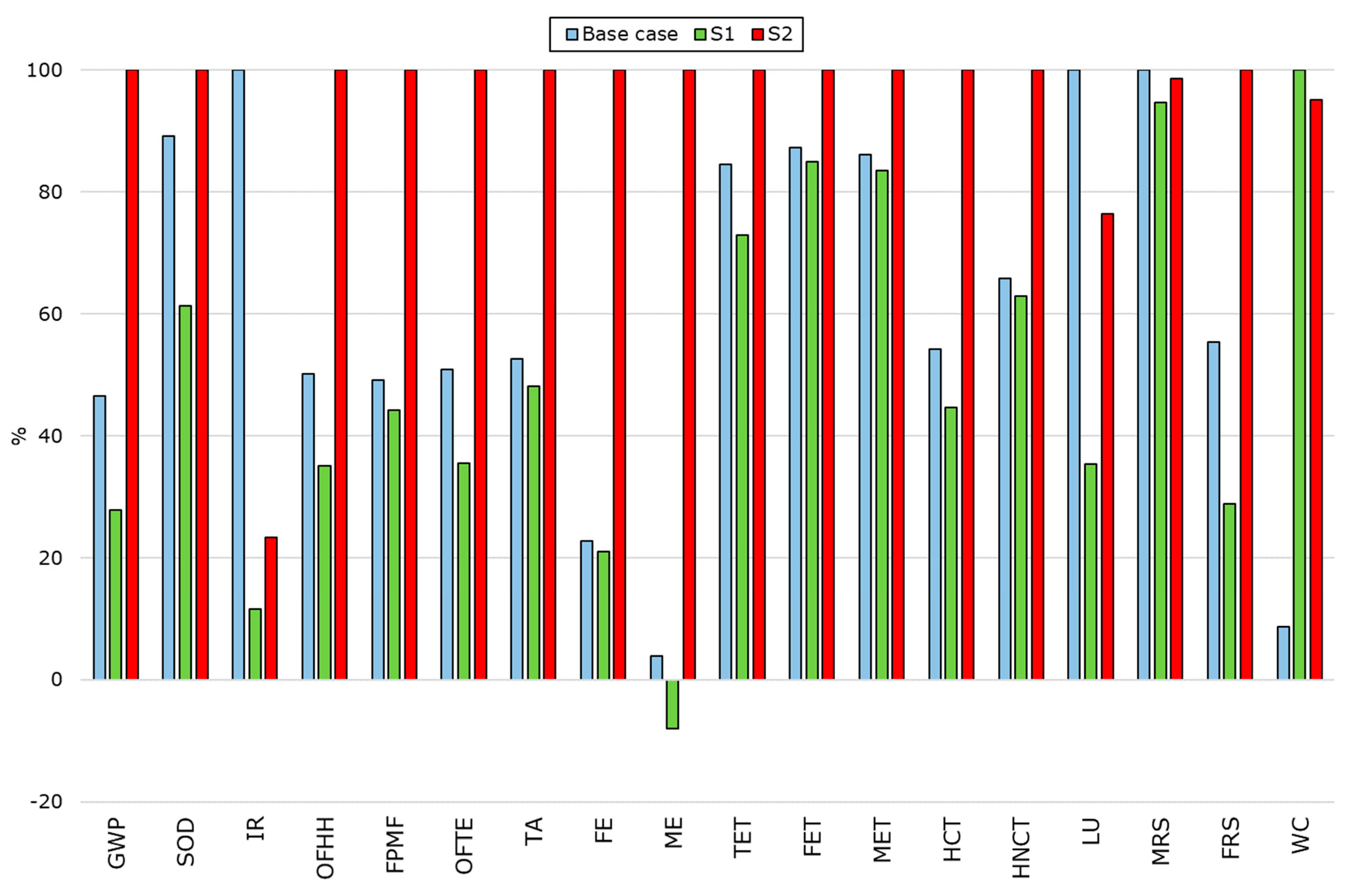
A second sensitivity analysis was performed to assess the influence of different EU electricity mixes for charging the battery during use phase. Three scenarios were considered:
- Base case: energy consumption associated with the EV use phase was modelled using the United Kingdom electricity mix.;
- S1: energy consumption is based on the Norwegian electricity mix and is representative of a system largely relying on renewable energy sources, particularly hydropower [50];
- S2: energy consumption is based on the Polish electricity mix and is representative of a system strongly dependent on fossil fuel-based power generation [51].
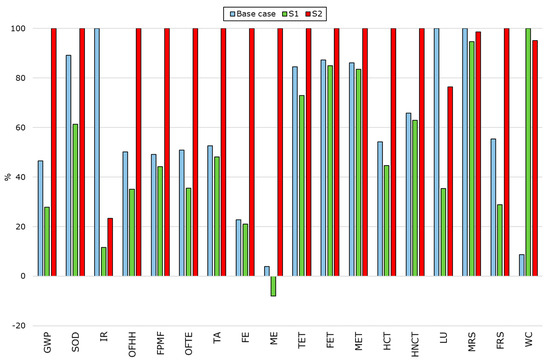
The results of the sensitivity analysis in Figure 4 show that the environmental performance of the system is strongly influenced by the energy mix assumed for the use phase. Scenario S2 exhibits the highest impacts in most of the categories considered, with particularly relevant increases compared with the base case for GWP, FPMF, FE, and ME. Conversely, scenario S1 shows an overall reduction in environmental impacts, representing the best option for almost all the impact categories analyzed. This result confirms the importance of the composition of the energy mix and, in particular, the environmental benefits associated with a higher share of energy generated from renewable sources. The most significant reductions in S1 compared with the base case are observed for GWP, IR, LU, and FRS. However, it should be noted that S1 leads to a significant increase in the WC indicator compared with the base case, highlighting a potential environmental trade-off that should be considered in the overall interpretation of the results.
Figure 4.
Graphical results of the sensitivity analysis comparing the base case with cases S1 and S2.
5. Conclusions
This study presented a comprehensive “cradle-to-grave” LCA of an LFP battery for electric vehicle traction, with the objectives of identifying the most critical life cycle stages, quantifying the contribution of key CRMs to specific impact categories, and evaluating the robustness of the results through Monte Carlo and sensitivity analyses.
The results show that the material manufacturing phase dominates most impact categories, with the exception of IR and LU, where the use phase is particularly relevant due to electricity consumption during operation. End-of-life recycling generates environmental benefits across all categories, largely driven by the recovery of aluminium, copper, and lithium through hydrometallurgical processes. The gravity analysis demonstrates that a limited set of CRMs structurally governs both environmental burdens and avoided impacts. In particular, the greatest impact is caused by aluminium and lithium for the GWP category, copper for FET and MET, and aluminium for HCT. A significant impact for the GWP, FET, and MET categories is also attributable to the electronic components of the battery, including the battery management system.
Monte Carlo uncertainty analysis confirms the robustness of the results for most impact categories, with low variability except for MET, which exhibits higher uncertainty. The first sensitivity analysis highlighted that the most significant improvements in the environmental profile are associated with Cases A2 and B2, which propose a 5.0% increase in battery capacity and a 5% increase in RTE, respectively, compared to the baseline. The second sensitivity analysis confirms that the electricity mix used during the EV use phase is a key driver of environmental performance, with renewable-based systems leading to lower impacts in most categories and fossil fuel-based systems resulting in substantially higher burdens.
Some limitations should be considered when interpreting these results. The study is based primarily on secondary inventory data derived from the Ecoinvent database and scientific literature. Future research could improve accuracy by utilizing primary industrial data and modeling emerging recycling technologies—such as those involving deep eutectic solvents, supercritical CO2, biotechnology, or electrochemical methods [52]—for which data are currently limited or unavailable. Furthermore, in light of the results obtained, future developments in this research could involve a more in-depth analysis using multi-regional LCA models, the accounting of impacts associated with the cascading use of batteries in second-life applications, and the design optimization of lighter battery packs through a reduction in aluminium content.
Overall, this study provides a design-oriented LCA framework that explicitly links environmental performance to CRM content, operational efficiency, and end-of-life recovery. The findings highlight that optimizing material use and battery performance parameters is essential for minimizing environmental impacts, thereby supporting the development of more sustainable LFP battery systems.
Supplementary Materials
The following supporting information can be downloaded at: https://www.mdpi.com/article/10.3390/en19143410/s1.
Author Contributions
Conceptualization, M.O. and A.M.; methodology, A.M.; software, M.O.; validation, H.R., R.L. and A.M.; investigation, M.O.; data curation, M.O.; writing—original draft preparation, M.O.; writing—review and editing, H.R., R.L. and A.M.; supervision, H.R., R.L. and A.M. All authors have read and agreed to the published version of the manuscript.
Funding
This research received no external funding.
Data Availability Statement
The original contributions presented in this study are included in the article/Supplementary Materials. Further inquiries can be directed to the corresponding author.
Conflicts of Interest
The authors declare no conflicts of interest.
Abbreviations
The following abbreviations are used in this manuscript:
| CRM | Critical Raw Material |
| EoL | End Of Life |
| FE | Freshwater Eutrophication |
| FET | Freshwater Ecotoxicity |
| FPMF | Fine Particulate Matter Formation |
| FRS | Fossil Resource Scarcity |
| GHG | Greenhouse Gas |
| GWP | Global Warming Potential |
| HCT | Human Carcinogenic Toxicity |
| HNCT | Human Non-Carcinogenic Toxicity |
| IR | Ionizing Radiation |
| LCA | Life Cycle Assessment |
| LFP | Lithium Iron Phosphate |
| LU | Land Use |
| ME | Marine Eutrophication |
| MET | Marine Ecotoxicity |
| MRS | Mineral Resource Scarcity |
| OFHH | Ozone Formation—Human Health |
| OFTE | Ozone Formation—Terrestrial Ecosystems |
| RTE | Round-Trip Efficiency |
| SOD | Stratospheric Ozone Depletion |
| TA | Terrestrial Acidification |
| TET | Terrestrial Ecotoxicity |
| WC | Water Consumption |
References
- European Commission. Communication from the Commission to the European Parliament, the European Council, the Council, the European Economic and Social Committee and the Committee of the Regions—The European Green Deal. COM(2019) 640 Final. 11 December 2019. Available online: https://www.consilium.europa.eu/media/47573/st_15051_2019_init_en.pdf (accessed on 19 June 2026).
- Arshad, F.; Lin, J.; Manurkar, N.; Fan, E.; Ahmad, A.; Tariq, M.-N.; Wu, F.; Chen, R.; Li, L. Life Cycle Assessment of Lithium-Ion Batteries: A Critical Review. Resour. Conserv. Recycl. 2022, 180, 106164. [Google Scholar] [CrossRef] [Scilit]
- Li, M.M.; Weller, J.M.; Reed, D.M.; Sprenkle, V.L.; Li, G. Thermally Activated Batteries and Their Prospects for Grid-Scale Energy Storage. Joule 2023, 7, 619–623. [Google Scholar] [CrossRef] [Scilit]
- Llamas-Orozco, J.A.; Meng, F.; Walker, G.S.; Abdul-Manan, A.F.N.; MacLean, H.L.; Posen, I.D.; McKechnie, J. Estimating the Environmental Impacts of Global Lithium-Ion Battery Supply Chain: A Temporal, Geographical, and Technological Perspective. PNAS Nexus 2023, 2, pgad361. [Google Scholar] [CrossRef] [Scilit] [PubMed]
- Yang, X.-G.; Liu, T.; Wang, C.-Y. Thermally Modulated Lithium Iron Phosphate Batteries for Mass-Market Electric Vehicles. Nat. Energy 2021, 6, 176–185. [Google Scholar] [CrossRef] [Scilit]
- Directorate-General for Internal Market, Industry, Entrepreneurship and SMEs (European Commission). Methodology for Establishing the EU List of Critical Raw Materials: Guidelines; Publications Office of the European Union: Luxembourg, 2017; ISBN 978-92-79-68051-9. [Google Scholar] [CrossRef]
- European Commission. Proposal for a Regulation of the European Parliament and of the Council Establishing a Framework for Ensuring a Secure and Sustainable Supply of Critical Raw Materials and Amending Regulations (EU) 168/2013, (EU) 2018/858, 2018/1724 and (EU) 2019/1020. COM(2023) 160 Final. 16 March 2023. Available online: https://eur-lex.europa.eu/legal-content/EN/TXT/?uri=celex:52023PC0160 (accessed on 19 June 2026).
- Lehtimäki, H.; Karhu, M.; Kotilainen, J.M.; Sairinen, R.; Jokilaakso, A.; Lassi, U.; Huttunen-Saarivirta, E. Sustainability of the Use of Critical Raw Materials in Electric Vehicle Batteries: A Transdisciplinary Review. Environ. Chall. 2024, 16, 100966. [Google Scholar] [CrossRef] [Scilit]
- Hauschild, M.Z.; Rosenbaum, R.K.; Olsen, S.I. (Eds.) Life Cycle Assessment: Theory and Practice; Springer International Publishing: Cham, Switzerland, 2018; ISBN 978-3-319-56474-6. [Google Scholar]
- Mazzi, A. Chapter 1—Introduction. Life Cycle Thinking. In Life Cycle Sustainability Assessment for Decision-Making; Ren, J., Toniolo, S., Eds.; Elsevier: Amsterdam, The Netherlands, 2020; pp. 1–19. ISBN 978-0-12-818355-7. [Google Scholar]
- Sala, S.; Laurent, A.; Vieira, M.; Van Hoof, G. Implications of LCA and LCIA Choices on Interpretation of Results and on Decision Support. Int. J. Life Cycle Assess. 2020, 25, 2311–2314. [Google Scholar] [CrossRef] [Scilit]
- Val, S.; Lambán, M.P. Enhancing Sustainability with LCA: A Comparative Analysis of Design and Manufacturing Processes. Processes 2025, 13, 195. [Google Scholar] [CrossRef] [Scilit]
- Quan, J.; Zhao, S.; Song, D.; Wang, T.; He, W.; Li, G. Comparative Life Cycle Assessment of LFP and NCM Batteries Including the Secondary Use and Different Recycling Technologies. Sci. Total Environ. 2022, 819, 153105. [Google Scholar] [CrossRef] [Scilit] [PubMed]
- Larouche, F.; Tedjar, F.; Amouzegar, K.; Houlachi, G.; Bouchard, P.; Demopoulos, G.P.; Zaghib, K. Progress and Status of Hydrometallurgical and Direct Recycling of Li-Ion Batteries and Beyond. Materials 2020, 13, 801. [Google Scholar] [CrossRef] [Scilit] [PubMed]
- Yoo, E.; Lee, U.; Kelly, J.C.; Wang, M. Life-Cycle Analysis of Battery Metal Recycling with Lithium Recovery from a Spent Lithium-Ion Battery. Resour. Conserv. Recycl. 2023, 196, 107040. [Google Scholar] [CrossRef] [Scilit]
- Domingues, A.M.; de Souza, R.G. Review of Life Cycle Assessment on Lithium-Ion Batteries (LIBs) Recycling. Next Sustain. 2024, 3, 100032. [Google Scholar] [CrossRef] [Scilit]
- Barbosa, J.C.; Pinto, R.S.; Serra, J.P.; Gonçalves, R.; Lizundia, E.; Costa, C.M.; Lanceros-Mendez, S. Batteries and Sustainability: The Relevance of Life Cycle Assessment. Sustain. Energy Technol. Assess. 2025, 82, 104488. [Google Scholar] [CrossRef] [Scilit]
- Kim, S.-H.; Park, S.-H.; Lim, S.-R. Identification of Principal Factors for Low-Carbon Electric Vehicle Batteries by Using a Life Cycle Assessment Model-Based Sensitivity Analysis. Sustain. Energy Technol. Assess. 2024, 64, 103683. [Google Scholar] [CrossRef] [Scilit]
- Khandelwal, N.; Behera, S.K.; Kumar, A.; Gedam, V.V. Life Cycle Assessment and Circular Economy in Emerging Green and Sustainable Energy Sectors: A Critical Review. Sustain. Energy Technol. Assess. 2025, 81, 104436. [Google Scholar] [CrossRef] [Scilit]
- Paul, D.; Pechancová, V.; Saha, N.; Pavelková, D.; Saha, N.; Motiei, M.; Jamatia, T.; Chaudhuri, M.; Ivanichenko, A.; Venher, M.; et al. Life Cycle Assessment of Lithium-Based Batteries: Review of Sustainability Dimensions. Renew. Sustain. Energy Rev. 2024, 206, 114860. [Google Scholar] [CrossRef] [Scilit]
- Scrucca, F.; Presciutti, A.; Baldinelli, G.; Barberio, G.; Postrioti, L.; Karaca, C. Life Cycle Assessment of Li-Ion Batteries for Electric Vehicles: A Review Focused on the Production Phase Impact. J. Power Sources 2025, 639, 236703. [Google Scholar] [CrossRef] [Scilit]
- ISO 14040:2006; Environmental Management—Life Cycle Assessment—Principles and Framework. The International Organization for Standardization: Geneva, Switzerland, 2006. Available online: https://www.iso.org/standard/76121.html (accessed on 19 June 2026).
- ISO 14044:2006; Environmental Management—Life Cycle Assessment—Requirements and Guidelines. The International Organization for Standardization: Geneva, Switzerland, 2006. Available online: https://www.iso.org/standard/38498.html (accessed on 19 June 2026).
- Kallitsis, E.; Korre, A.; Kelsall, G.H. Life Cycle Assessment of Recycling Options for Automotive Li-Ion Battery Packs. J. Clean. Prod. 2022, 371, 133636. [Google Scholar] [CrossRef] [Scilit]
- Chen, M.; Ma, X.; Chen, B.; Arsenault, R.; Karlson, P.; Simon, N.; Wang, Y. Recycling End-of-Life Electric Vehicle Lithium-Ion Batteries. Joule 2019, 3, 2622–2646. [Google Scholar] [CrossRef] [Scilit]
- Mazzi, A.; Barbiero, C.; Miserocchi, F.; Nisato, F.; Tassinato, G.; Cerchier, P. Life Cycle Assessment of Al-Cu-Ag-Si Recycling Process from Photovoltaic Waste. Resour. Conserv. Recycl. 2024, 211, 107885. [Google Scholar] [CrossRef] [Scilit]
- Wernet, G.; Bauer, C.; Steubing, B.; Reinhard, J.; Moreno-Ruiz, E.; Weidema, B. The ecoinvent database version 3 (part I): Overview and methodology. Int. J. Life Cycle Assess. 2016, 21, 1218–1230. [Google Scholar] [CrossRef] [Scilit]
- Winjobi, O.; Dai, Q.; Kelly, J.C. Update of Bill-of-Materials and Cathode Chemistry Addition for Lithium-Ion Batteries in GREET® 2020; Argonne National Laboratory: Lemont, IL, USA, 2020. [Google Scholar]
- Ellingsen, L.A.-W.; Hung, C.R.; Strømman, A.H. Identifying Key Assumptions and Differences in Life Cycle Assessment Studies of Lithium-Ion Traction Batteries with Focus on Greenhouse Gas Emissions. Transp. Res. Part Transp. Environ. 2017, 55, 82–90. [Google Scholar] [CrossRef] [Scilit]
- Feng, T.; Guo, W.; Li, Q.; Meng, Z.; Liang, W. Life Cycle Assessment of Lithium Nickel Cobalt Manganese Oxide Batteries and Lithium Iron Phosphate Batteries for Electric Vehicles in China. J. Energy Storage 2022, 52, 104767. [Google Scholar] [CrossRef] [Scilit]
- Yang, Y.; Lan, L.; Hao, Z.; Zhao, J.; Luo, G.; Fu, P.; Chen, Y. Life Cycle Prediction Assessment of Battery Electrical Vehicles with Special Focus on Different Lithium-Ion Power Batteries in China. Energies 2022, 15, 5321. [Google Scholar] [CrossRef] [Scilit]
- Zackrisson, M.; Avellán, L.; Orlenius, J. Life Cycle Assessment of Lithium-Ion Batteries for Plug-in Hybrid Electric Vehicles—Critical Issues. J. Clean. Prod. 2010, 18, 1519–1529. [Google Scholar] [CrossRef] [Scilit]
- Guo, W.; Feng, T.; Li, W.; Hua, L.; Meng, Z.; Li, K. Comparative Life Cycle Assessment of Sodium-Ion and Lithium Iron Phosphate Batteries in the Context of Carbon Neutrality. J. Energy Storage 2023, 72, 108589. [Google Scholar] [CrossRef] [Scilit]
- Marques, P.; Garcia, R.; Kulay, L.; Freire, F. Comparative Life Cycle Assessment of Lithium-Ion Batteries for Electric Vehicles Addressing Capacity Fade. J. Clean. Prod. 2019, 229, 787–794. [Google Scholar] [CrossRef] [Scilit]
- Choux, M.; Marti Bigorra, E.; Tyapin, I. Task Planner for Robotic Disassembly of Electric Vehicle Battery Pack. Metals 2021, 11, 387. [Google Scholar] [CrossRef] [Scilit]
- Yao, L.P.; Zeng, Q.; Qi, T.; Li, J. An Environmentally Friendly Discharge Technology to Pretreat Spent Lithium-Ion Batteries. J. Clean. Prod. 2020, 245, 118820. [Google Scholar] [CrossRef] [Scilit]
- Mohr, M.; Peters, J.F.; Baumann, M.; Weil, M. Toward a cell-chemistry specific life cycle assessment of lithium-ion battery recycling processes. J. Ind. Ecol. 2020, 24, 1310–1322. [Google Scholar] [CrossRef] [Scilit]
- SimaPro, B.V. SimaPro—Sustainability Insights for Informed Changemakers. Available online: https://simapro.com/ (accessed on 19 June 2026).
- Huijbregts, M.A.J.; Steinmann, Z.J.N.; Elshout, P.M.F.; Stam, G.; Verones, F.; Vieira, M.; Zijp, M.; Hollander, A.; van Zelm, R. ReCiPe2016: A Harmonised Life Cycle Impact Assessment Method at Midpoint and Endpoint Level. Int. J. Life Cycle Assess. 2017, 22, 138–147. [Google Scholar] [CrossRef] [Scilit]
- Huijbregts, M.A.J.; Steinmann, Z.J.N.; Elshout, P.M.F.; Stam, G.; Verones, F.; Vieira, M.D.M.; Hollander, A.; van Zelm, R. ReCiPe 2016: A Harmonized Life Cycle Impact Assessment Method at Midpoint and Endpoint Level. In Report I: Characterization; RIVM Report 2016-0104; National Institute for Public Health and the Environment: Bilthoven, The Netherlands, 2016. [Google Scholar]
- van Zelm, R.; Hennequin, T.; Huijbregts, M.A.J. Performing life cycle impact assessment with the midpoint and end-point method ReCiPe. Nat. Protoc. 2025, 20, 3400–3411. [Google Scholar] [CrossRef] [Scilit] [PubMed]
- Groen, E.A.; Heijungs, R.; Bokkers, E.A.M.; de Boer, I.J.M. Sensitivity analysis in life cycle assessment. In Proceedings of the 9th International Conference on Life Cycle Assessment in the Agri-Food Sector (LCA Food 2014); Schenck, R., Huizenga, D., Eds.; American Center for Life Cycle Assessment (ACLCA): Vashon, WA, USA, 2014; pp. 482–488. [Google Scholar]
- Directorate-General for Internal Market, Industry, Entrepreneurship and SMEs (European Commission). Study on the Critical Raw Materials for the EU 2023—Final Report; Publications Office of the European Union: Luxembourg, 2023; ISBN 978-92-68-00414-2. [Google Scholar] [CrossRef]
- European Parliament; Council of the European Union. Regulation (EU) 2024/1252 of 11 April 2024 Establishing a Framework for Ensuring a Secure and Sustainable Supply of Critical Raw Materials and Amending Regulations (EU) No 168/2013, (EU) 2018/858, (EU) 2018/1724 and (EU) 2019/1020. Off. J. Eur. Union 2024, L 1252. Available online: https://www.gov.cy/media/sites/5/2025/11/EU-2024-1252-CRM_EN_TXT.pdf (accessed on 19 June 2026). [CrossRef] [Scilit]
- Peters, J.F.; Baumann, M.; Zimmermann, B.; Braun, J.; Weil, M. The Environmental Impact of Li-Ion Batteries and the Role of Key Parameters—A Review. Renew. Sustain. Energy Rev. 2017, 67, 491–506. [Google Scholar] [CrossRef] [Scilit]
- Heijungs, R. On the Number of Monte Carlo Runs in Comparative Probabilistic LCA. Int. J. Life Cycle Assess. 2020, 25, 394–402. [Google Scholar] [CrossRef] [Scilit]
- Jiang, T.; Wang, H.; Jin, Q. Comparison of Three Typical Lithium-Ion Batteries for Pure Electric Vehicles from the Perspective of Life Cycle Assessment. Clean. Technol. Environ. Policy 2024, 26, 331–350. [Google Scholar] [CrossRef] [Scilit]
- Liu, Z.; Sederholm, J.G.; Lan, K.-W.; Cho, E.J.; Dipto, M.J.; Gurumukhi, Y.; Rabbi, K.F.; Hatzell, M.C.; Perry, N.H.; Miljkovic, N.; et al. Life Cycle Assessment of Hydrometallurgical Recycling for Cathode Active Materials. J. Power Sources 2023, 580, 233345. [Google Scholar] [CrossRef] [Scilit]
- European Parliament; Council of the European Union. Regulation (EU) 2023/1542 of 12 July 2023 concerning batteries and waste batteries, amending Directive 2008/98/EC and Regulation (EU) 2019/1020 and repealing Directive 2006/66/EC. Off. J. Eur. Union 2023, L 191, 1–117. Available online: https://eur-lex.europa.eu/eli/reg/2023/1542/oj/eng (accessed on 19 June 2026).
- Tselika, K.; Jaehnert, S. Hydropower market dynamics in Norway: Evaluating the market value and volatility in the electricity sector. J. Environ. Manag. 2025, 381, 125087. [Google Scholar] [CrossRef] [Scilit] [PubMed]
- Zhang, S.; Zhao, W.; Zhu, B.; Yan, C.; Song, X.; Jiang, H.; Fang, J.; Ciais, P.; Xuan, N.; Gentine, P.; et al. A near-real time daily European power consumption and carbon intensity dataset (ECON-PowerCI). Sci. Data 2025, 12, 1693. [Google Scholar] [CrossRef] [Scilit] [PubMed]
- Ma, X.; Meng, Z.; Bellonia, M.V.; Spangenberger, J.; Harper, G.; Gratz, E.; Olivetti, E.; Arsenault, R.; Wang, Y. The Evolution of Lithium-Ion Battery Recycling. Nat. Rev. Clean. Technol. 2025, 1, 75–94. [Google Scholar] [CrossRef] [Scilit]

Disclaimer/Publisher’s Note: The statements, opinions and data contained in all publications are solely those of the individual author(s) and contributor(s) and not of MDPI and/or the editor(s). MDPI and/or the editor(s) disclaim responsibility for any injury to people or property resulting from any ideas, methods, instructions or products referred to in the content. |
© 2026 by the authors. Licensee MDPI, Basel, Switzerland. This article is an open access article distributed under the terms and conditions of the Creative Commons Attribution (CC BY) license.