


Abstract
This paper evaluates residential energy management systems (EMSs) that combine on-site renewable generation and battery energy storage in an all-electric house. This work compares four levels of control complexity: baseline operation, deterministic rule-based control, an optimization-based benchmark, and adaptive control using machine learning, predictive control, and a transactive framework. A calibrated gray-box house model based on the Archetype Sustainable House in Vaughan, Ontario, was used to test each strategy under the same operating assumptions. The comparison shows a clear trade-off between simplicity and performance. Deterministic load-shifting strategies are easy to implement but deliver the lowest savings. The optimized controller provides a practical upper bound on achievable performance. The machine-learning controller, trained from optimized historical operation, produced the strongest annual savings and outperformed deterministic control by a range of about 15–22%. Predictive control showed promise, but its demonstration was limited by forecast-data quality; more than 40% of collected forecast files were unusable, leaving only a 10-day continuous case study. A transactive energy management system delivered moderate direct savings, but its main value was flexibility, agent-based coordination, and future applicability to community-scale control. Experimental work further showed that 98% of an air-source heat pump peak-hour load could be shifted using battery control hardware. Despite these technical benefits, this study finds that battery-supported residential EMSs remain financially unattractive under the electricity prices and battery costs considered here. The results suggest that the most realistic path forward is not a one-size-fits-all controller, but a staged transition from simple battery logic to adaptive and transactive control as hardware prices fall, data quality improves, and homes become more connected.
1. Introduction
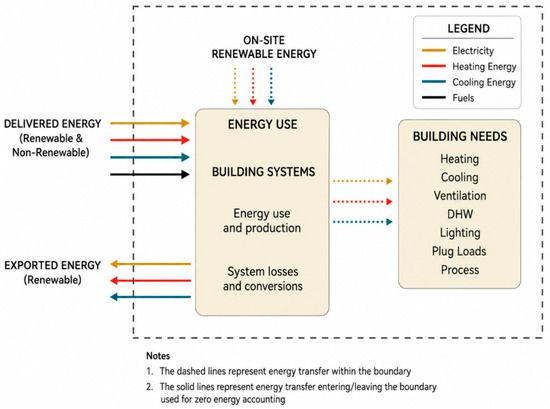
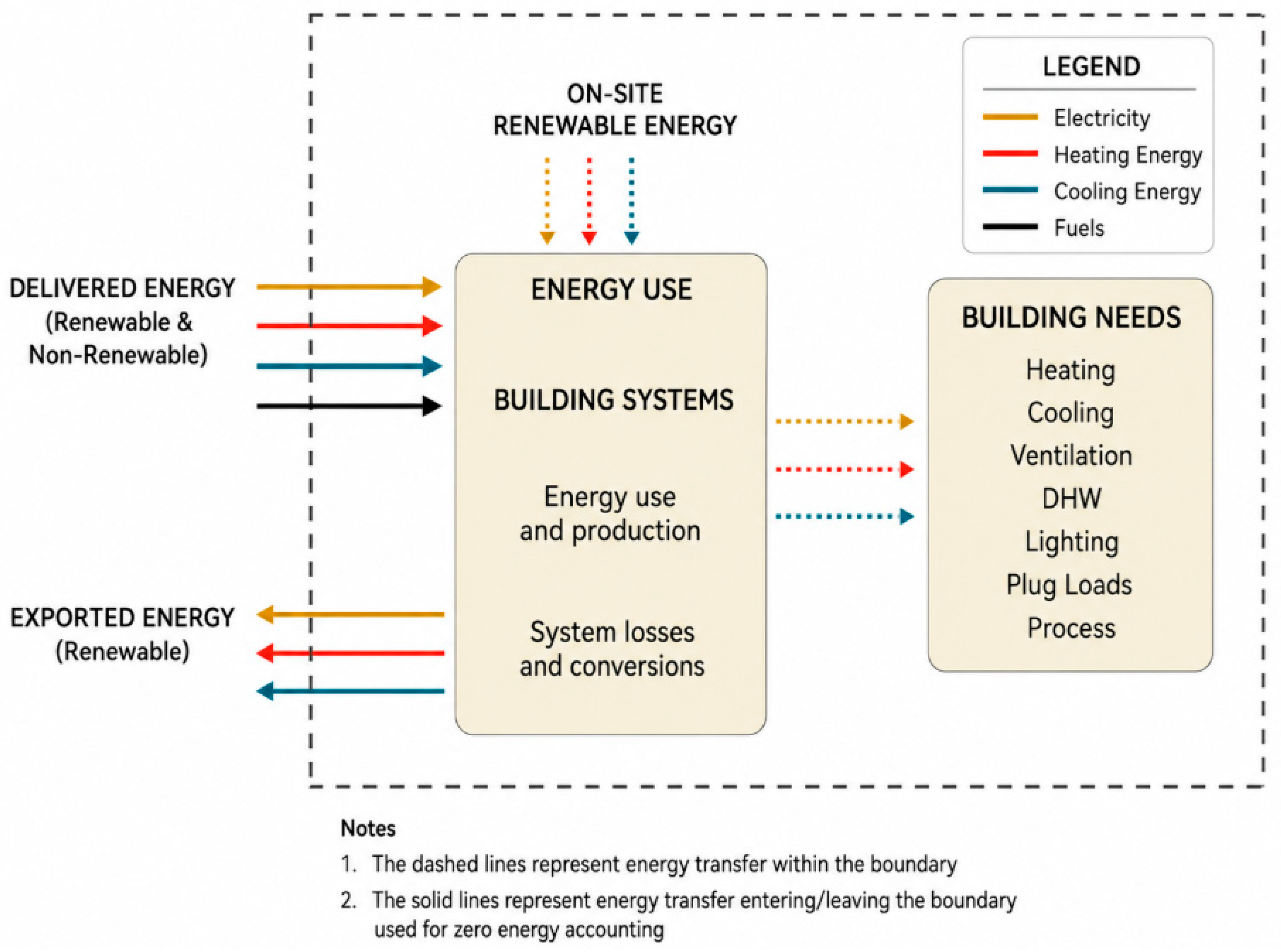
Residential buildings remain a major part of energy demand and emissions, and they are becoming more electrified as space conditioning, water heating, electric vehicles, and distributed generation spread across the housing sector [1,2,3,4]. At the same time, rooftop solar, smart meters, and household batteries are moving homes from passive consumption toward active participation in the grid [5,6,7,8,9]. This shift creates a practical need for energy management systems that are technically effective, simple enough to deploy, and credible under real utility prices. The broader net-zero energy framing adopted in this study is illustrated in Figure 1.
Figure 1.
Net-zero energy site boundary used to frame the residential EMS (energy management system) problem.
For residential EMS design, the central question is not whether a controller can reduce grid imports in theory. The real question is which level of control complexity is worth implementing in an ordinary home. A highly optimized controller may perform well in simulation, but it can also require forecasting tools, communication infrastructure, and tuning effort that make it difficult to use in practice. A simpler controller may save less money, but it may be more robust, easier to explain, and easier to install.
The present study addresses that trade-off by comparing several EMS strategies on the same calibrated house model and under the same tariff and weather assumptions. This work focuses on battery control in combination with renewable generation because that combination is now common in discussions of net-zero homes, resilient buildings, and smart-grid demand flexibility [10,11,12,13,14,15].
This study is guided by four main objectives:
- ▪
- First, the annual energy, cost, and emissions performance of several residential EMS strategies were compared on the same calibrated house model.
- ▪
- Second, the practical complexity of these strategies was assessed in terms of data needs, forecast dependence, communication burden, and implementation realism.
- ▪
- Third, the technical feasibility of battery-supported load shifting and controller interaction was checked through targeted proof-of-concept experiments.
- ▪
- Fourth, the financial feasibility of battery-supported EMS operation was evaluated under Ontario electricity prices and battery-cost assumptions.
2. Related Work and Research Gap
2.1. Literature Review
Research on residential EMSs has grown alongside the rise of smart grids, distributed generation, and battery storage. Early work established the broader smart-grid vision, where energy use is no longer passively consumed but actively monitored, scheduled, and coordinated through intelligent control systems [7,8,9]. In parallel, the net-zero energy building concept gained momentum, especially as studies clarified that high-performance buildings must be evaluated not only by efficient design, but also by how on-site renewable generation interacts with demand over time [10,11]. This line of work created the foundation for residential EMS research by showing that building performance increasingly depends on operational control, not only on envelope or equipment efficiency. Recent work has been moving toward broader coordination of energy resources, especially through electric vehicle (EV) integration, storage-based load shifting, smart city energy management, and hybrid AC–DC (alternating current–direct current) microgrid control [16,17,18,19,20]. These studies are useful because they highlight the growing importance of flexibility, storage coordination, and advanced control in modern EMS. At the same time, their focus is generally placed on infrastructure coordination, EV charging, or hybrid microgrid stability rather than on a direct, fair comparison of multiple EMS strategies within the same residential building model. As a result, they strengthen the case for advanced control, but they still leave the practical residential question open; addressed in this manuscript: how much added value is really gained when deterministic, optimized, machine-learning, predictive, and transactive EMS approaches are tested side by side on the same calibrated house under the same operating assumptions.
A major stream of previous work has focused on microgrids and distributed energy systems. Studies have examined centralized, autonomous, and agent-based control structures for microgrids containing combinations of PV (photovoltaic), wind, storage, and controllable loads [13,15,21,22,23,24,25,26]. These studies show that advanced coordination can improve system flexibility and renewable utilization. However, most of this work is carried out at the microgrid or community scale, where communication infrastructure, central control platforms, and engineering support are more readily assumed than in an ordinary house. As a result, the lessons are valuable, but they do not directly answer a practical residential question: how much control complexity is truly justified in a single home.
Another large body of literature has examined demand response and load scheduling in buildings. Time-of-use pricing, direct load control, and appliance scheduling have all shown potential to reduce electricity costs and shift load away from peak periods [27,28,29,30,31,32,33,34]. Residential demand response studies have also demonstrated that savings are possible without major comfort penalties when flexible loads are managed carefully [35,36,37,38,39,40,41,42]. Still, many of these studies focus on one control objective at a time, such as peak reduction or tariff minimization, and often do not examine how the same house would perform under multiple competing EMS strategies.
A more advanced stream of work has explored transactive energy and market-based coordination, where devices bid for energy in response to system conditions and price signals [43,44,45,46,47]. This approach is attractive because it supports scalability, flexibility, and coordination across multiple loads and energy resources. Transactive control can also improve demand response participation and thermal comfort compared with simpler rule-based control [45,46,47]. Even so, most published examples emphasize communication logic, bidding structure, or community-scale demonstrations. Much less attention has been given to how a transactive framework compares, on the same residential platform, with deterministic battery control, optimized scheduling, or machine-learning-based control.
A fourth major area of related work involves optimization and artificial intelligence for EMS design. Mixed-integer linear programming, mixed-integer nonlinear programming, stochastic optimization, heuristic methods, genetic algorithms, artificial neural networks, and recurrent neural networks have all been used to improve scheduling, forecasting, and renewable integration [48,49,50,51,52,53,54,55,56,57,58,59,60,61,62,63,64,65,66,67]. These methods have shown strong technical potential, particularly for minimizing cost, reducing emissions, or handling uncertainty. MPC (model predictive control) has been especially influential because it can combine forecasts, system dynamics, and operational constraints in one framework [68,69,70,71,72]. However, most of these studies investigate a single control method in isolation and under their own assumptions, datasets, and test conditions. Because of this, it is difficult to determine whether the performance gain of a more advanced controller is large enough to justify its additional data requirements, tuning effort, and implementation burden in a residential setting.
Taken together, the literature clearly shows that residential EMS performance can be improved through load shifting, renewable integration, optimization, forecasting, and transactional control. What remains less clear is the relative value of these approaches when they are compared fairly. Existing studies rarely evaluate deterministic, optimized, machine-learning, predictive, and transactive controllers on the same house model, under the same tariff structure, and with the same renewable and storage assumptions [48,49,50,51,52,53,54,55,56,57,58,59,60,61,62,63,64,65,66,67,68,69,70,71,72]. In addition, many studies pay limited attention to practical deployment issues such as data quality, communication reliability, controller simplicity, and homeowner usability. The main research gap is not the absence of individual EMS methods, but the lack of a consistent side-by-side comparison that quantifies the additional benefit gained as control logic becomes more advanced. This study addresses that gap by comparing several EMS strategies within one calibrated residential framework and by interpreting their performance not only in terms of technical savings, but also in terms of deploying ability and practical value.
Recent EMS research has moved further toward reinforcement learning, battery degradation-aware scheduling, and grid-interactive efficient buildings, especially in studies that seek better coordination between indoor flexibility, distributed generation, and dynamic grid signals [72,73,74,75,76]. These newer studies confirm that controller performance can be improved through advanced learning and predictive methods, but they also reinforce a continuing problem in the literature: many methods are still tested under different assumptions, datasets, and objective functions, which makes a fair comparison difficult. The present work responds to that need by keeping the residential platform and comparison basis fixed rather than introducing another standalone algorithm under a separate test environment. Table 1 summarizes the related works studied for this work.
Table 1.
Chronology of representative related work.
2.2. Research Gap
Although previous studies have demonstrated the value of demand response, optimization, predictive control, transactive coordination, and AI-based EMS design, most of them examine a single control strategy under a unique set of assumptions. As a result, the literature does not clearly show how these methods compare when tested on the same residential building, with the same tariff structure, renewable profile, and battery assumptions. In addition, many studies emphasize technical optimality but give less attention to implementation burden, data quality, and homeowner practicality. The key gap, therefore, is the lack of a consistent and deployment-aware comparison of EMS strategies ranging from simple deterministic control to advanced adaptive and transactive methods. This study addresses that gap by evaluating multiple EMS approaches within one calibrated residential framework.
Compared with much of the earlier EMS literature, this study does not present one controller under its own assumptions and then generalize from that single case. Instead, deterministic, optimized, machine-learning, predictive, and transactive strategies are tested on the same calibrated house model, under the same tariff basis, the same Ontario emissions basis, and the same renewable-and-storage logic. That side-by-side structure makes it possible to separate true control benefits from differences caused by model setup. The contribution is therefore a deployment-aware comparison of how much practical value is gained as controller sophistication increases. Recent 2025 reviews have highlighted both the growing importance of machine learning in building energy management and the continuing influence of model predictive control in smart buildings, while newer 2025–2026 work on smart building–grid interaction has emphasized performance metrics, implementation burden, and scalable coordination as increasingly important research themes [73,74,75,76].
The original contribution of this work lies in the combination of several elements rather than in one isolated controller. First, a unified comparison framework is used so that deterministic, optimized, machine-learning, predictive, and transactive EMS strategies are evaluated on the same calibrated residential platform under the same tariff basis, renewable assumptions, and emissions basis. Second, the comparison is grounded in the calibrated Archetype Sustainable House model rather than in an abstract residential test case. Third, this work extends beyond a simulation-only comparison by including targeted proof-of-concept experimental validation for battery-supported load shifting and controller communication. Fourth, this study interprets performance not only through annual energy and cost savings, but also through practical implementation burden, forecast-data quality, and economic realism under Ontario conditions. The contribution of the present work is therefore not simply a new controller, but a fair and deployment-aware comparison that shows which level of EMS sophistication is actually justified in a residential setting.
3. Methodology
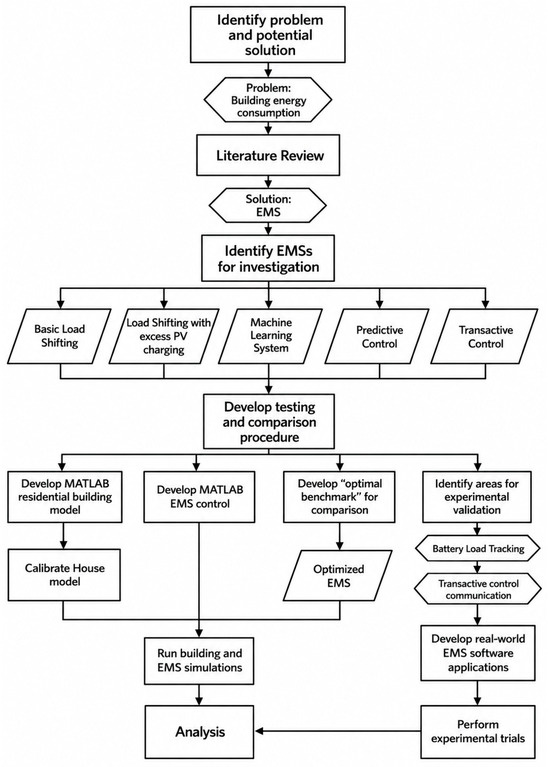
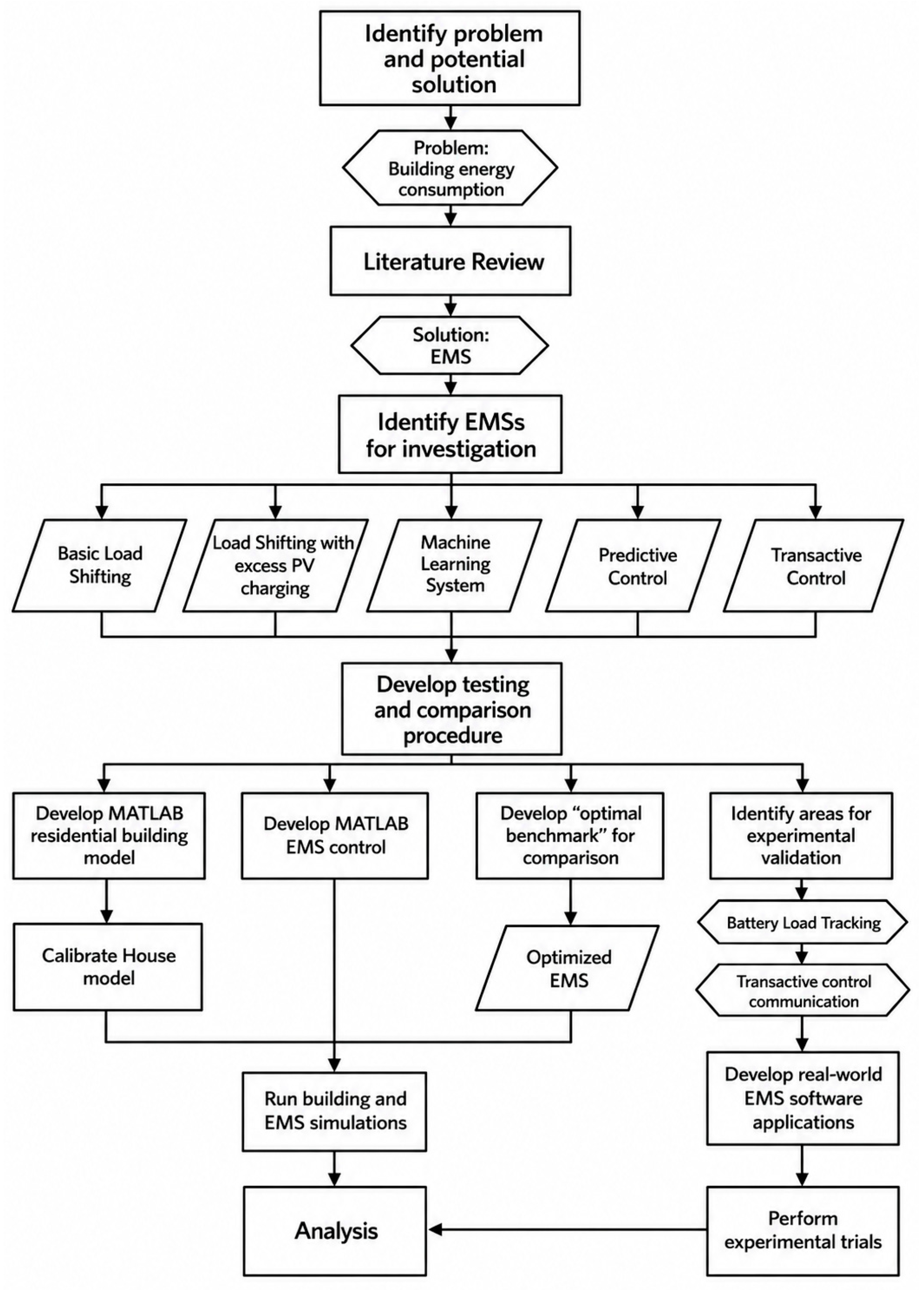
This study used a calibrated simulation model and targeted experimental trials to compare EMS strategies fairly. All cases were assessed on the same residential platform, with the same electricity tariff assumptions, the same Ontario emissions basis, and the same logic for battery charging and discharging unless otherwise stated. The overall workflow is summarized in Figure 2.
Figure 2.
Research methodology flow chart.
3.1. Case Study House and Simulation Environment
The simulation platform was based on the ASH (Archetype Sustainable House) at the Living City Campus in Vaughan, Ontario. A simplified gray-box model was developed in MATLAB (MATrix LABoratory) version R2012b; to capture the thermal response of the house and the interaction among the air-source heat pump, heat recovery ventilator, air handling unit, on-site solar PV, and battery storage. The model was calibrated to reproduce both short-term thermal response and annual heating and cooling behavior. A photograph of the case study facility is provided in Figure 3.
Figure 3.
Archetype Sustainable House test facility used as the case study basis for the calibrated model.
To keep the comparison consistent, several simplifying assumptions were applied. The houses were treated as all-electric, most household end uses were treated as critical loads, and Heating, Ventilation and Air Conditioning (HVAC) operation was the main flexible load. Renewable generation was assumed to offset load first, with surplus either curtailed or directed to the battery depending on the EMS under study. This allowed the impact of control strategies to be isolated more clearly.
All houses were treated as all-electric. Most end uses were treated as critical loads, while HVAC (Heating, Ventilation and Air Conditioning) operation was treated as the main flexible load. Renewable generation was always used to offset household demand first; only the remaining surplus could be curtailed or sent to the battery. The optimized benchmark used a custom genetic algorithm with two battery states: state 0 enabled charging and state 1 enabled discharging. The problem was solved day-by-day using a 24-step chromosome, an initial population of 50 chromosomes, ranked and elitist selection, random crossover, and mutation, with convergence typically reached in about 30 iterations.
Mathematical Formulation of the Comparative EMS Framework
For all EMS cases, the household energy balance was treated in a common form so that the controllers were compared fairly. At each time step t, household demand was met by the sum of on-site renewable generation, battery discharge, and grid import, while any remaining renewable surplus could be used for battery charging or exported/curtailed depending on the case. The electrical balance was written as:
where is household load, is on-site photovoltaic generation, is battery discharge power, is battery charging power, is grid import, and is grid export or curtailed surplus depending on the scenario definition.
Battery state of charge was updated at each time step using charging and discharging efficiencies according to Equation (2):
Equation (2) was subject to battery-capacity and charging/discharging limits as:
The primary economic objective for the benchmark controller was to minimize annual operating cost under the given Ontario tariff structure as follows:
where is the applicable purchase tariff and is the export or sellback value. Annual emissions were estimated from time-dependent grid electricity use using the Ontario emissions basis as:
where is the grid emission factor at time step . In this way, cost was treated as the primary optimization objective, while annual grid use and emissions were retained as secondary evaluation metrics.
3.2. Evaluation of EMS Strategies
Four categories of EMS were evaluated. Their core purpose was to decide when the battery should charge, discharge, or remain available while respecting the operating logic of the house. Table 2 summarizes the EMS categories.
Table 2.
Summary of EMS categories.
The optimized benchmark was formulated as a day-ahead scheduling problem solved over a 24 h horizon with 1 h time steps. The battery decision variable at each hour was represented as a binary state indicating charging or discharging availability, and the genetic algorithm searched for the schedule that minimized daily operating cost under the known daily tariff, household-load profile, and renewable-generation profile. In that sense, the benchmark assumed prior knowledge of the next day’s conditions and should be interpreted as an idealized upper bound rather than as a directly deployable controller. The GA used a 24-step chromosome, an initial population of 50 chromosomes, ranked and elitist selection, random crossover, and mutation, with convergence typically reached in about 30 iterations.
3.3. Adaptive Control Details
The machine-learning system was trained from the behavior of the optimized controller. Historical hourly load and renewable profiles were aggregated, optimized, and then used to train a classifier. Medium k-nearest neighbors gave the best balance of performance and simplicity within the MATLAB Classification Learner environment. Training accuracy exceeded 93%, and the reported ROC (Receiver Operating Characteristic) area was 0.97 in the experiment.
For the machine-learning controller, hourly averaged electrical load, renewable generation, time-of-use price, and hour of day were used as the model inputs, and the controller output was the 0/1 battery-state label generated by the optimized benchmark. Medium k-nearest neighbors (k = 10) were selected as the final classifier. The reported training accuracy exceeded 93%, and the ROC area was 0.97. Comparative training cases were built using one year of data, monthly cumulative training, and monthly reset training. In practical terms, the machine-learning comparison was not framed as a random train/test split on shuffled data. It was framed as a chronological learning problem in which historical hourly data were used to learn the optimized policy and then applied to later operating periods. This was kept because it better reflects how a residential controller would actually be trained and updated in practice.
The predictive control case combined weather forecasts, artificial neural network models for HVAC load and PV generation, and daily optimization. In principle, this controller would re-train from recent data, use forecast weather inputs, predict the next day’s load and generation, and then compute an optimal battery schedule. In practice, the forecast-data pipeline was unstable. More than 40% of forecast files contained only null values, so the predictive case had to be reduced to a 10-day demonstration rather than a full annual comparison. Because the predictive control workflow could only be demonstrated over a 10-day continuous period, it should not be read as a full-year quantitative competitor to the deterministic, optimized, and machine-learning annual cases. Its role in this study is narrower and more practical. It demonstrates how forecast-driven EMS control would be structured, while also documenting that poor forecast-file quality prevented a fair year-round comparison. For that reason, the predictive case is best interpreted as a limited feasibility demonstration.
For the predictive control demonstration, only HVAC load and PV generation were forecast. The predictive ANNs used ambient temperature, irradiance terms, and wind speed as inputs. Because the predictive case was narrowed to HVAC and PV only, a 25-kWh battery was assumed in that workflow. In the later financial sensitivity section, a 55-kWh residential battery-bank comparison was used to test economic viability under larger storage-capital assumptions.
This limitation affects how the results should be read. The predictive control case is included as a proof-of-concept workflow rather than as a fully equivalent annual competitor to the deterministic, optimized, machine-learning, and transactive cases. Its role is to show that forecast-driven control is conceptually workable, while also making clear that unreliable forecast acquisition prevented a fair full-year numerical comparison.
TEMS (the transactive energy management system) used an agent-based structure with a centralized marketplace. Load agents, generation agents, and battery agents submitted bids, and the marketplace cleared energy based on system conditions and willingness to buy or sell. In this study, the main flexible load was the air-source heat pump, and battery bids were governed by a fuzzy inference system. In the TEMS workflow, load, generation, and battery agents submitted bids to a centralized marketplace at each decision interval. Load-agent bids reflected flexibility and thermal priority, generation-agent bids reflected available renewable output, and battery-agent bids were shaped by state of charge and fuzzy-logic rules. The marketplace then ranked bids and cleared the energy exchange according to system conditions and bid priority. In practical terms, the controller can be summarized in five steps:
- ▪
- Agent states were updated;
- ▪
- Bids were formed;
- ▪
- Bids were ranked and matched by the marketplace;
- ▪
- The resulting dispatch signals were sent back to the agents; and
- ▪
- House operation was updated for the next interval.
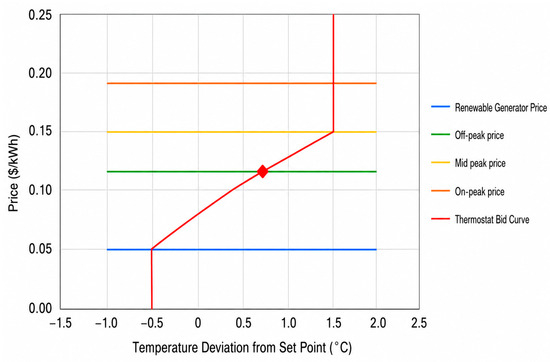
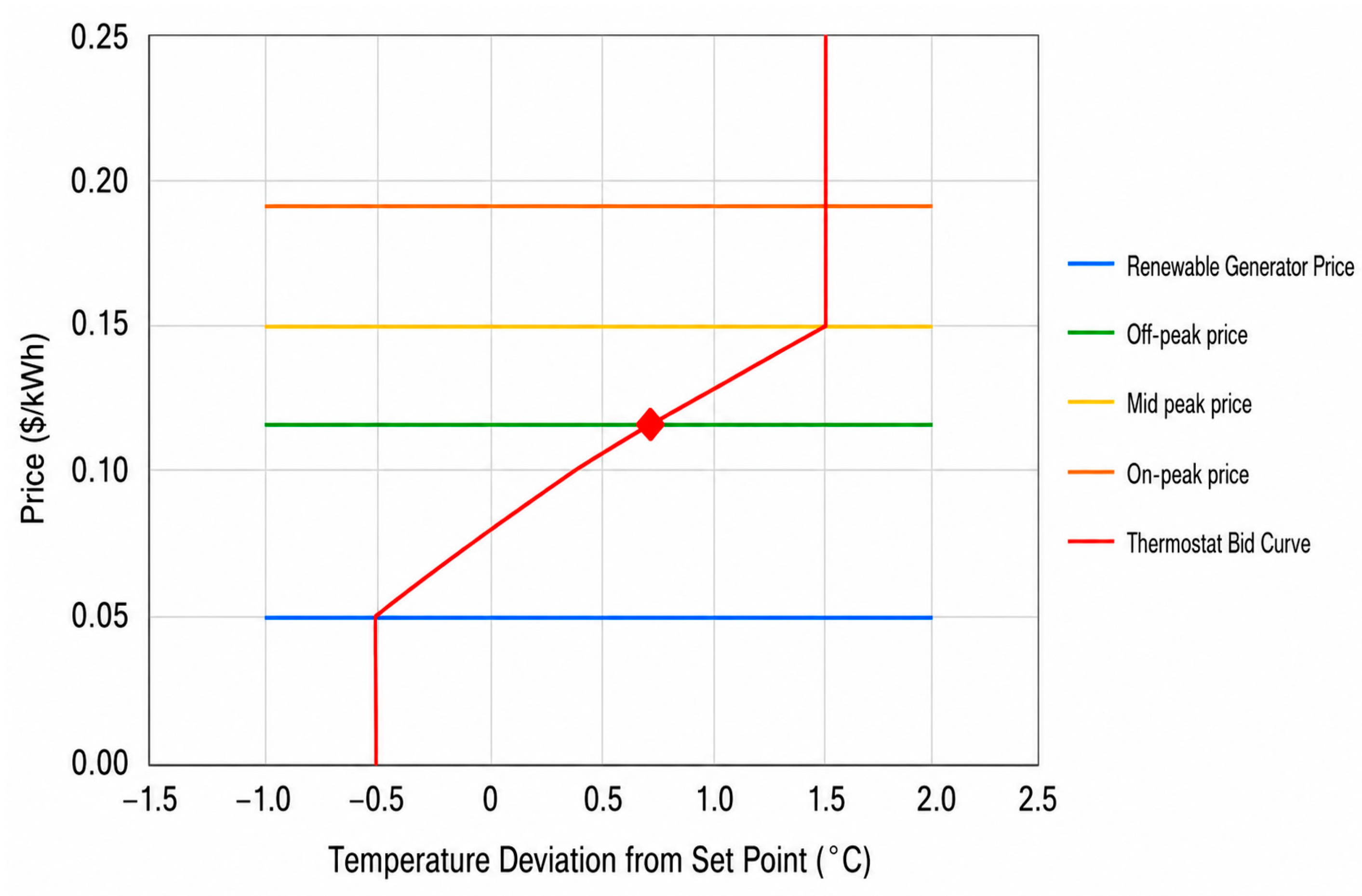
In this study, the purpose of the TEMS case was to demonstrate structured coordination rather than to claim a fully generalized market-clearing formulation. A representative thermostat bidding logic is shown in Figure 4. The red diamond in Figure 4. indicates the intersection between the thermostat bid curve and the off-peak electricity price. This point represents the temperature deviation at which the thermostat’s willingness to consume electricity becomes equal to the off-peak market price. Below this point, the bid price is lower than the electricity price, so the EMS may delay or reduce operation. Above this point, the bid price exceeds the electricity price, indicating that maintaining indoor comfort becomes more important and the HVAC system is more likely to operate.
Figure 4.
Representative ASHP (air-source heat pump) bid curve used in the transactive energy management system.
3.4. Experimental Validation
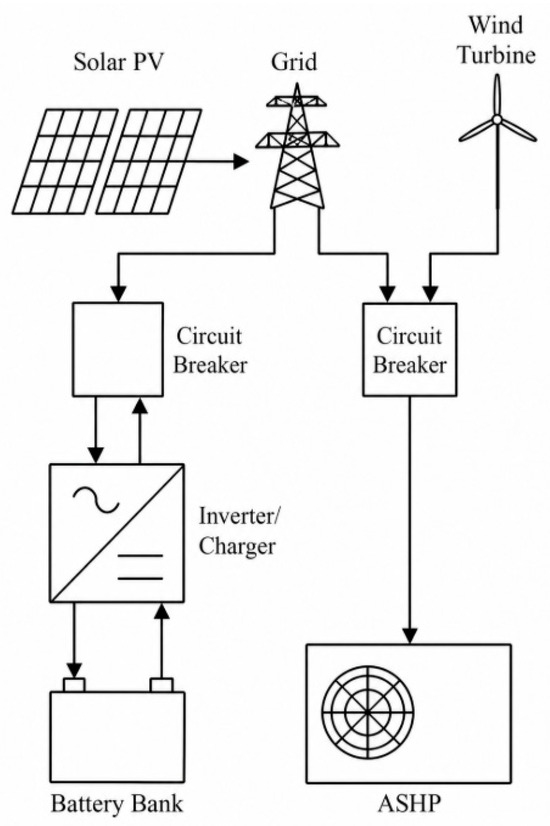
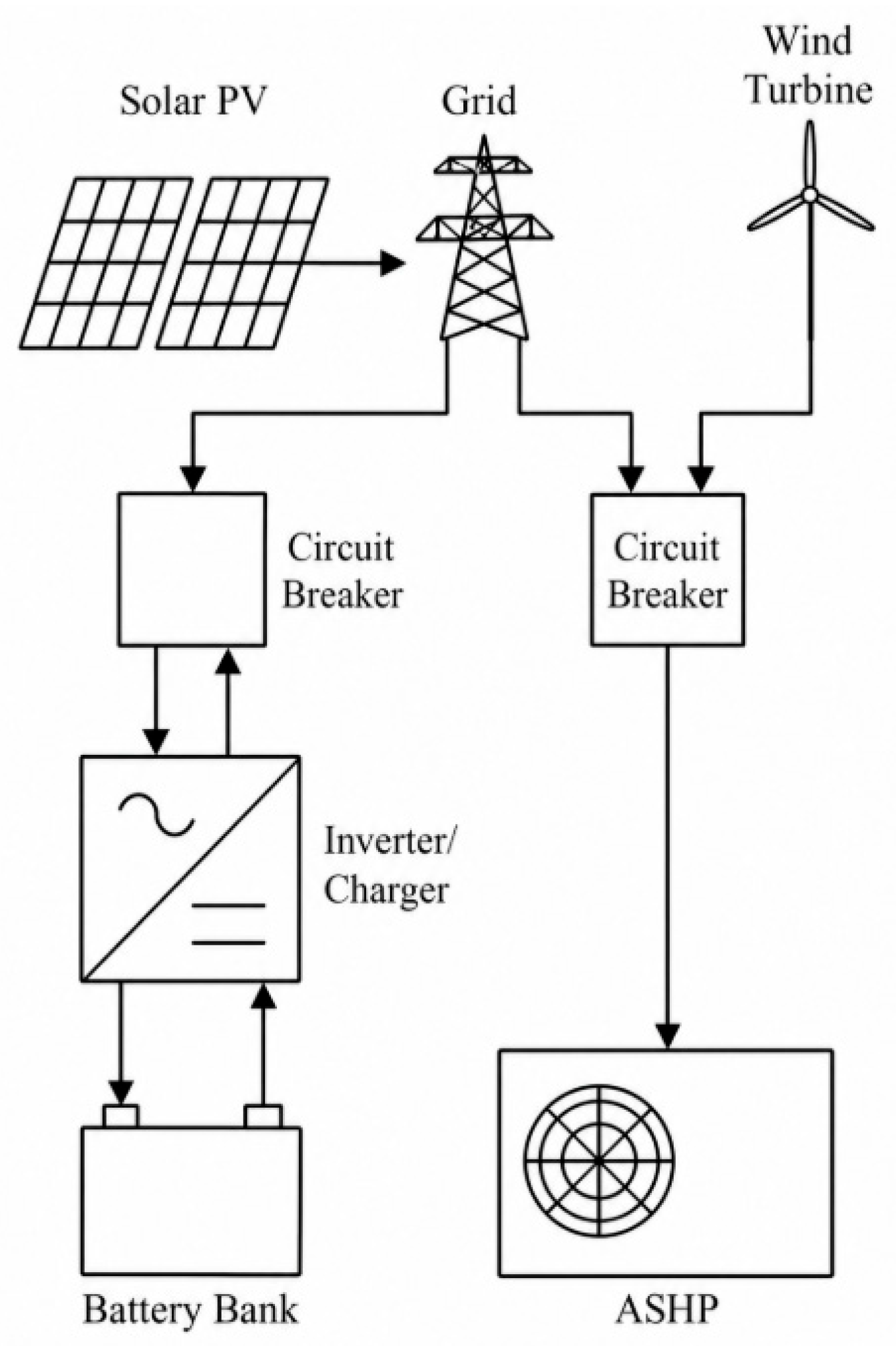
Short experimental trials were carried out to validate two key claims from the simulation work: first, battery control could track and shift HVAC-related load in practice; and second, agent-based communication could support a transactive control structure. These tests were proof-of-concept demonstrations rather than full-year field deployments. The experimental setup used for proof-of-concept validation is shown in Figure 5.
Figure 5.
Experimental load-shifting setup used to validate battery-supported control and device interaction.
The overall methodology workflow can be summarized as follows:
- ▪
- A calibrated gray-box residential building model was developed and used as the common simulation platform for all EMS cases.
- ▪
- The EMS strategies were grouped into baseline, deterministic, optimized, and adaptive categories, and were evaluated under the same load, tariff, emissions, and battery assumptions.
- ▪
- Battery charge and discharge decisions were generated in each case according to the control logic being tested, while renewable generation was first allocated to household demand.
- ▪
- An optimized benchmark was produced and then used as the reference against which simpler and more advanced EMS strategies were compared.
- ▪
- Key simulation findings were validated through targeted proof-of-concept experiments in which battery-supported load shifting and transactive communication were demonstrated.
4. Results and Discussion
4.1. Relative Performance of EMS Strategies
The comparison across all EMS cases showed a consistent pattern. The deterministic controllers were the simplest to understand and implement, but they also delivered the smallest savings. The optimized controller produced the best theoretical battery schedules and served as a useful upper benchmark, but it should still be viewed as an idealized reference rather than something that could simply be deployed in a typical home. The machine-learning controller came closest to that benchmark while remaining much more realistic for practical use. In the original thesis, the machine-learning cases improved annual cost savings by a range of about 15–22% relative to deterministic control, which is large enough to matter in real residential operation.
An important point also came out of the optimized benchmark. Lowest annual cost did not always mean lowest annual grid electricity use. In some cases, the machine-learning controller reduced grid dependence more than the optimized benchmark, because the benchmark was designed to minimize cost under the tariff, not to minimize grid imports or maximize self-consumption. That distinction matters because cost, energy, and emissions do not always move in the same direction.
As household demand increased, the gap between simple excess-charging logic and the optimized benchmark became smaller. In higher-load homes, more on-site renewable generation was consumed immediately by the house, leaving less surplus for strategic charging of the battery. This means that the value of advanced battery control was greatest when the timing mismatch between renewable generation and household demand was also greatest. Table 3 presents a comparative summary of EMS performance.
Table 3.
Comparative summary of EMS performance.
For the low whole-house consumption case, annual energy cost fell from USD 2592.20 in the zero-feedback reference case to as low as USD 2027.47 with monthly reset training, corresponding to 21.8% savings. For the medium house, cost fell from USD 3026.80 to USD 2467.75, a savings of 18.5%. For the high-load case, the best machine-learning result reduced annual cost from USD 3678.60 to USD 3130.22, or 14.9%. These values are lower than the deterministic cases and close enough to the optimized benchmark to make the machine-learning controller the strongest realistic option in the overall comparison.
The benchmark and most controller comparisons in this study were organized around a primary cost objective. Annual grid electricity use and annual emissions were then treated as secondary evaluation metrics rather than as the quantity being directly minimized by every controller. This distinction is important because a controller that minimizes annual electricity cost under a tariff structure will not automatically minimize annual grid imports or annual carbon impact.
4.2. What Experiments Confirm
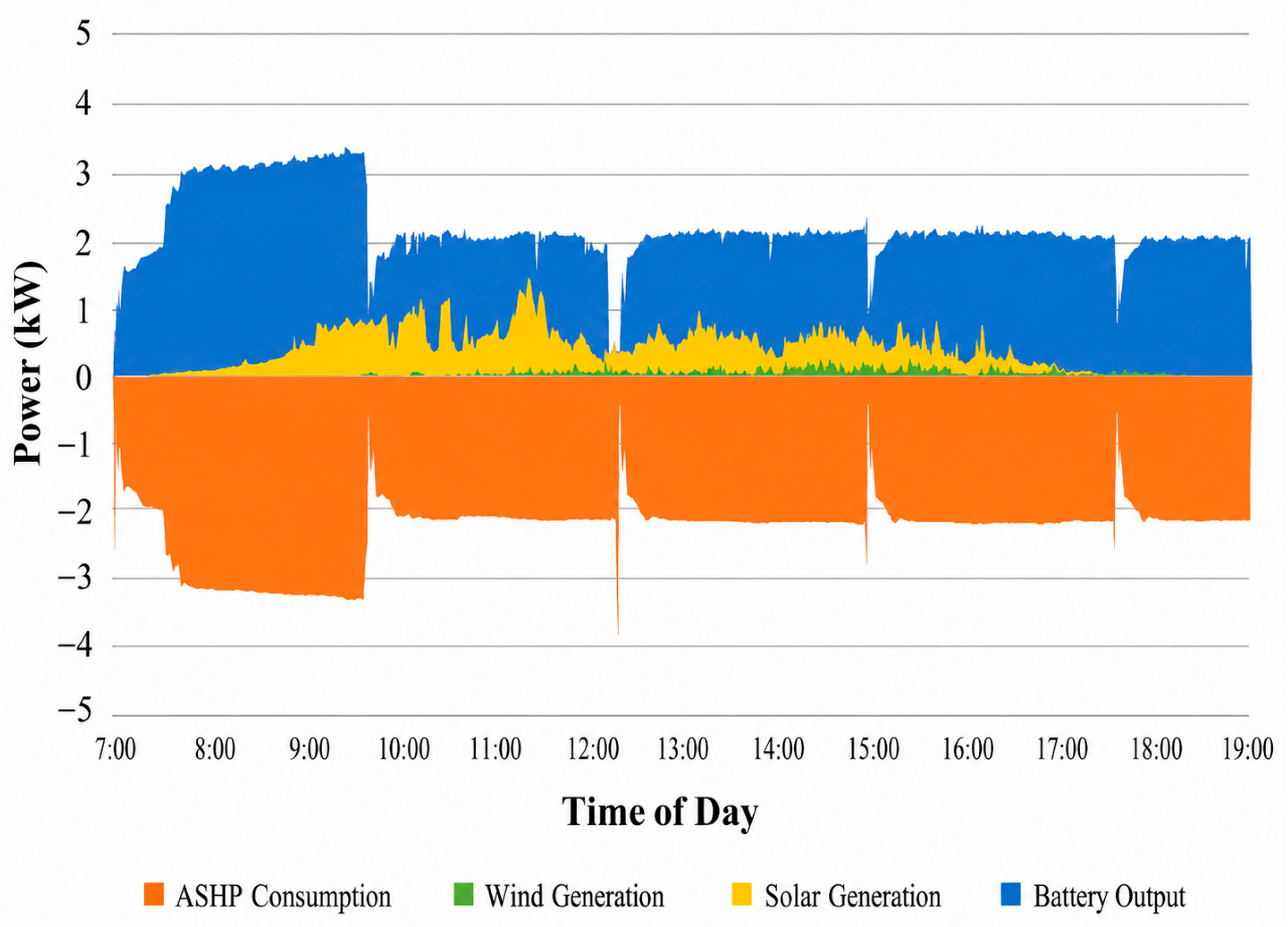
The experimental work supported the main technical claims from the simulations. In the load-shifting trial, 98% of the air-source heat pump peak-hour load was shifted using the available battery-supported control hardware. One example day reported in the thesis showed that 93.5% of the ASHP load during mid- and on-peak hours was supplied by the battery bank while the average outdoor temperature was −6.1 °C. That matters because it shows the central control idea was not confined to simulation. The battery could track and support the HVAC load in a real system.
The transactive demonstration provided a different kind of validation. Its value was not mainly in showing the largest direct cost reduction over a short period of time. Instead, it showed that structured bidding, controller communication, and agent removal could be handled without the control framework breaking down. That is especially important because the real value of a transactive system is not limited to one house. Its larger promise lies in coordinated operation across many homes, flexible loads, and distributed energy resources. Table 4 summarizes the proof-of-concept experimental conditions used to validate battery-supported load shifting and controller communication.
Table 4.
Summary of experimental setup and main validation outcomes.
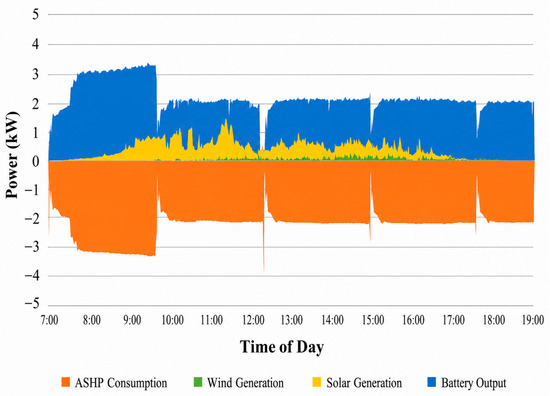
A measured experimental-day load-tracking plot is shown in Figure 6. It shows the relationship among ASHP consumption, PV generation, wind generation, and battery-bank output during the load-shifting trial.
Figure 6.
Mid-peak and on-peak ASHP consumption, generation, and battery bank output.
4.3. Financial Feasibility and Emissions
The economic analysis provided the clearest practical constraint in the whole study. Even though several EMS strategies improved technical performance, none of the battery-supported strategies were financially attractive under the assumed battery costs and Ontario electricity prices. In simple terms, the control algorithms were more ready than the economics. The thesis further showed that mid- and on-peak prices would need to rise to roughly three times their assumed levels before battery-supported load shifting became financially viable.
The cost comparison makes that point very clear. For the medium whole-house case, basic load shifting without distributed generation reduced annual cost from USD 3941.02 to USD 3514.78, which is a savings of 10.8%. When renewables and excess charging were available, the same medium-load house dropped from USD 3026.80 to USD 2571.73, a savings of 15.0%. The optimized benchmark pushed that further to USD 2384.93, corresponding to 21.2% savings. The machine-learning controller then achieved USD 2467.75 in its best version, which translates to 18.5% savings and places it between the deterministic and optimized cases. This is exactly why the machine-learning case stands out: it captured much of the optimized benefit without demanding impossible hindsight. Table 5 presents annual cost comparison for key EMA cases.
Table 5.
Annual cost comparison for key EMS cases.
The emissions results were more nuanced than the cost results. The annual average Ontario grid emission factor used in the work was 58.1 gCO2eq/kWh, but the hourly factor varied enough that shifting battery charging from one part of the day to another changed the carbon outcome. This meant that a controller designed around price alone did not automatically give the best emissions result. In fact, the thesis found that both basic forms of load shifting could increase the use of grid electricity during higher-emission hours. Only the strategies that used excess renewable charging were consistently better than the baseline in emissions terms.
The timing of nighttime charging also mattered. For the medium-load house without distributed generation, the best emissions outcome occurred when battery recharging began between about 10:00 p.m. and midnight. The improvement was only about 3%, but it still carried an important message: the best time to charge from a price perspective is not always the best time to charge from a carbon perspective. Table 6 is the emissions interpretation from Ontario-based sensitivity analysis.
Table 6.
Emissions interpretation from the Ontario-based sensitivity analysis.
4.4. Takeaways for Residential EMS Design
Taken together, the results argue against treating residential EMS design as a race toward maximum controller complexity. The better answer depends on the objective. If the main goal is easy deployment, deterministic logic still has value. If the goal is stronger annual savings without requiring an idealized controller, machine-learning control appears to be the most practical next step. If the goal is future coordination among homes, flexible loads, and distributed energy resources, then transactive control becomes much more attractive even if its direct household savings are not the largest in the present study.
The most important practical conclusion is that machine-learning control offered the best balance between savings and deploy-ability. The most important caution is that economic viability still depended far more on battery cost and tariff structure than on controller intelligence alone. In other words, the control side of the problem is advancing faster than the business case. That is why the near-term path forward is likely to be staged: start with simpler battery logic, move toward adaptive control where reliable data are available, and expand toward transactive coordination as communication infrastructure and connected-home platforms become more mature.
5. Limitations
Several limitations remain in this study. First, much of the comparison relies on simulation, even though selected behaviors were validated experimentally. Second, the predictive control case could not be tested over a full year because of missing or corrupted forecast files. Third, most household loads were treated as inflexible, with HVAC as the principal controllable load. Fourth, the economic conclusions depend strongly on Ontario pricing structures and the battery costs assumed in the original study.
These limitations do not weaken the main conclusions, but they do shape how the results should be interpreted. This is best understood as a comparative control study under a realistic residential framework, not as a complete field demonstration of every EMS type. The main limitations of the study are listed below:
- ▪
- Much of the comparison relies on simulation, even though selected control behaviors were validated experimentally.
- ▪
- The predictive control case could not be tested over a full year because more than 40% of the collected forecast files were unusable, so that case should be interpreted as a short proof-of-concept rather than a full annual comparison.
- ▪
- Most household loads were treated as inflexible, with HVAC kept as the principal controllable load. This simplifies the control problem and likely understates the role of appliance-level flexibility.
- ▪
- The economic conclusions remain region-specific because they depend strongly on Ontario tariff structure, the battery prices assumed in the source study, and the 2015 Ontario grid emission profile used in the comparison.
These limitations do not overturn the central findings, but they do affect how broadly the results should be generalized. This paper should therefore be read as a comparative residential EMS study under a realistic Ontario-based framework, rather than as a full field demonstration of every EMS type.
6. Conclusions
This study compares residential energy management systems ranging from simple rule-based load shifting to optimization, machine learning, predictive control, and a transactive framework. Using the same calibrated house model made it possible to compare these approaches on equal footing. The clearest conclusion is that better control is possible, but more advanced control is not automatically more practical. Deterministic controllers remain attractive for their simplicity. Optimization is valuable as a benchmark. Machine learning appears to offer the best near-term balance between performance and deployment ability when historical data are available. Predictive control remains promising, but only if forecast-data quality becomes dependable. Transactive control offers a different kind of value: not the highest direct savings in one home, but a credible path toward coordinated, community-scale energy management. This study also shows that battery prices remain the main barrier to adoption. As storage costs fall and household data systems improve, the strongest opportunities will likely come from controllers that combine adaptive decision-making with straightforward implementation. Under the assumptions examined in this study, machine-learning control appeared to offer the strongest near-term balance between performance and deployment practicality. The result is therefore best understood as a strong comparative indication within the present study framework, rather than as a universal claim that machine-learning control will outperform other EMS strategies under all residential conditions.
Author Contributions
Conceptualization, A.S.F. and A.B.; methodology, A.B., N.K., and A.S.F.; software, A.B.; validation, A.S.F. and N.K.; formal analysis, A.B., N.K., and A.S.F.; investigation, N.K. and A.S.F.; resources, A.S.F. and N.K.; data curation, A.B.; writing—original draft preparation, A.B.; writing—review and editing, A.S.F. and N.K.; visualization, N.K.; supervision, A.S.F.; project administration, A.S.F.; funding acquisition, A.S.F. All authors have read and agreed to the published version of the manuscript.
Funding
This research received funding support from the Natural Sciences and Engineering Research Council (NSERC) of Canada Discovery Grant and the Canada First Research Excellence Fund (CFREF) Volt-Age project, grant number [GPIN-2019-06853].
Data Availability Statement
The data presented in this study are available on request from the corresponding author. The data are not publicly available due to privacy preservation.
Acknowledgments
This research acknowledges the Department of Mechanical, Industrial, and Mechatronics Engineering, Toronto Metropolitan University (TMU), Canada.
Conflicts of Interest
The authors declare no conflicts of interest.
Abbreviations
The following abbreviations are used in this manuscript:
| AC | Alternating Current |
| AI | Artificial Intelligence |
| ANN | Artificial Neural Network |
| ASH | Archetype Sustainable House |
| ASHP | Air-Source Heat Pump |
| DC | Direct Current |
| DER | Distributed Energy Resource |
| DERs | Distributed Energy Resources |
| DG | Distributed Generation |
| EMS | Energy Management System |
| EMSs | Energy Management Systems |
| EV | Electric Vehicle |
| GA | Genetic Algorithm |
| HVAC | Heating, Ventilation and Air Conditioning |
| MATLAB | MATrix LABoratory |
| MILP | Mixed-Integer Linear Programming |
| MINLP | Mixed-Integer Nonlinear Programming |
| MPC | Model Predictive Control |
| NZEB | Net-Zero Energy Building |
| PV | Photovoltaic |
| RNN | Recurrent Neural Network |
| ROC | Receiver Operating Characteristic |
| TEMS | Transactive Energy Management System |
| TOU | Time of Use |
References
- D&R International, Ltd. Buildings-Energy-DataBook-BEDB. March 2012. Available online: https://ieer.org/wp/wp-content/uploads/2012/03/DOE-2011-Buildings-Energy-DataBook-BEDB.pdf (accessed on 20 February 2015).
- NRCan. Energy Markets Facts Book. 2014–2015. Available online: https://natural-resources.canada.ca/sites/www.nrcan.gc.ca/files/energy/files/pdf/2014/14-0173EnergyMarketFacts_e.pdf (accessed on 20 February 2015).
- IEA. How to Guide for Smart Grids in Distribution Networks. May 2015. Available online: https://www.iea.org/reports/how2guide-for-smart-grids-in-distribution-networks (accessed on 21 February 2015).
- Ontario Ministry of Energy. Ontario’s Long-Term Energy Plan. Toronto: Queen’s Printer for Ontario. August 2012. Available online: https://www.simcoemuskokahealth.org/docs/default-source/jfy-communities/august_2012_mei_ltep_en (accessed on 23 February 2015).
- Schram, W.L.; Lampropoulos, I.; van Sark, W.G. Photovoltaic systems coupled with batteries that are optimally sized for household self-consumption: Assessment of peak shaving potential. Appl. Energy 2018, 223, 69–81. [Google Scholar] [CrossRef]
- Kloppenburg, S.; Smale, R.; Verkade, N. Technologies of engagement: How battery storage technologies shape householder participation in energy transitions. Energies 2019, 12, 4384. [Google Scholar] [CrossRef]
- IEA. Technology Roadmap—Smart Grids; IEA: Paris, France, 2011; Available online: https://www.iea.org/reports/technology-roadmap-smart-grids (accessed on 25 February 2015).
- Gelazanskas, L.; Gamage, K.A. Demand side management in smart grid: A review and proposals for future direction. Sustain. Cities Soc. 2014, 11, 22–30. [Google Scholar] [CrossRef]
- IEC. Grid Integration of Large-Capacity Renewable Energy Sources and Use of Large-Capacity Electrical Energy Storage; IEC Resource Center: Geneva, Switzerland, 2012. [Google Scholar]
- Marszal, A.; Heiselberg, P.; Bourrelle, J.; Musall, E.; Voss, K.; Sartori, I.; Napolitano, A. Zero Energy Building—A review of definitions and calculation methodologies. Energy Build. 2011, 43, 971–979. [Google Scholar] [CrossRef]
- DOE. A Common Definition for Zero Energy Buildings; U.S. Department of Energy: Washington, DC, USA, 2015.
- Boehm, R.F. An approach to decreasing the peak electrical demand in residences. Energy Procedia 2012, 14, 337–342. [Google Scholar] [CrossRef]
- Lidula, N.; Rajapakse, A. Microgrids research: A review of experimental microgrids and test systems. Renew. Sustain. Energy Rev. 2011, 15, 186–202. [Google Scholar] [CrossRef]
- IEA. Technology Roadmap How2Guide for Smart Grids in Distribution Networks; IEA Technology Roadmaps: Paris, France, 2015. [Google Scholar]
- Unamuno, E.; Barrena, J.A. Hybrid AC/DC microgrids—Part I: Review and classification of topologies. Renew. Sustain. Energy Rev. 2015, 52, 1251–1259. [Google Scholar] [CrossRef]
- Lotfi, M.; Almeida, T.; Javadi, M.S.; Osório, G.J.; Monteiro, C.; Catalão, J.P. Coordinating energy management systems in smart cities with electric vehicles. Appl. Energy 2022, 307, 118241. [Google Scholar] [CrossRef]
- Tran, V.T.; Sutanto, D.; Muttaqi, K.M. The state of the art of battery charging infrastructure for electrical vehicles: Topologies, power control strategies, and future trend. In Proceedings of the 2017 Australasian Universities Power Engineering Conference (AUPEC); IEEE: Piscataway, NJ, USA, 2017. [Google Scholar]
- Tarroja, B.; Zhang, L.; Wifvat, V.; Shaffer, B.; Samuelsen, S. Assessing the stationary energy storage equivalency of vehicle-to-grid charging battery electric vehicles. Energy 2016, 106, 673–690. [Google Scholar] [CrossRef]
- Onda, H.; Yamamoto, S.; Takeshit, H.; Okamoto, S.; Yamanaka, N. Peak load shifting and electricity charges reduction realized by electric vehicle storage virtualization. AASRI Procedia 2014, 7, 101–106. [Google Scholar] [CrossRef]
- Jain, D.; Saxena, D. Comprehensive review on control schemes and stability investigation of hybrid AC-DC microgrid. Electr. Power Syst. Res. 2023, 218, 109182. [Google Scholar] [CrossRef]
- IEEE 1547.4-2011; IEEE Guide for Design, Operation, and Integration of Distributed Resource Island Systems with Electric Power Systems. IEEE: Piscataway, NJ, USA, 2011.
- Barnes, M.; Dimeas, A.; Engler, A.; Fitzer, C.; Hatziargyriou, N.; Jones, C.; Papathanassiou, S.; Vandenbergh, M. Microgrid laboratory facilities. In Proceedings of the 2005 International Conference on Future Power Systems; IEEE: Amsterdam, The Netherlands, 2005; p. 6. [Google Scholar]
- Benjamin, K.; Robert, L.; Toshifumi, I. A look at microgrid technologies and testing, projects from around the world. IEEE Power Energy Mag. 2008, 6, 41–53. [Google Scholar]
- ABB. ABB to Enable Integration of Renewables in Alaskan Island Microgrid; ABB: Zurich, Switzerland, 2014. [Google Scholar]
- ABB. ABB Microgrid Solutions: Advancing Sustainable and Reliable Energy Solutions; ABB: Zurich, Switzerland, 2014. [Google Scholar]
- Erge, T.; Becker, R.; Kroger-Vodde, A.; Laukamp, H.; Thoma, M.; Werner, R. Report on Improved Power Management in Low voltage Grids by the Application of the PoMS System; Dispower: Nicosia, Cyprus, 2006. [Google Scholar]
- Electricity Canada. Electricity 101; Electricity 101: Toronto, ON, Canada, 2023. [Google Scholar]
- Siano, P. Demand response and smart grids—A survey. Renew. Sustain. Energy Rev. 2014, 30, 461–478. [Google Scholar] [CrossRef]
- Mathew, V.; Sitaraman, R.K.; Shenoy, P. Reducing energy costs in Internet-scale distributed systems using load shifting. In Proceedings of the 2014 Sixth International Conference on Communication Systems and Networks (COMSNETS); IEEE: Bangalore, India, 2014. [Google Scholar]
- IESO. IESO Demand; IESO: Toronto, ON, Canada, 2015. [Google Scholar]
- Toronto Hydro. Conservation and Demand Management Strategy 2011–2014; Toronto Hydro: Toronto, ON, Canada, 2010. [Google Scholar]
- Poulad, M.E.; Fung, A.S.; He, L.; Colpan, C.O. Modelling residential house electricity demand profile and analysis of peaksaver program using ANN: Case study for Toronto, Canada. Int. J. Glob. Warm. 2016, 10, 158. [Google Scholar] [CrossRef]
- Hydro Ottawa. Save on Energy-Peaksaver PLUS; Hydro Ottawa: Ottawa, ON, Canada, 2013. [Google Scholar]
- Castillo-Cagigal, M.; Gutiérrez, Á.; Monasterio-Huelin, F.; Caamaño-Martín, E.; Masa, D.; Jiménez-Leube, J. A semi-distributed electric demand-side management system with PV generation for self-consumption enhancement. Energy Convers. Manag. 2011, 52, 2659–2666. [Google Scholar] [CrossRef]
- Matallanas, E.; Castillo-Cagigal, M.; Gutiérrez, A.; Monasterio-Huelin, F.; Caamaño-Martín, E.; Masa, D.; Jiménez-Leube, J. Neural network controller for Active Demand-Side Management with PV energy in the residential sector. Appl. Energy 2012, 91, 90–97. [Google Scholar] [CrossRef]
- Liu, X.; Ivanescu, L.; Kang, R.; Maier, M. Real-time household load priority scheduling algorithm based on prediction of renewable source availability. IEEE Trans. Consum. Electron. 2012, 58, 318–326. [Google Scholar] [CrossRef]
- Radhakrishnan, A.; Selvan, M.P. Load scheduling for smart energy management in residential buildings with renewable sources. In Proceedings of the 2014 Eighteenth National Power Systems Conference (NPSC); IEEE: Guwahati, India, 2014. [Google Scholar]
- Fernandes, F.; Morais, H.; Vale, Z.; Ramos, C. Dynamic load management in a smart home to participate in demand response events. Energy Build. 2014, 82, 592–606. [Google Scholar] [CrossRef]
- Liu, Y.; Yuen, C.; Huang, S.; Hassan, N.U.; Wang, X.; Xie, S. Peak-to-average ratio constrained demand-side management with consumer’s preference in residential smart grid. IEEE J. Sel. Top. Signal Process. 2014, 8, 1084–1097. [Google Scholar] [CrossRef]
- Keshtkar, A.; Arzanpour, S.; Keshtkar, F.; Ahmadi, P. Smart residential load reduction via fuzzy logic, wireless sensors, and smart grid incentives. Energy Build. 2015, 104, 165–180. [Google Scholar] [CrossRef]
- Falope, T.O.; Lao, L.; Huo, D.; Kuang, B. Development of an Integrated Energy Management System for Off-Grid Solar Applications with Advanced Solar Forecasting, Time-of-Use Tariffs, and Direct Load Control. Sustain. Energy Grids Netw. 2024, 39, 101449. [Google Scholar] [CrossRef]
- Faruqui, A.; Sergici, S. Household Response to Dynamic Pricing of Electricity—A Survey of the Empirical Evidence. 2010. Available online: https://ssrn.com/abstract=1134132 (accessed on 27 February 2015).
- Schweppe, F.C.; Tabors, R.D.; Kirtley, J.L.; Outhred, H.R.; Pickel, F.H.; Cox, A.J. Homeostatic Utility Control. IEEE Trans. Power Appar. Syst. 1980, PAS-99, 1151–1163. [Google Scholar] [CrossRef]
- Somasundaram, S.; Pratt, R.G.; Akyol, B.A.; Fernandez, N.; Foster, N.A.F.; Katipamula, S.; Mayhorn, E.T.; Somani, A.; Steckley, A.C.; Taylor, Z.T. Transaction-Based Building Controls Framework, Volume 1: Reference Guide; No. PNNL-23302; Pacific Northwest National Lab. (PNNL): Richland, WA, USA, 2014. [Google Scholar]
- Katipamula, S.; Chassin, D.P.; Hatley, D.D.; Pratt, R.G.; Hammerstrom, D.J. Transactive Controls: A Market-Based GridWiseTM Controls for Building Systems; No. PNNL-15921; Pacific Northwest National Lab. (PNNL): Richland, WA, USA, 2006. [Google Scholar]
- Chassin, D.P.; Stoustrup, J.; Agathoklis, P.; Djilali, N. A new thermostat for real-time price demand response: Cost, comfort and energy impacts of discrete-time control without deadband. Appl. Energy 2015, 155, 816–825. [Google Scholar] [CrossRef]
- Snowdon, J.; Ambrosio, R. The Olympic Peninsula Project. Smart Grid for Smart Cities; IBM Global Energy & Utilities Industry: New York, NY, USA, 2010. [Google Scholar]
- Khan, A.A.; Naeem, M.; Iqbal, M.; Qaisar, S.; Anpalagan, A. A compendium of optimization objectives, constraints, tools and algorithms for energy management in microgrids. Renew. Sustain. Energy Rev. 2016, 58, 1664–1683. [Google Scholar] [CrossRef]
- Kassab, F.A.; Celik, B.; Locment, F.; Sechilariu, M.; Liaquat, S.; Hansen, T.M. Optimal sizing and energy management of a microgrid: A joint MILP approach for minimization of energy cost and carbon emission. Renew. Energy 2024, 224, 120186. [Google Scholar] [CrossRef]
- Morais, H.; Kádár, P.; Faria, P.; Vale, Z.A.; Khodr, H. Optimal scheduling of a renewable micro-grid in an isolated load area using mixed-integer linear programming. Renew. Energy 2010, 35, 151–156. [Google Scholar] [CrossRef]
- Palma-Behnke, R.; Benavides, C.; Lanas, F.; Severino, B.; Reyes, L.; Llanos, J.; Sáez, D. A Microgrid energy management system based on the rolling horizon strategy. IEEE Trans. Smart Grid 2013, 4, 996–1006. [Google Scholar] [CrossRef]
- Alharbi, W.; Bhattacharya, K. Demand response and energy storage in MV islanded microgrids for high penetration of renewables. In Proceedings of the 2013 IEEE Electrical Power & Energy Conference; IEEE: Halifax, NS, Canada, 2013. [Google Scholar]
- Manjili, Y.S.; Rajaee, A.; Jamshidi, M.; Kelley, B.T. Intelligent decision making for energy management in microgrids with air pollution reduction policy. In Proceedings of the 2012 7th International Conference on System of Systems Engineering (SoSE); IEEE: Genova, Italy, 2012; pp. 13–18. [Google Scholar]
- Marzband, M.; Sumper, A.; Domínguez-García, J.L.; Gumara-Ferret, R. Experimental validation of a real time energy management system for microgrids in islanded mode using a local day-ahead electricity market and MINLP. Energy Convers. Manag. 2013, 76, 314–322. [Google Scholar] [CrossRef]
- Giacomoni, A.M.; Goldsmith, S.Y.; Amin, S.M.; Wollenberg, B.F. Analysis, modeling, and simulation of autonomous microgrids with a high penetration of renewables. In Proceedings of the 2012 IEEE Power and Energy Society General Meeting; IEEE: San Diego, CA, USA, 2012; pp. 1–6. [Google Scholar]
- Zakariazadeh, A.; Jadid, S.; Siano, P. Smart microgrid energy and reserve scheduling with demand response using stochastic optimization. Int. J. Electr. Power Energy Syst. 2014, 63, 523–533. [Google Scholar] [CrossRef]
- Su, W.; Wang, J.; Roh, J. Stochastic energy scheduling in microgrids with intermittent renewable energy resources. IEEE Trans. Smart Grid 2013, 5, 1876–1883. [Google Scholar] [CrossRef]
- Ma, K.; Hu, G.; Spanos, C.J. Energy consumption scheduling in smart grid: A non-cooperative game approach. In Proceedings of the 2013 9th Asian Control Conference (ASCC); IEEE: Istanbul, Turkey, 2013. [Google Scholar]
- Khederzadeh, M. Optimal automation level in microgrids. In Proceedings of the 22nd International Conference and Exhibition on Electricity Distribution, Stockholm, Sweden, 10–13 June 2013; p. 160. [Google Scholar]
- Hino, H.; Shen, H.; Murata, N.; Wakao, S.; Hayashi, Y. A Versatile clustering method for electricity consumption pattern analysis in households. IEEE Trans. Smart Grid 2013, 4, 1048–1057. [Google Scholar] [CrossRef]
- Bansal, R.; Pandey, J. Load forecasting using artificial intelligence techniques: A literature survey. Int. J. Comput. Appl. Technol. 2005, 22, 109–119. [Google Scholar] [CrossRef]
- Reddy, Y.J.; Kumar, Y.V.P.; Kumar, V.S.; Raju, K.P. Distributed ANNs in a layered architecture for energy management and maintenance scheduling of renewable energy HPS microgrids. In Proceedings of the 2012 International Conference on Advances in Power Conversion and Energy Technologies (APCET); IEEE: Mylavaram, India, 2012; pp. 1–6. [Google Scholar]
- Urias, M.E.G.; Sanchez, E.N.; Ricalde, L.J. Electrical microgrid optimization via a new recurrent neural network. IEEE Syst. J. 2014, 9, 945–953. [Google Scholar] [CrossRef]
- Mitchell, M. An Introduction to Genetic Algorithms; MIT Press: Cambridge, MA, USA, 1998. [Google Scholar]
- Sadegheih, A. Optimal design methodologies under the carbon emission trading program using MIP, GA, SA, and TS. Renew. Sustain. Energy Rev. 2011, 15, 504–513. [Google Scholar] [CrossRef]
- Gholami, R.; Shahabi, M.; Haghifam, M.-R. An efficient optimal capacitor allocation in DG embedded distribution networks with islanding operation capability of micro-grid using a new genetic based algorithm. Int. J. Electr. Power Energy Syst. 2015, 71, 335–343. [Google Scholar] [CrossRef]
- Corso, G.; Di Silvestre, M.L.; Ippolito, M.G.; Sanseverino, E.R.; Zizzo, G. Multi-objective long term optimal dispatch of distributed energy resources in micro-grids. In Proceedings of the 45th International Universities Power Engineering Conference UPEC2010; IEEE: Cardiff, UK, 2010; pp. 1–5. [Google Scholar]
- Rawlings, J.; Mayne, D. Postface to Model Predictive Control: Theory and Design; Nob Hill Pub: San Francisco, CA, USA, 2012; Volume 5, pp. 155–158. [Google Scholar]
- Allgower, F.; Findeisen, R.; Nagy, Z.K. Nonlinear model predictive control: From theory to application. J.-Chin. Inst. Chem. Eng. 2004, 35, 299–316. [Google Scholar]
- Minchala-Avila, L.I.; Garza-Castañón, L.E.; Vargas-Martínez, A.; Zhang, Y. A review of optimal control techniques applied to the energy management and control of microgrids. Procedia Comput. Sci. 2015, 52, 780–787. [Google Scholar] [CrossRef]
- Qi, W.; Liu, J.; Christofides, P.D. A distributed control framework for smart grid development: Energy/water system optimal operation and electric grid integration. J. Process. Control. 2011, 21, 1504–1516. [Google Scholar] [CrossRef]
- Qi, W.; Liu, J.; Chen, X.; Christofides, P.D. Supervisory predictive control of standalone wind/solar energy generation systems. IEEE Trans. Control. Syst. Technol. 2010, 19, 199–207. [Google Scholar] [CrossRef]
- Kadir, N.; Fung, A.S. Integrated Micro- and Nano-Grid with Focus on Net-Zero Renewable Energy—A Survey Paper. Energies 2025, 18, 794. [Google Scholar] [CrossRef]
- Michailidis, P.; Michailidis, I.; Minelli, F.; Coban, H.H.; Kosmatopoulos, E. Model Predictive Control for Smart Buildings: Applications and Innovations in Energy Management. Buildings 2025, 15, 3298. [Google Scholar] [CrossRef]
- Amini Toosi, R.; Gholamzadehmir, M.; Amini Toosi, H. Smart Building–Grid Interaction in Urban Energy Transitions: A Taxonomy of Key Performance Indicators and Enabling Technologies. Urban Sci. 2025, 9, 483. [Google Scholar] [CrossRef]
- Xiang, Y. A Comprehensive Review of Building-to-Grid Interaction. Innov. Energy Use 2026, 2, 100043. [Google Scholar] [CrossRef]



Disclaimer/Publisher’s Note: The statements, opinions and data contained in all publications are solely those of the individual author(s) and contributor(s) and not of MDPI and/or the editor(s). MDPI and/or the editor(s) disclaim responsibility for any injury to people or property resulting from any ideas, methods, instructions or products referred to in the content. |
© 2026 by the authors. Licensee MDPI, Basel, Switzerland. This article is an open access article distributed under the terms and conditions of the Creative Commons Attribution (CC BY) license.