Feasibility of Residential Energy Management Systems with Renewable Generation and Battery Storage


Abstract
1. Introduction
- ▪
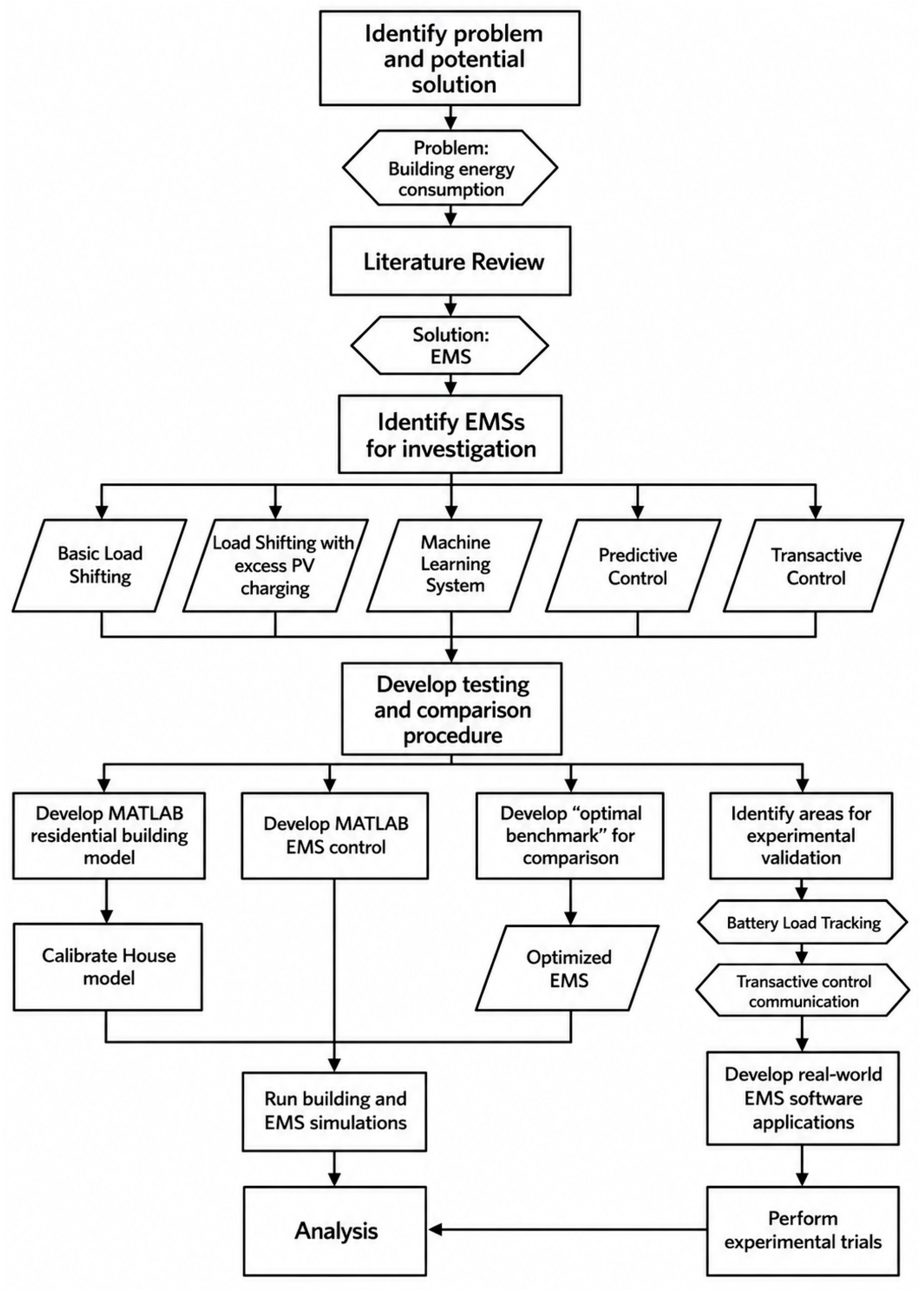
- First, the annual energy, cost, and emissions performance of several residential EMS strategies were compared on the same calibrated house model.
- ▪
- Second, the practical complexity of these strategies was assessed in terms of data needs, forecast dependence, communication burden, and implementation realism.
- ▪
- Third, the technical feasibility of battery-supported load shifting and controller interaction was checked through targeted proof-of-concept experiments.
- ▪
- Fourth, the financial feasibility of battery-supported EMS operation was evaluated under Ontario electricity prices and battery-cost assumptions.
2. Related Work and Research Gap
2.1. Literature Review
2.2. Research Gap
3. Methodology
3.1. Case Study House and Simulation Environment
Mathematical Formulation of the Comparative EMS Framework
3.2. Evaluation of EMS Strategies
3.3. Adaptive Control Details
- ▪
- Agent states were updated;
- ▪
- Bids were formed;
- ▪
- Bids were ranked and matched by the marketplace;
- ▪
- The resulting dispatch signals were sent back to the agents; and
- ▪
- House operation was updated for the next interval.
3.4. Experimental Validation
- ▪
- A calibrated gray-box residential building model was developed and used as the common simulation platform for all EMS cases.
- ▪
- The EMS strategies were grouped into baseline, deterministic, optimized, and adaptive categories, and were evaluated under the same load, tariff, emissions, and battery assumptions.
- ▪
- Battery charge and discharge decisions were generated in each case according to the control logic being tested, while renewable generation was first allocated to household demand.
- ▪
- An optimized benchmark was produced and then used as the reference against which simpler and more advanced EMS strategies were compared.
- ▪
- Key simulation findings were validated through targeted proof-of-concept experiments in which battery-supported load shifting and transactive communication were demonstrated.
4. Results and Discussion
4.1. Relative Performance of EMS Strategies
4.2. What Experiments Confirm
4.3. Financial Feasibility and Emissions
4.4. Takeaways for Residential EMS Design
5. Limitations
- ▪
- Much of the comparison relies on simulation, even though selected control behaviors were validated experimentally.
- ▪
- The predictive control case could not be tested over a full year because more than 40% of the collected forecast files were unusable, so that case should be interpreted as a short proof-of-concept rather than a full annual comparison.
- ▪
- Most household loads were treated as inflexible, with HVAC kept as the principal controllable load. This simplifies the control problem and likely understates the role of appliance-level flexibility.
- ▪
- The economic conclusions remain region-specific because they depend strongly on Ontario tariff structure, the battery prices assumed in the source study, and the 2015 Ontario grid emission profile used in the comparison.
6. Conclusions
Author Contributions
Funding
Data Availability Statement
Acknowledgments
Conflicts of Interest
Abbreviations
| AC | Alternating Current |
| AI | Artificial Intelligence |
| ANN | Artificial Neural Network |
| ASH | Archetype Sustainable House |
| ASHP | Air-Source Heat Pump |
| DC | Direct Current |
| DER | Distributed Energy Resource |
| DERs | Distributed Energy Resources |
| DG | Distributed Generation |
| EMS | Energy Management System |
| EMSs | Energy Management Systems |
| EV | Electric Vehicle |
| GA | Genetic Algorithm |
| HVAC | Heating, Ventilation and Air Conditioning |
| MATLAB | MATrix LABoratory |
| MILP | Mixed-Integer Linear Programming |
| MINLP | Mixed-Integer Nonlinear Programming |
| MPC | Model Predictive Control |
| NZEB | Net-Zero Energy Building |
| PV | Photovoltaic |
| RNN | Recurrent Neural Network |
| ROC | Receiver Operating Characteristic |
| TEMS | Transactive Energy Management System |
| TOU | Time of Use |
References
- D&R International, Ltd. Buildings-Energy-DataBook-BEDB. March 2012. Available online: https://ieer.org/wp/wp-content/uploads/2012/03/DOE-2011-Buildings-Energy-DataBook-BEDB.pdf (accessed on 20 February 2015).
- NRCan. Energy Markets Facts Book. 2014–2015. Available online: https://natural-resources.canada.ca/sites/www.nrcan.gc.ca/files/energy/files/pdf/2014/14-0173EnergyMarketFacts_e.pdf (accessed on 20 February 2015).
- IEA. How to Guide for Smart Grids in Distribution Networks. May 2015. Available online: https://www.iea.org/reports/how2guide-for-smart-grids-in-distribution-networks (accessed on 21 February 2015).
- Ontario Ministry of Energy. Ontario’s Long-Term Energy Plan. Toronto: Queen’s Printer for Ontario. August 2012. Available online: https://www.simcoemuskokahealth.org/docs/default-source/jfy-communities/august_2012_mei_ltep_en (accessed on 23 February 2015).
- Schram, W.L.; Lampropoulos, I.; van Sark, W.G. Photovoltaic systems coupled with batteries that are optimally sized for household self-consumption: Assessment of peak shaving potential. Appl. Energy 2018, 223, 69–81. [Google Scholar] [CrossRef]
- Kloppenburg, S.; Smale, R.; Verkade, N. Technologies of engagement: How battery storage technologies shape householder participation in energy transitions. Energies 2019, 12, 4384. [Google Scholar] [CrossRef]
- IEA. Technology Roadmap—Smart Grids; IEA: Paris, France, 2011; Available online: https://www.iea.org/reports/technology-roadmap-smart-grids (accessed on 25 February 2015).
- Gelazanskas, L.; Gamage, K.A. Demand side management in smart grid: A review and proposals for future direction. Sustain. Cities Soc. 2014, 11, 22–30. [Google Scholar] [CrossRef]
- IEC. Grid Integration of Large-Capacity Renewable Energy Sources and Use of Large-Capacity Electrical Energy Storage; IEC Resource Center: Geneva, Switzerland, 2012. [Google Scholar]
- Marszal, A.; Heiselberg, P.; Bourrelle, J.; Musall, E.; Voss, K.; Sartori, I.; Napolitano, A. Zero Energy Building—A review of definitions and calculation methodologies. Energy Build. 2011, 43, 971–979. [Google Scholar] [CrossRef]
- DOE. A Common Definition for Zero Energy Buildings; U.S. Department of Energy: Washington, DC, USA, 2015.
- Boehm, R.F. An approach to decreasing the peak electrical demand in residences. Energy Procedia 2012, 14, 337–342. [Google Scholar] [CrossRef]
- Lidula, N.; Rajapakse, A. Microgrids research: A review of experimental microgrids and test systems. Renew. Sustain. Energy Rev. 2011, 15, 186–202. [Google Scholar] [CrossRef]
- IEA. Technology Roadmap How2Guide for Smart Grids in Distribution Networks; IEA Technology Roadmaps: Paris, France, 2015. [Google Scholar]
- Unamuno, E.; Barrena, J.A. Hybrid AC/DC microgrids—Part I: Review and classification of topologies. Renew. Sustain. Energy Rev. 2015, 52, 1251–1259. [Google Scholar] [CrossRef]
- Lotfi, M.; Almeida, T.; Javadi, M.S.; Osório, G.J.; Monteiro, C.; Catalão, J.P. Coordinating energy management systems in smart cities with electric vehicles. Appl. Energy 2022, 307, 118241. [Google Scholar] [CrossRef]
- Tran, V.T.; Sutanto, D.; Muttaqi, K.M. The state of the art of battery charging infrastructure for electrical vehicles: Topologies, power control strategies, and future trend. In Proceedings of the 2017 Australasian Universities Power Engineering Conference (AUPEC); IEEE: Piscataway, NJ, USA, 2017. [Google Scholar]
- Tarroja, B.; Zhang, L.; Wifvat, V.; Shaffer, B.; Samuelsen, S. Assessing the stationary energy storage equivalency of vehicle-to-grid charging battery electric vehicles. Energy 2016, 106, 673–690. [Google Scholar] [CrossRef]
- Onda, H.; Yamamoto, S.; Takeshit, H.; Okamoto, S.; Yamanaka, N. Peak load shifting and electricity charges reduction realized by electric vehicle storage virtualization. AASRI Procedia 2014, 7, 101–106. [Google Scholar] [CrossRef]
- Jain, D.; Saxena, D. Comprehensive review on control schemes and stability investigation of hybrid AC-DC microgrid. Electr. Power Syst. Res. 2023, 218, 109182. [Google Scholar] [CrossRef]
- IEEE 1547.4-2011; IEEE Guide for Design, Operation, and Integration of Distributed Resource Island Systems with Electric Power Systems. IEEE: Piscataway, NJ, USA, 2011.
- Barnes, M.; Dimeas, A.; Engler, A.; Fitzer, C.; Hatziargyriou, N.; Jones, C.; Papathanassiou, S.; Vandenbergh, M. Microgrid laboratory facilities. In Proceedings of the 2005 International Conference on Future Power Systems; IEEE: Amsterdam, The Netherlands, 2005; p. 6. [Google Scholar]
- Benjamin, K.; Robert, L.; Toshifumi, I. A look at microgrid technologies and testing, projects from around the world. IEEE Power Energy Mag. 2008, 6, 41–53. [Google Scholar]
- ABB. ABB to Enable Integration of Renewables in Alaskan Island Microgrid; ABB: Zurich, Switzerland, 2014. [Google Scholar]
- ABB. ABB Microgrid Solutions: Advancing Sustainable and Reliable Energy Solutions; ABB: Zurich, Switzerland, 2014. [Google Scholar]
- Erge, T.; Becker, R.; Kroger-Vodde, A.; Laukamp, H.; Thoma, M.; Werner, R. Report on Improved Power Management in Low voltage Grids by the Application of the PoMS System; Dispower: Nicosia, Cyprus, 2006. [Google Scholar]
- Electricity Canada. Electricity 101; Electricity 101: Toronto, ON, Canada, 2023. [Google Scholar]
- Siano, P. Demand response and smart grids—A survey. Renew. Sustain. Energy Rev. 2014, 30, 461–478. [Google Scholar] [CrossRef]
- Mathew, V.; Sitaraman, R.K.; Shenoy, P. Reducing energy costs in Internet-scale distributed systems using load shifting. In Proceedings of the 2014 Sixth International Conference on Communication Systems and Networks (COMSNETS); IEEE: Bangalore, India, 2014. [Google Scholar]
- IESO. IESO Demand; IESO: Toronto, ON, Canada, 2015. [Google Scholar]
- Toronto Hydro. Conservation and Demand Management Strategy 2011–2014; Toronto Hydro: Toronto, ON, Canada, 2010. [Google Scholar]
- Poulad, M.E.; Fung, A.S.; He, L.; Colpan, C.O. Modelling residential house electricity demand profile and analysis of peaksaver program using ANN: Case study for Toronto, Canada. Int. J. Glob. Warm. 2016, 10, 158. [Google Scholar] [CrossRef]
- Hydro Ottawa. Save on Energy-Peaksaver PLUS; Hydro Ottawa: Ottawa, ON, Canada, 2013. [Google Scholar]
- Castillo-Cagigal, M.; Gutiérrez, Á.; Monasterio-Huelin, F.; Caamaño-Martín, E.; Masa, D.; Jiménez-Leube, J. A semi-distributed electric demand-side management system with PV generation for self-consumption enhancement. Energy Convers. Manag. 2011, 52, 2659–2666. [Google Scholar] [CrossRef]
- Matallanas, E.; Castillo-Cagigal, M.; Gutiérrez, A.; Monasterio-Huelin, F.; Caamaño-Martín, E.; Masa, D.; Jiménez-Leube, J. Neural network controller for Active Demand-Side Management with PV energy in the residential sector. Appl. Energy 2012, 91, 90–97. [Google Scholar] [CrossRef]
- Liu, X.; Ivanescu, L.; Kang, R.; Maier, M. Real-time household load priority scheduling algorithm based on prediction of renewable source availability. IEEE Trans. Consum. Electron. 2012, 58, 318–326. [Google Scholar] [CrossRef]
- Radhakrishnan, A.; Selvan, M.P. Load scheduling for smart energy management in residential buildings with renewable sources. In Proceedings of the 2014 Eighteenth National Power Systems Conference (NPSC); IEEE: Guwahati, India, 2014. [Google Scholar]
- Fernandes, F.; Morais, H.; Vale, Z.; Ramos, C. Dynamic load management in a smart home to participate in demand response events. Energy Build. 2014, 82, 592–606. [Google Scholar] [CrossRef]
- Liu, Y.; Yuen, C.; Huang, S.; Hassan, N.U.; Wang, X.; Xie, S. Peak-to-average ratio constrained demand-side management with consumer’s preference in residential smart grid. IEEE J. Sel. Top. Signal Process. 2014, 8, 1084–1097. [Google Scholar] [CrossRef]
- Keshtkar, A.; Arzanpour, S.; Keshtkar, F.; Ahmadi, P. Smart residential load reduction via fuzzy logic, wireless sensors, and smart grid incentives. Energy Build. 2015, 104, 165–180. [Google Scholar] [CrossRef]
- Falope, T.O.; Lao, L.; Huo, D.; Kuang, B. Development of an Integrated Energy Management System for Off-Grid Solar Applications with Advanced Solar Forecasting, Time-of-Use Tariffs, and Direct Load Control. Sustain. Energy Grids Netw. 2024, 39, 101449. [Google Scholar] [CrossRef]
- Faruqui, A.; Sergici, S. Household Response to Dynamic Pricing of Electricity—A Survey of the Empirical Evidence. 2010. Available online: https://ssrn.com/abstract=1134132 (accessed on 27 February 2015).
- Schweppe, F.C.; Tabors, R.D.; Kirtley, J.L.; Outhred, H.R.; Pickel, F.H.; Cox, A.J. Homeostatic Utility Control. IEEE Trans. Power Appar. Syst. 1980, PAS-99, 1151–1163. [Google Scholar] [CrossRef]
- Somasundaram, S.; Pratt, R.G.; Akyol, B.A.; Fernandez, N.; Foster, N.A.F.; Katipamula, S.; Mayhorn, E.T.; Somani, A.; Steckley, A.C.; Taylor, Z.T. Transaction-Based Building Controls Framework, Volume 1: Reference Guide; No. PNNL-23302; Pacific Northwest National Lab. (PNNL): Richland, WA, USA, 2014. [Google Scholar]
- Katipamula, S.; Chassin, D.P.; Hatley, D.D.; Pratt, R.G.; Hammerstrom, D.J. Transactive Controls: A Market-Based GridWiseTM Controls for Building Systems; No. PNNL-15921; Pacific Northwest National Lab. (PNNL): Richland, WA, USA, 2006. [Google Scholar]
- Chassin, D.P.; Stoustrup, J.; Agathoklis, P.; Djilali, N. A new thermostat for real-time price demand response: Cost, comfort and energy impacts of discrete-time control without deadband. Appl. Energy 2015, 155, 816–825. [Google Scholar] [CrossRef]
- Snowdon, J.; Ambrosio, R. The Olympic Peninsula Project. Smart Grid for Smart Cities; IBM Global Energy & Utilities Industry: New York, NY, USA, 2010. [Google Scholar]
- Khan, A.A.; Naeem, M.; Iqbal, M.; Qaisar, S.; Anpalagan, A. A compendium of optimization objectives, constraints, tools and algorithms for energy management in microgrids. Renew. Sustain. Energy Rev. 2016, 58, 1664–1683. [Google Scholar] [CrossRef]
- Kassab, F.A.; Celik, B.; Locment, F.; Sechilariu, M.; Liaquat, S.; Hansen, T.M. Optimal sizing and energy management of a microgrid: A joint MILP approach for minimization of energy cost and carbon emission. Renew. Energy 2024, 224, 120186. [Google Scholar] [CrossRef]
- Morais, H.; Kádár, P.; Faria, P.; Vale, Z.A.; Khodr, H. Optimal scheduling of a renewable micro-grid in an isolated load area using mixed-integer linear programming. Renew. Energy 2010, 35, 151–156. [Google Scholar] [CrossRef]
- Palma-Behnke, R.; Benavides, C.; Lanas, F.; Severino, B.; Reyes, L.; Llanos, J.; Sáez, D. A Microgrid energy management system based on the rolling horizon strategy. IEEE Trans. Smart Grid 2013, 4, 996–1006. [Google Scholar] [CrossRef]
- Alharbi, W.; Bhattacharya, K. Demand response and energy storage in MV islanded microgrids for high penetration of renewables. In Proceedings of the 2013 IEEE Electrical Power & Energy Conference; IEEE: Halifax, NS, Canada, 2013. [Google Scholar]
- Manjili, Y.S.; Rajaee, A.; Jamshidi, M.; Kelley, B.T. Intelligent decision making for energy management in microgrids with air pollution reduction policy. In Proceedings of the 2012 7th International Conference on System of Systems Engineering (SoSE); IEEE: Genova, Italy, 2012; pp. 13–18. [Google Scholar]
- Marzband, M.; Sumper, A.; Domínguez-García, J.L.; Gumara-Ferret, R. Experimental validation of a real time energy management system for microgrids in islanded mode using a local day-ahead electricity market and MINLP. Energy Convers. Manag. 2013, 76, 314–322. [Google Scholar] [CrossRef]
- Giacomoni, A.M.; Goldsmith, S.Y.; Amin, S.M.; Wollenberg, B.F. Analysis, modeling, and simulation of autonomous microgrids with a high penetration of renewables. In Proceedings of the 2012 IEEE Power and Energy Society General Meeting; IEEE: San Diego, CA, USA, 2012; pp. 1–6. [Google Scholar]
- Zakariazadeh, A.; Jadid, S.; Siano, P. Smart microgrid energy and reserve scheduling with demand response using stochastic optimization. Int. J. Electr. Power Energy Syst. 2014, 63, 523–533. [Google Scholar] [CrossRef]
- Su, W.; Wang, J.; Roh, J. Stochastic energy scheduling in microgrids with intermittent renewable energy resources. IEEE Trans. Smart Grid 2013, 5, 1876–1883. [Google Scholar] [CrossRef]
- Ma, K.; Hu, G.; Spanos, C.J. Energy consumption scheduling in smart grid: A non-cooperative game approach. In Proceedings of the 2013 9th Asian Control Conference (ASCC); IEEE: Istanbul, Turkey, 2013. [Google Scholar]
- Khederzadeh, M. Optimal automation level in microgrids. In Proceedings of the 22nd International Conference and Exhibition on Electricity Distribution, Stockholm, Sweden, 10–13 June 2013; p. 160. [Google Scholar]
- Hino, H.; Shen, H.; Murata, N.; Wakao, S.; Hayashi, Y. A Versatile clustering method for electricity consumption pattern analysis in households. IEEE Trans. Smart Grid 2013, 4, 1048–1057. [Google Scholar] [CrossRef]
- Bansal, R.; Pandey, J. Load forecasting using artificial intelligence techniques: A literature survey. Int. J. Comput. Appl. Technol. 2005, 22, 109–119. [Google Scholar] [CrossRef]
- Reddy, Y.J.; Kumar, Y.V.P.; Kumar, V.S.; Raju, K.P. Distributed ANNs in a layered architecture for energy management and maintenance scheduling of renewable energy HPS microgrids. In Proceedings of the 2012 International Conference on Advances in Power Conversion and Energy Technologies (APCET); IEEE: Mylavaram, India, 2012; pp. 1–6. [Google Scholar]
- Urias, M.E.G.; Sanchez, E.N.; Ricalde, L.J. Electrical microgrid optimization via a new recurrent neural network. IEEE Syst. J. 2014, 9, 945–953. [Google Scholar] [CrossRef]
- Mitchell, M. An Introduction to Genetic Algorithms; MIT Press: Cambridge, MA, USA, 1998. [Google Scholar]
- Sadegheih, A. Optimal design methodologies under the carbon emission trading program using MIP, GA, SA, and TS. Renew. Sustain. Energy Rev. 2011, 15, 504–513. [Google Scholar] [CrossRef]
- Gholami, R.; Shahabi, M.; Haghifam, M.-R. An efficient optimal capacitor allocation in DG embedded distribution networks with islanding operation capability of micro-grid using a new genetic based algorithm. Int. J. Electr. Power Energy Syst. 2015, 71, 335–343. [Google Scholar] [CrossRef]
- Corso, G.; Di Silvestre, M.L.; Ippolito, M.G.; Sanseverino, E.R.; Zizzo, G. Multi-objective long term optimal dispatch of distributed energy resources in micro-grids. In Proceedings of the 45th International Universities Power Engineering Conference UPEC2010; IEEE: Cardiff, UK, 2010; pp. 1–5. [Google Scholar]
- Rawlings, J.; Mayne, D. Postface to Model Predictive Control: Theory and Design; Nob Hill Pub: San Francisco, CA, USA, 2012; Volume 5, pp. 155–158. [Google Scholar]
- Allgower, F.; Findeisen, R.; Nagy, Z.K. Nonlinear model predictive control: From theory to application. J.-Chin. Inst. Chem. Eng. 2004, 35, 299–316. [Google Scholar]
- Minchala-Avila, L.I.; Garza-Castañón, L.E.; Vargas-Martínez, A.; Zhang, Y. A review of optimal control techniques applied to the energy management and control of microgrids. Procedia Comput. Sci. 2015, 52, 780–787. [Google Scholar] [CrossRef]
- Qi, W.; Liu, J.; Christofides, P.D. A distributed control framework for smart grid development: Energy/water system optimal operation and electric grid integration. J. Process. Control. 2011, 21, 1504–1516. [Google Scholar] [CrossRef]
- Qi, W.; Liu, J.; Chen, X.; Christofides, P.D. Supervisory predictive control of standalone wind/solar energy generation systems. IEEE Trans. Control. Syst. Technol. 2010, 19, 199–207. [Google Scholar] [CrossRef]
- Kadir, N.; Fung, A.S. Integrated Micro- and Nano-Grid with Focus on Net-Zero Renewable Energy—A Survey Paper. Energies 2025, 18, 794. [Google Scholar] [CrossRef]
- Michailidis, P.; Michailidis, I.; Minelli, F.; Coban, H.H.; Kosmatopoulos, E. Model Predictive Control for Smart Buildings: Applications and Innovations in Energy Management. Buildings 2025, 15, 3298. [Google Scholar] [CrossRef]
- Amini Toosi, R.; Gholamzadehmir, M.; Amini Toosi, H. Smart Building–Grid Interaction in Urban Energy Transitions: A Taxonomy of Key Performance Indicators and Enabling Technologies. Urban Sci. 2025, 9, 483. [Google Scholar] [CrossRef]
- Xiang, Y. A Comprehensive Review of Building-to-Grid Interaction. Innov. Energy Use 2026, 2, 100043. [Google Scholar] [CrossRef]



| Period | Focus of the Literature | Representative References | Main Contribution | Remaining Limitation |
|---|---|---|---|---|
| Early smart-grid framing | Smart grid, distributed intelligence, and active consumers. | [7,8,9] | Established the need for intelligent control and distributed decision-making. | Broad system vision and limited residential EMS comparison. |
| Net-zero and building-scale integration | NZEB (net-zero energy building) definitions, and renewable interaction with building demand. | [10,11,12] | Linked building operation with on-site generation and peak reduction. | Focused more on concept and design than EMS comparison. |
| Microgrid control development | Centralized, autonomous, and agent-based microgrid control. | [13,15,21,22,23,24,25,26] | Demonstrated control architectures for DER (distributed energy resources)-rich systems. | Often assumes infrastructure beyond normal residential practice. |
| EV integrated and hybrid energy coordination studies | Smart-city EMS coordination, EV charging infrastructure, vehicle-to-grid/storage virtualization, peak-load shifting with EV, and hybrid AC–DC microgrid control. | [16,17,18,19,20] | Showed that storage coordination, EV flexibility, and hybrid control structures can improve system operation and support load shifting at broader system level. | Focused more on EV, city scale coordination, or hybrid microgrid operation than on a fair side-by-side comparison of multiple EMS strategies within the same calibrated residential platform. |
| Demand response and scheduling | TOU (time-of-use) control, direct load control, and appliance scheduling. | [27,28,29,30,31,32,33,34,35,36,37,38,39,40,41,42] | Showed cost savings and peak reduction potential in homes and grids. | Usually, studies one control approach at a time. |
| Transactive energy | Bidding-based control and decentralized coordination. | [43,44,45,46,47] | Introduced scalable market-based coordination for flexible loads. | Limited direct comparison with simpler residential EMS methods. |
| Optimization and AI-based (artificial intelligence-based) EMS | MILP (mixed-integer linear programming), MINLP (mixed-integer nonlinear programming), stochastic methods, GA (genetic algorithm), ANN (artificial neural network), and RNN (recurrent neural network). | [48,49,50,51,52,53,54,55,56,57,58,59,60,61,62,63,64,65,66,67] | Improved scheduling, forecasting, and renewable utilization. | Different assumptions and datasets make comparison difficult. |
| Predictive control era | MPC, forecast-based building, and microgrid control. | [68,69,70,71,72] | Combined system dynamics, forecasts, and control constraints. | Strong performance, but higher implementation and data burden. |
| Recent deployment-aware EMS and building–grid studies | Machine learning in building energy management, MPC in smart buildings, and smart building–grid interaction with emphasis on implementation, KPIs, and scalable coordination. | [73,74,75,76] | Showed that recent EMS research is moving beyond pure control accuracy toward deployment-aware evaluation, including forecast quality, implementation burden, building-to-grid coordination, and practical performance metrics. | Still limited in providing a fair side-by-side comparison of deterministic, optimized, machine-learning, predictive, and transactive EMS strategies on the same calibrated residential platform. |
| EMS Category | Core Logic | Main Practical Implication |
|---|---|---|
| Baseline | No active battery control; renewable generation offsets load directly. | Reference case for cost, energy use, and emissions. |
| Deterministic | Fixed schedule for load shifting based on time-of-use pricing; includes basic load shifting and excess charging from renewables. | Simple to implement but relatively inflexible. |
| Optimized benchmark | Daily genetic algorithm searches choose charge/discharge states to minimize annual cost under known conditions. | Upper-bound comparison rather than a directly deployable controller. |
| Adaptive | Includes machine-learning battery control, predictive control using weather forecasts and ANN models, and a transactive energy management system. | Higher intelligence and coordination potential, but greater data and communication requirements. |
| EMS Strategy | Main Outcome | Quantitative Signal from the Study | Practical Reading |
|---|---|---|---|
| Deterministic load shifting | Lowest active-control savings. | A range of about 10.6–11.0% savings for whole-house load shifting without DGs (distributed generations) | Easy to deploy, but relatively limited. |
| Excess-charging deterministic control | Better than basic load shifting. | A range of about 14.5–15.5% savings for whole-house cases with PV/wind support. | Stronger use of surplus renewables, still simple. |
| Optimized benchmark | Best theoretical scheduling. | A range of 17.1–24.6% savings versus zero-feedback operation. | Useful benchmark, not directly deployable. |
| Machine-learning EMS | Best realistic annual savings. | About 13.9–21.8% savings depending on house type and training method. | Best near-term balance of performance and practicality. |
| Predictive control | Promising, but incomplete. | More than 40% of forecast files were unusable. | Limited more by data quality than by control concept. |
| Transactive EMS | Moderate direct savings. | Annual ASHP cost dropped from USD 729.73 to USD 700.28 in the simplest bid-curve case. | Most valuable for coordination and future scalability. |
| Experimental Aspect | Description |
|---|---|
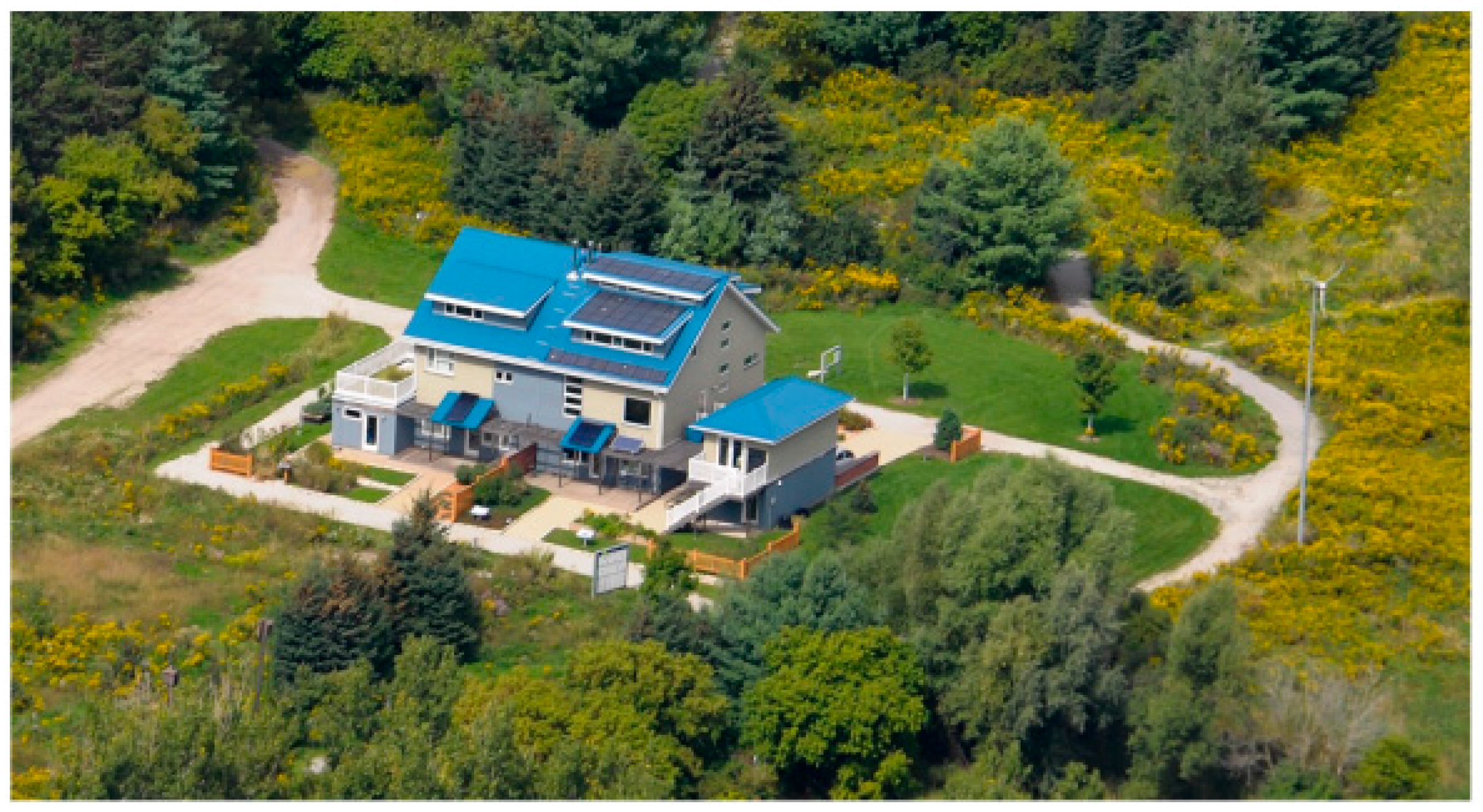
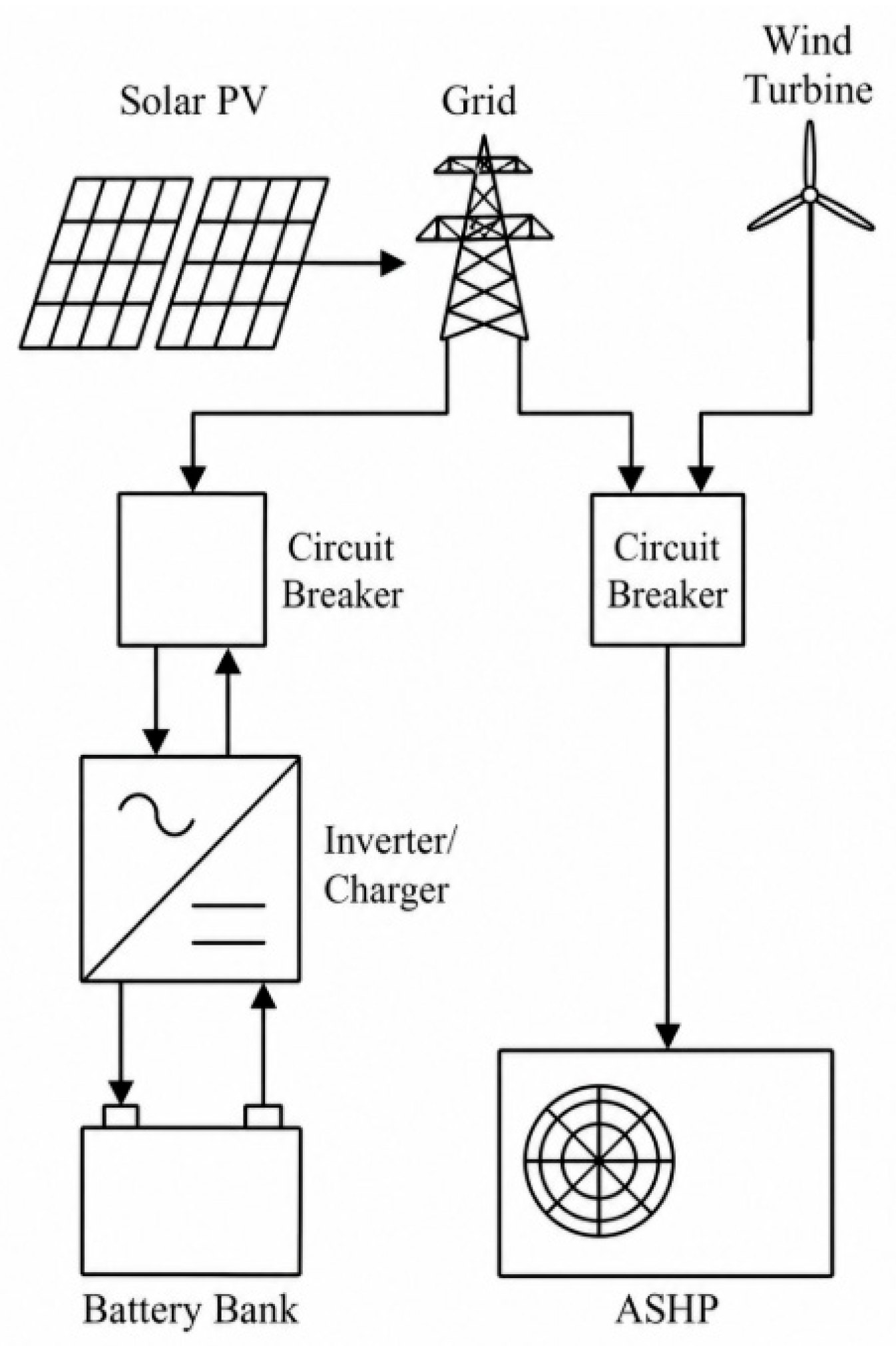
| Test facility | Archetype Sustainable House (ASH) experimental platform. |
| Main controllable load | Air-source heat pump (ASHP). |
| Purpose of the experiment | To check whether battery-supported control could shift HVAC-related peak-hour load in practice. |
| Secondary purpose | To check whether agent-based communication could support the transactive control concept. |
| Validation type | Short proof-of-concept trials, not full-year field deployment. |
| Reference case | Normal or uncontrolled HVAC-related peak-hour operation. |
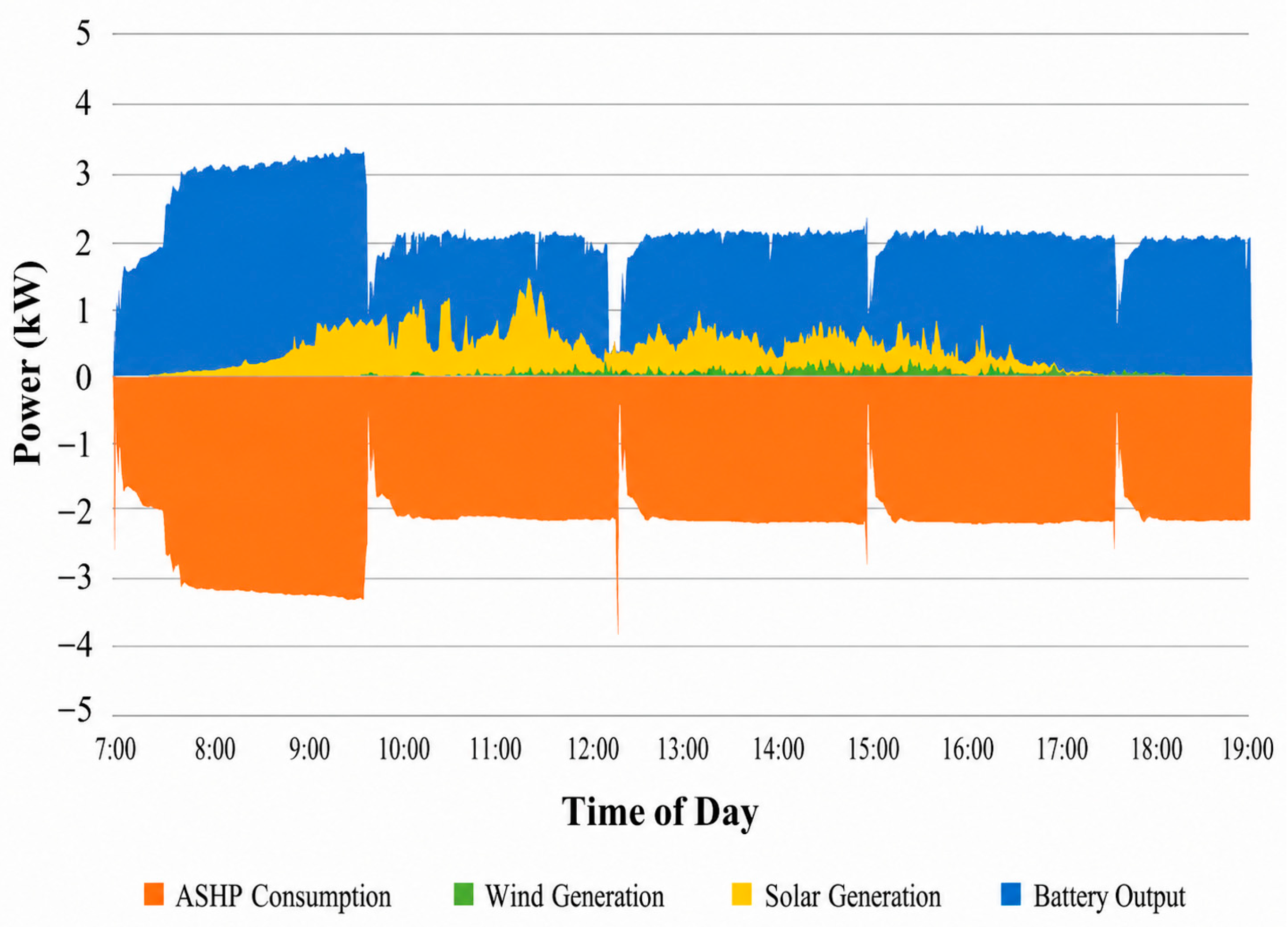
| Measured result | Up to 98% of ASHP peak-hour load was shifted during the validation tests. |
| Representative test day result | On one winter test day, 93.5% of the ASHP load during mid- and on-peak hours was supplied by the battery bank. |
| Outdoor condition on that test day | Average outdoor temperature was −6.1 °C. |
| Main takeaway | The battery-control logic worked physically, and the communication-based control structure was shown to function in practice |
| Case | Low-Load House (USD/yr) | Medium-Load House (USD/yr) | High-Load House (USD/yr) | Savings Interpretation |
|---|---|---|---|---|
| Basic deterministic load shifting, no DG (distributed generation) | 3072.33 | 3514.78 | 4157.91 | A range of about 10.6–11.0% savings from the no-control reference. |
| Excess-charging deterministic control with PV/wind | 2191.66 | 2571.73 | 3145.05 | A range of about 14.5–15.5% savings versus zero-feedback renewable operation. |
| Optimized benchmark | 1954.46 | 2384.93 | 3050.55 | Best theoretical performance, 17.1–24.6% savings. |
| Best machine-learning case | 2027.47 | 2467.75 | 3130.22 | A range f 14.9–21.8% savings, strongest realistic controller. |
| Transactive ASHP case | — | 700.28 vs. 729.73 baseline | — | Moderate but real reduction in ASHP operating cost. |
| Emissions Indicator | Value or Finding | Meaning for EMS Design |
|---|---|---|
| Annual average Ontario grid emission factor used in this study | 58.1 gCO2eq/kWh | A relatively low-carbon grid still showed meaningful hourly variation. |
| Basic load shifting without renewables | Emissions increased relative to baseline | Cheap charging periods were not always the cleanest periods. |
| Basic load shifting with renewables | Emissions were still not consistently lower than baseline | Renewable presence alone was not enough if charging logic remained grid driven. |
| Excess renewable charging | Consistently better than baseline | Charging from surplus on-site generation gave the strongest emissions outcome. |
| Best nighttime recharge window for the medium-load case without DG | About 10:00 p.m. to midnight | Charging time alone changed annual emissions. |
| Emissions improvement from best recharge window | About 3% | Modest in size, but important in principle. |
Disclaimer/Publisher’s Note: The statements, opinions and data contained in all publications are solely those of the individual author(s) and contributor(s) and not of MDPI and/or the editor(s). MDPI and/or the editor(s) disclaim responsibility for any injury to people or property resulting from any ideas, methods, instructions or products referred to in the content. |
© 2026 by the authors. Licensee MDPI, Basel, Switzerland. This article is an open access article distributed under the terms and conditions of the Creative Commons Attribution (CC BY) license.
Share and Cite
Kadir, N.; Brookson, A.; Fung, A.S. Feasibility of Residential Energy Management Systems with Renewable Generation and Battery Storage. Energies 2026, 19, 3055. https://doi.org/10.3390/en19133055
Kadir N, Brookson A, Fung AS. Feasibility of Residential Energy Management Systems with Renewable Generation and Battery Storage. Energies. 2026; 19(13):3055. https://doi.org/10.3390/en19133055
Chicago/Turabian StyleKadir, Nourin, Aidan Brookson, and Alan S. Fung. 2026. "Feasibility of Residential Energy Management Systems with Renewable Generation and Battery Storage" Energies 19, no. 13: 3055. https://doi.org/10.3390/en19133055
APA StyleKadir, N., Brookson, A., & Fung, A. S. (2026). Feasibility of Residential Energy Management Systems with Renewable Generation and Battery Storage. Energies, 19(13), 3055. https://doi.org/10.3390/en19133055