


Abstract
This study investigated possibilities to increase the efficiency of anaerobic digestion of sewage sludge using biochar produced by pyrolysis of digested sludge (sludgechar). Experiments were conducted in continuous laboratory bioreactors operated at the same loading rate, gradually increased from 3.2 to 4.5 g/(L·d) (COD) under mesophilic conditions (40 °C). Sludgechar (SCH) was dosed into the experimental bioreactor at a rate of 0.4–1.3 g/(L·d), corresponding to 12–28% of the added COD. Biogas production in the experimental bioreactor increased by 6.9–33% compared with the control bioreactor, while the CH4 concentration remained comparable, averaging 62.8%. The COD removal efficiency remained high in the sludgechar-supplemented bioreactor as the loading rate increased, whereas it decreased in the control bioreactor, corresponding to lower biogas production. The adsorption capacity, alkalinity, and mineral buffering properties of sludgechar prevented pH decline and the accumulation of volatile fatty acids (VFAs) at higher substrate loading. The pH values were less affected by increasing organic loading in the experimental than in the control bioreactor and remained within 6.9–7.0. Continuous experiments confirmed that sludgechar can facilitate stable operation at loading rates that would otherwise cause process failure. However, the low carbon-to-inorganic ratio of sludgechar is its significant disadvantage.
1. Introduction
As the global population increases, so does the need for efficient waste processing, including the management of sewage sludge produced during wastewater treatment. A cost-effective and widely used method is anaerobic digestion (AD), which converts biodegradable organic matter from sludge into biogas, leaving the inorganic fraction with residual unused organic matter as sludge digestate or stabilized anaerobic sludge. The remaining proportion of less readily degradable organic matter in sludge digestate ranges between 40 and 50% [1], making it a usable raw material. Sludge digestate can be used as a fertilizer on agricultural land [2], but this is not always feasible due to strict limits on the content of inorganic pollutants set by the European Union’s Directive 86/278/EEC on the protection of the environment, particularly the soil, when sewage sludge is used in agriculture, along with the even stricter laws of some EU member states [3]. Thermochemical processes, such as pyrolysis, can then be advantageously used to process and valorize sludge.
Within a circular economy, thermochemical processes convert various waste carbon-rich biomass (e.g., wood pellets, wheat straw, rice husk, fruitwood) into usable products such as bio-oil, biochar, or energy-rich gases [4]. Recently, biochar has received considerable attention in both research and industry, particularly its distinctive properties, namely, porous structure, high specific surface area, high ion-exchange capacity, adsorption capacity, and conductive properties. In addition to the application of biochar for improving soil properties or air purification [5], its application in anaerobic digestion accelerates the metabolism of anaerobic cultures, increases the concentration of slow-growing microorganisms by immobilizing them in the pores, promotes direct interspecies electron transfer (DIET) [6], or mitigates the inhibitory effects of ammonia [7,8]. These positive impacts can synergistically intensify the anaerobic digestion process, increasing the CH4 yield (YCH4) [9]. In the study by Cai, He [10], which examined the use of fruit food biochar in the anaerobic digestion of food waste, the lag phase was shortened and the CH4 production increased. Similar results were obtained in a study by Shanmugam, Adhikari [11], where the lag phase was also shortened using biochar produced by the hydrothermal carbonization of algal biomass. Furthermore, Shen [12] and Cai [13] found that adding biochar can reduce the inhibitory free ammonia concentration by up to 10.5% and improve the activity of methanogenic microorganisms under reduced pH conditions. Biochar absorbs ammonia nitrogen through chemical adsorption (electrostatic attraction, ion exchange, and complexation) and physical adsorption. The results of study [14] revealed that the most significant factors were the total pore volume and the adsorption capacity of biochar from biomass. In comparison, the DIET factor was important, but likely not dominant, due to the limited electrical conductivity and electron-donating/accepting capacities of biochar. The microbial analysis further indicated that mediated interspecies electron transfer remained the primary mechanism.
The positive effect of biochar on the anaerobic process has been demonstrated for many substrates and under various conditions, though primarily in batch experiments. Several studies focusing on the AD process under semicontinuous or continuous conditions provide valuable findings. In study [12], semi-continuous experiments were conducted with the addition of biochars derived from corn stover and pine wood using an anaerobic digestion process for sewage sludge in a two-stage thermophilic system. The results indicated a significant improvement in methane production of up to 25%. Similarly, in study [15], a series of continuous experiments was conducted to investigate the improvement in the thermophilic AD of primary sludge by adding biochar derived from corn straw, where a 13.8% increase in CH4 production and improved removal of volatile solids (VSs) were reported. In study [16], the distribution of food waste residue-based biochar and its impact on AD was investigated in a 30 L semi-continuously operated bench-scale anaerobic digester. The results demonstrated that the biochar significantly increased biogas yields by 23.38% at an organic loading rate (OLR) of 3.0 g/(L⋅d) VSs. The stability of the AD at an OLR of 4.0 g/(L⋅d) VSs was also improved by the addition of biochar.
Although the use of various types of biochar to enhance anaerobic digestion has been thoroughly investigated, there is still a need for more knowledge regarding the effect of sludgechar (SCH), which is derived from anaerobically stabilized sewage sludge, on the anaerobic digestion process, especially in semi-continuous or continuous systems. Pyrolysis is increasingly being integrated into sewage sludge management technologies at wastewater treatment plants (WWTPs). This technology reduces the volume of sludge that cannot or should not be applied to agricultural land or composted. The reason for this is the application of the precautionary principle concerning the presence of inorganic pollutants (e.g., heavy metals) and organic contaminants (persistent organic pollutants such as PAHs, PCBs, PCDD/Fs, and PFAS, as well as various pharmaceuticals, endocrine disruptors, and personal care products) [3,17,18]. If it were possible to reuse sludgechar to improve the anaerobic digestion process, this would provide additional motivation to incorporate pyrolysis into sludge treatment technologies.
In general, sludgechar exhibits less favorable properties compared with biochar produced from other waste biomass, primarily due to its higher ash content, much lower specific surface area, and a different porous structure [19]. Nevertheless, the possibility of using it is highly beneficial in terms of circular economy principles. The use of sludgechar as an additive to anaerobic digestion has recently been the subject of several studies. In batch experiments with sludgechar added, as described in studies [20,21], the digestion of sewage sludge resulted in increased methane production, a shorter lag phase in the methanogenic process, and accelerated decomposition of organic matter, with acetotrophic methanogens becoming dominant over hydrogenotrophic species. Although these findings are promising, they do not allow us to estimate how the added sludgechar will influence the continuous AD process.
The study in [22] presents interesting and valuable results, as the authors attempted to simulate conditions for full-scale anaerobic digestion of mixed sludge (primary and secondary) at a WWTP. They operated a laboratory semi-continuous digester fed with real mixed sludge taken directly from a WWTP. Sludgechar was produced by pyrolysis at 550 °C, followed by physical activation with CO2 at 900 °C. Since the quality of the dosed mixed sludge varied with current operating conditions, this had a considerable impact on the process in the model. Moreover, because the experiment did not allow parallel monitoring of a control process without dosing sludgechar, its effect was partly obscured by the lower organic loading applied. As mentioned by Shao et al. [23], the effect of biochar becomes particularly significant under stressful conditions, affecting the anaerobic microbial community. Although an increase in both biogas and methane production was observed, the quantitative evaluation of the effect was not sufficiently reliable.
To address the knowledge gap and gain further insight into the enhancement of anaerobic digestion by sludgechar, this study investigated the impact of sludgechar on the anaerobic digestion process using continuously operated laboratory-scale bioreactors, providing practical insights for future scaling up of the process. The study evaluated the effect of different sludgechar doses on the efficiency of anaerobic sludge digestion and biogas production compared with a control bioreactor without sludgechar addition. For this purpose, various organic loading rates were tested to determine the capacity of anaerobic sludge digestion in the presence of sludgechar.
Unlike most previous studies focused on biomass-derived biochars and batch-scale experiments, this work investigated the application of sludgechar produced directly from digested sewage sludge in long-term continuous anaerobic fermentation. The study aimed to evaluate not only its effects on biogas production and process stability but also its performance under progressively increasing organic loading rates and its practical limitations associated with the accumulation of inorganic solids. The results provide new insights into the potential role of sludgechar as a functional additive for improving the resilience of anaerobic sludge fermentation under high-load operating conditions.
2. Materials and Methods
2.1. Experimental Setup
The experimental setup consisted of two continuously stirred reactors (CSTRs) with total and working volumes of 17 L and 12 L, respectively. One CSTR served as a control bioreactor (C), to which only the substrate was dosed, while the second CSTR served as the experimental bioreactor (E), to which both the substrate and sludgechar were dosed. No biological replicate reactors were operated. The experimental bioreactors were custom-built at the Department of Water Technology and Environmental Engineering, University of Chemistry and Technology Prague, Prague, Czech Republic. The bioreactors were operated under mesophilic conditions (40 ± 1 °C) maintained by heating coils wrapped around the acrylic glass walls of the CSTRs. Mixing was performed using double-blade mixers operating at 55 rpm. Each lid of the bioreactor was equipped with three flanges for a pH probe (Polilyte Plus H Arc 225, (Hamilton, Bonaduz, Switzerland), a temperature probe (T-type ThermoCouples, (National Instruments, Austin, TX, USA), and a septum for the biogas sampling and analyses. Biogas production was measured using a MilliGascounter (MGC-1 PMMA, RITTER, Bochum, Germany). Substrate dosing was controlled by LabVIEW 2012 software (National Instruments, Austin, TX, USA). Temperature, biogas production, and pH measurements were recorded using Compact RIO controllers and LabVIEW 2012 software (National Instruments, Austin, TX, USA). Additionally, equipment for conveying and dosing sludgechar (SCH) into the headspace of bioreactor E was installed on its lid. The equipment for conveying and dosing sludgechar (SCH) was custom-built at the Department of Water Technology and Environmental Engineering, University of Chemistry and Technology Prague, Prague, Czech Republic. A continuously mixed feeding tank, stored in a refrigerator at 5 °C, ensured substrate dosage to each bioreactor via peristaltic pumps (see Figure S1).
2.2. Inoculum, Substrate, and Sludgechar Characteristics
The continuously stirred-tank reactors (CSTRs) were inoculated with anaerobic sludge from the mesophilic anaerobic digester processing sewage sludge produced at a municipal WWTP. The characteristics of the inoculum used were as follows: pH of 7.4, total solids (TSs) 27.9 g/L, volatile solids (VSs) 14.9 g/L, and chemical oxygen demand (COD) 25.8 g/L.
The substrate was periodically collected from a municipal wastewater treatment plant as a mixture of primary sludge and thickened-disintegrated waste activated sludge at a volume ratio of 3:1. The collected substrate was refrigerated at 5 °C prior to any laboratory pre-treatment. The chemical composition of the substrate, monitored throughout the experimental duration, was as follows: pH of 6.7 ± 0.1, TSs 55 ± 5 g/L, VSs 39 ± 1 g/L, COD 72 ± 3 g/L, and volatile fatty acids (VFAs) 1.6 ± 0.7 g/L.
The sludgechar was produced from digested and dried sludge obtained from Trutnov WWTP, Trutnov, Czech Republic. previously described in [18]. In brief, the sludge was pyrolyzed in a PYREG PX 500 SF pyrolyzer (PYREG GmbH, Dörth, Germany) at 600–650 °C, with an approximate residence time of the sludge/sludgechar in the reactor of 15 min. The complex characterization of the sludgechar is displayed in the Supplementary Information in Tables S1 and S2, where the methodology of the analysis was done according to [24] and further described in the Supplementary Information.
The properties of sludgechar include a specific surface area of 45 m2/g, a pH of 11.7, an ash content of 76.2%, and an electrical conductivity of 1500 μS/cm. Compared with biochars derived from sources with higher organic fractions, such as woody biomass or agricultural digestates, digested sewage sludge disposes a higher ash content, resulting in sludgechar with a lower carbon content and specific surface area. Consequently, all attributes associated with positive effects on anaerobic digestion are low in the sludgechar used. However, the study aimed to investigate the potential for the purposeful use of the pyrolysis product directly at the site of its production.
2.3. Settings of Individual Phases of Bioreactors Operation
Before the start of the experiments, both bioreactors were inoculated and gradually adapted to the sewage sludge substrate until they reached the initial organic loading rate of 3.1 g/(L·d) (COD). The first phase was to confirm stable, comparable operating conditions for both bioreactors before the start of sludgechar dosing. In the subsequent phases, the organic loading of both bioreactors and sludgechar doses to the experimental reactor was gradually increased, and the residence time was shortened according to the scheme shown in Table 1. The sludgechar doses were selected as stepwise increasing laboratory-scale doses to evaluate the response of the anaerobic fermentation process to increasing organic loading rates. These doses should therefore be interpreted as experimental doses rather than optimized full-scale application rates.
Table 1.
Settings of organic loading and hydraulic retention time of both bioreactors and sludgechar dosing to experimental bioreactor in individual phases of experiment.
2.4. Analytical Methods
Liquid samples from the bioreactor were collected at least once per week for analysis of COD, TSs, volatile solids (VSs), and volatile suspended solids (VSSs) in accordance with the Standard Methods for Examination of Water and Wastewater [25]. Concentrations of individual VFA (acetate, propionate, butyrate, valerate, and caproic acid) were determined by the GC 2010 gas chromatograph (Shimadzu Corporation, Kyoto, Japan) following the method described in Andreides, Bautista Quispe [26]. Biogas composition (H2, CH4, and CO2) was determined using the gas chromatograph with a thermal conductivity detector (GC 8000 Top, CE Instruments, Milan, Italy). The column temperature (Hayesep D packed column (80/100)) and detector temperature were set to 100 °C and 185 °C, respectively. Argon was used as the carrier gas, and the analysis time was 3 min. The pH values and temperature measurements were obtained using probes and sensors permanently inserted into the bioreactors.
2.5. Calculations
The biogas volume produced was calculated as dry gas at standard conditions (0 °C and 101,325 kPa). The CH4 production yield (YCH4) was calculated as daily CH4 production (CH4out) divided by the daily dosed VSs (VSin) (Equation (1)). The VS input (VSin) used for methane yield calculations included only the volatile solids supplied with the sewage sludge substrate. Volatile solids associated with the sludgechar additive were not included in the calculation.
The COD or VS removal efficiency (ηi) was calculated according to Equation (2):
where ηi represents removal efficiency, mi,in is the daily substrate mass inlet to the bioreactors, mi,out is the daily mass outlet from the bioreactors, and i refers to either COD or VSs.
3. Results and Discussion
The following sections present the operational dynamics of the bioreactors across six phases (1–6), with a particular focus on biogas quality and quantity. Subsequent sections discuss the stability of the anaerobic digestion process, the efficiency of COD removal, and the influence of sludgechar addition on the solids composition and concentration in the digested sludge.
3.1. Biogas Production and Methane Yield
In the first phase, both bioreactors were operated as conventional anaerobic sludge digesters without sludgechar addition, establishing a baseline for subsequent comparison. The CH4 concentration in biogas averaged 62.9 ± 0.8% in the experimental bioreactor E and 62.7 ± 0.8% in the control bioreactor C. Consistent methane yields (YCH4) were observed in both bioreactors E and C, recorded at 0.22 ± 0.01 L/g of VSs, with daily biogas production reaching approximately 7.5 L.
In phase 2, the integration of sludgechar at a dosage of 5.1 g/d into bioreactor E was initiated. This modification did not substantially affect the CH4 concentration compared with the control bioreactor C. However, there was an increase in both biogas production volume and YCH4. Bioreactor E produced 7.7 L/d of biogas with a YCH4 of 0.23 L/g, and bioreactor C produced 7.2 L/d of biogas with a YCH4 of 0.22 L/g. The lower biogas production in the control bioreactor resulted from declining substrate quality, affected by conditions at the WWTP.
During phase 3, the sludgechar dosage into bioreactor E was increased from 5.1 g/d to 10.2 g/d, while the organic loading rate as COD in both bioreactors was 3.4 g/(L·d). The biogas production of bioreactor E increased to 7.9 L/d compared with 7.3 L/d in the control bioreactor, representing an increase of 8.3%. Methane yield in the experimental bioreactor reached 0.24 L/g VS compared with 0.22 L/g VS in bioreactor C, a difference of 9.1%.
The fourth phase with OLR of COD 3.8 g/(L·d) caused a further increase of biogas production and methane yield in bioreactor E to 7.8 L/d and 0.26 L/g VS, representing increases of 8.9% and 8.3%, respectively.
A higher increase in OLR of COD to 4.4 g/(L·d) in phase 5 caused an increase in biogas production in the experimental bioreactor to 14.3 L/d, as well as specific methane production to 0.32 L/g VS, representing increases of 31.2% and 37.5% respectively, compared with the control bioreactor.
In the last phase of the experiment with further increase in OLR of COD to 4.5 g/(L·d) and SCH dose to 15 g/d, the control bioreactor showed significant signs of overloading; in contrast, bioreactor E achieved 33% higher biogas production and the same for methane yield.
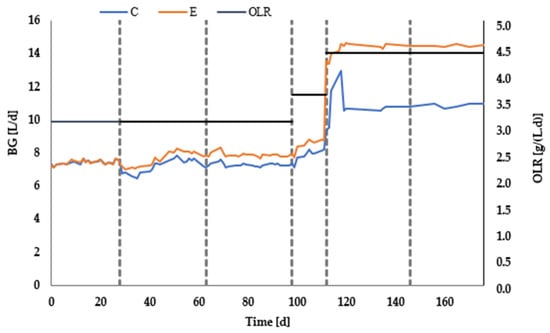
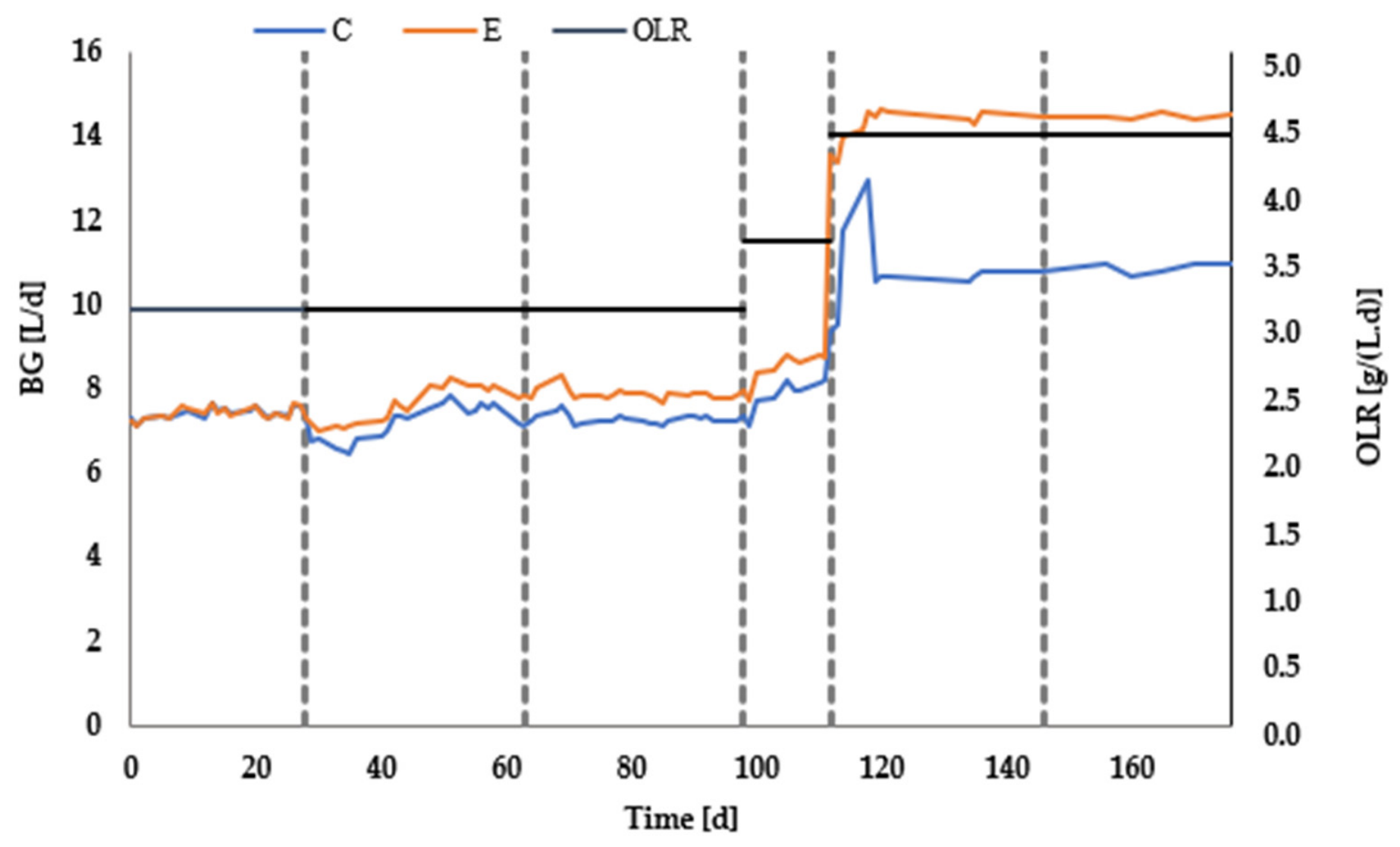
Changes in biogas production across different phases are presented in Figure 1.
Figure 1.
Daily biogas production (BG) in control bioreactor (C) and in experimental bioreactor (E) in relation to organic loading rate (OLR). C—control bioreactor; E—experimental bioreactor; OLR—organic loading rate.
Detailed data for all phases are provided in Table 2. Depending on the phase duration and the monitored parameter, 4–6 observations were typically included when calculating the mean values and standard deviations.
Table 2.
Basic data characterizing phases of experiment.
At low substrate loading in the system (3.1–3.8 g/(L·d) COD), the addition of SCH did not significantly affect the biogas production (phases 1–4). However, increasing the bioreactor load to 4.4 and 4.5 g/(L·d) COD resulted in biogas overproduction when SCH was added. Similar increases in biogas production with higher loading and SCH addition have also been reported by [27].
3.2. Bioreactors Stability and COD Removal
The stability of bioreactor operation is primarily assessed by monitoring pH and volatile fatty acids concentration, as acid accumulation and the resulting drop in pH typically indicate suboptimal process conditions and inhibition of methanogenic microorganisms.
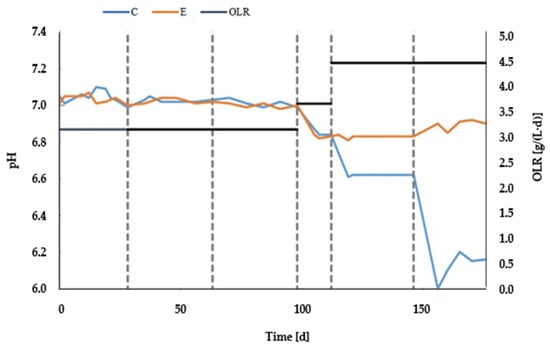
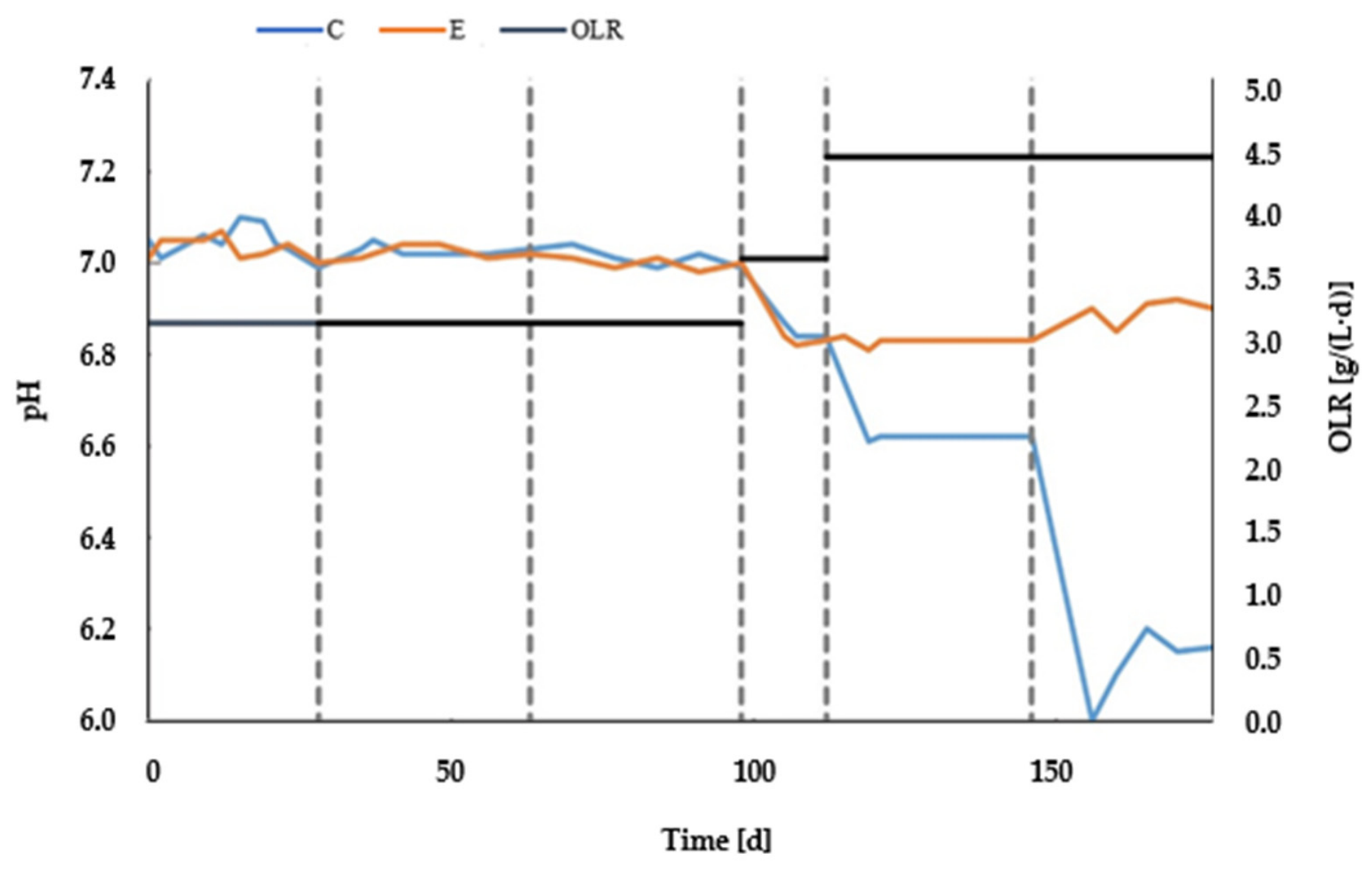
The difference in pH trends between the two bioreactors is shown in Figure 2, and it is evident that the pH in bioreactor E, with applied sludgechar, was less affected by the increasing organic loading rate than in the control bioreactor and remained within the range acceptable to the microorganisms of anaerobic culture. This demonstrates the buffering capacity of biochar, as reported by many authors [20,28].
Figure 2.
Trends of pH in bioreactors E and C during phases of the experiment. C—control bioreactor; E—experimental bioreactor; OLR—organic loading rate. Vertical lines separate the individual experimental phases.
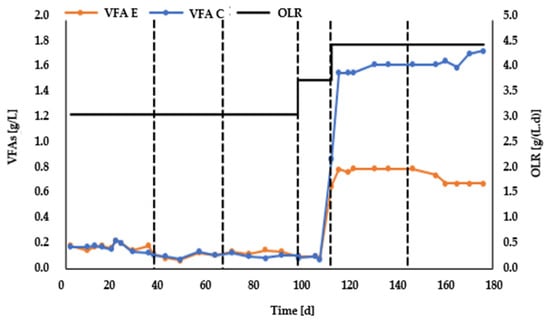
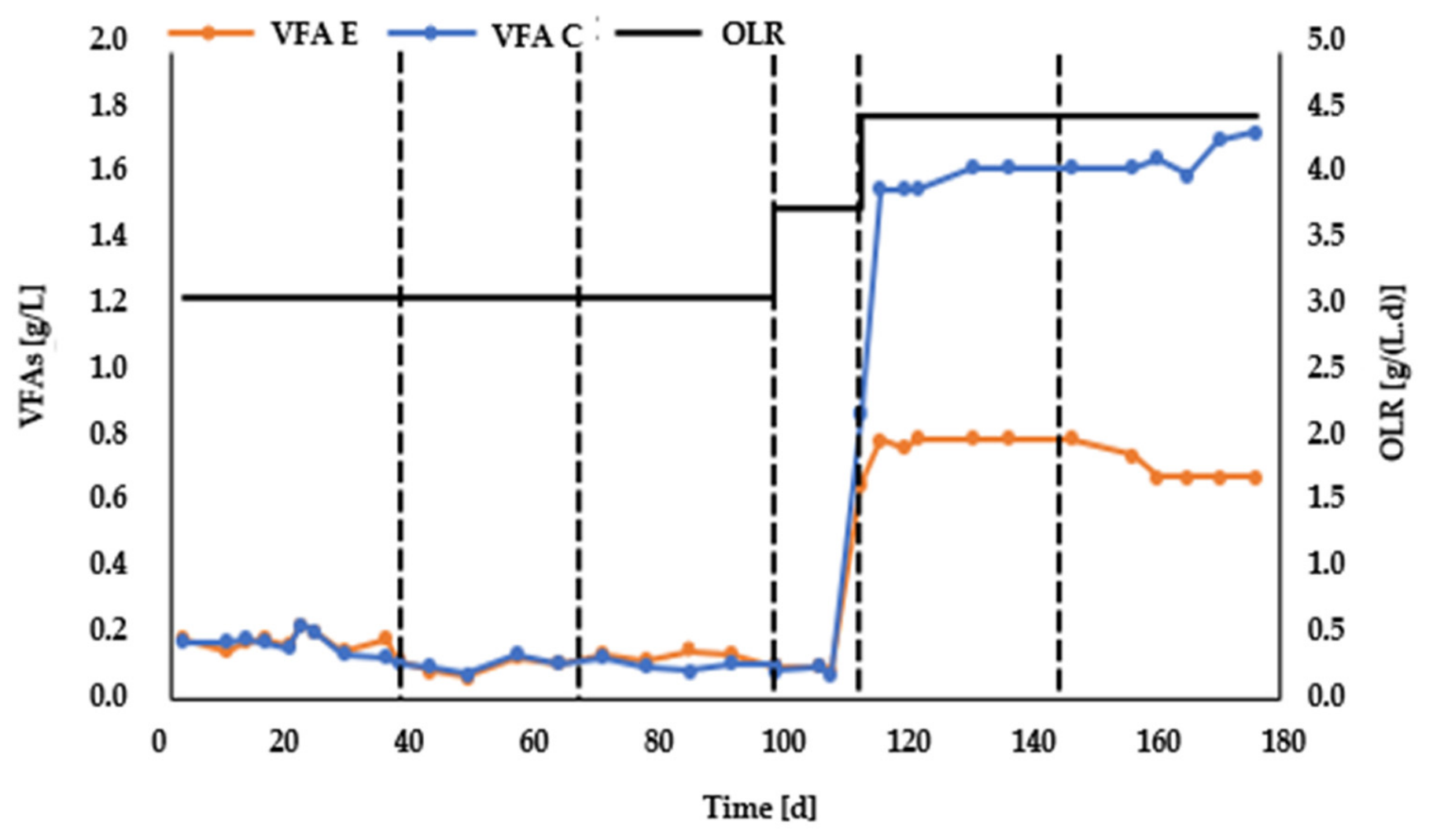
In the range of OLR 3.1–3.4 g/(L·d) (COD), the total amount of volatile fatty acids (expressed as acetic acid) in both bioreactors decreased from 200 to about 100 mg/L. A sharp increase to 1200 mg/L and 1400 mg/L in the bioreactor C was noted after increasing the organic load to 4.4 and 4.5 g/(L·d), while it had only increased to about 600 mg/L in bioreactor E. The high concentration of VFAs in the bioreactor C corresponds to a decrease in pH, whereas in bioreactor E, there was only a slight pH decrease to 6.8, which is still acceptable for an effective function of methanogens. The development of the VFAs concentration during individual phases of the experiment is shown in Figure 3.
Figure 3.
Total amount of volatile fatty acids (VFAs) during individual phases of the experiment. VFAs C—control bioreactor; VFAs E—experimental bioreactor, OLR—organic loading rate. Vertical lines separate the individual experimental phases.
Owing to its absorption properties, the addition of SCH prevents or moderates the increase in VFAs concentration at higher substrate loads and, through the gradual release of these compounds, enables continuous biogas production [29,30].
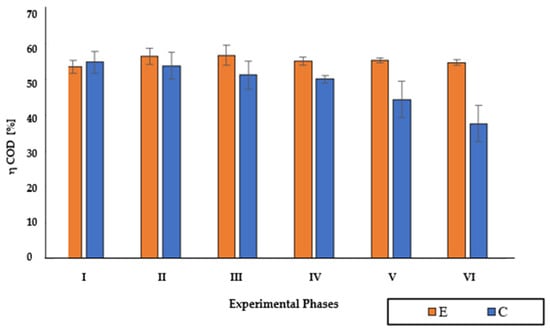
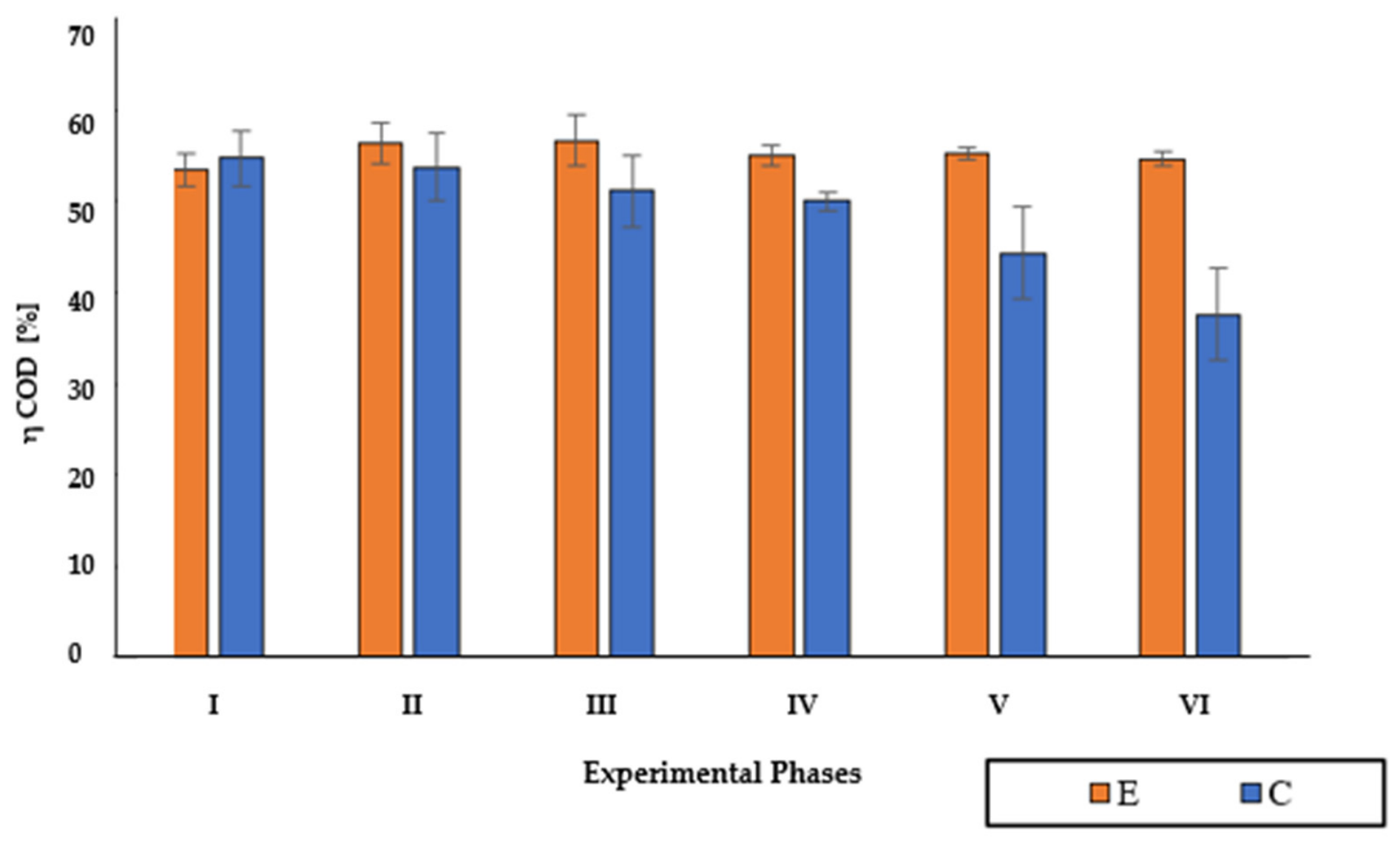
The COD removal efficiency for each phase of the experiment is shown in Figure 4. The COD removal efficiency was calculated based solely on the influent and effluent COD associated with the sewage sludge substrate; the sludgechar added directly to the reactor was not included in the influent COD load.
Figure 4.
COD removal efficiency in individual phases of experiment. C—control bioreactor; E—experimental bioreactor.
It is clear that as the organic load increased, the COD efficiency remained high in the SCH-supplemented bioreactor, whereas it decreased in the control bioreactor, which is consistent with its lower biogas production. The addition of SCH increased the range of applicable organic loads for anaerobic digestion, which would otherwise significantly reduce process efficiency.
These results also support the findings of the authors who worked with batch tests. The lag phase occurred at the beginning of a batch test, when all the tested substrate was dosed at once, creating a higher load that was, to some extent, unfavorable for the anaerobic culture and required time to overcome. Overload is always manifested by increased production of volatile fatty acids and a lower associated pH, and due to its absorption and buffering properties, biochar can alleviate these symptoms and thereby shorten or eliminate the lag phase [31,32,33]. The higher COD removal observed in the sludgechar-amended reactor may have been associated not only with enhanced biological conversion but also with adsorption of soluble organic compounds onto the sludgechar surface. The present study does not permit a quantitative distinction between these mechanisms. Therefore, the observed increase in COD removal should be interpreted as a combined effect of biological and physicochemical processes.
3.3. Influence of Sludgechar Addition on Solids Concentration in Digested Sludge
The composition of sludgechar (see Section 2.2) is not very favorable for carbon content due to its high ash content. To ensure the beneficial effect of carbon, an increased total amount of SCH is needed [22,34], thereby increasing the inorganic content of the anaerobic sludge. The composition of the inoculum, sewage sludge, and digested sludge solids in both bioreactors is summarized in Table 3.
Table 3.
Solids and COD concentrations in bioreactors E and C during experiments.
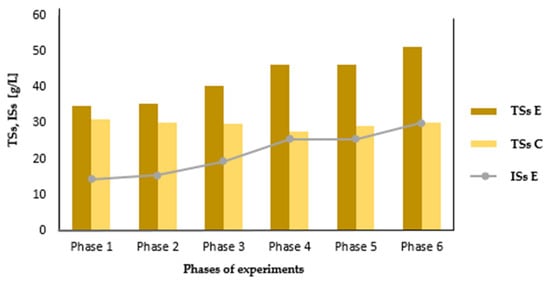
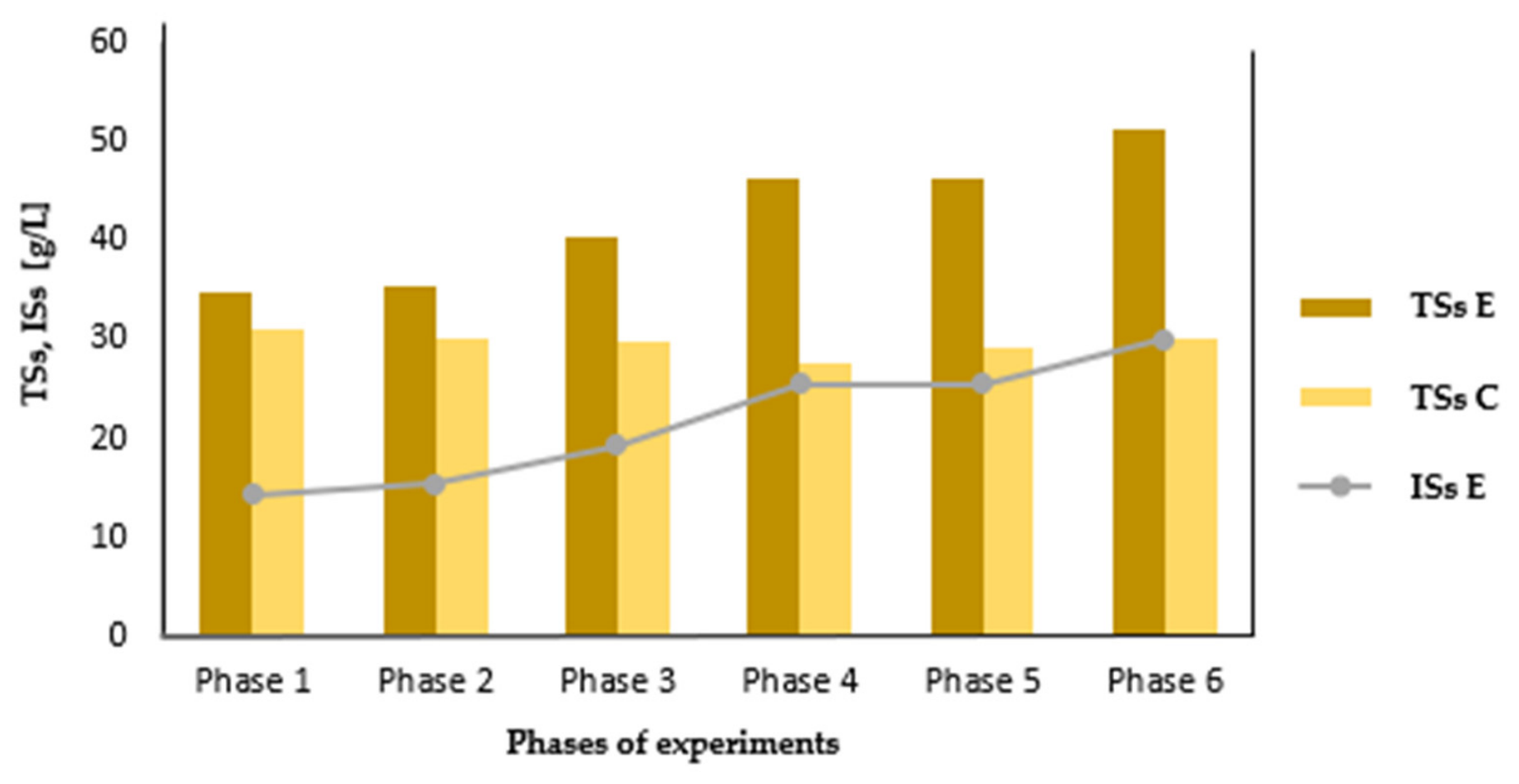
As shown in Table 3, the addition of SCH significantly increased the concentration of total solids in bioreactor E versus bioreactor C, and as shown in Figure 5, the increase corresponds to the inorganic fraction of the digested sludge solids. In the case of potential sludgechar application in anaerobic digestion processes, it will be necessary to verify whether the installed mixing equipment can ensure sufficient homogenization of the digesters at elevated sludge concentrations. Additional potential issues may be associated with the abrasive effects of the inorganic fraction of sludgechar. Sludge with a high concentration of inorganic material would also be an unsuitable feedstock for pyrolysis; therefore, future research is focused on the co-pyrolysis of digested sludge with waste materials rich in organic matter, as discussed by Biney [35] and Díaz Lara [36].
Figure 5.
Total solids in bioreactor E (TSs E, g/L), total solids in bioreactor C (TSs C, g/L), and inorganic solids in bioreactor E (ISs E, g/L) in individual phases of experiment.
The stimulatory effect of the organic fraction of sludgechar, combined with the catalytic effect of its ash content, appears to be highly potent, allowing similar effects to be achieved at lower dosages. When comparing the effect of biochar derived from organic materials used in semi-continuous experiments by Shen [12], a 36.9% increase in CH4 production was achieved using a biochar dose of 3.4 g/g [SCH/VS]. In contrast, our experiments achieved a 37.5% increase in CH4 production using only 0.37 g/g [SCH/VS].
In addition to increasing the biogas yield and improving the stability of the anaerobic digestion process, the subsequent application of digestate containing sludgechar to soil may also provide significant benefits. Although elevated concentrations of ash and trace metals may restrict direct agricultural application, the environmental impact depends not only on their total concentrations but also on their chemical speciation and bioavailability. The presence of sludgechar may enhance micronutrient availability, reduce soil hydraulic conductivity, improve water retention, and increase soil aeration and water availability.
4. Strategies for Improving Sludgechar Properties for Anaerobic Fermentation Applications
The useful properties of biochar for anaerobic digestion are already well known. These have been tested across many types of biochars produced under different conditions. These key properties include pore size, specific surface area, and carbon and ash contents, as described by Nie [37]. The properties of sludgechar are largely governed by the composition of the sewage sludge from which it is produced. Although the high mineral content of sludgechar may contribute to buffering and catalytic effects, its relatively low carbon content and high ash fraction may limit some of the properties typically associated with biomass-derived biochars. Therefore, various approaches aimed at improving sludgechar characteristics and enhancing its performance in anaerobic fermentation are currently being investigated.
Sludgechar possesses distinct mineralogical and catalytic properties that differentiate it from conventional biomass-derived biochar, particularly in adsorption processes and contaminant removal. These advantages are largely attributed to the mineral-rich and catalytically active surface of sludgechar. This surface acts both as an adsorbent and a reactive medium, according to Lee [38].
To further enhance the properties of sludgechar, several studies have proposed modifications to its production from sewage sludge to improve its stimulatory effects, including works by Jin [39], Duan [20], Nie [37], and Singhal [31]. Proposed sludgechar functionalization methods include heteroatom doping (N, P, S), which enhances its electrochemical properties and increases the number of surface functional groups. Other methods involve treatment with acids or alkalis and doping with metals (Fe, Mn, Co) or trace elements (Cu, Ni, Zn, Co, Mo), as discussed by Choong and Nie [37].
Moreover, to increase the carbon content in sludgechar, co-pyrolysis with additional biomass sources has already been proposed and investigated [35] as a means of increasing the concentration of organic matter entering the pyrolysis process and thereby improving the ash-to-carbon ratio, as reported by Cao [40] and da Silva [41].
5. Conclusions
Continuous anaerobic fermentation experiments with sewage sludge demonstrated that the addition of sludgechar produced directly from digested sewage sludge was associated with improved process stability under elevated organic loading conditions. While only minor differences between the control and experimental reactors were observed at lower loading rates, the beneficial effect of sludgechar became increasingly evident at higher organic loading rates, where the control reactor exhibited signs of overloading.
The sludgechar-amended reactor showed lower VFA accumulation; improved pH stability; higher COD removal; and increases in biogas production and specific methane yields of up to 33% and 38%, respectively. These improvements are likely associated with a combination of adsorption, buffering, mineral, and catalytic effects of sludgechar, although the individual mechanisms were not directly investigated in the present study.
A practical limitation of sludgechar is its relatively low carbon content and high ash fraction compared with conventional biomass-derived biochars. At doses sufficient to improve process performance, sludgechar increases the concentration of inorganic solids in the digester, which may affect mixing efficiency and increase the risk of mechanical wear.
The increased inorganic fraction resulting from sludgechar addition should also be considered when assessing the final utilization pathways of the digestate. At the same time, the mineral-rich digestate may offer opportunities for resource recovery and integration into circular bioeconomy concepts, including phosphorus recovery and co-pyrolysis with organic waste streams.
Overall, the results suggest that sludgechar is a promising functional additive for improving the resilience and performance of anaerobic sludge fermentation under high-load operating conditions. Further research should focus on optimizing sludgechar properties and application rates while minimizing the negative impacts associated with the accumulation of inorganic solids.
Supplementary Materials
The following supporting information can be downloaded from https://www.mdpi.com/article/10.3390/en19133054/s1. Figure S1 Bioreactors setup for investigating the effects of sludgechar on the anaerobic digestion of sewage sludge. Analysis of the sludgechar. Table S1 Macro- and micronutrients analyzed in sludgechar and the standard analytical methods used for their determination. Properties of sludgechar. Table S2 Physico-chemical properties of the sludgechar used as additive to anaerobic digestion process. Refs. [42,43,44,45,46] are cited in the Supplementary Materials.
Author Contributions
Conceptualization, J.Z. and M.P.; methodology, D.P., J.M., J.Z. and M.P.; validation, D.S., D.P., A.H. and J.M.; formal analysis, D.S., A.H. and J.M.; investigation, D.S., A.H. and J.M.; resources, D.P., M.P. and J.Z.; data curation, D.S. and J.M.; writing—original draft preparation, D.S.; writing—review and editing, D.P., M.P. and J.Z.; visualization, D.S. and J.M.; supervision, M.P. and J.Z.; project administration, D.P.; funding acquisition, D.P. All authors have read and agreed to the published version of the manuscript.
Funding
This research was supported by the Specific University Research programme of the University of Chemistry and Technology Prague, Czech Republic under grants A1_FTOP_2025_001 and A1_FTOP_2025_002.
Data Availability Statement
The data supporting the results of this study are available from the corresponding/first author upon reasonable request.
Acknowledgments
The authors thank Karbo HF/HST Hydrosystemy, Czech Republic, for providing the sludgechar sample. The sludgechar was produced at the Bohuslavice-Trutnov WWTP, Trutnov, Czech Republic.
Conflicts of Interest
The authors declare no conflicts of interest.
Abbreviations
The following abbreviations are used in this manuscript:
| COD | chemical oxygen demand |
| TSs | total solids |
| VSs | volatile solids |
| VSSs | volatile suspended solids |
| SCH | sludgechar (sludge-derived biochar) |
| VFAs | volatile fatty acids |
| WWTP | wastewater treatment plant |
| OLR | organic loading rate |
| HRT | hydraulic retention time |
| CSTR | continuously stirred reactor |
| YCH4 | methane yield |
References
- Zabranska, J.; Pokorna, D. Bioconversion of carbon dioxide to methane using hydrogen and hydrogenotrophic methanogens. Biotechnol. Adv. 2018, 36, 707–720. [Google Scholar] [CrossRef] [Scilit] [PubMed]
- Eurostat. Sewage Sludge Production and Disposal from Urban Wastewater (in Dry Substance); Dataset ten00030; Statistical Office of the European Union: Luxembourg, 2022. [Google Scholar]
- Hušek, M.; Moško, J.; Pohořelý, M. Sewage sludge treatment methods and P-recovery possibilities: Current state-of-the-art. J. Environ. Manag. 2022, 315, 115090. [Google Scholar] [CrossRef] [Scilit]
- Werle, S.; Sobek, S. Gasification of sewage sludge within a circular economy perspective: A Polish case study. Environ. Sci. Pollut. Res. 2019, 26, 35422–35432. [Google Scholar] [CrossRef] [Scilit]
- Masud, M.A.A.; Shin, W.S.; Sarker, A.; Septian, A.; Das, K.; Deepo, D.M.; Iqbal, M.A.; Islam, A.R.M.T.; Malafaia, G. A critical review of sustainable application of biochar for green remediation: Research uncertainty and future directions. Sci. Total Environ. 2023, 904, 166813. [Google Scholar] [CrossRef] [Scilit] [PubMed]
- Sun, Z.; Feng, L.; Li, Y.; Han, Y.; Zhou, H.; Pan, J. The role of electrochemical properties of biochar to promote methane production in anaerobic digestion. J. Clean. Prod. 2022, 362, 132296. [Google Scholar] [CrossRef] [Scilit]
- Ngo, T.; Shahsavari, E.; Shah, K.; Surapaneni, A.; Ball, A.S. Improving bioenergy production in anaerobic digestion systems utilising chicken manure via pyrolysed biochar additives: A review. Fuel 2022, 316, 123374. [Google Scholar] [CrossRef] [Scilit]
- Zhang, L.; Lim, E.Y.; Loh, K.-C.; Ok, Y.S.; Lee, J.T.E.; Shen, Y.; Wang, C.-H.; Dai, Y.; Tong, Y.W. Biochar enhanced thermophilic anaerobic digestion of food waste: Focusing on biochar particle size, microbial community analysis and pilot-scale application. Energy Convers. Manag. 2020, 209, 112654. [Google Scholar] [CrossRef] [Scilit]
- Sikarwar, V.S.; Pohořelý, M.; Meers, E.; Skoblia, S.; Moško, J.; Jeremiáš, M. Potential of coupling anaerobic digestion with thermochemical technologies for waste valorization. Fuel 2021, 294, 120533. [Google Scholar] [CrossRef] [Scilit]
- Cai, J.; He, P.; Wang, Y.; Shao, L.; Lü, F. Effects and optimization of the use of biochar in anaerobic digestion of food wastes. Waste Manag. Res. 2016, 34, 409–416. [Google Scholar] [CrossRef] [Scilit] [PubMed]
- Shanmugam, S.R.; Adhikari, S.; Nam, H.; Kar Sajib, S. Effect of bio-char on methane generation from glucose and aqueous phase of algae liquefaction using mixed anaerobic cultures. Biomass Bioenergy 2018, 108, 479–486. [Google Scholar] [CrossRef] [Scilit]
- Shen, Y.; Forrester, S.; Koval, J.; Urgun-Demirtas, M. Yearlong semi-continuous operation of thermophilic two-stage anaerobic digesters amended with biochar for enhanced biomethane production. J. Clean. Prod. 2017, 167, 863–874. [Google Scholar] [CrossRef] [Scilit]
- Cai, Y.; Zhu, M.; Meng, X.; Zhou, J.L.; Zhang, H.; Shen, X. The role of biochar on alleviating ammonia toxicity in anaerobic digestion of nitrogen-rich wastes: A review. Bioresour. Technol. 2022, 351, 126924. [Google Scholar] [CrossRef] [Scilit] [PubMed]
- Wang, Z.; Zhang, C.; Watson, J.; Sharma, B.K.; Si, B.; Zhang, Y. Adsorption or direct interspecies electron transfer? A comprehensive investigation of the role of biochar in anaerobic digestion of hydrothermal liquefaction aqueous phase. Chem. Eng. J. 2022, 435, 135078. [Google Scholar] [CrossRef] [Scilit]
- Wei, W.; Guo, W.; Ngo, H.H.; Mannina, G.; Wang, D.; Chen, X.; Liu, Y.; Peng, L.; Ni, B.-J. Enhanced high-quality biomethane production from anaerobic digestion of primary sludge by corn stover biochar. Bioresour. Technol. 2020, 306, 123159. [Google Scholar] [CrossRef] [Scilit] [PubMed]
- Zhang, J.; Liu, H.; Wu, J.; Chen, C.; Ding, Y.; Liu, H.; Zhou, Y. Rethinking the biochar impact on the anaerobic digestion of food waste in bench-scale digester: Spatial distribution and biogas production. Bioresour. Technol. 2025, 420, 132115. [Google Scholar] [CrossRef] [Scilit] [PubMed]
- Moško, J.; Pohořelý, M.; Cajthaml, T.; Jeremiáš, M.; Robles-Aguilar, A.A.; Skoblia, S.; Beňo, Z.; Innemanová, P.; Linhartová, L.; Michalíková, K.; et al. Effect of pyrolysis temperature on removal of organic pollutants present in anaerobically stabilized sewage sludge. Chemosphere 2021, 265, 129082. [Google Scholar] [CrossRef] [Scilit] [PubMed]
- Husek, M.; Semerad, J.; Skoblia, S.; Mosko, J.; Kukla, J.; Beno, Z.; Jeremias, M.; Cajthaml, T.; Komarek, M.; Pohorely, M. Removal of per- and polyfluoroalkyl substances and organic fluorine from sewage sludge and sea sand by pyrolysis. Biochar 2024, 6, 31. [Google Scholar] [CrossRef] [Scilit]
- Zhang, M.; Li, J.; Wang, Y.; Yang, C. Impacts of different biochar types on the anaerobic digestion of sewage sludge. RSC Adv. 2019, 9, 42375–42386. [Google Scholar] [CrossRef] [Scilit] [PubMed]
- Duan, S.; He, J.; Xin, X.; Li, L.; Zou, X.; Zhong, Y.; Zhang, J.; Cui, X. Characteristics of digested sludge-derived biochar for promoting methane production during anaerobic digestion of waste activated sludge. Bioresour. Technol. 2023, 384, 129245. [Google Scholar] [CrossRef] [Scilit] [PubMed]
- Xu, Q.; Liao, Y.; Cho, E.; Ko, J.H. Effects of biochar addition on the anaerobic digestion of carbohydrate-rich, protein-rich, and lipid-rich substrates. J. Air Waste Manag. Assoc. 2020, 70, 455–467. [Google Scholar] [CrossRef] [Scilit] [PubMed]
- Chiappero, M.; Cillerai, F.; Berruti, F.; Mašek, O.; Fiore, S. Addition of Different Biochars as Catalysts during the Mesophilic Anaerobic Digestion of Mixed Wastewater Sludge. Catalysts 2021, 11, 1094. [Google Scholar] [CrossRef] [Scilit]
- Shao, L.; Li, S.; Cai, J.; He, P.; Lü, F. Ability of biochar to facilitate anaerobic digestion is restricted to stressed surroundings. J. Clean. Prod. 2019, 238, 117959. [Google Scholar] [CrossRef] [Scilit]
- Moško, J.; Pohořelý, M.; Skoblia, S.; Fajgar, R.; Straka, P.; Soukup, K.; Beňo, Z.; Farták, J.; Bičáková, O.; Jeremiáš, M.; et al. Structural and chemical changes of sludge derived pyrolysis char prepared under different process temperatures. J. Anal. Appl. Pyrolysis 2021, 156, 105085. [Google Scholar] [CrossRef] [Scilit]
- APHA. Standard Methods for the Examination of Water and Wastewater, 22nd ed.; APHA: New York, NY, USA, 2012. [Google Scholar]
- Andreides, D.; Bautista Quispe, J.I.; Bartackova, J.; Pokorna, D.; Zabranska, J. A novel two-stage process for biological conversion of syngas to biomethane. Bioresour. Technol. 2021, 327, 124811. [Google Scholar] [CrossRef] [Scilit] [PubMed]
- Chiappero, M.; Berruti, F.; Mašek, O.; Fiore, S. Semi-continuous anaerobic digestion of mixed wastewater sludge with biochar addition. Bioresour. Technol. 2021, 340, 125664. [Google Scholar] [CrossRef] [Scilit] [PubMed]
- Drosg, B. Process Monitoring in Biogas Plants; IEA Bioenergy: Paris, France, 2013. [Google Scholar]
- Goswami, L.; Kushwaha, A.; Singh, A.; Saha, P.; Choi, Y.; Maharana, M.; Patil, S.V.; Kim, B.S. Nano-Biochar as a Sustainable Catalyst for Anaerobic Digestion: A Synergetic Closed-Loop Approach. Catalysts 2022, 12, 186. [Google Scholar] [CrossRef] [Scilit]
- Rosi, L.; Cenni, M.; Ciuffi, B.; Casini, D.; Maria Rizzo, A.; Chiaramonti, D. Enhancing biogas production in anaerobic digestion by the addition of oxidized and non-oxidized biochars. Biomass Convers. Biorefin. 2024, 14, 5457–5468. [Google Scholar]
- Singhal, S.; Agarwal, S.; Singhal, N. Review of performance enhancement of anaerobic digestion with the aid of biochar and future perspectives. J. Renew. Sustain. Energy 2023, 16, 012702. [Google Scholar]
- Johnravindar, D.; Wong, J.W.C.; Chakraborty, D.; Bodedla, G.; Kaur, G. Food waste and sewage sludge co-digestion amended with different biochars: VFA kinetics, methane yield and digestate quality assessment. J. Environ. Manag. 2021, 290, 112457. [Google Scholar] [CrossRef] [Scilit]
- Luo, C.; Lü, F.; Shao, L.; He, P. Application of eco-compatible biochar in anaerobic digestion to relieve acid stress and promote the selective colonization of functional microbes. Water Res. 2015, 68, 710–718. [Google Scholar] [CrossRef] [Scilit] [PubMed]
- Johnravindar, D.; Kaur, G.; Liang, J.; Lou, L.; Zhao, J.; Manu, M.K.; Kumar, R.; Varjani, S.; Wong, J.W.C. Impact of total solids content on biochar amended co-digestion of food waste and sludge: Microbial community dynamics, methane production and digestate quality assessment. Bioresour. Technol. 2022, 361, 127682. [Google Scholar] [CrossRef] [Scilit] [PubMed]
- Biney, M.A.; Gusiatin, M.Z.; Trakal, L.; Moško, J.; Soukup, K.; Pohořelý, M. Co-pyrolysis of municipal sewage sludge with oak bark and hemp hurd to tailor biochar stability, carbon sequestration and heavy metal immobilization. Waste Manag. 2026, 218, 115520. [Google Scholar] [CrossRef] [Scilit] [PubMed]
- Díaz Lara, C.O. Towards Circularity in Anaerobic Digestion: Methane Yield Enhancement Using Sludge-Derived Biochar. Recycling 2025, 10, 84. [Google Scholar] [CrossRef] [Scilit]
- Nie, W.; He, S.; Lin, Y.; Cheng, J.J.; Yang, C. Functional biochar in enhanced anaerobic digestion: Synthesis, performances, and mechanisms. Sci. Total Environ. 2024, 906, 167681. [Google Scholar] [CrossRef] [Scilit] [PubMed]
- Lee, G.-B.; Jeong, W.-G.; Tsang, Y.F.; Baek, K. Stability assessment of heavy metals in sewage sludge pyrolysis biochar based on the chemical-enhanced primary treatment (CEPT) process. Process Saf. Environ. Prot. 2026, 206, 108338. [Google Scholar] [CrossRef] [Scilit]
- Jin, L. Application and development of sludge-based materials for environmental pollution remediation: A bibliometric review from 2004 to 2024. RSC Adv. 2025, 15, 8072–8087. [Google Scholar] [CrossRef] [Scilit] [PubMed]
- Cao, H. Sludge-based biochar preparation: Pyrolysis and co-pyrolysis. J. Clean. Prod. 2025, 373, 132265. [Google Scholar]
- da Silva, P. Biochar from Co-pyrolysis of Sewage Sludge Improves Plant Growth. BioEnergy Res. 2026, 26, 4773–4789. [Google Scholar] [CrossRef] [Scilit]
- Brunauer, S.; Emmett, P.H.; Teller, E. Adsorption of Gases in Multimolecular Layers. J. Am. Chem. Soc. 1938, 60, 309–319. [Google Scholar] [CrossRef] [Scilit]
- de Boer, J.H.; Lippens, B.C.; Linsen, B.G.; Broekhoff, J.C.P.; van den Heuvel, A.; Osinga, T.J. Thet-curve of multimolecular N2-adsorption. J. Colloid Interface Sci. 1966, 21, 405–414. [Google Scholar] [CrossRef] [Scilit]
- Barrett, E.P.; Joyner, L.G.; Halenda, P.P. The Determination of Pore Volume and Area Distributions in Porous Substances. I. Computations from Nitrogen Isotherms. J. Am. Chem. Soc. 1951, 73, 373–380. [Google Scholar] [CrossRef] [Scilit]
- Roberts, B.F. A procedure for estimating pore volume and area distributions from sorption isotherms. J. Colloid Interface Sci. 1967, 23, 266–273. [Google Scholar] [CrossRef] [Scilit]
- ASTM D6556-21; Standard Test Method for Carbon Black—Total and External Surface Area by Nitrogen Adsorption. ASTM International: West Conshohocken, PA, USA, 2017.

Disclaimer/Publisher’s Note: The statements, opinions and data contained in all publications are solely those of the individual author(s) and contributor(s) and not of MDPI and/or the editor(s). MDPI and/or the editor(s) disclaim responsibility for any injury to people or property resulting from any ideas, methods, instructions or products referred to in the content. |
© 2026 by the authors. Licensee MDPI, Basel, Switzerland. This article is an open access article distributed under the terms and conditions of the Creative Commons Attribution (CC BY) license.