


Abstract
This study evaluated the performance of thermochromic windows as dynamic envelopes for smart greenhouses, focusing on the light environment and cooling load under peak summer conditions. Four covering materials, glass, Low-E glass, polycarbonate, and thermochromic windows, were compared using EnergyPlus (v9.2.0) simulation for an 8-span greenhouse with a floor area of 1008 m2 in Gwangju, South Korea, on a representative summer day of 21 July. Thermochromic properties were modeled with temperature-dependent SHGC variations from 0.521 at 25 °C to 0.425 at 85 °C. Results showed that thermochromic windows reduced noon illuminance by 75% compared to conventional glass, from 26,482 lux to 6628 lux, while maintaining adequate light levels above the compensation point for tomato and paprika cultivation. Simultaneously, peak cooling load decreased by 13.1%, from 537,929 W to 467,477 W, outperforming Low-E glass at 9.2% and polycarbonate at 7.0%. At peak hours of 1:00 p.m., when the glass surface temperature reached 60.5 °C, the thermochromic glazing reduced transmitted solar radiation by 37.8% per unit area compared to conventional glass. This study demonstrates that thermochromic windows effectively balance photosynthetic light provision and cooling energy reduction in smart greenhouses, offering a viable design solution for controlled environment agriculture under extreme summer conditions.
1. Introduction
Smart greenhouses are agricultural facilities capable of simultaneously improving productivity and quality by precisely controlling crop growth environments, and their importance has been increasingly recognized in recent years from the perspectives of climate change response and agricultural energy efficiency improvement [1,2]. Particularly in summer, excessive heat gain due to solar radiation in smart greenhouses causes a rapid increase in cooling loads, which is identified as a major problem directly linked to increased energy costs and deterioration of crop growth environments [1]. To mitigate this problem, the selection of the envelope (covering material) at the greenhouse design stage acts as a key factor that simultaneously governs both the light and thermal environments [3]. The greenhouse envelope introduces solar radiation indoors while determining heat exchange with the external thermal environment. Accordingly, optical and thermal properties such as visible transmittance (VT), solar heat gain coefficient (SHGC), and U-value directly affect cooling loads and crop growth [3,4]. Previous studies have compared and analyzed illuminance distribution, solar heat gain, and cooling and heating load characteristics for various envelope materials including glass, films, and polycarbonate, through which the impact of envelope performance on greenhouse energy consumption has been quantitatively presented [5,6]. However, most previous studies performed analyses assuming fixed optical and thermal performance of envelopes, and research on dynamic envelopes whose performance changes according to external environmental conditions is relatively limited [7]. In particular, thermochromic envelopes, which have recently attracted attention in the building and energy fields, have the advantage of actively changing the solar heat gain coefficient (SHGC) according to temperature changes while maintaining relatively stable visible light transmittance. Despite this, quantitative analysis research targeting smart greenhouse applications has not been sufficiently conducted [8]. In a study by Wu et al. (2023), EnergyPlus simulations across nine representative cities in China demonstrated that thermochromic smart windows with a higher transition temperature (40°C) can achieve energy savings in all climate zones, though the reduction remains below 4% [9]. The results further indicate that thermochromic materials with higher visible light transmission in the tinted state are more effective at optimising energy efficiency across diverse climatic conditions. Meanwhile, in cold climates, simple Low-E was shown to be most favorable rather than thermochromic windows that change color and block light, as heat retention is the primary concern.
Rashidzadeh et al. (2023) reviewed smart window performance and comfort by selecting 54 core studies from 2013–2022 [10]. Analyzing thermochromic windows, which are important in this study, they have the advantages of not requiring power and sensors, making maintenance easy, being less expensive than other smart windows, and enabling single-layer coating. On the other hand, there are disadvantages of low visible light transmittance (maximum 60%) and potentially high phase transition temperature settings.
Aburas et al. (2019) performed a systematic literature review on thermochromic films, coatings, and glass that analyzed building energy saving performance using computer simulation and full-scale models, comprehensively presenting energy saving effects and comfort analysis [11]. Thermochromic technology is attracting attention as a next-generation building technology that enables intelligent control of indoor solar radiation and energy savings by adjusting the optical properties of windows in response to real-time temperature changes. While thermochromic glass has been actively researched from a material perspective and various coating technologies have been developed, studies quantitatively analyzing energy and comfort performance in actual building applications have been relatively limited. According to the study, thermochromic windows were reported to have the potential to reduce cooling and heating energy demand by 5.0% to up to 75% depending on climatic conditions compared to regular glass. Energy saving performance also showed significant differences by region (climate) and window type, with performance differences up to 73.4% when cities differed, even when applying the same thermochromic film, while the difference was relatively small at up to 21.6% when applying different films in the same city [11].
Harjunowibowo et al. (2017) used EnergyPlus to compare and analyze heat loss and heating energy demand of existing commercial greenhouses with new roof shapes and various envelope materials [12]. According to the study, more than 80% of total energy consumption in commercial greenhouses in the Northern Hemisphere is used for heating, of which up to 40% originates from heat loss due to low insulation performance (U-value) of envelopes. Simulation results demonstrated that applying envelope materials with low U-value and improved roof structures could reduce energy consumption by up to 65% compared to existing commercial greenhouses. While previous studies have proven that thermal properties of covering materials have a significant impact on greenhouse energy loads, there is a limitation that discussions have mainly focused on reducing heating loads in winter. Accordingly, the need for research on dynamic materials for preventing overheating and reducing cooling loads in summer is raised.
Thermochromic envelopes have the potential to reduce cooling loads by lowering SHGC and VT under conditions where outdoor air temperature and glass temperature rise, thereby suppressing solar heat and light influx while maintaining relatively stable transmission in the visible light range required for photosynthesis [8,13]. These characteristics are expected to be particularly effective in smart greenhouse environments where both cooling energy savings and crop growth must be simultaneously satisfied. However, to evaluate actual applicability, it is necessary to examine not only simple energy consumption comparison, but also the impact of hourly and seasonal SHGC changes on solar heat gain and cooling loads, and whether the light environment satisfies crop growth limit conditions [13,14].
Meanwhile, in smart greenhouses, shading screens are commonly applied in parallel to reduce cooling loads, but excessive shading can cause illuminance to drop below the crop’s light compensation point, leading to growth inhibition [15]. Therefore, an approach is required that quantitatively evaluates the degree of light environment margin secured according to envelope performance and establishes shading strategies within that margin range. From this perspective, research that integrates envelope performance, light environment, cooling load, and shading strategies is not yet sufficient [16].
Therefore, this study aims to perform simulations applying conventional glass, Low-E glass, polycarbonate, and thermochromic envelopes targeting the same smart greenhouse building model to compare and analyze light environment and cooling load characteristics according to envelope type. In particular, by reflecting the SHGC variable characteristics of thermochromic envelopes as variables, hourly and seasonal changes in solar heat gain and cooling loads are quantitatively analyzed. Additionally, by interpreting the analysis results from the perspective of the light compensation point and light saturation point based on three representative crops—watermelon, paprika, and tomato—with optimal growth temperature ranges of 25–30 °C, this study aims to evaluate whether the light environment margin according to envelope application exists.
2. Method
2.1. Concept of Thermochromic Envelope and Simulation Implementation Method
Thermochromic envelopes are self-adaptive smart envelope technology where the material itself senses ambient temperature changes and alters optical properties without external power or separate sensors [8,10]. Such envelopes can actively control solar radiation influx according to external environmental conditions and are attracting attention as a technology with high applicability in buildings and smart greenhouse environments requiring cooling energy reduction [9,14]. Thermochromic envelopes utilize the metal–insulator transition (MIT) phenomenon, where phase transitions of materials occur based on a specific critical temperature (Tc) [17]. During this process, optical response characteristics to solar radiation change [18]. Generally, in low-temperature states, solar radiation transmittance is high, while in high-temperature states, the behavior of reflecting or blocking radiation centered on the near-infrared region occurs, reducing solar heat entering indoors [17,19]. These characteristics contribute to reducing cooling peak loads by suppressing solar heat gain under high-temperature conditions in summer.
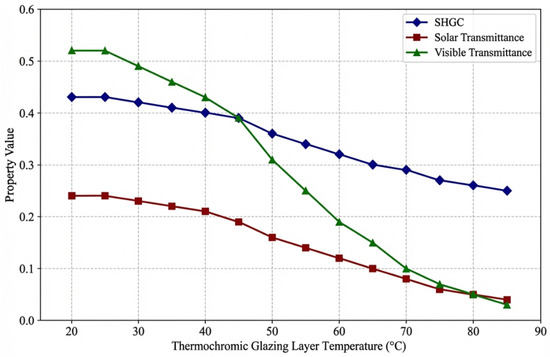
In this study, to reflect these characteristics of thermochromic envelopes in simulation, the Thermochromic Glazing Group example model provided by EnergyPlus was utilized [20]. In this model, the optical and thermal properties of thermochromic envelopes consist of multiple property sets defined by temperature ranges rather than single performance values. Each property set includes the solar heat gain coefficient (SHGC) and visible transmittance (VT), with characteristics where both SHGC and VT decrease together as temperature rises, as shown in Figure 1 [20].
Figure 1.
Variations of window properties with temperature [20].
During the EnergyPlus simulation process, the properties of thermochromic envelopes are selected and applied based on the glass temperature from the previous timestep, not the current timestep [20,21]. This is based on the assumption that the actual response speed of thermochromic materials is similar to the simulation timestep, following EnergyPlus’s standard control logic, where properties are not recalculated even if glass temperature changes within one timestep. According to this simulation implementation method, when applying thermochromic envelopes, both the cooling peak load reduction effect due to decreased solar heat gain and the indoor light environment deterioration due to visible light transmittance changes can occur simultaneously under high-temperature conditions in summer. Therefore, this study aimed to comprehensively analyze the impact of temperature-dependent SHGC and VT change characteristics of thermochromic envelopes on the light environment and cooling peak load of smart greenhouses.
2.2. Overview of Target Greenhouse and Weather Data
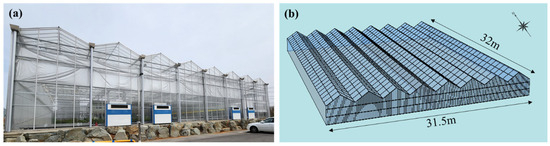
The target greenhouse for analysis is an 8-span glass greenhouse based on a smart greenhouse located in the Naju area of Jeollanam-do, with a total cultivation area of approximately 1008 m2 [6]. The plan dimensions of the greenhouse are 31.5 m in width and 32.0 m in length, with a maximum height of approximately 6–7 m, as shown in Figure 2.
Figure 2.
(a) On-site smart greenhouse and (b) simulation modeling image.
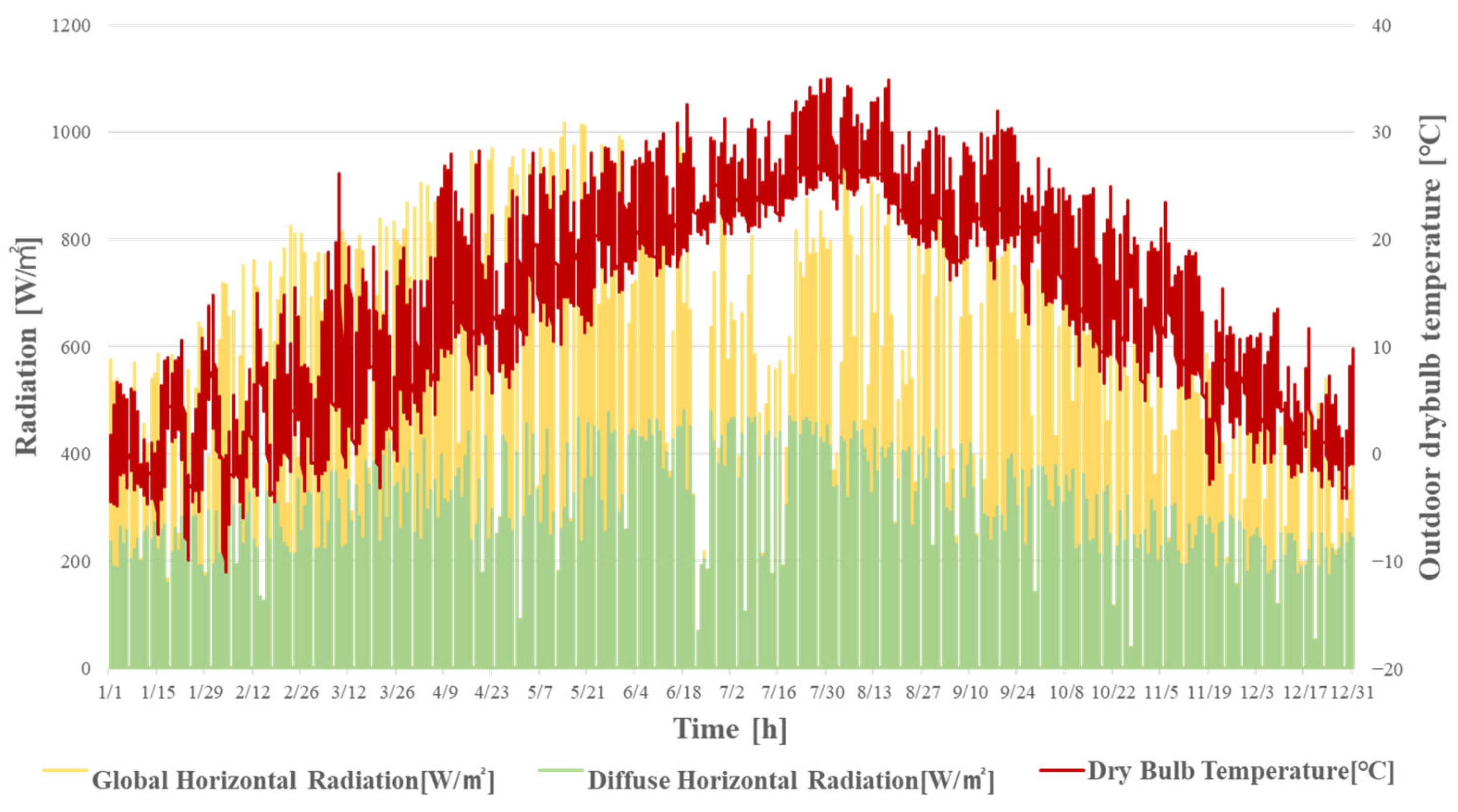
The interior of the greenhouse consists mainly of crop cultivation space, and auxiliary spaces such as the lobby, machine room, and service space were excluded from the analysis scope of this study to focus on the light environment and cooling load characteristics of the cultivation space. Three-dimensional modeling of the greenhouse was performed based on design drawings and field survey data, and the EnergyPlus simulation program was used for energy and light environment performance analysis [20]. The weather data applied to the simulation used the Gwangju region EPW (EnergyPlus Weather) file, as shown in Figure 3. The Gwangju region EPW weather file was obtained from the Climate.OneBuilding.Org repository (https://climate.onebuilding.org/WMO_Region_2_Asia/KOR_South_Korea/index.html#IDKJ_Gwangju, accessed on 15 January 2026). The same weather conditions were applied to all envelope cases so that only the impact of envelope performance differences could be compared [21]. IdealLoadsAirSystem was applied for cooling load calculation, and the cooling setpoint temperature was fixed at 25 °C. Internal heat gain, ventilation, and operating conditions were set identically in all simulation cases so that cooling load differences according to envelope type and thermochromic envelope behavior were directly reflected.
Figure 3.
Weather conditions in Gwangju, Jeollanam-do (dry-bulb temperature and solar radiation).
The simulation analysis of this study was performed targeting the representative day when the summer cooling load is greatest. The analysis target day was set as 21 July, when both solar radiation and outdoor air temperature are high, and indoor illuminance changes and cooling peak loads were analyzed, focusing on hourly simulation results during the 24 h of that day. Rather than analyzing annual or cooling period cumulative energy consumption, the analysis focused on clearly comparing envelope performance differences under maximum cooling load conditions that are meaningful from a design perspective. Through such modeling and basic condition settings, this study aimed to minimize variables according to building models and operating conditions, and quantitatively analyze the impact of envelope (covering material) type and temperature-dependent optical property changes of thermochromic envelopes on the light environment and cooling peak load of smart greenhouses.
2.3. Envelope Types and Properties
In this study, four envelope types were selected as analysis targets to compare the impact of smart greenhouse envelope performance on indoor light environment and cooling peak load, as shown in Table 1.
Table 1.
Physical properties of various smart farm covering materials.
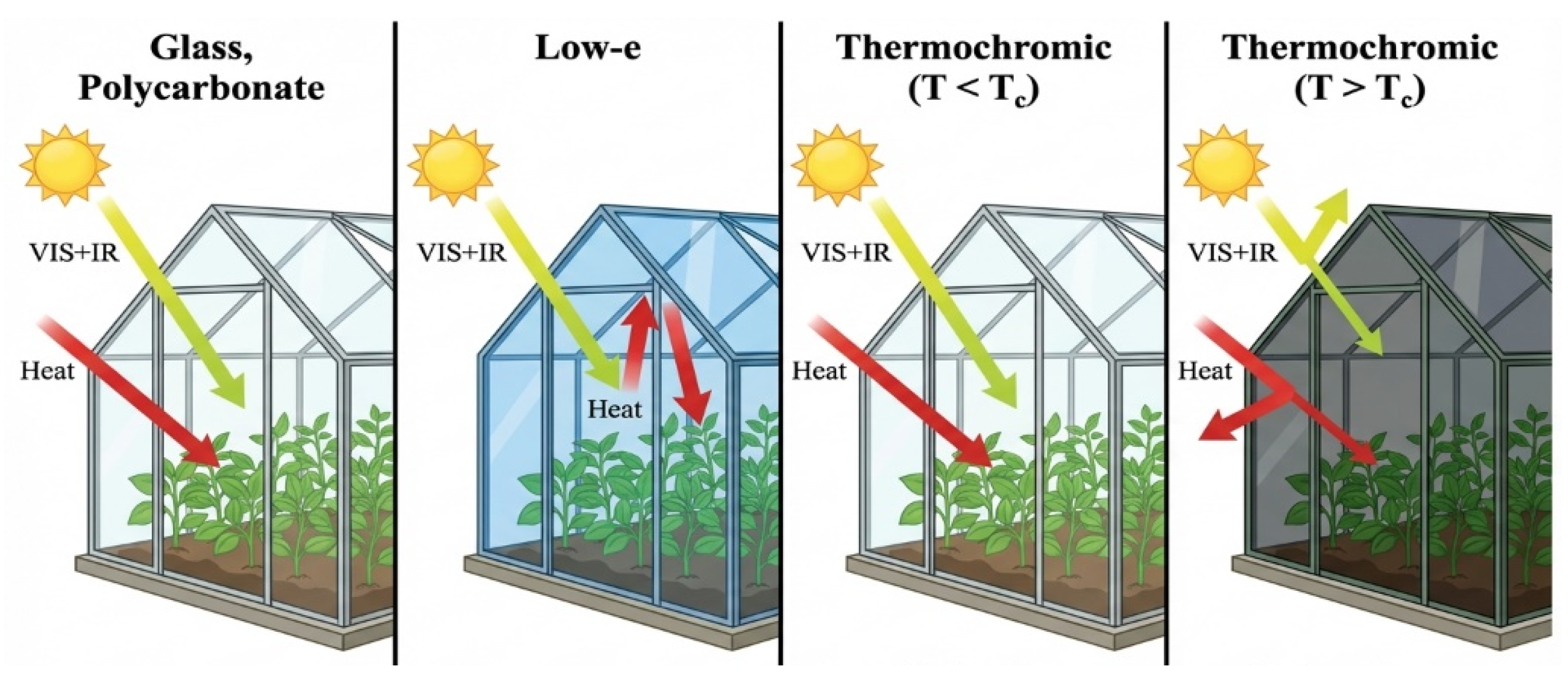
The analysis target envelopes consist of glass, Low-E glass, polycarbonate, and thermochromic envelopes, with each envelope set based on materials with high utilization potential in actual smart greenhouses. Glass and Low-E glass were assumed to be static envelopes with fixed optical and thermal properties as representative transparent envelope materials widely used in existing greenhouses and buildings. Polycarbonate envelopes were also set as materials with fixed properties, and light environment and cooling load characteristics were evaluated through comparative analysis against transparent envelopes. Thermochromic envelopes were set as dynamic envelopes where optical properties change variably according to temperature changes. In this study, based on the Thermochromic Glazing Group example model provided by EnergyPlus (v9.2.0), different optical and thermal property sets were input for each temperature range. Accordingly, thermochromic envelopes were modeled so that both solar heat gain coefficient (SHGC) and visible transmittance (VT) change together according to glass temperature changes during the simulation process, with the concept diagram shown in Figure 4. U-value, solar heat gain coefficient (SHGC), and visible transmittance (VT) for each envelope type were set by referring to literature data and EnergyPlus example values, and representative values were used so that relative performance differences between envelope types could be clearly shown. For thermochromic envelopes, temperature-range properties were applied rather than single property values to reflect both solar heat blocking effects and light environment change characteristics under high-temperature conditions in summer.
Figure 4.
Optical and thermal properties of covering materials.
Envelope properties are summarized in Table 1, and conditions other than envelopes were maintained identically in all simulation cases so that only the impact of envelope performance differences could be compared.
2.4. Evaluation Method for Light Environment and Cooling Peak Load
To simultaneously evaluate the impact of temperature-dependent optical property changes of envelope types and thermochromic envelopes on the indoor light environment and cooling peak load of smart greenhouses, an integrated simulation analysis was performed. The analysis targeted the representative day of 21 July when the summer cooling load is maximum, and comparisons and analyses were conducted focusing on hourly illuminance changes and cooling loads during the 24 h of that day. Light environment evaluation was performed based on the cultivation surface (canopy height) that directly affects crop growth. Measurement reference points were set at canopy height, with a total of 64 sensors arranged to calculate hourly indoor illuminance (lux), and the impact of natural lighting influx characteristics and visible light transmittance changes according to envelope type on the indoor light environment was analyzed. Illuminance levels and variation characteristics by envelope were compared, especially focusing on the time period around noon when solar radiation is maximum. Light environment suitability evaluation was performed based on the light compensation point and light saturation point to interpret from a crop growth perspective. This study targeted three representative crops—watermelon, paprika, and tomato—with optimal growth temperature ranges of 25–30 °C, and utilized general light compensation point and light saturation point ranges for each crop as reference indicators, as shown in Table 2. Cooling load analysis was performed based on the same representative day (21 July), and hourly cooling load changes according to envelope type were compared under cooling setpoint temperature 25 °C conditions. This study focused on cooling peak loads that are meaningful from a design perspective rather than annual or cumulative cooling energy consumption to evaluate envelope performance differences. Through this, the cooling peak load reduction effect due to decreased solar heat gain when applying thermochromic envelopes was quantitatively analyzed.
Table 2.
Light compensation point (LCP) and light saturation point (LSP) of target crops.
3. Results
3.1. Comparative Analysis of Light Environment by Envelope Type
This section analyzed the indoor light environment characteristics of smart greenhouses according to envelope type from spatial and temporal perspectives, targeting the representative day of 21 July when the summer cooling peak load occurs. The analysis was performed based on the cultivation surface (canopy height), and natural lighting influx characteristics according to envelope type, and crop growth suitability were comprehensively evaluated.
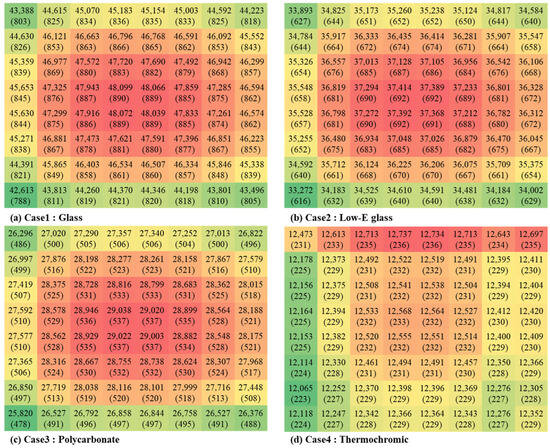
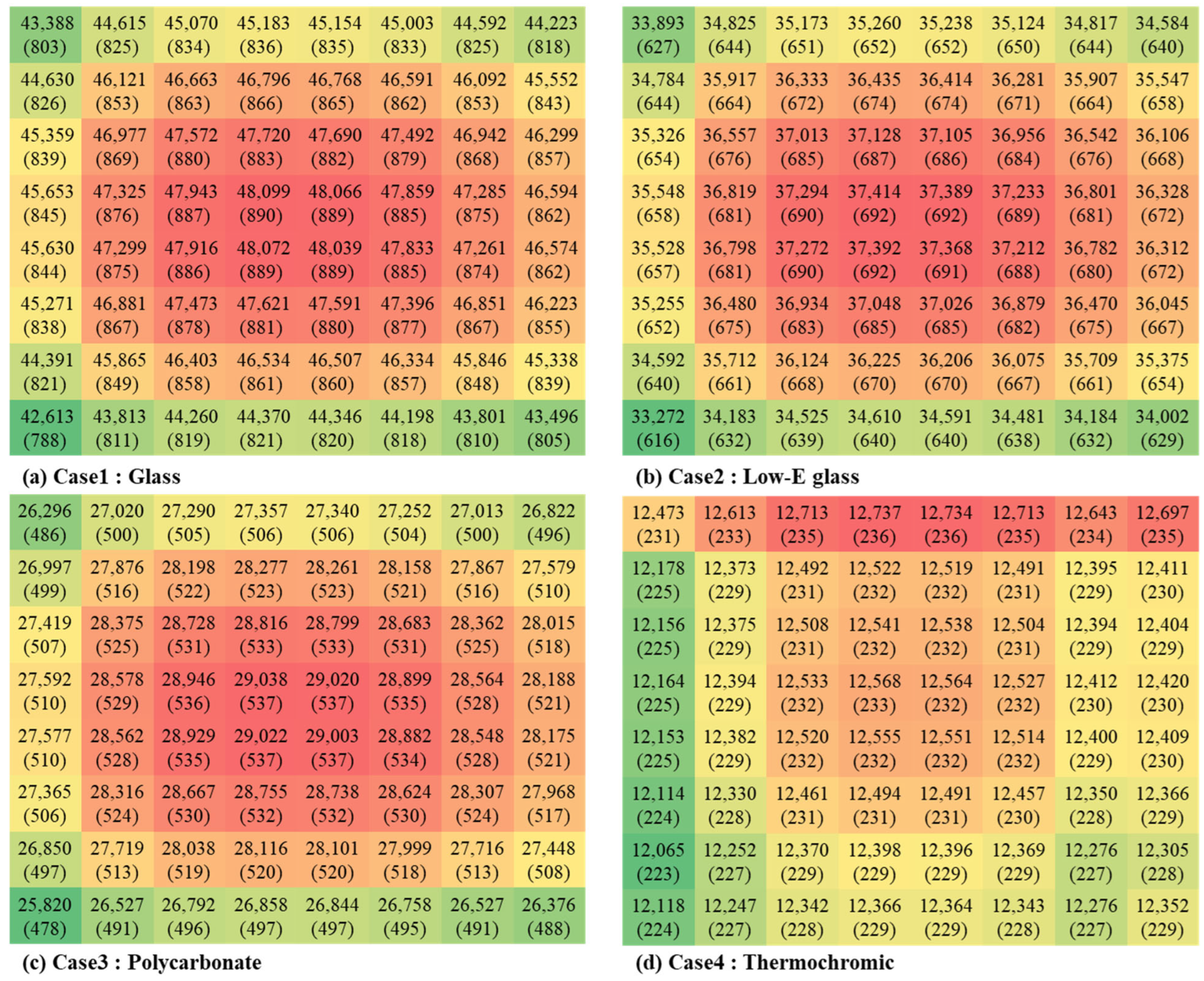
Figure 5 shows conditional formatting maps of indoor illuminance by envelope type for the noon time period on 21 July. When applying glass and Low-E glass, high illuminance levels were confirmed throughout the greenhouse, with excessive illuminance areas widely distributed, especially in the south and central areas. This is a result directly reflecting solar radiation influx, suggesting the possibility of localized light environment imbalance under high solar radiation conditions in summer. For polycarbonate envelopes, overall illuminance levels were lower than those of glass, but relatively high illuminance was still observed in some areas. In contrast, when applying thermochromic envelopes, high-illuminance areas during noon time significantly decreased, and indoor illuminance distribution was formed relatively uniformly. This is interpreted as a result reflecting the behavior of thermochromic envelopes, where visible light transmittance decreases as temperature rises.
Figure 5.
Illuminance (PPFD) distribution maps for different covering materials: (a) Case 1, (b) Case 2, (c) Case 3, and (d) Case 4.
The numerical values displayed in Figure 5 represent PPFD (Photosynthetic Photon Flux Density) in units of µmol·m−2·s−1, which quantifies the amount of photosynthetically active photons available for plant photosynthesis. PPFD serves as a direct indicator of whether the indoor light environment meets the minimum light requirement (Light Compensation Point, LCP) and remains below the maximum threshold (Light Saturation Point, LSP) for crop growth. For high-light-demanding crops such as watermelon, the LCP ranges from 50 to 100 µmol·m−2·s−1, while the LSP ranges from 800 to 1500 µmol·m−2·s−1. This means that indoor PPFD values must exceed at least 50–100 µmol·m−2·s−1 for watermelon to survive and grow normally. According to the simulation results shown in Figure 6, when conventional glass (Case 1) was applied, the indoor PPFD at summer noon reached very high values of approximately 800 to 889 µmol·m−2·s−1. These values not only satisfy the LCP for watermelon (50–100 µmol·m−2·s−1) but also fully meet the minimum growth requirements for tomato and paprika, which have lower light demands (20 µmol·m−2·s−1). However, these values far exceed the necessary range and approach the light saturation point, resulting in excessive illuminance conditions where surplus solar radiation contributes to greenhouse overheating. In contrast, when the thermochromic envelope (Case 4) was applied, the indoor PPFD during the same time period decreased significantly to 229.8 µmol·m−2·s−1 compared to conventional glass. Despite this substantial light reduction, this PPFD value still comfortably exceeds the LCP threshold not only for tomato and paprika but also for watermelon, which has the most stringent light requirements (50–100 µmol·m−2·s−1).
Figure 6.
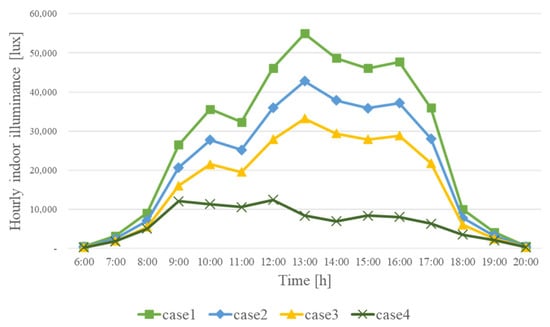
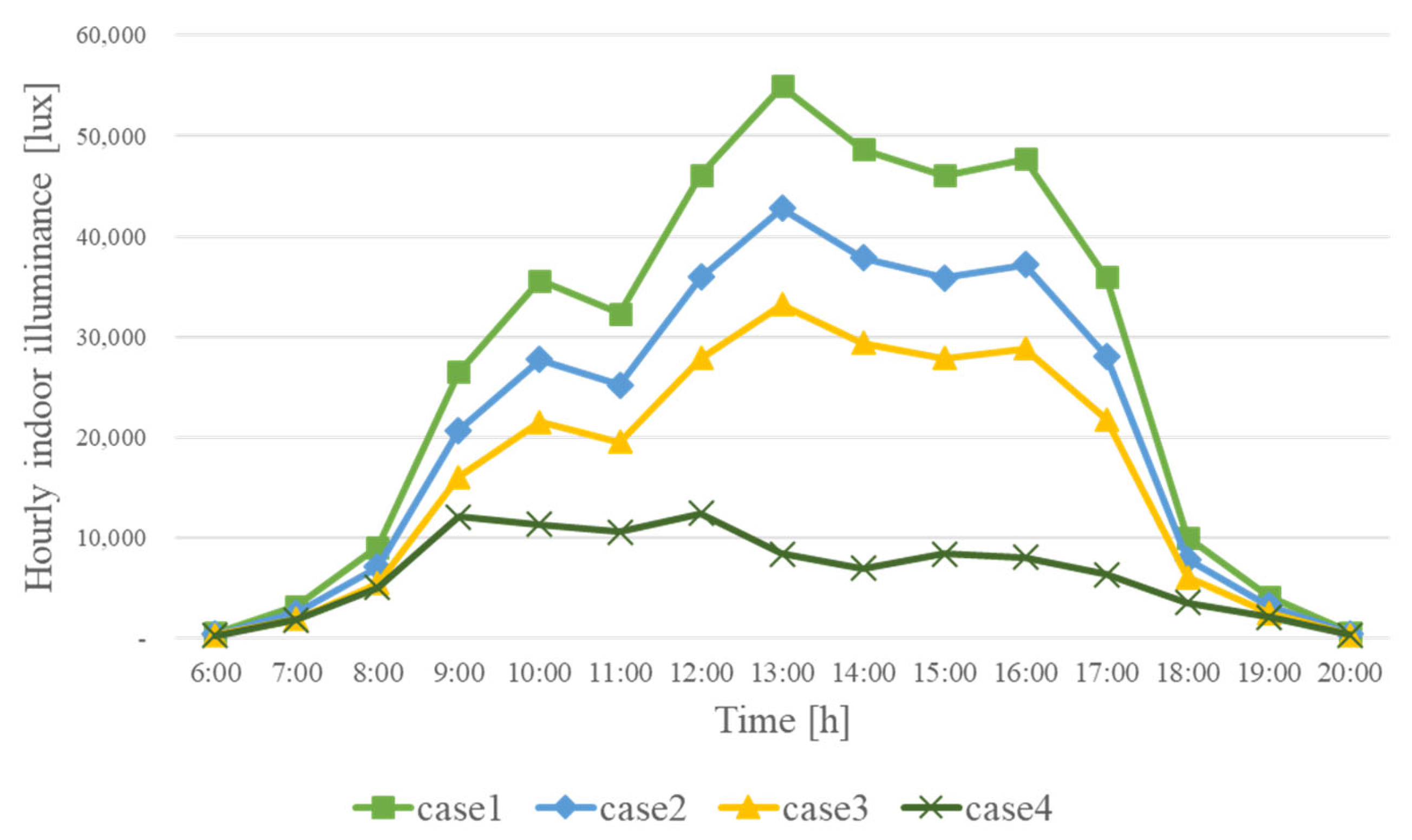
Hourly indoor illuminance comparison by covering material.
In conclusion, although the thermochromic envelope transmits significantly less light than conventional glass, it maintains PPFD levels above the minimum threshold (above LCP) required for all three crops, watermelon, tomato, and paprika, to grow, while effectively trimming only the excessive surplus light that causes crop stress. This demonstrates that thermochromic envelopes achieve a critical balance between maintaining adequate photosynthetic light provision and reducing thermal load.
Figure 6 shows the results of comparing hourly average illuminance changes throughout the day on 21 July by envelope type. All cases showed general daily variation trends where illuminance gradually increased after sunrise, reached maximum values around noon, then decreased.
Based on the noon (13:00) time period, the average illuminance of glass (Case 1) was approximately 26,482 lux, showing the highest level, while thermochromic envelopes (Case 4) were approximately 6628 lux, showing an illuminance level approximately 75% lower than glass.
For glass and Low-E glass, very high illuminance levels were maintained during time periods around noon, meaning that excessive illuminance conditions exceeding levels required for crop growth persist for long periods. In contrast, when applying thermochromic envelopes, illuminance during noon time showed a tendency to decrease relatively moderately, which is judged to be a result of visible light transmittance decreasing as outdoor air temperature and glass temperature rise. To interpret light environment characteristics by envelope type from a crop growth perspective, analysis was performed based on light compensation point and light saturation point, targeting three representative crops—watermelon, paprika, and tomato—with optimal growth temperature ranges of 25–30 °C. As a result of comparing hourly illuminance results with those standards, glass and Low-E glass were found to form excessive illuminance conditions exceeding the light saturation point during most daytime hours. For thermochromic envelopes, although illuminance during noon time decreased significantly compared to glass, sufficient time periods maintaining above the light compensation point were secured, so it was judged that the light environment necessary for growth could be satisfied by natural light alone for some crops. This suggests that, despite mitigating excessive noon illuminance by approximately 75% when applying thermochromic envelopes, a light environment margin can exist simultaneously with cooling peak load reduction.
Comprehensively, thermochromic envelopes showed the possibility of effectively mitigating excessive natural lighting under extreme summer conditions while maintaining the minimum light environment necessary for crop growth. These characteristics can be utilized as design judgment grounds for envelope and shading strategies in connection with subsequent cooling peak load analysis and shading scenario evaluation.
3.2. Comparative Analysis of Cooling Peak Load by Envelope Type
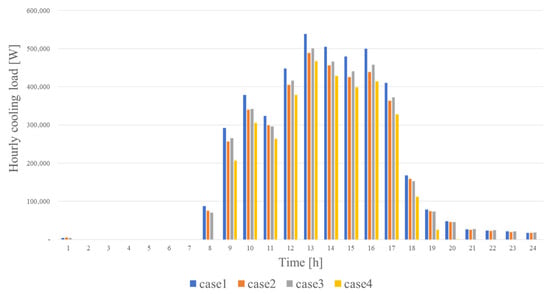
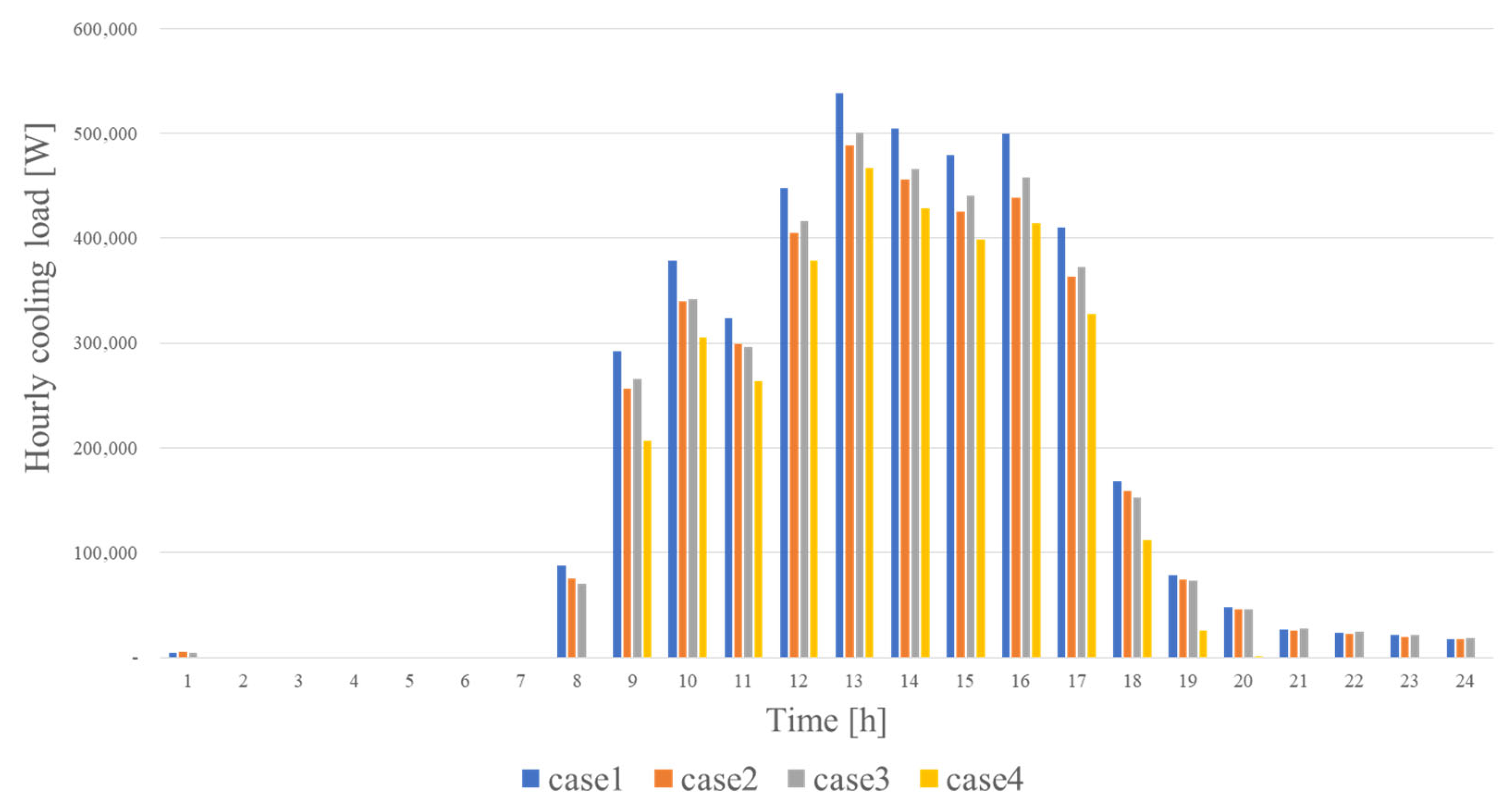
This section compared and analyzed cooling load characteristics of smart greenhouses according to envelope type, targeting the summer representative day of 21 July. The analysis was performed under cooling setpoint temperature 25 °C conditions, and envelope performance differences were evaluated, focusing on hourly cooling load changes and daily maximum cooling peak load. Figure 7 shows cooling load changes by envelope type and time. All cases showed trends where cooling loads increased from morning hours due to increased solar radiation and rising outdoor air temperature, reached maximum values after noon, then gradually decreased with decreasing solar radiation. This shows that solar radiation influx has a dominant impact on cooling load formation in greenhouse environments.
Figure 7.
Comparison of hourly cooling load for different simulation cases.
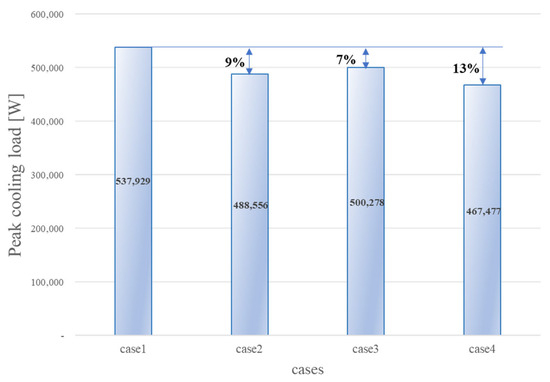
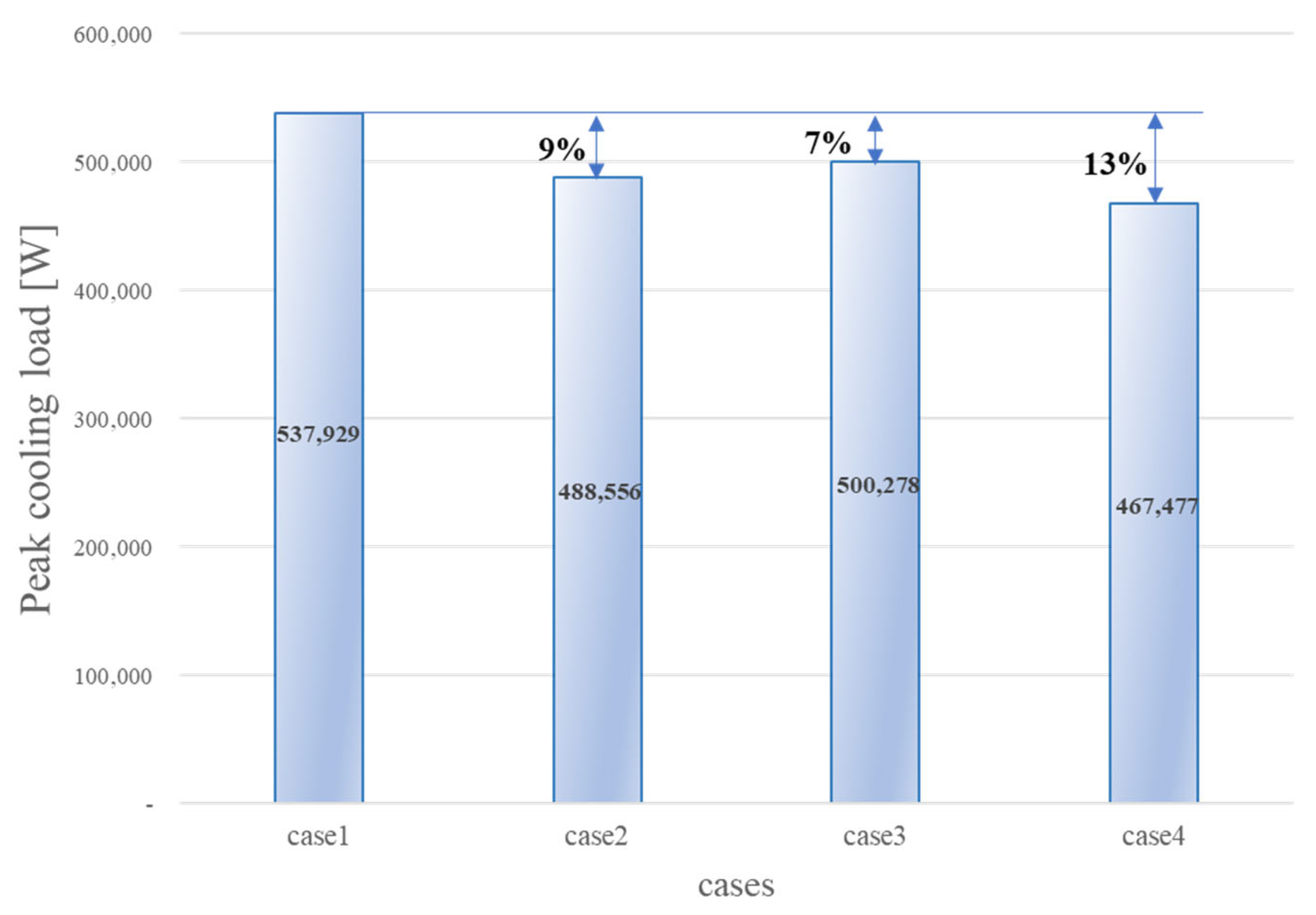
As shown in Figure 8, when applying glass, the highest cooling load occurred, with a daily maximum cooling peak load of approximately 537,929 W.
Figure 8.
Comparison of peak cooling load for different simulation cases.
This is interpreted as being due to large amounts of solar radiation entering indoors due to a high solar heat gain coefficient (SHGC). Low-E glass showed a tendency for cooling load to decrease somewhat compared to glass, but the peak load reduction rate was only about 9.2%, with high cooling loads still maintained during time periods around noon. Polycarbonate envelopes also showed limited cooling load reduction effects under extreme summer conditions, showing only about 7.0% peak load reduction compared to glass, despite solar radiation influx being suppressed to some extent. In contrast, when applying thermochromic envelopes, the cooling load increases during time periods around noon appeared relatively moderate, with the daily maximum cooling peak load analyzed as approximately 467,477 W. This is judged to be a result of solar heat gain being effectively suppressed as the SHGC of thermochromic envelopes decreased with rising outdoor air temperature and glass temperature [20]. As a result of comparing daily maximum cooling peak loads by envelope type, thermochromic envelopes showed approximately a 13.1% reduction in peak cooling load compared to glass, showing the best performance, even compared to Low-E glass (9.2%) and polycarbonate envelopes (7.0%). These results suggest that thermochromic envelopes can provide design advantages in terms of cooling equipment capacity reduction and peak power load reduction under extreme summer conditions. Synthesizing with the light environment analysis results from Section 3.1, thermochromic envelopes were found to have characteristics of mitigating excessive noon illuminance by approximately 75% while reducing cooling peak load by approximately 13.1% under high solar radiation conditions in summer.
3.3. Design Significance of Thermochromic Envelopes
Synthesizing the analysis results from Section 3.1 and Section 3.2, it can be confirmed that in adaptive building envelope design, light environment performance and cooling peak load performance are not independent indicators but closely linked characteristics [22]. Particularly under extreme summer conditions, there is a tendency for cooling peak load to increase significantly due to increased solar heat gain as natural lighting acquisition is maximized. Glass and Low-E glass provide sufficient margin in terms of light environment through high illuminance levels, but showed limitations where cooling peak load increases significantly due to excessive solar radiation influx during time periods around noon in summer. This means that envelope design prioritizing light environment performance can work disadvantageously in terms of energy performance [23,24]. Allen et al. (2017) demonstrated that thermotropic windows can achieve 22% annual energy savings in hot Mediterranean climates by dynamically controlling solar heat gain coefficient based on temperature changes, supporting the necessity of adaptive envelope strategies for cooling-dominated environments [24].
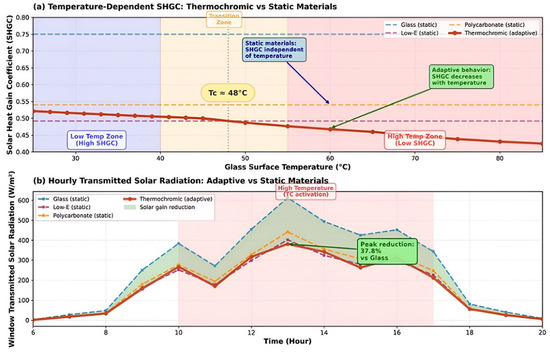
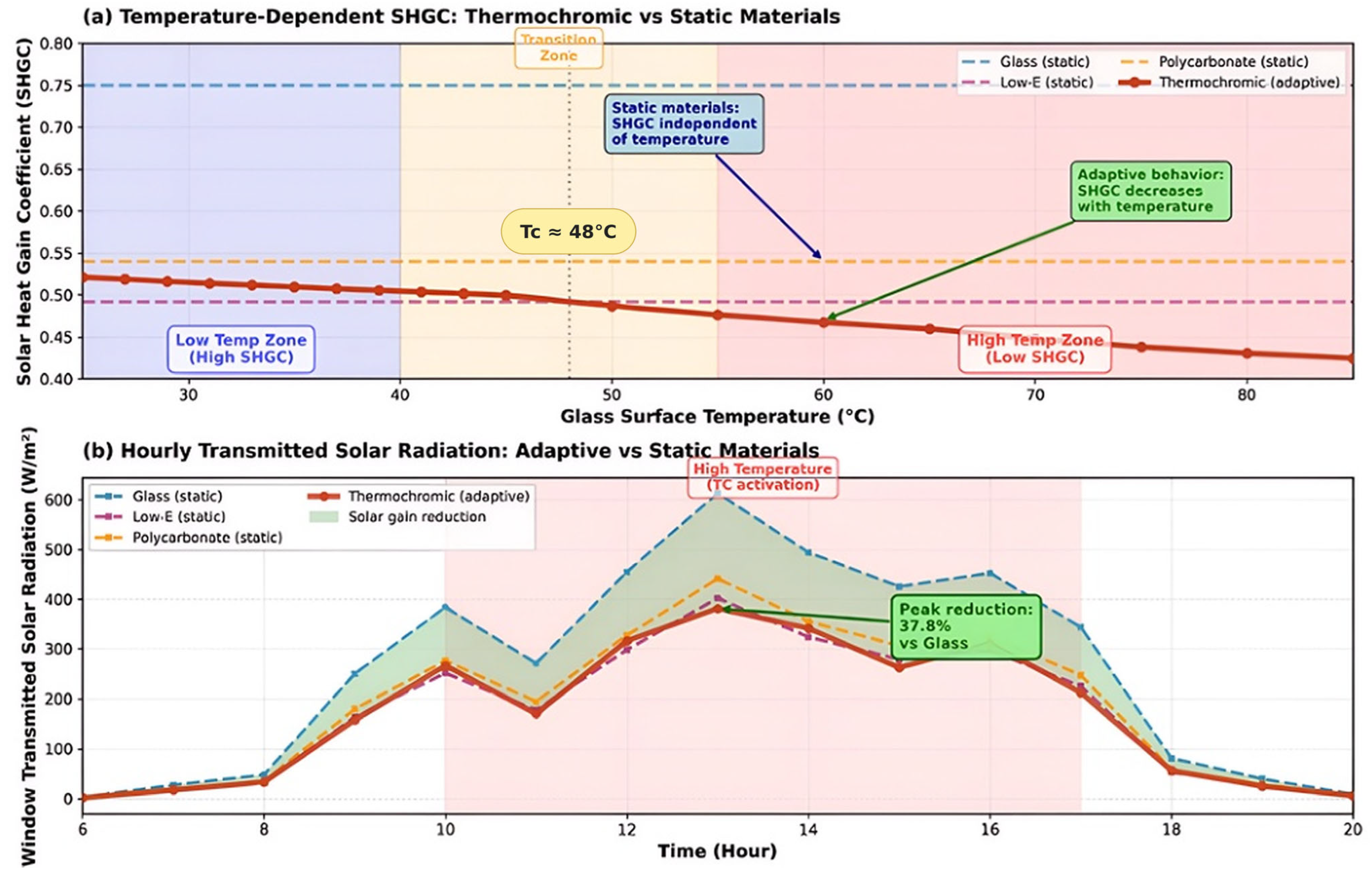
As shown in Figure 9a, while general envelope materials (Glass, Low-E, Polycarbonate) exhibit static characteristics where SHGC remains constant regardless of temperature, thermochromic windows show temperature-dependent characteristics where SHGC decreases by 18.6% from 0.521 at 25 °C to 0.425 at 85 °C as the glass surface temperature rises.
Figure 9.
Temperature-dependent SHGC of the thermochromic window. (a) SHGC decreases from 0.521 to 0.425 vs. a constant SHGC of static materials. (b) Transmitted solar radiation: 37.8% reduction at peak hour compared to clear glass.
These characteristics are divided into three operating ranges: (1) In the low-temperature range (25–40 °C), high SHGC (0.512–0.521) is maintained to maximize solar heat gain in winter; (2) In the transition range (40–55 °C), SHGC rapidly decreases centered on Tc (≈48 °C); (3) In the high-temperature range (55–85 °C), low SHGC (0.425–0.477) suppresses summer cooling loads. Performance evaluation results showed that thermochromic windows effectively suppress transmitted solar radiation during high-temperature time periods (10–17 h) through SHGC reduction (Figure 9b). Particularly at peak time (13:00), when the glass surface temperature reached 60.5 °C (exceeding Tc), SHGC decreased to 0.467, resulting in 37.8% reduction in transmitted solar radiation per unit window area compared to glass.
In contrast, thermochromic envelopes operated in the direction of mitigating excessive illuminance and effectively reducing cooling peak load under high solar radiation conditions in summer due to characteristics where SHGC and visible light transmittance decrease simultaneously as outdoor air temperature and glass temperature rise. This temperature-responsive behavior represents a paradigm shift from static to dynamic building envelopes, enabling adaptive performance optimization in response to real-time environmental conditions [25]. Quantitatively speaking, the noon average illuminance (approximately 6628 lux) when applying thermochromic envelopes sufficiently exceeds the light compensation point (approximately 1200 lux) for paprika and tomato, so it is judged that there will be no hindrance to growth. However, for watermelon with relatively high light requirements (light compensation point 3000~6000 lux), while the standard is met at clear-day noon, supplemental lighting in coordination with lighting equipment should be considered as needed on cloudy days or during time periods with insufficient solar radiation.
Consequently, thermochromic envelopes showed effects of reducing noon time illuminance by approximately 75% compared to glass while simultaneously reducing summer representative day cooling peak load by approximately 13.1%. Although illuminance levels decreased compared to glass, sufficient time periods maintaining above the light compensation point were secured, so the minimum light environment necessary for crop growth was judged to be satisfied. These results suggest that thermochromic envelopes are suitable for envelope design strategies oriented toward “quantitative moderation of light environment” rather than “light environment maximization.”
In other words, in smart greenhouses where cooling equipment capacity and peak power burden are important design conditions in summer, thermochromic envelopes that can mitigate excessive noon illuminance to approximately 75% levels while reducing cooling peak load by 13% or more can be a reasonable alternative, forming a balance point between light environment and energy performance.
Comprehensively, the design value of thermochromic envelopes lies not in the excellence of single performance indicators, but in their role as “adaptive envelopes” that can quantitatively reduce cooling peak load while satisfying light environment requirement levels under extreme summer conditions [24,25]. As emphasized by Perino and Serra (2015), the transition from static to adaptable building envelope systems represents a fundamental shift in energy-efficient design philosophy, where dynamic responsiveness to climatic conditions becomes essential for optimizing both thermal and luminous performance [25]. These characteristics can be utilized even more effectively when combined with shading strategies under conditions where the light environment margin is secured, providing important implications for smart greenhouse envelope and environmental control design [25,26].
4. Conclusions
Limitations
This study has several limitations that should be acknowledged for proper interpretation of the findings. The analysis was conducted using a single design day (21 July) representing peak summer cooling conditions. While this approach is appropriate for evaluating maximum cooling demand and equipment sizing requirements, it does not capture seasonal variations in solar geometry (solar altitude and azimuth angles), day length changes from June to September, or cumulative thermal mass effects across the entire cooling period. Under a full seasonal simulation, thermochromic envelope performance may differ depending on the frequency distribution and duration of temperature conditions that trigger thermochromic phase transitions, the ratio of clear to cloudy days affecting solar heat gain patterns, performance during shoulder seasons (spring and autumn) when transition temperatures occur more frequently, and interaction effects with heating loads during cooler periods. Additionally, this study focused on peak cooling load reduction rather than annual or seasonal cumulative energy consumption. The design day approach effectively identifies maximum load conditions critical for equipment sizing and peak demand management, but does not provide comprehensive insights into seasonal or annual energy cost implications. Furthermore, the findings are based on EnergyPlus simulation with thermochromic properties derived from literature sources and example models [20]. While simulation provides controlled comparison conditions, experimental validation using actual thermochromic envelope installations in operating smart greenhouses would strengthen the conclusions and reveal real-world performance variations not fully captured in simulation models. Despite these limitations, the design day approach provides valuable design-relevant insights for envelope selection under critical thermal stress conditions and establishes a foundation for more comprehensive seasonal and annual analyses in future research.
This study compared and analyzed light environment and cooling peak load characteristics according to envelope type (glass, Low-E glass, polycarbonate, thermochromic envelopes) through simulation-based targeting of a smart greenhouse under summer representative day (21 July) conditions. Particularly, the impact of temperature-dependent SHGC and visible transmittance change characteristics of thermochromic envelopes on light environment and energy performance was evaluated. The main conclusions derived from this study are as follows.
First, light environment characteristics of summer smart greenhouses showed distinct differences according to envelope type. Glass and Low-E glass showed very high illuminance levels during time periods around noon, providing a light environment margin, but excessive illuminance problems occurred under extreme summer conditions. In contrast, thermochromic envelopes were found to reduce noon time average illuminance by approximately 75% compared to glass, effectively mitigating excessive natural lighting.
Second, as a result of cooling peak load analysis, thermochromic envelopes showed performance reducing daily maximum cooling peak load by approximately 13.1% compared to glass, based on a summer representative day due to solar heat gain coefficient (SHGC) reduction effects. This is the best peak load reduction effect compared to Low-E glass (approximately 9.2%) and polycarbonate envelopes (approximately 7.0%).
Third, when comprehensively considering light environment and cooling peak load, thermochromic envelopes were evaluated as suitable alternatives for envelope design strategies that simultaneously improve energy performance through “quantitative moderation of light environment” rather than “light environment maximization.” Although illuminance levels decreased compared to glass, sufficient time periods maintaining above the light compensation point were secured, so the minimum light environment necessary for crop growth was analyzed to be satisfied.
Fourth, the possibility was confirmed that cooling peak load can be additionally reduced by combining shading strategies under conditions where the light environment margin is secured when applying thermochromic envelopes. This suggests that thermochromic envelopes can further improve the summer energy performance of smart greenhouses through combined control strategies with shading systems, not just a standalone application.
Comprehensively, this study quantitatively presented that thermochromic envelopes can be utilized as “adaptive envelopes” that can mitigate excessive noon illuminance to approximately 75% levels while reducing cooling peak load by 13% or more under extreme summer conditions in smart greenhouses. In future research, it is judged necessary to further expand the applicability of thermochromic envelopes through annual energy performance evaluation across all seasons to assess cumulative energy savings and cost-effectiveness, seasonal analysis including heating loads and shoulder season performance to understand year-round behavior, linkage analysis with environmental management systems (EMS) and automatic shading control for optimized integrated strategies, and experimental validation using actual thermochromic installations in operating greenhouses to verify simulation predictions and identify real-world performance factors. Such comprehensive studies will address the limitations of the current design day approach and provide practical guidelines for implementing thermochromic envelope technology in commercial smart greenhouse applications.
Author Contributions
Conceptualization, J.S. and D.-Y.P.; methodology, Y.-H.J.; software, J.S. and D.-Y.P.; validation, D.-S.C.; formal analysis, Y.-H.J.; writing—original draft, J.S. and D.-Y.P.; writing—review and editing, J.S. and D.-Y.P.; supervision, D.-S.C. All authors have read and agreed to the published version of the manuscript.
Funding
This work was supported by the National Research Foundation of Korea (NRF) grant funded by the Korea government (MSIT) (RS-2025-24533343) and this research was supported by the basic research fund of Chungwoon University in 2025.
Data Availability Statement
The original contributions presented in this study are included in the article. Further inquiries can be directed to the corresponding author.
Acknowledgments
During the revision of this manuscript, the authors used Genspark AI (https://www.genspark.ai/) for English language polishing, readability improvement, and limited editorial assistance in organizing revision-related text. AI assistance was also used as a supportive tool during literature-related wording revision and reference-format checking. However, all literature selection, reading of the cited articles, scientific interpretation, citation relevance assessment, quotation verification, and final validation of all references were performed manually by the authors. The authors reviewed and edited all AI-assisted content and take full responsibility for the accuracy, validity, and integrity of this publication.
Conflicts of Interest
The authors declare no conflicts of interest.
References
- Boulard, T.; Wang, S. Greenhouse crop transpiration simulation from external climate conditions. Agric. For. Meteorol. 2000, 100, 25–34. [Google Scholar] [CrossRef] [Scilit]
- Fatnassi, H.; Boulard, T.; Bouirden, L. Simulation of climatic conditions in full-scale greenhouse fitted with insect-proof screens. Agric. For. Meteorol. 2003, 118, 97–111. [Google Scholar] [CrossRef] [Scilit]
- Sethi, V.P.; Sumathy, K.; Lee, C.; Pal, D.S. Thermal modeling aspects of solar greenhouse microclimate control: A review on heating technologies. Sol. Energy 2013, 96, 56–82. [Google Scholar] [CrossRef] [Scilit]
- Granqvist, C.G. Transparent conductors as solar energy materials: A panoramic review. Sol. Energy Mater. Sol. Cells 2007, 91, 1529–1598. [Google Scholar] [CrossRef] [Scilit]
- Hemming, S.; Mohammadkhani, V.; Dueck, T. Diffuse greenhouse covering materials—Material technology, measurements and evaluation of optical properties. Acta Hortic. 2008, 797, 469–476. [Google Scholar] [CrossRef] [Scilit]
- Park, D.-Y.; Lee, H.-J.; Yun, S.-I.; Choi, S.-M. Simulation Analysis of Daylight Characteristics and Cooling Load Based on Performance Test of Covering Materials Used in Smart Farms. Energies 2021, 14, 6331. [Google Scholar] [CrossRef] [Scilit]
- Baetens, R.; Jelle, B.P.; Gustavsen, A. Properties, requirements and possibilities of smart windows for dynamic daylight and solar energy control. Sol. Energy Mater. Sol. Cells 2010, 94, 87–105. [Google Scholar] [CrossRef] [Scilit]
- Li, S.-Y.; Niklasson, G.A.; Granqvist, C.G. Thermochromic fenestration with VO2-based materials: Three challenges and how they can be met. Thin Solid Films 2012, 520, 3823–3828. [Google Scholar] [CrossRef] [Scilit]
- Wu, S.; Sun, H.; Duan, M.; Lin, B.; Huang, Z. Energy performance of thermochromic smart windows in office buildings in different climate zones. In Proceedings of the Building Simulation 2023: 18th Conference of IBPSA, Shanghai, China, 4–6 September 2023; pp. 1378–1385. [Google Scholar] [CrossRef] [Scilit]
- Rashidzadeh, Z.; Heidari Matin, N. A Comparative Study on Smart Windows Focusing on Climate-Based Energy Performance and Users’ Comfort Attributes. Sustainability 2023, 15, 2294. [Google Scholar] [CrossRef] [Scilit]
- Aburas, M.; Ebendorff-Heidepriem, H.; Wu, Y.; Soebarto, V.; Williamson, T.; Liang, R. Thermochromic smart window technologies for building application: A review. Appl. Energy 2019, 255, 113522. [Google Scholar] [CrossRef] [Scilit]
- Harjunowibowo, D.; Ding, Y.; Omer, S.A.; Riffat, S.B. Reducing greenhouse energy consumption using novelty rooftop: A simulation. In Proceedings of the 16th International Conference on Sustainable Energy Technologies—SET 2017, Bologna, Italy, 17–20 July 2017. [Google Scholar]
- Favoino, F.; Overend, M.; Jin, Q. The optimal thermo-optical properties and energy saving potential of adaptive glazing technologies. Appl. Energy 2015, 156, 1–15. [Google Scholar] [CrossRef] [Scilit]
- Jelle, B.P.; Kalnæs, S.E.; Gao, T. Low-emissivity materials for building applications. Energy Build. 2015, 96, 329–356. [Google Scholar] [CrossRef] [Scilit]
- Li, T.; Heuvelink, E.; Dueck, T.A.; Janse, J.; Gort, G.; Marcelis, L.F.M. Enhancement of crop photosynthesis by diffuse light: Quantifying the contributing factors. Ann. Bot. 2014, 114, 145–156. [Google Scholar] [CrossRef] [Scilit] [PubMed]
- Shamshiri, R.R.; Kalantari, F.; Ting, K.C.; Thorp, K.R.; Hameed, I.A.; Weltzien, C.; Ahmad, D.; Shad, Z.M. Advances in greenhouse automation and controlled environment agriculture. Int. J. Agric. Biol. Eng. 2018, 11, 1–22. [Google Scholar] [CrossRef] [Scilit]
- Morin, F.J. Oxides which show a metal-to-insulator transition at the Neel temperature. Phys. Rev. Lett. 1959, 3, 34–36. [Google Scholar] [CrossRef] [Scilit]
- Warwick, M.E.A.; Ridley, I.; Binions, R. The effect of transition gradient in thermochromic glazing systems. Energy Build. 2014, 77, 80–90. [Google Scholar] [CrossRef] [Scilit]
- Taiz, L.; Zeiger, E.; Møller, I.M.; Murphy, A. Plant Physiology and Development, 6th ed.; Sinauer Associates: Sunderland, MA, USA, 2015. [Google Scholar]
- U.S. Department of Energy. EnergyPlus Engineering Reference, Version 9.2; DOE: Washington, DC, USA, 2019.
- Crawley, D.B.; Lawrie, L.K.; Winkelmann, F.C.; Buhl, W.; Huang, Y.; Pedersen, C.O.; Strand, R.K.; Liesen, R.J.; Fisher, D.E.; Witte, M.J.; et al. EnergyPlus: Creating a new-generation building energy simulation program. Energy Build. 2001, 33, 319–331. [Google Scholar] [CrossRef] [Scilit]
- Favoino, F.; Goia, F.; Perino, M.; Serra, V. Experimental analysis of the energy performance of an ACTive, RESponsive and Solar (ACTRESS) façade module. Sol. Energy 2016, 133, 226–248. [Google Scholar] [CrossRef] [Scilit]
- Loonen, R.C.G.M.; Trčka, M.; Cóstola, D.; Hensen, J.L.M. Climate adaptive building shells. Renew. Sustain. Energy Rev. 2013, 25, 483–493. [Google Scholar] [CrossRef] [Scilit]
- Allen, K.; Connelly, K.; Rutherford, P.; Wu, Y. Smart windows—Dynamic control of building energy performance. Energy Build. 2017, 139, 535–546. [Google Scholar] [CrossRef] [Scilit]
- Perino, M.; Serra, V. Switching from static to adaptable and dynamic building envelopes: A paradigm shift for the energy efficiency in buildings. J. Facade Des. Eng. 2015, 3, 143–163. [Google Scholar] [CrossRef] [Scilit]
- Kibert, C.J. Sustainable Construction: Green Building Design and Delivery, 4th ed.; Wiley: Hoboken, NJ, USA, 2016. [Google Scholar]

Disclaimer/Publisher’s Note: The statements, opinions and data contained in all publications are solely those of the individual author(s) and contributor(s) and not of MDPI and/or the editor(s). MDPI and/or the editor(s) disclaim responsibility for any injury to people or property resulting from any ideas, methods, instructions or products referred to in the content. |
© 2026 by the authors. Licensee MDPI, Basel, Switzerland. This article is an open access article distributed under the terms and conditions of the Creative Commons Attribution (CC BY) license.