


Abstract
Frequency Response Analysis (FRA) is a proven method for detecting mechanical faults in transformers, such as winding deformations and short circuits. However, traditional FRA interpretation relies heavily on visual and subjective comparison of frequency response curves, which can introduce human bias and lead to inconsistent results. Integrating Machine Learning (ML) with FRA can significantly enhance fault diagnosis by automatically identifying complex patterns within the data that are difficult to detect using through human analysis. This integration can automate diagnostics, enhance accuracy, improve predictive maintenance, reduce reliance on expert interpretation and curtail operational costs. This paper reviews the application of FRA and ML alongside complementary techniques for transformer winding health assessment.
1. Introduction
Power transformers are critical in electrical power networks. Their failure can result in severe outages, costly repairs, and safety risks. Throughout their operational lifetime, transformers are subjected to various stresses, including mechanical, electrical, chemical, thermal, and environmental factors [1,2]. These stresses can lead to faults such as short circuits, overloads, and aging, affecting key components such as windings, insulation, bushings, and cooling systems [3,4]. The windings are particularly susceptible to deformations caused by mechanical forces in current-carrying conductors. High fault currents, overcurrent, or improper handling and transportation can cause these deformations and alter the key electrical properties like inductance and capacitance and increase the risk of failure [3,5,6]. Deformations may occur during transportation due to inadequate securing or mechanical stress [7,8].
Detecting winding deformations is crucial for transformer health management but remains challenging. Common conventional diagnostic techniques, such as Dissolved Gas Analysis (DGA) and Differential Protection Schemes, often fail to accurately detect these faults [9]. For example, DGA can misinterpret gas signatures, especially in air-cooled transformers and Differential Protection Schemes rely on precise measurements that are not always available [10,11]. DGA also may fails to detect some mechanical faults, such as axial and radial forces during high fault currents or transportation in transformer windings [12]. Similarly, differential current analysis has limitations under specific conditions, including inrush currents or current transformer saturation [11]. As transformers exceed their design lives, replacing all aging units becomes financially impractical. Instead, condition assessment through advanced monitoring techniques has become essential for ensuring the reliability of aging transformers and preventing costly failures [13].
In this context, Frequency Response Analysis (FRA) emerges as a powerful diagnostic technique for detecting winding deformations often missed by other methods. FRA measures the transformer’s electrical response across a range of frequencies to assess the winding condition [14,15]. It is susceptible to minor changes in winding geometry caused by mechanical stresses [16]. This makes FRA reliable, non-invasive, and useful for monitoring and diagnosing faults like axial displacements and radial deformations [17,18]. Despite its advantages, interpreting FRA results remains complex. The relationship between faults and their impact on frequency responses often requires expert judgment [15,19,20]. The variability in FRA signatures based on fault conditions and transformer designs creates inconsistencies in fault detection [9,19]. There are several methods focused on identifying radial displacement, such as analyzing changes in Dissipation Factor (DPI) and short-circuit natural frequencies. While these approaches offer practical solutions for early fault detection [21], they cannot account for variables such as time and temperature that require more complex analysis methods. Combining FRA data with Machine Learning (ML) can offer an effective approach to addressing these challenges.
ML techniques offer a way to improve FRA interpretation. Algorithms such as Support Vector Machines (SVM), Radial Basis Function (RBF) neural networks (NN), and k-nearest neighbors (kNN) provide automated methods for analyzing FRA data [22,23]. These methods reduce the need for expert interpretation and offer consistent diagnostics [9,24]. ML models can learn from large datasets of FRA measurements and identify patterns and correlations that are difficult for human analysts to detect [25,26].
Combining FRA with ML can solve inherent problems of conventional diagnostic approaches. For example, while conventional methods such as lumped circuit models and FEM-based simulations can improve fault diagnosis, they require large datasets and specialized skills, that in simulation-based methods, are not available in all cases. These approaches are often slow and may not give clear results [27]. ML algorithms can process large datasets, identify subtle patterns, and make precise fault classifications with improved accuracy and efficiency compared to conventional methods [25,28]. They are also flexible, as they can adapt to new data and various fault scenarios and provide faster and more accurate decisions for transformer maintenance [29]. The objective of this paper is to explore how ML can enhance the interpretation of FRA results. It highlights gaps in existing methods and proposes future research directions to enhance diagnostic efficiency and reliability. The paper also explores the principles of FRA, its evolution as a diagnostic tool, complementary techniques along it and the challenges in interpreting FRA data. Furthermore, it demonstrates how integrating ML with FRA can enhance fault detection accuracy, minimizes reliance on expert intervention, and be being an effective in transformer maintenance decisions.
2. FRA in Transformer Diagnostics
2.1. Principles of FRA
Transformers can be modeled as lumped RLC circuit as comprising Resistance (from windings), Self and mutual Inductance (from coils), and Capacitance (from insulation layers and ground) [30]. During Frequency Response Analysis (FRA), a known input signal, typically a sinusoidal wave, is injected into the transformer, and the output signal is measured across a range of frequencies [31]. The ratio of output to input (transfer function) is calculated at each frequency, which provides a frequency response curve [32]. By comparing this signature to a reference signature recorded, it allows the identification of changes in the transformer’s characteristics [33]. There are several ways to examine the condition of a power transformer’s winding; however, FRA is a widely used tool to detect mechanical changes inside a power transformer [34,35]. Mechanical stresses, such as high-current faults or improper transportation, significantly affect transformer windings. For example, axial displacement and radial deformation can significantly alter the electrical properties of the windings [12,36]. FRA can measure the transformer’s response to different frequencies and provides a unique signature of the transformer’s condition [37].
Researchers detect changes by comparing the current transformer performance to its original fingerprint recorded under baseline conditions. This comparison helps identifying faults and diagnose the problem [38,39]. In addition to detecting initial mechanical issues, FRA can also be employed to verify the integrity of a transformer after repairs. Deviations in frequency response caused by changes in winding structure, grounding modifications, or clamping pressure adjustments provide critical insight into the success of repair work and the overall health of the transformer [13].
2.2. Historical Development and Evolution of FRA
FRA has undergone significant development since its introduction in the late 1970s by Dick and Erven at Ontario Hydro [26]. In the 1990s, FRA gained widespread international recognition and was introduced at global conferences and technical meetings. This period also saw the development of the first commercially available systems for on-site FRA measurements. Other developments in the field such as Sweep Frequency Response Analysis (SFRA) and Impulse Frequency Response Analysis (IFRA) were introduced and allowed more precise diagnostics across various frequencies [40]. In the 2000s, enhanced measurement tools and digital processing techniques enabled more effective faults detection and improved FRA’s accuracy and reliability. New methods, such as using numerical indices like Euclidean Distance, were developed to quantify differences in transfer functions, thereby promoting objective diagnostics [27,28]. FRA gained global recognition with guidelines from the IEC, CIGRE, and IEEE, which established its status as a standard diagnostic tool [25,41]. Since the 2010s, ML algorithms have automated data interpretation and reduced the need for expert judgment and increased diagnostic reliability. Figure 1 presents a historical timeline of FRA and shows the progression from its introduction, through its standardization and technological advancements, to its current integration with ML techniques.
Figure 1.
Timeline of events in the development of FRA.
2.3. Conducting FRA Analyses
FRA measures the response of transformer windings to a low-voltage signal to identify mechanical faults through two main methods: impulse-based and swept frequency response [42,43]. The impulse-based method uses high-energy pulses to detect winding deformations and insulation issues by analyzing time-domain data converted to the frequency domain [44]. The swept frequency method, favored for its accuracy, analyzes amplitude and phase shifts to identify winding deformations [39,45].
According to IEEE, CIGRE, and IEC standards [4,16,46], FRA measurements are classified based on the connection type: end-to-end or inter-winding tests. Each connection type emphasizes specific transformer characteristics and is suitable for detecting particular faults (Figure 2) [12].
Figure 2.
FRA measurement configurations: (a) End-to-End Open-Circuit, (b) End-to-End Short-Circuit, (c) Capacitive Inter-Winding, (d) Inductive Inter-Winding.
The following Table 1 summarizes the sensitivity of each FRA connection type across different frequency ranges and the specific faults each method best detects [47,48,49].
Table 1.
Sensitivity of FRA measurement configurations to defects.
This structured approach allows practitioners to select the optimal FRA connection for targeted diagnostics and improves accuracy and reliability in transformer fault detection [50,51].
2.4. Interpreting FRA Results
Interpreting FRA results poses challenges due to the necessity of accurately comparing current measurements with reference data [52]. Two primary methods are employed to interpret FRA results:
- Verifying alignment with expected frequency response patterns.
- Comparing current measurements against a baseline reference to identify discrepancies.
The objective is to assess the transformer’s condition, identify any shifts or damage to components, and determine whether maintenance or replacement is necessary [53]. Factors such as changes in clamping pressure or modifications to the grounding configuration can significantly influence FRA signatures and shift resonance frequencies or alter amplitude responses [13]. Understanding these influences is essential for accurate interpretation, as they can mask or mimic the presence of mechanical faults.
2.5. Frequency Ranges and Fault Detection
The natural frequencies of a transformer’s windings are inversely related to its size; larger transformers, due to their larger windings with higher inductance and capacitance, exhibit lower natural resonance frequencies [54]. Higher inductance, increased capacitance, and longer electrical paths, all of which contribute to a shift toward lower-frequency resonance peaks. Dividing the frequency response spectrum into distinct sub-bands (low, medium, and high frequencies) allows for the isolation of specific transformer components that contribute to fault conditions, which improves analysis. This focused approach, links faults to different parts of the equipment, e.g., the winding structure, core, and mutual inductance between windings. Using numerical indices in each sub-band provides quantitative features that allow capturing subtle fault characteristics and enhance the accuracy [55]. Table 2 presents the commonly used FRA frequency ranges and their typical fault associations for core-type transformers with disk windings [5,45,56,57]. Although these trends are generally consistent, variations may occur across different transformer types and winding configurations, highlighting the need for further research to explore these differences and refine diagnostic accuracy.
Table 2.
Frequency ranges and related specific faults.
Detection of a fault by FRA requires a significant change in the inductance or capacitance occur in a substantial portion of the winding [5]. Faults that do not initially produce noticeable changes may go undetected but can become detectable, if they lead to secondary damage. Examples include short-circuited turns or severe localized winding damage, both causing measurable impedance variations [5]. Short-circuited turns alter the transformer’s low-frequency response and affect its magnetizing properties [58]. Circulating current loops of sufficient magnitude, can redirect leakage flux into the core and also impact the low-frequency response [58]. If the core is ungrounded, it changes the shunt capacitance of the winding closest to the core and influences the low-frequency response.
The medium-frequency response is sensitive to faults that modify the characteristics of the entire winding. An increase in medium-frequency resonances generally indicates axial movement of a winding, while a significant decrease often suggests radial displacement, such as hoop buckling of the inner winding [59,60]. Minor changes in this frequency range are commonly due to the windings settling into their final position and do not necessarily indicate a fault.
The high-frequency response serves as a sensitive indicator of localized faults within the winding [61]. Such faults can cause unpredictable changes and the appearance of new resonant frequencies. High-frequency response is also influenced by grounding issues in the transformer tank or the measurement cables. Grounding problems in the tank affect all windings uniformly and are relatively easy to identify. Localized damage typically impacts only one winding or a single phase, particularly in severe cases.
Capacitance and inductance changes have a noticeable effect on the output of FRA in transformer windings. Capacitance shifts the resonance points at low frequencies, and inductance impacts a broader range of frequencies. These changes are critical because they can lead to an incorrect interpretation of the transformer’s condition if not properly understood. Recognizing these electrical variations is essential to avoid distortions in the FRA curve and misdiagnosis. For example, combined changes in capacitance and inductance can cause distortions in FRA curves and raise the risk of incorrect fault identification [62].
FRA interpretation methods often rely on subjective visual inspection of curves and expert judgment to assess transformer conditions [25,63]. Recently, researchers have focused on developing objective methods to reduce dependence on experts by exploring numerical indices, high-frequency simulation models, artificial intelligence algorithms, or a combination of these [47,50,64,65,66]. The FRA data in interpretation studies are derived from real transformers, laboratory experiments, or simulation studies.
Various numerical indices are used to quantify differences in transformers [67]. These indices include Absolute Logarithmic Error (ALSE), Logarithmic Correlation Coefficient (LCC), Cross-Correlation Function (CCF), Euclidean Distance (ED), Standard Deviation (SD), Cumulative Sum of Differences (CSD), Root Mean Square Error (RMSE), Shape Distance Algorithm (SDA), and Shape Error (SE) [47,50,64,65]. Indices like CSD, ED, LCC, SD, SDA, RMSE, and SE exhibit high sensitivity to frequency shifts and amplitude changes, making them effective in detecting mechanical changes [65]. Indices such as Correlation Coefficient (CC), CCF, LCC, SDA, SE, and ALSE show minimal data-size dependency and also provide consistent reliability across various measurement resolutions [47]. Bigdeli et al. [68] tested 21 indices on both model and real transformers to classify fault types like axial displacement and short circuits. The method accurately detected faults and estimated severity with a probability above 50%. Based on these findings, using LCC, SDA, SE, and CCF are recommended as the most suitable indices for interpreting FRA data [5]. These indices provide a robust quantitative approach and lay the groundwork for developing standardized thresholds and also advanced algorithms for identifying fault types [66]. On the other hand, data analysis techniques, such as cross-correlation and hierarchical clustering analysis, have also been used to diagnose winding faults by measuring the similarity between healthy and faulty transformers and grouping similar faults [69].
Table 3 summarizes interpretation criteria used in FRA from four major standards: Chinese Standard DL/T 911-2016 [52], IEC Standard 60076-18 [46], IEEE Standard C57.149-2012 [16], and CIGRE guidelines. This table provides calculation methods, threshold values, and interpretations of these values regarding the transformer’s mechanical integrity. The Chinese and IEC standards offer specific thresholds for the correlation coefficients. In contrast, the IEEE and CIGRE guidelines rely mostly on expert analysis without fixed numerical thresholds.
Table 3.
Summary of interpretation criteria from major standards.
Experimental data further suggest that different indices vary in their effectiveness at detecting mechanical deformations. For instance, ASLE and ED performed well in specific cases, such as axial displacement detection, while indices like CC displayed limitations under certain conditions. The sensitivity of these indices can also depend on the type of mechanical deformation, like axial or radial displacement. In this context, selecting appropriate indices based on the specific fault characteristics is essential to accurate diagnostics [5].
2.6. Recent Advances in FRA Modeling Techniques for Transformer Winding Diagnostics
Significant progress has been made in the application of FRA to transformer winding diagnostics. Researchers have developed modeling techniques, measurement methods, and fault detection algorithms which allow detailed analysis without physically damaging transformers. Table 4 presents a comprehensive summary of recent studies on transformer winding diagnostics using FRA. The studies are organized based on methodology: Lumped Circuit Models, Multi-Conductor Transmission Line (MTL) Models, Finite Element Method (FEM) Models, Hybrid Models, and Advanced Data Analysis Techniques. The table includes key details about the studies to facilitate comparison and understand their contributions to the field. This compilation aims to provide different approaches and their effectiveness in detecting transformer winding faults.
Table 4.
Summary of recent advances in FRA modeling techniques for transformer winding diagnostics.
Recent mentioned advances in FRA models have significantly enhanced transformer winding diagnostics. Regarding Table 4, lumped circuit models offer simplicity and initial fault detection but lack detailed accuracy. MTL models provide an in-depth analysis of winding behaviors but introduce complexity and computational challenges. FEM models deliver high precision in fault detection and localization. They allow the simulation of various faults, such as axial displacement and radial deformation with high accuracy, but they have high computational requirements. Hybrid models combine lumped parameters with FEM or MTL models and achieve a balance between simplicity and precision. Advanced data analysis techniques improve fault detection sensitivity and accuracy. Methods using image processing, feature extraction, and statistical analysis can reduce reliance on expert interpretation and historical data. Innovative methods, such as integrating online FRA with sensors [94], open new possibilities for real-time monitoring and fault localization. Recent advancements in transformer modeling, such as the hybrid and ladder models, have significantly enhanced the accuracy of FRA-based diagnostics. These models simulate fault scenarios with equivalent circuit parameters to severity identifying precise fault types [95].
2.7. Remaining Challenges
Despite these advancements, several challenges persist. Many methods require complex models and significant computational resources. Also, some of those techniques depend on extensive experimental data or specific transformer types and are limited in their general applicability. Techniques that handle large datasets, identify patterns, and adapt to various conditions would enhance the effectiveness of FRA in transformer diagnostics. Methods capable of processing complex data without heavy computational demands would be valuable. By knowing that transformers present almost unique FRA, the ability to generalize across different transformer types and conditions would enhance practical applicability. Developing such techniques could advance the field of transformer diagnostics significantly.
3. Other Conventional Diagnostic Methods for Transformer Windings
Transformers require a range of diagnostic methods to monitor their health and detect potential faults accurately. FRA is just one of several techniques used for this purpose. Table 5 summarizes the key diagnostic methods used for monitoring transformer windings and the primary faults each technique detects [96,97,98,99]. While other conventional methods such as DGA and PD have been widely used for diagnosing transformer insulation conditions, FRA provides a complementary approach, particularly in detecting mechanical faults (winding deformation, core movement, etc.). The integration of these techniques can enhance diagnostic accuracy by addressing different failure mechanisms.
Table 5.
Other conventional diagnostic methods.
Also, several recent studies have explored diagnostic methods for transformer windings without using FRA. Table 6 summarizes these research efforts with their methodologies, fault types detected, key findings, and limitations.
Table 6.
Alternative diagnostic methods for transformer windings.
Recent advances in transformer diagnostic methods have provided innovative approaches to transformer winding fault detection. Techniques such as synthetic aperture radar imaging and UWB-based methods offer non-intrusive monitoring of mechanical deformations. Vibration analysis combined with advanced signal processing and ML algorithms also has improved fault identification accuracy.
Despite the innovative approaches presented, these diagnostic methods face several challenges. Some rely on specialized equipment or sophisticated computational techniques. This reliance may limit their practicality in diverse operational environments/conditions. Some methods present reduced effectiveness in identifying a broader range of transformer issues. Their dependence on substantial data collection and complex signal analysis can hinder real-time monitoring capabilities. Additionally, these methods often require further validation across different transformer models and operating conditions to confirm their reliability.
Given these challenges, a more robust and versatile diagnostic approach becomes necessary. Furthermore, FRA offers the advantage of less dependence on specialized equipment, which reduces the complexity and cost associated with transformer diagnostics. Its widespread acceptance in the industry underscores its effectiveness and reliability. Therefore, although alternative methods may contribute with valuable insights, FRA remains an evident choice for comprehensive transformer winding diagnostics.
4. Machine Learning in Diagnostic Applications
4.1. Overview of Machine Learning Techniques
Artificial intelligence (AI) techniques, such as Artificial Neural Networks (ANN), Support Vector Machines (SVM), Fuzzy Logic, and Deep Belief Networks (DBN), play a crucial role in assessing transformer conditions. Each method offers strengths in feature extraction and classification, with applications tailored to different types of fault detection. AI techniques such as fuzzy logic, expert systems, and neural networks, are widely applied in transformer condition assessment. Fuzzy logic systems utilize a set of linguistic rules to diagnose faults based on transformer condition features [114]. Expert systems replicate the decision process of human experts and often use fuzzy logic to address uncertainties [115]. Neural networks, particularly back-propagation neural networks, are employed for their ability to learn from data and recognize complex patterns [116].
Table 7 provides a detailed overview of these AI techniques, their applications, advantages, and limitations. This structured approach enables practitioners to select the most appropriate method for specific diagnostic tasks and identifies areas for improvement.
Table 7.
Overview AI techniques in transformer condition monitoring.
Advanced methods such as Kernel-based Extreme Learning Machines (KELM) optimized with techniques like Seagull Optimization offer rapid learning and stronger diagnostic accuracy for transformer fault detection [136]. Additionally, interpolation models including linear, natural cubic spline, and piecewise Hermite polynomial approaches, connect frequency response data directly to fault severity levels and map data to fault conditions. Feature selection techniques, such as the modified sequential forward search algorithm, help reduce data dimensionality and make the model more efficient for precise fault severity identification [137].
The reported advantages and limitations are derived from findings across individual studies, where datasets, transformer types, and testing conditions vary. The effectiveness of each ML approach is influenced by these factors, making a direct one-to-one comparison across different methodologies challenging [138]. Additionally, ML approaches that rely on manual feature selection and basic models may struggle to capture the complex nature of transformer faults, potentially limiting their diagnostic accuracy [139], but they can provide robust solutions for classification, fault detection, and severity estimation [120]. The choice of technique depends on the specific diagnostic requirements, data characteristics, computational resources available, and a tailored approach for maintaining transformer health and operational reliability.
4.2. Types of ML Algorithms Used in Diagnostics
In general, ML algorithms can be categorized into three main types: supervised, unsupervised, and reinforcement learning. Table 8 shows the application of various ML algorithms in transformer diagnostics. Each type of ML approach has unique strengths for handling various data types, such as vibration measurements, FRA signals, and DGA data. This table provides an overview of types of ML algorithms based on objectives, data types, and algorithm examples to help select suitable methods for diagnosing and classifying transformer faults.
Table 8.
Types of algorithms used in recent FRA based research.
The structure and nature of data also influence diagnostic accuracy in transformers. Time series data, like FRA measurements, can help in the prediction of fault severity and classification of winding types by utilizing its sequential characteristics [124,125,130,133,137,140]. Similarly, structured data, which includes vibration measurements, electrical parameters, and DGA data, facilitate fault detection and diagnostic processes when algorithms like ANNs and SVMs are used in the analysis [119,135]. Conversely, unstructured data, including images derived from vibration signals, introduce a novel and non-intrusive approach to diagnostics [105]. These datasets are particularly suited for CNNs, which excel in processing image-based information for enhanced fault analysis. Integrating diverse data types with appropriate algorithms strengthens the accuracy and scope of ML-driven transformer diagnostics.
Building on the discussion of data types and their integration with ML algorithms, optimization techniques have also been employed to strengthen the performance of models used in transformer fault diagnosis. These techniques, such as Genetic Algorithms (GA) and Adaptive Particle Swarm Optimization (APSO), were primarily used to fine-tune the parameters of the models for better accuracy and efficiency such as improve identification of winding deformations and fault conditions [141]. Similarly, APSO was utilized to refine the parameters of equivalent circuit models and enhanced the detection of faults such as radial displacement in transformer windings [142]. These optimization methods play a key role on overcoming limitations in data or model complexity, thereby supporting the effectiveness of the core supervised and unsupervised algorithms.
5. Integration of FRA and ML for Transformer Diagnostics
5.1. Reason for Using ML in FRA Interpretations
Combining FRA with ML techniques can provide a more robust approach to transformer fault diagnosis, since it addresses the significant limitations. The FRA method requires a high level of expertise to interpret its results. The variability in the transfer function based on different fault types and conditions, makes it difficult to standardize the interpretation process, which is often subjective and inconsistent. Different faults can cause various effects on the FRA signatures and complicate their interpretation further [9].
ML algorithms train on large datasets from various fault scenarios, which gathered from experiments or simulation models [143]. With sufficient training data, ML models can learn how to identify patterns and correlations in FRA signatures that may not be immediately obvious to human experts. This allows detection of faults and even determining their type and location with high accuracy, often exceeding 98% [25]. Statistical methods can augment FRA interpretation by quantifying deviations between FRA signatures and provide clear thresholds for fault detection. Integrating ML with numerical indices such as correlation coefficients, standard deviation of differences, and kurtosis, enhances fault detection and enables the identification of even minor deviations that might be overlooked in manual analysis [144]. These methods quantify the deviations between healthy and faulty conditions in transformers, standardize the diagnostic process, and improve consistency in the evaluation of winding conditions. For example, the application of windowed standard deviation methods, can isolate frequencies where faults manifest enhances the ability of ML models’ to detect both major and incipient faults with greater accuracy [65].
By contrast, ML techniques offer a scalable and flexible alternative that can automate the fault detection process. Algorithms analyze large datasets, detect subtle patterns, and classify fault types and locations with precision.
5.2. Data Preprocessing and Feature Extraction from FRA Results
Data preprocessing and feature extraction are essential steps in preparing FRA data for ML applications. This process typically includes four key steps: data labeling, noise removal, frequency spectrum division, and the use of numerical and statistical indices [9].
Figure 3 outlines the steps in FRA data processing for transformer winding diagnostics. Data labeling associates each measurement with transformer states to help ML models identify patterns. Noise removal with Gaussian filters improves data quality and also divides frequency into sub-bands to manage data volume for model training. Finally, numerical and statistical indices compare FRA data to reference sets to enhance fault detection accuracy [24,58]. These indices are selected based on their properties like monotonicity, linearity, sensitivity, and data size, which are used to generate features that serve as inputs for ML algorithms [145]. Various research have proposed different indices and methods for this purpose, and techniques like cross-validation are employed to avoid overfitting and improve the reliability of the model outcomes.
Figure 3.
Data preprocessing and feature extraction process from FRA results.
5.3. Case Studies and Examples of Integrated FRA-ML Approaches
This section presents a comprehensive view of ML techniques applied to transformer diagnostics and summarized in Table 9. These studies explore various algorithms and methods under specific experimental conditions to enhance fault detection, classification, and localization in transformers.
Table 9.
Summary of existing integrated FRA and ML approaches in transformer diagnostics.
The methodologies, data types, and processing techniques vary significantly across the studies and also reflect the complexity of transformer fault diagnosis. One key observation is the lack of specific standards in applying ML algorithms to FRA data. Researchers have utilized different data sources such as simulated data from finite element analysis or MATLAB Simulink R2024b, experimental data from laboratory setups, and real-world measurements from operational transformers. This diversity in data types and sources makes direct comparison of results challenging and underscores the need for standardized datasets and evaluation protocols [151]. Simulated FRA datasets are invaluable for training deep learning models, given the challenges of obtaining real-world fault data. High-fidelity transformer models serve as digital twins that can enable the generation of synthetic data for network training and testing [152,153]. Notably, custom-designed transformer models allow controlled fault simulation and temperature variation during FRA testing [144].
Although a direct comparison between machine learning (ML) approaches and human expert-based FRA interpretation has not been fully established, traditional FRA diagnostics heavily rely on the operator’s experience and visual pattern recognition. As a result, both the time taken and the accuracy of fault identification can vary considerably between cases. This variability complicates efforts to quantify the time saved or the faults detected by machine learning in comparison to human analysis.
Furthermore, many studies in this field do not explicitly specify the winding design of the transformers used. Since winding structure significantly influences FRA traces and ML-based fault detection, we have compiled a comparison in Table 10 (from Table 9) that focuses on studies providing both winding design and power rating, ensuring a more consistent basis for evaluation.
Table 10.
Comparative Summary of Transformer Studies with Specified Winding Designs and Power Ratings.
Furthermore, when Table 9 and Table 10 are analyzed together, it becomes clear that the main fault studies, FRA methods, ML algorithms used, and key findings across different works are diverse and inherently incomparable. Even if transformers have the same power rating, their winding configurations, fault types studied, dataset sources, and experimental setups differ significantly. Moreover, due to the lack of standardized ML methodologies in this field, different studies may use different FRA measurement setups, feature extraction techniques, and ML models, making direct performance comparison unreliable.
Therefore, rather than making direct numerical comparisons, the aim of our work is to provide an overview of this research field and serves as a groundwork for future studies and help researchers identify gaps, standardize methodologies, and improve the integration of FRA and ML for more reliable transformer fault diagnosis.
Regarding these, for general analysis in Table 9, SVM-based methods stand out for their balance between computational efficiency and diagnostic accuracy across multiple transformer types. Notably, studies incorporating image processing with SVM and also techniques like SMOTE demonstrated enhanced fault classification and localization [139]. Clustering techniques like K-means with optimization algorithms such as GOA have shown improved transformer condition monitoring by identifying subtle variations in frequency response data. Also, deep learning models, such as CNNs, have achieved superior accuracy but require extensive data and computational resources, which may limit their practicality for real-time applications. Alternatively, hybrid approaches combining FRA with recursive least squares and SVM have yielded high classification accuracy, reaching up to 99.75%. These models exhibit strong performance in identifying winding faults, but their applicability depends on the complexity of the transformer system and available computational power.
As matter of fact, hyperparameter tuning is a critical aspect across all ML models. Adjusting parameters such as learning rates, kernel functions, and network architectures significantly impacts model performance but adds complexity to the development process. The lack of standardized guidelines for hyperparameter optimization makes this process challenging and can affect the reproducibility of results.
Overall, these studies illustrate the wide-ranging potential of ML in transformer diagnostics. They showed that while high diagnostic accuracy is achievable, the diversity in processes, data types, and algorithms presents challenges in standardization and direct comparison. The variability in transformer design and operational conditions affects the consistency of their application across different transformer types and power ratings. Also, the absence of specific standards in applying ML algorithms to FRA data underscores the need for developing standardized methodologies and datasets. Validating these models across different transformer types and fault scenarios is essential to ensure broader applicability and robustness. Developing standardized datasets and benchmarks would facilitate the comparison of different algorithms and promote the adoption of the most effective techniques. Addressing the identified challenges will be crucial in harnessing the full potential of these technologies to increase transformer maintenance practices.
5.4. Benefits and Limitations of Using ML in FRA
The application of ML in FRA has transformed transformer diagnostics by advancing fault detection accuracy and automating the interpretation process. However, this integration presents both significant benefits and certain limitations. Table 11 and Table 12 outline this context. By separating benefits and limitations, this overview shows the strengths ML brings to transformer fault detection, as well as the challenges that must be managed to maximize its effectiveness.
Table 11.
Benefits of using ML in FRA.
Table 12.
Limits of using ML in FRA.
In summary, while ML reduces reliance on expert judgment, it complements rather than replaces human expertise, especially in complex scenarios.
6. Challenges and Future Directions
This section addresses the challenges faced and explores potential solutions that warrant further research. Table 13 organizes these insights, connecting key issues to advancements in modeling, data processing, and AI-driven methodologies. Additionally, it highlights areas where progress in automation, adaptability, and standardization could significantly enhance the effectiveness of diagnostics. Through these considerations, the table provides a roadmap for how future developments can tackle current obstacles and optimize diagnostic processes.
Table 13.
Challenges and Solutions in FRA-Based Transformer Diagnostics.
Another significant challenge is the lack of standardized benchmarks for comparing traditional expert-based FRA with machine learning (ML) approaches. Human interpretation of FRA results can vary considerably based on experience and training, meaning there is no universally accepted reference for evaluating how much time ML can save or how many additional faults it can detect. Furthermore, research studies often use different transformer types and operating conditions, complicating the ability to draw meaningful comparisons between methods. Variations in transformer design, fault simulation strategies, and measurement setups introduce inconsistencies, hindering the validation and generalization of findings. To address this, future research should prioritize clearly defining transformer characteristics and testing conditions while comparing different diagnostic methods using the same transformer type. This approach would facilitate a more standardized evaluation, yielding more reliable insights into the effectiveness of FRA-based ML models.
By overcoming these limitations, future advancements can enhance the accuracy, scalability, and practical applicability of FRA interpretation, making it more valuable for real-world transformer diagnostics and maintenance.
7. Conclusions
This paper presented the integration of FRA with ML in transformer winding diagnostics and its potential to improve fault detection accuracy and diagnostic efficiency. ML algorithms uncover subtle patterns and anomalies within FRA data and can identify potential issues that may go undetected in manual methods and minimizing diagnostic errors.
Table 14 presents a comparison based on reviewed studies, including defined relevant metrics and a summary of various ML techniques applicable in this domain.
Table 14.
Comparison of ML techniques with relevant metrics with FRA: FDA (Fault Detection Accuracy), CC (Computational Complexity), FER (Feature Engineering Requirement), SDI (Sensitivity to Data Imbalance), IY (Interpretability), TDD (Training Data Dependency).
By automating complex analysis, ML reduces the need for continuous human intervention, which accelerates the diagnostic process and lessens dependency on expert knowledge. Additionally, ML-based interpretation provides an objective standardized approach that avoids the subjective biases of traditional FRA and ensures consistent results across different operators and tests. The key insights from this review are outlined below:
- ML improves FRA-based fault detection and interpretation:
- ○
- ML techniques (SVM, CNN, RF) improve fault classification accuracy in winding deformations and mechanical faults;
- ○
- Hybrid models using numerical indices (CSD, LCC, SDA, SE) improve sensitivity to winding deformations;
- ○
- Deep learning automates feature extraction, reducing reliance on expert-driven analysis.
- Main challenges in standardization and generalization:
- ○
- Variations in transformer designs affect ML model applicability;
- ○
- Lack of standardized datasets limits reproducibility;
- ○
- Data imbalance issues require augmentation methods (GANs, SMOTE).
- Computational considerations for real-time monitoring:
- ○
- Deep learning offers high accuracy but requires high computational power;
- ○
- Lighter models (SVM, Decision Trees) balance accuracy and efficiency for field applications;
- ○
- Edge computing and cloud AI could enable real-time FRA diagnostics.
- Main future directions:
- ○
- Standardized ML methodologies to ensure consistency across transformers;
- ○
- Explainable AI for better model transparency and adoption;
- ○
- Hybrid diagnostics combining FRA with DGA, thermal imaging, vibration monitoring;
- ○
- Adaptive ML models for long-term monitoring as transformers age;
- ○
- Consideration of transformer characteristics, including winding configuration and power rating, to improve the applicability of ML models;
- ○
- Alignment with identified research gaps to enhance diagnostic effectiveness.
Ultimately, the integration of ML with FRA can transition from experimental studies to practical applications, enhancing transformer reliability and reducing maintenance costs. The insights presented in this review lay a benchmark for future research, offering a pathway to refine ML-based FRA methods and establish a more standardized approach to transformer fault diagnostics. This progress will pave the way for more efficient and accurate diagnostics, contributing to the long-term sustainability of transformer operations.
Author Contributions
Conceptualization and methodology, M.B.A. and I.F.; formal analysis, M.B.A., I.F. and J.P.D.C.S.; data curation, M.B.A.; writing—original draft preparation, M.B.A.; writing—review and editing, M.B.A., I.F., Y.B. and J.P.D.C.S.; supervision, I.F. and F.M.; funding acquisition, I.F. All authors have read and agreed to the published version of the manuscript.
Funding
This research has been supported by the Canada Research Chair (CRC) program under the grant number CRC-2021-00453.
Data Availability Statement
No new data were created or analyzed in this study. Data sharing is not applicable to this article.
Conflicts of Interest
The authors declare no conflicts of interest.
References
- Li, L.; Longjun, X.; Deng, Z.; Bin, Y.; Yafeng, G.; Fuchang, L. Condition assessment of power transformers using a synthetic analysis method based on association rule and variable weight coefficients. IEEE Trans. Dielectr. Electr. Insul. 2013, 20, 2052–2060. [Google Scholar] [CrossRef] [Scilit]
- Abu-Siada, A.; Islam, S. A Novel Online Technique to Detect Power Transformer Winding Faults. IEEE Trans. Power Deliv. 2012, 27, 849–857. [Google Scholar] [CrossRef] [Scilit]
- Bhide, R.S.; Srinivas, M.S.S.; Banerjee, A.; Somakumar, R. Analysis of winding inter-turn fault in transformer: A review and transformer models. In Proceedings of the 2010 IEEE International Conference on Sustainable Energy Technologies (ICSET), Kandy, Sri Lanka, 6–9 December 2010; pp. 1–7. [Google Scholar]
- CIGRE WG A2.20; Economics of Transformer Management; Cigre: Paris, France, 2004.
- Samimi, M.H.; Tenbohlen, S. FRA interpretation using numerical indices: State-of-the-art. Int. J. Electr. Power Energy Syst. 2017, 89, 115–125. [Google Scholar] [CrossRef] [Scilit]
- Araujo, J.F.; Costa, E.G.; Andrade, F.L.M.; Germano, A.D.; Ferreira, T.V. Methodology to Evaluate the Electromechanical Effects of Electromagnetic Forces on Conductive Materials in Transformer Windings Using the Von Mises and Fatigue Criteria. IEEE Trans. Power Deliv. 2016, 31, 2206–2214. [Google Scholar] [CrossRef] [Scilit]
- Yuan, Y.; Zhao, J.; Hong, K.; Wang, N.; Zheng, J. Assessment of the Winding Mechanical Condition Based on Transformer Vibration during Transient Processes. Electronics 2024, 13, 2519. [Google Scholar] [CrossRef] [Scilit]
- Cheng, Q.; Zhao, Z.; Tang, C.; Qian, G.; Islam, S. Diagnostic of transformer winding deformation fault types using continuous wavelet transform of pulse response. Measurement 2019, 140, 197–206. [Google Scholar] [CrossRef] [Scilit]
- Esmaeili Nezhad, A.; Samimi, M.H. A review of the applications of machine learning in the condition monitoring of transformers. Energy Syst 2024, 15, 463–493. [Google Scholar] [CrossRef] [Scilit]
- Vatsa, A.; Hati, A.S.; Rathore, A.K. Enhancing Transformer Health Monitoring With AI-Driven Prognostic Diagnosis Trends: Overcoming Traditional Methodology’s Computational Limitations. IEEE Ind. Electron. Mag. 2023, 18, 2–16. [Google Scholar] [CrossRef] [Scilit]
- Rybel, T.D.; Singh, A.; Vandermaar, J.A.; Wang, M.; Marti, J.R.; Srivastava, K.D. Apparatus for Online Power Transformer Winding Monitoring Using Bushing Tap Injection. IEEE Trans. Power Deliv. 2009, 24, 996–1003. [Google Scholar] [CrossRef] [Scilit]
- Frequency Response Analysis Interpretation for Winding Deformation of Power Transformers. In Transformer Ageing; Wiley: Hoboken, NJ, USA, 2017; pp. 303–328.
- Ferreira, R.; Simard, H.; Picher, P.; Behjat, V.; Fofana, I.; Ezzaidi, H. Case study for assessing the integrity of a service-aged transformer repair using Frequency Response Analysis (FRA). In Proceedings of the CIGRE Canada Conference, Montreal, QC, Canada, 16–19 September 2019. [Google Scholar]
- Zhao, Z.; Tang, C.; Zhou, Q.; Xu, L.; Gui, Y.; Yao, C. Identification of Power Transformer Winding Mechanical Fault Types Based on Online IFRA by Support Vector Machine. Energies 2017, 10, 2022. [Google Scholar] [CrossRef] [Scilit]
- Satish, L.; Sahoo, S.K. Locating faults in a transformer winding: An experimental study. Electr. Power Syst. Res. 2009, 79, 89–97. [Google Scholar] [CrossRef] [Scilit]
- C57.149-2012; IEEE Guide for the Application and Interpretation of Frequency Response Analysis for Oil-Immersed Transformers. IEEE: New York, NY, USA, 2013; pp. 1–72. [CrossRef] [Scilit]
- Maulik, S.; Satish, L. Localization and estimation of severity of a discrete and localized mechanical damage in transformer windings: Analytical approach. IEEE Trans. Dielectr. Electr. Insul. 2016, 23, 1266–1274. [Google Scholar] [CrossRef] [Scilit]
- Mukherjee, P.; Satish, L. Diagnosing axial displacement in an actual, single, isolated transformer winding: Experimental results. IEEE Trans. Dielectr. Electr. Insul. 2017, 24, 1280–1287. [Google Scholar] [CrossRef] [Scilit]
- Sofian, D.M.; Wang, Z.D.; Jayasinghe, S.B. Frequency response analysis in diagnosing transformer winding movements—Fundamental understandings. In Proceedings of the 39th International Universities Power Engineering Conference, UPEC 2004, Bristol, UK, 6–8 September 2004; Volume 131, pp. 138–142. [Google Scholar]
- Cigre. Cigre. Cigre Guidelines for life management techniques for power transformers. In Technical Brochure; Cigre: Paris, France, 2002; Volume 227. [Google Scholar]
- Mukherjee, P.; Satish, L. Localization of Radial Displacement in an Actual Isolated Transformer Winding—An Analytical Approach. IEEE Trans. Power Deliv. 2016, 31, 2511–2519. [Google Scholar] [CrossRef] [Scilit]
- Jin, L.; Kim, D.; Chan, K.Y.; Abu-Siada, A. Deep Machine Learning-Based Asset Management Approach for Oil- Immersed Power Transformers Using Dissolved Gas Analysis. IEEE Access 2024, 12, 27794–27809. [Google Scholar] [CrossRef] [Scilit]
- Alwady, A.A.; Al-Ameri, S.M. Application of ANN and Equivalent Electrical Circuit for Understanding the Power Transformer Frequency Response Analysis. In Proceedings of the 2024 International Conference on Green Energy, Computing and Sustainable Technology (GECOST), Virtual, 17–19 January 2024; pp. 50–54. [Google Scholar]
- Bigdeli, M.; Siano, P.; Alhelou, H.H. Intelligent Classifiers in Distinguishing Transformer Faults Using Frequency Response Analysis. IEEE Access 2021, 9, 13981–13991. [Google Scholar] [CrossRef] [Scilit]
- Picher, P.; Lachman, M.; Patel, P. Advances in the interpretation of transformer Frequency Response Analysis (FRA). In Cigre Technical Brochure; Cigre: Paris, France, 2020; Volume 812. [Google Scholar]
- Dick, E.P.; Erven, C.C. Transformer Diagnostic Testing by Frequuency Response Analysis. IEEE Trans. Power Appar. Syst. 1978, PAS-97, 2144–2153. [Google Scholar] [CrossRef] [Scilit]
- Al-Ameri, S.M.A.N.; Kamarudin, M.S.; Yousof, M.F.M.; Salem, A.A.; Banakhr, F.A.; Mosaad, M.I.; Abu-Siada, A. Understanding the Influence of Power Transformer Faults on the Frequency Response Signature Using Simulation Analysis and Statistical Indicators. IEEE Access 2021, 9, 70935–70947. [Google Scholar] [CrossRef] [Scilit]
- Tahir, M.; Tenbohlen, S. Novel calculation method for power transformer winding fault detection using Frequency Response Analysis. In Proceedings of the 5th International Colloquium Transformer Research and Asset Management, Opatija, Croatia, 9–12 October 2019. [Google Scholar]
- Moradzadeh, A.; Moayyed, H.; Mohammadi-Ivatloo, B.; Gharehpetian, G.B.; Aguiar, A.P. Turn-to-Turn Short Circuit Fault Localization in Transformer Winding via Image Processing and Deep Learning Method. IEEE Trans. Ind. Inform. 2022, 18, 4417–4426. [Google Scholar] [CrossRef] [Scilit]
- Jayarathna, P.; Ediriweera, S.; Samarasinghe, R.; Lucas, R. Modelling the lumped parameter network of a power transformer using sweep frequency response analysis. Aust. J. Electr. Electron. Eng. 2023, 20, 309–321. [Google Scholar] [CrossRef] [Scilit]
- Zhao, X.; Wu, G.; Yang, D.; Xu, G.; Xing, Y.; Yao, C.; Abu-Siada, A. Enhanced detection of power transformer winding faults through 3D FRA signatures and image processing techniques. Electr. Power Syst. Res. 2025, 242, 111433. [Google Scholar] [CrossRef] [Scilit]
- Zhang, Z. Derivation of transformer winding equivalent circuit by employing the transfer function obtained from frequency response analysis data. IET Electr. Power Appl. 2024, 18, 826–840. [Google Scholar] [CrossRef] [Scilit]
- Reddy, R.; Shah, K.; Kallamadi, M. Performance Evaluation of Laboratory and Industrial Equipment in FRA Measurement. Iran. J. Sci. Technol. Trans. Electr. Eng. 2024, 48, 187–199. [Google Scholar] [CrossRef] [Scilit]
- Abu-Siada, A.; Islam, S. A new approach to identify power transformer criticality and asset management decision based on dissolved gas-in-oil analysis. IEEE Trans. Dielectr. Electr. Insul. 2012, 19, 1007–1012. [Google Scholar] [CrossRef] [Scilit]
- Aljohani, O.; Abu-Siada, A. Minimum detection of power transformer short circuit fault using frequency response analysis. In Proceedings of the 2015 Australasian Universities Power Engineering Conference (AUPEC), Wollongong, Australia, 27–30 September 2015; pp. 1–5. [Google Scholar]
- Alsuhaibani, S.; Khan, Y.; Beroual, A.; Malik, N.H. A Review of Frequency Response Analysis Methods for Power Transformer Diagnostics. Energies 2016, 9, 879. [Google Scholar] [CrossRef] [Scilit]
- Bagheri, M.; Naderi, M.S.; Blackburn, T.; Phung, T. Frequency response analysis and short-circuit impedance measurement in detection of winding deformation within power transformers. IEEE Electr. Insul. Mag. 2013, 29, 33–40. [Google Scholar] [CrossRef] [Scilit]
- Khalili Senobari, R.; Sadeh, J.; Borsi, H. Frequency response analysis (FRA) of transformers as a tool for fault detection and location: A review. Electr. Power Syst. Res. 2018, 155, 172–183. [Google Scholar] [CrossRef] [Scilit]
- Ferreira, R.S.D.A.; Picher, P.; Ezzaidi, H.; Fofana, I. Frequency Response Analysis Interpretation Using Numerical Indices and Machine Learning: A Case Study Based on a Laboratory Model. IEEE Access 2021, 9, 67051–67063. [Google Scholar] [CrossRef] [Scilit]
- Breytenbach, R. Winding Frequency Response Analysis Using the Impulse Frequency Response Analysis (IFRA) Method. In IEEE FRA Specification. Starlogic IFRA Submission Version; IEEE: New York, NY, USA, 2003; Volume 1, p. 29. [Google Scholar]
- A2.26. Mechanical-Condition Assessment of Transformer Windings Using Frequency Response Analysis (FRA); Cigre: Paris, France, 2008. [Google Scholar]
- Picher, P.; Tenbohlen, S.; Lachman, M.; Scardazzi, A.; Patel, P. Current state of transformer FRA interpretation: On behalf of CIGRE WG A2.53. Procedia Eng. 2017, 202, 3–12. [Google Scholar] [CrossRef] [Scilit]
- Al-Ameri, S.M.; Kamarudin, M.S.; Yousof, M.F.M.; Salem, A.A.; Siada, A.A.; Mosaad, M.I. Interpretation of Frequency Response Analysis for Fault Detection in Power Transformers. Appl. Sci. 2021, 11, 2923. [Google Scholar] [CrossRef] [Scilit]
- Arunachalam, K.; Madanmohan, B.; Rajamani, R. Extended Application for the Impulse-Based Frequency Response Analysis: Preliminary Diagnosis of Partial Discharges in Transformer. IEEE Access 2020, 8, 226897–226906. [Google Scholar] [CrossRef] [Scilit]
- Ryder, S.A. Diagnosing transformer faults using frequency response analysis. IEEE Electr. Insul. Mag. 2003, 19, 16–22. [Google Scholar] [CrossRef] [Scilit]
- IEC 60076-18:2012; Power Transformers—Part 18: Measurement of Frequency Response. IEC: Geneva, Switzerland, 2012.
- Tahir, M.; Tenbohlen, S.; Samimi, M.H. Evaluation of Numerical Indices for Objective Interpretation of Frequency Response to Detect Mechanical Faults in Power Transformers. In Proceedings of the 21st International Symposium on High Voltage Engineering, Cham, Switzerland, 26–30 August 2020; pp. 811–824. [Google Scholar]
- Alawady, A.A.; Al-Ameri, S.M.; Abdul-Malek, Z.; Yousof, M.F.M.; Salem, A.A. Short-circuit Fault Detection in Power Transformer Using Frequency Response Analysis bipolar signature of Inductive Inter-Winding Measurement. In Proceedings of the 2023 IEEE 3rd International Conference in Power Engineering Applications (ICPEA), Putrajaya, Malaysia, 6–7 March 2023; pp. 1–4. [Google Scholar]
- Feser, K.; Christian, J.; Neumann, C.; Sundermann, U.; Leibfried, T.; Kachler, A.; Loppacher, M. The transfer function method for detection of winding displacements on power transformers after transport, short circuit or 30 years of service. Cigre 2000, 12, 33–104. [Google Scholar]
- Jong-Wook, K.; ByungKoo, P.; Seung Cheol, J.; Sang Woo, K.; PooGyeon, P. Fault diagnosis of a power transformer using an improved frequency-response analysis. IEEE Trans. Power Deliv. 2005, 20, 169–178. [Google Scholar] [CrossRef] [Scilit]
- A2-214_2018. A New Approach for High Frequency Modelling of Disc Windings. In Power Transformers and Reactors (A2); Cigre: Paris, France, 2018. [Google Scholar]
- DL/T 911-2016; Frequency Response Analysis on Winding Deformation of Power Transformers. China Electric Power Press: Beijing, China, 2016.
- Wang, S.; Wang, S.; Cui, Y.; Long, J.; Ren, F.; Ji, S.; Wang, S. An Experimental Study of the Sweep Frequency Impedance Method on the Winding Deformation of an Onsite Power Transformer. Energies 2020, 13, 3511. [Google Scholar] [CrossRef] [Scilit]
- Ni, J.; Zhao, Z.; Tan, S.; Chen, Y.; Yao, C.; Tang, C. The actual measurement and analysis of transformer winding deformation fault degrees by FRA using mathematical indicators. Electr. Power Syst. Res. 2020, 184, 106324. [Google Scholar] [CrossRef] [Scilit]
- Tahir, M.; Tenbohlen, S. Transformer Winding Condition Assessment Using Feedforward Artificial Neural Network and Frequency Response Measurements. Energies 2021, 14, 3227. [Google Scholar] [CrossRef] [Scilit]
- Tang, W.H.; Shintemirov, A.; Wu, Q.H. Detection of minor winding deformation fault in high frequency range for power transformer. In Proceedings of the IEEE PES General Meeting, Minneapolis, MN, USA, 25–29 July 2010; pp. 1–6. [Google Scholar]
- Velasquez, J.; Kolb, D. Identification of transformer-specific frequency sub-bands as basis for a reliable and automatic assessment of FRA results. In Proceedings of the International Conference on Condition Monitoring and Diagnosis, Tokyo, Japan, 29–30 September 2010. [Google Scholar]
- Tahir, M.; Tenbohlen, S. Transformer Winding Fault Classification and Condition Assessment Based on Random Forest Using FRA. Energies 2023, 16, 3714. [Google Scholar] [CrossRef] [Scilit]
- Hashemnia, N.; Abu-Siada, A.; Islam, S. Improved power transformer winding fault detection using FRA diagnostics—Part 1: Axial displacement simulation. IEEE Trans. Dielectr. Electr. Insul. 2015, 22, 556–563. [Google Scholar] [CrossRef] [Scilit]
- Hashemnia, N.; Abu-Siada, A.; Islam, S. Improved power transformer winding fault detection using FRA diagnostics—Part 2: Radial deformation simulation. IEEE Trans. Dielectr. Electr. Insul. 2015, 22, 564–570. [Google Scholar] [CrossRef] [Scilit]
- Hassane, E.; Houassine, H.; Moulahoum, S.; Amara, A. Evaluating the Severity of Transformer Winding Faults using FRA and Artificial Intelligence. Russ. Electr. Eng. 2023, 94, 138–142. [Google Scholar] [CrossRef] [Scilit]
- Banaszak, S.; Gawrylczyk, K.M.; Trela, K.; Bohatyrewicz, P. The Influence of Capacitance and Inductance Changes on Frequency Response of Transformer Windings. Appl. Sci. 2019, 9, 1024. [Google Scholar] [CrossRef] [Scilit]
- Pham, D.A.K.; Pham, T.M.T.; Borsi, H.; Gockenbach, E. A new diagnostic method to support standard frequency response analysis assessments for diagnostics of transformer winding mechanical failures. IEEE Electr. Insul. Mag. 2014, 30, 34–41. [Google Scholar] [CrossRef] [Scilit]
- Badgujar, K.; Maoyafikuddin, M.; Kulkarni, S. Alternative statistical techniques for aiding SFRA diagnostics in transformers. IET Gener. Transm. Distrib. 2012, 6, 189–198. [Google Scholar] [CrossRef] [Scilit]
- Yang, Y.; Shen, S.; Zhang, F.; Ji, S.; Ekanayake, C.; Saha, T.K.; Tenbohlen, S.; Jarman, P.; Wang, Z. A review of transformer FRA measurement and diagnosis techniques. Transform. Mag. 2023, 10, 96–109. [Google Scholar]
- Samimi, M.H.; Tenbohlen, S.; Shayegani Akmal, A.A.; Mohseni, H. Improving the numerical indices proposed for the FRA interpretation by including the phase response. Int. J. Electr. Power Energy Syst. 2016, 83, 585–593. [Google Scholar] [CrossRef] [Scilit]
- Tahir, M.; Tenbholen, S.; Miyazaki, S. Analysis of Statistical Methods for Assessment of Power Transformer Frequency Response Measurements. IEEE Trans. Power Deliv. 2021, 36, 618–626. [Google Scholar] [CrossRef] [Scilit]
- Bigdeli, M.; Azizian, D.; Gharehpetian, G.B. Detection of probability of occurrence, type and severity of faults in transformer using frequency response analysis based numerical indices. Measurement 2021, 168, 108322. [Google Scholar] [CrossRef] [Scilit]
- Abbasi, A.R.; Mahmoudi, M.R.; Avazzadeh, Z. Diagnosis and clustering of power transformer winding fault types by cross-correlation and clustering analysis of FRA results. IET Gener. Transm. Distrib. 2018, 12, 4301–4309. [Google Scholar] [CrossRef] [Scilit]
- WG A1.22. Guide for Consideration of Duty on Windings of Generators; Cigre: Paris, France, 2014; p. 23. [Google Scholar]
- Yang, Y.; Wang, Z. Broadband frequency response analysis of transformer windings. IEEE Trans. Dielectr. Electr. Insul. 2012, 19, 1782–1790. [Google Scholar] [CrossRef] [Scilit]
- Florkowski, M.; Furgał, J. Modelling of winding failures identification using the frequency response analysis (FRA) method. Electr. Power Syst. Res. 2009, 79, 1069–1075. [Google Scholar] [CrossRef] [Scilit]
- Wang, S.; Guo, Z.; Zhu, T.; Feng, H.; Wang, S. A New Multi-Conductor Transmission Line Model of Transformer Winding for Frequency Response Analysis Considering the Frequency-Dependent Property of the Lamination Core. Energies 2018, 11, 826. [Google Scholar] [CrossRef] [Scilit]
- Shamlou, A.; Reza Feyzi, M.; Behjat, V. Winding deformation classification in a power transformer based on the time-frequency image of frequency response analysis using Hilbert-Huang transform and evidence theory. Int. J. Electr. Power Energy Syst. 2021, 129, 106854. [Google Scholar] [CrossRef] [Scilit]
- Mahvi, M.; Behjat, V.; Mohseni, H. Analysis and interpretation of power auto-transformer winding axial displacement and radial deformation using frequency response analysis. Eng. Fail. Anal. 2020, 113, 104549. [Google Scholar] [CrossRef] [Scilit]
- Tahir, M.; Tenbohlen, S. FRA lookup charts for the quantitative determination of winding axial displacement fault in power transformers. IET Electr. Power Appl. 2020, 14, 2370–2377. [Google Scholar] [CrossRef] [Scilit]
- Trela, K.; Gawrylczyk, K.M. FEM Modelling of the Influence of the Remaining Windings on the Frequency Response of the Power Transformer. Appl. Sci. 2020, 10, 7633. [Google Scholar] [CrossRef] [Scilit]
- Lin, J.; Chen, H.; Gao, X. Research on transformer winding for deformation fault diagnosis based on K-fault diagnosis method. J. Eng. 2018, 2017, 2345–2349. [Google Scholar] [CrossRef] [Scilit]
- Nurmanova, V.; Bagheri, M.; Zollanvari, A.; Aliakhmet, K.; Akhmetov, Y.; Gharehpetian, G.B. A New Transformer FRA Measurement Technique to Reach Smart Interpretation for Inter-Disk Faults. IEEE Trans. Power Deliv. 2019, 34, 1508–1519. [Google Scholar] [CrossRef] [Scilit]
- Ji, T.Y.; Tang, W.H.; Wu, Q.H. Detection of power transformer winding deformation and variation of measurement connections using a hybrid winding model. Electr. Power Syst. Res. 2012, 87, 39–46. [Google Scholar] [CrossRef] [Scilit]
- Kornatowski, E.; Banaszak, S. Frequency Response Quality Index for Assessing the Mechanical Condition of Transformer Windings. Energies 2020, 13, 29. [Google Scholar] [CrossRef] [Scilit]
- Trela, K.; Gawrylczyk, K.M. Modeling of Axial Displacements of Transformer Windings for Frequency Response Analysis Diagnosis. Energies 2024, 17, 3274. [Google Scholar] [CrossRef] [Scilit]
- Zhang, Z.; Gao, W.; Kari, T.; Lin, H. Identification of Power Transformer Winding Fault Types by a Hierarchical Dimension Reduction Classifier. Energies 2018, 11, 2434. [Google Scholar] [CrossRef] [Scilit]
- Banaszak, S.; Szoka, W. Cross Test Comparison in Transformer Windings Frequency Response Analysis. Energies 2018, 11, 1349. [Google Scholar] [CrossRef] [Scilit]
- Miyazaki, S.; Tahir, M.; Tenbohlen, S. Detection and quantitative diagnosis of axial displacement of transformer winding by frequency response analysis. IET Gener. Transm. Distrib. 2019, 13, 3493–3500. [Google Scholar] [CrossRef] [Scilit]
- Miyazaki, S.; Mizutani, Y.; Taguchi, A.; Murakami, J.; Tsuji, N.; Takashima, M.; Kato, O. Diagnosis Criterion of Abnormality of Transformer Winding by Frequency Response Analysis (FRA). Electr. Eng. Jpn. 2017, 201, 25–34. [Google Scholar] [CrossRef] [Scilit]
- Duan, J.; He, Y.; Wu, W. Fault localization on transformer winding by frequency response analysis and evidential reasoning. J. Eng. 2019, 2019, 9079–9082. [Google Scholar] [CrossRef] [Scilit]
- Karimifard, P.; Gharehpetian, G.B.; Tenbohlen, S. Localization of winding radial deformation and determination of deformation extent using vector fitting-based estimated transfer function. Eur. Trans. Electr. Power 2008, 19, 749–762. [Google Scholar] [CrossRef] [Scilit]
- Zhou, L.; Jiang, J.; Li, W.; Wu, Z.; Gao, S.; Guo, L.; Liu, H. FRA modelling for diagnosing axial displacement of windings in traction transformers. IET Electr. Power Appl. 2019, 13, 2121–2127. [Google Scholar] [CrossRef] [Scilit]
- Nosratian Ahour, J.; Seyedtabaii, S.; Gharehpetian, G.B. Determination and localisation of turn-to-turn fault in transformer winding using frequency response analysis. IET Sci. Meas. Technol. 2018, 12, 291–300. [Google Scholar] [CrossRef] [Scilit]
- Cheng, Y.; Bi, J.; Chang, W.; Xu, Y.; Pan, X.; Ma, X.; Chang, S. Proposed methodology for online frequency response analysis based on magnetic coupling to detect winding deformations in transformers. High Volt. 2020, 5, 343–349. [Google Scholar] [CrossRef] [Scilit]
- Rahimpour, E.; Jabbari, M.; Tenbohlen, S. Mathematical Comparison Methods to Assess Transfer Functions of Transformers to Detect Different Types of Mechanical Faults. IEEE Trans. Power Deliv. 2010, 25, 2544–2555. [Google Scholar] [CrossRef] [Scilit]
- Srikanta Murthy, A.; Azis, N.; Al-Ameri, S.; Mohd Yousof, M.F.; Jasni, J.; Talib, M.A. Investigation of the Effect of Winding Clamping Structure on Frequency Response Signature of 11 kV Distribution Transformer. Energies 2018, 11, 2307. [Google Scholar] [CrossRef] [Scilit]
- Beheshti Asl, M.; Fofana, I.; Meghnefi, F. Review of Various Sensor Technologies in Monitoring the Condition of Power Transformers. Energies 2024, 17, 3533. [Google Scholar] [CrossRef] [Scilit]
- Kakolaki, S.E.H.; Hakimian, V.; Sadeh, J.; Rakhshani, E. Comprehensive Study on Transformer Fault Detection via Frequency Response Analysis. IEEE Access 2023, 11, 81852–81881. [Google Scholar] [CrossRef] [Scilit]
- Nnachi, G.U.; Nicolae, D.V. Diagnostic methods of frequency response analysis for power transformer winding a review. In Proceedings of the 2016 IEEE International Power Electronics and Motion Control Conference (PEMC), Varna, Bulgaria, 25–28 September 2016; pp. 563–568. [Google Scholar]
- Trinh, N.G.; Aubin, J.; Bolduc, L. Dielectric and short-circuit tests of used transformers. In CEA Fall Meeing Electrical Apparatus Section; ETDEWEB: Winnipeg, MB, Canada, 1982. [Google Scholar]
- Bolduc, L.; Picher, P.; Pare, G.; Demers, R.; Belanger, J. Transformer Winding Displacement by the Frequency Response of Stray Losses (FRSL); CIGRE: Paris, France, 2000. [Google Scholar]
- Bagheri, M.; Naderi, M.S.; Blackburn, T. Advanced transformer winding deformation diagnosis: Moving from off-line to on-line. IEEE Trans. Dielectr. Electr. Insul. 2012, 19, 1860–1870. [Google Scholar] [CrossRef] [Scilit]
- Mahmoodi, M.; Abadi, S.M.N.R.; Karami, H.; Hejazi, M.A.; Gharehpetian, G.B. Design and implementation of dielectric windows for detection of radial deformation of HV transformer winding using radar imaging. IET Sci. Meas. Technol. 2020, 14, 478–485. [Google Scholar] [CrossRef] [Scilit]
- Karami, H.; Gharehpetian, G.B.; Norouzi, Y.; Akhavan-Hejazi, M. Simultaneous radial deformation and partial discharge detection of high-voltage winding of power transformer. IET Electr. Power Appl. 2020, 14, 383–390. [Google Scholar] [CrossRef] [Scilit]
- Mukherjee, P.; Panda, S.K. Diagnosing Disk-Space Variation in Transformer Windings Using High-Frequency Inductance Measurement. IEEE Trans. Power Deliv. 2022, 37, 4282–4290. [Google Scholar] [CrossRef] [Scilit]
- Rahbarimagham, H.; Karami, H.; Esmaeili, S.; Gharehpetian, G.B. Determination of transformer HV winding axial displacement extent using hyperbolic method—A feasibility study. IET Electr. Power Appl. 2019, 13, 1004–1013. [Google Scholar] [CrossRef] [Scilit]
- Rahbarimagham, H.; Esmaeili, S.; Gharehpetian, G.B. Determination of transformer HV winding axial displacement occurrence, direction, and extent using time-domain analysis of UWB signals. IET Sci. Meas. Technol. 2018, 12, 514–520. [Google Scholar] [CrossRef] [Scilit]
- Hong, K.; Jin, M.; Huang, H. Transformer Winding Fault Diagnosis Using Vibration Image and Deep Learning. IEEE Trans. Power Deliv. 2021, 36, 676–685. [Google Scholar] [CrossRef] [Scilit]
- Kung, P.; Idsinga, R.; Fu, J.B.; Durand, H.C.V.; Yang, C.S.; Comanici, M.I. Online detection of windings distortion in power transformers by direct vibration measurement using a thin fiber optics sensor. In Proceedings of the 2016 IEEE Electrical Insulation Conference (EIC), Montreal, QC, Canada, 19–22 June 2016; pp. 576–578. [Google Scholar]
- Yang, Q.; Chen, Y.; Han, R.; Su, P. Transient overvoltage response performance of transformer windings with short-circuit fault. IET Gener. Transm. Distrib. 2018, 12, 2265–2272. [Google Scholar] [CrossRef] [Scilit]
- Wang, X.; Ding, J. A Novel Method for Winding Faults Diagnostic of Power Transformers Based on Parameter Estimation. IEEJ Trans. Electr. Electron. Eng. 2021, 16, 1563–1572. [Google Scholar] [CrossRef] [Scilit]
- Wu, H.; Wang, X.; Zhang, J. Online monitoring and diagnosis method of transformer winding deformation. IEEJ Trans. Electr. Electron. Eng. 2019, 14, 1747–1753. [Google Scholar] [CrossRef] [Scilit]
- Jiang, P.; Zhang, Z.; Dong, Z.; Yang, Y.; Pan, Z.; Deng, J. Axial and radial electromagnetic-vibration characteristics of converter transformer windings under current harmonics. High Volt. 2022, 8, 477–491. [Google Scholar] [CrossRef] [Scilit]
- Chen, C.; Jianyuan, X.; Xin, L.; Xiaolong, L. State diagnosis method of transformer winding deformation based on fusing vibration and reactance parameters. IET Electr. Power Appl. 2020, 14, 818–826. [Google Scholar] [CrossRef] [Scilit]
- Bin, Z.; Dan, Z.; Feiming, W.; Kejian, S.; Zhenyang, Z. Research on mechanical fault diagnosis method of power transformer winding. J. Eng. 2019, 2019, 2096–2101. [Google Scholar] [CrossRef] [Scilit]
- Jing, Y.; Wang, X.; Yu, Z.; Wang, C.; Liu, Z.; Li, Y. Diagnostic Research for the Failure of Electrical Transformer Winding Based on Digital Twin Technology. IEEJ Trans. Electr. Electron. Eng. 2022, 17, 1629–1636. [Google Scholar] [CrossRef] [Scilit]
- Taha, I.B.M. Power Transformers Health Index Enhancement Based on Convolutional Neural Network after Applying Imbalanced-Data Oversampling. Electronics 2023, 12, 2405. [Google Scholar] [CrossRef] [Scilit]
- Tian, F.; Jing, Z.; Zhao, H.; Zhang, E.; Liu, J. A Synthetic Condition Assessment Model for Power Transformers Using the Fuzzy Evidence Fusion Method. Energies 2019, 12, 857. [Google Scholar] [CrossRef] [Scilit]
- Rokani, V.; Kaminaris, S.D.; Karaisas, P.; Kaminaris, D. Power Transformer Fault Diagnosis Using Neural Network Optimization Techniques. Mathematics 2023, 11, 4693. [Google Scholar] [CrossRef] [Scilit]
- Rahmatian, M.; Naderi, M.; Gharehpetian, G.; Ghanizadeh, A. Simultaneous detection of radial deformation location and axial displacement extent in a transformer winding using cross-correlation technique and ann. Int. J. Eng. Innov. Res. 2012, 1, 478–483. [Google Scholar]
- Ghanizadeh, A.J.; Gharehpetian, G.B. ANN and cross-correlation based features for discrimination between electrical and mechanical defects and their localization in transformer winding. IEEE Trans. Dielectr. Electr. Insul. 2014, 21, 2374–2382. [Google Scholar] [CrossRef] [Scilit]
- Wang, J.; Zhang, X.; Zhang, F.; Wan, J.; Kou, L.; Ke, W. Review on Evolution of Intelligent Algorithms for Transformer Condition Assessment. Front. Energy Res. 2022, 10, 904109. [Google Scholar] [CrossRef] [Scilit]
- Mharakurwa, E.T.; Lutzemberger, G. In-Service Power Transformer Life Time Prospects: Review and Prospects. J. Electr. Comput. Eng. 2022, 2022, 9519032. [Google Scholar] [CrossRef] [Scilit]
- Muhammed, A.; Saji, P.; Mojiza, J.; Vinod, V.; Sunil Kumar, P.R. An Efficient Method to Localize and Quantify Axial Displacement in Transformer Winding Using Support Vector Machines. IEEE Trans. Ind. Appl. 2024, 60, 1827–1836. [Google Scholar] [CrossRef] [Scilit]
- Ezziane, H.; Houassine, H.; Moulahoum, S.; Chaouche, M.S. A Novel Method to Identification Type, Location, and Extent of Transformer Winding Faults Based on FRA and SMOTE-SVM. Russ. J. Nondestruct. Test. 2022, 58, 391–404. [Google Scholar] [CrossRef] [Scilit]
- Dong, L.; Wang, G.; Qi, X. Power Transformer Winding Deformation Diagnosis Based on the Sum of Two-Way Shortest Distance. IEEJ Trans. Electr. Electron. Eng. 2023, 18, 1869–1875. [Google Scholar] [CrossRef] [Scilit]
- Ezziane, H.; Houassine, H.; Moulahoum, S. Application of Support Vector Machine Classifier for Transformer Winding Faults Diagnosis. In Proceedings of the 2022 19th International Multi-Conference on Systems, Signals & Devices (SSD), Setif, Algeria, 6–10 May 2022; pp. 1144–1149. [Google Scholar]
- Mao, X.; Wang, Z.; Crossley, P.; Jarman, P.; Fieldsend-Roxborough, A.; Wilson, G. Transformer winding type recognition based on FRA data and a support vector machine model. High Volt. 2020, 5, 704–715. [Google Scholar] [CrossRef] [Scilit]
- Rezaei, N.; Uddin, M.; Ifte, K.A.; Othman, M.L.; Marsadek, M.; Hasan, M.M. A Novel Hybrid Machine Learning Classifier Based Digital Differential Protection Scheme for Intertie Zone of Large-Scale Centralized DFIG based Wind Farms. IEEE Trans. Ind. Appl. 2020, 56, 1. [Google Scholar] [CrossRef] [Scilit]
- Ravi, N.N.; Drus, S.M.; Krishnan, P.S. Data Mining Techniques for Transformer Failure Prediction Model: A Systematic Literature Review. In Proceedings of the 2019 IEEE 9th Symposium on Computer Applications & Industrial Electronics (ISCAIE), Kota Kinabalu, Malaysia, 27–28 April 2019; pp. 305–309. [Google Scholar]
- Li, Z.; Zhang, Y.; Abu-Siada, A.; Chen, X.; Li, Z.; Xu, Y.; Zhang, L.; Tong, Y. Fault Diagnosis of Transformer Windings Based on Decision Tree and Fully Connected Neural Network. Energies 2021, 14, 1531. [Google Scholar] [CrossRef] [Scilit]
- Li, A.; Yang, X.; Dong, H.; Xie, Z.; Yang, C. Machine Learning-Based Sensor Data Modeling Methods for Power Transformer PHM. Sensors 2018, 18, 4430. [Google Scholar] [CrossRef] [Scilit] [PubMed]
- Zhou, L.; Jiang, J.; Zhou, X.; Wu, Z.; Lin, T.; Wang, D. Detection of transformer winding faults using FRA and image features. IET Electr. Power Appl. 2020, 14, 972–980. [Google Scholar] [CrossRef] [Scilit]
- Chen, T.; Zhao, Z.; Shen, Z.; Ming, L.; Wang, H. A Homogenized FEM Data-Driven Model for Calculating Leakage Inductance of High-Frequency Transformer With Litz-Wire Winding. IEEE J. Emerg. Sel. Top. Power Electron. 2024, 12, 2067–2081. [Google Scholar] [CrossRef] [Scilit]
- Chen, Y.; Zhao, Z.; Liu, J.; Tan, S.; Liu, C. Application of generative AI-based data augmentation technique in transformer winding deformation fault diagnosis. Eng. Fail. Anal. 2024, 159, 108115. [Google Scholar] [CrossRef] [Scilit]
- Chen, X.; Zhao, Z.; Guo, F.; Tan, S.; Wang, J. Diagnosis method of transformer winding mechanical deformation fault based on sliding correlation of FRA and series transfer learning. Electr. Power Syst. Res. 2024, 229, 110173. [Google Scholar] [CrossRef] [Scilit]
- Thango, B.A.; Nnachi, A.F.; Dlamini, G.A.; Bokoro, P.N. A Novel Approach to Assess Power Transformer Winding Conditions Using Regression Analysis and Frequency Response Measurements. Energies 2022, 15, 2335. [Google Scholar] [CrossRef] [Scilit]
- Rucconi, V.; Maria, L.D.; Garatti, S.; Bartalesi, D.; Valecillos, B.; Bittanti, S. Deep Learning For Fault Detection In Transformers Using Vibration Data. IFAC-Pap. 2021, 54, 262–267. [Google Scholar] [CrossRef] [Scilit]
- Wang, G.; Qiu, S.; Xie, F.; Luo, T.; Song, Y.; Wang, S. Diagnosing Fault Types and Degrees of Transformer Winding Combining FRA Method With SOA-KELM. IEEE Access 2024, 12, 50287–50299. [Google Scholar] [CrossRef] [Scilit]
- Nurmanova, V.; Akhmetov, Y.; Bagheri, M.; Zollanvari, A.; Gharehpetian, G.B.; Phung, T. A New Transformer FRA Test Setup for Advanced Interpretation and Winding Short-circuit Prediction. In Proceedings of the 2020 IEEE International Conference on Environment and Electrical Engineering and 2020 IEEE Industrial and Commercial Power Systems Europe (EEEIC/I&CPS Europe), Madrid, Spain, 9–12 June 2020; pp. 1–6. [Google Scholar]
- AlShorman, O.; Irfan, M.; Saad, N.; Zhen, D.; Haider, N.; Glowacz, A.; AlShorman, A. A Review of Artificial Intelligence Methods for Condition Monitoring and Fault Diagnosis of Rolling Element Bearings for Induction Motor. Shock Vib. 2020, 2020, 8843759. [Google Scholar] [CrossRef] [Scilit]
- Alenezi, M.; Anayi, F.; Packianather, M.; Shouran, M. Enhancing Transformer Protection: A Machine Learning Framework for Early Fault Detection. Sustainability 2024, 16, 10759. [Google Scholar] [CrossRef] [Scilit]
- Mao, X.; Wang, Z.; Jarman, P.; Fieldsend-Roxborough, A. Winding Type Recognition through Supervised Machine Learning using Frequency Response Analysis (FRA) Data. In Proceedings of the 2019 2nd International Conference on Electrical Materials and Power Equipment (ICEMPE), Guangzhou, China, 7–10 April 2019; pp. 588–591. [Google Scholar]
- Ren, F.; Ji, S.; Zhu, L.; Zhang, F.; Liu, Y. Generic algorithm to calculate Jacobian matrix used for ladder network parameters identification and winding fault diagnosis. IET Gener. Transm. Distrib. 2019, 13, 3370–3377. [Google Scholar] [CrossRef] [Scilit]
- Jahan, M.S.; Keypour, R.; Izadfar, H.R.; Keshavarzi, M.T. Detecting the location and severity of transformer winding deformation by a novel adaptive particle swarm optimization algorithm. Int. Trans. Electr. Energy Syst. 2019, 29, e2666. [Google Scholar] [CrossRef] [Scilit]
- Barkas, D.A.; Kaminaris, S.D.; Kalkanis, K.K.; Ioannidis, G.C.; Psomopoulos, C.S. Condition Assessment of Power Transformers through DGA Measurements Evaluation Using Adaptive Algorithms and Deep Learning. Energies 2023, 16, 54. [Google Scholar] [CrossRef] [Scilit]
- Suassuna de Andrade Ferreira, R.; Picher, P.; Ezzaidi, H.; Fofana, I. A Machine-Learning Approach to Identify the Influence of Temperature on FRA Measurements. Energies 2021, 14, 5718. [Google Scholar] [CrossRef] [Scilit]
- Samimi, M.H.; Tenbohlen, S.; Shayegani Akmal, A.A.; Mohseni, H. Evaluation of numerical indices for the assessment of transformer frequency response. IET Gener. Transm. Distrib. 2017, 11, 218–227. [Google Scholar] [CrossRef] [Scilit]
- Moradzadeh, A.; Pourhossein, K. Application of Support Vector Machines to Locate Minor Short Circuits in Transformer Windings. In Proceedings of the 2019 54th International Universities Power Engineering Conference (UPEC), Bucharest, Romania, 3–6 September 2019; pp. 1–6. [Google Scholar]
- Shintemirov, A.; Tang, W.J.; Tang, W.H.; Wu, Q.H. Improved modelling of power transformer winding using bacterial swarming algorithm and frequency response analysis. Electr. Power Syst. Res. 2010, 80, 1111–1120. [Google Scholar] [CrossRef] [Scilit]
- Liu, J.; Zhao, Z.; Tang, C.; Yao, C.; Li, C.; Islam, S. Classifying Transformer Winding Deformation Fault Types and Degrees Using FRA Based on Support Vector Machine. IEEE Access 2019, 7, 112494–112504. [Google Scholar] [CrossRef] [Scilit]
- Bigdeli, M.; Abu-Siada, A. Clustering of transformer condition using frequency response analysis based on k-means and GOA. Electr. Power Syst. Res. 2022, 202, 107619. [Google Scholar] [CrossRef] [Scilit]
- Liu, J.; Zhao, Z.; Pang, K.; Wang, D.; Tang, C.; Yao, C. Improved Winding Mechanical Fault Type Classification Methods Based on Polar Plots and Multiple Support Vector Machines. IEEE Access 2020, 8, 216271–216282. [Google Scholar] [CrossRef] [Scilit]
- Abu-Siada, A.; Mosaad, M.I.; Kim, D.; El-Naggar, M.F. Estimating Power Transformer High Frequency Model Parameters Using Frequency Response Analysis. IEEE Trans. Power Deliv. 2020, 35, 1267–1277. [Google Scholar] [CrossRef] [Scilit]
- Phillip, M.; Singh, A.; Ramlal, C.J. Narrow Band Frequency Response Analysis of Power Transformers with Deep Learning. Energies 2023, 16, 6347. [Google Scholar] [CrossRef] [Scilit]
- Souza, J.P.d.C.; Picher, P.; Zinflou, A.; Fofana, I.; Asl, M.B. A Comprehensive Review on Artificial Intelligence-Based Applications for Transformer Thermal Modeling: Background and Perspectives. IEEE Access 2024, 12, 152310–152329. [Google Scholar] [CrossRef] [Scilit]
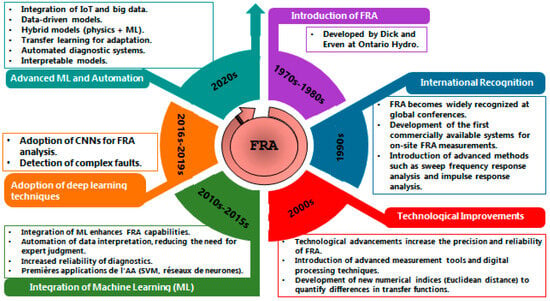
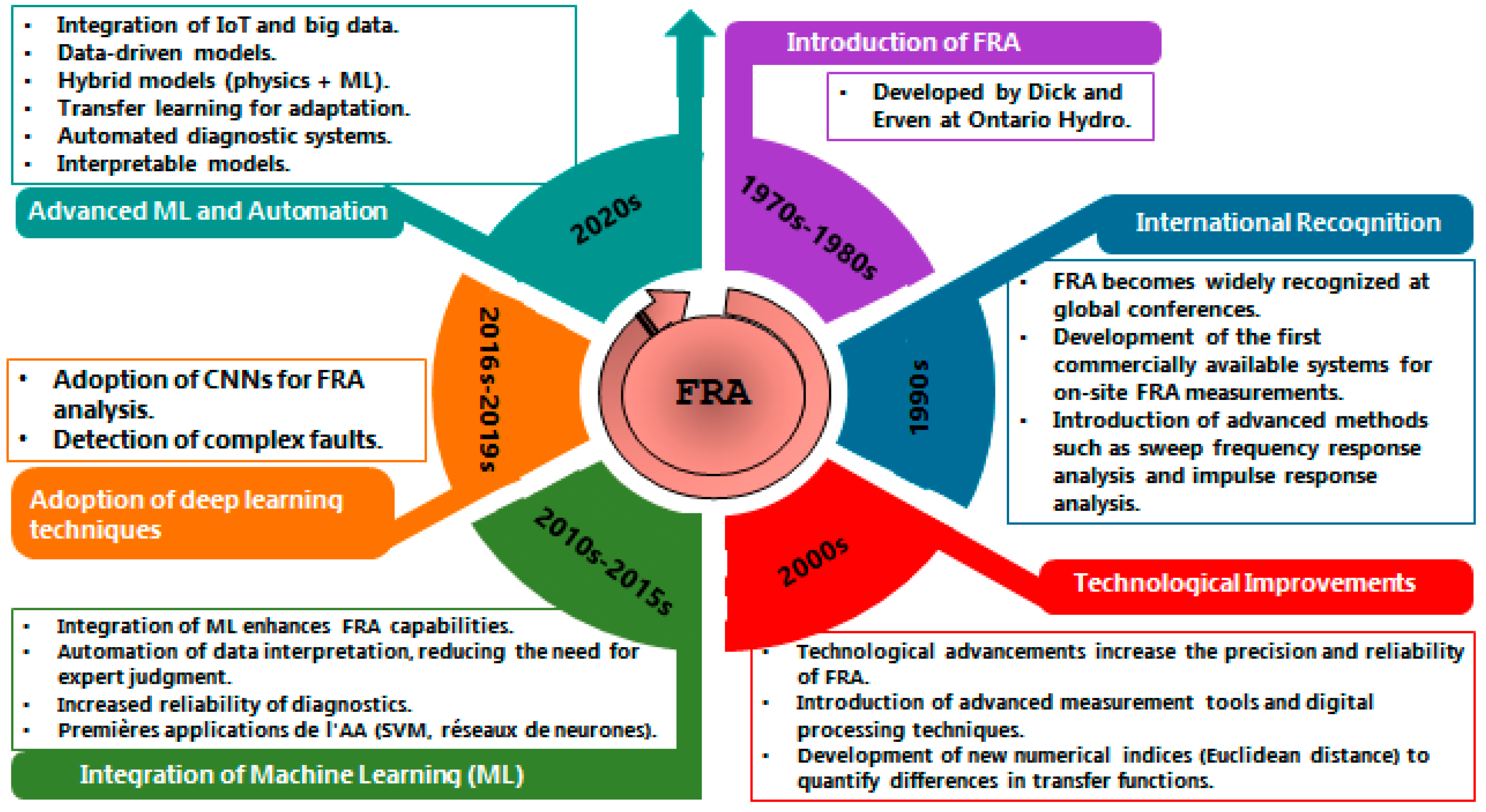
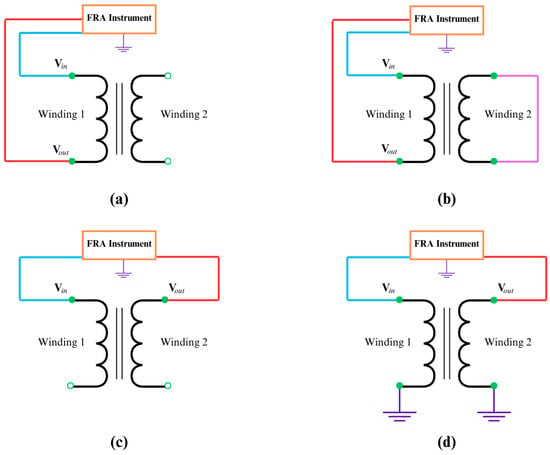
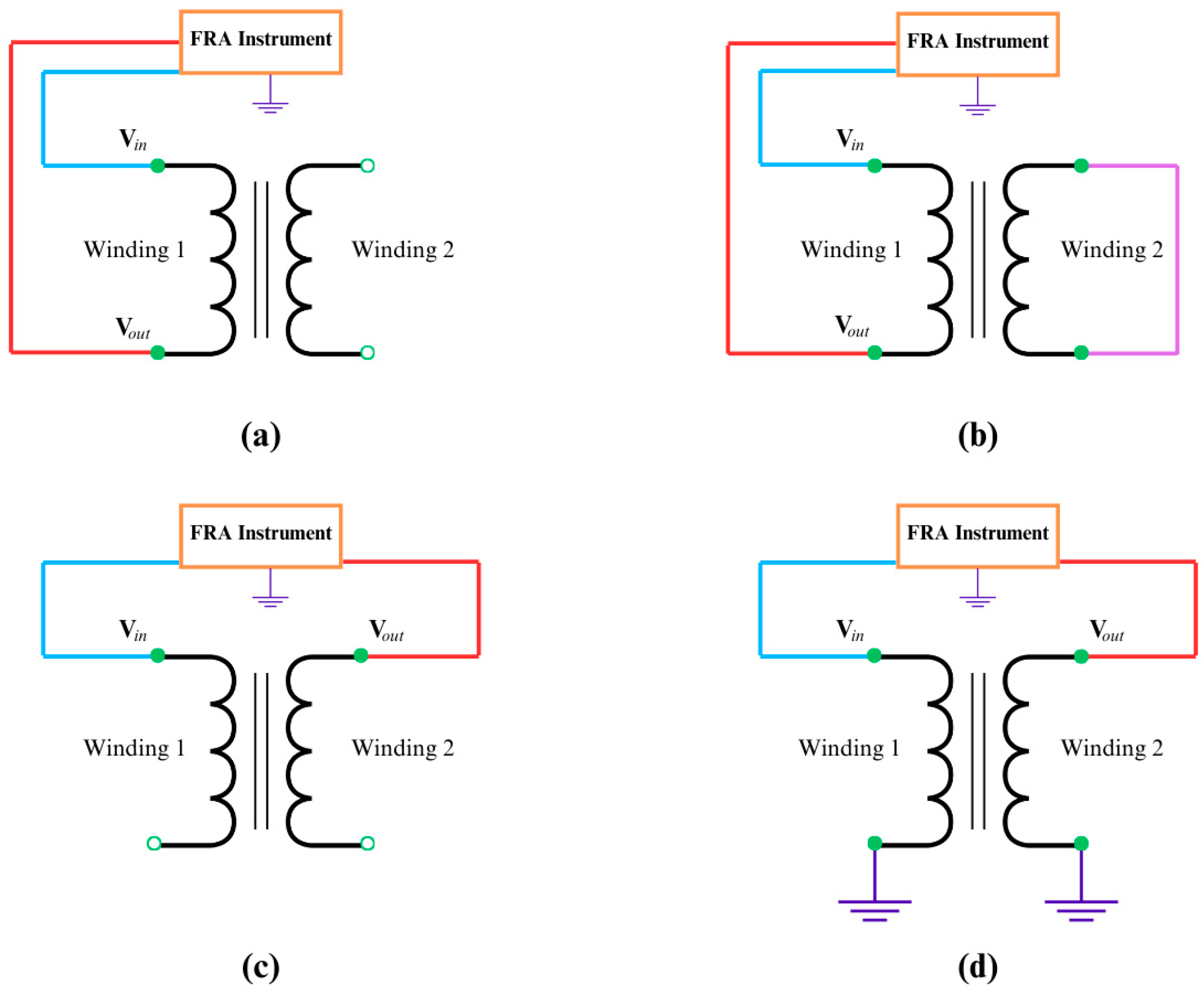
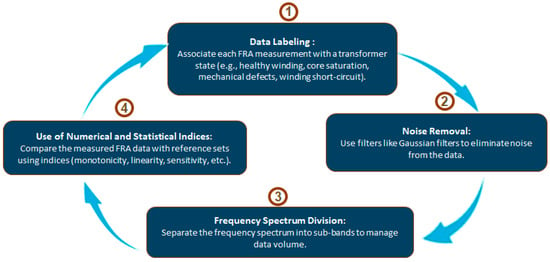
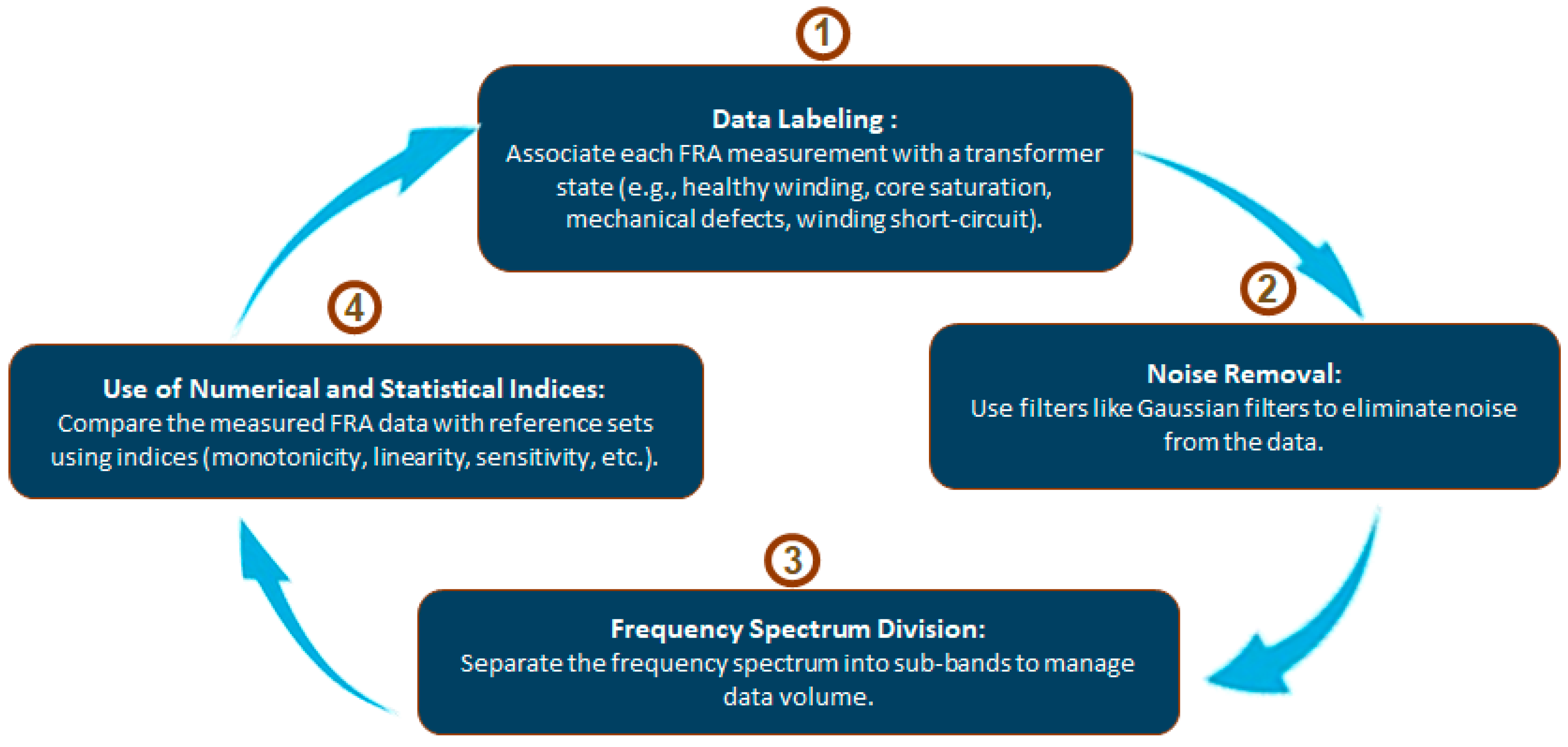

Disclaimer/Publisher’s Note: The statements, opinions and data contained in all publications are solely those of the individual author(s) and contributor(s) and not of MDPI and/or the editor(s). MDPI and/or the editor(s) disclaim responsibility for any injury to people or property resulting from any ideas, methods, instructions or products referred to in the content. |
© 2025 by the authors. Licensee MDPI, Basel, Switzerland. This article is an open access article distributed under the terms and conditions of the Creative Commons Attribution (CC BY) license (https://creativecommons.org/licenses/by/4.0/).