


Abstract
The aim of the paper is to recognize the role of external institutions in supporting the Transport, Shipping, and Logistics (TSL) sector in the transformation towards sustainable and low-emission operations in Poland. In the context of the EU’s decarbonization agenda and accelerating climate challenges, the study explores how regulatory, financial, and normative mechanisms affect the electrification of transport fleets. A mixed-methods approach was applied, combining qualitative content analysis of European and national policy frameworks with a quantitative CATI survey among logistics enterprises. The results reveal that legal and normative instruments remain the dominant institutional drivers of fleet electrification, while fiscal incentives—subsidies and tax reliefs—play a supportive but still secondary role. Sectoral and financial pressures from banks and market stakeholders are emerging as new, complementary forces of change. Firm size, ownership structure, and market scope significantly moderate these perceptions. The paper contributes to institutional and innovation-diffusion theory and offers policy insights for designing coherent and multi-level frameworks.
1. Introduction
The consequences of climate change have become increasingly visible in recent years, affecting ecosystems, territorial stability, and the resilience of societies and economies [1]. These escalating risks have intensified the need for coordinated mitigation and adaptation measures. Among the available strategies, decarbonization plays a central role in achieving climate neutrality across major sectors, including energy, manufacturing, construction, and transport [2]. In Poland, CO2 emissions tend to decline year by year. The average CO2 emissions in Poland in 2024 were 652 g CO2 eq/kWh, with 29% of energy produced from renewable sources. In Poland, declining CO2 intensity and the growing share of renewable energy reflect gradual progress, yet the transformation requires comprehensive organisational and technological adjustments along the value chain [3]. Despite notable barriers [4], firms increasingly implement renewable-energy technologies, energy-efficiency solutions, and advanced innovations such as AI-supported energy management and CCS systems [5,6].
Decarbonization also involves increasingly intensive actions in transport processes towards low-emission or even zero-emission solutions. The European Commission emphasizes that transport represents almost a quarter of Europe’s greenhouse gas emissions and is the main cause of air pollution in cities [7]. Therefore, coherent and well-thought-out actions that support emission reductions in every branch of transport are crucial, starting from road transport to aviation, rail, and maritime transport, in accordance with the guidelines to achieve a 90% reduction by 2050 [8]. Furthermore, it is worth adding that the development of the Low-Carbon Transportation Sector, besides promoting so-called intelligent transport systems, highlighted the role of fuel cells, which, based on advanced clean energy technologies, have demonstrated great potential and significance in balancing energy security [9].
Decarbonization of transport is progressing in multiple directions, as each type of transport has its own specifics and technical possibilities [10]. Road transport remains the largest source of emissions. It accounts for as much as 73% of the total carbon footprint in the transport sector in the European Union [11]. Since this is the most common type of mobility both in the B2C and B2B markets, it is treated as a priority in climate strategies. The European Union has set a carbon neutrality target for the transportation sector by 2050 through its “Sustainable and Smart Mobility Strategy” and has strongly promoted electric vehicles and hydrogen technologies [12]. These changes particularly concern the integrated TSL sector (Transportation, Shipping and Logistics), a key link in the optimal functioning of both local and global supply chains [13].
The electrification of the TSL sector is a fast-developing and transdisciplinary area, which concerns not only the typical so-called heavy road transport, but also warehouse transportation processes, or, for example, last-mile logistics [14]. The concept of fleet electrification should be understood as a series of operational actions that are not limited solely to replacing combustion vehicles with electric ones, but are primarily a fundamental restructuring of the way companies in the TSL sector manage energy, operational logistics, maintenance procedures, and long-term planning of funding for sustainable resources [15]. This is a well-thought-out long-term investment in a new operational ecosystem. Its effectiveness and financial efficiency, require holistic skills to deal with the numerous barriers encountered by the logistics and transport industry. These are primarily economic and political-legal factors, but also groups of variables related to technological, environmental, and social issues [16].
Therefore, the electrification of transport requires support on many levels, but above all, these are measurable institutional initiatives. The main role is assigned to state entities, as the primary regulator of the analyzed area [17]. Apart from regulatory pressure, resulting primarily from the transposition of European or global assumptions, broadly understood support at the national level is necessary, tailored to the specifics of the processes carried out in the TSL industry. Public support, apart from the possibility of obtaining grants in the form of subsidies, also includes various tax reliefs in terms of VAT, CIT/PIT, or excise exemptions. Additionally, conditions set by the state for public tenders, for example, for transport services, can significantly influence the development of electrification; an example is the so-called Green Public Procurement, which emphasizes the use of zero-emission fleets. Another, though less typical, form of support includes solutions such as clean transport zones or exemptions from fees on state highways and in city-paid parking zones. Furthermore, public consultation points are available for entrepreneurs who plan the electrification of their fleets.
Banks also play an important role in the process of electrifying the TSL sector. An increasing number of them offer favorable financing options for the sustainable transformation of transport. In addition, banks that have registered for the national program “My Electric” act as intermediaries in the national subsidy system and are obliged to cooperate with any leasing company that demonstrates a willingness to participate in this program [18].
Financing electromobility is not limited to the purchase of vehicles. It is a matter of creating comprehensive financing models that take into account the specifics of the transformation and the unique lifecycle of this type of investment, from depreciation to residual value. Such support is offered by specialized financial institutions, which, for example, provide flexible leasing terms, considering technological development, or even offer specialized insurance for electric fleets. The comprehensiveness of financial services is increasingly becoming an important variable driving electromobility in the TSL industry.
Comprehensive support is increasingly also offered by entities associated with manufacturers in the automotive industry. An example is Volkswagen Bank, which, as part of Volkswagen Financial Services, provides multidimensional support in fleet electrification, covering the entire transformation ecosystem, including assistance with vehicle operation [19].
Decarbonizing transportation is a challenge, but also a goal whose achievement is in the interest of society as a whole [20]. Adapting to regulatory requirements or market trends is not the only benefit of electrification. It is estimated that accelerated electrification will bring tangible economic benefits, namely allowing for an increase in employment by an additional 21,000 jobs and an increase in added value by EUR 1.1 billion, i.e., PLN 5 billion, compared to the scenario of maintaining the status quo by 2035 [21]. That is why it is so important to properly define the appropriate directions and forms of integrated support that would facilitate this multidimensional transformation, not only in the financial dimension but also in procedural, infrastructural, and mental aspects. For this reason, only proactive engagement of all stakeholders and collaboration between governments, regulators, and private industries are essential to address these challenges and support the logistics industry’s transition to electric fleets.
The analytical foundation of this paper combines institutional theory and innovation diffusion theory, which together provide a comprehensive framework for understanding organisational responses to the low-carbon transition. Institutional theory explains how firms adapt to external pressures through coercive (regulatory), normative (social), and mimetic (competitive) mechanisms that shape strategic behaviour and legitimacy-seeking actions within an evolving sustainability regime [22,23]. In the context of transport decarbonisation, these pressures manifest in regulatory mandates, environmental standards, and market expectations encouraging the adoption of electromobility solutions. Innovation diffusion theory offers a complementary perspective by emphasising that the uptake of new technologies—such as electric vehicle fleets—depends on organisational resources, perceived relative advantages, uncertainty, and managerial openness to change [24,25]. While both theories illuminate important facets of fleet electrification, their applicability differs across organisational contexts. Institutional theory helps explain the strong compliance-driven behaviour observed among large, foreign-owned, and internationally active firms that are more exposed to regulatory and normative expectations. In contrast, innovation diffusion theory better accounts for the incremental, resource-sensitive adoption patterns characteristic of small domestic enterprises, which tend to rely more heavily on financial incentives and evaluate electrification through perceived benefits and risk. Integrating both perspectives therefore enables a nuanced interpretation of fleet electrification as simultaneously an institutionally driven adaptation process and a technological innovation trajectory shaped by firm-level characteristics and the broader policy environment [26,27], providing a robust foundation for analysing the heterogeneity observed within the Polish TSL sector.
Despite extensive research on sustainable transport and policy instruments in Europe, three gaps remain. First, empirical studies seldom examine how institutional mechanisms interact with firm-level diversity in the TSL sector, particularly in countries with evolving and fragmented institutional environments such as Poland. Second, most prior studies assess regulatory or financial incentives in isolation, without integrating institutional and innovation-diffusion perspectives into a single analytical framework. Third, there is a lack of mixed-methods approaches that connect institutional analysis with firm-level behavioural data. This paper addresses the lack of empirical analysis linking institutional mechanisms with firm-level heterogeneity in the Polish TSL sector—and we now clearly articulate that the novelty of our work lies precisely in addressing this gap through a dual-theory framework and empirical evidence.
Building on this dual-theory foundation, the present study examines how institutional mechanisms and firm-level characteristics jointly shape the electrification pathways of enterprises in the Polish TSL sector. In this context of the described issues the aim of the paper is to recognize the role of external institutions in supporting TSL sector in the transformation towards sustainable and low-emission operations in Poland. To achieve it the following two research questions were formulated:
RQ1: How do financial, public, and regulatory institutions support the transformation of transport fleets in the logistics sector towards sustainable and low-carbon operations in Poland?
RQ2: What is the perception of institutional incentives in stimulating the electrification of vehicle fleets in the Polish TSL sector?
To answer RQ1, the qualitative research was conducted. Its results are presented in Section 3.1. To answer RQ2, the quantitative research was conducted. Its results are presented in Section 3.2. Additionally, in the quantitative research the following hypotheses were tested:
H1.
Perceptions of institutional incentives differ in strength across types of support, with legal and normative frameworks exerting a stronger influence on fleet electrification decisions than financial or sectoral mechanisms.
H2.
The perception of institutional incentives depends on firm size, ownership, and market scope.
The formulation of hypotheses allowed to deepen the researched issue in terms of the characteristics of companies and the importance of support for their decisions to electrify their fleet.
2. Materials and Methods
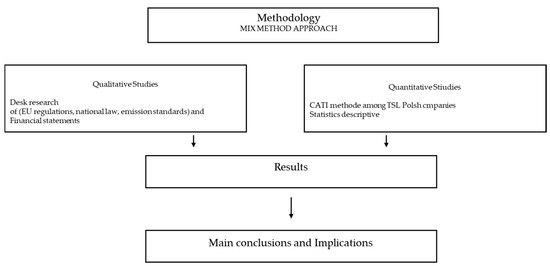
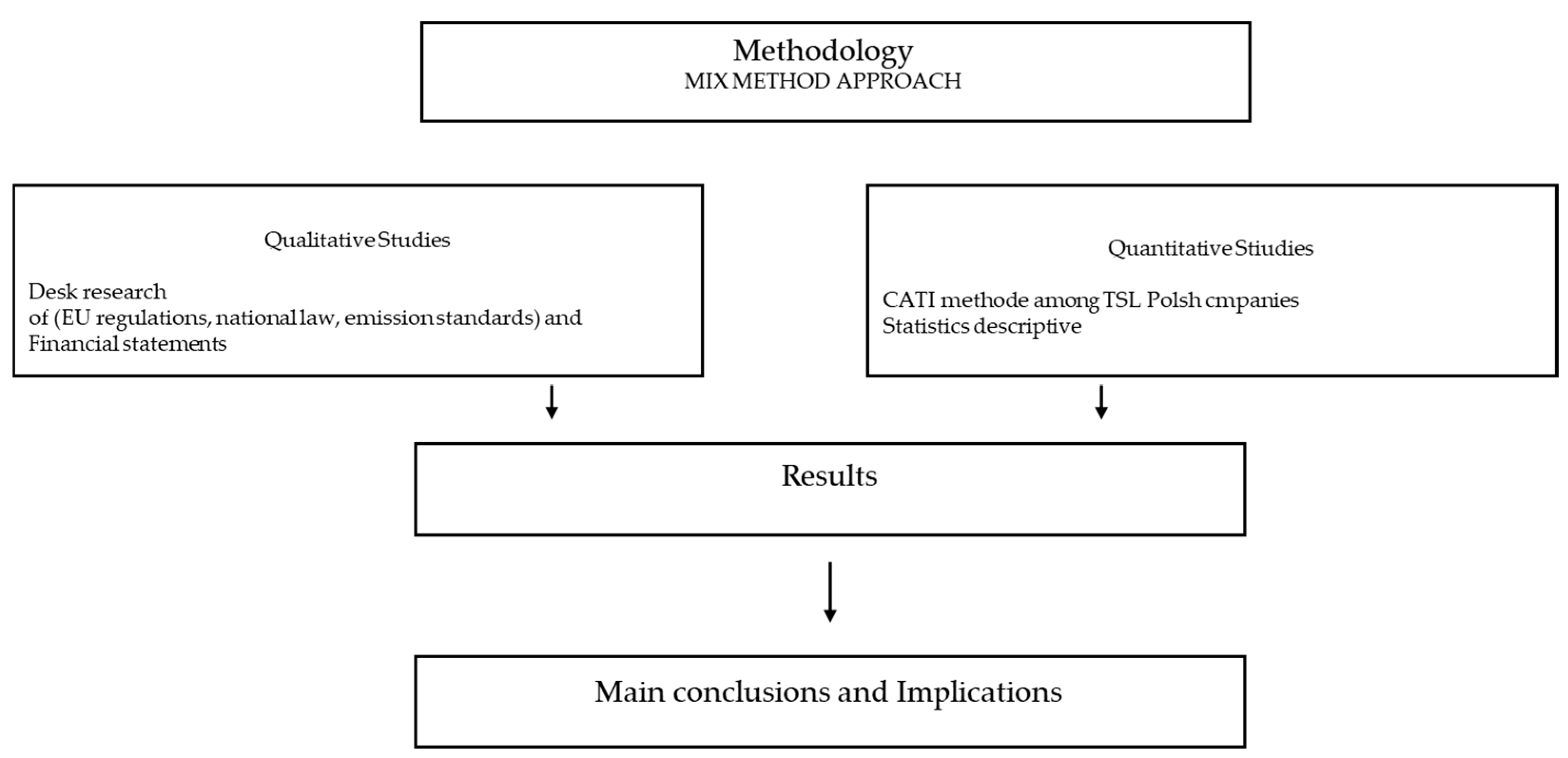
The study employs a mixed-method approach, combining qualitative content analysis of institutional frameworks with quantitative research among Polish logistics companies, see Figure 1.
Figure 1.
Methodology approach.
A mixed-method approach was applied because the research problem concerns both the institutional conditions shaping the external environment of fleet electrification and the organisational responses of logistics enterprises, which cannot be comprehensively captured using a single-method design. The qualitative phase involved content analysis of regulatory, financial, and normative frameworks, enabling the identification of institutional mechanisms that facilitate or constrain the transition toward low-emission fleets. In turn, the quantitative phase examined how enterprises perceive the significance of these mechanisms and how such perceptions vary across firm size, ownership structure, market scope, and fleet characteristics. By integrating structural insights from institutional analysis with behavioural data from enterprises, the mixed-method design enhances explanatory depth, increases internal validity through methodological triangulation, and provides a more complete understanding of how institutional pressures interact with organisational decision-making in the context of the low-carbon transition in the TSL sector.
2.1. Qualitative Phase
Qualitative data covers the main EU and national law regulations and plans. The data on sustainable finance concerning fleet transport electrification was analysed quantitatively in order to retrieve it from the biggest bank operating in Poland. The data was collected based on integrated reporting containing sustainable development statements. The list of studied banks included: Alior Bank, Bank Millennium, Bank PEKAO SA, BNP Paribas, City Handlowy, Credit Agricole, ING Bank Śląski, mBank, PKO BP, Santander BP SA. The aim was to establish the extent to which the topic of financing the decarbonisation of transport is covered in the 2024 sustainability reports. 2024 was the first year in which the largest European and Polish companies disclosed their sustainability activities. The reports also included data on sustainable economic activity in line with the EU Taxonomy. These reports were treated as a source of public information about sustainability efforts for customers.
Accordingly, the qualitative research was designed to address R1, examining how financial, public, and regulatory institutions support the transformation of transport fleets in the logistics sector towards sustainable and low-carbon operations in Poland.
2.2. Quantitative Phase
The quantitative phase investigated how logistics enterprises perceive the significance of institutional incentives for fleet electrification. Firms were eligible for inclusion if they: (1) operated in the Transport, Shipping, and Logistics (TSL) sector for at least three years in Poland, (2) employed more than ten people, and (3) implemented digital logistics tools or solutions. In this way only firms using digital logistics tools were included, as technological capability is a prerequisite for reliably assessing electrification requirements, institutional incentives, and data-driven fleet-management considerations central to the study. Micro-enterprises and sole proprietorships, whose decision-making and institutional exposure differ fundamentally were excluded to ensure organizational comparability. These criteria were selected to focus the study on firms with a sufficiently developed organisational structure to make strategic electrification decisions. Respondents were middle- or senior-level managers responsible for logistics, transport, or supply chain operations. It should be noted that the sampling frame did not include a variable capturing the regional location of the enterprises. This choice was intentional, as the study focused on organisational determinants of perceived institutional support rather than on spatial disparities. The sample was therefore treated as a national-level representation of the Polish TSL sector without regional stratification.
Data collection was carried out by an external research agency using the CATI method in the second quarter of 2024. The purposive sample of 100 enterprises was selected and surveyed to ensure sufficient organisational diversity for analysing differences across firm size, ownership structure, market scope, and fleet type. Although not intended to achieve national representativeness, this sample size provides adequate statistical power for ANOVA-based comparisons and is consistent with exploratory studies examining heterogeneous sectors such as TSL. The questionnaire captured the influence of institutional and environmental drivers of fleet electrification—legal and normative frameworks, subsidy systems, tax reliefs, and financial pressures. Institutional factors were operationalised using concrete, theory-based descriptors [19,20]: legal pressures (mandatory regulations and emission standards), normative pressures (industry and client expectations), financial incentives (subsidies and tax reliefs), and sectoral/financial pressures (influence of competitors, banks, and market partners), ensuring a clear conceptual distinction for respondents. The instrument was pilot-tested on five companies to verify its reliability and face validity. Given the theory-driven and predefined nature of the institutional constructs, and the limited sample size typical of exploratory studies, more advanced validity procedures such as factor analysis were not necessary; instead, reliability was verified through expert review, pilot testing, and Cronbach’s alpha.
The surveyed firms represented a diverse cross-section of the Polish logistics sector. Most were small- or medium-sized enterprises (54 small, 30 medium, 16 large). Ownership structures comprised 67% domestic capital, 23% mixed, and 10% foreign. Ownership structure was measured based on respondents’ declaration of the majority origin of capital (>50%), distinguishing domestic, foreign, and mixed-capital enterprises. The companies operated fleets including forklifts, trucks, and passenger cars and served both B2B and B2C markets domestically and internationally.
The collected data were analyzed using descriptive and inferential statistics. Measures of central tendency and dispersion were calculated for quantitative variables, and frequency distributions for categorical variables. The results informed comparative analyses using one-way ANOVA, testing whether the perceived significance of institutional incentives varied by firm size, ownership, market orientation, and fleet type. The variables were measured on a five-point Likert scale (1 = no significance to 5 = very high significance). Assumptions for ANOVA were assessed using Shapiro–Wilk and Levene’s tests, confirming that the distributional properties of the Likert-scale data allowed for the application of parametric procedures. The reliability of scales was verified using Cronbach’s alpha (α = 0.82), confirming internal consistency. All analyses were conducted using standard statistical software.
2.3. Integration of Research Phases
The mixed-methods approach allowed both exploration and validation of findings. Triangulation between qualitative and quantitative phases increased construct validity, while pilot testing and standardized data collection procedures enhanced reliability. Although the sample size (N = 100) was modest, it is consistent with exploratory studies in the logistics sector and sufficient for ANOVA given the effect sizes observed (Cohen’s f ≈ 0.25, power = 0.80).
Findings from the qualitative analysis informed the structure of the quantitative questionnaire, ensuring conceptual alignment between institutional mechanisms and enterprise perceptions. This integration strengthened the study’s explanatory power and its capacity to identify policy and managerial implications.
The methodological framework provided a robust foundation for addressing both research questions and for linking the institutional environment to corporate decision-making processes in fleet electrification.
The utilization of a mixed-methods research design to examine the current state of the business environment and corporate approach to electrification enabled the research gap to be addressed and a comprehensive context to be delineated for the necessary and anticipated transformations. Transformation affects both the involved entities and the institutions responsible for establishing the regulatory framework and supporting the transition towards net-zero emissions.
3. Results
3.1. Diverse Environment for Fleet Transport Decarbonisation
The shift towards low-carbon operations in the Polish logistics sector fleet transport is a complex transformation phase, demonstrably driven by a confluence of supranational regulatory imposition, coordinated national policy alignment, and the mobilization of strategic financial capital. Research Question 1: How do financial, public, and regulatory institutions support the transformation of transport fleets in the logistics sector toward sustainable and low-carbon operations in Poland? Was proposed to analyse those factors in the whole climate transformation process.
3.1.1. Regulatory Landscape
The global geopolitical situation is highly dynamic. However, this volatility does not affect the EU’s commitment to achieving the objectives set out in the Paris Agreement. The Fit for 55 Package [28] is a key European legislative initiative that comprehensively addresses decarbonisation, particularly in the transport sector. The strategy envisages a profound transformation of freight transport, including the electrification of fleets, expanding infrastructure for alternative fuels, and reducing CO2 emissions by 55% by 2030. Consequently, the transport industry must adapt to new market conditions at every stage of its operations, including the services provided, vehicle manufacturing methods and infrastructure transformation. The EU Sustainable and Smart Mobility Strategy (COM (2020)789) [29] places particular emphasis on the electrification of transport through the development of zero-emission vehicles and charging infrastructure, as well as regulations that support the sector’s energy transition. The strategy’s objectives are designed to support the electrification of vehicle fleets, including freight transport. In addition to the above, developing alternative fuels, particularly hydrogen, is crucial in accelerating the phase-out of fossil fuels. The strategy also aims to adapt the energy grid to the evolving landscape of energy production and usage, which requires the integration of all components within the value chain. Regulation 2023/851 [30] requires a 100% reduction in CO2 emissions for new passenger cars and light commercial vehicles (LCVs) from 2035 onwards. This measure will have a significant impact on light urban logistics (i.e., vans). Furthermore, reducing emissions necessitates changes to the infrastructure required for electric heavy-duty vehicles. Business obligations arising from the imperative to counteract climate change are materialising in the form of investments and actions related to financing the transition. The EU Taxonomy [31] can serve as a framework for setting transport process goals. The EU Taxonomy applies to the financing of investments, including those in the transport sector, by imposing a disclosure obligation regarding the alignment of activities with climate goals. This enhances transparency while simultaneously pressuring companies to implement changes. Taxonomy disclosures for the transport sector include road freight transport services, infrastructure supporting low-carbon road transport and public transport, and rail freight transport. Due to its significant environmental impact, the transport sector has the potential to contribute to the realisation of all adopted Taxonomy objectives, whether through considerations relating to vehicle types, components such as tyres, or noise emissions.
3.1.2. National Context
European regulations impact the national situation. In the National Energy and Climate Plan [32] transport occupies an important place as a sector not covered by the ETS but with a significant impact on the environment and therefore requiring transformation. Transport-related changes include increasing the share of electromobility, promoting intermodal and rail transport, and improving public transport. The need for transport transformation was emphasised in Environmental Policy 2030 [33]. This applies in particular to ‘the development and refinement of new standards for transport infrastructure design and the modernisation of existing infrastructure’. Changes in technical standards will also be inevitable. The document specifying the directions of development is the ‘Strategy for Sustainable Transport Development until 2030’ [34]. The result of tightening regulations is the emergence of programmes that systematically support businesses. Several Polish ministries are responsible for decarbonisation, including the Ministry of Climate and Environment, the Ministry of Infrastructure, and the Ministry of Funds and Regional Policy. These ministries coordinate policies and programmes dedicated to decarbonisation goals, such as the Modernisation Fund and the European Funds for Infrastructure, Climate and Environment 2021–2027 (FEnIKS) programme. It is worth noting that while some of the funds are dedicated to the transport sector, others can support its transformation by developing and strengthening the network of vehicle charging stations or the energy system. Polish entrepreneurs can also benefit from instruments managed directly by the European Commission, such as the Connecting Europe Facility (CEF) and the Alternative Fuels Infrastructure Facility (AFIF). The National Fund for Environmental Protection and Water Management’s strategy for 2025–2028 includes the strategic objective of ‘supporting the low-carbon transformation and sustainable development of Poland, and improving its environmental quality, through the implementation of effective and efficient pro-environmental initiatives’. The planned initiatives also include those aimed at minimising the negative environmental impact of transport. The National Fund for Environmental Protection and Water Management, which operates the Modernisation Fund, has obtained PLN 1.4 billion. These are non-returnable funds earmarked for Poland’s green transformation. Current activities are an extension of previous efforts to support electromobility, including programmes that subsidised the purchase of electric cars.
3.1.3. Financial Factors
Transforming transport requires investment. “Decarbonising the economy by 2050 will require a total investment of $105 billion in the energy sector, and a further $449 billion in transport, buildings, industry, agriculture, and forestry. These figures represent 1.1% and 4.5% of GDP over the next 25 years, respectively. 94% of this amount is already included in the current policy, regardless of the pace and scale of decarbonisation, due to the need to address the problem of ageing power plants and buildings, as well as inefficient industrial and transport fleets.” [35]. As a key stakeholder, the banking sector can support private investment in transport fleet development and decarbonisation projects. However, the sector itself is exposed to the risks of transformation resulting from increasingly stringent regulations. As of 30 September 2022, banks’ exposure to high-emission activities totalled PLN 75.8 billion (17.2% of total credit exposure), including 54.3% in the transport sector and 10.7% in the fossil fuel extraction sector [35].
For most banks, financing sustainable transport is part of a broader ‘green financing’ strategy that complies with the EU Taxonomy (as a part of climate change mitigation). The study showed that most entities invested sustainable finance in leasing zero-emission vehicles, including those offered under the My Electrician programme. However, this area of activity was limited by the lack of distinction between financing for the industrial sector and individual users. The analysed entities offer products for financing green transport. These products were related to the leasing of electric vehicles. The analysed institutions have separate programmes and projects that promote low-emission products and solutions to consumers. Low-emission transport is one of the product categories that can be financed on preferential terms. Alongside leasing, other tools that support the transition to sustainable transport include eco-loans and purchase loans. Some banks also offer support for infrastructure in addition to vehicle financing. Another form of support is customer advisory services. The Polish fleet transition is not merely an optional upgrade but a regulatory and financial imperative. The value of the described factors lies in their synergistic relationship. This consolidating ecosystem is effectively establishing the requisite infrastructure, regulatory certainty, and financial support essential for the full-scale decarbonisation and electrification of fleet transport.
3.2. Differentiated Perceptions of Institutional Incentives Across Firm Characteristics in the Polish TSL Sector
The quantitative analysis addressed Research Question 2: To what extent does the significance of institutional incentives for fleet electrification in the Polish TSL sector depend on firm size, ownership, and market scope?
3.2.1. Descriptive Overview
The analysis revealed a multi-dimensional system of institutional incentives, encompassing legal, normative, fiscal, and financial dimensions. As summarized in Table 1, enterprises rated legal and normative frameworks as the most significant external drivers of fleet electrification (means ≈ 3.8–3.7 on a five-point scale). Tax reliefs and subsidies were perceived as moderately important (means ≈ 3.4–3.5), while sectoral and financial pressures scored slightly lower (mean ≈ 3.2). These findings suggest that formal, regulation-driven mechanisms dominate Poland’s institutional landscape, while financial and market-based incentives play a supplementary role. Small and domestically owned firms exhibited the strongest sensitivity to financial incentives, indicating that fiscal tools remain essential for mitigating cost barriers among resource-constrained enterprises.
Table 1.
Descriptive Statistics of Institutional Support Drivers and Moderating Variables in Polish TSL sector.
3.2.2. Moderating Variables
Table 2 presents how company characteristics influence the perceived significance of institutional factors. Large firms (>250 employees) assigned the highest importance to legal and normative drivers (mean ≈ 4.1–4.2), reflecting their stronger compliance orientation and greater exposure to transnational regulations. In contrast, smaller enterprises prioritized tax and subsidy incentives, emphasizing financial dependence over regulatory alignment.
Table 2.
The Institutional Factor Ratings by Moderating Variables.
Ownership structure also produced meaningful variation. Firms with foreign or mixed capital reported greater responsiveness to normative and legal frameworks, likely due to global corporate sustainability standards. Domestic firms, by comparison, valued financial and sectoral instruments more highly, revealing a pragmatic reliance on direct economic support.
Market orientation proved equally influential. B2B and hybrid (B2B/B2C) firms rated all institutional factors higher than purely B2C operators, suggesting that business clients and supply chain partners exert additional normative pressure toward sustainable practices.
A more detailed exploration was conducted to examine how company characteristics influenced the perceived importance of institutional factors in the process of fleet electrification. The analysis focused on moderating variables such as enterprise size, capital origin, market orientation, business type, market scope, and vehicle fleet composition.
Firm size emerged as an important differentiating factor. Large enterprises (over 250 employees) consistently reported the highest mean ratings across all institutional categories—particularly regarding legal and normative conditions—indicating that they are more responsive to formal regulatory frameworks. Small firms (11–50 employees), in contrast, tended to rate tax reliefs and subsidy systems slightly higher than other institutional drivers, reflecting their stronger reliance on financial incentives rather than regulatory pressure.
When analyzed by capital origin, enterprises with foreign or mixed ownership placed significantly greater emphasis on normative and legal requirements compared to purely domestic firms, suggesting that international compliance standards and global corporate policies may accelerate their transition toward low-emission transport. Domestic firms, however, were more sensitive to subsidy availability and sectoral pressure, particularly from competitors and financial institutions.
In terms of market orientation, firms operating in B2B and hybrid (B2B/B2C) environments assessed all institutional incentives as more relevant than those serving only consumer markets. This may stem from the greater exposure of business clients to environmental requirements and corporate sustainability targets.
Regarding business type, transport carriers exhibited slightly higher mean scores than freight forwarders across all dimensions, especially for tax reliefs and sectoral pressures, indicating that direct fleet owners perceive institutional support as more consequential for their operational decisions.
The market scope variable also revealed notable differences. Enterprises operating in both domestic and international markets evaluated legal and normative factors as most influential, reflecting their exposure to EU-level environmental directives. Firms serving only the domestic market attached higher importance to subsidies and tax reliefs, consistent with a more pragmatic focus on financial support mechanisms rather than compliance obligations.
Finally, when considering the type of vehicle fleet, companies managing passenger cars and light vehicles showed the greatest sensitivity to tax and subsidy incentives, whereas operators of heavy trucks or material handling vehicles (forklifts) attributed more importance to sectoral and financial pressure, reflecting the greater investment and regulatory complexity involved in electrifying heavier fleets.
3.2.3. One-Way ANOVA Results
One-way ANOVA was selected as the most appropriate method for identifying differences across categorical firm characteristics, while more complex regression models were not applied due to the exploratory nature of the study and the sample size, which could lead to overfitting in multivariate analyses. Assumptions for ANOVA were assessed using Shapiro–Wilk and Levene’s tests, confirming that the distributional properties of the Likert-scale data allowed for the application of parametric procedures. The inferential analysis (see Table 3) confirmed these relationships statistically. Significant differences were observed for legal and normative factors across firm size, ownership, and market scope (p-values ranging between p < 0.05 and p < 0.01). Large, foreign-owned, and internationally active firms consistently reported higher mean values, confirming that exposure to EU-level regulation and cross-border competition intensifies institutional responsiveness.
Table 3.
One-Way ANOVA Results for Differences in the Perceived Significance of Institutional Support Drivers.
In contrast, financial instruments such as tax reliefs and subsidies exhibited no statistically significant variation across groups (p > 0.10), indicating a broadly uniform but moderate appreciation of these measures. Sectoral and financial pressures displayed only marginal trends, implying that market-based environmental expectations are emerging but not yet institutionalized.
The ANOVA results confirm that institutional sensitivity within the Polish TSL sector is not homogeneous but significantly conditioned by firm-level characteristics. The strongest and most consistent differences occur for legal and normative conditions (p < 0.05–0.01), where large, foreign-owned, and internationally operating enterprises display the highest mean ratings (≈4.0–4.2). These findings underscore the dominance of regulatory and compliance-based incentives as the primary institutional forces behind fleet electrification. In contrast, financial mechanisms—tax reliefs and subsidy programs—show no statistically significant variation across enterprise groups, indicating a generally uniform yet moderate appreciation of economic support (mean ≈ 3.4–3.6). Sectoral and financial pressures exhibit only marginal trends (p ≈ 0.09–0.15), suggesting that market-driven environmental expectations are still emerging rather than consolidated. Overall, Table 2 demonstrates that the sector’s decarbonization trajectory is predominantly regulation-led, while financial and reputational incentives remain supplementary.
Summarizing the RQ2 Findings, the results reveal a hierarchical pattern of institutional influence: regulatory and normative factors—primary and statistically significant drivers; fiscal incentives—moderately influential but evenly perceived; sectoral and financial pressures—secondary and evolving determinants. The empirical evidence demonstrates that fleet electrification in the Polish TSL sector remains primarily regulation-led. Financial and market incentives complement but do not replace formal regulatory influence. Differences across firm size, ownership, and market reach underscore that larger, foreign, and internationally active firms are more adaptive to regulatory pressures, while smaller domestic firms rely heavily on fiscal support to overcome structural and financial constraints. These findings confirm that Poland’s transition toward low-emission transport is shaped by both institutional enforcement and organizational capacity, with institutional coherence emerging as a key condition for accelerating sector-wide transformation.
4. Discussion
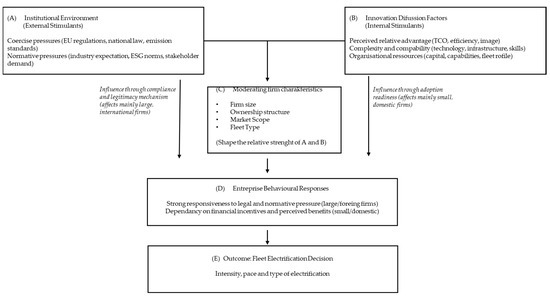
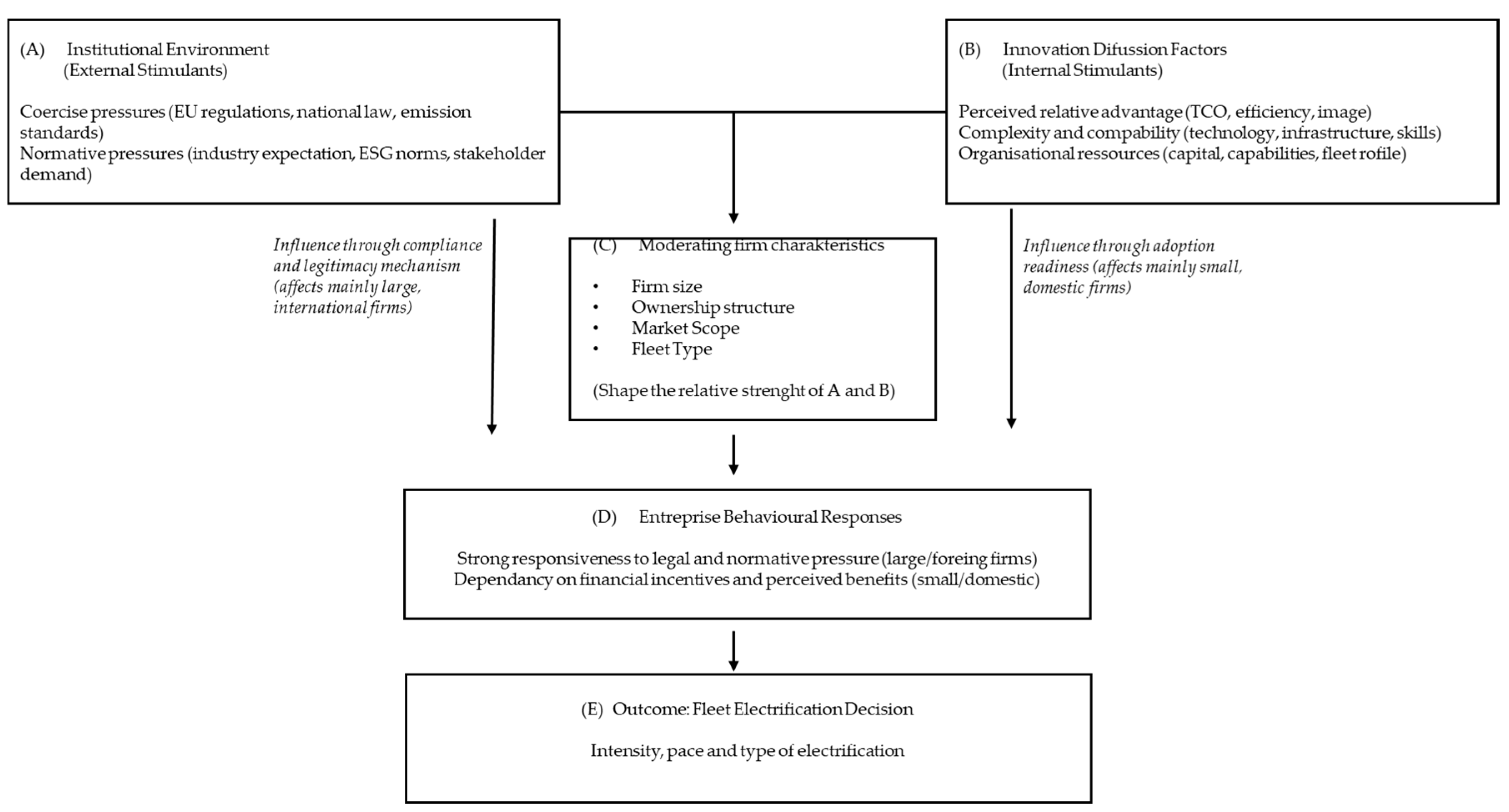
Before interpreting the empirical findings, the conceptual model that informs their interpretation is summarised in Figure 2. This model synthesises the dual-theory framework used in the study and shows how external institutional mechanisms and internal innovation-related drivers jointly shape firms’ decisions to electrify their fleets. It also highlights the moderating influence of organisational characteristics, which is central to explaining the heterogeneity revealed in the empirical results.
Figure 2.
Conceptual model illustrating the interaction between institutional pressures, innovation-diffusion factors, moderating firm characteristics, and fleet electrification outcomes in the TSL sector.
To conclude, the conceptual framework illustrates how institutional and innovation-related mechanisms jointly shape firms’ decisions to electrify their vehicle fleets. The institutional environment (A) encompasses external stimulants, including coercive pressures arising from European Union regulations, national legislation and emission standards, as well as normative pressures embedded in industry expectations, ESG norms and stakeholder demands. In parallel, innovation-diffusion factors (B) represent internal stimulants that influence firms’ readiness for electrification, such as perceived relative advantages related to total cost of ownership, efficiency and corporate image, as well as the complexity, compatibility and resource requirements of new technologies. The impact of both external and internal drivers is conditioned by moderating firm characteristics (C), including company size, ownership structure, market scope and fleet type, which shape the relative strength of institutional and innovation forces. These interactions lead to differentiated behavioural responses (D) and ultimately determine the intensity, pace and form of fleet electrification outcomes (E).
The findings of this study confirm that regulatory and normative frameworks remain the most powerful institutional drivers of fleet electrification in the Polish TSL sector. Companies perceive legal obligations, environmental standards, and compliance mechanisms as decisive external forces shaping investment behavior. This aligns with prior research showing that regulatory frameworks provide the foundation for low-emission transition across European transport systems [17,36]. However, the results also highlight a significant implementation gap: although the EU and national legal systems create strong coercive pressure for change, their impact varies markedly across firm types and resource capacities.
Large logistics enterprises, with greater financial and technological resources, exhibit higher readiness to comply with regulatory requirements and integrate electromobility solutions. In contrast, small- and medium-sized enterprises (SMEs) encounter structural barriers—capital constraints, uncertain returns, and limited access to infrastructure—that reduce their responsiveness. This imbalance suggests a risk of market concentration, in which resource-rich firms accelerate decarbonization while smaller actors lag behind. Such asymmetry reinforces the need for differentiated policy tools targeting SMEs through fiscal or advisory support [37,38].
Consistent with earlier studies [39,40,41], the analysis confirms that financial incentives—notably subsidies and tax reliefs—positively influence adoption decisions but remain secondary to legal drivers. Their overall effect appears moderate, reflecting both the limited scale and unstable continuity of Polish support programs. Empirical evidence from other markets shows that well-designed fiscal measures can significantly accelerate electric vehicle uptake, increasing adoption rates by up to 2–3% per $1000 of incentive [40]. However, as markets mature, the marginal effect of such incentives declines, emphasizing the importance of long-term policy stability and complementary infrastructure investment [42,43].
The findings further demonstrate that non-financial factors—particularly infrastructure availability, technological readiness, and regulatory predictability—are increasingly influential in shaping fleet electrification strategies. Stable, multi-dimensional policy mixes that integrate both financial and non-financial instruments are therefore more effective in building market confidence, particularly in capital-intensive sectors such as logistics [44,45,46]. In Poland, however, public support remains fragmented, with emphasis placed on legal compliance rather than integrated policy design.
The findings show that institutional theory and innovation diffusion theory illuminate different but complementary mechanisms shaping fleet electrification in the Polish TSL sector. Coercive legal and regulatory pressures clearly dominate the institutional landscape, while normative and mimetic influences—arising from client expectations, industry standards, and peer behaviour—are still emerging [47,48,49]. Large, foreign-owned and internationally active enterprises exhibit the strongest alignment with these coercive and normative pressures, indicating that external requirements such as EU-level regulations, ESG obligations, and transnational supply-chain expectations serve as primary triggers for adoption. This behaviour is consistent with institutional theory, which emphasises legitimacy-seeking adaptation to regulatory frameworks and evolving industry norms.
Financial institutions also play an increasingly important role as institutional agents. By embedding ESG and EU Taxonomy principles into lending and leasing practices, banks transmit global sustainability frameworks into domestic financing conditions, thereby exerting indirect normative pressure on firms to adopt low-emission technologies [50,51]. Although this influence is currently less pronounced than direct regulatory mechanisms, its importance is expected to grow as financial markets internalise transition risks and integrate carbon criteria into credit assessments.
In contrast, smaller and domestically owned enterprises display behavioural patterns more closely aligned with innovation diffusion theory. These firms tend to prioritise financial incentives, perceive greater uncertainty regarding the long-term benefits of electrification, and are more sensitive to technological, operational, and infrastructural barriers. Their adoption trajectories reflect the central constructs of diffusion theory—relative advantage, complexity, compatibility, and resource availability—indicating that SMEs function as later adopters whose decisions depend heavily on enabling economic conditions rather than on compliance pressures alone [38,52].
Taken together, these results demonstrate a clear diffusion asymmetry: institutional pressures predominantly influence firms with greater organisational capacity, international exposure, and strategic integration within global sustainability regimes, whereas innovation diffusion mechanisms are more relevant to resource-constrained domestic firms. This integrated theoretical lens provides a more nuanced interpretation of the heterogeneous adoption patterns identified in the Polish TSL sector and strengthens the explanatory power of the analytical framework used in this study. Market orientation and international exposure further amplify institutional sensitivity. Firms operating in B2B or international markets face higher environmental expectations from clients, investors, and regulators, leading to greater alignment with sustainability norms. These actors often perceive environmental performance as a source of competitive legitimacy and risk mitigation [53,54,55]. In contrast, domestic and B2C-oriented firms remain primarily motivated by cost factors, indicating the persistence of instrumental rather than normative compliance within the national logistics sector.
Fleet composition also shapes firms’ responsiveness to institutional incentives. Operators of light-duty fleets—passenger cars and vans—respond most strongly to tax and subsidy programs that lower the total cost of ownership [41,56]. Meanwhile, firms managing heavy-duty and material-handling vehicles encounter higher technological and infrastructural barriers, making them less reactive to conventional incentives and more dependent on long-term investment support, fuel price dynamics, and carbon regulation [57,58,59].
Taken together, the results confirm that Poland’s institutional framework for transport electrification remains fragmented and predominantly regulatory in nature. National policy has thus far focused on ensuring compliance with EU directives—such as the Act on Electromobility and Alternative Fuels—rather than developing integrated programs that couple financial incentives, infrastructure investment, and stakeholder coordination [60,61,62]. Consequently, while formal alignment with EU objectives has been achieved, the systemic coherence and accessibility of support instruments remain limited, particularly outside major urban centers.
This study therefore underscores the necessity of creating a more coherent and multi-layered institutional ecosystem, one that balances coercive regulatory pressures with enabling financial, infrastructural, and knowledge-based mechanisms. Only through such integration can Poland’s logistics industry achieve a scalable, inclusive, and economically viable transition toward low-carbon mobility.
5. Conclusions
The conducted study contributes to the broader discussion on achieving climate neutrality through decarbonization, providing an empirical basis for shaping effective instruments for supporting and developing low-emission technologies in the logistics industry.
Fleet electrification requires synergy between fiscal, infrastructure, and information policies. The analysis of TSL industry landscape (RQ1) revealed that in Poland the transformation is primarily driven by formal mechanisms of national and European regulations or standards. TSL companies are supported by several government subsidies programs and infrastructure funding, as well as preferential loans offered by banks in Poland. Even though banks offer incentives, research has shown that this is not the most important factor in the development of the electric fleet.
The results of quantitative research (RQ2) indicate that institutional support currently plays a moderate but growing role in the electrification of TSL fleets, particularly in large, foreign, and international companies. The effectiveness of these instruments is strongly dependent on the organizational context, including available resources, the scale of operations, and the type of fleet used. The results indicate an implementation gap between large enterprises and the SME sector. Larger entities, with the capital and technology at their disposal, are adopting electromobility solutions more quickly, while smaller companies face financial and infrastructure barriers. This asymmetry increases the risk of market concentration and requires the use of diverse public policy instruments to support SMEs. Given the early development phase of fleet electrification in Poland, public policy should better address the needs of small- and medium-sized enterprises, which constitute a key segment of the logistics market. This will enable more effective support for the achievement of goals related to sustainable energy resource management, energy strategies, and climate change. Additionally, support programs need to be on a higher scale and continuously available. Particular support is required for companies operating in heavy transport, where implementation barriers are the highest. Therefore, more intensive instruments, such as higher subsidies or tax incentives, are necessary. However, the subsidies alone are not a sufficient transformational stimulus. Successful electrification of transport requires a complementary measures, including the development of charging infrastructure, a stable regulatory framework, and advisory and educational programs. This may ensure an inclusive and scalable transition to low-emission mobility.
The results have significant implications for both public policy and business practice, as well as for further research. At the policy level, they point to the need for diverse support instruments tailored to the specific needs of different fleet types, as well as the importance of combining financial mechanisms (e.g., subsidies) with infrastructure development programs. More support is also needed for SMEs and large goods vehicles. At the business level, the results emphasize the need to integrate investment decisions with ESG policies and long-term cost planning, which can support more sustainable enterprise development. In Poland, limitations to the use of electric vehicles include the lack of sufficient charging infrastructure outside major cities as well as the inconsistency and fragmentation that occur in the institutional framework for transport electrification. The proposed support solutions are intended to reduce barriers and make the electrification process more efficient and effective. At the theory level, the study confirmed that the perception of support is a function of organizational resources and the degree of integration with the international market.
Future research should expand the scope of analysis to include several key areas that can deepen and complement existing findings. First, a significant research direction is to conduct a life-cycle cost analysis of TSL fleets, which would allow for a comprehensive assessment of both the economic and environmental aspects of transport and logistics companies’ operations. Second, special attention should be paid to examine the impact of EU programs on the pace and scale of new technology adoption in the sector, which will enable a better understanding of the mechanisms supporting the industry’s transformation. Third, conducting international comparisons, including, for example, the other UE countries, would be a valuable addition, allowing for the identification of differences and similarities in development strategies and the effectiveness of implemented solutions in individual countries for the same region. Moreover, future research could employ larger samples and multivariate statistical models to more precisely isolate the effects of organisational characteristics on fleet electrification decisions. The conducted study has some limitations that should be considered when interpreting the results. First, the relatively small sample size (n < 150) limits the generalizability of the findings to a broader population. Second, the analysis was based on participants’ perceptions rather than the actual use of institutional support, which may result in subjective responses. Third, the sample included only firms using digital logistics tools, which ensured technological comparability but may limit the generalisability of the findings to less digitalised operators. Fourth, the study did not include a spatial analysis that took into account differences between Polish regions, which could provide additional, more detailed contextual information. Given the uneven distribution of charging infrastructure and regional development disparities, future research should incorporate spatial analysis to better capture territorial aspects of the low-carbon transition in the TSL sector. Considering these aspects in future research would allow for a more complete picture of the issue under investigation.
Author Contributions
Conceptualisation: A.W., M.R., A.R. and G.K., methodology: A.W., M.R., A.R. and G.K., validation: A.W., M.R., A.R. and G.K., formal analysis: A.W., M.R., A.R. and G.K.; investigation: A.W., M.R., A.R. and G.K., resources: A.W., M.R., A.R. and G.K., data curation: A.W., M.R., A.R. and G.K., writing—original draft preparation: A.W., M.R., A.R. and G.K., writing—review and editing: A.W., M.R., A.R. and G.K., visualisation: A.W., M.R., A.R. and G.K., supervision: A.W., M.R., A.R. and G.K. All authors have read and agreed to the published version of the manuscript.
Funding
This research received no external funding.
Data Availability Statement
The original contributions presented in this study are included in the article. Further inquiries can be directed to the corresponding author.
Conflicts of Interest
The authors declare no conflict of interest. The funders had no role in the design of the study; in the collection, analyses, or interpretation of data; in the writing of the manuscript; or in the decision to publish the results.
Abbreviations
The following abbreviations are used in this manuscript:
| TSL | Transport, Shipping, and Logistics |
| EU | European Union |
| CATI | Computer-Assisted Telephone Interviewing |
| CCS | Carbon capture and storage |
| B2C | Business-to-consumer |
| B2B | Business-to-business |
| VAT | Value Added Tax |
| CIT | Corporate Income Tax |
| PIT | Personal Income Tax |
| EUR | Euro |
| PLN | Polish Zloty (official currency of Poland) |
| LCV | Light commercial vehicle |
| ETS | Emissions trading system |
| FEnIKS | Programme: European Funds for Infrastructure, Climate, Environment |
| CEF | Connecting Europe Facility |
| AFIF | Alternative Fuels Infrastructure Facility |
| GDP | Gross Domestic Product |
| SMEs | Small- and medium-sized enterprises |
| ESG | Environmental, Social, and Governance |
References
- European Commission. Consequences of Climate Change. Available online: https://climate.ec.europa.eu/climate-change/consequences-climate-change_en (accessed on 28 October 2025).
- Rizzoli, V.; Soledad Norton, L.; Sarrica, M. Mapping the meanings of decarbonisation: A systematic review of studies in the social sciences using lexicometric analysis. Clean. Environ. Syst. 2021, 3, 100065. [Google Scholar] [CrossRef] [Scilit]
- Sairanen, M.; Aarikka-Stenroos, L. Low-carbon business models: Review and typology. Ind. Mark. Manag. 2024, 123, 222–250. [Google Scholar] [CrossRef] [Scilit]
- Zhang, A.; Faizan Alvi, M.; Gong, Y.; Wang, J.X. Overcoming barriers to supply chain decarbonization: Case studies of first movers. Resour. Conserv. Recycl. 2022, 186, 106536. [Google Scholar] [CrossRef] [Scilit]
- Haque, F.; Ntim, C.G. Do corporate sustainability initiatives improve corporate carbon performance? Evidence from European firms. Bus. Strategy Environ. 2022, 31, 3318–3334. [Google Scholar] [CrossRef] [Scilit]
- Viitala, R.; Miettinen, M.; Marquez, R.; Hämäläinen, A.; Karhinen, A.; Barrios, N.; Gonzalez, R.; Pal, L.; Jameel, H.; Holmberg, K. Integration of artificial intelligence and sustainable energy management in the pulp and paper industry: A path to decarbonization. Renew. Sustain. Energy Rev. 2025, 218, 115809. [Google Scholar] [CrossRef] [Scilit]
- European Commission. Transport Decarbonization. Available online: https://climate.ec.europa.eu/eu-action/transport-decarbonisation_en (accessed on 28 October 2025).
- European Commission. Transport and the Green Deal. Available online: https://commission.europa.eu/strategy-and-policy/priorities-2019-2024/european-green-deal/transport-and-green-deal_en (accessed on 28 October 2025).
- Zhao, X.; Han, J. How is Transportation Sector Low-Carbon (TSLC) Research Developing After the Paris Agreement (PA)? A Decade Review. Sustainability 2025, 17, 2261. [Google Scholar] [CrossRef] [Scilit]
- Martin, B.; Pestiaux, J.; Schobbens, Q.; Emmrich, J.; Hagemann, M. A radical transformation of mobility in Europe: Exploring the decarbonisation of the transport sector by 2040. In Explorative Scenario and Related Policy Packages; NewClimate Institute: Cologne, Germany; Climact: Brussels, Belgium, 2020; Available online: https://newclimate.org/sites/default/files/2020/09/TransportRoadmap_Report_September2020.pdf (accessed on 28 October 2025).
- PWC. Decarbonization of Transport in the EU. Challenges, Technologies and Directions of Change by 2050; Report PWC; PWC: London, UK, 2025; Available online: https://www.pwc.pl/en/publikacje/decarbonization-of-transport-in-the-eu.html (accessed on 28 October 2025).
- EUR Lex. Communication from the Commission to the European Parliament, the Council, the European Economic and Social Committee and the Committee of the Regions Sustainable and Smart Mobility Strategy—Putting European Transport on Track for the Future. Available online: https://eur-lex.europa.eu/legal-content/EN/TXT/?uri=CELEX%3A52020DC0789 (accessed on 28 October 2025).
- Sun, X.; Yu, H.; Solvang, W.D.; Wang, Y.; Wang, K. The application of Industry 4.0 technologies in sustainable logistics: A systematic literature review (2012–2020) to explore future research opportunities. Environ. Sci. Pollut. Res. 2022, 29, 9560–9591. [Google Scholar] [CrossRef] [Scilit]
- Gillström, H.; Jobrant, M.; Sallnäs, U. Towards building an understanding of electrification of logistics systems—A literature review and a research agenda. Clean. Logist. Supply Chain 2024, 10, 100134. [Google Scholar] [CrossRef] [Scilit]
- De Angelis, E.; Turrini, E.; Carnevale, C.; Volta, M. Vehicle fleet electrification: Impacts on energy demand, air quality and GHG emissions. An integrated assessment approach. IFAC-PapersOnLine 2020, 53, 16581–16586. [Google Scholar] [CrossRef] [Scilit]
- Raźniewska, M.; Wronka, A. Transport Fleet Electrification Development Conditions—Perspective of Transport, Shipping, and Logistics Industry in Poland. Energies 2024, 17, 4288. [Google Scholar] [CrossRef] [Scilit]
- Kriukelyte, E.; Sochor, J.; Kramers, A. Actualizing sustainable transport: The interplay between public policy instruments and shared mobility providers’ business models. Eur. Transp. Res. Rev. 2024, 16, 11. [Google Scholar] [CrossRef] [Scilit]
- Korzeb, Z.; Niedziółka, P. The Role of the Banking Sector in the Energy Transition. In Fossil Fuels in the European Union. Lecture Notes in Energy; Springer: Cham, Switzerland, 2024; Volume 99. [Google Scholar] [CrossRef] [Scilit]
- Volkswagen Financial Services. Available online: https://www.vwfs.pl/klienci-biznesowi/floty/electrify.html (accessed on 28 October 2025).
- Kelly, J.A.; Guo, Y.; Clinch, J.P. Who benefits from fleet electrification? quantifying the costs and benefits of transportation electrification strategies from different perspectives. Transp. Res. Interdiscip. Perspect. 2025, 32, 101492. [Google Scholar] [CrossRef] [Scilit]
- Report Polish Economic Institute. Electrification of Heavy Transport; Report Polish Economic Institute: Warsaw, Poland, 2025; Available online: https://pie.net.pl/wp-content/uploads/2023/06/PIE-Raport-2023_Elektryfikacja_transportu-ciezkiego.pdf (accessed on 28 October 2025).
- DiMaggio, P.J.; Powell, W.W. The Iron Cage Revisited: Institutional Isomorphism and Collective Rationality in Organizational Fields. Am. Sociol. Rev. 1983, 48, 147–160. [Google Scholar] [CrossRef] [Scilit]
- Scott, W.R. Institutions and Organizations: Ideas, Interests, and Identities, 4th ed.; Sage Publications: Thousand Oaks, CA, USA, 2014. [Google Scholar]
- Rogers, E.M. Diffusion of Innovations, 5th ed.; Free Press: New York, NY, USA, 2003. [Google Scholar]
- Damanpour, F.; Schneider, M. Phases of the Adoption of Innovation in Organizations: Effects of Environment, Organization, and Top Managers. Br. J. Manag. 2006, 17, 215–236. [Google Scholar] [CrossRef] [Scilit]
- Zhu, Q.; Sarkis, J.; Lai, K.-H. Green Supply Chain Management Innovation Diffusion and Its Relationship to Organizational Improvement: An Ecological Modernization Perspective. J. Eng. Technol. Manag. 2012, 29, 168–185. [Google Scholar] [CrossRef] [Scilit]
- Del Río González, P. The Empirical Analysis of the Determinants for Environmental Technological Change: A Research Agenda. Ecol. Econ. 2009, 68, 861–878. [Google Scholar] [CrossRef] [Scilit]
- Fit for 55. Available online: https://www.consilium.europa.eu/en/policies/fit-for-55/ (accessed on 15 October 2025).
- Sustainable and Smart Mobility Strategy UE (COM(2020)789). Available online: https://transport.ec.europa.eu/document/download/be22d311-4a07-4c29-8b72-d6d255846069_en?filename=2021-mobility-strategy-and-action-plan.pdf (accessed on 20 October 2025).
- Regulation (EU) 2023/851 of the European Parliament and of the Council of 19 April 2023 Amending Regulation (EU) 2019/631 as Regards Strengthening the CO2 Emission Performance Standards for New Passenger Cars and New Light Commercial Vehicles in Line with the Union’s Increased Climate Ambition (Text with EEA Relevance). Available online: https://eur-lex.europa.eu/eli/reg/2023/851/oj/eng (accessed on 20 October 2025).
- EU Taxonomy for Sustainable Activities. Available online: https://finance.ec.europa.eu/sustainable-finance/tools-and-standards/eu-taxonomy-sustainable-activities_en (accessed on 10 October 2025).
- National Energy and Climate Plan Poland. Available online: https://www.gov.pl/web/climate/national-energy-and-climate-plan (accessed on 10 October 2025).
- Polityka Ekologiczna Państwa 2030. Available online: https://www.gov.pl/web/ia/polityka-ekologiczna-panstwa-2030-pep2030 (accessed on 10 October 2025).
- Strategia Zrównoważonego Rozwoju Transportu do 2030 Roku. Available online: https://www.gov.pl/web/infrastruktura/projekt-strategii-zrownowazonego-rozwoju-transportu-do-2030-roku (accessed on 10 October 2025).
- Report Zielone Finanse w Polsce 2025. Available online: https://ungc.org.pl/wp-content/uploads/2025/05/publikacja_Zielone_finanse_www_2025.pdf (accessed on 10 October 2025).
- Jaller, M.; Otero-Palencia, C.; Yie-Pinedo, R. Inventory and Fleet Purchase Decisions under a Sustainable Regulatory Environment. Supply Chain Forum Int. J. 2020, 21, 53–65. [Google Scholar] [CrossRef] [Scilit]
- IBRM SAMAR. Rejestracje Samochodów Osobowych i Dostawczych w Lipcu 2020 (Registrations of Passenger Cars and Vans in July 2020); IBRM SAMAR Report; IBRM SAMAR: Warszawa, Poland, 2020; Available online: https://www.samar.pl/ (accessed on 28 October 2025).
- Qamar, A.; Gardner, E.; Buckley, T.; Zhao, K. Home-owned versus foreign-owned firms in the UK automotive industry: Exploring the microfoundations of ambidextrous production and supply chain positioning. Int. Bus. Rev. 2021, 30, 101657. [Google Scholar] [CrossRef] [Scilit]
- Roberson, L.; Helveston, J. Not all subsidies are equal: Measuring preferences for electric vehicle financial incentives. Environ. Res. Lett. 2022, 17, 084003. [Google Scholar] [CrossRef] [Scilit]
- Jenn, A.; Springel, K.; Gopal, A. Effectiveness of electric vehicle incentives in the United States. Energy Policy 2018, 119, 349–356. [Google Scholar] [CrossRef] [Scilit]
- Lévay, P.; Drossinos, Y.; Thiel, C. The effect of fiscal incentives on market penetration of electric vehicles: A pairwise comparison of total cost of ownership. Energy Policy 2017, 105, 524–533. [Google Scholar] [CrossRef] [Scilit]
- Qadir, S.; Ahmad, F.; Al-Wahedi, A.; Iqbal, A.; Ali, A. Navigating the complex realities of electric vehicle adoption: A comprehensive study of government strategies, policies, and incentives. Energy Strategy Rev. 2024, 53, 101379. [Google Scholar] [CrossRef] [Scilit]
- Wu, Y.; Ng, A.; Ng, A.; Yu, Z.; Huang, J.; Meng, K.; Dong, Z. A review of evolutionary policy incentives for sustainable development of electric vehicles in China: Strategic implications. Energy Policy 2021, 148, 111983. [Google Scholar] [CrossRef] [Scilit]
- Martins, E.; Lépine, J.; Corbett, J. Assessing the effectiveness of financial incentives on electric vehicle adoption in Europe: Multi-period difference-in-difference approach. Transp. Res. Part A Policy Pract. 2024, 189, 104217. [Google Scholar] [CrossRef] [Scilit]
- Ledna, C.; Muratori, M.; Brooker, A.; Wood, E.; Greene, D. How to support EV adoption: Tradeoffs between charging infrastructure investments and vehicle subsidies in California. Energy Policy 2022, 165, 112931. [Google Scholar] [CrossRef] [Scilit]
- Yang, W.; Fan, A.; Zhang, J.; Pan, Y. Effectiveness of policies for electric commercial vehicle adoption and emission reduction in the logistics industry. Energy Policy 2024, 188, 112931. [Google Scholar] [CrossRef] [Scilit]
- Pandita, D.; Bhatt, V.; Kumar, V.; Fatma, A.; Vapiwala, F. Electrifying the future: Analysing the determinants of electric vehicle adoption. Int. J. Energy Sect. Manag. 2024, 18, 1767–1786. [Google Scholar] [CrossRef] [Scilit]
- Zaino, R.; Ahmed, V.; Alhammadi, A.; Alghoush, M. Electric Vehicle Adoption: A Comprehensive Systematic Review of Technological, Environmental, Organizational and Policy Impacts. World Electr. Veh. J. 2024, 15, 375. [Google Scholar] [CrossRef] [Scilit]
- Farajnezhad, M.; Kuan, J.; Kamyab, H. Impact of Economic, Social, and Environmental Factors on Electric Vehicle Adoption: A Review. Eídos 2024, 17, 39–62. [Google Scholar] [CrossRef] [Scilit]
- Amer, E. Internationalization, institutional pressures in foreign markets, and environmental sustainability. J. Int. Manag. 2022, 29, 100974. [Google Scholar] [CrossRef] [Scilit]
- Kautish, P.; Lavuri, R.; Roubaud, D.; Grebinevych, O. Electric vehicles’ choice behaviour: An emerging market scenario. J. Environ. Manag. 2024, 354, 120250. [Google Scholar] [CrossRef] [Scilit]
- Nippa, M.; Patnaik, S.; Taussig, M. MNE responses to carbon pricing regulations: Theory and evidence. J. Int. Bus. Stud. 2021, 52, 904–929. [Google Scholar] [CrossRef] [Scilit]
- Bueno-García, M.; Delgado-Márquez, B.; Georgallis, P.; Aragón-Correa, J. How do shareholders influence international firms’ environmental strategies? The differential impact of strategic and financial investors. Long Range Plan. 2022, 55, 102183. [Google Scholar] [CrossRef] [Scilit]
- Tzanidis, T.; Magni, D.; Scuotto, V.; Maalaoui, A. B2B green marketing strategies for European firms: Implications for people, planet and profit. Ind. Mark. Manag. 2024, 117, 481–492. [Google Scholar] [CrossRef] [Scilit]
- Jain, S.; Basu, S.; Dwivedi, Y. Green brand identity and B2B channel partners’ tactical green marketing orientation: Moderating effect of brand governance. Ind. Mark. Manag. 2024, 119, 218–237. [Google Scholar] [CrossRef] [Scilit]
- Zhou, Y.; Ong, G.; Meng, Q. The road to electrification: Bus fleet replacement strategies. Appl. Energy 2023, 337, 120903. [Google Scholar] [CrossRef] [Scilit]
- Bae, Y.; Rindt, C.; Mitra, S.; Ritchie, S. Fleet operator perspectives on alternative fuels for heavy-duty vehicles. Transp. Policy 2024, 149, 36–48. [Google Scholar] [CrossRef] [Scilit]
- Li, K.; Acha, S.; Sunny, N.; Shah, N. Strategic transport fleet analysis of heavy goods vehicle technology for net-zero targets. Energy Policy 2022, 168, 112988. [Google Scholar] [CrossRef] [Scilit]
- Chowdhury, V.; Tuli, F.; Mitra, S. Sustainable Shift: Analyzing Drivers for Low-Carbon Transportation Adoption in California’s Heavy-Duty and Off-Road Sectors. Sustainability 2024, 16, 1722. [Google Scholar] [CrossRef] [Scilit]
- Sendek-Matysiak, E.; Łosiewicz, Z. Analysis of the Development of the Electromobility Market in Poland in the Context of the Implemented Subsidies. Energies 2021, 14, 222. [Google Scholar] [CrossRef] [Scilit]
- Tomczyk, M.; Wojtaszek, H.; Chackiewicz, M.; Orłowska, M. Electromobility and Renewable Energy Sources: Comparison of Attitudes and Infrastructure in Poland and Germany. Energies 2023, 16, 7935. [Google Scholar] [CrossRef] [Scilit]
- Kucharski, A.; Lekka-Porębska, I. Implementation of electric road transport—Poland in comparison with European countries. In Scientific Papers of Silesian University of Technology Organization and Management Series; Silesian University of Technology Publishing House: Gliwice, Poland, 2023. [Google Scholar] [CrossRef] [Scilit]

Disclaimer/Publisher’s Note: The statements, opinions and data contained in all publications are solely those of the individual author(s) and contributor(s) and not of MDPI and/or the editor(s). MDPI and/or the editor(s) disclaim responsibility for any injury to people or property resulting from any ideas, methods, instructions or products referred to in the content. |
© 2025 by the authors. Licensee MDPI, Basel, Switzerland. This article is an open access article distributed under the terms and conditions of the Creative Commons Attribution (CC BY) license (https://creativecommons.org/licenses/by/4.0/).