Article

Particle Swarm-Optimized Fuzzy Logic Energy Management of Hybrid Energy Storage in Electric Vehicles


Intelligent Robotic and Energy Systems Research Group, Faculty of Engineering and Design, Carleton University, Ottawa, ON K1S 5B6, Canada
*
Authors to whom correspondence should be addressed.
Energies 2024, 17(9), 2163; https://doi.org/10.3390/en17092163
Submission received: 26 March 2024 / Revised: 22 April 2024 / Accepted: 26 April 2024 / Published: 30 April 2024

Abstract

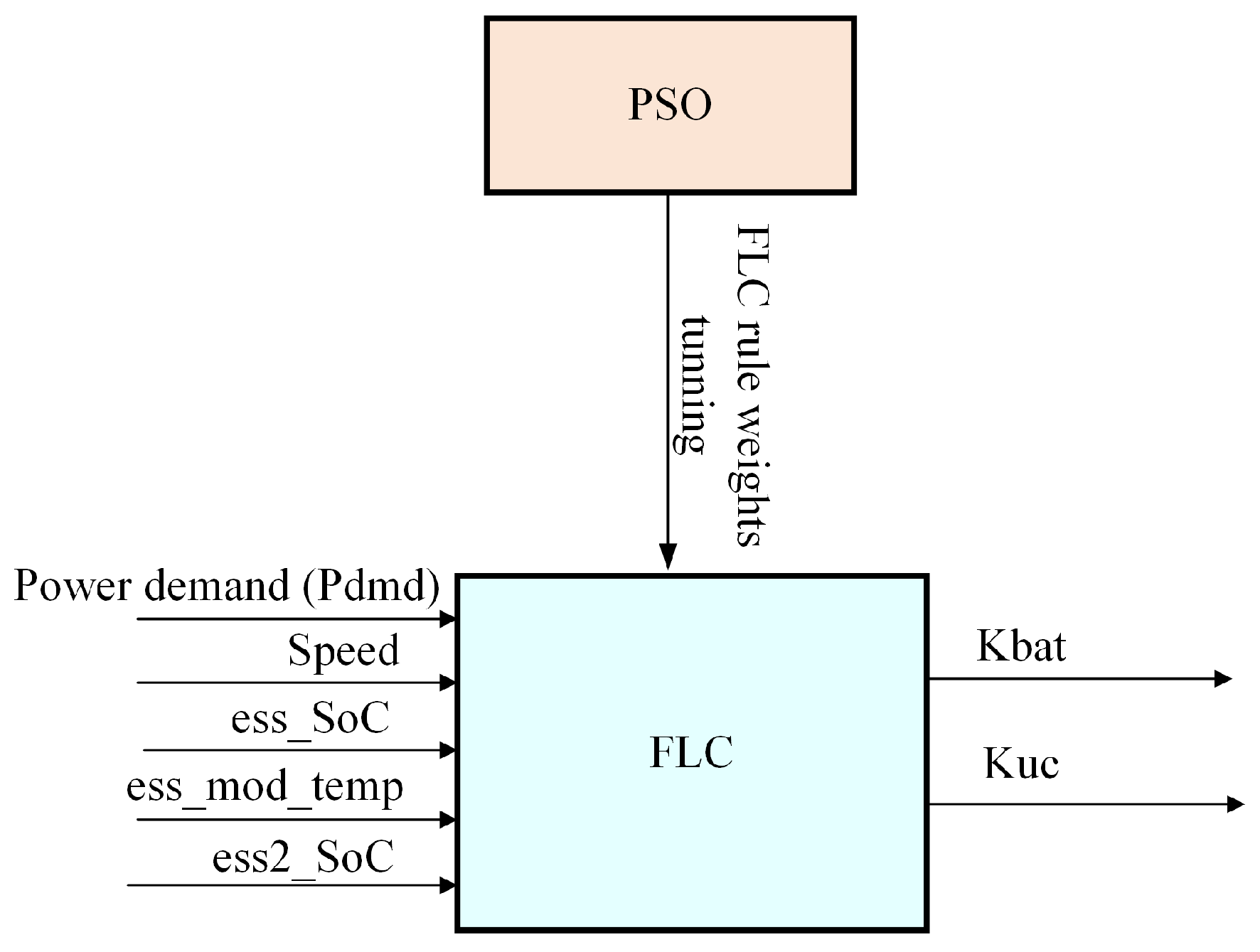
A lithium-ion battery–ultracapacitor hybrid energy storage system (HESS) has been recognized as a viable solution to address the limitations of single battery energy sources in electric vehicles (EVs), especially in urban driving conditions, owing to its complementary energy features. However, an energy management strategy (EMS) is required for the optimal performance of the HESS. In this paper, an EMS based on the particle swarm optimization (PSO) of the fuzzy logic controller (FLC) is proposed. It aims to minimize battery current and power peak fluctuations, thereby enhancing its capacity and lifespan, by optimizing the weights of formulated FLC rules using the PSO algorithm. This paper utilizes the battery temperature as the cost function in the optimization problem of the PSO due to the sensitivity of lithium-ion batteries (LIBs) to operating temperature variations compared to ultracapacitors (UCs). An evaluation of optimized FLC using PSO and a developed EV model is conducted under the Urban Dynamometer Driving Schedule (UDDS) and compared with the unoptimized FLC. The result shows that 5.4% of the battery’s capacity was conserved at 25.5 °C, which is the highest operating temperature attained under the proposed strategy.
Keywords: battery; electric vehicle; energy management strategies; fuzzy logic control; hybrid energy storage system; particle swarm optimization battery; electric vehicle; energy management strategies; fuzzy logic control; hybrid energy storage system; particle swarm optimization