Article

Oscillating Heat Pipe Cooling System of Electric Vehicle’s Li-Ion Batteries with Direct Contact Bottom Cooling Mode

Applied Thermal Engineering Lab, School of Mechanical Engineering, Chungbuk National University, 1 ChungDae-ro, SeoWon-gu, Cheongju, Chungbuk 28644, Korea
*
Author to whom correspondence should be addressed.
Energies 2019, 12(9), 1698; https://doi.org/10.3390/en12091698
Submission received: 30 March 2019 / Revised: 22 April 2019 / Accepted: 30 April 2019 / Published: 5 May 2019
(This article belongs to the Special Issue EV Battery Thermal Management)

Abstract

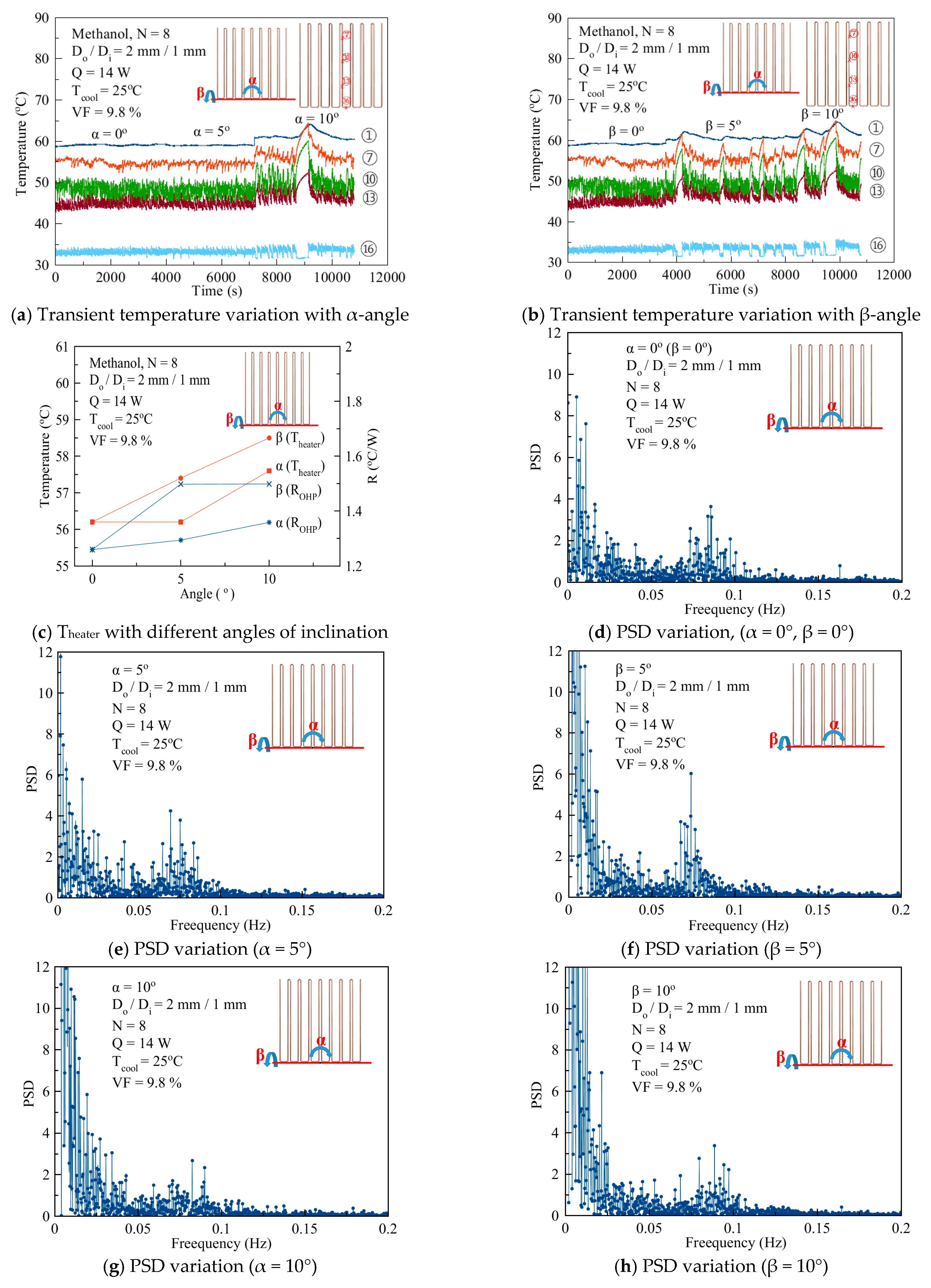
Recently, the use of electrical vehicles has abruptly increased due to environmental crises. The high energy density of lithium-ion batteries is their main advantage for use in electric vehicles (EVs). However, the thermal management of Li-ion batteries is a challenge due to the poor heat resistance of Lithium ions. The performance and lifetime of lithium ion batteries are strongly affected by the internal operating temperature. Thermal characterization of battery cells is very important to ensure the consistent operation of a Li-ion battery for its application. In the present study, the OHP (Oscillating Heat Pipe) system is proposed as a battery cooling module, and experimental verification was carried out. OHP is characterized by a long evaporator section, an extremely short condenser section, and almost no adiabatic section. Experimental investigations were conducted using various parameters such as the filling ratio, orientation, coolant temperature, and heat flux. Average temperature of the heater’s surface was maintained at 56.4 °C using 14 W with 25 °C coolant water. The experimental results show that the present cooling technology basically meets the design goal of consistent operation.
Keywords: Oscillating Heat Pipe; Li-ion battery cooling; electric vehicles; heat transfer; battery thermal management Oscillating Heat Pipe; Li-ion battery cooling; electric vehicles; heat transfer; battery thermal management