Visual vs. Spatial Contributions to Microsaccades and Visual-Spatial Working Memory
Abstract
Defining the Code and Capacity in VSWM
Oculomotor Programming and Attention
Method
Participants
Apparatus
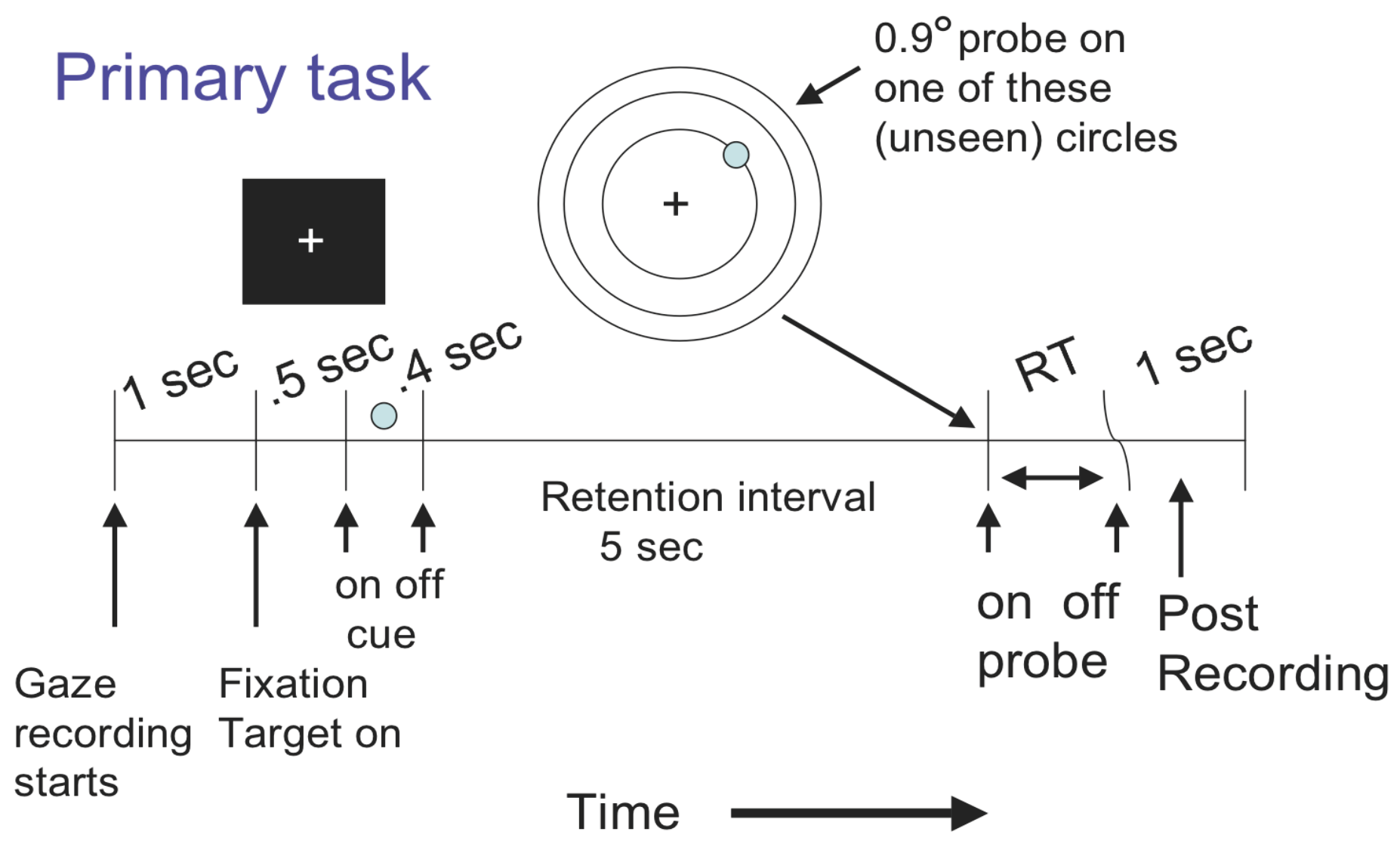
Behavioral Task
Procedure
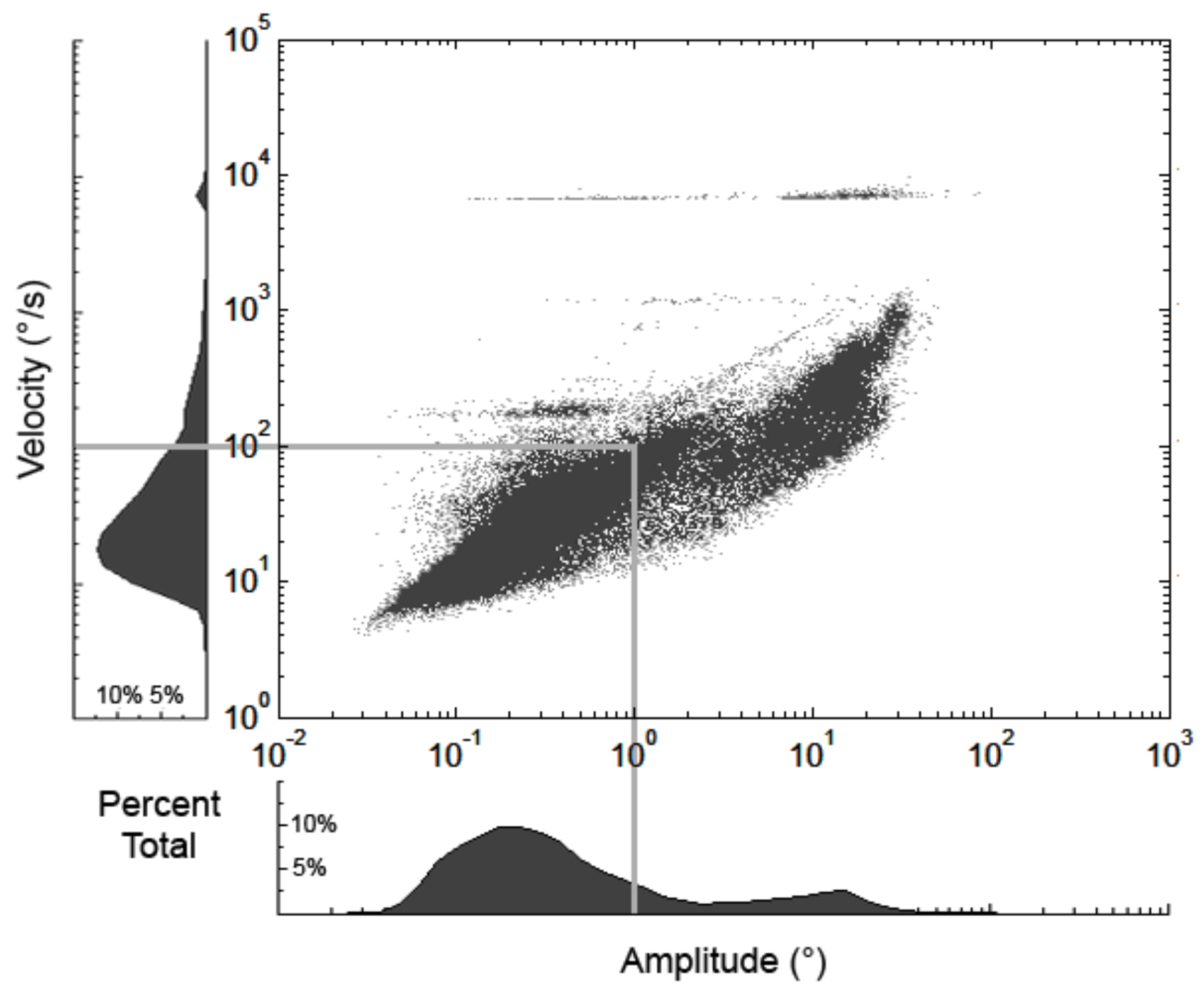
Gaze Data Processing
Behavioral Tasks
Results
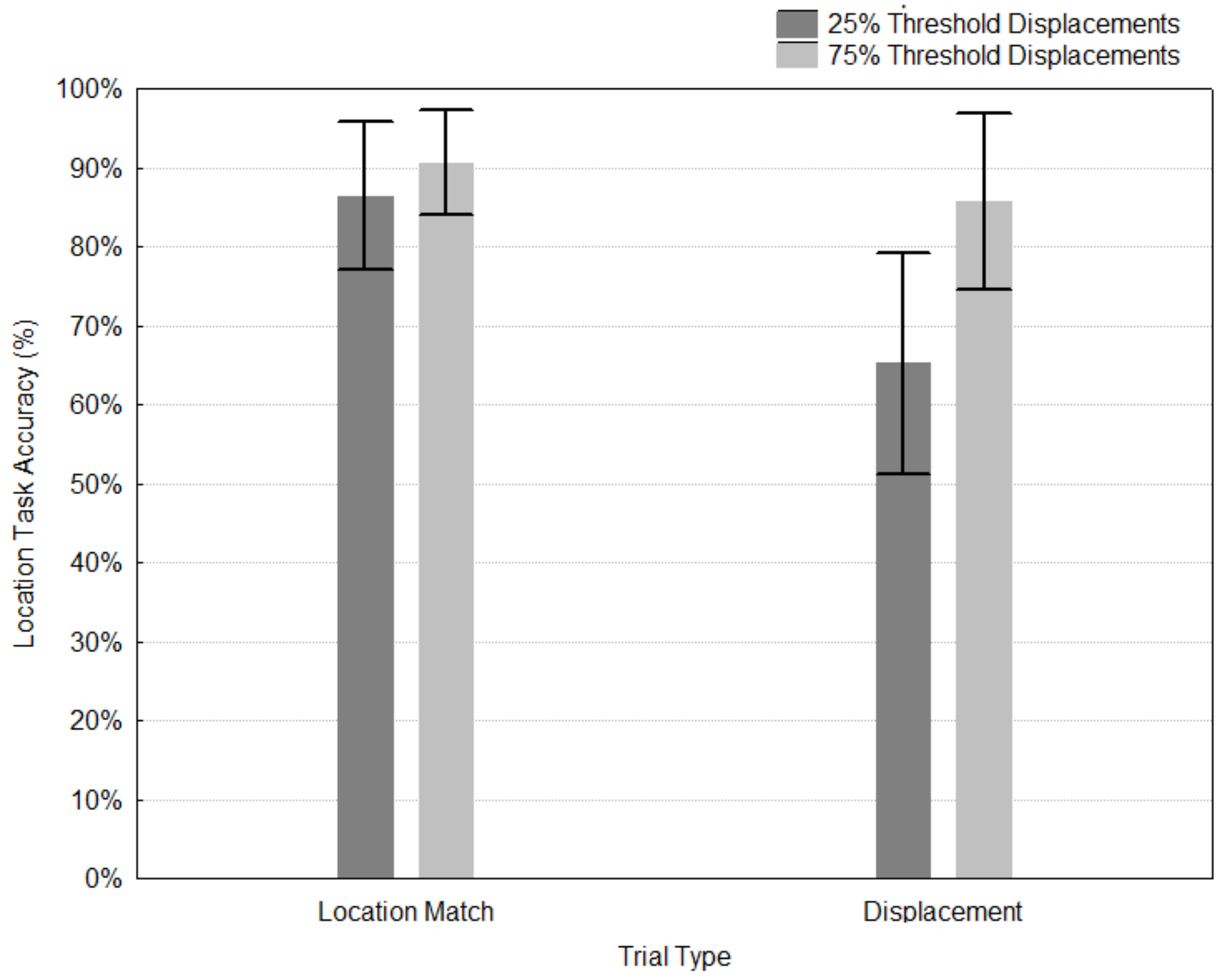
Behavioral Data
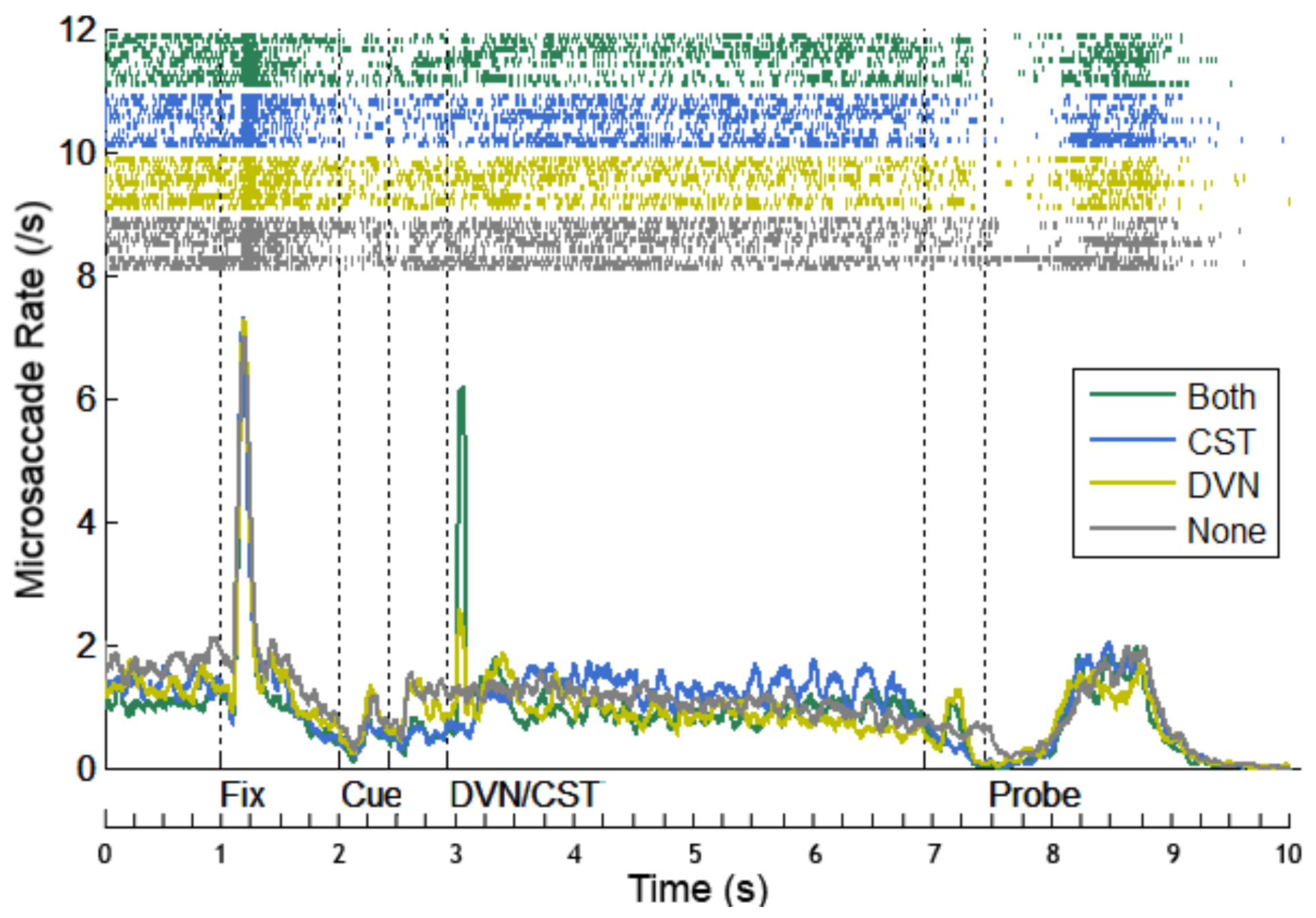
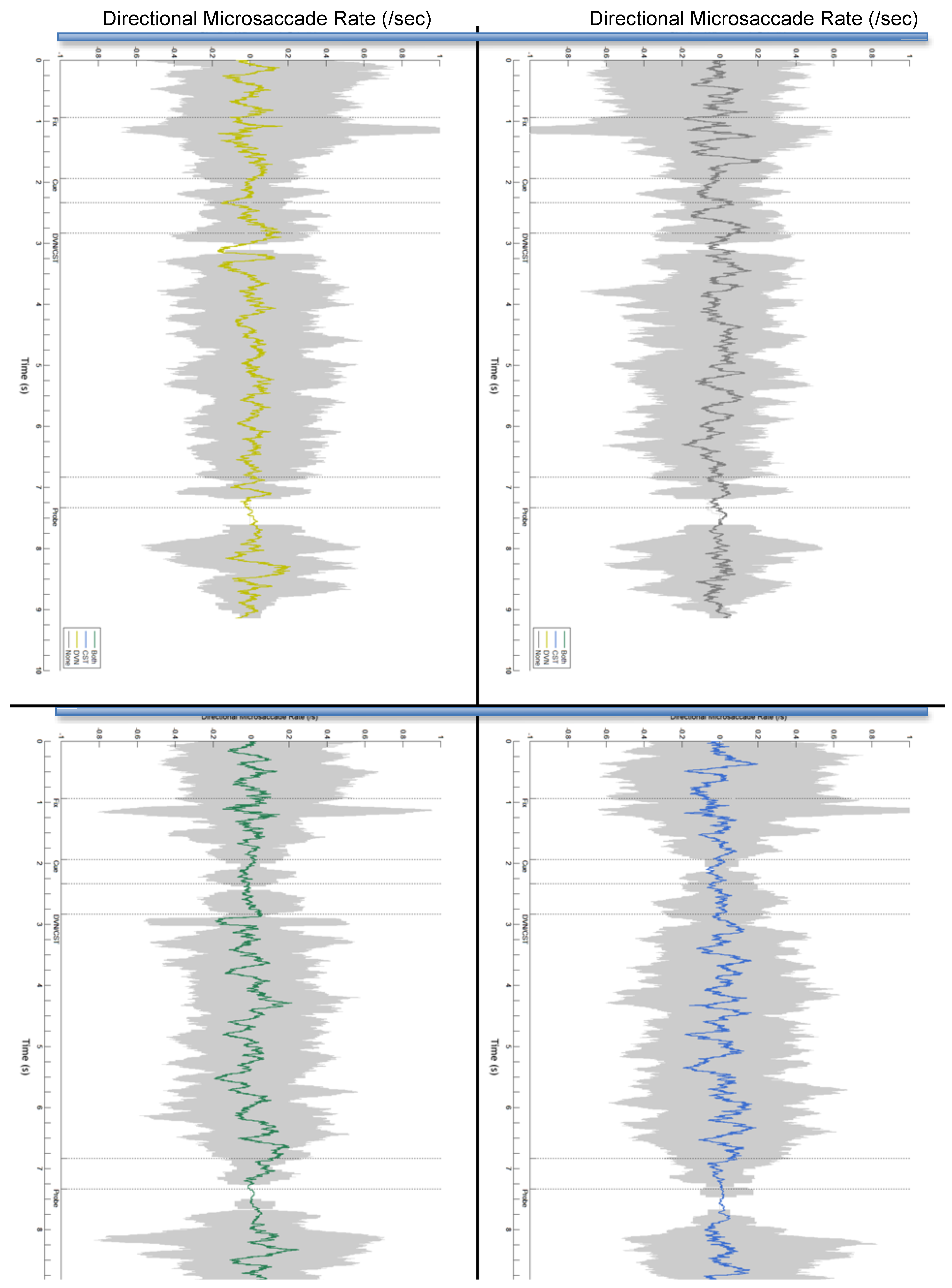
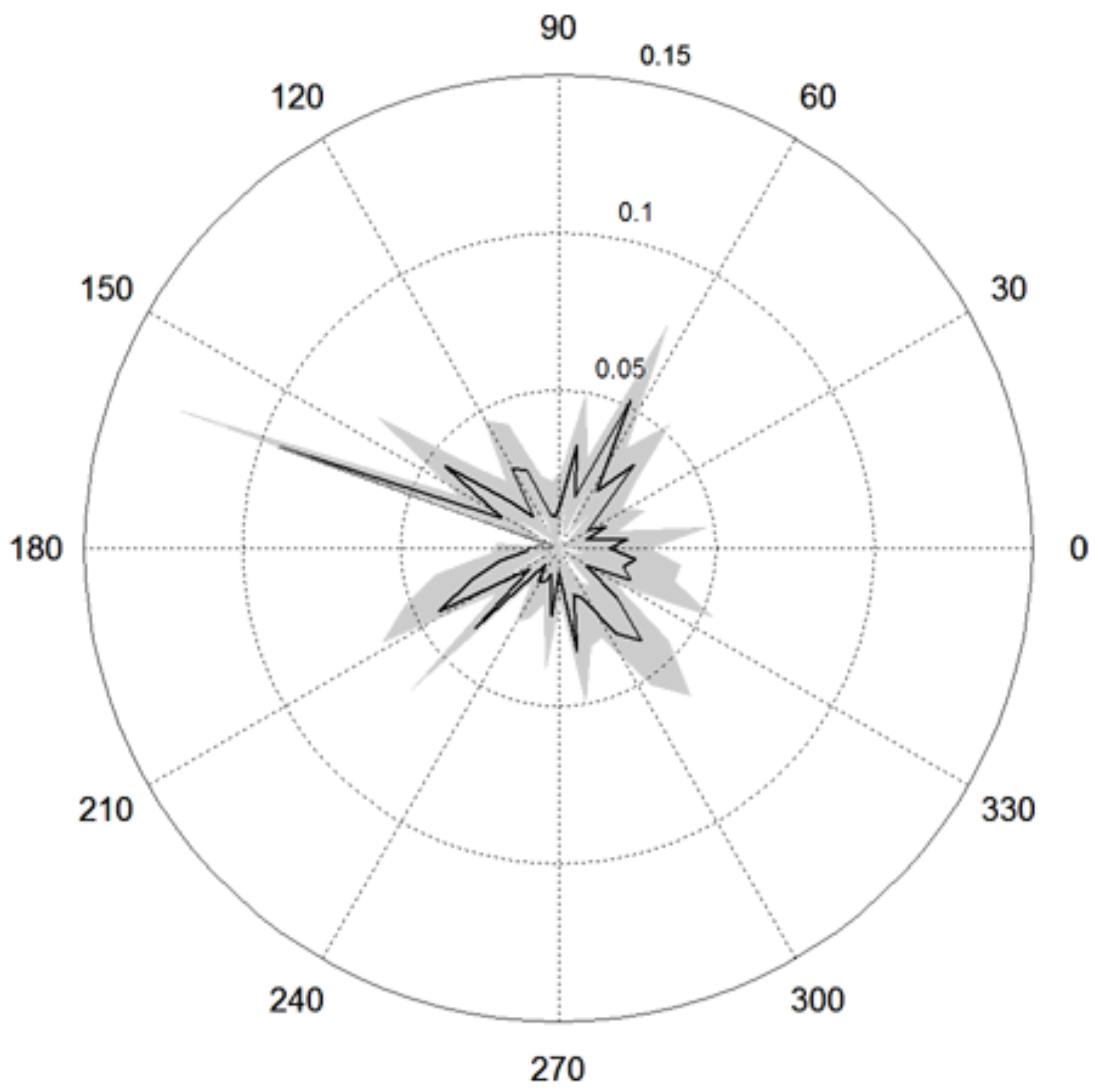
Microsaccades
Discussion
References
- Andersen, R. A. 1989. Visual and eye movement functions of the posterior parietal cortex. Annual Review of Neuroscience 12: 377–403. [Google Scholar] [CrossRef] [PubMed]
- Awh, E., B. Barton, and K. E. Vogel. 2007. Visual working memory represents a fixed number of items regardless of complexity. Psychological Science 18: 622–628. [Google Scholar] [CrossRef] [Scilit]
- Awh, E., and J. Jonides. 2001. Overlapping mechanisms of attention and spatial working memory. Trends in Cognitive Sciences 5: 119–125. [Google Scholar] [CrossRef] [Scilit]
- Bach, M., D. Bouis, and B. Fischer. 1983. An accurate and linear infrared oculometer. Journal of Neuroscience Methods 9: 9–14. [Google Scholar] [CrossRef] [Scilit]
- Baddeley, A. D., and G. Hitch. 1974. Edited by G. Bower. Working memory. In The Psychology of Learning and Motivation. New York: Academic Press. Vol. 8. [Google Scholar]
- Baddeley, A. D., and K. Lieberman. 1980. Edited by R. Nickerson. Spatial working memory. In Attention and performance, VI. London: Academic Press. pp. 522–539. [Google Scholar]
- Belopolsky, A. V., and J. Theeuwes. 2009. Inhibition of saccadic eye movements to locations in spatial working memory. Attention, Perception, & Psychophysics 71: 620–631. [Google Scholar]
- Betta, E., and M. Turatto. 2006. Are you ready? I can tell by looking at your microsaccades. NeuroReport 17: 1001–1004. [Google Scholar] [CrossRef] [Scilit]
- Bichot, N. P., S. C. Rao, and J. D. Schall. 2001. Continuous processing in macaque frontal cortex during visual search. Neuropsychologia 39: 972–982. [Google Scholar] [CrossRef] [Scilit]
- Bosch, V., A. Mecklinger, and A. D. Friederici. 2001. Slow cortical potentials during retention of object, spatial, and verbal information. Cognitive Brain Research 10: 219–237. [Google Scholar] [CrossRef] [Scilit]
- Brainard, D. H., and D. G. Pelli. 1997. The psychophysics toolbox. Spatial Vision 10: 433–436. [Google Scholar] [CrossRef] [Scilit]
- Bridgeman, B., D. Hendry, and L. Stark. 1975. Failure to detect displacement of the visual world during saccadic eye movements. Vision Research 15: 719–722. [Google Scholar] [CrossRef] [Scilit]
- Bridgeman, B., M. Kirch, and A. Sperling. 1981. Segregation of cognitive and motor aspects of visual function using induced motion. Perception & Psychophysics 29: 336–342. [Google Scholar]
- Bridgeman, B., S. Lewis, G. Heit, and M. Nagle. 1979. Relation between cognitive and motororiented systems of visual position perception. Journal of Experimental Psychology 5: 692–700. [Google Scholar] [PubMed]
- Bridgeman, B., and J. Palca. 1980. The role of microsaccades in high acuity observational tasks. Vision Research 20: 813–817. [Google Scholar] [CrossRef] [Scilit] [PubMed]
- Colegate, R. L., J. E. Hoffman, and C. W. Eriksen. 1973. Selective encoding from multielement visual displays. Perception & Psychophysics 14: 217–224. [Google Scholar]
- Conrad, R., and A. J. Hull. 1964. Information, acoustic confusion, and memory span. British Journal of Psychology 55: 429–432. [Google Scholar] [CrossRef] [Scilit]
- Corbetta, M., and G. L. Shulman. 2002. Control of goal-directed and stimulus-driven attention in the brain. Nature Reviews Neuroscience 3: 201–215. [Google Scholar] [CrossRef] [Scilit]
- Corbetta, M., E. Akbudak, T. E. Conturo, A. Z. Snyder, J. M. Ollinger, H. A. Drury, and et al. 1998. A common network for functional areas for attention and eye movements. Neuron 21: 761–773. [Google Scholar] [CrossRef] [Scilit]
- Corbetta, M., J. M. Kincade, and G. L. Shulman. 2002. Neural systems for visual orienting and their relationships to spatial working memory. Journal of Cognitive Neuroscience 14: 508–523. [Google Scholar] [CrossRef] [Scilit]
- Cornoldi, C., and T. Vecchi. 2003. Edited by C. Cornoldi and T. Vecchi. A continuity approach to visuo-spatial working memory. In Visuo-spatial working memory and individual differences. New York, NY: Psychology Press. pp. 119–134. [Google Scholar]
- Courtney, S. M., L. G. Ungerleider, K. Keil, and J. V. Haxby. 1996. Object and spatial visual working memory activate separate neural systems in human cortex. Cerebral Cortex 6: 39–49. [Google Scholar] [CrossRef] [Scilit]
- Cowan, N. 2001. The magical number 4 in short-term memory: A reconsideration of mental storage capacity. Behavioral & Brain Sciences 24: 87–185. [Google Scholar]
- Dean, G. M., S. A. Dewhurst, and A. Whittaker. 2008. Dynamic visual noise interferes with storage in visual working memory. Experimental Psychology 55: 283–289. [Google Scholar] [CrossRef] [Scilit] [PubMed]
- Engbert, R. 2006. Microsaccades: A microcosm for research on oculomotor control, attention, and visual perception. Progress in Brain Research 154: 177–192. [Google Scholar]
- Engbert, R. 2012. Computational modeling of collicular integration of perceptual responses and attention in microsaccades. The Journal of Neuroscience 32: 8035–8039. [Google Scholar] [CrossRef] [Scilit] [PubMed]
- Engbert, R., and R. Kliegl. 2003. Microsaccades uncover the orientation of covert attention. Vision Research 15: 431–436. [Google Scholar] [CrossRef] [Scilit]
- Engbert, R., and R. Kliegl. 2004. Microsaccades keep the eyes’ balance during fixation. Psychological Science 43: 1035–1045. [Google Scholar] [CrossRef] [Scilit]
- Farah, M. J., K. M. Hammond, D. N. Levine, and R. Calvino. 1988. Visual and spatial mental imagery: Dissociable systems of representation. Cognitive Psychology 20: 439–462. [Google Scholar] [CrossRef] [Scilit]
- Farmer, E. W., J. V. F. Berman, and Y. L. Fletcher. 1986. Evidence for visuo-spatial scratch-pad in working memory. Quarterly Journal of Experimental Psychology 38A: 675–688. [Google Scholar] [CrossRef] [Scilit]
- Gaunt, J., and B. Bridgeman. 2012. Microsaccades and Visual-Spatial Working Memory. Journal of Eye Movement Research 5: 1–16. [Google Scholar] [CrossRef] [Scilit]
- Hafed, Z. M., and J. J. Clark. 2002. Microsaccades as an overt measure of covert attention shifts. Vision Research 42: 2533–2545. [Google Scholar] [CrossRef] [Scilit]
- Hanes, D. P., W. F. Patterson, and J. D. Schall. 1998. Role of frontal eye fields in countermanding saccades: Visual, movement, and fixation activity. Journal of Neurophysiology 79: 817–834. [Google Scholar] [CrossRef] [Scilit]
- Hecker, R., and B. Mapperson. 1997. Dissociation of visual and spatial processing in working memory. Neuropsychologica 35: 599–603. [Google Scholar] [CrossRef] [Scilit] [PubMed]
- Kaernbach, C. 1990. A single-interval adjustmentmatrix (SIAM) procedure for unbiased adaptive testing. Acoustical Society of America 88: 2645–2654. [Google Scholar] [CrossRef] [Scilit] [PubMed]
- Klauer, K. C., and R. Stegmaier. 1997. Interference in immediate spatial memory: Shifts of spatial attention or central-executive involvement? Quarterly Journal of Experimental Psychology 50A: 79–99. [Google Scholar] [CrossRef] [Scilit] [PubMed]
- Klauer, K. C., and Z. Zhou. 2004. Double dissociations in visual and spatial short-term memory. Journal of Experimental Psychology: General 133: 355–381. [Google Scholar] [CrossRef] [Scilit]
- Kustov, A. A., and D. L. Robinson. 1996. Shared neural control of attentional shifts and eye movements. Nature 384: 74–77. [Google Scholar] [CrossRef] [Scilit]
- Lange, E. B., C. Starzynski, and R. Engbert. 2012. Capture of the gaze does not capture the mind. Attention, Perception, & Psychophysics 74: 1168–1182. [Google Scholar]
- Lange, E. B., and R. Engbert. 2013. Differentiating between verbal and spatial encoding using eyemovement recordings. Quarterly Journal of Experimental Psychology 66: 1840–1857. [Google Scholar] [CrossRef] [Scilit]
- Laubrock, J., R. Engbert, and R. Kliegl. 2005. Microsaccade dynamics during covert attention. Vision Research 45: 721–730. [Google Scholar] [CrossRef] [Scilit]
- Lawrence, B., J. Myerson, and R. A. Abrams. 2004. Interference with spatial working memory: An eye movement is more than a shift of attention. Psychonomic Bulletin & Review 11: 488–494. [Google Scholar]
- Lennie, P. 2003. The cost of cortical computation. Current Biology 13: 493–497. [Google Scholar] [CrossRef] [Scilit]
- Logie, R. H., and C. Marchetti. 1991. Edited by R. H. Logie and M. Denis. Visuo-spatial working memory: Visual, spatial or central executive? In Mental Images in Human Cognition. Amsterdam: Elsevier. pp. 105–115. [Google Scholar]
- Luck, S. J., and E. K. Vogel. 1997. The capacity of visual working memory for features and conjunctions. Nature 390: 279–281. [Google Scholar] [CrossRef] [Scilit] [PubMed]
- Martinez-Conde, S., S. L. Macknik, and D. H. Hubel. 2004. The role of fixational eye movements in visual perception. Nature Reviews Neuroscience 5: 229–240. [Google Scholar] [CrossRef] [Scilit] [PubMed]
- Martinez-Conde, S., J. Otero-Milan, and S. Macknik. 2012. The impact of microsaccades on vision: Towards a unified theory of saccadic function. Nature Reviews Neuroscience 14: 1–14. [Google Scholar] [CrossRef] [Scilit] [PubMed]
- Mecklinger, A., and N. Muller. 1996. Dissociations in the processing of “what” and “where” information in working memory: An event-related potential analysis. Journal of Cognitive Neuroscience 8: 453–473. [Google Scholar] [CrossRef] [Scilit]
- Milner, A. D., and M. A. Goodale. 1995. The visual brain in action. Oxford, England: Oxford University Press. [Google Scholar]
- Moore, T., and M. Fallah. 2004. Microstimulation of the frontal eye field and its effects on covert spatial attention. Journal of Neurophysiology 91: 152–162. [Google Scholar] [CrossRef] [Scilit]
- Moschovakis, A. K., C. A. Scudder, and S. M. Highstein. 1996. The microscopic anatomy and physiology of the mamalian saccadic system. Progress in Neurobiology 50: 133–254. [Google Scholar] [CrossRef] [Scilit]
- Pashler, H. 1988. Familiarity and visual change detection. Perception & Psychophysics 44: 369–378. [Google Scholar]
- Pastukhov, A., and J. Braun. 2010. Rare but precious: Microsaccades are highly informative about attentional allocation. Vision Research 50: 1173–1184. [Google Scholar] [CrossRef] [Scilit]
- Pastukhov, A., V. Vonau, S. Stonkute, and J. Braun. 2013. Spatial and temporal attention revealed by microsaccades. Vision Research 85: 45–57. [Google Scholar] [CrossRef] [Scilit]
- Pearson, D. G., and A. Sahraie. 2003. Oculomotor control and the maintenance of spatially and temporally distributed events in visuo-spatial working memory. Quarterly Journal of Experimental Psychology 56A: 1089–1111. [Google Scholar] [CrossRef] [Scilit]
- Posner, M. I. 1980. Orienting of attention. Quarterly Journal of Experimental Psychology 32: 3–25. [Google Scholar] [CrossRef] [Scilit] [PubMed]
- Posner, M. I., M. J. Nissen, and W. C. Ogden. 1978. Edited by H. L. Pick and B. J. Saltzman. Attended and unattended processing modes: The role of set in spatial locations. In Modes of perceiving and processing information. Hillsdale, NJ: Erlbaum. pp. 137–158. [Google Scholar]
- Posner, M. I., and M. K. Rothbart. 2007. Research on attention networks as a model for the integration of psychological science. Annual Review of Psychology 58: 1–23. [Google Scholar] [CrossRef] [Scilit] [PubMed]
- Pylyshyn, Z. W., and R. W. Storm. 1988. Tracking multiple independent targets: Evidence for a parallel tracking mechanism. Spatial Vision 3: 179–197. [Google Scholar] [CrossRef] [Scilit] [PubMed]
- Quinn, J. G., and J. McConnell. 1996. Irrelevant pictures in visual working memory. Quarterly Journal of Experimental Psychology 49A: 200–215. [Google Scholar] [CrossRef] [Scilit]
- Quinn, J. G., and J. McConnell. 1999. Manipulation of interference in the passive visual store. European Journal of Cognitive Psychology 11: 373–389. [Google Scholar] [CrossRef] [Scilit]
- Ratliff, F., and L. A. Riggs. 1950. Involuntary motions of the eye during monocular fixation. Journal of Experimental Psychology 40: 687–700. [Google Scholar] [CrossRef] [Scilit]
- Rizzolatti, G., L. Riggio, I. Dascola, and C. Umilta. 1987. Reorienting attention across the horizontal and vertical meridians: Evidence in favor of a premotor theory of attention. Neuropsychologica 25: 31–40. [Google Scholar] [CrossRef] [Scilit]
- Rolfs, M., R. Engbert, and R. Kliegl. 2008. Toward a model of microsaccade generation: The case of microsaccade inhibition. Journal of Vision 8: 1–23. [Google Scholar] [CrossRef] [Scilit]
- Rossi-Arnaud, C., L. Pieroni, and A. D. Baddeley. 2006. Symmetry and binding in visuospatial working memory. Neuroscience 139: 393–400. [Google Scholar] [CrossRef] [Scilit]
- Scolari, M., E. K. Vogel, and E. Awh. 2008. Perceptual expertise enhances the resolution but not the number of representations in working memory. Psychometric Bulletin & Review 15: 215–222. [Google Scholar]
- Siegenthaler, E., F. Costela, M. McCamy, L. Di Stasi, J. Otero-Millan, A. Sonderegger, R. Groner, S. Macknik, and S. Martinez-Conde. 2013. Task difficulty in mental arithmetic affects microsaccadic rates and magnitudes. European Journal of Neuroscience 39, 2: 287–294. [Google Scholar] [CrossRef] [Scilit] [PubMed]
- Smyth, M. M., and K. A. Scholey. 1994. Interference in immediate spatial memory. Memory & Cognition 22: 1–13. [Google Scholar]
- Smyth, M. M., N. A. Pearson, and L. R. Pendleton. 1988. Movement and working memory: Patterns and positions in space. Quarterly Journal of Experimental Psychology 40A: 497–514. [Google Scholar] [CrossRef] [Scilit]
- Sperling, G. 1960. The information available in brief visual presentations. Psychological Monographs 74: 1–29. [Google Scholar] [CrossRef] [Scilit]
- Tresch, M. C., H. M. Sinnamon, and J. G. Seamon. 1993. Double dissociations of spatial and object visual memory: Evidence from selective interference in intact human subjects. Neuropsychologia 31: 211–219. [Google Scholar] [CrossRef] [Scilit] [PubMed]
- Turatto, M., M. Valsecchi, L. Tame, and E. Betta. 2007. Microsaccades distinguish between global and local visual processing. Neuroreport 18: 1015–1018. [Google Scholar] [CrossRef] [Scilit]
- Ungerleider, L. G., and M. Mishkin. 1982. Edited by D. J. Ingle, M. A. Goodale and R. J. W. Mansfield. Two cortical visual systems. In Analysis of visual behavior. Cambridge, MA: MIT Press. pp. 549–586. [Google Scholar]
- Vogel, E. K., G. F. Woodman, and S. J. Luck. 2001. Storage of features, conjunctions, and objects in visual working memory. Journal of Experimental Psychology: Human Perception and Performance 27: 92–114. [Google Scholar] [CrossRef]
- Winterson, B. J., and H. Collewijn. 1976. Microsaccades during finely guided visuomotor tasks. Vision Research 16: 1387–1390. [Google Scholar] [CrossRef] [Scilit]
- Zimmer, H. D. 2008. Visual and spatial working memory: From boxes to networks. Neuroscience and Biobehavioral Reviews 32: 1373–1395. [Google Scholar] [CrossRef] [Scilit]
- Zuber, B. L., and L. Stark. 1966. Saccadic suppression: Elevation of visual threshold associated with saccadic eye movements. Experimental Neurology 16: 65–79. [Google Scholar] [CrossRef] [Scilit]
- Zuber, B. L., L. Stark, and G. Cook. 1965. Microsaccades and the velocity-amplitude relationship for saccadic eye movements. Science 150: 1459–1460. [Google Scholar] [CrossRef] [Scilit]


Copyright © 2014. This article is licensed under a Creative Commons Attribution 4.0 International License.
Share and Cite
Gaunt, J.T.; Bridgeman, B. Visual vs. Spatial Contributions to Microsaccades and Visual-Spatial Working Memory. J. Eye Mov. Res. 2014, 7, 1-14. https://doi.org/10.16910/jemr.7.2.2
Gaunt JT, Bridgeman B. Visual vs. Spatial Contributions to Microsaccades and Visual-Spatial Working Memory. Journal of Eye Movement Research. 2014; 7(2):1-14. https://doi.org/10.16910/jemr.7.2.2
Chicago/Turabian StyleGaunt, Joshua T., and Bruce Bridgeman. 2014. "Visual vs. Spatial Contributions to Microsaccades and Visual-Spatial Working Memory" Journal of Eye Movement Research 7, no. 2: 1-14. https://doi.org/10.16910/jemr.7.2.2
APA StyleGaunt, J. T., & Bridgeman, B. (2014). Visual vs. Spatial Contributions to Microsaccades and Visual-Spatial Working Memory. Journal of Eye Movement Research, 7(2), 1-14. https://doi.org/10.16910/jemr.7.2.2