


Abstract
In the physical examination of the patient suspected of having tarsal tunnel syndrome, the podiatric physician relies on Tinel’s sign: tapping the posterior tibial nerve in the tarsal tunnel should produce a distally radiating sensation if the nerve is pathologically compressed at this lo- cation. The American College of Rheumatology recognizes fibromyal- gia as a condition characterized by multiple “tender points” on physical examination. This report compares the locations of the 18 critical diag- nostic fibromyalgia points with known sites of anatomical entrapment of peripheral nerves in the lower extremity. We also describe a patient with both fibromyalgia and tarsal tunnel syndrome. Tinel’s sign in the lower extremity is a valid technique for assessing peripheral nerve compression in the patient with fibromyalgia.
Fibromyalgia, a descriptive term that does not at- tempt to define the pathogenesis, is recognized by the American College of Rheumatology as a condition characterized by multiple “tender points.”[1] There is currently no accepted laboratory test to confirm the diagnosis. It is important for the podiatric physician to know whether the symptoms of fibromyalgia include those that might overlap with foot symptoms traditionally considered to be related to specific anatomical problems in the foot, such as compression of the tibial nerve in the tarsal tunnel. In addition, it is important to know whether traditional physical ex- amination techniques, such as evaluation for Tinel’s sign, are still valid in the patient with fibromyalgia.
Fibromyalgia Points
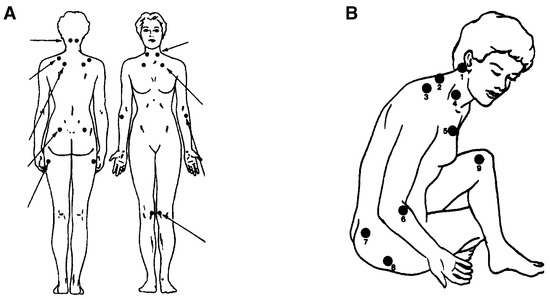
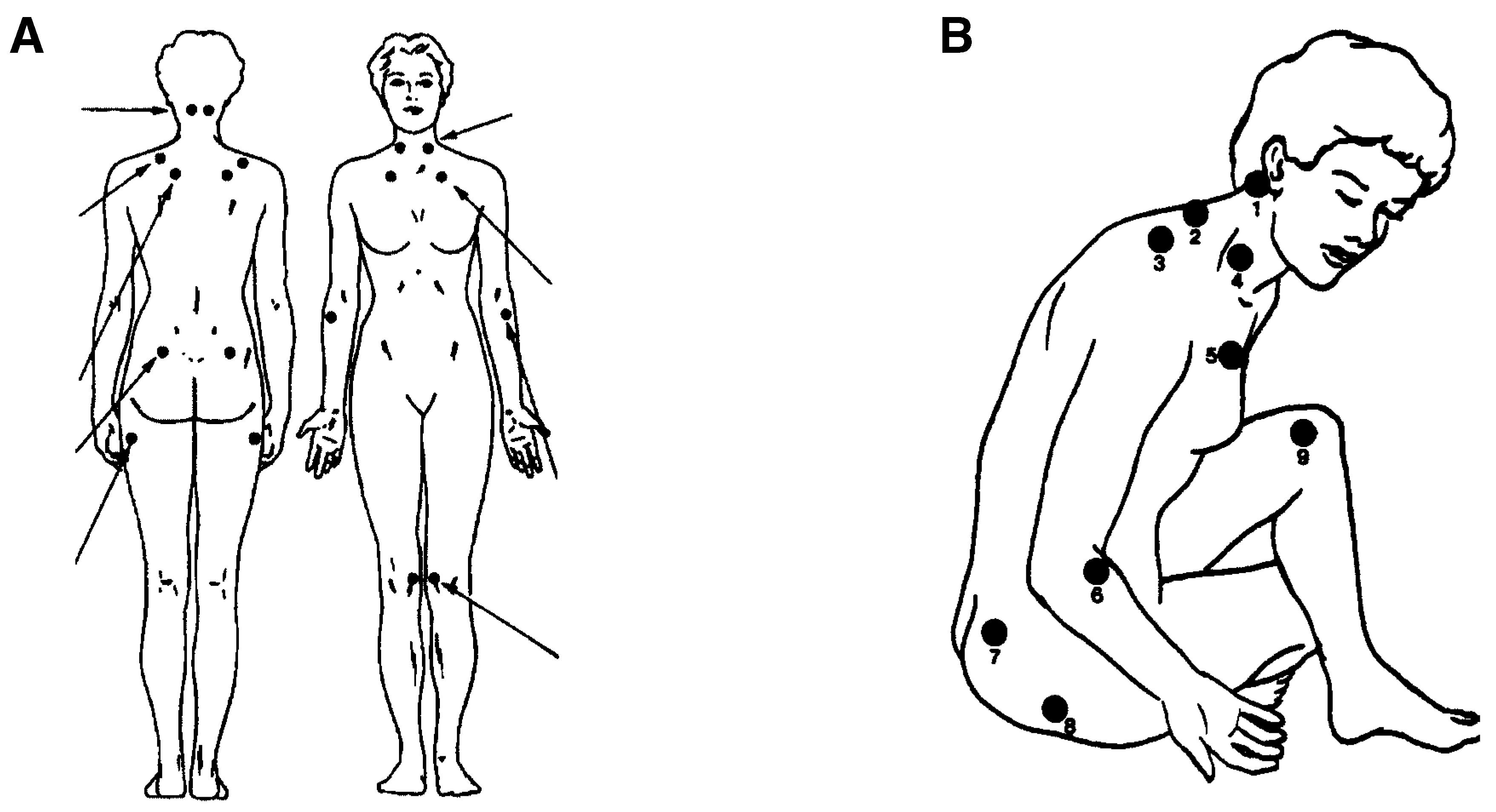
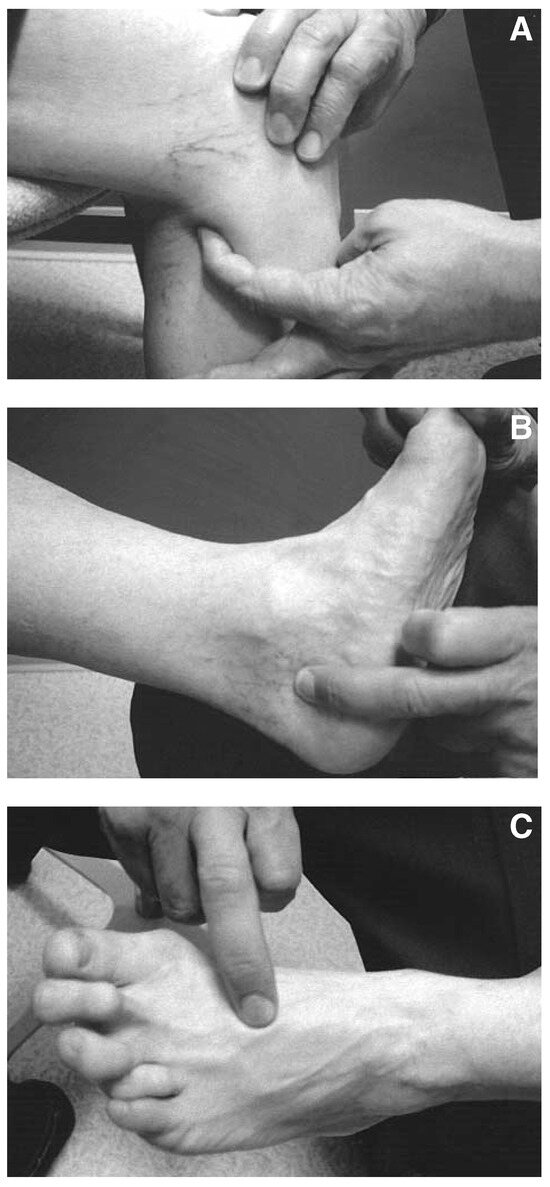
The locations of the nine paired tender points that compose the 1990 American College of Rheumatology criteria for fibromyalgia are illustrated in Figure 1. These nine fibromyalgia tender points are compared with the sites of Tinel’s sign in a patient with tarsal tunnel syndrome (Figure 2). The site at which Tinel’s sign would be expected in the patient with tarsal tunnel syndrome differs from the sites at which a tender point for fibromyalgia would be expected.
Figure 1.
Locations of the nine paired tender points for the diagnosis of fibromyalgia. A, Anterior and posterior views; B, lateral view.
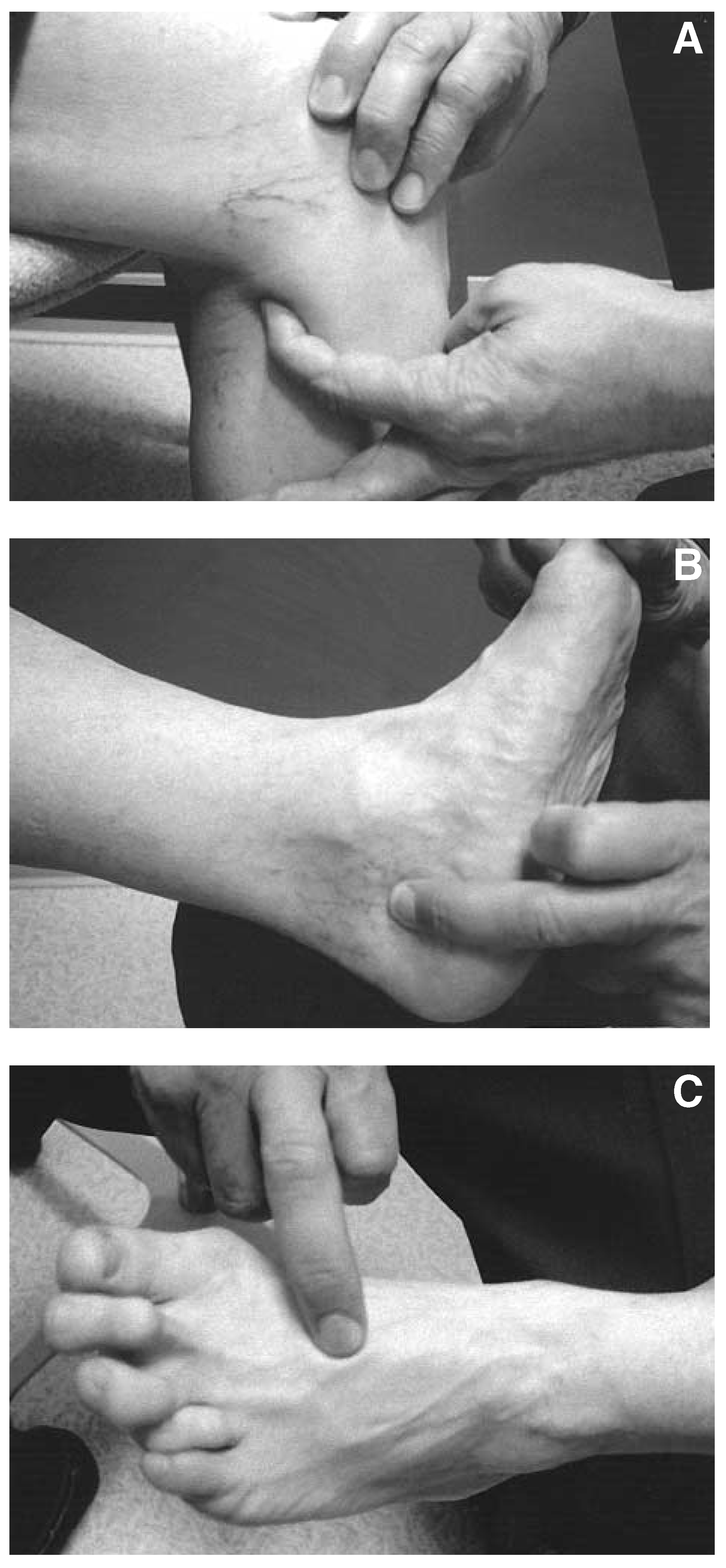
Figure 2.
Location of Tinel’s sign for entrapment of pe- ripheral nerves in the lower extremity. A, Tarsal tunnel; B, common peroneal nerve; C, deep peroneal nerve.
Case Report
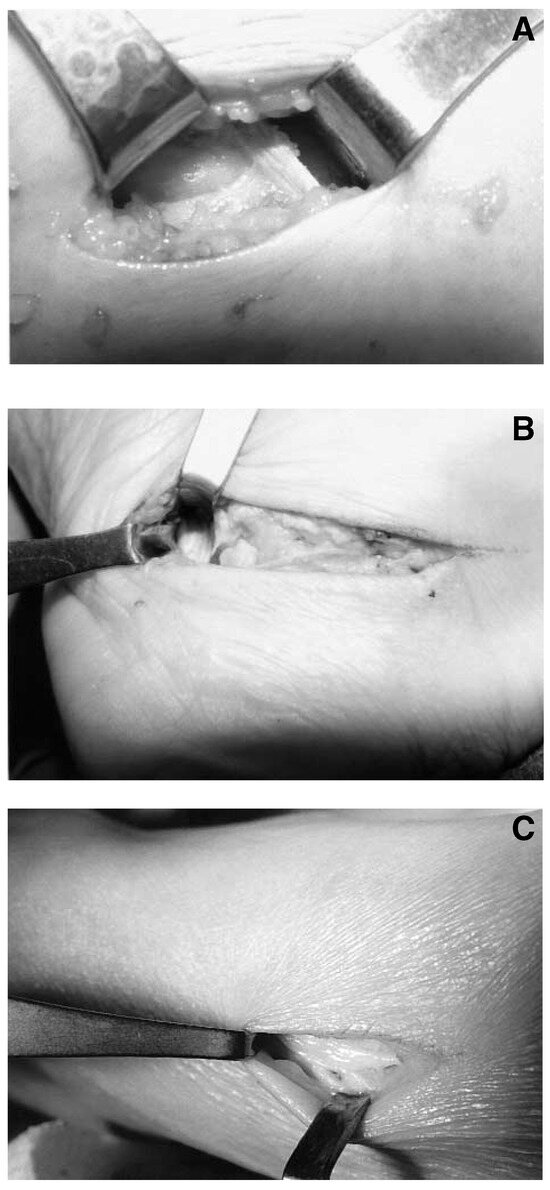
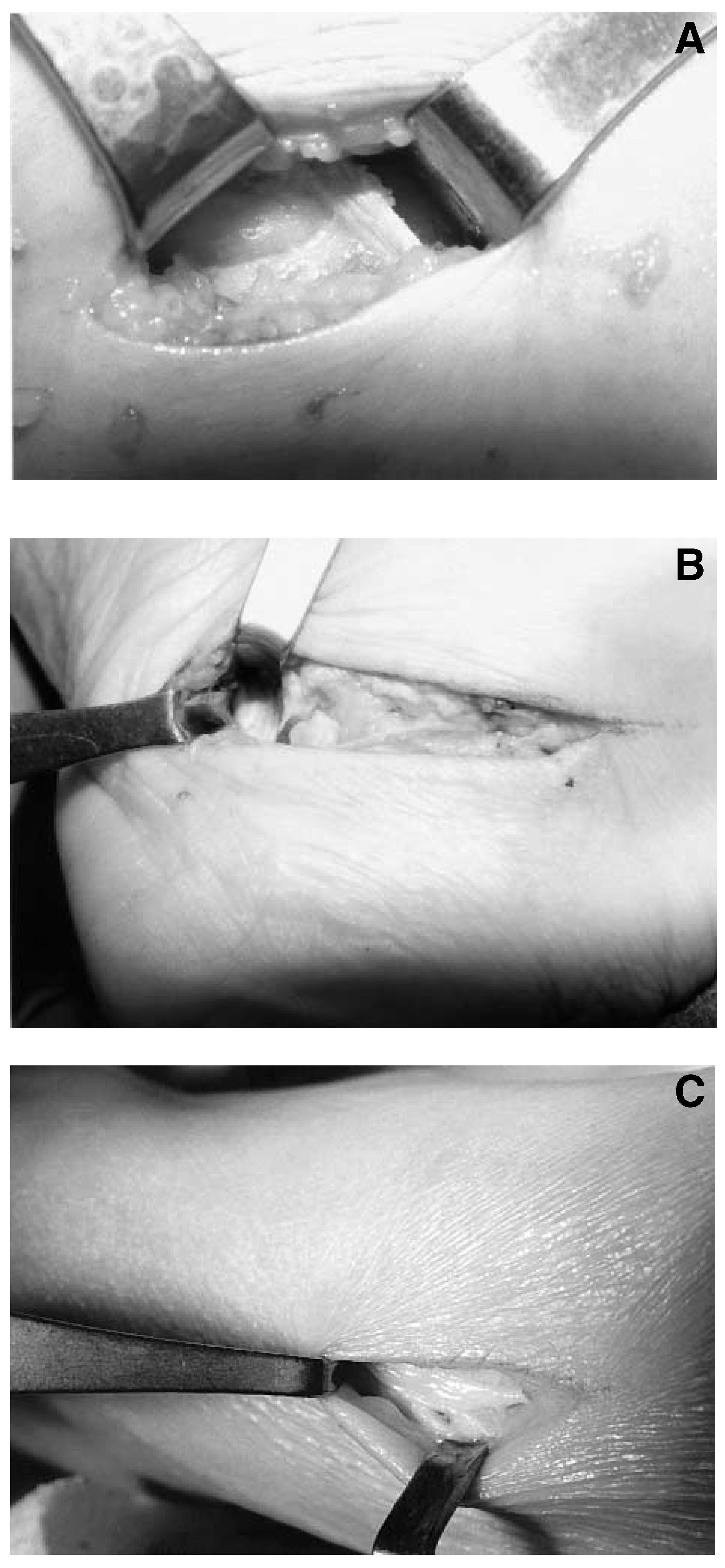
A 45-year-old woman with a 17-year history of fibro- myalgia presented to the office of one of the authors (G.I.F.) in Hagerstown, Maryland, with complaints of discomfort and numbness in both feet. Specifically, she had numbness and tingling in the arch and toes that worsened as the day progressed and disturbed her sleep. The discomfort had increased in severity during the past 3 years. At the time of presentation, her symptoms were constant, and she rated her pain as 8 on a scale from 0 to 10, with pain intermittently rated as 10. She had no other medical problems. She was taking narcotics plus gabapentin for the pain. Neurosensory testing with the Pressure-Specified Sensory Device (Sensory Management Services LLS, Baltimore, Maryland) confirmed preserved two-point discrimination with increased cutaneous pressure thresholds in the medial plantar, medial calcaneal, and deep and superficial peroneal nerves.[2] On physical examination, Tinel’s sign was present over the tibial nerve in the tarsal tunnel, the common peroneal nerve at the fibular head, and the deep peroneal nerve over the dorsum of the foot, consistent with localized compression of the peroneal and tibial nerves at these locations.[3] The patient underwent re- lease of the four medial ankle tunnels and decompression of the peroneal nerves at the knee and the dorsum of the foot. Intraoperatively, her nerves were found to be compressed (Figure 3). Symptoms improved by the third postoperative week. The contralateral leg underwent the same operation 3 months after the first procedure. Six weeks after completion of both operations, the patient’s pain level was reported to be 0 on a scale from 0 to 10 when at rest and 2 when standing or walking at her job. By 3 months after the second surgery, she had stopped taking narcotic medications and gabapentin. Postoperative neurosensory testing using the Pressure-Specified Sensory Device demonstrated normal measurements in the medial plantar, medial calcaneal, and deep and superficial peroneal nerves.
Figure 3.
Intraoperative view of the compression sites. A, Tarsal tunnel; B, common peroneal nerve; C, deep peroneal nerve.
Discussion
The American College of Rheumatology’s specified tender points in the lower extremity do not correspond to the known sites of entrapment of the posterior tibial nerve within the tarsal tunnel, the common peroneal nerve at the fibular neck, or the deep peroneal nerve at the dorsum of the foot. One may conclude that the presence of Tinel’s sign over these peripheral nerves in the patient with fibromyalgia can be considered a legitimate indicator of peripheral nerve compression.
The definition of Tinel’s sign in a patient with nerve compression and the definition of a tender point in a patient with fibromyalgia require further comment. For example, how much pressure should be applied in attempting to elicit Tinel’s sign when examining the patient with fibromyalgia? Clearly, force applied to any given spot can cause pain. In fibromyalgia, it has been stated that “an amount of pressure required to blanch the examiner’s nail” should be used.1 The amount of pressure required to elicit Tinel’s sign has not been stated[4,5,6] but should be such that it does not cause pain over an adjacent site of the same anatomical part that is tested and does not cause pain over a nerve at a site that is asymptomatic.
For the diagnosis of fibromyalgia, the patient should have 11 of the 18 tender points “positive.”[1] The patient is also required to have a history of chronic widespread pain involving all four quadrants of the body and the axial skeleton. Clauw[1] reviewed literature indicating that 1% to 2% of the US population meet these criteria. His review also notes that, in the general population, the number of tender points ranges from one to four, that there is an increase in the number of tender points with stress, and that women are nine times more likely than men to have 11 of 18 tender points. The chronic nature and widespread distribution of the discomfort present in the patient with fibromyalgia differ from the very specific complaints associated with peripheral nerve compression.
It is helpful to note the marked disparity in physical complaints expressed by the patient with fibromyalgia and the patient with peripheral nerve compression. Typically, the symptoms of peripheral nerve compression are “classic,” consisting of numbness, tingling, or weakness rather than actual pain.[3] In contrast, the typical patient with fibromyalgia complains of “aching all over” and of multifocal pain, which commonly varies in intensity and is nondermatomal.
References
- CLAUW, D.J. “Fibromyalgia,” in Kelly’s Textbook of Rheuma- tology, Ruddy, S., Haven, E., Sledge, C., Eds.; WB Saunders: Philadelphia, 2001; Vol 1, p. 417. [Google Scholar]
- DELLON, A.L. Somatosensory Testing and Rehabilitation; Institute for Peripheral Nerve Surgery: Baltimore, 2000. [Google Scholar]
- MACKINNON, S.E.; DELLON, A.L. Surgery of the Peripheral Nerve; Thieme: New York, 1988. [Google Scholar]
- TINEL J: The sign of “tingling” in lesions of the periph- eral nerves. Arch Neurol 1971, 24, 574. [CrossRef] [Scilit]
- KAPLAN, E.J. “Tinel’s Fourmillement Paper,” in Injuries to the Major Branches of Peripheral Nerves of the Forearm,; Spinner, M., Ed.; WB Saunders: Philadelphia, 1978; p. 8. [Google Scholar]
- DELLON AL: Tinel or not Tinel? J Hand Surg Br 1984, 9, 216. [CrossRef]
© 2004 American Podiatric Medical Association