


Abstract
Contrary to popular belief, a patient’s signature on a piece of paper does not constitute informed consent. This article describes the ethical framework of consent in the context of the larger process of informed decision making. The elements of informed consent are examined in practical terms. Common pitfalls are addressed, with strategies to help anticipate and resolve possible dilemmas. These important tools are integral to all levels of medical decision making, including those at the end of life.
Despite its firm foundations in medical ethics and the law, informed consent is often misunderstood by physicians and inadequately applied in daily practice. The driving force behind informed consent is the idea of respecting patients’ autonomy and right to make their own decisions on matters related to their health care. A myth exists that a signature on a form qualifies as consent and provides protection from legal liability. Actually, it offers little protection alone, without a prerequisite discussion documented in the medical record that includes careful attention to certain key elements: capacity, information, understanding, voluntariness, and decision.[1-3]
Perhaps the term “informed consent” is a misnomer that contributes to its own misapplication. “Informed decision making” may be a preferable and more accurate expression. Emphasizing “informed” stresses the central importance of the process itself: the effective communication between physician and patient with the intention of empowering patients to make well-informed decisions. Consent is not necessarily the goal. A patient’s refusal of treatment may be the result of a process performed exceptionally well.
In this article, I examine the ethical foundations of informed consent, analyze its essential elements, and address commonly encountered problems and obstacles. I touch on the basic principles that serve as the bedrock of medical ethics, and how they influence the process of informed consent, and conclude by relating what has been discussed to advance directives and surrogate decision making.
Principles of Medical Ethics
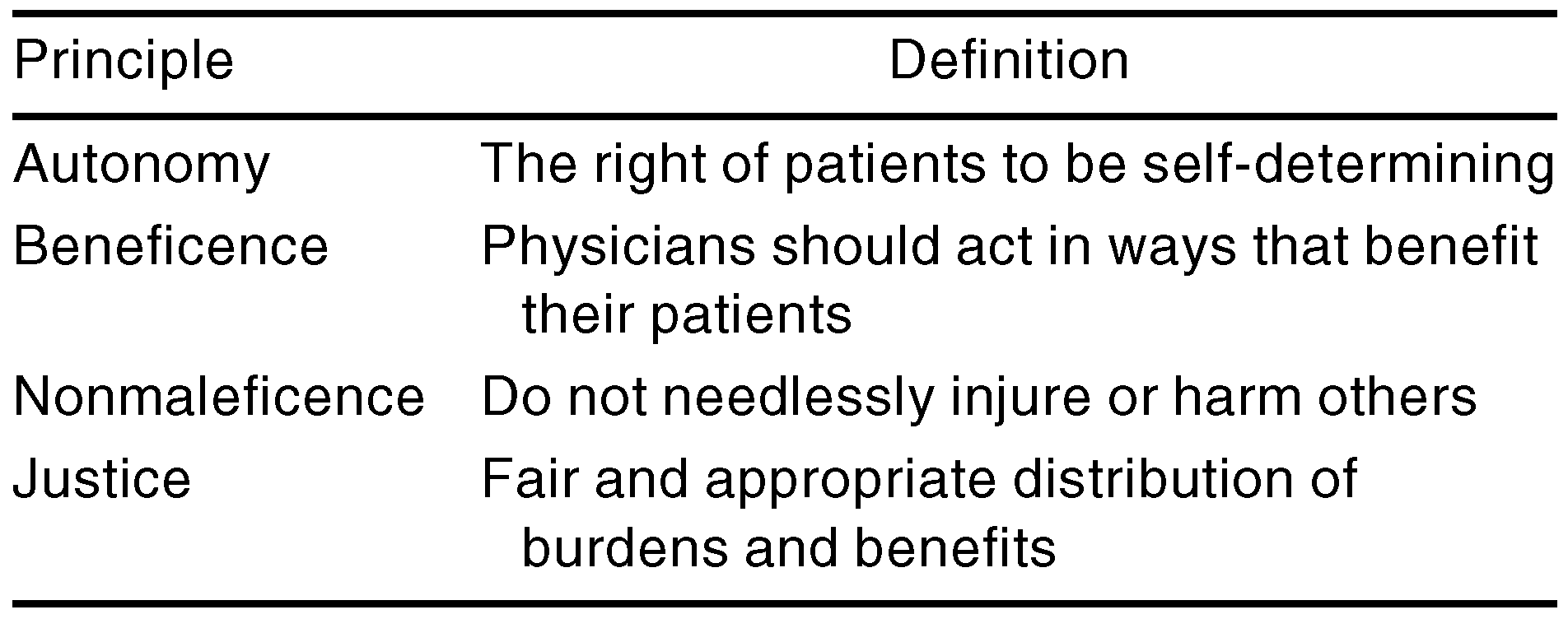
There has been much emphasis in medical ethics on the four principles of autonomy, beneficence, nonmaleficence, and justice (Table 1).[4] The “principle-based” approach to ethics establishes essential theoretical considerations necessary to understanding ethical problems. Concentrating solely on principles, however, fosters the simplistic and misguided assumption that by mining these moral absolutes one will find “the answer.” Thinking in terms of abstract principles alone negates the dynamic, emotional, human natures of the participants. Feelings and relationships influence behavior and must be considered.[5, 6]

Table 1.
Principles of Medical Ethics.
Respect for Autonomy: Foundations of Informed Consent
The word autonomy is derived from the Greek autos (self) and nomos (rule). Specifically applied to medical practice, the principle of autonomy centers on the patient’s ability to make decisions about his or her own care. The writings of Immanuel Kant and John Stuart Mill figure heavily in the ethical foundations of autonomy. Kant argued that persons possess intrinsic dignity, unconditional worth, and the capacity to control their individual destinies.[7] Thus they should be treated as means unto themselves, with the ability to choose and determine their own destinies, and not as instruments to satisfy the goals of others. Mill argued that people should possess the freedom and autonomy to shape their own lives as long as they do not interfere with the expression of freedom of others.[8] Mill focuses his position on noninterference and the strengthening of individual autonomy, whereas Kant demands respectful treatment of others as a moral imperative.
The legal foundation of respect for autonomy can be summed up by a statement of Judge Benjamin Cardozo in 1914 in the case of Schloendorff v Society of New York Hospital: “Every human being of adult years and sound mind has a right to determine what shall be done with his own body.”[9] In a legal context, treating patients without their consent or with inadequate consent can expose clinicians to charges of unlawful touching, assault and battery, and negligence.[1, 2]
Physicians have an obligation to patients to acquire valid, morally defensible, and legally sound consent before engaging in therapeutic or diagnostic treatment. The informed consent process is a dialogue that requires time, skill, and insight to be done well. But the process promises many benefits, regardless of the patient’s final decision. It honors and respects patients as people, promotes trust in the physician, and improves patient satisfaction, compliance, and health outcomes.
Elements of Informed Consent
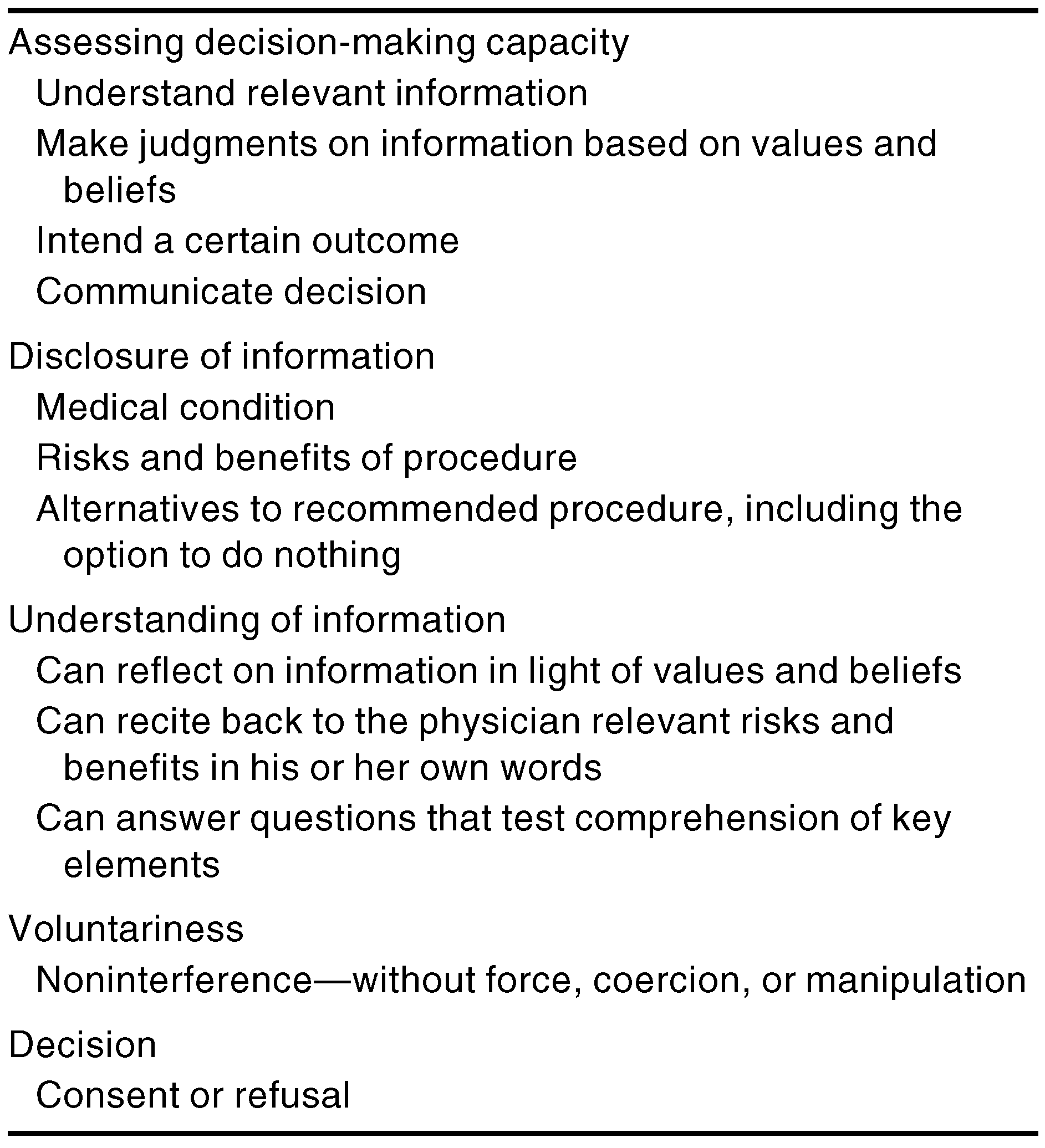
Two conditions are essential for people to be considered autonomous decision-making agents: liberty, or independence from controlling influences, and agency, or the capacity for intentional action.[4] By breaking down informed consent into its essential elements, it will become easier to understand what is truly meant by liberty and agency and thus to develop a clearer idea of patient autonomy (Table 2).
Table 2.
Elements of Informed Consent.
Capacity
Determining a patient’s decision-making capacity is necessary before a physician considers a patient’s treatment preferences. Capacity is defined as the ability to understand relevant information, to judge the risks and benefits, and to make a decision.[10]
Possessing decision-making capacity should not be confused with competence, which is a legal judgment made by the courts. Competency is often used interchangeably with capacity, which can lead to confusion. Capacity is task-specific and pertains to a particular decision at a particular place and time. For example, an elderly woman with significant diabetes mellitus, coronary artery disease, and peripheral vascular disease may be unable to tend to her own finances or to care for herself but may possess the capacity to consent to or refuse an amputation if she understands her condition, the risks and benefits of surgery, and alternative therapies (including no surgery); can reflect on what was told to her; intends a certain outcome; and communicates a decision consistent with her values.
Although capacity is evaluated at a particular moment, it is really a process that is determined over time. Take the example of the elderly woman. The physician may approach her bedside with the goal of obtaining consent for surgery and discover that she is agitated, denies having ischemic, painful feet, and wants to leave the hospital. Under these conditions, she does not exhibit the cognitive skills to assess her own situation with any clarity. The physician checks her blood glucose level and discovers that she is hypoglycemic. After receiving an ampule of dextrose and eating lunch, the patient returns to a euglycemic state and her mental capacities return.
If a patient is deemed not to have capacity, the physician’s first responsibility is to address possible reversible causes; examples include inadequately treated pain, fever, dehydration, infection or sepsis, medication side effects or drug–drug interactions, and depression. After attending to reversible causes, the physician should reevaluate the patient. Successive discussions may be required to confidently ascertain whether the patient has capacity.
Physicians determine whether a patient possesses or lacks decision-making capacity. A psychiatrist is not necessary to make that judgment. However, psychiatrists are often consulted to lend their expertise in teasing out possible mental health explanations for the compromised capacity. Another feasible option is to ask another physician for a second opinion. Sometimes physicians request a consultation from the hospital ethics committee for support in these situations.
Examining the authenticity of the patient’s questions, thoughts, and beliefs may be useful in gaining a better understanding of capacity. Are they consistent with an individual’s history and values? If the elderly woman in the previous example refused the amputation despite repeated conversations in the past about moving forward in her life and becoming more active with her grandchildren, one might question her capacity. However, refusal alone does not justify claims of diminished capacity. As a general rule, the decision should not invalidate the process, regardless of the physician’s discomfort.
A physician may demand a higher level of capacity from a patient to refuse a procedure than to agree to the same procedure. This is called the sliding scale concept of capacity—necessary capacity to make a decision is adjusted in relation to the consequences of the decision and the complexity of the choices involved.[4] If the decision made by the patient involves great personal risk or the ability to reflect on multiple or complicated treatment options, the physician may require the patient to demonstrate more communication, understanding, and reasoning skills to prove his or her capacity. The justification for this sliding scale concept involves protecting patients from avoidable harm because of diminished capacity. This notion can be ethically perilous. On the surface, it purports to look out for what is best for the patient. The principle of beneficence obligates physicians to act in ways that benefit patients or that at least prevent harm or remove them from harm. However, the physician negotiates a minefield when using beneficence to justify overriding the wishes of another and potentially violating the right to self-determination. Paternalism exemplifies this conflict.
Patients with organic brain disease, eg, those with dementia or mental retardation, exemplify situations in which judging capacity may seem troublesome. If the physician concentrates on the “anatomy” of capacity, a justifiable assessment may not be difficult to ascertain. An important concept to keep in mind is that people are generally assumed to have capacity, and, if doubt exists, the onus is on the physician to prove otherwise. There are degrees of dementia, so the diagnosis alone should not automatically exclude these individuals from participating in their own health-care decisions. Mental status examinations and other dementia assessment criteria may help establish cognitive abilities or deficiencies. However, capacity should be tested for the decision at hand. These patients often reside in institutions, sometimes against their will. Self-care issues and the ability to make treatment decisions should be evaluated and considered separately.
Disclosure and Understanding
What does it mean to disclose information? How much information should physicians disclose to patients? How can physicians ascertain that patients have understood the relevant information?
Communicating information is the heart of informed consent. Disclosure is not a lecture or a recitation of important facts and percentages. It is a dialogue: the physician presents information, the patient asks questions, the physician responds, and so on. Consider the act of disclosure as a mutual exploration. The physician guides the patient to a fuller understanding of his or her present condition and illuminates the risks and benefits of the various diagnostic or treatment options, including the option of doing nothing.
Various standards of disclosure help define the degree of information required of physicians. The subjective standard permits the physician to tailor the necessary information to the individual patient. Such an approach may be overly paternalistic. Giving the physician great freedom to decide what degree of information is best for the patient can compromise the very purpose of informed consent. The professional practice standard obligates physicians to disclose what a typical physician would share with patients. This standard is an improvement on the first, but it is still precarious because studies have shown that physicians typically tell their patients very little. The reasonable person standard asks what degree of information the average person would require to make a decision.
In pragmatic terms, how do these varying standards provide meaningful guidance for physicians? Some patients may not demand a litany of information. They may not want to know all of the possible things that can go wrong, or they trust their physician to make the right decision. Others may demand every last ounce of information, conduct exhaustive research, and come prepared for the discussion weighted with sheaths of printouts from their Internet search. Cultural, ethnic, racial, and socioeconomic factors may influence the nature and degree of required information. In traditional Navajo culture, thought and language are believed to shape reality and control events.[11] Negative information, including disclosing risks of medical treatment, conflicts with the Navajo view of language and its relationship to reality and contradicts the importance of speaking in a positive way. Korean American and Mexican American patients are more likely to adhere to a family-centered model of medical decision making.[12] Race and socioeconomic barriers may hinder trust between the community and physicians and the health-care system.
All of these situations can best be dealt with by taking the necessary time and weighing the patient’s understanding of the information. Consider whether relevant medical information was given to the patient. Can he or she deliberate about the medical options, taking into account personal values and life goals? Can the patient demonstrate adequate understanding and explain why he or she does or does not want to comply with the recommendations?
Should a patient make a decision that seems to contradict his or her values or that exposes the patient to serious harm, the physician needs to reevaluate the discussion with a focus on identifying problems related to information processing. Was the patient given adequate information? Was the patient overloaded with too much information that was either obfuscated by too many medical terms or presented in a disorganized manner? Was the information colored by framing errors? For example, patients look more positively on a surgery when told it has a 70% chance of success than if it is described as having a 30% chance of death. Patients may perceive treatment that affects their lives in the present and near future with more weight than treatments that hold distant future benefits and consequences. Patients may also be blinded by denial, a contrary perception of the medical problem, or fear of the procedure. An article by Brock and Wartman[13] provides a more comprehensive discussion of this topic.
Voluntariness
The final element in the informed consent process is voluntariness. It reflects back on the importance of liberty and the notion that people have the right to make decisions about their health care free of interference.
There are generally three types of external influence that can restrict a patient’s ability to make an autonomous decision: force, coercion, and manipulation. Force involves using physical restraints or chemical sedation to facilitate treatment. Coercion involves the implicit or explicit threat of harm or force: “If you don’t want to have the amputation, find another physician.” Manipulation consists of altering or distorting information with the intent of convincing another to do what one wants. Lying and withholding information are examples of manipulation.
Voluntariness may be compromised in common situations without physicians realizing it. A substantial power imbalance exists in the physician–patient relationship. Patients are vulnerable. Sick and injured, naked or scantily gowned, the patient seeks help from the physician, who possesses the power to diagnose and heal. The physician needs to be cognizant of this power. For example, inadequately treated pain may undermine autonomy, alter personal identity, and distort or even replace a patient’s sense of self. Patients may feel compelled to comply with a physician’s recommendations out of fear that to decide otherwise might negatively influence how their pain is managed.
This does not mean that physicians should not try to influence a patient’s beliefs through reason—a process called persuasion. The opposite approach, an information smorgasbord where options are spread out for the choosing, does not promise a voluntary and autonomous decision. Models of the physician–patient relationship recognize the role of physicians in fostering patient decision making by either helping patients make decisions that are in line with their values or assisting them in a value exploration so that they can develop a richer understanding of themselves before making a decision.
The notion of voluntariness cannot be emphasized enough. Even patients with severe psychiatric diseases who are involuntarily committed to psychiatric hospitals because they pose a danger to themselves or others retain the right to consent to or refuse treatment, with the exception of emergency rule, which is discussed later. The loss of physical freedom does not imply the global loss of autonomy. Physicians should be especially vigilant about voluntariness when seeking consent from patients situated in environments where freedom is restricted or where patients are dependent on the institution; examples include prisoners, the elderly in nursing homes, and other institutionalized people for whom the idea of free, unencumbered decision making in any sphere of their lives may be foreign.
Preserving patients’ voluntariness in clinical practice is an endeavor that requires insight and subtlety. Physicians must be constantly attentive to how their behavior, tone of voice, and body language may influence patients’ choices. Information must be complete, and presented in a clear, concise, and unbiased manner. Physicians can comb for bias or manipulation by asking patients to recite the discussion in their own words, by having them explain why they made the decision that they did, and by asking them directly if they felt pressured to make a particular decision.
Refusal of Treatment
Patients have the right to refuse treatment if all of the elements necessary for informed consent are satisfied: they displayed adequate decision-making capacity; they were given relevant information; they expressed sound understanding of their condition, of the purpose of the recommended treatment or procedure, and of the risks and benefits of the available options, including no treatment; and they made the decision freely, without evidence of undue influence. Documentation should be made in the medical record pertaining to each of these elements, using the patient’s own words if possible.
A patient’s refusal of treatment for a life-threatening condition should not lead to the presumption that he or she lacks capacity, should be declared incompetent, or should be considered irrational. Unusual beliefs alone are not sufficient evidence for someone to fail the test of capacity. Patients bring their own values and beliefs into the decision-making process, and respecting them despite one’s own personal opinions or biases is at the heart of respecting their right to self-determination.[13]
The task of distinguishing irrational beliefs that may be evidence of severe mental illness, impaired decision-making capacity, or even global incompetence from unusual attitudes, values, and beliefs can be difficult.[13] Frustration is compounded by the fact that if a patient needs protection from making an irrational decision, failure to protect can expose that patient to serious harm. The patient’s unusual beliefs require respect and noninterference, as long as others are not at risk of harm. A patient’s basic rights of autonomy and liberty are violated if he or she is involuntarily held or hospitalized, resulting in battery and false imprisonment. A well-trained psychiatrist can be extremely useful in these circumstances, as can a hospital ethics committee consultation.
It may also be productive to analyze the authenticity of the decision. Does it reflect enduring values and belief systems? Is the decision consistent with previous life choices? If so, the decision and the foundational unusual belief clearly deserve respect.
Is Informed Consent Always Necessary?
There are several instances when certain elements of the informed consent process may be waived. A patient may not want to know certain information pertaining to his or her medical condition or prognosis: “If you discover colon cancer during the colonoscopy, do not tell me.” It is best to come to such an agreement beforehand with such patients, ideally in concert with the patient’s family or surrogate decision maker. Such a strategy should rarely, if ever, be a unilateral decision made by the physician or the family if the patient has decision-making capacity.
Therapeutic privilege argues that the physician may feel justified withholding certain information in the informed consent process if disclosure could result in great harm to the patient.[4] Various harmful outcomes include risk to life, provoking irrational decisions, and producing excessive stress and anxiety. Legal jurisdictions vary in how broadly or narrowly they interpret harm. The strictest formulation states that a physician can invoke therapeutic privilege only if he or she believes that the information disclosed would make the patient incompetent to make a decision. Regardless, the concept of therapeutic privilege is an ethical and legal hornet’s nest. Best practice would advise refraining from invoking it, for it is impossible to predict if, and how badly, one will get stung.
Emergency rule permits physicians to give medical care to patients without valid informed consent. The following conditions are necessary to invoke emergency rule: the patient is either unconscious or unable to give valid consent; medical circumstances are severe enough that significant harm or loss of life is imminent and exceeds the potential harm from the necessary treatment; and there is insufficient time to investigate the patient’s wishes. Emergency rule is justified by the presumption that reasonable people would want treatment to prevent significant harm or death if they were unconscious or incapacitated and unable to participate in the decision-making process. This assumes that the patient had left no advance directive instructing that certain treatment be withheld.
Advance Directives
The purpose of informed consent is to foster the autonomy of the patient in medical decision making. Advance directives are written documents designed to preserve the wishes of patients and to allow them to direct future health-care decisions when they lose the capacity to make them.
The Patient Self-determination Act, a federal law passed in 1991, requires that health-care facilities, including hospitals, nursing homes, and hospice programs, provide patients with written information on their rights to control their own health care by executing a living will or durable power of attorney. The hope was that patients and physicians would feel more secure knowing that treatment decisions made for patients when they were incompetent accurately reflected their wishes.
Advance directives can take many forms. A durable power of attorney for health care is a written document that allows a patient to designate someone to make medical decisions when he or she becomes incompetent. The designated person, or surrogate decision maker or proxy, represents the interests of the patient. He or she should make decisions on behalf of the patient in consultation with the physician using a substituted judgment standard, which means that the surrogate tries to make the same decision that the patient would have made if he or she was competent, accounting for the patient’s beliefs, values, and previously expressed preferences.
The substituted judgment standard differs in several respects from the best interests standard, which is often used for incompetent patients who provided no known advance directive or never-competent patients. The best interests standard defines a more objective evaluation of risks and benefits of various treatments, taking into account pain, suffering, and burdens to the patient. Quality-of-life assessments enter into the best interests standard of decision making. Surrogates give voice to the now incompetent patient. They should not resort to a decision based on best interests, where they are deciding what is best for the patient.
The most basic form of advance directive is a living will, or a do-not-resuscitate order. These forms instruct physicians on how to respond in the event of a cardiac or pulmonary arrest. These forms have become more detailed, delineating particular interventions like cardiac compressions, intubation, intravenous nutrition and hydration, cardiac pressers, blood transfusions, and so on. In the past, these forms were vaguely worded, with terms like “no aggressive support” or “no extraordinary means,” which often left the physician with a critically ill patient and no clear instructions. Physicians, usually in emergency departments, dealt with the confusion by erring on the side of “doing everything.” As the distinction between withdrawing treatment and withholding treatment is morally irrelevant, the treatment would be withdrawn later if more information came to the fore. This practice is ethically dubious. Even if treatment can be withdrawn, it still does not justify imposing the pain and burden of resuscitative measures if the patient left instructions limiting interventions. The treatment choices are not limited to “doing everything” and “doing nothing.” Alternative treatment options exist. An advance directive that in good faith is not sought, or not followed, denies patients compassion, palliative-care measures like pain control and symptom management, and the right to control spiritual and interpersonal dimensions at the end of life.
Some states have enacted surrogate decision-making laws permitting relatives or significant others to serve in the role of surrogate for an incapacitated patient if the patient did not draft an advance directive beforehand. Such laws support the idea that those people closest to the incapacitated patient would have the best insight into the patient’s wishes. State laws establish a hierarchy, prioritizing the standing of respective family members. One example delegates the spouse as the first choice to serve as the legally recognized surrogate. If he or she is not available or refuses to participate, adult children are called on next, followed by the patient’s adult siblings.
It is important to remember that advance directives are invoked only when patients lose their capacity to make decisions for themselves. If a patient remains competent, the use of surrogates and advance directives to guide care is ethically and legally inappropriate. If a patient is competent and decides to revoke the advance directive, he or she can do so either orally or by destroying the written document. If the family disagrees with a sound advance directive, efforts should be made to explore the reasoning of the family, but there is little ethical and legal ground to contradict someone’s previously stated wishes. If new information has become available, or the family casts doubt on the authenticity of the patient’s wishes, a hospital ethics committee should be consulted.
Nowadays, there are many substantive problems with advance directives. Studies have documented that many physicians are not having the necessary dialogue about advance directives with their patients, despite evidence that patients and their families want to have such discussions. Advance directives either are not being written or are not constructed in a meaningful way.[14, 15] Even when patients have advance directives, they often are not much help in shaping end-of-life care.[16] Studies done a few years after passage of the Patient Self-determination Act reveal that “seriously ill patients and their families did not know more about advance directives or use them substantively more often, nor did advance directives substantially alter decision making about resuscitation.”[16, 17]
Advance directives cannot be expected to function well unless physicians communicate effectively with their patients. A good advance directive addresses not only whether certain efforts to prolong life should end but also when in the arc of a patient’s illness these efforts should cease. When we talk about informed consent, advance directives represent the greatest challenge for physicians to get it right, as they become necessary exactly at the moment when patients lose capacity and the ability to clarify their values and beliefs. Surrogates or health-care proxies allow a more dynamic response to medical problems, but studies have shown that surrogates are often unable to predict the patient’s wishes with great accuracy.[18]
One situation in which the function of a do-not-resuscitate order can seem particularly murky is in the operating room. Surgeons and anesthesiologists are often reluctant to take patients with a do-not-resuscitate order to the operating room. Invasive monitoring and interventions that might be deemed extraordinary care on the medical floor, eg, intubation, are considered mandatory for a patient about to undergo general anesthesia. Patients do not forgo their individual liberties or their right to autonomy once they get wheeled into the operating room. Policies that unilaterally suspend do-not-resuscitate orders in the operating room tread on perilous ethical and legal ground.
Cardiac arrest in the operating room has a different prognosis than cardiopulmonary resuscitation performed elsewhere in the hospital. Fifty percent to 80% of patients resuscitated in the operating room return to their previous level of functioning. Most cardiac arrests in the operating room have readily identifiable causes. The patient is already wired to monitors, so cardiac arrest may be identified very early. Typically, the airway is already secured. As a result, the operating room team can respond to the cardiac arrest with great speed and efficiency.
However, the patient’s goals still reign supreme. If a patient requests that a previous do-not-resuscitate order be honored in the operating room, the wishes should be respected, even if the event was precipitated by anesthesia or medications or was the result of a reversible surgery-related event, eg, hemorrhage. Take the earlier example of the woman with coronary artery disease and diabetes who requires an amputation. Assume that she has an advance directive. After having a meaningful discussion with the anesthesiologist and the surgeon, she decides that should anything happen in surgery, she wants the advance directive followed. If her blood pressure should drop as a result of the anesthesia and cardiac arrest should occur, the team must honor her wishes. That the potential lethal event has nothing to do with her original illness, and treatment may involve dealing with the adverse consequences of a previous medical intervention, is morally irrelevant.[18-21]
It must be emphasized that advance directives cannot possibly cover every conceivable situation. Like the acquisition of informed consent for other procedures or health-care decisions, the advance directive itself is worth only so much. The process, the dialogue over time, is where substantive information is gleaned and where the physician develops a true sense of the patient’s autonomous wishes so that a treatment plan can be designed that reflects those desires.
The mechanism of informed consent should be followed to develop an accurate advance directive. The stakes to get it right are much higher because the advance directive is intended to speak for the patient when he or she loses the capacity to make health-care decisions. Often, the physician getting the advance directive will not be the treating physician caring for the patient when he or she becomes critically ill. In this manner, advance directives differ from informed consent for a procedure or test, where commonly the same physician controls both the consent process and the intended treatment. General informed consent deviates in another relevant fashion. There is proximity between the time the decision is made and when the test or treatment is performed. Often, advance directives are conceived years before they are used. During that time, the medical conditions prompting the instructions to limit care may have improved, the goals of care may have changed, or the person may have changed his or her mind about burdens and benefits.[22] Time, disease evolution, and modification of personal values may cause physicians or surrogates to question the advance directives. Patients’ wishes change over time. Physicians should make every effort to reevaluate patients’ wishes and to generate new documents to reflect current preferences, especially when patients are readmitted to the hospital. Only in this manner will patients make informed decisions with the best and most recent information.
Conscientious physicians must not forget the intent of advance directives. The piece of paper is not enough. Ultimately, it is an ongoing promise to patients that their autonomy, their right to self-determination, will be respected in what is becoming an increasingly technocratic and arguably intimidating and impersonal medical culture.
Conclusion
Encouraging informed decision making by patients should be the goal of all health-care providers. It is a process over time, a dialogue, an exchange of facts and emotions. It is a shared experience that, if done well, promotes respect for patients and their families and fosters trust between patients and physicians.
References
- Reid WH: Competence to consent. J Psychiatr Pract (July): 276, 2001.
- Annas GJ: The last resort: the use of medical restraints in medical emergencies. N Engl J Med341: 1408, 1999.
- Meisel A, Kuczewski M: Legal and ethical myths about informed consent. Arch Intern Med156: 2521, 1996.
- Beauchamp TL, Childress JF: Principles of Biomedical Ethics, Oxford University Press, New York, 1994..
- Morris D: “Narrative, Ethics and Pain: Thinking with Stories,” in Stories Matter: The Role of Narrative in Medical Ethics, ed by R Charon, M Montello, p 196, Routledge, New York, 2002..
- Hawkins AH: “The Idea of Character,” in Stories Matter: The Role of Narrative in Medical Ethics, ed by R Charon, M Montello, p 69, Routledge, New York, 2002..
- Kant I: “Fundamental Principles of the Metaphysics of Morals,” sec. 2, in Basic Writings of Kant, trans by TK Abbott, Modern Library, New York, 2001..
- Mill JS: On Liberty, Penguin Books, New York, 1985..
- Schloendorff v Society of New York Hospital, 211 NY125, 105 NE92 (1914)..
- Applebaum PA, Grisso T: Assessing patients’ capacities to consent to treatment. N Engl J Med319: 1635, 1988.
- Carrese JA, Rhodes LA: Western bioethics on the Navajo reservation: benefit or harm?. JAMA274: 826, 1995.
- Blackhall LJ, Murphy ST, Frank G, et al: Ethnicity and attitudes toward patient autonomy. JAMA274: 820, 1995.
- Brock DW, Wartman SA: When competent patients make irrational choices. N Engl J Med322: 1595, 1990.
- Bedell SE, Pelle D, Maher PL, et al: Do-not-resuscitate orders for critically ill patients in the hospital. JAMA256: 233, 1986.
- Tulsky JA, Fischer GS, Rose MR, et al: Opening the black box: how do physicians communicate about advance directives?. Ann Intern Med129: 441, 1998.
- Teno J, Lynn J, Wenger N, et al: Advance directives for seriously ill hospitalized patients: effectiveness with the Patient Self-determination Act and the SUPPORT intervention. J Am Geriatr Soc45: 500, 1997.
- Teno JM, Licks S, Lynn J, et al: Do advance directives provide instructions that direct care?. J Am Geriatr Soc45: 508, 1997.
- Seckler AB, Meier DE, Mulvihill M, et al: Substituted judgment: how accurate are proxy predictions?. Ann Intern Med115: 92, 1991.
- Trough RD: Do-not-resuscitate orders during anesthesia and surgery. Anesthesiology74: 606, 1991.
- Troug RD, Waisel DB, Burns JP: DNR in the OR: a goal-directed approach. Anesthesiology90: 289, 1999.
- Walker RM: DNR in the OR: resuscitation and operative risk. JAMA266: 2407, 1991.
- Wenger NS, Oye RK, Desbiens NA, et al: The stability of DNR orders on hospital readmission. J Clin Ethics7: 48, 1996.
© 2004 American Podiatric Medical Association