


Abstract
The clinical laboratory is a vital component of modern podiatric medical practice. In order to interpret laboratory data correctly, the practitioner must understand the essentials of diagnostic testing. These essentials include precision, accuracy, sensitivity, specificity, and prevalence-based values of a given test. In addition, the podiatric physician should be aware of the limitations, variations, and interferences that can spuriously alter test results. (J Am Podiatr Med Assoc 94(2): 194-197, 2004)
In 1995, more than $1 trillion was spent on health-care services in the United States, which is more than $3,400 per person and more than in any other country on earth.[1] The substantial contribution of the clinical laboratory to this health-care expenditure is twofold: 1) advances in technology and 2) additional testing generated by findings from initial tests. Clinicians take advantage of the laboratory during the diagnosis, monitoring, screening, and follow-up phases of patient management. Regarding reimbursement, the Centers for Medicare and Medicaid Services, which was initially conceived as a mechanism to pay for acute care, does not pay for screening tests, with a few exceptions, eg, prostate-specific antigen testing. Although other third-party payers are not obligated to follow Medicare and Medicaid guidelines, these guidelines are relevant for many patients and are often adopted by other insurers. Furthermore, for a screening test to be covered by a third-party payer there generally needs to be a strong evidence base favoring its use.
Perioperative screening represents a special screening scenario relevant to podiatric medicine whereby the laboratory may be used to assess patient health status with the goal of reducing perioperative risk. However, in the absence of disease, specific symptoms, or a particular clinical history (eg, excessive bleeding or bruising), screening with routine laboratory testing is generally not indicated, except in 1) female patients older than 15 years, in whom hemoglobin/hematocrit and pregnancy testing should be performed, and 2) all patients older than 50 years, in whom a complete blood cell count without a differential count is indicated.
Evaluating and Using Laboratory Data
Podiatric physicians who rely on laboratory data must be familiar with its management and limitations, and especially with its precision and accuracy. Accuracy refers to how close the measured value is to the true value of the substance being analyzed. Precision is synonymous with reproducibility and measures the proximity of repeated measurements of the same substance in the same sample. Precision measures the inherent variability of a test.[2](p3)
Specificity and Sensitivity
The specificity of a test is its ability to generate a true-negative, not a false-positive, result when a healthy person is tested. The sensitivity of a test is its ability to generate a true-positive, not a false-negative, result when a diseased person is tested. In the ideal measurement, both specificity and sensitivity would be equal to 100%. However, no actual laboratory test can meet this requirement.[2](p3) For screening tests, the sensitivity should be high, but this is at the expense of specificity. For a diagnostic test, high specificity is required. Stated differently, a highly sensitive test is very useful to exclude a particular diagnosis when results are negative. Alternatively, a highly specific test helps confirm a diagnosis when results are positive, and it is best understood in relation to the concept of a positive predictive value, which also takes into account disease prevalence (ie, pretest probability).
Predictive Values
The predictive value of a test is useful to the clinician when trying to determine whether a patient has a particular disease. The predictive value combines sensitivity, specificity, and disease prevalence in the population or community to provide the statistical likelihood that the disease is either present (positive predictive value) or absent (negative predictive value). The predictive value can be vital in making or excluding diagnoses clinically. However, unlike the intrinsic test characteristics of sensitivity and specificity, predictive values associated with a given test can vary markedly when applied to different geographic locations or to people who differ in age, sex, or race owing to differing disease prevalence.
Reference Range or Reference Interval
All laboratory test results are reported with a reference range against which the patient result will be compared. How these reference ranges are determined can have an important impact on the interpretation of the test results. Ideally, each laboratory should determine the reference interval for each substance tested for the population served by the laboratory. Often the reference range should be tailored to race, age, and sex. Unfortunately, many laboratories do not have the resources to determine their own reference ranges and instead use information from the literature or the test manufacturer. Although this is an acceptable practice, it introduces a potential source of error when considering a particular patient.
The reference range is obtained by plotting the data from 120 “healthy” or asymptomatic volunteers (frequently medical students) and constructing a 95% confidence interval.[3] This leaves 5% of the subjects in the high and low abnormal ranges. Because the reference interval includes 95% of the population tested, 5% of the subjects are outside of the reference limits. Furthermore, the more tests that are performed on an individual, the greater the chance of finding an abnormal result by statistical probability alone (ie, false-positive results). One can calculate the chance by applying statistical analysis. If the probability of one test result being out of range by chance alone is 1 – 0.95 = 0.05, then there is a 40% (1 – 0.9510) chance of at least one test result being abnormal in a 10-test panel and a 64% chance in a 20-test panel.[2](p21) Thus this theoretical limitation of profile or panel testing has significant clinical implications in practice. Indiscriminate panel testing should be avoided in favor of a more considered approach.
When analyzing the reference intervals of different tests (analytes), we can separate or divide them into two main groups: group A consists of analytes with wide intervals and group B consists of analytes with narrow intervals.
Obviously, this is an oversimplification of the problem of biologic individuality, but it helps make the point. In general, if we consider the healthy individual’s test values in group A, no one of the individual’s values will span the entire reference interval with repeated testing. Conversely, in group B, with retesting it is likely that all individual values will span the entire reference interval. This finding is due to the biologic individuality of the analytes. Group A analytes have great individuality, whereas group B analytes have very little or no individuality.[4] The practical consequence of the existence of analytes with high individuality is that a subject whose test results are at the lower end of the reference interval when healthy could still have results within the normal reference range when ill and so not be flagged by the laboratory as “abnormal.” Because many clinicians use the reference range values or the abnormal value flags as a guide to laboratory test interpretation, they may consider such results to be insignificant. Analyte individuality is one explanation for why laboratory tests are often ineffective in finding presymptomatic or asymptomatic disease. Also, this is another reason why profiles or panels have failed to show significant screening or case-finding capabilities.[4]
Panel or Profile Testing
The advent of automated testing has revolutionized laboratory medicine. Historically, the first automatic testing instruments had important limitations that affected the practice patterns of a generation of clinicians. The instruments could process few tests, and all tests had to be performed every time regardless of the need. Consequently, clinicians became very familiar with a small panel of tests that were routinely ordered as a group not defined by specific patient need. These instruments were called sequential multiple analyzers, and the group of tests was called SMA-7 or SMA-12; SMA-7 indicated sodium, potassium, chloride, CO2, glucose, blood urea nitrogen, and creatinine. These analytes were chosen because they were the most frequently ordered tests at the time. Fortunately, modern analyzers have the capacity for random access of analytes and so can analyze and report test results individually. Thus if one is interested in a particular test, only that individual test should be ordered, not a full panel of tests (eg, an electrolyte panel when all that is really needed is a serum sodium test).
In addition to the problem of false-positive test results with the indiscriminate use of multiple-analyte test panels, there is frequently little consistency among physicians regarding the test content of certain panels. For example, the laboratory at Memorial Hospital of Rhode Island documented that when a physician ordered a liver function test, the composition of the panel depended on the preference of the individual ordering the test. Seven different patterns were found, from Dr. A with only 3 tests to Dr. G with 12 tests. Similar findings were noted with thyroid function testing. Also, there was a general tendency to order entire panels to monitor single test abnormalities once a condition was diagnosed and treatment was instituted. As a result of these findings, the laboratory request form does not include panels but only individual tests.
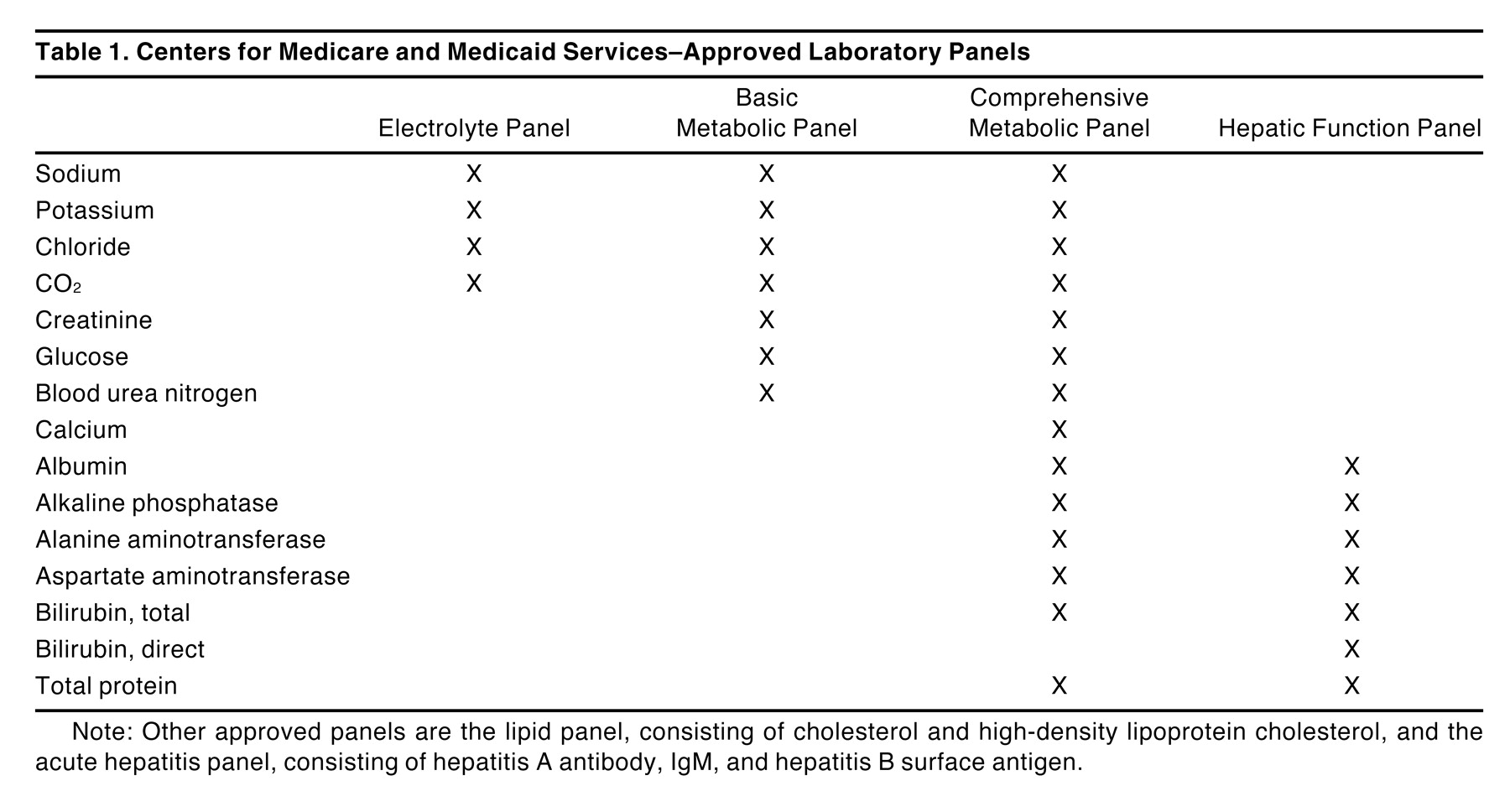
The Centers for Medicare and Medicaid Services has approved a defined set of analyte panels (Table 1), with no provision for customized panels. The basic metabolic panel includes the electrolyte panel, and the comprehensive metabolic panel includes the hepatic function panel. The Centers for Medicare and Medicaid Services mandates that all laboratory tests must be medically necessary and so requires an appropriate diagnostic code associated with the organ or disease referenced with the panel for laboratory reimbursement. For example, a hepatic function panel requires an International Classification of Diseases, 9th Revision, code associated with a liver disease or disorder as proof of medical necessity.

Table 1.
Centers for Medicare and Medicaid Services–Approved Laboratory Panels
Sources of Error
Preanalytic Variation
Preanalytic variation refers to artifacts introduced during the sample collection (including patient preparation) and handling (including transportation) phase of the testing process. Most laboratory test result errors are due to errors made during the preanalytic phase. For example, prolonged tourniquet application can increase the values of some analytes by 5% to 8% (eg, albumin, bilirubin, creatine kinase, and calcium).[5] The glucose concentration decreases by 8% to 10% per hour until cells and plasma are separated by centrifugation. With increased white blood cell counts, the consumption of glucose is even greater and can reach panic values of hypoglycemia in a short time. To compensate, collection tubes with glucose preservative are supplied by the laboratory when the time of separation of cells from plasma exceeds 1 hour (eg, home care–drawn specimens). Obtaining the blood sample through an intravenous line is considered less traumatic to the patient than repeated venipuncture. However, if it is not performed according to a strict protocol, intravenous blood sampling can introduce dangerous artifacts due to dilution (eg, artifactual hypokalemia).
Interference
Laboratory interference is present when a special patient condition and the method used by the laboratory impede a correct test result. There are three main analytic methods used in the evaluation of the patient’s chemical homeostasis: 1) immunoassays, 2) enzymatic reactions, and 3) chemical reactions.
Immunoassays use antigen–antibody reactions. The antigens and antibodies in these assays are of animal origin, including mouse, goat, sheep, cow, pig, rat, and horse. Patient samples with endogenous anti–animal antibodies can interfere with these assays and show either falsely elevated or falsely depressed values when tested. The most common anti–animal antibody is human anti–mouse antibody, which can arise by diagnostic administration of mouse monoclonal antibodies or may be idiopathic.
The prevalence of human anti–mouse antibody and other animal antibodies is not well known. In a study[6] of 1,008 blood donors it was reported that human anti–mouse antibody was present in 9.12%. In general, hormone levels and tumor markers and other tests (creatine kinase MB fraction, troponin, hepatitis, etc) are performed with immunologic assays. The laboratory, therefore, should be informed in a timely manner if the patient has received animal monoclonal antibodies in the past so that apparently abnormal results can be verified by nonimmunologic methods.
Alternatively, the enzymatic and chemical methods can be interfered with by drug therapy, including over-the-counter drugs and health supplements. Thus health-care professionals who order and interpret laboratory tests should be broadly familiar with these laboratory methods and should consider interference as a possible explanation for unanticipated results that do not otherwise make sense in a particular clinical context. Consequently, these occurrences should not be discarded as “laboratory error”; rather, the laboratory should be informed about them.
Conclusion
The clinical laboratory is a vital component of modern podiatric medical practice. To make best use of the laboratory, practitioners should understand the essentials of diagnostic testing, including the concepts of precision and accuracy, the intrinsic test characteristics of sensitivity and specificity, and the clinically useful prevalence-based positive and negative predictive values of a given test. Furthermore, the limitations of multianalyte panels and other common sources of error, such as preanalytic specimen variation and interference, must be appreciated to better avoid the pitfalls of a false-positive test result. Equipped with this foundational knowledge, podiatric physicians can better apply laboratory resources for the betterment of their patients’ health and well-being.
References
- Davis BG, Mass D, Bishop ML: “Clinical Laboratory Utilization Rationale,” in Principles of Clinical Laboratory Utilization and Consultation, p 3, WB Saunders, Philadelphia, 1999.
- Sacher RA, McPherson RA, Campos JM: “General Principles,” in Wilderman’s Clinical Interpretation of Laboratory Tests, FA Davis, Philadelphia, 2000.
- NCCLS (National Committee for Clinical Laboratory Standards): How to Define and Determine Reference Intervals in the Clinical Laboratory, NCCLS document C28-A2, p 13, NCCLS, Wayne, PA, 2000.
- Fraser CG: “Biological Individuality,” in Biological Variation, p 104, AACC Press, Washington, DC, 2001.
- Fraser CG: “The Nature of Biological Variation,” in Biological Variation, p 1, AACC Press, Washington, DC, 2001.
- Thompson RJ, Jackson AP, Langlois N: Circulating antibodies to mouse monoclonal immunoglobulins in normal subjects: incidence, species specificity, and effects on a two-site assay for creatine kinase–MB isoenzymes. Clin Chem 1986, 32, 476.
© 2004 American Podiatric Medical Association