


Abstract
Medicine as a profession depends on a unique social contract between the public and health-care professionals. We define professionalism in medicine, provide examples of challenges in professionalism relevant to podiatric medicine, and offer resources on ethics and professionalism in medicine. “Medical professionalism” is the set of attitudes, values, and conduct exhibited by medical providers resulting from placing patients’ and society’s interests above their own. The primacy of patient welfare has been at the core of a set of values held by medical professionals since the drafting of the Hippocratic Oath, and it remains at the center of medical professionalism today.
The term profession has recently been defined as follows:
An occupation whose core element is work, based on the mastery of a complex body of knowledge and skills. It is a vocation in which knowledge of some department of science or learning, or the practice of an art founded on it, is used in the service of others. Its members profess a commitment to competence, integrity, morality, altruism, and the promotion of the public good within their domain. These commitments form the basis of a social contract between a profession and society, which in return grants the profession autonomy in practice and the privilege of self-regulation. Professions and their members are accountable to those served and to society.[1]
Medicine as a profession depends on a unique social contract between the public and health-care professionals. Society trusts these professionals (eg, physicians, nurses, and therapists) to put patients’ welfare ahead of any other considerations.[2] As described by medical ethicist Edmund Pellegrino,[3] the word profession means to proclaim something publicly; this is the essence of the commitment physicians make to their patients. Physicians proclaim their social contract with society and their patients the moment they take their “oath” on completing medical training. Physicians repeat this “profession” and their commitment each time they see a patient, offer assistance, and extend trust.
In the following pages, we define professionalism in medicine, provide examples of challenges in professionalism relevant to podiatric medicine, and offer resources on ethics and professionalism in medicine.
Professionalism
Professionalism refers to the set of qualities and behaviors that have become expected of professionals.[3] Thus “medical professionalism” is the set of attitudes, values, and conduct exhibited by medical providers resulting from placing patients’ and society’s interests above their own.[4] The concept that physicians hold dear a set of attitudes and values dates back to at least the fifth century bc, with the birth of the Hippocratic Oath.[5] Today, many medical societies have statements of their core values that form the basis of professional behavior expected of their members. Examples of these modern statements include the American Medical Association’s Code of Medical Ethics,[6] the Medical Professionalism Project’s Charter on Medical Professionalism,[7] and the American Podiatric Medical Association’s Code of Ethics.[8] Each of these statements centers on the principles that physicians place their patients’ interests first, practice medicine with honesty and integrity, maintain confidentiality when dealing with patient information, and take on the responsibility of educating future generations of physicians.[9] Furthermore, professional behavior is expected by all state medical licensing boards, and unprofessional conduct can be cause for revocation of a license to practice medicine.
Charter on Medical Professionalism
Physicians face new challenges in today’s continually evolving health-care environment as “the health care delivery systems in virtually all industrialized countries threaten the very nature and values of medical professionalism.”[7] In response to the challenges posed by the current health-care environment, the American Board of Internal Medicine Foundation, the American College of Physicians–American Society of Internal Medicine Foundation, and the European Federation of Internal Medicine developed the Charter on Medical Professionalism. This charter outlines a set of principles “to which all medical professionals can and should aspire.”[7] The charter restates that the core of medical professionalism is medicine’s contract with society, and it describes three fundamental principles and a set of professional responsibilities (Table 1).

Table 1.
Charter on Medical Professionalism: Principles and Responsibilities.
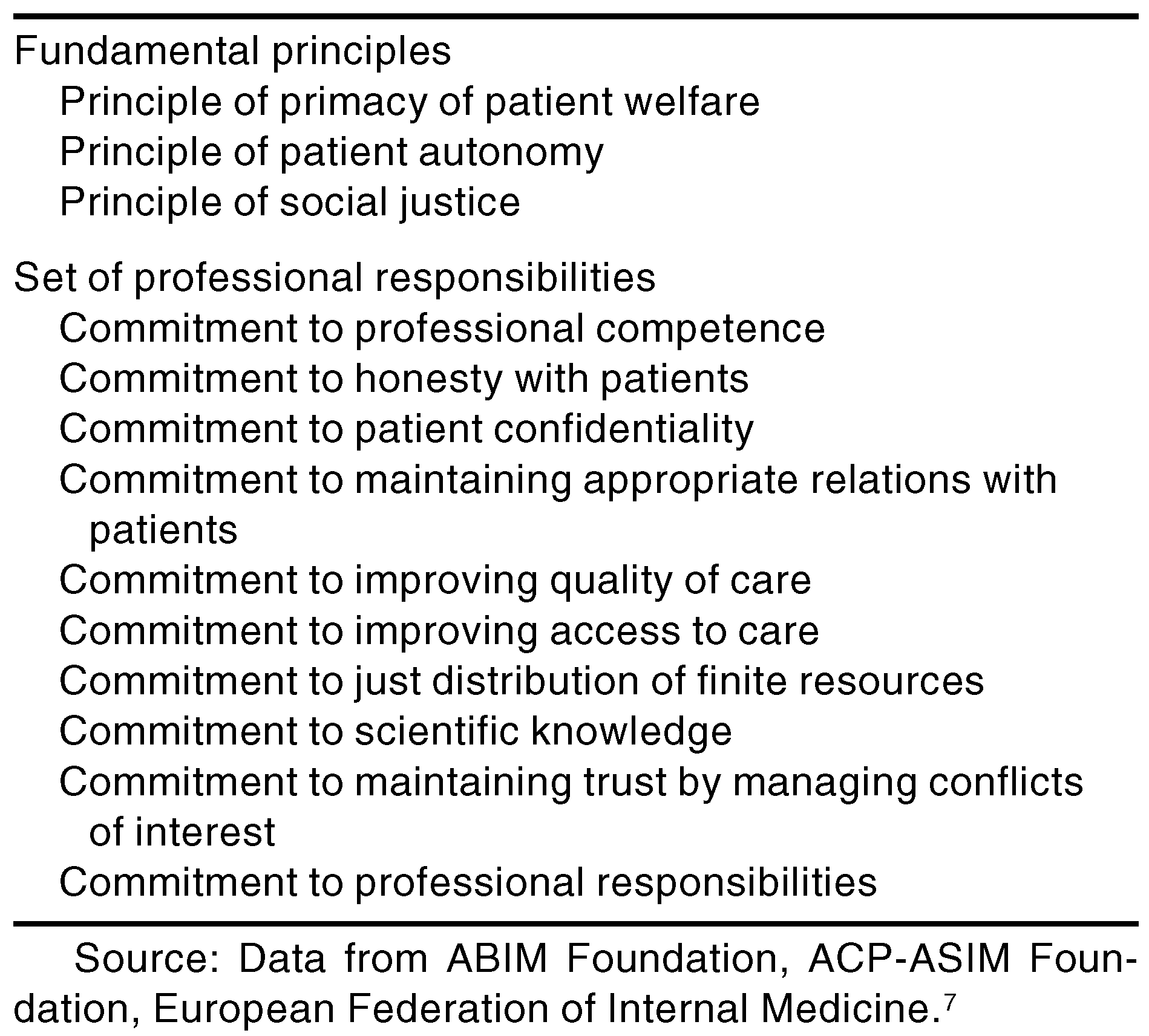
The first of the charter’s fundamental principles is the “principle of primacy of patient welfare,” which emphasizes that serving patients’ interests is the core of the physician–patient relationship. The “principle of patient autonomy” encourages physicians to empower their patients to make informed decisions about their health care and stresses the importance of physicians’ honesty in the medical decision-making process. The final fundamental principle is that of “social justice,” which promotes the concept of fair distribution of health-care resources and the elimination of all forms of discrimination in the delivery of health care. Together with the set of professional responsibilities, these three fundamental principles define a code of medical professionalism in the modern health-care environment.
Case-Based Illustrations
Physician–Industry Challenges
While waiting for his physician to write a prescription for a brand-name anti-inflammatory medication, Mr. Jones asks his physician if it is a coincidence that the pen he is using and the clock above his desk bear the same drug name as the prescription.
In 2000, the pharmaceutical industry spent approximately $13 billion promoting medications to physicians and providing physicians with free medication samples.[10] Physicians often attend “educational” dinners and events sponsored by the pharmaceutical industry. Many physicians receive an “honorarium” for lecturing at these events. Physician interactions with the pharmaceutical industry are both complex and controversial. On the one hand, the pharmaceutical industry is largely responsible for drug research and development, promotes medical education, and provides medications to many patients with limited financial resources. On the other hand, pharmaceutical industries are commercial entities whose marketing practices influence physician behavior, as indicated by growing evidence.[11]
One of the fundamental principles set forth by the Charter on Medical Professionalism is the principle of primacy of patient welfare.[7] By this principle, the medical professional is to act in the patient’s best interests. It is important for physicians to consider the impact that interaction with the pharmaceutical industry may have on their behavior, given that pharmaceutical marketing may influence physicians’ behaviors, such as prescribing.[12-14] Although physician–industry relations are not specifically addressed in the charter, several medical societies have established guidelines and recommendations concerning them. The American College of Physicians–American Society of Internal Medicine is one group that has released position papers on physician–industry relations. The position papers stress the importance of maintaining “objectivity of professional judgments” and not compromising “the best interests of patients” when interacting with the pharmaceutical industry.[15] Pharmaceutical marketing tactics, and other relations with the pharmaceutical industry, have the potential to influence physician behavior and attitudes. Physicians can maintain professionalism in their interactions with the pharmaceutical industry by always considering patients’ best interests.
Physician–Patient Challenges
A young physician out socializing with friends after work coincidentally encounters one of his patients with whom he has had a congenial professional relationship and to whom he is physically attracted. After several cocktails, he invites his patient on a dinner date the following weekend.
Given the nature of illness, patients are in inherently vulnerable and exploitable states. Their illness causes them to enter into a relationship with a physician that they would otherwise not enter.[16] Ethical prohibition of sexual relations between physicians and patients dates back to the time of the Hippocratic Oath.[17] Modern codes of ethics similarly prohibit sexual relationships between physicians and their patients.
Among the set of professional responsibilities set forth by the Charter on Medical Professionalism is the “commitment to maintaining appropriate relations with patients,” emphasizing the “vulnerability and dependency of patients.”[7] The codes of ethics of the American Medical Association and the American Podiatric Medical Association refer to the “vulnerability of the patient”[6] and the “authority figure(s)”[8] that physicians represent, as they similarly prohibit sexual or romantic relationships with patients. Such relationships detract from the fundamental principle of the primacy of patient welfare, affect physician objectivity, and may ultimately cause the patient harm.
Even after the therapeutic physician–patient relationship has ended, sexual involvement between physician and patient raises concern. Although the original medical relationship no longer exists, the romantic or sexual relationship may still be affected by the influences of the previous physician–patient relationship. According to the American Medical Association’s Code of Ethics, “sexual or romantic relationships with former patients are unethical if the physician uses or exploits trust, knowledge, emotions, or influence derived from the previous professional relationship.”[6] The Code of Ethics of the American Podiatric Medical Association goes as far as to say that “sexual intimacy with patients, students, residents, or employees is inappropriate unless the personal relationship precedes [italics added] the professional relationship.”[8]
Physician–Physician Challenges
While covering over a weekend, a junior faculty member notices that a senior physician colleague has made several careless prescribing mistakes in the medical chart. During the next several weeks, the junior faculty member encounters additional mistakes and notes the smell of alcohol on the breath of the senior physician. The senior physician is a well-respected physician, teacher, and mentor, and the junior faculty member is not sure how to approach the situation.
“Impaired physicians” are those who are unable to perform their professional duties for any reason, including substance abuse, medical, and psychiatric problems.[18] As impaired physicians threaten patient welfare, they should not assume the responsibilities of patient care.
Although some physicians may feel that their training and experience make them immune to impairment, the prevalence of alcohol and illicit drug abuse among physicians is similar to that in the general population and is a major concern to medical professionals and the public.[18] Often, the affected individual does not recognize the problem or denies that one exists. If the impaired physician lacks insight into the impairment, his or her colleagues have an obligation to patients, and their profession, to intervene. This obligation is clearly defined in the codes of ethics of many medical societies, including the American Medical Association and the American Podiatric Medical Association.
Because all physicians have a responsibility for patient well-being, physicians have an obligation to monitor others in their profession. Knowing the risk factors, behaviors, and signs of potential substance abuse is the first step in identifying a colleague in trouble. A physician who suspects that a colleague is impaired should not delay intervening out of fear of embarrassment or possible litigation.[19] There are several resources that the identifying physician can use when dealing with the difficult task of reporting a colleague, including the hospital’s “impaired physician” committee, the chairman of the department, senior staff members, and state medical societies. Most state medical societies have a physician advocacy program. These programs are designed to assist impaired physicians, and they usually have mechanisms for confidentially reporting physicians who are suspected of impairment or who are engaged in other professional misconduct (eg, sexual or financial).
Conclusion
Professionalism is the set of values, attitudes, and behaviors that are expected of professionals. Medical professionals have a unique relationship with society, and their codes of conduct reflect their commitment to place the interests of their patients above their own. In practice, adherence to a high professional standard of conduct is an expectation placed on medical professionals by society. Although state medical boards of licensure and discipline act to enforce the standards, it is the responsibility of all medical professionals to ensure that their own behavior and that of colleagues meet this standard. Guidance is available from a variety of sources, including medical societies, state boards, and professional organizations. The primacy of patient welfare has been at the core of a set of values held by medical professionals since the creation of the Hippocratic Oath, and it remains at the center of medical professionalism today.
Resources
The American Medical Association and the American Podiatric Medical Association codes of ethics, as well as the American College of Physicians ethics manual, are available online:
- American Medical Association Code of Medical Ethics: http://www.ama-assn.org/ama/pub/category/2503.html
- American Podiatric Medical Association Code of Ethics: http://www.apma.org/codeofethics402.htm
- American College of Physicians Ethics Manual: http://www.acponline.org/ethics/ethics_man.htm
The American Board of Internal Medicine Foundation is a nonprofit organization dedicated to the advancement of medical professionalism. The Physician Charter on Medical Professionalism, along with additional resources on medical professionalism, can be found on its Web site (http://www.abimfoundation.org/mpp2003/index.html).
Further information on physician–pharmaceutical industry relations can be found at the American Medical Student Association’s PharmFree Web site (http://www.amsa.org/prof/pharmfree.cfm) and at the No Free Lunch Web site (http://www.nofreelunch.org/). The Pharmaceutical Research and Manufacturers of America’s code on relationships between pharmaceutical companies and health-care professionals is accessible on its Web site (http://www.phrma.org/mediaroom/press/releases/19.04.2002.390.cfm). The American College of Physicians–American Society of Internal Medicine’s position paper on physician–industry relations is also online (http://www.acponline.org/ethics/phys_inds.htm).
References
- Cruess SR, Johnston S, Cruess R: Professionalism for medicine: opportunities and obligations. Med J Aust177: 208, 2002.
- Sullivan WM: Medicine under threat: professionalism and professional identity. CMAJ162: 673, 2000.
- Pellegrino ED: Professionalism, profession and the virtues of the good physician. Mt Sinai J Med69: 378, 2002.
- Barry D, Cyran E, Anderson RJ: Common issues in medical professionalism: room to grow. Am J Med108:: 136, 2000.
- Graham D: Revisiting Hippocrates: does an oath really matter?. JAMA284: 2841, 2000.
- American Medical Association: Code of Medical Ethics: current opinions. Available at: http://www.ama-assn.org/ama/pub/category/2503.html. Accessed July 14, 2003.
- ABIM Foundation, ACP-ASIM Foundation, European Federation of Internal Medicine: Medical professionalism in the new millennium: a physician charter. Ann Intern Med136: 243, 2002.
- American Podiatric Medical Association: APMA Code of Ethics. Available at: http://www.apma.org/codeofethics402.htm. Accessed July 14, 2003.
- Poses RM: A cautionary tale: the dysfunction of American health care. Eur J Intern Med14: 123, 2003.
- National Institute for Health Care Management: Prescription drugs and mass media advertising, 2000. Available at: http://www.nihcm.org/DTCbrief2001.pdf. Accessed July 14, 2003.
- Abassi K, Smith R: No more free lunches. BMJ326: 1155, 2003.
- Orlowski JP, Wateska L: The effects of pharmaceutical firm enticements on physician prescribing patterns: there’s no such thing as a free lunch. Chest102: 270, 1992.
- Chren MM, Landefeld CS: Physicians’ behavior and their interactions with drug companies. JAMA271: 684, 1994.
- Chew LD, O’Young TS, Hazlet TK, et al: A physician survey of the effect of drug sample availability on physicians’ behavior. J Gen Intern Med15: 478, 2000.
- Coyle SL: Physician-industry relations: part 1. Individual physicians. Ann Intern Med136: 396, 2002.
- Pellegrino E, Thomasma D: “Medicine as a Moral Community,” in The Virtues in Medical Practice, p 35, Oxford University Press, New York, 1993.
- Dehlendorf CE, Wolfe S: Physicians disciplined for sex-related offenses. JAMA279: 1883, 1998.
- O’Connor PG, Spickard A: Physician impairment by substance abuse. Med Clin North Am81: 1037, 1997.
- American College of Physicians: Ethics Manual: Fourth Edition. Ann Intern Med128: 576, 1998. . Available at: http://www.acponline.org/ethics/ethicman.htm. Accessed July 14, 2003.
© 2004 American Podiatric Medical Association