Article

Quantitative Assessment of the Correlation Between ‘COVID Toes’ Search Volume and COVID-19 Case Incidence and Mortality Dynamics: A Longitudinal Data-Driven Approach

1
Department of Microbiology, Immunology & Pathology, Des Moines University, West Des Moines, IA 50266, USA
2
Department of Dermatology, University of Nebraska Medical Center, Omaha, NE 68198, USA
3
Department of Surgery, University of Missouri School of Medicine, Columbia, MO 65212, USA
4
Ellis Fischel Cancer Center, University of Missouri School of Medicine, Columbia, MO 65212, USA
*
Author to whom correspondence should be addressed.
J. Am. Podiatr. Med. Assoc. 2026, 116(3), 38; https://doi.org/10.3390/japma116030038
Submission received: 10 June 2025 / Revised: 5 July 2025 / Accepted: 1 August 2025 / Published: 17 June 2026

Abstract

COVID-19, caused by the SARS-CoV-2 virus, has become a global public health crisis with diverse clinical manifestations affecting multiple organ systems, including the integumentary system. One notable cutaneous manifestation, referred to as “COVID toes,” involves the development of pernio-like chilblains, characterized by red-to-violet macules, plaques, or nodules, primarily on toes and fingers. This characteristic clinical feature gained significant attention due to its apparent association with COVID-19, especially during the early stages of the pandemic when individuals with mild or asymptomatic cases exhibited these symptoms. Concurrently, digital platforms such as Google Trends have emerged as tools for tracking public interest in health-related topics, offering insights into real-time patterns of disease awareness. Previous research has demonstrated that Google Trends data may correlate with the incidence of infectious diseases, suggesting that search interest can be a proxy for disease outbreaks. In this study, we sought to explore the potential relationship between public interest in COVID toes, as reflected in Google Trends, and the incidence and mortality rates of COVID-19. Specifically, we examined whether peaks in search interest for “COVID toes” corresponded with surges in COVID-19 cases and deaths. By analyzing trends in search data, we aimed to assess the utility of digital platforms as an epidemiological tool for monitoring disease progression and public awareness. Our findings provide insights into the potential role of digital search data in forecasting outbreaks and highlight the interplay between public perception and the clinical burden of COVID-19, emphasizing the importance of real-time data in public health surveillance and response.

1. Introduction

COVID-19, caused by the SARS-CoV-2 virus, has emerged as a global pandemic with profound implications for public health worldwide. As an infectious disease, COVID-19 is characterized by a broad spectrum of clinical manifestations, affecting multiple organ systems and presenting with a diverse array of symptoms [1]. COVID-19 has been documented in patients with mild or even asymptomatic presentations, often emerging late in the disease course. However, due to the media’s relative lack of emphasis on this phenomenon, it is plausible that the general public remains largely unaware of this relatively mild clinical manifestation [2]. While respiratory symptoms remain the hallmark of the disease including fever, cough, and myalgia, an increasing body of evidence has highlighted the multisystemic nature of COVID-19, with notable involvement of the integumentary system [1].
Among the cutaneous manifestations, a particularly distinctive and enigmatic finding has been the development of pernio-like chilblains, commonly referred to as “COVID toes” [3]. This clinical presentation is characterized by the appearance of red-to-violet macules, plaques, or nodules, primarily located on the distal aspects of the toes and fingers, and is often associated with swelling, pain, and erythema [4]. The presentation of COVID toes has garnered significant attention from both the scientific community and the general public due to its apparent association with COVID-19, particularly during the early phases of the pandemic, when many patients with otherwise mild symptoms exhibited this cutaneous phenomenon [5].
At present, COVID toes are frequently considered an accompanying symptom of COVID-19 or a strong antiviral response to the coronavirus from our immune systems, but without clear causal attribution to the SARS-CoV-2 virus itself [6]. In a separate study, researchers sought to elucidate the clinical, pathological, and laboratory features of COVID-19 patients throughout the pandemic. This investigation included a cohort of 40 patients with COVID toes, none of whom tested positive via PCR [7]. Interestingly, 30% (12/40) of these patients exhibited positive results on serologic testing for COVID-19. These patients also presented with increased D-dimer levels, evidence of vascular damage, lymphocytic inflammation, and a notable interferon-alpha response, which led the authors to propose that COVID toes may represent a cutaneous manifestation of a viral-induced type 1 interferonopathy [1]. Consequently, the study concluded that, although COVID toes were observed in these individuals, they did not appear to be directly associated with active COVID-19 infection, as evidenced by the absence of PCR positivity in the majority of cases [8].
As the pandemic unfolded, reports of COVID toes became more widespread, sparking a surge in public curiosity and concern regarding the potential link between these cutaneous manifestations and the underlying viral infection [9]. The widespread media coverage, coupled with growing anecdotal evidence from clinicians, led to increased recognition of COVID toes as a potential indicator of COVID-19 infection, even in individuals who otherwise exhibited only mild or asymptomatic forms of the disease [10]. This phenomenon led to the formulation of hypotheses about the nature and pathogenesis of COVID-19, as well as the need for a deeper understanding of how non-respiratory symptoms could contribute to the diagnosis and prognosis of the disease [11].
While COVID toes have been widely regarded as a cutaneous manifestation linked to COVID-19, it is crucial to recognize that they are not predictive of COVID-19 infection. Rather, chilblain-like lesions have been documented well before the pandemic, indicating that the condition is not novel. For example, in Minnesota, the incidence of chilblains averages between 9 and 10 cases annually, underscoring that such lesions, in isolation, are a rare but recognized phenomenon unrelated to COVID-19. Despite this, the onset of COVID toes in the context of the pandemic—first reported in early March 2020, when a 13-year-old Italian boy developed chilblain-like lesions alongside the classic COVID symptoms of fever, myalgia, and headache—sparked a significant interest in the potential association between the condition and SARS-CoV-2 infection [12].
In parallel with the surge of interest in clinical manifestations such as COVID toes, there has been growing recognition of the utility of digital platforms, such as Google Trends, in providing valuable insights into public awareness and interest in health-related topics [13]. Previous studies have demonstrated that Google Trends data can serve as a useful proxy for monitoring the spread of infectious diseases, as search queries related to specific symptoms or conditions often correlate with real-world outbreaks. This has led to the suggestion that digital search data, including searches related to COVID-19 symptoms, could provide an early warning system for identifying patterns in disease incidence, potentially offering valuable information for public health surveillance and response [14].
Given these factors, we sought to investigate whether public interest in COVID toes, as reflected in Google Trends data, was correlated with the incidence of COVID-19 cases [15]. Specifically, we aimed to explore whether peaks in search interest for “COVID toes” corresponded with increases in the reported number of COVID-19 cases and mortality rates, thereby providing further insight into the potential utility of digital search data as an epidemiological tool. Through this analysis, we hope to better understand the relationship between public perception and the actual clinical burden of COVID-19, and to evaluate the potential role of digital platforms in monitoring and forecasting the progression of infectious disease outbreaks [16].

2. Methods

The relative search volumes (RSV) for the search term “COVID-19 COVID toes” were retrieved from Google Trends (https://trends.google.com/ (accessed on 15 March 2020)) over the period spanning from 1 March 2020 to 31 December 2020, with the data representing trends across the entire United States. This timeframe was chosen to coincide with the onset and progression of the COVID-19 pandemic, allowing for an analysis of how public interest in the term “COVID toes” correlated with the broader dynamics of the pandemic. RSV data is a normalized metric that reflects the relative frequency of a specific search term compared to all other searches conducted within the same time frame, enabling an assessment of public interest over time [17].
In addition to the Google Trends data, the incidence of confirmed COVID-19 cases within the United States was sourced from the Centers for Disease Control and Prevention (CDC) data repository [18]. The CDC data provided the number of reported cases on a daily basis, which was then plotted against the RSVs for the search term “COVID toes.” By correlating these two datasets, we aimed to explore potential trends or spikes in public interest related to “COVID toes” and examine whether such interest corresponded with increases in COVID-19 cases [17].
This analysis offers insight into how public concern or curiosity regarding specific COVID-19 symptoms—such as the dermatological manifestations of the virus, often referred to as “COVID toes”—may have fluctuated in relation to the spread of the virus itself. The investigation may also reveal patterns in information-seeking behavior, reflecting broader public awareness or anxiety, which could provide valuable context for understanding the informational landscape during the early months of the pandemic [19]. Furthermore, the methodology of using Google Trends data in conjunction with epidemiological case data offers a novel approach to analyzing public interest in health-related topics during a global health crisis [20].

3. Results

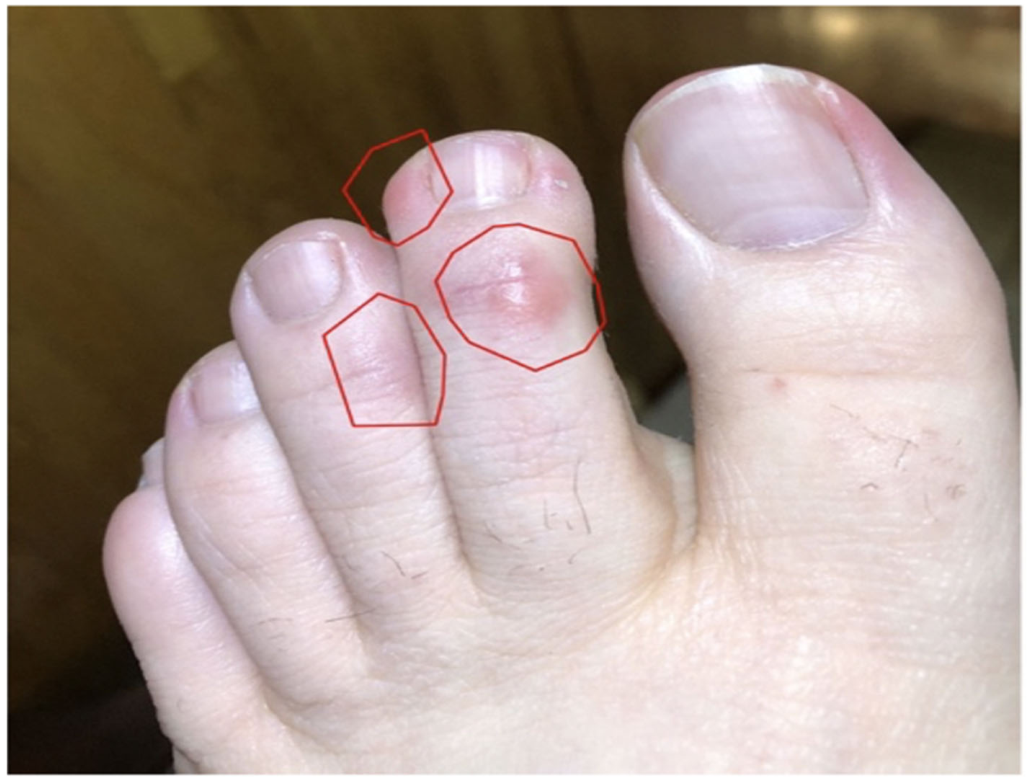
Cutaneous manifestations associated with SARS-CoV-2 infection have exhibited a remarkably heterogeneous array of morphologic phenotypes, encompassing pernio-like acral eruptions, morbilliform exanthems, urticarial plaques, vesiculobullous lesions, and vascular-mediated presentations such as retiform purpura, as delineated in Figure 1 [21]. Among these diverse dermatologic sequelae, the presentation of acral pernio-like eruptions—colloquially referred to as “COVID toes”—has emerged as a particularly salient and widely recognized clinical entity [22]. These chilblain-like acral lesions, frequently arising in individuals with minimal or absent systemic symptomatology, have attained a quasi-pathognomonic status within the dermatologic characterization of COVID-19 [23].
The distinct histopathologic and morphologic features associated with these lesions implicate a potentially idiosyncratic pathogenetic mechanism unique to SARS-CoV-2, potentially involving immune dysregulation, interferon-mediated inflammatory pathways, and microvascular injury or thrombotic microangiopathy [24]. This phenomenon invites rigorous investigation into the underlying immunovascular mechanisms, with a view to elucidating the interplay between innate immune responses, endothelial function, and viral–host interactions that may drive this atypical cutaneous phenotype [25]. As such, these dermatologic findings not only offer diagnostic value but may also provide critical insight into the systemic vascular and immunologic perturbations induced by COVID-19 [26].
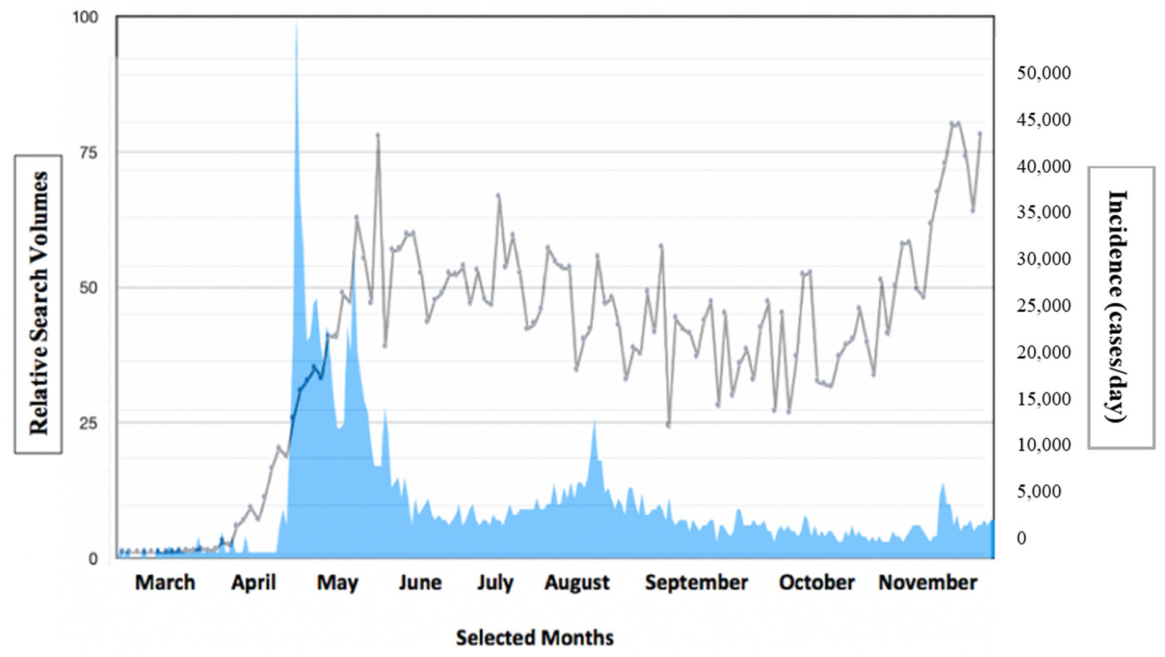
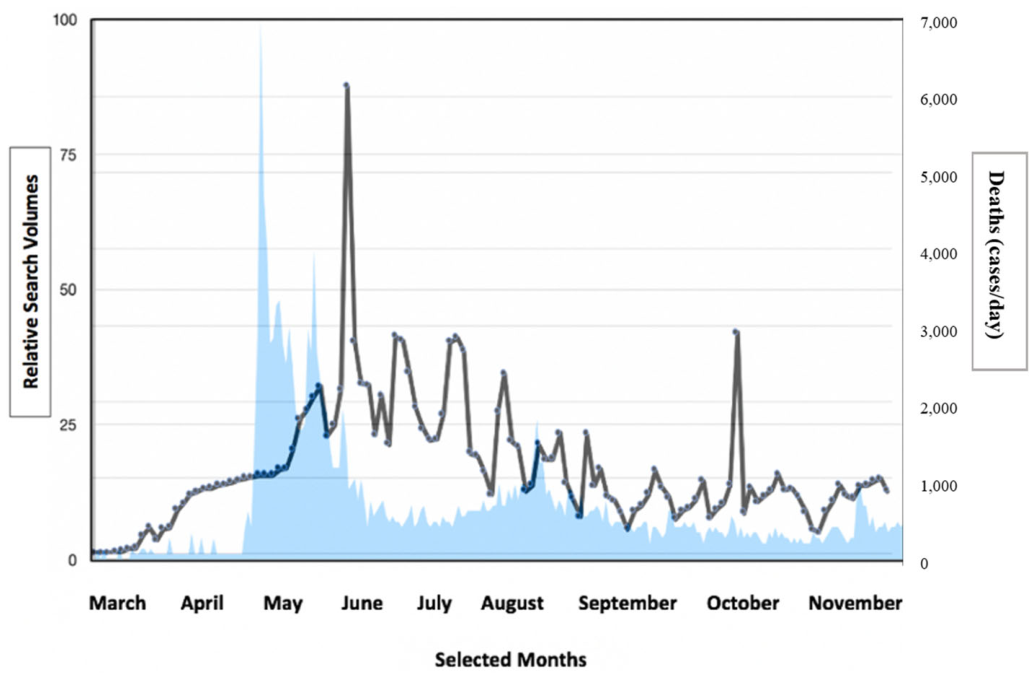
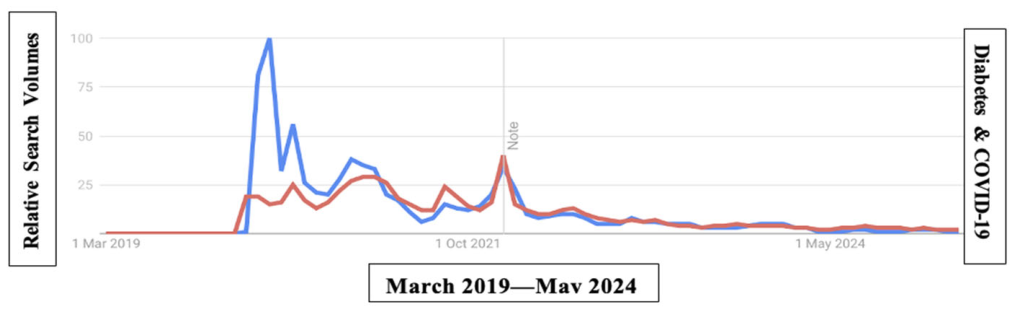
Our comprehensive analysis revealed a notable peak in the relative search volume (RSV) for the term “COVID-19 COVID toes” on 22 April 2020, reaching a maximal relative interest score of 100 on the 0–100 scale (Figure 2). This peak occurred approximately twelve days following the initial surge in COVID-19 case incidence in the United States on 10 April 2020, suggesting a delayed, yet significant, public engagement with this specific manifestation of the virus. Subsequent spikes in RSV were observed on 28 June 2020 and 12 July 2020, with the overall search volume remaining relatively stable in the intervening period. However, after 12 July 2020, the RSV for “COVID toes” experienced a marked decline, with only modest fluctuations occurring in September and November. Notably, a rapid resurgence in RSV occurred between October and December 2020, peaking once again on 5 December 2020, in conjunction with a substantial increase in COVID-19 incidence, which reached its highest point of 249,869 cases. This resurgence of public interest culminated in another notable spike in RSV on 26 December 2020, further underscoring the temporal relationship between COVID-19 case surges and heightened public awareness of this particular symptom. As seen in Figure 3, the peak deaths were from 2 June to 28 June 2020, with the relative search spanning from June to September. There was an increase in interest from 6 October to 17 October 2020. Figure 4 showed a correlation between the search of “COVID Toes” and “Diabetes COVID.”

4. Discussion

Our investigation reveals that relative search volumes (RSVs) for the term “COVID-19 COVID toes” exhibited an initial uptick following the first significant wave of COVID-19 cases in the United States, though no sustained correlation was observed between RSVs and the incidence of COVID-19 during the subsequent months of 2020. This stands in stark contrast to findings from Effenberger, who conducted a similar analysis across Europe, demonstrating that, on average, public interest, as measured by RSV indices for “coronavirus,” peaked approximately 11.5 days prior to a peak in COVID-19 case incidence [27]. Furthermore, data originating from France suggests that public interest in the phenomenon of COVID toes preceded formal pronouncements or media coverage from relevant scientific and medical authorities. One plausible explanation for this divergence between European and U.S.-based observations may stem from the earlier onset of the pandemic in Europe, which in turn catalyzed a more pronounced and immediate public response [28].
Although the initial surge in COVID-19 cases on April 10, 2020, predated the rise in RSVs for “COVID toes,” our analysis indicates that public interest in this specific symptom was evident as early as mid-March, suggesting that there was a notable degree of early public awareness regarding this clinical manifestation of the disease. This is particularly intriguing considering that, at the time, COVID toes had not yet been formally recognized or extensively discussed in scientific literature. While Google Trends data could potentially offer a predictive utility in forecasting public attention to emerging phenomena, our findings also suggest that it holds promise as a tool for longitudinal assessment, enabling tracking of shifts in public interest and educational outreach over time [29].
However, it is important to recognize several limitations inherent in our study. First, the search term “COVID-19 COVID toes” yielded sufficient data only from 17 U.S. states exhibiting the highest search volumes, which may not fully capture the national trends, thus limiting the generalizability of our conclusions. Furthermore, another notable limitation stems from the ongoing uncertainty surrounding the classification of COVID toes as a definitive manifestation of COVID-19. For instance, in a cohort of 505 patients presenting with skin lesions associated with COVID-19, 63% (318) were diagnosed with pernio-like chilblains, yet only 28% of these patients were tested for COVID-19, with 25% (23/318) of them testing positive In another clinical investigation, researchers identified a group of patients with COVID toes who had negative PCR results at the time of diagnosis, and only 30% (12/40) developed antibodies to the virus, as confirmed by serologic testing [30]. These findings suggest a substantial degree of uncertainty regarding whether COVID toes can be definitively attributed to COVID-19 infection, underscoring the need for further large-scale, prospective studies to elucidate the potential association between this dermatologic manifestation and the SARS-CoV-2 virus [13].

5. Conclusions

In conclusion, it remains difficult to definitively establish whether COVID toes are directly attributable to COVID-19 infection. Numerous cases have been reported in which patients exhibiting COVID toes did not test positive for the virus, challenging the hypothesis of a clear causal link [31]. Moreover, the condition appears most frequently in the later stages of illness, when viral symptoms have often resolved or subsided, further complicating the question of whether COVID toes should be considered a primary manifestation of COVID-19. The increased frequency and temporal correlation with COVID-19 symptoms have nonetheless led to the colloquial association of the term “COVID toes” with the pandemic [32]. However, these same studies also revealed an inconsistency in the detection of SARS-CoV-2 within the lesions, suggesting that COVID toes do not uniformly correlate with the presence of the virus. Additionally, it is noteworthy that the lesions typically appear following a successful viral response, often in patients whose symptoms are subsiding, implying that the manifestation of COVID toes is more frequent during the convalescent phase of the illness [33]. This temporal association further suggests that COVID toes may not be an early indicator of infection but rather a late-stage phenomenon, occurring when systemic viral symptoms are either absent or significantly diminished [34]. Ongoing research is required to better understand the true nature of this manifestation and its relationship, if any, to the broader spectrum of COVID-19-related pathologies.

Author Contributions

Conceptualization, Y.F.; writing—original draft preparation, A.E.K. and R.A.P.; writing—review and editing, Y.F. and M.R.W.; visualization, A.E.K.; supervision, Y.F.; revision, A.W. All authors have read and agreed to the published version of the manuscript.

Funding

This study is partially supported by a grant for Yujiang Fang (IOER 112-3119).

Data Availability Statement

The original contributions presented in this study are included in the article. Further inquiries can be directed to the corresponding author.

Conflicts of Interest

The authors declare no conflicts of interest.

Abbreviations

The following abbreviations are used in this manuscript:
RSVRelative search volumes
CDCCenters for Disease Control and Prevention
CNSCentral Nervous System

References

  1. Hubiche, T.; Cardot-Leccia, N.; Le Duff, F.; Seitz-Polski, B.; Giordana, P.; Chiaverini, C.; Giordanengo, V.; Gonfrier, G.; Raimondi, V.; Bausset, O.; et al. Clinical, Laboratory, and Interferon-Alpha Response Characteristics of Patients with Chilblain-like Lesions During the COVID-19 Pandemic. JAMA Dermatol. 2021, 157, 202–206. [Google Scholar] [CrossRef] [PubMed]
  2. Reis, J.; Buguet, A.; Román, G.C.; Spencer, P.S. The COVID-19 Pandemic, an Environmental Neurology Perspective. Rev. Neurol. 2022, 178, 499–511. [Google Scholar] [CrossRef] [PubMed]
  3. Dowdle, T.; Brown, T.; Peterson, J.; Banafshay, K.; Nguyen, J.; Sturgeon, A. COVID Toes: A Unique Cutaneous Indicator of COVID-19. Southwest Respir. Crit. Care Chron. 2021, 9, 15–21. [Google Scholar] [CrossRef]
  4. COVID Toes: What Are They and What Do They Mean. Available online: https://mydoctor.kaiserpermanente.org/mas/news/covid-toes-what-are-they-and-what-do-they-mean-1758928 (accessed on 9 April 2025).
  5. Discepolo, V.; Catzola, A.; Pierri, L.; Mascolo, M.; Della Casa, F.; Vastarella, M.; Smith, G.; Travaglino, A.; Punziano, A.; Nappa, P.; et al. Bilateral Chilblain-like Lesions of the Toes Characterized by Microvascular Remodeling in Adolescents During the COVID-19 Pandemic. JAMA Netw. Open 2021, 4, e2111369. [Google Scholar] [CrossRef] [PubMed]
  6. Escandón, K.; Rasmussen, A.L.; Bogoch, I.I.; Murray, E.J.; Escandón, K.; Popescu, S.V.; Kindrachuk, J. COVID-19 False Dichotomies and a Comprehensive Review of the Evidence Regarding Public Health, COVID-19 Symptomatology, SARS-CoV-2 Transmission, Mask Wearing, and Reinfection. BMC Infect. Dis. 2021, 21, 710. [Google Scholar] [CrossRef] [PubMed]
  7. Rocha, K.O.; Zanuncio, V.V.; de Freitas, B.A.C.; Lima, L.M. “COVID Toes”: A Meta-Analysis of Case and Observational Studies on Clinical, Histopathological, and Laboratory Findings. Pediatr. Dermatol. 2021, 38, 1143–1149. [Google Scholar] [CrossRef] [PubMed]
  8. Rochman, S. ‘COVID Toes’ Were Likely Not Caused by COVID-19, in Most Cases. Available online: https://divisionofresearch.kaiserpermanente.org/covid-toes-not-caused-by-covid/ (accessed on 9 April 2025).
  9. Rose-Sauld, S.; Dua, A. COVID Toes and Other Cutaneous Manifestations of COVID-19. J. Wound Care 2020, 29, 486–487. [Google Scholar] [CrossRef] [PubMed]
  10. Massey, P.R.; Jones, K.M. Going Viral: A Brief History of Chilblain-like Skin Lesions (“COVID Toes”) amidst the COVID-19 Pandemic. Semin. Oncol. 2020, 47, 330–334. [Google Scholar] [CrossRef] [PubMed]
  11. van Eijk, L.E.; Binkhorst, M.; Bourgonje, A.R.; Offringa, A.K.; Mulder, D.J.; Bos, E.M.; Kolundzic, N.; Abdulle, A.E.; van der Voort, P.H.; Olde Rikkert, M.G.; et al. COVID-19: Immunopathology, Pathophysiological Mechanisms, and Treatment Options. J. Pathol. 2021, 254, 307–331. [Google Scholar] [CrossRef] [PubMed]
  12. Paparella, R.; Tarani, L.; Properzi, E.; Costantino, F.; Saburri, C.; Lucibello, R.; Richetta, A.; Spalice, A.; Leonardi, L. Chilblain-like Lesions Onset during SARS-CoV-2 Infection in a COVID-19-Vaccinated Adolescent: Case Report and Review of Literature. Ital. J. Pediatr. 2022, 48, 93. [Google Scholar] [CrossRef] [PubMed]
  13. Gao, J.C.; Huang, A.; Desai, A.; Safai, B.; Marmon, S. “COVID Toes”: A True Viral Phenomenon or a Diagnosis without a Leg to Stand On? JAAD Int. 2022, 9, 1–6. [Google Scholar] [CrossRef] [PubMed]
  14. Wang, D.; Guerra, A.; Wittke, F.; Lang, J.C.; Bakker, K.; Lee, A.W.; Finelli, L.; Chen, Y.-H. Real-Time Monitoring of Infectious Disease Outbreaks with a Combination of Google Trends Search Results and the Moving Epidemic Method: A Respiratory Syncytial Virus Case Study. Trop. Med. Infect. Dis. 2023, 8, 75. [Google Scholar] [CrossRef] [PubMed]
  15. Saegner, T.; Austys, D. Forecasting and Surveillance of COVID-19 Spread Using Google Trends: Literature Review. Int. J. Env. Res. Public Health 2022, 19, 12394. [Google Scholar] [CrossRef] [PubMed]
  16. Reeves, J.J.; Pageler, N.M.; Wick, E.C.; Melton, G.B.; Tan, Y.-H.G.; Clay, B.J.; Longhurst, C.A. The Clinical Information Systems Response to the COVID-19 Pandemic. Yearb. Med. Inf. 2021, 30, 105–125. [Google Scholar] [CrossRef] [PubMed]
  17. Gholamzadeh, M.; Asadi Gharabaghi, M.; Abtahi, H. Public Interest in Online Searching of Asthma Information: Insights from a Google Trends Analysis. BMC Pulm. Med. 2025, 25, 76. [Google Scholar] [CrossRef] [PubMed]
  18. Khan, D.; Park, M.; Burkholder, J.; Dumbuya, S.; Ritchey, M.D.; Yoon, P.; Galante, A.; Duva, J.L.; Freeman, J.; Duck, W.; et al. Tracking COVID-19 in the United States with Surveillance of Aggregate Cases and Deaths. Public Health Rep. 2023, 138, 428–437. [Google Scholar] [CrossRef] [PubMed]
  19. Park, T.; Ju, I.; Ohs, J.E.; Hinsley, A.; Muzumdar, J. Information Seeking during the COVID-19 Pandemic: Application of the Risk Information Seeking and Processing Model. Res. Soc. Adm. Pharm. 2023, 19, 956–964. [Google Scholar] [CrossRef] [PubMed]
  20. Havelka, E.M.; Mallen, C.D.; Shepherd, T.A. Using Google Trends to Assess the Impact of Global Public Health Days on Online Health Information Seeking Behaviour in Central and South America. J. Glob. Health 2020, 10, 010403. [Google Scholar] [CrossRef] [PubMed]
  21. Gisondi, P.; PIaserico, S.; Bordin, C.; Alaibac, M.; Girolomoni, G.; Naldi, L. Cutaneous Manifestations of SARS-CoV-2 Infection: A Clinical Update. J. Eur. Acad. Dermatol. Venereol. 2020, 34, 2499–2504. [Google Scholar] [CrossRef] [PubMed]
  22. Fung, M.; Otani, I.; Pham, M.; Babik, J. Zoonotic Coronavirus Epidemics. Ann. Allergy Asthma Immunol. 2021, 126, 321–337. [Google Scholar] [CrossRef] [PubMed]
  23. Kanitakis, J.; Lesort, C.; Danset, M.; Jullien, D. Chilblain-like Acral Lesions during the COVID-19 Pandemic (“COVID Toes”): Histologic, Immunofluorescence, and Immunohistochemical Study of 17 Cases. J. Am. Acad. Dermatol. 2020, 83, 870–875. [Google Scholar] [CrossRef] [PubMed]
  24. Aberger, S.; Kozakowski, N.; Proházka, Z.; Pleininger, T.; Salmhofer, H. Dobrava Hantavirus and Coinciding SARS-CoV-2 Infection Mimicking Thrombotic Microangiopathy and Responding to a Single Dose of Eculizumab. Clin. Kidney J. 2023, 16, 2750–2753. [Google Scholar] [CrossRef] [PubMed]
  25. Wang, R.; Lan, C.; Benlagha, K.; Camara, N.O.S.; Miller, H.; Kubo, M.; Heegaard, S.; Lee, P.; Yang, L.; Forsman, H.; et al. The Interaction of Innate Immune and Adaptive Immune System. MedComm 2024, 5, e714. [Google Scholar] [CrossRef] [PubMed]
  26. Sadeghzadeh-Bazargan, A.; Rezai, M.; Najar Nobari, N.; Mozafarpoor, S.; Goodarzi, A. Skin Manifestations as Potential Symptoms of Diffuse Vascular Injury in Critical COVID-19 Patients. J. Cutan. Pathol. 2021, 48, 1266–1276. [Google Scholar] [CrossRef] [PubMed]
  27. Effenberger, M.; Kronbichler, A.; Shin, J.I.; Mayer, G.; Tilg, H.; Perco, P. Association of the COVID-19 Pandemic with Internet Search Volumes: A Google TrendsTM Analysis. Int. J. Infect. Dis. 2020, 95, 192–197. [Google Scholar] [CrossRef] [PubMed]
  28. Guillon, M. Digital Contact-Tracing in France: Uptake by COVID-19 Risk Factor and by Exposure Risk. J. Public Health 2022, 44, e366–e375. [Google Scholar] [CrossRef]
  29. Chu, A.M.; Chong, A.C.Y.; Lai, N.H.T.; Tiwari, A.; So, M.K.P. Enhancing the Predictive Power of Google Trends Data Through Network Analysis: Infodemiology Study of COVID-19. JMIR Public Health Surveill. 2023, 9, e42446. [Google Scholar] [CrossRef] [PubMed]
  30. Freeman, E.E.; McMahon, D.E.; Lipoff, J.B.; Rosenbach, M.; Kovarik, C.; Takeshita, J.; French, L.E.; Thiers, B.H.; Hruza, G.J.; Fox, L.P.; et al. Pernio-like Skin Lesions Associated with COVID-19: A Case Series of 318 Patients from 8 Countries. J. Am. Acad. Dermatol. 2020, 83, 486–492. [Google Scholar] [CrossRef] [PubMed]
  31. What Are COVID Toes? A Case Study. Available online: https://www.nursingcenter.com/journalarticle?Article_ID=5706248&Journal_ID=448075&Issue_ID=5705678 (accessed on 21 April 2025).
  32. COVID Toe: Symptoms, Duration and Treatments. Available online: https://ada.com/covid/covid-19-toes-symptoms/ (accessed on 21 April 2025).
  33. COVID Toe: A Dermatological Manifestation of COVID-19. Available online: https://researchoutreach.org/articles/covid-toe-dermatological-manifestation-covid-19/ (accessed on 21 April 2025).
  34. Wollina, U.; Abdelmaksoud, A.; Chiriac, A.; Brzezinski, P.; Temiz, S. SYMPTOMATOLOGY AND TREATMENT OF COVID-19 AFFECTING SKIN APPENDAGES: A NARRATIVE REVIEW BEYOND COVID-TOES. Georgian Med. News 2022, 331, 78–84. [Google Scholar]
Figure 1. Chilblain-like lesions on an adult male’s toes, informally referred to as “COVID toes”.
Japma 116 00038 g001
Figure 2. COVID 19 Incidence in the United States compared to the relative interest of “COVID Toes” on Google Trends. The blue shaded area denotes daily COVID-19 incidence (cases/day; right y-axis), and the black line denotes relative Google Trends search volume for “COVID toes” (left y-axis).
Japma 116 00038 g002
Figure 3. COVID 19 Deaths in the United States compared to the relative interest of “COVID Toes” on Google Trends. The blue shaded area represents daily COVID-19 deaths in the United States (right y-axis), while the black line represents relative Google Trends search interest for ‘COVID toes’ (left y-axis).
Japma 116 00038 g003
Figure 4. Diabetes and COVID 19 in the United States compared to relative interest of “COVID Toes” on Google Trends. The blue line denotes relative search volume for ‘COVID toes’, and the red line denotes diabetes and COVID-19 prevalence in the United States.
Japma 116 00038 g004
Disclaimer/Publisher’s Note: The statements, opinions and data contained in all publications are solely those of the individual author(s) and contributor(s) and not of MDPI and/or the editor(s). MDPI and/or the editor(s) disclaim responsibility for any injury to people or property resulting from any ideas, methods, instructions or products referred to in the content.