


Abstract
Cushing’s syndrome is an uncommon clinical condition most frequently presenting with central obesity, facial rounding, proximal muscle weakness, and skin thinning. The objective of this case report is to highlight an unusual presentation of Cushing’s syndrome. A 35-year- old woman presented to the orthopedic clinic with a 1-year history of foot pain without any history of trauma. Radiography of the foot showed multiple metatarsal fractures. Evaluation for secondary causes of reduced bone strength revealed that the patient had Cushing’s disease, although other typical signs and symptoms were not remarkable. It can be concluded that Cushing’s syndrome should always be included in the differential diagnosis of foot fracture without any evidence of trauma.
Cushing’s syndrome is a metabolic and clinical disorder characterized by an excess of glucocorticoids resulting from any cause. The most common cause of high levels of cortisol is adrenocorticotropic hormone (ACTH)–secreting pituitary adenoma. Patients with Cushing’s syndrome usually present with central obesity leading to weight gain, facial rounding and plethora, proximal muscle weakness, and thinning of the skin. In addition, the manifestation of disease also includes diabetes mellitus, hypertension, and osteoporosis [1]. As a consequence of decreased bone mineral density caused by hypercortisolism, pathologic fractures are typically developed. They are usually solitary and located in thoracic or lumbar vertebra [2]. The cases in which multiple fractures or other fracture sites are reported are very rare [3,4]. Here, we describe an unusual case of a patient with endogenous Cushing’s syndrome presenting with multiple metatarsal fractures.
Case Report
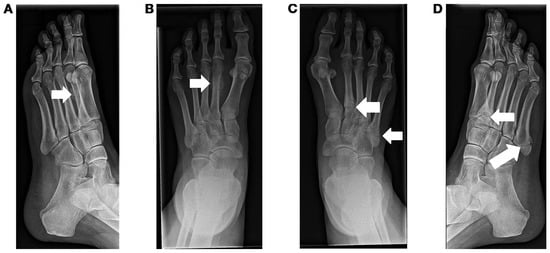
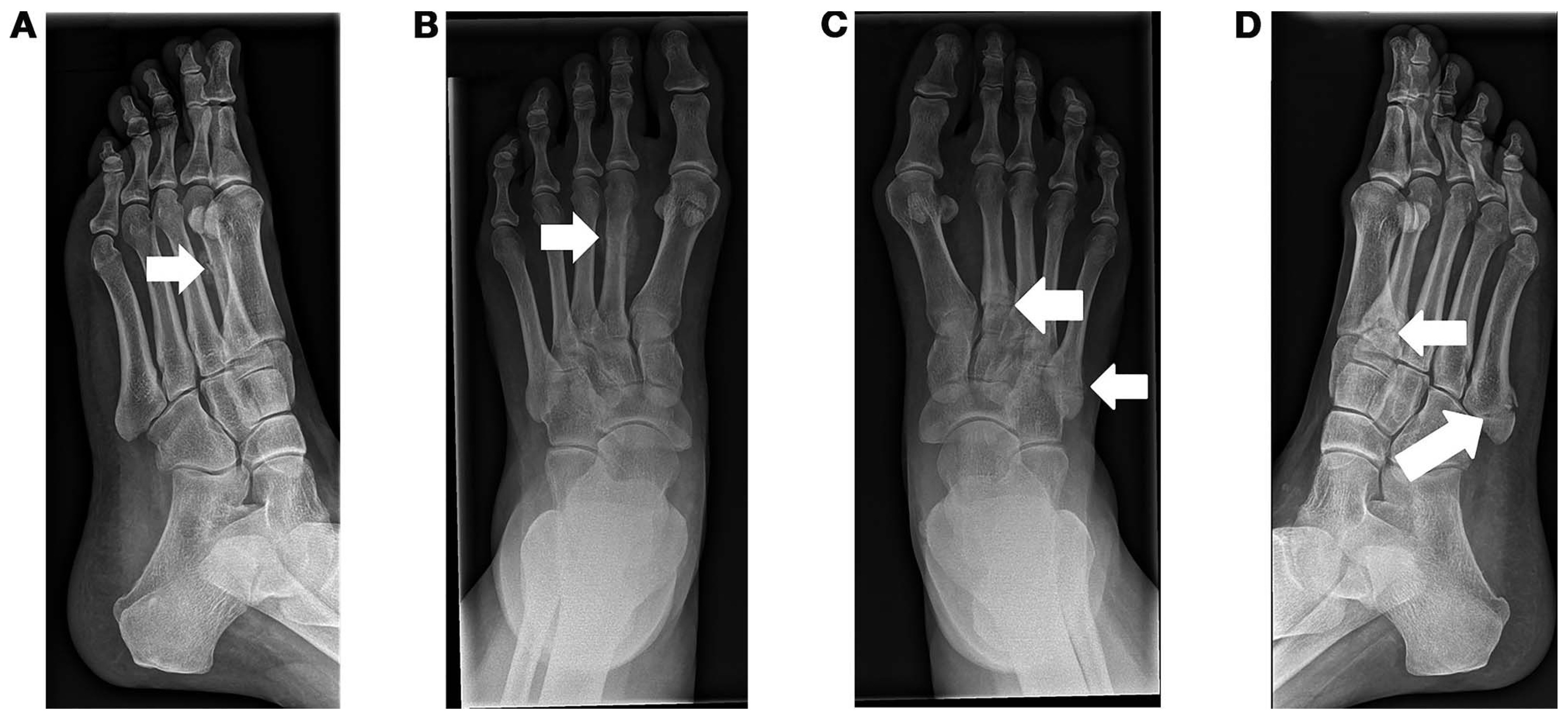
A 35-year-old woman presented to the orthopedic outpatient clinic with a 1-year history of foot pain. The patient had a sedentary job and did not engage in regular exercise, and there was no history of trauma. The pain originated in the forefoot and was aggravated with walking. Plain radiographs revealed multiple stress fractures of metatarsal bones (Figure 1). At that point, the patient was treated with nonweightbearing.
Figure 1.
Radiographs of the patient’s left (A and B) and right foot (C and D) in oblique and dorsoplantar views. Fractures are annotated by the arrows: dyaphisis of the second metatarsal of the left foot (A and B) and bases of the second and the fifth metatarsal bones of the right foot (C and D).
The patient weighed 82 kg and was 172 cm tall. She had gained 10 kg in the past few years. She had a history of moderate bronchial asthma present since childhood treated with topical corticosteroids, and a history of mild depression. Menarche occurred at the age of 12 years. Over the past 2 years, she had oligomenorrhea treated with gestagens. She had no pregnancies.
Dual-energy x-ray absorptiometry (QDR Delphi Hologic) scan showed T-scores at L1-4, femur neck, and total hip of −1.1, −1.5, and −0.6, respectively, consistent with osteopenia. Because of the suspicion of the metabolic bone disease causing the low-trauma fractures, the patient was referred to an endocrinologist. Clinical examination showed moderately excessive hair growth on the extremities and face, and easy bruising without significant trauma. There was no facial plethora or rounding. Blood pressure and glucose were normal.
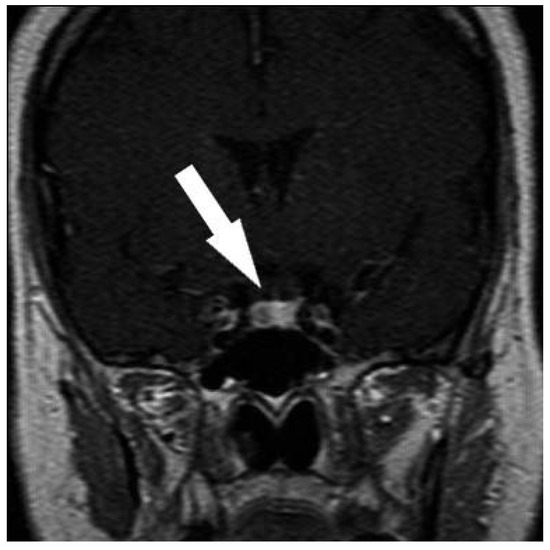
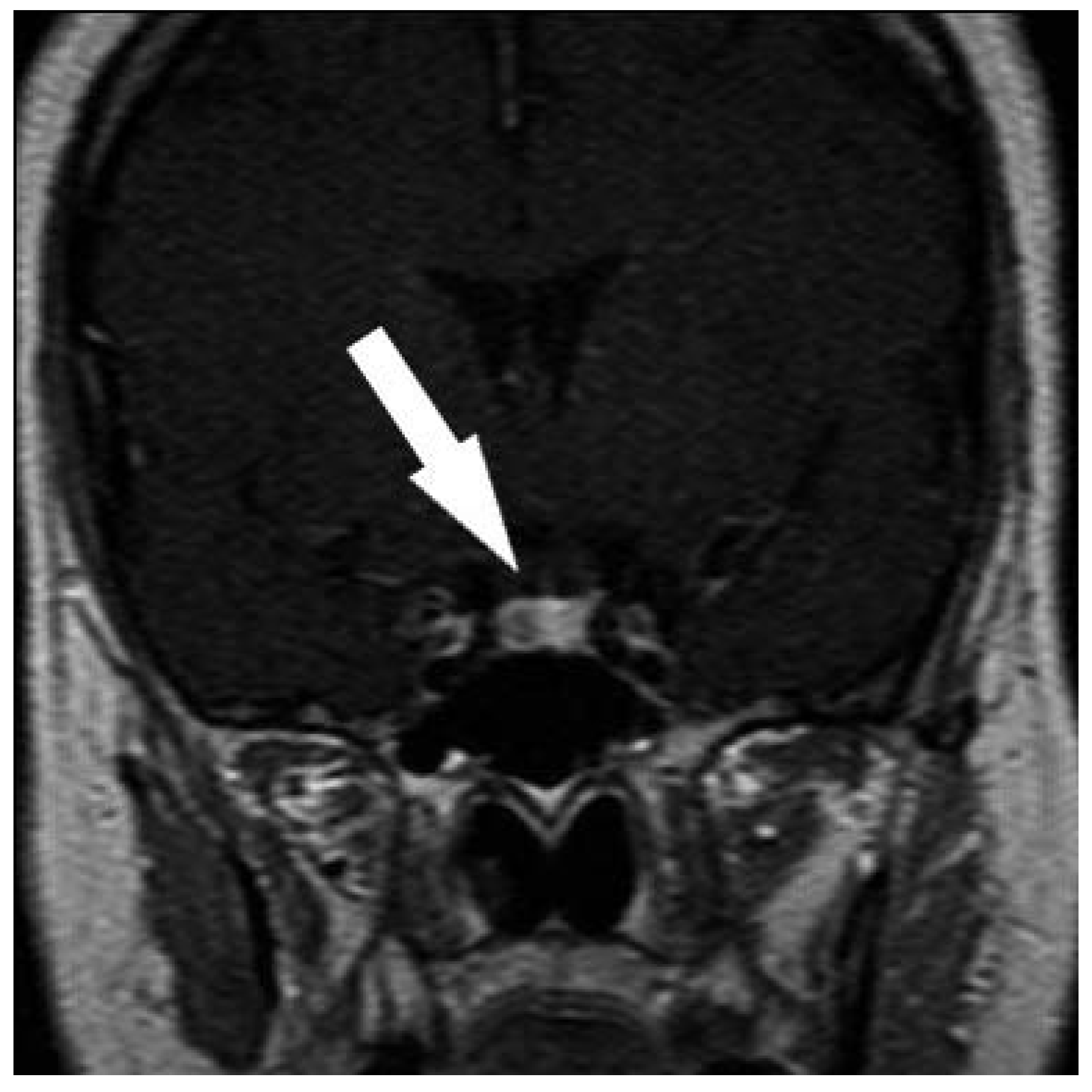
Endocrine workup showed elevated levels of 24- hour urine free cortisol (1976 nmol/dU) in addition to unsuppressed cortisol after 1-mg overnight dexamethasone suppression (500 nmol/L), which confirmed endogenous Cushing’s syndrome. Subsequently, plasma ACTH value was determined to be 28.8 pmol/L, indicating ACTH-dependent Cushing’s syndrome. Finally, on pituitary magnetic resonance imaging scan, two pituitary microadenomas were found (Figure 2). Transsphenoidal resection of the adenoma was performed. The postoperative cortisol level was 22 nmol/L, showing disease remission. Tumor histology was consistent with corticotrophin adenomas.
Figure 2.
Frontal view brain magnetic resonance imaging scan. The pituitary gland is annotated by the arrow. Within the pituitary gland, there are two zones lacking contrast imbibition, which correspond to pituitary microadenomas.
Discussion
Forefoot pain is common among adults and may arise because of various acute and chronic conditions. In particular, chronic causes include Morton neuroma, metatarsophalangeal synovitis, avascular necrosis, and sesamoiditis, whereas the most common acute condition is a metatarsal fracture, especially stress fracture caused by overuse [5].
Although our patient had no history of acute trauma or overuse, we decided to perform foot radiography, which revealed multiple metatarsal fractures. Common causes of nontraumatic metatarsal fractures include increased intensity, duration, or frequency of exercise and insufficient rest periods; inappropriate footwear; continuation of training despite pain; and rheumatoid arthritis, neuropathic foot, and osteoporosis. Based on the patient’s lifestyle, fatigue was not likely to be the cause of fractures, and we therefore reviewed the potential hormonal disturbances that might derange bone metabolism, such as Cushing’s syndrome.
The mechanism of decrease in bone strength in Cushing’s syndrome includes glucocorticoid-dependent dysfunction of osteoblasts and reduction in their number, leading to microstructural bone alterations. In addition, trabecular bones are more frequently affected than cortical bones because of their higher sensitivity to glucocorticoids [6]. Therefore, bone fractures in Cushing’s syndrome most commonly affect vertebrae.
Our patient did not have other typical clinical signs of Cushing’s syndrome, such as hypertension, facial plethora, purple striae, moon face, or buffalo hump. Nor did she have metabolic abnormalities typically found in patients with hypercortisolism, such as diabetes or hypokalemia. Multiple metatarsal fractures were the first manifestation of the Cushing’s disease in our patient, which makes this case quite interesting.
Conclusions
Low-trauma fractures are frequently seen in patients with Cushing’s syndrome. Nevertheless, multiple low-trauma fractures bringing the patient first to the orthopedic surgeon are uncommon presenting signs of Cushing’s syndrome. This case report points to the conclusion that Cushing’s syndrome should be suspected in all patients with low-trauma fractures, even in the absence of other typical signs and symptoms of hypercortisolism. Finally, it also illustrates that cooperation between different medical professions is mandatory.
Financial Disclosure: None reported.
Conflict of Interest: None reported.
References
- LACROIX, A.; FEELDERS, R.A.; STRATAKIS, C.A.; et al. Cushing’s syndrome. Lancet 2015, 386, 913. [Google Scholar] [CrossRef] [Scilit] [PubMed]
- MANCINI, T.; DOGA, M.; MAZZIOTTI, G.; et al. Cushing’s syndrome and bone. Pituitary 2004, 7, 249. [Google Scholar] [CrossRef] [Scilit] [PubMed]
- LEE, H.J.; JE, J.H.; SEO, J.H.; et al. Mutiple spontaneous rib fractures in patient with Cushing’s syndrome. J Bone Metab 2014, 21, 277. [Google Scholar] [CrossRef] [Scilit] [PubMed]
- LIYEUNG, L.L.; LUI, T.H. Bilateral adrenal adenoma presented as multiple metatarsal and phalangeal fractures. J Orthop Case Rep 2015, 5, 77. [Google Scholar] [PubMed]
- BLOM, A.; WARWICK, D.; WHITEHOUSE, M.R. The Ankle and Foot,’’ in Apley & Solomon’s System of Orthopaedics and Trauma, 609; CRC Press: Boca Raton, FL, 2018. [Google Scholar]
- HAN, J.Y.; LEE, J.; KIM, G.E.; et al. A case of Cushing syndrome diagnosed by recurrent pathologic fractures in a young woman. J Bone Metab 2012, 19, 153. [Google Scholar] [CrossRef] [Scilit] [PubMed]
© 2021 American Podiatric Medical Association