


Abstract
Background: Plantar fasciitis is one of the most common clinical presentations seen by podiatric clinicians today. With corticosteroid injection being a classic treatment modality and extracorporeal pulse-activated therapy (EPAT) technology improving, the purpose of this study was to retrospectively compare pain and functional outcomes of patients with plantar fasciitis treated with either injection or EPAT. Methods: Between November 1, 2014, and April 30, 2016, 60 patients who met the inclusion criteria were treated with either corticosteroid injection or EPAT. Patients were evaluated with both the visual analog scale (VAS) and the American Orthopaedic Foot & Ankle Society Hindfoot Score at each visit. Results: The EPAT was found to reduce pain on the VAS by a mean of 1.98 points, whereas corticosteroid injection reduced pain by a mean of 0.94 points. This was a significant reduction in the VAS score for EPAT compared with corticosteroid injection (P = .035). Conclusions: Extracorporeal pulse-activated therapy is as effective as corticosteroid injection, if not more so, for the treatment of recalcitrant plantar fasciitis and should be considered earlier in the treatment course of plantar fasciitis.
Plantar fasciitis is one of the most common complaints encountered in podiatric medical practice.[1]-[3] In fact, plantar fasciitis has been shown to be the most common cause of heel pain, accounting for 11% to 15% of all heel pain in adults.[4]-[7] This condition is believed to be self-limiting, but its unpredictable course and painful symptoms frequently motivate patients to seek therapeutic intervention. Research shows that there is a 70% to 90% success rate after conservative treatment.[1]-[3,5]-[8] Being that it is such a common condition, plantar fasciitis continues to be a popular area of research as we continue to learn more about its pathology and search for the best treatment options available for our patients. Despite extensive existing literature that has increased our understanding of its pathology, there is no single conclusive treatment option that stands above the rest in the treatment of plantar fasciitis.
Intralesional corticosteroid injections have been a long-standing modality that is minimally invasive and provides immediate relief.[9] Corticosteroid injections have been shown to predispose recipients to plantar fascia rupture,[9,10] fat pad atrophy, and osteomyelitis of the calcaneus.[3,6] Patient precautions after injection and advanced imaging techniques for injection guidance have been used to reduce the likelihood of complications associated with corticosteroid injections.[3,6]
The effectiveness of extracorporeal shockwave therapy (ESWT) is continually being examined as a successful treatment option for various musculoskeletal problems, including plantar fasciitis.[1,3,8] This therapy applies acoustic shockwaves of varying intensities to a specific area of pathology. Propagating pressure waves and cavitation created from ESWT thereby applies mechanical force to the tissue.[8,11] Extracorporeal shockwave therapy has been shown to improve angiogenesis, increase local growth factors, and decrease inflammatory cytokines to the area of application.[1,6,7,11] In this way, ESWT creates controlled tissue damage to the pathologic area as well as a subsequent healing environment.[6,8] Generated energy, referred to as energy flux density (EFD), is focused into small areas to maximize therapeutic effects while minimizing injury to surrounding tissues.[3] Extracorporeal shockwave therapy has been proved to be an effective treatment modality for chronic plantar fasciitis compared with placebo, as demonstrated by Gollwitzer et al.[1] Application of ESWT is classified as high energy (EFD >0.12 mJ/mm2) or low energy (EFD <0.12 mJ/mm2).[3,6] Although focused shockwave (high-dose therapy) is a single treatment, it does require the use of sedation or anesthesia. Radial shockwave (low-energy) treatment, on the other hand, requires more treatment sessions but usually does not require local anesthesia.[3,6] Application of local anesthesia in conjunction with ESWT has been shown to reduce the efficacy of the treatment.[1,5]
Higher EFD (focused shockwave) levels have been associated with greater pain reduction[1,5] but also a greater incidence of adverse effects.[6] Contraindications to ESWT include pregnancy, nerve damage, tarsal tunnel syndrome, osteoporosis, rheumatoid arthritis, peripheral vascular disease, infection, tumor, bleeding disorders, cardiac pacemaker, chronic regional pain syndrome, anticoagulant therapy, and healing fractures.[3,8] Known major adverse effects encountered with ESWT include swelling, erythema, pain, or throbbing during treatment or in the days after application.[1,3,5,6,8] Gerdesmeyer et al[5] found no adverse events of participants receiving radial ESWT) regarding infection, tendon rupture, changes in protective sensation as measured with Semmes-Weinstein monofilament, or observation of toe clawing that may be found after corticosteroid injection or surgery. Other studies that have found no adverse effects after ESWT include those by Saxena et al[12] and Malay et al.[8] Although low-energy ESWT has been shown to have low efficacy and high-energy ESWT requires anesthesia, the alteration of shockwave application could provide a more efficacious treatment modality.
Low-energy radial-focused ESWT, also known as extracorporeal pulse-activated therapy (EPAT), is a method of shockwave technology that transforms kinetic energy into radially expanding shockwaves.[12] The focused shockwaves allow for deeper tissue penetration by concentrating energy into a small focus, enabling broader treatment application. Thereby, radial ESWT may more useful in treating a painful region, as in chronic plantar fasciitis, than focused ESWT, which is best applied for a focused painful point.[5] Specifically, EPAT has become an attractive option in treating recalcitrant plantar fasciitis, and the need for supplementing research is evident.
Overall, it can be generally concluded that the longer the onset of symptoms preceding the diagnosis of plantar fasciitis, the longer treatment duration necessary for successful resolution and the reduced likelihood of achieving a favorable outcome.[3,4,6,13] The outcome study of plantar fasciitis by Martin et al[13] found that treatment results are most favorable when early, aggressive, nonsurgical treatment was achieved within 12 months of the onset of symptoms. Currently, the Journal of Foot and Ankle Surgery Clinical Practice Guidelines have stretching exercises, shoe modifications, cryotherapy, oral anti-inflammatories, padding and strapping, corticosteroid injections, and weight loss as conservative tier 1 treatment options.[4] On the other hand, ESWT is ranked as a tier 3 option and is recommended only after 6 months of tier 1 and 2 treatment options have proved to be unsuccessful. Comparable with other tier 3 options, the noninvasive ESWT is a desirable alternative to plantar fasciotomy or heel spur resection.[3,4]
The overall effectiveness and justification of EPAT compared with corticosteroid injections, however, remains an area of debate. Corticosteroid injections and EPAT are both competitive and attractive options for the treatment of plantar fasciitis that cannot be addressed with other noninvasive conservative options. Both EPAT and corticosteroid injections prove to be desirable options for patients because they allow for immediate return to daily activity.[7] It is for this reason, in addition to EPAT's lack of major adverse effects and noninvasive nature, that EPAT should be considered earlier in the disease process.[7] Note that ESWT does have the disadvantage of being considerably more costly than corticosteroid injections,[3,6] and its optimal technical parameters regarding energy intensity, number of impulses, role of anesthesia, and use of radial versus focused application are still under investigation.[1,5,6] The extent of corticosteroid injection use for the treatment of plantar fasciitis is also a major issue of debate in the medical community that may limit its use as a treatment modality. Existing research findings for all treatment modalities for plantar fasciitis are frequently contradictory and inconsistent, which can largely be attributed to the unpredictable course and multifactorial etiology of plantar fasciitis. Although there are numerous studies investigating the effectiveness of corticosteroid injections and EPAT individually, a comparison of each modality at similar stages of plantar fasciitis is lacking in the literature.
Methods
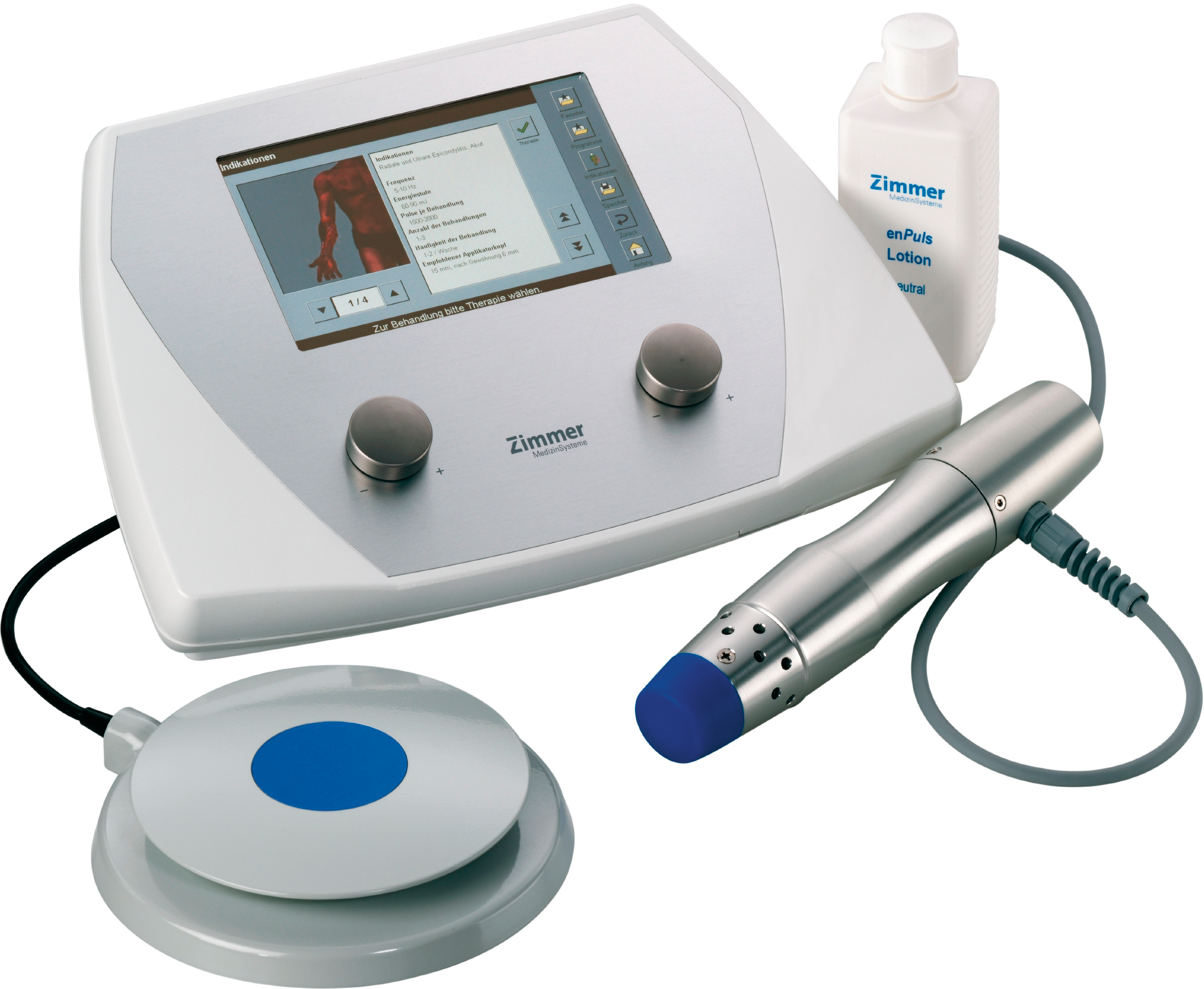
The Rosalind Franklin University institutional review board provided approval to retrospectively review, using deidentified patient data, functional and pain outcomes of treatment for recalcitrant plantar fasciitis. Patients were treated according to their condition, and consent was given. EnPuls EPAT (Zimmer MedizinSysteme GmbH, Neu-Ulm, Germany) (Fig. 1]) or corticosteroid injection was used for the treatment of recalcitrant plantar fasciitis.
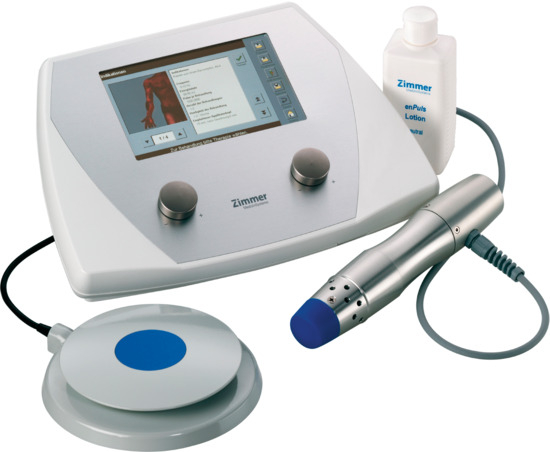
Figure 1
.
The Zimmer enPuls radial pulse device.
Between November 1, 2014, and April 30, 2016, patients presenting to the Foot and Ankle Institute of Chicago, Illinois, with clinical signs and symptoms of plantar fasciitis were eligible for this study. Each patient was diagnosed as having plantar fasciitis based on their clinical examination and ultrasound findings. Patients underwent conservative treatment via a combination of taping and orthotic administration for 3 to 6 months. After 3 to 6 months of failed conservative treatment, patients were treated by one of us (J.G.) with either enPuls EPAT or corticosteroid injection. Patient inclusion criteria were plantar fasciitis recalcitrant to taping and orthotic treatment. Exclusion criteria included a previous plantar fasciotomy, tarsal tunnel syndrome, or concurrent pathology.
EnPuls EPAT ideally comprises 3 sessions, each 1 week apart, in which patients are administered 2,000 shocks at a frequency of 10 Hz and an energy level of 90 to 185 mJ, gradually increasing, titrating to the patient's pain tolerance. No local anesthesia was used during EPAT administration. Certain patients were immobilized after treatment according to their posttreatment pain.
Corticosteroid injection treatment consisted of one to three injections distributed at one per month, depending on the effectiveness of the previous injection. The injections were composed of 0.5 mL of dexamethasone (Decadron; Fera Pharmaceuticals, Locust Valley New York), 0.5 mL of bupivacaine (0.5% Marcaine; Hospira, Lake Forest, Illinois) with epinephrine, and 0.5 mL of triamcinolone acetonide Kenalog-40 (Bristol-Myers Squibb, Princeton, New Jersey); or 2 mL of Marcaine 0.5% plain, 0.5 mL of Decadron, and 0.5 mL of Kenalog-40. Injections were directed at the medial tubercle of the calcaneal tuberosity with ultrasound guidance.
Each patient's progress was monitored by a pretreatment and posttreatment American Orthopaedic Foot & Ankle Society (AOFAS) score and a visual analog scale (VAS) score. These variables were compared between the two groups. Patients were evaluated after every treatment (EPAT or injection) for up to 6 months on the AOFAS and the VAS.
We were required to exclude patients treated with EPAT before September 2015 due to a faulty enPuls unit. Once the unit's malfunction was noticed, Zimmer was notified and the unit was replaced. The new enPuls unit was received in September 2015; therefore, all patients in the EPAT group were included after this date.
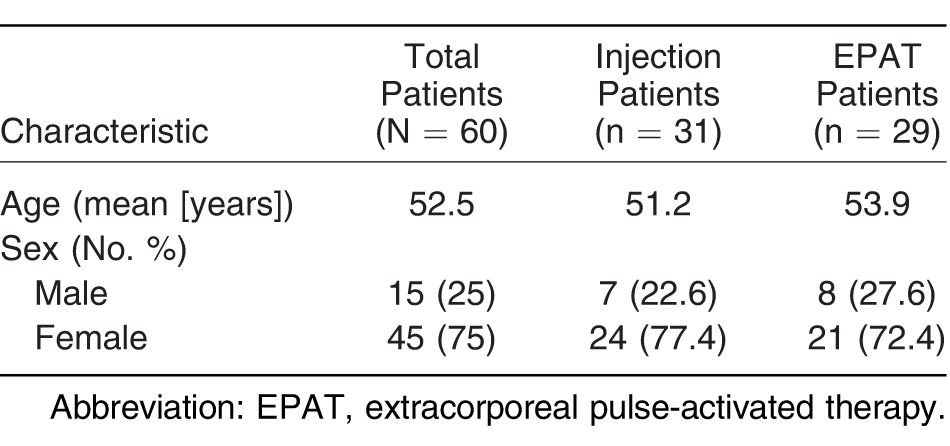
Sixty patients with a diagnosis of plantar fasciitis who met the inclusion criteria were included in this study: 31 who received corticosteroid injection treatments and 29 who received EPAT treatment. There were three times as many women as there were men in the present study. A complete list of patient demographics is given in Table 1.
Table 1
.
Patient Demographic Characteristics
Results
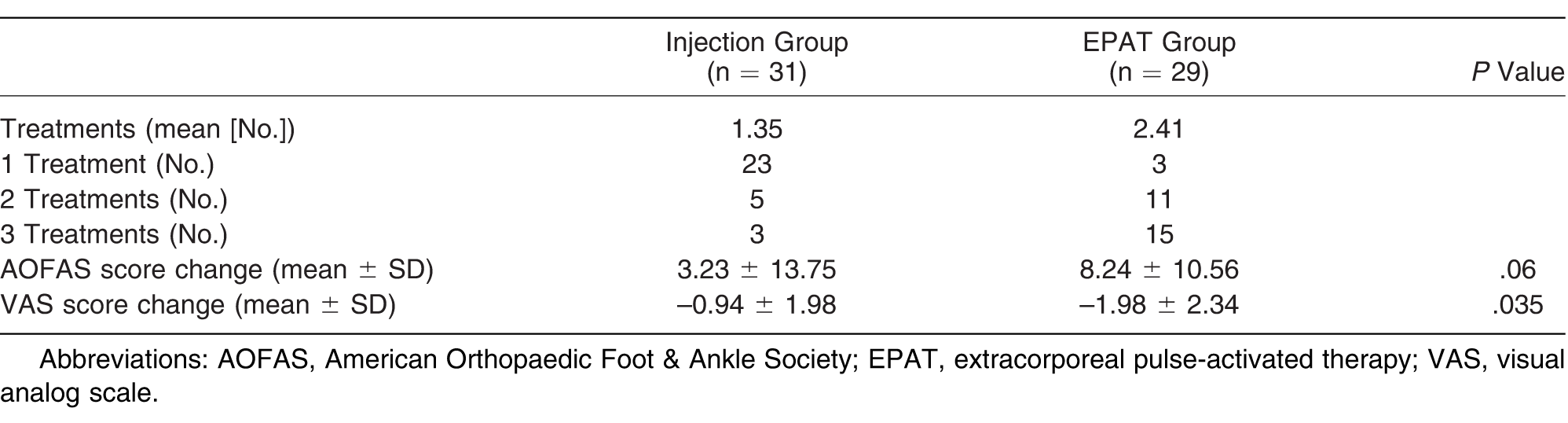
Patient data were analyzed using an independent t test with equal variance and was performed using a 0.05 confidence interval. The mean ± SD change in pretreatment to posttreatment AOFAS scores was 3.23 ± 13.75 for injection patients and 8.24 ± 10.56 for EPAT patients. The mean ± SD change in pretreatment to posttreatment VAS scores was –0.94 ± 1.98 for injection patients and –1.98 ± 2.34 for EPAT patients. The VAS score was significantly improved with EPAT treatment compared with corticosteroid injection (P = .035). There was no significant difference in AOFAS scores between patients receiving injections and patients receiving EPAT treatment (P = .12). Comparisons between the two patient groups are listed in Table 2.
Table 2
.
Number of Treatments per Patient by Group
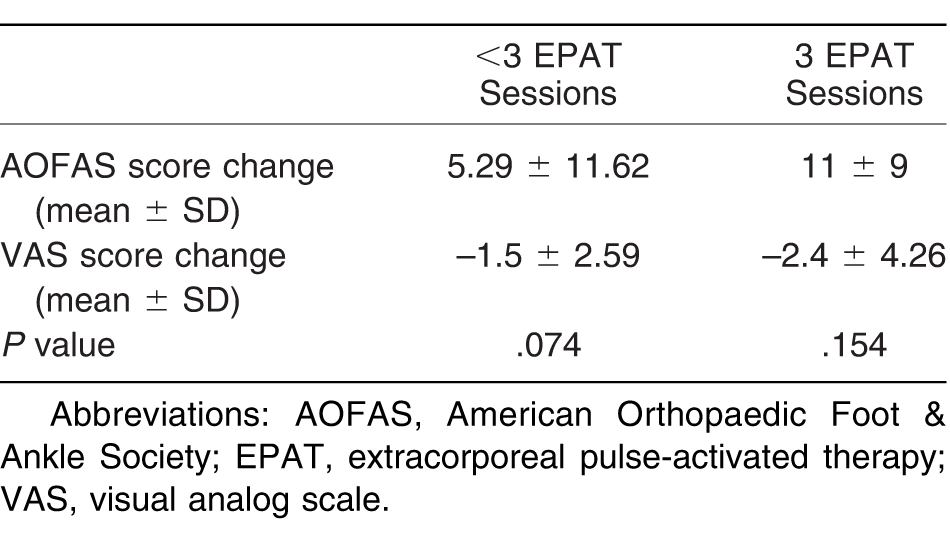
Although the AOFAS scores were not statistically significant, there was an increase in the mean AOFAS score, as well as a greater decrease in VAS scores between patients receiving fewer than three EPAT sessions and those who completed all three sessions (Table 3). No adverse effects were noted in either group in this study.
Table 3
.
Improvement Scores by Number of Treatment Sessions
Discussion
This study sought to compare pain and functional outcomes of patients with plantar fasciitis treated with corticosteroid injection or EPAT. In this patient population, we were able to show a statistically significantly greater reduction in pain when treated with EPAT compared with injection. Although we did not find the difference in functional outcomes between the two patient groups to be statistically significant, we were able to make some interesting observations. First, EPAT was equally as effective as corticosteroid injections in improving patient pain and function. Second, although not statistically significant, it was noted that patients treated with a full course of three EPAT treatments showed more improvement in both pain and function than patients who received only one or two treatments.
Saxena et al[12] found ESWT to be effective in treating plantar fasciitis compared with endoscopic plantar fasciotomy (EPF). Their study included 37 athletes divided into an EPF group, an ESWT group, or a placebo ESWT group. Both the EPF and the ESWT groups showed statistically significant improvement in subjective and functional outcomes. The major advantage of ESWT was that patients were able to continue activity throughout the study, while still gaining relief from pain.
In a level 1 randomized, double-blind, placebo-controlled multicenter study, Gollwitzer et al[1] investigated the efficacy of ESWT for chronic plantar fasciitis. In the study, 246 patients were randomized into either the ESWT or the placebo group. Both pain and function showed statistically significant improvement in the ESWT group compared with the placebo group. The VAS score was reduced by 69.2% in the ESWT group and by 34.5% in the placebo group. Functionality, measured in the Roles and Maudsley score, was also statistically significantly improved by 0.4 points more in the ESWT group than in the placebo group. This study definitively showed that ESWT is an effective and reliable treatment for patients with chronic plantar fasciitis.
Yucel et al[6] previously compared corticosteroid injection and ESWT treatments for plantar fasciitis. In their study, 60 patients with plantar fasciitis were treated with corticosteroid injection or high-energy ESWT. No statistically significant difference was noted between the two treatment groups. Although this study showed the efficacy of high-energy ESWT that requires anesthesia, the present study supports the clinical use of EPAT in a clinical setting to treat plantar fasciitis.
In conclusion, both corticosteroid injection and enPuls EPAT are viable treatment modalities for patients with recalcitrant plantar fasciitis. Neither treatment elicited adverse effects in this study, and both treatments are safe and effective in treating plantar fasciitis. We believe that this study supports EPAT being a first-level treatment for plantar fasciitis. In addition, EPAT should be considered when other conservative modalities have failed.
Financial Disclosure: None reported.
Conflict of Interest: None reported.
References
- Gollwitzer H, Saxena A, DiDomenico L, et al: Clinically relevant effectiveness of focused extracorporeal shock wave therapy in the treatment of chronic plantar fasciitis: a randomized, controlled multicenter study. J Bone Joint Surg Am97: 701, 2015.
- Tomczak R, Haverstock B: A retrospective comparison of endoscopic plantar fasciotomy to open plantar fasciotomy with heel spur resection for chronic plantar fasciitis/heel spur syndrome. J Foot Ankle Surg34: 305, 1995.
- Porter M, Shadbolt B: Intralesional corticosteroid injection versus extracorporeal shock wave therapy for plantar fasciopathy. Clin J Sport Med15: 119, 2005.
- Thomas JL, Christensen JC, Kravitz SR, et al: The diagnosis and treatment of heel pain: a clinical practice guideline–revision 2010. J Foot Ankle Surg49: S1, 2010.
- Gerdesmeyer L, Frey C, Vester J, et al: Radial extracorporeal shock wave therapy is safe and effective in the treatment of chronic recalcitrant plantar fasciitis: results of a confirmatory randomized placebo-controlled multicenter study. Am J Sports Med36: 2100, 2008.
- Yucel, I, Ozturan K, Demiraran Y, et al: Comparison of high-dose extracorporeal shockwave therapy and intralesional corticosteroid injection in the treatment of plantar fasciitis. JAPMA100: 105, 2010.
- Saxena A, Fournier M, Gerdesmeyer L, et al: Comparison between extracorporeal shockwave therapy, placebo ESWT and endoscopic plantar fasciotomy for the treatment of chronic plantar heel pain in the athlete. Muscles Ligaments Tendons J2: 312, 2012.
- Malay D, Pressman M, Assili A, et al: Extracorporeal shockwave therapy versus placebo for the treatment of chronic proximal plantar fasciitis: results of a randomized, placebo-controlled, double-blinded, multicenter intervention trial. J Foot Ankle Surg45: 196, 2006.
- Pribut SM: Current approaches to the management of plantar heel pain syndrome, including the role of injectable corticosteroids. JAPMA97: 68, 2007.
- Sellman J: Plantar fascia rupture associated with corticosteroid injection. Foot Ankle Int15: 376, 1994.
- Waugh C, Morrissey D, Jones E, et al: In vivo biological response to extracorporeal shockwave therapy in human tendinopathy. Eur Cell Mat29: 268, 2015.
- Saxena A, Ramdath SJr, O'Halloran P, et al: Extra-corporeal pulsed-activated therapy (“EPAT” sound wave) for Achilles tendinopathy: a prospective study. J Foot Ankle Surg50: 315, 2011.
- Martin RL, Irrgang, JJ, Conti SF: Outcome study of subjects with insertional plantar fasciitis. Foot Ankle Int19: 803, 1998.
© 2019 American Podiatric Medical Association