In 1889, Bourns described a series of sharply demarcated hyperpigmented lesions on the lips and tongue of a patient after ingestion of 20 g of antipyrine.[
1] The term fixed delayed drug reaction was first introduced by Brocq in 1894.[
2] Fixed drug reactions are a delayed type IV hypersensitivity reaction from reexposure of the offending agent and are regulated by CD8 T cells.[
3] The drug activates a reaction by binding to basal keratinocytes. This binding incites an inflammatory response with release of interferon, cytotoxic granules, and lymphokines associated with mast cells, which causes damage to the basal cell layer.[
4]
A fixed drug reaction (FDR) is defined as a reaction that occurs at the same site with repeated exposure of the inciting medication.[
5-[
7] The prevalence of cutaneous drug reactions has been reported to range between 1% and 2%, with 16% to 21% of all cutaneous drug eruptions being caused by an FDR. The cutaneous manifestations of FDR are diverse and range from, but are not limited to, dermatitis, Stevens-Johnson syndrome, urticaria, morbilliform exanthema, hypersensitivity syndrome, pigmentary changes, acute generalized exanthematous pustulosis, photosensitivity, vasculitis, and others. Fluoroquinolones, such as ciprofloxacin and levofloxacin, have been known to cause fixed drug reactions, specifically, urticaria, angioedema, maculopapular exanthema, and photosensitivity.[
8] Ciprofloxacin is an antibiotic used commonly by the podiatric profession since 1986.[
9] It has excellent efficacy against gram-negative bacteria, with superb bone, tissue, and skin penetration.
Case Report
The patient is a 52-year-old white man with a history of chronic dental infection and no surgical history. He presented to the emergency department with a rash and bullae to his extremities that began soon after taking oral ciprofloxacin the previous day. The podiatry service was consulted because of the bullae and erythema present on the bilateral lower extremity. The patient stated that he had a chronic dental infection around the crown of his right upper jaw, and had taken a single dose of his wife's ciprofloxacin 1 day prior. The rash began soon after he had taken the antibiotic and spread more proximally to his feet and hands. The next day, the patient awoke and had a large blister over the medial arch of his left foot.
The patient also states that he previously had a similar drug reaction to ciprofloxacin causing erythema to his distal extremities, but without the blistering he is experiencing currently. He denies any drug allergies or recent exposure to any chemicals, and cannot recall any inciting events that led to the rash, except for the ciprofloxacin exposure. He also denies pain over the affected areas, but relates mild itching, specifically where the erythema is greatest.
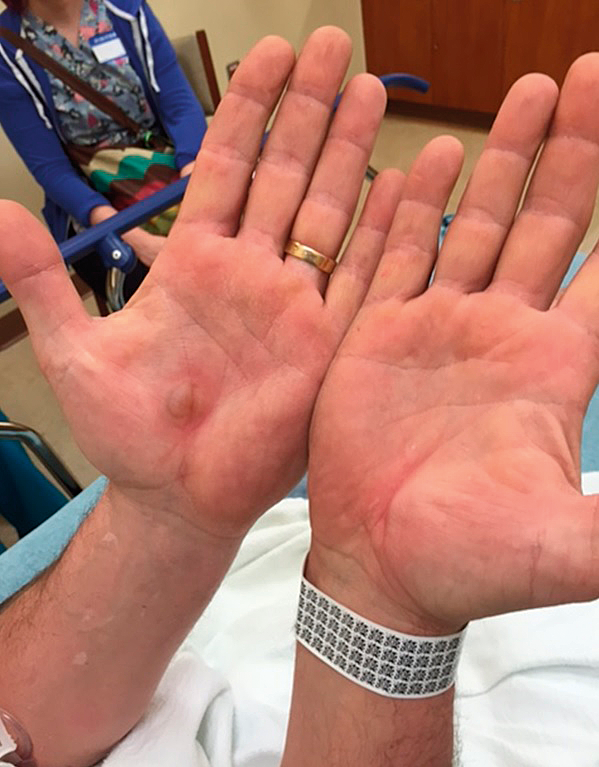
The patient did not attempt any treatments for this skin rash and blistering before coming to the emergency room. He denies nausea, fever, chills, and vomiting. His vital signs were within normal ranges, and there were no genital, oral, or other lesions anywhere on his body except for the erythema and bullae of the extremities. On physical examination, his left hand had an approximately a 2 × 2-cm bulla present (
Fig. 1) on the palmar surface, with erythema overlying the bilateral upper extremity extending distally from the wrists. The medial arch of the patient's left lower extremity had two bullae present (
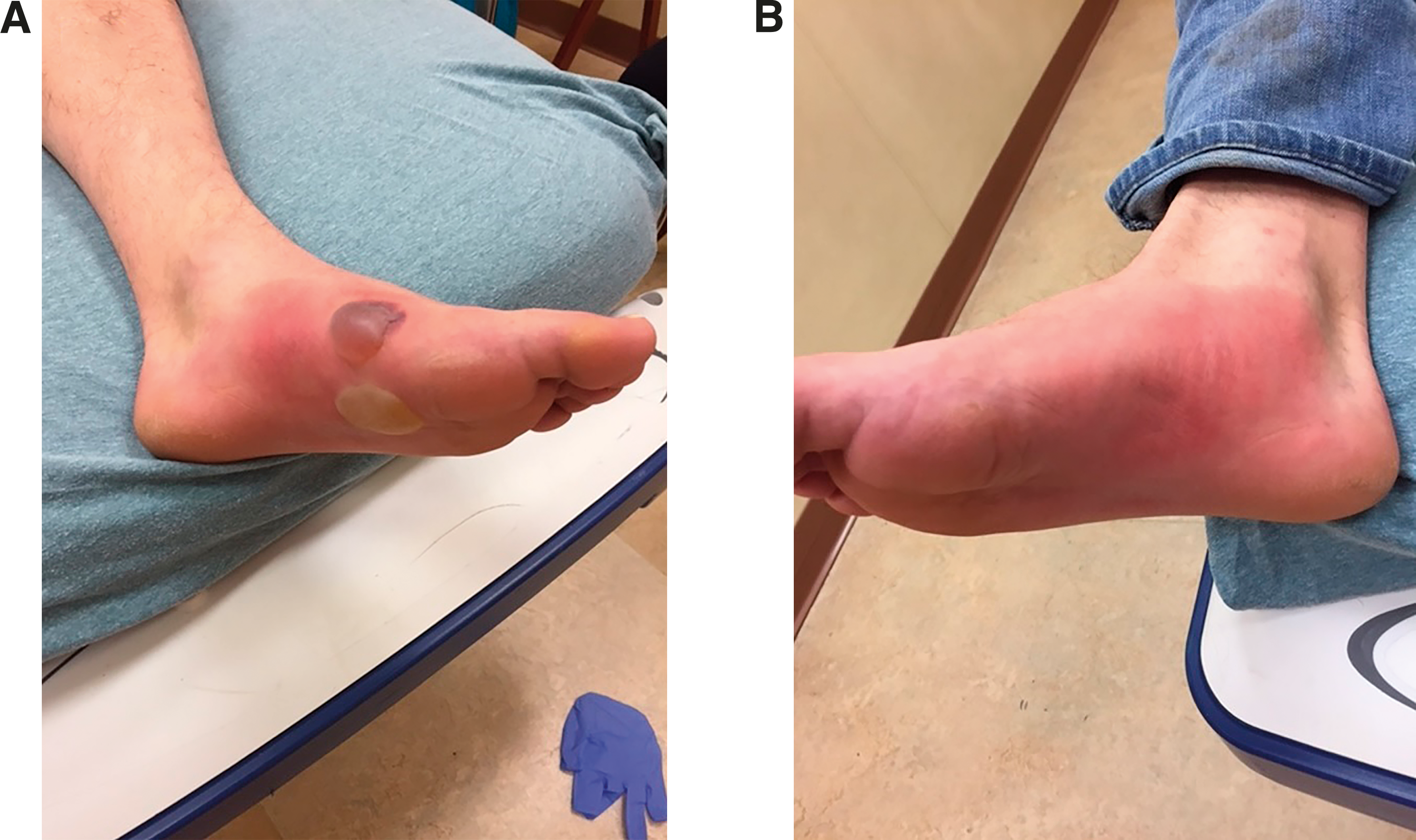
Fig. 2). The dorsal bulla was approximately 6 × 4 cm and the more plantar bulla was 5 × 4 cm. Erythema extended distally from the medial malleoli bilaterally.
Figure 1
.
Bulla present on the left palmar upper extremity, 2 × 2 cm on the palmar surface of the hand, with erythema extending proximally to approximately the wrist.
Figure 1
.
Bulla present on the left palmar upper extremity, 2 × 2 cm on the palmar surface of the hand, with erythema extending proximally to approximately the wrist.
Figure 2
.
A, Left lower extremity; B, right lower extremity. Two bullae overlying the left lower extremity: an approximately 6 × 4-cm dorsal bulla and a 5 × 4-cm plantar bulla. Erythema was present bilaterally extending distally from the medial malleolus.
Figure 2
.
A, Left lower extremity; B, right lower extremity. Two bullae overlying the left lower extremity: an approximately 6 × 4-cm dorsal bulla and a 5 × 4-cm plantar bulla. Erythema was present bilaterally extending distally from the medial malleolus.
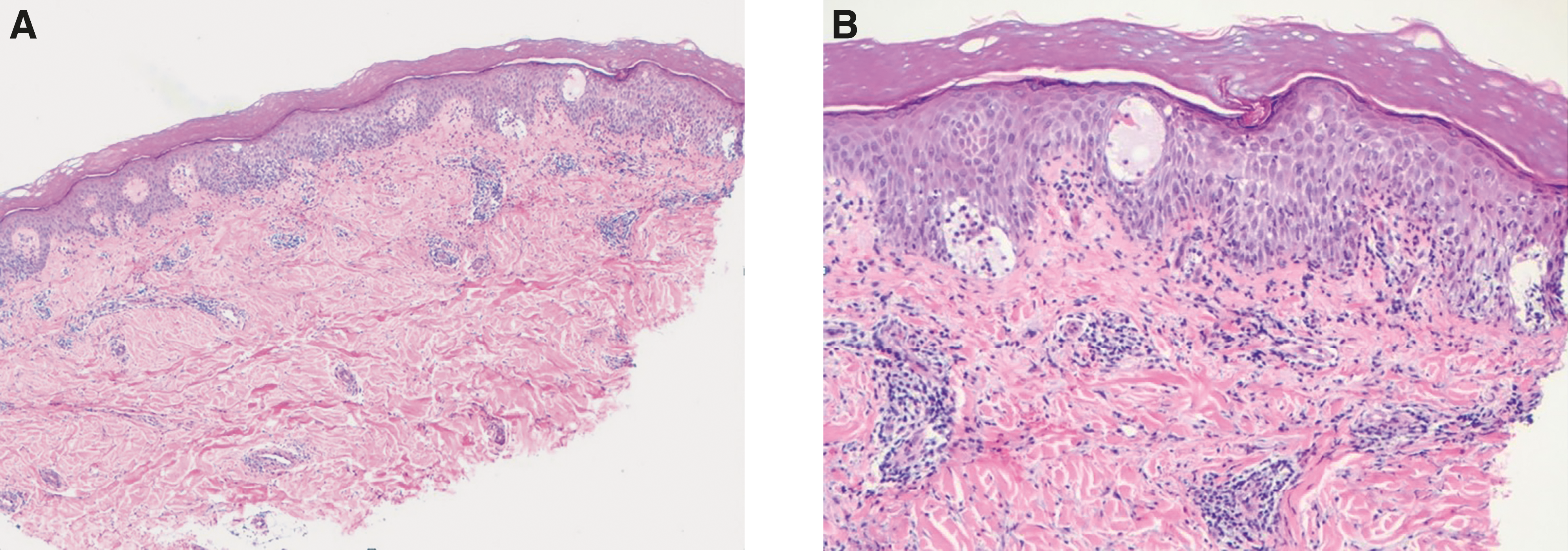
A punch biopsy specimen was taken of the left medial dorsal foot bulla and sent for dermatopathologic evaluation. The punch biopsy specimen was analyzed and found to demonstrate eosinophils infiltrating the epidermis, and also eosinophilic and lymphocytic infiltrate (
Fig. 3). The specimen was diagnosed as spongiotic dermatitis secondary to a fixed drug reaction. The patient has avoided taking ciprofloxacin, and was advised to use Benadryl (Johnson & Johnson Consumer, Skillman, New Jersey) as needed to treat the itching over his extremities. The rash and bullae of the extremities resolved uneventfully, and the patient has followed up with a dermatologist.
Figure 3
.
Low-power (A) and high-power (B) views of a punch biopsy specimen of the bulla of the lower extremity demonstrates spongiotic epidermis with microvesicles at different levels of the dermis, which contain eosinophils in the epidermis, and interstitial lymphocytic and eosinophilic inflammation with few neutrophils.
Figure 3
.
Low-power (A) and high-power (B) views of a punch biopsy specimen of the bulla of the lower extremity demonstrates spongiotic epidermis with microvesicles at different levels of the dermis, which contain eosinophils in the epidermis, and interstitial lymphocytic and eosinophilic inflammation with few neutrophils.
Discussion
This case is unique because it demonstrates a rare drug reaction caused by ciprofloxacin. A thorough and focused history and physical examination are key factors that lead to rapid diagnosis for this patient. A key finding was the lack of metabolic and autoimmune disorders for this patient, which would increase the differential diagnosis significantly.[
10] In this case, the essential piece of information was the patient's previous exposure to ciprofloxacin, which caused erythema of the extremities but no blistering. This is consistent with sensitization of CD8 T cells causing a type IV delayed type hypersensitivity and ultimately leading to the creation of the bullae that appeared in this case on the acral surfaces of the extremities.
Cutaneous adverse drug reactions make up 1% to 2% of all adverse drug reactions. Of these adverse cutaneous drug reactions, 16% to 21% can be categorized as FDRs. Cutaneous drug reactions for ciprofloxacin are not uncommon; however, an FDR with bullous variant as demonstrated in this case is rare. Spongiotic dermatitis is a common secondary manifestation caused during an FDR with a bullous variant, as demonstrated by the pathology report for this patient.
Rechallenging the patient to the suspected offending drug agent is the only known test to possibly discern a causative agent; however, this would not be ethical or advisable in this case. No further action is required to treat this patient. However, that patient should refrain from taking fluoroquinolone antibiotics in the future.
Conclusions
The intent of these authors for sharing this case was to demonstrate a rare cause of an FDR. Timely deduction by the prescribing physician of drug reactions and prompt treatment are invaluable skills for the clinician to possess, which lead to positive patient outcomes. Ciprofloxacin is a commonly prescribed antibiotic used in podiatric medicine. Awareness of this bullous FDR and the need to discontinue the drug is of great importance. Thus, it is the authors' intent to educate the podiatric community and advise other practitioners to also report similar rare drug reactions in the future.