


Abstract
Background: Idiopathic toe-walking (ITW) gait may present in children older than 3 years and in the absence of a medical condition known to cause or be associated with toe-walking gait. It is unknown how this gait type changes pressure distribution in the growing foot. We sought to determine whether children with ITW gait exhibit different plantar pressures and temporal gait features than typically developing children. Methods: Children aged 3 to 6 years were recruited who had either a typical heel-toe gait pattern or a diagnosis of ITW. The ITW diagnosis was reported by the parent/caregiver and confirmed through history and physical examination. Temporal gait measures, peak pressures, and impulse percentages were measured. A minimum of ten unshod footprints were collected. Data were compared with unpaired t tests. Results: The study included 40 children with typical gait and 56 with ITW gait. The ITW group displayed lower peak pressures at the hallux, midfoot, and hindfoot (P < .05) and higher and lower pressure impulse percentages at the forefoot (P < .001) and hindfoot (P < .001), respectively. The ITW group spent a higher percentage of contact time at all areas of the forefoot and less at the midfoot and rearfoot (P < .05). There were no significant differences in total step duration and foot progression angle between groups (P > .05). Conclusions: There were differences in pressure distributions between groups. Understanding these differences may help us better understand the compensations or potential long-term impact that ITW gait may have on a young child's foot. Podiatric physicians may also consider the use of this equipment in the clinical setting to measure outcomes after treatment for ITW.
Children diagnosed as having idiopathic toe-walking (ITW) gait typically walk without heel contact constantly or walk on their tiptoes intermittently despite the fact that they are capable of heel-toe or flat-footed walking on request.[1,2] Many young children may toe-walk when perfecting their gait pattern; however, as their gait matures, they tend to walk with a flatfoot gait within 6 months and generally after age 3 years.[3] There are many medical conditions known to cause or be associated with toe-walking gait, in particular, cerebral palsy, muscular dystrophy, and autism.[1,4] Idiopathic toe-walking is the diagnosis given when all known medical conditions associated with toewalking gait have been excluded.
There are some known musculoskeletal changes associated with ITW, but little is known about changes at the foot or in foot posture. Children who are diagnosed as having ITW commonly also have reduced ankle range of motion.[5,6] Because ITW typically presents with the child walking symmetrically on their tiptoes,[4,7] observations of a similar bilateral reduction of ankle range of motion at both lower limbs has also been reported,[8,9] supporting the symmetrical nature of this gait type. Some adults who were previously diagnosed as having ITW have observed skeletal changes, including external tibial torsion.[10] For this reason, examination of children with ITW gait usually includes evaluation of ankle mobility alongside visual gait observation, either directly or by means of video recordings.[5,7,10,11] Only one study has examined the foot posture of children with ITW gait and associated ankle equinus.[6] This previous study used the Foot Posture Index (FPI-6).[12] The FPI-6 is a commonly reported static weightbearing measure of foot posture that also has published reliability and pediatric normative values.[13,14] Although children diagnosed as having ITW exhibited greater foot pronation than the control group in the study, the average FPI-6 score of the ITW group was comparable with other published normative values.
Although lack of heel contact is easily visually observed, some of the subtle gait changes and compensations during ITW gait are more difficult to observe.[11] In particular, these changes may be plantar pressure related. Gait analysis may include electromyographic, kinetic, and kinematic characteristics of the ITW pattern[4,15] to supplement the performance or biomechanical measures recorded during clinical examination to monitor the impact of the gait pattern or the success of any implemented treatment.[2,11,16]
Among the newest technology to analyze the ITW pattern are those designed to evaluate the baropodometric pressures during gait (such as accelerometers and sensors in footwear to quantify heel impact). These types of technologies aim to detect incipient alterations.[17] Despite the high sensitivity of dynamic baropodometry to detect gait changes,[18,19,20,21] only one study has analyzed the ITW plantar pressure pattern with this technology. This recently published research proposed the use of baropodometric pressures to classify ITW severity to guide treatment.[22] However, there were no comparisons of pressures with control data; therefore, any diagnostic value of this measurement equipment remains unknown. It is becoming commonplace for podiatric physicians to use technology in the clinical setting to assist in accurate diagnosis. Understanding differences in foot posture between children with ITW gait and children without toe-walking gait, as measured with this type of clinically available equipment, will enable podiatric physicians to consider whether this type of measure may assist in everyday practice. The present research aimed to analyze differences in plantar pressure and step development characteristics between children with ITW and children without toe-walking using dynamic baropodometry.
Materials and Methods
This research was a cross-sectional study and was approved by the Clinical Investigation Ethics Committee of the Faculty of Nursing, Physiotherapy and Podiatry of the Complutense University of Madrid.
Participants and Setting
All of the children in this study were recruited from the general community via online advertising and posters at local medical clinics and hospitals. There were two groups of children recruited, aged 3 to 6 years. The first group consisted of children diagnosed as having ITW by a medical specialist (parent reported). This diagnosis was also confirmed through examination by an experienced physiotherapist, who took into account their birth history, their lower-limb neurologic responses, their ability to put their heels on the ground, normalized gait on request, the range of motion of their lower limbs, and parent confirmation of no medical conditions known to cause or be associated with toe-walking gait. This exclusionary diagnostic criterion was similar to that described in other studies recruiting children with ITW gait.[7] Children who were currently undergoing treatment or previously had treatment for ITW were ineligible to participate.
A second group of children was recruited as a comparison group. They were also examined by the physiotherapist, who confirmed age-typical heel-toe gait, no lower-limb gait abnormalities, and no parent-reported conditions known to cause lowerlimb or gait changes.
Measurements
Demographic data were collected from the children, including age, sex, height, and weight. Gait was measured with the Footscan USB gait clinical system (RSscan International, Paal, Belgium) (2.0 3 0.4 3 0.02 m, 16,384 sensors, 500 Hz, and three sensors per square centimeter and multistep analysis), integrated in a 9-m gait track. The Footscan collected the following variables:
- Peak pressures at the hallux, from the second to the fifth toe, from the first to the fifth metatarsal, midfoot, medial hindfoot, and lateral hindfoot.
- Total percentage of pressure impulse at the forefoot, midfoot, and hindfoot was determined by the cumulative pressure measurement taken during the stance phase and divided by the total pressure impulse of the whole foot, multiplied by 100.
- Percentage of contact time at the hallux, from the second to the fifth toe, from the first to the fifth metatarsal, midfoot, medial hindfoot, and lateral hindfoot determined by the difference between the end and the starting of the foot contact divided by the step duration, multiplied by 100.
- Step duration.
- Foot progression angle.
The Footscan calculated these variables, and the variables were exported from the system for analysis. The foot areas were also determined by the Footscan through the system’s automatic division of foot zones. This method has been reported in studies on validity and calculations of plantar pressures of children[18,19,20] and adults.[23,24]
Procedure
All of the parents or caregivers gave written consent, and children assented to participate. Children were familiarized with the testing environment and then were instructed to walk in a straight line at a comfortable pace over the gait track including the Footscan recording platform while looking straight ahead. Parents and therapists allowed the children to self-determine their pace. Because the entire walk was less than 100 m, no breaks were provided as it was not predicted that this length of walking would cause fatigue. The children repeated the walking track until a minimum of ten footprints of each foot were recorded, excluding the first and last prints to eliminate any partial prints.
Statistical Analysis
Data were analyzed using IBM SPSS Statistics for Windows, Version 19.0 (IBM Corp, Armonk, New York). Participant demographics are described as mean ± SD and frequency (percentage). Because ITW gait is a symmetrical condition, only the data from the right foot were used in the analysis. Data from left and right feet were also compared, and there was no statistically significant difference between the two. Use of data from a single limb has previously been demonstrated to satisfy the assumption of data independence.[25]
All of the data were checked for normality and compared with an unpaired two-sample t test; statistical significance was determined as P < .05. Because no pressure mapping had previously been undertaken with this population, no power calculation was conducted to determine sample size.
Results
A total of 151 children aged 3 to 6 years were recruited. After screening based on case history and physiotherapist assessment, there were 40 children (23 boys [58%]) in the non-ITW group and 56 (39 boys [70%]) in the ITW group. The data were collected from each child in a single session, and no child withdrew owing to noncompletion of the walking component. No child was fatigued or needed a break during data collection.
There were no statistically significant differences in any of the anthropometric characteristics between groups. The mean ± SD age of the non-ITW group was 4.6 ± 1.2 years and of the ITW group was 4.6 ± 1.0 years (P > .05); the mean ± SD body mass index was similar between the non-ITW and ITW groups (15.9 ± 1.3 vs 16.5 ± 1.9; P > .05).
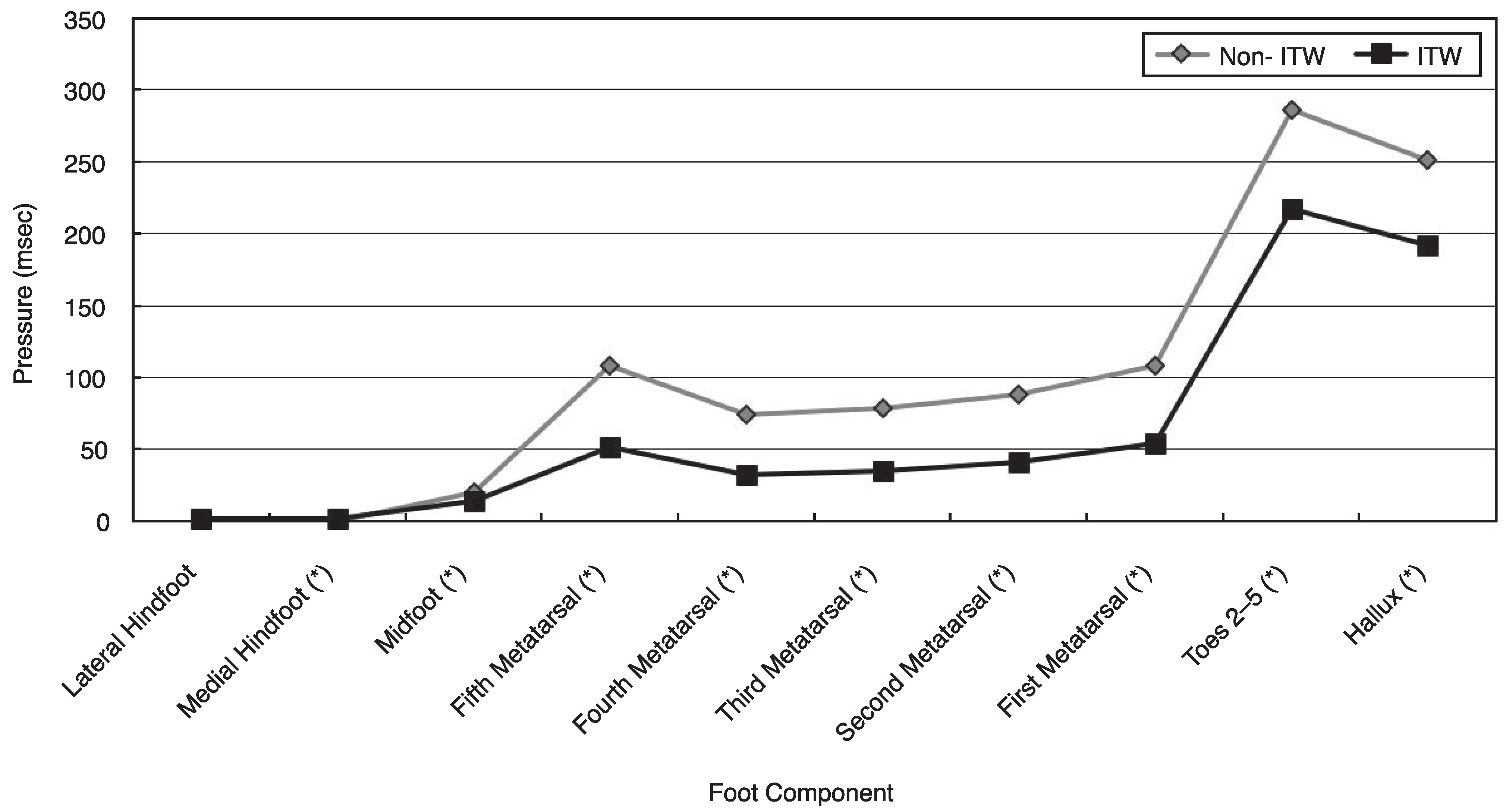
There were differences (P < .05) in peak pressure between the groups at the hallux, midfoot, and hindfoot record (Table 1). The ITW group exhibited less pressure in these areas. There were also differences between groups in percentage of pressure impulse, with the ITW group having a different percentage at the forefoot and hindfoot (P < .05) than the non-ITW group (Table 2). However, there were no differences between total foot pressure impulses between the groups (Table 2). The ITW group spent a higher percentage of contact time at all areas of the forefoot and less at the midfoot and rearfoot (P < .05) (Table 3). There was no difference in the total step duration between the groups (P = .197) (Table 3); however, there were differences in the change in pressure under different zones of the foot between the groups (Fig. 1). There were no differences in mean ± SD foot progression angles between the groups (non-ITW group: 3.7186 6.538; ITW group: 4.838 ± 8.128; P = .474).
Table 1.
Peak Pressures Registered Under Different Zones of the Right Foot
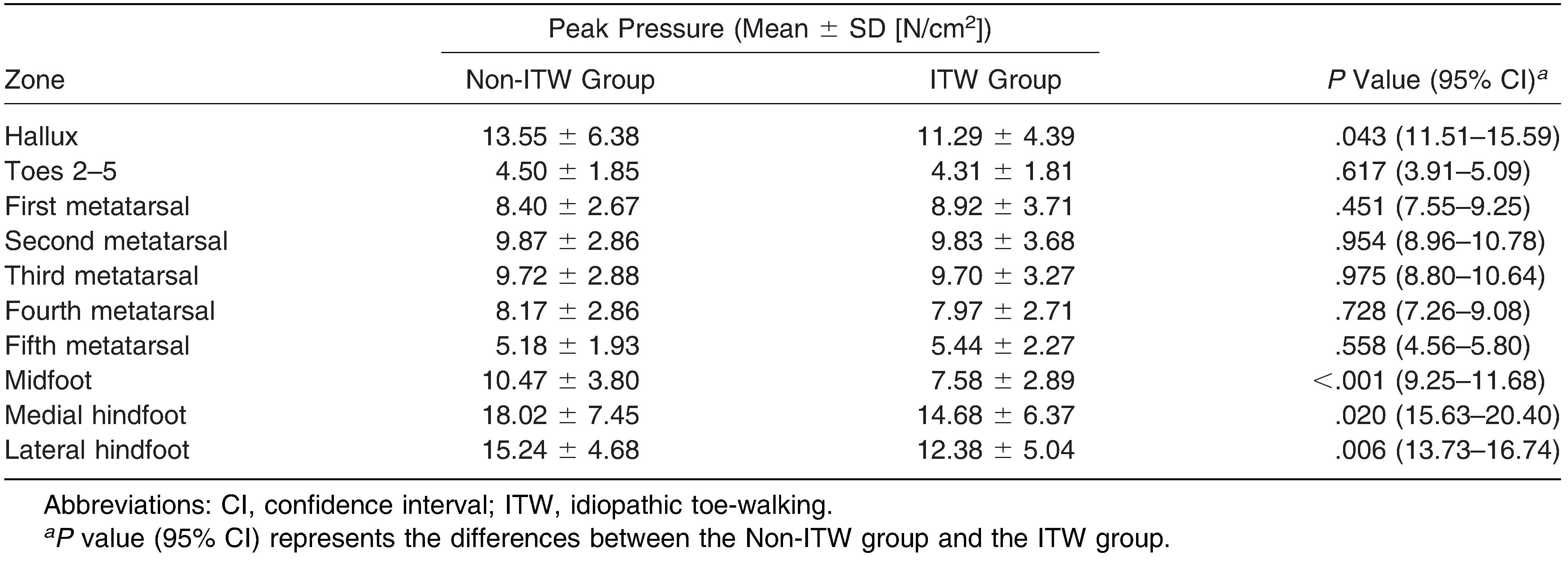
Table 2.
Percentage of Pressure Impulse Exercised by Different Foot Regions and Total Impulse Value of the Right Foot
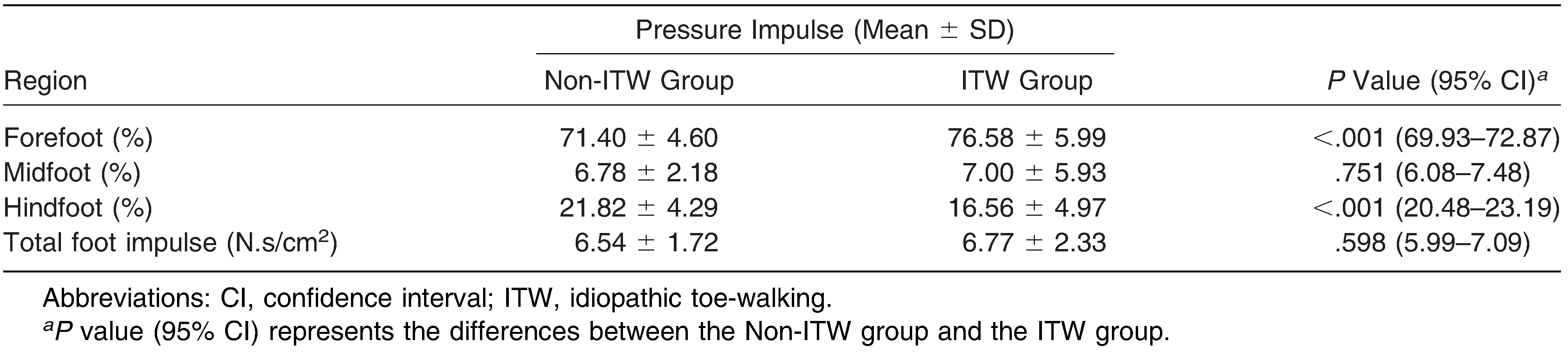
Table 3.
Percentage of Contact Time of Different Foot Areas and Total Step Duration
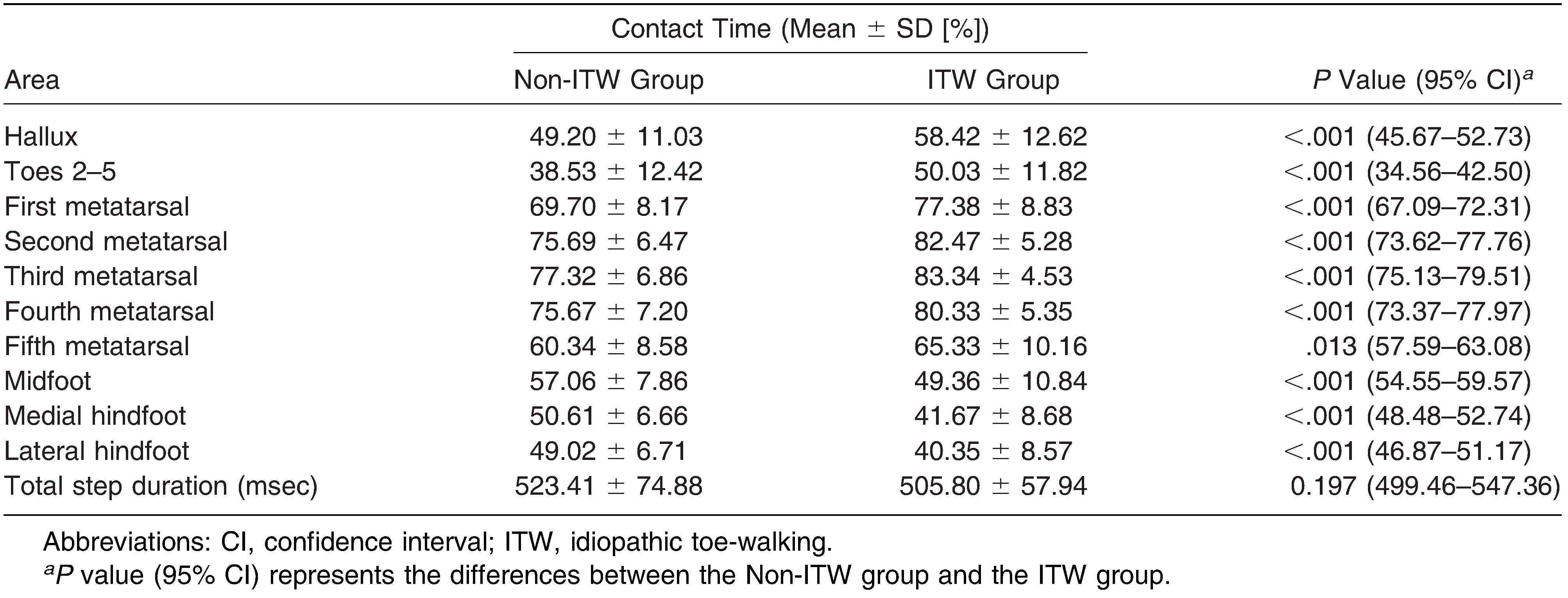
Figure 1.
Changes in pressure under different zones of the right foot. ITW, idiopathic toe-walking. Asterisk indicates a P < .05.
Discussion
To our knowledge, this is the first study that develops a dynamic plantar pressure analysis to compare the differences between children with ITW gait and typically developing ones.
Children who walk with ITW gait demonstrated lower peak pressure at the hallux, midfoot, and hindfoot regions compared with typically developing children. The typically developing children in this study displayed similar foot pressure profiles as those of similar other cohorts.[18,19,20] Children with ITW gait also exhibited differences in their pressure impulse, percentage of contact time, and change in pressure during walking.
There has only been one study to date that looked at foot posture and ITW.[6] This previous study found that there was no difference in foot posture between the ITW and typically developing groups. This study did not compare pressure differences and was a measure of static foot posture only. Some authors hold the opinion that children with ITW gait will grow out of the walking style with no treatment.[9,26] Seeing that there are no foot posture changes but there are pressure differences in the developing foot should change how clinicians view this gait pattern. When a child learns to walk and perfects motor development, the pressure they gain through the ground helps with gait maturity and balance perfection.[19,21] Changes in pressure patterns may lead to differences in osseous modeling[27] or skin and callus formation.
Considering the gait adaption that children with ITW made in the present study, some of these findings were to be expected. Children with ITW had less pressure and contact time at the rearfoot and midfoot and more at the forefoot than the typically developing group. This makes sense to those who have observed the gait of this population group. An interesting finding was the lower peak pressure at the hallux in the ITW group and the contact time percentage differences between the groups with no difference in step duration. It may be proposed that retraction of the hallux may be to stabilize the foot. This retraction may also be from overactivity of the flexor hallucis longus to compensate for any equinus that has commonly been observed in this population group.[1,2,6] Differences in impulses and pressure distribution at the forefoot may also be due to a weakness or imbalance in the muscles dorsiflexing the foot, which have previously been observed with ITW.[2,28] Future research should consider the longitudinal impact of the higher pressure impulse at the forefoot together with the lower peak pressure at the hallux of children diagnosed as having ITW.
There was no difference in the foot progression angles in children from the ITW group or the typically developing group. Both groups demonstrated similar ranges as larger populations of typically developing children.[29,30] Older children with surgically treated ITW gait have been observed to have a greater than typical external rotation from the tibia ITW.[31] This observation was made in older children; therefore, again, it is unknown whether this was a difference in population groups or a change that progressively occurs the longer the child exhibits the toe-walking pattern.
There were several limitations in this study. It is commonly accepted that after age 3 years, children should no longer exhibit typical toe-walking.[4,18] It is possible that including children of this age group may have included children who were delayed in naturally achieving heel-toe gait. Undertaking any gait assessment in children who have ITW is challenging owing to the children’s ability to selfcorrect their gait. The Hawthorne effect could have influenced the results because it is impossible to conduct without the assessor present and because of the variability of the ITW gait.[10,11] Last, there are limited reliability data on the Footscan gait system. Gait speed is variable, particularly with children. Pressure mapping systems are variable due to sensor placement and ITW may be normalized, and this further introduces variability in footprints. No correlation statistics were calculated because it was presumed that the variabilities in speed and sensory capture were similar between the groups. Use of a large normative population sample of typically developing children aimed to minimize this impact, but further research into the validity of this measurement system in different age groups should be undertaken.
This present study describes some important features of pressure distribution in ITW gait. This understanding may assist researchers who are investigating treatment options to consider how to normalize the pressure distribution and potentially shift weight to have better treatment outcomes. Dynamic pedobarography has recently been used to classify the severity of ITW to guide treatment options.[22] Although the present study shows the utility of baropodometry to accurately detect ITW, this other method demonstrates its capacity to provide clues about the severity of this gait type, which has practical application in the clinical setting. This also has potential implications for measurement of treatment outcomes.
Conclusions
Gait analysis of children with ITW gait with the Footscan system demonstrated forward impulse displacement and lower peak pressures in the hindfoot and midfoot. There was also precocious heel lift and advancement of all foot zones of contact except the hindfoot. Health professionals should consider these specific baropodometric patterns to inform their clinical approach to improve any secondary alterations of pressure distribution and evaluate treatment effectiveness.
Financial Disclosure
Dr. Williams is supported by a National Health and Medical Research Council Early Career Health Professional Fellowship.
Conflict of Interest
None reported.
References
- FOX, A.; DEAKIN, S.; PETTIGREW, G. ET AL: Serial casting in the treatment of idiopathic toe-walkers and review of the literature. Acta Orthop Belg 2006, 72, 722. [Google Scholar]
- BRUNT, D.; WOO, R.; KIM, H.D.; et al. Effect of botulinum toxin type A on gait of children who are idiopathic toewalkers and children with spastic cerebral palsy. J Surg Orthop Adv 2004, 13, 149. [Google Scholar] [PubMed]
- BURNETT, C.N.; JOHNSON, E.W. Development of gait in childhood: II. Dev Med Child Neurol 1971, 13, 207. [Google Scholar] [CrossRef] [Scilit]
- ALVAREZ, C.; DE VERA, M.; BEAUCHAMP, R.; et al. Classification of idiopathic toe walking based on gait analysis: development and application of the ITW severity classification. Gait Posture 2007, 26, 428. [Google Scholar] [CrossRef] [Scilit]
- ENGELBERT, R.; GORTER, J.W.; UITERWAAL, C. ET AL: Idiopathic toe-walking in children, adolescentents and young adults: a matter of local or generalised stiffness? BMC Musculoskelet Disord 2011, 12, 61. [Google Scholar] [CrossRef] [Scilit] [PubMed]
- WILLIAMS, C.; TINLEY, P.D.; CURTIN, M. ET AL: Foot and ankle characteristics of children with an idiopathic toewalking gait. JAPMA 2013, 103, 374. [Google Scholar] [CrossRef] [Scilit]
- WILLIAMS, C.M.; TINLEY, P.; CURTIN, M. The Toe Walking Tool: a novel method for assessing idiopathic toe walking children. Gait Posture 2010, 32, 508. [Google Scholar] [CrossRef] [Scilit] [PubMed]
- SOBEL, E.; CASELLI, M.A.; VELEZ, Z. Effect of persistent toe walking on ankle equinus: analysis of 60 idiopathic toe walkers. JAPMA 1997, 87, 17. [Google Scholar] [CrossRef] [Scilit]
- STRICKER, S.J.; ANGULO, J.C. Idiopathic toe walking: a comparison of treatment methods. J Pediatr Orthop 1998, 18, 289. [Google Scholar] [CrossRef] [Scilit]
- HIRSCH, G. WAGNER B: The natural history of idiopathic toe-walking: a long-term follow-up of fourteen conservatively treated children. Acta Paediatr 2004, 93, 196. [Google Scholar] [CrossRef]
- STOTT, N.S.; WALT, S.E.; LOBB, G.A.; et al. Treatment for idiopathic toe-walking: results at skeletal maturity. J Pediatr Orthop 2004, 24, 63. [Google Scholar] [CrossRef] [Scilit]
- REDMOND A: The Foot Posture Index: User Guide and Manual. University of Leeds: Leeds, UK, 1998.
- EVANS, A.M.; ROME, K.; PEET, L. The Foot Posture Index, ankle lunge test, Beighton scale and the lower limb assessment score in healthy children: a reliability study. J Foot Ankle Res 2012, 5, 1. [Google Scholar] [CrossRef] [Scilit]
- MORRISON, S.C.; FERRARI, J. Inter-rater reliability of the Foot Posture Index (FPI-6) in the assessment of the paediatric foot. J Foot Ankle Res 2009, 2, 26. [Google Scholar] [CrossRef] [Scilit] [PubMed]
- ARMAND, S.; WATELAIN, E.; MERCIER, M. ET AL: Identification and classification of toe-walkers based on ankle kinematics, using a data-mining method. Gait Posture 2006, 23, 240. [Google Scholar] [CrossRef] [Scilit] [PubMed]
- ENGSTRO¨ M P, GUTIERREZ-FAREWIK EM, BARTONEK A, ET AL: Does botulinum toxin A improve the walking pattern in children with idiopathic toe-walking? J Child Orthop 2010, 4, 301. [CrossRef] [Scilit] [PubMed]
- CLARK, E.; SWEENEY, J.K.; YOCUM, A. ET AL: Effects of motor control intervention for children with idiopathic toe walking: a 5-case series. Pediatr Phys Ther 2010, 22, 417. [Google Scholar] [CrossRef] [Scilit]
- BOSCH, K.; GERSS, J.; ROSENBAUM, D. Development of healthy children’s feet: nine-year results of a longitudinal investigation of plantar loading patterns. Gait Posture 2010, 32, 564. [Google Scholar] [CrossRef] [Scilit]
- HALLEMANS, A.; DE CLERCQ, D.; VAN DONGEN, S. ET AL: Changes in foot-function parameters during the first 5 months after the onset of independent walking: a longitudinal follow-up study. Gait Posture 2006, 23, 142. [Google Scholar] [CrossRef] [Scilit]
- BERTSCH, C.; UNGER, H.; WINKELMANN, W.; et al. Evaluation of early walking patterns from plantar pressure distribution measurements: first year results of 42 children. Gait Posture 2004, 19, 235. [Google Scholar] [CrossRef] [Scilit]
- JAMESON, E.G.; DAVIDS, J.R.; ANDERSON, J.P.; et al. Dynamic pedobarography for children: use of the center of pressure progression. J Pediatr Orthop 2008, 28, 254. [Google Scholar] [CrossRef] [Scilit]
- Marti´n-Casas P, Meneses-Monroy A, Ballestero-Pe´ rez R, ET AL: Dynamic pedobarographic classification of idiopathic toe-walkers for therapeutical indication. y Salud 2017, 28, 17.
- WOODBURN, J.; HELLIWELL, P. Observations on the F-Scan in-shoe pressure measuring system. Clin Biomech 1996, 11, 301. [Google Scholar] [CrossRef] [Scilit]
- HUGHES, J.; PRATT, L.; LINGE, K.; et al. Reliability of pressure measurements: the EM ED F system. Clin Biomech 1991, 6, 14. [Google Scholar] [CrossRef] [Scilit]
- SUTTON, A.J.; MUIR, K.R.; JONES, A.C. Two knees or one person: data analysis strategies for paired joints or organs. Ann Rheum Dis 1997, 56, 401. [Google Scholar] [CrossRef] [Scilit]
- Eastwood, D.M.; Menelaus, M.B.; Dickens, D.R. Idiopathic toe-walking: does treatment alter the natural history? J Pediatr Orthoped B 2000, 9, 47. [Google Scholar] [CrossRef] [Scilit]
- PEARSON, O.M. LIEBERMAN DE: The aging of Wolff’s ‘‘law’’: ontogeny and responses to mechanical loading in cortical bone. Am J Physical Anthropol Suppl 2004, 39, 63. [Google Scholar] [CrossRef] [Scilit]
- CRENNA, P.; FEDRIZZI, E.; ANDREUCCI, E. ET AL: The heel-contact gait pattern of habitual toe walkers. Gait Posture 2005, 21, 311. [Google Scholar] [CrossRef]
- HO, C.; LIN, C.J.; CHOU, Y.L. ET AL: Foot progression angle and ankle joint complex in preschool children. Clin Biomech 2000, 15, 271. [Google Scholar] [CrossRef] [Scilit] [PubMed]
- STAHELI, L.T.; CORBETT, M.; WYSS, C. ET AL: Lower-extremity rotational problems in children: normal values to guide management. J Bone Joint Surg Am 1985, 67, 39. [Google Scholar] [CrossRef] [Scilit] [PubMed]
- MCMULKIN, M.L.; BAIRD, G.O.; CASKEY, P.M. ET AL: Comprehen-sive outcomes of surgically treated idiopathic toe walkers. J Pediatr Orthop 2006, 26, 606. [Google Scholar] [CrossRef] [Scilit] [PubMed]
© 2019 American Podiatric Medical Association