


Abstract
Background: The scope of podiatric practice has changed significantly in the past couple of decades. Despite the increased quality of training, many people outside of podiatry may not realize what our scope of practice entails. Methods: We conducted a survey consisting of 10 items and asked internal medicine residents at Rush University Medical Center and patients whether they would feel comfortable consulting podiatrists, or being treated for each issue. Results: The results for residents are as follows: 1) toenail fungus, 35% yes and 65% no; 2) diabetic wound care, 87.5% yes and 12.5% no; 3) bunion surgery, 90% yes and 10% no; 4) ankle fracture surgery, 25% yes and 75% no; 5) calcaneal fracture surgery, 50% yes and 50% no; 6) tarsal tunnel nerve surgery, 62.5% yes and 37.5% no; 7) lower extremity arterial bypass, 5% yes and 95% no; 8) below-knee amputation, 5% yes and 95% no; 9) transmetatarsal amputation, 67.5% yes and 32.5% no; and 10) venous stasis wound care, 65% yes and 35% no. The results for patients are as follows: 1) toenail fungus, 72.5% yes and 27.5% no; 2) diabetic wound care, 70% yes and 30% no; 3) bunion surgery, 62.5% yes and 37.5% no; 4) ankle fracture surgery, 57.5% yes and 42.5% no; 5) calcaneal fracture surgery, 55% yes and 45% no; 6) tarsal tunnel nerve surgery, 50% yes and 50% no; 7) lower extremity arterial bypass, 32.5% yes and 67.5% no; 8) below-knee amputation, 27.5% yes and 72.5% no; 9) transmetatarsal amputation, 52.5% yes and 47.5% no; and 10) venous stasis wound care, 32.5% yes and 67.5% no. Conclusions: Internal medicine residents and patients do not have an accurate perception of the scope of podiatric medicine. This proves that, as a profession, we need to raise awareness about what the podiatric scope of medicine actually entails.
The scope of practice of podiatric surgery has changed significantly in the past couple of decades. Improvements in residency training have led to an increased scope of practice in several states; however, some states still do not have ankle privileges. These states allow podiatric physicians to operate only on the foot, even though the physician may have been trained in rearfoot and ankle reconstructive surgery. [1]
As a profession, podiatric physicians have made a push toward equality with physicians that have MD and DO credentials. Perhaps some of the most important changes for gaining parity were made in 1978, when the five colleges of podiatric medicine at that time agreed to adopt the same requirements used for entrance into US medical schools. [2] With these new educational requirements, the basic science curriculum in podiatric medical schools became very similar to that provided by US allopathic and osteopathic medical schools. It also generated an inflow of academically comparable applicants. [2]
In 1986, the Project 2000 Commission published Comprehensive Foot Care: The Report of the National Commission on Podiatric Medicine. It presented the following evaluation of the relationship between podiatrists and other physicians: “Medicine has failed to understand that podiatrists do perform many physician functions; that is, they independently diagnose and treat diseases of the foot, for which they receive adequate training.” The report generated 19 recommendations that were conscientiously pursued over the ensuing years, with most being entirely addressed and resolved. [3,4]
The evolution of postgraduate training has become increasingly more rigorous in an attempt to gain parity. Originally, podiatric residency positions lasted 1 year and were mostly nonsurgical. In addition, they were very limited, and many podiatrists were not fortunate enough to be able to pursue residency training. In January of 2003, the Council on Podiatric Medical Education formally adopted Podiatric Medicine and Surgery (PMSR) 24 and PMSR36 replacing the previous nonsurgical residencies. Since July of 2013, all residency programs are 3-year surgical training programs with designations of PMSR or PMSR/RRA (for those with an added credential in reconstructive rearfoot and ankle procedures). [5] Our profession has also standardized our board examinations to become more like the allopathic boards, and an increasing number of podiatrists are becoming board certified. [6]
Despite this push for equality, and the increased quality of training that graduating residents are receiving, many people outside of podiatric medicine—including patients, medical residents, and attending physicians—may not realize exactly what our scope of practice entails. To determine this, we conducted a survey consisting of 10 items and asked internal medicine residents at Rush University Medical Center whether they would consult podiatry for each issue. We also gave the same survey to patients in a private practice and asked whether or not they would feel comfortable being treated by a podiatrist for each issue (pretending that they had each problem). The assumption of our study was that many people outside of our profession would not have an accurate perception of the scope of practice of podiatric physicians.
The purpose of this study was to determine whether or not medical residents (ie, future attending physicians) would consult or refer patients to us for certain procedures, as well as to see what ailments patients would seek a podiatric physician to treat. This was done to help determine their understanding of the podiatric physician's scope of practice.
Methods
In February of 2016, we conducted a survey consisting of 10 items that was sent out to all Rush University Medical Center internal medicine residents, 121 in total. It was made clear that the surveys were completely anonymous and voluntary. To do this, we contacted the chief resident, who sent an e-mail to all of the residents, asking them to complete the survey. The e-mail specified that this was for research by a Rush podiatry resident and included a link to complete the survey on the Research Monkey Web site. The survey specifically read, “Would you consult the podiatry service for.…” A second e-mail was sent 3 weeks later, again by the chief resident, urging everyone to complete the survey.
The survey was also given to patients in Dr. Jeffery Alexander's private podiatry practice, and they were asked whether or not they would want to be treated by a podiatrist for each issue, assuming they had each problem. The survey for patients was a written document that was given to the patients by the medical assistant during the initial rooming of the patient. It was made clear to them that the survey was completely anonymous and voluntary. It was also made clear to them that there would be no penalty if they did not complete the survey, that the physicians would not know whether or not they filled it out, and that the physicians would not have any knowledge as to the answers they may have chosen. The survey for patients read, “Please answer each question honestly. Please pretend that you have each of the following underlying issues and circle yes or no on whether or not you would be confident in a podiatrist treating them.” The medical assistant then collected the survey on scheduling a follow-up appointment. The 10 items consisted of common procedures that podiatrists perform in the clinic and during surgery, as well as a few items outside our scope of practice. The 10 items consisted of the following: 1) toenail fungus, 2) diabetic wound care, 3) bunion surgery, 4) ankle fracture surgery, 5) calcaneal fracture surgery, 6) tarsal tunnel nerve surgery, 7) lower extremity arterial bypass, 8) below-knee amputation, 9) transmetatarsal amputation, and 10) venous stasis wound care. The primary author then analyzed the results.
Results
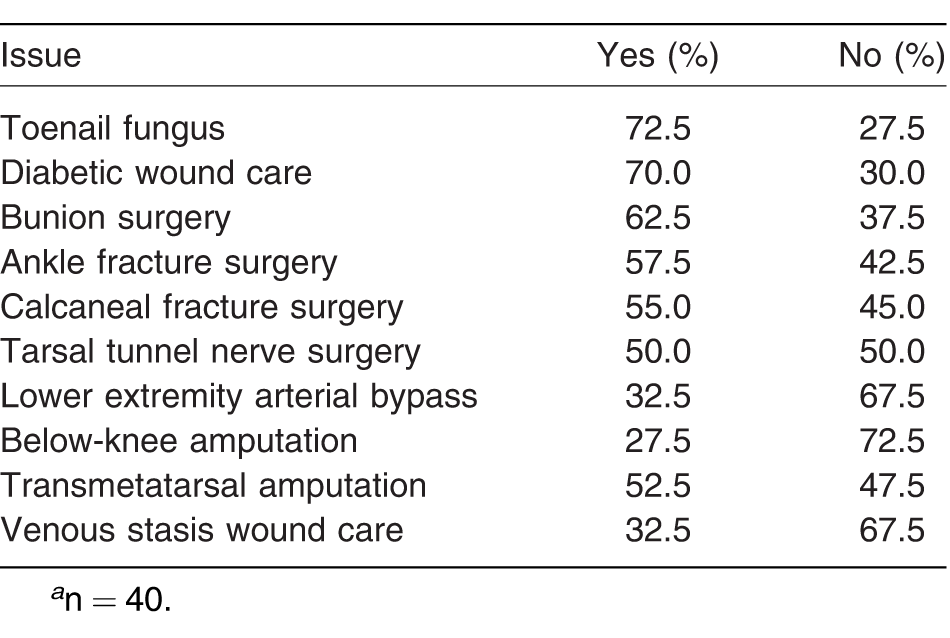
Forty of the 121 residents to which the survey was sent responded, for an overall response rate of 33%. The results for whether or not they would consult a podiatrist for each issue are as follows: 1) toenail fungus, 35.0% yes and 65.0% no; 2) diabetic wound care, 87.5% yes and 12.5% no; 3) bunion surgery, 90.0% yes and 10.0% no; 4) ankle fracture surgery, 25.0% yes and 75.0% no; 5) calcaneal fracture surgery, 50.0% yes and 50.0% no; 6) tarsal tunnel nerve surgery, 62.5% yes and 37.5% no; 7) lower extremity arterial bypass, 5.0% yes and 95.0% no; 8) below-knee amputation, 5.0% yes and 95.0% no; 9) transmetatarsal amputation, 67.5% yes and 32.5% no; and 10) venous stasis wound care, 65.0% yes and 35.0% no (Table 1). None of the residents gave all yes or all no responses. The results regarding whether or not patients would be treated by a podiatrist for each issue are as follows: 1) toenail fungus, 72.5% yes and 27.5% no; 2) diabetic wound care, 70.0% yes and 30.0% no; 3) bunion surgery, 62.5% yes and 37.5% no; 4) ankle fracture surgery, 57.5% yes and 42.5% no; 5) calcaneal fracture surgery, 55.0% yes and 45.0% no; 6) tarsal tunnel nerve surgery, 50.0% yes and 50.0% no; 7) lower extremity arterial bypass, 32.5% yes and 67.5% no; 8) below-knee amputation, 27.5% yes and 72.5% no; 9) transmetatarsal amputation, 52.5% yes and 47.5% no; and 10) venous stasis wound care, 32.5% yes and 67.5% no (Table 2). There were seven patients that filled out all yes responses and six patients that filled out all no responses. In total, 40 patients completed the surveys. After reaching 40, we stopped administering the surveys, because this is the number of residents that answered the survey, so the results were easily comparable.
Table 1.
Internal Medicine Resident Survey Responses a
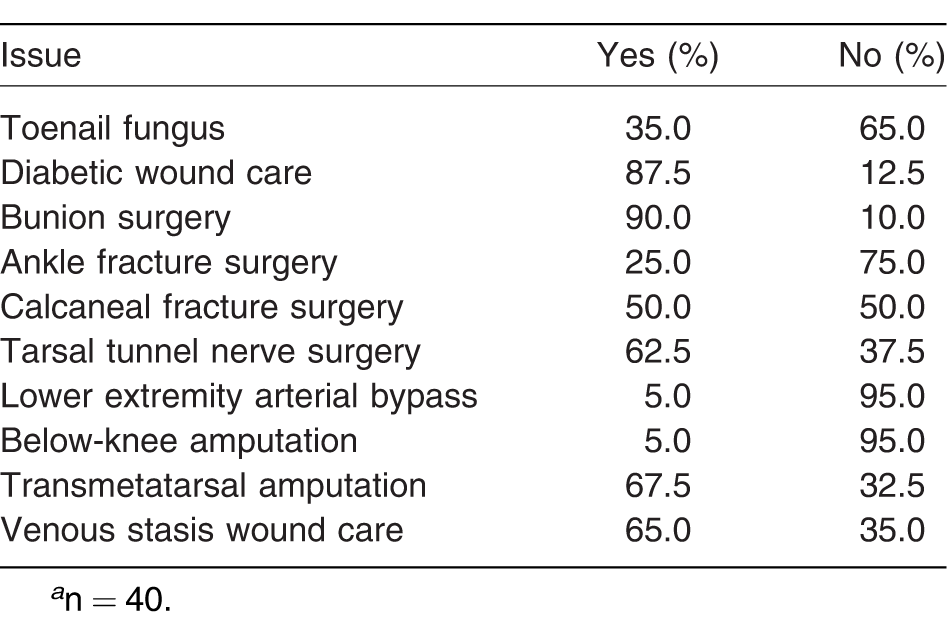
Table 2.
Patient Survey Responses a
Discussion
The results of this study show that internal medicine residents do not have an accurate perception of podiatric physicians' scope of practice with regard to the conditions for which it would be appropriate to consult us. In addition, it shows that patients do not have an accurate perception of podiatric physicians' scope of practice regarding ailments for which they can or should seek treatment from us. The top three conditions that internal medicine residents would consult us for are bunion surgery, diabetic wound care, and transmetatarsal amputation. The top three conditions that patients would seek treatment from us for are toenail fungus, diabetic wound care, and bunion surgery. These results came as a surprise to us, because bunion surgery is the condition ranked highest on the likelihood to refer to a podiatric physician; however, our profession is far more commonly consulted for diabetic wound care and transmetatarsal amputations. This is likely because our institution is a teaching hospital, where residents who completed these surveys more commonly consult us for inpatient concerns, among which bunion surgery is typically not included. I also found it surprising from the patient's point of view because, in this particular private practice, a variety of foot and ankle ailments are seen daily, including trauma; forefoot, rearfoot, and ankle fusions; elective procedures; and Charcot reconstructions. In fact, this particular private practice has a relatively low number of appointments regarding onychomycosis. These data allude to the fact that more work needs to be done to make other physicians—and the public—aware of the podiatric physician's scope of practice and extensive training.
An advantage that our profession possesses is that podiatry school focuses a large amount of the curriculum on aliments affecting the foot and ankle, giving students a firm base of knowledge in their area of specialty, even before starting a 3-year residency. One would think that other physicians would be more likely to refer treatment to someone who has had more specialized, extensive training, in a specific area of the body. Perhaps there is a lack of knowledge among MDs, DOs, and the public in general that requirements to gain entrance into podiatry school are the same as those for allopathic and osteopathic schools, that all residency programs are standardized 3-year surgical programs, and that podiatrists go though a rigorous board-certification process.
An American Medical Association report from 2007 describes how medical postgraduate education (residency) specialties are independent from medical school and concludes that the problems associated with this “compartmentalization” should be the stimulus for rethinking the medical education model and perhaps exposing them to a specialty earlier. [7]
The Accreditation Council for Graduate Medical Education reports that the national average for total foot procedures performed by orthopedic residents is 109.5 procedures per resident over the entire course of 5 years of training. [8] Podiatric residents must participate in a minimum of 400 procedures per resident over 3 years of training. The actual number of procedures performed by podiatric residents many times far exceeds the required minimum. [3]
Pinzur et al state that foot and ankle surgery is an important aspect of orthopedic residency programs but that training guidelines are vague and do not guide adequate foot and ankle competencies. They undertook a survey to determine the exposure to foot and ankle surgery that orthopedic residents receive during their training. The total duration of their foot and ankle clinical experience ranged from as little as 6 weeks to as much as 24 weeks out of a possible 260 weeks of residency training. Many programs had only one faculty member dedicated to foot and ankle surgery—and some had none. They concluded that there is a disparity in the commitment of orthopedic residencies to adequately train their residents in foot and ankle surgery. [9] This speaks to the high level of training that podiatrists are receiving.
To the best of the authors' knowledge, this is the only study that conducted a survey on the conditions for which it is considered appropriate for internal medicine residents to consult podiatry. There were limitations to this study. There was a relatively small sample size, as only 33% of residents responded to the survey despite receiving e-mails from the chief resident urging them to complete it. The study did not include reasoning for why “no” was chosen, and it did not ask who they would refer to if not us. Another limitation is that this study was done in a single center in Chicago, Illinois, where there are many fellowship-trained foot and ankle orthopedic surgeons. The results may differ in other geographic locales. It was also done in an inpatient setting where podiatrists are less likely to be consulted for elective surgery. The surveys filled out by patients may not have been reliable because seven filled out all yes responses and six filled out all no responses. It is possible that the patients who filled out all no responses, and patients in general, did not understand what each item entailed, as they likely have had no medical training. Despite assuring them that this was completely voluntary and anonymous, patients may have filled out all yes responses out of fear that the physician would be disappointed if they would not want to be treated by a podiatrist for a certain condition.
Future studies on this topic should be performed to further our profession's knowledge of what other physicians, and patients, perceive our scope to be. These studies should be larger than the current one, and should include large teaching hospitals across the nation so that different geographic locales can be accounted for. In addition, the surveys should include reasoning for why a podiatrist would not be consulted and/or who would be consulted in place of a podiatrist.
Conclusions
Despite all of the advances that have been made in the podiatric profession in the past couple of decades, it appears that internal medicine residents do not have an accurate perception of the scope of podiatric medicine and when it is appropriate to consult a podiatrist. In addition, patients do not have an accurate perception of what treatments they can seek from us. This proves that, as a profession, we need to raise awareness about what the podiatric scope of medicine actually entails, not only in hospitals and medical settings, but also in the general community. Aside from our scope of practice, there may be a lack of knowledge as to the extensive surgical training podiatrists receive, and that podiatrists undergo a rigorous board-certification process. It should be the responsibility of podiatric physicians ourselves to raise awareness and be advocates for our field. This could be accomplished by giving routine lectures at hospitals regarding foot and ankle ailments and lecturing on when it is appropriate to consult a podiatrist. Since undertaking this study, the authors have lectured at Rush University Medical Center on multiple occasions regarding different topics related to the foot and ankle, and have lectured on when it is appropriate to consult a podiatrist. Another way to accomplish this may be to publish future studies on this topic in well-recognized medical journals, such as The Journal of the American Medical Association, that medical professionals from a variety of specialties read regularly.
Financial Disclosure
None reported.
Conflict of Interest
None reported.
References
- American Podiatric Medical Association: State reference manual scope of practice July 2015. American Podiatric Medical Association Web site. Available at: http://www.apma.org/. Accessed April 15, 2017.
- Levy LA: Podiatric medical education and practice. 1960s to the 21st century. JAPMA86: 370, 1996.
- Levrio J: The residency in podiatric medicine. A brief historical overview. JAPMA82: 560, 1992.
- The Project 2000 Commission: Comprehensive Foot Care: The Report of the National Commission on Podiatric Medicine. American Podiatric Medical Association, Inc, Washington, DC, 1986.
- American Podiatric Medical Association: Available at: https://www.apma.org. Accessed April 15, 2017.
- National Board of Podiatric Medical Examiners: News. Available at: http://www.nbpme.info/News.html. Accessed April 15, 2017.
- American Medical Association: Initiative to Transform Medical Education, American Medical Association, Chicago, IL, 2007.
- Accreditation Council for Graduate Medical Education: Orthopaedic Surgery Case Logs: National Data Report, Accreditation Council for Graduate Medical Education, Chicago, IL, 2007.
- Pinzur MS, Mikolyzk D, Aronow MS, et al: Foot and ankle experience in orthopaedic residency. Foot Ankle Int24: 567, 2003.
© 2018 American Podiatric Medical Association