The health-care system in the United States is becoming increasingly complex, and medical practitioners are being challenged to be more business savvy. The plan at Kent State University College of Podiatric Medicine (KSUCPM) is to train individuals who have the desire and the skills to make positive contributions in the ever-changing medical environment. A related study was conducted at Des Moines University that looked at perceived value of a dual Doctor of Podiatric Medicine (DPM)/Master in Health Administration degree, which concluded there was a need for physician leaders to obtain knowledge and understanding of the business aspects of medicine. [
1]
Looking at our allopathic colleagues, more than half of the 133 accredited medical schools allow students to pursue a dual degree. [
2] The first Doctor of Medicine (MD)/Master of Business Administration (MBA) dual program was established at the University of Pennsylvania in 1970. [
3] McGill University established Canada's first dual program in 1996. [
4] There are also a growing number of dual programs at osteopathic medical schools and dental schools. The first Doctor of Osteopathic Medicine (DO)/MBA program was established by a joint union between the Philadelphia College of Osteopathic Medicine and Saint Joseph's University in 1989. [
5] Ohio University Heritage College of Osteopathic Medicine, which established a dual DO/MBA program in 2015, stated that the mission of their dual program is to develop outstanding physician leaders, skilled in both medicine and management, to take positions of influence through which they will contribute substantially to the health and well-being of individuals and society. [
6]
Our colleagues in dentistry also see the benefit of obtaining a dual degree. For example, Temple University states that someone completing the DMD/MBA program will be a highly qualified graduate with broad marketable skills and increased career options in dentistry, business, and public service. In addition to the expected skills to tackle administrative positions in insurance companies, hospitals, and health maintenance organizations, it is felt that this training would better equip individuals to manage personal finances. [
7]
There is a thought that the training in a traditional medical school does not always translate directly to the MBA program. The medical student learns that self-reliance leads to self-determination, which is in contrast to the MBA experience, where success seems to come most often when there is collaboration and teamwork. [
2] For a younger MD or DPM, the MBA degree can be used to expand their thinking through “virtual” experiences from countless businesses and industries. It does not have to be limited to health care. [
8]
If podiatrists are to be put into management positions, it would be good to arm them with some necessary skills. Some individuals can make the transition easily, whereas it may be more of a struggle for others. A partial explanation for this may be the different approaches of the two fields. Physicians must make rapid decisions on their own rather than using the team collaboration that occurs in business. The goal in medicine is to be altruistic and empathic, whereas the goal in business is to be more profit-driven and competitive. [
8]
The DPM program at Kent State University celebrated its centennial anniversary in 2016. The forerunner to KSUCPM was the Ohio College of Podiatric Medicine. The College of Podiatric Medicine has been part of Kent State University since 2012, and from the beginning of the merger, there has been a strong desire to work collaboratively with other colleges on the main campus. The College of Business Administration at Kent State University has some 4,372 total students, of whom 267 are graduate students. [
9] The College of Business Administration already has five dual-degree programs, in the fields of architecture, communication studies, library and information science, nursing, and translation.
The dual-degree program being considered at KSUCPM is for students at the College of Podiatric Medicine; however, in the future, a program could be developed for the practicing DPM. For example, the Kelly School of Business at Indiana University established the nation's first MBA program exclusively devoted to the practicing physician. The Business of Medicine MBA program, started in 1991, introduces pertinent transformations within the industry and teaches how to apply business fundamentals to improve patient care and lower costs. [
10]
Although mentioned previously that an MD or a DPM does not always pursue an MBA degree with a health-care focus, this concentration does have a more unique specialization. The primary focus of business is to make a profit; however, in health care, the goal is to help patients to obtain better health. [
11] Business training can teach students to approach decisions in the absence of evidence, because during some classes they may debate ambiguous choices and the framework used to analyze them. The MBA program also provides training in communication and interpersonal relationships, which are valuable skills to possess in a more team-based health-care system. [
12] Training that combines both clinical and management skills can help to steer talented future podiatric physicians to become physician-executives. [
13]
Structure of the Dual Degree
There are several models for a dual-degree MD/MBA program. A traditional approach that is commonly seen is to spend a block of time completing the science courses in the MD curriculum, normally 2 years or finishing 3 years of medical education, such as at Indiana University. Then, time is taken to complete the business courses in the MBA program. At Indiana University, after the third year, the student then begins to integrate coursework involved in their MBA degree requirements, which adds approximately 6 to 6.5 credit hours per quarter, for a total of 25.5 credit hours for year 1 and 25.5 credit hours for year 2. [
11] Another model similar to Indiana University's program is the program offered by the University of Illinois College of Medicine at Urbana-Champaign. This dual-degree program extends the MD/MBA education to 5 or 6 years, with the students starting the first year with required classes for the MBA portion of the degree. [
14] Both programs extend the time frame of graduation from medical school, but the end result is the dual degree whether starting with MBA requirements or medical school education.
However, there are other approaches, such as at Temple University, where the MD/MBA dual-degree program is online and allows the medical student to enroll in courses at any time during their medical education and adds no additional time to their medical education. These students do have a 5-day orientation period where they take a leadership development course and engage in team-building exercises, among other skills. [
15] The program has 36 MBA coursework credits, and 12 elective credits are awarded toward the MBA on completion of two medical education courses, Doctoring 1 and 2. [
15] The students participate in an integrative capstone experience that allows students to demonstrate their knowledge in a real-world setting. The Association of MD/MBA Programs lists online programs including University of North Carolina at Chapel Hill, University of Southern California, and George Washington University, to name just a few. Another variation of this 4-year dual-degree program would be the MD/MBA (Health Organization Management) program at Texas Tech University. The students complete the 42-hour MBA (Health Organization Management) program in 18 months. These students attend classes rather than participate online (as in the version offered at Temple University) in the summers before and after the first year of medical curriculum, plus they complete two online courses by December of the second year of medical school. [
16]
Each of these programs has attractive features that could be used. At KSUCPM, we appreciate the strenuous nature of both the DPM program and the MBA program. Therefore, we are considering establishing a program where the first year is spent entirely in the College of Business Administration. The student could complete the bulk of the business coursework either online or on campus. The online option could help to reduce the cost to the student who elects to live at home. We feel this approach would allow students to concentrate on one program at a time, with less disruption to the podiatric medical curriculum, but does give the student some freedom of having online availability.
Importance of the MBA Degree
Among physicians who hold a dual degree, there is a particular edge when it comes to hospital administration. Administrators often possess an MBA degree, and those with an MD degree alone more likely occupied middle management. [
17] Within the podiatric community, there is not a strong history of hospital administration; however, the next generation of podiatric physicians will be strongly encouraged to pursue leadership roles in the hospital. The DPM/MBA degree may also serve to attract high-performing students who want to perform high-level foot care while navigating an ever-changing health system. There is some controversy about those who would obtain both the MD and the MBA degree. Some feel they may be the most academically talented in each class. In contrast, others feel the dual-degree program may be a safety net for less academically accomplished students who would not be the best to make administrative policy decisions. [
8] Although the number of DPM/MBAs is very small compared with DO/MBAs or certainly MD/MBAs, DPMs would want the numbers to grow. There is a valuable contribution that DPM/MBAs can make in the health-care sector. The DPM/MBA—like the MD/MBA—can help identify inefficiencies and develop new practices that can lead to lower health costs. The health system is ripe for a shakeup when as much as a
$1 trillion per year is considered wasted money according to Dr. Kevin Schulman at Duke University. [
18]
Methods
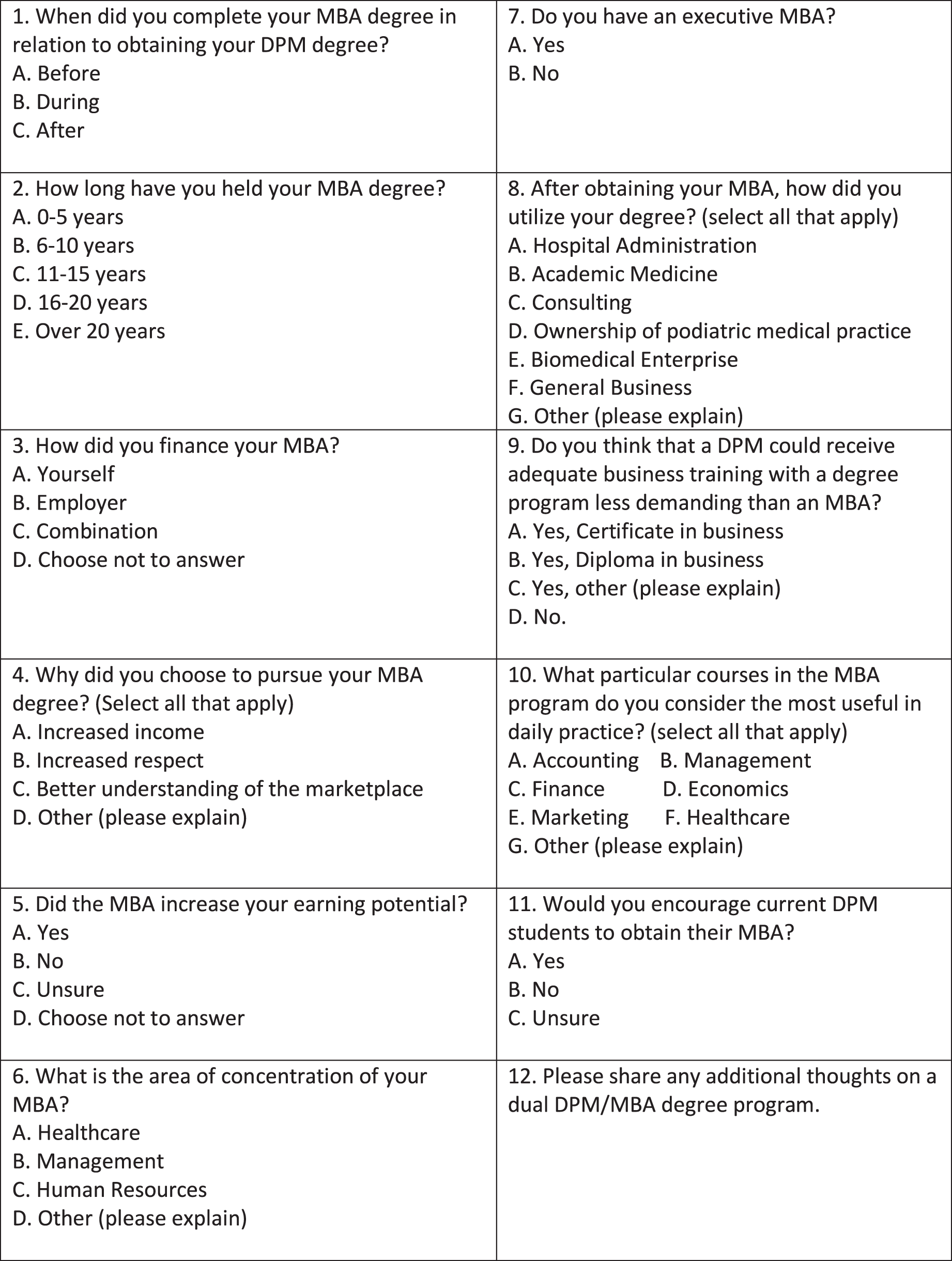
Institutional review board approval was sought and obtained through KSUCPM. Through several research methods, 38 people were identified who possessed both the DPM and the MBA degrees. The survey for practitioners who acquired both the DPM and the MBA degrees was constructed with the Web-based SurveyMonkey. Outlined in
Figure 1 is the survey, which was constructed and sent out to 38 individuals who met the research criteria.
Figure 1.
Dual-degree survey provided to practitioners identified as possessing both a Doctor of Podiatric Medicine (DPM) and a Master of Business Administration (MBA) degree.
Figure 1.
Dual-degree survey provided to practitioners identified as possessing both a Doctor of Podiatric Medicine (DPM) and a Master of Business Administration (MBA) degree.
This survey was sent to all dual-degree holders that we were able to identify, and they were asked how they used this joint degree, what the most relevant business courses were, and whether they would advise a DPM student to also pursue an MBA degree. To the best of our knowledge, there has not been a prior survey of individuals with a DPM/MBA background.
The survey was mailed to all 38 individuals, and they had the option of completing either an electronic or a paper survey. There was a link to SurveyMonkey to complete the survey online or a prepaid envelope for them to return the survey by mail. The participants were asked to complete only one survey. One person completed both an electronic and a paper survey; however, they added additional information in their paper response. They were given 1 month to complete the survey. After 2 weeks, a reminder mailing was sent out to all of the dual-degree holders on our list.
Results
Overall, 66.67% of respondents obtained their MBA degree after obtaining their DPM degree. There was no opportunity for individuals to obtain the MBA degree simultaneously, so it makes sense that individuals obtained the business degree during their practice period.
The amount of time that the respondents have had their MBA degree is the same for those who had it for less than 5 years, 10 to 15 years, and 20 years or more. All those categories were at 25%. Our sample of DPM/MBA respondents represent a varied range of periods of being dual-degree holders.
Because the business of medicine is ever changing, all of these dual-degree holders have to continue to upgrade their skills. Although we did not ask the ages of the DPMs when they began pursuing the dual degree, it likely mirrors the MD experience. An interview of several prominent Executive MBA (EMBA) programs found starting ages ranging from as young as 28 to as old as 62 years. [
19]
Our respondents financed their MBA degree in the majority of cases (83.33%). There are varying rates for MBA programs but, in general, it can be a significant financial undertaking. If someone is currently pursuing a full-time MBA program, they could be looking at a cost of tuition of
$80,000, boarding and books of
$40,000, and peripheral expenditures of
$20,000, bringing the total MBA cost to approximately
$140,000. [
20]
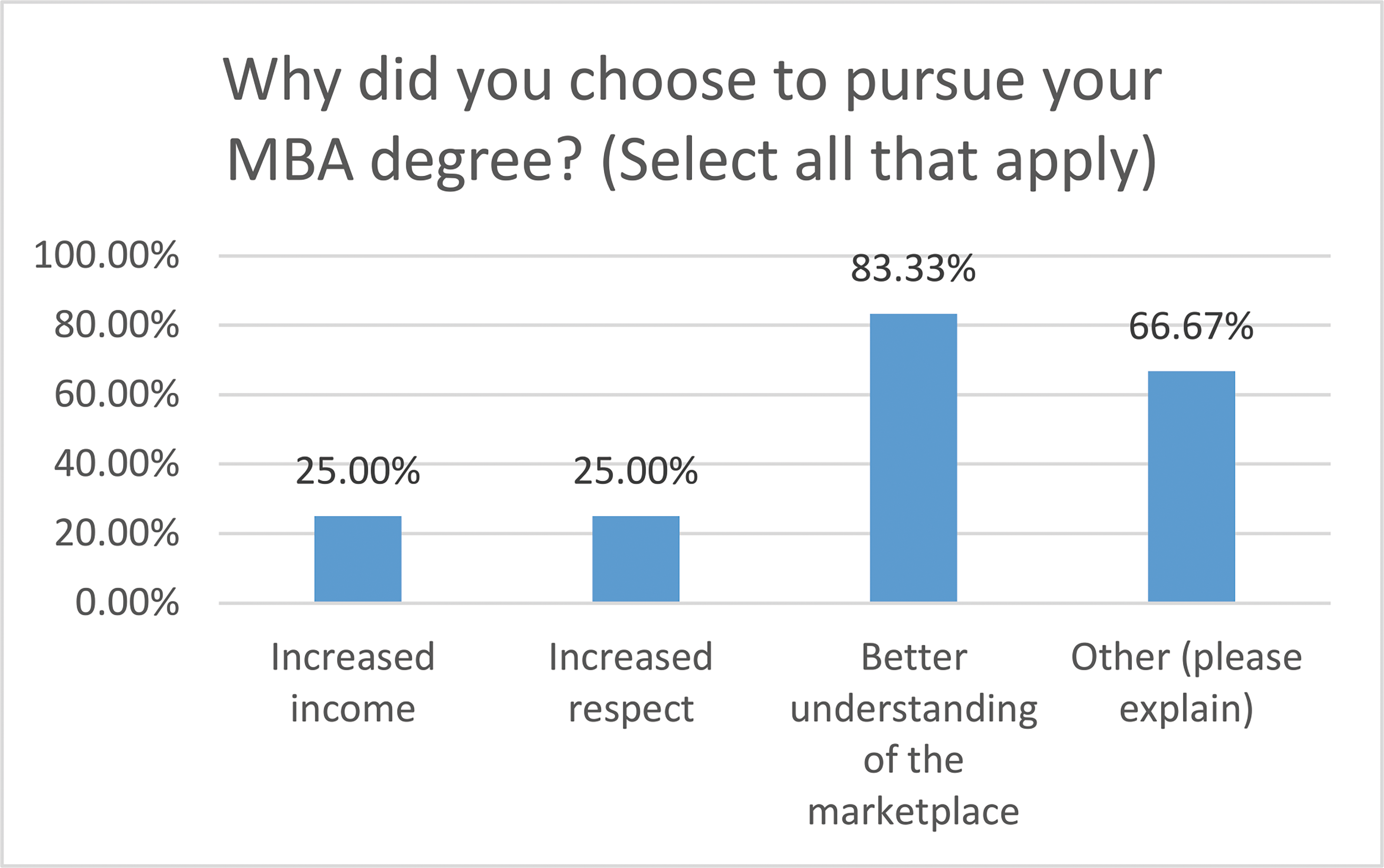
A key question in the survey was the motivation behind choosing to pursue an MBA degree in addition to the respondent's DPM degree. The survey respondents were given four options, as shown in
Figure 2, including increased income, increased respect, better understanding of the marketplace, and other. The respondents could choose all that applied, and if “other” was chosen, they were asked to elaborate. Overwhelmingly, 83.33% of respondents considered a better understanding of the marketplace as a motivating factor for pursuing an MBA degree. Both increased respect and increased income were considered for 25% of the respondents as a factor in their decision. Over half of the respondents, 66.67%, stated they had additional or other motivations for pursuing an MBA degree. Several of the explanations included business and leadership skills to improve or start their private practice offices. Other respondents had similar comments on improving other business ventures in their life. Often, the advancement of a physician to leadership roles is through career achievements and distinction rather than their management skills and experience. [
21] This often leads physicians to be ill equipped for management roles and having to learn skills on the job, or leads to unsuccessful transition into these roles. [
21] In 2008, approximately 4% of hospitals were headed by physicians, compared with 35% in 1935. [
22] A drop of approximately 90% in the number of physician chief executive officers was seen when the numbers were compared.
Figure 2.
Results of question pertaining to pursuit of a Master of Business Administration (MBA) degree.
Figure 2.
Results of question pertaining to pursuit of a Master of Business Administration (MBA) degree.
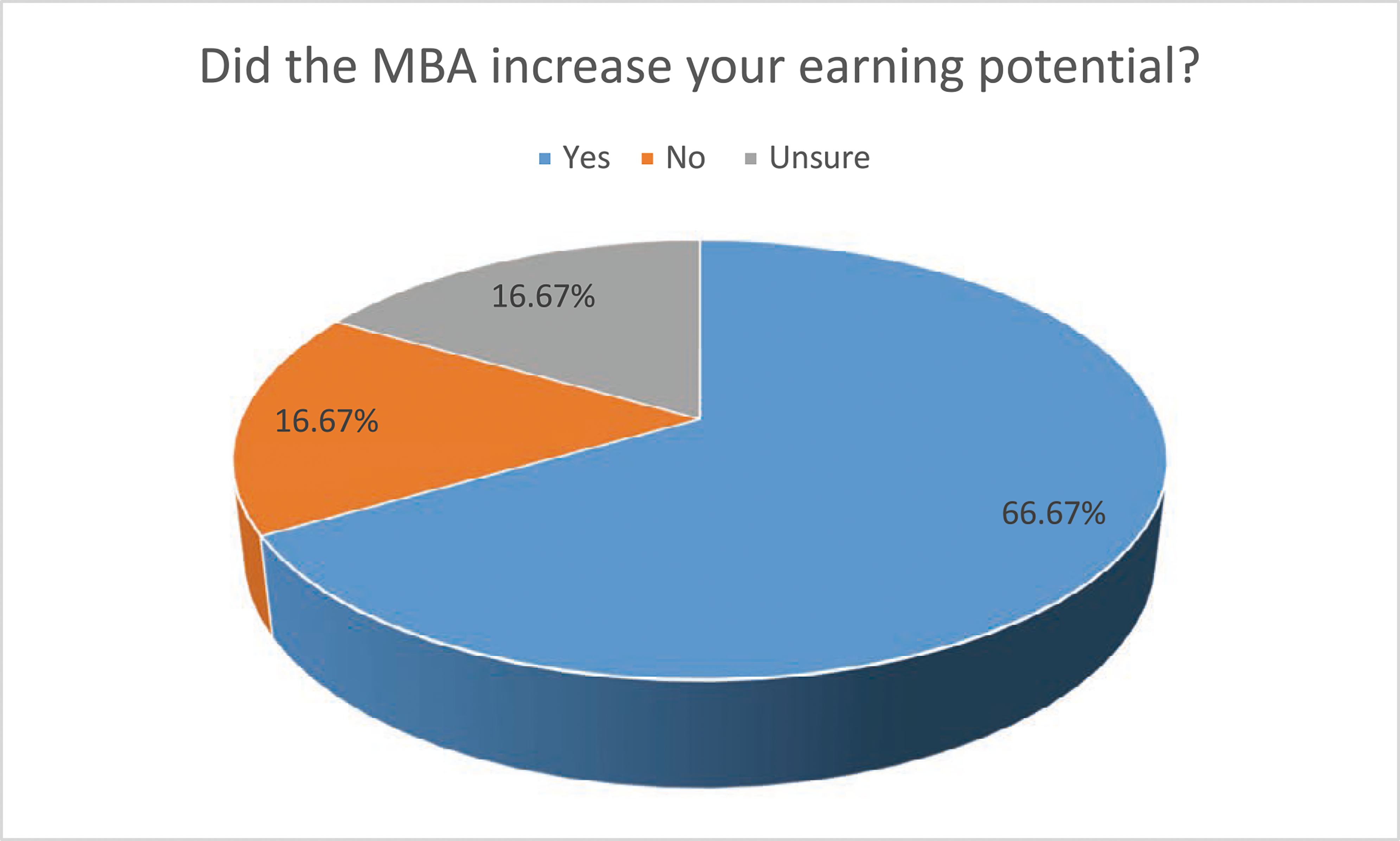
The podiatrist may not begin their career as an owner or partner in a practice but may eventually strike out on their own or earn a partnership and may then be required to use more managerial skills and have more business acumen. Our respondents also answered the question of whether their MBA degree increased their earning potential, as shown in
Figure 3. The majority of respondents (66.67%) felt that their MBA degree did increase their earning potential. Other respondents were unsure (16.67%), and a few respondents felt it did not increase their earning potential (16.67%). The results of these questions lead us to believe that a dual-degree DPM/MBA could be beneficial for those podiatric physicians that would like to advance to leadership or owner/partner roles in their career. In addition to advancing their career, a dual-degree holder may be able to increase their earning potential with the aid of an MBA degree.
Figure 3.
Earning potential after a Master of Business Administration (MBA) degree.
Figure 3.
Earning potential after a Master of Business Administration (MBA) degree.
The respondents were asked to specify the area of concentration in their MBA, and several choices such as health care, management, human resources, or other were given. Management was a key concentration with our respondents at 41.67%. Several other options were explained, which included marketing, accounting, finance, and health-care administration. They were also asked in the survey whether they had an EMBA degree. An EMBA degree is usually sought by midcareer individuals who could benefit from the business training offered but lack the time to pursue an MBA degree full-time for 2 years. The EMBA program is a more tailored curriculum and is scheduled on weekends to minimize career disruptions. [
23] The EMBA program traditionally targets corporate managers and executives. Of our respondents, 41.67% of them had an EMBA degree. In the future, a dual-degree program for our students could serve as a catalyst for practicing DPMs in the community to pursue an EMBA degree.
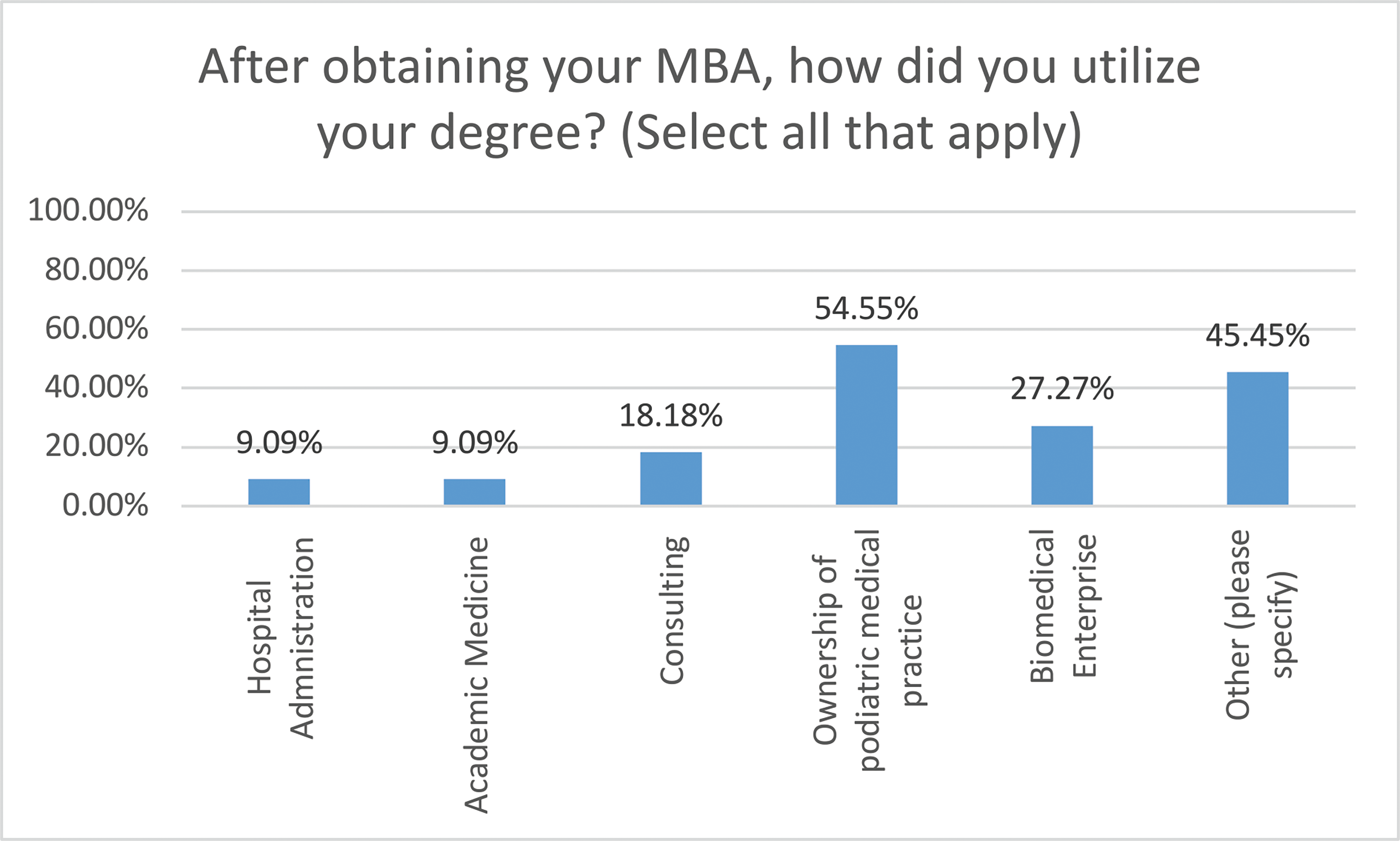
The survey addressed use of the MBA degree after obtaining it, as shown in
Figure 4. The majority of respondents (54.55%) used their MBA degree for ownership of a podiatric practice. The next highest response at 45.45% chose other and explained use in other business ventures. Other respondents used their MBA degree for biomedical enterprise, consulting, academic medicine, and hospital administration. Overall, respondents to the survey used their MBA degree in ways that would extend their podiatric career by enhancing their business acumen and management skills.
Figure 4.
Survey results for use of the Master of Business Administration (MBA) degree.
Figure 4.
Survey results for use of the Master of Business Administration (MBA) degree.
Discussion
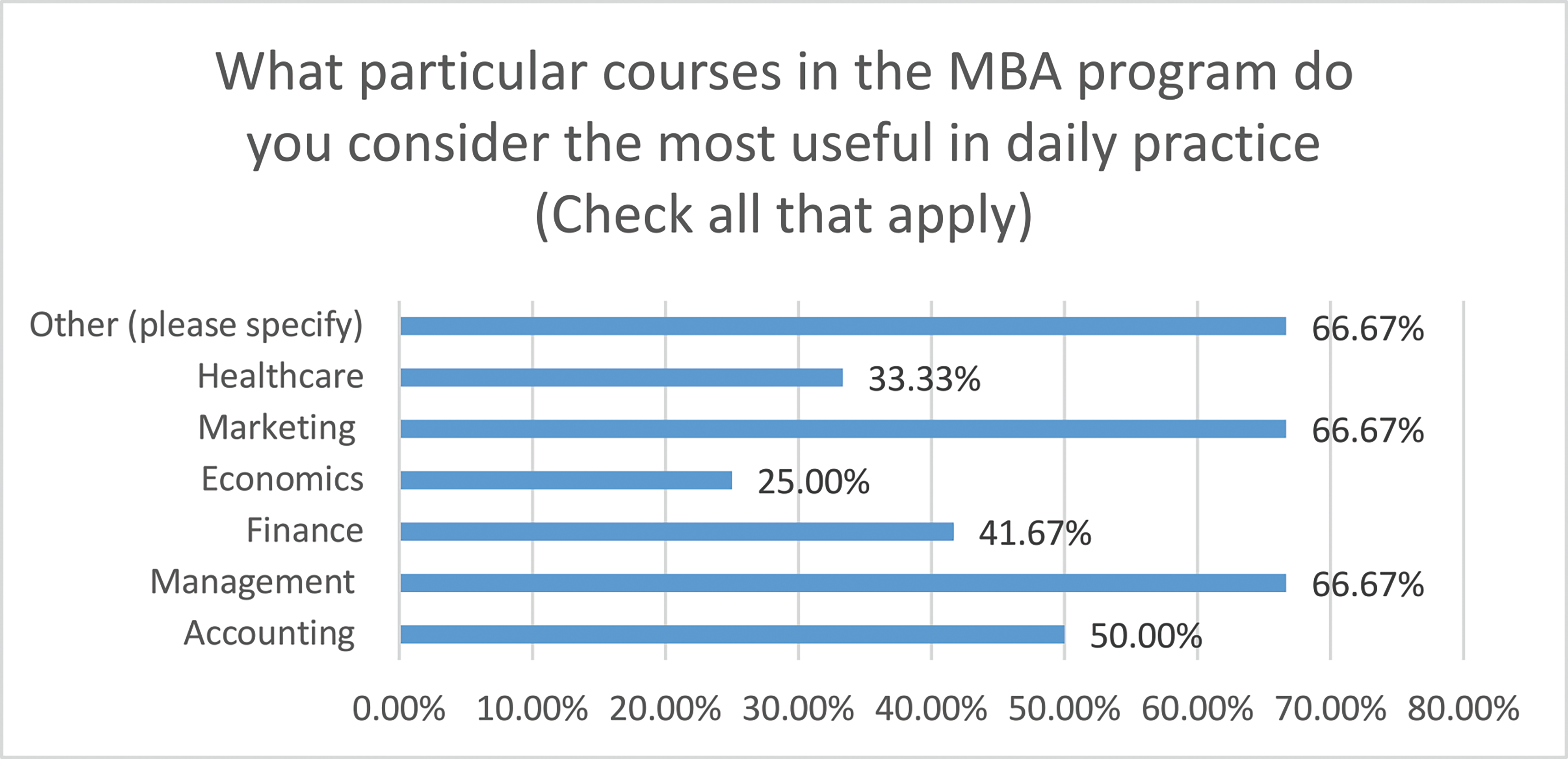
As we continue to research a dual-degree program, questions arise as to whether an MBA degree is necessary or whether only certain areas within the degree are more beneficial for a DPM. The survey addressed these questions by polling the respondents' thoughts on whether a DPM could have a diploma or certificate program or other options that would be less rigorous for the student. The majority of the respondents felt that a DPM could receive adequate training with either a program that is less demanding such as a diploma program (8.33%) or a certificate program (16.67%) or with another option that the respondents were asked to explain (41.67%). Comments from respondents who responded “yes but other” rather than a certificate or diploma, overwhelmingly had a similar tone of response that coursework in high-yield areas of the MBA program and leadership would be beneficial for the DPM. The specific areas considered beneficial during their MBA programs were also queried in the survey. The areas of interest are noted in
Figure 5. The highest ranked courses among our respondents were management, marketing, and accounting. The option was given to respondents for “other,” and they were asked to specify those courses. Additional courses mentioned included human resources and business law. One respondent included reference sites for financial information and reports that were learned during the MBA program. Another comment stated that all the courses are relevant during an MBA program because of the “new language learned from the experience.” These questions will aid in the educational experience of our students as they move forward in their career whether they may have the opportunity to choose a dual-degree program or continue to enhance their business education in the changing face of health care.
Figure 5.
Results of question pertaining to pertinent courses in the Master of Business Administration (MBA) program.
Figure 5.
Results of question pertaining to pertinent courses in the Master of Business Administration (MBA) program.
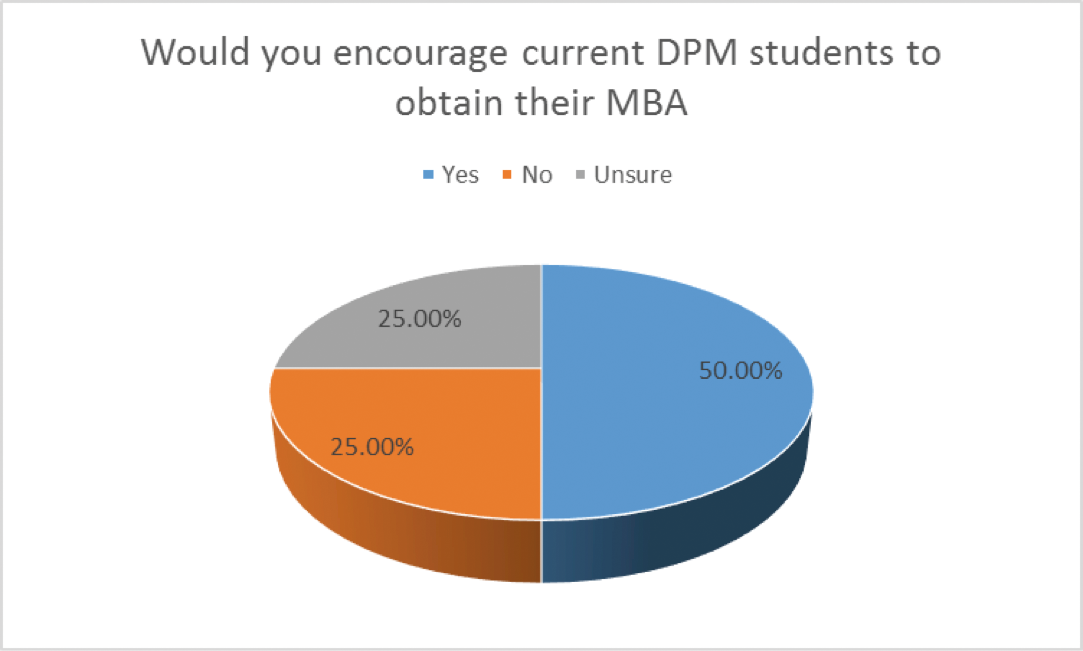
The dual-degree respondents were asked at the end of their survey whether they would encourage current podiatry students to pursue a dual degree, as shown in
Figure 6, and their final question asked the respondents to share any additional thoughts about a dual-degree DPM/MBA program. The majority of respondents (50%) felt they would encourage current students to pursue a dual degree. A smaller number of respondents (25%) felt that current students should not pursue a dual degree. Also, 25% of respondents were unsure whether current students should pursue a dual degree. Although there was no additional comment sections for the answer of “no or unsure,” the last question of the survey did ask for final comments or thoughts. Some of the responses from the participants may give additional information to those who were unsure. Several comments centered on the future aspirations of the student and would recommend the dual degree for students who were interested in advanced leadership or managerial positions. Other respondents felt that if the student was going in to private practice, they may need only certain aspects of the MBA program, whereas other respondents felt that the MBA program with experience outside of health care was beneficial and could transfer to health-care models. One final comment did express encouragement in a dual-degree program, but was concerned with the overall format because of the rigorous coursework in both an MBA degree and a DPM degree. In evaluating both questions, the respondents had an overall positive attitude toward a dual-degree program for the student that has particular aspirations toward leadership roles during their career and are highly motivated.
Figure 6.
Results of question pertaining to encouragement of pursuit of Master of Business Administration (MBA) degree. DPM, Doctor of Podiatric Medicine.
Figure 6.
Results of question pertaining to encouragement of pursuit of Master of Business Administration (MBA) degree. DPM, Doctor of Podiatric Medicine.