


Abstract
We examine the impact of board gender diversity on the financial and operating performance of the banking sector in Egypt over the period 2016–2024. We document a clear upward trend in female board representation, particularly following regulatory reforms introduced in 2019 and beyond. Our results show that board gender diversity is positively associated with bank performance, including profitability, efficiency, asset quality, and capital adequacy. However, this relationship becomes economically and statistically meaningful only after a critical mass of female directors is reached. Within the limited range of female board representation observed in the sample, we do not observe a declining or inverted U-shaped pattern. We further show that the positive role of gender-diverse boards is amplified under stronger governance structures—particularly where board independence is high, state ownership is limited, and CEO–chairman roles are separated. These findings provide support for regulatory initiatives aimed at increasing female representation on corporate boards, including Egypt’s Vision 2030 target of 30% female leadership representation. At the same time, the results highlight that the effectiveness of such policies depends on institutional readiness, governance quality, and meaningful participation beyond symbolic compliance. These results suggest that compliance-driven board gender diversity mandates can contribute to sustainable governance, supporting SDG 5 objectives and the long-term institutional resilience of the banking sector in emerging economies.
Keywords:
board gender diversity; corporate governance; bank performance; sustainable development; Egypt JEL Classification:
G21; G34; K38; L25; M14; Q56
1. Introduction
The call for greater gender diversity is a central tenet of the United Nations Sustainable Development Goals (SDGs), particularly SDG 5 on gender equality. Target 5.5 of SDG 5, which emphasizes “ensuring women’s full and effective participation and equal opportunities for leadership at all levels of decision-making in political, economic, and public life,” is deemed crucial for achieving gender equality. Indicator 5.5.2 views the proportion of women in managerial positions as a key metric for this objective (UN, 2015).
This global agenda is rooted in foundational theories of corporate governance, most notably Resource Dependence Theory and Agency Theory. Resource Dependence Theory suggests that boards serve as a crucial link to the external environment, providing access to vital resources, information, and networks. From this perspective, a gender-diverse board can introduce a wider range of perspectives, skills, and social capital, enhancing a firm’s ability to navigate market complexities and improve stakeholder relations (Pfeffer & Salancik, 2003). As Reddy and Jadhav (2019) summarize, female directors can improve a board’s ability to access talent, build legitimacy with external stakeholders, and improve responsiveness to market dynamics—benefits especially relevant in the banking sector where reputation and trust are central to performance. Complementing this, Agency Theory posits that boards act as monitors, mitigating conflicts of interest between management and shareholders. A diverse board, with its varied viewpoints, is believed to provide more rigorous oversight, reduce agency costs, and foster greater transparency. Both theoretical frameworks provide a strong basis for arguing that increasing female representation on corporate boards could lead to improved organizational performance (Jensen & Meckling, 1976; and Eisenhardt, 1989).
Drawing on this theoretical framework, we conjecture that greater gender diversity on corporate boards is likely to be associated with stronger performance outcomes, particularly in terms of profitability and operational efficiency. We also consider that gender diversity may interact with other governance features, such as ownership structure and board composition, in shaping performance. Additionally, we examine the possibility that diversity may only translate into tangible benefits once a critical mass of women directors is achieved.
These expectations are especially relevant in emerging markets such as Egypt, where evolving governance standards and shifting socio-cultural norms around gender roles may influence how board composition affects firm behavior and outcomes. Notably, despite the growing body of research exploring the impact of gender diversity on corporate boards, most studies remain focused on developed economies and major emerging markets, leaving a significant gap in understanding how these dynamics unfold within smaller emerging markets—especially in regions such as the Middle East and North Africa (MENA). Egypt, in particular, offers a compelling and relatively underexplored case study, given its distinctive economic and socio-cultural environment and recent regulatory changes designed to encourage greater female representation on corporate boards. By focusing on the Egyptian banking sector, our study aims to go beyond the issue of regulatory compliance, investigating whether and how these diversity-promoting measures genuinely influence bank performance. Specifically, we examine multiple dimensions of bank performance—including profitability and efficiency—to present comprehensive insights into the practical effects of gender-diverse boards in this distinctive context. Ultimately, our study not only addresses an important gap in the existing literature but also provides valuable guidance to policymakers and practitioners interested in promoting effective corporate governance in Egypt and similar emerging markets.
We use Egypt as a case study because it represents an underexplored setting for examining the relationship between board gender diversity and bank performance, particularly within the MENA region. Furthermore, Egypt’s regulatory framework provides a useful institutional setting for examining the effects of mandatory female board representation in the banking sector, particularly given the implementation of quotas for female representation on banks’ boards. This context allows us to examine not only whether greater female representation is associated with bank performance, but also whether a critical mass of female directors matters and whether the effectiveness of board gender diversity varies with other governance mechanisms. Building on our conjecture outlined above, this study pursues two main objectives. First, it documents the evolution of women’s representation on the boards of Egyptian banks, with particular attention to regulatory reforms that mandated greater diversity. Second, it evaluates whether the presence of women on boards influences profitability, efficiency, and governance effectiveness, thereby providing empirical evidence to test the hypotheses outlined in the next section.
Using a sample of 33 Egyptian banks, representing the entire banking sector over the 2016–2024 period, we document a clear upward trend in female board representation, particularly following key regulatory reforms introduced in 2019 and strengthened thereafter. Our empirical results indicate that female board representation is positively associated with bank performance, but that this relationship becomes statistically and economically meaningful only once a critical mass of women directors is reached. We do not find evidence of an inverted U-shaped relationship between women on boards and bank performance.
We further show that the effectiveness of gender-diverse boards is shaped by broader governance structures. Board independence is positively associated with bank performance, while state ownership is associated with weaker outcomes. CEO–chairman separation also exhibits a positive association with selected performance measures.
Our interaction analysis suggests that female board representation can partially offset the negative effects of state ownership and CEO-Chairman duality, while also strengthening the positive association between board independence and bank performance.
Overall, the results provide support for regulatory efforts in Egypt aimed at promoting gender diversity in corporate leadership, including the policy objective of reaching 30% female representation as outlined in Egypt Vision 2030. These findings also highlight the importance of careful implementation of board quotas, ensuring that organizational culture, merit-based selection, and meaningful participation are preserved to translate representation into effective governance outcomes.
These results reinforce the view that board gender diversity is an important determinant of firm performance, with its positive effects being amplified under stronger institutional and governance frameworks, particularly in emerging-market banking systems.
Taken together, our findings contribute to the sustainable development literature by providing empirical evidence that compliance-driven board gender diversity mandates—when effectively implemented—can function as a sustainable governance mechanism that supports SDG 5 objectives and strengthens the long-term institutional resilience of the banking sector in emerging economies.
The remainder of this paper is organized as follows. Section 2 develops the research hypotheses, while Section 3 provides the institutional background on corporate governance and reviews selected empirical studies examining how board gender diversity—specifically, the presence of women on boards—affects firm performance. Section 4 presents the data, methodology, and empirical models employed in the paper. Section 5 discusses the empirical findings, and Section 6 concludes by summarizing the results and offering policy implications.
2. Hypotheses Development
Drawing on the theoretical perspectives outlined earlier, we develop three hypotheses linking board gender diversity to bank performance in the Egyptian context. These hypotheses are grounded in established governance theories and supported by empirical evidence, which we review in Section 3.
H1.
Board gender diversity is positively associated with bank performance.
This hypothesis is grounded in Resource Dependence Theory and Agency Theory. Resource Dependence Theory (Pfeffer & Salancik, 2003) argues that diverse boards bring broader skills, networks, and legitimacy, enabling firms to access critical external resources and manage environmental uncertainty. Agency Theory (Jensen & Meckling, 1976; Eisenhardt, 1989) emphasizes the monitoring role of boards, suggesting that gender-diverse boards improve oversight, reduce managerial opportunism, and enhance transparency. Based on these arguments—and supported by several empirical studies (see Section 3)—we expect greater female representation on bank boards to be positively linked with better bank performance.
H2.
Board gender diversity moderates the effect of other governance mechanisms on bank performance.
This hypothesis builds on contingency perspectives in corporate governance, which extend from broader organizational contingency theory (Donaldson, 2001). These perspectives suggest that governance mechanisms (e.g., ownership structure and concentration, board independence, CEO-Chairman duality) do not operate in isolation but interact with contextual features. Gender diversity may act as a catalyst, strengthening or reshaping the effect of other governance mechanisms on firm performance—by mitigating risks associated with concentrated ownership or CEO dominance, while amplifying the positive influence of independent directors and private ownership structures.
H3.
The positive effect of board gender diversity on bank performance is more pronounced when the proportion of female directors exceeds a critical mass.
This hypothesis draws on Kanter’s (1977) Critical Mass Theory, which argues that when women are only token members of a board, their influence is limited and their perspectives often marginalized because they occupy what Kanter terms a “skewed” group. However, once a critical mass of women directors is reached—commonly interpreted in the literature as at least two or three members or roughly 20–30% of the board—the group begins to take on what Kanter described as a “tilted” status. At this level, women directors can exert greater collective influence, reshape board dynamics, and start to experience the real benefits of diversity. Several empirical studies (see Section 3) also confirm that the impact of women on boards strengthens significantly after this threshold is crossed, suggesting that token representation is insufficient for meaningful change.
3. Institutional Background and Related Literature
3.1. Institutional Background
Egypt’s approach to board gender diversity reflects a broader international shift toward regulating board composition rather than leaving representation to voluntary firm-level choices. This shift is grounded in the principle of equality of treatment: comparable situations warrant comparable treatment, precluding both direct and indirect discrimination (Watson, 1995). In practice, this principle is pursued through two complementary channels—equality of opportunity, which centers on fair access to career progression, and equality of outcome, which centers on the resulting distribution of positions such as board seats (McCoy Family Center for Ethics in Society, 2016).
Board gender quotas have become one of the more common instruments used to pursue this equality-of-outcome objective. Terjesen et al. (2015) report that ten countries mandate quotas of 33 to 50 percent for the boards of publicly traded or state-owned firms, while a further fifteen operate non-binding, comply-or-explain quotas embedded in their corporate governance codes; adoption tends to cluster in countries with stronger female labor-force participation, more generous welfare-state provisions, and left-leaning governing coalitions. Egypt’s own regulatory framework, summarized below, extends this global trend to a domestic banking sector where governance quality and stakeholder trust are of particular importance.
The FRA and CBE regulatory decrees provided a one-year period for compliance with the respective requirements, or until the next change in the board of directors, where applicable. This allowed the required changes in board composition to be implemented within the applicable compliance period or, where necessary, upon the next board reconstitution.
- 2019—FRA Decrees No. 123 and 124: at least one woman required on the boards of listed companies and non-bank financial institutions (NBFIs1).
- 2021—FRA Decrees No. 109 and 110: requirement raised to at least two women or 25% of the board.
- 2021—CBE directive: bank boards specifically required to include at least two women.
- Egypt Vision 2030 target: 30% female representation in senior leadership by 2030.
These decrees draw on Article 11 of the Egyptian Constitution of 2014, which guarantees women equal rights and opportunities across civil, political, economic, social, and cultural life, and they position the banking sector at the forefront of a broader national effort to translate constitutional equality guarantees into measurable boardroom outcomes (Omran, 2022).
3.2. Related Literature
Interest in gender diversity on boards stems from the notion that women are perceived as generally more ethical than men. Disparate perspectives and experiences brought by gender diversity may lead to improved performance in control and strategic roles (Mahmood et al., 2018; Kang et al., 2010). It has also been argued that women may have greater insight into customers’ needs. Having more women on boards theoretically provides deeper insights into how firms can best meet customers’ needs (Ahmadi et al., 2018).
Furthermore, gender diversity is expected to help alleviate agency issues, which may encourage greater innovation (Chen et al., 2018). Several studies find that female representation on boards improves the diversity of opinions in boardrooms, providing female role models, mentors, and diverse leadership styles. Strategic input helps reduce conflicts of interest, enhances multitasking skills, improves risk management and communication abilities, and influences decision-making quality (Bernardi et al., 2002; Carter et al., 2003; Fehr-Duda et al., 2006; Nielsen & Huse, 2010).
Despite a substantial body of research, empirical evidence on the impact of female board representation on firm performance remains mixed. Some studies show a positive effect. They find that women directors add value, and firms with more women on their boards attain higher returns on assets (Singh et al., 2002; Carter et al., 2003; Erhardt et al., 2003; Julizaerma & Sori, 2012; Nguyen & Faff, 2012; Ahmadi et al., 2018; Garanina & Muravyev, 2021; Mastella et al., 2021; Simionescu et al., 2021). Others find a negative effect (Adams & Ferreira, 2009; Y. Wang & Clift, 2009; Darmadi, 2011; Minguez-Vera & Martin, 2011; Ahmad et al., 2020; Akram et al., 2020). In contrast, several other studies show no significant effect at all (Shrader et al., 1997; Rose, 2007; Carter et al., 2010; Gregory-Smith et al., 2014; Kakabadse et al., 2015; Bertrand et al., 2019; Ararat & Yurtoglu, 2021).
In a seminal paper, Post and Byron (2014) attempt to reconcile these conflicting findings. They combine results from 140 studies statistically and explore whether the variations are attributable to firms’ legal/regulatory or sociocultural aspects. They find a positive correlation between female representation on boards and accounting returns, with the strength of the relationship increasing in countries with stronger shareholder protections. They suggest that robust shareholder protections incentivize boards to more effectively utilize the diverse knowledge, experience, and values of each member. This leads to improved decision-making and, ultimately, higher accounting returns.
However, Post and Byron’s (2014) findings for market performance were less conclusive. The overarching association remains statistically insignificant across all countries, but they uncover a positive correlation in countries characterized by higher gender parity. This suggests that board diversity, when embedded in a supportive societal context, potentially contributes to enhanced performance. The contrasting negative relationship observed in countries with lower gender parity may be attributable to investor perceptions based on societal human capital differences. For example, Bennouri et al. (2018), using a sample of 394 French firms over the 2001–2010 period, find that female representation on boards is significantly positively associated with ROA and ROE but negatively associated with Tobin’s Q. More recently, K. Wang et al. (2024), examining 1990 listed Japanese firms from 2006 to 2023, report a significant negative effect of board gender diversity on firm performance, particularly among smaller, more leveraged firms, underscoring that the direction of this relationship remains far from settled even in recent evidence. In contrast, quota-based evidence from another large emerging market points the other way: exploiting India’s 2013 mandatory gender-quota reform in a difference-in-differences design, Patil and Yadav (2026) find that compliance with the quota is associated with a 4.2 percentage-point increase in RoA and a 3.8 percentage-point increase in RoE among 2341 Indian listed firms, with the effect strongest among family-controlled firms and firms that previously had all-male boards.
As for the impact of gender diversity on bank performance, it remains complex and nuanced. De Cabo et al. (2012) examine the impact of gender diversity on corporate boards for 612 banks from 20 European countries. They note that women accounted for just 7% of board members in 2006. They argue that banks should carefully consider diversity when determining board composition, as it can influence critical functions such as management monitoring. They also show that banks with more women on their boards have higher growth rates of total assets.
Pathan and Faff (2013) employ a large sample of 212 U.S. bank holding companies from 1997–2011 and find a positive association between gender diversity and performance during the pre-Sarbanes–Oxley Act (SOX) era (1997–2002). This beneficial effect, however, weakened considerably in both the post-SOX (2003–2006) and 2007–2011 crisis periods.
García-Meca et al. (2015) further explore this relationship in a broader international context, covering fifty-nine banks across nine countries from 2004 to 2010. Their findings confirm a positive link between gender diversity and performance. Farag and Mallin (2017) introduce a unique perspective by investigating the influence of board diversity on both financial fragility and performance in ninety-nine banks from seventeen countries between 2004 and 2012. They identify a non-linear relationship, with the positive impact of female directors peaking at critical mass thresholds of 21% and 23% for boards of directors and supervisory boards, respectively. Interestingly, exceeding these thresholds led to declining influence, highlighting potential benefits of optimal representation rather than mere presence.
This notion is supported by Fan et al. (2019), who also find an inverted U-shaped relationship between female board representation and bank earnings management in a study of ninety-one BHCs from 2000–2014. This reinforces the case for non-linearity and supports more nuanced approaches to promoting board diversity within the financial sector.
Owen and Temesvary (2019) further bolster the evidence for a non-linear relationship. They show that banks achieve performance improvements as gender diversity on their boards increases, reaching a critical mass at approximately 13–17%. Thus, the positive effect may not be triggered simply by having one female member; rather, additional female board members contribute to enhanced overall performance once at least one woman is already present. Likewise, Cardillo et al. (2021) identify a positive association between gender diversity and RoA, Tobin’s Q, including less commonly studied measures such as dividend payout ratios in a sample of listed European banks. They argue that these findings support recent gender quota reforms implemented in several EU countries.
Galletta et al. (2022) expand the scope beyond strictly financial metrics. Using a dataset of 880 bank-year observations from 48 countries, they find that increasing the proportion of female directors enhances both financial and environmental performance in banks.
Finally, Arnaboldi et al. (2020) show that board diversity reforms in EU banks are associated with increases in bank stock returns and volatility. However, these effects are beneficial only in countries with strong institutional environments, greater economic freedom, and openness to diversity. In contrast, Liao et al. (2022), using a broader international sample, find that bank risk-taking and systemic risk increased after the enactment of gender quota laws for banks that did not meet the requirement in the pre-adoption period. The authors find that banks may manipulate gender quota regulations by appointing insiders to board positions, which can hinder the board’s oversight ability. Additionally, women serving on multiple bank boards may contribute to ineffective governance. They conclude that the effect of gender quota laws is shaped by external factors, including the availability and quality of female candidates, and country-specific attributes linked to institutional quality such as economic and governance standards.
For emerging markets, Javed et al. (2013) investigate the influence of board diversity on the performance of thirty Pakistani banks from 2007 to 2011. They identify a positive association between bank financial performance and a higher number of directors, inclusion of non-executive directors, CEO-Chairman duality, and female board representation. However, this positive association diverges across contexts. Kilic (2015) observes a negative relationship between board diversity and financial performance in Turkish banks. Topçu (2020) reaches a similar conclusion for Turkish publicly traded commercial banks from 2007 to 2019. She finds no significant impact of the proportion of female directors on bank performance. More recently, Sbai et al. (2025) similarly document a negative association between female board representation and performance across 134 banks in fifteen MENA and Central Asian countries, though this negative effect is moderated by national culture and turns positive in less individualistic, lower power-distance settings. In contrast, Ho et al. (2025) find that greater board gender diversity enhances stability efficiency and reduces risk-taking among Vietnamese commercial banks. These mixed and context-dependent findings highlight the importance of considering context-specific factors that may moderate the relationship between board diversity and bank performance.
We draw two key insights from this literature. First, compared to the role of board gender diversity on non-financial firm performance, relatively little is known about its impact on the performance of financial firms such as banks, and the two sectors do not necessarily behave alike: Feyisetan and Alkaraan (2026), comparing FTSE 350 financial and non-financial firms, find that board gender diversity is positively associated with ESG performance in financial firms but that this effect is economically weaker and statistically insignificant among non-financial firms, underscoring the need for sector-specific evidence of the kind this study provides. Second, most existing evidence comes from developed economies, while research from emerging markets—including the MENA region—is quite limited. Therefore, a focused examination of board gender diversity in a MENA country is particularly warranted.
Last, the sustainability literature has increasingly recognised board gender diversity as a governance mechanism with implications that extend beyond financial performance. Female directors have been shown to enhance firms’ sustainability disclosure quality, contributing to greater transparency on economic, social, and environmental issues (Mahmood et al., 2018). In the banking sector specifically, gender-diverse boards have been linked to more prudent risk management and greater responsiveness to stakeholder concerns, both of which contribute to the long-term sustainability of financial institutions. Our study complements this strand of the literature by examining whether regulatory-mandated gender diversity—a compliance-driven mechanism—can generate the kind of governance improvements that ultimately serve broader sustainability objectives in an emerging market context.
4. Data, Methodology, and Empirical Models
4.1. Data
Our analysis encompasses the entire banking sector in Egypt, which consists of thirty-three banks. The study covers the nine-year period (2016–2024). The dataset includes all licensed banks operating in Egypt during the study period. While some governance variables may exist in different databases prior to 2016, coverage is incomplete and uneven across Egyptian banks. Earlier data are often limited to a few larger banks and not systematically reported across the full licensed banking population, raising concerns of selection bias if included. More importantly, the period 2016–2024 coincides with a policy-relevant window in Egypt. From 2016 onwards, governance disclosures became more consistent, and from 2019 onwards, the Financial Regulatory Authority and, subsequently, the Central Bank of Egypt began introducing initiatives related to women’s representation on boards and board diversity. Focusing on this period allows us to capture both a few years before and after the introduction of these diversity measures. Therefore, our choice of 2016–2024 is based not only on data limitations but also on research relevance: It reflects the institutional environment where gender diversity became a regulatory and practical concern, enabling a meaningful comparison of women’s board participation before and after these reforms. These constraints shaped the timeframe of the study. We gather data to compare board compositions before and after the decrees. This allows us to assess how these quotas have influenced female board participation trends. We also investigate the impact of increased female representation on banks’ operating and financial performance over time to assess whether the female quotas are achieving their intended effect. The financial and non-financial data on individual banks come mainly from the CBE.2
4.2. Methodology and Empirical Models
To document the evolution of female representation on boards over time, we first quantify both the number and percentage of women board members. For each bank, the mean number and proportion are calculated prior to and after the regulatory requirements, and a parametric t-test is then employed to identify significant changes in means, and a Wilcoxon signed-rank test to detect significant changes in medians.
Second, we evaluate whether the regulatory decrees mandating the inclusion of at least two women on a board are justified in terms of bank performance. The sample is segmented into two subgroups: banks that fall below the regulatory requirements (with fewer than two women on the board), and banks that meet or exceed the regulatory requirements. Mean (median) financial and operational performance metrics are compared between compliant and non-compliant banks using both t-tests and Mann–Whitney tests to detect significant differences.
Third, as mentioned earlier, bank financial and operating performance may be affected by a broad range of other variables. Therefore, it is important to test the effect of female representation on boards after controlling for several bank- and board-level characteristics. The variables used in the empirical models are classified into four groups: dependent variables, the main independent variable of interest, control variables, and interaction terms. The dependent variables capture different dimensions of bank financial and operating performance, while the percentage of women on the board represents the main independent variable of interest. The control variables comprise board characteristics (proportion of independent directors, CEO-Chairman duality, and board size), ownership structure (a dummy variable that equals 1 if the state owns more than 50%, and 0 if it owns less than 50%), and bank size. Interaction terms are introduced to examine whether the relationship between female board representation and bank performance varies according to selected corporate governance and ownership characteristics. Table 1 provides the definition and measurement of each variable, together with its role in the empirical models and the corresponding data sources.
Table 1.
Variables, Definitions, Measurements, and Roles in the Empirical Models.
Based on these variables, the study estimates the following panel fixed-effects model to test the first two hypotheses mentioned above:
where is the performance measure of bank i at time t. We consider several accounting performance measures from Omran (2007) as proxies for bank performance. refers to the percentage of women on the board of bank i at ; is the board characteristics of bank i at , i.e., INDPNDT (percentage of independent directors), DUALTY (a dummy variable that equals 1 if the CEO and chairman are the same person, and 0 otherwise), and BORDSIZE is the size of the board. is the type of owner of bank i at , which takes the form of CONTR (a dummy variable that equals 1 if the state owns more than 50%, and 0 if it owns less than 50%); and SIZE is the log of total assets of bank i at . is the interaction term between the percentage of women on the board of bank i at and each variable of board characteristics and ownership structure of bank i at ; respectively (WOMN*INDPNDT; WOMN*DUALTY; and WOMN*CONTR). These interaction terms offer valuable insights into how gender diversity interacts with other variables to influence bank performance. The rationale is to investigate potential moderating effects of control variables on the relationship between the percentage of women on boards and bank performance. Examining how this relationship varies across different levels of control variables provides a clearer understanding of the specific circumstances under which the presence of women on a board influences outcomes. is year fixed effect; is bank fixed effect; and is the error term.
As for the third hypothesis, we replace the percentage of women on the board by the number of women on the board to investigate whether the impact of women on boards strengthens significantly after a threshold is crossed by estimating the following model:
where here refers to the number of women on the board of bank i at ; (we use WOMN_1, WOMN_2, and WOMN_3 as dummy variables, where WOMN_1 is a dummy variable that equals 1 if the board contains one woman, and 0 otherwise, and the same logic applies to the other two variables, WOMN_2 and WOMN_3).
5. Empirical Results
Before presenting the main empirical findings, the current level of compliance with regulatory mandates across Egyptian banks is shown in Table 2, Panel A, while Panel B provides descriptive statistics of all variables employed later in the regression models.
Table 2.
Current compliance status among Egyptian banks as of 2024, and descriptive statistics.
Table 2, Panel A, and Chart B1 show that two-thirds of Egyptian banks now comply with the board gender quota. Among the eleven non-compliant banks, seven have one woman on the board (just over one-fifth of the sector), and four (12%) have none. Notably, while both the FRA and CBE decrees are mandatory, banks are granted a grace period to comply, allowing time to update board composition.
The empirical findings are presented next, beginning with an overview of the evolution of female representation on bank boards in Egypt (Table 3, Panel A and Chart B2), followed by tests for significant changes in both the percentage and number of women on boards before and after the regulatory decrees (Table 3, Panel B and Chart B3). Finally, Panel C compares the performance of banks that fall below the regulatory requirements with those that meet or exceed them (see also Charts B4–B10).
Table 3.
Evolution of women’s board participation (2016–2024) and bank performance: pre/post-regulation and compliance-based comparisons.
To examine this evolution over time, Table 3, Panel A, and Chart B2 illustrate how both the number and percentage of women on boards have changed. A particularly pronounced acceleration occurred after 2020, following the implementation of the key decrees. The number (and percentage) of women in the banking sector increased from 29 (10.8%) in 2016 to 60 (18.8%) in 2024—more than doubling in absolute terms and rising by 75% in proportional representation. In a global context, Egypt has made notable progress on this front. According to Deloitte’s (2024) report on women in the boardroom, the global percentage increased from 15% in 2016 to nearly a quarter (23.3%) in 2023. Although Egypt rose from a lower level, its growth rate (75%) still outpaced the global rate (roughly 55%) over roughly the same period (2016–2023).
To achieve its stated 30% target by 2030, Egypt must sustain an approximate 8% annual growth rate in the percentage of women on boards over the remaining six years. Given this required trajectory, authorities may wish to monitor progress closely and evaluate the necessity for further regulatory decrees.
Attention now turns to Panel B of Table 3 and Chart B3, which show a significant difference in women’s board participation pre- versus post-regulatory decrees. The mean increases from 1.04 to 1.61, with the difference showing significance at the 5% level. We find similar results, as the mean (median) increases from 12.4% (11.1%) to 17.5% (15.2%). This is consistent with a positive and significant association between the decrees and the number and percentage of women on Egyptian bank boards. The findings are consistent with those of Casteuble et al. (2019), who compare the gender composition of boards before and after the quotas. On average, they find that firms had significantly fewer women on their boards than the mandated minimum prior to the law. Moreover, although the percentage of female directors increased subsequently, it tended to be below the legal quota at the date of compliance.
For our second objective, the impact on bank performance of female representation on boards, we split our sample into two subsamples: banks that are below the regulatory requirements (at least two women on the board), and banks that meet or exceed regulatory requirements. Significant differences in mean (median) performance are tested, and the findings are reported in Panel C.3
Results from Panel C and Charts B4–B10 indicate that banks meeting the minimum regulatory requirements outperform those that do not in all financial and operating efficiency measures, except for asset growth rate. For example, in terms of profitability ratio, we document that the mean (median) RoA of banks with fewer than two women on their boards is 0.12 (0.15), compared with 0.19 (0.19) for banks with at least two women. The differences are highly significant at the 1% level. We find similar results for RoE.
For the asset quality indicator, we find that banks with at least two women on the board exhibit better asset quality. Their mean (median) losses to loans are 0.006 (0.003), compared to 0.011 (0.008) for other banks. The difference in mean (median) is significant at a 1% level. We confirm similar behavior for the capital risk indicator. Thus, banks with at least two women on their boards tend to be well-capitalized and to generally meet the minimum regulatory capital requirements.4
We also find that banks with at least two women on their boards tend to deliver better operating efficiency in terms of net interest margin. Their mean (median) performance of 0.045 (0.043) outperforms that of their counterparts (0.033 (0.034)) and is significant at a 1% level. We find no significant differences in liquidity positions as measured by the ratio of investment securities to total assets. We document higher asset growth rates as well, but the statistical tests do not reach conventional levels of significance.
Overall, these preliminary results suggest that women’s presence on boards is impactful and may contribute to superior performance. Thus far, the findings give credibility to the regulatory decrees that mandate having at least two women on the boards of Egyptian banks. They support the view that women’s ability to influence board decisions increases with their number (Fondas & Sassalos, 2000). Our findings appear consistent with those of Pathan and Faff (2013), García-Meca et al. (2015), and Owen and Temesvary (2019). For emerging markets, our results are also consistent with Javed et al. (2013) for Pakistan, but contradict findings for Turkish banks (Kilic, 2015; Topçu, 2020).
To validate our earlier findings, we examine the relationship between women on boards and bank performance by estimating panel regression models using contemporaneous governance and ownership variables. The contemporaneous specification allows us to capture the immediate association between board characteristics and bank performance measures within the same reporting period. This approach is particularly relevant in the banking sector, where governance structures, oversight quality, and strategic decisions may exert direct and timely effects on financial and operating performance.
Our baseline empirical framework includes measures of female board representation together with several governance and ownership control variables commonly employed in the banking and corporate governance literature, including board independence, CEO-Chairman duality, board size, ownership structure, and bank size. We also include interaction terms between female board representation and selected governance variables to explore whether the presence of women on boards moderates the effectiveness of governance structures.
The models are estimated using bank fixed effects and year fixed effects to control for unobserved heterogeneity across banks and macroeconomic conditions over time. Standard errors are adjusted to account for heteroskedasticity and serial correlation where appropriate. The findings from our direct linear and interaction specifications are presented in Table 4, followed by our critical mass threshold configurations in Table 5. These two tables form the core focus of our empirical analysis.
Table 4.
Percentage of Women on Boards and Bank Performance (Contemporaneous Variables).
Table 5.
Critical Mass of Women on Boards and Bank Performance (Contemporaneous Variables).
This table presents the results of panel fixed-effects regression analyses examining the determinants of bank performance over the 2016–2024 period, using the following model:
where is the performance measure of bank i at time t; refers to the percentage of women on the board of bank i at ; is the board characteristics of bank i at , i.e., INDPNDT (percentage of independent directors), DUALTY (a dummy variable that equals 1 if the CEO and chairman are the same person, and 0 otherwise), and BORDSIZE is the size of the board. is the type of owner of bank i at , which takes the form of CONTR (a dummy variable that equals 1 if the state owns more than 50%, and 0 if it owns less than 50%); SIZE is the log of total assets of bank i at . is the interaction term between the percentage of women on the board of bank i at and each variable of board characteristics and ownership structure of bank i at ; respectively (WOMN*INDPNDT; WOMN*DUALTY; and WOMN*CONTR). is year fixed effect; is bank fixed effect; and is the error term. All models include bank and year fixed effects. Standard errors are clustered at the bank level. *** Significant at the 1% level. ** Significant at the 5% level. * Significant at the 10% level.
This table presents the results of panel fixed-effects regression analyses examining the determinants of bank performance over the 2016–2024 period, using the following model:
where is the performance measure of bank i at time t; refers to the percentage of women on the board of bank i at ; is the board characteristics of bank i at , i.e., INDPNDT (percentage of independent directors), DUALTY (a dummy variable that equals 1 if the CEO and chairman are the same person, and 0 otherwise), and BORDSIZE is the size of the board. is the type of owner of bank i at , which takes the form of CONTR (a dummy variable that equals 1 if the state owns more than 50%, and 0 if it owns less than 50%); SIZE is the log of total assets of bank i at . is the interaction term between the percentage of women on the board of bank i at and each variable of board characteristics and ownership structure of bank i at ; respectively (WOMN*INDPNDT; WOMN*DUALTY; and WOMN*CONTR). is year fixed effect; is bank fixed effect; and is the error term. All models include bank and year fixed effects. Standard errors are clustered at the bank level. *** Significant at the 1% level. ** Significant at the 5% level. * Significant at the 10% level.
Table 4 and Table 5 show that, after controlling for a range of bank characteristics—including board composition, ownership structure and bank size—the number and percentage of women on boards are significantly and positively associated with profitability (RoA and RoE). These findings support Hypotheses 1 and 3 (H1 and H3) and reinforce the idea that greater female participation can improve firm performance in the banking sector. Interestingly, we find that the presence of a single woman on a board does not lead to measurable performance gains. However, when boards include two or more women—and especially when the number reaches three—a clear and statistically significant positive relationship emerges. Within the range of representation observed in our sample, this pattern is consistent with a critical mass threshold, beyond which gender diversity begins to affect board dynamics in a meaningful way; given that female representation rarely exceeds three directors in our data, we are cautious about extrapolating this positive, apparently linear relationship beyond the levels currently observed.5 Our findings contrast with those of Farag and Mallin (2017) and Fan et al. (2019), who document an inverted U-shaped relationship between gender diversity and firm performance. In their studies, performance benefits diminish or even reverse beyond a certain level of female representation. In contrast, our data show a consistently positive relationship across the observed range, with no evidence of declining returns or an inverted U-shaped relationship.6
This difference may reflect contextual and institutional factors. In Egypt, female representation on bank boards remains relatively limited, with most banks having no more than three female directors. In this environment, incremental increases in diversity are likely to yield meaningful improvements in oversight, independence, and board deliberation. Thus, it is plausible that benefits continue to rise—at least within the current representation levels—without hitting a saturation point.
Having said that, it is somewhat premature to conclude that the observed positive relationship would continue indefinitely. An important limitation of this finding is the relatively narrow range of female representation observed in the sample, with most banks having no more than three female directors. This limits our ability to examine whether the relationship between board gender diversity and bank performance changes at higher levels of representation. Accordingly, the positive relationship observed in this study should be interpreted within the range of female representation covered by the sample rather than as evidence that the relationship will remain linear as representation increases. As more women are appointed to boards over time, the relationship between diversity and performance may evolve. For example, if boards grow more diverse without parallel shifts in board culture, integration, or leadership style, the benefits may level off or even reverse. As female participation on bank boards continues to increase in line with national objectives such as Egypt Vision 2030, future research using longer longitudinal data and greater variation in female representation could provide a more rigorous assessment of potential non-linear or threshold effects, including the possibility of an inverted U-shaped relationship. Regarding the control variables, board composition is considered first. The results document a positive and significant impact of the percentage of independent directors on bank profitability. This aligns with the theoretical perspective that a higher proportion of independent directors enhances board monitoring effectiveness. They should be in a better position to challenge the CEO and defend shareholder interests, rather than the interests of specific groups or blockholders. This finding is consistent with the rationale underlying the FRA and CBE decrees on board composition, which mandate a minimum number of independent directors and require them to chair bank audit committees.
We observe that the DUALTY dummy variable is negative in several regression models. This supports the view that separating the CEO and chairman roles enhances corporate governance by promoting a better balance of power and authority.7 Furthermore, we note that the FRA and CBE decrees require listed companies and banks to separate the two positions, allowing for a grace period for compliance.
As for ownership structure, the results show that state ownership has a significantly negative impact on bank profitability. These results are generally consistent with prior findings, particularly for Egypt (Omran, 2007)8. Our empirical models fail, however, to find a significant relationship between either board size or the size of banks and bank performance. A plausible explanation is the relatively high concentration and close regulatory oversight of the Egyptian banking sector, where CBE-mandated governance and capital standards apply fairly uniformly across banks regardless of size, likely compressing the scale effects that board size and bank size proxy for in less tightly regulated settings.
To test for Hypothesis 2 (H2), the interaction terms between the percentage of women on boards and various governance variables are of particular interest. Most interaction terms exhibit positive and significant coefficients, supporting the validity of our Hypothesis 2 (H2). This suggests that board gender diversity moderates the impact of other governance mechanisms on bank performance. Specifically, women on boards play a dual role—mitigating negative impacts while enhancing positive ones.
First, women’s participation on boards helps reduce the negative effects of state ownership control. Their presence can decrease bureaucratic inefficiencies, increase transparency, and sharpen the focus on performance, thereby mitigating the drawbacks of state ownership. The interaction between gender diversity and state ownership provides valuable insights into how governance dynamics may influence bank performance. Our results suggest that the negative association typically observed between state ownership and performance is weaker in banks with greater female representation on their boards. This pattern suggests that women may enhance governance in settings where state control typically introduces inefficiencies or weakens accountability. This is consistent with the foundational governance literature on state ownership, dating to Shleifer and Vishny (1997) and La Porta et al. (1998), which identifies political influence, weak oversight, and non-commercial objectives as recurring governance challenges facing state-owned institutions, concerns that remain directly relevant to state-owned banks in emerging markets such as Egypt today. In such settings, gender-diverse boards may contribute positively by strengthening board independence, increasing the likelihood of active monitoring, and bringing diverse views to strategic discussions. Additionally, women directors have been found to be more diligent in board duties, more active in committees, and more likely to question managerial decisions compared to their male counterparts (Adams & Ferreira, 2009; and Terjesen et al., 2015). These characteristics may be particularly valuable in settings where some directors may be influenced by political connections or may be reluctant to challenge the status quo. In the Egyptian context, many state-owned banks operate under legacy structures and institutional constraints that limit innovation and performance accountability. The presence of women on such boards may help shift governance toward a more technocratic, performance-oriented culture by introducing new perspectives, strengthening deliberative processes, and reducing groupthink9.
Second, CEO-Chairman duality can result in excessive concentration of power. Women on boards can offer essential checks and balances, strengthen independent oversight, and promote sound governance practices, counteracting the negative effects of power concentration. This demonstrates that gender diversity can introduce better governance practices and diverse perspectives that help address governance and operational challenges.
Women on boards can also significantly improve bank performance in contexts of high percentages of independent directors. In these situations, women’s participation aligns interests, introduces innovative practices, helps adopt global standards, and enhances cultural diversity. Banks benefit from the more diverse viewpoints and governance strengths of women. They complement the role of independent directors and lead to better strategic oversight and decision-making, thereby augmenting performance. This is consistent with recent evidence that independent directors’ external networks and oversight capacity strengthen firms’ governance and non-financial performance outcomes (Xu et al., 2026).
Thus, integrating more women into board positions not only directly improves bank performance, but it may also modify the impact of other critical governance and ownership factors. This can lead to more robust and effective governance structures.
Similar results emerge for the efficiency ratio: The number and percentage of women on boards are positively and significantly associated with bank efficiency, as measured by net interest margin. Similar results are obtained for board composition, ownership structure, and bank size. These findings reinforce the results observed for the profitability measures.
Our results also find that the presence of women on boards is negatively correlated with asset quality indicators but positively correlated with capital risk indicators. We measure asset quality using loan losses as a percentage of total loans. Thus, a negative coefficient implies that greater female representation is associated with better asset quality. This may reflect the fact that women tend to be more conservative. Boards with more women may adopt stricter credit rules than their counterparts with fewer women.
The percentage of independent directors and state ownership also appear to matter. Banks with lower state ownership control and higher percentages of independent directors tend to have better asset quality. Capital risk indicator models qualitatively produce similar results, and the differences are quantitative. Furthermore, interaction terms are largely consistent with our previous analysis.
For the final two performance measures—liquidity and asset growth rate—our empirical models find no significant relationship between these variables and the number or percentage of women on boards. We observe that the coefficient sign is positive for liquidity but turns negative in the case of asset growth (though not significant at any level). In contrast, state-controlled banks tend to grow faster, as shown by the positive coefficient of CONTR.
Collectively, our results reveal that banks with a higher number and percentage of women on boards tend to outperform, with no evidence of a U-shaped relationship. Additionally, having more women on a board is not only positively associated with bank performance but also influences the relationship between performance and other key governance and ownership factors.
Before delving into the potential mechanisms behind our main findings—namely, how increasing the presence of women on bank boards enhances performance—it is useful to look more closely at recent trends in female representation in Egypt. Our dataset shows that the board sizes of roughly two-thirds of the banks have remained largely unchanged since 2020. This implies that, rather than expanding the board, most banks are replacing male directors with female counterparts. Such replacements are likely to affect board dynamics in meaningful ways.
In parallel, the CBE has demonstrated a strong commitment to financial sector reform by cultivating a pipeline of highly qualified potential board members. With a stringent selection process in place, the new appointees—predominantly women— are selected through a stringent process and may bring strong qualifications and relevant expertise to board positions.
There is also an important distinction in workload: men in Egypt tend to sit on more boards than women. As a result, male directors may face greater time constraints, which can affect their ability to fulfil board responsibilities. In contrast, female board members—often serving on fewer boards—may have more time to dedicate and thus display higher levels of engagement and commitment.
Most Egyptian bank boards are composed of non-executive and independent directors. Regulations set specific criteria for qualifying as “independent,” and a significant number of female directors meet this threshold. This enables them to take part in key oversight roles—particularly in audit and risk committees—as required by both the CBE and the FRA.10
We argue that increasing the representation of women on bank boards in Egypt has the potential to inject a diverse array of perspectives and experiences into banks’ decision-making processes. Women directors contribute unique viewpoints in areas such as strategic planning, risk management, monitoring functions, and corporate governance. Such diversity of thought can facilitate more comprehensive deliberation and lead to improved decision-making and stronger bank performance.
This argument is particularly relevant given Egypt’s high level of shareholder protection rights (discussed in more detail below). According to Post and Byron’s (2014) seminal work, the strength of the relationship between female board representation and performance is amplified in countries with stronger shareholder protections. Robust safeguards encourage boards to draw on the diverse expertise, perspectives, and values of each member, enriching deliberation and ultimately boosting returns.
Gender diversity on boards may also be associated with better corporate governance practices. Women directors tend to demonstrate stronger oversight and monitoring of management, thereby boosting accountability and transparency within Egyptian banks. This is particularly noteworthy given that banks in Egypt are not permitted to circumvent gender quotas by appointing insiders to boards, as in some other countries (Liao et al., 2022). This may strengthen stakeholder confidence and contribute to improved performance.
A dedication to gender diversity on boards can also signify a broader commitment to diversity and inclusion across the organization. This in turn has the potential to ensure that employees, regardless of gender, feel valued and empowered. Such an environment is consistent with numerous research studies showing that inclusive workplaces are correlated with higher levels of employee engagement, satisfaction, and retention (see, e.g., Shore et al., 2018).
Finally, higher female representation on bank boards may also improve relations with stakeholders such as customers, employees, and regulators. This can further bolster a positive environment that contributes to improved performance. Beyond their direct impact on bank performance, these findings carry broader implications for sustainable development. Our results suggest that regulatory-driven female board representation contributes to more accountable, transparent, and inclusive governance structures—outcomes that are central to SDG 5, Target 5.5. In this sense, moving from compliance to performance is not only a governance story, but a sustainable development one.
In sum, we present strong evidence of a positive and significant association between the number and percentage of women on boards and several key financial and operating performance indicators of Egyptian banks. These findings may partly reflect differences in boardroom perspectives and decision-making associated with greater gender diversity. Prior research suggests that gender-related behavioural differences may influence decision-making and interpersonal dynamics (see, e.g., Eagly, 1987). Such differences may encourage greater attention to collaboration, accountability, and stakeholder concerns and may contribute to more effective board deliberation and oversight. However, these potential mechanisms cannot be directly tested with the present data.
Our findings underscore the importance of enhancing female representation in senior positions within the private sector, particularly given Egypt’s prevailing male-dominated societal norms. To achieve this, companies should proactively pursue greater gender diversity on their boards by setting diversity targets, actively identifying qualified female candidates, and adopting policies that promote gender parity. In addition, firms should offer training and mentorship programs tailored to women on boards—facilitating both skill development and knowledge enhancement—while also providing the necessary support and guidance. Just as importantly, companies must cultivate an inclusive culture by encouraging open communication, embracing diverse perspectives, and ensuring a work environment free from discrimination and bias. Encouraging women on corporate boards to take on leadership roles is also critical—not only to boost their confidence, but to provide valuable experience that supports their long-term advancement. Through these efforts, firms can empower their female board members and help foster a more inclusive and equitable workplace.
In light of these findings, Egypt provides a relevant case for other MENA countries considering similar approaches to board gender diversity. Egypt has relatively strong corporate governance practices, as reflected in its scores across several governance indicators. It scores 6 out of 6 on the shareholder rights index, 8 out of 10 on the disclosure index, and 6 out of 7 on both the extent of ownership and control index and the corporate transparency index. In comparison, the corresponding scores for OECD countries are 4.7, 6.5, 4.5, and 5.7, respectively, while those for the MENA region are 3.2, 6.4, 3.6, and 3.5 (World Bank’s Doing Business Report, (World Bank, 2020). These comparisons highlight the relevance of Egypt’s experience for the broader MENA context, while recognizing that institutional and regulatory differences may affect the applicability of these lessons across countries. The key policy implications for other MENA countries include implementing regulatory frameworks to encourage gender diversity in board appointments, adopting rigorous selection processes for potential board members, and prioritizing the development of highly qualified candidates. Additionally, countries should reassess workload distribution among board members to ensure equitable time allocation. It would also be beneficial to have a significant proportion of female board members serve as independent directors, particularly on key oversight committees. Considering these results, expanding gender quotas could be effective, but without parallel reforms in board dynamics and leadership pipelines, such measures may fall short or even result in unintended consequences.
Robustness Tests
While the contemporaneous baseline findings reported in Table 4 and Table 5 reveal a strong and statistically significant association between women on boards and bank performance, the corporate governance literature frequently raises concerns regarding potential endogeneity, reverse causality, and simultaneity issues. In particular, it may be argued that better-performing banks are more likely to appoint female directors rather than female board participation itself contributing to stronger performance outcomes.
To address these concerns and verify the temporal direction of the baseline relationship, we re-estimate the full empirical framework using lagged explanatory variables. Specifically, we lag all primary corporate governance attributes, ownership structure, and bank-level control variables by one period () relative to the contemporaneous bank performance metrics ().
This specification helps ensure proper temporal ordering between explanatory and dependent variables and allows us to examine whether governance characteristics possess predictive power over subsequent bank performance. However, the results reported in Table 6 and Table 7 remain qualitatively consistent with the baseline contemporaneous specifications. In particular, the coefficients on women on boards and the interaction terms continue to exhibit their expected signs and statistical significance across most model specifications, although coefficient magnitudes become moderately smaller in certain cases. Overall, these findings provide additional support for the robustness of the baseline results and suggest that the observed relationships are not driven solely by contemporaneous correlations.
Table 6.
Robustness Test Results: Percentage of Women on Boards and Bank Performance (Lagged Variables).
Table 7.
Robustness Test Results: Critical Mass of Women on Boards and Bank Performance (Lagged Variables).
This table presents the results of panel fixed-effects regression analyses examining the determinants of bank performance over the 2016–2024 period, using the following model:
where is the performance measure of bank i at time t; refers to the percentage of women on the board of bank i at ; is the board characteristics of bank i at , i.e., INDPNDT (percentage of independent directors), DUALTY (a dummy variable that equals 1 if the CEO and chairman are the same person, and 0 otherwise), and BORDSIZE is the size of the board. is the type of owner of bank i at time , which takes the form of CONTR (a dummy variable that equals 1 if the state owns more than 50%, and 0 if it owns less than 50%); SIZE is the log of total assets of bank i at . is the interaction term between the percentage of women on the board of bank i at and each variable of board characteristics and ownership structure of bank i at ; respectively (WOMN*INDPNDT; WOMN*DUALTY; and WOMN*CONTR). is year fixed effect; is bank fixed effect; and is the error term. All models include bank and year fixed effects. Standard errors are clustered at the bank level. *** Significant at the 1% level. ** Significant at the 5% level. * Significant at the 10% level.
This table presents the results of panel fixed-effects regression analyses examining the determinants of bank performance over the 2016–2024 period, using the following model:
where is the performance measure of bank i at time t, refers to the number of women on the board of bank i at ; where WOMN_1, WOMN_2, and WOMN_3 are dummy variables. WOMN_1 is a dummy variable that equals 1 if the board contains one woman, and 0 otherwise, and the same logic applies to the other two variables, WOMN_2 and WOMN_3. is the board characteristics of bank i at , i.e., INDPNDT (percentage of independent directors), DUALTY (a dummy variable that equals 1 if the CEO and chairman are the same person, and 0 otherwise), and BORDSIZE is the size of the board. is the type of owner of bank i at time , which takes the form of CONTR (a dummy variable that equals 1 if the state owns more than 50%, and 0 if it owns less than 50%); SIZE is the log of total assets of bank i at . is the year fixed effect; is bank fixed effect; and is the error term. All models include bank and year fixed effects. Standard errors are clustered at the bank level. *** Significant at the 1% level. ** Significant at the 5% level. * Significant at the 10% level.
Although the use of lagged explanatory variables helps establish temporal ordering between governance characteristics and bank performance, endogeneity may still remain a concern. In particular, omitted variables and unobserved factors could simultaneously influence both female board representation and bank performance. As highlighted by Bound et al. (1995), identifying valid instrumental variables is particularly challenging in single-country studies because researchers cannot readily exploit institutional, legal, or regulatory differences across jurisdictions. While cross-country studies may benefit from such variation, single-country analyses often face significant constraints in finding instruments that are both relevant and exogenous.
Recognizing these challenges, we view the instrumental variables (IV) analysis as a supplementary robustness exercise rather than our primary identification strategy. Consistent with prior governance literature, we consider bank size and board size as potential instruments for the percentage of women on boards.
The theoretical rationale for bank size as a potential instrument rests on the relationship between organizational scale, institutional visibility, and board composition. Larger banks typically possess greater organizational resources and are more visible to regulators, investors, customers, and other stakeholders. This greater visibility can increase exposure to stakeholder expectations concerning corporate governance and diversity, while greater resources may provide banks with more capacity to implement such governance practices. Accordingly, larger banks may have stronger incentives and greater ability to appoint women to their boards, generating a theoretically plausible association between bank size and female board representation. This argument is consistent with the broader corporate governance literature, which links organizational size and visibility to greater attention to board composition and diversity (Hillman et al., 2007).
The rationale for board size is somewhat more direct. A larger board provides a greater number of available seats and therefore creates more opportunities to appoint directors with diverse backgrounds, skills, and characteristics. Larger boards may also provide greater flexibility in balancing different stakeholder and governance considerations when selecting directors. Consistent with this reasoning, previous studies have reported a positive association between board size and gender diversity (Carter et al., 2003; Brammer et al., 2007; Burke, 2000). Thus, both bank size and board size have a theoretically grounded relationship with the endogenous variable, female board representation, supporting their relevance as potential instruments.
The exclusion restriction requires that these variables do not affect bank performance directly, other than through their relationship with female board representation. Although bank size and board size could, in principle, influence performance through conventional scale or governance channels, the expectation in the present setting is that these direct effects are limited once bank and year fixed effects are accounted for. This distinction is important because the theoretical arguments above establish the relevance of the instruments, but do not, by themselves, establish their exogeneity.
In the Egyptian banking sector, this rationale is particularly relevant because banks operate under relatively strong and broadly applied governance and capital requirements imposed by the CBE. These regulatory requirements, together with the relatively concentrated structure of the banking sector, may limit the extent to which differences in bank size and board size translate into independent variation in bank performance through conventional scale or governance channels. Accordingly, in this setting, the more plausible role of these instruments is to capture the institutional capacity and visibility associated with greater female board representation rather than an independent effect on bank performance. The plausibility of the exclusion restriction is subsequently assessed using reduced-form regressions and additional exogeneity and over-identification tests. To evaluate the suitability of these instruments, we first estimate the following first-stage equation:
where represents the percentage of women on the board of bank at time , is the size of the board of bank i at time t; and is the log of total assets of bank i at time t. Again, is year fixed effects, is bank fixed effects, and is the error term.
The first-stage results, reported in Table A1 of Appendix A, indicate that both board size and bank size are positively and significantly associated with female board representation, providing support for the relevance condition for instrumental variables.
Before proceeding with the Two-Stage Least Squares (2SLS) estimation, we conduct a series of additional diagnostic tests to assess the validity of the selected instruments. First, we estimate reduced-form regressions in which each bank performance measure is regressed directly on the instrumental variables. The results reported in Table A2 show that neither board size nor bank size exerts a statistically significant direct effect on any of the performance measures. These findings provide support for the exclusion restriction and suggest that the instruments influence performance primarily through their association with female board representation.
Second, we perform exogeneity tests to examine whether the instrumental variables are correlated with the error term in the performance equations. The results presented in Table A3 yield statistically insignificant test statistics across all specifications, indicating that we fail to reject the null hypothesis that the instruments are uncorrelated with the regression residuals. These findings are therefore consistent with the assumption that the selected instruments are exogenous.
Third, we conduct Hansen J over-identification tests as an additional robustness check. The Hansen J statistics reported in Table A4 are statistically insignificant across all performance measures, suggesting that the over-identifying restrictions cannot be rejected. Taken together, the evidence from the reduced-form regressions, exogeneity tests, and Hansen J tests provides support for the validity of the selected instruments, while recognizing the inherent limitations associated with instrumental variable selection in single-country governance studies.
Having established instrument relevance and obtained supporting evidence regarding instrument validity, we proceed with the 2SLS estimation. In the first stage, Equation (3) is estimated to obtain the fitted values of female board representation. In the second stage, these fitted values replace the observed percentage of women on boards in the performance equation, as follows:
where represents the predicted value of female board representation obtained from the first-stage regression.
Overall, the 2SLS estimates reported in Table A5 remain broadly consistent with both the baseline contemporaneous specifications and the lagged robustness models. Female board representation continues to exhibit a statistically significant association with bank performance, while the overall pattern of results remains qualitatively unchanged. Consequently, the IV analysis provides additional reassurance that the main findings are not driven by endogeneity concerns. Nevertheless, given the inherent challenges associated with identifying perfectly exogenous instruments in single-country governance studies, the primary conclusions of this study remain anchored in the fixed-effects baseline models and the lagged robustness specifications.
6. Conclusions and Policy Implications
This paper analyzes a sample of thirty-three Egyptian banks over the 2016–2024 period, during which several regulatory decrees introduced quotas for female board representation. The analysis first tracks the evolution of women on boards in the banking sector in Egypt over time. We find that banks increased both the number and percentage of women on their boards more aggressively after the decrees were introduced. Next, we examine whether there is any significant difference in performance measures between banks with at least two women on their boards and their counterparts with fewer women. Our statistical tests reveal that the former group outperforms the latter across most performance metrics, particularly profitability and efficiency ratios.
We control for various bank characteristics such as board composition, ownership structure, and bank size. Our empirical models with several specifications confirm that women’s participation in boardrooms matters. Women have a positive and significant impact, with effects emerging at two board members and strengthening with three. However, within the range of female board representation observed in the sample, we do not observe a declining or inverted U-shaped pattern. As female representation increases, however, this relationship should be re-examined using longer longitudinal data and greater variation in board gender diversity to determine whether potential non-linear or threshold effects emerge. We also find that banks with stronger performance tend to have a higher percentage of independent directors, and, to a lesser extent, separation between the CEO and chairman and lower state ownership. The interaction terms between the percentage of women on boards and other control variables are mostly positive and significant. Thus, increasing female representation on boards not only directly enhances bank performance but also influences the effects of other key governance and ownership factors. This leads to more robust and effective governance structures.
Our findings support the view that greater board diversity can enhance bank performance and are consistent with Pathan and Faff (2013), García-Meca et al. (2015), Owen and Temesvary (2019), and Javed et al. (2013), who similarly document a positive association between female board representation and bank performance once a threshold level of representation is reached. Our results contrast, however, with Farag and Mallin (2017) and Fan et al. (2019), who report an inverted U-shaped relationship, and with Kilic (2015) and Topçu (2020), who find no significant effect in Turkish banks; as discussed above, we attribute this contrast largely to the limited variation in female board representation observed in our Egyptian sample relative to these other settings. The findings suggest that regulators and policymakers can employ mandatory quotas to achieve gender balance on corporate boards without compromising firm performance. Our findings suggest that policymakers and authorities in other emerging markets, particularly those in the MENA region, may consider similar initiatives to promote gender diversity on corporate boards. While our findings affirm that increasing female board representation can enhance performance, we acknowledge that policy tools such as gender quotas may involve trade-offs. Expanding quotas without addressing the broader institutional and cultural context may result in unintended consequences. One concern often raised is the risk of tokenism, where women are appointed to meet compliance targets rather than being meaningfully included in strategic decision-making. This can dilute the intended benefits of diversity and may even lead to resistance within boards or symbolic participation that lacks influence.
Moreover, quota-based policies must be balanced with principles of merit, competence, and the readiness of the talent pipeline. In contexts where the pool of qualified female candidates is still developing—especially in technical or executive roles—imposing aggressive targets could create governance strain or limit flexibility in board composition. Therefore, any expansion of quotas should be complemented by broader capacity-building initiatives, including mentoring programs, leadership development for women, and governance reforms that foster inclusiveness and accountability. Quotas should be viewed not as a stand-alone solution but as part of a comprehensive strategy to advance gender diversity in leadership. This approach would help maximize the effectiveness of such policies while minimizing potential drawbacks.
Our findings also speak to the broader sustainable development agenda. Egypt’s regulatory experience suggests that mandating female board representation—when supported by merit-based selection and sound governance—can translate compliance into genuine performance gains. This has direct relevance to SDG 5, Target 5.5, which calls for women’s full and effective participation in economic decision-making. For policymakers in Egypt and the wider MENA region, our results suggest that board gender quotas need not be viewed merely as a social policy instrument, but as a mechanism for building more resilient and better-performing financial institutions. Moving from compliance to performance, as our evidence suggests, is achievable—but only when the institutional foundations are in place to support it.
Funding
This research received no external funding.
Institutional Review Board Statement
Not applicable.
Informed Consent Statement
Not applicable.
Data Availability Statement
The data presented in this study are available from the corresponding author upon reasonable request. However, access to the underlying bank-level data is subject to confidentiality and data-use restrictions imposed by the Central Bank of Egypt. Requests for access will be considered subject to the applicable permissions and requirements of the Central Bank of Egypt.
Acknowledgments
I gratefully acknowledge the Central Bank of Egypt (CBE) for providing the necessary data for this research, especially Ashraf Bahie Eldin and his team. I also thank Ahmed Elbahiry and his team at Mubasher-Egypt for their valuable assistance. My sincere thanks also go to Omrane Guedhami for his excellent support and insightful discussions, and to Xinya (Lucia) Yu, a student at the Darla Moore School of Business, for her assistance during the early stages of the data analysis. Part of this research was conducted while Mohammed Omran was a Sonoco Visiting Fellow in International Business at the Darla Moore School of Business, University of South Carolina.
Conflicts of Interest
The author declares no conflict of interest.
Appendix A. Endogeneity Tests and Instrumental Variables Validity Analysis
Table A1.
First-Stage regression (Instrument relevance test).
This table shows the results from the first-stage regression analyses testing the relevance of instrumental variables (Board Size and Bank Size) in predicting the percentage of women on boards from 2016 to 2024. The model used is:
where is the percentage of women on the board of bank i at time t; is the size of the board of bank i at time t; is the log of total assets of bank i at time t; represents year fixed effect; represents bank fixed effect; and is the error term. All models include bank and year fixed effects. Standard errors are clustered at the bank level. *** Significant at the 1% level. ** Significant at the 5% level.
Table A2.
Reduced regression results (Exclusion restriction test).
This table presents the results of reduced-form regressions testing whether instrumental variables directly affect bank performance measures from 2016 to 2024. The regression model used is:
where represents different bank performance measures for bank i at time t; is the size of the board of bank i at time t; is the log of total assets of bank i at time t; is year fixed effect; is bank fixed effect; and is the error term. All models include bank and year fixed effects. Standard errors are clustered at the bank level.
Table A3.
Exogeneity (Over-Identification) test using residuals.
This table shows the results of the over-identification (exogeneity) test, verifying the absence of correlation between the instrumental variables and the residuals from the second-stage regressions for each bank performance measure from 2016 to 2024. The regression model used is:
where is the residual from the second-stage regression; is the size of the board of bank i at time t; is the log of total assets of bank i at time t; is year fixed effect; is bank fixed effect; and is the error term. All models include bank and year fixed effects. Standard errors are clustered at the bank level.
Table A4.
Hansen J Test Results for Over-Identification.
This table provides the results of the Hansen J test, further verifying the joint validity and exogeneity of instrumental variables (IVs) (Bank Size and Board Size) across all performance measures from 2016 to 2024. The Hansen J statistics are calculated as follows:
where J is the Hansen J statistic used to test the validity of over-identifying restrictions (instrumental variables validity); n is the number of observations used in the regression; g(θ^) is the vector of sample moment conditions (the residuals obtained from models based on the estimated parameters θ^); W is the weighting matrix, calculated as the inverse of the covariance matrix of these moment conditions; and θ^ is the vector of estimated parameters in the regression models, obtained through IVs estimation via (2SLS) regression. All models include bank and year fixed effects. Standard errors are clustered at the bank level.
J = n·g(θ^)′Wg(θ^)
Table A5.
Robustness Test Results: Percentage of Women on Boards and Bank Performance Using the Two-Stage Least Squares (2SLS) Method.
This table presents the results of robustness test of panel fixed-effects regression analyses examining the determinants of bank performance over the 2016–2024 period, using the following model:
where is the performance measure of bank i at time t; refers to the percentage and the number of women on the board of bank i at (the fitted values of the % of women on the board of bank i at time t, obtained from the first-stage regression within the context of the two-stage least squares (2SLS) method using the following equation:
where is the percentage of women on the board of bank i at time t; is the size of the board of bank i at time t; is the log of total assets of bank i at time t; represents year fixed effect; represents bank fixed effect; and is the error term. is the board characteristics of bank i at , i.e., INDPNDT (percentage of independent directors and DUALTY (a dummy variable that equals 1 if the CEO and chairman are the same person, and 0 otherwise)). is the type of owner of bank i at time , which takes the form of CONTR (a dummy variable that equals 1 if the state owns more than 50%, and 0 if it owns less than 50%). is the interaction term between the percentage of women on the board of bank i at and each variable of board characteristics and ownership structure of bank i at ; respectively (WOMN*INDPNDT; WOMN*DUALTY; and WOMN*CONTR). is year fixed effect; is bank fixed effect; and is the error term. All models include bank and year fixed effects. Standard errors are clustered at the bank level. *** Significant at the 1% level. ** Significant at the 5% level. * Significant at the 10% level.
Appendix B. Visual Summary of Gender Diversity and Bank Performance
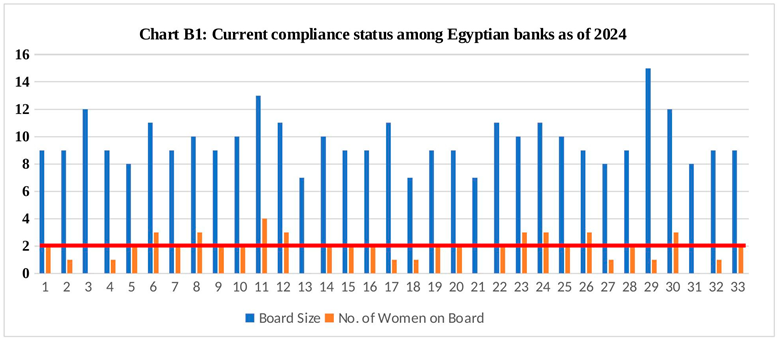
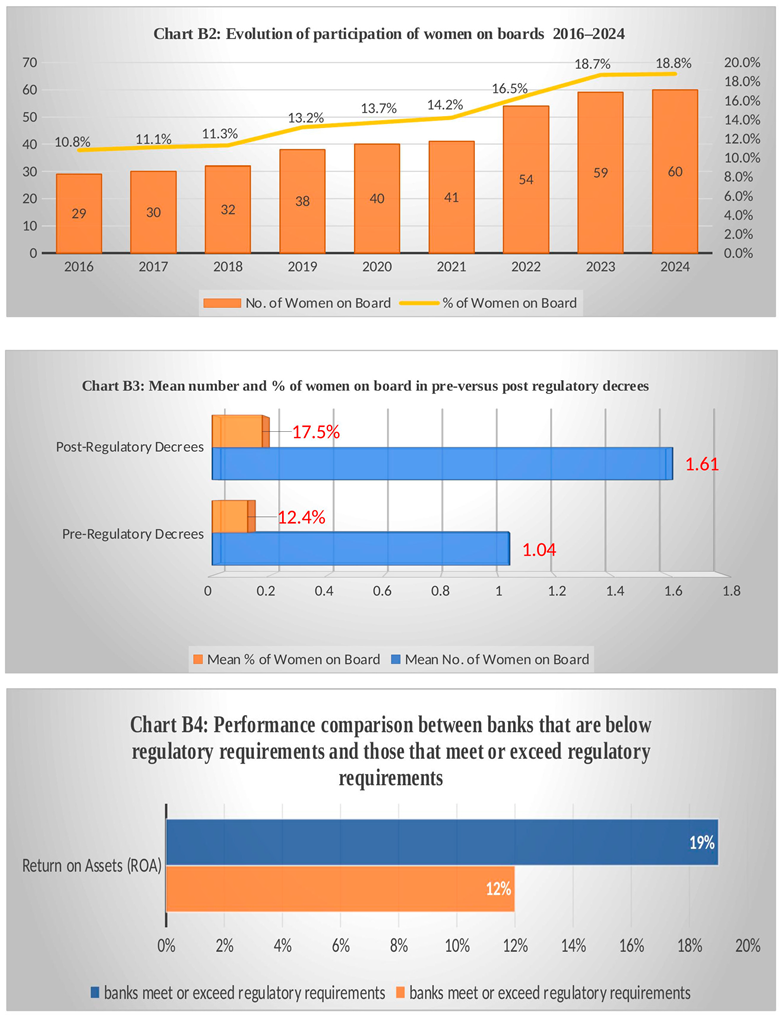
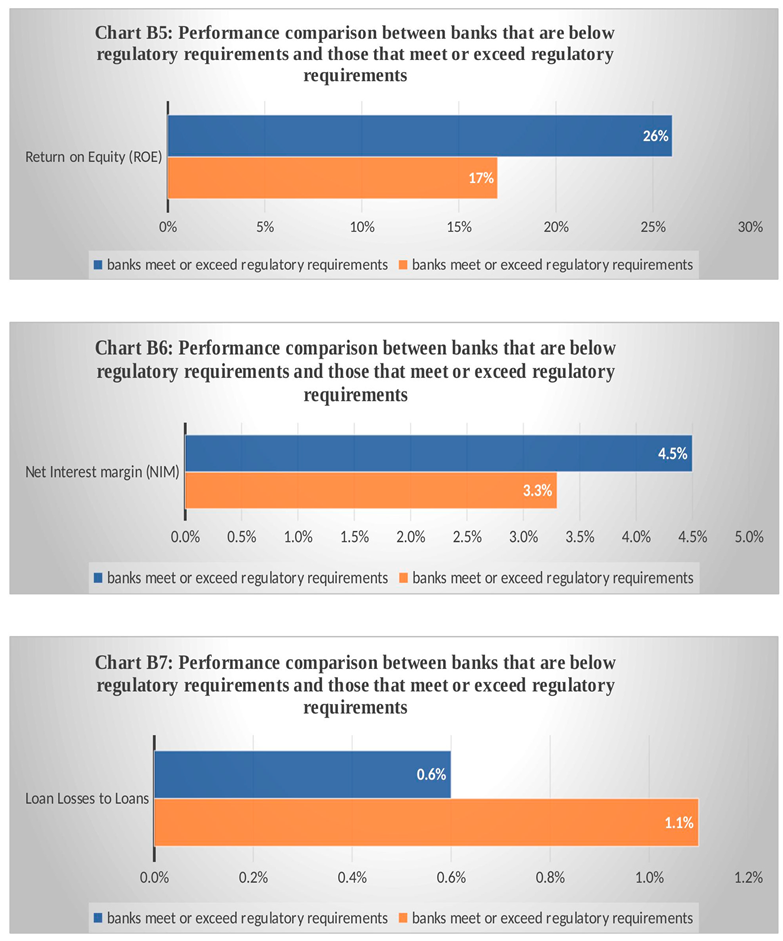
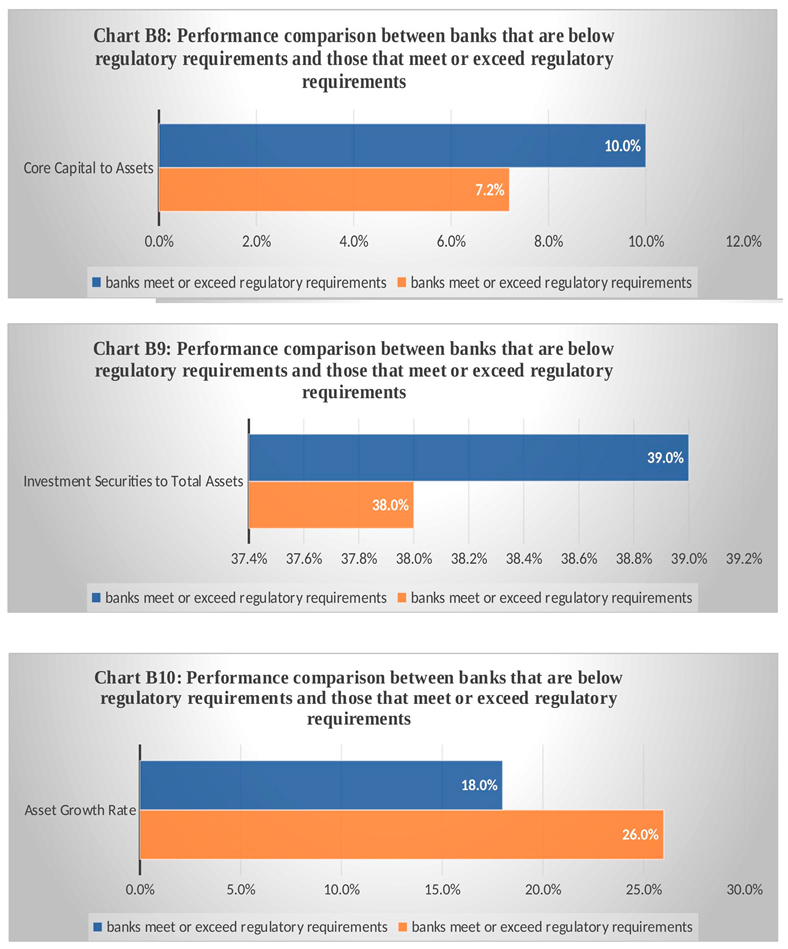
Notes
| 1 | NBFIs under FRA regulations are capital markets and stock exchanges, the insurance sector, mortgage financing firms, leasing, factoring, micro, small, and medium-size finance enterprises, and consumer finance firms. |
| 2 | We also obtain data from other sources, such as Mubasher-Egypt, data-feeding service providers, and individual bank websites. |
| 3 | The intention of our assessment does not directly scrutinize the impact of regulatory mandates on banks due to the constraints imposed by the limited time frame. This may compromise the robustness of such analysis. Nevertheless, our objective is to ascertain whether these regulatory mandates serve as indicators of favorable signals concerning board performance, and, consequently, overall performance of banks in Egypt. |
| 4 | Under Basel III, banks must maintain a capital-to-asset or capital adequacy ratio of 8%. However, this is calculated in a more comprehensive manner in order to capture risk-weighted assets. |
| 5 | In our analysis, we identify only one bank that exceeded the threshold of three women serving on its board, totalling four women. Nevertheless, for the purpose of modelling empirical tests, we categorize this bank within the subset of banks with three women on their boards. |
| 6 | Given the limited variation in female board representation across our sample, where most boards include no more than three women, our analysis provides evidence on the critical-mass relationship within the observed range of representation but cannot establish whether the positive association would persist, weaken, or reverse at substantially higher levels of female representation. As female board participation increases in line with national targets such as Egypt Vision 2030, future research may revisit this question using a broader distribution of representation levels and a longer longitudinal period. |
| 7 | On the other hand, it may lead to both agency and information costs. |
| 8 | When we estimate the model with state ownership control alone, the coefficient is negative and statistically significant, indicating that higher government ownership is associated with weaker bank performance. To check whether this result simply reflects the absence of alternative ownership types, we also estimated regressions (not reported here for space considerations, but available upon request) that include private and foreign ownership. In these specifications, both private and foreign ownership display positive and significant coefficients, with the effect of foreign ownership being not only more precisely estimated but also larger in magnitude than that of private ownership. This pattern suggests that while government ownership tends to constrain bank performance, private and especially foreign ownership are associated with performance improvements (see also Omran, 2009). |
| 9 | While our data are quantitative, the observed interaction effects point to a meaningful governance mechanism in which gender diversity improves the functioning of boards, especially in publicly owned banks. These findings open the door to further exploration—ideally through case-based or interview-driven research—to better understand how women influence boardroom dynamics in contexts shaped by state ownership and public-sector norms. |
| 10 | Both the CBE and the FRA (for publicly listed banks) require that most of these committees be formed and led by independent directors. |
References
- Adams, R. B., & Ferreira, D. (2009). Women in the boardroom and their impact on governance and performance. Journal of Financial Economics, 94(2), 291–309. [Google Scholar] [CrossRef] [Scilit]
- Ahmad, M., Raja Kamaruzaman, R. N. S., Hamdan, H., & Annuar, H. A. (2020). Women directors and firm performance: Malaysian evidence post policy announcement. Journal of Economic and Administrative Sciences, 36(2), 97–110. [Google Scholar] [CrossRef] [Scilit]
- Ahmadi, A., Nakaa, N., & Bouri, A. (2018). Chief executive officer attributes, board structures, gender diversity and firm performance among French CAC 40 listed firms. Research in International Business and Finance, 44, 218–226. [Google Scholar] [CrossRef] [Scilit]
- Akram, F., ul Haq, M. A., Natarajan, V. K., Chellakan, R. S., & McMillan, D. (2020). Board heterogeneity and corporate performance: An insight beyond agency issues. Cogent Business & Management, 7(1), 1809299. [Google Scholar] [CrossRef] [Scilit]
- Ararat, M., & Yurtoglu, B. (2021). Female directors, board committees, and firm performance: Time-series evidence from Turkey. Emerging Markets Review, 48, 100768. [Google Scholar] [CrossRef] [Scilit]
- Arnaboldi, F., Casu, B., Kalotychou, E., & Sarkisyan, A. (2020). Board diversity reforms: Do they matter for EU bank performance? European Financial Management, 26, 416–454. [Google Scholar] [CrossRef] [Scilit]
- Bennouri, M., Chtioui, T., Nagati, H., & Nekhili, M. (2018). Female board directorship and firm performance: What really matters? Journal of Banking and Finance, 88, 267–291. [Google Scholar] [CrossRef] [Scilit]
- Bernardi, R. A., Bean, D. F., & Weippert, K. M. (2002). Signaling gender diversity through annual report pictures: A research note on image management accounting. Auditing and Accounting Journal, 15(4), 609–616. [Google Scholar]
- Bertrand, M., Black, S., Jensen, S., & Lleras-Muney, A. (2019). Breaking the glass ceiling? The effect of board quotas on female labour market outcomes in Norway. Review of Economic Studies, 86(1), 191–239. [Google Scholar] [CrossRef] [Scilit]
- Bound, J., Jaeger, D. A., & Baker, R. M. (1995). Problems with instrumental variables estimation when the correlation between the instruments and the endogenous explanatory variable is weak. Journal of the American Statistical Association, 90(430), 443–450. [Google Scholar] [CrossRef] [Scilit]
- Brammer, S., Millington, A., & Pavelin, S. (2007). Gender and ethnic diversity among UK corporate boards. Corporate Governance: An International Review, 15, 393–403. [Google Scholar] [CrossRef] [Scilit]
- Burke, R. J. (2000). Company size, board size and numbers of women corporate directors. In R. J. Burke, & M. C. Mattis (Eds.), Women on corporate boards of directors (Issues in Business Ethics, pp. 157–167). Kluwer Academic Publishers. [Google Scholar]
- Cardillo, G., Onali, E., & Torluccio, G. (2021). Does gender diversity on banks’ boards matter? Evidence from public bailouts. Journal of Corporate Finance, 71, 101560. [Google Scholar] [CrossRef] [Scilit]
- Carter, D. A., D’Souza, F., Simkins, B. J., & Simpson, W. G. (2010). The gender and ethnic diversity of US boards and board committees and firm financial performance. Corporate Governance: International Review, 18(5), 396–414. [Google Scholar] [CrossRef] [Scilit]
- Carter, D. A., Simkins, B. J., & Simpson, W. G. (2003). Corporate governance, board diversity and firm value. The Financial Review, 38, 33–53. [Google Scholar] [CrossRef] [Scilit]
- Casteuble, C., Lepetit, L., & Tran, T. (2019). Women on boards: Do quotas affect firm performance? Working Paper. Available online: https://hal.science/hal-02385034/ (accessed on 16 March 2024).
- Chen, J., Leung, W. S., & Evans, K. P. (2018). Female board representation, corporate innovation and firm performance. Journal of Empirical Finance, 48, 236–254. [Google Scholar] [CrossRef] [Scilit]
- Darmadi, S. (2011). Board diversity and firm performance: The Indonesian evidence. Corporate Ownership & Control, 8(2–4), 450–466. [Google Scholar] [CrossRef] [Scilit]
- De Cabo, R. M., Gimeno, R., & Nieto, M. J. (2012). Gender diversity on European banks’ board of directors. Journal of Business Ethics, 109(2), 145–162. [Google Scholar] [CrossRef] [Scilit]
- Deloitte. (2024). Women in the boardroom: A global perspective (8th ed.). Available online: https://www.deloitte.com/content/dam/assets-zone3/ca/en/docs/services/audit-assurance/2025/ca-women-in-the-boardroom-8th-edition-2024-en-aoda.pdf (accessed on 6 January 2024).
- Donaldson, L. (2001). The contingency theory of organizations (2nd ed.). Sage. [Google Scholar]
- Eagly, A. H. (1987). Sex differences in social behavior: A social-role interpretation. Lawrence Erlbaum. [Google Scholar]
- Eisenhardt, K. M. (1989). Agency theory: An assessment and review. Academy of Management Review, 14(1), 57–74. [Google Scholar] [CrossRef] [Scilit]
- Erhardt, N. L., Werbel, J. D., & Shrader, C. B. (2003). Board of director diversity and firm financial performance. Corporate Governance: International Review, 11(2), 102–111. [Google Scholar] [CrossRef] [Scilit]
- Fan, Y., Jiang, Y., Zhang, X., & Zhou, Y. (2019). Women on boards and bank earnings management: From zero to hero. Journal of Banking and Finance, 107, 105607. [Google Scholar] [CrossRef] [Scilit]
- Farag, H., & Mallin, C. (2017). Board diversity and financial fragility: Evidence from European banks. International Review of Financial Analysis, 49, 98–112. [Google Scholar] [CrossRef] [Scilit]
- Fehr-Duda, H., de Gennaro, M., & Schubert, R. (2006). Gender, financial risk, and probability weights. Theory and Decision, 60(2), 283–313. [Google Scholar] [CrossRef] [Scilit]
- Feyisetan, O. O., & Alkaraan, F. (2026). Board gender diversity and innovation strategies: Sectoral effects on ESG performance in financial and non-financial firms. Journal of Risk and Financial Management, 19(2), 145. [Google Scholar] [CrossRef] [Scilit]
- Fondas, N., & Sassalos, S. (2000). A different voice in the boardroom: How the presence of women directors affects board influence over management. Global Focus, 12, 13–22. [Google Scholar]
- Galletta, S., Mazzù, S., Naciti, V., & Vermiglio, C. (2022). Gender diversity and sustainability performance in the banking industry. Corporate Social Responsibility and Environmental Management, 29, 161–174. [Google Scholar] [CrossRef] [Scilit]
- Garanina, T., & Muravyev, A. (2021). The gender composition of corporate boards and firm performance: Evidence from Russia. Emerging Markets Review, 48, 100772. [Google Scholar] [CrossRef] [Scilit]
- García-Meca, E., García-Sánchez, I., & Martínez-Ferrero, J. (2015). Board diversity and its effects on bank performance: An international analysis. Journal of Banking & Finance, 53, 202–214. [Google Scholar] [CrossRef] [Scilit]
- Gregory-Smith, I., Main, B. G. M., & O’Reilly, C. A., III. (2014). Appointments, pay and performance in UK boardrooms by gender. Economic Journal, 124(574), F109–F128. [Google Scholar] [CrossRef] [Scilit]
- Hillman, A. J., Shropshire, C., & Cannella, A. A., Jr. (2007). Organizational predictors of women on corporate boards. Academy of Management Journal, 50(4), 941–995. [Google Scholar] [CrossRef] [Scilit]
- Ho, T. N. T., Nguyen, D., Le, T., Nguyen, H. T., & Tran, S. (2025). Does board gender diversity affect bank financial stability? Evidence from a transitional economy. Gender in Management: An International Journal, 40(1), 64–90. [Google Scholar] [CrossRef] [Scilit]
- Javed, M., Saeed, R., Lodhi, R. N., & Malik, Q. U. Z. (2013). The effect of board size and structure on firm financial performance: A case of banking sector in Pakistan. Middle East Journal of Scientific Research, 15(2), 243–251. [Google Scholar]
- Jensen, M. C., & Meckling, W. H. (1976). Theory of the firm: Managerial behavior, agency costs and ownership structure. Journal of Financial Economics, 3(4), 305–360. [Google Scholar] [CrossRef] [Scilit]
- Julizaerma, M. K., & Sori, Z. (2012). Gender diversity in the boardroom and firm performance of Malaysian public listed companies. Procedia Social and Behavioral Sciences, 65, 1077–1085. [Google Scholar] [CrossRef] [Scilit]
- Kakabadse, N., Figueira, C., Nicolopoulou, K., Hong Yang, J., Kakabadse, A., & Ozbilgin, M. (2015). Gender diversity and board performance: Women’s experiences and perspectives. Human Resource Management, 54(2), 265–281. [Google Scholar] [CrossRef] [Scilit]
- Kang, E., Ding, D. K., & Charoenwong, C. (2010). Investor reaction to women directors. Journal of Business Research, 63(8), 888–894. [Google Scholar] [CrossRef] [Scilit]
- Kanter, R. M. (1977). Men and women of the corporation. Basic Books. [Google Scholar]
- Kilic, M. (2015). The effect of board diversity on the performance of banks: Evidence from Turkey. Journal of Business and Management, 10(9), 182–192. [Google Scholar] [CrossRef] [Scilit]
- La Porta, R., Lopez-de-Silanes, F., Shleifer, A., & Vishny, R. (1998). Law and finance. Journal of Political Economy, 106(6), 1113–1155. [Google Scholar] [CrossRef] [Scilit] [PubMed]
- Liao, R. C., Loureiro, G., & Taboada, A. G. (2022). Gender quotas and bank risk. Journal of Financial Intermediation, 52, 100998. [Google Scholar] [CrossRef] [Scilit]
- Mahmood, Z., Kouser, R., Ali, W., Ahmad, Z., & Salman, T. (2018). Does corporate governance affect sustainability disclosure? A mixed methods study. Sustainability, 10(1), 207. [Google Scholar] [CrossRef] [Scilit]
- Mastella, M., Vancin, D., Perlin, M., & Kirch, G. (2021). Board gender diversity: Performance and risk of Brazilian firms. Gender in Management: An International Journal, 36(4), 498–518. [Google Scholar] [CrossRef] [Scilit]
- McCoy Family Center for Ethics in Society. (2016). Equality of outcome. In Equality of Opportunity and Education. Stanford. Available online: https://edeq.stanford.edu/sections/section-1-equality-opportunity-and-alternatives/equality-outcome (accessed on 12 April 2024).
- Minguez-Vera, A., & Martin, A. (2011). Gender and management on Spanish SMEs: An empirical analysis. International Journal of Human Resource Management, 22, 2852–2873. [Google Scholar] [CrossRef] [Scilit]
- Nguyen, H., & Faff, R. (2012). Impact of board size and board diversity on firm value: Australian evidence. Corporate Ownership and Control, 4, 24–32. [Google Scholar]
- Nielsen, S., & Huse, M. (2010). Women directors’ contribution to board decision-making and strategic involvement: The role of equality perception. European Management Review, 7, 16–29. [Google Scholar] [CrossRef] [Scilit]
- Omran, M. (2007). Privatization, state ownership, and bank performance in Egypt. World Development, 35(4), 714–733. [Google Scholar] [CrossRef] [Scilit]
- Omran, M. (2009). Post-privatization corporate governance and firm performance: The role of private ownership concentration, identity, and board composition. Journal of Comparative Economics, 37(4), 658–673. [Google Scholar] [CrossRef] [Scilit]
- Omran, M. (2022). Regulatory enforcement, gender quotas, and women on board: Evolution and firm performance. International Business Logistics Journal, 2(2), 63–66. [Google Scholar] [CrossRef] [Scilit]
- Owen, A. L., & Temesvary, J. (2019). Gender diversity on bank board of directors and performance. In FEDS notes. Board of Governors of the Federal Reserve System. [Google Scholar]
- Pathan, S., & Faff, R. (2013). Does board structure in banks really affect their performance? Journal of Banking and Finance, 37(5), 1573–1589. [Google Scholar] [CrossRef] [Scilit]
- Patil, A., & Yadav, R. (2026). Gender board diversity and financial performance: Evidence from India’s mandatory gender quota. International Journal of Disclosure and Governance. [Google Scholar] [CrossRef] [Scilit]
- Pfeffer, J., & Salancik, G. R. (2003). The external control of organizations: A resource dependence perspective. Stanford University Press. [Google Scholar]
- Post, C., & Byron, K. (2014). Women on boards and firm financial performance: A meta-analysis. Academy of Management Journal, 58(5), 1546–1571. [Google Scholar] [CrossRef] [Scilit]
- Reddy, S., & Jadhav, A. M. (2019). Gender diversity in boardrooms—A literature review. Cogent Economics & Finance, 7(1), 1644703. [Google Scholar] [CrossRef] [Scilit]
- Rose, C. (2007). Does female board representation influence firm performance? The Danish evidence. Corporate Governance: International Review, 15(2), 404–413. [Google Scholar] [CrossRef] [Scilit]
- Sbai, H., Meghouar, H., & Benaguid, O. (2025). Gender diversity and bank performance in developing countries: The moderating effect of culture. Corporate Board: Role, Duties and Composition, 21(3), 35–47. [Google Scholar] [CrossRef] [Scilit]
- Shleifer, A., & Vishny, R. (1997). A survey of corporate governance. The Journal of Finance, 52(2), 737–783. [Google Scholar] [CrossRef] [Scilit]
- Shore, L., Cleveland, J., & Sanchez, D. (2018). Inclusive workplaces: A review and model. Human Resource Management Review, 28(2), 176–189. [Google Scholar] [CrossRef] [Scilit]
- Shrader, C., Blackburn, V., & Iles, P. (1997). Women in management and firm financial performance: An exploratory study. Journal of Managerial Issues, 9(3), 355–372. [Google Scholar]
- Simionescu, L. N., Gherghina, Ş. C., Tawil, H., & Sheikha, Z. (2021). Does board gender diversity affect firm performance? Empirical evidence from Standard & Poor’s 500 Information Technology Sector. Financial Innovation, 7(52). [Google Scholar] [CrossRef] [Scilit]
- Singh, V., Kumra, S., & Vinnicombe, S. (2002). Gender and impression management: Playing the promotion game. Journal of Business Ethics, 37(1), 77–89. [Google Scholar] [CrossRef] [Scilit]
- Terjesen, S., Aguilera, R., & Lorenz, R. (2015). Legislating a woman’s seat on the board: Institutional factors driving gender quotas for boards of directors. Journal of Business Ethics, 128(2), 233–251. [Google Scholar] [CrossRef] [Scilit]
- Topçu, G. (2020). Bank performance and board structure: Evidence from Turkey. Management and Political Sciences Review, 2(1), 1–17. [Google Scholar]
- United Nations. (2015). Transforming our world: The 2030 agenda for sustainable development. United Nations. [Google Scholar]
- Wang, K., Ma, J., Xue, C., & Zhang, J. (2024). Board gender diversity and firm performance: Recent evidence from Japan. Journal of Risk and Financial Management, 17(1), 20. [Google Scholar] [CrossRef] [Scilit]
- Wang, Y., & Clift, B. (2009). Is there a business case for board diversity? Pacific Accounting Review, 21(2), 88–103. [Google Scholar] [CrossRef] [Scilit]
- Watson, P. (1995). Equality of treatment: A variable concept? Industrial Law Journal, 24(1), 33–48. [Google Scholar] [CrossRef] [Scilit]
- World Bank. (2020). Doing business report. World Bank. [Google Scholar]
- Xu, Z., Yu, Z., Jiang, L., & Xie, T. (2026). Digital economy, independent directors’ social capital, and corporate environmental performance: Climate policy uncertainty. Review of Managerial Science. [Google Scholar] [CrossRef] [Scilit]

Disclaimer/Publisher’s Note: The statements, opinions and data contained in all publications are solely those of the individual author(s) and contributor(s) and not of MDPI and/or the editor(s). MDPI and/or the editor(s) disclaim responsibility for any injury to people or property resulting from any ideas, methods, instructions or products referred to in the content. |
© 2026 by the author. Licensee MDPI, Basel, Switzerland. This article is an open access article distributed under the terms and conditions of the Creative Commons Attribution (CC BY) license.