
Going Concern Risk and the Market’s Use of Earnings: Multi-Year Evidence Preceding First-Time Going Concern Opinions

Abstract
1. Introduction
2. Sample Selection and Hypothesis Development
2.1. Sample Selection and Data Sources
2.2. Hypothesis Development
3. Going Concern Audit Opinion and Earnings Informativeness
3.1. Informativeness of Earnings Preceding a Going Concern Audit Opinion
3.2. Informativeness of Earnings Conditional on a Subsequent-Year Going Concern Opinion
4. Firm-Specific Economic Factors Preceding the Going Concern Opinion
4.1. Evidence on Determinants of Earnings Informativeness
4.2. Joint Tests of Known Determinants of Earnings Informativeness and the Going Concern Opinion
5. Managers’ Accounting Choices Preceding the Going Concern Opinion
6. Summary and Conclusions
Author Contributions
Funding
Institutional Review Board Statement
Informed Consent Statement
Data Availability Statement
Conflicts of Interest
| 1 | For research in this area (see Carson et al., 2013; Myers et al., 2018; Gutierrez et al., 2020; Menon & Williams, 2010; Blay et al., 2011; Blay & Geiger, 2013; Dong et al., 2015; Amin et al., 2014; Geiger & Kumas, 2018; Bédard et al., 2019; and Vandamas & Myring, 2026). |
| 2 | For a summary of research in this area, see Kothari and Wasley (2019); for related research on earnings informativeness, persistence, and distress-related variation (see Kormendi & Lipe, 1987; Hayn, 1995; Warfield & Wild, 1992; Charitou et al., 2011; Barth et al., 2023; Dechow et al., 2010; Dechow et al., 2011; Dichev & Tang, 2008; Wilson, 2008). |
| 3 | Accounting interest stems from the application of generally accepted accounting principles, which are founded on the going concern assumption, under circumstances in which the validity of an underlying assumption is doubtful. Evidence on how the informativeness of earnings is affected by the likelihood that the firm is, or is not, a going concern is relevant to this discussion. Auditing interest stems not only from the information conveyed in the auditor’s report, but also from the possibility that market participants revise the usefulness of earnings before and potentially substantially before the formal report date. To the extent that market participants revalue the informativeness of earnings in periods preceding the auditor’s going concern opinion, the timeliness of and information conveyed in the auditor’s report are predictably impacted. This point is particularly relevant given evidence that going concern opinions can be anticipated by sophisticated investors and that announcement-date reactions are often confounded by concurrent disclosures. |
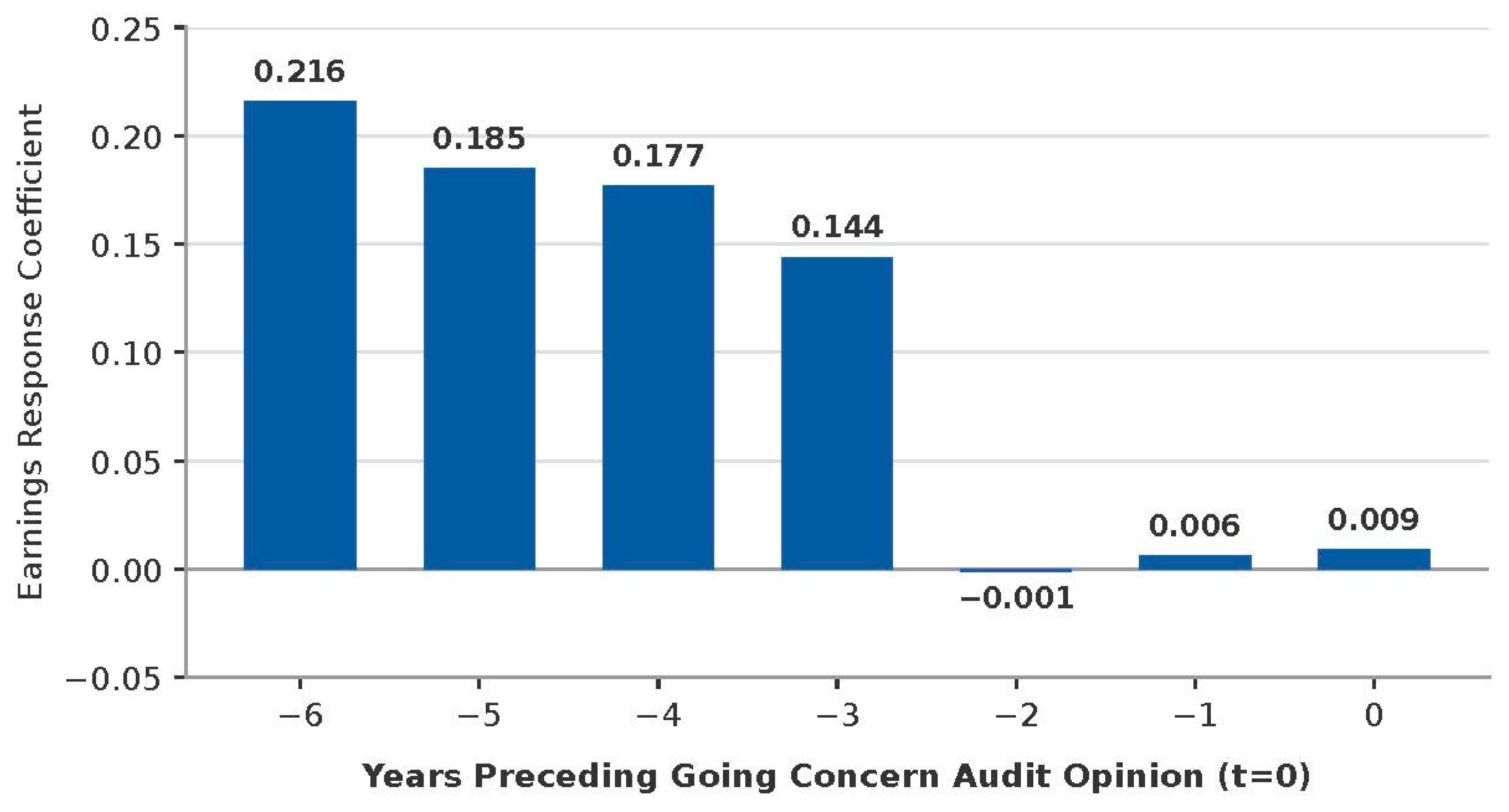
| 4 | The earnings response coefficient from each of the 3 to 6 years prior to the going concern opinion was significantly greater than zero; the earnings response coefficient from each of the 2 years prior to, and the year of, the going concern opinion was insignificantly different from zero. |
| 5 | Four reasons motivate the sample period selection of 1983–1990. First, all sample opinions would have been issued under a single, uniform going concern reporting criterion—the initial years following the adoption of SAS No. 59—so the within-firm temporal tests would not be confounded by shifts in auditing standards or by later institutional changes to the audit report (which would be challenging given the 8-year window). Second, quarterly earnings announcements in this period are comparatively clean information events with far less concurrent predisclosure (e.g., management guidance and conference calls), which sharpens identification of the market’s use of earnings. Third, the data underlie related published research (e.g., Subramanyam & Wild, 1996), permitting comparability of the evidence across studies. Finally, the hypotheses concern the fundamental link between the going concern assumption and the measurement and valuation relevance of earnings—a relation that is not specific to any reporting regime—and recent evidence indicates that the underlying mechanisms remain operative in current reporting environments (e.g., Gutierrez et al., 2020; Vandamas & Myring, 2026). |
| 6 | The earnings response coefficient for year {−4} through year {0} is computed by adding the respective year’s change parameter (γ) to α1; for example, the earnings response coefficient of 0.009 for year {0} is obtained by summing α1 = 0.190 and γ0 = −0.181. |
| 7 | We also examined the sensitivity of results to a five-day cumulation period for returns; none of the study’s inferences are altered with these alternative cumulation periods for abnormal returns. |
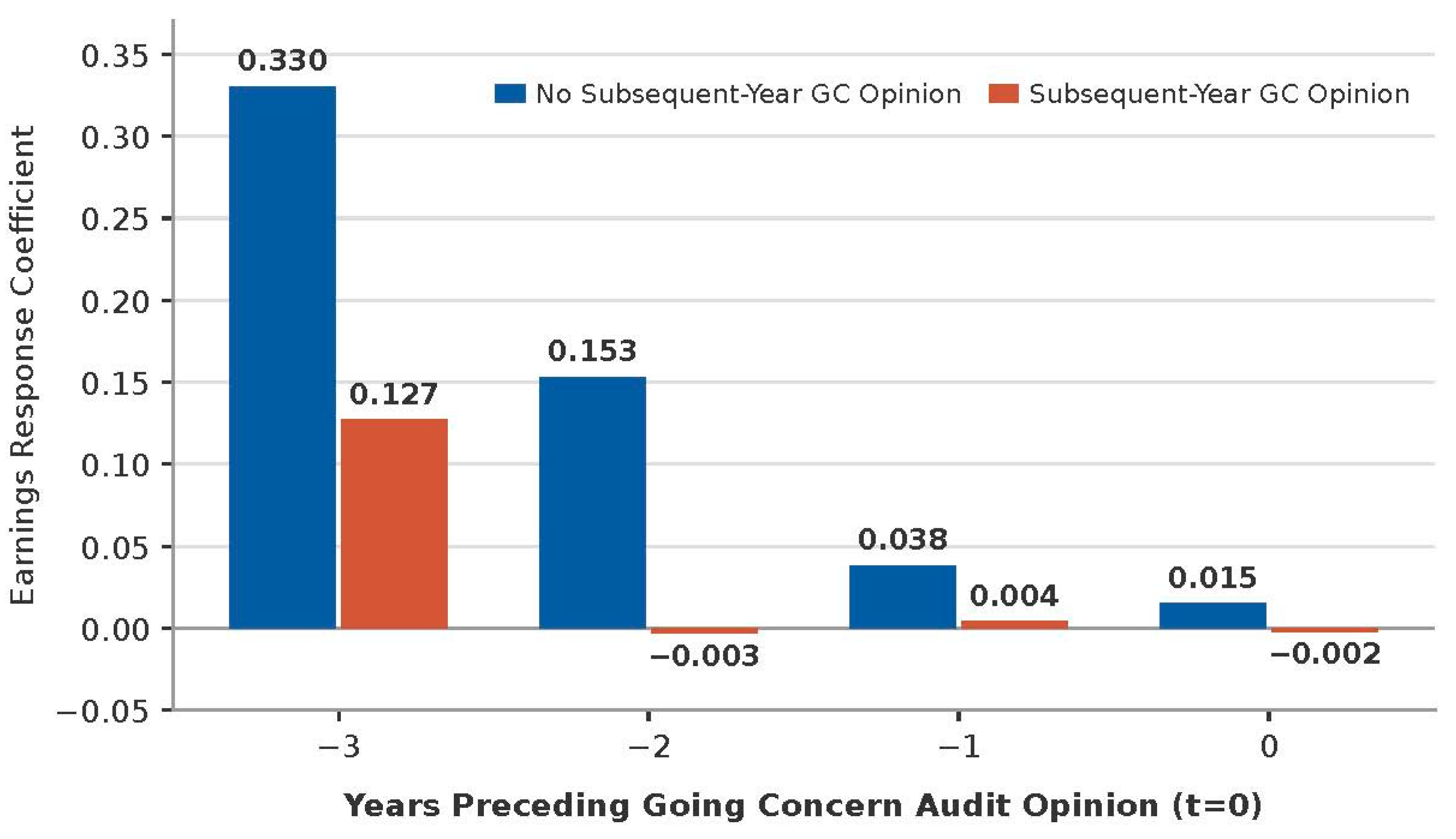
| 8 | For example, the earnings response coefficient of 0.045 in year {0}, for the sample that did not receive a subsequent-year going concern opinion, was computed by summing the estimates for α1 = 0.190 and γ0 = −0.145. |
| 9 | For example, the earnings response coefficient of −0.008 in year {0}, for companies with a subsequent-year going concern opinion, was computed by summing the estimates α1 = 0.190, γ0 = −0.145, and ψ0 = −0.053. |
| 10 | For background on the motivation for these factors as determinants of earnings informativeness, see Kothari and Wasley (2019); also see Kormendi and Lipe (1987); Easton and Zmijewski (1989); Collins and Kothari (1989); Lang (1991); Dhaliwal and Reynolds (1994); Ali and Zarowin (1992); Lipe (1990); Dhaliwal et al. (1991); Choi and Jeter (1992); Warfield et al. (1995); and Wild and Wild (2022, 2025). |
| 11 | Firm size is more typically used as a cross-sectional determinant of earnings informativeness (to capture differential incentives for information search) and is likely less applicable in tracking the temporal behavior of the earnings response coefficient as modelled in this study. |
| 12 | We re-ran the regression test of Equation (3) using a nondirectional measure of stock price variability as the dependent variable and removing the directional earnings (E) independent variable. This sensitivity test is important in that it abstracts from potential error in measurement of unexpected earnings and it focuses on the market reaction at the earnings report, irrespective of its sign. The results of this regression are qualitatively identical to the evidence in Table 6. This suggests that the inferences of this study are robust to potential error in the unexpected earnings calculation (this test is in addition to earlier robustness tests that examined several alternative measures of earnings information). |
| 13 | There is some prior research that provides evidence of significant income reduction when firms are in distress (e.g., see H. DeAngelo et al., 1994). That evidence is consistent with the argument that the auditor pressures management to adopt more conservative practices. |
| 14 | We experimented with several other expectation models, including the random walk model and a “rolling” expectations model, along with other scaling factors, with no effect on the inferences drawn. |
| 15 | For example, if earnings decline sufficiently below the level necessary for a bonus, then managers have incentives to decrease reported earnings. On the other hand, financially distressed firms are unlikely to pay bonuses and tend to curtail the use of accounting-based compensation plans. Further, the threat of job loss is likely to exceed managers’ concern regarding future bonuses. For background on tests of accruals along with evidence on distressed firms (see Healy, 1985; L. E. DeAngelo, 1986, 1988; Liberty & Zimmerman, 1986; Gilson & Vetsuypens, 1993; Bowen et al., 1986; Weisbach, 1988; and Gilson, 1989). |
| 16 | We also investigated managers’ accounting choices as reflected in the absolute value of discretionary abnormal accounting accruals, in a regression of returns on earnings to consider their potential in explaining the temporal decline in earnings informativeness. This analysis included the other known determinants of earnings informativeness as explanatory variables. The evidence (not reported here) revealed that much, but again not all, of the temporal decline in earnings informativeness leading up to the going concern audit opinion is explained by the joint inclusion of all determinants. |
References
- Ali, A., & Zarowin, P. (1992). Permanent versus transitory components of annual earnings and estimation error in earnings response coefficients. Journal of Accounting and Economics, 15, 249–264. [Google Scholar] [CrossRef] [Scilit]
- Altman, E. I. (1968). Financial ratios, discriminant analysis and the prediction of corporate bankruptcy. The Journal of Finance, 23(4), 589–609. [Google Scholar] [CrossRef]
- Amin, K., Krishnan, J., & Yang, J. S. (2014). Going concern opinion and cost of equity. Auditing: A Journal of Practice & Theory, 33(4), 1–39. [Google Scholar] [CrossRef] [Scilit]
- Ashraf, S., Félix, E. G. S., & Serrasqueiro, Z. (2019). Do traditional financial distress prediction models predict the early warning signs of financial distress? Journal of Risk and Financial Management, 12(2), 55. [Google Scholar] [CrossRef] [Scilit]
- Averio, T. (2021). The analysis of influencing factors on the going concern audit opinion–A study in manufacturing firms in Indonesia. Asian Journal of Accounting Research, 6(2), 152–164. [Google Scholar] [CrossRef] [Scilit]
- Barth, M. E., Li, K., & McClure, C. G. (2023). Evolution in value relevance of accounting information. The Accounting Review, 98(1), 1–28. [Google Scholar] [CrossRef] [Scilit]
- Bédard, J., Brousseau, C., & Vanstraelen, A. (2019). Investor reaction to auditors’ going concern emphasis of matter: Evidence from a natural experiment. Auditing: A Journal of Practice & Theory, 38(2), 27–55. [Google Scholar] [CrossRef] [Scilit]
- Blay, A. D., & Geiger, M. A. (2001). Market expectations for first-time going-concern recipients. Journal of Accounting, Auditing & Finance, 16(3), 209–226. [Google Scholar] [CrossRef] [Scilit]
- Blay, A. D., & Geiger, M. A. (2013). Auditor fees and auditor independence: Evidence from going concern reporting decisions. Contemporary Accounting Research, 30(2), 579–606. [Google Scholar] [CrossRef] [Scilit]
- Blay, A. D., Geiger, M. A., & North, D. S. (2011). The auditor’s going-concern opinion as a communication of risk. Auditing: A Journal of Practice & Theory, 30(2), 77–102. [Google Scholar] [CrossRef] [Scilit]
- Bowen, R. M., Burgstahler, D., & Daley, L. A. (1986). Evidence on the relationships between earnings and various measures of cash flow. The Accounting Review, 61(4), 713–725. [Google Scholar] [CrossRef] [Scilit]
- Campa, D., & Camacho-Miñano, M.-M. (2015). The impact of SME’s pre-bankruptcy financial distress on earnings management tools. International Review of Financial Analysis, 42, 222–234. [Google Scholar] [CrossRef] [Scilit]
- Campbell, J. Y., Hilscher, J., & Szilagyi, J. (2008). In search of distress risk. The Journal of Finance, 63(6), 2899–2939. [Google Scholar] [CrossRef] [Scilit]
- Carson, E., Fargher, N. L., Geiger, M. A., Lennox, C. S., Raghunandan, K., & Willekens, M. (2013). Audit reporting for going-concern uncertainty: A research synthesis. Auditing: A Journal of Practice & Theory, 32, 353–384. [Google Scholar] [CrossRef] [Scilit]
- Charitou, A., Lambertides, N., & Trigeorgis, L. (2011). Distress risk, growth and earnings quality. Abacus, 47(2), 158–181. [Google Scholar] [CrossRef] [Scilit]
- Choi, S. K., & Jeter, D. C. (1992). The effects of qualified audit opinions on earnings response coefficients. Journal of Accounting and Economics, 15, 229–247. [Google Scholar] [CrossRef] [Scilit]
- Collins, D. W., & Kothari, S. (1989). An analysis of intertemporal and cross-sectional determinants of earnings response coefficients. Journal of Accounting and Economics, 11, 143–181. [Google Scholar] [CrossRef] [Scilit]
- DeAngelo, H., DeAngelo, L., & Skinner, D. J. (1994). Accounting choice in troubled companies. Journal of Accounting and Economics, 17, 113–143. [Google Scholar] [CrossRef] [Scilit]
- DeAngelo, L. E. (1986). Accounting numbers as market valuation substitutes: A study of management buyouts of public stockholders. The Accounting Review, 61(3), 400–420. [Google Scholar] [CrossRef] [Scilit]
- DeAngelo, L. E. (1988). Managerial competition, information costs, and corporate governance: The use of accounting performance measures in proxy contests. Journal of Accounting and Economics, 10, 3–36. [Google Scholar]
- Dechow, P. M., Ge, W., Larson, C. R., & Sloan, R. G. (2011). Predicting material accounting misstatements. Contemporary Accounting Research, 28(1), 17–82. [Google Scholar] [CrossRef] [Scilit]
- Dechow, P. M., Ge, W., & Schrand, C. (2010). Understanding earnings quality: A review of the proxies, their determinants and their consequences. Journal of Accounting and Economics, 50, 344–401. [Google Scholar] [CrossRef] [Scilit]
- Deis, D. R., Reynolds, J. K., Wertheim, C., Xu, T., & Zhang, D. (2026). Going concern risk and bankruptcy outcomes associated with property, plant, and equipment intensity, impairment, and age. Risks, 14(3), 45. [Google Scholar] [CrossRef] [Scilit]
- Dhaliwal, D. S., Lee, K. J., & Fargher, N. L. (1991). The association between unexpected earnings and abnormal security returns in the presence of financial leverage. Contemporary Accounting Research, 8(1), 20–41. [Google Scholar] [CrossRef] [Scilit]
- Dhaliwal, D. S., & Reynolds, S. S. (1994). The effect of the default risk of debt on the earnings response coefficient. The Accounting Review, 69(2), 412–419. [Google Scholar] [CrossRef] [Scilit]
- Dichev, I. D., & Tang, V. W. (2008). Matching and the changing properties of accounting earnings over the last 40 years. The Accounting Review, 83(6), 1425–1460. [Google Scholar] [CrossRef] [Scilit]
- Dong, B., Robinson, D., & Robinson, M. (2015). The market’s response to earnings surprises after first-time going-concern modifications. Advances in Accounting, 31(1), 21–32. [Google Scholar] [CrossRef] [Scilit]
- Easton, P. D., & Zmijewski, M. E. (1989). Cross-sectional variation in the stock market response to accounting earnings announcements. Journal of Accounting and Economics, 11, 117–141. [Google Scholar] [CrossRef] [Scilit]
- Geiger, M. A., & Kumas, A. (2018). Anticipation and reaction to going-concern modified audit opinions by sophisticated investors. International Journal of Auditing, 22(3), 522–535. [Google Scholar] [CrossRef] [Scilit]
- Gilson, S. C. (1989). Management turnover and financial distress. Journal of Financial Economics, 25(2), 241–262. [Google Scholar] [CrossRef] [Scilit]
- Gilson, S. C., & Vetsuypens, M. R. (1993). CEO Compensation in financially distressed firms: An empirical analysis. Journal of Finance, 48, 425–458. [Google Scholar] [CrossRef]
- Gutierrez, E., Krupa, J., Minutti-Meza, M., & Vulcheva, M. (2020). Do going concern opinions provide incremental information to predict corporate defaults? Review of Accounting Studies, 25(4), 1344–1381. [Google Scholar] [CrossRef] [Scilit]
- Hayn, C. (1995). The information content of losses. Journal of Accounting and Economics, 20(2), 125–153. [Google Scholar] [CrossRef] [Scilit]
- Healy, P. M. (1985). The effect of bonus schemes on accounting decisions. Journal of Accounting and Economics, 7, 85–107. [Google Scholar] [CrossRef] [Scilit]
- Holthausen, R. W., & Verrecchia, R. E. (1988). The effect of sequential information releases on the variance of price changes in an intertemporal multi-asset market. Journal of Accounting Research, 26(1), 82. [Google Scholar] [CrossRef] [Scilit]
- Kausar, A., Taffler, R. J., & Tan, C. (2009). The going-concern market anomaly. Journal of Accounting Research, 47(1), 213–239. [Google Scholar] [CrossRef] [Scilit]
- Kormendi, R., & Lipe, R. (1987). Earnings innovations, earnings persistence, and stock returns. The Journal of Business, 60(3), 323. [Google Scholar] [CrossRef] [Scilit] [PubMed]
- Kothari, S. P., & Wasley, C. (2019). Commemorating the 50-year anniversary of ball and brown (1968): The evolution of capital market research over the past 50 years. Journal of Accounting Research, 57(5), 1117–1159. [Google Scholar] [CrossRef] [Scilit]
- Lang, M. (1991). Time-varying stock price response to earnings induced by uncertainty about the time-series process of earnings. Journal of Accounting Research, 29(2), 229. [Google Scholar] [CrossRef] [Scilit]
- Li, Y., Li, X., Xiang, E., & Djajadikerta, H. G. (2020). Financial distress, internal control, and earnings management: Evidence from China. Journal of Contemporary Accounting & Economics, 16(3), 100210. [Google Scholar] [CrossRef] [Scilit]
- Liberty, S. E., & Zimmerman, J. L. (1986). Labor union contract negotiations and accounting choices. The Accounting Review, 61(4), 692–712. [Google Scholar] [CrossRef] [Scilit]
- Lipe, R. (1990). The relation between stock returns and accounting earnings given alternative information. The Accounting Review, 65(1), 49–71. [Google Scholar] [CrossRef] [Scilit]
- Menon, K., & Williams, D. D. (2010). Investor reaction to going concern audit reports. The Accounting Review, 85(6), 2075–2105. [Google Scholar] [CrossRef] [Scilit]
- Myers, L. A., Shipman, J. E., Swanquist, Q. T., & Whited, R. L. (2018). Measuring the market response to going concern modifications: The importance of disclosure timing. Review of Accounting Studies, 23(4), 1512–1542. [Google Scholar] [CrossRef] [Scilit]
- Srebro, B., Mavrenski, B., Arsić, V. B., Knežević, S., Milašinović, M., & Travica, J. (2021). Bankruptcy risk prediction in ensuring the sustainable operation of agriculture companies. Sustainability, 13(14), 7712. [Google Scholar] [CrossRef] [Scilit]
- Subramanyam, K., & Wild, J. J. (1996). Going-concern status, earnings persistence, and informativeness of earnings. Contemporary Accounting Research, 13(1), 251–273. [Google Scholar] [CrossRef] [Scilit]
- Vandamas, V., & Myring, M. (2026). Going-concern CAM disclosures: An intermediate-level warning for financial distress. Journal of Accounting and Public Policy, 55, 107398. [Google Scholar] [CrossRef] [Scilit]
- Warfield, T. D., & Wild, J. J. (1992). Accounting recognition and the relevance of earnings as an explanatory variable for returns. The Accounting Review, 67(4), 821–842. [Google Scholar] [CrossRef] [Scilit]
- Warfield, T. D., Wild, J. J., & Wild, K. L. (1995). Managerial ownership, accounting choices, and informativeness of earnings. Journal of Accounting and Economics, 20(1), 61–91. [Google Scholar] [CrossRef] [Scilit]
- Weisbach, M. S. (1988). Outside directors and CEO turnover. Journal of Financial Economics, 20, 431–460. [Google Scholar] [CrossRef] [Scilit]
- Wild, J. J., & Wild, J. M. (2022). Explanatory Power of Earnings for Returns: Nonstationarity, Disaggregation and Timeliness. Review of Accounting and Finance, 21(4), 320–340. [Google Scholar] [CrossRef] [Scilit]
- Wild, J. J., & Wild, J. M. (2025). Corporate Social Responsibility and Disclosure Transparency. Journal of Financial Reporting and Accounting, 23(6), 2454–2483. [Google Scholar] [CrossRef] [Scilit]
- Wilson, W. M. (2008). An empirical analysis of the decline in the information content of earnings following restatements. The Accounting Review, 83(2), 519–548. [Google Scholar] [CrossRef] [Scilit]



| Year Relative to Going Concern Opinion a | Number of Company- Quarter Observations | Correlation Between Earnings and Returns b |
|---|---|---|
| All Years | 896 | 0.08 |
| Year {−4} | 147 | 0.31 |
| Year {−3} | 180 | 0.30 |
| Year {−2} | 193 | 0.29 |
| Year {−1} | 212 | 0.10 |
| Year {0} | 164 | 0.08 |
| Parameter Estimates | Sample | F-Value | |||||||
|---|---|---|---|---|---|---|---|---|---|
| α0 | α1 | γ−4 | γ−3 | γ−2 | γ−1 | γ0 | Size | R2% | (Sig. Level) |
| −0.009 *** | 0.190 *** | −0.013 | −0.046 | −0.191 *** | −0.184 ** | −0.181 ** | 1142 | 2.42% | 4.70 |
| (−4.10) | (2.32) | (−0.11) | (−0.52) | (−2.34) | (−2.25) | (−2.18) | (0.001) | ||
| Parameter Estimates | Sample | F-Value | |||||||
|---|---|---|---|---|---|---|---|---|---|
| α0 | α1 | γ−4 | γ−3 | γ−2 | γ−1 | γ0 | Size | R2% | (Sig. Level) |
| Panel A: Unexpected earnings not truncated for extreme observations | |||||||||
| −0.010 *** | 0.055 * | −0.038 | −0.090 ** | −0.056 * | −0.055 * | −0.066 * | 1161 | 1.73% | 3.39 |
| (−4.46) | (1.33) | (−0.73) | (−2.12) | (−1.35) | (−1.31) | (−1.56) | (0.003) | ||
| Panel B: Abnormal stock returns cumulated over the quarterly reporting period | |||||||||
| −0.032 *** | 0.625 ** | −0.444 | −0.489 * | −0.605 ** | −0.544 ** | −0.521 ** | 1142 | 1.64% | 3.15 |
| (−3.85) | (2.05) | (−1.00) | (−1.48) | (−1.98) | (−1.78) | (−1.69) | (0.005) | ||
| Parameter Estimates | Sample | F-Value | ||||||||||||
|---|---|---|---|---|---|---|---|---|---|---|---|---|---|---|
| α0 | α1 | γ−4 | γ−3 | γ−2 | γ−1 | γ0 | ψ−4 | ψ−3 | ψ−2 | ψ−1 | ψ0 | Size | R2% | (Sig. Level) |
| −0.009 *** | 0.190 *** | −0.126 | 0.086 | −0.189 *** | −0.179 ** | −0.145 ** | 0.202 | −0.200 *** | −0.004 | −0.075 *** | −0.053 ** | 1142 | 4.05% | 4.33 |
| (−3.98) | (2.34) | (−0.82) | (0.86) | (−2.32) | (−2.20) | (−1.71) | (1.15) | (−2.81) | (−0.51) | (−2.60) | (−1.69) | (0.001) | ||
| Year Relative to the Going Concern Audit Opinion | ||||||
|---|---|---|---|---|---|---|
| Determinant | −5 | −4 | −3 | −2 | −1 | 0 |
| Firm size | ||||||
| Levels | 294.49 | 287.01 | 327.01 | 329.99 | 291.50 | 264.99 |
| Changes | 18.37 | 81.06 | 38.66 | −31.46 | −34.71 | |
| t-statistic | (1.53) * | (4.76) *** | (2.27) ** | (−1.87) ** | (−2.34) ** | |
| Leverage | ||||||
| Levels | 0.4148 | 0.4277 | 0.4204 | 0.4647 | 0.4906 | 0.5484 |
| Changes | 0.0130 | −0.0052 | 0.0483 | 0.0472 | 0.0572 | |
| t-statistic | (1.25) | (−0.42) | (5.27) *** | (3.90) *** | (4.09) *** | |
| Growth | ||||||
| Levels | 1.1900 | 1.3211 | 2.2075 | 2.0969 | 1.5596 | 1.1400 |
| Changes | −0.2030 | 0.7193 | −0.3125 | −0.5724 | −0.6494 | |
| t-statistic | (−0.58) | (1.43)* | (−0.78) | (−1.60) * | (−1.73) ** | |
| Systematic risk | ||||||
| Levels | 0.7931 | 0.8707 | 0.8112 | 0.8010 | 0.7983 | 0.6891 |
| Changes | 0.065 | −0.0366 | 0.0116 | −0.0327 | −0.1315 | |
| t-statistic | (1.43) * | (−0.87) | (0.28) | (−0.95) | (−3.69) *** | |
| Earnings variability | ||||||
| Levels | 0.0637 | 0.0717 | 0.0713 | 0.1659 | 0.2657 | 0.3695 |
| Changes | 0.0111 | 0.0091 | 0.1089 | 0.1169 | 0.1129 | |
| t-statistic | (1.55) * | (1.10) | (2.82) *** | (3.89) *** | (5.11) *** | |
| Earnings persistence | ||||||
| Levels | 0.1590 | 0.1272 | 0.1541 | 0.1689 | 0.0456 | 0.0414 |
| Changes | 0.0146 | 0.0133 | −0.0020 | −0.0940 | 0.0117 | |
| t-statistic | (0.32) | (0.32) | (−0.05) | (−2.55) *** | (0.38) | |
| Parameter Estimates | Sample | |||||||||||||
|---|---|---|---|---|---|---|---|---|---|---|---|---|---|---|
| α0 | α1 | γ−4 | γ−3 | γ−2 | γ−1 | γ0 | δ1 | δ2 | δ3 | δ4 | δ5 | δ6 | Size | R2% |
| Panel A: Regression without known determinants | ||||||||||||||
| −0.0125 | 0.2310 | −0.1504 | 0.0823 | −0.2184 | −0.2130 | −0.2403 | 702 | 5.28 | ||||||
| (−4.60) *** | (2.21) ** | (−1.05) | (0.69) | (−2.06) ** | (−2.03) ** | (−2.27) ** | ||||||||
| Panel B: Regression with known determinants | ||||||||||||||
| −0.0121 | 0.2089 | −0.1700 | 0.1063 | −0.1720 | −0.1830 | −0.1838 | 0.0003 | −0.0670 | 0.0123 | 0.0066 | −0.0084 | 0.0171 | 702 | 7.96 |
| (−4.50) *** | (1.95) ** | (−1.18) | (0.90) | (−1.62) * | (−1.70) ** | (−1.70) ** | (2.29) ** | (−1.89) ** | (3.64) *** | (0.19) | (−0.72) | (0.64) | ||
| Year Relative to Going | Abnormal Changes | Statistical Tests | ||
|---|---|---|---|---|
| Concern Opinion | Mean | Median | t-Statistic | Wilcoxon Signed-Rank |
| Panel A: Abnormal earnings | ||||
| Year {−4} | −0.011 | −0.006 | −0.59 | −192.5 |
| Year {−3} | −0.021 | −0.018 | −0.97 | −367.0 *** |
| Year {−2} | −0.077 | −0.026 | −2.91 *** | −720.5 *** |
| Year {−1} | −0.211 | −0.065 | −2.73 *** | −633.5 *** |
| Year { 0} | −0.160 | −0.114 | −3.82 *** | −571.0 *** |
| Panel B: Abnormal accounting accruals | ||||
| Year {−4} | −0.023 | −0.028 | −0.64 | −57.5 |
| Year {−3} | −0.004 | −0.058 | −0.12 | −89.0 |
| Year {−2} | −0.057 | −0.038 | −1.45 | −120.0 * |
| Year {−1} | −0.093 | −0.018 | −1.55 | −80.0 |
| Year { 0} | −0.328 | −0.178 | −2.69 *** | −178.0 *** |
| Panel C: Abnormal cash flows | ||||
| Year {−4} | 0.020 | 0.015 | 0.78 | 55.0 |
| Year {−3} | 0.006 | 0.031 | 0.26 | 68.0 |
| Year {−2} | −0.006 | −0.014 | −0.24 | −39.0 |
| Year {−1} | −0.003 | −0.033 | −0.11 | −46.0 |
| Year { 0} | 0.164 | −0.054 | 1.95 *** | 97.0 * |
Disclaimer/Publisher’s Note: The statements, opinions and data contained in all publications are solely those of the individual author(s) and contributor(s) and not of MDPI and/or the editor(s). MDPI and/or the editor(s) disclaim responsibility for any injury to people or property resulting from any ideas, methods, instructions or products referred to in the content. |
© 2026 by the authors. Licensee MDPI, Basel, Switzerland. This article is an open access article distributed under the terms and conditions of the Creative Commons Attribution (CC BY) license.
Share and Cite
Wild, J.J.; Wild, J.M. Going Concern Risk and the Market’s Use of Earnings: Multi-Year Evidence Preceding First-Time Going Concern Opinions. J. Risk Financ. Manag. 2026, 19, 644. https://doi.org/10.3390/jrfm19080644
Wild JJ, Wild JM. Going Concern Risk and the Market’s Use of Earnings: Multi-Year Evidence Preceding First-Time Going Concern Opinions. Journal of Risk and Financial Management. 2026; 19(8):644. https://doi.org/10.3390/jrfm19080644
Chicago/Turabian StyleWild, John J., and Jonathan M. Wild. 2026. "Going Concern Risk and the Market’s Use of Earnings: Multi-Year Evidence Preceding First-Time Going Concern Opinions" Journal of Risk and Financial Management 19, no. 8: 644. https://doi.org/10.3390/jrfm19080644
APA StyleWild, J. J., & Wild, J. M. (2026). Going Concern Risk and the Market’s Use of Earnings: Multi-Year Evidence Preceding First-Time Going Concern Opinions. Journal of Risk and Financial Management, 19(8), 644. https://doi.org/10.3390/jrfm19080644