


Abstract
This study examines whether female governance representation and the presence of a female signing audit partner are associated with key audit matter (KAM) reporting in Japan. The descriptive sample comprises 9808 firm-year observations for Japanese listed companies from 2021 to 2023; primary multivariate analyses use 9794 complete cases. KAM headings were manually collected and classified as account- or entity-level matters. Poisson and zero-truncated Poisson models with firm-clustered standard errors are the primary KAM-count specifications; Tobit is retained only as a supplementary check. The interaction between female audit-partner involvement (FEAUD) and female governance representation (FEBOARD) is negative in both count models, but evidence is limited and model-dependent; the corresponding p-values are 0.067 in the Poisson model and 0.293 in the zero-truncated Poisson model. Supplementary estimates are also negative, although statistical significance varies across specifications. Conditional KAM-count differences are small and emerge mainly at higher levels of female governance representation. Evidence for total KAM-section length is weaker, and length checks indicate that any negative total-length association reflects fewer KAMs rather than shorter descriptions per KAM. Type-specific analyses provide only weak descriptive evidence. The findings are associational and do not directly measure communication, coordination, or disclosure quality.
1. Introduction
Recent reforms have expanded the information provided in auditors’ reports by requiring auditors to identify the matters that demanded the greatest attention during an engagement. Key audit matter (KAM) disclosures give external users insight into the estimates, transactions, and uncertainties that posed the greatest audit challenges. Their usefulness, however, depends on more than volume. A concise KAM section can be informative when it isolates consequential risks, whereas a longer section may add little if its descriptions are repetitive, standardized, or insufficiently entity-specific.
KAM reporting, therefore, entails a disclosure trade-off. Auditors are expected to explain important audit concerns, yet detailed reporting may also attract scrutiny, increase perceived responsibility, or expose both the client and the auditor to reputational or litigation risk. This trade-off is consistent with theories of information asymmetry, agency conflict, disclosure costs, and audit quality. KAMs may reduce information gaps by drawing attention to significant audit risks, but the selection and wording of those matters also reflect professional judgment, interactions with governance bodies, and incentives to avoid unnecessary or defensive disclosure.
This study examines whether gender-related governance and audit characteristics are associated with this trade-off. It does not assume that greater female representation necessarily expands or contracts disclosure. Prior evidence is mixed: gender diversity may strengthen monitoring, accountability, and sensitivity to risk, but it may also be associated with more selective reporting when additional wording is considered redundant, defensive, or costly. The question is therefore not simply whether gender diversity is associated with more or less disclosure, but whether female governance representation, the presence of a female signing audit partner, and their joint presence are associated with the quantity, length, and composition of KAM reporting.
Japan offers a useful setting because mandatory KAM reporting is recent and typically concise. The requirement applies to listed companies for fiscal years ending in March 2021 or later. Firms in the final sample report an average of only 1.233 KAMs, and account-level matters predominate. In this low-KAM environment, the inclusion or omission of a single additional KAM is readily visible, making differences in disclosure focus easier to observe than in settings where reports routinely contain many KAMs.
The study draws on a final descriptive sample of 9808 firm-year observations from 2021 to 2023; the primary multivariate analyses use 9794 complete-case observations. KAM headings are collected manually from statutory audit reports and classified as account-level KAMs (ALKAMs) or entity-level KAMs (ELKAMs). ALKAMs relate to specific balances, estimates, or transactions, whereas ELKAMs concern broader organizational risks, including going concern, restructuring, fraud, internal-control deficiencies, information technology systems, and major organizational changes. This classification distinguishes disclosure quantity from risk focus.
Two gender-related measures are used. Female governance representation (FEBOARD) is derived from NEEDS-Cges and measures the percentage of female officers among all officers reported in the firm’s annual securities report. The disclosed officer population is an aggregate category that may include directors, statutory auditors, and, where applicable, statutory executive officers, depending on the firm’s governance structure. The NEEDS-Cges data available for this study do not provide a role-specific breakdown of female officers, and the analysis therefore makes no role-specific claim. Female audit-partner involvement (FEAUD) identifies engagements with at least one female signing audit partner using the Nikkei Audit Firms and Audit Opinions database and corroborating public sources. Their interaction captures the observed joint presence of women on the governance and audit sides. It does not directly measure private communication, coordination, or agreement between the auditor and those charged with governance.
The results are nuanced. In primary KAM-count specifications using Poisson and zero-truncated Poisson models with firm-level clustered standard errors, the interaction between FEAUD and FEBOARD is negative in both models. The evidence is limited and model-dependent: the corresponding interaction p-values are 0.067 in the Poisson model and 0.293 in the zero-truncated Poisson model. Supplementary Tobit and pooled firm-clustered linear checks yield statistically significant negative interaction estimates, whereas the observable-selection and firm fixed-effects estimates remain negative but are not statistically significant. None of these supplementary checks is treated as the primary basis for inference. Conditional predictions indicate small differences in KAM counts that become negative mainly at typical and higher levels of female governance representation. Evidence for total KAM-section length is weaker: representative conditional effects are not statistically distinguishable from zero, and additional narrative-length checks show no association with log average characters per KAM or with total KAM-section length after controlling for KAM count. The type-specific results are also interpreted cautiously because ELKAMs are rare and ALKAMs are highly prevalent. Overall, the study provides associational evidence of a conditional KAM-count pattern in some specifications, but it does not establish disclosure quality, causal effects, or actual coordination between auditors and governance bodies.
The study makes three contributions. First, it frames KAM reporting as a risk-prioritization decision rather than simply a matter of disclosure volume. Second, it examines the simultaneous presence of women on the client-governance and audit-engagement sides, extending research that has considered either side separately. Third, it provides evidence from Japan, where the early-stage, low-KAM reporting environment makes the boundaries of KAM selection particularly visible.
2. Institutional Background and Theoretical Framing
2.1. KAMs as Audit Risk Disclosure
International Standard on Auditing (ISA) 701 requires auditors to identify, from the matters communicated with those charged with governance, those that required the greatest audit attention during the period (International Auditing and Assurance Standards Board [IAASB], 2015). Japan adopted the same reporting concept through Auditing Standards Committee Statement No. 701 (Japanese Institute of Certified Public Accountants, 2019). Under the Japanese standard, auditors select KAMs from matters communicated with governance bodies and explain why each matter was significant and how it was addressed in the audit.
KAMs lie at the intersection of audit quality and disclosure theory. Audit quality depends on auditors’ competence, independence, effort, and incentives to discover and report material issues (DeAngelo, 1981; Francis & Yu, 2009; Lennox, 1999; Simunic, 1980). Disclosure theory emphasizes that public reporting can reduce information asymmetry but may also impose proprietary, reputational, and litigation costs (Skinner, 1994; Verrecchia, 2001; Watts, 2003). KAM reporting therefore requires auditors to judge which matters are sufficiently important and informative to warrant public disclosure.
Evidence on expanded auditor reporting points to both benefits and costs. Expanded reporting can make audit reports more informative, but it may also alter perceptions of auditor responsibility and potential exposure (Bédard et al., 2014; Gutierrez et al., 2018; Velte & Issa, 2019). Subsequent research shows that KAM wording reflects organizational routines, regulatory pressure, repetition, auditor incentives, and the degree of engagement-specific detail (Fu et al., 2025; Küster, 2024; Maroun & Duboisée de Ricquebourg, 2024). Recent evidence further suggests that KAM disclosure may have broader economic consequences, including effects on corporate financialization (Zhao et al., 2025).
Cross-country evidence further indicates that KAM practice is shaped by institutional context. Research from Jordan and stakeholder studies of expanded reporting document differences in implementation, audit work, and perceived audit quality (Abdullatif & Al-Rahahleh, 2020; Nguyen & Kend, 2021). Archival studies from Europe and Asia link KAM volume and content to client and auditor characteristics (Ferreira & Morais, 2020; Pinto & Morais, 2019; Wuttichindanon & Issarawornrawanich, 2020). Recent auditing research also indicates that reporting outcomes are shaped by institutional and control environments, including social trust, internal-control quality, and financial misconduct (Khalid et al., 2026).
2.2. Gender, Monitoring, and Risk-Related Judgment
Research on gender and professional judgment does not support a single directional prediction. Experimental and behavioral evidence suggests that women may take less risk in some settings and may assess questionable business conduct more critically (Byrnes et al., 1999; Croson & Gneezy, 2009; Franke et al., 1997). Auditing studies likewise associate gender with judgments in complex tasks and with audit-quality outcomes (Chung & Monroe, 2001; Hardies et al., 2015; Ittonen et al., 2013). At the board level, female representation has been associated with stronger monitoring, higher earnings quality, more informative capital-market outcomes, and context-dependent effects on valuation or performance (Adams & Ferreira, 2009; Ahern & Dittmar, 2012; Gul et al., 2011; Liu et al., 2014; Srinidhi et al., 2011).
These findings do not imply a uniform effect of gender composition on disclosure. Rather, they suggest that gender composition may shape how decision makers respond to particular governance and reporting environments. Recent studies illustrate this contingency: board gender diversity changes the relationship between charitable donations and earnings management, moderates the audit-quality consequences of audit-partner busyness, and moderates the relationship between the use of artificial intelligence and environmental, social, and governance (ESG) performance (Ahmed et al., 2025; Kolsi & Al-Hiyari, 2026; Yue et al., 2026). The relevance of gender composition therefore appears to depend on the surrounding governance and audit conditions.
Research directly examining KAMs also reports mixed findings. Evidence from the United Kingdom links female audit partners to more extensive reporting (Abdelfattah et al., 2021). Other studies relate audit-committee gender diversity to readability, show that conclusions depend on the readability measure used, and document differences between account-level and entity-level KAMs (Bepari et al., 2022; Hussin et al., 2023; Velte, 2018). Partner gender has also been associated with year-to-year variation in KAMs and with the detail of explanations in a dual-signature setting (Bepari & Mollik, 2023; He & Rivai, 2024). Taken together, this evidence supports a context-dependent rather than uniformly directional expectation.
2.3. Auditor-Client Matching and Joint Female Involvement
The interaction examined in this study draws on research on engagement-partner assignment and auditor-client matching. Partners are assigned with reference to client needs, capacity constraints, industry expertise, and relationship considerations; client representatives and audit committees may also influence continuation and selection decisions (Dodgson et al., 2020; Hardies et al., 2026; Lee et al., 2019). Individual-level audit research underscores the economic relevance of this setting by linking auditor identity, partner identity, and audit-manager experience to audit effort, responsiveness, and reporting decisions (Contessotto et al., 2019; Gul et al., 2013; Knechel et al., 2015).
Accordingly, the FEAUD × FEBOARD interaction is interpreted as the joint presence of women on the governance and audit sides. It does not directly measure private communication, coordination, or agreement between auditors and governance bodies. A communication-based explanation is therefore treated as one possible interpretation of the association, not as an observed mechanism.
The predicted joint effect does not imply a general reduction in transparency. If the presence of women on both sides is associated with more selective risk prioritization, the KAM section may contain fewer matters because routine or duplicative items are not elevated to public disclosure. Under this interpretation, a shorter KAM section may reflect prioritization; however, it may also reflect omission or standardization. The analysis therefore does not equate shorter reporting with higher disclosure quality.
3. Hypothesis Development
3.1. Stand-Alone Gender Involvement and KAM Disclosure
Prior KAM research supports both disclosure expansion and disclosure restraint. Stronger monitoring may generate more extensive explanations, whereas concerns about repetition, ambiguity, proprietary costs, or legal exposure may favor a narrower report (Abdelfattah et al., 2021; Bepari et al., 2022; He & Rivai, 2024; Velte, 2018). A directional prediction for either stand-alone gender variable would therefore impose more structure than the literature supports.
Accordingly, H1 and H2 ask whether the stand-alone gender variables are associated with KAM count, the primary measure of disclosure quantity. Other outcomes, including total narrative-length and KAM-type occurrence, are treated as supplementary because their interpretation depends on KAM quantity and the uneven distribution of KAM types in Japan. Although H1 and H2 are non-directional, they still require statistically significant evidence of an association; insignificant coefficients are therefore not interpreted as evidence of an association.
H1.
Female governance representation is associated with KAM count.
H2.
Female audit partner involvement is associated with KAM count.
3.2. Joint Involvement and Selective KAM Disclosure
Because KAMs are selected from matters communicated with those charged with governance, the central empirical prediction concerns moderation rather than a simple difference in levels. The coefficient on FEAUD × FEBOARD tests whether the association between the presence of a female signing audit partner and KAM reporting changes with increases in female governance representation. Research on homophily and interpersonal communication suggests that shared characteristics may facilitate coordination, while the auditor-client literature shows that partner relationships and assignments reflect client characteristics (Eagly & Johnson, 1990; Ibarra, 1992; McPherson et al., 2001; Dodgson et al., 2020; Hardies et al., 2026; Lee et al., 2019).
This argument differs from a simple prediction about female representation. The stand-alone variables may capture monitoring, caution, or disclosure incentives on one side of the audit dialogue. The interaction tests whether the audit-side association becomes more negative as female governance representation increases. If the joint presence of women on both sides is associated with more selective prioritization, this negative moderation should be most apparent in KAM count. Any effect on the total length of the KAM section is expected to arise mainly because fewer KAMs are reported, not because each individual KAM explanation is necessarily shorter.
H3a.
As female governance representation increases, the association between the presence of a female signing audit partner and KAM count becomes more negative.
H3b.
As female governance representation increases, the association between the presence of a female signing audit partner and the total length of the KAM section becomes more negative.
3.3. Exploratory KAM-Type Analysis
Following Sierra-Garcia et al. (2019) and Bepari et al. (2022), the study classifies KAMs as ALKAMs or ELKAMs. ALKAMs concern specific accounts or transactions and often recur, whereas ELKAMs concern broader organizational risks, including going concern, restructuring, fraud, internal-control deficiencies, information systems, and major operational changes. Because ELKAMs concern the entity as a whole, they may convey strategically salient risk information.
The type-specific analysis is exploratory and does not form the primary basis for the paper’s conclusions. ELKAMs appear in only 8.4% of firm-years, whereas ALKAMs appear in 95.7%. This pronounced imbalance characterizes the Japanese KAM environment but also limits variation in binary-outcome models. The type-specific tests therefore provide supplementary evidence on disclosure focus rather than definitive evidence of a change in reporting quality.
Exploratory expectation. Female governance representation and the presence of a female audit partner may be associated with patterns in the occurrence of different KAM types. Because ELKAMs are relatively rare and ALKAMs are highly prevalent, the analysis is treated as supplementary and suggestive rather than as a primary hypothesis test.
4. Materials and Methods
4.1. Data Sources and KAM Extraction
The sample covers Japanese listed companies from 2021 to 2023, the first three years of mandatory KAM reporting. Firm and governance information is obtained from NEEDS-Cges, and financial data are obtained from NEEDS-FinancialQUEST. KAM headings, narrative length, audit fees, auditor changes, and signing-partner names are collected manually from annual securities reports and the Nikkei Audit Firms and Audit Opinions database. Each heading is counted as one KAM. Narrative length is measured as the number of Japanese characters in the KAM section, and WORD is the natural logarithm of this count.
The eligibility criteria exclude financial institutions in the banking, securities, and insurance sectors; observations with fiscal periods other than 12 months; firm-years for which the KAM section required for coding was unavailable or unusable after review of the audit opinion, including adverse or disclaimer opinions; and observations lacking required financial data or the public-filing disclosure date used in the eligibility screen. This is a dataset-specific coding decision and should not be interpreted as a general claim that Japanese auditing standards categorically preclude KAM-related reporting in all circumstances involving modified opinions. The full KAM coding database contains 9985 firm-years. Of these, 99 fail the initial industry or fiscal-period screens. A further 78 observations are excluded because the KAM section is unavailable or unusable after opinion review (48), return on assets (ROA) is missing (20), or the public-filing disclosure date required for the eligibility screen is missing (10), leaving a final descriptive sample of 9808 firm-years (Table 1). Within this descriptive sample, 14 observations lack ATRM, the NEEDS-Cges CINDEX variable used to construct the announcement-timing control (DAYS). Because DAYS is included only in the multivariate specifications, the primary multivariate analyses use 9794 complete cases. This 9794-observation sample is used in Tables 7–9 and serves as the starting sample for the type-specific models in Table 10. The effective Table 10 samples are smaller because a limited number of industry cells perfectly predict the binary outcomes.
Table 1.
Sample selection procedure.
4.2. KAM Classification Procedure
The detailed KAM-topic coding procedure used in this study builds on the framework developed and documented in Inoue (2022) for Japan’s first mandatory KAM-reporting year. That framework provides a published, detailed topic taxonomy. The present study applies and extends those documented coding principles to the 2021–2023 database and maps the detailed topic categories into the broader ALKAM and ELKAM groups used in the empirical analyses. The author classified each KAM heading according to the pre-specified criteria in Table 2. When a heading alone did not provide sufficient information to distinguish account-level from entity-level content, the corresponding KAM narrative in the audit report was reviewed before the final code was assigned. Ambiguous cases were reviewed a second time after the initial coding, and a mixed KAM was classified as an ELKAM only when its entity-level component was substantive rather than incidental.
Table 2.
Key audit matter (KAM) classification criteria.
The previously published framework, the pre-specified decision rules, the detailed-category crosswalk reported in Table 6, and the second-pass review provide a documented coding audit trail and reduce the scope for ad hoc classification. These safeguards do not, however, substitute for independent inter-coder verification. No independent second coder participated in the original coding process; accordingly, an inter-coder reliability statistic is unavailable. The lack of independent verification is therefore acknowledged as a limitation, and the type-specific findings are interpreted as supplementary and suggestive because entity-level KAMs are relatively rare in Japan.
4.3. Dependent Variables and Model Specification
KAM is the number of headings reported in a firm-year. WORD_COUNT is the number of Japanese characters in the KAM section, and WORD is the natural logarithm of WORD_COUNT. AVEWORD is the natural logarithm of the average number of characters per KAM and is used in supplementary analyses to address the mechanical relationship between total narrative length and KAM count. ELKAM equals one when a firm-year contains at least one entity-level KAM, whereas ALKAM equals one when it contains at least one account-level KAM.
Because KAM is an observed positive count variable ranging from one to five, the empirical analysis treats count-data models as the primary specifications for KAM count. The main KAM-count analyses use Poisson and zero-truncated Poisson models with firm-level clustered standard errors. The ordinary Poisson model is used as a conditional-mean quasi-maximum-likelihood specification with firm-clustered standard errors, whereas the zero-truncated Poisson model explicitly incorporates the positive support of the observed outcome. Because the Japanese sample is concentrated near one KAM and no single count-data model is uniquely definitive, substantive inference is based on the pattern across these count-data specifications and related sensitivity checks. Tobit estimates using Stata’s tobit command (Stata/BE 19.0; StataCorp LLC, College Station, TX, USA), with the lower limit set to one, are retained only as supplementary robustness and comparability checks. WORD is estimated by ordinary least squares (OLS), and the binary KAM-type outcomes are estimated by logistic regression. All statistical analyses were conducted using Stata/BE 19.0 (StataCorp LLC, College Station, TX, USA).
Except for the firm fixed-effects sensitivity models, all specifications include industry and year fixed effects and the control variables described below. The firm fixed-effects models include firm and year fixed effects and use the same time-varying controls where identified; industry indicators and other time-invariant firm characteristics are absorbed by the firm fixed effects. The empirical design estimates associations rather than causal effects; unobserved governance culture, client preferences, and audit-firm assignment practices may jointly influence gender composition and reporting choices.
As an observable-selection sensitivity analysis, FEAUD is treated as the treatment variable. The propensity score is estimated with a logistic model using FEBOARD, all control variables listed in Table 3, and year and industry indicators. Stabilized inverse-probability weights are calculated as Pr(FEAUD = 1)/p_i for observations with FEAUD = 1 and as Pr(FEAUD = 0)/(1 − p_i) for observations with FEAUD = 0, where p_i is the fitted probability of FEAUD from the treatment model. The weights are not trimmed or winsorized. Common support is assessed by comparing the distributions of fitted probabilities for FEAUD and non-FEAUD observations. In the implementation used for the supplementary inverse-probability-weighting (IPW) check, the stabilized weights range from 0.348 to 5.052, with the 1st, 50th, and 99th percentiles equal to 0.652, 0.995, and 1.530, respectively. Covariate balance is assessed using standardized mean differences; the maximum absolute standardized mean difference across the treatment-model covariates decreases from 0.286 before weighting to 0.043 after weighting. The weighted outcome model uses firm-level clustered standard errors.
ηi,t = α0 + α1FEAUDi,t + α2FEBOARDi,t + α3(FEAUDi,t × FEBOARDi,t) + γ′Xi,t + INDj + YEARt
In Equation (1), η denotes the linear predictor for firm i in year t. FEAUD identifies engagements with at least one female signing audit partner, and FEBOARD measures female governance representation. FEBOARD is reported as a proportion in the descriptive statistics but is entered in all regression models as percentage points by multiplying the reported proportion by 100. Thus, the mean FEBOARD value of 0.086 in the descriptive statistics corresponds to 8.6 percentage points in the regression models and conditional-effect calculations. The interaction between FEAUD and FEBOARD captures the joint presence of women on the governance and audit sides. X is the vector of control variables, and IND and YEAR denote industry and year fixed effects.
For the Poisson specification, λi,t is the conditional mean of KAM count. For the zero-truncated Poisson specification, λi,t is the mean parameter of the underlying Poisson distribution, and the conditional mean of the observed positive count is adjusted for zero truncation. In both specifications, log(λi,t) = ηi,t. For the linear models, including the supplementary KAM-count and narrative-length specifications, Yi,t = ηi,t + εi,t. For the binary KAM-type models, let qi,t denote the conditional probability that the relevant KAM-type indicator equals one; then log[qi,t/(1 − qi,t)] = ηi,t.
4.4. Key Explanatory Variables
FEAUD equals one when at least one signing audit partner is coded as female. Partner names are obtained from the Nikkei database and statutory reports. Gender coding is based on publicly available professional information where available, including audit-firm websites, professional profiles, and other public records. Names are used as an initial screening aid, but ambiguous cases are not coded solely from name-based inference; they are checked against corroborating public information and reviewed manually.
FEBOARD is the percentage of female officers among all officers reported in the firm’s annual securities report, as supplied by NEEDS-Cges. The disclosed officer population is an aggregate category that may include directors, statutory auditors, and, where applicable, statutory executive officers, depending on the firm’s governance structure. The NEEDS-Cges data available for this study do not provide a role-specific breakdown of female officers. Role-specific ratios for female directors, female audit and supervisory board members, or female audit and supervisory committee members could therefore not be constructed consistently for the full sample. This measurement breadth prevents the study from identifying which particular governance role drives the reported association. Accordingly, the analysis makes no role-specific claim. FEBOARD is reported as a proportion in Table 5 and entered in the regressions in percentage-point units. The term female governance representation is used throughout to emphasize the broad scope of the measure.
FEAUD × FEBOARD captures the simultaneous presence of women on the audit and governance sides. It is not interpreted as direct evidence of private communication, coordination, or assignment mechanisms.
4.5. Control Variables
The control variables follow prior evidence that KAM reporting varies with auditor and client characteristics (Abdullatif & Al-Rahahleh, 2020; Ferreira & Morais, 2020; Pinto & Morais, 2019; Sierra-Garcia et al., 2019; Wuttichindanon & Issarawornrawanich, 2020). See Table 3 for variable definitions and measurements. The Big Four audit-firm indicator (BIG4) captures audit-firm scale and quality-control capacity (DeAngelo, 1981; Francis & Yu, 2009; Lennox, 1999). The audit-fee control (FEES) is the natural logarithm of observed audit fees and is used in the multivariate regressions to capture audit effort, client risk, and engagement complexity reflected in fees (Simunic, 1980). Before log transformation, audit fees are measured in millions of Japanese yen as disclosed in annual securities reports.
The audit-firm-change indicator (SWITCH) identifies a change in audit firm, and the busy-season indicator (BUSY) identifies March year-ends. The announcement-timing control (DAYS) is used in the multivariate specifications. DAYS is obtained from the NEEDS-Cges CINDEX variable ATRM, defined as the number of days from fiscal-period end to the stand-alone financial-statement announcement. In the data extract used for this study, missing ATRM values are blank; observed zero values are retained as valid zero-day intervals because the source documentation defines ATRM as a day-count measure rather than as a coded missing-value category. These variables capture transition costs and reporting-time pressure that may affect KAM preparation (Lin & Yen, 2022; Nguyen & Kend, 2021). Firm size (SIZE) and business-segment complexity (SEG) control for firm scale and organizational complexity, which are associated with corporate transparency and the reporting environment (Bushman et al., 2004; Frias-Aceituno et al., 2014). The International Financial Reporting Standards (IFRS) indicator equals one for firms applying IFRS or U.S. generally accepted accounting principles (U.S. GAAP) and captures reporting complexity. The accounting-policy-change measure (POLICY) and restatement indicator (WARN) capture accounting-policy changes and restatement-related risk (Jermakowicz & Gornik-Tomaszewski, 2006; Miah et al., 2023; Feldmann et al., 2009; Chi & Pan, 2022; Peterson et al., 2022). The going-concern indicator (GC), leverage (LEV), loss indicator (LOSS), return on assets (ROA), and sales intensity (SALES) capture financial condition, operating risk, and distress-related reporting incentives (Camacho-Minano et al., 2024). The nomination-committee indicator (NOMCOM), audit-and-supervisory-committee indicator (AUDCOM), and outside-director ratio (OUTSIDE) control for committee structure and board independence (Armstrong et al., 2010; Beasley et al., 2009; Carcello et al., 2011).
Table 3.
Variables, measurement, and interpretation.
5. Sample and Descriptive Evidence
Table 4 reports the distribution of the final sample by industry and year. The sample spans a broad range of Japanese industries, with the largest concentrations in services, trading companies, retail, electrical machinery, machinery, and chemicals.
Table 4.
Sample distribution by industry and year.
Table 5 summarizes the final descriptive sample. For ease of interpretation, indicator variables are reported as both counts and percentages. Firms report an average of 1.233 KAMs; ELKAMs appear in 8.4% of firm-years and ALKAMs in 95.7%. FEAUD equals one in 10.7% of observations, and the mean FEBOARD ratio is 8.6%. Table 5 reports the number of observations for each variable: most variables are available for all 9808 firm-years, whereas DAYS, obtained from the NEEDS-Cges CINDEX source variable ATRM, has 9794 non-missing observations and defines the primary multivariate complete-case sample.
Table 5.
Descriptive statistics.
Table 6 is based on a broader KAM-coding database than the regression sample. It contains 12,623 KAM-level observations from 9985 firm-years before the industry, fiscal-period, opinion, and missing-data screens used in the multivariate analyses. The largest categories are fixed-asset valuation, revenue recognition, investments and other assets, and inventory valuation; entity-level categories are far less common. Table 6 also provides the crosswalk from the detailed topic taxonomy to the broader ALKAM and ELKAM groups used in the regressions. Because Table 5 and Table 6 differ in both their unit of analysis and sample coverage, the KAM-level total in Table 6 cannot be inferred from the final-sample mean in Table 5.
Table 6.
Detailed key audit matter (KAM) topic taxonomy and crosswalk to account-level KAMs (ALKAMs) and entity-level KAMs (ELKAMs) in the full coding sample.
6. Empirical Results
6.1. Primary Count-Data Specifications for KAM Count and Narrative-Length Checks
Table 7 reports the primary count-data specifications for KAM count. The first row presents a non-interacted Poisson model with firm-level clustered standard errors. This model provides no statistically detectable stand-alone adjusted association between either gender variable and KAM count; the KAM-count results therefore do not support H1 or H2. The interacted Poisson and zero-truncated Poisson rows report the conditional coefficients on FEAUD and FEBOARD together with FEAUD × FEBOARD. In these models, the FEAUD coefficient applies when FEBOARD equals zero, and the FEBOARD coefficient applies when FEAUD equals zero.
Table 7.
Primary count-data specifications for key audit matter (KAM) count.
In the primary count-data specifications, the coefficient on FEAUD × FEBOARD is negative in both models. The corresponding interaction p-values are 0.067 in the Poisson model and 0.293 in the zero-truncated Poisson model. Accordingly, the evidence for H3a is limited and model-dependent: the sign is directionally consistent with a lower KAM-count pattern as female governance representation increases, but statistical significance is not uniform across the primary count-data specifications.
Table 8 retains the Tobit estimates only as supplementary robustness and comparability checks and also reports linear, observable-selection, panel, and narrative-length checks. These supplementary analyses show where the negative interaction is statistically significant and where its interpretation must be narrowed, but the KAM-count inference is not based on Tobit alone.
Table 8.
Supplementary Tobit, ordinary least squares (OLS), observable-selection, panel, and narrative-length checks.
Table 8 reports supplementary robustness and comparability checks. The Tobit estimates are retained as supplementary limited-dependent-variable checks for comparability, but they are not the primary KAM-count models. The Tobit and pooled firm-clustered linear specifications show negative and statistically significant interaction estimates. The inverse-probability-weighted linear model and the firm fixed-effects models also retain negative interaction coefficients, but these estimates are not statistically significant. The fixed-effects estimates are based on limited within-firm changes over the three-year sample period: FEAUD changes within 168 of 3493 firms (4.8%), and FEAUD × FEBOARD changes within 262 firms (7.5%). These results further support a limited and model-dependent interpretation rather than a conclusion of robust statistical support.
The narrative-length checks further narrow the interpretation of H3b. The interaction is negative for total KAM-section length when firm-clustered standard errors are used (p = 0.062), but it is not statistically significant when the outcome is log average characters per KAM or when KAM count is added as a control. To the extent that a negative total-length association is observed, it appears to reflect fewer reported KAMs rather than shorter descriptions of individual KAMs.
6.2. Conditional Effects and Economic Magnitude of the Interaction
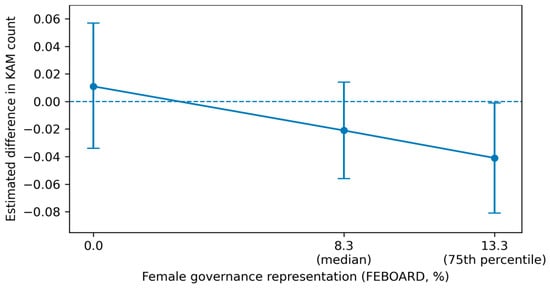
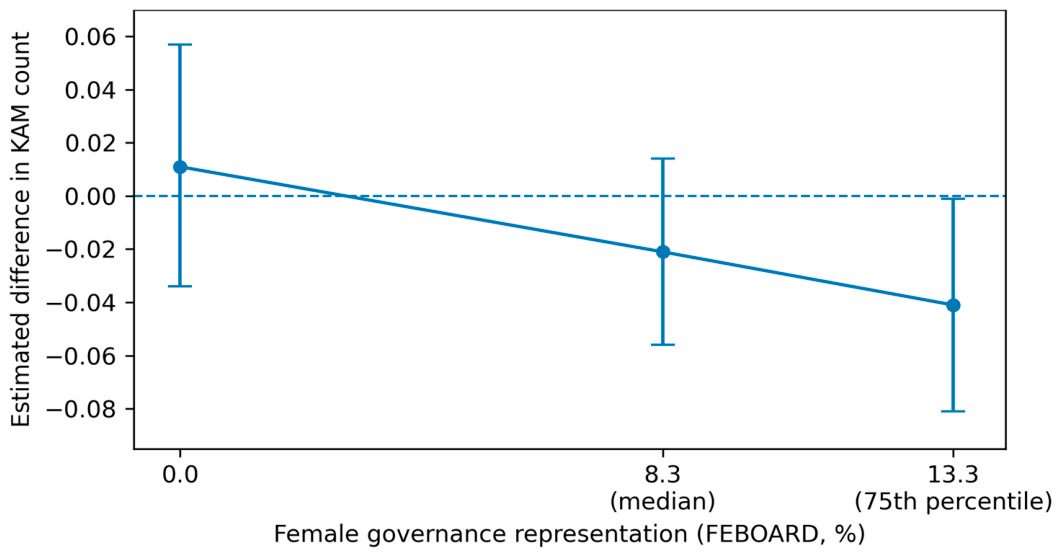
To avoid overinterpreting the interaction coefficient, Table 9 reports two observed-scale illustrations at representative levels of female governance representation. Panel A presents average predicted KAM counts from the primary Poisson specification. Panel B presents supplementary pooled firm-clustered linear predictions with 95% confidence intervals, and Figure 1 plots the Panel B KAM-count differences. Both count illustrations show a small positive difference when FEBOARD equals zero and negative differences at the sample median of 8.3% and the 75th percentile of 13.3%. In the Poisson model, the predicted differences are 0.009, −0.020, and −0.037 KAM, respectively. In the supplementary linear model, the corresponding differences are 0.011, −0.021, and −0.041, and the 95% confidence interval excludes zero only at the 75th percentile. The pattern for the total length of the KAM section differs. The estimated WORD difference is positive at FEBOARD = 0, close to zero at the median, and negative at the 75th percentile, but the confidence interval includes zero at all three values. The negative interaction coefficient for this outcome should therefore not be characterized as evidence of a general association between joint female involvement and shorter KAM narratives.
Table 9.
Conditional predicted values and female audit-partner involvement (FEAUD) differences at representative female governance representation (FEBOARD) levels.
Figure 1.
Estimated marginal effect of female audit-partner involvement (FEAUD) on key audit matter (KAM) count at representative female governance representation (FEBOARD) levels. Note: Points show the adjusted difference in predicted KAM count between FEAUD = 1 and FEAUD = 0. Vertical bars indicate 95% confidence intervals. Estimates are obtained from the supplementary pooled firm-clustered linear model reported in Table 9. The dashed line denotes zero. The figure provides an observed-scale illustration; primary inference for KAM count is based on the Poisson and zero-truncated Poisson specifications.
The economic magnitude is modest in both count illustrations. At FEBOARD = 13.3%, the primary Poisson model predicts a difference of −0.037 KAM, equivalent to approximately 3.0% of the sample mean of 1.233 KAMs and about 3.7 fewer predicted KAMs per 100 otherwise comparable firm-years. The supplementary linear model yields a closely similar difference of −0.041 KAM, equivalent to approximately 3.3% of the sample mean and about 4.1 fewer predicted KAMs per 100 otherwise comparable firm-years. Its 95% confidence interval [−0.081, −0.001] barely excludes zero, and the conditional differences at lower FEBOARD values are not statistically distinguishable from zero. These estimates indicate a small, context-dependent shift in expected reporting frequency rather than a large practical effect or higher disclosure quality.
Because WORD is measured in natural logarithms, the conditional differences of 0.031, 0.006, and −0.010 correspond to approximately +3.1%, +0.6%, and −1.0%, respectively, in expected KAM-section character count at FEBOARD values of 0%, 8.3%, and 13.3%. The point estimates are economically small, and all three 95% confidence intervals include zero. Accordingly, the results provide no statistically reliable evidence of a practically meaningful change in total KAM-section length.
6.3. Results by KAM Type
Table 10 reports the KAM-type models. These results warrant caution because ELKAMs appear in only 8.4% of firm-years, whereas ALKAMs appear in 95.7%. This imbalance is characteristic of the Japanese KAM environment, where reports are concise and account-level matters predominate, but it also limits statistical variation in binary-outcome models.
Table 10.
Logistic regressions by key audit matter (KAM) type with firm-level clustered standard errors.
In the firm-clustered interaction logit models, the conditional FEAUD coefficient is positive in the ELKAM equation when FEBOARD equals zero, and the conditional FEBOARD coefficient is negative in the ALKAM equation when FEAUD equals zero. However, none of the gender-related coefficients is statistically significant after firm-level clustering. These coefficients represent conditional log odds, not general effects on probability. The interaction terms are not statistically significant in either type model. Moreover, ELKAM and ALKAM are modeled as separate, non-mutually exclusive binary outcomes at the firm-year level. The type-specific results are therefore treated as weak and descriptive evidence on patterns in the occurrence of different KAM types rather than support for a distinct KAM-type mechanism.
7. Discussion
Four conclusions emerge. First, the primary count-data evidence does not support H1 or H2 with respect to KAM count. The non-interacted Poisson model shows no statistically significant adjusted association between either gender variable and KAM count. In the interaction models, the main-effect coefficients are conditional rather than average effects. Thus, the results provide no evidence of a statistically significant stand-alone association with KAM count; insignificant coefficients do not confirm the non-directional hypotheses.
Second, FEAUD × FEBOARD is the central empirical result, but it requires a conditional and model-sensitive interpretation. In the primary count-data specifications, the interaction is negative in both the Poisson and zero-truncated Poisson models. The corresponding interaction p-values are 0.067 in the Poisson model and 0.293 in the zero-truncated Poisson model. Supplementary Tobit and pooled firm-clustered linear checks yield statistically significant negative interaction estimates, whereas the observable-selection and firm fixed-effects estimates remain negative but are not statistically significant. The firm fixed-effects results further indicate that statistical support for the interaction is sensitive to the source of identifying variation; because the three-year panel provides limited within-firm variation in FEAUD and the interaction term, these estimates are imprecise and are treated as supplementary. The primary Poisson predictions imply a −0.037 KAM difference at the 75th percentile of FEBOARD, approximately 3.0% of the sample mean or 3.7 fewer predicted KAMs per 100 otherwise comparable firm-years. The supplementary linear illustration is closely similar at −0.041 KAM, approximately 3.3% of the sample mean or 4.1 fewer predicted KAMs per 100 otherwise comparable firm-years, with a confidence interval that barely excludes zero. The evidence for H3a is therefore limited and model-dependent. The results are consistent with lower KAM counts at higher levels of female governance representation in some specifications, but the estimated magnitude is modest and the design does not establish either communication alignment or a causal mechanism.
Third, support for H3b is weaker. The total-length interaction is negative in supplementary OLS estimates, but the conditional effects on the total length of the KAM section are not statistically distinguishable from zero at the representative FEBOARD values examined. Neither the logarithm of average characters per KAM nor WORD after controlling for KAM count supports the claim that individual KAM explanations are shorter. To the extent that a negative association with total length appears, it seems to reflect fewer reported KAMs rather than shorter individual descriptions. This distinction matters because shorter disclosure is not necessarily better disclosure: it may reflect focus, but it may also reflect omission, standardization, or insufficient entity-specific detail.
Fourth, the KAM-type analyses provide only weak and descriptive evidence on patterns in the occurrence of different KAM types. After firm-level clustering, none of the gender-related coefficients is statistically significant in the interaction logit models; the interaction terms are also not statistically significant, and the reported coefficients are log-odds coefficients rather than effects on probability. Because ELKAMs are rare, ALKAMs are highly prevalent, and the models use separate non-mutually exclusive binary outcomes, the type-specific results complement the KAM-count evidence but do not form the primary basis for the paper’s conclusions.
The broad FEBOARD measure also requires caution. FEBOARD is the percentage of female officers among all officers reported in the firm’s annual securities report, as supplied by NEEDS-Cges. The disclosed officer population is an aggregate category that may include directors, statutory auditors, and, where applicable, statutory executive officers, depending on the firm’s governance structure. The NEEDS-Cges data available for this study do not provide a role-specific breakdown of female officers. Role-specific ratios for female directors, female audit and supervisory board members, or female audit and supervisory committee members could therefore not be constructed consistently for the full sample. Accordingly, the analysis makes no role-specific claim and cannot identify which particular governance role drives the reported association. Future research should distinguish female directors, female outside directors, female audit committee members, and female executive officers when more detailed data become available.
7.1. Practical Implications
The findings have practical implications for boards, audit committees, audit firms, investors, regulators, and standard setters, but these implications must be considered within the limits of the research design. The evidence is consistent with the possibility that gender composition on the audit and governance sides is related to KAM reporting patterns. It does not demonstrate differences in risk-prioritization discussions, communication routines, coordination, or communication quality. For boards and audit committees, the results suggest that composition may be relevant to reporting patterns, not that diversity mechanically improves audit communication.
For audit firms, the findings indicate that engagement-team composition may be relevant to KAM reporting patterns, but they do not identify the communication processes underlying those patterns. KAM reporting requires professional judgment about which matters warrant public disclosure, yet this study cannot observe how that judgment is formed in private discussions between auditors and governance bodies.
For investors, the results caution against interpreting the number or length of KAMs mechanically. Fewer KAMs do not necessarily imply lower risk, and longer KAM sections do not necessarily indicate higher disclosure quality. Users should instead assess whether the reported KAMs identify consequential risks and provide entity-specific explanations.
For regulators and standard setters, the findings suggest that assessments of KAM reporting should extend beyond the number of disclosed matters. The specificity, readability, and risk relevance of KAM descriptions may be more informative than disclosure volume alone.
7.2. Limitations and Generalizability
Several limitations qualify these interpretations. The empirical design is associational and cannot identify causal mechanisms. The study does not observe private communication between auditors and governance bodies, nor can it determine whether female audit partners were assigned in response to client characteristics. The inverse-probability-weighted analysis addresses observable selection only imperfectly and cannot eliminate unobserved selection or reverse causality.
The study also does not directly measure KAM disclosure quality. KAM count, total narrative length, and KAM type capture reporting scope and disclosure focus, but they do not capture readability, specificity, boilerplate language, similarity, or decision usefulness. A shorter KAM section may be more focused, but it may also omit relevant detail. Future research should combine KAM counts with textual measures of entity specificity, readability, similarity, and boilerplate content.
The Japanese setting also limits generalizability. Mandatory KAM reporting was introduced recently, and the sample covers only the first three mandatory reporting years, during which firms and auditors may still have been adapting to the regime. Japanese KAM reports are also concise and dominated by account-level matters. The findings may therefore apply most closely to settings in which KAM reporting is concise, partner names are publicly available, and governance structures involve multiple monitoring roles. They may not extend directly to jurisdictions with more mature expanded-auditor-reporting regimes, different litigation environments, or different audit-committee structures.
8. Conclusions
This study examines whether female governance representation and the presence of a female signing audit partner are associated with KAM reporting in Japan. It draws on a final descriptive sample of 9808 firm-year observations from 2021 to 2023, with 9794 complete-case observations used in the primary multivariate analyses. The study treats Poisson and zero-truncated Poisson models with firm-level clustered standard errors as the primary KAM-count specifications and retains Tobit estimates only as supplementary robustness and comparability checks. The interaction between FEAUD and FEBOARD is negative in both primary count-data models, but the evidence is limited and model-dependent: the corresponding interaction p-values are 0.067 in the Poisson model and 0.293 in the zero-truncated Poisson model. The evidence therefore concerns a conditional and model-sensitive pattern rather than a universal stand-alone gender effect.
The results warrant caution. Evidence for H3a is limited and model-dependent: lower KAM counts appear mainly at higher levels of female governance representation and in some, but not all, specifications. The estimated differences are modest in economic terms. Support for H3b is weaker because none of the conditional effects on the total length of the KAM section at the representative FEBOARD values is statistically distinguishable from zero. The design identifies associations rather than causal effects and does not observe private communication between auditors and governance bodies. The findings should therefore be interpreted as evidence on joint female involvement, not as direct evidence of alignment between governance bodies and auditors or of communication quality.
The narrative-length result is more limited than the supplementary Tobit or OLS interaction coefficients alone might suggest. To the extent that a negative total-length association is observed, it appears to reflect fewer reported KAMs rather than shorter descriptions of individual KAMs. The KAM-type analysis likewise provides weak descriptive, not definitive, evidence on patterns of KAM-type occurrence. Because ELKAMs are rare and ALKAMs are highly prevalent in Japan, and because the gender-related coefficients are not statistically significant after firm-level clustering, these type-specific findings remain supplementary.
The study contributes by linking gender-related governance and audit characteristics to KAM reporting in a low-KAM institutional setting. It also emphasizes the importance of distinguishing KAM quantity, total narrative length, detail per KAM, and disclosure focus. Future research should examine readability, specificity, boilerplate language, direct auditor-governance communication, and cross-country differences in expanded auditor reporting.
Funding
This work was supported by JSPS KAKENHI Grant Number JP24K16485. The article processing charge (APC) was funded by the same grant.
Institutional Review Board Statement
Not applicable.
Informed Consent Statement
Not applicable.
Data Availability Statement
The author manually collected the KAM classifications and audit-related variables from public statutory reports. Financial and governance variables were obtained from NEEDS-FinancialQUEST and NEEDS-Cges, proprietary databases available under license. These licensed data cannot be made publicly available by the author. Researchers may obtain access directly from the data providers, subject to their licensing terms. Additional details of the coding process are available from the author, subject to the same restrictions.
Acknowledgments
During preparation of this manuscript, the author used OpenAI ChatGPT (GPT-5.6 Pro; accessed July 2026) for language editing and support with manuscript structure. The tool was not used to generate or modify the underlying data, statistical code, or empirical results. The author reviewed and edited all outputs and accepts full responsibility for the content of the publication.
Conflicts of Interest
The author declares no conflicts of interest.
References
- Abdelfattah, T., Elmahgoub, M., & Elamer, A. A. (2021). Female audit partners and extended audit reporting: UK evidence. Journal of Business Ethics, 174, 177–197. [Google Scholar] [CrossRef] [Scilit]
- Abdullatif, M., & Al-Rahahleh, A. S. (2020). Applying a new audit regulation: Reporting key audit matters in Jordan. International Journal of Auditing, 24, 268–291. [Google Scholar] [CrossRef] [Scilit]
- Adams, R. B., & Ferreira, D. (2009). Women in the boardroom and their impact on governance and performance. Journal of Financial Economics, 94, 291–309. [Google Scholar] [CrossRef] [Scilit]
- Ahern, K. R., & Dittmar, A. K. (2012). The changing of the boards: The impact on firm valuation of mandated female board representation. The Quarterly Journal of Economics, 127, 137–197. [Google Scholar] [CrossRef] [Scilit]
- Ahmed, A., Hussain, A., & Tessema, A. M. (2025). The dual impact of audit partner busyness and boardroom gender diversity on audit quality in Australia. Journal of Financial Reporting and Accounting. Advance online publication. [Google Scholar] [CrossRef] [Scilit]
- Armstrong, C. S., Guay, W. R., & Weber, J. P. (2010). The role of information and financial reporting in corporate governance and debt contracting. Journal of Accounting and Economics, 50, 179–234. [Google Scholar] [CrossRef] [Scilit]
- Beasley, M. S., Carcello, J. V., Hermanson, D. R., & Neal, T. L. (2009). The audit committee oversight process. Contemporary Accounting Research, 26, 65–122. [Google Scholar] [CrossRef] [Scilit]
- Bepari, K., & Mollik, A. T. (2023). Audit partners’ gender and time variances of key audit matters. Managerial Auditing Journal, 38, 1187–1214. [Google Scholar] [CrossRef] [Scilit]
- Bepari, K., Mollik, A. T., Nahar, S., & Islam, M. N. (2022). Determinants of account level and entity level key audit matters: Further evidence. Accounting in Europe, 19, 397–422. [Google Scholar] [CrossRef] [Scilit]
- Bédard, J., Gonthier-Besacier, N., & Schatt, A. (2014, June 20–21). Costs and benefits of reporting key audit matters in the audit report: The French experience. International Symposium on Audit Research, Maastricht, The Netherlands. [Google Scholar]
- Bushman, R. M., Piotroski, J. D., & Smith, A. J. (2004). What determines corporate transparency? Journal of Accounting Research, 42, 207–252. [Google Scholar] [CrossRef] [Scilit]
- Byrnes, J. P., Miller, D. C., & Schafer, W. D. (1999). Gender differences in risk taking: A meta-analysis. Psychological Bulletin, 125, 367–383. [Google Scholar] [CrossRef]
- Camacho-Minano, M., Munoz-Izquierdo, N., Pincus, M., & Wellmeyer, P. (2024). Are key audit matter disclosures useful in assessing the financial distress level of a client firm? The British Accounting Review, 56, 101200. [Google Scholar] [CrossRef] [Scilit]
- Carcello, J. V., Hermanson, D. R., & Ye, Z. (2011). Corporate governance research in accounting and auditing: Insights, practice implications, and future research directions. Auditing: A Journal of Practice & Theory, 30, 1–31. [Google Scholar] [CrossRef] [Scilit]
- Chi, W., & Pan, C. K. (2022). How do auditors respond to accounting restatements? Evidence on audit staff allocation. Review of Quantitative Finance and Accounting, 58, 847–879. [Google Scholar] [CrossRef] [Scilit]
- Chung, J., & Monroe, G. S. (2001). A research note on the effects of gender and task complexity on audit judgment. Behavioral Research in Accounting, 13, 111–125. [Google Scholar] [CrossRef] [Scilit]
- Contessotto, C., Knechel, W. R., & Moroney, R. A. (2019). The association between audit manager and auditor-in-charge experience, effort and risk responsiveness. Auditing: A Journal of Practice & Theory, 38, 121–147. [Google Scholar] [CrossRef] [Scilit]
- Croson, R., & Gneezy, U. (2009). Gender differences in preferences. Journal of Economic Literature, 47, 448–474. [Google Scholar] [CrossRef] [Scilit]
- DeAngelo, L. E. (1981). Auditor size and audit quality. Journal of Accounting and Economics, 3, 183–199. [Google Scholar] [CrossRef] [Scilit]
- Dodgson, M. K., Agoglia, C. P., Bennett, G. B., & Cohen, J. R. (2020). Managing the auditor-client relationship through partner rotations: The experiences of audit firm partners. The Accounting Review, 95, 89–111. [Google Scholar] [CrossRef] [Scilit]
- Eagly, A. H., & Johnson, B. T. (1990). Gender and leadership style: A meta-analysis. Psychological Bulletin, 108, 233–256. [Google Scholar] [CrossRef]
- Feldmann, D. A., Read, W. J., & Abdolmohammadi, M. J. (2009). Financial restatements, audit fees, and the moderating effect of CFO turnover. Auditing: A Journal of Practice & Theory, 28, 205–223. [Google Scholar] [CrossRef] [Scilit]
- Ferreira, C., & Morais, A. I. (2020). Analysis of the relationship between company characteristics and key audit matters disclosed. Revista Contabilidade & Finanças, 31(83), 262–274. [Google Scholar] [CrossRef] [Scilit]
- Francis, J. R., & Yu, M. D. (2009). Big 4 office size and audit quality. The Accounting Review, 84, 1521–1552. [Google Scholar] [CrossRef] [Scilit]
- Franke, G. R., Crown, D. F., & Spake, D. F. (1997). Gender differences in ethical perceptions of business practices: A social role theory perspective. Journal of Applied Psychology, 82, 920–934. [Google Scholar] [CrossRef] [Scilit] [PubMed]
- Frias-Aceituno, J. V., Rodriguez-Ariza, L., & Garcia-Sanchez, I. M. (2014). Explanatory factors of integrated sustainability and financial reporting. Business Strategy and the Environment, 23, 56–72. [Google Scholar] [CrossRef] [Scilit]
- Fu, Y., Lv, X., & Zheng, T. (2025). Regulation risk and the quality of key audit matters: An analysis based on the auditor’s disclosing motivation. Applied Economics, 57, 5910–5923. [Google Scholar] [CrossRef] [Scilit]
- Gul, F. A., Srinidhi, B., & Ng, A. C. (2011). Does board gender diversity improve the informativeness of stock prices? Journal of Accounting and Economics, 51, 314–338. [Google Scholar] [CrossRef] [Scilit]
- Gul, F. A., Wu, D., & Yang, Z. (2013). Do individual auditors affect audit quality? Evidence from archival data. The Accounting Review, 88, 1993–2023. [Google Scholar] [CrossRef] [Scilit]
- Gutierrez, E., Minutti-Meza, M., Tatum, K. W., & Vulcheva, M. (2018). Consequences of adopting an expanded auditor’s report in the United Kingdom. Review of Accounting Studies, 23, 1543–1587. [Google Scholar] [CrossRef] [Scilit]
- Hardies, K., Breesch, D., & Branson, J. (2015). The female auditor: Does gender impact audit quality? European Accounting Review, 24, 305–336. [Google Scholar] [CrossRef] [Scilit]
- Hardies, K., Vandennieuwenhuysen, J., Hoang, K., & Vandenhaute, M.-L. (2026). Companies’ auditor selection processes: A framework and systematic literature review. Auditing: A Journal of Practice & Theory, 45(2), 93–120. [Google Scholar] [CrossRef] [Scilit]
- He, L. J., & Rivai, F. A. (2024). The effect of gender diversity on the disclosure of key audit matters: Examination of dual-signature environment. Managerial Auditing Journal, 39, 396–418. [Google Scholar] [CrossRef] [Scilit]
- Hussin, N., Md Salleh, M. F., Ahmad, A., & Rahmat, M. M. (2023). The association between audit firm attributes and key audit matters readability. Asian Journal of Accounting Research, 8, 322–333. [Google Scholar] [CrossRef] [Scilit]
- Ibarra, H. (1992). Homophily and differential returns: Sex differences in network structure and access in an advertising firm. Administrative Science Quarterly, 37, 422–447. [Google Scholar] [CrossRef] [Scilit]
- Inoue, S. (2022). Investigating on disclosing key audit matters in Japan: An early analysis in audit reports 2021. Fukuoka University Review of Commercial Sciences, 66, 811–845. [Google Scholar]
- International Auditing and Assurance Standards Board [IAASB]. (2015). ISA 701: Communicating key audit matters in the independent auditor’s report. International Auditing and Assurance Standards Board. [Google Scholar]
- Ittonen, K., Vähämaa, E., & Vähämaa, S. (2013). Female auditors and accruals quality. Accounting Horizons, 27, 205–228. [Google Scholar] [CrossRef] [Scilit]
- Japanese Institute of Certified Public Accountants. (2019). Auditing standards committee statement No. 701: Communicating key audit matters in the independent auditor’s report. JICPA. Available online: https://jicpa.or.jp/specialized_field/2-24-701-2-20191009.pdf (accessed on 1 July 2026). (In Japanese)
- Jermakowicz, E. K., & Gornik-Tomaszewski, S. (2006). Implementing IFRS from the perspective of EU publicly traded companies. Journal of International Accounting, Auditing and Taxation, 15, 170–196. [Google Scholar] [CrossRef] [Scilit]
- Khalid, F., Toumi, F., Yue, S., & Srivastava, M. (2026). Social trust and audit report lag: The roles of internal control quality and financial misconduct. Cogent Business & Management, 13, 2620843. [Google Scholar] [CrossRef] [Scilit]
- Knechel, W. R., Vanstraelen, A., & Zerni, M. (2015). Does the identity of engagement partners matter? An analysis of audit partner reporting decisions. Contemporary Accounting Research, 32, 1443–1478. [Google Scholar] [CrossRef] [Scilit]
- Kolsi, M. C., & Al-Hiyari, A. (2026). Boardroom gender diversity’s effect on the relationship between corporate charitable donations and earnings management: Evidence from Borsa Istanbul. International Journal of Finance & Economics, 31, 1472–1486. [Google Scholar] [CrossRef] [Scilit]
- Küster, S. (2024). The determinants of linguistic features in key audit matters: Empirical evidence from Europe. International Journal of Auditing, 28, 582–614. [Google Scholar] [CrossRef] [Scilit]
- Lee, H. S., Nagy, A. L., & Zimmerman, A. B. (2019). Audit partner assignments and audit quality in the United States. The Accounting Review, 94, 297–323. [Google Scholar] [CrossRef] [Scilit]
- Lennox, C. (1999). Audit quality and auditor size: An evaluation of reputation and deep pockets hypotheses. Journal of Business Finance & Accounting, 26, 779–805. [Google Scholar] [CrossRef] [Scilit]
- Lin, H., & Yen, A. (2022). Auditor rotation, key audit matter disclosures, and financial reporting quality. Advances in Accounting, 57, 100594. [Google Scholar] [CrossRef] [Scilit]
- Liu, Y., Wei, Z., & Xie, F. (2014). Do women directors improve firm performance in China? Journal of Corporate Finance, 28, 169–184. [Google Scholar] [CrossRef] [Scilit]
- Maroun, W., & Duboisée de Ricquebourg, A. (2024). How auditors identify and report key audit matters—An organizational routines perspective. The British Accounting Review, 56, 101263. [Google Scholar] [CrossRef] [Scilit]
- McPherson, M., Smith-Lovin, L., & Cook, J. M. (2001). Birds of a feather: Homophily in social networks. Annual Review of Sociology, 27, 415–444. [Google Scholar] [CrossRef] [Scilit]
- Miah, M. S., Jiang, H., Rahman, A., & Stent, W. (2023). The impact of IFRS complexity on analyst forecast properties: The moderating role of high quality audit. International Journal of Finance & Economics, 28, 902–928. [Google Scholar] [CrossRef] [Scilit]
- Nguyen, L. A., & Kend, M. (2021). The perceived impact of the KAM reforms on audit reports, audit quality and auditor work practices: Stakeholders’ perspectives. Managerial Auditing Journal, 36, 437–462. [Google Scholar] [CrossRef] [Scilit]
- Peterson, K., Schmardebeck, R., & Wilks, T. J. (2022). Accounting changes and misstatement risk. SSRN Working Paper No. 3745418. SSRN. [Google Scholar] [CrossRef] [Scilit]
- Pinto, I., & Morais, A. I. (2019). What matters in disclosures of key audit matters: Evidence from Europe. Journal of International Financial Management & Accounting, 30, 145–162. [Google Scholar] [CrossRef] [Scilit]
- Sierra-Garcia, L., Gambetta, N., Garcia-Benau, M. A., & Orta-Perez, M. (2019). Understanding the determinants of the magnitude of entity-level risk and account-level risk key audit matters: The case of the United Kingdom. The British Accounting Review, 51, 227–240. [Google Scholar] [CrossRef] [Scilit]
- Simunic, D. A. (1980). The pricing of audit services: Theory and evidence. Journal of Accounting Research, 18, 161–190. [Google Scholar] [CrossRef] [Scilit]
- Skinner, D. J. (1994). Why firms voluntarily disclose bad news. Journal of Accounting Research, 32, 38–60. [Google Scholar] [CrossRef] [Scilit]
- Srinidhi, B., Gul, F. A., & Tsui, J. (2011). Female directors and earnings quality. Contemporary Accounting Research, 28, 1610–1644. [Google Scholar] [CrossRef] [Scilit]
- Velte, P. (2018). Does gender diversity in the audit committee influence key audit matters’ readability in the audit report? UK evidence. Corporate Social Responsibility and Environmental Management, 25, 748–755. [Google Scholar] [CrossRef] [Scilit]
- Velte, P., & Issa, J. (2019). The impact of key audit matter (KAM) disclosure in audit reports on stakeholders’ reactions: A literature review. Problems and Perspectives in Management, 17, 323–341. [Google Scholar] [CrossRef] [Scilit]
- Verrecchia, R. E. (2001). Essays on disclosure. Journal of Accounting and Economics, 32, 97–180. [Google Scholar] [CrossRef] [Scilit]
- Watts, R. L. (2003). Conservatism in accounting part I: Explanations and implications. Accounting Horizons, 17, 207–221. [Google Scholar] [CrossRef] [Scilit]
- Wuttichindanon, S., & Issarawornrawanich, P. (2020). Determining factors of key audit matter disclosure in Thailand. Pacific Accounting Review, 32, 563–584. [Google Scholar] [CrossRef] [Scilit]
- Yue, S., Bajuri, N. H., Wang, B., & Samara, H. (2026). Artificial intelligence and sustainable governance: The moderating role of board gender and age diversity. Journal of Management and Governance. Advance online publication. [Google Scholar] [CrossRef] [Scilit]
- Zhao, Y., Su, K., & Xu, Y. (2025). Does key audit matters (KAMs) disclosure affect corporate financialization? Journal of Contemporary Accounting & Economics, 21, 100491. [Google Scholar] [CrossRef] [Scilit]

Disclaimer/Publisher’s Note: The statements, opinions and data contained in all publications are solely those of the individual author(s) and contributor(s) and not of MDPI and/or the editor(s). MDPI and/or the editor(s) disclaim responsibility for any injury to people or property resulting from any ideas, methods, instructions or products referred to in the content. |
© 2026 by the author. Licensee MDPI, Basel, Switzerland. This article is an open access article distributed under the terms and conditions of the Creative Commons Attribution (CC BY) license.