


Abstract
With the growing relevance of sustainable accounting reports, new ways of evaluating the accountability of firms have come into practice, particularly in sectors that are environmentally sensitive, such as the oil industry. However, doubts have emerged over whether sustainable reporting based on ethical principles actually reflects the sustainability performance of firms. This question becomes even more relevant in the context of transition economies, where weak institutional capacity leaves room for corporate manipulation. This paper attempts to determine whether sustainability reporting based on ethical principles indicates actual financial performance in transition economies or merely reflects the symbolic compliance trend among firms. In this regard, a financial ratio–based benchmarking methodology was applied to assess whether there is a link between financial and sustainability indicators of oil firms in transition economies like Albania, Bosnia and Herzegovina, Kosovo, Montenegro, North Macedonia, and Serbia. The paper expands on financial ratio benchmarking approaches by incorporating sustainable accounting into its methodology and presents an empirical analysis based on data from transition economies. Benchmarking methods in this research consist of mixed approaches, including secondary data analysis by using publicly available reports, financial statements, sustainability reports, and databases related to firms, alongside primary data collection based on the structured survey conducted among managers and sustainability specialists of the sampled of oil firms. The sampling includes 30 oil firms active in six countries of the Western Balkans for a five-year period. As opposed to previous research studies that used sustainability indicators based on multiple measures, the current paper uses benchmarking methods with the help of accounting-based financial ratios. The results indicate that sustainability performance reported by oil firms in transition economies can be described as more symbolic than real, as measured in terms of financial performance in environmental and cost-related aspects. The findings provide practical implications for regulators, investors, and policymakers seeking to strengthen sustainability governance, disclosure quality, and environmental accountability in transition economies.
1. Introduction
The inclusion of sustainability within corporate reporting has significantly impacted accounting practices in terms of changes within high-impact industries such as oil (Tsang et al., 2023). The integration of sustainability into the narrative of firms’ disclosures within financial and non-financial reports has been identified as part of their attempts at becoming more ethical and creating more sustainable business models. Nevertheless, the relationship between such disclosures and actual performance on sustainability issues remains in question. A number of scholars have pointed out discrepancies between so-called ‘symbolic’ and ‘substantive’ reporting within organizations (Cho et al., 2015; Lyon & Montgomery, 2015). Symbolic reporting refers to instances in which firms report certain aspects of sustainability to reinforce their legitimacy but do not implement any changes to their performance. Meanwhile, substantive reporting refers to instances in which firms demonstrate improved performance in reported areas of their operations (Bebbington et al., 2014). The concept of “symbolic” is applied in describing accounting disclosures without substantial support from accounting evidence. The differentiation between symbolic and substantive accounting disclosures is critical to the research and will be discussed using a ratio-based benchmarking technique.
In this paper, the topic will be examined with regard to the Western Balkan countries1 because the region is characterized by transition economies, weak regulation, and varying forms of ownership. Specifically, the oil sector in the region includes firms from different countries of origin: some are subsidiaries of foreign firms, while others are locally owned private firms (Frey, 2024). Most of them have embraced sustainability reporting in their financial statements and other disclosures, but the extent to which these disclosures reflect actual performance remains unclear.
With regard to the Western Balkans, the 2024 Regional Cooperation Council report identifies structural disadvantages: reliance on fossil fuels; poor environmental performance; high energy intensity; and a lack of institutional capacity to pursue sustainable reforms (Regional Cooperation Council (RCC), 2025). The same source also identifies one additional characteristic: transition economies in the region tend to apply environmental standards inconsistently and incompletely, leading to a situation in which sustainability reporting develops faster than operations and accounting. The transition in the energy sector in the Western Balkans takes place in a complex setting, including dependence on fossil fuels, aging of the infrastructure, weak institutions, and increasing pressure towards alignment with climate change policies in Europe (Frey, 2024). Despite the official commitment to the Green Agenda for the Western Balkans and reaching carbon neutrality by 2050, the efforts towards decarbonization have been rather ineffective. The underinvestment in energy infrastructure, fragmentation of energy markets, weak capacity to implement the agenda, and the persistence in state-led energy sector development represent some of the reasons behind the observed trend. Collectively, these structural and institutional characteristics make the Western Balkan oil industry a particularly relevant context for examining the alignment between ethical accounting disclosures and underlying accounting practices within transition economies undergoing European integration and energy transition pressures (Udovički & Erić, 2021).
In this regard, the present study seeks to address the gap by employing an analysis of ethical accounting disclosures with the use of a framework based on financial ratios. Rather than relying on the sustainability index, which encompasses various aspects, the study focuses on accounting measures that provide quantified figures for assessing sustainability performance. As such, there is an opportunity to compare the results from the disclosed information with the financial ratios, allowing for a better assessment of the disclosure quality. Specifically, this study seeks to address the following research question: To what extent does the ethical accounting disclosure in the oil industry of the Western Balkans reflect sustainability performance as determined by financial ratios?
The following are three major contributions of the study to the relevant body of literature. First, the current research contributes to ethical accounting disclosure studies by shifting the direction of research from measuring sustainability through composite metrics to ethical accounting practices as measured through financial ratios. Second, the study provides a new benchmarking approach that links the principles of ethical accounting disclosure, including transparency, prudence, and accountability, with financial benchmarks, which can contribute to a more objective evaluation of firms’ sustainability. Third, the paper provides an empirical application of the theoretical approach to the Western Balkan oil industry in a transition economy environment.
This study employs an accounting benchmarking approach that relies on publicly available financial data and sustainability information compiled from questionnaire-based data obtained from oil firms in the Western Balkans. The five-year span has been used to analyze the accounting performance of sustainability using several financial ratios that are consistent with ethical accounting practices. The originality of this research does not lie in the fundamental division between symbolic and substantive ethical accounting disclosure, which is recognized and accepted as a part of sustainability accounting literature. The novelty accounting, in which concrete ethical accounting disclosure practices are combined with the calculation of financial ratios. Thus, the application of the above-discussed approach to the oil industry of the Western Balkans is its methodological novelty.
2. Literature Review
Sustainable accounting has shifted from its limited approach to environmental reporting to become a holistic accountability system. This approach combines financial reporting with ethics, environmental challenges, and the firm’s long-term sustainability. In contrast to conventional accounting, which focuses on profit generation, liquidity, solvency, and shareholder dividends, sustainable accounting broadens reporting to cover the impact of the operations of the firm on natural resources, people, the environment, regulatory bodies, and posterity (Rossignoli et al., 2021). This more extensive approach is particularly vital in industries prone to environmental challenges, such as the oil industry, where financial statements might fail to fully illustrate the firm’s environmental obligations, risks involved, social challenges, or public relations issues (Serafeim, 2020). In this industry, sustainable accounting, therefore, goes beyond being a mere reporting technique, but becomes a tool for ethical accountability.
The primary research problem in sustainable accounting is determining whether corporate disclosures signify real accountability or just symbolically communicate information. The literature suggests that firms may disclose sustainability information in an effort to gain legitimacy, appeal to investors, and meet regulatory requirements even if such information is unrelated to performance indicators (Rusconi, 2019). The relevance of this topic becomes clearer in transition economies, which are characterized by less developed regulatory institutions compared to developed countries. Thus, in transition economies, sustainable accounting practices implemented by firms may turn into mere periodic activities, while they remain opaque regarding environmental expenses, provisions, liabilities, and future risks (Velte, 2023). As such, benchmarking, as explained by Kacani et al. (2022) provides a useful context for this study since it uses financial ratios to analyze firms in the oil industry currently operating in the Western Balkans, where firm-level information is relatively scarce.
The adoption of sustainability accounting in transition economies can be traced to both internal and external motivators. For instance, according to Ikpor et al. (2022), using data from Nigeria, it can be established that sustainability reporting in transition economies is a function of governance, firm attributes, and stakeholder pressure, but not necessarily regulatory requirements. Importantly, this has significant implications as it indicates that, besides the existence of reporting standards, sustainability reporting quality will be influenced by the strength of internal governance practices and external monitoring. In transition economies where institutional enforcement environments are weak, firms tend to disclose selectively. In these cases, firms tend to disclose favorable sustainability practices while intentionally omitting adverse environmental issues. Such issues include environmental pollution, emissions, occupational safety, and environmental penalties (Okpala & Iredele, 2018). This means that, when assessing the sustainability disclosures of any firm, there is a need to consider whether the disclosures correspond to actual financial measures of the organization. One industry in which the ethical dimensions of accounting disclosures can be effectively studied is the oil sector. The question of whether disclosures in sustainability accounting adequately represent true environmental performance has remained unanswered for some time now. Previous studies have shown that sometimes the strength of disclosures does not correlate with actual environmental improvement, especially in industries that experience high levels of legitimacy pressure (Cho et al., 2015; Michelon et al., 2015). In essence, firm could be making large disclosures without necessarily reflecting high environmental intentions from a financial perspective. Such considerations become important in the oil sector because provisions for environmental issues, capital spending on environmental projects, and environmental clean-up costs provide clear examples of the accounting representation of sustainability intentions.
Oil firms are always under close observation due to their emissions, spills, land degradation, community effects, and environmental remediation. It means there is significant interest in making disclosures about environmental sustainability issues, as they help firms maintain their social license to operate (Popoola & Onmonya, 2024). Nevertheless, research on oil firms operating in transition economies shows that this practice is inconsistent and unreliable. Namely, there is some evidence of studying the sustainability disclosure of Sub-Saharan African oil firms in connection with financial performance; however, such disclosures raise some concerns regarding their consistency and comparability (Onyebuenyi & Ofoegbu, 2022). At the same time, one may say that Nigerian oil firms’ sustainability disclosures also depend on many other aspects, except for their ethics and responsibility. Thus, the research proves that these firms’ disclosures are largely dependent on the size, ownership, regulation, and profitability (Olayiwola & Adebisi, 2024). There is little doubt that the experience of the Nigerian oil industry can be applied to analyzing the situation in the Western Balkans. Indeed, this comparison is necessary, as the Nigerian experience shows how petroleum operations in transition economies are associated with the need to shift from voluntarily making sustainability disclosures to making environmental and climate disclosures. In particular, Nigeria has recently introduced IFRS-based standards for sustainability and climate disclosures that are linked to stopping superficial compliance with regulations and greenwashing (Anyaogu, 2024). This example is relevant to the Western Balkans, given the increasing international pressure on transition economies to improve sustainability disclosures backed by accounting data.
Legitimacy theory and institutional theory form the basis of this analysis. The legitimacy theory is based on the idea that firms are keen to align themselves with social expectations as part of their efforts to ensure their continued legitimacy, as well as their ability to retain access to necessary resources (Suchman, 1995). Within sustainable accounting, legitimacy theory suggests that firms can disclose information concerning their ethics as a way of improving their public image, regardless of the fact that the firm has not made any changes in its activities. Thus, legitimacy theory plays a critical role in explaining symbolic sustainable accounting disclosures. Legitimacy, according to Suchman (1995), refers to the perceptions people have that the behavior of a firm is socially desirable and appropriate. According to legitimacy theory in accounting research, firms have disclosed social and environmental information, particularly when their operations were controversial or environmentally damaging (Deegan, 2002). Oil firms face significant legitimacy pressures due to the link between their operations and pollution and environmental destruction. Thus, sustainability disclosures may be a method of repairing their legitimacy, especially when there is a dramatic increase in sustainability disclosures following environmental controversies or regulatory pressures, yet no improvement in financial or operational performance. Empirical evidence is increasingly focusing on the gap between the effectiveness of sustainability disclosure and real-world environmental performance. It shows that firms that engage in extensive sustainability disclosure do not necessarily achieve good environmental outcomes, meaning that intensive sustainability disclosure does not necessarily reflect actual environmental performance (Tsang et al., 2023; Wang & Fan, 2025; Garefalakis et al., 2026). This distinction emphasizes the importance of financial ratios for determining whether sustainability is based on accounting figures. Environmental liabilities are primarily recognized under IAS 37, which governs provisions arising from environmental remediation, decommissioning obligations, and future restoration commitments. In the extractive and energy sectors, these obligations provide one of the most direct accounting representations of environmental responsibility because they require firms to recognize future environmental costs within current financial statements. Accordingly, environmental provisions were incorporated into the benchmarking framework as an important indicator of substantive sustainability commitment beyond narrative disclosure.
The idea of institutional theory complements that of legitimacy by explaining why firms across different nations and sectors tend to align their reporting practices. According to DiMaggio and Powell (1983), coercive, mimetic, and normative pressures cause firms to become increasingly similar over time. Coercive pressures include laws, regulations, and state organizations. On the other hand, mimetic pressures arise when firms mimic other firms perceived as leaders amid uncertainty, and normative pressures are created through professionals’ codes of conduct, accountancy organizations, consultants, auditors, and industry organizations. In the context of sustainable accounting, the aforementioned pressures may lead firms to adopt sustainability reporting guidelines even in the absence of effective measures. Modern accounting literature further explores institutional theory in terms of corporate social and environmental accounting while stressing that an institutionally based adoption of a particular practice does not necessarily entail real accountability (Eitrem et al., 2024). Thus, both theories suggest that there is little relation between institutional compliance and corporate ethics in the context of reporting sustainability-related information. Following the difference made in the sustainability and legitimacy accounting research between symbolic and substantive sustainability reporting (Cho et al., 2015; Lyon & Montgomery, 2015; Tsang et al., 2023), the former refers to environmental responsibility disclosures that are accompanied by a sense of commitment towards sustainability but are not yet backed up with any measurement or operationally oriented accounting practices. The latter reflects a higher correlation between the reported information on the matter and the firm’s accounting practices and environmental commitments.
In recent years, significant differences have been found in the quality of sustainability accounting and reporting, sustainability disclosure, and the nature of sustainability-related accountability systems in European transition and emerging economies. The analysis of current conditions in Central and Eastern Europe indicates that sustainability reporting in these countries is still driven by institutional pressures and regulatory convergence. In Romania and other countries emerging from transition periods, there has been an enormous increase in sustainability-related disclosures over the last ten years; however, several studies suggest that sustainability disclosure practices are predominantly compliance-based and are primarily aimed at legitimacy (Grosu et al., 2023). Similarly, studies on non-financial reporting across European countries provide evidence of considerable variation in the quality and comparability of disclosures (La Torre et al., 2018).
The findings in Croatia, Serbia, Poland, the Czech Republic, and other nations in Central and Eastern Europe suggest that sustainability reporting quality is more strongly associated with variables such as foreign ownership, market listing status, and regulatory requirements, rather than with internally developed capabilities in sustainability accounting. Mio et al. (2020) show that legitimacy motivations remain significant drivers of non-financial disclosures despite the introduction of reporting guidelines in Europe. On the other hand, for Velte (2023), the relationship between sustainability reporting and sustainability performance is uneven across various institutional environments. Such information becomes particularly relevant regarding the Western Balkan region due to the process of integration into Europe and the development of sustainability reporting frameworks, which make the use of such reporting increasingly attractive even as the capabilities of sustainability accounting and environmental accountability are still developing. Thus, transition economies present an excellent environment for studying the relationship between sustainability disclosures and accounting-based evidence of sustainability.
The dynamics of the Western Balkans add color to the discussion. Firms from countries like Albania, Bosnia and Herzegovina, Kosovo, Montenegro, North Macedonia, and Serbia operate under conditions in which integration into Europe, investment, state and family ownership, and market fragmentation shape their economies. In that respect, the use of sustainability information could be seen as an attempt to align with international trends or gain a competitive advantage in terms of financing and reputation. The problem, however, lies in differences in regulatory and disclosure practices; thus, simply using sustainable accounting terminology would not indicate improved performance by the firm. A financial ratio analysis provides an effective perspective for evaluating the actuality or symbolism of ethical accounting disclosures. For many decades, financial ratios have been successfully used to evaluate liquidity, solvency, profitability, and risk (Brigham & Houston, 2022; Fridson & Alvarez, 2022). In case of sustainability accounting, it will be possible to apply ratios such as carbon intensity, energy intensity, environmental cost ratios, environmental provisions/total liabilities, fines/revenues, training intensity, injury rates, and audit independence. However, the application of these ratios should not be taken as an attempt to replace qualitative assessment of accounting disclosures; these ratios simply provide more substantial accounting data that allow making more informed judgments about the real value of ethical disclosures. Similar benchmarking practices are widely used to evaluate firms’ risk and performance across various countries and industries in the Western Balkans (Kacani et al., 2022; Shaqiri et al., 2024). Financial ratio analysis is an established method for evaluating firm performance. The use of financial ratios based on financial statement data provides objective measures of firm activity that allow estimation of their efficiency, risks, and resource allocation (Fridson & Alvarez, 2022).
Consequently, the existing literature points out three significant gaps which this study intends to address. Firstly, sustainable accounting research has paid more attention to developed countries while less attention has been devoted to transition economies (Rizzato et al., 2019). Secondly, although there is a large body of literature on disclosure problems in the oil industry in emerging markets, studies comparing ethical accounting disclosure measures with financial ratio-based benchmarks remain scarce. Thirdly, the oil industry in the Western Balkans, with its unique characteristics such as environmental consciousness, institutions in transition, and diverse ownership, has been examined less by researchers (Bosi et al., 2022).
3. Principles Applied in Ethical Accounting in the Oil Industry
The notion of ethical accounting refers to an approach grounded in principles that enable firms to identify, measure, communicate, and substantiate the financial and nonfinancial consequences of sustainability, characterized by transparency, faithful representation, prudence, accountability, comparability, materiality, and independent verification. In the oil industry, this entails the need to provide tangible proof of all the firm’s liabilities to the environment, the expenses associated with rehabilitation and decommissioning, provisions for local communities, and sustainability risk management. The above definition of ethical accounting was borrowed from the theory of sustainability accountability, which posits that accounting is more than just financial information for the benefit of shareholders (Bebbington et al., 2014; Rusconi, 2019).
In this context, ethical accounting is an excellent addition to the broader paradigm of sustainability accountability. It is important to emphasize that both sustainability accountability and ethical accounting frameworks place an emphasis on the need for organizations to take responsibility for all the social, environmental, and economic implications of their operations and to provide stakeholders with information about impacts, risks, and commitments. In other words, these frameworks assume that accountability does not mean only reporting of compliance with requirements. Rather, it means showing how sustainability goals are incorporated into governance, decision-making, and allocation of resources.
It can be assumed that ethical accounting is an excellent framework to support such a broad approach by structuring the process of transforming commitments to sustainable performance into accounting recognition, reporting, and verification of sustainability results. The difference from other frameworks is that ethical accounting places much importance on the significance of accounting evidence such as environmental provisions, environmental liabilities, sustainability expenses, governance procedures, and verification procedures.
Additionally, ethical accounting promotes ethical sustainability governance through stressing the importance of such values as transparency, accountability, prudence, and stakeholder responsibility in corporate reporting (Rusconi, 2019; Cucari et al., 2018). Through supporting better correspondence of disclosures with the accounting results, ethical accounting reduces the amount of symbolic reporting. Thus, ethical accounting is not only a reporting mechanism but also a governance tool that provides sustainability accountability.
Ethical accounting within the oil industry is anchored on the understanding that accounting should not simply aim to ensure compliance with accounting rules, but should provide a true, transparent, and relevant accounting of the environmental and social impact of petroleum operations. Such standards are particularly important in an industry where profit generation is often associated with significant negative environmental impacts, including emissions, soil degradation, oil spills, gas flaring, decommissioning liabilities, and cleanup expenses. Ethical accounting, therefore, requires organizations to account for more than just financial matters pertinent to their investors, but also for social and environmental issues important to the impacted communities (Grosu et al., 2023; Bebbington et al., 2014; Serafeim, 2020). These principles and the corresponding financial ratios are displayed in Figure 1.
Figure 1.
Principles of ethical accounting and corresponding financial ratios. Note: Prepared by the authors based on Tsang et al. (2023), Garefalakis et al. (2026), Rusconi (2019), La Torre et al. (2018), Cho et al. (2015), Velte (2023), and Grosu et al. (2023).
Transparency is the first principle regarding their sustainability accounting practices. Transparency is especially important for the oil sector because there are lagging, uncertain, or transferred costs associated with pollution from the industry (Tsang et al., 2023). Previous studies examining disclosures of environmental information by oil firms operating in developing nations indicate significant variation in the extent of disclosure among firms (Nwangele, 2025; Michelon et al., 2015). The variations are not only with regard to whether firms make disclosures, but also to the specificity, completeness, and verifiability of those disclosures. It is worth noting that the transparency of accounting practices assumes even greater importance in transition economies. Publicly available registries and corporate reports provide limited environmental information.
The second principle of ethical accounting includes faithful representation, which requires information provided to accurately reflect true performance. For firms in the oil industry, the need for faithful representation translates into making sustainability assertions based on reliable accounting figures, such as environmental expenditures, environmental reserves, fines, environmental liabilities, energy intensity, carbon intensity, and decommissioning provisions (Garefalakis et al., 2026). The potential threat of impression management in this context arises when firms disclose a wide array of sustainability stories but provide no information on the financial impacts of environment-related risks. According to Cho et al. (2015), sustainability reports can serve as an impression management tool, whereas Lyon and Montgomery (2015) provide empirical evidence that greenwashing occurs through impression management in corporate communication.
The third principle is prudence, which is particularly relevant for environmental provisions and contingent liabilities. Prudence, on the other hand, plays a critical role in terms of environmental provisions and contingent liabilities (Rusconi, 2019). Firms in the oil industry face issues related to site restoration, asset retirement, environmental cleanup, and decommissioning, among others. As per IAS 37, Provisions, Contingent Liabilities and Contingent Assets, there must be recognition of provisions when there exists a present obligation, and there is a probability of an outflow of resources; moreover, the measurement of the provision should also be reliable. According to the IFRS Foundation (2025), such provisions should be disclosed so that users can understand their characteristics and contingent liabilities. In this regard, prudence can apply to the operations of the oil industry, meaning that ethical accounting involves a proper assessment of future risks and obligations related to environmental matters. The emerging literature on accounting for environmental liabilities under IAS 37 focuses on the complexities and difficulties involved. Even though the creation of environmental liabilities should cover possible remediation, reclamation, and decommissioning liabilities in the future, managers have wide discretion in recognizing, assessing probabilities, and valuing such liabilities. Consequently, there could be an understatement of such liabilities (IFRS Foundation, 2025; Velte, 2023; Garefalakis et al., 2026).
Fourthly, the principle of accountability implies that accounting information can be useful to various stakeholders other than just stockholders (Rasche et al., 2023). The stakeholders of oil firms include workers, lenders, regulators, communities, suppliers, government agencies, and future generations. In transition economies, the concept of accountability is even more relevant, as there may be a lack of regulatory control and communities rely on firms’ reporting to understand social and environmental risks (Yeşil, 2024). Studies of sustainability accounting conducted in Nigeria have revealed that stakeholders demand more economic, social, and environmental information from firms, and sustainability reporting is significantly affected by institutional and governance factors (Ikpor et al., 2022). Thus, accountability in the oil industry requires disclosure of information on expenditures related to negative environmental impacts and on funds spent to prevent them.
Comparability is the fifth principle and refers to accounting disclosures that enable comparisons of accounting data over time, across different nations, and between firms with different ownership structures (La Torre et al., 2018). The importance of this principle cannot be overstated because the oil industry in the Western Balkans comprises locally owned firms, foreign-owned firms, and regional distributors. It is difficult to compare the quality of sustainability reporting between two firms without using comparable ratios. Financial ratio benchmarking provides a feasible way to compare firms using their accounting figures. This technique is exemplified in several works by Kacani et al. (2022) and Shaqiri et al. (2024), which show how accounting ratios could be used to determine the risk and financial performance of firms regardless of national boundaries. In ethical accounting, ratios such as the environmental cost ratio, the environmental provisions-to-liabilities ratio, the training intensity ratio, and the audit independence ratio will enhance the comparability of financial statements (Andriastuti, 2025).
The sixth principle of accounting, which is materiality, requires firms to provide users of both financial and non-financial statements with information that can influence their decisions. Environmental matters in the oil industry have materiality since they affect the firm’s ability to generate cash flow, be exposed to regulations, obtain financing, manage asset value, and mitigate the risk of damage to reputation (Mio et al., 2020). The consideration of materiality in accounting is important, especially where there are risks associated with carbon, retirement obligations of assets, environmental costs, and compliance costs. According to Velte (2023), environmental obligations, including those associated with decommissioning, may increase due to new regulations or climate change policies, thereby requiring appropriate reporting by organizations owning assets with a long useful life. Ethically speaking, materiality should not be viewed in a restrictive sense as far as providing environmental information is concerned.
The seventh principle addresses independent verification and assurance. Independent audits and assurance can lend credibility to ethically disclosed information. In the oil industry, because environmental reporting relies largely on technical estimates and managerial discretion, assurance helps limit selective disclosure. According to Buchetti et al. (2025), assurance has become important in ensuring credible reporting of corporate responsibilities, although the degree of assurance varies between nations and the providers of assurance services. This becomes more relevant in transition economies, where poor enforcement may allow firms to report on their sustainability information without proper verification. Therefore, the presence or absence of assurance may be considered an ethical accounting measure for benchmarking using financial ratios (Gerritsma, 2020).
This can be better understood with examples from the case studies of transition economies, which are reliant on oil production, and Nigeria serves as an interesting example in this case. As an oil-producing country, Nigeria has faced several environmental issues related to gas flaring, pollution, and waste disposal. It is now mandatory for organizations operating within the nation to use environmental and climate reporting criteria for their operations. The regulators believe that these reporting activities must help address greenwashing tendencies and should not serve merely as a tick-the-box exercise (Anyaogu, 2024). This case shows a shift from voluntary sustainability disclosures to regulated accountability practices, but one thing needs to be considered. According to a study by Wang and Fan (2025), the green sustainability performance and operational efficiency of major international oil and gas firms operating across both developed and emerging economies are analyzed. The paper does not focus on a single country, but instead evaluates a global sample of multinational oil and gas firms to measure sustainability efficiency and environmental performance. Studies in Sub-Saharan Africa further justify ethical accounting within the oil industry. In a study examining environmental sustainability disclosure and firm performance in listed oil and gas firms in Nigeria, Namibia, and Kenya, Onyebuenyi and Ofoegbu (2022), reveal that the relevance of sustainability disclosures is increasing in terms of performance assessment in oil producers and distributors. It is particularly significant when applying these insights to the Western Balkans, as sustainability disclosure must be assessed alongside firm-level performance measures. In a similar study, it was observed that environmental accounting and sustainability disclosures in Nigerian oil firms are linked to corporate social responsibility and corporate financial performance (Okonewa, 2023).
Another set of findings from the developing world supports this perspective. Studies conducted in Ghana on green accounting practices found that mining, oil, and gas firms have increasingly incorporated sustainability-related data into their accounting practices. The problem is that the degree of incorporation varies across firms (Grosu et al., 2023). What can be concluded is that while firms in resource-intensive industries tend to adopt environmentally oriented practices, this does not necessarily mean they do so for moral reasons, since the ethical value of these practices depends on the transparency and comparability of the information they provide. Similar findings were identified by Zhen and Rahman (2024) in Bangladesh that suggest that environmental management accounting and green finance positively relate to sustainability related outcomes in transition economies.
For firms in the oil industry operating in the Western Balkans, these values imply considering ethical accounting information from two perspectives: narratives and ratios. A firm in the industry that makes promises about its sustainability yet fails to mention aspects such as environmental obligations, cleanup expenses, fines, energy efficiency, or environmental spending could be engaged in symbolic tendencies in accounting practices. However, a firm that records its environmental obligations and invests resources in addressing these issues could provide more convincing evidence of substantive accountability, despite its modest statements regarding sustainability. This is the key point of the research, which seeks to transform ethical accounting from a communicative process into an accountable one. In general, ethical accounting in the oil sector should be viewed as a principles-based system grounded in fundamental principles such as transparency, faithful representation, prudence, accountability, comparability, materiality, and independent assurance (Tsang et al., 2023). The above-mentioned principles are particularly important in transition economies, where institutional enforcement mechanisms are often less effective, thereby allowing companies to engage in greenwashing. The current research proposes an empirical tool for financial ratio benchmarking that enables the determination of whether the disclosure practices of oil firms have substance or are merely symbolic (Wang & Fan, 2025).
Although there is an emerging stream of research on sustainability accounting, there are three significant gaps in the literature. The first gap is that most studies rely on composite sustainability indices, which may mask organizational-level differences and impede transparency in performance assessment. The second gap pertains to the extensive amount of research conducted in relation to the oil sector in developed countries, but little empirical work has been done for transition economies. Lastly, there have been limited studies that directly link the principles of ethical accounting to financial ratio-based measures. This study addresses these gaps by developing a ratio-based benchmarking framework that operates ethical accounting principles within the Western Balkan oil industry.
4. Materials and Methods
The research follows the perspective of critical realism and pragmatism. In ontological terms, it sees the sustainability accounting practices as consisting of observable as well as socially constructed aspects. The disclosures made by corporations may be able to construct legitimacy discourses, but the financial impact of obligations, provisions, expenses, liabilities, and the consumption of energy is observable via financial metrics. In epistemological terms, it neither assumes nor denies that ratios alone can provide an understanding of ethical accounting practices; rather, ratios can serve as observable metrics to measure the extent to which sustainability discourse is financially backed.
This paper uses a financial ratios approach to examine whether ethical accounting disclosures in the Western Balkans’ oil industry are considered sustainable accounting in practice or are purely symbolic. The research design follows the approach of similar studies conducted among firms in the Western Balkans. Kacani et al. (2022) developed a benchmarking tool for assessing Western Balkan firms using accounting information and financial ratios, while Shaqiri et al. (2024) further refined this technique by developing an instrument combining surveys and ratios for Western Balkan firms, applying a five-year span of information and firm-level classification to identify the difference between industries. Inspired by this methodology, the proposed study is also using the logic underlying these studies but adapting them to the oil industry through the use of financial ratios as well as sustainability ratios to capture ethical accounting practices (Nguyen et al., 2024). From the perspective of critical realism, financial ratios do not perfectly reflect the organization’s reality; rather, they are observable and empirically useful for highlighting the organization’s actual accounting practices related to sustainability. Despite reporting and measurement issues, such indicators provide a foundation for assessing the accounting support for sustainability disclosures.
4.1. Population and Sample
The research will examine oil firms in the six Western Balkan countries, which include Albania, Bosnia and Herzegovina, Kosovo, Montenegro, North Macedonia, and Serbia. It will adopt purposive sampling where 30 oil firms are selected based on their financial performance, operations, ownership, and disclosure practices. It is appropriate because the oil industry in the region is more concentrated, and some firms lack sufficient information to benchmark using ratios. In the sample, upstream firms explore, drill, and produce crude oil, while downstream firms distribute, market, store, and transport petroleum products. A third category in the sample refers to integrated firms. In the sample, integrated firms combine upstream operations with refining, marketing, or distribution activities. For the purposes of the study, it is essential to distinguish among these three types of firms, given significant differences in their environmental impacts. The activities undertaken by upstream firms, including exploration, drilling, and crude oil production, make them more exposed to environmental risks due to decommissioning, reclamation, and provisioning requirements. In contrast, firms that distribute, market, store, and transport petroleum products face lower production risks but greater exposure through logistics and related activities. The sample selection criteria are presented in Table 1. Purposive sampling was selected due to the highly concentrated nature of the oil industry in the Western Balkans and the limited availability of accounting information related to sustainability. Thirty firms were finally included in the sample based on their economic significance, environmental impact, relevance, and availability of relevant financial information. In cases where smaller, local firms failed to meet any of the criteria, such as turnover, employees, operations, or disclosures used to create benchmarks based on ratios, they were excluded from the sample. It can thus be said that the results obtained only represent the larger oil firms in the region.
Table 1.
Firm selection criteria in the oil industry.
The period covers five years, providing insight into how financial sustainability indicators persist and remain consistent over time. This five-year period follows the same rationale used when obtaining financial statements for five years and survey and financial data for five years, to allow benchmarking among firms. The selection of firms involves identifying economically important oil firms that contribute to environmental and accounting impacts. The sample is limited to firms that meet minimum standards for turnover, number of employees, distribution channels, ownership significance, industrial sector, and access to sustainability information.
For the present study, a purposive sampling strategy was employed to select firms with the greatest economic significance in relation to oil in the Western Balkan countries. Rather than achieving statistical representation across all oil sector organizations, the objective was to identify firms with an appropriate level of reporting maturity and readily available financial information. Initially, 57 oil-related firms were selected based on business registers, industry reports, and other relevant databases. From this initial set, 27 firms were rejected due to a lack of financial information or the unavailability of sustainability reporting or insufficient data to calculate the required ratio. Thus, the final sample consisted of 30 firms meeting all requirements for analysis. Consequently, the research results could be considered representative only in terms of large oil-sector organizations in the Western Balkans.
The sample reflects the composition of the oil industry within the region, whereby the distribution of downstream firms is the largest component of the industry, followed by integrated firms, while upstream firms constitute a small proportion of the industry. This composition reflects the regional market configuration, in which countries in the Western Balkans are not major oil producers yet rely heavily on the distribution, importation, storage, wholesaling, and retailing of oil. The sample also includes firms with varying forms of ownership. Domestic firms account for the biggest portion of the sample, followed by joint venture firms and foreign-owned subsidiaries.
The sample includes firms with varying levels of transparency in their disclosures. Some firms have disclosed their annual or sustainability reports online, but there are also firms that only reveal a limited amount of information about their finances and operations. The distinction is important to the research problem because it seeks to determine whether ethical accounting disclosure is substantial or symbolic. Firms that disclose little information but have high environmental exposure suggest a lack of transparency.
4.2. Data Sources and Survey Design
The study combines two sources of data. First, secondary data is collected from publicly available online sources, including firm websites, annual financial statements, sustainability reports, environmental disclosures, business registry data, ownership information, and other publicly accessible corporate documents. On the other hand, the primary data included in the analysis are obtained through a structured questionnaire administered to management representatives, finance officers, sustainability officers, or other senior employees familiar with the firm’s accounting and reporting practices. This combined approach is necessary because sustainability accounting data in transition economies are often incomplete, fragmented, or inconsistently disclosed. The questionnaire is designed to complement online information and to obtain missing data on environmental costs, environmental provisions, community investments, distribution points, operational segment, ownership structure, audit committee composition, and reporting consistency. This study structures the questionnaire into three main sections: firm characteristics, sustainability-related accounting information, and ethical disclosure practices.
The first part of the questionnaire collected general information about the firm, including its country, ownership structure, number of employees, annual turnover, number of distribution points, operational segment, and whether it is domestic, foreign-controlled, or jointly owned. The second part collected financial and accounting information required to calculate the sustainability accounting ratios. The third part focuses on disclosure practices, including environmental disclosure intensity, reporting consistency, external assurance, audit independence, and female board representation. The reliability of the collected data received through questionnaire responses is compared with publicly available financial statements. In cases where discrepancies were identified, priority was given to audited financial statements, official firm reports, and regulatory filings. When exact values are unavailable, the firm is retained in the sample only if sufficient information exists to classify the relevant ratio category. Confidentiality and anonymity were respected in line with the ethical approach, with respondents being managers aware of the research process, and the confidentiality of firm information was explicitly considered. Questionnaire responses were used primarily as a triangulation mechanism to validate, supplement, and contextualize sustainability-related accounting information obtained from publicly available sources rather than as a standalone source of evidence.
4.3. Financial Ratios Used for Sustainability Accounting Benchmarking
The study operationalizes ethical accounting principles using financial ratios to assess whether sustainability-related disclosures are supported by underlying accounting evidence. The ratios are grouped according to seven ethical accounting principles: transparency, faithful representation, prudence, accountability, comparability, materiality, and independent verification. The financial ratio indicators are presented in Table 2. The thresholds in Table 2 are used as benchmarks rather than as universal accounting standards. They provide a consistent basis for classifying firms as having weak, moderate, or strong ethical accounting performance. This table is adapted from the sustainability accounting ratio framework prepared for the paper.
Table 2.
Financial ratios used for benchmarking to measure sustainability accounting.
The benchmarking measures are founded on a theoretical basis, which is basically drawn from the legitimacy theory and the institutional theory. The legitimacy theory considers the reasons behind the disclosure of sustainability accounting information by businesses in an attempt to seek validation from their stakeholders for their social legitimacy, with the help of such factors as transparency and accountability. The institutional theory helps in understanding the way regulatory pressure, normative pressure, and governance pressure affect the perception, measurement, and communication of sustainability accounting information. The threshold values used as a basis for comparison in Table 2 have been set based on sustainability accounting research, techniques for benchmarking financial ratios, environmental reporting by environmentally sensitive firms, and relevant accounting policies regarding environmental commitments and sustainability costs. Like earlier benchmarking studies, these threshold values are not accounting principles but rather classification criteria intended to help distinguish between poor and good sustainability accounting performance (Fridson & Alvarez, 2022; Kacani et al., 2022; Shaqiri et al., 2024). Detailed definitions of ratios, benchmark thresholds, data sources, and anonymized firm-level benchmarking results are provided in Appendix B to facilitate transparency and reproducibility. Additional justification for the selection of the benchmarking indicators and their relationship to relevant accounting standards is provided in Appendix C.
After obtaining financial ratios for each firm in each year, classification of firms in terms of their weak, moderate, or strong sustainability accounting performance, depending on the value of ratios, is made, with results reported in Table 3. As a part of benchmarking, financial ratios are compared within and across firms following (Rondós-Casas et al., 2026; Gerritsma, 2020). We further develop benchmarking as a way of classifying ratios in each firm as low-, medium-, or high-potential and aggregation of those into industry or sub-industry level metrics. Benchmarking is defined as a continuous process of analyzing and comparing firms’ performance against the best-in-market and industry standards. For the purposes of this study, we employ the “ratio of averages” benchmarking technique, which works well for relatively small data samples and limits the influence of outliers. This benchmarking technique is used here to measure performance in sustainable accounting. Benchmarking is performed at the operational-segment level, distinguishing among upstream, downstream, and integrated firms based on different environmental risks associated with operational activities.
Table 3.
Classification rule for firm-level ethical accounting performance.
The formula is:
where represents the benchmark ratio for a specific operational segment or industry group at a given time ; represents the numerator of the ratio for the firm at time ; represents the denominator of the ratio for the firm at time ; and represents the number of firms included in the benchmark group. For each ratio, firm-level values are compared against both the predefined benchmark thresholds in Table 3 and the segment-level benchmark calculated through the ratio of averages. A firm is considered to have low ethical accounting performance when most of its ratio values fall within the poor benchmark range. A firm is classified as having moderate ethical accounting performance when most values fall between the poor and strong thresholds or close to the industry benchmark. A firm is classified as having high ethical accounting performance when most values fall within the strong benchmark range and above the segment-level benchmark.
Thresholds for the benchmarks were defined using guidelines on sustainable accounting, prior research on sustainable benchmarking, and the distribution of variable values. The classification system seeks to facilitate comparison of firms operating in diverse institutional settings. To evaluate the reliability of the benchmarking scheme, a sensitivity analysis was conducted using different sets of thresholds. The outcomes were consistent with changes in thresholds, with over 80% of firms retaining their initial classifications. Therefore, the conclusions were not dependent on a specific threshold. The results of the sensitivity analysis confirmed the reliability of the benchmarking findings. Changing thresholds made minor differences in classification but did not affect the main conclusion that sustainability reporting frequently exceeded the extent justified by financial measures.
The final classification of each firm is based on the category in which the highest number of ratios falls. After the calculations, in case a firm has the same ratios across two or three categories, the final classification is determined by the ratios most directly related to environmental obligations: the environmental provision ratio, environmental liability ratio, environmental cost materiality ratio, and environmental CAPEX ratio. This rule is consistent with the logic used in Shaqiri et al. (2024), where the final category is determined by the dominant ratio category, and, in cases of equal distribution, the ratios with higher values prevail. For each firm, each ratio is calculated annually over the five years. The five-year structure allows the study to evaluate not only the level of ethical accounting performance but also its consistency over time. The five-year analysis also allows firms to be compared through average performance and trend behavior. A firm that reports environmental costs only in one year, but not in subsequent years, may be classified as less consistent than a firm with stable disclosures over the period. Similarly, when the calculation indicates a firm with increasing environmental provisions and environmental CAPEX may indicate stronger prudence and faithful representation, while a firm with repeated low or missing values may indicate symbolic disclosure tendencies.
The five-year average for each ratio is calculated as follows:
where represents the five-year average ratio for the firm , and represents the ratio value of the firm in year t.
4.4. Ethical Considerations
Due to the use of questionnaire-based data, the research is conducted in compliance with ethical guidelines governing data collection. The research participants are introduced to the aim of the research as well as the manner in which their data will be utilized and assured that the data provided by firms will remain confidential. The data collected from firms is aggregated rather than identified if it can be obtained from other sources, such as newspapers. To enhance credibility, the study has utilized triangulation, in which survey responses are corroborated with publicly available online data, including but not limited to annual reports, sustainability statements, websites, business registers, and ownership data.
The benchmarking research methodology seeks to identify, using financial indicators, differences between ethical and symbolic accounting disclosure tendencies. The fundamental assumption underlying this methodology is that sustainable accounting should be visible both in the discourse and in the firm’s financial behavior (Zorn et al., 2018). If there is a strong claim about environmental performance combined with extremely low ratios of environmental provisions, environmental CAPEX, and OPEX, discrepancies in disclosures, and limited audit independence, one can conclude that such disclosures are mainly symbolic. On the other hand, if there are relatively high ratios related to environmental, social, and governance accounting indicators, this firm conducts more substantial ethical accounting activities. The current approach enhances the literature by applying the concept of financial benchmarking to sustainability accounting in the oil industry. Such an approach seems particularly effective when dealing with the countries of Western Balkans.
4.5. Data Reliability, Validation, and Verification Procedures
Data accuracy was improved by using a tri-phase approach. In phase one, data were extracted from audited financial statements, annual reports, sustainability reports, and other publicly available firm disclosures. In the second phase, questionnaire answers were used to cover any information gap regarding sustainability issues. Lastly, responses to questionnaire items were verified based on any public documents available. If there were any inconsistencies between the answers, the audited financial statements and regulatory filings were relied upon as sources of information.
Numeric imputations were not statistically conducted. Data points were considered missing only when information was insufficient. The firm was included in the data set if sufficient data were available for computing the benchmarking ratios. For minimizing errors in data extraction, independent verification was done for all collected data and computed ratios by two researchers in the team (Mathes et al., 2017).
4.6. Robustness Analysis
The reliability and validity of the results are improved by conducting robustness analyses using alternative classifications, benchmarking comparisons, and consistency analyses across different firm attributes. The absence of composite sustainability indices and the reliance on financial ratios as substitutes for ethical accounting disclosures necessitate robustness analyses to mitigate undue influence from firm-level attributes.
The first robustness check addresses the issue of comparison between upstream and downstream firms. Since upstream oil firms engaged in exploration and production tend to have relatively higher carbon intensity by nature, whereas downstream firms engaged in distribution and retailing tend to have lower emissions, the environmental cost ratio and environmental provision activities of both categories of firms are analyzed separately. It is found that although the downstream firms demonstrate relatively lower carbon intensity, they also allocate much less money to environmental costs and provision. Therefore, the lower carbon emissions of downstream firms can be attributed more to structure than to superior accounting ethics. Therefore, the overall conclusion that sustainable reporting does not correlate with financial performance remains unchanged.
The second test for robustness is performed by focusing on the firm’s ownership structure as domestic firms are compared to those with foreign owners. Drawing on previous studies, it is clear that foreign-owned firms tend to have better governance and disclosure practices due to international guidelines and parent-firm policies (Velte, 2023; Buchetti et al., 2025). However, our findings support this assumption in the case of audit independence and more frequent disclosures by the firms. Nonetheless, when we examine the financial ratios and especially the environmental cost alignment and provisioning ratios, the difference between foreign and domestically owned firms decreases considerably, highlighting the weakness of symbolic accounting tendencies. The third robustness test is carried out to examine the impact of firm size on the results. Firms that are relatively larger, like those in integrated petroleum operations, are compared to the smaller distributor firms and regional players. Larger firms usually tend to disclose more information on sustainability, which gives the impression that there is ethical accounting. However, the ratio analysis indicates that greater disclosure intensity does not necessarily correlate with higher environmental expenses or lower carbon intensity. The fourth and final robustness test involves examining different countries within the Western Balkans region (Rondós-Casas et al., 2026). It compares firms in countries with relative compliance with EU standards, such as Serbia and North Macedonia, to those in countries with weaker transparency standards, such as Kosovo and Bosnia and Herzegovina. There are slight variations in the completeness of disclosures, but the financial ratios remain relatively similar across the nations examined. This means that institutional factors affect disclosure but not sustainability (Kušljugić et al., 2023).
In addition, an examination of consistency is undertaken where different financial ratios are compared within the same ethical accounting approach. For example, ratios related to costs for the environment are compared with those for provisions made for the environment and carbon intensity. It can be noted that, in many cases, firms which have a high level of sustainability discourse do not exhibit any consistent behavior in terms of these financial ratios (Brigham & Houston, 2022). This inconsistency further strengthens the claim that ethical accounting information is at odds with the financial ratios used to measure financial performance. The results from robustness checks demonstrate that the key results obtained in this study are not affected by the classification of the firm, ownership type, company size, or country-specific variables.
Further tests of robustness involving continuous ratio distributions provided findings consistent with the categorization in the benchmarks, indicating that the overwhelming presence of weak sustainability accounting performance cannot be attributed to any arbitrary cutoffs for categories. The sensitivity analysis was done by changing the threshold values for all benchmarks in relation to baseline standards by ±10%. The intention was to determine if the classification of firms into weak, moderate, and strong sustainability accounting performers would vary significantly depending on the threshold values selected. The findings indicated only minimal changes in the different scenarios examined. Using lower threshold values changed only a few firms from weak to moderate performers and slightly increased the proportion of strong performers. On the other hand, using higher threshold values increased the proportion of weak performers, while the proportion of moderate performers decreased only minimally.
Such findings indicate that the study’s main premises remain valid even after a certain level of modification to the benchmark criteria. In any case, weak sustainability accounting emerges as the predominant category, accounting for more than two-thirds, or even three-quarters, of the total number of firms, whereas strong sustainability accounting accounts for only a minority of the sample. Therefore, it can be assumed that there is no dependence on subjective choices of threshold parameters between disclosure and accounting information regarding sustainability. The obtained results also imply that the proposed benchmarking technique, based on financial ratios, is quite solid in terms of its validity and reliability.
5. Results
The empirical study finds considerable diversity in the sustainability accounting practices of oil firms operating in the Western Balkans. Nevertheless, even with the presence of such diversity, the general observation that emerges from the empirical investigation of this paper is that the sustainability disclosures of such firms are primarily symbolic tendencies rather than being an integral part of their accounting practices and regular activities. The benchmarking analysis indicates that a difference always remains between the ethical discourse presented in accounting disclosures and the financial data that could have supported those disclosures.
The analysis in Table 4 shows that most firms have weak performance in environmental accounting. Approximately 70% of the sampled firms indicate ratios for environmental disclosure intensity less than 0.40, meaning that the environmental reports are not consistent and selective in the oil industry within the region. Firms do not provide specific figures on their environmental liabilities, remediation responsibilities, environmental costs, or energy savings, but instead make vague remarks about their commitment to the environment. Environmental reporting consistency ratios vary considerably. Many firms report environmental information during some years while neglecting it during others.
Table 4.
Summary of financial ratio benchmarking results.
The findings on carbon intensity and energy efficiency support this inference further. It is noted that most firms have relatively high energy intensity, often exceeding the threshold of 0.60. Such data indicate inefficient use of energy relative to the income generated and insufficient efforts towards sustainability. Even if downstream firms have comparatively low levels of energy intensity because of the type of their economic activity, they still demonstrate low environmental expenditure intensity rates, which proves that their low impact on the environment is inherent rather than the result of ethical approaches in management.
The indicators that measure the concept of prudence expose yet another limitation in sustainable accounting practice. As observed in almost all firms, ratios of environmental provision are significantly low, being less than 0.02. Such values indicate poor consideration of long-term environmental obligations, which may include costs for decommissioning, site restoration, environmental remediation, and contingent environmental risks. This is especially true for upstream firms and firms with both upstream and downstream operations, due to the nature of their activities that generate higher obligations towards the environment. Environmental provision ratios exceeding 0.05, or even 0.08, are found only among a small percentage of firms that are larger, integrated firms, or those controlled by foreigners.
The findings regarding the indicators of accountability reveal generally poor approaches towards the stakeholders. The ratios for most of the firms’ investments in the community remain well below 0.01, while those for community investment intensity ratios tend to be around 0.005 or less. This situation implies that social investments form an insignificant proportion of the firm’s earnings and revenues in general terms within the regional oil industry. In certain instances, there have been isolated cases where some of the larger firms engaged in sponsorship, community support initiatives, and corporate social responsibility programs; however, the amount of money invested in these activities still remains relatively low.
It can be seen from the analysis of the environmental risk indicators that the materiality of such risks is not fully captured by accounting systems. The environmental cost materiality ratio remains below 0.02 indicating that environmental factors are typically financially immaterial when viewed in terms of operating costs. Moreover, the environmental liability ratio is often less than 0.01 despite the inherent environmental sensitivity of oil firms’ operations. All in all, it appears that many firms underestimate their environmental responsibility. As a result, there is an evident discrepancy between environmental exposure and its consideration in environmental accounting. Only about a quarter of firms demonstrate recognition of their environmental exposure and associated liabilities.
In comparison, the indicators characterizing corporate governance and independent verification demonstrate relatively better results than the environmental risk indicators. Thus, foreign-owned firms show higher audit independence ratios than purely domestic firms and higher female board representation. Similarly, female board representation is noticeably higher among foreign-owned subsidiaries and regionally integrated firms. Nevertheless, the improvement in governance formalization does not necessarily mean the positive development in environmental accounting. Indeed, there are quite a few firms with good governance performance but weak environmental expenditure ratios and provision and environmental materiality ratio.
According to the benchmarking classification presented in Table 5, it can be concluded that weak sustainability is prevalent in relation to accounting performance among the selected sample. Moderate sustainability accounting performance is observed in six out of 30 firms, constituting 20% of the total sample size. Although these firms demonstrate some convergence between financial figures and disclosures as well as better provisioning practices, disclosure consistency, and governance measures, there are some financial ratios that are not stable or barely meet benchmark criteria.
Table 5.
Summary of sustainability accounting benchmarking.
From the analysis, just three (10%) demonstrate a high sustainability accounting performance, consistently showing greater environmental disclosure levels, higher environmental provision ratios, greater environmental capital expenditures shares, lower energy intensity and more developed governance practices. Moreover, there is less inconsistency in their reporting practices within the five-year span and greater convergence between narrative sustainability disclosures and financial metrics. It is important to note that firms demonstrating a high sustainability accounting performance are primarily large-scale vertically integrated and foreign-owned, thus demonstrating greater influence of international reporting standards and greater external governance.
Comparing the countries shows only slight differences in disclosure quality and significantly less variation in financial metrics. Specifically, firms from Montenegro, North Macedonia, and Serbia tend to have slightly stronger governance and reporting frameworks due to stronger compliance with European regulations and a more favorable institutional environment (Regional Cooperation Council (RCC), 2025). In turn, firms from Albania, Bosnia and Herzegovina, and Kosovo show worse disclosure consistency and lower environmental provision rates. However, even in countries where the institutional indicator is relatively good, most firms demonstrate weak sustainability accounting.
However, over the past five years, there have been minimal developments in sustainability accounting practices within the regional oil sector. There was an observed increase in the intensity of environmental disclosure and governance indicators for a few firms; however, the increase in expenditure on the environment, provisioning, and materiality ratios was not substantial. For some firms, the sustainability discourse increased, while there was no proportional increase in environmental expenditure. This further reinforces the notion that the sustainability discourse in the region has been more focused on institutional legitimacy and reputation than on any substantive changes. The findings from the research indicate that the study hypothesis holds true as far as sustainability accounting in the Western Balkans’ oil industry is concerned.
Finally, data concerning assurance from outside parties were available only for a very limited sample of firms. In particular, around 18% of firms indicated that external assurance of sustainability information had been conducted, whereas the remaining firms did not mention any assurance. The scarcity of assurance data prevented us from using it as an additional benchmarking parameter. However, it seems reasonable to suggest that the results of our analysis would not be materially affected by this omission. Although there was very little evidence of sustainability assurance in the region, data on sustainability assurance was collected only when available. A minority of firms reported external assurance for their sustainability reports; however, many either relied on internal systems or provided no information at all on sustainability assurance. Lack of sustainability assurance poses additional challenges to reliability and comparability.
6. Discussion
The study’s results convincingly demonstrate that ethical accounting disclosures in the oil industry of the Western Balkans have no real meaning; rather, the sustainability disclosures display strong symbolic tendencies, as they are only partially supported by measurable accounting indicators. For the majority of firms, the disclosure of sustainability-related information serves as a legitimizing device intended to ensure conformity with evolving stakeholder expectations, international reporting standards, and various institutional demands. It should be noted that firms in the oil industry tend to employ sustainability-oriented discourses and reporting techniques without making any progress in increased expenditures on environmental activities, environmental provisions, efficient operations, or stakeholder-oriented investments. This is consistent with legitimacy theory, which suggests that organizations disclose social and environmental information to maintain social acceptance and preserve their institutional legitimacy (Suchman, 1995; Deegan, 2002).
These results provide significant backing for the institutional theory framework. Firms operating in transition economies have increasing pressures placed upon them in relation to European integration, pressure from foreign investors, international accounting principles, and trends related to sustainability accounting (Mio et al., 2020). As a result, these firms could incorporate reporting mechanisms like those employed by international corporations or those operating on an international level, even though their own internal accounting mechanisms are still immature. It can thus be seen why some of the firms examined have advanced sustainability disclosure narratives but poor environmental provisions and low levels of environmental expenditure. Sustainability accounting appears to be more of a reaction rather than a form of environmental accountability.
The differences between financial ratios and publicly available sustainability disclosure information call into question the effectiveness of relying solely on narrative reports for assessing the effectiveness of sustainability accounting. Depending entirely on narrative reports might allow firms to appear socially responsible and ethical in the absence of evidence of how much money they have invested in sustainability-related initiatives (Grosu et al., 2023). According to our ratio-based benchmarking model, financial ratios are more reliable measures when assessing sustainability accounting performance. The inconsistencies in environmental provisions, environmental capital expenditures, environmental liabilities, and energy intensity become apparent when the financial ratios method is applied. For example, several firms announced their commitment to sustainability even though they made little in terms of investments in environmental protection or community development.
This finding is particularly significant for transition economies. Within the context of the Western Balkans, institutions are varied, regulations are nascent, enforcement is relatively weak, and traditions of transparency are highly diverse. All of these factors combine to create an atmosphere conducive to the emergence of the symbolic sustainability reporting trend. Organizations could find themselves under increasing pressure to align with global sustainability norms in environments where environmental accounting requirements are poorly enforced. In such cases, sustainability reporting may be driven less by practice than reputation. The low levels of environmental provisioning and materiality identified across most of the sample are consistent with this hypothesis.
Another key finding drawn from the research is that there is no automatic relation between the level of governance and the degree of environmental accounting performance. In essence, while foreign-owned firms have a high degree of audit independence and a high number of women among their directors, these two governance improvements do not always translate into greater environmental expenditures and proper provisioning policies (Rossignoli et al., 2021; Cucari et al., 2018). In other words, having proper governance procedures in place does not make corporations behave more sustainably. Instead, it may just improve the way accounting is presented in terms of formalization and regularity without changing much regarding investments in the environment.
These findings highlight some significant disparities within operating segments. Upstream and integrated firms are likely to exhibit high levels of environmental exposure due to high energy intensity and environmental provisions. However, even among upstream and integrated firms, the level of environmental provisioning will continue to remain relatively low (Rasche et al., 2023). On the other hand, downstream firms tend to have low levels of emissions and energy intensity. But at the same time, they devote significantly fewer resources to environmental issues and corporate social responsibility activities. The findings imply that the lower environmental impact of downstream firms is attributable to their business model rather than to their higher level of ethics-based accounting. This implies that sustainability performance should also consider how environmental expenses are allocated and managed (Wang & Fan, 2025).
Another important implication of this study concerns the role of financial ratio benchmarking in sustainable accounting research. In most sustainability research, the emphasis is largely on disclosure score, content analysis, or composite sustainability index. While such approaches contribute significantly to sustainability research, they often fail to show the relationship between disclosure and real financial commitment to sustainability. The financial ratio benchmarking approach used in this study shows clearly how ethical accounting can be tied to financial measures. It allows assessment of sustainable accounting based on accounting measures rather than disclosure alone (Kacani et al., 2022).
Implications of the findings are evident in both practical and regulatory spheres. In the case of transition economies, regulatory authorities may find it necessary to strengthen disclosure enforcement mechanisms and integrate environmental accounting into financial reporting systems (Frey, 2024). Furthermore, there is a need for investors to exercise caution in the process of interpreting sustainability reports in environmentally sensitive industries due to the lack of enforcement and external assurance mechanisms. Lastly, the findings demonstrate that policymakers should favor standardized reporting on environmental obligations, expenditures, and liability recognition.
Practical implications arise from the results of the research and have relevance to regulators, investors, and practitioners from the oil industry operating in transition economies. First, the findings suggest that sustainability reporting needs to be supplemented with more stringent requirements regarding environmental provisions, environmental liabilities, and environmental expenses, as well as independent verification processes. Improvements in quality and harmonization of accounting reporting with new sustainability reporting standards from Europe can increase the effectiveness of such measures (La Torre et al., 2018; Mio et al., 2020). Second, the findings imply that investors should take into account sustainability accounting indicators alongside narrative sustainability reports, as the latter may not necessarily reflect the firm’s true condition regarding environmental risks and performance (Tsang et al., 2023; Velte, 2023). Finally, for oil firms operating in transition economies, the findings suggest going beyond the simple process of reporting on sustainability issues and integrating them into accounting processes, investment decision-making, management of environmental risks, and corporate governance procedures (Cho et al., 2015; Garefalakis et al., 2026).
In the end, the research highlights the necessity of moving from mere talk about sustainability to genuine accountability. An ethical accountancy approach in the oil industry cannot be measured just on the basis of having sustainability information disclosed, but also in terms of the extent to which firms recognize their environmental duties, invest money towards environmental preservation, ensure transparency in governance practices, and align themselves in terms of what is reported versus what is being practiced. The persistent disparity between disclosure and finance proves that, for many firms in the Western Balkans oil industry, sustainability reporting tends to be purely symbolic.
7. Conclusions
In conclusion, the paper demonstrates that ethical accounting disclosures in the oil industry of the Western Balkans are not always supported by financial performance measures. Although more firms issue sustainability-oriented disclosures and ethical accounting statements, these disclosures lack financial substantiation in areas such as investments in environmental protection, environmental provisioning, operational efficiency, and expenditures related to stakeholders. The findings of the empirical research demonstrate that a gap remains between sustainability stories and the accounting facts that are supposed to support them.
Based on the results, the sustainability reporting practices in the oil industry in the Western Balkans are strongly influenced by institutional and legitimacy pressures. It appears that corporations have become increasingly motivated to comply with trends in international reporting practices and to meet stakeholders’ demands for greater transparency regarding sustainability (Garefalakis et al., 2026). However, a ratio-based assessment shows that sustainability reporting practices do not always reflect investment in the environment in terms of financial resources, consideration of environmental liabilities, and long-term sustainability. Thus, sustainability reporting tends to be more of institutional practice than evidence of a transformation process.
The implications of this research in practice are important. First, for regulatory bodies, it is important to ensure stricter implementation of sustainability accounting standards and closer integration of environmental responsibilities into reporting frameworks. Second, for investors and other stakeholders, the results suggest they should be cautious about narrative sustainability disclosures unless they are supported by concrete accounting data. Third, for management, the results of the research suggest that governance reforms will not guarantee sustainable behavior by firms unless there are greater investments in the environmental aspects of their operations and better reporting practices.
In this respect, the results are of special relevance to the Western Balkan nations, whose movement towards more sustainable and accountable economy is intricately connected with the general processes of European integration. Since increasingly environmentally responsible and strategically relevant industries are facing increasing pressure to meet European sustainability requirements, the oil industry is an especially important platform for introducing ethical accounting in the Western Balkans. In this sense, the research shows that the further development of environmental responsibility and sustainability-based financial reporting will be crucial for ensuring transparency, sustainability, and overall economic stability in the Western Balkans.
Although this paper made significant contributions, it has several limitations. First, the analysis partly depends on financial ratios which are calculated based on publicly accessible information, including annual reports, sustainability reports, company websites, and business registries, all of which, in transition economies, are subject to incomplete or inconsistent reporting, or lack of transparency, specifically with respect to the costs and expenditures related to the environment, environmental liabilities, and environmental provisions. Despite data triangulation and validation of the results through questionnaires, measurement imprecision remains inevitable. Second, although the five-year benchmarking approach enables trend analysis and comparisons among firms, it does not capture the long-term causality between sustainability reporting and financial performance. While financial ratios are considered more objective in assessing the performance of sustainability accounting compared to narrative reporting only, financial ratios cannot reflect qualitative aspects of ethical accounting practices such as intention, culture, trust, ethics and sustainability commitment. Another limitation is the research’s geographical focus on the oil industry in the Western Balkans. Finally, the availability of external assurance and third-party verification data is quite limited, thereby restricting the ability to assess the credibility of disclosures. It would therefore be beneficial for further research to consider assurance quality and scope, as well as third-party verification, as additional dimensions of sustainability accounting (Velte, 2023). The empirical evidence suggests that poor sustainability accounting performance is evident in variables such as the intensity of environmental disclosure, environmental provisioning, environmental operating expenses, the intensity of community investments, and environmental liability recognition. In contrast, the results from governance-related measures, such as audit independence and board diversity, are relatively better. The discrepancy signifies that there is no connection between progress in governance arrangements and environmental accounting practices in the Western Balkans’ oil sector. Finally, although developed in the context of the Western Balkan oil industry, the proposed ethical accounting benchmarking framework may be adapted to other environmentally sensitive sectors, including mining, energy utilities, transportation, and heavy manufacturing, where sustainability disclosures and environmental accountability play a critical role.
In general, the results show that the sustainability disclosures made by the oil industry in the Western Balkans are only partially consistent with the accounting and financial practices in the field. As long as there is a discrepancy between disclosures and sustainability accounting and financial indicators, it can be concluded that ethical accounting practices in the region remain in their early stages and are significantly influenced by institutional legitimacy, reputation, and reporting pressures (Zhen & Rahman, 2024). However, this research has also revealed the limitations of narrative sustainability disclosure analysis in the absence of financial backing. This paper contributes to the current research in the area of ethical accounting by introducing a ratio-based benchmarking framework that enables the evaluation of sustainability accounting practices within environmentally sensitive industries. More specifically, the research adds to the literature by operationalizing the concept of ethical accounting through the development of financial benchmarks and enabling a differentiation between symbolic tendencies and substantive reporting behavior. From a practical perspective, the study offers insights into improving transparency, accountability, and sustainable governance practices in emerging economies (Rondós-Casas et al., 2026). Additionally, the benchmarking model presented may serve as a basis for future comparisons across industries, regions, and emerging markets characterized by fragmented sustainability disclosure practices.
Author Contributions
Conceptualization, J.K. and E.Z.; methodology, J.K. and E.Z.; validation, E.Z. and I.S.; formal analysis, E.Z.; investigation, I.S. and E.Z.; resources, J.K. and E.Z.; writing—original draft preparation, J.K. and E.Z.; writing—review and editing, E.Z. and I.S. All authors have read and agreed to the published version of the manuscript.
Funding
This research received no external funding.
Institutional Review Board Statement
Ethical review and approval were waived for this study because the study did not involve any intervention or collection of identifiable personal data.
Informed Consent Statement
Informed consent was obtained from all subjects involved in the study.
Data Availability Statement
The data collected through the questionnaire from firms is considered to be confidential. The data contains sensitive and strategic information relating to their performance and activities. Therefore, the data collected will only be used for academic purposes, which is guided by confidentiality and ethical guidelines in conducting research.
Conflicts of Interest
The authors declare no conflicts of interest.
Appendix A. Questionnaire of the Research Paper
Participation in this survey is voluntary. All information will be treated confidentially and used exclusively for academic research purposes. Individual firm information will not be disclosed, and results will be reported only in aggregated form. By completing this questionnaire, respondents provide informed consent for the use of the information for research purposes.
Section A. Company Profile
A1. Country of Operation
□ Albania
□ Bosnia and Herzegovina
□ Kosovo
□ Montenegro
□ North Macedonia
□ Serbia
A2. Company Name
________________________________________________________
A3. Ownership Structure
□ Fully Domestic
□ Joint Domestic-Foreign Ownership
□ Fully Foreign-Owned Subsidiary
A4. Main Operational Segment
□ Upstream (Exploration and Production)
□ Downstream (Distribution and Retail)
□ Integrated Operations
A5. Annual Revenue (Most Recent Fiscal Year)
□ EUR 150–200 million
□ EUR 200–250 million
□ EUR 250–500 million
□ Above EUR 500 million
A6. Number of Employees
□ 200–250
□ 251–300
□ 301–500
□ More than 500
A7. Number of Distribution Points
□ 20–25
□ 26–40
□ More than 40
A8. Number of Years in Operation
_____ years
A9. What is the firm’s revenue?
| 2025 EUR | 2024 EUR | 2023 EUR | 2022 EUR | 2021 EUR |
| _________ | _________ | __________ | _______ | _________ |
Section B. Sustainability Accounting Information
Environmental Provisions
B1. What was the total value of environmental provisions recognized?
| 2025 EUR | 2024 EUR | 2023 EUR | 2022 EUR | 2021 EUR |
| _________ | _________ | __________ | _______ | _________ |
B2. What percentage of total liabilities do environmental provisions represent?
| 2025 % | 2024 % | 2023 % | 2022 % | 2021 % |
| _________ | _________ | __________ | _______ | _________ |
B3. Does your company recognize provisions related to:
| Item | Yes | No |
| Site restoration | □ | □ |
| Environmental remediation | □ | □ |
| Decommissioning obligations | □ | □ |
| Pollution liabilities | □ | □ |
Environmental Capital Expenditure
B4. What was the total value of environmental capital expenditures?
| 2025 EUR | 2024 EUR | 2023 EUR | 2022 EUR | 2021 EUR |
| _________ | _________ | __________ | _______ | _________ |
B5. Please indicate investments in:
| Category | 2025 EUR | 2024 EUR | 2023 EUR | 2022 EUR | 2021 EUR |
| Emission reduction technology | ______ | ______ | ______ | ______ | ______ |
| Energy efficiency improvements | ______ | ______ | ______ | ______ | ______ |
| Waste treatment facilities | ______ | ______ | ______ | ______ | ______ |
| Environmental monitoring systems | ______ | ______ | ______ | ______ | ______ |
Environmental Operating Expenditure
B6. What was the annual environmental operating expenditure?
| 2025 EUR | 2024 EUR | 2023 EUR | 2022 EUR | 2021 EUR |
| _________ | _________ | __________ | _______ | _________ |
B7. Environmental operating expenditures include:
| Item | Yes | No |
| Environmental monitoring | □ | □ |
| Waste management | □ | □ |
| Environmental audits | □ | □ |
| Environmental training | □ | □ |
| Pollution prevention activities | □ | □ |
B8. What are the disclosed environmental items?
| 2025 | 2024 | 2023 | 2022 | 2021 |
| _________ | _________ | __________ | _______ | _________ |
B9. What are the expected environmental items to be disclosed?
| 2025 | 2024 | 2023 | 2022 | 2021 |
| _________ | _________ | __________ | _______ | _________ |
B10. What is the firm’s environmental CAPEX?
| 2025 | 2024 | 2023 | 2022 | 2021 |
| _________ | _________ | __________ | _______ | _________ |
B11. What is the firm’s total CAPEX?
| 2025 | 2024 | 2023 | 2022 | 2021 |
| _________ | _________ | __________ | _______ | _________ |
B12. What is the firm’s environmental OPEX?
| 2025 | 2024 | 2023 | 2022 | 2021 |
| _________ | _________ | __________ | _______ | _________ |
Section C. Environmental Liabilities and Materiality
C1. Total environmental liabilities reported:
| 2025 EUR | 2024 EUR | 2023 EUR | 2022 EUR | 2021 EUR |
| _________ | _________ | __________ | _______ | _________ |
C2. Total environmental costs reported:
| 2025 EUR | 2024 EUR | 2023 EUR | 2022 EUR | 2021 EUR |
| _________ | _________ | __________ | _______ | _________ |
C3. Total operating costs:
| 2025 EUR | 2024 EUR | 2023 EUR | 2022 EUR | 2021 EUR |
| _________ | _________ | __________ | _______ | _________ |
C4. Has the company received environmental penalties or fines during the last three years?
□ Yes
□ No
If yes:
| 2025 EUR | 2024 EUR | 2023 EUR | 2022 EUR | 2021 EUR |
| _________ | _________ | __________ | _______ | _________ |
Section D. Energy Efficiency
D1. Annual energy consumption:
| 2025 MWh | 2024 MWh | 2023 MWh | 2022 MWh | 2021 MWh |
| _________ | _________ | __________ | _______ | _________ |
D2. Annual fuel consumption:
| 2025 Lt/Tons | 2024 Lt/Tons | 2023 Lt/Tons | 2022 Lt/Tons | 2021 Lt/Tons |
| _________ | _________ | __________ | _______ | _________ |
D3. Has the company implemented energy-efficiency projects during the last three years?
□ Yes
□ No
Section E. Community Investment and Accountability
E1. Total annual community investment expenditure:
| 2025 EUR | 2024 EUR | 2023 EUR | 2022 EUR | 2021 EUR |
| _________ | _________ | __________ | _______ | _________ |
E2. Community investments were directed toward:
| Area | Yes | No |
| Education | □ | □ |
| Health | □ | □ |
| Environment | □ | □ |
| Community infrastructure | □ | □ |
| Social welfare | □ | □ |
E3. Total annual net profit:
| 2025 EUR | 2024 EUR | 2023 EUR | 2022 EUR | 2021 EUR |
| _________ | _________ | __________ | _______ | _________ |
Section F. Sustainability Disclosure Practices
F1. Which of the following sustainability-related items are publicly disclosed?
| Item | Yes | No |
| Environmental expenditures | □ | □ |
| Environmental provisions | □ | □ |
| Environmental liabilities | □ | □ |
| Energy consumption | □ | □ |
| Environmental penalties | □ | □ |
| Community investments | □ | □ |
| Environmental targets | □ | □ |
| Environmental risks | □ | □ |
| Governance indicators | □ | □ |
| External assurance information | □ | □ |
F2. For each statement, indicate your level of agreement.
1 = Strongly Disagree
2 = Disagree
3 = Neutral
4 = Agree
5 = Strongly Agree
| Statement | 1 | 2 | 3 | 4 | 5 |
| Sustainability information is disclosed annually. | □ | □ | □ | □ | □ |
| Environmental performance indicators are publicly reported. | □ | □ | □ | □ | □ |
| Environmental expenditures are disclosed separately. | □ | □ | □ | □ | □ |
| Environmental liabilities are disclosed separately. | □ | □ | □ | □ | □ |
| Sustainability reports remain consistent over time. | □ | □ | □ | □ | □ |
| Sustainability reporting follows recognized standards. | □ | □ | □ | □ | □ |
F3. Has the company published sustainability-related information for:
| Year | Yes | No |
| 2023 | □ | □ |
| 2024 | □ | □ |
| 2025 | □ | □ |
Section G. Governance and Independent Verification
G1. Number of Audit Committee Members:
| 2025 | 2024 | 2023 | 2022 | 2021 |
| _________ | _________ | __________ | _______ | _________ |
G2. Independent audit committee members are:
□ Non-executive directors
□ External experts
□ Combination of both
Number of Independent Audit Committee Members:
| 2025 | 2024 | 2023 | 2022 | 2021 |
| _________ | _________ | __________ | _______ | _________ |
G3. Does the company obtain external assurance for sustainability disclosures?
□ Yes
□ No
G4. External assurance provider:
□ Big Four
□ National Audit Firm
□ Sustainability Consultancy
□ Other
Scope of external assurance:
□ Full sustainability report
□ Environmental disclosures only
□ Selected sustainability indicators
□ Governance disclosures
□ No external assurance
G5. Number of Board Members:
| 2025 | 2024 | 2023 | 2022 | 2021 |
| _________ | _________ | __________ | _______ | _________ |
G6. Number of Female Board Members:
| 2025 | 2024 | 2023 | 2022 | 2021 |
| _________ | _________ | __________ | _______ | _________ |
Section H. Ethical Accounting Practices
Using a scale from 1 to 5:
| Statement | 1 | 2 | 3 | 4 | 5 |
| Environmental obligations are recognized conservatively. | □ | □ | □ | □ | □ |
| Sustainability disclosures accurately reflect company performance. | □ | □ | □ | □ | □ |
| Environmental risks are fully disclosed. | □ | □ | □ | □ | □ |
| Sustainability reporting is independently verified. | □ | □ | □ | □ | □ |
| Management prioritizes transparency in environmental reporting. | □ | □ | □ | □ | □ |
| Sustainability information influences strategic decisions. | □ | □ | □ | □ | □ |
Appendix B. Sample of Replication and Benchmarking Data
| Firm | Country | Env. Disclosure Intensity | Env. Provision Ratio | Env. CAPEX Ratio | Community Investment Intensity | Audit Independence Ratio | Final Classification |
| ALF1 | Albania | 0.28 | 0.01 | 0.05 | 0.003 | 0.42 | Weak |
| ALF2 | Albania | 0.35 | 0.02 | 0.07 | 0.004 | 0.48 | Weak |
| ALF3 | Albania | 0.31 | 0.01 | 0.08 | 0.002 | 0.45 | Weak |
| ALF4 | Albania | 0.52 | 0.03 | 0.12 | 0.009 | 0.61 | Moderate |
| ALF5 | Albania | 0.74 | 0.08 | 0.35 | 0.022 | 0.82 | Strong |
| BIHF1 | Bosnia and Herzegovina | 0.27 | 0.01 | 0.04 | 0.002 | 0.40 | Weak |
| BIHF2 | Bosnia and Herzegovina | 0.33 | 0.02 | 0.06 | 0.004 | 0.50 | Weak |
| BIHF3 | Bosnia and Herzegovina | 0.41 | 0.03 | 0.14 | 0.008 | 0.58 | Moderate |
| BIHF4 | Bosnia and Herzegovina | 0.29 | 0.01 | 0.05 | 0.003 | 0.44 | Weak |
| BIHF5 | Bosnia and Herzegovina | 0.78 | 0.09 | 0.38 | 0.025 | 0.84 | Strong |
| KSF1 | Kosovo | 0.26 | 0.01 | 0.04 | 0.002 | 0.39 | Weak |
| KSF2 | Kosovo | 0.32 | 0.01 | 0.06 | 0.003 | 0.47 | Weak |
| KSF3 | Kosovo | 0.38 | 0.02 | 0.09 | 0.005 | 0.51 | Weak |
| KSF4 | Kosovo | 0.45 | 0.03 | 0.15 | 0.010 | 0.63 | Moderate |
| KSF5 | Kosovo | 0.30 | 0.01 | 0.05 | 0.003 | 0.43 | Weak |
| MNE1 | Montenegro | 0.34 | 0.02 | 0.07 | 0.004 | 0.50 | Weak |
| MNE2 | Montenegro | 0.48 | 0.03 | 0.18 | 0.012 | 0.66 | Moderate |
| MNE3 | Montenegro | 0.29 | 0.01 | 0.05 | 0.003 | 0.45 | Weak |
| MNE4 | Montenegro | 0.36 | 0.02 | 0.08 | 0.004 | 0.52 | Weak |
| MNE5 | Montenegro | 0.81 | 0.10 | 0.42 | 0.028 | 0.86 | Strong |
| MKDF1 | North Macedonia | 0.31 | 0.02 | 0.07 | 0.004 | 0.49 | Weak |
| MKDF2 | North Macedonia | 0.42 | 0.03 | 0.13 | 0.009 | 0.60 | Moderate |
| MKDF3 | North Macedonia | 0.28 | 0.01 | 0.05 | 0.003 | 0.44 | Weak |
| MKDF4 | North Macedonia | 0.34 | 0.02 | 0.08 | 0.005 | 0.53 | Weak |
| MKDF5 | North Macedonia | 0.47 | 0.03 | 0.16 | 0.011 | 0.65 | Moderate |
| SRBF1 | Serbia | 0.33 | 0.02 | 0.07 | 0.004 | 0.52 | Weak |
| SRBF2 | Serbia | 0.46 | 0.03 | 0.17 | 0.011 | 0.64 | Moderate |
| SRBF3 | Serbia | 0.30 | 0.01 | 0.05 | 0.003 | 0.46 | Weak |
| SRBF4 | Serbia | 0.39 | 0.02 | 0.09 | 0.006 | 0.55 | Weak |
| SRBF5 | Serbia | 0.51 | 0.04 | 0.20 | 0.013 | 0.68 | Moderate |
Appendix C. Mapping of Ethical Accounting Principles, Financial Ratios, and Relevant Accounting Standards
| Ethical Principle | Financial Ratio | Relevant Accounting Standard(s) | Expected Pattern Under Substantive Reporting | Expected Pattern Under Symbolic Reporting |
| Transparency | Environmental Disclosure Intensity | IFRS Sustainability Disclosure Standards (IFRS S1, IFRS S2), CSRD | Extensive disclosure of material environmental information supported by accounting evidence | Limited, selective, or inconsistent disclosure focused on image enhancement |
| Environmental Reporting Consistency | IFRS S1, CSRD | Stable and comparable disclosures across reporting periods | Significant fluctuations or selective reporting over time | |
| Faithful Representation | Environmental Provision Ratio | IAS 37 Provisions, Contingent Liabilities and Contingent Assets | Recognition of material environmental obligations and remediation costs | Minimal recognition of environmental liabilities despite environmental exposure |
| Environmental Capital Expenditure Ratio | IAS 16 Property, Plant and Equipment | Significant investment in environmental assets and pollution-control infrastructure | Extensive sustainability narratives with limited environmental investment | |
| Prudence | Environmental Provision Ratio | IAS 37 | Conservative recognition of future environmental risks and obligations | Delayed or limited recognition of environmental obligations |
| Environmental Operating Expenditure Ratio | IAS 1, IAS 37 | Continuous environmental spending reflecting proactive risk management | Limited environmental spending despite sustainability commitments | |
| Accountability | Community Investment Ratio | IAS 1, IFRS S1 | Financial commitment to stakeholders reflected in measurable expenditures | Stakeholder-oriented narratives without proportional financial commitment |
| Community Investment Intensity | IFRS S1, CSRD | Community investments aligned with company size and economic capacity | Minimal social investment despite extensive CSR disclosures | |
| Comparability | Sustainability Cost Standardization | IAS 1 Presentation of Financial Statements | Consistent reporting and classification of sustainability-related costs | Inconsistent recognition and disclosure of sustainability costs |
| Energy Intensity Ratio | IFRS S2 Climate-related Disclosures | Continuous improvement in operational efficiency and resource utilization | Sustainability claims not reflected in operational performance indicators | |
| Materiality | Environmental Cost Materiality Ratio | IAS 1, IFRS S1 | Material environmental impacts adequately reflected in accounting information | Material environmental issues receive limited financial recognition |
| Environmental Liability Ratio | IAS 37 | Environmental risks and obligations recognized according to their financial significance | Environmental liabilities underreported relative to operational exposure | |
| Independent Verification | Audit Independence Ratio | International Standards on Auditing (ISA), Corporate Governance Codes | Strong independent oversight supporting disclosure credibility | Weak governance oversight and reduced reporting credibility |
| Female Board Representation | Corporate Governance Frameworks, Governance Guidelines | Greater board diversity associated with stronger monitoring and accountability | Limited governance diversity and weaker oversight mechanisms | |
| Note: The objective of this table is not to identify any direct one-to-one connection between each of these ratios and particular accounting standards. Rather, the table above identifies major accounting and reporting systems that support the recognition, measurement, disclosure, and validation of sustainability-related information. In light of the above, benchmarking measures can serve as tangible proxies for assessing the extent of sustainability disclosures using accounting data. | ||||
Note
| 1 | Western Balkan countries include Albania, Bosnia Herzegovina, Kosovo, Montenegro, North Macedonia, and Serbia. |
References
- Andriastuti, N. (2025). The effect of financial ratios and sustainability report disclosure on company value. Injuruty: Interdisciplinary Journal and Humanity, 4(8), 566–579. [Google Scholar] [CrossRef] [Scilit]
- Anyaogu, I. (2024, March 22). Nigeria gives businesses four years to adopt eco-friendly reporting standards. Reuters.
- Bebbington, J., Unerman, J., & O’Dwyer, B. (Eds.). (2014). Sustainability accounting and accountability (2nd ed.). Routledge. [Google Scholar] [CrossRef] [Scilit]
- Bosi, M. K., Lajuni, N., Wellfren, A. C., & Lim, T. S. (2022). Sustainability reporting through environmental, social, and governance: A bibliometric review. Sustainability, 14(19), 12071. [Google Scholar] [CrossRef] [Scilit]
- Brigham, E. F., & Houston, J. F. (2022). Fundamentals of financial management (17th ed.). Cengage Learning. [Google Scholar]
- Buchetti, B., Arduino, F. R., & Perdichizzi, S. (2025). A literature review on corporate governance and ESG research: Emerging trends and future directions. International Review of Financial Analysis, 97, 103759. [Google Scholar] [CrossRef] [Scilit]
- Cho, C. H., Laine, M., Roberts, R. W., & Rodrigue, M. (2015). Organized hypocrisy, organizational façades, and sustainability reporting. Accounting, Organizations and Society, 40, 78–94. [Google Scholar] [CrossRef] [Scilit]
- Cucari, N., Esposito De Falco, S., & Orlando, B. (2018). Diversity of board of directors and environmental social governance: Evidence from Italian listed companies. Corporate Social Responsibility and Environmental Management, 25(3), 250–266. [Google Scholar] [CrossRef] [Scilit]
- Deegan, C. (2002). Introduction: The legitimising effect of social and environmental disclosures—A theoretical foundation. Accounting, Auditing & Accountability Journal, 15(3), 282–311. [Google Scholar] [CrossRef] [Scilit]
- DiMaggio, P. J., & Powell, W. W. (1983). The iron cage revisited: Institutional isomorphism and collective rationality in organizational fields. American Sociological Review, 48, 147–160. [Google Scholar] [CrossRef] [Scilit]
- Eitrem, A., Meidell, A., & Modell, S. (2024). The use of institutional theory in social and environmental accounting research: A critical review. Accounting and Business Research, 54(7), 775–810. [Google Scholar] [CrossRef] [Scilit]
- Frey, B. (2024). The energy transition in the Western Balkans: The status quo, major challenges and how to overcome them (wiiw Policy Notes No. 76). The Vienna Institute for International Economic Studies. Available online: https://wiiw.ac.at/the-energy-transition-in-the-western-balkans-the-status-quo-major-challenges-and-how-to-overcome-them-dlp-6896.pdf (accessed on 8 April 2026).
- Fridson, M. S., & Alvarez, F. (2022). Financial statement analysis: A practitioner’s guide (5th ed.). John Wiley & Sons. [Google Scholar] [CrossRef] [Scilit]
- Garefalakis, A., Despoina, K., Angelaki, E., Papademetriou, C., & Passas, I. (2026). Navigating ESG challenges: The role of chartered accountants in corporate sustainability. Risks, 14(3), 47. [Google Scholar] [CrossRef] [Scilit]
- Gerritsma, B. (2020). Selecting and benchmarking a sustainability ratio: Combining the environmental impact and financial performance of a company [Master’s thesis, University of Twente]. [Google Scholar]
- Grosu, V., Tiron-Tudor, A., Socoliuc, M., Ciubotariu, M.-S., Hlaciuc, E., Macovei, A.-G., Tulvinschi, M., Mihalciuc, C.-C., & Melega, A. (2023). Financial sustainability of oil and gas companies—Basis for building resilience strategies. Frontiers in Environmental Science, 11, 1205522. [Google Scholar] [CrossRef] [Scilit]
- IFRS Foundation. (2025). IAS 37 provisions, contingent liabilities and contingent assets. IFRS Foundation. Available online: https://www.ifrs.org/issued-standards/list-of-standards/ias-37-provisions-contingent-liabilities-and-contingent-assets/ (accessed on 11 March 2026).
- Ikpor, I. M., Bracci, E., Kanu, C. I., Ievoli, R., Okezie, B., Mlanga, S., & Ogbaekirigwe, C. (2022). Drivers of sustainability accounting and reporting in emerging economies: Evidence from Nigeria. Sustainability, 14(7), 3780. [Google Scholar] [CrossRef] [Scilit]
- Kacani, J., Mukli, L., & Hysa, E. (2022). A framework for short- vs. long-term risk indicators for outsourcing potential for enterprises participating in global value chains: Evidence from Western Balkan countries. Journal of Risk and Financial Management, 15(9), 401. [Google Scholar] [CrossRef] [Scilit]
- Kušljugić, M., Miljević, D., & Rajaković, N. (2023). Chaotic and fake decarbonization of power sectors in the Western Balkans. Sustainable Energy Transition CENTER (RESET). Available online: https://reset.ba/images/2023/11_novembar/Chaotic%20and%20fake%20decarbonization%20on%20WB%20RESET%20web.pdf (accessed on 19 March 2026).
- La Torre, M., Sabelfeld, S., Blomkvist, M., Tarquinio, L., & Dumay, J. (2018). Harmonising non-financial reporting regulation in Europe. Meditari Accountancy Research, 26(4), 598–621. [Google Scholar] [CrossRef] [Scilit]
- Lyon, T. P., & Montgomery, A. W. (2015). The means and end of greenwash. Organization & Environment, 28(2), 223–249. [Google Scholar] [CrossRef] [Scilit]
- Mathes, T., Klaßen, P., & Pieper, D. (2017). Frequency of data extraction errors and methods to increase data extraction quality: A methodological review. BMC Medical Research Methodology, 17, 152. [Google Scholar] [CrossRef] [Scilit] [PubMed]
- Michelon, G., Pilonato, S., & Ricceri, F. (2015). CSR reporting practices and the quality of disclosure: An empirical analysis. Critical Perspectives on Accounting, 33, 59–78. [Google Scholar] [CrossRef] [Scilit]
- Mio, C., Fasan, M., Marcon, C., & Panfilo, S. (2020). The predictive ability of legitimacy and agency theory after the implementation of the EU directive on non-financial information. Corporate Social Responsibility and Environmental Management, 27(6), 2465–2476. [Google Scholar] [CrossRef] [Scilit]
- Nguyen, T. T. H., Nguyen, T. T. M., & Tran, M. D. (2024). The influence of financial indicators on Vietnamese enterprise’s sustainability reports disclosing process. Journal of Risk and Financial Management, 17(4), 146. [Google Scholar] [CrossRef] [Scilit]
- Nwangele, C. R. (2025). The role of accounting in corporate sustainability reporting. Account and Financial Management Journal, 10(8), 3665–3671. [Google Scholar] [CrossRef] [Scilit]
- Okonewa, O. (2023). Value relevance of environmental sustainability information disclosure. Asian Journal of Economics, Business and Accounting, 23(8), 1–11. [Google Scholar] [CrossRef] [Scilit]
- Okpala, O. P., & Iredele, O. O. (2018). Corporate social and environmental disclosures and market value of listed firms in Nigeria. Copernican Journal of Finance & Accounting, 7(3), 9–28. [Google Scholar] [CrossRef] [Scilit]
- Olayiwola, J. A., & Adebisi, A. M. (2024). Environmental management accounting and operating performance of listed oil companies: A longitudinal study in an emerging economy. Management of Sustainable Development, 16(2), 38–58. [Google Scholar] [CrossRef] [Scilit]
- Onyebuenyi, F. E., & Ofoegbu, G. N. (2022). Environmental sustainability disclosure and firm performance of quoted oil and gas companies in Sub-Saharan Africa countries. Academy of Accounting and Financial Studies Journal, 26(1), 1–18. [Google Scholar]
- Popoola, O. O., & Onmonya, L. O. (2024). Environmental disclosure and financial performance: A study of listed oil and gas firms in Nigeria. African Journal of Accounting and Financial Research, 7(4), 230–245. [Google Scholar] [CrossRef] [Scilit]
- Rasche, A., Morsing, M., & Moon, J. (2023). Corporate sustainability: Managing responsible business in a globalized world (2nd ed.). Cambridge University Press. [Google Scholar]
- Regional Cooperation Council (RCC). (2025). 2024 report on the implementation of the Green Agenda for the Western Balkans Action Plan (GARI). Regional Cooperation Council. Available online: https://www.rcc.int/pubs/218/2024-report-on-the-implementation-of-the-green-agenda-for-the-western-balkans-action-plan-gari (accessed on 25 March 2026).
- Rizzato, F., Busso, D., Fiandrino, S., & Cantino, V. (2019). Non-financial information and risk disclosure: Compliance levels with mandatory requirements in the Italian market. In The future of risk management, volume II: Perspectives on financial and corporate strategies (Springer EBooks). Palgrave Macmillan. [Google Scholar] [CrossRef] [Scilit]
- Rondós-Casas, E., Arimany-Serrat, N., Carreras-Simó, M., & Coenders, G. (2026). Using financial and sustainability ratios to map sectors: An approach with compositional data. Corporate Social Responsibility and Environmental Management. Advance online publication. [Google Scholar] [CrossRef] [Scilit]
- Rossignoli, F., Lionzo, A., & Buchetti, B. (2021). Beyond corporate governance reporting: The usefulness of information on board member profiles. Journal of Management and Governance, 25(1), 27–60. [Google Scholar] [CrossRef] [Scilit]
- Rusconi, G. (2019). Ethical firm system and stakeholder management theories: A possible convergence. European Management Review, 16(1), 147–157. [Google Scholar] [CrossRef] [Scilit]
- Serafeim, G. (2020). Social-impact efforts that create real value. Harvard Business Review, 98(5), 38–48. [Google Scholar]
- Shaqiri, G., Kacani, J., & Qorraj, G. (2024). Unlocking regional value chains: Fintech’s role in the Western Balkans’ integration into global markets. European Journal of Government and Economics, 13(2), 206–224. [Google Scholar] [CrossRef] [Scilit]
- Suchman, M. C. (1995). Managing legitimacy: Strategic and institutional approaches. Academy of Management Review, 20(3), 571–610. [Google Scholar] [CrossRef] [Scilit]
- Tsang, A., Frost, T., & Cao, H. (2023). Environmental, social, and governance (ESG) disclosure: A literature review. The British Accounting Review, 55(1), 101149. [Google Scholar] [CrossRef] [Scilit]
- Udovički, K., & Erić, M. (2021). Decarbonizing the Western Balkans: (Political) Economic challenges and opportunities. In V. Esch, & V. Palm (Eds.), Implementing the green Agenda for the Western Balkans (pp. 8–18). Aspen Institute Germany. Available online: www.aspeninstitute.de/wp-content/uploads/2021_Aspen-Germany_Implementing-the-Green-Agenda-for-the-WB.pdf (accessed on 5 March 2026).
- Velte, P. (2023). Determinants and consequences of corporate social responsibility decoupling—Status quo and limitations of recent empirical quantitative research. Corporate Social Responsibility and Environmental Management, 30(6), 2695–2717. [Google Scholar] [CrossRef] [Scilit]
- Wang, Z., & Fan, Z. (2025). Green sustainability assessment and efficiency improvement study of international oil and gas companies: Based on data envelopment analysis. Heliyon, 11(1), e40942. [Google Scholar] [CrossRef] [Scilit] [PubMed]
- Yeşil, T. (2024). Analysis of sustainability accounting standards: A review. Entrepreneurship and Sustainability Issues, 12(1), 303–324. [Google Scholar] [CrossRef] [Scilit] [PubMed]
- Zhen, T., & Rahman, M. M. (2024). Greening emerging economies: Enhancing environmental, social, and governance performance through environmental management accounting and green financing. Sustainability, 16(11), 4753. [Google Scholar] [CrossRef] [Scilit]
- Zorn, A., Esteves, M., Baur, I., & Lips, M. (2018). Financial ratios as indicators of economic sustainability: A quantitative analysis for Swiss dairy farms. Sustainability, 10(8), 2942. [Google Scholar] [CrossRef] [Scilit]
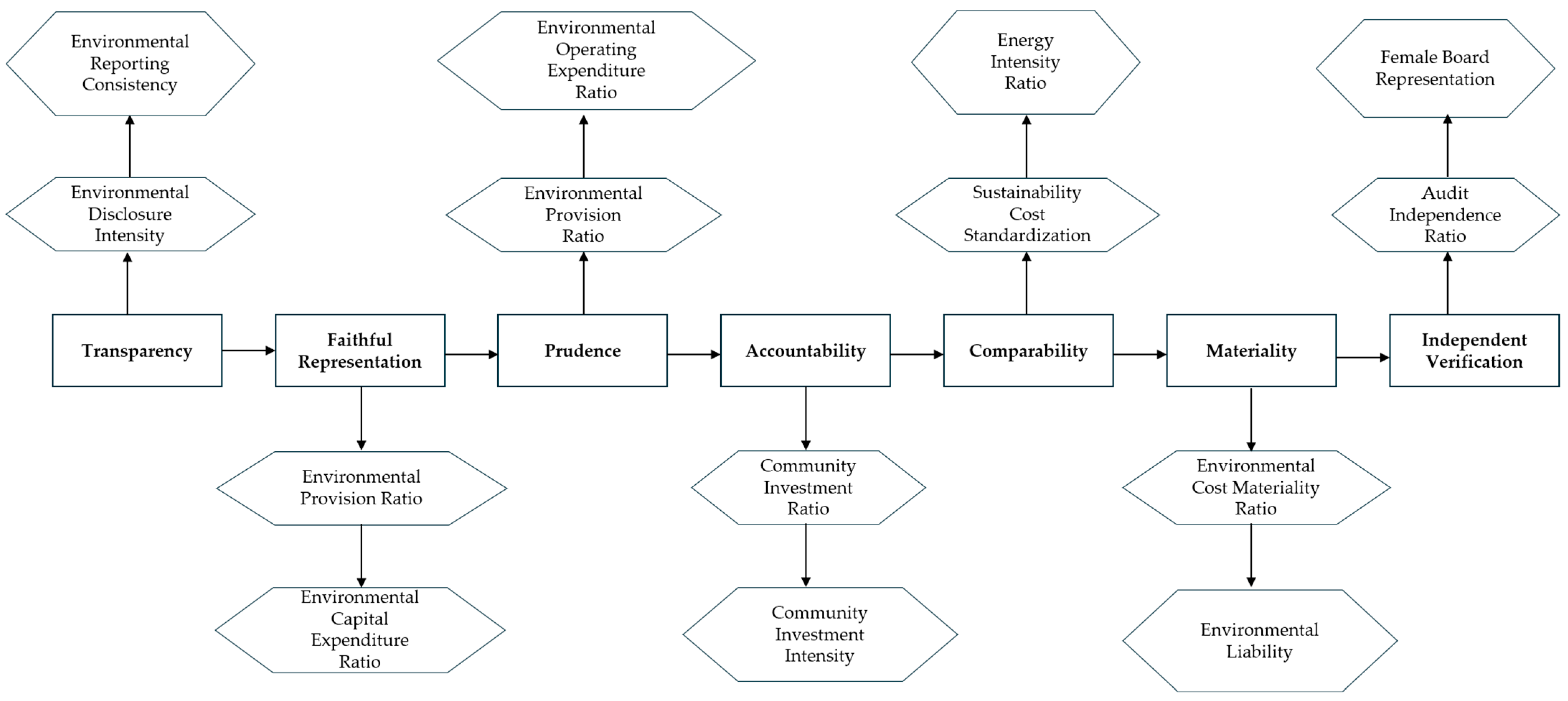

Disclaimer/Publisher’s Note: The statements, opinions and data contained in all publications are solely those of the individual author(s) and contributor(s) and not of MDPI and/or the editor(s). MDPI and/or the editor(s) disclaim responsibility for any injury to people or property resulting from any ideas, methods, instructions or products referred to in the content. |
© 2026 by the authors. Licensee MDPI, Basel, Switzerland. This article is an open access article distributed under the terms and conditions of the Creative Commons Attribution (CC BY) license.