


Abstract
This study investigates the role of big data analytics (BDA) on the relationship between environmental, social, and governance (ESG) scoring and Saudi listed firm value over the four-year period from 2021 to 2024. We employed structural equation modeling (SEM) as a path analysis and a 5000-replication bootstrap method to evaluate the mediation effect of BDA and to enhance inferential robustness. The findings indicate a partial mediation effect of BDA on the relationship between ESG scoring and Tobin’s Q, indicating that ESG contributes to firm value partly through BDA capabilities. The findings underscore the role of leverage ratio and firm size as predictors of BDA effect on firm value. The study is grounded in stakeholder, signaling, and resource-based theories, arguing that ESG performance builds stakeholder trust, ESG scores signal firm value, and BDA capabilities act as strategic assets that enhance market valuation. The findings emphasize the importance of Saudi investors supporting the integration of BDA within ESG practices to maximize firm value, consistent with stakeholder theory. This study contributes to the literature in two ways. First, it demonstrates the mediating role of BDA in the ESG–firm value nexus, reinforcing the market relevance of ESG signals in line with signaling and resource-based perspectives. Second, it extends empirical evidence on the strategic role of BDA in ESG contexts within emerging markets. For policymakers, the results suggest that ESG initiatives require complementary investments in BDA capabilities to achieve their value potential.
1. Introduction
The environmental, social, and governance (ESG) scoring economic implications on companies’ values have become a central focus in global business environment. As companies increasingly integrate sustainability and ethical responsibility into their strategic frameworks, evaluating the economic impact of these performances remains crucial for various stakeholders (Hussain et al., 2024). Previous studies suggest that enhanced ESG performance contributes to enhanced company value and financial results through reinforcing stakeholder trust and effective risk management (Friede et al., 2015; Clark et al., 2015; Rahman et al., 2023; Bancel et al., 2025). However, some researchers indicated that ESG initiatives may be largely superficial, lacking evidence of their impact on companies’ market values in emerging markets (Dossa et al., 2026).
The exponential growth and complexity of companies’ ESG scores render conventional data processing methods insufficient; therefore, the integration of advanced analytical tools has become imperative. BDA represents a systematic process encompassing data collection, analysis, and interpretation, linked to actionable insights that can boost business value and sustainability performance (Bose et al., 2022; Chatterjee et al., 2023). BDA enables companies to develop valuable, rare, inimitable, and non-substitutable resources by integrating advanced technological tools that connect multiple business processes to improve operational efficiency and strategic outcomes (Wamba et al., 2017). As an accelerator of organizational transformation, BDA facilitates improved financial and operational performance through data-driven innovations (Bertello et al., 2021).
Previous studies argued that BDA is associated with corporate innovation, transforming complex datasets into strategic insights that optimize managerial decision-making and operational efficiency, and can impact companies’ values (Joshi & Marthandan, 2018; Sun et al., 2025). However, the realization of these technological benefits is inherently contingent upon robust governance structures capable of mitigating systemic risks to financial integrity and cybersecurity (Pham et al., 2025). Contemporary studies increasingly link BDA to enhanced ESG performance, suggesting that data-driven transparency acts as an institutional mechanism to mitigate reputational risks in less digitized firms in non-heavily polluting sectors (Wang & Zhang, 2024; Khan et al., 2026). This intersection is especially pronounced in emerging markets like Saudi Arabia, where integrated BDA adoption uniformly elevates ESG dimensions, signaling corporate alignment with the sustainability aims of Saudi Vision 2030 while interacting dynamically with structural firm-level characteristics such as size and leverage (Ebnaoof, 2026).
BDA integration aligns explicitly with Saudi Arabia’s Vision 2030, a large-scale transformation agenda anchored in measurable strategic objectives and national key performance indicators (KPIs), which increases the critical role of advanced analytical capabilities for effective monitoring. Conventional performance systems remain insufficient for such complexity, highlighting the critical role of BDA in enhancing KPI accuracy, transparency, and reporting timeliness and supporting more effective, evidence-based policy initiatives (Gulam, 2026). Consequently, Saudi market reinforces the facilitation of sustainable technology by Saudi Data and AI Authority (SDAIA) and robust organizational support as the primary catalysts for translating BDA adoption into the measurable financial and ESG performance mandated by the Kingdom’s 2030 targets (Alkhedhairy, 2025).
This study addresses three interrelated objectives. First, it examines the direct impact of ESG scoring on firm value, using Tobin’s Q for 115 Saudi listed companies from 2021 to 2024. Second, it investigates whether BDA capabilities mediate this relationship as a technological channel through which ESG scores can be translated into market valuation. Third, it analyzes the firm-level determinants such as leverage and firm size that can affect the BDA adoption in companies and its mediating mechanism on firms’ values.
Prior research has examined the role of ESG scoring in reinforcing stakeholder trust and enhancing firm value, consistent with signaling and stakeholder theories. BDA capabilities are considered a mediating mechanism, thereby specifying how sustainability scoring converts into market valuation according to resource-based theory. The findings provide a partial mediation that BDA capabilities transmit a meaningful portion of ESG’s effect on firm value, yet the direct path remains significant. This outcome introduces a boundary condition for resource-based theory. Internal digital resources are necessary but insufficient; signaling theory is further supported by the findings that ESG performance retains independent pricing effects beyond what technological capability alone can explain.
The Saudi Arabian setting provides an institutionally distinct empirical contribution. Vision 2030 is linked to a period of regulatory-driven ESG adoption, structurally unlike the incremental evidence documented in developed-economy studies, allowing identification of the BDA-ESG value relationship. The findings consequently demonstrate how sustainability frameworks interact with firm-level digital capabilities in markets where ESG infrastructure is still being constructed.
The remainder of this paper proceeds as follows. Section 2 develops the theoretical framework. Section 3 reviews relevant literature and develops hypotheses. Section 4 describes the research design, including sample selection, variable construction, and SEM models. Section 5 discusses empirical results. Finally, Section 6 concludes the paper by summarizing the key contributions, discussing theoretical and practical implications, and identifying directions for future research.
2. Theoretical Framework: ESG, BDA, and Firm Performance
Stakeholder theory frames ESG initiatives as a strategic shift toward multidimensional accountability. This framework posits that managers act as stewards not merely for shareholders but for a broad array of groups whose interests are critical to a firm’s long-term viability. ESG scores serve as an essential tool securing a firm’s reputation and legitimacy, reducing systemic risks and acquiring the necessary resources, which enhances intrinsic value (Velte, 2017; B. J. Kim et al., 2022). ESG scoring is associated with superior financial performance, enhancing the corporate creditworthiness and increasing the firm’s value (Aydoğmuş et al., 2022; Kanno, 2023).
From a signaling theory perspective, ESG scores can be interpreted as informational devices that convey aspects of organizational integrity and risk management quality (Amel-Zadeh & Serafeim, 2018). In emerging markets characterized by elevated information asymmetry, superior ESG performance functions as a differentiating signal of firm quality, enabling firms to distinguish themselves from competitors. Such signals can be positively valued by investors and reflected in a market premium, thereby reinforcing firm value as proxied by Tobin’s Q (Barka et al., 2023). Accordingly, ESG scores have evolved beyond mere disclosure metrics to function as strategic signals that are linked to investor judgments and market valuation outcomes. However, this relationship is likely to be context-dependent, as ESG assessments in emerging markets are often associated with inconsistent disclosure practices, limited comparability, and increased compliance costs (Qachach et al., 2025).
Resource-based theory (RBT), in contrast, emphasizes the role of internal capabilities such as BDA as contributors to sustained competitive advantage. BDA capabilities, characterized as valuable, rare, inimitable, and non-substitutable (VRIN), enable firms to transform data into actionable insights that enhance efficiency, innovation, and performance (Mikalef et al., 2019; Wamba et al., 2017; Mazzei & Noble, 2020). Yet, RBT has been criticized for underestimating the influence of external institutional pressures and market perceptions, which are central to both stakeholder and signaling perspectives.
While stakeholder theory emphasizes legitimacy and broader accountability, signaling theory highlights information asymmetry and market interpretation, and RBT focuses on internal capability development. The intersection of ESG scoring and BDA adoption remains an area of ongoing debate, with their combined impact on firm valuation likely shaped by both firm-specific resources and the broader institutional environment.
3. Literature Review and Hypotheses Development
3.1. The Impact of ESG Scoring on Firm Value
The relationship between ESG performance and financial performance continues to generate mixed empirical evidence, with prior studies offering inconsistent conclusions regarding its economic relevance. While some studies (Friede et al., 2015; Clark et al., 2015; Bancel et al., 2025) suggest that enhanced ESG scoring can improve firm valuation, other studies (Delmas & Burbano, 2011; Dossa et al., 2026) indicate that ESG performance may be superficial and not necessarily reflective of substantive corporate practices.
Extant studies such as Rahman et al. (2023) indicate that ESG dimensions have a significant positive association with Tobin’s Q. The findings also disclose the distinct moderations of sustainability strategy and top management commitment in the relations of ESG and each of its separate dimensions with ROA and Tobin’s Q. The only insignificant relationship between governance and Tobin’s Q also converted into a significant positive association through the moderation of top management commitment. Moreover, Bancel et al. (2025) provide evidence that external stakeholders, including investment advisors and financial consultants, are more likely than corporate insiders to incorporate ESG considerations into valuation practices, primarily through adjustments to discount rates. These investors adjust the discount rate as the preferred mechanism in the valuation approaches used. Conversely, H. J. Kim et al. (2025) emphasize that ESG scoring plays a critical role when firms face ESG related controversies. Their study advances ESG literature by showing that ESG performance can offer shareholders an insurance-like protection, thereby lending support to stakeholder theory.
In addition, empirical studies show that ESG performance plays a protective role during systemic crises, thereby enhancing firm value, especially for firms with a higher proportion of long-term institutional investors; however, its effectiveness is weakened under higher economic policy uncertainty (Xue et al., 2026). Collectively, these findings suggest that ESG performance is a strategic asset and has valuation relevance that can potentially associate with the financial value of firms. Furthermore, Dossa et al. (2026) reveal a robust inverted U-shaped relationship, demonstrating that moderate ESG scoring enhances firm performance, whereas excessive ESG investment results in diminishing or even negative returns. The findings indicate that ESG investments are associated with intangible assets such as legitimacy, trust, and innovation only up to an optimal threshold, with institutional and financial contexts shaping the relationship.
In the Saudi context, Hamdouni (2025) investigated the effect of ESG disclosure on firm value among 100 firms listed on the Saudi Stock Exchange (2014–2023). Findings confirm that ESG disclosure positively and significantly enhances firm performance, with firm size amplifying this relationship. Grounded in agency, stakeholder, and signaling theories, these findings indicate that ESG transparency reduces information asymmetry and builds stakeholder trust, with direct relevance to policymakers, investors, and firms operating within Saudi Arabia’s Vision 2030 sustainability framework. Moreover, Asiri and Alyafai (2026) find that capital expenditure is positively and significantly related to ESG scoring. These findings are consistent with the stakeholder theory that ESG scoring is linked to superior financial performance, enhancing the firm’s value. Based on the above argument, we can formulate the following hypothesis:
H1.
ESG scoring has a significant effect on firm value among Saudi listed companies.
3.2. The Role of BDA in the Relationship Between ESG Scoring and Firm Value
Based on resource-based theory (RBT) and signaling theory, big data analytics (BDA) can be conceptualized as a VRIN (valuable, rare, imitable, non-substitutable) resource that supports competitive advantage when effectively utilized (Barney et al., 2011). While the transformative potential of BDA is increasingly recognized, its successful adoption and its role as a mechanism for firm value creation are contingent upon organizational characteristics and external supervisory environments. The following hypotheses develop these relationships.
3.2.1. The Impact of Leverage on BDA Capabilities
From a resource-based theory perspective, the development of big data analytics (BDA) capabilities requires substantial investment in infrastructure, analytical talent, and data integration systems (Mikalef et al., 2019). Firms with higher leverage may be better positioned to secure the financial resources needed to support these costly investments, especially when building data capabilities that require significant upfront commitment (Joshi & Marthandan, 2018). In addition, debt financing often increases external monitoring, which can encourage reliable reporting discipline and transparency, both of which are important for effective analytics-driven decision-making (Wang & Zhang, 2024). Accordingly, leverage may facilitate the acquisition and development of BDA capabilities by expanding access to capital and strengthening managerial accountability. Based on the above argument, we can formulate the following hypothesis:
H2.
Leverage has a positive impact on BDA capabilities.
3.2.2. The Impact of Firm Size on BDA Capabilities
Resource-based theory (RBT) suggests that competitive advantage associates with firms whose resource endowments are valuable, rare, inimitable, and non-substitutable (Barney et al., 2011). Larger firms command greater financial slack, more sophisticated information systems, and higher specialized human capital resources that lower the barriers to technology adoption and enhance the returns on digital investment (Ebner et al., 2014; Wamba et al., 2017). For BDA specifically, these barriers are simultaneously financial, technical, and organizational, which makes size a particularly relevant conditioning factor. Oncioiu et al. (2019) show that larger firms are more likely to integrate internal and external data sources into BDA initiatives over time, consistent with RBT argues that sustainable competitive advantage associated with the cumulative nature of BDA development (Dahiya et al., 2022). Evidence from emerging markets further suggests that BDA adoption improves ESG outcomes and reporting transparency, with organizational scale facilitating capability conversion rather than mere technology acquisition (Ebnaoof, 2026). Accordingly, the following hypothesis is proposed:
H3.
Firm size has a positive impact on BDA capabilities.
3.2.3. The Mediating Role of BDA in the ESG–Firm Value Relationship
Grounded in signaling theory, ESG performance can be interpreted as a signal of managerial quality and long-term commitment to stakeholders (Spence, 1973; Connelly et al., 2011). However, the credibility of this signal depends on the firm’s ability to collect, process, and communicate ESG-related information effectively. BDA strengthens this process by converting dispersed ESG data into reliable and timely insights, thereby improving disclosure quality, transparency, and decision usefulness (Mikalef et al., 2019; Wang & Zhang, 2024). Prior research also shows that BDA contributes to innovation, operational efficiency, and improved firm performance, which supports its role as a strategic capability within the resource-based view (Barney et al., 2011; Joshi & Marthandan, 2018). At the same time, the effectiveness of BDA can be weakened by cybersecurity threats, data integrity concerns, and weak governance structures, suggesting that its contribution to value creation is context dependent (Pham et al., 2025; Anjum et al., 2025). Thus, BDA may act as a mediating mechanism through which ESG performance translates into higher firm value. Based on the above argument, the authors can formulate the following hypothesis:
H4.
BDA capabilities mediate the relationship between ESG scoring and firm value.
4. Research Methodology
4.1. Measures
The analysis in this research utilizes the linear regression method and structural equation model (SEM) as path analysis, consistent with Habib (2023), to evaluate the mediation role of BDA capabilities on the relation between ESG and firm value. We use the following two linear regression models to test our hypotheses:
Model 1:
TobinQit = β0 + β1ESGit + β2ROAit + β3LEVit + β4SIZEit + β5AudiQit + εit
We added the mediation term BDA in model 2:
Model 2 (Path analysis)
BDAit = β0 + β1ESGit + β2ROAit + β3LEVit + β4SIZEit + β5AudiQit + εit (Path A)
TobinQit = β0 + β1BDAit + β2ESGit + β3ROAit + β4LEVit + β5SIZEit + β6AudiQit + εit (Path B)
BDAit = β0 + β1SIZE + β2LEVit + β3ROAit + β4AudiQit + εit (Path C)
Path (C) utilized to test H2, H3 as LEV and SIZE are predictors of BDA.
4.2. Variable Definitions
Table 1 demonstrates that firm value is measured using Tobin’s Q, calculated as the market value of equity plus the book value of total liabilities, divided by the book value of total assets, following Sun et al. (2025). ESG scoring is drawn from Bloomberg’s composite ESG score, which reflects firms’ environmental, social, and governance practices and disclosure across the sample period, as employed by (Kathan et al., 2024; Tawfik et al., 2026). BDA adoption is proxied by the frequency of BDA adoption-related keywords in firms’ annual reports, a textual measure that captures how extensively firms discuss their analytical capabilities in annual reports, such as big data, data mining, text mining, data visualization, heterogeneous data, credit reporting, augmented reality, mixed reality, and virtual reality, consistent with (Han et al., 2023).
Table 1.
Variable measurements.
Four firm-level controls are included across both models. Financial leverage (LEV) is total debt divided by total assets, reflecting capital structure risk in line with Demiraj et al. (2022). Profitability (ROA) is net income divided by total assets, following Aydoğmuş et al. (2022). Firm size (SIZE) is the natural logarithm of net sales, which reduces skewness across firms of varying scale, as applied by Youssef and Tawfik (2026). Audit quality (AudiQ) is a dummy variable, 1 if the auditor is a Big 4 auditor and 0 otherwise, reflecting the association of audit quality, consistent with Alaskar et al. (2026). Together, these controls address potential omitted variable bias in estimating the ESG–BDA–firm value relationship.
4.3. Data and Sample
Our sample period is from 2021 to 2024; we begin in 2021 because it is the effective year after the COVID period in the Saudi markets. The data were collected manually from two main sources: the Tadawul website and Bloomberg database. The final sample included 115 listed companies (460 firm-year observations) in the Saudi market (Tadawul) from 2021 to 2024. Real Estate Investment Trusts (REITSs) and Saudi companies controlled by the government were excluded as they are subjected to regulations and firm characteristics that are different from industrial and services sectors. Table 2 demonstrates the detailed composition of the study sample.
Table 2.
Sample composition.
4.4. Descriptive Statistics and Correlation Analysis
Table 3 presents the descriptive statistics for all variables used in the analysis (Panel A) and the correlation matrix (Panel B) for the key variables considered in this analysis. Panel A shows that the firms in the sample have significant heterogeneity across critical indicators. The mean Tobin’s Q scoring is 1.468, with a standard deviation of 0.782, suggesting an intermediate degree of heterogeneity across firms. ESG scoring shows a mean score of 22.005 and spans a wide range from 0.05 to 76.1, indicating substantial variation in sustainability engagement among the sampled firms. Regarding the mediation variable BDA, the mean is 3.859, with values ranging from 1 to 12. For control variables, return on assets (ROA) values vary considerably, ranging from −0.234 to 0.36, indicating substantial deviation across companies, with a mean of 0.034, indicating low levels of return on assets during the study period. SIZE displays wide dispersion, reflecting scale heterogeneity in the sample from 12.24 to 25.9. Leverage (LEV) exhibits an average of 0.485 and ranges from 0.02 to 0.874, implying varying debt levels across firms. Lastly, audit quality (AudiQ) with a mean of 0.85 reflects the tendency of utilizing Big 4 audit firms in Saudi listed companies.
Table 3.
Descriptive statistics and correlation matrix.
Panel B of Table 3 demonstrates the Pearson correlation matrix and multicollinearity diagnostics. According to Kalnins (2018), the Pearson correlation coefficient measured the linear relationship between continuous independent variables, and the coefficient values are below the threshold of 0.70, suggesting the absence of multicollinearity issues in the model. Furthermore, consistent with Anh and Tan (2026), the variant inflation factors reported in Panel B of Table 3 are all below 10. These diagnostics collectively demonstrate that multicollinearity does not bias our statistical estimations.
4.5. Main Tests
Table 4 presents a direct and positive and statistically significant relationship between ESG scoring and firm value (β = 0.1199, p = 0.040). These results indicate that companies in Saudi Arabia that demonstrate robust performance in ESG dimensions tend to command higher market valuations, as reflected in Tobin’s Q. The findings support the first hypothesis (H1), which posited that ESG scoring has a direct and positive effect on firm value among Saudi listed companies, independent of BDA capabilities.
Table 4.
Structural equation model parameter estimates.
According to the results, every incremental increase in ESG scoring serves to enhance the overall value of the company. Overall, these results suggest that higher ESG metrics are a significant determinant of market perception within the Saudi context, consistent with the perspective of stakeholder theory, that ESG performance represent a strategic shift toward multidimensional accountability and fulfills divergent stakeholder groups interests (Aydoğmuş et al., 2022). These findings correspond with signaling theory, suggesting that ESG scoring reduces information asymmetry between firms’ stakeholders and investors’ perceived risks and reinforces firm value (Amel-Zadeh & Serafeim, 2018).
Table 5 results confirm the relationships between ESG, firm value, and BDA, through decomposition of direct, indirect, and total effects. The ESG scores have a positive and statistically significant effect on firm value, with a direct standardized coefficient of (β = 0.1199, p = 0.040) and a total effect of (β = 0.1903, p = 0.000), which also support H1. These figures indicate that ESG performance is associated with real market valuation effects among Saudi listed firms, because higher ESG scores provide signals of governance credibility to investors, consistent with signaling theory (Barka et al., 2023; Qachach et al., 2025).
Table 5.
Direct, indirect, and total effects with standardized coefficients.
LEV has a significant and positive relationship with BDA adoption (β = 0.1330, p = 0.001), suggesting that access to external financing enables firms to invest in data infrastructure. These results support H2.
The direct path from firm size to BDA capability is positive and statistically significant (β = 0.090, p = 0.048), consistent with resource-based theory, which suggests that larger Tadawul-listed firms generate higher data volumes, employ more specialized personnel, and face stronger organizational pressure to manage information systematically, which collectively reduce the relative cost of BDA adoption (Ebnaoof, 2026). However, the indirect path SIZE → BDA → Tobin’s Q fails to attain significance (indirect β = 0.012, p = 0.120), indicating that BDA does not mediate the relationship between firm size and market valuation. Although larger firms adopt BDA at higher rates, capital markets do not appear to price that adoption incrementally beyond the direct size–valuation relationship, that can be reflected in the long time period of utilizing BDA. Accordingly, H3 is not supported. However, the findings in Table 4 reflect a significant and negative relation between SIZE and Tobin’s Q due to measurement of Tobin’s Q and an inverse size valuation relationship in which larger companies trade at lower market-to-book multipliers. They indicate significant and positive association in the direct path SIZE → BDA, demonstrating that the large size firms are capable of acquiring and utilizing BDA. There is a non-significant positive of SIZE → BDA → Tobin’s Q, which can be interpreted as diminishing growth opportunities and value discounting from investors for large companies (Demiraj et al., 2022).
Finally, the ESG → BDA → Tobin’s Q path reveals partial mediation of ESG’s effect on Tobin’s Q (indirect β = 0.0704, p = 0.014), yet the direct ESG–value path remains significant (β = 0.1199, p = 0.040), rejecting a fully mediated model, supporting H4.
These findings are interpreted as ESG scoring being able to boost firm value through two complementary paths. First, ESG is associated with direct value by signaling credibility, reducing regulatory risk and building reputation with stakeholders, which adds to firm value independently of BDA capabilities. The second path is consistent with the RBT argument that BDA forms a strategic resource generating sustained competitive advantage (Wamba et al., 2017); thereby, firms with higher ES metrics integrate BDA capabilities into firms’ process linking ESG performance into business intelligence that markets reward in firm value. The partial mediation of the ESG → BDA → Tobin’s Q relation extends the extant theories on the digital-ESG performance relationship (Wang & Zhang, 2024) by providing evidence from an emerging economy context.
Audit quality (AudiQ) and profitability (ROA) indicate a significant and positive association with Tobin’s Q (β = 0.160, p = 0.001; β = 0.126, p = 0.004, respectively) affirming the robustness of the control frameworks and consistent with comparable market context (Alaskar et al., 2026; Aydoğmuş et al., 2022).
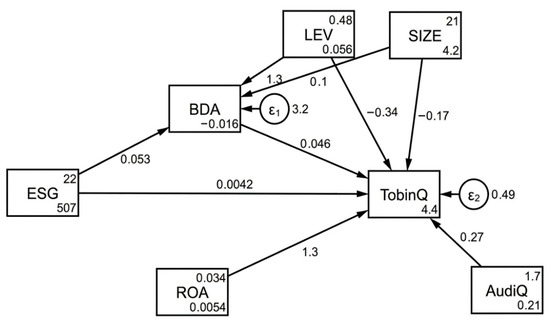
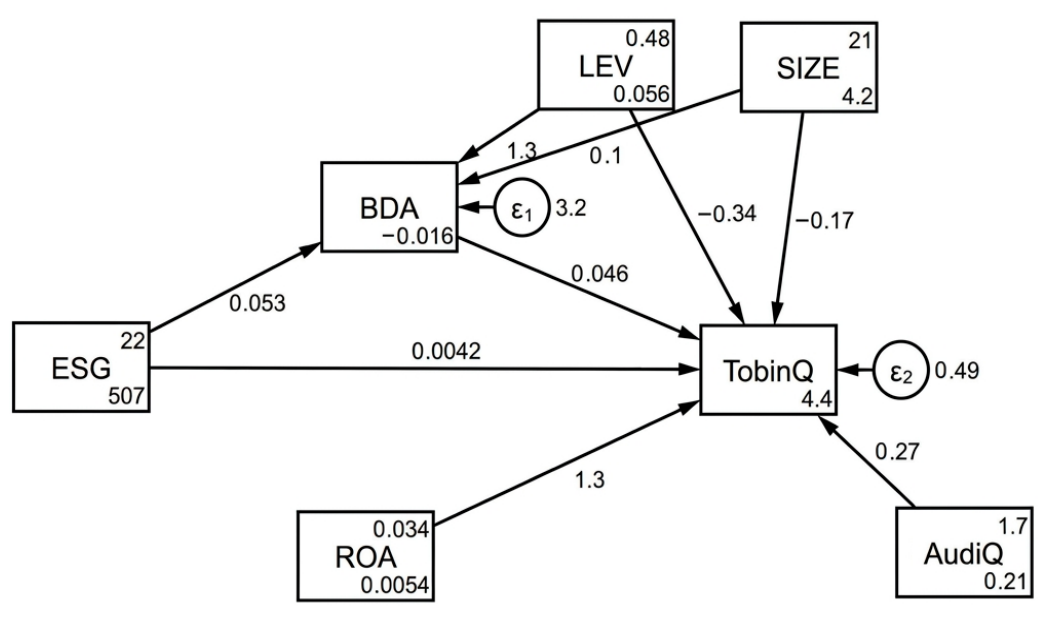
The structural equation model can be illustrated as follows in Figure 1:
Figure 1.
Direct and indirect effects and coefficient: Source: Author’s own work.
Table 6 summarizes the goodness-of-fit statistics for the structural model. The model’s chi-square statistic (χ2(2) = 3.56, p = 0.169) suggests that the hypothesized covariance structure is consistent with the observed data. The Root Mean Square Error of Approximation (RMSEA = 0.041) falls below the 0.06 threshold (Hu & Bentler, 1999), and the p-close statistic (0.479) further supports this assessment. Moreover, the Comparative Fit Index (CFI = 0.995), Tucker–Lewis Index (TLI = 0.972), and Standard Root Mean Square Residual (SRMR = 0.013) fulfill established benchmarks. Given that the model possesses two degrees of freedom, these indices indicate that the hypothesized paths are a plausible representation of the data structure. Regarding explanatory power, the model accounts for 37.9% of the variance in BDA adoption and 18.6% in Tobin’s Q. While these indices suggest a reasonable model fit, the indices merely demonstrate that the hypothesized model does not significantly contradict the observed covariance structure. The near-saturated nature of this specification interprets these results as consistent with our theoretical framework rather than as definitive proof of model adequacy.
Table 6.
Model goodness-of-fit statistics.
Table 7 demonstrates an additional test that addresses concerns about non-normality in the sampling distribution of indirect effects to control potential estimation instability in samples. The indirect effects of ESG metrics on Tobin’s Q through BDA were re-estimated using a maximum likelihood bootstrap procedure with 5000 replications to enhance inferential robustness (Imai et al., 2010; Hayes, 2018). This approach enhances the reliability of the inference by addressing potential non-normality and providing more precise estimates of the indirect effects. The structural equation model indicates that ESG performance is positively associated with BDA capabilities (β = 0.0597, p < 0.001), indicating that each unit increase in ESG scoring is associated with a 0.06-unit expansion in BDA adoption, a relationship whose precision across 5000 bootstrap draws substantially mitigates concerns about sampling instability and reinforces confidence in the partial mediation findings. In the Tobin’s Q equation, BDA is positive and significant (β = 0.0461, p = 0.018), and the direct ESG coefficient retains significance (b = 0.00415, p = 0.042). The residual variance estimates, var(e.BDA) = 3.371 and var(e.TobinQ) = 0.495, are well-behaved and within acceptable bounds for firm-level panel data, indicating no gross model misspecification.
Table 7.
Additional test for indirect effect estimation.
5. Discussion
The results support stakeholder theory’s core contention that firms fulfilling the informational and accountability demands of diverse constituencies achieve superior market valuation, a relationship that holds within the Saudi institutional environment despite its structurally distinct ownership and regulatory landscape. Firms managing competing obligations across multiple stakeholder groups appear to narrow their systemic risk exposure in ways that Saudi capital markets recognize through a valuation premium. Prior evidence from emerging market contexts supports this pattern (Rahman et al., 2023), where information asymmetry reinforces the credibility of sustainability commitments and their effect on firm valuation. Stakeholder theory does not, however, specify how risk reduction translates into market valuations. The observed premium may reflect a measurable reduction in the firm’s exposure to systemic risk. It may equally reflect investor sentiment toward firms that score well on ESG measures without materially changing their underlying risk profile. These two explanations produce the same coefficient with different theoretical implications, and the cross-sectional design cannot distinguish between them.
BDA captures one important transmission channel, but the direct ESG–firm value path persists after analytical infrastructure is controlled for. BDA capacity does not fully account for how ESG performance translates into market valuations. The residual direct effect is most plausibly attributed to reputational capital or stakeholder relational quality, constructs that are qualitative by nature and resist reliable operationalization through quantitative ESG scoring. The direct effect remains statistically significant; however, it should be interpreted cautiously because it may partly reflect measurement error in the BDA proxy or residual reverse causality that the fixed-effects specification cannot fully eliminate. Accordingly, the current design does not allow us to distinguish between these alternative explanations. Despite this limitation, the finding remains consistent with resource-based theory, which posits that digital infrastructure constitutes a strategic firm-specific resource capable of generating market premiums.
That the mediation is partial rather than full aligns with prior evidence according to Wang and Zhang (2024), that digital capabilities amplify but do not replace the reputational and relational channels through which ESG initiatives influence investors.
The signaling interpretation of our mediation results is therefore debatable in the Saudi setting. Applying signaling theory to explain BDA’s indirect role presumes that investors can infer the quality of firms’ BDA from public disclosures, yet this presumption lacks direct empirical support. Saudi disclosures on BDA and ESG remain largely voluntary and unstandardized, which may impede investors’ ability to separate substantive BDA capacity from symbolic digital positioning and thus undermines the verification mechanism the signaling account requires (Gulam, 2026; Ebnaoof, 2026). Because the BDA proxies capture analytics infrastructure investment rather than verified reporting accuracy, the measurement approach cannot isolate the effect of BDA deployment on ESG disclosure verifiability, limiting causal interpretation of the reported associations. Consequently, the study cannot establish whether infrastructure investment translates into verifiable improvements in ESG performance. An additional interpretive ambiguity concerns whether Saudi capital markets reward compliance with Vision 2030 as a distinct valuation signal, rather than ESG performance itself. Although firms that appear aligned with the reform agenda may reduce perceived regulatory risk and attract a premium, the mediation design does not isolate this effect from genuine ESG performance quality or from contemporaneous market shifts, such as Tadawul’s MSCI inclusion, foreign ownership changes, and macroeconomic reforms. As a result, the observed association may reflect compliance signaling rather than substantive performance.
6. Conclusions
This study analyses 115 Saudi listed companies over the period 2021–2024 (460 firm-year observations), focusing on the mediating role of BDA on the relationship between ESG scoring and firm value. The study uses structural equation model path analysis to illustrate the partial and full mediation relation of the ESG, BDA, and firms’ Tobin Q and utilizes additional testing for the indirect effect using bootstrap method replications. The results indicate that ESG performance is associated with firm value through both direct and indirect channels, with BDA acting as a partial mediator. Although the indirect effect of BDA in the ESG–Tobin’s Q relationship is statistically significant, the persistence of a direct ESG–value association suggests that BDA does not fully explain how sustainability initiatives translate into market valuation. These findings are consistent with RBT, which suggests that digital infrastructure may function as a strategic, firm-specific resource associated with market premiums. However, the estimated direct effect should be interpreted cautiously, as it may partly reflect measurement error in the BDA proxy or residual reverse causality that the fixed-effects design cannot fully rule out. In addition, firm size and leverage are positively associated with BDA adoption, suggesting that larger firms and those with greater access to external financing are better positioned to invest in BDA infrastructure. By contrast, the market does not appear to value the indirect relationship between firm size and Tobin’s Q.
From a theoretical perspective, this study contributes to literature by integrating RBT theory and stakeholder and signaling theories to illustrate the relationship between technological capabilities within ESG frameworks. Although BDA reinforces the value relevance of ESG performance, its role as a partial rather than dominant mediator suggests that BDA capabilities alone are insufficient to fully translate ESG initiatives into firms’ market values. The persistence of a significant direct association between ESG performance and Tobin’s Q highlights the primacy of external intangible strategic assets, legitimacy, signaling, and stakeholder trust, which may play a more substantial role than internal technological capabilities.
Empirically, this study offers novel evidence from an emerging market context by identifying the mechanisms through which ESG scoring is integrated into firm value. The findings reveal that while the market rewards data-driven ESG efficiencies, it remains highly responsive to broader environmental variables affect firm values. Additionally, highlighting that firm size and leverage are positively associated with BDA adoption, the study extends the corporate finance literature by highlighting the role of firm size and its access to external financing as key structural variables affecting the mediating role of BDA in the relationship between ESG performance and firm value.
The findings present several important implications for policymakers, regulators, corporate managers, and auditors. First, the results suggest that firms should not frame ESG initiatives and BDA capabilities as independent strategic activities. Rather, companies are encouraged to integrate BDA tools into ESG-related processes to enhance the accuracy of sustainability reporting, improve the quality of managerial decision-making, and reinforce stakeholder confidence. Strategic investments in BDA infrastructure, robust data governance frameworks, and analytical talent can enable firms to extract greater value from ESG performance and translate it into measurable economic benefits.
Second, the findings provide relevant insights for regulators and policymakers in Saudi Arabia, particularly in the context of advancing the objectives of Vision 2030. Encouraging the adoption of standardized ESG reporting frameworks alongside digital transformation initiatives can play a pivotal role in improving market transparency and accountability. Regulatory support for the integration of BDA into sustainability practices may also enhance the attractiveness of Saudi capital markets to foreign investors and contribute to the overall competitiveness of domestic firms.
Third, from a managerial perspective, the study underscores that maximizing firm value requires a careful alignment between internal digital capabilities and credible external ESG communication. Given that ESG performance exerts a direct effect on firm value beyond the mediating role of BDA, managers should prioritize transparent ESG disclosure practices and proactive stakeholder engagement strategies. Such efforts are essential for strengthening corporate legitimacy, reducing information asymmetry, and enhancing market trust.
Finally, the study offers important implications for auditors and assurance providers. As ESG scoring becomes increasingly data-intensive and complex, auditing practices must evolve to incorporate advanced analytical technologies capable of processing and verifying large volumes of sustainability-related data. The integration of BDA into ESG assurance processes can enhance reporting reliability, mitigate information asymmetry, and ultimately strengthen stakeholder confidence in corporate sustainability disclosures.
Several limitations related to BDA measurement may obscure generalization of results, as reliance on a single-country sample and the numbers of Saudi companies adopting BDA and obtained ESG scores constrain external validity. Furthermore, the utilization of ESG scores as proxies for firms’ sustained performance may not capture the full initiatives of firms’ ESG. Future studies can investigate the role of alternative mediators such as innovation capacity, risk management, and cost of capital and testing non-linear effects of BDA on ESG scoring, which could provide a more comprehensive understanding of the ESG scoring and firm value relationships. Furthermore, future research could investigate the role of corporate governance mechanisms in the relationship between BDA and firm value. Extending the analysis across different institutional contexts would enhance the generalizability of the findings. In addition, future studies may incorporate alternative technological proxies, such as artificial intelligence (AI) adoption, and utilize more robust causal identification strategies to strengthen inference.
Author Contributions
Conceptualization, A.M.S.T. and H.M.I.Y.; methodology, A.M.S.T., H.M.I.Y., A.A.A. and L.M.A.A.; validation, L.M.A.A.; formal analysis, A.M.S.T.; investigation, H.M.I.Y.; resources, A.A.A.; data curation, A.M.S.T.; writing—original draft preparation, A.M.S.T. and H.M.I.Y.; writing—review and editing, A.A.A. and L.M.A.A.; visualization, L.M.A.A.; supervision, A.M.S.T.; project administration, H.M.I.Y.; funding acquisition, H.M.I.Y. and A.A.A. All authors have read and agreed to the published version of the manuscript.
Funding
This work was supported and funded by the Deanship of Scientific Research at Imam Mohammad Ibn Saud Islamic University (IMSIU) (grant number IMSIU-DDRSP2602).
Institutional Review Board Statement
Not applicable.
Informed Consent Statement
Not applicable.
Data Availability Statement
The data that supports the findings of this study are available from the corresponding author.
Acknowledgments
The authors would like to thank Imam Mohammad Ibn Saud Islamic University (IMSIU) for their support.
Conflicts of Interest
The authors declare no conflict of interest.
References
- Alaskar, M. Z., Alomair, A., Abdelraheem, A. A. E., & Musa, A. M. H. (2026). The mediating role of audit quality in the relationship between IFRS adoption and financial reporting: Evidence from Big Four auditing firms in an emerging market. Journal of Risk and Financial Management, 19(3), 182. [Google Scholar] [CrossRef] [Scilit]
- Alkhedhairy, M. A. (2025). Balancing privacy and risk: A critical analysis of personal data use as governed by Saudi insurance law. Laws, 14(4), 47. [Google Scholar] [CrossRef] [Scilit]
- Amel-Zadeh, A., & Serafeim, G. (2018). Why and how investors use ESG information: Evidence from a global survey. Financial Analysts Journal, 74(3), 87–103. [Google Scholar] [CrossRef] [Scilit]
- Anh, T. D., & Tan, H. C. (2026). Board characteristics and corporate cash flow risk: Evidence from an emerging market. Journal of Risk and Financial Management, 19(4), 273. [Google Scholar] [CrossRef] [Scilit]
- Anjum, N., Latif, Z., & Chen, H. (2025). Security and privacy of industrial big data: Motivation, opportunities, and challenges. Journal of Network and Computer Applications, 104130. [Google Scholar] [CrossRef] [Scilit]
- Asiri, M., & Alyafai, A. (2026). The impact of capital expenditure on ESG performance: The moderating role of CEO board membership in Saudi listed firms. International Journal of Islamic and Middle Eastern Finance and Management, 19(3), 840–863. [Google Scholar] [CrossRef] [Scilit]
- Aydoğmuş, M., Gülay, G., & Ergun, K. (2022). Impact of ESG performance on firm value and profitability. Borsa Istanbul Review, 22, S119–S127. [Google Scholar] [CrossRef] [Scilit]
- Bancel, F., Glavas, D., & Karolyi, G. A. (2025). Do ESG factors influence firm valuations? Evidence from the field. Financial Review, 60, 1191–1223. [Google Scholar] [CrossRef] [Scilit]
- Barka, Z., Hamza, T., & Mrad, S. (2023). Corporate ESG scores and equity market misvaluation: Toward ethical investor behavior. Economic Modelling, 127, 106467. [Google Scholar] [CrossRef] [Scilit]
- Barney, J. B., Ketchen, D. J., Jr., & Wright, M. (2011). The future of resource-based theory: Revitalization or decline? Journal of Management, 37(5), 1299–1315. [Google Scholar] [CrossRef] [Scilit]
- Bertello, A., Ferraris, A., Bresciani, S., & De Bernardi, P. (2021). Big data analytics (BDA) and degree of internationalization: The interplay between governance of BDA infrastructure and BDA capabilities. Journal of Management and Governance, 25(4), 1035–1055. [Google Scholar] [CrossRef] [Scilit]
- Bose, S., Dey, S. K., & Bhattacharjee, S. (2022). Big data, data analytics and artificial intelligence in accounting: An overview. In S. Akter, & S. F. Wamba (Eds.), Handbook of big data methods (pp. 1–34). Edward Elgar Publishing. [Google Scholar] [CrossRef] [Scilit]
- Chatterjee, S., Chaudhuri, R., Vrontis, D., & Thrassou, A. (2023). Impacts of big data analytics adoption on firm sustainability performance. Qualitative Research in Financial Markets, 15(4), 589–607. [Google Scholar] [CrossRef] [Scilit]
- Clark, G. L., Feiner, A., & Viehs, M. (2015). From the stockholder to the stakeholder: How sustainability can drive financial outperformance. Available online: https://papers.ssrn.com/sol3/papers.cfm?abstract_id=2508281&__cf_chl_rt_tk=1OS_gq3XYlxGvhU0RW8lOoITqMJfk9VaTNBJvqWlJDc-1782528187-1.0.1.1-8kIbDRBjUDHqQeuvxRoP3q2AxLSzW0neQxEUJMzHJVY (accessed on 16 May 2026). [CrossRef] [Scilit]
- Connelly, B. L., Certo, S. T., Ireland, R. D., & Reutzel, C. R. (2011). Signaling theory: A review and assessment. Journal of Management, 37(1), 39–67. [Google Scholar] [CrossRef] [Scilit]
- Dahiya, R., Le, S., Ring, J. K., & Watson, K. (2022). Big data analytics and competitive advantage: The strategic role of firm-specific knowledge. Journal of Strategy and Management, 15(2), 175–193. [Google Scholar] [CrossRef] [Scilit]
- Delmas, M. A., & Burbano, V. C. (2011). The drivers of greenwashing. California Management Review, 54(1), 64–87. [Google Scholar] [CrossRef] [Scilit]
- Demiraj, R., Dsouza, S., & Abiad, M. (2022). Working capital management impact on profitability: Pre-pandemic and pandemic evidence from the European automotive industry. Risks, 10(12), 236. [Google Scholar] [CrossRef] [Scilit]
- Dossa, J. V., Gopang, A. A., Kapola, T. O., Ukwuoma, C. C., Thomas, D., & Dossa, J. M. (2026). When more isn’t better: The curvilinear effects of ESG on firm performance. Business Ethics, the Environment & Responsibility, 1–17. [Google Scholar] [CrossRef] [Scilit]
- Ebnaoof, A. (2026). The role of artificial intelligence in shaping ESG disclosure evidence from listed companies in Saudi Arabia. Frontiers in Sustainability, 7, 1797708. [Google Scholar] [CrossRef] [Scilit]
- Ebner, K., Bühnen, T., & Urbach, N. (2014, January 6–9). Think big with big data: Identifying suitable big data strategies in corporate environments. 2014 47th Hawaii International Conference on System Sciences (pp. 3748–3757), Waikoloa, HI, USA. [Google Scholar]
- Friede, G., Busch, T., & Bassen, A. (2015). ESG and financial performance: Aggregated evidence from more than 2000 empirical studies. Journal of Sustainable Finance & Investment, 5(4), 210–233. [Google Scholar] [CrossRef] [Scilit]
- Gulam, G. (2026). Big data analytics framework for vision 2030 performance monitoring and national KPIs. Veredas do Direito, 23(6), e235732. [Google Scholar] [CrossRef] [Scilit]
- Habib, A. M. (2023). Do business strategies and environmental, social, and governance (ESG) performance mitigate the likelihood of financial distress? A multiple mediation model. Heliyon, 9(7), e17847. [Google Scholar] [CrossRef] [Scilit] [PubMed]
- Hamdouni, A. (2025). AI, sustainability and value creation: Empirical insights from Saudi banks (2015–2024). International Journal of Financial Studies, 13(4), 202. [Google Scholar] [CrossRef] [Scilit]
- Han, F., Zhang, X., Chan, K. C., & Li, Y. (2023). Firms’ digital transformation and management earnings forecasts: Evidence from China. Borsa Istanbul Review, 23(6), 1356–1366. [Google Scholar] [CrossRef] [Scilit]
- Hayes, A. F. (2018). Partial, conditional, and moderated moderated mediation: Quantification, inference, and interpretation. Communication Monographs, 85(1), 4–40. [Google Scholar] [CrossRef] [Scilit]
- Hu, L. T., & Bentler, P. M. (1999). Cutoff criteria for fit indexes in covariance structure analysis: Conventional criteria versus new alternatives. Structural Equation Modeling: A Multidisciplinary Journal, 6(1), 1–55. [Google Scholar] [CrossRef] [Scilit]
- Hussain, M. A., Alsayegh, M. F., & Boshnak, H. A. (2024). The impact of environmental, social, and governance disclosure on the performance of Saudi Arabian companies: Evidence from the top 100 non-financial companies listed on Tadawul. Sustainability, 16(17), 7660. [Google Scholar] [CrossRef] [Scilit]
- Imai, K., Keele, L., & Yamamoto, T. (2010). Identification, inference and sensitivity analysis for causal mediation effects. Statistical Science, 25, 51–71. [Google Scholar] [CrossRef] [Scilit]
- Joshi, P. L., & Marthandan, G. (2018). The hype of big data analytics and auditors. EMAJ: Emerging Markets Journal, 8(2), 1–4. [Google Scholar] [CrossRef] [Scilit]
- Kalnins, A. (2018). Multicollinearity: How common factors cause type 1 errors in multivariate regression. Strategic Management Journal, 39(8), 2362–2385. [Google Scholar] [CrossRef] [Scilit]
- Kanno, M. (2023). Does ESG performance improve firm creditworthiness? Finance Research Letters, 55, 103894. [Google Scholar] [CrossRef] [Scilit]
- Kathan, M. C., Utz, S., Dorfleitner, G., Eckberg, J., & Chmel, L. (2024). What you see is not what you get: ESG scores and greenwashing risk. SSRN Electronic Journal, 74, 106710. [Google Scholar] [CrossRef] [Scilit]
- Khan, S. T., Bhat, M. A., Tiwari, C. K., Pal, A., & Behl, A. (2026). Big data analytics and green finance as drivers of sustainable ESG performance. Journal of Science and Technology Policy Management, 1–26. [Google Scholar] [CrossRef] [Scilit]
- Kim, B. J., Jung, J. Y., & Cho, S. W. (2022). Can ESG mitigate the diversification discount in cross-border M&A? Borsa Istanbul Review, 22(3), 607–615. [Google Scholar] [CrossRef] [Scilit]
- Kim, H. J., Ahn, T.-W., & Yi, J. (2025). ESG controversies and firm value: Moderating role of ESG performance. Asia Pacific Journal of Financial Studies, 54, 228–269. [Google Scholar] [CrossRef] [Scilit]
- Mazzei, M. J., & Noble, D. (2020). Big data and strategy: Theoretical perspectives. In Strategy and behaviors in the digital economy (p. 51). IntechOpen. [Google Scholar] [CrossRef] [Scilit]
- Mikalef, P., Boura, M., Lekakos, G., & Krogstie, J. (2019). Big data analytics capabilities and innovation: The mediating role of dynamic capabilities and moderating effect of the environment. British Journal of Management, 30(2), 272–298. [Google Scholar] [CrossRef] [Scilit]
- Oncioiu, I., Bunget, O. C., Türkeș, M. C., Căpușneanu, S., Topor, D. I., Tamaș, A. S., & Hint, M. Ș. (2019). The impact of big data analytics on company performance in supply chain management. Sustainability, 11(18), 4864. [Google Scholar] [CrossRef] [Scilit]
- Pham, V. A. T., Nguyen, L. A., Dellaportas, S., Phan, D. H. T., & Nguyen, Q. H. (2025). How does big data analytics impact accounting manipulation? Accounting & Finance, 65, 2918–2934. [Google Scholar] [CrossRef] [Scilit]
- Qachach, A. R., El Mahrad, B., Kharbouch, O., Moumen, A., El Aoufi, S., El Gueddari, M., & Abdallah-Ou-Moussa, S. (2025). Bridging the ESG data gap: Transparent metrics and rankings for emerging financial markets. International Journal of Financial Studies, 13(4), 198. [Google Scholar] [CrossRef] [Scilit]
- Rahman, H. U., Zahid, M., & Al-Faryan, M. A. S. (2023). ESG and firm performance: The rarely explored moderation of sustainability strategy and top management commitment. Journal of Cleaner Production, 404, 136859. [Google Scholar] [CrossRef] [Scilit]
- Spence, A. M. (1973). Job market signaling. Quarterly Journal of Economics, 87(3), 355–374. [Google Scholar] [CrossRef] [Scilit]
- Sun, P., Di, J., Li, X., & Zhou, Y. (2025). Big data analytics and firm value: Evidence from non-IT firms in China. Applied Economics, 1–17. [Google Scholar] [CrossRef] [Scilit]
- Tawfik, A. M. S., Alsudays, R., Aladwey, L., Elsayed, M., & Youssef, H. M. I. (2026). Bridging the gap? Board gender diversity, ESG performance, and executive pay in GCC. Humanities and Social Sciences Communications, 13(1), 510. [Google Scholar] [CrossRef] [Scilit]
- Velte, P. (2017). Does ESG performance have an impact on financial performance? Evidence from Germany. Journal of Global Responsibility, 8(2), 169–178. [Google Scholar] [CrossRef] [Scilit]
- Wamba, S. F., Gunasekaran, A., Akter, S., Ren, S. J. F., Dubey, R., & Childe, S. J. (2017). Big data analytics and firm performance: Effects of dynamic capabilities. Journal of Business Research, 70, 356–365. [Google Scholar] [CrossRef] [Scilit]
- Wang, M., & Zhang, D. (2024). Big data infrastructure and corporate ESG performance: Evidence from listed Chinese manufacturing companies. Sustainability, 16(12), 5147. [Google Scholar] [CrossRef] [Scilit]
- Xue, J., Zhang, R., Wang, Y., Li, D., Xing, Y., & He, J. (2026). Protective role of ESG disclosure in firm valuation during global crisis: Evidence from institutional investor ownership. Business Ethics, the Environment & Responsibility, 1–29. [Google Scholar] [CrossRef] [Scilit]
- Youssef, H. M. I., & Tawfik, A. M. S. (2026). The relationship between managerial ability, audit fees and audit quality: Evidence from a developing country. Cogent Business & Management, 13(1), 2601945. [Google Scholar] [CrossRef] [Scilit]

Disclaimer/Publisher’s Note: The statements, opinions and data contained in all publications are solely those of the individual author(s) and contributor(s) and not of MDPI and/or the editor(s). MDPI and/or the editor(s) disclaim responsibility for any injury to people or property resulting from any ideas, methods, instructions or products referred to in the content. |
© 2026 by the authors. Licensee MDPI, Basel, Switzerland. This article is an open access article distributed under the terms and conditions of the Creative Commons Attribution (CC BY) license.