


Abstract
This paper aims to present proposals for improving public lending design in an economic crisis. It combines casual empirical observations, institutional analysis and normative theoretical modeling. We obtain casual evidence from the analysis of the emergency lending scheme offered by Germany’s national development bank (NDB) KfW during the COVID-19 crisis. We identify obstacles to efficient contracting in these two-tier lending relationships, involving the NDB, the participating commercial banks, and the ultimate firm borrowers. Theoretical arguments and empirical evidence based on this case study help to understand major incentive risks of subsidized public lending schemes. To counter these risks, we propose a smart set of public lending contracts which induces banks to refrain from applying for public support for financially strong firms and for non-viable zombie firms. For firms which need financial support, we propose a set of public contracts from which the firm chooses the contract which maximizes its subsidy, reveals its rating, and obtains public funds according to its crisis-induced needs. This partially revealing signaling equilibrium implies higher interest rates for firms with a need for more public funding, thereby mitigating information asymmetries. In order to ensure incentive alignment, banks should retain a share of borrower default risk.
Keywords:
COVID-19 crisis; public loan support; role of banks and NDBs; moral hazard and market distortions; signaling JEL Classification:
D82; G01; G38; H81
1. Introduction
Systemic economic shocks, like the COVID-19 pandemic, have profound and immediate effects on national economies. The pandemic disruption threatened to trigger a severe recession. Faced with heightened default risks, banks adopted a more cautious lending stance, curtailing new loans and the renewal of existing loans. Hence, many firms experienced liquidity shortages, further boosting the crisis dynamics. Economic policy in many countries responded by injecting public financial support for firms and households, including loans, guarantees for new bank loans, moratoria for tax and other payment obligations, furlough money, and non-repayable financial transfers.
How to design public lending programs is the key theme of this paper. For this purpose, it combines empirical evidence based on a case study of the KfW COVID-19 support, institutional analysis, theoretical arguments and normative statements. This hybrid approach enables us to derive new proposals. Objectives of public support in an economic crisis are to cover reduced incomes and prevent unnecessary and permanent damage to productive capacity, using means which are as cost-effective as possible (Lucas, 2020). The program design is challenging because subsidies tend to distort financial markets and are prone to various forms of undesirable wealth transfer1.
Three issues will be addressed: first, macro uncertainty about the strength and the duration of the economic crisis; second, subsidies and market distortions; and third, micro information asymmetry, i.e., the state usually has little information about the firms asking for support.
Macro uncertainty relates to the initial, highly uncertain duration of the crisis-induced interruption of normal economic processes (Camacho et al., 2011; Davis & Kahn, 2008). In a benign “V-shaped” scenario the crisis is short-lived, normal economic activity can resume quickly, and extra-liquidity loans can be repaid without much delay. If, however, the crisis is malign, resembling an “L-shape” and implying a longer interruption of production processes together with a severe fall in economic activity, more firms may incur solvency problems, loan defaults will be more frequent and loss-given default will be higher, also endangering the banks.
Prudent lenders will adjust their lending decisions to macro uncertainty, triggering a reinforcing recession dynamic, as these risk considerations lead banks to extend fewer loans which, in turn, increases delinquencies—even if the V-scenario prevails. Therefore, this paper also discusses ways of public support how to mitigate detrimental effects of macro uncertainty, a novel challenge.
Subsidies are allowed by the Lisbon Treaty of the European Union, Art. 107, only in case of natural disasters or exceptional occurrences. An important question is which firm should benefit from subsidies, and which should be excluded. This paper takes a normative stance by proposing public support according to the “need model” as opposed to the “damage model”, i.e., we propose that public emergency funding should offer a liquidity bridge to weak firms only - rather than insuring all firms against damage. Financially resilient firms with access to private funding are in no need of public support and should not get subsidies. Also, weak firms with no sustainable business model (zombies) should be excluded because subsidies would be wasted. Only firms with a sustainable business model but severely constrained access to funding should be subsidized so as to enable them to survive the crisis. The “need” of such a firm2 is defined as its prospective lack of private financial funds, required by surviving the crisis, including potential adjustments of its business model. The Group of Thirty (2020, p. 3f) criticizes broad support of businesses and proposes “moving to more targeted measures focused on those firms that need support but are expected to be viable.” The “need model” motivates our proposals for public support design.
Distinguishing between needy-and-promising firms, needy-but-forlorn firms and financially strong firms is (or should be) the competency of private banks. Therefore, in line with several countries, public funding programs should make the expertise of private banks (tier 1) subservient to a tier-2 national development bank (NDB) providing public support. The NDB usually has little information on firms applying for help. Cooperation of the NDB and the firm’s bank allows for the use of pre-existing, private information structures embedded in bank–firm relationships. This is particularly important for an NDB providing many public loans to SMEs.
Private banks play a crucial role in our setting. Thus, public support involves three players, the firm, the private bank and the NDB. Yet the firm and the private bank still retain some information advantage. As they benefit from a higher subsidy, they are incentivized to adverse selection and moral hazard. The public cost of both is defined relative to the “need model”, i.e., the cost equals the difference between the actual subsidy and that justified by the “need model”. The public support program should be designed so as to mitigate this cost effectively.
To constrain adverse selection, private banks should be obliged to identify and exclude financially strong firms and zombie firms from public support. We propose that the government designs public funding contracts so that private banks prevent financially strong firms from receiving public support since they prefer to lend to these firms themselves. Banks should be made liable for the damage of the NDB if they file requests for the public support of zombie firms.
For the viable but financially constrained firms, we propose a partially revealing signaling equilibrium (PRSE). The NDB should offer a smart set of contracts from which each firm chooses that one which maximizes the subsidy and thereby reveals its financial strength. In this PRSE, financially weaker firms receive higher subsidies, implying larger public funding at higher interest rates in line with the “need model”, thereby mitigating information asymmetries.
To minimize market distortions by public funding, the contract options offered by the NDB should copy the market features of private funding contracts as far as possible. The contracts should not provide options which are priced in markets for free. To align banks’ interest with that of the NDB, they should share the risk of the public loans given to their borrowers; they should always have “skin in the game”. Thus, a well-designed public support scheme should use both firms and banks in novel arrangements to channel money to needy firms with a sustainable business model and to effectively constrain the waste of public money.
To constrain moral hazard, the NDB may use covenants, collateral, seniority rules and other restrictions imposed on the firm and on the bank, as discussed in the literature. The NDB may rely on the bank as an information intermediary as long as the firm appears to operate in a healthy manner. When a reorganization appears appropriate, then the NDB should actively intervene as the conflicts of interest between the three players become virulent.
The paper is structured as follows. In Section 2.1, we describe the German COVID-19 lending support program, managed by the German state-owned development bank KfW. In Section 2.2, we derive guidelines for the design of state_aid in view of important market frictions. In Section 2.3, we derive conjectures about the attractiveness of the different KfW funding options and present some casual empirical evidence, using data collected by KfW, and findings of a panel with a representative of KfW and representatives of large German banks who were involved in the support program. Finally, we summarize lessons to be learned and our proposals for the design of public support.
2. Targeted Public Lending
2.1. Description of the KfW Program
This section gives an overview of the rules of KfW’s lending program, built specifically to deal with the pandemic episode starting in 2019, and it presents summary statistics on the allocation and the volumes of the offered public loan contracts. Explanations and rationalizations are mostly left for later sections of the paper. KfW, the German development bank, acts within national boundaries and also in the EU and in less developed countries (Mertens, 2021).
The initiative for a KfW loan contract may be taken by a firm or by its bank, provided that the eligibility conditions of the contract are met. Both have to agree. Typically, KfW has no prior experience with a firm asking for a loan. It relies on the bank as an intermediary. As public loans include some gift from the taxpayer, access to these loans needs to be constrained. Constraints include restrictions on the quality of the subsidized firm, on the maximum amount and the maximum maturity of public loans, and restrictions on the firm’s use of the money (see also Bundesrechnungshof, 2022). In the following, we present the essential restrictions for each of the three contract variants, Instant Loans, Entrepreneur Loans and Direct Participation in Syndicated Lending.
The paper focuses on public support of SMEs; they may use Instant Loans and Entrepreneur Loans. The crucial difference between those two loans for SMEs is that the Entrepreneur Loan offers more attractive terms to the firm but imposes part of the default risk on the bank, while the Instant Loan imposes no default risk on the bank. This built-in conflict between the two loans is an important driver of the demand for these loans, as will be discussed later.
- (a)
- Rules on Instant Loans, Entrepreneur Loans, Direct Participation in Syndicated Lending
During the pandemic, KfW offered three different types of loan facilities, the Instant Loan (Schnellkredit), the Entrepreneur Loan (Unternehmerkredit) including the Loan for Young Firms (Gründerkredit), and Direct Participation in Syndicated Lending (syndicate lending, SL, see KfW, 2020c). For all contract variants, to constrain adverse selection, the firm must not be in default and should have a viable business model so that zombie firms are excluded. The maximum loan amount is limited to at most ¼ of the revenues in 2019. To constrain moral hazard of firms and banks, the loan must not be used to substitute for bank loans, and the firm is not allowed to pay dividends, pay out profits or repay equity capital until the loan is fully repaid. The reader who is not interested in the technical details of the three contract variants, may skip the rest of subsection a.
Syndicated Lending SL started in March 2020, soon after the pandemic started. In SL, KfW joins a syndicate and contributes at least €25 million to the syndicate loan. The lead arranger of the syndicate is usually a bank closely related to the firm. KfW may take an active role in project screening and deal structuring. Apart from the overall eligibility requirements mentioned above, a firm is eligible only if there is no moratorium and no serious covenant breach.
The maximum loan amount is limited to twice the labor cost in 2019, 50% of the firm’s total debt and to liquidity needs for the next twelve months, apart from the revenue cap mentioned above. Maturity is limited to six years. Collateral and covenants may be included in the loan contract. KfW absorbs up to 80% of the default losses experienced by the syndicate. As we focus on public loans to SMEs, we mostly exclude SL in the following sections.
In April 2020, KfW started the Entrepreneur Loan and the Instant Loan programs. Among the eligibility criteria for applying firms is a one-year default probability of not more than 10% as estimated by the bank filing the application3. That should exclude firms without a viable business model. Applications for the Entrepreneur Loan also required that the firm was not an ‘undertaking in difficulty’ (see EU Regulation 651/2014, Art. 2 #18) at the end of 2019 and whose funding in 2020 would not have been in difficulties without the pandemic. Applications for the Instant Loan also required that the firm was profitable in the previous year (i.e., in 2019), or on average over the last three years (see KfW, 2020a). Thus, various conditions served to constrain adverse selection.
For an Entrepreneur Loan, the loan volume is limited to €100 million and maturity between six and 10 years. The same caps for the loan amount apply as for SL, except that for SMEs liquidity needs are limited to 18 months. KfW absorbs 90% [80%] of the default losses in case of SMEs [larger firms]. It charges an interest rate between 1 and 1.46% for SMEs and 2% to 2.12% for larger firms. In the case of a larger Entrepreneur Loan, KfW may analyze the loan risk and charge a lower interest rate if the debtor has a better rating or if collateralization of the loan is stronger. The risk margin of the loan is split between KfW and the bank according to the default risk. KfW’s risk margin is inversely related to the loan’s default risk so that the bank’s risk margin increases with default risk and, thus, motivates the bank to take a higher default risk. For undisbursed parts of the loan KfW charges 0.15% per month. The loan can be costless redeemed anytime. Several restrictions are designed to deal with the risk of free riding (see KfW, 2020b). Normal remuneration for owners being natural persons is allowed.
For the Instant Loan, the maximum loan amount increases with the number of employees4. The maturity of the loan is limited to 10 years. KfW bears 100% of all potential default losses and charges an interest rate of 3% per year. Collateral for the KfW loan is not allowed. The full amount of the loan has to be drawn down within one month after KfW acceptance. The loan can be redeemed without cost anytime. Management compensation is limited to €150,000 p.a. per person.
- (b)
- Automated Procedure
KfW uses a fully automated procedure for handling the application for an Instant Loan. This is also true for Entrepreneur Loans up to €3 million. Fully automated means KfW relies completely on banks for due diligence, as information intermediaries and as service agents, without explicit risk analysis and without renegotiations. After signing a contract with the bank, KfW transmits the loan volume to the bank which is obliged to transmit it to the firm. It collects interest payments and loan repayments of the firm and transmits these to KfW. The bank monitors the firm and passes new important information about the firm. Yet KfW may have quite limited information about the firm. When it comes to a workout/restructuring of the firm, KfW typically retains the right to interfere and to be involved in decision making.
The fully automated procedure not only reduces the transaction cost of a KfW loan, but it also allows for near-instant KfW decisions on applications—a feature particularly welcome in a crisis. Automatization involves a tradeoff between lower transaction costs and increased risk for the taxpayer, due to the absence of KfW’s credit risk analysis and the exclusion of (re)negotiations of KfW with the firm. This underlines the important role played by tier-1 banks in determining the success of an automated lending program. Given this tradeoff, KfW restricted the automatic procedure to Entrepreneur Loans up to €3 million. For larger loans, KfW gets increasingly involved in the decision process. For loans between €3 and 10 million, KfW may use a simplified risk analysis including not only the firm risk but also aiming at a “fair” sharing of the default risk with banks. For loans between €10 and 100 million, KfW carefully analyzes the firm risk, including future business prospects, and negotiates the details of the loan terms including collaterals and the term structure of repayments. For example, banks may be urged by KfW to extend the term structure of their loan repayments.
- (c)
- Selected evidence on KfW’s support program
Next, we present some evidence on loan applications and accepted loans to better understand the demand patterns for the three contract variants of the KfW pandemic program. KfW generously provided us this evidence. Figure 1 and Figure 2 and Figure A1 in the Appendix A are original material of the KfW, using German numerical notation, i.e., comma is replaced by point and vice versa. The monthly volumes of applications allow us to study the impact of the COVID-19 development on the demand for public support. Moreover, we are particularly interested in the comparison of the demand for the Entrepreneur and the Instant Loan to better understand the role of banks and firms in contract choice. Our hypotheses, referred to as conjectures, will be presented later on and be discussed in the light of these case study findings and discussions with bank managers.
Figure 1 shows monthly application volumes (bn. €) of the special program from the start in March 2020 to November 2021. The November 2021 figure represents only the first third of the month.
Figure 1.
Monthly application volumes (bn. €) for the KfW special program from March 2020 to November 2021, original presentation of KfW using German numbering.
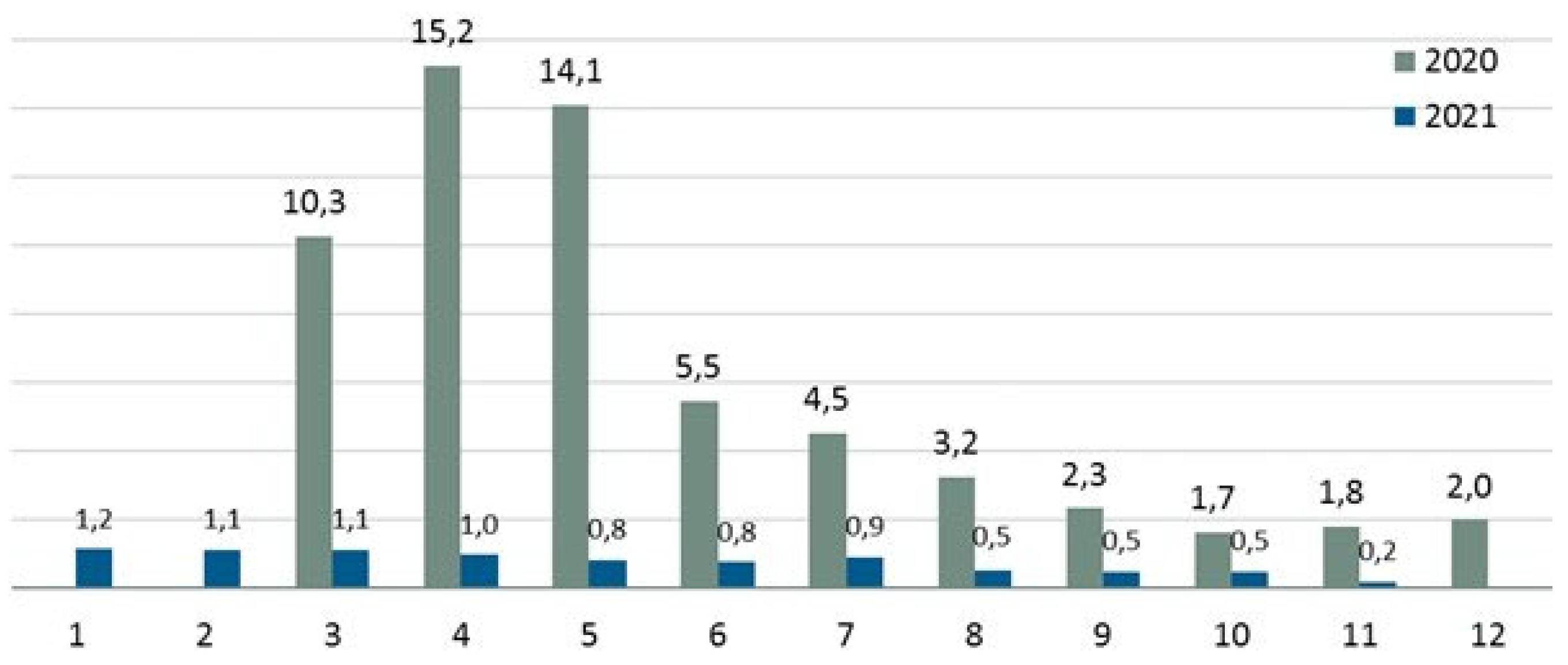
Clearly, applications peaked from March to June 2020 when the program started and the economy was severely hit by the lockdown. This lockdown ended in June, firms became more optimistic and applications dropped significantly until October 2020 when infection numbers strongly increased again and a selective lockdown was imposed on some branches, in particular hotels and restaurants. The application volume dropped to €1.7 bn. in October and increased to €2.0 bn. in December. Even though the selective lockdown was removed gradually, ending in May 2021, application volumes dropped to €1.2 bn. in January 2021 and then declined further. This is presumably also related to satiation effects. And firms could not apply to the COVID-19 program more than once.
Table 1 displays application numbers and volumes over 2020 and 2021, and those accepted by KfW, to illustrate the rough time pattern of demand. The number of applications dropped by more than half from 2020 to 2021, and the average application volume by almost 2/3. The economic crisis faded away in 2021. Firms which applied in 2021, were mostly SMEs as indicated by the low average application volume of €192,000. Less than three percent of the applications and the application volume was not accepted, indicating the strong role of the automated procedure for small fund requests.
Table 1.
Annual numbers (#) of applications and accepted applications for the KfW pandemic program, in addition to annual application volumes, accepted volumes and the average of accepted volumes5.
A closer look at the critical year, 2020, shows that more than 108,000 applications were received and almost 103,000 applications were accepted, with a volume of almost €46 bn. While the average volume of accepted applications was about €446,000, the median volume was only €115,000. This is also explained by the demand for the different contract variants as depicted in Figure 2.
The volume of applications (bn. €, cumulative) and the total number of accepted applications (cumulative) are displayed below.
Figure 2.
The block diagram shows the cumulated application volumes separately for the four contract variants (lhs) and the gray curve depicts the cumulated number of all accepted applications (rhs) in 2020.  Direct Participation In Syndicate Lending,
  Entrepreneur Loan,
  Entrepreneur Loan for Young Firms,
  Instant Loan. Original presentation of KfW using German numbering.
Direct Participation In Syndicate Lending, Entrepreneur Loan, Entrepreneur Loan for Young Firms, Instant Loan. Original presentation of KfW using German numbering.
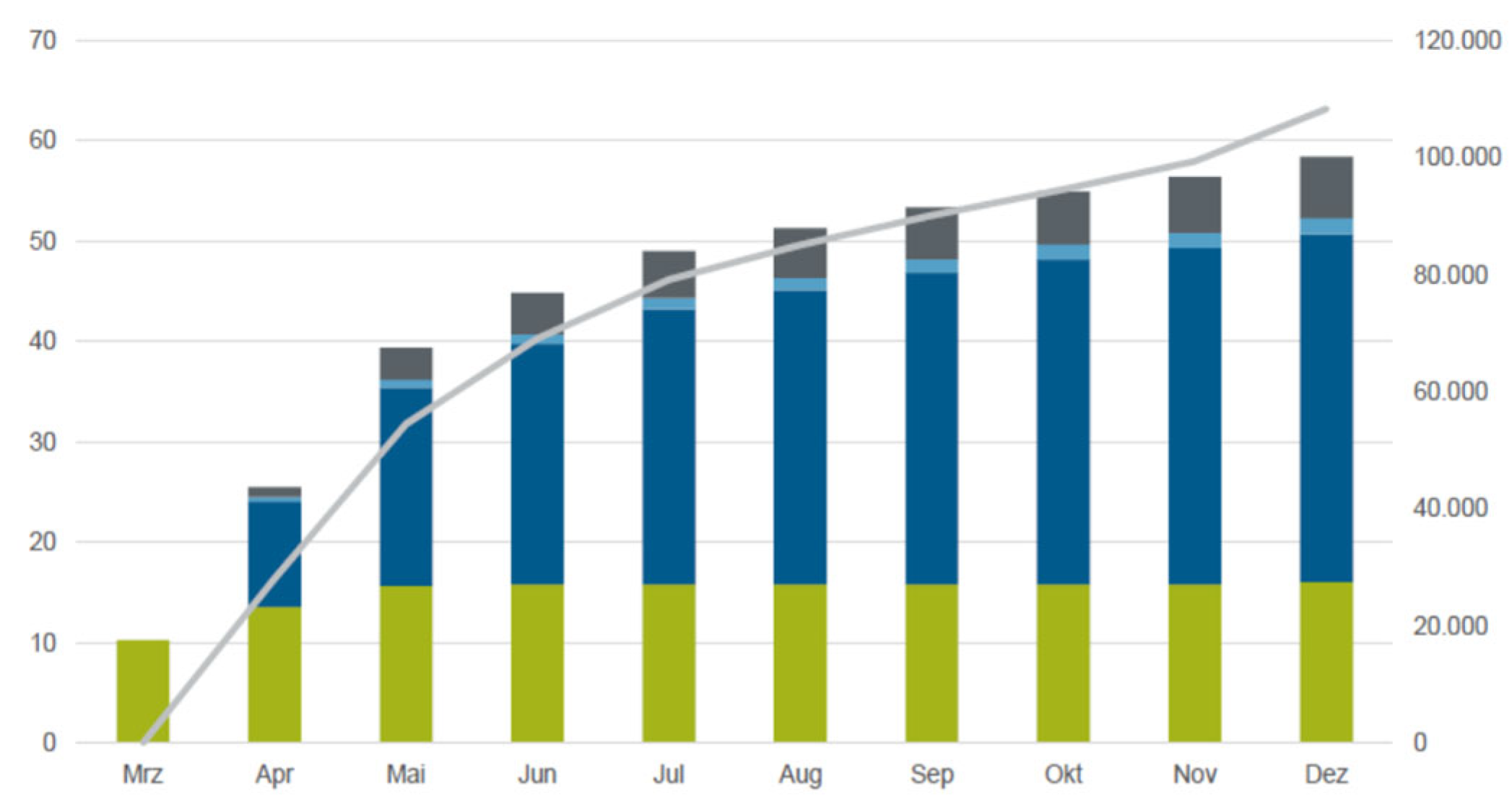
Direct Participation in Syndicate Lending started in March, before the other programs. Big firms had already filed 35 of the overall 45 applications by the end of April 2020. The application volume totaled €16.249 bn. in 2020. A total of 42 applications were accepted and granted €8.425 bn. Out of 21 applications for more than €100 million with a volume of €15.015 bn., 20 were accepted and granted €7.897 bn., with an average of almost €395 million. Four applications were officially rejected. Internally, KfW classified about 15% of all formal and informal applications as rejected, with about 5% being rejected by KfW and about 10% being rejected by firms due to additional contract terms imposed by KfW.
By far the most important contract variant was the Entrepreneur Loan. A total of 85,701 applications were filed in 2020 with a volume of €36.247 bn., including 82,537 applications from SMEs. A total of 80,753 applications were granted €29.755 bn., with an average of about €368,500. In particular, applications for larger volumes were not successful. For the Instant Loan, out of 22,584 applications with a volume of €6.089 bn., 21,975 applications were accepted with a volume of €5.890 bn., implying an average volume of about €268,000. No application was officially rejected.
The low official rejection numbers are also explained by the tier-1 banks’ role. They had to check the formal requirements for a KfW loan. KfW accepted 99% of the applications by an automated procedure. The distribution of loan volumes is strongly skewed. While the average for each contract variant is above €200,000, the median of all granted loans is only €115,000. A total of 97% of the applications in 2020 were from SMEs.
The overall disbursement ratio of granted volumes was about 2/3 at the end of 2020. Roughly 1/3 of the large loans, checked in detail by KfW, were already fully repaid or canceled. For the smaller loans, this ratio was about 15%. Apparently, several firms which had obtained large loans no longer needed precautionary public borrowing.
Due to the long maturity of many loans, it is too early to estimate the default rate of the COVID-19 program. Dörr et al. (2021) analyze credit rating and insolvency data of actively rated German firms and conclude that the policy response to COVID-19 triggered a backlog of insolvencies in Germany that is particularly pronounced among small, financially weak firms.
The data presented in this section depict the German COVID-19-situation; data patterns in other countries may be quite different6. Nevertheless, the German data provide some insight into the interplay between firms, banks and the NDB and will be used for preliminary, casual evidence for the conjectures to be derived and discussed later.
2.2. Targeted Lending: Aims, Constraints, Restrictions and (Suitable) Contractual Design
- (a)
- Aims of public support programs and empirical evidence
Public support to firms in a crisis aims to prevent permanent damage, using cost-effective means (Lucas, 2020). Observed COVID-19 programs reveal a large variety of programs across countries, including public loans, public loan guarantees, moratoria for existing loans, furlough money, financial support á fonds perdu, etc. Public lending schemes are intended to tilt financing flows from what they would be under zero support conditions to what they ought to be in the eyes of policy makers. However, according to Art. 107, 1 of the Lisbon Treaty, state aid which distorts or threatens to distort competition is generally not permitted. Exceptions are related to market disorder and to damages caused by natural disasters or other exceptional events. The principal economic rationale for public support is “that market failures may lead to less investment and, thus, slower future growth than would be economically efficient, and that an institution with a public mandate is better placed than private operators to overcome these market failures”. Asymmetric information can lead to market failures, “for example, credit rationing and high return requirements due to banks’ high transaction costs” (European Commission, 2015, p. 3). At the same time, public support should be designed so as to avoid undesirable effects “such as maintaining inefficient market structures, sectors with overcapacity or supporting undertakings in difficulty; crowding out of private sector financiers, thus holding back financial sector development” (European Commission, 2015, p. 4). To minimize market distortions, public aid designs should copy well-established market mechanisms, achieving a second-best outcome.
According to the Group of Thirty (2020, p. 3f), “Public support should adapt to new business realities rather than trying to preserve the status quo”, in particular facing an L-shape. “Private sector expertise should be tapped to optimize resource allocation, where possible. Properly functioning markets can help allocate resources … using existing expertise and funding channels.” “Minimize risk and maximize upside potential for taxpayers while ensuring stakeholders share in losses and do not receive unjustified windfalls.”
The empirical evidence on public support in the COVID-19-crisis indicates certain features being the same across countries while others diverge. Cao et al. (2024) find that very weak firms, often defined by bad ratings, are excluded from public support in all countries. This also prohibits evergreening, i.e., prolonging loans so as to avoid default (Faria-e-Castro et al., 2023). Also, there are always caps on public loans/guarantees provided to firms (Cao et al., 2024) limiting public support to some measures of firm size. In line with the concentration of KfW loans on SMEs in Germany, Altavilla et al. (2021) find, for EU countries, that guaranteed loans are overwhelmingly awarded to small firms which are heavily affected by COVID-19, excluding firms close to distress before the crisis.
But the empirical evidence is mixed regarding the riskiness of publicly supported firms. Firms asking for support may already be riskier before the crisis and/or they may be hit harder by the crisis. Bonaccorsi di Patti et al. (2024) observe that, in Italy, firms facing bigger illiquidity shocks due to a revenue collapse more likely demanded guarantees. Ex ante riskier borrowers were less likely to get guaranteed loans. Similarly, Mateus and Neugebauer (2022) observed that, in Portugal, guaranteed loans were mostly given to ex ante low-risk firms which suffered the most from COVID-19. The riskier firms paid higher interest rates and obtained smaller loans but benefited more from moratoria. Goldberg et al. (2024) also find that, in the EU, more guarantees are given to firms more affected by COVID-19, smaller firms and less risky firms. They also investigate the role of banks and find that more guarantees are observed at larger banks. According to Jiménez et al. (2024), in Spain, banks provide more public guaranteed loans to riskier firms in which banks have a higher pre-crisis share in firm total credit. This effect is stronger for weaker banks, indicating a credit supply-driven mechanism of public support. Huneeus et al. (2023) find for the partial guarantee program in Chile that lending shifted towards riskier firms. But the implied macro risk was small because banks had skin in the game. According to Cao et al. (2024), in some countries, publicly supported firms are riskier, as well as the involved banks. But in the majority of countries, bank risk and size do not matter for public support. As shown above, in Germany, KfW motivates banks to provide an Entrepreneur Loan to riskier borrowers by increasing the bank’s interest risk margin with default risk. These conflicting findings provide important insights into the working of public support systems across countries, but they also indicate that more research is needed to clarify how the politics of NDBs and banks in arranging public support matter. This is essential for proposing improvements in public lending schemes.
Also, some shortcomings of these empirical studies need to be addressed. First, the studies do not distinguish between public support driven by need and driven by damage. This distinction is difficult to validate empirically because, apart from financially strong firms and zombies, need and damage are positively correlated. Second, the empirical findings provide evidence that zombies tend to be excluded from public support, but linear regressions of public lending on firm quality, as in the quoted studies, may be misleading. If weak firms get public support, but neither very strong nor very weak firms do, then this non-linearity may support misleading conclusions. Third, whether more or less risky firms get public support can only be answered in relative terms if the frequency distribution of firm quality is taken into consideration.
- (b)
- V-shape or L-shape?
Attempts to improve state aid design have to address important market frictions, in particular asymmetric information, externalities and market power (European Commission, 2015, sect. 2.1; see also Group of Thirty, 2020). A particular lack of information relates to macro uncertainty. State aid design should take this into account, i.e., the nature of the economic shock is only gradually revealed. In a V-shaped recovery, business activity resumes after a short time, and if public support is offered, it is disbursed widely among business subjects so as to retain a level playing field in the economy at large. In contrast, in a longer-lasting L-shaped recovery, overall economic activity will not resume where it stopped before the crisis. Instead, besides the fall in economic activity, business conditions are typically changing, including changes in consumer demand for goods and services and changes in supply chains. Moreover, technological innovations and new regulations, some of which are driven by the very crisis event, may force firms to invest in new technologies or different business processes. L-shaped recoveries, therefore, also motivate firms to reorganize and restructure their activities.
The incidence of V-shape or L-shape is typically unsung until after the crisis has unfolded for some time. How the crisis unfolds also depends on the speed and effectiveness of state aid so that a lack of state aid may promote an L-shape. As a consequence, state aid should not only take into consideration the rebuilding and restructuring needs, but it should also support (disruptive) innovations. In other words, a planned state aid program should encompass the corporate restructuring aspect from day one on, along with the purely liquidity-oriented bridge financing aspect.
Over time, as more information intrudes and V and L shapes may be identified better, the support program should be adjusted accordingly. The main insight at this point is that due to the ambiguity of V and L, government support programs need to be versatile enough to be supportive in both scenarios: the pure liquidity crisis requiring bridge loans, and the deeper solvency crisis requiring, in addition, support for business transformation.
- (c)
- Direct or intermediated design of lending scheme?
To minimize market distortions, state aid should be managed by a national development bank (NDB). Public aid designs should copy well-established market mechanisms, achieving a second-best outcome. Therefore, support programs typically rely on a two-tier intermediation structure which allows them to take advantage of the available information at the level of financial intermediaries, esp. banks. Banks, which we designate as “tier-1 banks”, manage the lending relationship with firms, while the allocation of subsidies to firms and to tier-1 banks, in the form of subsidized refinancing, is managed by a “tier-2” institution, typically the NDB. This two-layer set-up preserves much of the existing financial architecture of the economy. Given the large number of applications for such loans and the need to handle these applications fast and at low cost, the NDB may rely on the bank as an information intermediary and a transaction agent7.
Yet this special arrangement of a private public partnership poses many problems as discussed by Fabre and Straub (2023). The well-known agency problems of bank lending are now two-tiered as well. Eslava and Freixas (2021) emphasize mis-incentives in loan guarantees relative to subsidized bank lending. The NDB has to deal with the risk that tier-1 banks may use the subsidies for themselves rather than channeling them in full to their own clients, the ultimate borrowers. Banks extract rents from guarantees and tilt the allocation of guarantees towards their highly indebted borrowers (Martin et al., 2025). Thus, the taxpayer faces adverse selection and moral hazard not only of borrowing firms, but also of banks, acting separately or jointly.
- (d)
- Restricting Adverse Selection
(α) A Partially Revealing Signaling Equilibrium
Information asymmetries favor adverse selection by firms and banks, such that they extract more public lending benefits than socially desirable. Adverse selection can take various forms. As discussed before, all countries establish upper limits for public support in relation to firm size. This serves various purposes. (a) It should rule out “overfunding”, i.e., obtaining more funds than needed to extract more subsidies. (b) A firm may have unobservable alternative funding options so that there is no need for (more) public funding. These hard-to-observe funding sources comprise loans from other lenders, including the very bank handling the loan request. (c) Rationing public loans also helps to prevent arbitrage of the firm by investing cheap public funds in the market.
In order to constrain adverse selection, we propose a design of the public support program in which each firm chooses a public funding contract which truthfully reveals its needs. In line with European law and economic arguments, this normative approach starts from the “need model” as a benchmark for social desirability and not the “damage model” which gauges public support to the damage incurred by a firm in the economic crisis. Very weak firms and very strong firms should not get public support, the latter because they can cover their financial needs in the market, the former because public money would be wasted ruling out social desirability8. A tier-1 bank would probably benefit from channeling an NDB-loan to a zombie firm to which it is exposed. In order to prevent this, the financial rating of the firm should satisfy given standards. The tier-1 bank, knowing the firm, is best suited for providing such rating. In its COVID-19 program for small loans, KfW imposes this burden on the tier-1 bank which has to confirm that the one-year PD of the firm does not exceed 10%. This PD, equivalent to a rating, might be a rather crude instrument to rule out zombie financing. KfW assumes that tier-1 banks report PDs truthfully.
The design of public support can be viewed as a control problem under incomplete information, handled by the NDB. As in Laffont (1994), we apply a menu of linear contracts to implement optimal contracting. We propose a partially revealing signaling equilibrium (PRSE). To explain the idea of truth-telling, we sketch an argument borrowed from the literature9, relying on the concept of a PRSE. For this mechanism to work, the NDB has to offer a suitable set of contractual options from which potential borrowers can choose one. In a PRSE, the borrower’s self-selection reveals his publicly unknown “true” quality and his need for public funding, estimated by himself. We will illustrate a PRSE in an abstract model first and then turn to the implications.
Assume that all firms are risk-neutral. Moreover, a potential borrower prefers a public loan with a higher subsidy, everything else being the same. In a one-period setting, the NDB offers various one-period loans j, each with maximum volume V(j) and nominal interest rate i(j), j = 1, …, J. The firm can only apply for one of these loans. It chooses the maximum volume to maximize the subsidy. The NDB can invest in a risk-free asset yielding the risk-free rate r, or it may grant a subsidized loan to the firm. The firm repays V(j) (1 + i(j)) after one period with probability (1 − PD) and zero otherwise. PD is the probability of default of the firm under the condition that it receives a subsidized loan according to its needs. The subsidy inherent in the loan is
S(j) = V(j) [(1 + r) − (1 + i(j)) (1 − PD))] = V(j) [(r) –i(j) + (1 + i(j)) PD], j = 1, …, J.
The subsidy is positive for i(j) ≤ r and increases in PD. To discourage firm requests for high loan volumes beyond need, the interest rate should increase with the maximum loan volume so that V(1) < V(2) < … V(J) and i(1) < i(2) < … < i(J) ≤ r. Hence, the firm’s choice involves tradeoffs of higher volumes against higher interest rates. The loan which maximizes the subsidy depends on the firm’s PD, unknown to the NDB. Figure 3 illustrates the subsidy for three different loans as a function of the firm’s PD.
Figure 3.
The subsidy depending on the loan volume and the firm’s PD.
Loan (1) with a volume limit of €1500 charges no interest, loan (2) with €3000 charges 4% and loan (3) with €4500 6%. Given a risk-free rate of 6%, loan (1) yields the highest subsidy for a PD < 1.85%, loan (2) for a PD between 1.85 and 3.64% and loan (3) for a PD above 3.64%. A resilient firm (low PD) prefers option 1 with a low volume and zero interest rate, while a weak firm (high PD) prefers option 3 with a high volume and a high interest rate. Thus, the contract choice reveals the firm’s PD range.
In general, the limits V(j) and the interest rates i(j) need to be chosen so that the upper envelope of the linear curves is convex. The more loan options offered by the NDB, the smaller the PD range which maximizes the subsidy for a particular option, the more granular the PD signal. Obviously, given different sizes of SMEs, the loan limits V(j) have to be adjusted to firm size, for example, by an asset-based or a cashflow-based size measure as done by KfW.
In the PRSE, the subsidy increases in the firm’s PD, which increases with the firm’s need V. Weak/strong firms receive large/small public loans with strong/small subsidies. This is in line with the “need” model and the EU rules for public support. To avoid zombie financing, there is an upper limit on the PD enforced by the bank, so the horizontal axis in Figure 3 stop at that PD. In this model, one-period loans can be replaced by multi-period loans defining the overall subsidy as the present value of subsidies in all periods until maturity.
So far, a higher loan volume commands a higher interest rate so that the loan choice reveals the quality of the firm. Alternatively, the disciplining mechanism of a higher interest rate may be replaced by stricter covenants or more collateral. It is essential that there is a tradeoff between the contract options so that the subsidy-maximizing choice reveals the quality of the firm. The government can preselect the general subsidy level by choosing the terms of the offered loans in line with social preferences.
This rather simple model serves as a starting point for more complex models. It assumes risk neutrality of the borrower. The PD estimate of the borrower is his subjective probability, likely driven by his bank rating. Thus, the borrower chooses between subjective subsidy levels. If he is risk-averse, he might prefer a higher public loan, paying a higher interest rate. This would obscure the relation between contract choice and the PD. The revealed PD would then signal a kind of martingale probability. More complicated are potential dynamics of uncertainty as addressed by macro-uncertainty, e.g., this may induce precautionary and dynamic borrower behavior not included in the simple model10.
The model ignores the interplay with the borrower’s bank. The bank might benefit from a higher public loan because it might facilitate the substitution of a risky bank loan by the public loan. Thus, the bank may put pressure on the borrower to opt for a public loan larger than his need. The bank may support the borrower’s contract choice in the PRSE if its benefit is a constant fraction of the earned subsidy. This condition is violated if the risk share of the public contract to be borne by the bank differs across the contract variants. For example, KfW offered the Entrepreneur and the Instant Loan. A SME always prefers the Entrepreneur Loan because of the more favorable terms. The bank, however, may prefer the Instant Loan, in particular for weak borrowers, because the bank does not share the default risk of this loan in contrast to the Entrepreneur Loan. Thus, the choice of the Entrepreneur Loan is firm-driven, the choice of the Instant Loan is bank-driven. This mechanism differs from a PRSE in which only the firm is acting.
The NDB has to calibrate the contract options offered to potential borrowers. The level of subsidies to be offered is critical. This level should grow with the severity of the economic crisis to stabilize borrowers financially. The more severe the crisis, the larger the volumes of the public loans and/or the difference between market interest rates and those charged by the NDB should be. However, the other types of crisis subsidies and the government’s financial strength should also be taken into account. Finally, social preferences matter, as subsidies imply a redistribution of wealth between entrepreneurs and the taxpayer.
The crucial difference between the proposed PRSE and the observed linear support programs is that in the PRSE the borrower’s need determines his application for public funding, while in the linear model the borrower tends to maximize funding, subject to the generally defined funding limits, irrespective of need.
A larger variety of contract options would induce firms and banks to reveal more information through a more granular signal and more effectively constrain adverse selection. It also diminishes the benefit of further information collection by the NDB. Typically, writing a loan agreement involves the collection of initial information and sequential information through bargaining/renegotiation and observing the firm’s behavior (Fudenberg & Tirole, 1983). Given a rather granular quality signal in a PRSE, renegotiation is rather useless, so the NDB may use an automatic decision routine for SME loans which precludes renegotiation.
(ß) How to avoid windfall gains by public funding?
Exogenous shocks may lead to windfall gains of some players. Public funding should not automatically award windfall gains to firms and banks.
First, the “need model” excludes financially resilient firms from public lending. If only weaker viable firms qualify for public support, they might enjoy a windfall gain because excluded resilient firms may not be able to capitalize on their strengths. Public support programs should be designed in a way that mitigates such anti-competitive effects and prohibits undesirable concentration of market power. However, the windfall gain argument overlooks the fact that resilient firms have easy access to market funding and, therefore, can pursue their competitive advantage without public funding. Thus, windfall gains of weaker firms are unlikely.
Second, to avoid windfall gains of resilient firms, a well-defined support program would not exclude these but leave their exclusion to the better-informed tier-1 banks. An appropriate mechanism is the design of the public loan contract options so that the bank prefers to lend to the firm itself instead of filing an application for a public loan contract. Consider a simple stylized model.
Due to the macro shock, the firm faces a liquidity gap with volume V. The bank can fill this gap by providing an additional loan at some interest rate i*. Alternatively, the firm receives a public loan at an interest rate ip. Apart from the difference in interest rates, the firm’s PD is the same in both cases, as the firm’s liquidity stays the same. Given a risk-free rate r, an extension of the bank loan changes the bank’s expected profit by V(i* − r) − V(1 + i*) PD. In the case of a public loan, the bank has to take the share δ of the default risk of the public loan with an expected cost of δ V(1 + ip) PD.
Hence, the difference in the bank’s expected profit, ΔEPB, is
ΔEPB = V(i* − r) − V(1 + i*) PD + δ V(1 + ip) PD = V[(i* − r) − ((1 + i*) − (1 + ip) δ) PD]
As i* > r, the first term is positive while the second term converges with PD to 0. Therefore, the bank prefers extending its own loan instead of asking for a public loan if the firm is resilient, i.e., the PD is sufficiently small so that default risk is very small. Hence, resilient firms do not get subsidized loans11. The bank is better off with a subsidized loan if the firm is weak12.
Third, does public support provide a windfall gain to tier-1 banks? Windfall gains would accrue to banks if they did not take a share of the default losses of public loans given to their customers. In the absence of new private funding, a public loan reduces a firm’s PD and, thereby, also the default risk of private loans (Altavilla et al., 2021). A public loan without any risk-sharing would strongly motivate the bank to exploit the taxpayer by searching for public support, in particular for weak firms. Such support would be a free lunch for the bank at the expense of the taxpayer.
If banks are financially resilient, then a free lunch to banks has no justification, it violates European aid law. If banks are in trouble themselves due to the macro shock, then there are more effective ways to support banks directly than indirectly through support of their debtors. Hence, the banks and the taxpayer should share the default risk of public loans for firms and banks should have “skin in the game”. This would also motivate the banks to handle public loans more carefully, as argued by Eslava and Freixas (2021). In a similar spirit, Gryglewicz et al. (2024) address the importance of skin in the game for the origination of loans by a lender who can sell these to investors.
Cao et al. (2024) find a coverage ratio (=share of default risk of the public loan/guarantee, absorbed by the NDB) of 100% only for small public loans to SMEs in some countries.
The take-away from this modeling exercise is this: a public lending scheme which offers a viable firm various lending options so that the firm’s choice reveals its quality, reduces information asymmetry and, thus, alleviates the welfare cost of asymmetric information through a PRSE. This PRSE renders automated lending without renegotiation less dangerous for the NDB. The tradeoff between different options implies that weaker firms, i.e., those with a stronger need for financial support, obtain more funding and higher subsidies, paying higher interest rates. Public lending to resilient firms is unattractive to the intermediating tier-1 banks and thereby ruled out, in accordance with European law. These properties enhance welfare by strengthening the market mechanism and prohibiting windfall gains to firms through public funding.
- (e)
- Restricting Moral Hazard
Moral hazard also plays an important role in the business relationship between the bank and the NDB. Once the public loan has been granted, both typically compete for the firm’s cash flows until the final repayment of the public loan. If the firm’s default risk goes up, the bank may ask the firm to repay its loan using public funds or, later on, to repay its seasoned loan early by delaying the repayment of the subsidized loan. To avoid that, the NDB has to put up barriers against the substitution of private with public loans, for example, by covenants or seniority requirements. Some countries prohibit the substitution of bank loans with public loans (Cao et al., 2024); this is also true of KfW. Many countries impose restrictions on the use of public money, for example, using it only for working capital (Cao et al., 2024). This kind of cap likely ignores the needs of firms in an L-shape crisis.
It is difficult for the NDB to distinguish between loan substitution, enforced by the bank, and normal repayment of bank loans using public money. This is almost impossible when the NDB has no communication with the firm and fully relies on the bank as an intermediary.
A second source of moral hazard relates to asset liquidation proceeds in the case of a borrower default, as the bank and the NDB are competing for repayment, and the remaining assets will likely fall short of the outstanding nominal claims. Therefore, the NDB may request higher seniority for its credit, for example, by explicit seniority rules, valuable collateral, or by shortened loan duration.
The restructuring or liquidation procedure itself is a source of moral hazard if the NDB stays passive. While liquidation is largely governed by law and contractual arrangements, restructuring often requires difficult, information-sensitive decisions, including loan prolongations, moratoria, asset sales and fresh funding. These decisions may require changes in seniority rules and collateral arrangements; there may also be a need for fresh public money. To protect the taxpayer, the NDB should not delegate such decisions to a bank even if there are specific contractual provisions ensuring the equal treatment of all lenders (the time-honored rule of par conditio creditorum)13. The NDB should take an active role in restructuring procedures.
Equally important is the moral hazard of owners and managers of the firm. Debt holders face the risk of loss due to untimely carve-outs, be it through excessive dividend payments, share buybacks, increased management compensation or bonuses, and related-party payments. Therefore, KfW prohibits profit payouts, equity repayments and constrains management compensation until the full repayment of the public COVID-19 loan. This covenant is not cost-free, however, because it tends to crowd out other funding sources, in particular new equity financing.
Another source of moral hazard emerges when the firm’s “need” for public support is gone, but it does not repay the public loan to benefit from the interest subsidy further on. This amounts to the delayed substitution of bank loans. If public funding does not copy market mechanisms such as charging a higher interest rate for a longer loan maturity like markets do, then this discrepancy may create an arbitrage or pseudo-arbitrage opportunity for the firm at the expense of the taxpayer. Therefore, public loans should copy market mechanisms as much as possible.
So far, empirical evidence on adverse selection and moral hazard in COVID-19 support programs is sparse. Cao et al. (2024) find no evidence for moral hazard of banks while Bonaccorsi di Patti et al. (2024) find neither adverse selection nor moral hazard in public guarantees. These issues are addressed again in the next section, also referring to the KfW experience.
2.3. Targeted Public Lending in Practice: The COVID-19 Years in Germany
In this section, we use the results of the previous section to analyze the choices of firms and their banks with respect to the lending facilities offered by KfW during the COVID-19 years. The aim is to detect behavioral patterns that can be used to improve the design of NDBs’ financial products. Wherever possible, we base our conclusions on KfW lending data, and on responses obtained from interviews with senior bank managers14 and on the observations from the previous section. As the empirical evidence so far is quite limited, we formulate conjectures instead of propositions. The focus is on public support for SMEs. The insights will be used to formulate a set of policy recommendations: how state aid should be designed to assure an effective and “fair” risk sharing between taxpayers (via tier-2 lending), firms (as ultimate borrowers), and banks (as tier-1 lenders).
- (a)
- Firm Rating and Contract Choice
We start with the impact of firm rating on contract choice, assuming that the KfW-restrictions for subsidized loans are satisfied. An application for state aid requires a firm and its bank to agree to file such an application. Thus, the first question is under what circumstances can we expect firms/banks to apply for subsidized contracts?
Conjecture 1.
(a) For a firm with a strong rating, the relationship bank does not support a KfW loan application but prefers to extend its own loan. (b) For a viable firm with a weak rating, an application will be filed if the firm’s owners value the subsidy higher than the “costs” of the KfW restrictions.
State aid is designed to provide benefits to banks and firms at the expense of the taxpayer. The benefit to the bank is at best low, given a strong rating of the firm and a suitable design of public loan contracts. The bank prefers to raise its expected profit by extending its own loans without taking a substantial risk, as argued in Section 2.2ß. Hence, the bank likely rejects an application. This motivates Conjecture 1a. For a firm with a weak rating, the bank likely supports an application, as a public loan would lower its overall default risk in the firm15. The firm would benefit from the subsidy in the loan but would have to bear the burden of the KfW restrictions so that there is a tradeoff between the “costs” of this burden and the earned subsidy. Hence, mildly weak firms may reject public aid. This motivates Conjecture 1b.
In our interviews, senior bank managers of private banks mostly confirmed Conjecture 1a. One manager argued that state aid should only be available if it is difficult for a firm to obtain a loan on the market. Another manager said that “his” bank would not refuse an application of a strongly rated firm if it insists. But the bank would present alternative solutions which are likely market-based.
Given a firm with a weak rating, how would the bank and the firm choose between the Entrepreneur Loan and the Instant Loan? As argued in the previous section, firms likely prefer the Entrepreneur Loan if they look for a small loan. This is evident looking at the number of applications and applied volumes for both types of loans, subject to a volume limit of €0.8 million. In 2020, 78,645 applications with a volume of €12.585 bn. were filed for the Entrepreneur Loan, and 22,584 applications with a volume of €6.089 bn. for the Instant Loan. The importance of disbursement flexibility of the Entrepreneur Loan is also indicated by a disbursement ratio of the granted volumes of about 2/3 for the overall pandemic program at the end of 2020, i.e., about 1/3 was still kept as an unused credit line.
Given a relatively good rating, the bank can underwrite 10% of the default risk of the Entrepreneur Loan easily, supporting the firm’s preference for this loan. If the rating is weak, however, the bank will insist on an Instant Loan because it takes no risk. This suggests the following:
Conjecture 2.
Consider a small firm without a strong rating, but with a PD < 10%. (a) Given a relatively good rating, an application for the Entrepreneur Loan will be filed; (b) given a relatively weak rating, an application for the Instant Loan will be filed.
As KfW does not have data on the rating of firms, we cannot directly check the validity of Conjecture 2. Some indirect evidence is provided by the average loan size of both loan types. Regarding KfW loans with at most €800,000, the average volumes of the Entrepreneur Loan are €156,000 and €268,000 for the Instant Loan (numbers are derived from Figure A1 in Appendix A, provided by KfW). The higher average volume of the Instant Loan indicates weaker firms, so the banks prefer the Instant loan (where the banks take no risk) and push the firms to agree, despite the higher interest rate and disbursement inflexibility. It should be noted that KfW uses the automatic procedure for both types of small loans so that it does not interfere in the choice between both loans.
The KfW representative in our interview considered Conjecture 2 as plausible. Also, bank managers, when asked, did not object to this conjecture.
The observed combination of a higher volume and a higher interest rate of the Instant Loan relative to the Entrepreneur Loan is seemingly consistent with the PRSE in the previous section. But the choice of the Instant Loan, given a rather weak firm, is enforced by the bank which maximizes its own benefit even though the firm prefers the Entrepreneur Loan.
Altavilla et al. (2021) find that, for EU countries, public support is driven mainly by firms when they are solvent and have low liquidity needs, but by banks when firms are risky with strong liquidity needs. This is consistent with Conjecture 2.
Some further evidence for Conjecture 2 is based on the application volumes for both types of loans across different time periods. The banks’ preference for the Instant Loan which imposes no risk on the banks should be stronger in periods of higher new infection numbers/stricter lockdown measures. This motivates the following:
Conjecture 3.
In times of higher new COVID-19 infection numbers and stricter lockdown measures, the volume of new applications for the Instant Loan grows faster than for the Entrepreneur Loan.
The data in Table 2 broadly support Conjecture 3. We consider monthly growth rates of cumulated application volumes in 2020.
Table 2.
Monthly growth rates of cumulated application volumes of the Entrepreneur Loan and the Instant Loan in 2020 (numbers in percent).
As the Entrepreneur Loans started on April 6 and the Instant Loans on April 22, the observed growth rates in May reflect an initialization bias. In the first half of June the lockdown still existed, suggesting a stronger growth of the Instant Loan. Then, infection numbers went down significantly and optimism recurred, consistent with lower growth rates of Instant Loans between July and October 2020. The second infection wave started in October, which likely fueled pessimism, suggesting a reverse ranking of growth rates in November and December. Consistent with Conjecture 3, the December growth rate for Instant Loans was about 2 ½ times as large as that for Entrepreneur Loans.
This evidence is also consistent with Conjecture 2. A negative shock impairs most firms’ ratings. The rating decline tends to be stronger for weaker firms (see Alter et al., 2023). Consistent with the conjecture, the fraction of firms with a rather weak rating increases disproportionally. Thus, an increase in the number of COVID-19 infections motivates the banks to file applications for the Instant Loan even more. This incentive may be stronger for weaker banks as suggested by Jiménez et al. (2024) who find that, in Spain, when the opportunity arises, weak banks shift riskier corporate loans to taxpayers.
- (b)
- Uncertainty and Contract Choice
At the beginning of the pandemic, nobody could tell whether the crisis would be L- or V-shaped. Given the high level of uncertainty, firms had to prepare for temporary illiquidity shortages, but also for long-term changes in business models and liquidity needs. Similar to the great financial crisis, firms were very concerned about their liquidity and cut back cash outflows and tried to secure credit lines as a liquidity backstop. Also, banks were keen to secure their liquidity and reluctant to extend credit lines to firms. Firms and banks were awaiting public liquidity facilities. The KfW program offered these16.
In the first lockdown, the high level of uncertainty about the duration of the lockdown and its implications for future cash flows motivated firms’ search for long-term loans with flexible disbursements and repayments.17 Only the Entrepreneur Loan offered a credit line with disbursement flexibility. Therefore, the high level of uncertainty reinforced firms’ preference for the Entrepreneur Loan, but it raised the default risk and thus strengthened banks’ preference for the Instant Loan. This motivates the following:
Conjecture 4.
Consider firms with a weak rating. The high level of uncertainty in the initial months of the pandemic strengthens the firms’ preference for the Entrepreneur Loan, but also the banks’ preference for the Instant Loan.
The ratio of applications for the Entrepreneur Loan over those for the Instant Loan was 2.92 in May, 3.91 in June, 4.58 in July and 5.05 in August 2020. Hence, when uncertainty declined in the second quarter of 2020, the number of applications for the Entrepreneur Loan increased relatively faster than that for the Instant Loan. This indicates less resistance from the banks to the Entrepreneur Loan, imposing more risk on them. It allowed firms to benefit from disbursement flexibility and lower interest rates of the Entrepreneur Loan more; these numbers are broadly consistent with Conjecture 4.
Also, reputation may play a role. Participating in the pandemic aid program may be interpreted as a signal of financial weakness of a firm and thus impair reputation. The negative reputation effect is likely stronger if the firm gets an Instant Loan, as this indicates a lower rating. Therefore, firms likely prefer the Entrepreneur Loan for reputational reasons as well. Reputation damage, together with the other constraints on firms imposed by KfW after a more detailed check, may also explain why about 1/3 of the larger Entrepreneur Loans were fully repaid or canceled by the end of 2020. This ratio was only 15% for the smaller loans, presumably indicating less ability for early repayment by firms using Instant Loans.
- (c)
- Contract terms: maturity, seniority, collateral and covenants
The KfW program offers a free choice of the contract maturity up to prespecified limits. The other contract terms, in particular the interest rate, do not vary with the chosen maturity, thus ignoring the higher default risk of longer maturity. Moreover, an early retirement option is attached to these loans, which is also costless. Thus, extending the maturity is a costless option18. Therefore, firms are likely to choose a long maturity regardless of their prospective needs, thus not revealing these in a signaling equilibrium. This motivates Conjecture 5a. However, as long as the loan is not completely repaid, banks and firms have to observe the covenants of the KfW contract, restraining the freedom of banks and/or firms. Therefore, they are costly to them. But they also provide a way to self-commit under asymmetric information so that other contract terms may be improved. This explains Conjecture 5b.
Conjecture 5.
(a) Firms and banks both prefer KfW funding at longer maturities as the interest rates of the KfW loans do not vary with maturity, and early repayment is costless. (b) Firms and banks both prefer KfW lending with low seniority, paltry collateral and modest covenants, with all else being constant.
In our discussions, the senior bank managers said that they try to optimize the bank’s position, even at the expense of KfW. They need to act in the interest of their employer. At the same time, they acknowledged that KfW should negotiate the terms of larger loans to attain a fair risk sharing. In case of automatic KfW acceptance, all terms are fixed, however.
Regarding Conjecture 5a, in most loan applications KfW observed requests for maturities between 5 and 10 years. The maturity of the Entrepreneur Loan was limited to 10 years for volumes up to €0.8 million (later €1.8 million) and to six years for larger volumes. By the end of November 2021, 13% of the Entrepreneur Loans had a maturity of only two years, 23 (31)% a maturity of five (six) years and 23% a maturity of 10 years. For the Instant Loan with a maturity of at most 10 years, the volume-weighted average maturity was 9.72 years as of November 2021. Thus, the evidence supports Conjecture 5a.
Why did some firms opt for short maturities? In an internal investigation KfW included a sample of 4000 firms which received a KfW loan. A total of 64% responded that they used the loan to pay their suppliers, 61% for personnel expenses and 43% for rent payments. Only 20% used the money for investments in new marketing channels even though KfW encouraged all sustainable investments. It appears that most firms in the sample used funds for short-term liquidity needs.
The preference for a longer maturity should be particularly strong for weak firms. In line with this, Pagano (2024) finds that, for EU countries, it is primarily weaker firms that benefit from longer maturities and stronger interest rate reductions in public loans.
- (d)
- Early Repayment and Loan Substitution
There may also be a conflict between firms/banks and KfW regarding the exercise of the early repayment option. If the firm has a relatively good rating and suffered less than expected from the pandemic, then the bank or other financiers may be happy to substitute the KfW loan with a new loan at market terms. Also, the firm may wish to terminate the KfW restrictions on its policy and reputation impairments of public aid. Early repayment signals the financial strength of the firm. This motivates the following:
Conjecture 6.
The early repayment option is exercised primarily by firms with a better rating.
As KfW does not know the rating of the firms which obtained small loans, there is no direct test of this conjecture. But KfW knows the ratings of those firms whose risk it analyzed. As of November 2021, almost all firms with an investment-grade rating had repaid or canceled their loans so that the remaining loan portfolio consisted almost exclusively of loans carrying a non-investment-grade rating. This observation supports Conjecture 6.
Loan substitution was also addressed in the interviews with bank managers. The rules of the KfW program prohibit the substitution of bank loans with a KfW loan. But the enforcement of this rule is very difficult. Consider, for example, firms which choose KfW loans with a long maturity. Often, bank loans have shorter maturities. Therefore, the KfW loan may be used to repay bank loans. This kind of substitution could be curtailed by shorter maturities of the KfW loan. If KfW negotiates contract terms with the banks, it might urge the banks to extend the maturity of existing bank loans. Looking at the KfW study, cited above, only 20% of the firms used the KfW loans for investments. Most used these loans for paying off debt claims. This indicates delayed loan substitution. The KfW manager gave examples of applications for large KfW loans where KfW checked the risk carefully. A discussion emerged between KfW and some banks so that KfW actually insisted on an extension of the maturity of the bank loans. Sometimes banks refused and retracted the application. There are even cases when applications for high loan volumes were replaced by applications for small volumes—which were automatically granted. Clearly, these are examples of an inefficient self-selection scheme.
Several studies investigate potential inefficiencies in public lending which might show up in substitution of bank with KfW loans. Goldberg et al. (2024) observe loan substitution for almost all firms that received guaranteed loans in Italy and Spain and for about ¾ of firms in France and Germany. They expect substitution to be driven by the banks for quite risky firms, consistent with Conjecture 2b. Similarly, Cascarino et al. (2022) find substantial loan substitution in Italy19. Surprisingly, it is rather independent of firm characteristics. According to Altavilla et al. (2021), in the EU countries, loan substitution is higher for smaller, riskier firms, as well as if healthier banks are involved. Pagano (2024) investigates loan substitution over the period from February to August 2020 in France, Germany, Italy and Spain and finds positive substitution of roughly 30% for banks with a guaranteed loan. Substitution is higher for weaker firms.
The evaluation of potentially undesirable loan substitution requires a model of what should be expected in the absence of misbehavior of firms and banks. Lucas (2020) and Hong and Lucas (2024) expect a significant share of public funds to be retained rather than spent because of depressed economic activity, reducing the need for a working balance, and because of precautionary hoarding of money in a phase of strong uncertainty about future cash needs20. A convenient way of profitable hoarding is to use public money for repaying costly short-term bank loans, upholding credit lines for future cash needs. Such hoarding stabilizes firms financially and may be socially desirable. Moreover, the specifications of public funds may play a role. For instance, in Germany, the Instant Loan offered by the NDB requires the firm to fully withdraw the loan within one month, otherwise the Instant Loan expires. This may enforce temporary loan substitution.
However, if cheap public funding is mainly used ex ante to substitute for expensive bank funding and to transfer the default risk to the NDB, this violates the “need model” and indicates adverse selection. Moral hazard is likely if, after some time, the “need” has receded, and public money is channeled to substitute for private loans (delayed substitution), rather than public loan repayment. Thus, the flipside of Conjecture 6 is the delayed repayment of the public loan. Testing for such behavior requires long-term observations, which are beyond the scope of our study.
KfW attempts to constrain the misbehavior of banks. From time to time, it examines a bank’s behavior ex post in accepted loan deals together with default rates. If KfW detects misbehavior, it may ask the bank for the indemnification of losses. KfW exercises this examination option rarely, however.
The validity of the conjectures presented in this section is limited, due to the preliminary evidence. More empirical research is needed to strengthen their validity. In any case, the conjectures provide a good starting point for further investigations.
3. Lessons for Targeted Public Lending
Given a disastrous macro shock, public financing can be very helpful to sustain business activity so as to avoid significant social costs of unemployment, resource destruction and loss of competitiveness. As we have only casual evidence and normative approaches are required for the design of public support programs, we summarize our understanding of public emergency funding very cautiously in five remarks.
First, public lending programs should exploit the informational advantages that private tier-1 banks tend to have, based on long-lasting business relationships with their corporate clientele. Therefore, rather than competing with these tier-1 institutions, the NDB tier-2 bank can benefit from relying on the expertise of tier-1 banks. This way, due diligence-related activities are effectively delegated to tier-1 banks, at least for small public loans. Borrower eligibility should be contingent on tier-1 bank’s internal rating. However, the incentives of these tier-1 institutions to rid themselves of bad loans have to be taken into consideration, as indicated in Conjecture 1. If a firm’s rating signals a high level of default risk such as a one-year probability of default above 10%, the bank should not be allowed to file an application for a subsidized loan.
Second, access to crisis-related public lending facilities should be open to every firm with a viable business model. Firms should be offered public support so that they choose the loan volume according to their needs in overcoming the crisis. Financially resilient firms should not be supported. They should access markets to cover their financing needs; public support should be designed so that tier-1 banks prefer to lend out their own funds rather than filing for public support. This would also curtail market distortions through public lending.
Third, public lending programs should make all efforts to align the incentives of banks, firms and NDB. Information asymmetry should be mitigated through the self-selection of public aid contracts by firms and by incentive alignments between banks and the NDB. To constrain adverse selection gauged by the need model, the NDB may offer a set of contractual alternatives that allow for information revelation of firm quality. The ensuing partially revealing signaling equilibrium would provide more public aid to firms with a stronger need; it would support an automatic decision routine of the NDB without (re)negotiations.
Achieving (optimal) self-selection of corporate clients from a set of contractual alternatives is an important criterion to evaluate overall contract design. More differentiated self-selection may require a larger set of contractual alternatives, including variations in basic loan conditions, as indicated by Conjecture 5. More variants of the basic contract, with appropriate price differentiation, would reveal more information about the firm’s need.
Fourth, to promote incentive alignment between the NDB and banks, public aid should require some form of risk sharing. The bank should partially cover the default risk of the public loan; it should have “skin in the game”. This can be achieved by an NDB- coverage ratio below 100%, contractual details on collateral policy, loan duration, and seniority of the public loan. Seniority rules play an important role in corporate distress. They should be chosen to mitigate effects of information asymmetry, facilitate resolution of a distress event and asset separation in out-of-court, as well as in-court, debt restructurings.
Maturity choice in loan agreements should be priced, because a public term loan is effectively junior to private loans with shorter duration, as addressed in Conjecture 5. Longer dated loans are riskier—that should be priced in line with the market, ruling out free options. More generally, risks which are priced in the market should also be priced in public aid contracts to minimize market distortions. But early repayment of public loans, addressed in Conjecture 6, should remain costless so as to encourage the repayment of the public loan when the need for public support is gone.
“Skin in the game” helps to align bank incentives with those of the NDB, regarding the impact of exogenous risks on contract choice, addressed in Conjectures 3 and 4. This would also mitigate moral hazard such as the substitution of private loans with public loans. It also mitigates bank incentives to apply for public funding because of the involved windfall gain.
In the same spirit, early repayment of private loans or other forms of private carve-out such as profit payouts or equity repurchases should be constrained or excluded, thereby securing ‘fair’ risk sharing between the NDB, banks and owners/managers.
It remains controversial whether the NDB should offer contracts with different risk-coverage ratios. As illustrated in Conjecture 2, different coverage ratios weaken the firm’s ability to choose a contract according to its need and invites the bank to shift more default risk to the taxpayer. That is why a mere dichotomy of contracts, like that offered by KfW for SMEs, does not capture the benefits available through borrower self-selection. Full risk coverage by the NDB appears undesirable.
Fifth, the positive effect of bridging the void of economic interruption and stand-still has to be balanced against the risk of prolonging outdated business activities. Therefore, assisting firms in their response to a macro shock is not only about bridging a financial gap, but, more fundamentally, about promoting adaptations in their business models. This poses a difficult challenge for public lending programs: how to design a lending program that blends liquidity provision and the promotion of change before it is publicly known whether the macro crisis is V- or L-shaped?
The German NDB has not addressed the issue of how to distinguish between V-shape and L-shaped crises. As a lesson, therefore, the NDB could improve its program by (re)conditioning the structure of its lending program on an ongoing re-assessment of the nature of the macro crisis. Conditional on the re-assessment, part of the public funding in certain industries may be reserved for investments in new technologies, products and processes rather than the continuation of pre-existing activities.
In any case, the NDB should take great care not to interfere with the ‘creative destruction’ process that is inevitably linked to a large macro shock, particularly of an L-type. Public lending programs should encourage innovative investments leaving the investment decision to firms and banks. An appropriate remedy is a stronger dose of long-term risk sharing between tier-1 and tier-2 banks. This will also motivate banks to share new information about the prospects in a changing world, thereby facilitating adjustments in the lending program over time. A tier-1 bank with a sufficiently large skin in the game would put its own capital at additional risk if it did not push the borrowing firm to get ready for the challenges ahead.
Author Contributions
Both authors engaged in the discussions with senior bank managers and then jointly developed the normative statements and the conjectures. Their contribution is well balanced. All authors have read and agreed to the published version of the manuscript.
Funding
Guenter Franke acknowledges financial support from the Center for Financial Studies, Frankfurt.
Institutional Review Board Statement
Not applicable.
Informed Consent Statement
Not applicable.
Data Availability Statement
The research data are provided by KfW, mostly shown in Figure 1 and Figure 2 and Figure A1 in Appendix A.
Acknowledgments
We are very grateful to senior managers of banks for their discussions at various occasions, organized by the Frankfurt Institute for Risk Management and Regulation and the Center for Financial Studies, Frankfurt. We are particularly grateful to KfW for providing the data about its support program. A senior KfW manager of this program was very helpful by participating in the discussions and informing us about many details of the program and its implementation including the interaction with banks. We also thank Til Bünder (BCG) for constructive help in the initial phase of the project. We are very grateful for very helpful comments of unknown referees and the editor.
Conflicts of Interest
The authors declare no conflict of interest.
Appendix A
Figure A1.
The KfW table presents the numbers of applications and accepted applications, the application volumes and accepted volumes for the Entrepreneur Loan (including the Entrepreneur Loan for young companies), the Instant Loan and direct participations in 2020, differentiated according to loan size. Original presentation of KfW using German numbering. * Application figures include those which have been fully or partly retired after approval by KfW. Moreover, they include a few applications in the pipeline at the year’s end awaiting the KfW decision. Legend: Antragsvolumen = application volume, Anzahl = number, Zusagevolumen = accepted volume.
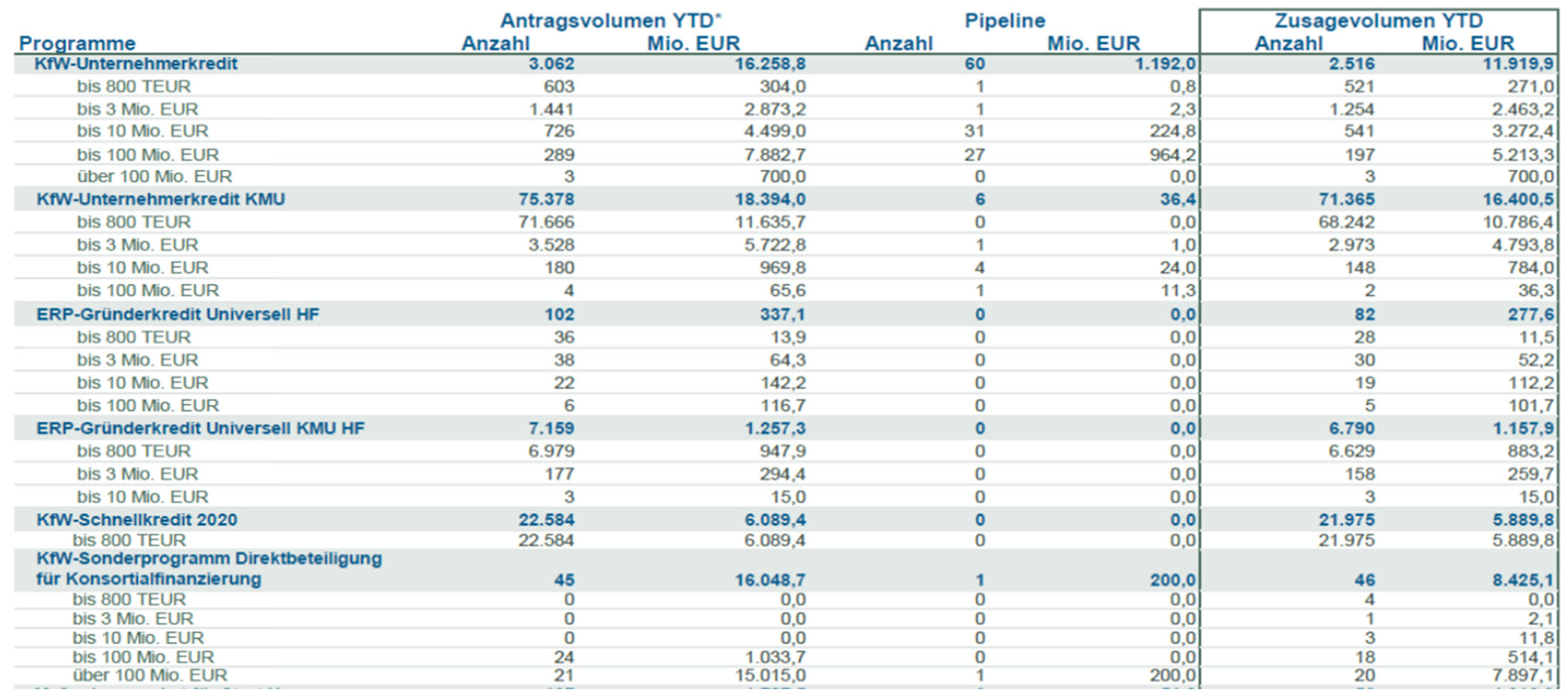
Notes
| 1 | A high-level treatment of development cooperation and the role of development banks can be found in Heidland et al. (2026). |
| 2 | The “need model” fundamentally differs from the “damage model”, which relates public support to the damage incurred in the crisis, irrespective of the financial strength of the firm. The damage of a firm is measured by its shock-induced shortfalls, i.e., financial or earnings damages. According to the “damage model”, public support indemnifies the firm against shock-induced damages. We argue in favor of the “need model” which is consistent with European aid law, while the “damage model” is not. Hong and Lucas (2024) argue that public support is target-inefficient when done without consideration of need. |
| 3 | In the early phases of the pandemic, banks often supplied a PD estimate from the end of 2019. |
| 4 | Initially, upper limits were €300k for firms with up to 10 employees, €500k for firms with up to 50 employees and €800k for larger firms. These limits were raised later. |
| 5 | The accepted volume increased to almost €60 bn. in June 2022, see Bundesministerium für Wirtschaft und Klimaschutz (2022). |
| 6 | The total accepted volume of the pandemic program at the end of 2020 was €45.87 bn., which is 1.33% of the German 2019 GDP. This may appear rather small. The KfW special program, however, is only a small part of a rather comprehensive German program of many different public stimulus measures for the economy. According to Bruegel (2020), the Bruegel datasets about fiscal support relative to the national 2019 GDP as of November 2020, rank Germany second after Italy, before other European countries and the United States. An overview of the German public support is provided by Bundesministerium für Wirtschaft und Klimaschutz (2022). |
| 7 | Administrative capacities of banks may be used by the NDB to also delegate the application for public loans and their administration and monitoring. |
| 8 | There are many firms like hospitals which are not profitable but are kept alive by subsidies because they provide social benefits to the public. These firms might also have access to subsidized lending. Acebo et al. (2026) find that, in Spain, 53% of small zombie firms targeted by government intervention in the COVID-19 crisis fully recovered within two years. |
| 9 | Spence (1973) proposed a model for a signaling equilibrium. Franke (1987) applied this to a costless signaling equilibrium. |
| 10 | Acharya and Steffen (2020) address precautionary liquidity and credit lines during COVID-19 and the impact of stabilization policies. |
| 11 | Jiménez et al. (2024) arrive at a similar conclusion in a different model. |
| 12 | The argument also remains valid if the interest rate differential i* − ip slightly raises the PD in case of private funding by a sufficiently small fraction. |
| 13 | See Brunner and Krahnen (2008) for an investigation in quasi-syndicated bank lending practices in pre-2000 German banking. |
| 14 | A group of senior managers of large German banks, one senior manager of KfW, one bank consultant and one finance professor met several times with the authors of this paper. |
| 15 | Surprisingly, a study in Switzerland about the Swiss state aid program during the pandemic found no clear evidence that firm indebtedness affected participation or that pre-existing potential zombie firms participated more strongly. See Fuhrer et al. (2020). |
| 16 | For fresh money, the firm may also ask some free-wheeling debt fund. If the firm is also concerned about its financial leverage, then it may prefer a strictly subordinated loan which may be counted as equity capital. |
| 17 | See Acharya and Steffen (2020) for an early assessment of the risk of credit line cutoffs. |
| 18 | The NDB might offer this option in view of macro uncertainty on the duration of the economic crisis. |
| 19 | Between April and June 2020, each euro of guarantees is associated with 84 cents of additional credit. In the following quarters, additionality decreased to 60 cents. It is the highest for 100% risk-coverage guarantees. For loans with coverage below 100%, substitution by better capitalized banks was smaller, in contrast to Altavilla et al. (2021). |
| 20 | Apparently, in France, many firms drew unused credit lines and used public loans after the start of COVID-19. Not surprisingly, the deposits of firms grew strongly (Vinas, 2020). |
References
- Acebo, E., Gutierrez-Lopez, C., Abad-Gonzalez, J., & Miguel-Davila, J. (2026). Lazarus, come forth! Public loan guarantees and the recovery of zombie firms. Economic Modelling, 154, 107366. [Google Scholar] [CrossRef] [Scilit]
- Acharya, V. V., & Steffen, S. (2020). The risk of being a fallen angel and the corporate dash for cash in the midst of COVID. The Review of Corporate Finance Studies, 9, 430–471. [Google Scholar] [CrossRef] [Scilit] [PubMed]
- Altavilla, C., Ellul, A., Pagano, M., Polo, A., & Vlassopoulos, T. (2021). Loan guarantees, bank lending and credit risk reallocation (Discussion Paper DP16727, 15 Nov 2021). CEPR. Available online: https://ssrn.com/abstract=4026567 (accessed on 16 February 2026).
- Alter, A., Badarinza, C., & Mahoney, E. (2023). Commercial real estate crisis: Evidence from transaction-level data (IMF Working Paper 015). International Monetary Fund. [Google Scholar]
- Bonaccorsi di Patti, E., Felici, R., Moretti, D., & Rinaldi, F. (2024). The allocation of public guaranteed loans to firms during COVID-19: Credit risk and relationship lending (Working Paper #1462). Banca d’Italia. [Google Scholar]
- Bruegel. (2020). The fiscal response to the economic fallout from the coronavirus. Last update: 24 November 2020. Available online: https://www.bruegel.org/dataset/fiscal-response-economic-fallout-coronavirus (accessed on 16 February 2026).
- Brunner, A., & Krahnen, J. (2008). Multiple lenders and corporate distress: Evidence on debt restructuring. The Review of Economic Studies, 75, 415–442. [Google Scholar] [CrossRef] [Scilit]
- Bundesministerium für Wirtschaft und Klimaschutz. (2022). Überblickspapier Corona-Hilfen Rückblick—Bilanz—Lessons learned, stand 27.6.2022. Bundesministerium für Wirtschaft und Klimaschutz. [Google Scholar]
- Bundesrechnungshof. (2022). Corona-Überbrückungshilfen: Ausgestaltung und Zugangsvoraussetzungen. Abschließende Mitteilung an das Bundesministerium für Wirtschaft und Klimaschutz. [Google Scholar]
- Camacho, M., Quiros, G. P., & Mendizabal, H. R. (2011). High growth recoveries, inventories and the great moderation. Journal of Economic Dynamics and Control, 35, 1322–1339. [Google Scholar] [CrossRef] [Scilit]
- Cao, J., Goldberg, L., Sinha, S., & Ungaro, S. (2024). Learning lessons from government guarantee programmes for bank lending to firms, CEPR, VoxEU. 10 July 2024. Available online: https://cepr.org/voxeu/columns/learning-lessons-government-guarantee-programmes-bank-lending-firms (accessed on 16 February 2026).
- Cascarino, G., Gallo, R., Palazzo, F., & Sette, E. (2022). Public guarantees and credit additionality during the COVID-19 pandemic (Working Paper # 1369). Banca d’Italia. [Google Scholar]
- Davis, S., & Kahn, J. (2008). Interpreting the great moderation: Changes in the volatility of economic activitiy at the macro and micro level. Journal of Economic Perspectives, 22, 155–180. [Google Scholar] [CrossRef] [Scilit]
- Dörr, O., Murmann, S., & Licht, G. (2021). The COVID-19 insolvency gap: First-round effects of policy responses on SMEs. ZEW; Mannheim. [Google Scholar]
- Eslava, M., & Freixas, X. (2021). Public development banks and credit market imperfections. Journal of Money, Credit and Banking, 53, 1121–1149. [Google Scholar] [CrossRef] [Scilit]
- European Commission. (2015). Working together for jobs and growth: The role of National Promotional Banks (NPBs) in supporting the investment plan for Europe. European Commission. [Google Scholar]
- Fabre, A., & Straub, S. (2023). The impact of Public–Private Partnerships (PPPs) in infrastructure, health, and education. Journal of Economic Literature, 61, 655–715. [Google Scholar] [CrossRef] [Scilit]
- Faria-e-Castro, M., Paul, P., & Sánchez, J. (2023). Do banks lend to distressed firms? (FRBSF Economic Letter 2023–31). Federal Reserve Bank of San Francisco. [Google Scholar]
- Franke, G. (1987). Costless signaling equilibrium in financial markets. Journal of Finance, 42, 809–822. [Google Scholar] [CrossRef]
- Fudenberg, D., & Tirole, J. (1983). Sequential bargaining with incomplete information. The Review of Economic Studies, 50, 221–247. [Google Scholar] [CrossRef] [Scilit]
- Fuhrer, L., Ramelet, M., & Tenhofen, J. (2020). Firms‘ participation in the COVID-19 loan programme (SNB Working Papers 25/2020). Swiss National Bank. [Google Scholar]
- Goldberg, L., Pagano, M., Ungaro, S., Cao, J., & Sinha, S. (2024). Loan guarantees and public policy—CEPR RPN European economic policy & financial architecture (CEPR Discussion Paper Oct 2024). CEPR. [Google Scholar]
- Group of Thirty. (2020). Reviving and restructuring the corporate sector post-COVID. Designing Public Policy Interventions. [Google Scholar]
- Gryglewicz, S., Mayer, S., & Morellec, E. (2024). The dynamics of loan sales and lender incentives. The Review of Financial Studies, 37, 2403–2460. [Google Scholar] [CrossRef] [Scilit]
- Heidland, T., Schularick, M., & Thiele, R. (2026). Mutual interest development cooperation: Aligning incentives in a fragmented world (Kiel Report No. 5). Kiel Institute for the World Economy. [Google Scholar]
- Hong, G. H., & Lucas, D. (2024). COVID-19 credit policies around the world: Size, scope, costs and consequences. The Brookings Papers on Economic Activity, 2023, 289–345. [Google Scholar] [CrossRef] [Scilit]
- Huneeus, F., Kaboski, J., Larrain, M., Schmukler, S., & Vera, M. (2023). The distribution of crisis credit: Effects on firm indebtedness and aggregate risk, NBER WP 29774, March 2023. Available online: http://www.nber.org/papers/w29774 (accessed on 16 February 2026).
- Jiménez, G., Laeven, L., Martinez-Miera, D., & Peydró, J. (2024). Public guarantees, private banks’ incentives, and corporate outcomes: Evidence from the COVID-19 crisis (ECB Working Paper Series #2913). ECB. [Google Scholar]
- KfW. (2020a). Merkblatt: KfW-Schnellkredit 2020. Updated 1 February 2022. Available online: https://www.kfw.de/PDF/Download-Center/Förderprogramme-(Inlandsförderung)/PDF-Dokumente/6000004525_M_078.PDF (accessed on 16 February 2026).
- KfW. (2020b). Merkblatt KfW-Unternehmerkredit. Updated 1 February 2022. Available online: https://www.kfw.de/PDF/Download-Center/Förderprogramme-(Inlandsförderung)/PDF-Dokumente/6000000188_M_037_047_Unternehmerkredit.pdf (accessed on 16 February 2026).
- KfW. (2020c). Merkblatt Sonderprogramm “Direktbeteiligung für Konsortialfinanzierung”. Updated 1 January 2022. Available online: https://www.kfw.de/PDF/Download-Center/F%C3%B6rderprogramme-(Inlandsf%C3%B6rderung)/PDF-Dokumente/6000004518_M_855.PDF (accessed on 16 February 2026).
- Laffont, J. (1994). The new economics of regulation ten years after. Econometrica, 62, 507–537. [Google Scholar] [CrossRef] [Scilit]
- Lucas, D. (2020). Policy Rx for the economy: Cash or credit? In S. Agrawal, Z. He, & B. Yeung (Eds.), Impact of COVID-19 on Asian economies and policy responses. World Scientific. [Google Scholar]
- Martin, A., Mayordomo, S., & Vanasco, V. (2025). Banks vs. firms: Who benefits from credit guarantees? CREi draft. [Google Scholar]
- Mateus, M., & Neugebauer, K. (2022). Stayin’ alive? Government support measures in Portugal during the COVID-19 Pandemic (Working Paper #12). Banco de Portugal. [Google Scholar]
- Mertens, D. (2021). A German model? KfW, field dynamics, and the Europeanization of “promotional” banking. In D. Mertens, M. Thiemann, & P. Volberding (Eds.), The reinvention of development banking in the European union: Industrial policy in the single market and the emergence of a field (pp. 117–142). Oxford University Press. [Google Scholar]
- Pagano, M. (2024). Loan guarantees and public policy: Euro-area evidence. In CEPR webinar of the European economic policy (EEP) and European financial architecture (EFA) research policy networks (RPN), 17 October 2024. CEPR. [Google Scholar]
- Spence, M. (1973). Job market signaling. Quarterly Journal of Economics, 87, 355–374. [Google Scholar] [CrossRef] [Scilit]
- Vinas, F. (2020). Outstanding loans to enterprises increased sharply in France in the first half of 2020. Bulletin de la Banque de France, 232, 7. [Google Scholar]
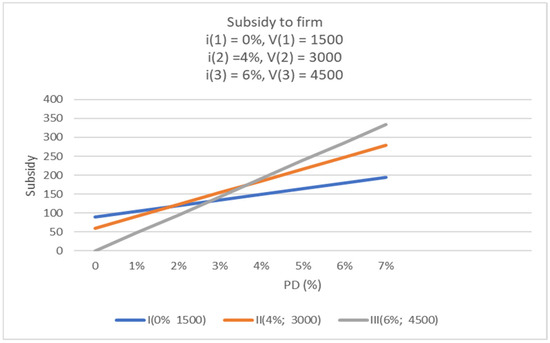
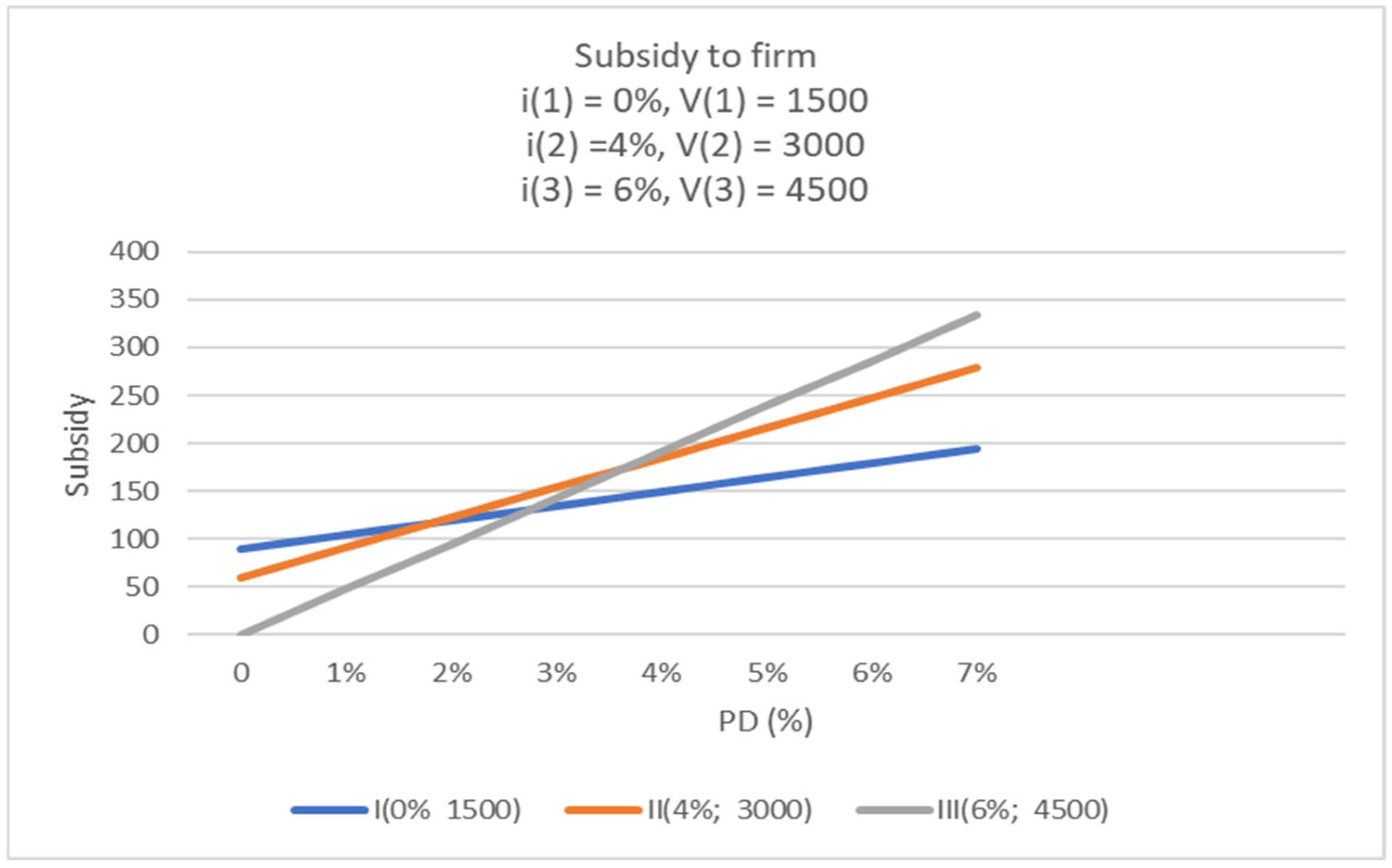

Disclaimer/Publisher’s Note: The statements, opinions and data contained in all publications are solely those of the individual author(s) and contributor(s) and not of MDPI and/or the editor(s). MDPI and/or the editor(s) disclaim responsibility for any injury to people or property resulting from any ideas, methods, instructions or products referred to in the content. |
© 2026 by the authors. Licensee MDPI, Basel, Switzerland. This article is an open access article distributed under the terms and conditions of the Creative Commons Attribution (CC BY) license.