
Financial Inclusion and Rural Economic Empowerment: Evidence from Self-Help Groups in Maharashtra, India



Abstract
1. Introduction
2. Literature Review, Research Questions, and Hypotheses
2.1. Physical Banking Access and the Use of Credit and Insurance Services
2.2. NRLM, Financial Inclusion and Economic Status
2.3. Physical Banking Access, Credit and Insurance Usage and Economic Status
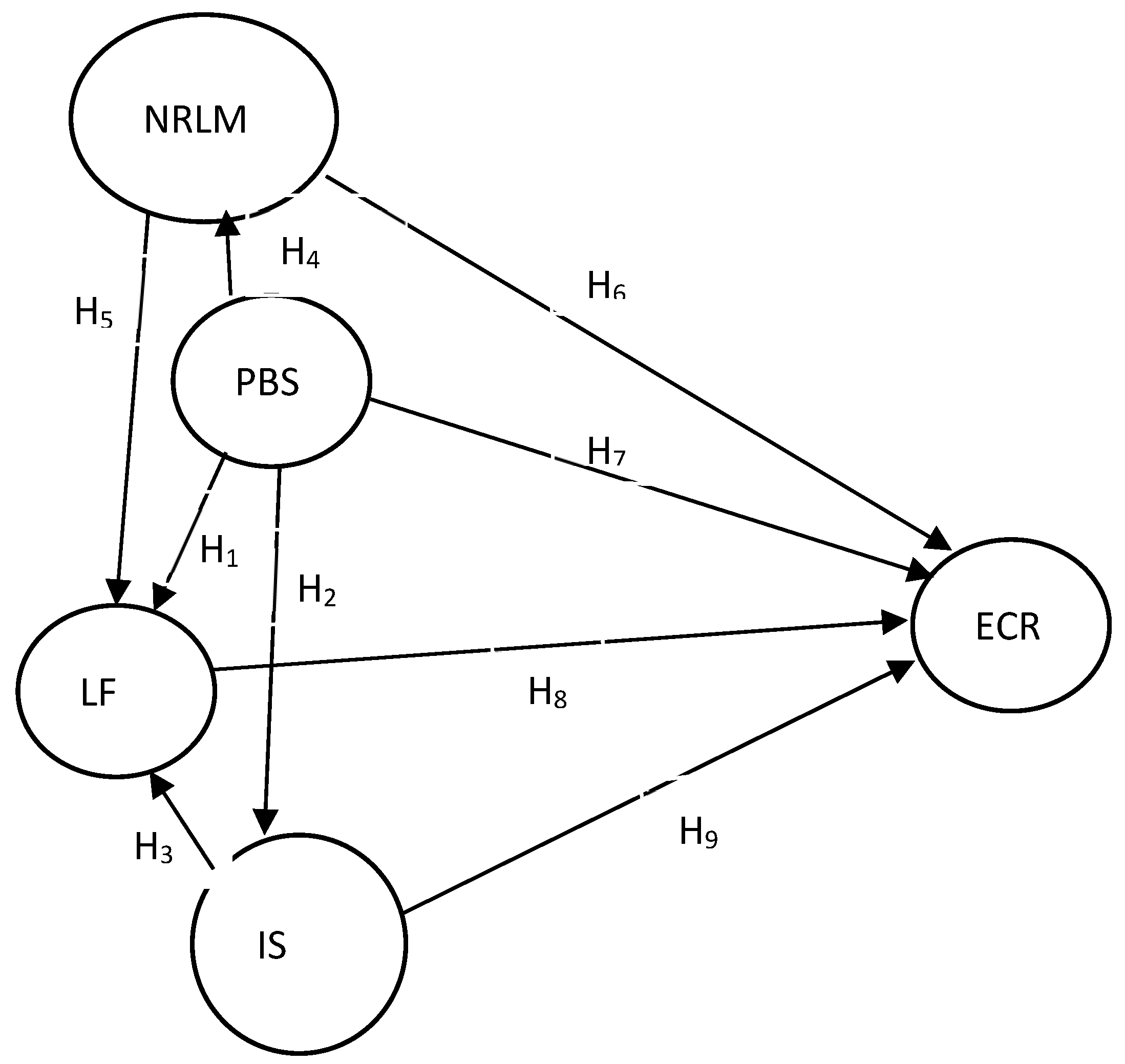
2.4. Conceptual Framework
3. Data and Research Methodology
4. Results and Analysis
4.1. Descriptive Analysis
4.2. Exploratory Factor Analysis (EFA)
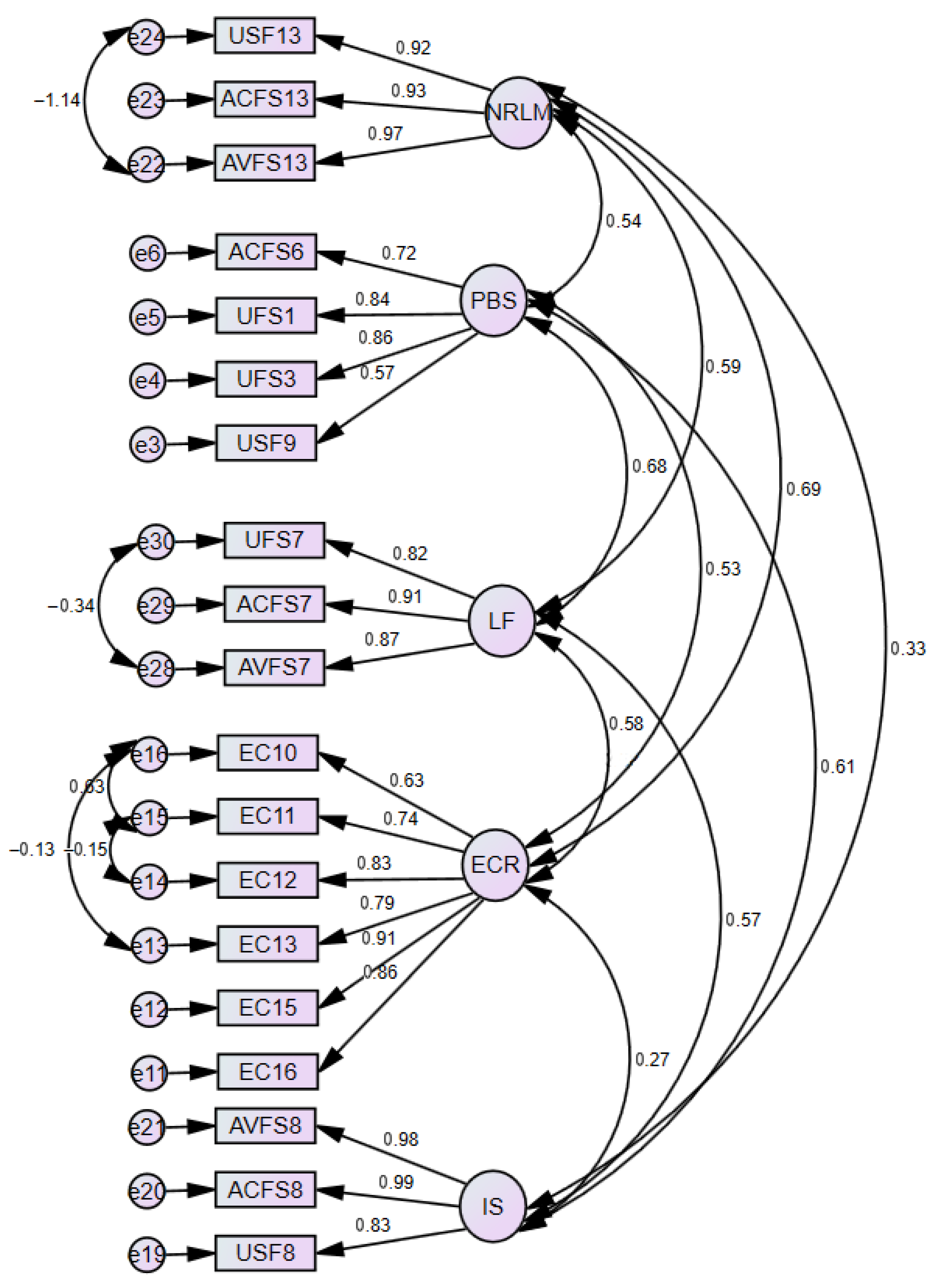
4.3. Confirmatory Factor Analysis (Measurement Model)
4.4. Construct Validity
4.5. Common Method Bias Test
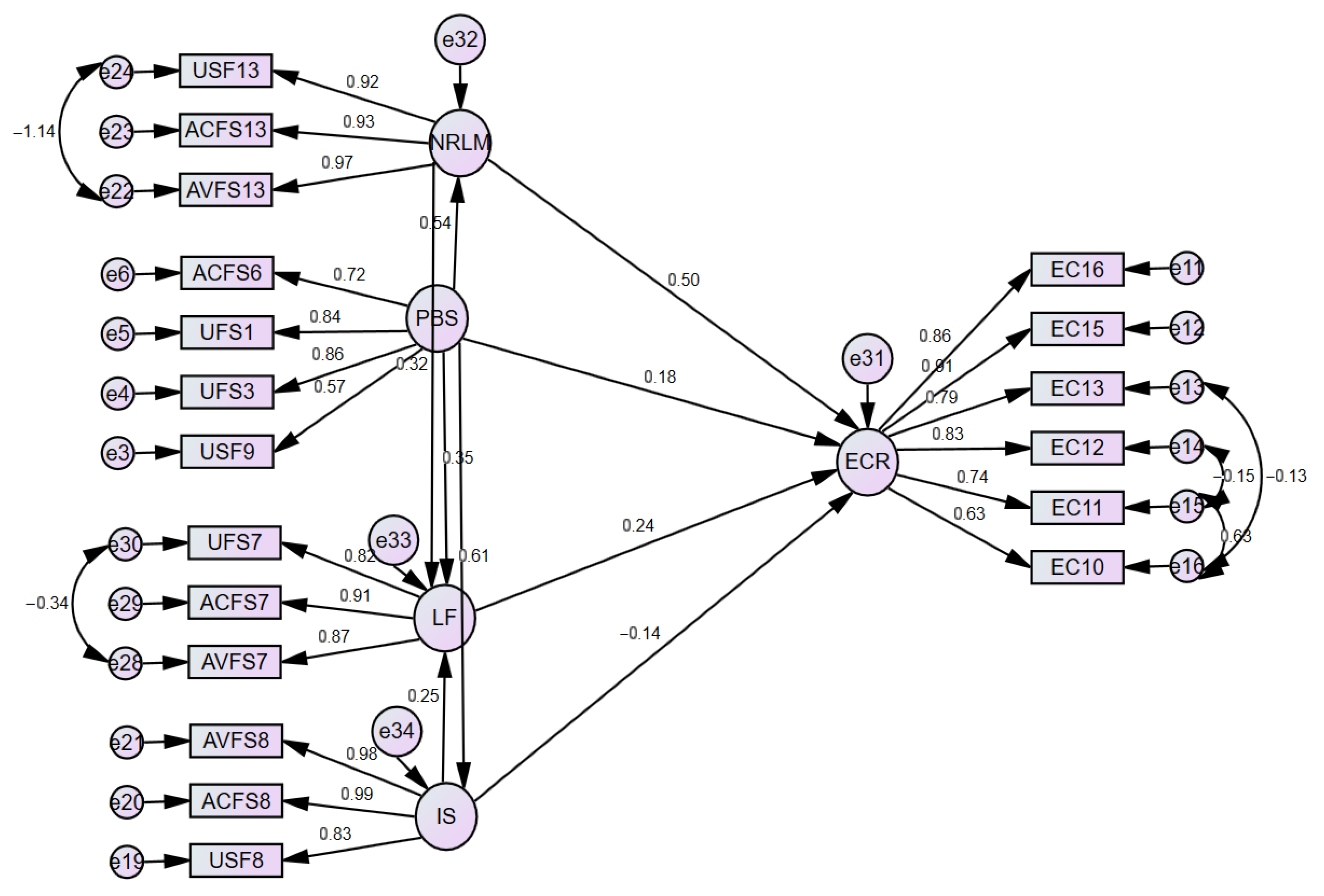
4.6. Structural Equation Modeling and Hypothesis Testing
4.7. Descriptive Group Comparison (Chi-Square Analysis)
4.8. Multi-Group Structural Equation Modeling Analysis
5. Discussion
Policy Implications
6. Conclusions
Limitations and Future Scope
Author Contributions
Funding
Institutional Review Board Statement
Informed Consent Statement
Data Availability Statement
Conflicts of Interest
Appendix A
| 1 | https://www.undp.org/india/national-multidimensional-poverty-index-progress-review-2023. The corresponding figures stood at 32.59% and 8.65% during 2015-16 for rural and urban areas, respectively. Accessed on 25 December 2025. |
| 2 | https://www.niti.gov.in/sites/default/files/2023-08/India-National-Multidimentional-Poverty-Index-2023.pdf. Accessed on 25 December 2025. |
| 3 | https://thedocs.worldbank.org/en/doc/4c4fe6db0fd7a7521a70a39ac518d74b-0050062022/original/Findex2021-India-Country-Brief.pdf. Accessed on 24 December 2025. |
| 4 | https://www.pmjdy.gov.in/home. Accessed on 24 December 2025. |
| 5 | https://www.pib.gov.in/PressReleaseIframePage.aspx?PRID=2080093®=3&lang=2. Accesssed on 25 December 2025. |
| 6 | https://thedocs.worldbank.org/en/doc/4c4fe6db0fd7a7521a70a39ac518d74b-0050062022/original/Findex2021-India-Country-Brief.pdf. Accessed on 25 December 2025. |
| 7 | https://sansad.in/getFile/annex/263/AU359.pdf?source=pqars. Accessed on 25 December 2025. |
| 8 | https://www.pmjdy.gov.in/home. Accessed on 24 December 2025. |
| 9 | |
| 10 | PMFBY provides subsidized crop insurance to farmers against crop losses. PMJJBY offers a life insurance of Rs. 2 lakhs at an annual premium of Rs. 436, while PMSBY provides accident insurance of up to Rs. 2 lakhs at an annual premium of Rs. 20, with both schemes linked to the insured’s bank accounts. (Press Information Bureau, India). |
| 11 | https://static.pib.gov.in/WriteReadData/specificdocs/documents/2025/may/doc202558551501.pdf. Accessed on 26 December 2025. |
| 12 | https://www.pib.gov.in/PressNoteDetails.aspx?ModuleId=3&NoteId=155010®=3&lang=2. Accessed on 26 December 2025. |
| 13 | The program is a modified version of the earlier Swarna Jayanti Gram Swarozgar Yojana (SGSY), which was launched in 1999. |
| 14 | Both Datta (2015) and Hoffmann et al. (2021) study the government-led SHG program Jeevika in Bihar, which served as a precursor for NRLM. |
| 15 | BC and BF are third-party agents who work as the agents of a bank in unbanked rural areas. |
| 16 | Appendix A provides definitions of all the measured variables. |
| 17 | After excluding the three measured items for the BC & BF construct, as BC & BF was not included in the final model. |
References
- Adegbite, O. O., & Machethe, C. L. (2020). Bridging the financial inclusion gender gap in smallholder agriculture in Nigeria: An untapped potential for sustainable development. World Development, 127, 104755. [Google Scholar] [CrossRef] [Scilit]
- Akoijam, S. L. S. (2012). Rural credit: A source of sustainable livelihood of rural India. International Journal of Social Economics, 40(1), 83–97. [Google Scholar] [CrossRef] [Scilit]
- Al-Kubati, N. A. A., & Selvaratnam, D. P. (2023). Empowering women through the self-help group bank linkage program as a tool for sustainable development: Lessons from India. Community Development Journal, 58(2), 283–308. [Google Scholar] [CrossRef] [Scilit]
- Allen, H. (2006). Village savings and loans associations: Sustainable and cost-effective rural finance. Enterprise Development & Microfinance, 17(1), 61–68. [Google Scholar]
- Angelucci, M., Karlan, D., & Zinman, J. (2015). Microcredit impacts: Evidence from a randomized microcredit program placement experiment by Compartamos Banco. American Economic Journal: Applied Economics, 7(1), 151–182. [Google Scholar] [CrossRef] [Scilit]
- Anzoategui, D., Demirgüç-Kunt, A., & Martínez Pería, M. S. (2014). Remittances and financial inclusion: Evidence from El Salvador. World Development, 54, 338–349. [Google Scholar] [CrossRef] [Scilit]
- Ashraf, N., Karlan, D., & Yin, W. (2010). Female empowerment: Impact of a commitment savings product in the Philippines. World Development, 38(3), 333–344. [Google Scholar] [CrossRef] [Scilit]
- Asif, M., Khan, M. N., Tiwari, S., Wani, S. K., & Alam, F. (2023). The impact of fintech and digital financial services on financial inclusion in India. Journal of Risk and Financial Management, 16(2), 122. [Google Scholar] [CrossRef] [Scilit]
- Azam, M. (2018). Does social health insurance reduce financial burden? Panel data evidence from India. World Development, 102, 1–17. [Google Scholar] [CrossRef] [Scilit]
- Banerjee, A., Karlan, D., & Zinman, J. (2015). Six randomized evaluations of microcredit: Introduction and further steps. American Economic Journal: Applied Economics, 7(1), 1–21. [Google Scholar] [CrossRef] [Scilit]
- Bansal, J., & Anil, K. (2018). Qualitative research on issues and trends in the bancassurance model in India: An interview report. International Journal of Banking, Risk and Insurance, 6(2), 67–78. [Google Scholar]
- Beck, T., Demirgüç-Kunt, A., & Levine, R. (2007). Finance, inequality and the poor. Journal of Economic Growth, 12(1), 27–49. [Google Scholar] [CrossRef] [Scilit]
- Benoist, G. (2002). Bancassurance: The new challenges. The Geneva Papers on Risk and Insurance: Issues and Practice, 27(3), 295–303. [Google Scholar] [CrossRef] [Scilit]
- Bergen, N., & Labonté, R. (2020). “Everything is perfect, and we have no problems”: Detecting and limiting social desirability bias in qualitative research. Qualitative Health Research, 30(5), 783–792. [Google Scholar] [CrossRef] [Scilit]
- Bongomin, G. O. C., Munene, J. C., Ntayi, J. M., & Malinga, C. A. (2017). Financial literacy in emerging economies: Do all components matter for financial inclusion of poor households in rural Uganda? Managerial Finance, 43(12), 1310–1331. [Google Scholar] [CrossRef] [Scilit]
- Burgess, R., & Pande, R. (2005). Do rural banks matter? Evidence from the Indian social banking experiment. American Economic Review, 95(3), 780–795. [Google Scholar] [CrossRef] [Scilit]
- Churchill, S. A., & Marisetty, V. B. (2020). Financial inclusion and poverty: A tale of forty-five thousand households. Applied Economics, 52(16), 1777–1788. [Google Scholar] [CrossRef] [Scilit]
- Cole, S., Giné, X., Tobacman, J., Topalova, P., Townsend, R., & Vickery, J. (2013). Barriers to household risk management: Evidence from India. American Economic Journal: Applied Economics, 5(1), 104–135. [Google Scholar] [CrossRef] [Scilit]
- Cole, S., Giné, X., & Vickery, J. (2017). How does risk management influence production decisions? Evidence from a field experiment. The Review of Financial Studies, 30(6), 1935–1970. [Google Scholar] [CrossRef] [Scilit]
- Cole, S., Sampson, T., & Zia, B. (2011). Prices or knowledge? What drives demand for financial services in emerging markets? Journal of Finance, 66(6), 1933–1967. [Google Scholar] [CrossRef] [Scilit]
- Dahiya, S., & Kumar, M. (2020). Linkage between financial inclusion and economic growth: An empirical study of the emerging Indian economy. Vision: The Journal of Business Perspective, 24(2), 184–193. [Google Scholar] [CrossRef] [Scilit]
- Danladi, S., Prasad, M. S. V., Modibbo, U. M., Ahmadi, S. A., & Ghasemi, P. (2023). Attaining sustainable development goals through financial inclusion: Exploring collaborative approaches to fintech adoption in developing economies. Sustainability, 15(17), 13039. [Google Scholar] [CrossRef] [Scilit]
- Dash, A., & Mohanta, G. (2024). Fostering financial inclusion for attaining sustainable goals: What contributes more to the inclusive financial behavior of rural households in India? Journal of Cleaner Production, 449, 141731. [Google Scholar] [CrossRef] [Scilit]
- Datta, U. (2015). Socio-economic impacts of JEEViKA: A large-scale self-help group project in Bihar, India. World Development, 68, 1–18. [Google Scholar] [CrossRef] [Scilit]
- Demir, A., Pesqué-Cela, V., Altunbas, Y., & Murinde, V. (2022). Fintech, financial inclusion, and income inequality: A quantile regression approach. The European Journal of Finance, 28(1), 86–107. [Google Scholar] [CrossRef] [Scilit]
- Demirgüç-Kunt, A., Klapper, L., & Singer, D. (2017). Financial inclusion and inclusive growth: A review of recent empirical evidence. World Bank Policy Research Working Paper No. 8040. World Bank Group. Available online: http://documents.worldbank.org/curated/en/403611493134249446 (accessed on 24 December 2025).
- Demirgüç-Kunt, A., Klapper, L., Singer, D., & Ansar, S. (2022). The global findex database 2021: Financial inclusion, digital payments, and resilience in the age of COVID-19. World Bank Group. Available online: https://documents.worldbank.org/curated/en/099818107072234182 (accessed on 18 January 2026).
- Dua, P., Sahay, N., & Deol, O. S. (2019). An overview and significance of different bancassurance schemes launched for financial inclusion in India. International Journal of Management, 10(6), 275–286. [Google Scholar] [CrossRef] [Scilit]
- Dupas, P., Green, S., Keats, A., & Robinson, J. (2014). Challenges in banking the rural poor: Evidence from Kenya’s Western Province. In S. Edwards, S. Johnson, & D. N. Weil (Eds.), African successes, Volume III: Modernization and development (pp. 63–101). National Bureau of Economic Research. [Google Scholar]
- Dupas, P., Karlan, D., Robinson, J., & Ubfal, D. (2018). Banking the unbanked? Evidence from three countries. American Economic Journal: Applied Economics, 10(2), 257–297. [Google Scholar] [CrossRef] [Scilit]
- Dupas, P., & Robinson, J. (2013). Why don’t the poor save more? Evidence from health savings experiments. American Economic Review, 103(4), 1138–1171. [Google Scholar] [CrossRef] [Scilit]
- Fuller, C. M., Simmering, M. J., Atinc, G., Atinc, Y., & Babin, B. J. (2016). Common methods variance detection in business research. Journal of Business Research, 69(8), 3192–3198. [Google Scholar] [CrossRef] [Scilit]
- Garg, S., Gupta, S., & Mallick, S. (2026). Does social identity constrain rural entrepreneurship? Evidence on the role of financial inclusion. Journal of Development Economics, 179, 103669. [Google Scholar] [CrossRef] [Scilit]
- Giné, X., & Yang, D. (2009). Insurance, credit, and technology adoption: Field experimental evidence from Malawi and India. Journal of Development Economics, 89(1), 1–11. [Google Scholar] [CrossRef] [Scilit]
- Giri, M., & Chatterjee, D. (2021). Factors affecting changes in insured status of rural and urban households: A study over two time periods in India. IIMB Management Review, 33(4), 360–371. [Google Scholar] [CrossRef] [Scilit]
- Goel, S., & Sharma, R. (2017). Developing a financial inclusion index for India. Procedia Computer Science, 122, 949–956. [Google Scholar] [CrossRef] [Scilit]
- Gupta, T., & Singh, U. B. (2018). An assessment of growth and potential of the self-help group-bank linkage program in India. International Journal of Agricultural & Statistical Sciences, 14, 373–386. [Google Scholar]
- Habib, S. S., Perveen, S., & Khuwaja, H. M. A. (2016). The role of micro health insurance in providing financial risk protection in developing countries: A systematic review. BMC Public Health, 16(1), 281. [Google Scholar] [CrossRef] [Scilit]
- Hair, J. F., Anderson, R. E., Babin, B. J., & Black, W. C. (2010). Multivariate data analysis: A global perspective (7th ed.). Pearson. [Google Scholar]
- Halim, N., Yount, K. M., & Cunningham, S. (2016). Do Scheduled Caste and Scheduled Tribe women legislators mean lower gender–caste gaps in primary schooling in India? Social Science Research, 58, 122–134. [Google Scholar] [CrossRef] [Scilit]
- Hasan, M., Le, T., & Hoque, A. (2021). How does financial literacy impact on inclusive finance? Financial Innovation, 7(1), 40. [Google Scholar] [CrossRef] [Scilit]
- Hoffmann, V., Rao, V., Surendra, V., & Datta, U. (2021). Relief from usury: Impact of a self-help group lending program in rural India. Journal of Development Economics, 148, 102567. [Google Scholar] [CrossRef] [Scilit]
- Inoue, T. (2019). Financial inclusion and poverty reduction in India. Journal of Financial Economic Policy, 11(1), 21–33. [Google Scholar] [CrossRef] [Scilit]
- Jobson, J. D. (2012). Applied multivariate data analysis: Volume II: Categorical and multivariate methods. Springer Science & Business Media. [Google Scholar]
- Jütting, J. P. (2001). The impact of health insurance on the access to health care and financial protection in rural developing countries: The example of Senegal. HNP Discussion Paper Series. World Bank. Available online: http://documents.worldbank.org/curated/en/382731468764075531 (accessed on 10 December 2025).
- Kaur, S., Raj, H., Singh, H., & Chattu, V. K. (2021). Crop insurance policies in India: An empirical analysis of Pradhan Mantri Fasal Bima Yojana. Risks, 9(11), 191. [Google Scholar] [CrossRef] [Scilit]
- Khandker, S. R. (2005). Microfinance and poverty: Evidence using panel data from Bangladesh. World Bank Economic Review, 19(2), 263–286. [Google Scholar] [CrossRef] [Scilit]
- Kim, D.-W., Yu, J.-S., & Hassan, M. K. (2018). Financial inclusion and economic growth in OIC countries. Research in International Business and Finance, 43, 1–14. [Google Scholar] [CrossRef] [Scilit]
- Kling, G., Pesqué-Cela, V., Tian, L., & Luo, D. (2022). A theory of financial inclusion and income inequality. The European Journal of Finance, 28(1), 137–157. [Google Scholar] [CrossRef] [Scilit]
- Krumpal, I. (2013). Determinants of social desirability bias in sensitive surveys: A literature review. Quality & Quantity, 47(4), 2025–2047. [Google Scholar]
- Kuri, P. K., & Laha, A. (2011). Financial inclusion and human development in India: An inter-state analysis. Indian Journal of Human Development, 5(1), 61–76. [Google Scholar] [CrossRef] [Scilit]
- Li, L. (2018). Financial inclusion and poverty: The role of relative income. China Economic Review, 52, 165–191. [Google Scholar] [CrossRef] [Scilit]
- Maity, S. (2023). Self help groups, microfinance, financial inclusion and social exclusion: Insight from Assam. Heliyon, 9(6), e16807. [Google Scholar] [CrossRef] [Scilit]
- Markose, S., Arun, T., & Ozili, P. (2022). Financial inclusion, at what cost? Quantification of economic viability of a supply side roll out. The European Journal of Finance, 28(1), 3–29. [Google Scholar] [CrossRef] [Scilit]
- Meager, R. (2019). Understanding the average impact of microcredit expansions: A Bayesian hierarchical analysis of seven randomized experiments. American Economic Journal: Applied Economics, 11(1), 57–91. [Google Scholar] [CrossRef] [Scilit]
- Mishra, A. K., & Bhardwaj, V. (2022). Financial access and household’s borrowing: Policy perspectives of an emerging economy. Journal of Policy Modeling, 44(5), 981–999. [Google Scholar] [CrossRef] [Scilit]
- Mishra, K., Gallenstein, R. A., Miranda, M. J., Sam, A. G., Toledo, P., & Mulangu, F. (2021). Insured loans and credit access: Evidence from a randomized field experiment in Northern Ghana. American Journal of Agricultural Economics, 103(3), 923–943. [Google Scholar] [CrossRef] [Scilit]
- Mugerman, Y., Sade, O., & Shayo, M. (2014). Long-term savings decisions: Financial reform, peer effects and ethnicity. Journal of Economic Behavior & Organization, 106, 235–253. [Google Scholar]
- Mureșan, G. M., Fülöp, M. T., & Ciumaș, C. (2021). The road from money to happiness. Journal of Risk and Financial Management, 14(10), 459. [Google Scholar] [CrossRef] [Scilit]
- Nagayya, D., & Rao, B. A. (2016). Microfinance through self-help groups and financial inclusion. Journal of Rural Development, 35(3), 341–375. [Google Scholar]
- Nimbrayan, P. K., Tanwar, N., & Tripathi, R. K. (2018). Pradhan Mantri Jan Dhan Yojana (PMJDY): The biggest financial inclusion initiative in the world. Economic Affairs, 63(2), 583–590. [Google Scholar] [CrossRef] [Scilit]
- Ningombam, S. K., & Bordoloi, S. (2024). DAY-NRLM scheme and its impact on women empowerment: A case of Morigaon district of Assam, India. Indian Growth and Development Review, 17(1), 26–42. [Google Scholar] [CrossRef] [Scilit]
- NITI Aayog. (2023). National Multidimensional Poverty Index: A progress review 2023. Government of India. Available online: https://www.niti.gov.in/sites/default/files/2023-08/India-National-Multidimentional-Poverty-Index-2023.pdf (accessed on 25 December 2025).
- Ohiomu, S., & Ogbeide-Osaretin, E. N. (2019). Financial inclusion and gender inequality reduction: Evidence from sub-Saharan Africa. The Indian Economic Journal, 67(3–4), 367–372. [Google Scholar] [CrossRef] [Scilit]
- Omar, M. A., & Inaba, K. (2020). Does financial inclusion reduce poverty and income inequality in developing countries? A panel data analysis. Journal of Economic Structures, 9, 37. [Google Scholar] [CrossRef] [Scilit]
- Paige Fields, L., Fraser, D. R., & Kolari, J. W. (2007). Is bancassurance a viable model for financial firms? Journal of Risk and Insurance, 74(4), 777–794. [Google Scholar] [CrossRef] [Scilit]
- Pandey, V., & Gupta, A. (2022). Can multi-sectoral development interventions boost livelihoods and women’s labor supply? Evidence from NRLM in India. Feminist Economics, 28(2), 217–246. [Google Scholar] [CrossRef] [Scilit]
- Podsakoff, P. M., MacKenzie, S. B., Lee, J. Y., & Podsakoff, N. P. (2003). Common method biases in behavioral research: A critical review of the literature and recommended remedies. Journal of Applied Psychology, 88(5), 879–903. [Google Scholar] [CrossRef] [Scilit]
- Prina, S. (2015). Banking the poor via savings accounts: Evidence from a field experiment. Journal of Development Economics, 115, 16–31. [Google Scholar] [CrossRef] [Scilit]
- Raghunathan, K., Kumar, N., Gupta, S., Thai, G., Scott, S., Choudhury, A., & Quisumbing, A. (2023). Scale and sustainability: The impact of a women’s self-help group program on household economic well-being in India. The Journal of Development Studies, 59(4), 490–515. [Google Scholar] [CrossRef] [Scilit]
- Rajesh, S., Jain, S., & Sharma, P. (2018). Inherent vulnerability assessment of rural households based on socio-economic indicators using categorical principal component analysis: A case study of the Kimsar region, Uttarakhand. Ecological Indicators, 85, 93–104. [Google Scholar] [CrossRef] [Scilit]
- Rizvi, F. F. (2023). Women’s empowerment outcome: Experiences from DAY-NRLM-BRLP in Gaya. Indian Journal of Economics, CIII, 743–755. [Google Scholar]
- Sarma, M., & Pais, J. (2011). Financial inclusion and development. Journal of International Development, 23(5), 613–628. [Google Scholar] [CrossRef] [Scilit]
- Saxena, R. K., & Mishra, A. K. (2016). BC model: A tool for reaching out to the unreached. Journal of Reviews and Research, 4(2), 1–12. [Google Scholar]
- Serrao, M., Sequeira, A., & Varambally, K. V. M. (2021). Impact of financial inclusion on the socio-economic status of rural and urban households of vulnerable sections in Karnataka. arXiv, arXiv:2105.11716. Available online: https://arxiv.org/abs/2105.11716 (accessed on 10 December 2025).
- Shylendra, H. S. (2022). Livelihood promotion: Can the collectives of NRLM really do it? International Journal of Rural Management, 18(3), 323–357. [Google Scholar] [CrossRef] [Scilit]
- Sobaih, A. E. E., & Elshaer, I. A. (2022). Structural equation modeling-based multi-group analysis: Examining the role of gender in the link between entrepreneurship orientation and entrepreneurial intention. Mathematics, 10(20), 3719. [Google Scholar] [CrossRef] [Scilit]
- Sun, Q., Liu, X., Meng, Q., Tang, S., Yu, B., & Tolhurst, R. (2009). Evaluating the financial protection of patients with chronic disease by health insurance in rural China. International Journal for Equity in Health, 8(1), 42. [Google Scholar] [CrossRef] [Scilit]
- Survase, M., & Inumula, K. M. (2019). Financial inclusion: Scale modification and validation of socio-economic indicators. SCMS Journal of Indian Management, 16(4), 31–40. [Google Scholar]
- Swain, R. B., & Wallentin, F. Y. (2009). Does microfinance empower women? Evidence from self-help groups in India. International Review of Applied Economics, 23(5), 541–556. [Google Scholar] [CrossRef] [Scilit]
- Swamy, V. (2014). Financial inclusion, gender dimension, and economic impact on poor households. World Development, 56, 1–15. [Google Scholar] [CrossRef] [Scilit]
- United Nations Development Programme. (2023, July 18). National multidimensional poverty index: A progress review 2023. UNDP India. Available online: https://www.undp.org/india/national-multidimensional-poverty-index-progress-review-2023 (accessed on 25 December 2025).
- Van, L. T. H., Vo, A. T., Nguyen, N. T., & Vo, D. H. (2021). Financial inclusion and economic growth: International evidence. Emerging Markets Finance and Trade, 57(1), 239–263. [Google Scholar] [CrossRef] [Scilit]
- World Bank. (2024). World development indicators. Available online: https://databank.worldbank.org/source/world-development-indicators (accessed on 22 December 2025).
- Xu, S., Asiedu, M., & Effah, N. A. A. (2023). Inclusive finance, gender inequality, and sustainable economic growth in Africa. Journal of the Knowledge Economy, 14(4), 4866–4902. [Google Scholar] [CrossRef] [Scilit]
- Zeller, M., & Sharma, M. (2000). Many borrow, more save, and all insure: Implications for food and microfinance policy. Food Policy, 25(2), 143–167. [Google Scholar] [CrossRef] [Scilit]



| Demographics | Household Details (N = 426) | Frequency | Percentage |
|---|---|---|---|
| Age | Less than 25 years | 55 | 13 |
| 25 to 35 years | 167 | 39.4 | |
| 36 to 45 years | 148 | 34.9 | |
| More than 45 years | 54 | 12.7 | |
| Caste | SC category | 123 | 22.1 |
| ST category | 186 | 33.5 | |
| OBC category | 155 | 27.9 | |
| General category | 92 | 16.5 | |
| Education | Illiterate | 37 | 8.7 |
| Below secondary | 205 | 48.3 | |
| Secondary & higher secondary | 156 | 36.8 | |
| Graduation & diploma | 16 | 3.8 | |
| Post-graduation & above | 10 | 2.4 | |
| Occupation | Self-employed | 59 | 13.9 |
| Private sector employee | 79 | 18.6 | |
| Unemployed | 10 | 2.4 | |
| Farmer | 199 | 46.9 | |
| Daily labor | 64 | 15.1 | |
| Public sector employee | 13 | 3.1 | |
| District | Pune | 154 | 36.2 |
| Thane | 129 | 30.3 | |
| Palghar | 143 | 33.5 |
| Rotated Component Matrix a | ||
|---|---|---|
| Constructs | Items | Factor Loading |
| ECR | EC4—Improvement in electronic goods ownership. | 0.62 |
| EC5—Improvement in vehicle ownership. | 0.514 | |
| EC10—Improvement in propensity to save. | 0.796 | |
| EC11—Improvement in propensity for investing. | 0.851 | |
| EC12—Improvement in accessibility to credit facility. | 0.659 | |
| EC13—Improvement in building of wealth. | 0.662 | |
| EC15—Improvement in current and future financial stability. | 0.739 | |
| EC16—Improvement in economic development as a whole. | 0.791 | |
| PBS | AVFS1—A bank branch is available at your place. | 0.766 |
| AVFS3—ATMs are available at your place. | 0.797 | |
| AVFS10—Deposit/withdrawing facility is available to the respondent. | 0.857 | |
| ACFS3—ATMs are easily accessible. | 0.756 | |
| ACFS6—Cheque book/facility is easily accessible to the respondent | 0.607 | |
| UFS1—The respondent used a bank branch to access financial services. | 0.723 | |
| UFS3—The respondent used ATMs services. | 0.765 | |
| UFS9—The respondent used an overdraft facility of a Bank. | 0.501 | |
| ACFS10—Cash deposit and withdrawal facilities are easily accessible to the respondent. | 0.805 | |
| USF10—The respondent used cash deposits/withdrawals facilities. | 0.679 | |
| IS | AVFS8—Insurance plans are available to the respondent. | 0.878 |
| ACFS8—Insurance services are easily accessible to the respondent. | 0.865 | |
| USF8—The respondent used insurance services. | 0.879 | |
| NRLM | AVFS13—NRLM schemes are available to the respondent. | 0.814 |
| ACFS13—NRLM services are easily accessible to the respondent. | 0.833 | |
| UFS13—The respondent used NRLM schemes. | 0.707 | |
| LF | AVFS7—Loan (credit) facility is available to the respondent. | 0.742 |
| ACFS7—Loan (credit) facility is easily accessible to the respondent. | 0.742 | |
| USF7—The respondent used a loan (credit) facility. | 0.617 | |
| BC & BF | AVFS2—Availability of BC & BF | 0.687 |
| ACFS2—Easy accessibility of BC &BF | 0.866 | |
| UFS2—Financial services were obtained via BC & BF. | 0.851 | |
| Total cumulative variance 76.005; Extraction Method: Principal Components Analysis; | ||
| Rotation Method: Kaiser Normalization using Varimax. a; | ||
| a. The rotation process reached convergence after seven rounds. | ||
| Construct | No. of Items | Cronbach’s Alpha (Reliability) |
|---|---|---|
| ECR | 8 | 0.94 |
| PBS | 10 | 0.93 |
| IS | 3 | 0.95 |
| NRLM | 3 | 0.95 |
| LF | 3 | 0.90 |
| BC & BF | 3 | 0.94 |
| Construct | ECR | PBS | IS | NRLM | LF |
|---|---|---|---|---|---|
| ECR | 1 | ||||
| PBS | 0.458 ** | 1 | |||
| IS | 0.275 ** | 0.577 ** | 1 | ||
| NRLM | 0.663 ** | 0.487 ** | 0.334 ** | 1 | |
| LF | 0.582 ** | 0.614 ** | 0.529 ** | 0.584 ** | 1 |
| BC & BF | 0.463 ** | −0.177 ** | −0.129 ** | 0.313 ** | 0.119 * |
| Indicators | Initial Measurement | Final Measurement | Acceptable Fit Criterion |
|---|---|---|---|
| CMIN/DF | 2.905 | 2.548 | ≤3 denotes a suitable fit ≤5 signifies a fair fit |
| CFI | 0.954 | 0.971 | ≥0.90 denotes a suitable fit ≥0.95 denotes a perfect fit |
| SRMR | 0.073 | 0.056 | ≤0.05 denotes a suitable fit |
| RMSEA | 0.067 | 0.06 | ≤0.05 denotes a perfect fit ≤0.08 denotes a suitable fit |
| PCLOSE | 0 | 0.014 | ≥0.05 the model is thought to fit quite well. |
| Construct | No. of Items | AVE | CR |
|---|---|---|---|
| ECR | 8 | 0.50 | 0.80 |
| PBS | 10 | 0.67 | 0.86 |
| IS | 3 | 0.77 | 0.88 |
| NRLM | 3 | 0.61 | 0.75 |
| LF | 3 | 0.49 | 0.59 |
| Total Variance Explained | ||||||
|---|---|---|---|---|---|---|
| Component | Initial Eigenvalues | Extraction Sums of Squared Loadings | ||||
| Total | % of Variance | Cumulative % | Total | % of Variance | Cumulative % | |
| 1 | 12.598 | 46.659 | 46.659 | 12.598 | 46.659 | 46.659 |
| 2 | 3.728 | 13.808 | 60.467 | |||
| 3 | 1.666 | 6.171 | 66.638 | |||
| 4 | 1.203 | 4.455 | 71.093 | |||
| 5 | 1.025 | 3.798 | 74.891 | |||
| 6 | 0.842 | 3.120 | 78.011 | |||
| 7 | 0.767 | 2.842 | 80.853 | |||
| 8 | 0.681 | 2.523 | 83.376 | |||
| 9 | 0.583 | 2.161 | 85.536 | |||
| 10 | 0.486 | 1.799 | 87.335 | |||
| 11 | 0.465 | 1.722 | 89.058 | |||
| 12 | 0.333 | 1.235 | 90.292 | |||
| 13 | 0.301 | 1.115 | 91.407 | |||
| 14 | 0.287 | 1.065 | 92.471 | |||
| 15 | 0.277 | 1.024 | 93.496 | |||
| 16 | 0.244 | 0.904 | 94.400 | |||
| 17 | 0.227 | 0.840 | 95.239 | |||
| 18 | 0.204 | 0.755 | 95.994 | |||
| 19 | 0.194 | 0.720 | 96.714 | |||
| 20 | 0.175 | 0.649 | 97.364 | |||
| 21 | 0.161 | 0.597 | 97.961 | |||
| 22 | 0.153 | 0.566 | 98.527 | |||
| 23 | 0.122 | 0.452 | 98.979 | |||
| 24 | 0.089 | 0.331 | 99.310 | |||
| 25 | 0.085 | 0.315 | 99.625 | |||
| 26 | 0.071 | 0.262 | 99.887 | |||
| 27 | 0.031 | 0.113 | 100.000 | |||
| Indicators | Estimate | Acceptable Fit Criterion |
|---|---|---|
| CMIN/DF | 2.53 | ≤3 denotes a suitable fit ≤5 signifies a fair fit |
| CFI | 0.971 | ≥0.90 denotes a suitable fit ≥0.95 denotes a perfect fit |
| SRMR | 0.056 | ≤0.05 denotes a suitable fit |
| RMSEA | 0.06 | ≤0.05 denotes a perfect fit ≤0.08 denotes a suitable fit |
| PCLOSE | 0.017 | ≥0.05 the model is thought to fit quite well. |
| Hypotheses | Path | Estimate (β) | Result |
|---|---|---|---|
| H1 | LF←PBS | 0.352 *** | Supported |
| H2 | IS←PBS | 0.606 *** | Supported |
| H3 | LF←IS | 0.247 *** | Supported |
| H4 | NRLM←PBS | 0.541 *** | Supported |
| H5 | LF←NRLM | 0.321 *** | Supported |
| H6 | ECR←NRLM | 0.495 *** | Supported |
| H7 | ECR←PBS | 0.185 ** | Supported |
| H8 | ECR←LF | 0.237 *** | Supported |
| H9 | ECR←IS | −0.139 ** | Not Supported |
| Panel A: Physical Banking Services (PBS) | ||||
| Users | Non-users | Statistics | p-Value | |
| Loan (Credit) Usage | 74.5% | 32.9% | 71.91 | <0.001 |
| Insurance Usage | 44.6% | 12.1% | 56.86 | <0.001 |
| NRLM Participation | 75% | 38.3% | 56.42 | <0.001 |
| Improvement in ECR | 70.7% | 24.6% | 89.47 | <0.001 |
| Panel B: NRLM Participation | ||||
| Users | Non-users | Statistics | p-Value | |
| Loan (Credit) Usage | 69.1% | 29.4% | 66.53 | <0.001 |
| Insurance Usage | 37.4% | 12.9% | 32.70 | <0.001 |
| Improvement in ECR | 68.2% | 16.5% | 114.15 | <0.001 |
| Panel C: Loan (Credit) Use | ||||
| Improvement in ECR | 64.8% | 23.6% | 73.01 | <0.001 |
| Panel D: Insurance Use | ||||
| Improvement in ECR | 69.3% | 35.8% | 37.41 | <0.001 |
| Hypothesis | Palghar | Thane | Pune | Group Difference (p-Value) | Group Difference Exists | |
|---|---|---|---|---|---|---|
| H1 | LF←PBS | 0.811 *** | 0.404 *** | 0.132 | <0.001 | Yes |
| H2 | IS← PBS | 0.82 *** | 0.605 *** | 0.22 ** | <0.001 | Yes |
| H3 | LF←IS | 0.145 *** | −0.005 | 0.054 | 0.405 | No |
| H4 | NRLM←PBS | 0.528 *** | 0.677 *** | 0.258 *** | <0.001 | Yes |
| H5 | LF←NRLM | 0.027 | 0.38 *** | 0.572 *** | <0.001 | Yes |
| H6 | ECR←NRLM | 0.677 *** | 0.203 * | 0.306 *** | 0.003 | Yes |
| H7 | ECR←PBS | −0.316 | 0.228 * | 0.24 *** | 0.193 | No |
| H8 | ECR←LF | 0.781 * | 0.36 *** | 0.508 *** | 0.242 | No |
| H9 | ECR←IS | −0.463 *** | 0.029 | 0.013 | 0.003 | Yes |
| Hypothesis | SC & ST | OBC | General | Group Difference (p-Value) | Group Difference Exists | |
|---|---|---|---|---|---|---|
| H1 | LF←PBS | 0.333 *** | 0.4 *** | 0.261 ** | 0.585 | No |
| H2 | IS←PBS | 0.522 *** | 0.681 *** | 0.538 *** | 0.417 | No |
| H3 | LF←IS | 0.236 *** | 0.291 *** | 0.319 *** | 0.639 | No |
| H4 | NRLM←PBS | 0.505 *** | 0.592 *** | 0.457 *** | 0.954 | No |
| H5 | LF←NRLM | 0.434 *** | 0.076 | 0.374 *** | 0.061 | No |
| H6 | ECR←NRLM | 0.426 *** | 0.507 *** | 0.56 *** | 0.381 | No |
| H7 | ECR←PBS | 0.058 | 0.451 *** | 0.143 | 0.031 | Yes |
| H8 | ECR←LF | 0.405 *** | 0.027 | 0.157 | 0.005 | Yes |
| H9 | ECR←IS | −0.172 ** | −0.215 | 0.028 | 0.166 | No |
| Hypothesis | Low | Medium | High | Group Difference (p-Value) | Group Difference Exists | |
|---|---|---|---|---|---|---|
| H1 | LF←PBS | 0.356 *** | 0.304 *** | 0.273 * | 0.33 | No |
| H2 | IS←PBS | 0.524 *** | 0.604 *** | 0.616 *** | 0.227 | No |
| H3 | LF←IS | 0.282 *** | 0.31 *** | 0.23 * | 0.505 | No |
| H4 | NRLM←PBS | 0.467 *** | 0.51 *** | 0.602 *** | 0.828 | No |
| H5 | LF←NRLM | 0.317 *** | 0.277 *** | 0.354 ** | 0.39 | No |
| H6 | ECR←NRLM | 0.448 *** | 0.593 *** | 0.672 *** | 0.064 | No |
| H7 | ECR←PBS | 0.132 * | 0.139 | 0.215 * | 0.65 | No |
| H8 | ECR← LF | 0.326 *** | 0.189 | 0.129 | 0.245 | No |
| H9 | ECR←IS | −0.168 ** | −0.051 | −0.199 * | 0.109 | No |
| Hypothesis | Farmer | Non-Farmer | Group Difference (p-Value) | Group Difference Exists | |
|---|---|---|---|---|---|
| H1 | LF←PBS | 0.334 * | 0.327 *** | <0.001 | Yes |
| H2 | IS←PBS | 0.475 *** | 0.659 *** | 0.018 | Yes |
| H3 | LF←IS | 0.232 ** | 0.268 *** | 0.139 | No |
| H4 | NRLM←PBS | 0.505 *** | 0.525 *** | 0.345 | No |
| H5 | LF←NRLM | 0.351 *** | 0.33 *** | 0.002 | Yes |
| H6 | ECR←NRLM | 0.484 *** | 0.511 *** | 0.834 | No |
| H7 | ECR←PBS | 0.153 *** | 0.168 | 0.181 | No |
| H8 | ECR←LF | 0.238 *** | 0.267 ** | 0.45 | No |
| H9 | ECR←IS | −0.111 | −0.145 ** | 0.558 | No |
Disclaimer/Publisher’s Note: The statements, opinions and data contained in all publications are solely those of the individual author(s) and contributor(s) and not of MDPI and/or the editor(s). MDPI and/or the editor(s) disclaim responsibility for any injury to people or property resulting from any ideas, methods, instructions or products referred to in the content. |
© 2026 by the authors. Licensee MDPI, Basel, Switzerland. This article is an open access article distributed under the terms and conditions of the Creative Commons Attribution (CC BY) license.
Share and Cite
Survase, M.; Panda, B. Financial Inclusion and Rural Economic Empowerment: Evidence from Self-Help Groups in Maharashtra, India. J. Risk Financ. Manag. 2026, 19, 142. https://doi.org/10.3390/jrfm19020142
Survase M, Panda B. Financial Inclusion and Rural Economic Empowerment: Evidence from Self-Help Groups in Maharashtra, India. Journal of Risk and Financial Management. 2026; 19(2):142. https://doi.org/10.3390/jrfm19020142
Chicago/Turabian StyleSurvase, Madan, and Bibhudutta Panda. 2026. "Financial Inclusion and Rural Economic Empowerment: Evidence from Self-Help Groups in Maharashtra, India" Journal of Risk and Financial Management 19, no. 2: 142. https://doi.org/10.3390/jrfm19020142
APA StyleSurvase, M., & Panda, B. (2026). Financial Inclusion and Rural Economic Empowerment: Evidence from Self-Help Groups in Maharashtra, India. Journal of Risk and Financial Management, 19(2), 142. https://doi.org/10.3390/jrfm19020142