


Abstract
Artificial intelligence technology has increased in popularity in the domain of accounting. Previous studies have focused on analysing the impact of AI integration on accounting in general and on work performance, with few researchers analysing the impact of AI on accounting information. Our study aims to determine the impact of AI on accounting information, on the one hand, and earnings management, on the other, using a bibliometric analysis that examines trends in scientific output. Our analysis was based on the use of the Bibliometrix package of RStudio software. The information is obtained from the “Web of Science” database, which identified 98 articles published in 37 journals that are the subject of our bibliometric analysis for the period 2017–2025. Our study shows that integrating AI into accounting can resolve the problem of information asymmetry, increase the transparency of financial information, and both limit earnings management practices and promote more sophisticated forms of earnings management. The bibliometric results show an increase in scientific output on our topic from 2023 onwards, reaching its peak in 2025. Bibliometric analysis presents productivity over time, identifies the most developed topics and the most cited authors and articles, and reveals the most frequently used keywords. This study provides guidance for future research directions.
1. Introduction
Artificial intelligence (AI) has undergone rapid development in recent years and now has an important role to play in organisations and production systems. Its applications have multiplied, particularly in the areas of task automation, large database analysis, predictive analysis, diagnostics, customer relations, and logistics. Since the 2010s, AI has attracted considerable attention thanks to the performance achieved through machine learning and deep learning. Machine learning, sometimes referred to as statistical learning, involves teaching a machine to perform tasks. It relies on algorithms capable of analysing large and complex datasets (big data) and identifying anomalies that traditional methods cannot detect (Wang & Wang, 2022). Deep learning, on the other hand, is considered a subcategory of machine learning and uses artificial neural networks to model complex relationships in data (Azhari, 2024). These tools help managers to manage earnings.
In the literature, agency theory assumes that the major problem that exists in an organisation is the conflict of interest and information asymmetry that exists between management and shareholders. Signalling theory assumes that information is distributed unevenly or asymmetrically, with managers assumed to be better informed than other stakeholders. Marchoud (2018) considers that managers have an interest in sending signals to shareholders and creditors, revealing the true characteristics of their company. Biased information is disseminated on the market in order to demonstrate the company’s profitability and obtain favourable financing terms. Hence, there is a need to change organisations’ internal processes and promote a culture of innovation and technology adoption within accounting teams. Y. Zhang and Zhang (2025) show that generative AI improves agent effort and social well-being, while reducing adverse selection and moral hazard on online labour platforms. These emerging applications demonstrate the potential of generative AI to produce richer and more adaptable signals than those obtained by traditional machine learning techniques. Hristova et al. (2024) and Song et al. (2024) consider that blockchain technology enhances information transparency by automating accounting, preparing financial statements, improving audit procedures, and recording transactions. Therefore, integrating AI technology offers significant opportunities to increase the transparency of financial information by analysing large volumes of data, detecting anomalies, and identifying opportunistic behaviour. Machine learning and deep learning techniques improve internal control, auditing, and financial transparency.
Based on agency theory, Lel (2019) and Lin and Xing (2024) consider that artificial intelligence technology can reduce information asymmetry, improve information transparency, and exclude earnings management. Similarly, Xiong (2025) analyses the impact of artificial intelligence (AI) on earnings management. The study was based on a sample of companies listed in Shanghai and Shenzhen between 2012 and 2022. The empirical results show that AI can limit earnings management practices. This study is also confirmed by Zhong et al. (2023). However, the impact of artificial intelligence on earnings management depends on human competence, data quality, strategic alignment, and the governance framework in place. As a result, AI can both limit and reinforce earnings management practices. The integration of AI into accounting needs continuous education for future auditors (Boyle et al., 2024; Kroon & do Céu Alves, 2023). Artificial intelligence technology is important for analysing annual reports, financial transactions, and tax returns. By combining this technology, companies can improve the accuracy of their financial forecasts, detect potential fraud, and optimise their risk management. Consequently, integrating AI into corporate accounting systems ensures rapid task execution, optimisation of internal processes, and increased productivity. AI is seen as a set of technologies that enable companies to improve the quality of accounting and financial information, freeing accounting professionals from routine tasks so they can focus on strategic analysis (Kumar & Singh, 2023). Technological advances, particularly artificial intelligence (AI) with its advanced data processing capabilities, offer significant opportunities to increase the efficiency, accuracy, and transparency of financial information. It plays an important role in meeting current financial management (Brynjolfsson & McAfee, 2014) and information disclosure requirements.
Previous studies have largely focused on analysing the impact of AI integration on accounting in general and on work performance. However, few studies have focused on analysing the effect of AI on accounting information disclosure. The main originality of our research lies in the analysis of the impact of AI on both accounting information and earnings management. Moreover, conducting an in-depth bibliometric analysis allows us to examine trends in scientific output in this domain. The results provide clear directions for future research and practical applications for professionals, regulators, and academic institutions. Our study aims to answer three research questions as follows:
- -
- Who are the most cited authors and documents?
- -
- What are the most frequent keywords in the literature?
- -
- What are the most developed research topics?
The rest of this paper will be organised as follows. First, based on the literature, we will analyse the impact of AI on accounting information and earnings management. AI can reduce the problem of information asymmetry by increasing the transparency of accounting information. However, its impact on earnings management is dual: it can both limit and encourage more sophisticated forms of manipulation. Second, due to the fragmentation and heterogeneous growth of the literature, bibliometric mapping is necessary to structure knowledge and examine trends in scientific production in this field. At this point, the data and methodology of our research are also presented. The Bibliometrix and Biblioshiny installation packages in the RStore tool were used to analyse our theme. Finally, the interpretation of the results and discussion allows us to identify the themes that are widely explored and those that require complementary studies.
2. Literature Review
The accounting and financial literature focuses on the importance of the quality of accounting and financial information. Agency theory, developed by Jensen and Meckling (1976), analyses the relationship between shareholders (or principals), who are the owners of a company, and managers (or agents), who are responsible for running the company. Jensen and Meckling (1976) define an agency relationship as “a contract in which one (or more) person(s) engages another person to perform some task on their behalf, involving a delegation of decision-making authority”. This delegation can lead to conflicts of interest, as agents have an informational advantage that allows them to make decisions that serve their own interests, to the detriment of those of shareholders, hence the information asymmetry that gives rise to agency costs. From this perspective, the quality of accounting and financial information becomes an essential lever for reducing these costs. Alsmady (2023) considers that transparent and accurate information enables shareholders to supervise the decisions made by managers and strengthen their confidence in the organisation’s governance, as well as assess the company’s economic situation. Certain theories have focused on the production and dissemination of high-quality information. On the one hand, positive theory focuses on the behaviour of information producers and users. Casta (2009) considers that this theory seeks to understand how accounting and financial information are actually produced and used in practice. On the other hand, normative theory assumes that accounting information is defined according to the objectives pursued and the needs of users. This theory proposes a prescriptive approach based on standards for the presentation of financial statements. However, the integration of AI technology offers significant opportunities to increase the transparency of financial information that is essential for strategic decision-making and organisational performance (Azhari, 2024). This helps resolve the issue of conflict of interest and information asymmetry that exists between different stakeholders. With its advanced data processing capabilities, AI enables companies to overcome obstacles related to data management, confidentiality, and financial information security (Azhari, 2024). Y. Zhang and Zhang (2025) demonstrate that integrating generative AI signals into dynamic, multi-agent contexts reduces information asymmetry. Their study examines how artificial intelligence can create detailed informational signals that enable principals to better understand agents’ profiles and control their actions. These authors consider that integrating AI-generated signals into a principal-agent model reduces inefficiencies and improves contract design. Through theoretical analysis and simulations, they have demonstrated that generative AI can effectively reduce adverse selection and moral hazard, resulting in more efficient market outcomes and increased social well-being. However, the integration of AI-generated signals into mechanism design frameworks remains underdeveloped. Dai and Vasarhelyi (2017) consider that blockchain technology in accounting, auditing, and smart contracts has attracted the attention of researchers. Blockchain has enabled organisations to record transactions in chronological order and share information in a transparent, simple, and verifiable manner. This technology also enables transaction recording, accounting automation, financial statement preparation, and improved audit procedures. The various stakeholders have access to the same set of accounting records and data, thereby enhancing the transparency of information (Hristova et al., 2024; Song et al., 2024) and making it difficult to alter accounting entries.
Kokina and Davenport (2017) show that machine learning and deep learning applications improve the accuracy of financial forecasts and optimise risk management. These results support the idea that AI technologies are powerful tools for transforming traditional accounting practices. The Enterprise Resource Planning (ERP) systems integrate AI solutions that enable more efficient management of inventory, resources, and financial processes. This enhances the quality and relevance of the information provided to decision-makers. AI improves the efficiency of accounting information systems by enhancing the intelligibility, reliability, credibility, and comparability of accounting information. As a result, it improves the quality of financial reporting, decision-making, reduces audit fees, and increases the accuracy and efficiency of audits. It plays an important role in meeting current requirements for earnings management (Brynjolfsson & McAfee, 2014) and information disclosure.
The impact of this technological revolution on the field of accounting has been the subject of several scientific and academic studies. According to Kaynak (2021), there has been strong growth in research since 2020, and they have found that AI does not replace accountants but profoundly transforms the profession and the way accounting information is produced, analysed, and used. However, projects to integrate AI technology require investment in hardware, software, and staff training. In accounting, AI is based on information systems theory. This theory suggests that the adoption of new technology, such as AI, can improve the management and quality of information, as well as its ability to provide real-time information and make quick decisions (Laudon & Laudon, 2022). A study by Tran Trung and Huu Nguyen (2023) on a sample of banks shows that there is a positive relationship between the use of accounting information systems and bank performance. They concluded that information systems help to protect data and assets, generate useful information, and subsequently improve decision-making, which leads to the achievement of business objectives.
AI decision-making incorporates machine learning and deep learning techniques to analyse large amounts of data and provide accurate forecasts to help managers manage results. Wang and Wang (2022) believe that machine learning algorithms can predict future cash flows, detect transaction anomalies, and optimise investment decisions. According to a study by Sanjiwani et al. (2024) conducted among audit firms, manufacturing companies, and tourism businesses, artificial intelligence significantly improves the accuracy of financial data and reports, particularly through machine learning and robotic process automation. Approximately 70% of respondents confirm its positive impact on the quality of financial information.
As a result, AI contributes to improving internal control through the analysis of large amounts of data, the detection of anomalies, and the improvement of auditing and financial transparency. Based on agency theory, artificial intelligence technology can reduce information asymmetry between companies and institutional investors, customers, and suppliers, improve transparency in information disclosure, and eliminate earnings management (Lel, 2019; Lin & Xing, 2024). Xiong (2025) considers that new AI technology can reduce the opportunistic behaviour that limits earnings management practices. This study is also confirmed by Zhong et al. (2023), who consider that digital transformation can reduce earnings management by decreasing information asymmetry between companies and stakeholders, limiting short-term opportunistic behaviour by management, and increasing information transparency within companies. On the other hand, AI can also strengthen earnings management practices. By relying on advanced predictive models, managers can resort to sophisticated and difficult-to-detect forms of earnings management through the adjustment of accounting estimates, the optimisation of revenue recognition timing, and the anticipation of financial market reactions. However, artificial intelligence does not eliminate earnings management. Its impact depends largely on human competencies, the governance framework in place, and ethical and regulatory rules. As a result, the integration of AI into accounting requires continuous training for future accountants (Boyle et al., 2024; Kroon & do Céu Alves, 2023).
Some researchers believe that this technological development faces challenges. Odonkor et al. (2024) consider that these obstacles can be summarised as the importance of having staff qualified in AI alongside accounting skills, concerns about data confidentiality and security, the high costs of integration, and resistance to change in firms and organisations. Therefore, employee acceptance of AI and resistance to technological change represent a major obstacle to the adoption of machine learning (Kureljusic & Karger, 2024). Research also highlights a poor alignment between AI strategies and organisational objectives and suggests that the existing skills gap should be addressed through training. However, employees and managers must understand the objectives of the transition to AI and learn how to manage it and adapt to change. AI governance is no easy task (Tlili, 2025). At this point, another lacuna is developing with regard to AI governance. According to Sanjiwani et al. (2024), AI raises ethical and technical challenges related to data protection and algorithmic bias. At this point, AI requires someone who is well-trained in data processing and analysis.
Although AI can improve work performance, it also raises ethical concerns, such as data confidentiality, bias, transparency, and responsibility (Schweitzer, 2024; C. Zhang et al., 2023), which are important for earnings management and accounting information transparency.
In light of the results found in the literature reviews, it should be noted that the majority of the studies analysed are recent, which explains the evolution of research on our analysed topic in recent years. It would be relevant to carry out a bibliometric analysis to understand the evolution of AI research over time, in order to help future researchers choose appropriate topics for their research.
3. Methodology and Data
Bibliometric analysis focuses on broader research, such as publications on the impact of AI on accounting (Tlili, 2025). Its advantages surpass those of systematic reviews, which require a limited field of investigation. Bibliometric analysis provides quantitative and qualitative methods for assessing academic output produced during a specific period. It is based on the consideration of citations as an effective and significant indicator of the impact of different documents or authors on specific research areas (Culnan et al., 1990). In bibliometrics, the use of a word cloud to evaluate the most frequently used words indicates that most of the work is concentrated in these areas (Atenstaedt, 2012). The results obtained allow researchers to assess the overall state of a scientific field and determine which topics require further exploration (Snyder, 2019).
3.1. Data Sources
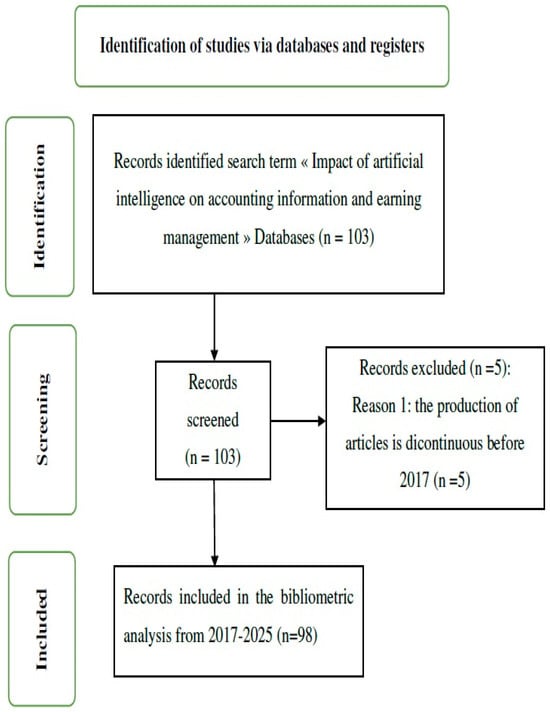
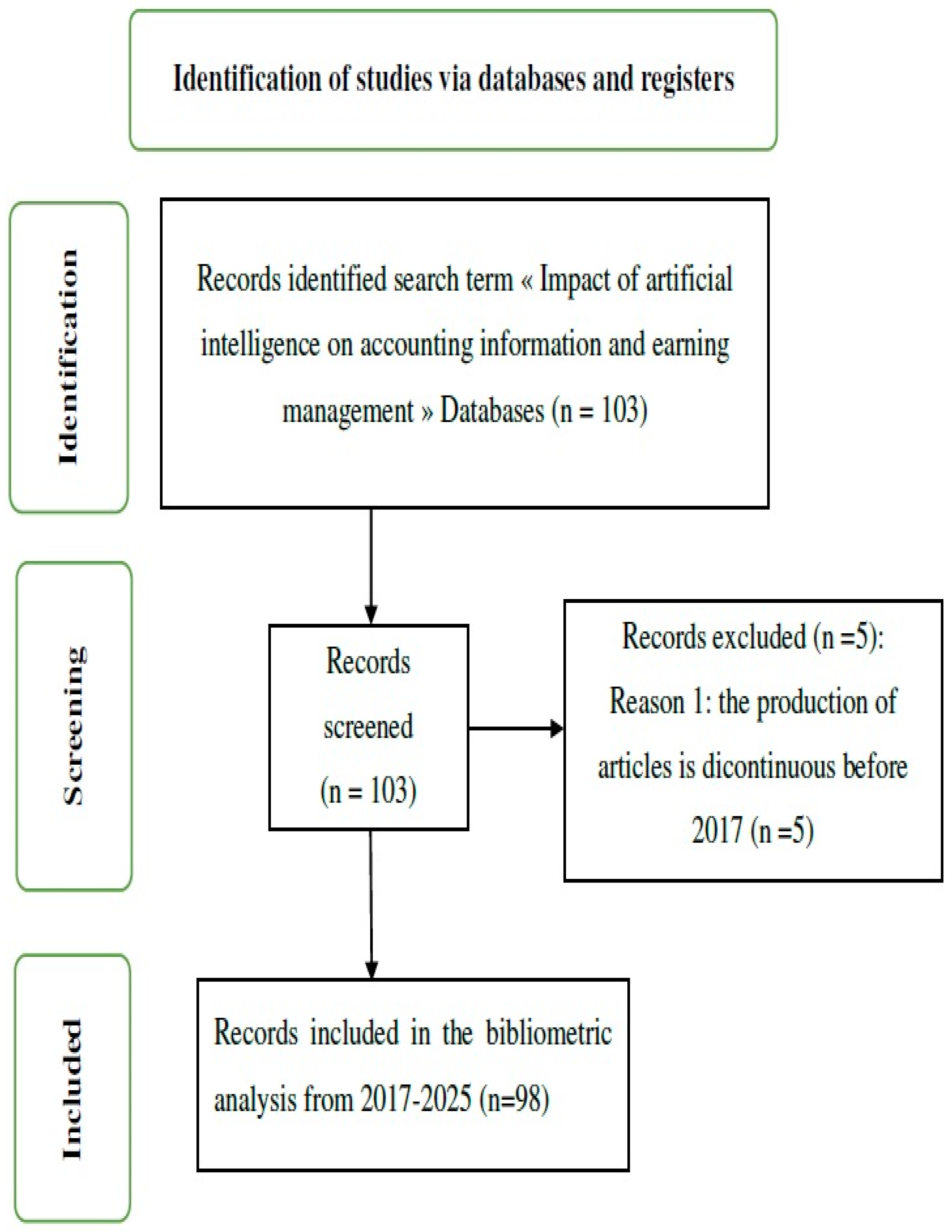
In order to conduct a relevant bibliometric analysis on our topic, the impact of artificial intelligence on accounting information and earnings management, a document search was carried out in English using the Web of Science database. This database was chosen because of its multidisciplinary nature and because it is an extensive global scientific database (Chadegani et al., 2013). In the database, we used the following theme: the impact of artificial intelligence on accounting information and earnings management. This search identified 103 articles. We followed the PRISMA 2020 framework (Page et al., 2021) (the Preferred Reporting Items for Systematic Reviews and Meta-Analyses) to select and critically review relevant studies. As a result, five articles were excluded from our dataset because publication of the articles was discontinued before 2017. Consequently, the analysis period selected is between 2017 and 2025. The study resulted in the selection of 98 articles eligible for bibliometric analysis, as illustrated in Figure 1.
Figure 1.
PRISMA diagram.
Our research identified 98 articles published in journals that are used in our bibliometric analysis. The Table 1 below presents general information about the database. The articles were published in 37 journals during the period 2017–2025. The average annual growth rate of production is estimated at 44.49%. The average age of a published article is almost two years. Each article is cited an average of 29 times. This database contains 3222 references and 138 keywords. A total of 145 authors contributed to the creation of these documents, and 28% of the documents were written as a result of international collaboration between authors.
Table 1.
General information about the data.
3.2. Research Methodology
Bibliometric analysis provides a relevant overview of a vast corpus of the research literature. It has deepened knowledge by providing quantitative and qualitative identification of past and present research (Chen et al., 2021).
The bibliometric analysis was based on the use of the Bibliometrix package in RStudio software R 4.2.2, which provides a descriptive analysis of the data, determines the annual growth in production over time, analyses which author publishes the most on which subject and in which journal, and determines the most frequent keywords, in accordance with previous studies (Donthu et al., 2021; Xu et al., 2022). Another advantage of bibliometric analysis is thematic mapping, which identifies the most developed research themes and those requiring complementary studies (Callon et al., 1991; Cobo et al., 2015). The results obtained will help future researchers interested in our topic to choose their research project. The Bibliometrix and Biblioshiny installation packages in the RStore software package were used to analyse our topic.
- -
- Annual scientific production.
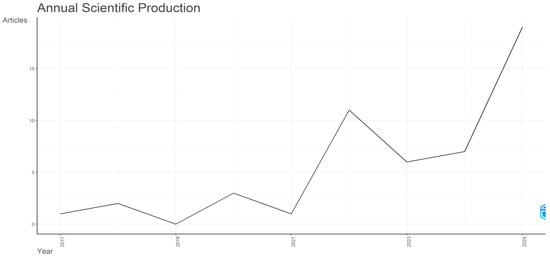
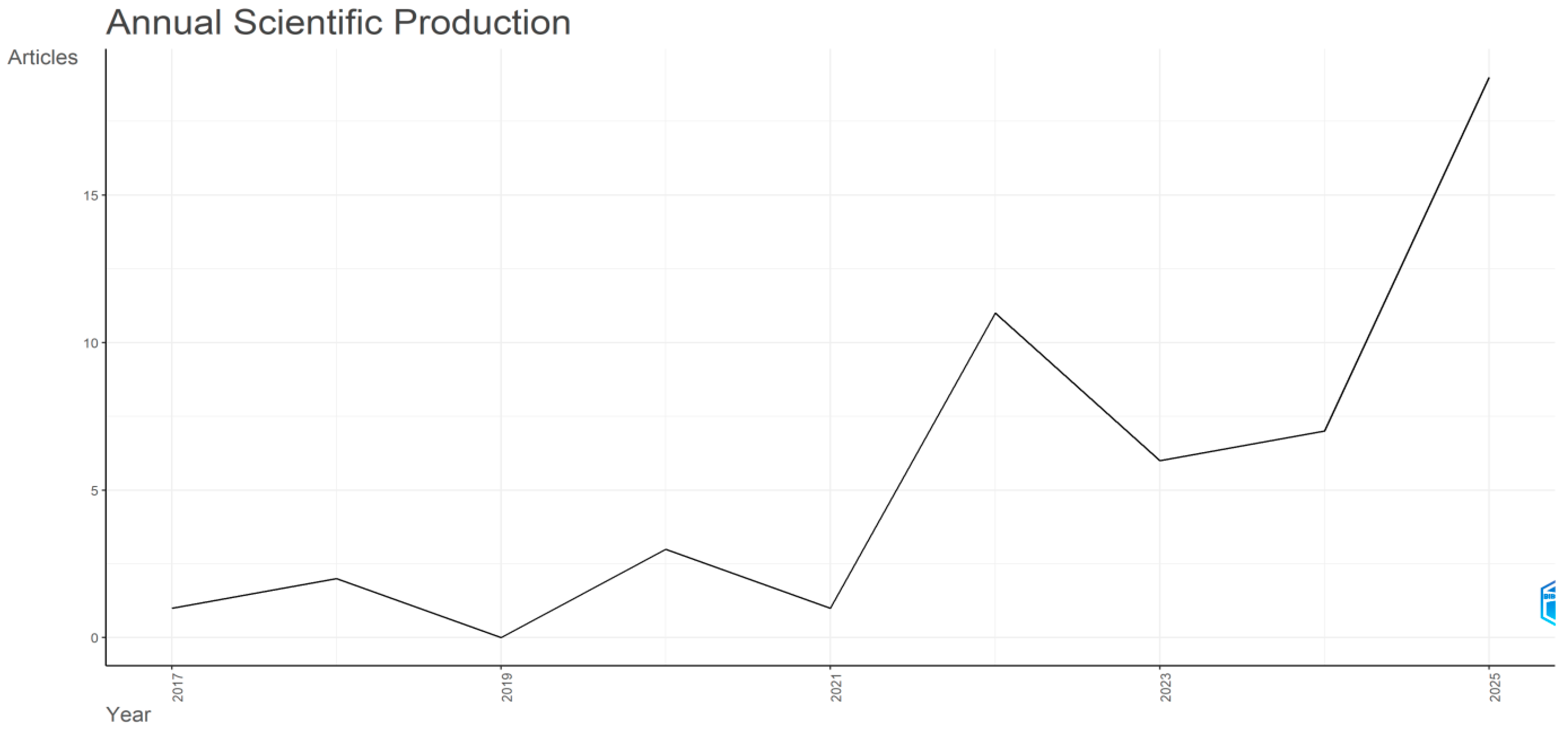
Figure 2 shows the annual trend in scientific production related to the general theme of the impact of artificial intelligence on accounting information and earnings management from 2017 to 2025. The curve takes a sinusoidal shape until 2023, showing that the number of publications sometimes increases and sometimes decreases. It should be noted that the curve peaks every two years in 2018–2020 and 2022. However, scientific production has increased steadily from 2023 to 2025, reaching its peak in terms of publications on our research topic, demonstrating the interest in this research. This significant increase in the number of articles indicates a growing interest in researching the impact of artificial intelligence on accounting information and earnings management. In 2025, the number of publications exceeded 18 articles. This remarkable increase in the number of publications highlights the importance of our research topic, which continues to expand. The growth rate will reach a certain number of publications per year until 2024.
Figure 2.
Annual scientific production.
4. Results and Discussion
4.1. Results
This section presents the various bibliometric results that constitute the analysis of document production.
- -
- The three-field plot.
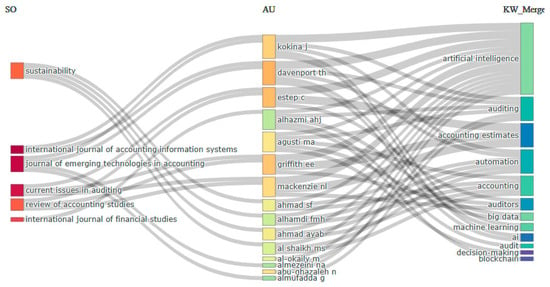
The graph below shows the top 15 keywords on the right, the top 15 sources on the left, and the top 15 authors in the middle. These three datasets are interconnected. In Figure 3, the rectangles represent individual elements (such as sources, authors, and keywords), and their size is proportional to their frequency, while the thickness of the lines connecting the fields indicates the strength or volume of the relationship between them. This graph shows which author publishes the most on which subject and in which journal. The author “Kokina” works more on our theme and especially on the relationship between “artificial intelligence”, “auditing”, “accounting estimates”, and “big data” (Figure 3). These themes relate to research into the impact of AI on earnings management and financial information transparency. The researcher “Davenport” is also ranked among the top authors and is interested in these same topics, so their studies are published in the Journal of Emerging Technologies in Accounting, which is ranked among the top journals publishing articles on our theme. A thick plot indicates a strong correlation, helping to identify trends, groups, or significant contributions in our field of research. The analysis of the three fields is important, as it can show the correlations between three elements based on the reference source, the author, and the main keywords/research topics. These relationships become an alternative reference for future studies on the impact of AI on earnings management and accounting information.
Figure 3.
Three-field plot.
- -
- Journal productivity over time.
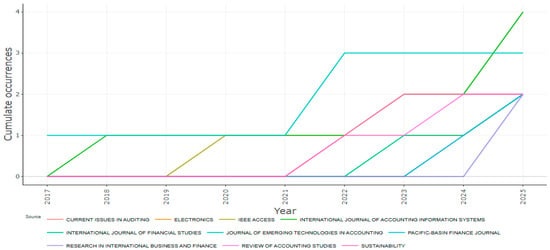
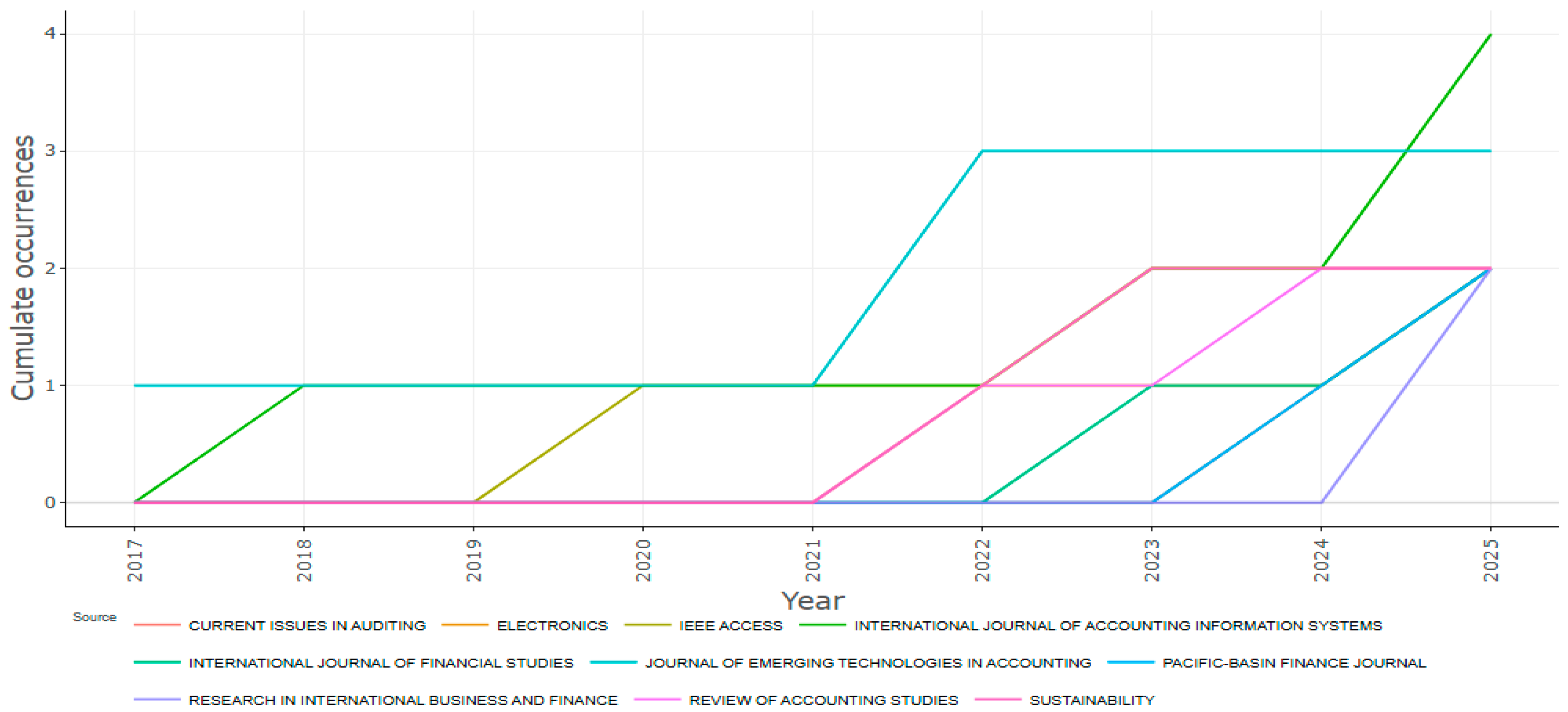
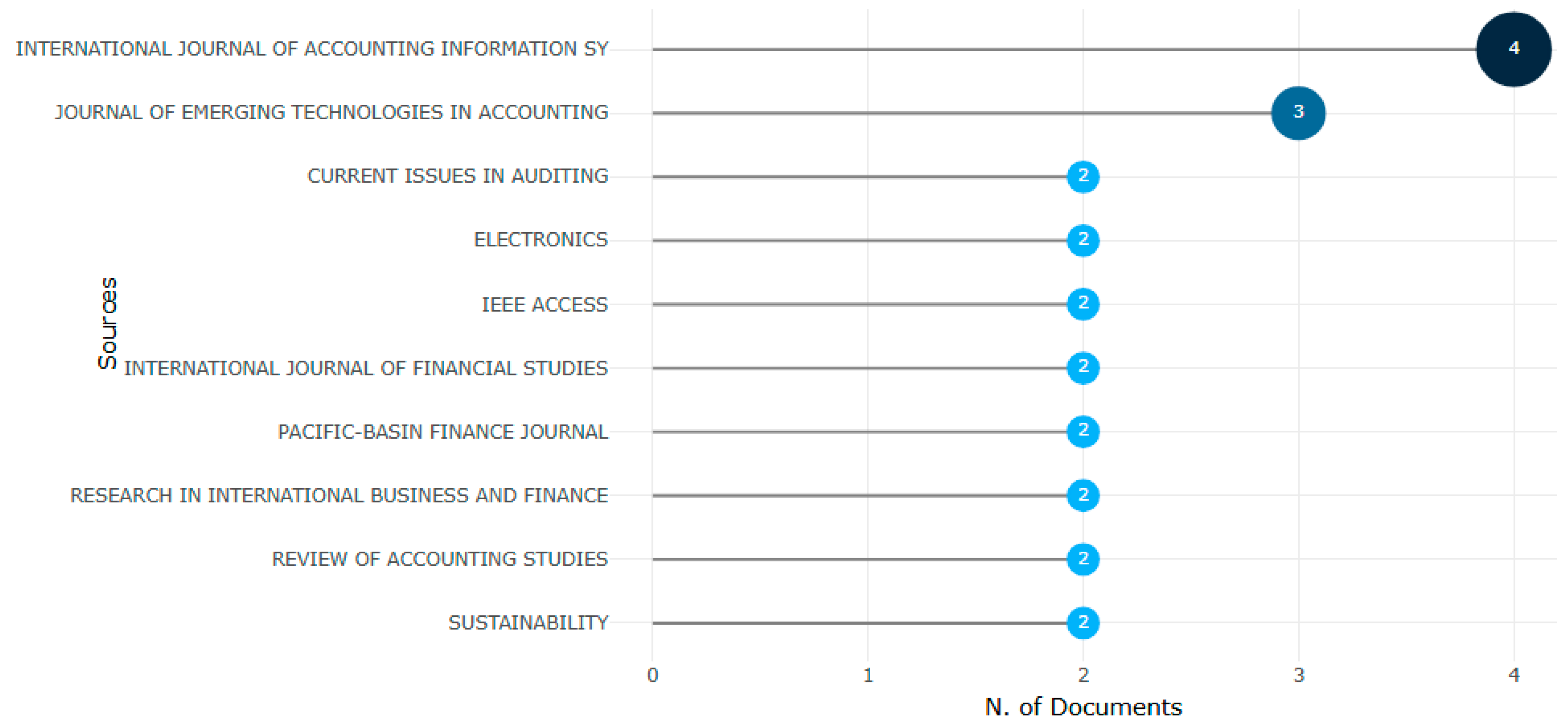
The graph below (Figure 4) shows journal productivity over time (2017–2025). It includes the top 10 most productive journals during this period. “The International Journal of Accounting Information Systems” ranks first in terms of publications analysing the impact of AI on accounting information and earnings management. The results are shown in more detail in Figure 5, which shows that the “International Journal of Accounting Information Systems” publishes four articles per year over the entire period, followed by the “Journal of Emerging Technologies in Accounting”, which publishes three articles per year. The results are recommended for use by researchers interested in analysing the impact of AI on earnings management.
Figure 4.
Sources’ production over time.
Figure 5.
Most relevant sources.
- -
- Author production and citations.
Table 2 presents a list of authors who dominate research on the impact of artificial intelligence on accounting information and earnings management. This section analyses the classification of authors using the total number of citations (TCs). The results show that researchers Davenport and Kokina rank first in terms of the highest number of citations, having been cited 219 times, as shown in Figure 3. Also, “Estep”, “Griffith”, and “Mackenzie” are cited 30 times each.
Table 2.
Authors’ production over time.
- -
- Most cited articles.
The table below (Table 3) shows the top 10 most cited articles. The most cited article is by Munoko et al. (2020) (cited 208 times). This article explores the advantages of AI and examines the ethical implications of using this emerging technology. The authors consider that AI can improve work performance, but it also limits the cognitive abilities of auditors and raises ethical issues, inviting future researchers to analyse its implications for earnings management. Among these 10 most cited articles, the most recent are those by Kokina et al. (2025) and Li and Goel (2025). The study by Kokina et al. (2025) examines the advantages and disadvantages of AI for the accounting sector. It considers that organisations must strike a balance between AI techniques and human expertise in order to maximise the benefits of AI while minimising its challenges. Meanwhile, the article by Li and Goel (2025) assumes that AI is auditable and that auditors’ skills are essential to ensuring the quality of AI audits.
Table 3.
Most cited documents globally.
- -
- Keyword analysis.
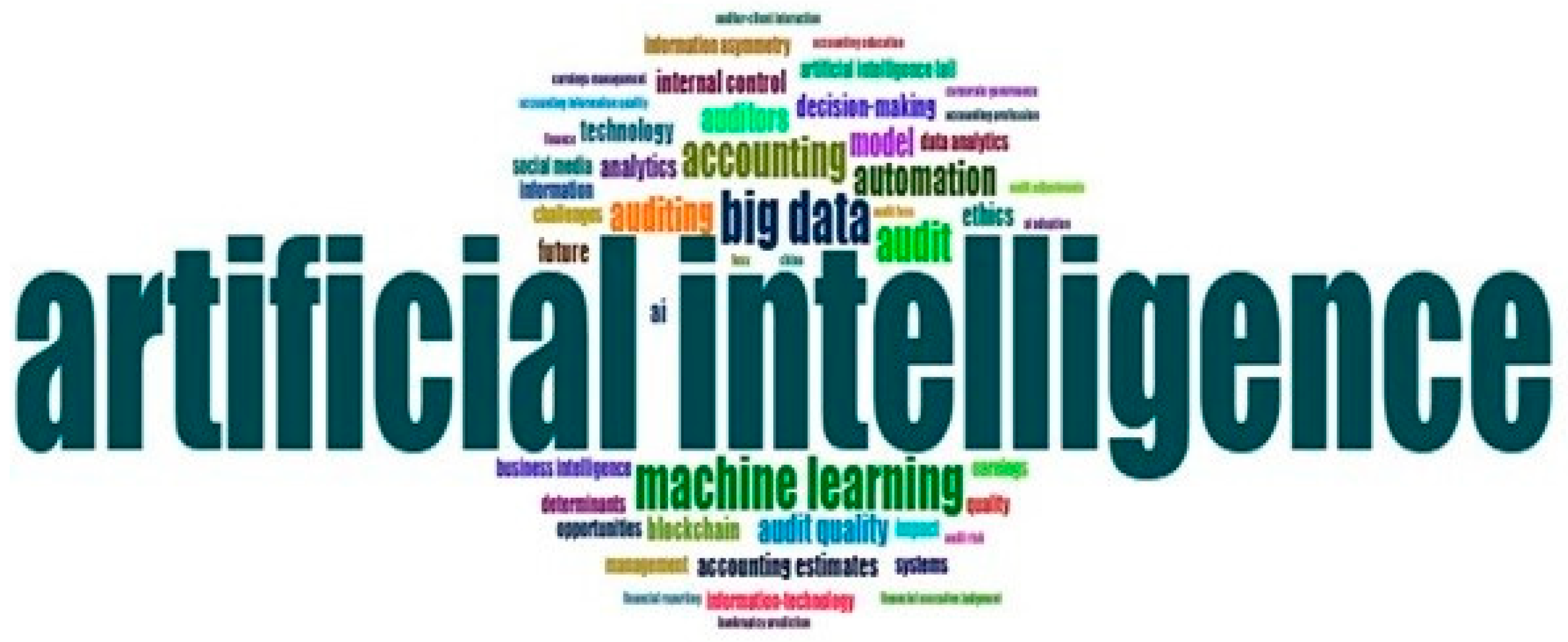
Keywords are the generalisation of a research topic and content. The keywords most frequently used in the literature are presented in the graph below in the form of a word cloud, which visually represents word frequency and indicates that most of the work is concentrated in these domains (Atenstaedt, 2012). They are presented more clearly in Table 4. In the word cloud (Figure 6), we can see that the terms “big data” and “machine learning” are closely related to AI. In addition, the table shows that the most frequently used keywords are “Big data” and “Machine learning”, with nine citations. The median years of use for these words are 2022 for “Big data” and 2024 for “Machine learning”. As a result, AI is attracting a lot of attention thanks to the performance achieved through machine learning and deep learning. The same is true for the words “accounting”, “audit”, and “auditing”. These keywords relate to research into the impact of AI on earnings management and financial reporting transparency, which require machine learning and deep learning algorithms to analyse large amounts of data and provide accurate forecasts. The words in smaller font suggest potential avenues for research (Mulay et al., 2020).
Table 4.
Top eight most frequently mentioned keywords.
Figure 6.
Keyword cloud.
- -
- Research topics.
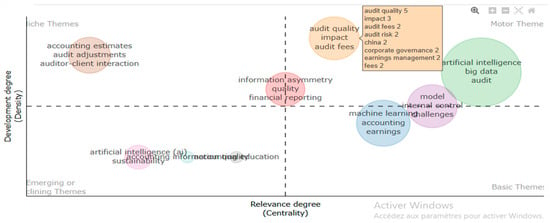
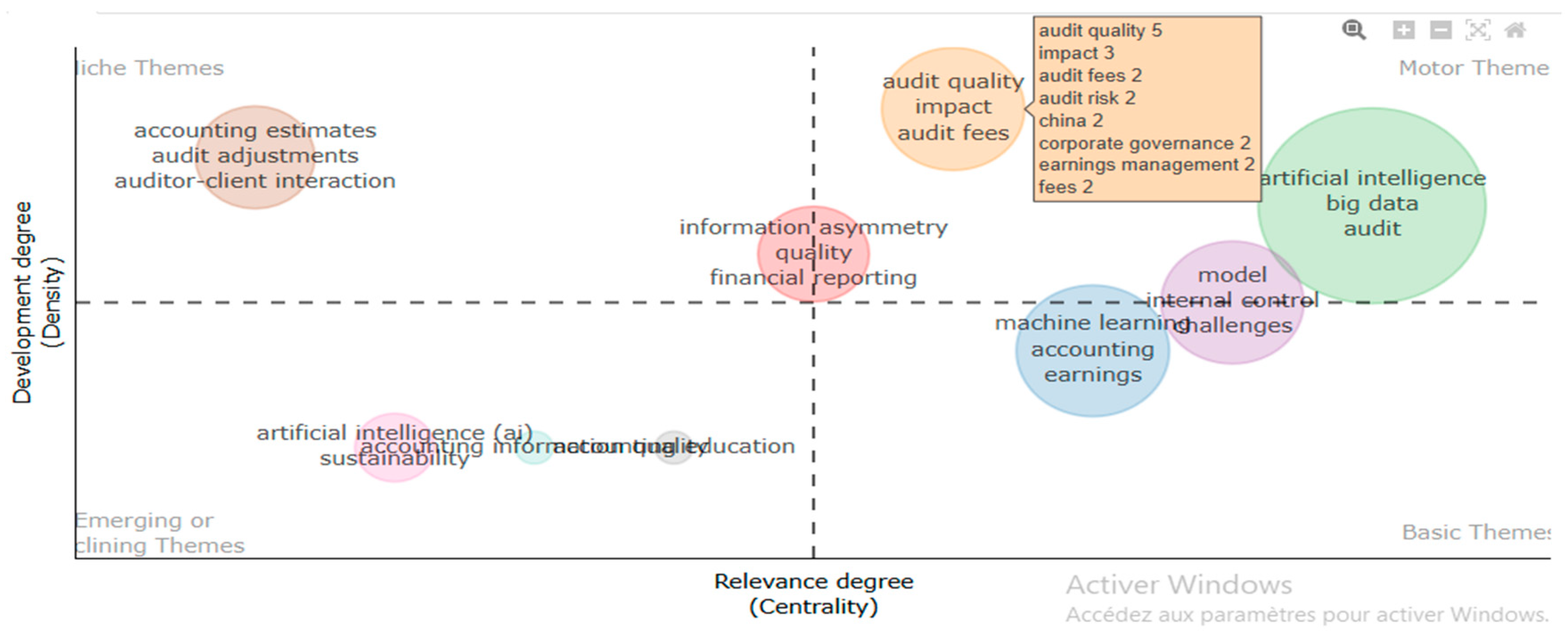
Figure 7 presents the thematic map that was constructed from the authors’ keywords, constituting a central step in the systematic review of the literature. This analysis identifies topics that have already been extensively researched and those that require further study. It is structured around four themes. Among the motor themes, the most developed research themes are shown at the top right and include group 1, artificial intelligence, big data, audit, and group 2, audit quality, impact, and audit fees. These topics have been the subject of a large number of empirical studies, indicating that the impact of AI on auditing, audit quality, and associated costs are well-developed areas of research. This work provides a solid basis for indirectly analysing the effects of AI on earnings management practices. The fundamental themes (bottom right) include machine learning, accounting, earnings, etc. Although these themes are central to the field, their level of development remains limited. This work suggests that further research is needed to better understand the role of machine learning techniques in accounting processes and earnings management. The niche themes (top left) include accounting estimates, audit adjustments, and auditor–client interaction. These themes are well-developed conceptually, but their weak connection to the dominant strands of the literature indicates that they remain relatively fragmented. However, they offer interesting research opportunities in AI and auditing. Finally, for the emerging or declining themes, group 1 includes artificial intelligence and sustainability. group 2 includes accounting information quality, and group 3 includes accounting education. These topics appear to be relatively unexplored, highlighting significant gaps in the literature and pointing to priority areas for future research. In particular, the relationship between AI, sustainability, and the quality of accounting information appears to be an important area of research requiring in-depth empirical investigation, particularly in the context of earnings management.
Figure 7.
Thematic maps.
In general, the thematic map highlights a field of research structured around auditing and AI, noting the existence of theoretical and empirical gaps that open the way for future research, particularly on the integration of AI into accounting practices, the quality of financial information, and earnings management.
4.2. Discussion
Since 2017, research has shown a growing interest in integrating AI into accounting. Our bibliometric analysis provides an overview of research trends on the impact of AI on accounting information and earnings management. Based on 98 articles published in Web of Science between 2017 and 2025, this study determined the correlations between sources, authors, and keywords/research topics. The bibliometric analysis also identified the main journals and most cited authors, the most frequently used keywords, and the most developed research topics. The results show that scientific output has increased steadily from 2023 to 2025, reaching its peak in terms of publications on our research topic, demonstrating the interest in researching the impact of artificial intelligence on accounting information and earnings management. Indeed, the adoption of AI has the potential to improve working conditions in accounting, which is considered the main factor contributing to scientific development, as highlighted by Boyle et al. (2024) and Bose et al. (2023).
The results also show that Kokina and Davenport publish more articles (Figure 3), with their studies focusing on the following keywords: artificial intelligence, machine learning, big data, auditing, and accounting estimates. In the word clouds, we can see that these words are ranked among the eight most frequent keywords (Table 4). Their work is published in the “Journal of Emerging Technologies in Accounting”, which is ranked among the top journals publishing the most articles on our topic. Davenport and Kokina also rank first in terms of total number of citations, having been cited 219 times (Table 2). The most cited article is that of Munoko et al. (2020) (cited 208 times). The results obtained in this article show that AI can improve work performance, but it also limits the cognitive abilities of auditors and raises ethical issues, inviting future researchers to analyse its implications for earnings management.
Based on the thematic map, there are still some topics that have been little explored, such as fundamental, niche, and emerging topics. These results provide several ideas for future research. Although the effects of AI on auditing and audit quality have already been extensively studied, the thematic map shows that there are still significant gaps in our understanding of its implications for earnings management, accounting information quality, sustainability, and training, thus providing clear directions for future research. It is, therefore, important to answer the following questions: How does AI affect earnings management and the reliability of accounting information? How can AI contribute to sustainable reporting and the consideration of ESG criteria? What AI competencies should future accountants learn?
At this point, we can see that ethics and educational methods for AI in accounting, which have been identified as important in the literature, are absent from the main keywords and themes, in line with the study by Tlili (2025). It should be remembered that the impact of AI on earnings management depends on the governance framework, managerial ethics, and control mechanisms. AI can solve the problem of information asymmetry and can both limit earnings management practices and promote more sophisticated forms of earnings management. However, this requires accountants who are well-qualified in new technologies.
5. Conclusions
The project to integrate artificial intelligence technology is profoundly transforming the accounting profession and the way accounting and financial information is produced, analysed, and used. The impact of this technological upheaval in the accounting field has been the subject of several scientific and academic studies. Previous studies have focused on analysing the impact of AI integration on accounting in general and on work performance, with few researchers analysing the impact of AI on the disclosure of accounting information. Our study analyses the impact of AI on accounting information on the one hand, and earnings management on the other. Our analysis identifies the current state and future trends of the impact of artificial intelligence on accounting information and earnings management. The methodology adopted in this study is a literature review aimed at examining the significance and impact of the integration of artificial intelligence on accounting information and earnings management. We, therefore, analysed the effects of AI integration on accounting as advanced by the literature. The results of the study show that the integration of AI technology offers significant opportunities to increase the transparency of financial information essential for strategic decision-making and organisational performance. This resolves the agency problem related to conflicts of interest and information asymmetry that exists between the various stakeholders in a team. With its advanced data processing capabilities, AI enables companies to overcome obstacles related to data management, confidentiality, and financial information security. AI decision-making incorporates machine learning and deep learning techniques to analyse large amounts of data and provide accurate forecasts to help managers manage the results. Thus, the impact of AI on earnings management depends on the governance framework, control mechanisms, and managerial ethics. As a result, when governance is effective, AI reduces earnings manipulation. Furthermore, in the absence of adequate controls and ethical and regulatory rules, AI can encourage more sophisticated and difficult-to-detect opportunistic practices in earnings management. Although AI can improve work performance, it also raises ethical concerns, such as data privacy, bias, transparency, and accountability (Schweitzer, 2024; C. Zhang et al., 2023), which are important for earnings management and accounting transparency.
In light of the results obtained in the literature review, it will be relevant to carry out a bibliometric analysis, which allows trends in scientific production to be examined. Our analysis was based on the use of the Bibliometrix package in RStudio software. The data search was carried out using the Web of Science database. The results show that research on the impact of AI on accounting information and earnings management has grown steadily since 2023 and continues to evolve through 2025, demonstrating the value of this research. Kokina and Davenport have published the most articles on our topic and are the most cited authors. Thematic mapping analysis has identified the most developed research topics, such as big data, AI, auditing, audit quality, earnings management, information asymmetry, and corporate governance. These keywords are a generalisation of the analysis of the impact of AI on information asymmetry and earnings management.
It should be noted that ethics and educational methods for AI in accounting, which have been identified as important in the literature, are absent from the main keywords. Also, in the article by Munoko et al. (2020), which is the most cited, the authors show that AI can improve work performance but also limit the cognitive abilities of auditors and raise ethical issues, inviting future researchers to analyse its implications for earnings management. In addition, the thematic map highlights topics that are widely studied, such as the effects of AI on auditing and audit quality. It also highlights topics that remain under-explored, including the role of artificial intelligence in earnings management, accounting information quality, sustainability, and training, thus providing clear directions for future research.
This work provides clear guidance for future research and practical applications for professionals, regulators, and academic institutions. Firstly, these results are important for audit and accounting professionals, as they show how AI can improve work performance while highlighting its limitations, particularly with regard to ethical issues. Secondly, for regulators, these results highlight the need to adapt regulatory and ethical frameworks in order to regulate the use of AI and ensure the reliability and transparency of accounting information. Thirdly, for academic and training institutions, these results highlight the importance of integrating AI competencies into teaching programmes in order to prepare future accountants for technological developments. Finally, this work is interesting in that it can deepen researchers’ knowledge of current topics and help them plan their future research projects.
Our study has three limitations. First, the bibliometric analysis focused on articles written in English. Secondly, it is limited to articles published on the Web of Science. Thirdly, the analysis covers the period 2017–2025. Our recommendation for future research is to retrieve and analyse data from other databases, such as Google Scholar and Scopus. This will enable researchers to find more publications on the topic analysed.
Funding
This research received no external funding.
Institutional Review Board Statement
Not applicable.
Informed Consent Statement
Not applicable.
Data Availability Statement
The data presented in this study are from the Web of Science database. The original contributions generated and analysed during this study are included in the article.
Conflicts of Interest
The author declare no conflict of interest.
References
- Alsmady, A. (2023). Accounting information quality, tax avoidance and companies’ performance: The moderate role of political connection. International Journal of Professional Business Review, 8(1), e0622. [Google Scholar] [CrossRef] [Scilit]
- Atenstaedt, R. (2012). Word cloud analysis of the BJGP. British Journal of General Practice, 62, 148. [Google Scholar] [CrossRef] [Scilit]
- Azhari, A. (2024). L’impact de l’intelligence artificielle sur la comptabilité: Amélioration de la qualité de l’information comptable à travers la prévision financière et la gestion des risques. African Scientific Journal, 3(25), pp: 0585–0611. [Google Scholar] [CrossRef]
- Bose, S., Dey, S. K., & Bhattacharjee, S. (2023). Big data, data analytics and artificial intelligence in accounting: An overview. In S. Akter, & S. F. Wamba (Eds.), Handbook of big data research methods (pp. 32–51). Edward Elgar Publishing. [Google Scholar] [CrossRef] [Scilit]
- Boyle, J. F., Marcy, A. S., Boyle, D. M., & Hermanson, D. R. (2024). Accounting chairs’ perceptions of current challenges. Issues in Accounting Education, 39(4), 1–18. [Google Scholar] [CrossRef] [Scilit]
- Brynjolfsson, E., & McAfee, A. (2014). The second machine age: Work, progress and prosperity in a time of brilliant technologies. W. W. Norton & Company. [Google Scholar]
- Callon, M., Courtial, J. P., & Laville, F. (1991). Co-word analysis as a tool for describing the network of interactions between basic and technological research: The case of polymer chemistry. Scientometrics, 22, 155–205. [Google Scholar] [CrossRef] [Scilit]
- Casta, J.-F. (2009). Théorie positive de la comptabilité. Encyclopédie de comptabilité, contrôle de gestion et audit (pp. 1393–1402). Economica. [Google Scholar]
- Chadegani, A. A., Salehi, H., Md Yunus, M., Farhadi, H., Fooladi, M., Farhadi, M., & Ale Ebrahim, N. (2013). A comparison between two main academic literature collections: Web of science and Scopus databases. Asian Social Science, 9(5), 18–26. [Google Scholar] [CrossRef] [Scilit]
- Chen, X. L., Zou, D., Kohnke, L., Xie, H. R., & Cheng, G. (2021). Affective states in digital game-based learning: Thematic evolution and social network analysis. PLoS ONE, 16, e0255184. [Google Scholar] [CrossRef] [Scilit] [PubMed]
- Cobo, M. J., Martínez, M. Á., Gutiérrez-Salcedo, M., Fujita, H., & Herrera-Viedma, E. (2015). 25 years at knowledge-based systems: A bibliometric analysis. Knowledge-Based Systems, 80, 3–13. [Google Scholar] [CrossRef] [Scilit]
- Culnan, M. J., O’Reilly, C. A., & Chatman, J. A. (1990). Intellectual structure of research in organizational behavior, 1972–1984: A cocitation analysis. Journal of the American Society for Information Science, 41, 453. [Google Scholar] [CrossRef] [Scilit]
- Dai, J., & Vasarhelyi, M. A. (2017). Toward blockchain-based accounting and assurance. Journal of Information Systems, 31(3), 5–21. [Google Scholar] [CrossRef] [Scilit]
- Donthu, N., Kumar, S., Mukherjee, D., Pandey, N., & Lim, W. M. (2021). How to conduct a bibliometric analysis: An overview and guidelines. Journal of Business Research, 133, 285–296. [Google Scholar] [CrossRef] [Scilit]
- Hristova, T., Mihaylov, G., Hristov, P., & Taneva, A. (2024). Analysis of data sharing systems in the context of Industry 4.0 via blockchain in 5G mobile network. Engineering Proceedings, 70(1), 2. [Google Scholar] [CrossRef] [Scilit]
- Jensen, M., & Meckling, W. (1976). Theory of the firm: Management behavior, agency costs and ownership structures. Journal of Financial Economics, 3(4), 305–360. [Google Scholar] [CrossRef] [Scilit]
- Kaynak, O. (2021). The golden age of artificial intelligence. Discover Artificial Intelligence, 1(1). [Google Scholar] [CrossRef] [Scilit]
- Kokina, J., Blanchette, S., Davenport, T. H., & Pachamanova, D. (2025). Challenges and opportunities for artificial intelligence in auditing: Evidence from the field. International Journal of Accounting Information Systems, 56, 100734. [Google Scholar] [CrossRef] [Scilit]
- Kokina, J., & Davenport, T. H. (2017). The emergence of artificial intelligence: How automation is changing auditing. Journal of Emerging Technologies in Accounting, 14, 115–122. [Google Scholar] [CrossRef] [Scilit]
- Kroon, N., & do Céu Alves, M. (2023). Examining the fit between supply and demand of the accounting professional’s competencies: A systematic literature review. The International Journal of Management Education, 21(3), 100872. [Google Scholar] [CrossRef] [Scilit]
- Kumar, V., & Singh, M. (2023). Artificial intelligence in accounting: Efficiency gains and challenges. Journal of Accounting and Finance, 18(1), 34–49. [Google Scholar]
- Kureljusic, M., & Karger, E. (2024). Forecasting in financial accounting with artificial intelligence: A systematic literature review and future research agenda. Journal of Applied Accounting Research, 25(1), 81–104. [Google Scholar] [CrossRef] [Scilit]
- Laudon, K. C., & Laudon, J. P. (2022). Management information systems: Managing the digital firm (16th ed.). Pearson. [Google Scholar]
- Lel, U. (2019). The role of foreign institutional investors in restraining earnings management activities across countries. Journal of International Business Studies, 50, 895–922. [Google Scholar] [CrossRef] [Scilit]
- Li, Y., & Goel, S. (2025). Artificial intelligence auditability and auditor readiness for auditing artificial intelligence system. International Journal of Accounting Information Systems, 56, 100739. [Google Scholar] [CrossRef] [Scilit]
- Lin, Y., & Xing, X. (2024). Supply chain spillover effect of media attention to customers from the perspective of real earnings management. Finance Research Letters, 63, 105316. [Google Scholar] [CrossRef] [Scilit]
- Marchoud, N. (2018). La communication financière des entreprises marocaines entre réglementation et pratiques managériales. Finance & Finance Internationale, (10). [Google Scholar] [CrossRef]
- Mulay, P., Joshi, R., & Chaudhari, A. (2020). Distributed incremental clustering algorithms: A bibliometric and word-cloud review analysis. Science & Technology Libraries, 39, 289–306. [Google Scholar] [CrossRef] [Scilit]
- Munoko, I., Brown-Liburd, H. L., & Vasarhelyi, M. (2020). The ethical implications of using artificial intelligence in auditing. Journal of Business Ethics, 167, 209–234. [Google Scholar] [CrossRef] [Scilit]
- Odonkor, B., Kaggawa, S., Uwaoma, P. U., Hassan, A. O., & Farayola, O. A. (2024). The impact of AI on accounting practices: A review: Exploring how artificial intelligence is transforming traditional accounting methods and financial reporting. World Journal of Advanced Research and Reviews, 21(01), 172–188. [Google Scholar] [CrossRef] [Scilit]
- Page, M. J., McKenzie, J. E., Bossuyt, P. M., Boutron, I., Hoffmann, T. C., Mulrow, C. D., Shamseer, L., Tetzlaff, J. M., Akl, E. A., Brennan, S. E., Chou, R., Glanville, J., Grimshaw, J. M., Hr’objartsson, A., Lalu, M. M., Li, T., Loder, E. W., Mayo-Wilson, E., McDonald, S., … Moher, D. (2021). The PRISMA 2020 statement: An updated guideline for reporting systematic reviews. BMJ, 372, n71. [Google Scholar] [CrossRef] [Scilit]
- Sanjiwani, P. D. A., Wulandari, A. A. I., Dewi, G. A., & Renta, M. P. P. (2024). The impact of artificial intelligence on accounting information systems. Journal Ekonomi, 13(02), 1220–1234. [Google Scholar]
- Schweitzer, B. (2024). Artificial intelligence (AI) ethics in accounting. Journal of Accounting, Ethics and Public Policy, 25(1), 67. [Google Scholar] [CrossRef] [Scilit]
- Snyder, H. (2019). Literature review as a research methodology: An overview and guidelines. Journal of Business Research, 104, 333–339. [Google Scholar] [CrossRef] [Scilit]
- Song, A., Seo, E., & Kim, H. (2024, February 4–7). Novel design of blockchain based IIoT framework for smart factory. 26th International Conference on Advanced Communications Technology (pp. 147–151), Pyeong Chang, Republic of Korea. [Google Scholar] [CrossRef] [Scilit]
- Tlili, H. (2025). Bibliometric analysis of artificial intelligence in accounting: Trends and future directions. International Journal of Advanced and Applied Sciences, 12(8), 149–165. [Google Scholar] [CrossRef] [Scilit]
- Tran Trung, T., & Huu Nguyen, A. (2023). Impact of accounting information systems on corporate performance: An application of agency theory. Corporate Governance and Organizational Behavior Review, 7(3), 429–443. [Google Scholar] [CrossRef] [Scilit]
- Wang, X., & Wang, Y. (2022). Enhancing financial forecasting through machine learning: Techniques and applications. Journal of Financial Economics, 78(5), 670–692. [Google Scholar]
- Xiong, W. (2025). The impact of artificial intelligence on enterprises’ accrual earnings management. Scientific Journal of Economics and Management Research, 7(3), 71–86. [Google Scholar] [CrossRef] [Scilit]
- Xu, X., Chen, Q., & Zhu, Z. (2022). Evolutionary overview of land consolidation based on bibliometric analysis in web of science from 2000 to 2020. International Journal of Environmental Research and Public Health, 19, 3218. [Google Scholar] [CrossRef] [Scilit] [PubMed]
- Zhang, C., Zhu, W., Dai, J., Wu, Y., & Chen, X. (2023). Ethical impact of artificial intelligence in managerial accounting. International Journal of Accounting Information Systems, 49, 100619. [Google Scholar] [CrossRef] [Scilit]
- Zhang, Y., & Zhang, T. (2025). Generative AI and information asymmetry: Impacts on adverse selection and moral hazard. arXiv, arXiv:2502.12969. [Google Scholar] [CrossRef] [Scilit]
- Zhong, Y., Zhao, H., & Yin, T. (2023). Resource bundling: How does enterprise digital transformation affect enterprise ESG development? Sustainability, 15(2), 1319. [Google Scholar] [CrossRef] [Scilit]

Disclaimer/Publisher’s Note: The statements, opinions and data contained in all publications are solely those of the individual author(s) and contributor(s) and not of MDPI and/or the editor(s). MDPI and/or the editor(s) disclaim responsibility for any injury to people or property resulting from any ideas, methods, instructions or products referred to in the content. |
© 2026 by the author. Licensee MDPI, Basel, Switzerland. This article is an open access article distributed under the terms and conditions of the Creative Commons Attribution (CC BY) license.