The Use of Artificial Intelligence Chatbots by Newly Diagnosed Cancer Patients: A Descriptive Phenomenological Study


Simple Summary
Abstract
1. Introduction
- “What is the essence and meaning of the experiences of adult patients diagnosed with cancer regarding the use of AI chatbots?”
2. Method
2.1. Research Design
2.2. Research Setting and Participants
2.3. Ethical Considerations
2.4. Data Collection
2.5. Data Analysis
2.6. Rigor
3. Results
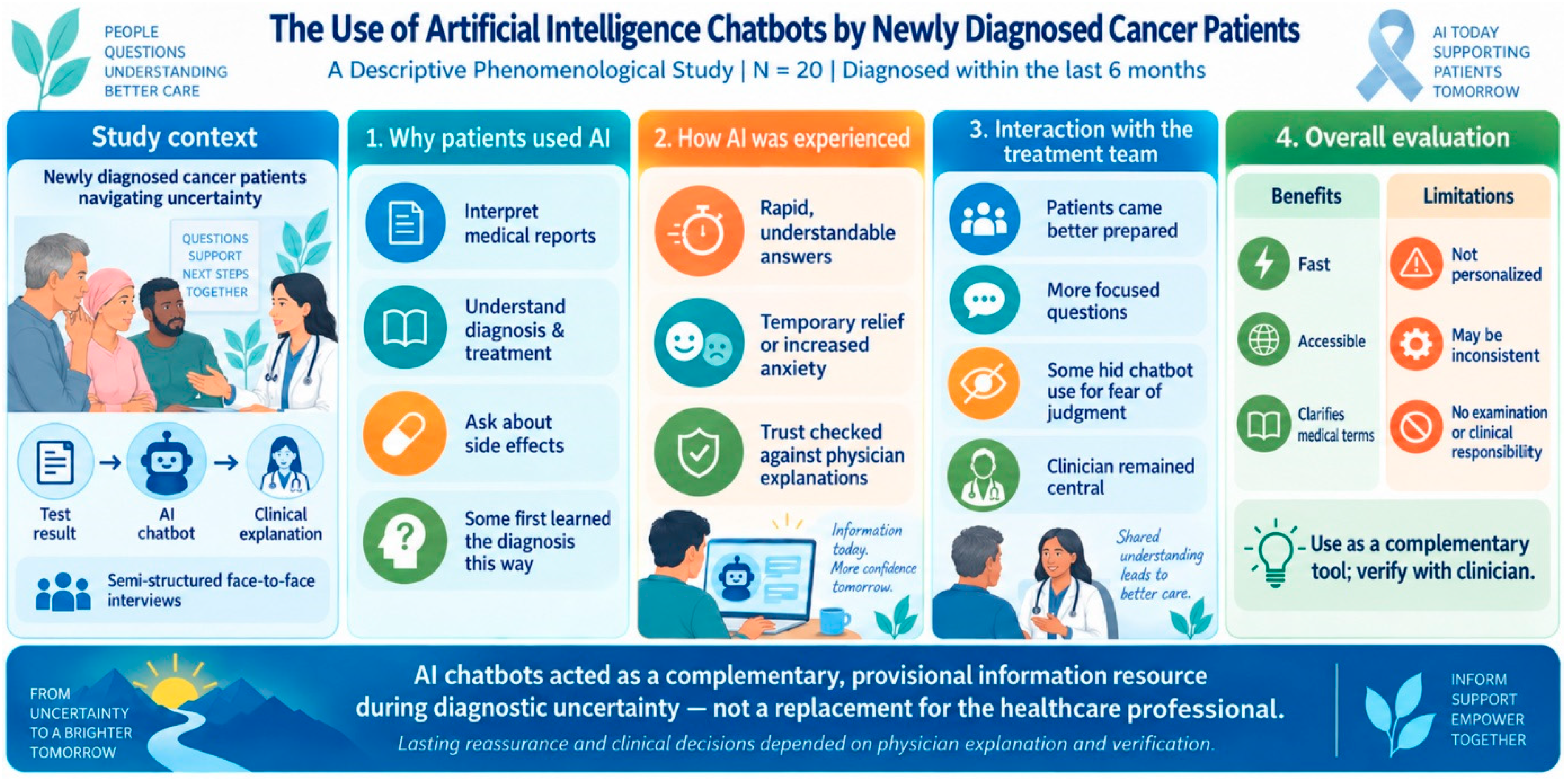
- Theme 1: Artificial intelligence usage purposes
- Sub-theme 1: Artificial intelligence as the first source of information acquisition
“Of course, I have already learned the diagnosis from artificial intelligence. Because I didn’t know the results of the reports and what the medical terms meant, I uploaded my first biopsy report to artificial intelligence and asked it to interpret it for me. And I learned firsthand that I had cancer directly from there. Then I made my physician’s appointment.”(K17; 42 years, female; breast cancer, stage I)
“After realizing that I had any mass on my chest, the first thing that came to my mind was Chat GPT because I noticed it the evening. I asked it to come up with positive and negative versions of what could happen and to ask questions about which surgeon or department I should go to as the first intervention I should do.”(K03; 47 years, female; breast cancer, stage II)
- Sub-theme 2: Treatment process and management of side effects
“It’s just the things that I need, the side effects of the treatments that I’ve taken little by little, so are these side effects normal? For example, I have a headache, is this a normal pain? I have diarrhea, is this a side effect of normal chemotherapy? You know, instead of constantly disturbing my physician, I researched some small things like this through artificial intelligence.”(K05; 41 years, female; breast cancer, stage II)
“I was relieved by the answers it gave to me, especially in questions about side effects, such as my pain during chemotherapy. So I understood what the reason was. That’s why I calmed down. When I couldn’t reach the physician right away, I used artificial intelligence. And the answers I received in that process relieved me.”(K13; 43 years, female; breast cancer, stage II)
- Theme 2: The experience of interacting with AI
- Sub-theme 3: Emotional effects of using artificial intelligence
“It’s too bad, I couldn’t go to bed until the morning. But when I went to my physician, he or she said more beautiful things that comforted me. I never ask ChatGPT or Google about a disease anymore.”(K10; 42 years, female; breast cancer, stage I)
“For example, my report falls into the system, for example, I take a screenshot from there and have it interpreted from ChatGPT. Some time must have passed until the appointment. At that time, I have already interpreted it. Frankly, there is a preliminary relief. But hearing it from my physician’s mouth is a completely different feeling.”(K12; 34 years, female; breast cancer, stage II)
- Sub-theme 4: Trust in AI interaction
“First of all, it is a system that always confuses me when the right question is not asked to the artificial intelligence about my disease. I am absolutely determined that the most accurate data is to share the information you receive from the artificial intelligence that carries out that treatment protocol with your physicians and find the right way. So that point is very important. Artificial intelligence is right, there is no such thing as yes.”(K07; 66 years, male; sarcoma, stage I)
“I was first looking unconsciously. I had no idea if it was true or not. But for example, after meeting with my physician a few times and generally getting the same results, my confidence in artificial intelligence increased. Because it was usually saying what my physician said. That’s how I started consulting more AI. But I still found what my physician said more important. I trusted him more, and I still trust him more.”(K12; 34 years, female; breast cancer, stage II)
- Theme 3: The effect of the patient’s reflection on the artificial intelligence experience on the relationship with the treatment team
- Sub-theme 5: The vitalness of the healthcare professional
“When I talk to my physician, my physician knows me from start to finish, he or she knows my physiological structure, he or she knows my biological structure, he or she knows my psychology very well. Because even though I hide something, as a physician, I think he understands very well what I am suppressing from my facial expression while I am telling it. But we cannot provide this in artificial intelligence. Whatever I write about artificial intelligence, it gives me the answer. But whatever I ask the physician, the physician answers me according to what he sees in front of him.”(K05; 41 years, female; breast cancer, stage II)
“Because a machine will answer me, they have no feelings. Since it has no feelings, its clear answer may upset me. But I believe that my physician will be able to motivate me a little more by getting me used to it a little more. I know that the physician will soften me a little and prepare me until he or she gives that answer. Even if the answer is bad. Maybe the answers given are the same. But the machine tells me that directly.”(K16; 49 years, male; gastric cancer, stage III)
- Sub-theme 6: The patient’s preparedness upon attending the interview
“I am going more consciously about myself, about my illness. I am going by learning something. I ask the physician more carefully the question I will ask, and I go accordingly more consciously.”(K13; 43 years, female; breast cancer, stage II)
- Sub-theme 7: The dynamic of sharing the AI usage experience
“After that, the physician’s brain reaction threw the paper in front of me. Then he said chatGPT should check you. He reacted like this.”(K02; 55 years, male; gastric cancer, stage I)
“He responded positively about it and even told us that he used it when necessary.”(K01; 62 years, male; breast cancer, stage II)
- Theme 4: Evaluation of the use of artificial intelligence (AI)
- Sub-theme 8: Perceived benefits
“The most useful aspect is quick, quick answer… If the question is clear, the answer is clear. That’s why that’s the benefit of artificial intelligence: instant answers.”(K16; 49 years, male; gastric cancer, stage III)
“I couldn’t decipher foreign terms in pathology and blood tests… When the artificial intelligence explained it, I was able to understand what it was.”(K09; 67 years, female; breast cancer, stage I)
- Sub-theme 9: Perceived limitations of AI
“There is information overload on the internet, and artificial intelligence can give it without filtering. So it can’t be trusted directly.”(K17; 42 years, female; breast cancer, stage I)
“A physician can see and understand what I feel… Artificial intelligence does not have this.”(K18; 58 years, female; breast cancer, stage III)
- Sub-theme 10: AI usage recommendations in the same process
“It is useful for initial information, but it must be confirmed with an expert.”(K01; 62 years, male; breast cancer, stage II)
“They should not do research for the disease; they should go directly to the physician.”(K10; 42 years, female; breast cancer, stage I)
- Fundamental structure of the experience
- Metaphors for the use of artificial intelligence
“You know, break the window urgently, somehow… I can also say that it is an emergency exit door that can relieve us in some way, provided that I do not trust it one hundred percent absolutely.”(K16; 49 years, male; gastric cancer, stage III)
“For me, it is a robot imitating a human… It is a tool that conveys the uploaded information to you.”(K14; 57 years, male; lung cancer, stage III)
4. Discussion
4.1. Reflections on Practice
- Management of the waiting process: The time between the delivery of the test result to the patient and its announcement by the clinician should be shortened as much as possible. In cases where this is not possible, short referral notes can be added to patient information systems indicating that the results alone are not sufficient to make a diagnosis or treatment decision.
- Non-judgmental communication: If patients hide the use of artificial intelligence, it may lead to false information being carried into the clinical interview with an unclear source. Asking about this usage in routine and non-judgmental language by healthcare professionals can make it easier to recognize and correct misinformation.
- Supporting digital health literacy: Patients should be supported in composing the right questions to submit to AI chatbots, comparing sources, and verifying information with the clinician. Chatbots should be positioned as supplementary resources that facilitate clinical interview preparation, not as clinician replacement tools.
- Incorporating AI use into clinical encounters and addressing misinformation: Beyond simply asking whether patients have consulted a chatbot, clinicians might invite patients to bring the specific AI-generated content they found confusing or concerning into the consultation so that accurate elements can be affirmed and perceived misinformation addressed together. A single, structured intake question about chatbot use could be integrated into existing pre-visit workflows with little additional time burden. Institutions may also consider providing patients with a short list of vetted, cancer-specific information resources as an alternative to general-purpose chatbots for disease-specific content.
4.2. Strengths and Limitations of the Research
4.3. Future Research
5. Conclusions
Supplementary Materials
Author Contributions
Funding
Institutional Review Board Statement
Informed Consent Statement
Data Availability Statement
Acknowledgments
Conflicts of Interest
Abbreviations
| AI | Artificial intelligence |
| COREQ | Consolidated Criteria for Reporting Qualitative Research |
| LLM | Large language model |
| MAXQDA | MAXQDA Qualitative Data Analysis Software |
References
- Evans Webb, M.; Murray, E.; Younger, Z.W.; Goodfellow, H.; Ross, J. The Supportive Care Needs of Cancer Patients: A Systematic Review. J. Cancer Educ. 2021, 36, 899–908. [Google Scholar] [CrossRef] [Scilit] [PubMed]
- Ferraris, G.; Monzani, D.; Coppini, V.; Conti, L.; Maria Pizzoli, S.F.; Grasso, R.; Pravettoni, G. Barriers to and facilitators of online health information-seeking behaviours among cancer patients: A systematic review. Digit. Health 2023, 9, 20552076231210663. [Google Scholar] [CrossRef] [Scilit] [PubMed]
- McMullan, R.D.; Berle, D.; Arnáez, S.; Starcevic, V. The relationships between health anxiety, online health information seeking, and cyberchondria: Systematic review and meta-analysis. J. Affect. Disord. 2019, 245, 270–278. [Google Scholar] [CrossRef] [Scilit] [PubMed]
- Yun, H.S.; Bickmore, T. Online Health Information-Seeking in the Era of Large Language Models: Cross-Sectional Web-Based Survey Study. J. Med. Internet Res. 2025, 27, e68560. [Google Scholar] [CrossRef] [Scilit] [PubMed]
- Chen, S.Y.; Kuo, H.Y.; Chang, S.H. Perceptions of ChatGPT in healthcare: Usefulness, trust, and risk. Front. Public Health 2024, 12, 1457131. [Google Scholar] [CrossRef] [Scilit] [PubMed]
- Alanezi, F. Examining the role of ChatGPT in promoting health behaviors and lifestyle changes among cancer patients. Nutr. Health 2025, 31, 739–748. [Google Scholar] [CrossRef] [Scilit] [PubMed]
- Ayers, J.W.; Poliak, A.; Dredze, M.; Leas, E.C.; Zhu, Z.; Kelley, J.B.; Faix, D.J.; Goodman, A.M.; Longhurst, C.A.; Hogarth, M.; et al. Comparing Physician and Artificial Intelligence Chatbot Responses to Patient Questions Posted to a Public Social Media Forum. JAMA Intern. Med. 2023, 183, 589–596. [Google Scholar] [CrossRef] [Scilit] [PubMed]
- Chen, D.; Chauhan, K.; Parsa, R.; Liu, Z.A.; Liu, F.F.; Mak, E.; Eng, L.; Hannon, B.L.; Croke, J.; Hope, A.; et al. Patient perceptions of empathy in physician and artificial intelligence chatbot responses to patient questions about cancer. npj Digit. Med. 2025, 8, 275. [Google Scholar] [CrossRef] [Scilit] [PubMed]
- Hao, Y.; Qiu, Z.; Holmes, J.; Löckenhoff, C.E.; Liu, W.; Ghassemi, M.; Kalantari, S. Large language model integrations in cancer decision-making: A systematic review and meta-analysis. npj Digit. Med. 2025, 8, 450. [Google Scholar] [CrossRef] [Scilit] [PubMed]
- Richlitzki, C.; Mansoorian, S.; Käsmann, L.; Stoleriu, M.G.; Kovacs, J.; Sienel, W.; Kauffmann-Guerrero, D.; Duell, T.; Schmidt-Hegemann, N.S.; Belka, C.; et al. Assessing ChatGPT’s Educational Potential in Lung Cancer Radiotherapy From Clinician and Patient Perspectives: Content Quality and Readability Analysis. JMIR Cancer 2025, 11, e69783. [Google Scholar] [CrossRef] [Scilit] [PubMed]
- Heudel, P.E.; Crochet, H.; Blay, J.Y. Impact of artificial intelligence in transforming the doctor-cancer patient relationship. ESMO Real World Data Digit. Oncol. 2024, 3, 100026. [Google Scholar] [CrossRef] [Scilit] [PubMed]
- Khairat, S.; Mehraby, H.; Masoumi, S.; Coffel, M.; Rockey-Bartlett, C.; Huang, A.; Wood, W.; Basch, E. Evaluation of Cancer Survivors’ Experience of Using AI-Based Conversational Tools: Qualitative Study. JMIR Cancer 2025, 11, e77390. [Google Scholar] [CrossRef] [Scilit] [PubMed]
- Durosini, I.; Masiero, M.A.; Strika, M.; Mazzoni, D.; Pravettoni, G. Attitudes toward the use of ChatGPT to seek oncological information: A qualitative study. Front. Psychol. 2025, 16, 1644323. [Google Scholar] [CrossRef] [Scilit] [PubMed]
- AlShammary, M.H.; Alyahya, N.M.; Alanazi, E.M.; Aldaeej, A.; Alanazi, A.M.; Hassan, W.; Farag, T.; Alanazi, S.M.; Al Otaibi, H.M.; Albagmi, S.; et al. Investigating patients’ perceptions of ChatGPT as a health information resource: A qualitative study. Nutr. Health 2026, 32, 1351–1361. [Google Scholar] [CrossRef] [Scilit] [PubMed]
- Thorne, S.; Hislop, T.G.; Kim-Sing, C.; Oglov, V.; Oliffe, J.L.; Stajduhar, K.I. Changing communication needs and preferences across the cancer care trajectory: Insights from the patient perspective. Support Care Cancer 2014, 22, 1009–1015. [Google Scholar] [CrossRef] [Scilit] [PubMed]
- Husserl, E. The Crisis of European Sciences and Transcendental Phenomenology: An Introduction to Phenomenological Philosophy; Northwestern University Press: Evanston, IL, USA, 1970. [Google Scholar]
- Giorgi, A. The Descriptive Phenomenological Method in Psychology: A Modified Husserlian Approach; Duquesne University Press: Pittsburgh, PA, USA, 2009. [Google Scholar]
- Colaizzi, P.F. Psychological research as the phenomenologist views it. In Existential-Phenomenological Alternatives for Psychology; Valle, R.S., King, M., Eds.; Oxford University Press: New York, NY, USA, 1978; pp. 48–71. [Google Scholar]
- Tong, A.; Sainsbury, P.; Craig, J. Consolidated criteria for reporting qualitative research (COREQ): A 32-item checklist for interviews and focus groups. Int. J. Qual. Health Care 2007, 19, 349–357. [Google Scholar] [CrossRef] [Scilit] [PubMed]
- World Medical Association. World Medical Association Declaration of Helsinki: Ethical principles for medical research involving human subjects. Jama 2013, 310, 2191–2194. [Google Scholar] [CrossRef] [Scilit] [PubMed]
- Guest, G.; Bunce, A.; Johnson, L. How Many Interviews Are Enough?: An Experiment with Data Saturation and Variability. Field Methods 2006, 18, 59–82. [Google Scholar] [CrossRef] [Scilit]
- Hennink, M.M.; Kaiser, B.N.; Marconi, V.C. Code Saturation Versus Meaning Saturation: How Many Interviews Are Enough? Qual. Health Res. 2017, 27, 591–608. [Google Scholar] [CrossRef] [Scilit] [PubMed]
- Lincoln, Y.S.; Guba, E.G. Establishing Trustworthiness. In Naturalistic Inquiry; Sage Publications: Beverly Hills, CA, USA, 1985; pp. 289–331. [Google Scholar]
- Bijlsma, E.; Henkel, T.; Linn, A.J.; Hillen, M.A.; van Laarhoven, H.W.M.; Kersten, M.J.; Stalpers, L.J.A.; van Berge Henegouwen, M.I.; van Weert, J.C.M.; Smets, E.M.A. Online Health Information Seeking Before and After Oncology Consultations and its Impact on Patients’ Anxiety and Uncertainty-A Longitudinal Questionnaire Study. Psychooncology 2025, 34, e70342. [Google Scholar] [CrossRef] [Scilit] [PubMed]
- Mousavi, S.L.; Saki, M.; Mohammadipour, F.; Gholami, M.; Almasian, M.; Pour, F.J. Experiences of cancer patients about seeking health information: A qualitative study. Support Care Cancer 2022, 30, 7697–7704. [Google Scholar] [CrossRef] [Scilit] [PubMed]
- Stiefel, F.; Bourquin, C.; Salmon, P.; Achtari Jeanneret, L.; Dauchy, S.; Ernstmann, N.; Grassi, L.; Libert, Y.; Vitinius, F.; Santini, D.; et al. Communication and support of patients and caregivers in chronic cancer care: ESMO Clinical Practice Guideline. ESMO Open 2024, 9, 103496. [Google Scholar] [CrossRef] [Scilit] [PubMed]
- Howcroft, A.; Bennett-Weston, A.; Khan, A.; Griffiths, J.; Gay, S.; Howick, J. AI chatbots versus human healthcare professionals: A systematic review and meta-analysis of empathy in patient care. Br. Med. Bull. 2025, 156, ldaf017. [Google Scholar] [CrossRef] [Scilit] [PubMed]
- Bai, X.; Wang, S.; Zhao, Y.; Feng, M.; Ma, W.; Liu, X. Application of AI Chatbot in Responding to Asynchronous Text-Based Messages From Patients With Cancer: Comparative Study. J. Med. Internet Res. 2025, 27, e67462. [Google Scholar] [CrossRef] [Scilit] [PubMed]
- Ruben, M.A.; Blanch-Hartigan, D.; Hall, J.A. What is Artificial Intelligence (AI) “Empathy”? A Study Comparing ChatGPT and Physician Responses on an Online Forum. J. Gen. Intern. Med. 2026, 41, 1304–1311. [Google Scholar] [CrossRef] [Scilit] [PubMed]
- Gibson, D.; Jackson, S.; Shanmugasundaram, R.; Seth, I.; Siu, A.; Ahmadi, N.; Kam, J.; Mehan, N.; Thanigasalam, R.; Jeffery, N.; et al. Evaluating the Efficacy of ChatGPT as a Patient Education Tool in Prostate Cancer: Multimetric Assessment. J. Med. Internet Res. 2024, 26, e55939. [Google Scholar] [CrossRef] [Scilit] [PubMed]
- Siu, A.H.Y.; Gibson, D.P.; Chiu, C.; Kwok, A.; Irwin, M.; Christie, A.; Koh, C.E.; Keshava, A.; Reece, M.; Suen, M.; et al. ChatGPT as a patient education tool in colorectal cancer-An in-depth assessment of efficacy, quality and readability. Colorectal Dis. 2025, 27, e17267. [Google Scholar] [CrossRef] [Scilit] [PubMed]
- Hillen, M.A.; de Haes, H.C.; Smets, E.M. Cancer patients’ trust in their physician-a review. Psychooncology 2011, 20, 227–241. [Google Scholar] [CrossRef] [Scilit] [PubMed]
- Hilbers, D.; Nekain, N.; Bates, A.; Nunez, J.J. Patient Attitudes Toward Artificial Intelligence in Cancer Care: Scoping Review. JMIR Cancer 2025, 11, e74010. [Google Scholar] [CrossRef] [Scilit] [PubMed]
- Berger, S.A.; Håland, E.; Solbjør, M. Patient Perspectives on Trust in Artificial Intelligence–Powered Tools in Prostate Cancer Diagnostics. Qual. Health Res. 2026, 36, 276–288. [Google Scholar] [CrossRef] [Scilit] [PubMed]
- Ghinassi, S.; Cervia, S.; Smorti, M. Trust when the healthcare ecosystem is integrated with Artificial Intelligence. Patient Educ. Couns. 2026, 142, 109361. [Google Scholar] [CrossRef] [Scilit] [PubMed]
- Thind, B.S.; Tsao, C.K. Artificial intelligence in oncology: Promise, peril, and the future of patient-physician interaction. Front. Digit. Health 2025, 7, 1633577. [Google Scholar] [CrossRef] [Scilit] [PubMed]
- Erdat, E.C.; Çay Şenler, F. Turkish medical oncologists’ perspectives on integrating artificial intelligence: Knowledge, attitudes, and ethical considerations. BMC Med. Ethics 2025, 26, 82. [Google Scholar] [CrossRef] [Scilit] [PubMed]
- Zeng, L.; Li, Q.; Zuo, Y.; Zhang, Y.; Li, Z. Perceptions and Attitudes of Chinese Oncologists Toward Endorsing AI-Driven Chatbots for Health Information Seeking Among Patients with Cancer: Phenomenological Qualitative Study. J. Med. Internet Res. 2025, 27, e71418. [Google Scholar] [CrossRef] [Scilit] [PubMed]
- Erul, E.; Aktekin, Y.; Danışman, F.B.; Gümüştaş, Ş.A.; Aktekin, B.S.; Yekedüz, E.; Ürün, Y. Perceptions, Attitudes, and Concerns on Artificial Intelligence Applications in Patients with Cancer. Cancer Control 2025, 32, 10732748251343245. [Google Scholar] [CrossRef] [Scilit] [PubMed]

| Feature | Female (n = 12) n (%) | Male (n = 8) n (%) | Total (n = 20) n (%) |
|---|---|---|---|
| Age group (years) | |||
| 18–34 | 1 (8) | 0 (0) | 1 (5) |
| 35–49 | 8 (67) | 1 (13) | 9 (45) |
| 50–64 | 2 (17) | 5 (63) | 7 (35) |
| 65–79 | 1 (8) | 2 (25) | 3 (15) |
| Education level | |||
| Primary school | 2 (17) | 1 (13) | 3 (15) |
| Secondary school | 1 (8) | 1 (13) | 2 (10) |
| High school | 3 (25) | 1 (13) | 4 (20) |
| University and above | 6 (50) | 5 (63) | 11 (55) |
| Marital status | |||
| Married | 9 (75) | 7 (88) | 16 (80) |
| Single | 3 (25) | 1 (13) | 4 (20) |
| Employment status | |||
| Working | 3 (25) | 0 (0) | 3 (15) |
| Not working | 7 (58) | 4 (50) | 11 (55) |
| Retired | 2 (17) | 4 (50) | 6 (30) |
| Income–expense perception | |||
| Income less than expenses | 2 (17) | 1 (13) | 3 (15) |
| Income equal to expenses | 7 (58) | 1 (13) | 8 (40) |
| Income more than expenses | 3 (25) | 6 (75) | 9 (45) |
| Type of cancer | |||
| Breast | 11 (92) | 1 (13) | 12 (60) |
| Gastric | 0 (0) | 2 (25) | 2 (10) |
| Other * | 1 (8) | 5 (63) | 6 (30) |
| Stage | |||
| I | 4 (33) | 3 (38) | 7 (35) |
| II | 6 (50) | 1 (13) | 7 (35) |
| III | 1 (8) | 3 (38) | 4 (20) |
| IV | 1 (8) | 1 (13) | 2 (10) |
| Time since diagnosis (months) | |||
| 0–2 | 8 (67) | 3 (38) | 11 (55) |
| 3–4 | 3 (25) | 2 (25) | 5 (25) |
| 5–6 | 1 (8) | 3 (38) | 4 (20) |
| Treatment received ** | |||
| Chemotherapy | 8 (67) | 6 (75) | 14 (70) |
| Surgery | 7 (58) | 5 (63) | 12 (60) |
| Radiotherapy | 5 (42) | 0 (0) | 5 (25) |
| Hormone therapy | 2 (17) | 0 (0) | 2 (10) |
| Feature | Total (n = 20) n (%) |
|---|---|
| Use of digital devices | |
| Daily | 18 (90) |
| Rarely | 2 (10) |
| Chatbot used * | |
| ChatGPT | 14 (70) |
| Gemini | 7 (35) |
| Claude | 1 (5) |
| Meta AI | 1 (5) |
| When the use started | |
| Before diagnosis | 14 (70) |
| After diagnosis | 6 (30) |
| Frequency of use | |
| Only at certain moments | 14 (70) |
| Daily | 5 (25) |
| Weekly | 1 (5) |
| Change in use after diagnosis | |
| Increased | 12 (60) |
| Unchanged | 7 (35) |
| Decreased | 1 (5) |
Disclaimer/Publisher’s Note: The statements, opinions and data contained in all publications are solely those of the individual author(s) and contributor(s) and not of MDPI and/or the editor(s). MDPI and/or the editor(s) disclaim responsibility for any injury to people or property resulting from any ideas, methods, instructions or products referred to in the content. |
© 2026 by the authors. Licensee MDPI, Basel, Switzerland. This article is an open access article distributed under the terms and conditions of the Creative Commons Attribution (CC BY) license.
Share and Cite
Alemdar, M.S.; Çolak, Y.; Günbayı, İ.; Mutlu, H. The Use of Artificial Intelligence Chatbots by Newly Diagnosed Cancer Patients: A Descriptive Phenomenological Study. Curr. Oncol. 2026, 33, 563. https://doi.org/10.3390/curroncol33090563
Alemdar MS, Çolak Y, Günbayı İ, Mutlu H. The Use of Artificial Intelligence Chatbots by Newly Diagnosed Cancer Patients: A Descriptive Phenomenological Study. Current Oncology. 2026; 33(9):563. https://doi.org/10.3390/curroncol33090563
Chicago/Turabian StyleAlemdar, Mustafa Serkan, Yağmur Çolak, İlhan Günbayı, and Hasan Mutlu. 2026. "The Use of Artificial Intelligence Chatbots by Newly Diagnosed Cancer Patients: A Descriptive Phenomenological Study" Current Oncology 33, no. 9: 563. https://doi.org/10.3390/curroncol33090563
APA StyleAlemdar, M. S., Çolak, Y., Günbayı, İ., & Mutlu, H. (2026). The Use of Artificial Intelligence Chatbots by Newly Diagnosed Cancer Patients: A Descriptive Phenomenological Study. Current Oncology, 33(9), 563. https://doi.org/10.3390/curroncol33090563