


Simple Summary
Yttrium-90 radioembolization treats liver cancer by delivering tiny radioactive beads into a tumor through its blood supply. Some patients who receive it have already had surgery or a procedure on their bile ducts, which drain bile from the liver. These procedures let gut bacteria into the bile ducts, and after chemoembolization, a related treatment, the bacteria can often cause a liver abscess (a pocket of infection). Whether the same happens after radioembolization is unclear. In published studies of 152 such patients, about 8 in 100 developed a liver or bile duct infection, usually an abscess (about 7 in 100), and about 1 in 100 died of infection. These rates appear lower than those reported after chemoembolization in similar patients but higher than in patients with intact bile ducts. Radioembolization may therefore be a more reasonable option, although the infection risk is real and the value of preventive antibiotics is unclear.
Abstract
Background: Yttrium-90 radioembolization (Y-90) is an established locoregional therapy for primary and metastatic liver malignancies. Patients with prior biliary intervention may face a higher risk of infectious complications because of altered biliary anatomy and bacterial colonization. Objective: To evaluate the incidence of infectious complications after Y-90 radioembolization in patients with prior biliary intervention. Methods: PubMed, Embase, and Scopus were searched from inception to June 2026, and risk of bias was assessed for each study. Studies were synthesized descriptively, with per-study proportions and crude totals that count overlapping patients once. Results: Eight studies were included: six retrospective cohorts and two case reports. Four cohorts reported per-patient outcomes in 152 patients; one reported only per procedure, and another was a subset of a larger cohort. Hepatobiliary infection (liver abscess or cholangitis) occurred in 12 of 152 patients (7.9%), liver abscess in 10 (6.6%), cholangitis in 5 (3.3%), and sepsis with hepatobiliary infection in 8 (5.3%); 2 patients died of infection (1.3%). Conclusion: Hepatobiliary infection after Y-90 radioembolization in patients with prior biliary intervention appears less frequent than reported after chemoembolization but more frequent than with intact biliary anatomy. Radioembolization may be a reasonable option in this population.
1. Introduction
Transarterial radioembolization (TARE) with yttrium-90 (Y-90) microspheres is an effective therapy for unresectable primary and metastatic liver malignancies [1,2]. Validated in hepatocellular carcinoma, it is now also used for intrahepatic cholangiocarcinoma and colorectal, neuroendocrine, and other liver metastases [3]. Y-90 microspheres are delivered through the hepatic artery and lodge at the arteriolar level, where high-dose beta radiation destroys tumor while relatively sparing the surrounding liver [4]. Unlike transarterial chemoembolization (TACE), TARE generally preserves hepatic arterial flow, causes radiation rather than ischemic injury, and has fewer post-embolization complications [5,6,7,8,9].
Some patients referred for TARE have had prior biliary interventions, such as endoscopic sphincterotomy, biliary stent placement, external biliary drainage, or biliary-enteric anastomosis, usually for biliary obstruction or pancreaticobiliary malignancy [10]. These interventions disrupt the barrier function of the sphincter of Oddi and allow retrograde colonization of the biliary tree by enteric bacteria [11]. Colonized ducts are prone to ascending infection, particularly when liver-directed therapy later injures the biliary epithelium through ischemia or radiation [12,13]. The Society of Interventional Radiology (SIR) antibiotic prophylaxis guidelines attribute abscess formation after hepatic embolotherapy to bacterial translocation through bile ducts injured by embolic ischemia, a mechanism attenuated with Y-90 because it causes less ischemia [14]. The same guidelines also list percutaneous ablation as high risk in this population, since bacteria can seed the necrotic ablation zone [15].
In the TACE and hepatic artery embolization (HAE) literature, abscess rates after prior biliary instrumentation range from 10% to 86%, depending on the modality and type of biliary intervention [16,17,18,19]. General Y-90 populations without prior biliary intervention have abscess rates consistently below 1% [20,21].
We found no review of infection after TARE in patients with prior biliary intervention, and current guidelines address this population inconsistently [14,22,23,24,25,26]. This comprehensive review evaluates the incidence and spectrum of infectious complications after Y-90 radioembolization in these patients, particularly hepatic abscess, cholangitis, sepsis, and infection-related mortality; summarizes other reported biliary complications; and interprets the findings in light of the evidence from chemoembolization, ablation, and antibiotic prophylaxis.
2. Materials and Methods
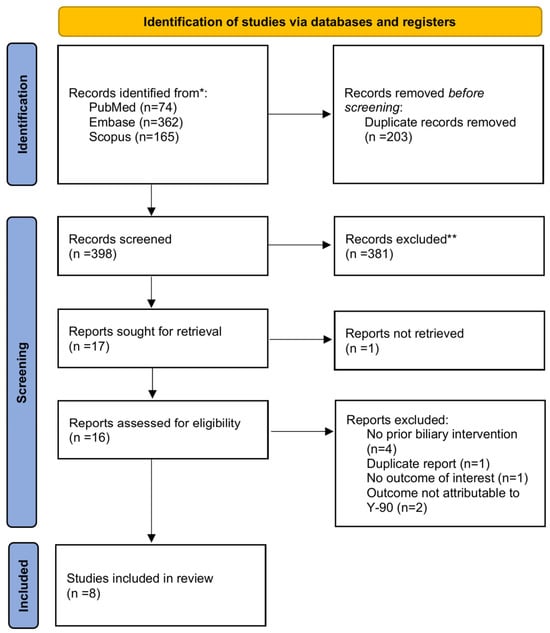
We chose a comprehensive review to interpret the included studies in light of the chemoembolization, ablation, and antibiotic-prophylaxis literature, the mechanism of biliary seeding, and the difference between ablative and non-ablative intent; these sources were selected for relevance rather than found by the systematic search. The search and selection were still systematic, and as a result, the clinical evidence was captured as fully as the three databases allowed and the selection was reproducible. Study selection is shown in a flow diagram (Figure 1) based on the Preferred Reporting Items for Systematic Reviews and Meta-Analyses (PRISMA 2020) template [27].
Figure 1.
Flow diagram of study identification, screening, and inclusion, based on the PRISMA 2020 template. * Number of records identified in each database searched. ** Records excluded at title and abstract screening.
2.1. Search Strategy
PubMed/MEDLINE, Embase, and Scopus were searched from inception to June 2026 for studies reporting infectious or biliary safety outcomes after TARE in patients with primary or metastatic liver malignancy and prior biliary intervention. Two reviewers developed the strategy independently, combining radioembolization and prior biliary intervention terms (keywords plus MeSH and Emtree headings) with Boolean operators. No limits were placed on malignancy type, language, or study design, to capture primary and metastatic disease and case reports. The full strategy for each database is given in Supplementary File S1.
2.2. Inclusion Criteria
Eligibility followed the PICOS (Population, Intervention, Comparator, Outcomes, Study design) framework. Eligible studies (1) enrolled adults (≥18 years) with primary or metastatic liver malignancy; (2) used TARE with Y-90 or equivalent microspheres; (3) included at least one patient with prior biliary intervention, defined as a procedure disrupting the biliary tree or sphincter of Oddi (biliary stenting, percutaneous biliary drainage, biliary-enteric anastomosis (BEA), or endoscopic sphincterotomy), as a case, subgroup, or cohort; (4) reported at least one infectious or biliary safety outcome (liver abscess, cholangitis, sepsis, hepatobiliary infection, infection-related mortality, or biliary fistula or injury); (5) were cohort studies, case series, or case reports with extractable data; and (6) were peer-reviewed full-text articles in English or with an English translation.
2.3. Exclusion Criteria
Studies were excluded if they: (1) did not report outcomes separately for patients with prior biliary intervention undergoing TARE; (2) evaluated other locoregional therapies without separate TARE reporting; (3) reported no outcome of interest; (4) were opinion pieces, reviews, meta-analyses, or conference abstracts; (5) contained duplicate or overlapping populations, in which case the most comprehensive or recent dataset was retained; or (6) had unavailable full text.
2.4. Study Selection Process
Records were exported to Zotero, and duplicates were removed and checked manually. Two reviewers independently screened titles and abstracts. Full texts of potentially eligible studies were then assessed against the PICOS criteria, and disagreements were resolved by discussion.
2.5. Data Extraction and Outcome Measures
Study characteristics, patient demographics, prior biliary interventions, and treatment details, including dosimetry and antibiotic prophylaxis, were extracted on a standardized Microsoft Excel form (Table 1). For case reports, the type and timing of the biliary complication, its management, and the outcome were extracted separately. Two reviewers independently extracted all data, including event counts and denominators, and discrepancies were resolved by discussion.
Table 1.
Comprehensive baseline characteristics and study details.
2.6. Quality Assessment
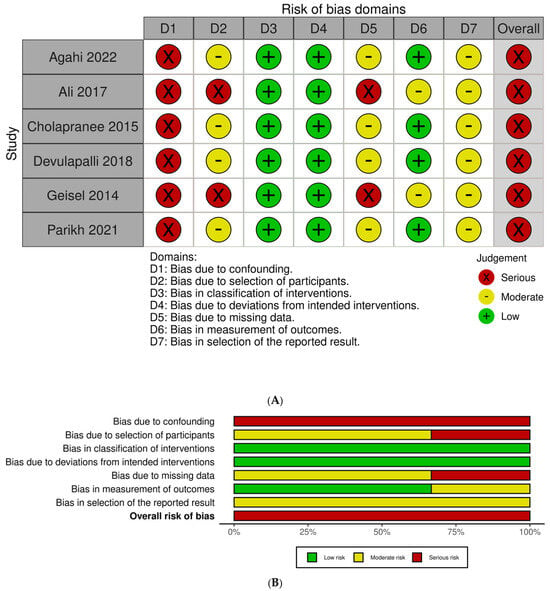
Cohort studies were assessed with the Risk of Bias in Non-randomized Studies of Interventions (ROBINS-I) tool [34]. Two reviewers assessed each study independently and resolved discrepancies by discussion. Each domain was judged low, moderate, serious, or critical, and the overall judgment was the highest level in any domain (Figure 2A,B). Case reports were appraised with the tool of Murad et al. [35].
Figure 2.
(A) ROBINS-I traffic-light plot showing the individual risk-of-bias judgment for each cohort study [28,29,30,31,32,33] across the seven ROBINS-I domains and the overall rating. D1, confounding; D2, selection of participants; D3, classification of interventions; D4, deviations from intended interventions; D5, missing data; D6, measurement of outcomes; D7, selection of the reported result. (B) ROBINS-I risk-of-bias summary plot for the six cohort studies, showing the proportion of studies judged at low, moderate, or serious risk of bias across the seven ROBINS-I domains and the overall assessment.
2.7. Outcomes and Statistical Analysis
The primary outcome was hepatobiliary infection after TARE, defined as liver abscess or cholangitis and counted as the number of patients with at least one infection; infection episodes were recorded where reported. Secondary outcomes were liver abscess, cholangitis, sepsis (classified by whether a source was identified), infection-related mortality, abdominal pain, fever, nausea and vomiting, need for drainage, and other biliary complications in the case reports.
Outcomes were synthesized using a structured narrative approach (Synthesis Without Meta-analysis, SWiM) [36]. No meta-analytic model was fitted: the evidence base was small, clinically heterogeneous, and dominated by one cohort that contributed most patients and events, so a pooled estimate would have reflected that study almost entirely. For each outcome, study-level event counts and crude proportions were tabulated and summarized as a range (Table 2). Crude totals are also reported; because they sum events and denominators across studies, they are weighted by study size and dominated by the largest cohort. Patients reported by more than one study were counted once and exact (Clopper–Pearson) 95% confidence intervals were calculated for each study’s proportions. Cohort studies supplied the rates, and case reports were summarized separately as a clinical spectrum. One cohort reported infection per procedure rather than per patient and is presented separately.
Table 2.
Infectious outcomes by study (per-patient cohorts).
3. Results
The search identified 601 records, and 16 reports were assessed in full. Eight studies met the inclusion criteria: six cohort studies and two case reports of biliary complications (Figure 1). Four cohorts reported per-patient infectious outcomes in 152 patients, and one reported infection per procedure. The sixth, Cholapranee et al., reported 16 patients who were also included in the Devulapalli et al. cohort, so they were counted only once, within that cohort [30]. It was retained rather than excluded under exclusion criterion 5 because it adds a comparison with chemoembolization in patients given the same prophylaxis, which the larger cohort does not report.
3.1. Study Characteristics and Patient Demographics
The four per-patient cohorts were published between 2014 and 2022, with prior-biliary subgroups of 2 to 126 patients (median 12) [28,29,31,32]. Malignancy type, prior biliary intervention, microsphere type, age, sex, performance status, administered activity, and follow-up are given by study in Table 1. Treatment extent in the prior-biliary group was all lobar in Cholapranee et al., whole liver in 6 and lobar in 3 patients in Geisel et al., and, per procedure, 11.7% whole liver, 69.4% lobar, and 16.1% one to three segments in Devulapalli et al.; the other cohorts did not report it for this group. Activity was calculated by the body surface area (BSA) method for resin and the single-compartment medical internal radiation dose (MIRD) method for glass; no cohort used partition/multicompartment or voxel-based dosimetry, and absorbed dose, where given, was reported as a median.
3.2. Risk of Bias Assessment
All six cohorts were at serious overall risk of bias, because confounding was serious in every study: none had a control group or could adjust for confounders such as baseline liver function, tumor burden, or prior treatment (Figure 2). Ali et al. and Geisel et al. were also rated serious for selection bias and missing data, as each analyzed a small, selectively referred subset of a larger cohort. Both case reports were of moderate quality on the Murad et al. tool (Supplementary Table S1).
3.3. Outcomes
Hepatobiliary infection occurred in 12 of 152 patients (7.9%) and in 13 episodes, as one patient was infected after each of two treatments (Table 2). Liver abscess occurred in 10 patients (6.6%), cholangitis in 5 (3.3%), and death from infection in 2 (1.3%). Sepsis was recorded in 8 patients (5.3%), all with hepatobiliary infection, and in one further patient with no identified source (1 of 26, 3.8%). Per-study infection rates ranged from 0% to 13.3%.
Prophylaxis regimens and bowel preparation (Table 3) differed between studies and, in the largest cohort, between centers; two cohorts did not report them. The only two studies that analyzed infection by prophylaxis found no association with its use, bowel preparation, or regimen, so the effect of prophylaxis could not be assessed across studies.
Table 3.
Antibiotic prophylaxis and bowel preparation by study.
3.4. Need for Drainage
Drainage was reported in two cohorts, always for hepatobiliary infection after TARE. In Devulapalli et al., 4 of 126 patients (3.2%) needed biliary drainage (1 percutaneous transhepatic drainage and 3 endoscopic stent exchanges), 4 needed image-guided abscess aspiration, and 5 needed abscess drain insertion [31]. Prior biliary intervention was not articulated per patient, although one stent exchange followed liver abscess and cholangitis 74 days after TARE in a patient with a pre-existing endoscopic stent. In Agahi et al., the liver abscess was drained under CT and the cholangitis resolved after stent replacement [28]. The other cohorts had no hepatobiliary infection or did not describe its treatment.
3.5. Non-Infectious Events
Non-infectious adverse events were reported only by Agahi et al., who recorded four within 30 days among 15 patients, each grade 3 by the Common Terminology Criteria for Adverse Events (version 4.0). Two patients had nausea and vomiting requiring admission for intravenous fluids, one had abdominal pain, and one had fever attributed to tumor lysis after no infectious source was found.
3.6. Biliary Complications (Case Reports)
Two case reports described delayed biliary complications (Table 4). Dökdök et al. [37] reported an arteriobiliary fistula with hemobilia in a patient with a percutaneous biliary drain, and Hall et al. reported recurrent cholangitis, sepsis, and a biliary-caval fistula in a patient with a BEA, who died [38].
Table 4.
Biliary-complication case reports.
4. Discussion
Across the four per-patient cohorts, hepatobiliary infection occurred in 7.9% of patients, with liver abscess in 6.6%, sepsis in 5.3%, and cholangitis in 3.3%. These values need cautious interpretation: most patients and events came from one multicenter cohort (Devulapalli et al.), and as a result the estimates mainly reflect that study; two of the four cohorts reported no infections, and the evidence base is small, retrospective, and clinically heterogeneous. The two case reports show that delayed biliary and fistulous complications can also occur, although this does not demonstrate TARE to be the cause.
The liver abscess rate of 6.6% is lower than after TACE or HAE in patients with a BEA or Whipple procedure, where rates of 33% to 86% have been reported, compared with 0.1% with intact biliary anatomy [16,17,18]. In the largest TACE cohort, which included patients with and without prior biliary intervention, abscess occurred in only 0.58% of 3613 patients, but 57.1% of those affected had a prior BEA or biliary stent [19]. All four series used conventional lipiodol-based chemoembolization or bland particle embolization. In one propensity-matched study of patients with hepatocellular carcinoma who had biliary drainage, mostly percutaneous, for bile duct invasion before treatment, liver abscess occurred within 30 days in 2 of 53 patients after drug-eluting beads and 4 of 53 after conventional TACE (p = 0.401) [39]. Drug-eluting beads may, however, pose a higher risk to the biliary epithelium than cTACE, as they have been associated with more biliary injury and biloma than conventional TACE in neuroendocrine metastases and hepatocellular carcinoma [40,41]. These comparisons with radioembolization are indirect, as the chemoembolization series can differ from the radioembolization cohorts in patient selection, prophylaxis, and follow-up. The difference between TACE and TARE may reflect the embolic mechanism, as Y-90 microspheres generally preserve hepatic arterial flow and cause radiation rather than ischemic injury [8,9,14]. Cholapranee et al. provided the most direct comparison, reporting 0 abscesses in 16 Y-90 patients versus 3 of 13 (23%) TACE patients with prior biliary intervention under identical antibiotic prophylaxis [30]. The National Comprehensive Cancer Network guidelines for neuroendocrine tumors cite infection rates of about 20% after transarterial embolization (TAE) or TACE versus 8% after TARE in this population and suggest TARE may be preferred [22]. The 6.6% rate nevertheless remains well above the less than 1% reported in general Y-90 populations [20,21], an apparent 7- to 22-fold difference depending on the baseline used. The general Y-90 populations in those two studies were treated lobar with glass microspheres to a target of 120 Gy by single-compartment/MIRD dosimetry, or unilobar and whole liver with resin microspheres dosed by BSA or multicompartment dosimetry at each center’s discretion, with palliative intent. Neither reflects ablative-intent treatment or radiation segmentectomy. The same gradient appears after thermal ablation, where prior biliary intervention is an independent predictor of infection (odds ratio 18.6 for any prior biliary intervention, 36.4 for bilioenteric anastomosis) [42,43] and abscess rates in affected patients range from 11% to 27% against about 1% in those with intact anatomy [44,45,46]. On these grounds ablation is considered a relative contraindication in patients with biliary diversion, whereas non-curative intent radioembolization carries no such caution [47]. Curative-intent or ablative radioembolization, however, may resemble thermal ablation in causing coagulative necrosis of the treatment zone, so caution is needed given the lack of data on radiation segmentectomy in this population. Thermal ablation and radiation segmentectomy have not been compared directly in patients with prior biliary intervention, and they can be used in different patient populations, so this comparison would also be indirect. Prior biliary intervention therefore remains a risk factor, though apparently a smaller one for palliative-intent radioembolization than for chemoembolization, thermal ablation, and possibly radiation segmentectomy.
Sepsis and cholangitis are poorly characterized after embolotherapy. Cholangitis is not a separate category in the SIR Standardization of Terminology document, which may explain its absence from most TACE studies [48], and the only prospective comparator reported sepsis after 1.7% (3/176) of TAE procedures without antibiotic prophylaxis [49]. When sepsis is described, it is often a fatal sequela of liver abscess, with blood cultures positive in nearly half of abscess patients and in-hospital mortality approaching 34% once sepsis develops [17,18,19,50]. Both endpoints were concentrated in the Devulapalli et al. cohort, possibly reflecting institutional differences in prophylaxis, biliary intervention type, or biliary flora [28,31].
No randomized trial has examined antibiotic prophylaxis for radioembolization. The supporting evidence comes from chemoembolization and ablation. Geschwind et al. found single-agent prophylaxis insufficient for TACE in biliary patients: 4 of 4 given cephalexin alone developed abscess, versus 0 of 4 given bowel preparation plus piperacillin/tazobactam [51]. Patel et al. showed a trend toward fewer abscesses with an aggressive multidrug regimen (levofloxacin, metronidazole, and neomycin/erythromycin bowel preparation) (2/7 vs. 6/7, p = 0.103) [52]. Khan et al. reported 0 abscesses with moxifloxacin monotherapy in 10 embolization patients [53]. In the only comparison of regimens that included radioembolization, Parikh et al. found no significant difference between moxifloxacin monotherapy and the multidrug regimen, with chemoembolization and radioembolization procedures analyzed together (18.2% vs. 10.5%, p = 0.3), nor between Y-90 and TACE (13.8% vs. 16.7%) [33]. In the ablation literature, Odisio et al. found 0 abscesses in 10 hepaticojejunostomy patients given the Patel-type regimen, and Tan et al. showed a significant benefit in 21 microwave ablation patients with BEA (0/11 vs. 6/10, p = 0.004) [54,55]. The 2018 SIR Practice Parameter offers only expert-opinion regimens for Y-90 (for example, moxifloxacin 400 mg daily from 2 days before to 10 days after), rated Class IIb, Level C-LD, and records no consensus on prophylaxis for radioembolization, whereas for chemoembolization and ablation it advises prophylaxis in patients with a BEA, stent, or sphincterotomy [14]. Sangro et al. found no strong evidence of increased risk but advised antibiotic prophylaxis before radioembolization in patients with prior biliary drainage [23]. Devulapalli et al. found no association between infection and either antibiotic prophylaxis or bowel preparation, although they noted that heterogeneous regimens may have limited this analysis [31]. This prophylaxis evidence, however, comes from modalities that create a discrete devitalized focus, by ischemia or by thermal necrosis, which is then seeded from a colonized biliary tree [14]. Radioembolization with palliative intent produces a more diffuse and delayed radiation injury, so extrapolating those regimens to Y-90 is less secure than it appears. The multidrug regimen has the most consistent comparative data, none of it from radioembolization.
Among biliary interventions, BEA appears to carry the highest infectious risk, although data are limited. Mezhir et al. found a 3.3-fold higher abscess rate with BEA than with an incompetent sphincter, and Song et al. identified a biliary status “prone to ascending infection” (BEA grouped with papillotomy and similar interventions) as the only independent predictor of abscess in 2439 TACE patients [17,56]. Parikh et al., however, found no difference between BEA (24.1%) and biliary stenting (23.8%) under aggressive prophylaxis, with chemoembolization and radioembolization combined, suggesting the difference may be attenuated [33].
Whether neuroendocrine metastases carry a higher risk is uncertain: in the largest cohort, 6 of the 10 patients with hepatobiliary infection had pancreatic neuroendocrine tumors, but the association was not significant (hazard ratio 2.66, 95% confidence interval 0.69–10.17; p = 0.15) and was not retained after adjustment [31]. Neither hepatobiliary infection in Agahi et al. occurred in a patient with a neuroendocrine tumor, and Parikh et al. found no difference in infection by malignancy, with chemoembolization and radioembolization combined (p = 0.7) [28,33]. No cohort reported tumor type by type of biliary intervention, and the role of the vascularity and hepatic burden could not be examined.
Limitations
The synthesis rests on four cohorts totaling 152 patients, too few for subgroup analysis by malignancy, microsphere type, or biliary intervention, although intervention types may carry different risks. The non-infectious events come from one study and are exploratory. All studies were retrospective and observational, and therefore vulnerable to selection bias and to variation in practice, prophylaxis, and complication definitions. The evidence is also dominated by one cohort and is not fully independent: Devulapalli et al. contributed 83% of patients (126/152) and most events, and although its rate (7.9%) was consistent with the smaller series, this concentration limits generalizability [31]. Devulapalli et al. state that they included the 16 patients of Cholapranee et al., who were therefore counted once. Parikh et al. reported from the same institution over an overlapping period, and per-center contributions were not given, so further overlap cannot be quantified; several prophylaxis series discussed above also come from that institution and are not independent corroboration. No included study described radiation segmentectomy or ablative dose intent (median absorbed liver dose in the largest cohort, 116 Gy for glass and 73 Gy for resin), so these estimates should not be extrapolated to ablative-intent radioembolization. Follow-up was short and uneven (median 4.0 to 9.3 months), so late infections may have been missed, and the mix of malignancies limits tumor-specific conclusions. The two case reports describe the spectrum of complications rather than their frequency and are subject to selection and publication bias, and publication bias may also overstate safety across the literature.
5. Conclusions
In patients with prior biliary intervention, hepatobiliary infection after Y-90 radioembolization occurred in about 8%, a rate that appears lower than in chemoembolization series of comparable patients but higher than in patients with intact biliary anatomy, although both comparisons are indirect. Radioembolization may therefore be a reasonable option in this population. The evidence comes from a few retrospective studies at serious risk of bias, some sharing patients, and does not establish whether antibiotic prophylaxis is needed or which regimen to use. A prospective study with a defined prophylaxis protocol may help to answer these questions. Future work should also specifically define the risk after ablative-intent radioembolization.
Supplementary Materials
The following supporting information can be downloaded at: https://www.mdpi.com/article/10.3390/curroncol33110715/s1, Supplementary File S1: Search strategies for PubMed, Embase, and Scopus; Table S1: Methodological quality of the two case reports [37,38] (Murad et al. 2018 tool [35]).
Author Contributions
Conceptualization, V.P.K.; methodology, A.S. (Areeb Siddiqui), A.K.A.A., S.Y. and V.P.K.; validation, A.S. (Areeb Siddiqui), A.S. (Abin Sajan), S.I., T.A.S., Z.T.B., K.G.-R., J.R. and V.P.K.; formal analysis, A.S. (Areeb Siddiqui), A.S. (Abin Sajan), J.M. and V.P.K.; investigation, A.S. (Areeb Siddiqui), K.N.-T., T.S.M. and V.P.K.; data curation, A.S. (Areeb Siddiqui) and V.P.K.; writing—original draft preparation, A.S. (Areeb Siddiqui); writing—review and editing, A.K.A.A., K.N.-T., T.S.M., A.S. (Abin Sajan), S.I., T.A.S., Z.T.B., S.Y., J.M., K.G.-R., J.R., V.P.K. and A.S. (Areeb Siddiqui); visualization, A.S. (Areeb Siddiqui); supervision, V.P.K.; project administration, V.P.K. All authors have read and agreed to the published version of the manuscript.
Funding
This research received no external funding.
Institutional Review Board Statement
Not applicable. This review analyzed previously published studies and did not involve new research on human or animal subjects.
Informed Consent Statement
Not applicable.
Data Availability Statement
All data supporting this review were extracted from previously published studies, which are cited in the reference list. The extracted dataset is available from the corresponding author on reasonable request.
Conflicts of Interest
The authors declare no conflicts of interest.
References
- Salem, R.; Lewandowski, R.J.; Mulcahy, M.F.; Riaz, A.; Ryu, R.K.; Ibrahim, S.; Atassi, B.; Baker, T.; Gates, V.; Miller, F.H.; et al. Radioembolization for Hepatocellular Carcinoma Using Yttrium-90 Microspheres: A Comprehensive Report of Long-Term Outcomes. Gastroenterology 2010, 138, 52–64. [Google Scholar] [CrossRef] [Scilit] [PubMed]
- Kallini, J.R.; Gabr, A.; Salem, R.; Lewandowski, R.J. Transarterial Radioembolization with Yttrium-90 for the Treatment of Hepatocellular Carcinoma. Adv. Ther. 2016, 33, 699–714. [Google Scholar] [CrossRef] [Scilit] [PubMed]
- Padia, S.A. Y90 Clinical Data Update: Cholangiocarcinoma, Neuroendocrine Tumor, Melanoma, and Breast Cancer Metastatic Disease. Tech. Vasc. Interv. Radiol. 2019, 22, 81–86. [Google Scholar] [CrossRef] [Scilit] [PubMed]
- Chen, K.; Tong, A.K.T.; Moe, F.N.N.; Ng, D.C.E.; Lo, R.H.G.; Gogna, A.; Yan, S.X.; Thang, S.P.; Loke, K.S.H.; Venkatanarasimha, N.K.; et al. The Impact of Radiation Dose and Tumour Burden on Outcomes in Hepatocellular Carcinoma: 11-Year Experience in a 413-Patient Cohort Treated with Yttrium-90 Resin Microsphere Radioembolisation. Liver Cancer 2024, 14, 158–179. [Google Scholar] [CrossRef] [Scilit] [PubMed]
- Salem, R.; Lewandowski, R.J.; Kulik, L.; Wang, E.; Riaz, A.; Ryu, R.K.; Sato, K.T.; Gupta, R.; Nikolaidis, P.; Miller, F.H.; et al. Radioembolization Results in Longer Time-to-Progression and Reduced Toxicity Compared with Chemoembolization in Patients with Hepatocellular Carcinoma. Gastroenterology 2011, 140, 497–507.e2. [Google Scholar] [CrossRef] [Scilit] [PubMed]
- Lance, C.; McLennan, G.; Obuchowski, N.; Cheah, G.; Levitin, A.; Sands, M.; Spain, J.; Srinivas, S.; Shrikanthan, S.; Aucejo, F.N.; et al. Comparative Analysis of the Safety and Efficacy of Transcatheter Arterial Chemoembolization and Yttrium-90 Radioembolization in Patients with Unresectable Hepatocellular Carcinoma. J. Vasc. Interv. Radiol. 2011, 22, 1697–1705. [Google Scholar] [CrossRef] [Scilit] [PubMed]
- Currie, B.M.; Nadolski, G.; Mondschein, J.; Dagli, M.; Sudheendra, D.; Stavropoulos, S.W.; Soulen, M.C. Chronic Hepatotoxicity in Patients with Metastatic Neuroendocrine Tumor: Transarterial Chemoembolization versus Transarterial Radioembolization. J. Vasc. Interv. Radiol. 2020, 31, 1627–1635. [Google Scholar] [CrossRef] [Scilit] [PubMed]
- Sato, K.; Lewandowski, R.J.; Bui, J.T.; Omary, R.; Hunter, R.D.; Kulik, L.; Mulcahy, M.; Liu, D.; Chrisman, H.; Resnick, S.; et al. Treatment of Unresectable Primary and Metastatic Liver Cancer with Yttrium-90 Microspheres (TheraSphere®): Assessment of Hepatic Arterial Embolization. Cardiovasc. Interv. Radiol. 2006, 29, 522–529. [Google Scholar] [CrossRef] [Scilit] [PubMed]
- Nalesnik, M.A.; Federle, M.; Buck, D.; Fontes, P.; Carr, B.I. Hepatobiliary Effects of 90yttrium Microsphere Therapy for Unresectable Hepatocellular Carcinoma. Human. Pathol. 2009, 40, 125–134. [Google Scholar] [CrossRef] [Scilit] [PubMed]
- Mangiavillano, B.; Pagano, N.; Baron, T.H.; Luigiano, C. Outcome of Stenting in Biliary and Pancreatic Benign and Malignant Diseases: A Comprehensive Review. World J. Gastroenterol. 2015, 21, 9038–9054. [Google Scholar] [CrossRef] [Scilit] [PubMed]
- Sung, J.Y.; Costerton, J.W.; Shaffer, E.A. Defense System in the Biliary Tract against Bacterial Infection. Dig. Dis. Sci. 1992, 37, 689–696. [Google Scholar] [CrossRef] [Scilit] [PubMed]
- Powerski, M.; Penzlin, S.; Hass, P.; Seidensticker, R.; Mohnike, K.; Damm, R.; Steffen, I.; Pech, M.; Gademann, G.; Ricke, J.; et al. Biliary Duct Stenosis after Image-Guided High-Dose-Rate Interstitial Brachytherapy of Central and Hilar Liver Tumors. Strahlenther. Onkol. 2019, 195, 265–273. [Google Scholar] [CrossRef] [Scilit] [PubMed]
- Ng, S.S.M.; Yu, S.C.H.; Lai, P.B.S.; Lau, W.Y. Biliary Complications Associated with Selective Internal Radiation (SIR) Therapy for Unresectable Liver Malignancies. Dig. Dis. Sci. 2008, 53, 2813–2817. [Google Scholar] [CrossRef] [Scilit] [PubMed]
- Chehab, M.A.; Thakor, A.S.; Tulin-Silver, S.; Connolly, B.L.; Cahill, A.M.; Ward, T.J.; Padia, S.A.; Kohi, M.P.; Midia, M.; Chaudry, G.; et al. Adult and Pediatric Antibiotic Prophylaxis during Vascular and IR Procedures: A Society of Interventional Radiology Practice Parameter Update Endorsed by the Cardiovascular and Interventional Radiological Society of Europe and the Canadian Association for Interventional Radiology. J. Vasc. Interv. Radiol. 2018, 29, 1483–1501.e2. [Google Scholar] [CrossRef] [Scilit] [PubMed]
- Fonseca, A.Z.; Santin, S.; Gomes, L.G.L.; Waisberg, J.; Ribeiro, M.A., Jr. Complications of Radiofrequency Ablation of Hepatic Tumors: Frequency and Risk Factors. World J. Hepatol. 2014, 6, 107–113. [Google Scholar] [CrossRef] [Scilit] [PubMed]
- Kim, W.; Clark, T.W.I.; Baum, R.A.; Soulen, M.C. Risk Factors for Liver Abscess Formation after Hepatic Chemoembolization. J. Vasc. Interv. Radiol. 2001, 12, 965–968. [Google Scholar] [CrossRef] [Scilit] [PubMed]
- Mezhir, J.J.; Fong, Y.; Fleischer, D.; Seo, S.K.; D’Amico, F.; Petre, E.; Covey, A.M.; Getrajdman, G.I.; Thornton, R.H.; Solomon, S.B.; et al. Pyogenic Abscess after Hepatic Artery Embolization: A Rare but Potentially Lethal Complication. J. Vasc. Interv. Radiol. 2011, 22, 177–182. [Google Scholar] [CrossRef] [Scilit] [PubMed]
- Woo, S.; Chung, J.W.; Hur, S.; Joo, S.-M.; Kim, H.-C.; Jae, H.J.; Park, J.H. Liver Abscess After Transarterial Chemoembolization in Patients With Bilioenteric Anastomosis: Frequency and Risk Factors. Am. J. Roentgenol. 2013, 200, 1370–1377. [Google Scholar] [CrossRef] [Scilit] [PubMed]
- Lv, W.-F.; Lu, D.; He, Y.-S.; Xiao, J.-K.; Zhou, C.-Z.; Cheng, D.-L. Liver Abscess Formation Following Transarterial Chemoembolization: Clinical Features, Risk Factors, Bacteria Spectrum, and Percutaneous Catheter Drainage. Medicine 2016, 95, e3503. [Google Scholar] [CrossRef] [Scilit] [PubMed]
- Atassi, B.; Bangash, A.K.; Lewandowski, R.J.; Ibrahim, S.; Kulik, L.; Mulcahy, M.F.; Murthy, R.; Ryu, R.K.; Sato, K.T.; Miller, F.H.; et al. Biliary Sequelae Following Radioembolization with Yttrium-90 Microspheres. J. Vasc. Interv. Radiol. 2008, 19, 691–697. [Google Scholar] [CrossRef] [Scilit] [PubMed]
- Maleux, G.; Albrecht, T.; Arnold, D.; Bargellini, I.; Cianni, R.; Helmberger, T.; Kolligs, F.; Munneke, G.; Peynircioglu, B.; Sangro, B.; et al. Predictive Factors for Adverse Event Outcomes After Transarterial Radioembolization with Yttrium-90 Resin Microspheres in Europe: Results from the Prospective Observational CIRT Study. Cardiovasc. Interv. Radiol. 2023, 46, 852–867. [Google Scholar] [CrossRef] [Scilit] [PubMed]
- Bergsland, E. Guidelines Detail. Available online: https://www.nccn.org/guidelines/guidelines-detail?id=1448 (accessed on 3 April 2026).
- Sangro, B.; Martínez-Urbistondo, D.; Bester, L.; Bilbao, J.I.; Coldwell, D.M.; Flamen, P.; Kennedy, A.; Ricke, J.; Sharma, R.A. Prevention and Treatment of Complications of Selective Internal Radiation Therapy: Expert Guidance and Systematic Review. Hepatology 2017, 66, 969. [Google Scholar] [CrossRef] [Scilit] [PubMed]
- Benson, A.B. Guidelines Detail. Available online: https://www.nccn.org/guidelines/guidelines-detail?category=1&id=1514 (accessed on 3 April 2026).
- Sangro, B.; Argemi, J.; Ronot, M.; Paradis, V.; Meyer, T.; Mazzaferro, V.; Jepsen, P.; Golfieri, R.; Galle, P.; Dawson, L.; et al. EASL Clinical Practice Guidelines on the Management of Hepatocellular Carcinoma. J. Hepatol. 2025, 82, 315–374. [Google Scholar] [CrossRef] [Scilit] [PubMed]
- Singal, A.G.; Llovet, J.M.; Yarchoan, M.; Mehta, N.; Heimbach, J.K.; Dawson, L.A.; Jou, J.H.; Kulik, L.M.; Agopian, V.G.; Marrero, J.A.; et al. AASLD Practice Guidance on Prevention, Diagnosis, and Treatment of Hepatocellular Carcinoma. Hepatology 2023, 78, 1922, Erratum in Hepatology 2023, 78, E105. [Google Scholar] [CrossRef] [Scilit] [PubMed]
- Page, M.J.; Moher, D.; Bossuyt, P.M.; Boutron, I.; Hoffmann, T.C.; Mulrow, C.D.; Shamseer, L.; Tetzlaff, J.M.; Akl, E.A.; Brennan, S.E.; et al. PRISMA 2020 Explanation and Elaboration: Updated Guidance and Exemplars for Reporting Systematic Reviews. BMJ 2021, 372, n160. [Google Scholar] [CrossRef] [PubMed]
- Agahi, K.N.; Mahvash, A.; Abdelsalam, M.E. Hepatic Abscess Following Yttrium-90 Radioembolization in Patients with Surgical Bilioenteric Anastomosis or Compromised Sphincter of Oddi: A Tertiary Cancer Center Experience. Curr. Oncol. 2022, 29, 7051–7058. [Google Scholar] [CrossRef] [Scilit] [PubMed]
- Ali, R.; Riaz, A.; Gabr, A.; Abouchaleh, N.; Mora, R.; Al Asadi, A.; Caicedo, J.C.; Abecassis, M.; Katariya, N.; Maddur, H.; et al. Clinical Outcomes of Y90 Radioembolization for Recurrent Hepatocellular Carcinoma Following Curative Resection. Eur. J. Nucl. Med. Mol. Imaging 2017, 44, 2195–2202. [Google Scholar] [CrossRef] [Scilit] [PubMed]
- Cholapranee, A.; Van Houten, D.; Deitrick, G.; Dagli, M.; Sudheendra, D.; Mondschein, J.I.; Soulen, M.C. Risk of Liver Abscess Formation in Patients with Prior Biliary Intervention Following Yttrium-90 Radioembolization. Cardiovasc. Interv. Radiol. 2015, 38, 397–400. [Google Scholar] [CrossRef] [Scilit] [PubMed]
- Devulapalli, K.K.; Fidelman, N.; Soulen, M.C.; Miller, M.; Johnson, M.S.; Addo, E.; El-Haddad, G.; Nutting, C.; Morrison, J.; Farsad, K.; et al. 90 Y Radioembolization for Hepatic Malignancy in Patients with Previous Biliary Intervention: Multicenter Analysis of Hepatobiliary Infections. Radiology 2018, 288, 774–781. [Google Scholar] [CrossRef] [Scilit] [PubMed]
- Geisel, D.; Powerski, M.-J.; Schnapauff, D.; Collettini, F.; Thiel, R.; Denecke, T.; Wieners, G.; Gebauer, B. No Infectious Hepatic Complications Following Radioembolization with 90Y Microspheres in Patients with Biliodigestive Anastomosis. Anticancer Res. 2014, 34, 4315–4321. [Google Scholar] [PubMed]
- Parikh, R.S.; Abousoud, O.; Hunt, S.; Gade, T.; Dagli, M.; Mondschein, J.; Shamimi-Noori, S.; Sudheendra, D.; Stavropoulos, S.W.; Soulen, M.C.; et al. Infection Rates Following Hepatic Embolotherapy in Patients with Prior Biliary Interventions: Comparison of Single-Drug Moxifloxacin and Multidrug Antibiotic Prophylaxis. J. Vasc. Interv. Radiol. 2021, 32, 739–744. [Google Scholar] [CrossRef] [Scilit] [PubMed]
- Sterne, J.A.; Hernán, M.A.; Reeves, B.C.; Savović, J.; Berkman, N.D.; Viswanathan, M.; Henry, D.; Altman, D.G.; Ansari, M.T.; Boutron, I.; et al. ROBINS-I: A Tool for Assessing Risk of Bias in Non-Randomised Studies of Interventions. BMJ 2016, 355, i4919. [Google Scholar] [CrossRef] [Scilit] [PubMed]
- Murad, M.H.; Sultan, S.; Haffar, S.; Bazerbachi, F. Methodological Quality and Synthesis of Case Series and Case Reports. BMJ EBM 2018, 23, 60–63. [Google Scholar] [CrossRef] [Scilit] [PubMed]
- Campbell, M.; McKenzie, J.E.; Sowden, A.; Katikireddi, S.V.; Brennan, S.E.; Ellis, S.; Hartmann-Boyce, J.; Ryan, R.; Shepperd, S.; Thomas, J.; et al. Synthesis without Meta-Analysis (SWiM) in Systematic Reviews: Reporting Guideline. BMJ 2020, 368, l6890. [Google Scholar] [CrossRef] [Scilit] [PubMed]
- Dökdök, M.; Karaman, K. Acute Arteriobiliary Fistula Emergent Long after Biliary Drainage and Radioembolization. J. Clin. Interv. Radiol. ISVIR 2022, 06, 205–206. [Google Scholar] [CrossRef] [Scilit]
- Hall, A.D.; White, S.B.; Rilling, W.S. Biliary-Caval Fistula Following Y90 Radioembolization. Semin. Interv. Radiol. 2021, 38, 488–491. [Google Scholar] [CrossRef] [Scilit] [PubMed]
- Fan, W.; Zheng, X.; Zhao, X.; Zhu, B.; Wu, Y.; Xue, M.; Tang, R.; Huang, Z.; Qiao, L.; Lu, M.; et al. DEB-TACE versus cTACE for Unresectable HCC with B1-Type Bile Duct Invasion after Successful Biliary Drainage: A Propensity Score Matching Analysis. Cancer Med. 2024, 13, e7419. [Google Scholar] [CrossRef] [Scilit] [PubMed]
- Guiu, B.; Deschamps, F.; Aho, S.; Munck, F.; Dromain, C.; Boige, V.; Malka, D.; Leboulleux, S.; Ducreux, M.; Schlumberger, M.; et al. Liver/Biliary Injuries Following Chemoembolisation of Endocrine Tumours and Hepatocellular Carcinoma: Lipiodol vs. Drug-Eluting Beads. J. Hepatol. 2012, 56, 609–617. [Google Scholar] [CrossRef] [Scilit] [PubMed]
- Monier, A.; Guiu, B.; Duran, R.; Aho, S.; Bize, P.; Deltenre, P.; Dunet, V.; Denys, A. Liver and Biliary Damages Following Transarterial Chemoembolization of Hepatocellular Carcinoma: Comparison between Drug-Eluting Beads and Lipiodol Emulsion. Eur. Radiol. 2017, 27, 1431–1439. [Google Scholar] [CrossRef] [Scilit] [PubMed]
- Li, X.; Zhang, Y.; Wang, X.; Zeng, H.; Zhou, L.; Huang, G.; Lin, M.; Zhuang, B.; Xie, X.; Xu, M. Predicting Infectious Complications after Percutaneous Thermal Ablation of Liver Malignancies: A 12-Year Single-Center Experience. Radiology 2023, 308, e223091. [Google Scholar] [CrossRef] [Scilit] [PubMed]
- Shibata, T.; Yamamoto, Y.; Yamamoto, N.; Maetani, Y.; Shibata, T.; Ikai, I.; Terajima, H.; Hatano, E.; Kubo, T.; Itoh, K.; et al. Cholangitis and Liver Abscess after Percutaneous Ablation Therapy for Liver Tumors: Incidence and Risk Factors. J. Vasc. Interv. Radiol. 2003, 14, 1535–1542. [Google Scholar] [CrossRef] [Scilit] [PubMed]
- Welch, B.T.; Schmitz, J.J.; Atwell, T.D.; McGauvran, A.M.; Kurup, A.N.; Callstrom, M.R.; Schmit, G.D. Evaluation of Infectious Complications Following Percutaneous Liver Ablation in Patients with Bilioenteric Anastomoses. Abdom. Radiol. 2017, 42, 1579–1582. [Google Scholar] [CrossRef] [Scilit] [PubMed]
- Kwak, D.H.; Yu, Q.; Malavia, M.; Sellers, E.; Said, A.; Patel, M.; Kumari, D.; Ahmed, O. Risk Factors for Abscess Development Following Percutaneous Microwave Ablation Therapy of Hepatic Tumors. Cardiovasc. Interv. Radiol. 2023, 46, 726–736. [Google Scholar] [CrossRef] [Scilit] [PubMed]
- Hoffmann, R.; Rempp, H.; Schmidt, D.; Pereira, P.L.; Claussen, C.D.; Clasen, S. Prolonged Antibiotic Prophylaxis in Patients with Bilioenteric Anastomosis Undergoing Percutaneous Radiofrequency Ablation. J. Vasc. Interv. Radiol. 2012, 23, 545–551. [Google Scholar] [CrossRef] [Scilit] [PubMed]
- Ratanaprasatporn, L.; Sainani, N.; Duda, J.B.; Aghayev, A.; Tatli, S.; Silverman, S.G.; Shyn, P.B. Imaging Findings during and after Percutaneous Cryoablation of Hepatic Tumors. Abdom. Radiol. 2019, 44, 2602–2626. [Google Scholar] [CrossRef] [Scilit] [PubMed]
- Gaba, R.C.; Lewandowski, R.J.; Hickey, R.; Baerlocher, M.O.; Cohen, E.I.; Dariushnia, S.R.; d’Othée, B.J.; Padia, S.A.; Salem, R.; Wang, D.S.; et al. Transcatheter Therapy for Hepatic Malignancy: Standardization of Terminology and Reporting Criteria. J. Vasc. Interv. Radiol. 2016, 27, 457–473. [Google Scholar] [CrossRef] [Scilit] [PubMed]
- Chen, C.; Tsang, Y.-M.; Hsueh, P.-R.; Huang, G.-T.; Yang, P.-M.; Sheu, J.-C.; Lai, M.-Y.; Chen, P.-J.; Chen, D.-S. Bacterial Infections Associated with Hepatic Arteriography and Transarterial Embolization for Hepatocellular Carcinoma: A Prospective Study. Clin. Infect. Dis. 1999, 29, 161–166. [Google Scholar] [CrossRef] [Scilit] [PubMed]
- Krieg, S.; Essing, T.; Krieg, A.; Roderburg, C.; Luedde, T.; Loosen, S.H. Recent Trends and In-Hospital Mortality of Transarterial Chemoembolization (TACE) in Germany: A Systematic Analysis of Hospital Discharge Data between 2010 and 2019. Cancers 2022, 14, 2088. [Google Scholar] [CrossRef] [Scilit] [PubMed]
- Geschwind, J.-F.H.; Kaushik, S.; Ramsey, D.E.; Choti, M.A.; Fishman, E.K.; Kobeiter, H. Influence of a New Prophylactic Antibiotic Therapy on the Incidence of Liver Abscesses after Chemoembolization Treatment of Liver Tumors. J. Vasc. Interv. Radiol. 2002, 13, 1163–1166. [Google Scholar] [CrossRef] [Scilit] [PubMed]
- Patel, S.; Tuite, C.M.; Mondschein, J.I.; Soulen, M.C. Effectiveness of an Aggressive Antibiotic Regimen for Chemoembolization in Patients with Previous Biliary Intervention. J. Vasc. Interv. Radiol. 2006, 17, 1931–1934. [Google Scholar] [CrossRef] [Scilit] [PubMed]
- Khan, W.; Sullivan, K.L.; McCann, J.W.; Gonsalves, C.F.; Sato, T.; Eschelman, D.J.; Brown, D.B. Moxifloxacin Prophylaxis for Chemoembolization or Embolization in Patients With Previous Biliary Interventions: A Pilot Study. Am. J. Roentgenol. 2011, 197, W343–W345. [Google Scholar] [CrossRef] [Scilit] [PubMed]
- Odisio, B.C.; Richter, M.; Aloia, T.A.; Conrad, C.; Ahrar, K.; Gupta, S.; Vauthey, J.-N.; Huang, S.Y. Use of Prophylactic Antibiotics to Prevent Abscess Formation Following Hepatic Ablation in Patients with Prior Enterobiliary Manipulation. J. Gastrointest. Surg. 2016, 20, 1428–1434. [Google Scholar] [CrossRef] [Scilit] [PubMed]
- Tan, S.; Yu, X.; Liang, P.; Liu, F.; Cheng, Z.; Han, Z.-Y.; Yu, J. Preventing Intrahepatic Infection after Ablation of Liver Tumours in Biliary-Enteric Anastomosis Patients. Int. J. Hyperth. 2017, 33, 664–669. [Google Scholar] [CrossRef] [Scilit] [PubMed]
- Song, S.Y.; Chung, J.W.; Han, J.K.; Lim, H.G.; Koh, Y.H.; Park, J.H.; Lee, H.S.; Kim, C.Y. Liver Abscess after Transcatheter Oily Chemoembolization for Hepatic Tumors: Incidence, Predisposing Factors, and Clinical Outcome. J. Vasc. Interv. Radiol. 2001, 12, 313–320. [Google Scholar] [CrossRef] [Scilit] [PubMed]

Disclaimer/Publisher’s Note: The statements, opinions and data contained in all publications are solely those of the individual author(s) and contributor(s) and not of MDPI and/or the editor(s). MDPI and/or the editor(s) disclaim responsibility for any injury to people or property resulting from any ideas, methods, instructions or products referred to in the content. |
© 2026 by the authors. Licensee MDPI, Basel, Switzerland. This article is an open access article distributed under the terms and conditions of the Creative Commons Attribution (CC BY) license.