


Abstract
Myelodysplastic neoplasm (MDS) is a heterogeneous group of clonal hematological disorders that originate from the hematopoietic and progenitor cells and present with cytopenias and morphologic dysplasia with a propensity to progress to bone marrow failure or acute myeloid leukemia (AML). Genetic evolution plays a critical role in the pathogenesis, progression, and clinical outcomes of MDS. This process involves the acquisition of genetic mutations in stem cells that confer a selective growth advantage, leading to clonal expansion and the eventual development of MDS. With the advent of next-generation sequencing (NGS) assays, an increasing number of molecular aberrations have been discovered in recent years. The knowledge of molecular events in MDS has led to an improved understanding of the disease process, including the evolution of the disease and prognosis, and has paved the way for targeted therapy. The 2022 World Health Organization (WHO) Classification and the International Consensus Classification (ICC) have incorporated the molecular signature into the classification system for MDS. In addition, specific germline mutations are associated with MDS development, especially in pediatrics and young adults. This article reviews the genetic abnormalities of MDS in adults with a brief review of germline predisposition syndromes.
1. Introduction
Myelodysplastic neoplasm (MDS) is a clonal hematologic neoplasm characterized by persistent cytopenias (Table 1) and morphologic dysplasia. The definition of myelodysplastic neoplasms in the 2022 World Health Organization (WHO) is still consistent with the 2016 WHO edition except for replacing the term “syndrome” with “neoplasm”, as myelodysplastic neoplasms are clonal hematopoietic neoplasms [1]. One notable difference between the 2022 WHO classification and the International Consensus Classification (ICC) is the creation of a novel entity of MDS/AML in the ICC that is not in the WHO definition. Therefore, both categories should be considered by pathologists when making diagnoses and clinicians when managing patients in order to determine the most appropriate treatment options.
Table 1.
Defining cytopenia values in MDS.
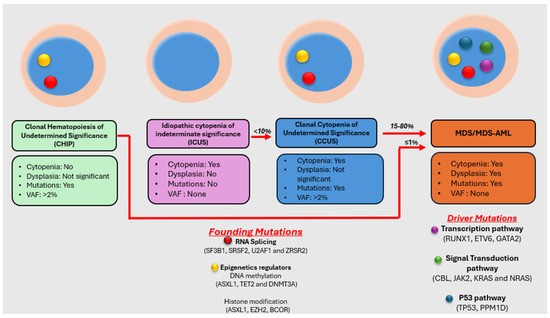
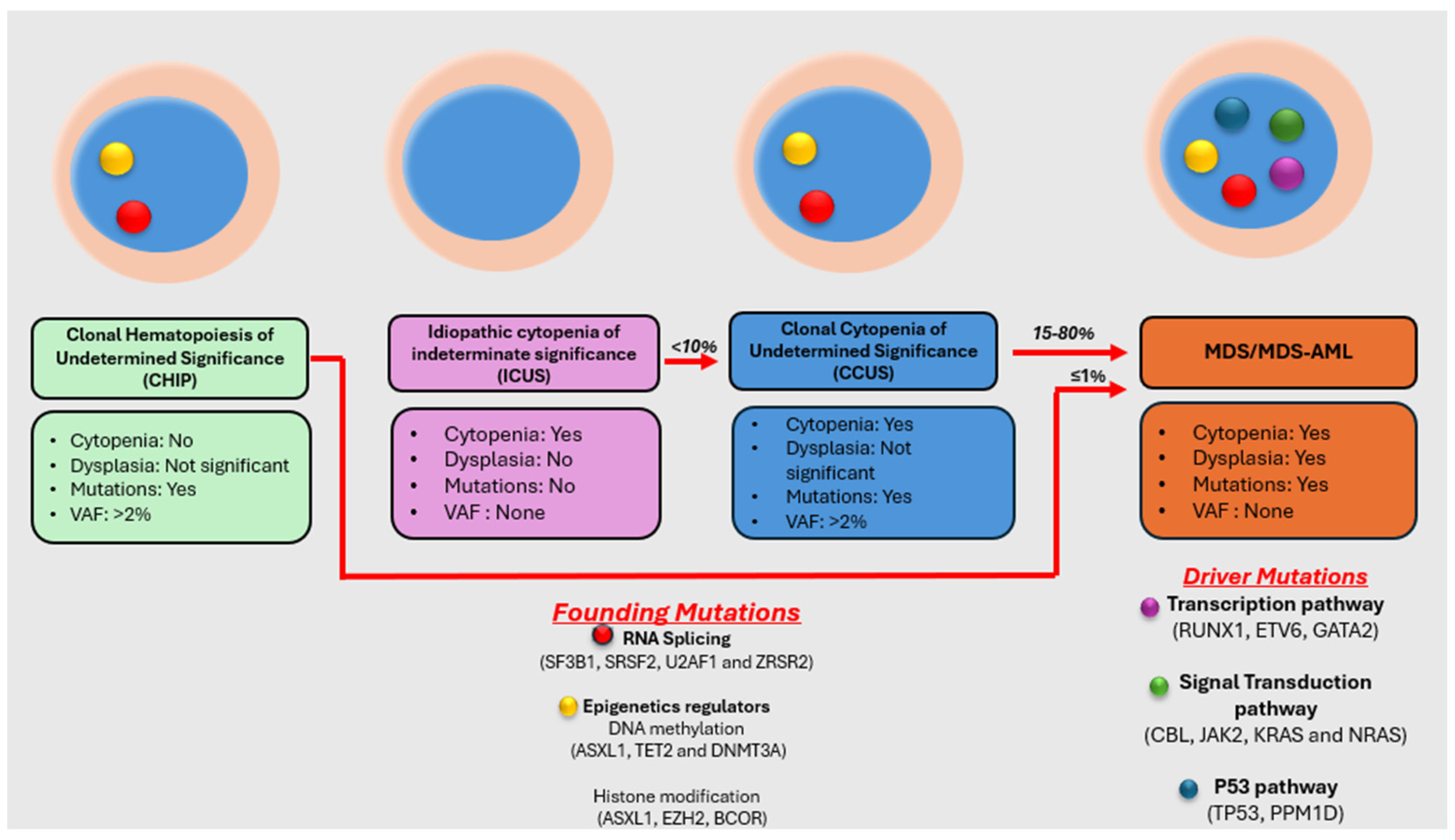
A key diagnostic challenge during the evaluation of cytopenias is differentiating MDS from other mimickers. Knowledge of the underlying genetic profile is helpful in making this distinction. The absence of driver mutations (well-defined somatic mutations known to be involved in disease pathogenesis) in cytopenias constitutes idiopathic cytopenias of undetermined significance (ICUS) with a low probability of evolving into MDS [2]. The presence of mutations in cytopenias raises the possibility of clonal cytopenias of undetermined significance (CCUS) or MDS [3]. Moreover, mutant clones without significant cytopenias can be found as an age-related phenomenon referred to as age-related clonal hematopoiesis (ARCH) or clonal hematopoiesis of undetermined potential (CHIP) [4] (Figure 1).
Figure 1.
Summary of the features of CHIP, ICUS, CCUS, and MDS/MDS-AML with mutational statuses and risk of progression.
Dysplasia is a characteristic feature of myelodysplastic syndrome (MDS), and certain morphological findings within hematopoietic lineages are considered dysplastic. Dysgranulopoiesis refers to changes that affect the neutrophils, such as nuclear hyposegmentation (pseudo-Pelger–Huët anomaly) or hypersegmentation, as well as changes in the cytoplasm like hypogranularity. Dysplastic changes in the erythroid lineage include nuclear budding, intranuclear bridging, karyorrhexis, hypercellularity, megaloblastic changes, ringed sideroblasts, and cytoplasmic vacuoles. Dysmegakaryopoiesis is characterized by micro-megakaryocytes or non-lobed nuclei in the megakaryocytes. However, since these morphological findings can also be seen in other scenarios, such as nutritional deficiency, infections, medications (including growth factors), and bone marrow failure syndromes, the current WHO definition requires that at least 10% of cells in at least one hematopoietic lineage show dysplastic changes.
2. Current Classification of MDS
Morphologic dysplastic features and cytopenia have remained crucial to making MDS diagnoses in the latest WHO and ICC classification systems. MDS is categorized based on genetic abnormalities or morphology. With overwhelming evidence supporting the role of genetic events in clinical outcome, prognosis, and treatment, the 2022 ICC does not require morphological dysplasia for a diagnosis of MDS in the presence of key molecular and cytogenetics features, which include mutated SF3B1, del(5q), and −7/del(7q) [5].
The defining MDS genetic abnormalities that fit into both the ICC and WHO classifications include the SF3B1 mutation, del (5q), and mutated TP53. Without the above genetic abnormalities and based on morphology, the WHO classifies MDS as MDS with low blasts, MDS hypoplastic, and MDS with increased blasts. The ICC recognizes entities as “MDS not otherwise specified (MDS-NOS)” and these fall into two categories: (i) MDS-NOS with at least one cytopenia and cytogenetic abnormalities such as monosomy 7 or complex karyotype even without morphologic evidence of dysplasia; (ii) MDS-NOS with single lineage dysplasia and MDS-NOS, with multilineage dysplasia, based on the morphologic features of dysplasia.
A major difference between the ICC and the WHO is in classifying cases of MDS with excess blasts ranging from 10 to 19% in the bone marrow and 10 to 19% in the peripheral blood, regardless of the presence of Auer rods. The ICC recognizes these cases as MDS/AML; this distinction is due to the fact that there is a biological flow between MDS and AML and having a 20% blast threshold to distinguish between them is not recommended, especially when they are associated and share high-risk genetic mutation profiles. This inclusion leads to more patients being enrolled in treatment regimens for AML. In addition, ICC has advocated subclassifying MDS/AML into (1) MDS/AML with myelodysplastic-related gene mutations, (2) MDS/AML-NOS, and (3) MDS/AML with mutated TP53. The recognition of AML/MDS as a category is supported by studies highlighting the molecular overlap between the secondary AML developed from MDS and high-risk MDS [6]. Table 2 summarizes and compares the classifications of MDS with excess/increased blasts between the WHO and ICC 2022 classifications in the absence of defining genetic abnormalities.
Table 2.
Classifications of MDS according to blast percentage in the bone marrow and peripheral blood in the absence of defining genetic abnormalities in the WHO 5th Edition and ICC 2022 classifications.
2.1. MDS with Low Blasts and Isolated 5q Deletion (MDS-5q)
Cytopenias and chromosome 5q deletion characterize this entity. The dysplastic features are striking in the megakaryocytes and are characterized by smaller cells with a single round/hypolobated nucleus. Less commonly, dysplasia in the erythroid and granulocytic lineages can also be seen; however, this does not rule out MDS-5q-. This occurs in approximately 10–15% [7] of MDS, occurs more commonly in women, and presents with macrocytic anemia and thrombocytosis. Extensive studies have been conducted on the recurrent and somatic mutations in the long arm of chromosome 5. These studies have identified a common deleted region (CDR) of approximately 1.5 Mb at 5q32–5q33.1, flanked by D5S413 and the GLRA1 gene, which results in the loss of several genes [8]. Other studies have shown that a partial loss of the RPS14 gene, which plays a crucial role in 18S pre-RNA processing and 40S ribosomal subunit formation, can affect erythroid differentiation through the p53 pathway. The deletion of two micro-RNAs, miR-145 and miR-146a, leads to megakaryocytic abnormalities and elevated platelets [9]. The other genetic mutation that plays a role in the pathogenesis of MDS with 5q is the casein kinase 1A1 gene (CSNK1A1), located in the common deleted region of 5q, and having a somatic mutation in CSNK1A1 on the non-deleted allele leads to haploinsufficiency and clonal dominance through the deregulated WNT/beta-catenin pathway [10]. Lenalidomide is an immunomodulatory agent and is considered one of the mainstay treatments in MDS, with a deletion in chromosome 5q. Lenalidomide has been found to be effective in reducing the need for blood transfusions [11]. Although the exact mode of action of lenalidomide remains unclear, some studies suggest that it inhibits the growth of abnormal erythroblasts by altering the expression of certain genes like VSIG4, PPIC, SPARC, and PMID [12]. This effect may be achieved by affecting the genes in the commonly deleted region (RBM22, CSNK1A1, SPARC, and RPS14) [13].
2.2. MDS with Biallelic TP53 Inactivation (MDS-biTP53)
p53 is a tumor suppressor protein encoded by the TP53 gene and is considered the most frequently mutated gene in cancers [14]. This is due to the major role that p53 plays in cellular proliferation, apoptosis, DNA repair, and mediating transcription–cell death [15,16]. A loss of heterozygosity (LOH) occurs in cancer when the second wild-type allele of the TP53 gene is lost, leading to the expression of the mutant TP53 gene [17]. Studies have identified TP53 alteration in 7–11% of MDS, and these alterations include mutation, deletion and copy loss of heterozygosity [18]. Transformation into AML is significantly increased in the presence of multi-hit TP53 mutations [19,20]. Therefore, the WHO and the ICCN have adopted multi-hit TP53 as a disease-defining entity in MDS (Table 3). The variant allele frequency (VAF) of TP53 in MDS has been shown to affect disease progression and prognosis. In one study, patients with MDS were divided into three groups according to their TP53 VAF; this study showed that patients who had TP53 VAF > 40% had inferior survival compared with patients with TP53 VAF < 20%, concluding that VAF is an essential factor for MDS prognosis [19]. Studies have shown a significant difference when comparing the clinical outcomes of patients with monoallelic TP53 with patients with multi-hit TP53 status. Patients with monoallelic TP53 status exhibit less cytopenia and lower blast percentages in the bone marrow. However, this may differ when several driver mutations co-exist [18]. Patients with complex cytogenetics and TP53 mutation have lower overall survival than those with TP53 WT with complex cytogenetics [21].
Table 3.
The molecular diagnostic criteria for MDS-mutated TP53 in the ICC 2022 classification.
TP53 mutational characteristics have led to clinical trials attempting to improve treatment outcomes. To date, no treatment has been clearly shown to be superior; however, in the ASCERTAIN trial, MDS patients with bi-allelic TP53 mutations treated with the oral hypomethylating agent decitabine/cedazuridine had a favorable survival of 13 months compared with historical outcomes [22].
2.3. MDS with Low Blasts and SF3B1 Mutation (MDS-SF3B1)
Spliceosomes are complexes that splice and remove introns from pre-mRNA, a critical step in gene expression [23]. There are two types of spliceosomes involved in gene splicing—a U2-dependent spliceosome that removes U2-type introns and a less common U12-dependent spliceosome [24]. Splicing Factor 3b, Subunit 1 (SF3B1) functions as an integral component of the U2 small nuclear ribonucleoprotein complex within the spliceosome. Its role involves facilitating the splicing process of genes implicated in the pathogenesis of myelodysplastic syndrome [25,26]. Somatic SF3B1 mutation was first reported in 34 MDS patients with defined syndromes such as ringed sideroblasts; refractory anemia with ringed sideroblasts; and refractory cytopenia with multilineage dysplasia and ringed sideroblasts [27]. The occurrence of ringed sideroblasts, coupled with an association with the SF3B1 mutation, stems from the altered splicing of ABCB7, a mitochondrial iron transport gene, and other genes involved in mitochondrial metabolism These alterations lead to ineffective erythropoiesis and the development of ringed sideroblasts [27,28]. MDS-SF3B1 has replaced MDS with ringed sideroblasts in the WHO 4th Edition classification. The diagnostic criteria for MDS-SF3B1 include the presence of the SF3B1 mutation with a variant allele frequency (VAF) of at least 10% and the absence of multi-hit TP53 or RUNX1 mutations, 5q deletion, monosomy 7, or complex karyotype [1,20]. Patients with the SF3B1 gene mutation in the absence of certain co-mutations have favorable prognoses [29,30].
3. Genetic Alterations in MDS
The evolution of MDS has been well-studied, and the model of initiation, progression, and transformation is a multistep event in MDS [31]. Recurrent mutations are commonly seen in 40–50 genes associated with MDS, and they are included in most commercially available NGS panels. Almost all patients with MDS have at least one somatic mutation [32], and the mutated gene pattern reveals biological pathological mechanisms involved in MDS. The dominant share of mutations in MDS involves proteins crucial for regulating the epigenetic aspects of gene expression. This encompasses DNA methylation control (TET2, DNMT3A, IDH1, and IDH2) and histone modification (ASXL1 and EZH2). RNA splicing genes other than SF3B1 also play a role in MDS pathogenies (SRSF2, U2AF1, and ZRSR2) [32] (Table 4). Studies have shown that mutations in the spliceosome and the methylation pathways with additional mutations in RUNX1, BCOR, EZH2, CBL, CUX1, and IDH1/IDH2 are highly specific for MDS in the right clinical setting [33]. Mutation patterns featuring the SF3B1 or TP53 mutations, along with alterations in DNMT3A, TET2, and ASXL1 (DTA genes) co-occurring with additional mutations, consistently exhibit a strong correlation with overt dysplasia when the variant allele frequency (VAF) is below 0.20. This implies that these genetic irregularities contribute to the manifestation of an overt dysplastic phenotype early in their developmental trajectory [33]. In contrast, other genotypes, including isolated or multiple mutations in DTA genes and patterns involving SRSF2, display low clinical expressivity and necessitate complete dominance to give rise to overt dysplasia in a clinical setting [33] Less commonly mutated genes include those involved in signal transduction and transcription factors (Figure 1). The impact of mutational VAF in MDS and its association with prognosis has shown to be different between the specific genes and the co-mutated genes present; for example, in one study, the NRAS gene was associated with leukemia transformation regardless of whether it had low or high VAF [34]; in another study, co-mutation of EZH2 with NRAS mutation was associated with poor overall survival regardless of the mutational burden of NRAS [35]. However, high allele burden in genes like TET2, TP53, and SF3B1 has an impact on survival and treatment response [35].
Table 4.
Somatic mutations seen in MDS.
4. Prognostication of MDS Based on Genetic Signature
Molecular genetic testing can help assess the prognosis of MDS patients. Mutations in MDS are divided into two types by some study groups. Type 1, associated with faster progression to secondary AML, includes alterations in FLT3, PTPN11, WT1, IDH1, NPM1, IDH2, and NRAS. Type 2, with alterations in TP53, GATA2, KRAS, RUNX1, STAG2, ASXL1, ZRSR2, and TET2, is rich in high-risk MDS [14]. A diversity of mutations and increased clone sizes have been described during disease progression, from low-grade to high-grade MDS [31,36]. Mutations in SF3B1 indicate a favorable prognosis, while mutations in TP53, RUNX1, EZH2, and NRAS are associated with poor outcomes [37]. Mutations in DDX41 have been linked to an increased percentage of blasts and a higher risk of developing acute myeloid leukemia (AML) in individuals with myelodysplastic syndrome with excess blasts. However, these mutations are associated with a favorable overall survival rate [38]. On the other hand, in multi-hit TP53, mutations in FLT3 (both TKD and ITD) and partial tandem duplication of KMT2A have been identified as predictors of adverse outcomes and an increased risk of transformation into AML [39]. A 2018 study by the Working Group for the MDS Molecular Prognostic Committee on 339 MDS patients found that 55% of those with a complex karyotype had TP53 mutations, a greater determinant of poorer overall survival than either monosomy or a complex karyotype.
The risk stratification for MDS used in the past was based on Revised International Prognostic Scoring System [IPSS-R], which considered hematologic parameters and cytogenetic abnormalities. However, since the mutational profile has a significant impact, this has led to the development of the revised IPSS-Molecular [IPSS-M]. IPSS-M includes molecular data, which are a valuable tool for making clinical decisions.
4.1. MDS with Somatic Mutations Involving DNA Methylation
DNMT3A mutations have been identified in 8% of patients with MDS and in about 22% of cases in de novo AML [40]. Specifically, the presence of DNMT3A R882 mutations in MDS is correlated with leukopenia and associated with mutations in SRSF2 and IDH2, with characteristics such as an excess of blasts and an elevated likelihood of transforming into AML, particularly when compared with cases lacking DNMT3A R882 mutations [41].
The tet methylcytosine dioxygenase 2 gene (TET2) has a significant role in promoting the self-renewal of stem cells, and its frequency in MDS is about 19% [42]. Patients with MDS who have more than one TET2 mutation have significantly increased monocyte counts in the bone marrow and peripheral blood, more specifically TET2I1873T mutation has been found to be significantly associated with progression to chronic myelomonocytic leukemia (CMML) [43]. In addition, the TET2 mutation is frequently the first hit mutation in CMML, and having a second TET2 might be a driver to the full CMML disease phenotype [44,45]. Isocitrate dehydrogenase 1/2 (IDH1/2) genes have been identified in cases of AML and MPN and have been detected in 5% of MDS cases. Some studies have shown that the IDH1 mutation is associated with poor prognosis and adverse effects, in contrast to the IDH2R140Q mutation, which does not play a role in leukemia-free or overall survival [46,47].
4.2. MDS with Somatic Mutations Involving Histone Modifications
ASXL1 mutations exclusively occur within exon 12 of the gene and are thought to result in the truncation of plant homeodomain10 at the protein’s C-terminus, and this truncation affects its involvement in chromatin modification [48]. In MDS, truncating mutations in ASXL1 are identified at an overall incidence of 15–25% and are independently associated with a poor prognosis [49]. When the ASXL1 mutation frequency was compared with karyotype findings, it was more commonly associated with del(7q)/monosomy 7 and uncommon in del (5q)/monosomy 5 karyotypes [50]; in addition, some groups have suggested using it as a molecular marker for minimal residual disease and disease progression [50]. From a treatment standpoint, mutations in ASXL1 have been reported to adversely affect responses to hypomethylating agents and lenalidomide but not the response to erythropoiesis-stimulating agents [51].
EZH2, also known as enhancer of zeste 2 polycomb repressive complex 2 subunits, functions as the catalytic subunit of the polycomb repressive complex 2, and is involved in repression of several tumor suppressor genes [52,53]. Nonsense and frameshift mutations in EZH2 occur in 5–10% of MDS. EZH2 alterations are independently associated with poor prognosis in MDS [54].
4.3. MDS with Somatic Mutations Involving RNA Splicing
Serine/arginine-rich splicing factor 2 (SRSF2) is a member of the SR protein family that plays a role in pre-mRNA splicing and spliceosome activities [55]. SRSF2 is one of the most frequently mutated genes in MDS [56] and is strongly associated with male sex and older age. The frequency of the mutation is similar in patients with low-risk MDS and high-risk MDS. It is frequently associated with additional mutations, especially RUNX1, ASXL1, and IDH2 which may explain the inferior overall survival [57].
U2 small nuclear RNA auxiliary factor 1 (U2AF1) is a gene that encodes for the auxiliary U2 pre-mRNA splicing complex, and its genetic alteration can lead to pre-mRNA splicing hematopoiesis alterations in primary progenitor cells [58]. Mutated U2AF1 is associated with shorter overall survival in MDS and are more likely to transform to AML compared to unmutated U2AF1, suggesting that these patients should undergo a more aggressive treatment plan when this mutation is present [59].
4.4. MDS with Somatic Mutations Involving p53 Pathway
PPM1D is frequently recurrent in therapy-related MDS, arising in patients with a history of cytotoxic chemotherapy and radiation exposure, and the frequency of PPM1D mutations alone is 51% in therapy-related MDS compared with TP53 mutations alone (39%) or concurrent PPM1D and TP53 mutations (54%) [60].
5. Non-Coding RNA in MDS
The regulation of gene expression is controlled by non-coding RNAs such as microRNAs (miRNAs) and long non-coding RNAs (lncRNAs). Their role in normal hematopoiesis involves the regulation of the early stages of hematopoiesis, which is identified by the expression of specific miRNAs such as miR-181, miR-223, and miR-142 [61]. The InRNAs are expressed in stage- and lineage-defining patterns from the early hematopoietic progenitor cells to the mature cells [62]. Since they play a role in erythropoiesis and megakaryocytopoiesis, the downregulation of miR-150 and miR-145 has been associated with MDS [63,64]. In addition, some studies have suggested using miRNAs as a potential prognostic marker; for example, the overexpression of miR-125a has been shown to be associated with poor prognosis [65]. Regarding the role of lncRNAs in MDS, the expression of the lncRNAs KCNQ10T1 and HOXB-AS3 is associated with poor prognosis [66,67].
6. Genetic Germline Predisposition in Myelodysplastic Neoplasms
It is sometimes observed that certain variants detected on NGS panels are germline in nature, rather than somatic. This is especially true for those variants with a VAF near 50%. Genetic germline mutations associated with various hematological neoplasms, including acute myeloid leukemia (AML), myelodysplastic neoplasms (MDS), myeloproliferative neoplasms (MPN), and MDS/MPN, are well described in the 2022 WHO classification. Myeloid neoplasm with the germline DDX41 mutation has been recognized as a cause of MDS in adults [68], with hematological features that include leukopenia and erythroid dysplasia with hypocellular bone marrow with increased blast counts and acute myeloid leukemia. The most common mutations associated with patients with germline DDX41 mutations are TP53, ASXL1, SRSF2, and DNMT3A, with no significant difference in the incidence of these mutations between the germline and somatic DDX41 variants [69]. The germline mutation of RUNX1 is associated with familial platelet disorders with predispositions to myeloid malignancy (FPDMM), which is an autosomal-dominant disease characterized by thrombocytopenia and platelet dysfunction that leads to an increased risk of hematological malignancy, such as myelodysplastic syndrome [70]. Differentiating between the somatic and germline variants holds significance, influencing the choice of an appropriate allogeneic transplant donor, monitoring patients for non-hematologic complications like epithelial cancers in Li–Fraumeni syndrome, and facilitating family counseling. To discern between germline and somatic variants, it might be essential to have a culture of fibroblasts or employ another non-hematopoietic cell source devoid of blood contamination. A detailed overview of germline syndromes is beyond the scope of this review.
7. Conclusions
Comprehending the genetic evolution of MDS is essential for accurate diagnosis, prognosis, and effective treatment. Negative molecular test results can significantly impact diagnostic evaluations given the elevated negative predictive value associated with a normal result for MDS. Molecular profiling has become integral to managing MDS, helping to stratify patients into different risk categories and guiding treatment options. Novel therapeutic strategies targeting specific genetic alterations offer hope for more personalized treatment options for MDS patients. It is important to consider certain limitations when it comes to molecular testing in MDS. For instance, in a patient suspected of having MDS, certain variants may be detectable that are not necessarily present in myeloid cells. If both a B-cell clonal population and dysplastic myeloid cells coexist in the same patient, an SF3B1 variant could be found in either the B-cell clone or the MDS. The accurate determination of this scenario typically requires mutation testing of lineage-sorted cells, a test not commonly available in clinical settings. Clinical NGS assays conducted in both commercial and academic institution laboratories often entail a significant billing markup, thereby introducing substantial expenses to the patient’s assessment. The accessibility of molecular testing remains limited, particularly in developing nations, and the sensitivity and gene coverage of available testing panels can vary.
Lastly, NGS testing is sometimes ordered without an appropriate indication due to the lack of standard recommendations on the timing of these studies.
Clinicians exhibit differing degrees of comfort and proficiency in deciphering cancer genome tests. Thus, maintaining continuous education becomes imperative, and pathologists play a pivotal role in aiding clinicians by offering clear and updated variant interpretations in their reports.
Author Contributions
Conceptualization, R.A. and S.T.P.; methodology, R.A. and S.T.P.; formal analysis, R.A. and S.T.P.; investigation, R.A. and S.T.P.; data curation, R.A. and S.T.P.; writing—original draft preparation, R.A.; writing—review and editing, R.A. and S.T.P. All authors have read and agreed to the published version of the manuscript.
Funding
This research received no external funding.
Conflicts of Interest
The authors declare no conflicts of interest.
References
- Khoury, J.D.; Solary, E.; Abla, O.; Akkari, Y.; Alaggio, R.; Apperley, J.F.; Bejar, R.; Berti, E.; Busque, L.; Chan, J.K.C.; et al. The 5th edition of the World Health Organization Classification of Haematolymphoid Tumours: Myeloid and Histiocytic/Dendritic Neoplasms. Leukemia 2022, 36, 1703–1719. [Google Scholar] [CrossRef] [Scilit] [PubMed]
- Valent, P.; Bain, B.J.; Bennett, J.M.; Wimazal, F.; Sperr, W.R.; Mufti, G.; Horny, H.P. Idiopathic cytopenia of undetermined significance (ICUS) and idiopathic dysplasia of uncertain significance (IDUS), and their distinction from low risk MDS. Leuk. Res 2012, 36, 1–5. [Google Scholar] [CrossRef] [Scilit] [PubMed]
- Valent, P.; Orazi, A.; Steensma, D.P.; Ebert, B.L.; Haase, D.; Malcovati, L.; van de Loosdrecht, A.A.; Haferlach, T.; Westers, T.M.; Wells, D.A.; et al. Proposed minimal diagnostic criteria for myelodysplastic syndromes (MDS) and potential pre-MDS conditions. Oncotarget 2017, 8, 73483–73500. [Google Scholar] [CrossRef] [Scilit]
- Steensma, D.P.; Bejar, R.; Jaiswal, S.; Lindsley, R.C.; Sekeres, M.A.; Hasserjian, R.P.; Ebert, B.L. Clonal hematopoiesis of indeterminate potential and its distinction from myelodysplastic syndromes. Blood 2015, 126, 9–16. [Google Scholar] [CrossRef] [Scilit] [PubMed]
- Arber, D.A.; Orazi, A.; Hasserjian, R.P.; Borowitz, M.J.; Calvo, K.R.; Kvasnicka, H.M.; Wang, S.A.; Bagg, A.; Barbui, T.; Branford, S.; et al. International Consensus Classification of Myeloid Neoplasms and Acute Leukemias: Integrating morphologic, clinical, and genomic data. Blood 2022, 140, 1200–1228. [Google Scholar] [CrossRef] [Scilit] [PubMed]
- Menssen, A.J.; Khanna, A.; Miller, C.A.; Nonavinkere Srivatsan, S.; Chang, G.S.; Shao, J.; Robinson, J.; O'Laughlin, M.; Fronick, C.C.; Fulton, R.S.; et al. Convergent Clonal Evolution of Signaling Gene Mutations Is a Hallmark of Myelodysplastic Syndrome Progression. Blood Cancer Discov. 2022, 3, 330–345. [Google Scholar] [CrossRef] [Scilit] [PubMed]
- Solé, F.; Espinet, B.; Sanz, G.F.; Cervera, J.; Calasanz, M.J.; Luño, E.; Prieto, F.; Granada, I.; Hernández, J.M.; Cigudosa, J.C.; et al. Incidence, characterization and prognostic significance of chromosomal abnormalities in 640 patients with primary myelodysplastic syndromes. Grupo Cooperativo Español de Citogenética Hematológica. Br. J. Haematol. 2000, 108, 346–356. [Google Scholar] [CrossRef] [Scilit] [PubMed]
- Boultwood, J.; Fidler, C.; Strickson, A.J.; Watkins, F.; Gama, S.; Kearney, L.; Tosi, S.; Kasprzyk, A.; Cheng, J.F.; Jaju, R.J.; et al. Narrowing and genomic annotation of the commonly deleted region of the 5q- syndrome. Blood 2002, 99, 4638–4641. [Google Scholar] [CrossRef] [Scilit] [PubMed]
- Starczynowski, D.T.; Kuchenbauer, F.; Argiropoulos, B.; Sung, S.; Morin, R.; Muranyi, A.; Hirst, M.; Hogge, D.; Marra, M.; Wells, R.A.; et al. Identification of miR-145 and miR-146a as mediators of the 5q- syndrome phenotype. Nat. Med. 2010, 16, 49–58. [Google Scholar] [CrossRef] [Scilit]
- Schneider, R.K.; Ademà, V.; Heckl, D.; Järås, M.; Mallo, M.; Lord, A.M.; Chu, L.P.; McConkey, M.E.; Kramann, R.; Mullally, A.; et al. Role of casein kinase 1A1 in the biology and targeted therapy of del(5q) MDS. Cancer Cell 2014, 26, 509–520. [Google Scholar] [CrossRef] [Scilit]
- Fenaux, P.; Giagounidis, A.; Selleslag, D.; Beyne-Rauzy, O.; Mufti, G.; Mittelman, M.; Muus, P.; Te Boekhorst, P.; Sanz, G.; Del Cañizo, C.; et al. MDS-004 Lenalidomide del5q Study Group. A randomized phase 3 study of lenalidomide versus placebo in RBC transfusion-dependent patients with Low-/Intermediate-1-risk myelodysplastic syndromes with del5q. Blood 2011, 118, 3765–3776. [Google Scholar] [CrossRef] [Scilit] [PubMed]
- Pellagatti, A.; Jädersten, M.; Forsblom, A.M.; Cattan, H.; Christensson, B.; Emanuelsson, E.K.; Merup, M.; Nilsson, L.; Samuelsson, J.; Sander, B.; et al. Lenalidomide inhibits the malignant clone and up-regulates the SPARC gene mapping to the commonly deleted region in 5q- syndrome patients. Proc. Natl. Acad. Sci. USA 2007, 104, 11406–11411. [Google Scholar] [CrossRef] [Scilit]
- Boultwood, J.; Pellagatti, A.; Cattan, H.; Lawrie, C.H.; Giagounidis, A.; Malcovati, L.; Della Porta, M.G.; Jädersten, M.; Killick, S.; Fidler, C.; et al. Gene expression profiling of CD34+ cells in patients with the 5q- syndrome. Br. J. Haematol. 2007, 139, 578–589. [Google Scholar] [CrossRef] [Scilit]
- Sabapathy, K.; Lane, D.P. Therapeutic targeting of p53: All mutants are equal, but some mutants are more equal than others. Nat. Rev. Clin. Oncol. 2018, 15, 13–30. [Google Scholar] [CrossRef] [Scilit] [PubMed]
- Menendez, D.; Inga, A.; Resnick, M.A. The expanding universe of p53 targets. Nat. Rev. Cancer 2009, 9, 724–737. [Google Scholar] [CrossRef] [Scilit]
- Vaseva, A.V.; Moll, U.M. The mitochondrial p53 pathway. Biochim. Biophys. Acta 2009, 1787, 414–420. [Google Scholar] [CrossRef] [Scilit]
- Dearth, L.R.; Qian, H.; Wang, T.; Baroni, T.E.; Zeng, J.; Chen, S.W.; Yi, S.Y.; Brachmann, R.K. Inactive full-length p53 mutants lacking dominant wild type p53 inhibition highlight loss of heterozygosity as an important aspect of p53 status in human cancers. Carcinogenesis 2007, 28, 289–298. [Google Scholar] [CrossRef] [Scilit]
- Bernard, E.; Nannya, Y.; Hasserjian, R.P.; Devlin, S.M.; Tuechler, H.; Medina-Martinez, J.S.; Yoshizato, T.; Shiozawa, Y.; Saiki, R.; Malcovati, L.; et al. Implications of TP53 allelic state for genome stability, clinical presentation, and outcomes in myelodysplastic syndromes. Nat. Med. 2020, 26, 1549–1556. [Google Scholar] [CrossRef] [Scilit] [PubMed]
- Sallman, D.A.; Komrokji, R.; Vaupel, C.; Cluzeau, T.; Geyer, S.M.; McGraw, K.L.; Al Ali, N.H.; Lancet, J.; McGinniss, M.J.; Nahas, S.; et al. Impact of TP53 mutation variant allele frequency on phenotype and outcomes in myelodysplastic syndromes. Leukemia 2016, 30, 666–673. [Google Scholar] [CrossRef] [Scilit]
- Bejar, R.; Stevenson, K.E.; Caughey, B.; Lindsley, R.C.; Mar, B.G.; Stojanov, P.; Getz, G.; Steensma, D.P.; Ritz, J.; Soiffer, R.; et al. Somatic mutations predict poor outcome in patients with myelodysplastic syndrome after hematopoietic stem-cell transplantation. J. Clin. Oncol. 2014, 32, 2691–2698. [Google Scholar] [CrossRef] [Scilit]
- Hasserjian, R.P.; Orazi, A.; Orfao, A.; Rozman, M.; Wang, S.A. The International Consensus Classification of myelodysplastic syndromes and related entities. Virchows. Arch. 2023, 482, 39–51. [Google Scholar] [CrossRef] [Scilit]
- Savona, M.R.; McCloskey, J.K.; Griffiths, E.A.; Yee, K.; Zeidan, A.M.; Al-Kali, A.; Deeg, J.; Patel, P.; Sabloff, M.; Keating, M.M.; et al. Prolonged Survival in Bi-Allelic TP53-Mutated (TP53mut) MDS Subjects Treated with Oral Decitabine/Cedazuridine in the Ascertain Trial (ASTX727-02). Blood 2022, 140 (Suppl. 1), 2066–2069. [Google Scholar] [CrossRef] [Scilit]
- Will, C.L.; Lührmann, R. Spliceosome structure and function. Cold Spring Harb. Perspect. Biol. 2011, 3, a003707. [Google Scholar] [CrossRef] [Scilit] [PubMed]
- Patel, A.A.; Steitz, J.A. Splicing double: Insights from the second spliceosome. Nat. Rev. Mol. Cell Biol. 2003, 4, 960–970. [Google Scholar] [CrossRef] [Scilit]
- Hahn, C.N.; Venugopal, P.; Scott, H.S.; Hiwase, D.K. Splice factor mutations and alternative splicing as drivers of hematopoietic malignancy. Immunol. Rev. 2015, 263, 257–278. [Google Scholar] [CrossRef] [Scilit] [PubMed]
- Alsafadi, S.; Houy, A.; Battistella, A.; Popova, T.; Wassef, M.; Henry, E.; Tirode, F.; Constantinou, A.; Piperno-Neumann, S.; Roman-Roman, S.; et al. Cancer-associated SF3B1 mutations affect alternative splicing by promoting alternative branchpoint usage. Nat. Commun. 2016, 7, 10615. [Google Scholar] [CrossRef] [Scilit] [PubMed]
- Papaemmanuil, E.; Cazzola, M. Chronic Myeloid Disorders Working Group of the International Cancer Genome Consortium. Somatic SF3B1 mutation in myelodysplasia with ring sideroblasts. N. Engl. J. Med. 2011, 365, 1384–1395. [Google Scholar] [CrossRef] [Scilit]
- Disruption of SF3B1 results in deregulated expression and splicing of key genes and pathways in myelodysplastic syndrome hematopoietic stem and progenitor cells. Leukemia 2015, 29, 1092–1103. [CrossRef] [Scilit]
- Nikpour, M.; Scharenberg, C.; Liu, A.; Conte, S.; Karimi, M.; Mortera-Blanco, T.; Giai, V.; Fernandez-Mercado, M.; Papaemmanuil, E.; Högstrand, K.; et al. The transporter ABCB7 is a mediator of the phenotype of acquired refractory anemia with ring sideroblasts. Leukemia 2013, 27, 889–896. [Google Scholar] [CrossRef] [Scilit] [PubMed]
- Malcovati, L.; Karimi, M.; Papaemmanuil, E.; Ambaglio, I.; Jädersten, M.; Jansson, M.; Elena, C.; Gallì, A.; Walldin, G.; Della Porta, M.G.; et al. SF3B1 mutation identifies a distinct subset of myelodysplastic syndrome with ring sideroblasts. Blood 2015, 126, 233–241. [Google Scholar] [CrossRef] [Scilit]
- Makishima, H.; Yoshizato, T.; Yoshida, K.; Sekeres, M.A.; Radivoyevitch, T.; Suzuki, H.; Przychodzen, B.; Nagata, Y.; Meggendorfer, M.; Sanada, M.; et al. Dynamics of clonal evolution in myelodysplastic syndromes. Nat. Genet. 2017, 49, 204–212. [Google Scholar] [CrossRef] [Scilit] [PubMed]
- Haferlach, T. The Molecular Pathology of Myelodysplastic Syndrome. Pathobiology 2019, 86, 24–29. [Google Scholar] [CrossRef] [Scilit] [PubMed]
- Gallì, A.; Todisco, G.; Catamo, E.; Sala, C.; Elena, C.; Pozzi, S.; Bono, E.; Ferretti, V.V.; Rizzo, E.; Molteni, E.; et al. Relationship between clone metrics and clinical outcome in clonal cytopenia. Blood 2022, 140, 2858. [Google Scholar] [CrossRef] [Scilit] [PubMed]
- Pellagatti, A.; Roy, S.; Di Genua, C.; Burns, A.; McGraw, K.; Valletta, S.; Larrayoz, M.J.; Fernandez-Mercado, M.; Mason, J.; Killick, S.; et al. Targeted resequencing analysis of 31 genes commonly mutated in myeloid disorders in serial samples from myelodysplastic syndrome patients showing disease progression. Leukemia 2016, 30, 247–250. [Google Scholar] [CrossRef] [Scilit]
- Jiang, L.; Wang, L.; Shen, C.; Zhu, S.; Lang, W.; Luo, Y.; Zhang, H.; Yang, W.; Han, Y.; Ma, L.; et al. Impact of mutational variant allele frequency on prognosis in myelodysplastic syndromes. Am. J. Cancer Res. 2020, 10, 4476–4487. [Google Scholar] [PubMed]
- Lindsley, R.C.; Mar, B.G.; Mazzola, E.; Grauman, P.V.; Shareef, S.; Allen, S.L.; Pigneux, A.; Wetzler, M.; Stuart, R.K.; Erba, H.P.; et al. Acute myeloid leukemia ontogeny is defined by distinct somatic mutations. Blood 2015, 125, 1367–1376. [Google Scholar] [CrossRef] [Scilit] [PubMed]
- Bejar, R.; Papaemmanuil, E.; Haferlach, T.; Garcia-Manero, G.; Maciejewski, J.P.; Sekeres, M.A.; Walter, M.J.; Graubert, T.A.; Cazzola, M.; Malcovati, L.; et al. Somatic Mutations in MDS Patients Are Associated with Clinical Features and Predict Prognosis Independent of the IPSS-R: Analysis of Combined Datasets from the International Working Group for Prognosis in MDS-Molecular Committee. Blood 2015, 126, 907. [Google Scholar] [CrossRef] [Scilit]
- Polprasert, C.; Schulze, I.; Sekeres, M.A.; Makishima, H.; Przychodzen, B.; Hosono, N.; Singh, J.; Padgett, R.A.; Gu, X.; Phillips, J.G.; et al. Inherited and Somatic Defects in DDX41 in Myeloid Neoplasms. Cancer Cell 2015, 27, 658–670. [Google Scholar] [CrossRef] [Scilit] [PubMed]
- Bernard, E.; Tuechler, H.; Greenberg, P.L.; Hasserjian, R.P.; Arango Ossa, J.E.; Nannya, Y.; Devlin, S.M.; Creignou, M.; Pinel, P.; Monnier, L.; et al. Molecular International Prognostic Scoring System for Myelodysplastic Syndromes. NEJM Evid. 2022, 1, EVIDoa2200008. [Google Scholar] [CrossRef] [Scilit]
- Walter, M.J.; Ding, L.; Shen, D.; Shao, J.; Grillot, M.; McLellan, M.; Fulton, R.; Schmidt, H.; Kalicki-Veizer, J.; O’Laughlin, M.; et al. Recurrent DNMT3A mutations in patients with Myelodysplastic syndromes. Leukemia 2011, 25, 1153–1158. [Google Scholar] [CrossRef] [Scilit]
- Jawad, M.; Afkhami, M.; Ding, Y.; Zhang, X.; Li, P.; Young, K.; Xu, M.L.; Cui, W.; Zhao, Y.; Halene, S.; et al. DNMT3AR882 Mutations Confer Unique Clinicopathologic Features in MDS Including a High Risk of AML Transformation. Front. Oncol. 2022, 12, 849376. [Google Scholar] [CrossRef] [Scilit] [PubMed]
- Weissmann, S.; Alpermann, T.; Grossmann, V.; Kowarsch, A.; Nadarajah, N.; Eder, C.; Dicker, F.; Fasan, A.; Haferlach, C.; Haferlach, T.; et al. Landscape of TET2 mutations in acute myeloid leukemia. Leukemia 2012, 26, 934–942. [Google Scholar] [CrossRef] [Scilit] [PubMed]
- Quang, V.T.; Podvin, B.; Desterke, C.; Tarfi, S.; Barathon, Q.; Badaoui, B.; Freynet, N.; Parinet, V.; Leclerc, M.; Maury, S.; et al. TET2 mutational status affects myelodysplastic syndrome evolution to chronic myelomonocytic leukemia. Haematologica 2023, 108, 3135–3141. [Google Scholar] [CrossRef] [Scilit] [PubMed]
- Itzykson, R.; Kosmider, O.; Renneville, A.; Morabito, M.; Preudhomme, C.; Berthon, C.; Adès, L.; Fenaux, P.; Platzbecker, U.; Gagey, O.; et al. Clonal architecture of chronic myelomonocytic leukemias. Blood 2013, 121, 2186–2198. [Google Scholar] [CrossRef] [Scilit] [PubMed]
- Awada, H.; Nagata, Y.; Goyal, A.; Asad, M.F.; Patel, B.; Hirsch, C.M.; Kuzmanovic, T.; Guan, Y.; Przychodzen, B.P.; Aly, M.; et al. Invariant phenotype and molecular association of biallelic TET2 mutant myeloid neoplasia. Blood Adv. 2019, 3, 339–349. [Google Scholar] [CrossRef] [Scilit] [PubMed]
- Kosmider, O.; Gelsi-Boyer, V.; Slama, L.; Dreyfus, F.; Beyne-Rauzy, O.; Quesnel, B.; Hunault-Berger, M.; Slama, B.; Vey, N.; Lacombe, C.; et al. Mutations of IDH1 and IDH2 genes in early and accelerated phases of myelodysplastic syndromes and MDS/myeloproliferative neoplasms. Leukemia 2010, 24, 1094–1096. [Google Scholar] [CrossRef] [Scilit] [PubMed]
- Patnaik, M.M.; Hanson, C.A.; Hodnefield, J.M.; Lasho, T.L.; Finke, C.M.; Knudson, R.A.; Ketterling, R.P.; Pardanani, A.; Tefferi, A. Differential prognostic effect of IDH1 versus IDH2 mutations in myelodysplastic syndromes: A Mayo Clinic study of 277 patients. Leukemia 2012, 26, 101–105. [Google Scholar] [CrossRef] [Scilit] [PubMed]
- Abdel-Wahab, O.; Manshouri, T.; Patel, J.; Harris, K.; Yao, J.; Hedvat, C.; Heguy, A.; Bueso-Ramos, C.; Kantarjian, H.; Levine, R.L.; et al. Genetic analysis of transforming events that convert chronic myeloproliferative neoplasms to leukemias. Cancer Res. 2010, 70, 447–452. [Google Scholar] [CrossRef] [Scilit]
- Gangat, N.; Mudireddy, M.; Lasho, T.L.; Finke, C.M.; Nicolosi, M.; Szuber, N.; Patnaik, M.M.; Pardanani, A.; Hanson, C.A.; Ketterling, R.P.; et al. Mutations and prognosis in myelodysplastic syndromes: Karyotype-adjusted analysis of targeted sequencing in 300 consecutive cases and development of a genetic risk model. Am. J. Hematol. 2018, 93, 691–697. [Google Scholar] [CrossRef] [Scilit]
- Boultwood, J.; Perry, J.; Pellagatti, A.; Fernandez-Mercado, M.; Fernandez-Santamaria, C.; Calasanz, M.J.; Larrayoz, M.J.; Garcia-Delgado, M.; Giagounidis, A.; Malcovati, L.; et al. Frequent mutation of the polycomb-associated gene ASXL1 in the myelodysplastic syndromes and in acute myeloid leukemia. Leukemia 2010, 24, 1062–1065. [Google Scholar] [CrossRef] [Scilit]
- Idossa, D.; Lasho, T.L.; Finke, C.M.; Ketterling, R.P.; Patnaik, M.M.; Pardanani, A.; Gangat, N.; Tefferi, A. Mutations and karyotype predict treatment response in myelodysplastic syndromes. Am. J. Hematol. 2018, 93, 1420–1426. [Google Scholar] [CrossRef] [Scilit] [PubMed]
- Tan, J.Z.; Yan, Y.; Wang, X.X.; Jiang, Y.; Xu, H.E. EZH2: Biology, disease, and structure-based drug discovery. Acta Pharmacol. Sin. 2014, 35, 161–174. [Google Scholar] [CrossRef] [Scilit]
- Lue, J.K.; Amengual, J.E. Emerging EZH2 Inhibitors and Their Application in Lymphoma. Curr. Hematol. Malig Rep. 2018, 13, 369–382. [Google Scholar] [CrossRef] [Scilit]
- Greenberg, P.L.; Stone, R.M.; Al-Kali, A.; Bennett, J.M.; Borate, U.; Brunner, A.M.; Chai-Ho, W.; Curtin, P.; de Castro, C.M.; Deeg, H.J.; et al. NCCN Guidelines® Insights: Myelodysplastic Syndromes, Version 3.2022. J. Natl. Compr. Canc. Netw. 2022, 20, 106–117. [Google Scholar] [CrossRef] [Scilit]
- Long, J.C.; Caceres, J.F. The SR protein family of splicing factors: Master regulators of gene expression. Biochem. J. 2009, 417, 15–27. [Google Scholar] [CrossRef] [Scilit]
- Yoshida, K.; Sanada, M.; Shiraishi, Y.; Nowak, D.; Nagata, Y.; Yamamoto, R.; Sato, Y.; Sato-Otsubo, A.; Kon, A.; Nagasaki, M.; et al. Frequent pathway mutations of splicing machinery in myelodysplasia. Nature 2011, 478, 64–69. [Google Scholar] [CrossRef] [Scilit] [PubMed]
- Wu, S.J.; Kuo, Y.Y.; Hou, H.A.; Li, L.Y.; Tseng, M.H.; Huang, C.F.; Lee, F.Y.; Liu, M.C.; Liu, C.W.; Lin, C.T.; et al. The clinical implication of SRSF2 mutation in patients with myelodysplastic syndrome and its stability during disease evolution. Blood 2012, 120, 3106–3111. [Google Scholar] [CrossRef] [Scilit]
- Shirai, C.L.; Ley, J.N.; White, B.S.; Kim, S.; Tibbitts, J.; Shao, J.; Ndonwi, M.; Wadugu, B.; Duncavage, E.J.; Okeyo-Owuor, T.; et al. Mutant U2AF1 Expression Alters Hematopoiesis and Pre-mRNA Splicing In Vivo. Cancer Cell 2015, 27, 631–643. [Google Scholar] [CrossRef] [Scilit] [PubMed]
- Wang, H.; Zhang, N.; Wu, X.; Zheng, X.; Ling, Y.; Gong, Y. Prognostic value of U2AF1 mutant in patients with de novo myelodysplastic syndromes: A meta-analysis. Ann. Hematol. 2019, 98, 2629–2639. [Google Scholar] [CrossRef] [Scilit]
- Lindsley, R.C.; Saber, W.; Mar, B.G.; Redd, R.; Wang, T.; Haagenson, M.D.; Grauman, P.V.; Hu, Z.H.; Spellman, S.R.; Lee, S.J.; et al. Prognostic Mutations in Myelodysplastic Syndrome after Stem-Cell Transplantation. N. Engl. J. Med. 2017, 376, 536–547. [Google Scholar] [CrossRef] [Scilit]
- Chen, C.Z.; Li, L.; Lodish, H.F.; Bartel, D.P. MicroRNAs modulate hematopoietic lineage differentiation. Science 2004, 303, 83–86. [Google Scholar] [CrossRef] [Scilit]
- Qiu, Y.; Xu, M.; Huang, S. Long noncoding RNAs: Emerging regulators of normal and malignant hematopoiesis. Blood 2021, 138, 2327–2336. [Google Scholar] [CrossRef] [Scilit]
- Lu, J.; Guo, S.; Ebert, B.L.; Zhang, H.; Peng, X.; Bosco, J.; Pretz, J.; Schlanger, R.; Wang, J.Y.; Mak, R.H.; et al. MicroRNA-mediated control of cell fate in megakaryocyte-erythrocyte progenitors. Dev. Cell 2008, 14, 843–853. [Google Scholar] [CrossRef] [Scilit]
- Kumar, M.S.; Narla, A.; Nonami, A.; Mullally, A.; Dimitrova, N.; Ball, B.; McAuley, J.R.; Poveromo, L.; Kutok, J.L.; Galili, N.; et al. Coordinate loss of a microRNA and protein-coding gene cooperate in the pathogenesis of 5q- syndrome. Blood 2011, 118, 4666–4673. [Google Scholar] [CrossRef] [Scilit]
- Gañán-Gómez, I.; Wei, Y.; Yang, H.; Pierce, S.; Bueso-Ramos, C.; Calin, G.; Boyano-Adánez Mdel, C.; García-Manero, G. Overexpression of miR-125a in myelodysplastic syndrome CD34+ cells modulates NF-κB activation and enhances erythroid differentiation arrest. PLoS ONE 2014, 9, e93404. [Google Scholar] [CrossRef] [Scilit]
- Zhang, S.F.; Jin, L.; Chen, Y.F. Significance of LncRNA KCNQ1OT1 expression in diagnosis and prognosis judgment of myelodysplastic syndrome. Eur. Rev. Med. Pharmacol. Sci. 2020, 24, 5558–5563. [Google Scholar]
- Huang, H.H.; Chen, F.Y.; Chou, W.C.; Hou, H.A.; Ko, B.S.; Lin, C.T.; Tang, J.L.; Li, C.C.; Yao, M.; Tsay, W.; et al. Long non-coding RNA HOXB-AS3 promotes myeloid cell proliferation, and its higher expression is an adverse prognostic marker in patients with acute myeloid leukemia and myelodysplastic syndrome. BMC Cancer 2019, 19, 617. [Google Scholar] [CrossRef] [Scilit]
- Makishima, H.; Bowman, T.V.; Godley, L.A. DDX41-associated susceptibility to myeloid neoplasms. Blood 2023, 141, 1544–1552. [Google Scholar] [CrossRef] [Scilit]
- Bataller, A.; Loghavi, S.; Gerstein, Y.; Bazinet, A.; Sasaki, K.; Chien, K.S.; Hammond, D.; Montalban-Bravo, G.; Borthakur, G.; Short, N.; et al. Characteristics and clinical outcomes of patients with myeloid malignancies and DDX41 variants. Am. J. Hematol. 2023, 98, 1780–1790. [Google Scholar] [CrossRef] [Scilit]
- Cunningham, L.; Merguerian, M.; Calvo, K.R.; Davis, J.; Deuitch, N.T.; Dulau-Florea, A.; Patel, N.; Yu, K.; Sacco, K.; Bhattacharya, S.; et al. Natural history study of patients with familial platelet disorder with associated myeloid malignancy. Blood 2023, 142, 2146–2158. [Google Scholar] [CrossRef] [Scilit]

Disclaimer/Publisher’s Note: The statements, opinions and data contained in all publications are solely those of the individual author(s) and contributor(s) and not of MDPI and/or the editor(s). MDPI and/or the editor(s) disclaim responsibility for any injury to people or property resulting from any ideas, methods, instructions or products referred to in the content. |
© 2024 by the authors. Licensee MDPI, Basel, Switzerland. This article is an open access article distributed under the terms and conditions of the Creative Commons Attribution (CC BY) license (https://creativecommons.org/licenses/by/4.0/).