


Abstract
Background: Systemic inflammatory activation after coronary artery bypass grafting (CABG) is associated with postoperative complications. We investigated the association of perioperative inflammatory markers with an early composite postoperative adverse outcome and clinically indicated graft pathology after on-pump or off-pump CABG. Methods: This retrospective cohort study included 350 patients undergoing isolated CABG between January 2021 and December 2025; 250 underwent on-pump and 100 off-pump surgery. Demographic, laboratory, echocardiographic, surgical, and clinical data were collected. The neutrophil-to-lymphocyte ratio, platelet-to-lymphocyte ratio, systemic immune-inflammatory index (SII), systemic inflammatory response index, C-reactive protein/albumin ratio, interleukin-6 (IL-6), and tumor necrosis factor-alpha (TNF-α) were assessed perioperatively. The primary endpoint was a composite early postoperative adverse outcome, defined as the occurrence of any of the following: in-hospital mortality, postoperative atrial fibrillation, acute kidney injury, low cardiac output syndrome, prolonged mechanical ventilation (>24 h), or intensive care unit stay exceeding 72 h. The graft pathology was assessed among patients undergoing clinically indicated postoperative coronary angiography. Results: Postoperative inflammatory activity was greater after on-pump CABG. At 24 h, the SII was higher in the on-pump group (1684 ± 542 vs. 1187 ± 436; p < 0.001), as were the IL-6 and TNF-α levels (both p < 0.001). The composite early postoperative adverse outcome occurred in 97 patients (27.7%). The postoperative SII, IL-6, TNF-α, and C-reactive protein/albumin ratio were higher in patients with the composite postoperative adverse outcome. Elevated postoperative SII (OR 1.84, 95% CI 1.29–2.63; p = 0.001) and IL-6 (OR 1.91, 95% CI 1.34–2.88; p < 0.001) independently was associated with MACE. Among 51 patients undergoing angiography, the graft pathology was identified in 17. Conclusions: Perioperative systemic immune-inflammatory activation is independently associated with early postoperative adverse outcomes after CABG. Postoperative SII and IL-6 may provide prognostic information for identifying patients at an increased risk of complications.
1. Background
Coronary artery disease remains one of the leading causes of mortality and morbidity worldwide [1]. Coronary artery bypass grafting (CABG) surgery is considered one of the optimal revascularization methods, particularly in complex multivessel disease, coronary artery disease associated with diabetes mellitus, and left main coronary artery disease [2]. Despite advances in surgical techniques, myocardial protection strategies, and perioperative intensive care processes, complications following CABG still pose a significant clinical problem.
The systemic inflammatory response following CABG arises as a result of surgical trauma, ischemia-reperfusion injury, endothelial activation, and cardiopulmonary bypass-related immunological processes [3]. In particular, the contact of blood with artificial surfaces during cardiopulmonary bypass leads to complement system activation, pro-inflammatory cytokine release, neutrophil activation, platelet aggregation, and widespread endothelial dysfunction [4]. This inflammatory process not only causes local myocardial damage but can also lead to multiple organ dysfunction, arrhythmias, renal failure, and microvascular circulatory disorders.
Postoperative atrial fibrillation (POAF) is the most common arrhythmia after CABG, occurring in approximately 20–40% of patients [5]. Inflammatory cytokines have been shown to cause atrial electrical remodeling through atrial fibrosis, oxidative stress, and ion channel dysfunction [6]. Similarly, inflammation is known to play a significant role in complications such as acute kidney injury, low cardiac output syndrome, and prolonged mechanical ventilation [7].
In recent years, biomarkers obtained from complete blood counts have come to the forefront in the evaluation of systemic inflammation. Parameters such as the neutrophil/lymphocyte ratio (NLR), platelet/lymphocyte ratio (PLR), systemic immune-inflammatory index (SII), and systemic inflammatory response index (SIRI) have been shown to have prognostic value in cardiovascular diseases [8,9]. SII, in particular, is considered one of the new generation prognostic biomarkers due to its simultaneous assessment of inflammation, thrombotic activity, and immune regulation [10].
Pro-inflammatory cytokines such as interleukin-6 and TNF-α are also among the key mediators of the inflammatory response developing after cardiac surgery. Increased IL-6 levels have been reported to be associated with postoperative mortality, POAF, and prolonged intensive care unit stay [11]. TNF-α plays a significant role in endothelial activation, myocardial depression, and the development of organ dysfunction [12].
Graft failure is one of the main causes of late cardiovascular events after CABG. Endothelial dysfunction, inflammatory cell infiltration, platelet activation, and intimal hyperplasia play a critical role in the development of graft stenosis [13]. However, studies evaluating the relationship between systemic inflammatory burden and clinically detected graft pathology are limited.
Recent studies have increasingly investigated the systemic immune-inflammation index (SII) in patients undergoing cardiac surgery. Previous CABG-specific studies have demonstrated associations between preoperative or perioperative SII levels and postoperative adverse outcomes, including postoperative atrial fibrillation and other complications. In addition, a 2024 meta-analysis incorporating eight studies and 3245 patients reported a significant association between SII and postoperative atrial fibrillation following cardiac surgery. These findings indicate that the association between SII and postoperative complications is not a novel observation and therefore should not be considered the sole novelty of the present study.
The present study was designed to extend this evidence by evaluating perioperative inflammatory activation using both a hematological composite marker, SII, and the cytokine IL-6, while simultaneously comparing inflammatory responses between on-pump and off-pump CABG. In addition, we explored the association between postoperative inflammatory markers and angiographically detected graft pathology in patients undergoing clinically indicated postoperative coronary angiography. Thus, rather than evaluating SII as an isolated predictor of postoperative complications, this study investigates the broader relationship between perioperative systemic inflammatory activation, early postoperative outcomes, surgical technique, and clinically detected graft pathology [14,15,16,17].
This study aimed to evaluate the association between perioperative inflammatory biomarker changes and early postoperative adverse outcomes and clinically detected graft pathology in patients undergoing isolated CABG surgery.
2. Methods
This retrospective observational cohort study included a total of 350 patients who underwent isolated CABG surgery at a tertiary cardiovascular surgery center between January 2021 and December 2025. The study protocol was approved by the local ethics committee, and the study was conducted in accordance with the principles of the Declaration of Helsinki.
All patients who underwent isolated CABG at our institution between January 2021 and December 2025 were initially screened for eligibility. Patients undergoing concomitant valve surgery, those with active infection, a history of malignancy, chronic inflammatory disease, immunosuppressive therapy, advanced hepatic impairment, a history of hematological disease, or incomplete clinical data were excluded. After application of the predefined eligibility criteria, 350 patients constituted the final study cohort.
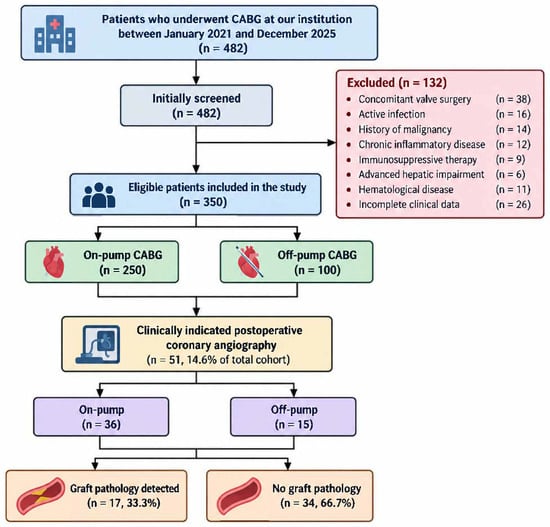
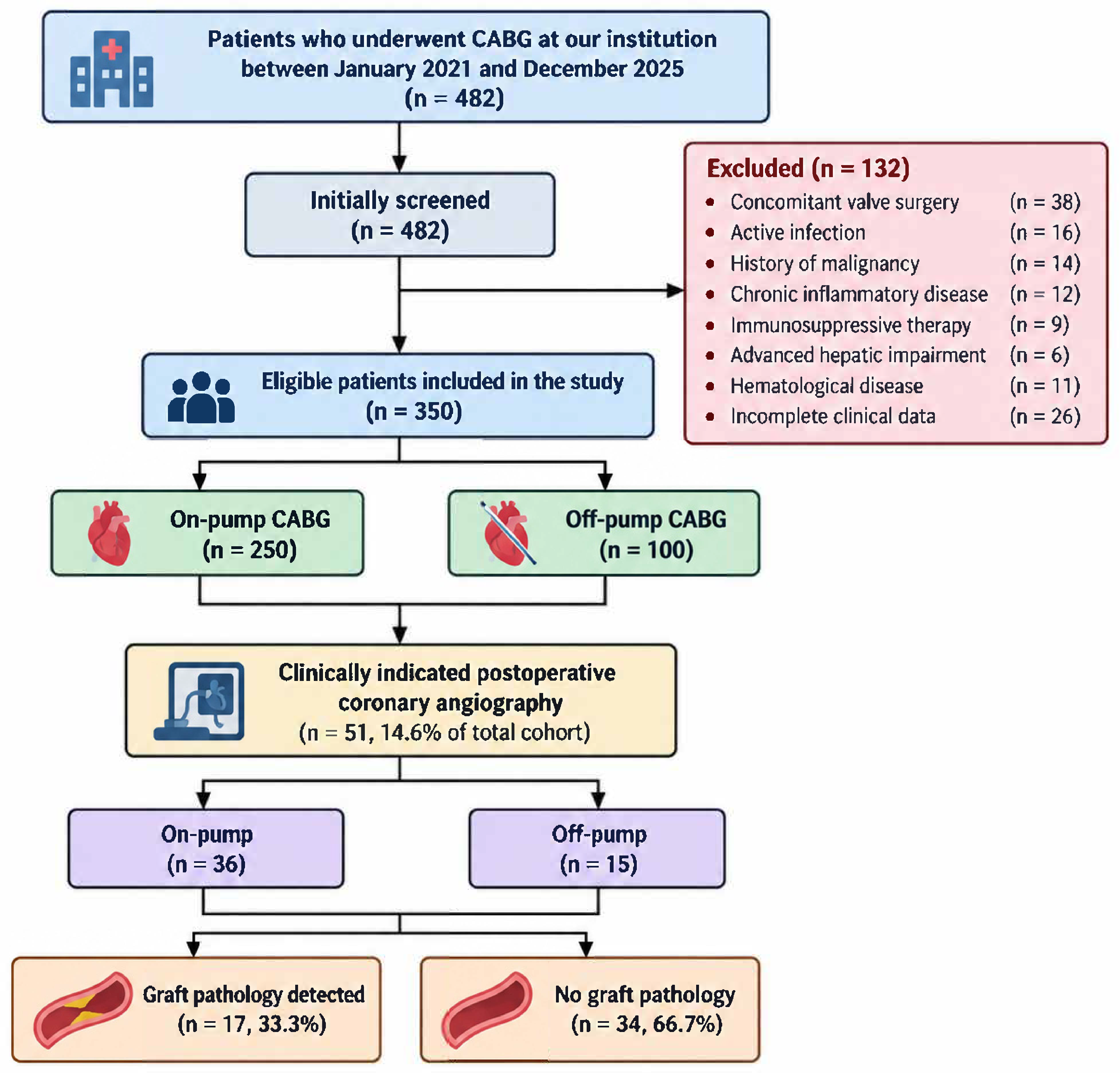
As this was a retrospective observational study, no a priori sample size calculation was performed. All consecutive eligible patients undergoing isolated CABG during the predefined study period were included, resulting in a final study population of 350 patients. 250 patients (71.4%) underwent on-pump CABG with cardiopulmonary bypass, and 100 patients (28.6%) underwent off-pump CABG on a beating heart. The flowchart of the study is shown in Figure 1.
Figure 1.
Flowchart of patient selection and study population. Flowchart illustrating the screening, exclusion, and final inclusion of patients who underwent coronary artery bypass grafting (CABG) surgery. The final study population was evaluated according to perioperative systemic immune-inflammatory biomarkers and early postoperative clinical outcomes and graft patency.
The choice of surgical technique was determined based on coronary anatomy, target vessel characteristics, comorbidities, hemodynamic status, and surgeon experience. Because surgical technique was selected according to these clinical and surgical considerations rather than random allocation, potential confounding by indication was considered in the comparative analyses.
Detailed demographic characteristics, cardiovascular risk factors, preoperative laboratory parameters, echocardiographic findings, and surgical characteristics of all patients were retrospectively evaluated via the electronic hospital record system.
All patients underwent preoperative transthoracic echocardiography. Left ventricular ejection fraction was calculated using the modified Simpson method. Left atrial diameter, pulmonary artery systolic pressure, valve function, and diastolic parameters were evaluated.
In patients undergoing on-pump surgery, aortic and right atrial cannulation was performed after standard median sternotomy. Cardiopulmonary bypass was initiated under mild hypothermia, and myocardial protection was provided with antegrade blood cardioplegia. Distal and proximal anastomoses were completed under cardiac arrest. In patients undergoing off-pump surgery, distal anastomoses were performed on a beating heart using stabilizer systems.
Blood samples were obtained approximately 24 h after surgery to assess the early postoperative systemic inflammatory response. Postoperative day 1 was selected as a standardized and clinically practical early postoperative time point for biomarker assessment. This sampling time was intended to capture early postoperative inflammatory activation and was not considered to represent the absolute peak of postoperative inflammatory response.
Perioperative inflammatory parameters were evaluated preoperatively, at 24 h postoperatively, and at 72 h postoperatively. Complete blood count parameters NLR, PLR, SII, and SIRI were calculated. Serum IL-6 and TNF-α levels were analyzed using the ELISA method. All biochemical analyses were performed in the same central laboratory.
Serum IL-6 concentrations were measured using a commercially available quantitative sandwich ELISA kit (Human IL-6 Quantikine ELISA Kit; R&D Systems, Minneapolis, MN, USA; catalog no. D6050B), according to the manufacturer’s instructions. The assay has a reported analytical range of 3.12–300 pg/mL and a sensitivity of approximately 0.7 pg/mL. According to the manufacturer’s validation data, intra-assay coefficients of variation range from 1.8% to 2.3%, whereas inter-assay coefficients of variation range from 3.8% to 4.3%, depending on analyte concentration. IL-6 concentrations were expressed as pg/mL.
The primary endpoint was defined as a composite early postoperative adverse outcome, consisting of in-hospital mortality, postoperative atrial fibrillation, acute kidney injury, low cardiac output syndrome, prolonged mechanical ventilation (>24 h), or intensive care unit stay exceeding 72 h. Each individual component of the composite endpoint was considered a secondary outcome. Postoperative atrial fibrillation was defined as an atrial fibrillation episode lasting at least 30 s on telemetry monitoring. Acute kidney injury was assessed according to the Kidney Disease Improving Global Outcomes criteria. Low cardiac output syndrome was defined as the persistence of low cardiac output findings despite inotropic support. Patients who underwent coronary angiography because of clinical indications during postoperative follow-up were additionally evaluated for graft pathology. Coronary angiography was performed in the presence of recurrent angina, acute coronary syndrome, a positive non-invasive ischemia test, unexplained left ventricular systolic dysfunction, or ventricular arrhythmia. A total of 51 patients underwent clinically indicated coronary angiography, including 36 patients in the on-pump group and 15 patients in the off-pump group. Graft pathology was classified as critical graft stenosis (≥70%) or total graft occlusion. Coronary angiographic evaluations were performed independently by two experienced interventional cardiologists. Because angiography was not routinely performed in the entire study population, this analysis was considered exploratory and hypothesis-generating.
Statistical analyses were performed using SPSS version 29.0. The distribution of continuous variables was evaluated using the Kolmogorov–Smirnov test. Variables showing normal distribution were expressed as mean ± standard deviation, while variables not showing normal distribution were expressed as median (minimum-maximum). Categorical variables were presented as numbers and percentages. Student t-test, Mann–Whitney U test, and Chi-square test were used for intergroup comparisons. Pearson correlation analysis was used to evaluate the relationships between inflammatory markers. Prognostic performance was assessed using receiver operating characteristic (ROC) analysis. Multivariate logistic regression analysis was performed to identify independent predictors of composite MACE development. Variables considered clinically relevant and/or associated with the composite MACE endpoint in univariable analyses were considered candidate variables for multivariable logistic regression. The final multivariable model included age, diabetes mellitus, surgical technique (on-pump versus off-pump CABG), postoperative SII, and postoperative IL-6. Cardiopulmonary bypass duration was not included in the primary multivariable model because it is not applicable to patients undergoing off-pump CABG. For categorical analyses and Kaplan–Meier survival analysis, postoperative SII and IL-6 were dichotomized according to the optimal cut-off values determined by ROC analysis, which were 1500 for SII and 105 pg/mL for IL-6. Potential multicollinearity between inflammatory biomarkers was assessed using correlation analysis and variance inflation factor (VIF) and tolerance values. Cardiopulmonary bypass duration was considered in relation to the surgical technique and was interpreted as a procedural variable applicable to patients undergoing on-pump CABG. Cox regression analysis was used for graft pathology development. Uncomplicated survival was evaluated using Kaplan–Meier survival analysis. For Kaplan–Meier analysis, patients were categorized into high and low postoperative SII groups according to the ROC-derived cut-off value of approximately 1500. Time-to-event was defined as the time from CABG surgery to the first occurrence of any component of the composite MACE endpoint. Patients who remained free of MACE were censored at 30 days after surgery. Kaplan–Meier curves were compared using the log-rank test. A p-value < 0.05 was considered statistically significant.
3. Results
The mean age of the 350 patients included in the study was 63.8 ± 9.7 years, and 250 (71.4%) of the patients were male. The mean age was 64.2 ± 9.4 years in the on-pump group and 62.9 ± 10.1 years in the off-pump group (p = 0.284). The prevalence of diabetes mellitus was 48.4% and 43%, respectively, the prevalence of hypertension was 69.6% and 65%, and the prevalence of hyperlipidemia was 60.8% and 55%, respectively. No significant differences were observed between the groups in terms of basic cardiovascular risk factors. The demographic, clinical, and echocardiographic characteristics of the patients participating in the study are summarized in Table 1.
Table 1.
Baseline demographic, clinical, and echocardiographic characteristics of the study population.
In the preoperative echocardiographic evaluation, the mean left ventricular ejection fraction was found to be 48.6 ± 8.9% in the on-pump group and 50.1 ± 7.8% in the off-pump group (p = 0.118). No significant differences were found in the left atrial diameter, left ventricular end-diastolic diameter, and pulmonary artery systolic pressure.
When surgical features were evaluated, the mean number of distal anastomoses was found to be 3.4 ± 0.8 in the on-pump group and 2.9 ± 0.7 in the off-pump group (p < 0.001). The mean cardiopulmonary bypass time was 96.8 ± 24.1 min, and the aortic cross-clamp time was 61.5 ± 18.7 min.
A longitudinal analysis using linear mixed-effects models demonstrated significant changes in inflammatory biomarkers over time. The postoperative inflammatory trajectory differed significantly between on-pump and off-pump CABG for SII, IL-6, and TNF-α, as demonstrated by significant time-by-surgical technique interactions (all p < 0.001). The magnitude of postoperative inflammatory activation was consistently greater in the on-pump group. Significant increases were observed in perioperative inflammatory markers in both groups. However, the severity of the inflammatory response was significantly higher in the on-pump group. While no difference was detected in SII levels in the preoperative period, a significant increase was observed in the on-pump group at 24 h postoperatively (1684 ± 542 vs. 1187 ± 436, p < 0.001). Inflammatory activity was also observed to be higher in the on-pump group at 72 h postoperatively (1398 ± 488 vs. 1016 ± 397, p < 0.001). The perioperative inflammatory biomarker profiles are summarized in Table 2.
Table 2.
Perioperative inflammatory biomarkers and related indices according to surgical technique.
The postoperative 24 h IL-6 levels were found to be 118.4 ± 42.7 pg/mL in the on-pump group and 71.6 ± 29.8 pg/mL in the off-pump group (p < 0.001). The TNF-α levels were 38.6 ± 12.1 pg/mL and 24.4 ± 10.7 pg/mL, respectively (p < 0.001). A strong positive correlation was observed between the IL-6 levels and SII (r = 0.68, p < 0.001).
The individual components of MACE were not mutually exclusive, as some patients experienced more than one postoperative complication. Therefore, the sum of individual component events was greater than the total number of patients experiencing the composite MACE endpoint (97 patients). The individual components of MACE were not mutually exclusive, and some patients experienced more than one postoperative event. Therefore, the total number of individual events exceeded the number of patients experiencing the composite MACE endpoint; overall, 97 patients (27.7%) experienced at least one MACE component. Composite MACE occurred in 97 patients (27.7%). The individual components of the composite endpoint were postoperative atrial fibrillation in 61 patients (17.4%), acute kidney injury in 34 patients (9.7%), low cardiac output syndrome in 19 patients (5.4%), and in-hospital mortality in 10 patients (2.8%). Because individual patients could experience more than one component of the composite endpoint, the sum of the individual event counts exceeds the total number of patients with composite MACE. Postoperative inflammatory markers were significantly higher in patients who developed MACE. The postoperative 24 h SII levels were 1912 ± 588 in patients who developed MACE, compared with 1248 ± 447 in patients without MACE (p < 0.001). The IL-6 levels were also significantly higher (139.2 ± 46.1 pg/mL vs. 82.4 ± 34.8 pg/mL, p < 0.001).
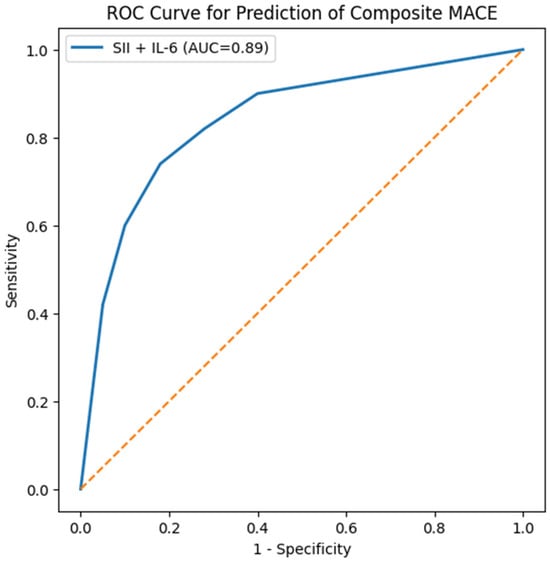
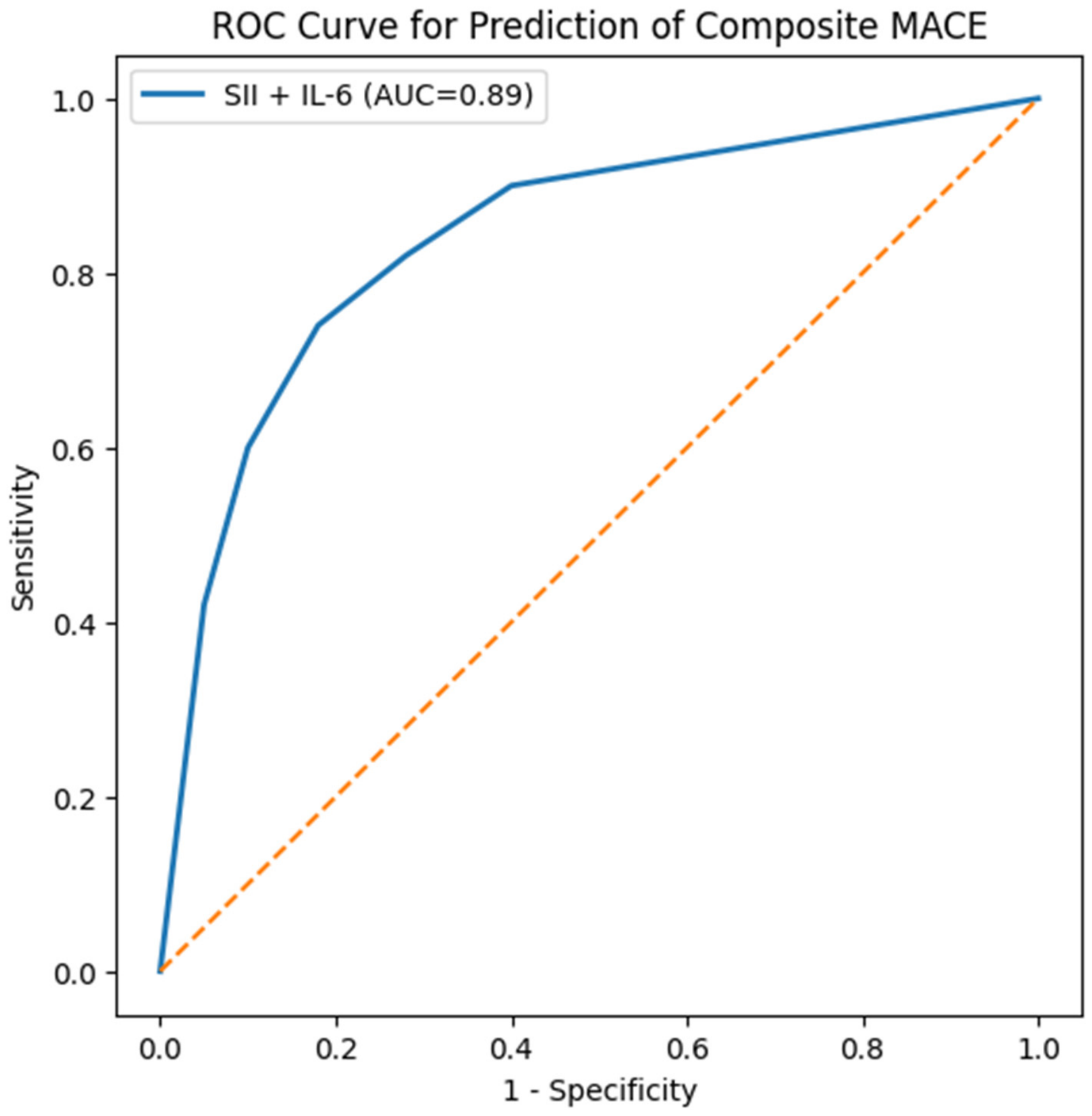
In the ROC analysis, the area under the curve for predicting MACE based on postoperative 24 h SII levels was found to be 0.81 (95% CI: 0.76–0.86, p < 0.001). The AUC value for IL-6 was determined to be 0.84 (95% CI: 0.79–0.88). In ROC analysis, the area under the curve for predicting MACE based on postoperative 24 h SII levels was 0.81 (95% CI: 0.76–0.86, p < 0.001), while the AUC for IL-6 was 0.84 (95% CI: 0.79–0.88). The combined SII and IL-6 model demonstrated a numerically higher discriminatory performance, with an AUC of 0.89 (95% CI: 0.85–0.93, p < 0.001). Because a formal statistical comparison between ROC curves was not performed, the higher AUC of the combined model should be interpreted as descriptive rather than as evidence of a statistically significant improvement. ROC curve analysis is demonstrated in Figure 2.
Figure 2.
Receiver operating characteristic (ROC) curve analysis for prediction of composite MACE. ROC curve demonstrating the predictive performance of postoperative systemic immune-inflammation index (SII) and interleukin-6 (IL-6) levels for composite major adverse cardiovascular events following coronary artery bypass grafting surgery. The combined SII + IL-6 model demonstrated excellent prognostic discrimination (AUC: 0.89).
In multivariate logistic regression analysis, an advanced age, diabetes mellitus, cardiopulmonary bypass time, high postoperative SII level, and high IL-6 level were identified as independent predictors of composite MACE. Independent predictors of composite MACE are presented in Table 3.
Table 3.
Individual components and multivariable logistic regression analysis for the composite early postoperative adverse outcome.
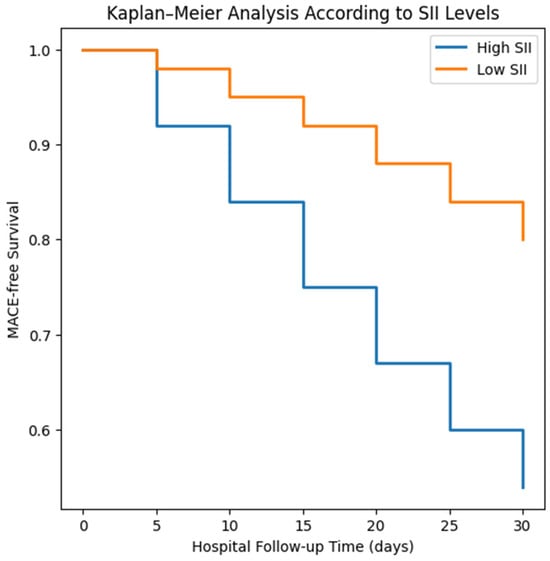
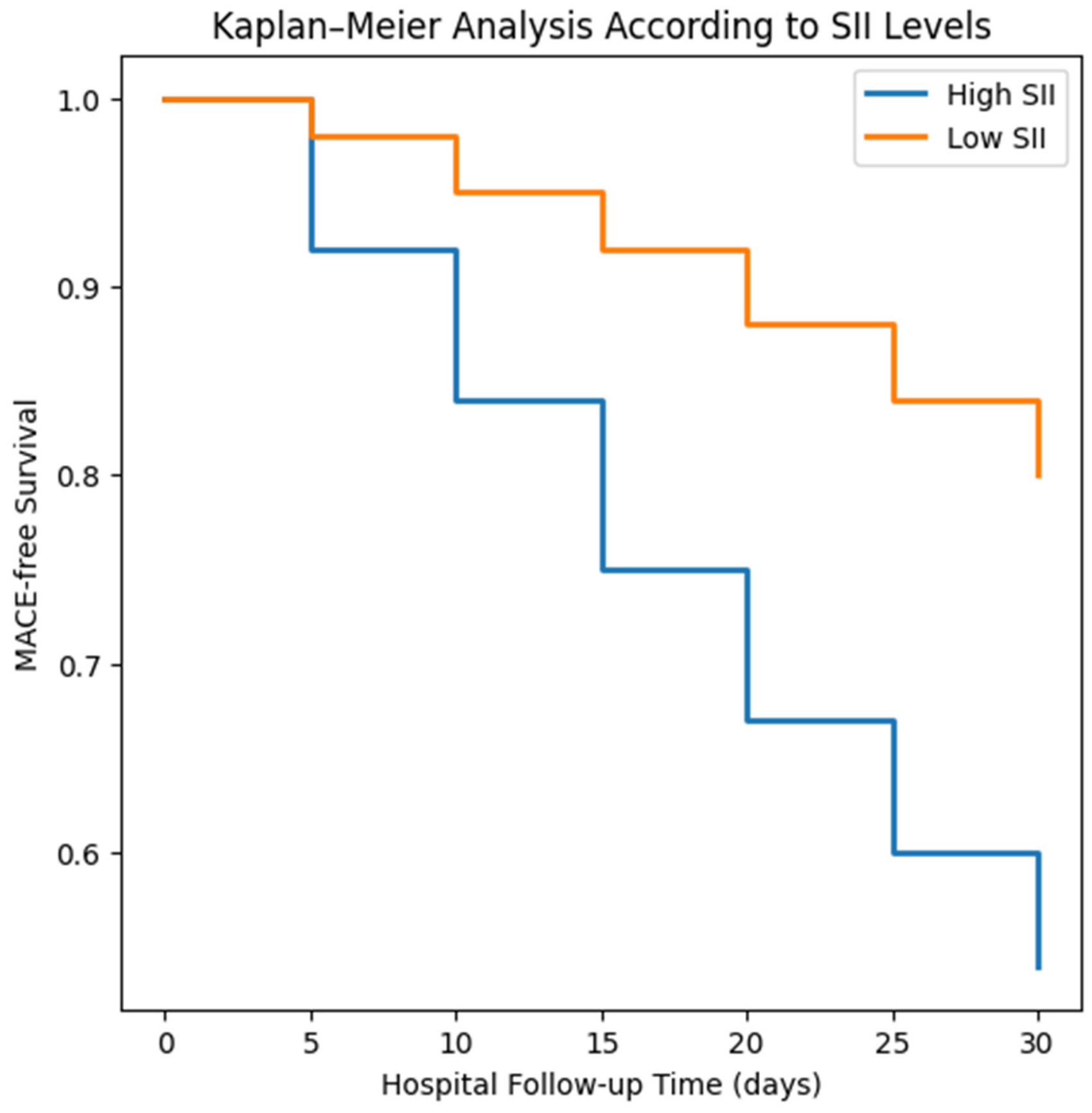
In the Kaplan–Meier analysis, patients were categorized into high and low postoperative SII groups according to the ROC-derived cut-off of approximately 1500. During the 30-day postoperative follow-up, patients with high SII levels had significantly lower MACE-free survival compared with those with lower SII levels (log-rank p < 0.001). Similarly, complication-free survival was significantly lower among patients with higher IL-6 levels. Kaplan–Meier survival curves are shown in Figure 3.
Figure 3.
Kaplan–Meier analysis according to postoperative systemic immune-inflammation index levels. Kaplan–Meier curves demonstrating MACE-free survival according to postoperative systemic immune-inflammation index (SII) levels following coronary artery bypass grafting surgery. Patients with elevated postoperative SII levels had significantly lower event-free survival rates compared with patients with lower SII levels (log-rank p < 0.001).
During the postoperative follow-up, 51 of the 350 patients underwent coronary angiography because of clinical indications. We found that 36 patients were from the on-pump group and 15 from the off-pump group. The mean time to angiography was 14.2 ± 6.1 months. Graft pathology was identified in 17 of these 51 patients (33.3%), including critical graft stenosis in 11 patients and total graft occlusion in 6 patients. Among the 51 patients who underwent clinically indicated coronary angiography, 17 developed angiographically detected graft pathology. In the Cox regression analysis, a higher postoperative SII was associated with graft pathology (HR: 2.14, 95% CI: 1.32–3.47, p = 0.002). Postoperative inflammatory markers were significantly higher among patients with angiographically detected graft pathology. The 24 h postoperative SII level was 2124 ± 603 in patients with graft pathology compared with 1378 ± 492 in those without angiographically detected graft pathology (p < 0.001). In the Cox regression analysis restricted to the patients who underwent coronary angiography, a higher postoperative SII was associated with graft pathology (HR: 2.14, 95% CI: 1.32–3.47, p = 0.002). Given that angiography was performed only when clinically indicated, this analysis should be considered exploratory and hypothesis-generating rather than a systematic assessment of graft patency in the overall cohort.
In the Cox regression analysis, a high postoperative SII level was found to be an independent predictor of graft pathology development (HR: 2.14, 95% CI: 1.32–3.47, p = 0.002).
4. Discussion
The main findings of this study demonstrate that perioperative systemic inflammatory activation following coronary artery bypass grafting (CABG) is associated with early postoperative adverse outcomes and clinically detected graft pathology. We found that patients undergoing on-pump CABG had a greater perioperative inflammatory response than those undergoing off-pump surgery, with more pronounced postoperative increases in systemic inflammatory indices and circulating cytokines. In addition, a higher postoperative systemic immune-inflammation index (SII) and interleukin-6 (IL-6) levels were independently associated with the composite early postoperative adverse outcome. Among patients who underwent clinically indicated coronary angiography, a higher postoperative inflammatory burden was also associated with clinically detected graft pathology. Collectively, these findings suggest that perioperative inflammatory activation may provide clinically relevant prognostic information during the early postoperative period after CABG.
The systemic inflammatory response following cardiac surgery involves complex and multifactorial mechanisms. Surgical trauma, ischemia-reperfusion injury, endothelial activation, oxidative stress, and exposure to cardiopulmonary bypass (CPB) all contribute to the activation of the inflammatory cascade [18]. In particular, the contact of blood with artificial surfaces during CPB promotes complement activation, leukocyte activation, platelet activation, and the release of pro-inflammatory cytokines, including IL-6 and TNF-α [19]. Consistent with these mechanisms, we observed substantially higher postoperative inflammatory marker levels in patients undergoing on-pump CABG, particularly at 24 h after surgery. The concomitant increase in IL-6, TNF-α, and hematological inflammatory indices suggests a coordinated systemic inflammatory response following surgical intervention. The association between SII and cytokine levels further supports the potential of hematological inflammatory indices to reflect broader postoperative inflammatory activation. However, the surgical technique was not randomly assigned and was determined according to the coronary anatomy, target-vessel characteristics, comorbidities, hemodynamic status, and surgeon experience. Therefore, the observed differences between on-pump and off-pump CABG should be interpreted as associations rather than evidence of a causal effect of CPB.
The prognostic significance of postoperative inflammatory biomarkers represents another important finding of our study. SII is a composite hematological index incorporating neutrophil, platelet, and lymphocyte counts and therefore reflects several components of the systemic inflammatory and immune response simultaneously [20]. In our cohort, higher postoperative SII and IL-6 levels were independently associated with the composite early postoperative adverse outcome, supporting their potential value for postoperative risk stratification. We also observed higher inflammatory marker levels among patients who developed postoperative atrial fibrillation (POAF). The relationship between inflammation and POAF is biologically plausible, as inflammatory cytokines may contribute to atrial electrical and structural remodeling through oxidative stress, atrial fibrosis, altered calcium handling, and ion-channel dysfunction [21]. Nevertheless, these findings should be interpreted as prognostic associations rather than evidence that SII or IL-6 directly causes individual postoperative complications.
Another potentially important finding was the association between postoperative inflammatory burden and clinically detected graft pathology. Among the 51 patients who underwent coronary angiography because of clinical indications, those with graft pathology had higher postoperative inflammatory marker levels, and a higher postoperative SII was associated with graft pathology in the regression analysis. These findings may indicate a relationship between systemic inflammatory activation and clinically apparent postoperative graft dysfunction or pathology. However, coronary angiography was not routinely performed in the entire cohort; therefore, our analysis does not represent an assessment of the anatomical graft patency or the overall incidence of graft failure. Rather, it reflects the clinically detected graft pathology in a selected subgroup of patients who underwent angiography. This introduces substantial potential for selection bias and limits the generalizability of the finding. Accordingly, the association between postoperative inflammation and graft pathology should be considered exploratory and hypothesis-generating and requires confirmation in prospective studies with a systematic graft assessment [22].
These findings may have potential clinical implications for early postoperative risk stratification following CABG. The identification of patients with marked postoperative inflammatory activation, particularly elevated SII or IL-6, may help identify individuals who warrant closer clinical surveillance during the early postoperative period. Such patients may potentially benefit from the intensified monitoring of cardiac rhythm, renal function, and hemodynamic status. However, the present findings do not establish that inflammation-guided monitoring or anti-inflammatory treatment improves clinical outcomes. Rather, they support the potential prognostic role of perioperative inflammatory biomarkers and provide a rationale for prospective studies evaluating whether biomarker-guided monitoring or targeted anti-inflammatory strategies can improve outcomes after CABG [23,24,25,26,27].
This study has several limitations. First, its retrospective, single-center design limits the ability to establish causal relationships and introduces the possibility of residual confounding and selection bias. In particular, the choice of on-pump versus off-pump surgery was not randomized, and, therefore, differences in patient characteristics, coronary anatomy, procedural complexity, and surgeon preference may have contributed to the observed differences in inflammatory responses. Second, although the composite early postoperative adverse outcome provides an overall measure of postoperative morbidity, its individual components—including POAF, acute kidney injury, low cardiac output syndrome, prolonged mechanical ventilation, prolonged ICU stay, and in-hospital mortality—are clinically heterogeneous and may be influenced by different perioperative mechanisms. Third, precise event-onset times for individual postoperative complications were not consistently available because of the retrospective nature of the study; consequently, a sensitivity analysis restricted to events occurring ≥24 h after surgery could not be reliably performed. Finally, the graft pathology analysis has important limitations because coronary angiography was performed in only 51 of 350 patients and exclusively according to clinical indications. The 17 cases of graft pathology therefore represent the clinically detected pathology rather than the incidence of graft failure in the overall cohort. This substantially limits generalizability and makes this analysis exploratory. Despite these limitations, the study provides clinically relevant data on the association between perioperative systemic inflammatory activation and early postoperative outcomes after CABG and may provide a basis for future prospective investigations.
5. Conclusions
Systemic immune-inflammatory activation following coronary artery bypass grafting was associated with early major adverse cardiovascular events. In particular, higher postoperative SII and IL-6 levels were independently associated with an increased risk of composite MACE. The inflammatory response was more pronounced among patients undergoing on-pump CABG; however, given the non-randomized selection of surgical technique, these findings should be interpreted as associations rather than evidence of a causal effect of cardiopulmonary bypass. Among the small subgroup of patients who underwent coronary angiography for clinical indications, higher postoperative inflammatory marker levels were associated with angiographically detected graft pathology. Because a graft assessment was not performed systematically in the overall cohort, this finding should be considered exploratory and hypothesis-generating. Postoperative SII, alone or in combination with IL-6, may provide useful prognostic information after CABG. Nevertheless, the retrospective observational design precludes causal inference, and the clinical utility of inflammatory biomarker-guided risk stratification or targeted anti-inflammatory interventions requires confirmation in prospective multicenter studies.
Author Contributions
Conceptualization, C.K., S.G. and F.C.S.; methodology, C.K.; software, C.K. and F.C.S.; validation, C.K.; formal analysis, C.K. and F.C.S.; investigation, C.K. and S.G.; resources, C.K. and F.C.S.; data curation, C.K. and S.G.; writing—original draft, C.K. and F.C.S.; writing—review and editing, C.K. and F.C.S.; visualization, C.K.; supervision, C.K. and S.G.; project administration, C.K. All authors have read and agreed to the published version of the manuscript.
Funding
This research received no external funding.
Institutional Review Board Statement
The study protocol was approved by Afyonkarahisar Health Sciences University Non-Interventional Clinical Research Ethics Committee and was performed in accordance with the principles outlined in the Declaration of Helsinki (Approval Code: 2025/5 and Approval date: 11 April 2025).
Informed Consent Statement
Informed consent was waived by Afyonkarahisar Health Sciences University Non-Interventional Clinical Research Ethics Committee due to the retrospective nature of the study, as no identifiable private information was collected.
Data Availability Statement
The datasets used and/or analyzed during the current study are available from the corresponding author upon reasonable request.
Conflicts of Interest
The authors declare no conflicts of interest.
References
- Roth, G.A.; Mensah, G.A.; Johnson, C.O.; Addolorato, G.; Ammirati, E.; Baddour, L.M.; Beaton, A.Z.; Benjamin, E.J.; Benziger, C.P.; Brauer, M.; et al. Global burden of cardiovascular diseases and risk factors. J. Am. Coll. Cardiol. 2020, 76, 2982–3021, Erratum in J. Am. Coll. Cardiol. 2021, 77, 1958–1959.. [Google Scholar] [CrossRef] [Scilit] [PubMed]
- Neumann, F.J.; Sousa-Uva, M.; Ahlsson, A.; Alfonso, F.; Banning, A.P.; Benedetto, U.; Byrne, R.A.; Collet, J.-P.; Falk, V.; Head, S.J.; et al. 2018 ESC/EACTS Guidelines on myocardial revascularization. Eur. Heart J. 2019, 40, 87–165, Erratum in Eur. Heart J. 2019, 40, 3096.. [Google Scholar] [CrossRef] [Scilit] [PubMed]
- Wan, S.; LeClerc, J.L.; Vincent, J.L. Inflammatory response to cardiopulmonary bypass. Chest 1997, 112, 676–692. [Google Scholar] [CrossRef] [Scilit] [PubMed]
- Paparella, D.; Yau, T.M.; Young, E. Cardiopulmonary bypass induced inflammation. Eur. J. Cardiothorac. Surg. 2002, 21, 232–244. [Google Scholar] [CrossRef] [Scilit] [PubMed]
- Shen, J.; Lall, S.; Zheng, V.; Damiano, R.J., Jr.; Schuessler, R.B. The persistent problem of new-onset postoperative atrial fibrillation. J. Thorac. Cardiovasc. Surg. 2011, 141, 559–570. [Google Scholar] [CrossRef] [Scilit] [PubMed]
- Harada, M.; Van Wagoner, D.R.; Nattel, S. Role of inflammation in atrial fibrillation pathophysiology. Circ. J. 2015, 79, 495–502. [Google Scholar] [CrossRef] [Scilit] [PubMed]
- Rosner, M.H.; Okusa, M.D. Acute kidney injury associated with cardiac surgery. Clin. J. Am. Soc. Nephrol. 2006, 1, 19–32. [Google Scholar] [CrossRef] [Scilit] [PubMed]
- Hu, B.; Yang, X.R.; Xu, Y.; Sun, Y.-F.; Sun, C.; Guo, W.; Zhang, X.; Wang, W.-M.; Qiu, S.-J.; Zhou, J.; et al. Systemic immune-inflammation index predicts prognosis of patients. Clin. Cancer Res. 2014, 20, 6212–6222. [Google Scholar] [CrossRef] [Scilit] [PubMed]
- Yang, Y.L.; Wu, C.H.; Hsu, P.F.; Chen, W.Y.; Lin, L.Y.; Lin, H.F.; Huang, S.S.; Chan, W.L.; Lin, S.J.; Chou, C.Y.; et al. Systemic immune-inflammation index predicts coronary artery disease. Clin. Chim. Acta 2020, 510, 293–297. [Google Scholar]
- Parmana, I.M.A.; Boom, C.E.; Poernomo, H.; Gani, C.; Nugroho, B.; Cintyandy, R.; Sanjaya, L.; Hadinata, Y.; Parna, D.R.; Yulia, M.; et al. High preoperative systemic immune-inflammation index values significantly predicted poor outcomes after on-pump coronary artery bypass surgery. J. Inflamm. Res. 2024, 17, 755–764. [Google Scholar] [CrossRef] [Scilit] [PubMed]
- Bruins, P.; te Velthuis, H.; Yazdanbakhsh, A.P.; Jansen, P.G.M.; van Hardevelt, F.W.J.; de Beaumont, E.M.F.H.; Wildevuur, C.R.H.; Eijsman, L.; Trouwborst, A.; Hack, C.E.; et al. Activation of the complement system during and after cardiopulmonary bypass surgery. Circulation 1997, 96, 3542–3548. [Google Scholar] [CrossRef] [Scilit] [PubMed]
- Day, J.R.; Taylor, K.M. The systemic inflammatory response syndrome and cardiac surgery. Perfusion 1998, 13, 91–107. [Google Scholar]
- Gaudino, M.; Antoniades, C.; Benedetto, U.; Deb, S.; Di Franco, A.; Di Giammarco, G.; Fremes, S.; Glineur, D.; Grau, J.; He, G.-W.; et al. Mechanisms, consequences, and prevention of coronary graft failure. Circulation 2017, 136, 1749–1764. [Google Scholar] [CrossRef] [Scilit] [PubMed]
- Önder, R.; Özçobanoğlu, S.; Gündoğdu, B.P.; Taçkın, V.B.; Kakillioğlu, İ. Association of preoperative and postoperative systemic inflammatory markers with early mortality and morbidity after CABG surgery. J. Cardiothorac. Surg. 2026, 21, 186. [Google Scholar] [CrossRef] [Scilit] [PubMed]
- Selcuk, M.; Cinar, T.; Saylik, F.; Dogan, S.; Selcuk, I.; Orhan, A.L. Predictive value of systemic immune inflammation index for postoperative atrial fibrillation in patients undergoing isolated coronary artery bypass grafting. Medeni. Med. J. 2021, 36, 318–324. [Google Scholar] [CrossRef] [Scilit] [PubMed]
- Topal, D.; Korkmaz, U.T.K.; Velioglu, Y.; Yuksel, A.; Donmez, I.; Uçaroğlu, E.R.; Kayis, S.A. Systemic immune-inflammation index as a novel predictor of atrial fibrillation after off-pump coronary artery bypass grafting. Braz. J. Med. Biol. Res. 2022, 68, 1240–1246. [Google Scholar] [CrossRef] [Scilit] [PubMed]
- Chen, Y.C.; Liu, C.C.; Hsu, H.C.; Hung, K.C.; Chang, Y.J.; Ho, C.N.; Hsing, C.H.; Yiu, C.Y. Systemic immune-inflammation index for predicting postoperative atrial fibrillation following cardiac surgery: A meta-analysis. Front. Cardiovasc. Med. 2024, 11, 1290610. [Google Scholar] [CrossRef] [Scilit] [PubMed]
- Warren, O.J.; Smith, A.J.; Alexiou, C.; Rogers, P.L.B.; Jawad, N.; Vincent, C.; Darzi, A.W.; Athanasiou, T. The inflammatory response to cardiopulmonary bypass. Ann. Thorac. Surg. 2009, 88, S2–S10. [Google Scholar]
- Dey, S.; Kashav, R.; Kohli, J.K.; Magoon, R.; ItiShri; Walian, A.; Grover, V. Systemic immune-inflammation index predicts poor outcome after elective off-pump CABG. J. Cardiothorac. Vasc. Anesth. 2021, 35, 2397–2404. [Google Scholar] [CrossRef] [Scilit] [PubMed]
- Selcuk, M.; Cinar, T.; Keskin, M. Predictive value of systemic immune inflammation index for postoperative atrial fibrillation in isolated CABG. Med. Princ. Pract. 2021, 31, 107–114. [Google Scholar]
- Frangogiannis, N.G. Regulation of the inflammatory response in cardiac repair. Circ. Res. 2012, 110, 159–173. [Google Scholar] [CrossRef] [Scilit] [PubMed]
- Motwani, J.G.; Topol, E.J. Aortocoronary saphenous vein graft disease. Circulation 1998, 97, 916–931. [Google Scholar] [CrossRef] [Scilit] [PubMed]
- Cremer, J.; Martin, M.; Redl, H.; Bahrami, S.; Abraham, C.; Graeter, T.; Haverich, A.; Schlag, G.; Borst, H.-G. Systemic inflammatory response syndrome after cardiac operations. Ann. Thorac. Surg. 1996, 61, 1714–1720. [Google Scholar] [CrossRef] [Scilit] [PubMed]
- Aviles, R.J.; Martin, D.O.; Apperson-Hansen, C.; Houghtaling, P.L.; Rautaharju, P.; Kronmal, R.A.; Tracy, R.P.; Van Wagoner, D.R.; Psaty, B.M.; Lauer, M.S.; et al. Inflammation as a risk factor for atrial fibrillation. Circulation 2003, 108, 3006–3010. [Google Scholar] [CrossRef] [Scilit] [PubMed]
- Hobson, C.E.; Yavas, S.; Segal, M.S.; Schold, J.D.; Tribble, C.G.; Layon, A.J.; Bihorac, A. Acute kidney injury is associated with increased long-term mortality after cardiothoracic surgery. Circulation 2009, 119, 2444–2453. [Google Scholar] [CrossRef] [Scilit] [PubMed]
- Ascione, R.; Lloyd, C.T.; Underwood, M.J.; Lotto, A.A.; Pitsis, A.A.; Angelini, G.D. Inflammatory response after coronary revascularization with or without cardiopulmonary bypass. Ann. Thorac. Surg. 2000, 69, 1198–1204. [Google Scholar] [CrossRef] [Scilit]
- Ridker, P.M.; Everett, B.M.; Thuren, T.; MacFadyen, J.G.; Chang, W.H.; Ballantyne, C.; Fonseca, F.; Nicolau, J.; Koenig, W.; Anker, S.D.; et al. Anti inflammatory therapy with canakinumab for atherosclerotic disease. N. Engl. J. Med. 2017, 377, 1119–1131. [Google Scholar] [PubMed]

Disclaimer/Publisher’s Note: The statements, opinions and data contained in all publications are solely those of the individual author(s) and contributor(s) and not of MDPI and/or the editor(s). MDPI and/or the editor(s) disclaim responsibility for any injury to people or property resulting from any ideas, methods, instructions or products referred to in the content. |
© 2026 by the authors. Licensee MDPI, Basel, Switzerland. This article is an open access article distributed under the terms and conditions of the Creative Commons Attribution (CC BY) license.