


Abstract
Low cholesterol levels have been linked to severe illness, including sepsis. This study evaluated whether early postoperative cholesterol levels are associated with adverse outcomes in patients after elective Coronary Artery Bypass Grafting with extracorporeal circulation. This retrospective single-center study included 3280 adults who had at least one cholesterol measurement within the first five postoperative days. The lowest cholesterol value was analyzed with demographic, comorbidity, intraoperative, and laboratory variables to assess associations with 30-day mortality, cerebrovascular accident, renal replacement therapy, and respiratory dysfunction. ROC analysis with Youden’s Index identified an optimal cut-off, and logistic regression determined independent associations. A cholesterol cut-off of 2.46 mmol/L best stratified 30-day mortality (AUC 0.716; 95% CI 0.657–0.775), with patients below this threshold showing higher mortality (3.9% vs. 1.2%; p < 0.001). Cholesterol < 2.46 mmol/L was independently associated with 30-day mortality (OR 2.759 (1.675–4.544); p < 0.001), cerebrovascular accident (OR 3.661 (1.271–10.540); p = 0.016), renal replacement therapy (OR 4.785 (1.809–12.658); p = 0.002), and respiratory dysfunction (OR 3.039 (1.648–5.602); p < 0.001). Early postoperative hypocholesterolemia shows concurrent associations with adverse outcomes after CABG. Cholesterol levels < 2.46 mmol/L are concurrently associated with higher 30-day mortality.
1. Introduction
Coronary Artery Bypass Grafting (CABG) remains the gold standard for myocardial revascularization in patients with complex multivessel disease [1], yet postoperative outcomes vary widely due to factors such as comorbidities, intraoperative events, and perioperative management [2]. Preoperative prediction of postoperative complications remains a significant challenge. This limitation is clinically relevant because frequent adverse outcomes such as cerebrovascular accident (CVA), renal replacement therapy (RRT), and respiratory dysfunction are established determinants of morbidity, prolonged hospitalization, and 30-day mortality [3,4,5]. Clinical and biochemical risk factors of adverse outcomes have been extensively investigated, with numerous studies examining their associations with events such as 30-day mortality, stroke, renal failure, prolonged ventilation, and hemoglobin levels [6,7,8,9]. Most of the above research has focused on preoperative risk stratification, aiming to identify patients at increased risk of adverse outcomes. While these models support clinical decision-making, they are inherently limited in capturing the dynamic physiological response to surgical stress, which largely determines postoperative recovery. Deterioration of patients still occurs despite acceptable preoperative risk profiles, underscoring the need for postoperative biomarkers that capture the physiological state and facilitate ongoing reassessment.
Cholesterol transport and high-density lipoprotein (HDL) remodeling, for example, link systemic inflammation to cardiovascular complications [10]. In inflammatory conditions such as sepsis, reductions in cholesterol of a comparable magnitude (16–35%) have been documented, likely driven by inflammation-induced alterations in lipid metabolism [11]. Within cardiac surgery, postoperative cholesterol levels were previously evaluated between postoperative days 4 and 7 in a mixed cohort, demonstrating an association between hypocholesterolemia and in-hospital mortality [12]. Although that analysis did not stratify outcomes by surgery type, the findings support a broader link between postoperative hypocholesterolemia and adverse outcomes. Although early postoperative cholesterol dynamics have not yet been systematically examined in relation to postoperative outcomes, the aim of the present study is to determine whether early hypocholesterolemia shows a concurrent association with early postoperative outcomes after CABG.
2. Materials and Methods
2.1. Patients and Methods
Given the retrospective nature of this observational study, the local medical ethics committee approved the study and waived the need for informed consent (nWMO-2020.167). Data were sourced from the patient data management system (HiX™ v6.3 Chipsoft, Amsterdam, The Netherlands) at Catharina Hospital, Eindhoven, The Netherlands. The study included all adult patients who underwent elective isolated CABG with the use of extracorporeal circulation (ECC) between 2010 and 2023. During this period, cholesterol measurement was routinely obtained as part of standard postoperative laboratory assessments. Cholesterol values were interpreted using the institutional reference interval (3.0–5.0 mmol/L), representing the normal physiological range for this assay. For this analysis, we included 3280 patients who were admitted to the Intensive Care Unit (ICU) and had at least one cholesterol measurement recorded during the first five postoperative days. The lowest cholesterol value was defined strictly within the first five postoperative days. When multiple measurements were available, the lowest value within this period was used. The dataset included patient characteristics such as demographic details, comorbidities, and laboratory values. The primary endpoint of this study was 30-day mortality with the secondary endpoints defined as CVA, RRT, and respiratory dysfunction. Thirty-day mortality was ascertained through the hospital electronic medical record system, which automatically updates patient status through national civil registry linkage. This approach ensures complete capture of deaths occurring both during admission and after discharge. To ensure clarity and reproducibility, explicit definitions and observation periods were applied to all secondary endpoints. CVA was defined as a rapidly developing focal or global neurological deficit of vascular origin, lasting ≥24 h or leading to death. Respiratory dysfunction was defined as impaired gas exchange requiring intubation. RRT was defined as initiation of dialysis or continuous therapy due to acute kidney failure. All adverse events were monitored throughout the duration of hospital admission.
2.2. Operative Techniques
Anesthetic management followed standardized institutional protocols, with the primary objective of enabling early extubation. Normothermic and non-pulsatile flow was used to establish ECC. Myocardial arrest was induced and maintained using either cold crystalloid or warm blood cardioplegia, selected at the discretion of the operating surgeon.
2.3. Statistical Analysis
To assess the distributional characteristics of the continuous variables, skewness and kurtosis were analyzed to determine deviations from normality. Variables exhibiting a normal distribution were presented using the mean and standard deviation (SD), and intergroup comparisons were conducted using Student’s t-test. Non-normally distributed variables were described using the median and interquartile range (IQR) (25–75%), with group differences evaluated using the Mann–Whitney U test. Categorical variables were reported as numbers and percentages. The Chi-Square test was applied for categorical comparisons; however, if the minimum expected cell-size assumption was not met, data were analyzed with Fisher’s exact test. First, the previously established cholesterol cut-off of 2.0 mmol/L was tested. Subsequently, the optimal cut-off was determined using Youden’s Index (J = (Sensitivity + Specificity) − 1), followed by Receiver Operating Characteristic (ROC) analysis. These cut-offs were used descriptively to characterize the degree of postoperative cholesterol suppression and were not intended as clinical decision thresholds. To examine associations between variables, binary logistic regression analyses were performed. Each model yielded an odds ratio (OR) with a 95% confidence interval (CI). Independent univariate models were constructed and, subsequently, variables demonstrating statistically significant associations in the univariate analyses were evaluated for multicollinearity. Minimum postoperative cholesterol was analyzed as a continuous variable, with odds ratios representing the change in odds per 1 mmol/L decrease in cholesterol concentration. The EuroSCORE I was not included in the multivariable models because it is a composite measure derived from variables already entered individually. All p-values reported are two-sided, with statistical significance defined as p < 0.05. All analyses were carried out using SPSS version 29 (Chicago, IL, USA).
3. Results
3.1. Patient Population
A total of 9946 elective isolated CABG patients were screened for eligibility. Due to missing postoperative cholesterol measurements or fast track protocols, 6666 patients were excluded from the analysis. Between 2010 and 2023, 3280 patients underwent elective CABG with the use of ECC and were admitted to the ICU. During postoperative days 1–5, cholesterol measurements were obtained in n = 2418 patients on day 1, n = 1354 on day 2, n = 779 on day 3, n = 516 on day 4, and n = 372 on day 5.
3.2. Cholesterol Cut-Off Value Determination for Adverse Outcomes
Analysis of the lowest cholesterol value, used as a continuous variable and recorded during the first five postoperative days after CABG, suggested that the lower cholesterol levels were concurrently associated with 30-day mortality, yielding an AUC of 0.716 (95% CI 0.657–0.775). Using the previously established cut-off of 2.0 mmol/L, sensitivity was 0.866 and specificity 0.392. In this cohort, the cholesterol level corresponding to the strongest association with 30-day mortality was 2.46 mmol/L. In addition, the secondary outcomes demonstrated a consistent pattern in which patients below the specific cholesterol cut-off point exhibited higher frequencies of CVA, RRT, and respiratory dysfunction, as summarized in Table 1.
Table 1.
Cut-off points of the lowest postoperative cholesterol level associated with study endpoints.
3.3. Patient Characteristics
We divided the population into two groups based on the cholesterol threshold corresponding to the strongest association with 30-day mortality. Group 1 included patients with a postoperative cholesterol level of <2.46 mmol/L (n = 1244); and group 2 included patients with a postoperative cholesterol level of ≥2.46 mmol/L (n = 2036). In group 1, there were significantly more males, and patients were significantly older, had a lower BMI, higher prevalence of hypertension and insulin-dependent diabetes, lower prevalence of COPD, and had a lower preoperative hemoglobin level compared to group 2. The log EuroSCORE was significantly lower in group 1 compared to group 2 (Table 2).
Table 2.
Preoperative baseline characteristics.
3.4. Intraoperative Findings and Outcomes
During surgery, patients in group 1 had prolonged ECC and aortic cross-clamp times compared to those in group 2. The 30-day mortality was significantly higher in group 1 compared to group 2 (3.9% versus 1.2%; p < 0.001). Patients in group 1 had significantly higher frequencies of postoperative CVA, need for RRT, and respiratory dysfunction compared to the patients in group 2 (Table 3).
Table 3.
Perioperative and outcome data.
3.5. Cholesterol Cut-Off Value and Adverse Outcomes
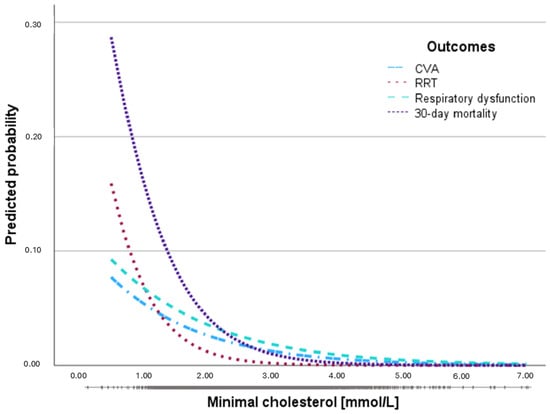
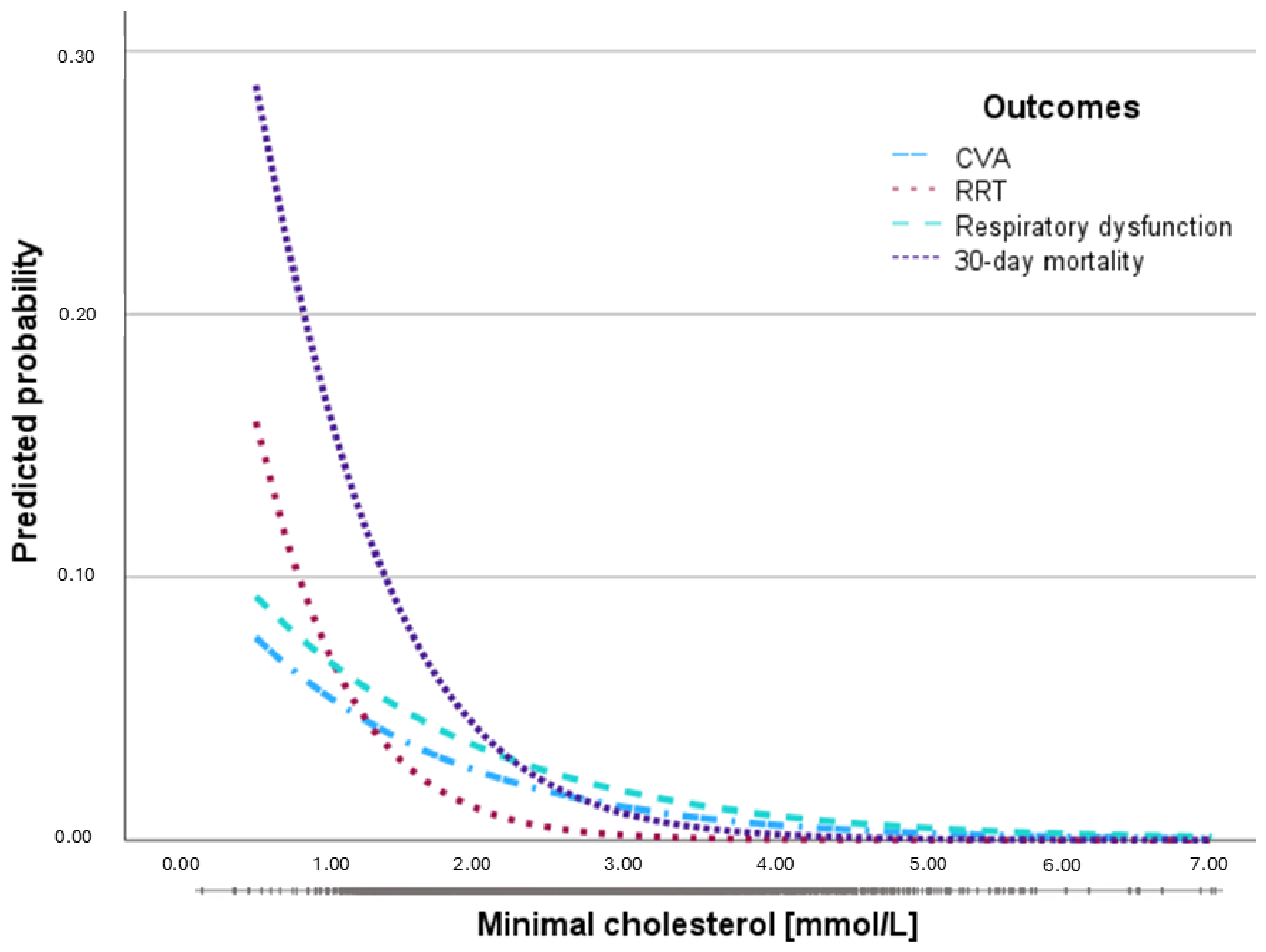
The association between minimum cholesterol levels during the first five postoperative days following CABG and the observed probability of 30-day mortality is presented in Figure 1. Mortality incidence increased significantly when cholesterol levels fell below 2.46 mmol/L. This trend was reflected in clinical outcomes: among a subset of patients with a minimal cholesterol level ≤ 1.0 mmol/L (n = 7), the observed 30-day mortality was 42.9% (n = 3), illustrating the strong concurrent association between extreme hypocholesterolemia and postoperative outcomes in this population.
Figure 1.
The association between minimum cholesterol levels during the first five postoperative days following CABG and the observed probability of adverse events. A rug plot is included along the x axis to illustrate the distribution of individual cholesterol measurements.
3.6. Logistic Regression Analysis
Table 4 shows the results of the logistic regression analyses for the endpoint 30-day mortality. Binary univariate regression analysis demonstrated that the cholesterol cut-off values corresponding to the strongest associations with CVA, RRT, and respiratory dysfunction were each significantly associated with their respective adverse outcomes (all p < 0.001; Supplemental Material Tables S1–S3).
Table 4.
Logistic regression analysis for the endpoint 30-day mortality.
All variables found to be statistically significant in the univariate analysis were subsequently included in the binary multivariate logistic regression model. Minimal cholesterol as a continuous variable during the first five postoperative days following elective CABG was independently associated with 30-day mortality (Table 4). Furthermore, the dichotomized cholesterol cut-off point of 2.46 mmol/L was independently associated with 30-day mortality in the multivariate analysis; patients with the lowest cholesterol level, <2.46 mmol/L, exhibited a 2.7-fold-higher observed frequency of 30-day mortality compared to those with levels ≥ 2.46 mmol/L (p < 0.001).
After adjusting for other independent variables in the multivariate regression analysis, the specific cholesterol cut-off point remained independently associated with CVA, need for RRT, and respiratory dysfunction. A comprehensive overview of these results is provided in Table 5, with the full analysis available in the Supplemental Material Tables S1–S3.
Table 5.
Logistic regression analysis using specific cholesterol cut-off points for other endpoints.
4. Discussion
The lowest cholesterol level within the first five days after CABG was independently associated with 30-day mortality. When an optimized cut-off value was applied for each postoperative adverse outcome, cholesterol was independently associated with 30-day mortality, and the development of CVA, need for RRT, and respiratory dysfunction.
The relevance of postoperative cholesterol suppression extends beyond cardiac surgery. In critically ill populations, cholesterol has been proposed as a potential biomarker associated with adverse outcomes [13]. This association is consistent with studies in both cardiac and general surgical populations, where cholesterol levels have been linked to increased mortality, organ failure, and sepsis. Furthermore, low cholesterol has been associated with prolonged ICU stays, increased susceptibility to infections, and overall adverse clinical outcomes [12,14,15,16]. These findings suggest that cholesterol may serve as an indicator of a patient’s general physiological resilience and functional status [11,15,17,18]. Both in our cohort and in previous studies, the observed reduction in cholesterol levels among non-survivors may be partially explained by the impact of systemic inflammation on lipoprotein and cholesterol metabolism [19]. In patients experiencing systemic inflammatory response syndrome (SIRS) or sepsis after major surgery, decreased levels of both cholesterol and lipoproteins have been correlated with adverse outcomes [17]. This phenomenon is thought to be mediated by proinflammatory cytokines and endotoxins such as lipopolysaccharide, which disrupt lipid homeostasis [20]. Supporting this, a study by Lagrost et al. demonstrated that preoperative cholesterol levels could differentiate patients into groups with different postoperative outcome profiles prior to elective cardiac surgery [21]. Notably, they found that cholesterol levels, both absolute and corrected for hemodilution, remained stable during ECC and at 3 and 24 h postoperatively, suggesting that the observed lipid disturbances are not merely due to hemodilution but may reflect underlying inflammatory processes. In the context of CABG, many patients exhibit a pronounced proinflammatory response, due to factors such as the extracorporeal circulatory circuit, the surgical trauma itself (e.g., post-cardiotomy SIRS), and potential infectious complications [22]. This inflammatory milieu has been linked to alterations in lipid metabolism. These findings collectively underscore the role of cholesterol as a dynamic biomarker associated with the interplay between inflammation and metabolic resilience in surgical patients. Moreover, cholesterol captures a different aspect of postoperative physiology than established markers such as lactate. Whereas lactate reflects acute disturbances in perfusion and oxygenation [23], cholesterol may reflect the aforementioned metabolic and inflammatory status.
Our study builds on this evidence by demonstrating that postoperative cholesterol cut-off values for adverse outcomes within the first five days after CABG are associated with higher observed frequencies of 30-day mortality, CVA, need for RRT, and respiratory dysfunction. The physiological stress response, inflammation, and early complications may themselves depress cholesterol levels, rather than cholesterol driving adverse outcomes. Thus, hypocholesterolemia may be an indicator of concurrent physiological stress rather than a mediator of postoperative risk. Low postoperative cholesterol levels likely reflect broader physiological dysregulation, encompassing impaired metabolic homeostasis, altered immune function, and reduced stress resilience, all of which may contribute to the diverse adverse outcomes observed in surgical patients [24]. Boucher et al. highlights that impaired cholesterol transport and inflammatory remodeling of HDL are mechanistic links between systemic inflammation and cardiovascular complications. This suggests that reduced cholesterol levels may be a consequence of systemic inflammation rather than a direct causal factor in mortality [25]. In contrast, remnant cholesterol, the cholesterol carried in triglyceride-rich lipoproteins, has been shown in chronic cardiovascular disease to be more strongly associated with systemic inflammation and cardiovascular mortality than LDL cholesterol, highlighting its distinct inflammatory profile, even though inflammation mediates only a minor part of the cardiovascular risk attributable to remnant cholesterol [26]. This ambiguity underscores the need for further mechanistic studies to elucidate the role of cholesterol in postoperative pathophysiology.
As such, cholesterol should be interpreted as a complementary biomarker reflecting metabolic and inflammatory status, rather than a replacement for existing markers or preoperative risk models. In this context, the EuroSCORE was not included in our multivariable models because it is a composite score derived from variables already assessed individually. Incorporating the EuroSCORE alongside its constituent factors would introduce collinearity and double adjustment, and therefore the individual risk factors were modeled instead. The observation that the lowest cholesterol value within the first five postoperative days was the strongest associated value does not reflect a formal comparison between individual postoperative days; rather, it acknowledges that the nadir cholesterol level may occur at any point within this period and was therefore used as the operative value.
The discriminative performance of cholesterol varied across outcomes; therefore, the clinical utility of deriving separate cut-off values for each secondary outcome is limited. These thresholds primarily illustrate the direction and relative strength of association rather than serving as actionable or outcome-specific decision points. These associations should therefore be interpreted with caution. Postoperative cholesterol showed variable discriminative performance across outcomes, with stronger associations for complications linked to systemic inflammatory or metabolic stress and weaker associations for outcomes which have multifactorial etiologies. This variability is expected and supports the interpretation of postoperative hypocholesterolemia as a general marker of perioperative physiological stress rather than a complication-specific predictor. Our findings should also be considered in the context of previous work in VA ECMO populations, where lower cholesterol cut-offs were reported [27]. Differences in baseline cholesterol levels, disease severity, and inflammatory burden likely explain these discrepancies and highlight the importance of population-specific thresholds. In a sensitivity analysis of patients with available preoperative cholesterol (n = 263), cholesterol decreased after CABG across all preoperative cholesterol strata (<3.0, 3.0–5.0, and >5.0 mmol/L), indicating that postoperative hypocholesterolemia reflects a uniform physiological response rather than a preoperative lipid phenotype. Postoperative adverse outcomes were comparable across these strata, suggesting that preoperative cholesterol did not identify subgroups with different postoperative risk profiles. Although preoperative statin therapy was unavailable, the absence of outcome differences across preoperative cholesterol groups indicates that missing statin data are unlikely to materially affect the interpretation of our findings.
Clinically, postoperative hypocholesterolemia should be interpreted as an indicator of concurrent physiological stress rather than a therapeutic target. There is currently no evidence to support interventions aimed at increasing cholesterol levels. Instead, low cholesterol levels should prompt careful evaluation for complications such as inflammation, hemodynamic instability, or early organ dysfunction.
Strengths and Limitations
The primary limitation of this study is the retrospective and observational design, which may introduce unknown confounding factors. Because the study groups were defined by postoperative cholesterol levels rather than preoperative characteristics, differences in baseline pathology between groups are expected and reflect underlying variation in physiological resilience rather than selection bias. These preoperative differences should therefore be interpreted as contextual rather than causal. In addition, the absence of preoperative cholesterol measurements limited our ability to distinguish preexisting low cholesterol levels from surgery-induced hypocholesterolemia. Additionally, we acknowledge the possibility of reverse causality and measurement-timing effects, as postoperative complications or early physiological deterioration may themselves depress cholesterol levels, meaning that some measurements may have been obtained after the onset of an adverse event. The study period spanned 13 years, during which perioperative practices may have evolved; although institutional protocols remained largely stable, temporal changes could introduce minor unmeasured variability and should be considered a contextual limitation. We evaluated potential temporal bias across the 2010–2023 inclusion period by adjusting the association between postoperative cholesterol and 30-day mortality for the year of surgery and by testing an interaction term (year * cholesterol < 2.46 mmol/L). Neither adjustment altered the strength of the association, and the interaction was not significant, indicating that temporal changes in surgical practice or laboratory methods did not materially influence the findings. Despite this, multiple strengths mitigate concerns regarding internal validity. The relatively large population enhances statistical power and generalizability, while the structured, protocol-driven environment of a highly efficient cardiothoracic center ensures consistency in clinical practice and data collection. The study focused exclusively on patients undergoing CABG with ECC who were admitted to the ICU, forming a homogeneous cohort that reduces variability. Although preoperative cholesterol measurements were not available, our analysis still captures critical postoperative trends relevant to metabolic and immune responses. Although perioperative protocols were standardized, we cannot assume that unmeasured treatments or patient factors were evenly distributed. Important potential confounders such as preoperative cholesterol levels, statin therapy, inflammatory status, hemodilution, and albumin/nutritional status may have influenced postoperative cholesterol trajectories. As a result, residual confounding cannot be excluded, and the observed associations should be interpreted within this context. However, institutional CABG pathways, postoperative ICU protocols, laboratory methods for cholesterol measurement, and complication definitions remained stable throughout the study period, making substantial temporal drift in postoperative cholesterol trajectories unlikely. Additionally, the model for outcomes with very low event counts, such as RRT, is inherently less stable, and the corresponding estimate should therefore be interpreted with appropriate caution. This analysis was included to provide a complete overview of postoperative associations, but the limited number of events restricts the precision of the effect estimate.
Potential influences such as lipid-lowering medication or propofol use were not specifically accounted for, but are likely evenly distributed due to standardized protocols. As a result, the observed associations are expected to reflect overall physiological response rather than isolated treatment effects. Additionally, the discriminative performance of postoperative cholesterol was limited, as AUC values approximating 0.7 indicate only fair-to-moderate association strength, underscoring that its clinically interpretability should be approached with caution rather than implying predictive capacity.
Finally, the clinical application of cholesterol as an indicator requires careful consideration. While postoperative cholesterol trends may provide insights into inflammatory and metabolic responses, their role in decision-making remains uncertain. Future research should validate the identified cut-offs and explore perioperative lipid profiling including preoperative values and lipoprotein subfractions to clarify mechanistic pathways and determine whether integrating cholesterol measurements into physiological assessment can improve outcomes. Taken together, these strengths support the reliability of our findings and underscore the clinical relevance of postoperative cholesterol monitoring in CABG patients.
5. Conclusions
Early postoperative cholesterol levels may provide insight into the physiological condition of CABG patients during the first postoperative days. In this cohort, the lowest cholesterol level within the first five postoperative days showed concurrent associations with 30-day mortality, CVA, need for RRT, and respiratory dysfunction.
Supplementary Materials
The following supporting information can be downloaded at https://www.mdpi.com/article/10.3390/cardiovascmed29030035/s1, Table S1: Logistic regression analysis for the endpoint cerebral vascular accident; Table S2: Logistic regression analysis for the endpoint renal replacement therapy; Table S3: Logistic regression analysis for the endpoint respiratory dysfunction.
Author Contributions
Conceptualization: M.d.H., E.B., M.A.S.-H., R.B., L.M.M., R.A.B., H.G.K. and F.J.t.W.; Data curation: M.d.H. and E.B.; Formal analysis: M.d.H. and E.B.; Methodology: M.d.H., E.B., R.B., R.A.B., H.G.K. and F.J.t.W.; Supervision: R.B., R.A.B., H.G.K. and F.J.t.W.; Writing—original draft: M.d.H. and E.B.; Writing—review and editing: M.d.H., E.B., F.J.t.W., M.A.S.-H., L.M.M., R.B., R.A.B. and H.G.K. All authors have read and agreed to the published version of the manuscript.
Funding
This research received no external funding.
Institutional Review Board Statement
The present study was submitted for evaluation to the Medical Ethics Committee of the Catharina Hospital, Eindhoven, the Netherlands. In accordance with the ICH-GCP guidelines, the Declaration of Helsinki, and applicable law, a positive vote was given (nWMO-2020.167). All patients were pseudonymized after the establishment of the study population according to the protocol submitted to the Medical Ethics Committee by assignment of a study identification number.
Informed Consent Statement
Given the observational nature of this study, the local medical ethics committee granted approval and waived the requirement for informed consent (nWMO-2020.167).
Data Availability Statement
Data are available upon request from the corresponding author.
Acknowledgments
We would like to express our sincere gratitude to Shrutin Ulman for his thorough review of the English grammar and language of this manuscript. His careful attention and constructive feedback significantly improved the clarity and readability of the final text.
Conflicts of Interest
Rick Bezemer, PhD, is currently employed at Philips.
References
- Virani, S.S.; Newby, L.K.; Arnold, S.V.; Bittner, V.; Brewer, L.C.; Demeter, S.H.; Dixon, D.L.; Fearon, W.F.; Hess, B.; Johnson, H.M.; et al. 2023 AHA/ACC/ACCP/ASPC/NLA/PCNA Guideline for the Management of Patients with Chronic Coronary Disease: A Report of the American Heart Association/American College of Cardiology Joint Committee on Clinical Practice Guidelines. Circulation 2023, 148, e9–e119. [Google Scholar] [CrossRef] [Scilit] [PubMed]
- Madsen, H.J.; Henderson, W.G.; Bronsert, M.R.; Dyas, A.R.; Colborn, K.L.; Lambert-Kerzner, A.; Meguid, R.A. Associations Between Preoperative Risk, Postoperative Complications, and 30-Day Mortality. World J. Surg. 2022, 46, 2365–2376. [Google Scholar] [CrossRef] [Scilit] [PubMed]
- Alexander, J.H.; Smith, P.K. Coronary-Artery Bypass Grafting. N. Engl. J. Med. 2016, 375, e22. [Google Scholar] [CrossRef] [Scilit] [PubMed]
- Alwardt, C.M.; Redford, D.; Larson, D.F. General anesthesia in cardiac surgery: A review of drugs and practices. J. Extra Corpor. Technol. 2005, 37, 227–235. [Google Scholar] [CrossRef] [Scilit]
- Snell, A.; Parizkova, B. Organ damage during cardiopulmonary bypass. In Cardiopulmonary Bypass; Ghosh, S., Falter, F., Cook, D.J., Eds.; Cambridge University Press: Cambridge, UK, 2009; pp. 140–152. [Google Scholar]
- Toumpoulis, I.K.; Anagnostopoulos, C.E.; Balaram, S.K.; Rokkas, C.K.; Swistel, D.G.; Ashton, R.C., Jr.; DeRose, J.J., Jr. Assessment of independent predictors for long-term mortality between women and men after coronary artery bypass grafting: Are women different from men? J. Thorac. Cardiovasc. Surg. 2006, 131, 343–351. [Google Scholar] [CrossRef] [Scilit] [PubMed]
- van Straten, A.H.; Hamad, M.A.; van Zundert, A.J.; Martens, E.J.; Schönberger, J.P.A.M.; de Wolf, A.M. Preoperative hemoglobin level as a predictor of survival after coronary artery bypass grafting: A comparison with the matched general population. Circulation 2009, 120, 118–125. [Google Scholar] [CrossRef] [Scilit] [PubMed]
- van Straten, A.H.; Soliman Hamad, M.A.; van Zundert, A.A.; Martens, E.J.; Schönberger, J.P.A.M.; de Wolf, A.M. Preoperative renal function as a predictor of survival after coronary artery bypass grafting: Comparison with a matched general population. J. Thorac. Cardiovasc. Surg. 2009, 138, 971–976. [Google Scholar] [CrossRef] [Scilit] [PubMed]
- van Straten, A.H.; Bramer, S.; Soliman Hamad, M.A.; van Zundert, A.A.; Martens, E.J.; Schönberger, J.P.; de Wolf, A.M. Effect of body mass index on early and late mortality after coronary artery bypass grafting. Ann. Thorac. Surg. 2010, 89, 30–37. [Google Scholar] [CrossRef] [Scilit] [PubMed]
- Vaisar, T.; Tang, C.; Babenko, I.; Hutchins, P.; Wimberger, J.; Suffredini, A.F.; Heinecke, J.W. Inflammatory remodeling of the HDL proteome impairs cholesterol efflux capacity. J. Lipid Res. 2015, 56, 1519–1530. [Google Scholar] [CrossRef] [Scilit] [PubMed]
- Lekkou, A.; Mouzaki, A.; Siagris, D.; Ravani, I.; Gogos, C.A. Serum lipid profile, cytokine production and clinical outcome in patients with severe sepsis. J. Crit. Care 2014, 29, 723–727. [Google Scholar] [CrossRef] [Scilit] [PubMed]
- Stachon, A.; Boning, A.; Weisser, H.; Laczkovics, A.; Skipka, G.; Krieg, M. Prognostic significance of low serum cholesterol after cardiothoracic surgery. Clin. Chem. 2000, 46, 1153–1157. [Google Scholar] [CrossRef] [Scilit]
- Taylor, R.; Zhang, C.; George, D.; Kotecha, S.; Abdelghaffar, M.; Forster, T.; Santos Rodrigues, P.D.; Reisinger, A.C.; White, D.; Hamilton, F.; et al. Low circulatory levels of total cholesterol, HDL-C and LDL-C are associated with death of patients with sepsis and critical illness: Systematic review, meta-analysis, and perspective of observational studies. eBioMedicine 2024, 100, 104981. [Google Scholar] [CrossRef] [Scilit] [PubMed]
- Black, L.P.; Puskarich, M.A.; Henson, M.; Miller, T.; Reddy, S.T.; Fernandez, R.; Guirgis, F.W. Quantitative and Qualitative Assessments of Cholesterol Association with Bacterial Infection Type in Sepsis and Septic Shock. J. Intensive Care Med. 2021, 36, 808–817. [Google Scholar] [CrossRef] [Scilit] [PubMed]
- Golucci, A.P.B.S.; Marson, F.A.L.; Ribeiro, A.F.; Nogueira, R.J.N. Lipid profile associated with the systemic inflammatory response syndrome and sepsis in critically ill patients. Nutrition 2018, 55–56, 7–14. [Google Scholar] [CrossRef] [Scilit] [PubMed]
- Vyroubala, P.; Chiarlab, C.; Giovanninib, I.; Hysplera, R.; Tichaa, A.; Hrnciarikovaa, D.; Zadak, Z. Hypocholesterolemia in clinically serious conditions—Review. Biomed. Pap. Med. Fac. Univ. Palacky Olomouc Czech Repub. 2008, 152, 181–189. [Google Scholar] [CrossRef] [Scilit] [PubMed]
- Chien, J.Y.; Jerng, J.S.; Yu, C.J.; Yang, P.C. Low serum level of high-density lipoprotein cholesterol is a poor prognostic factor for severe sepsis. Crit. Care Med. 2005, 33, 1688–1693. [Google Scholar] [CrossRef] [Scilit] [PubMed]
- Kreeftenberg, H.G.; Roos, A.N.; Bindels, A.J.G.H.; Scharnhorst, V. Cholesterol in the ICU: A cheap and reliable marker for illness severity? Neth. J. Crit. Care 2015, 20, 17–20. [Google Scholar]
- Khovidhunkit, W.; Memon, R.A.; Feingold, K.R.; Grunfeld, C. Infection and inflammation-induced proatherogenic changes of lipoproteins. J. Infect. Dis. 2000, 181, S462–S472. [Google Scholar] [CrossRef] [Scilit] [PubMed]
- Wendel, M.; Paul, R.; Heller, A.R. Lipoproteins in inflammation and sepsis. II. Clinical aspects. Intensive Care Med. 2007, 33, 25–35. [Google Scholar] [CrossRef] [Scilit] [PubMed]
- Lagrost, L.; Girard, C.; Grosjean, S.; Masson, D.; Deckert, V.; Gautier, T.; Debomy, F.; Vinault, S.; Jeannin, A.; Labbé, J.; et al. Low Preoperative Cholesterol Level Is a Risk Factor of Sepsis and Poor Clinical Outcome in Patients Undergoing Cardiac Surgery with Cardiopulmonary Bypass. Crit. Care Med. 2014, 42, 1065–1073. [Google Scholar] [CrossRef] [Scilit] [PubMed]
- Schulz, C.M.; Pritisanac, A.; Schutz, A.; Kilger, E.; Platzer, H.; Reichart, B.; Wildhirt, S.M. Effects of phospholipid-coated extracorporeal circuits on clinical outcome parameters and systemic inflammatory response in coronary artery bypass graft patients. Heart Surg. Forum 2002, 6, 47–52. [Google Scholar] [CrossRef] [Scilit] [PubMed]
- Haanschoten, M.C.; Kreeftenberg, H.G.; Bouwman, R.A.; Straten, A.H.M.v.; Buhre, W.F.; Soliman-Hamad, M.A. Use of Postoperative Peak Arterial Lactate Level to Predict Outcome After Cardiac Surgery. J. Cardiothorac. Vasc. Anesth. 2017, 31, 45–53. [Google Scholar] [CrossRef] [Scilit] [PubMed]
- Guo, J.; Chen, S.; Zhang, Y.; Liu, J.; Jiang, L.; Hu, L.; Yao, K.; Yu, Y.; Chen, X. Cholesterol metabolism: Physiological regulation and diseases. MedComm 2024, 5, e476. [Google Scholar] [CrossRef] [Scilit] [PubMed]
- Boucher, D.M.; Rochon, V.; Laval, T.; Lorant, V.; Carter, A.; Emerton, C.; Joyce, N.; Vinayak, N.; Scaffidi, M.; Auer, R.C.; et al. Postoperative Stress Accelerates Atherosclerosis through Inflammatory Remodeling of the HDL Proteome and Impaired Reverse Cholesterol Transport. Adv. Sci. 2026, 13, e11121. [Google Scholar] [CrossRef] [Scilit] [PubMed]
- Kraaijenhof, J.M.; Kerkvliet, M.J.; Nurmohamed, N.S.; Grefhorst, A.; Kroon, J.; Wareham, N.J.; Hovingh, G.K.; Stroes, E.S.G.; Boekholdt, S.M.; Reeskamp, L.F. The role of systemic inflammation in remnant cholesterol-associated cardiovascular risk: Insights from the EPIC-Norfolk study. Eur. J. Prev. Cardiol. 2025, 33, 729–739. [Google Scholar] [CrossRef] [Scilit] [PubMed]
- de Haan, M.; Bertjens, E.; Kreeftenberg, H.G.; Soliman-Hamad, M.A.; Bezemer, R.; Bouwman, R.A. Cholesterol levels as a predictive marker for ICU survival in patients with cardiogenic shock supported by VenoArterial ExtraCorporeal membrane oxygenation. Perfusion 2025, 40, 1847–1855. [Google Scholar] [CrossRef] [Scilit] [PubMed]

Disclaimer/Publisher’s Note: The statements, opinions and data contained in all publications are solely those of the individual author(s) and contributor(s) and not of MDPI and/or the editor(s). MDPI and/or the editor(s) disclaim responsibility for any injury to people or property resulting from any ideas, methods, instructions or products referred to in the content. |
© 2026 by the authors. Licensee MDPI, Basel, Switzerland. This article is an open access article distributed under the terms and conditions of the Creative Commons Attribution (CC BY) license.