


Abstract
Direct oral anticoagulants (DOACs) are considered advantageous compared with vitamin K antagonists in eligible atrial fibrillation patients, but the efficacy and the safety of DOACs are not well defined in the morbidly obese population. We report the case of a 59-year-old woman (160 cm, 188 kg, body mass index 73.5 kg/m²) with multiple comorbidities including non-valvular atrial fibrillation, who was anticoagulated with apixaban 5 mg twice a day and who was admitted to our hospital because of acute renal failure. We report changes in apixaban concentrations over the course of management. Apixaban concentrations were quantified using Liquid Anti-Xa HemosIL® Werfen. The table and figure show apixaban concentrations according to therapeutic modifications and renal function. This case illustrates the importance of occasionally measuring the DOAC concentration in the case of intercurrent pathology, in particular acute renal insufficiency, or in the case of topical use of drugs known to interact with DOACs by the oral route. Plasma DOAC measurement would be also interesting in the case of co-medications with an unknown potential for drug interactions. This case also shows an effective and safe anticoagulation by DOAC in a super-obese patient.
Direct oral anticoagulants (DOACs) are considered advantageous compared with vitamin K antagonists in eligible atrial fibrillation patients [1]. The efficacy and the safety of DOACs are not well defined in the morbidly obese population. A recent meta-analysis showed that, compared with warfarin therapy, the use of DOACs was not associated with a higher event rate of stroke or systemic embolism in morbidly obese patients with atrial fibrillation, but with a significantly lower rate of major bleeding [2]. There is very little information on super-obese patients. One case report showed that apixaban concentrations may be within expected on-therapy concentration ranges, but should be used with caution in the course of an of acute illness in super-obese patient [3].
We report on a 59-year-old woman patient (160 cm, 188 kg, body mass index [BMI] 73.5 kg/m²) with a history of arterial hypertension, obesity hypoventilation syndrome, heart failure with preserved ejection fraction, lymphoedema, chronic ulcers, chronic alcoholism partially weaned and atrial disease associated with highgrade conductive disorders treated with a pacemaker, who was admitted to our hospital because of acute renal failure.
Because of her non-valvular atrial fibrillation (CHA2DS-VASCc-Score 3), she was anticoagulated with apixaban 5 mg twice a day. Neither haemorrhagic nor embolic events had occurred during the 4 years of direct oral anticoagulation (weight at the beginning of apixaban was 163 kg, i.e., a BMI of 63 kg/m²).
On admission, creatinine was increased to 256 umol/l, estimated glomerular filtration rate (GFR) 17 ml/min according to CKD-EPI, with a profile of functional acute renal failure. She was suffering from severe undernutrition in the context of biological inflammatory syndrome (albumin 26 g/l, prealbumin 0.15 g/l and C-reactive protein 167.9 mg/l) probably related to the worsening of her chronic ulcers. Cardiac and hepatic function biomarkers were in the normal range (brain natriuretic peptide was normal at 62 pg/ml [<100 pg/ ml] and factor V was normal at 116%). Extensive skin mycosis led to the introduction of econazole powder applied to approximatively 10% of body surface the day after admission.
The wounds evolved favourably with local care without the need for antibiotic therapy and renal function improved with the reduction of the inflammatory syndrome and oral renutrition (fortified meals). Improvement of renal function allowed the reintroduction of furosemide (usual treatment 750 mg per day) to decrease sodium and water retention and the patient lost 9 kg in 10 days in this context of enriched meals (179 kg, BMI 70 kg/m²). No bleeding or embolic events occurred.
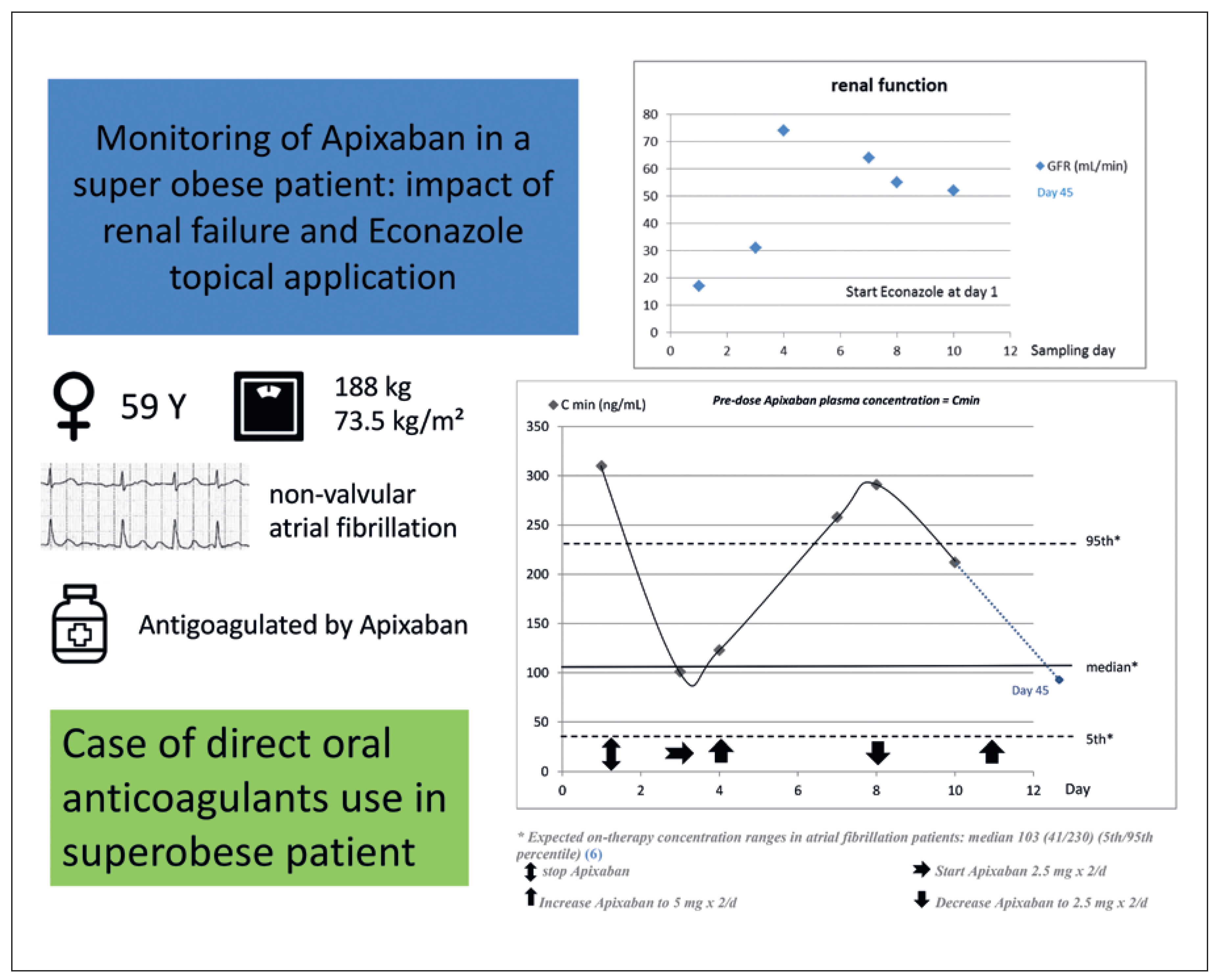
Apixaban was first stopped, owing to the decline in renal function, then restarted, initially at a lower dose, and then at the usual dose with the improvement of renal function. Surprisingly at day 7, apixaban concentration increased although renal function was stabilised and this was confirmed at day 8. Plasma concentrations of apixaban remained high despite a dose reduction from day 8 to 10. An interaction with the topical econazole powder was suspected. It was decided to discharge the patient from hospital. On discharge, we stopped the econazole powder and continued with the normal dose of apixaban. Predose apixaban plasma concentration was in the expected range 1 month later [4]. Econazole was applied for 10 days. Unfortunately, we were unable to perform an econazole assay.
Table 1 and Figure 1 show apixaban concentrations according to therapeutic modifications and renal function. Apixaban concentrations were quantified using Liquid Anti-Xa HemosIL® Werfen.
Table 1.
Evolution of apixaban concentration according to therapeutic modifications and renal function.
Figure 1.
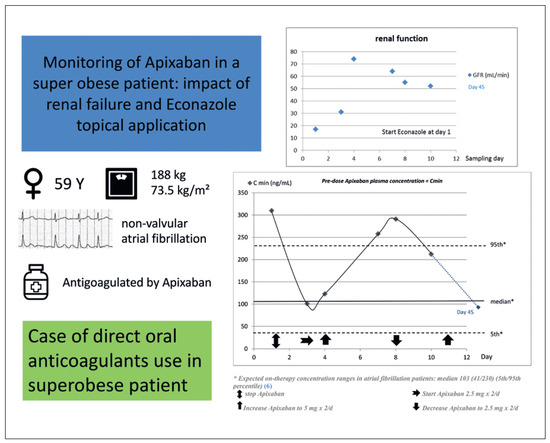
Apixaban concentrations in a super-obese patient with renal failure and treated with topical econazole.
A pharmacological study had previously shown that apixaban exposure was approximately 20% to 30% lower in a population with an average BMI of 42.6 kg/ m2, which the authors considered modest and unlikely to be clinically meaningful [5]. So we used apixaban expected concentration ranges in atrial fibrillation patients reported on summary of product characteristics [6].
The Use of Apixaban is Not Recommended in Patients Receiving Concomitant Systemic Treatment with Strong Inhibitors of Both CYP3A4 and P-Glycoprotein, such as Azole Antimycotics
The use of apixaban is not recommended in patients receiving concomitant systemic treatment with strong inhibitors of both CYP3A4 and P-glycoprotein, such as azole antimycotics [6,7]. Coadministration of apixaban with ketoconazole (400 mg once a day), a strong inhibitor of both CYP3A4 and P-glycoprotein, led to a 2-fold increase in mean apixaban area under the curve (AUC) and a 1.6-fold increase in mean peak apixaban concentrations [8].
Similarly, topical application of econazole has been associated with an increase in the anticoagulant effect of warfarin [9], so topical medication may enter the systemic circulation and cause toxicity. In our case, this hypothesis is supported by the large area of application and the important cutaneous weakness of the patient.
This case illustrates the importance of occasionally measuring the DOAC concentration in the case of intercurrent pathology, in particular acute renal insufficiency, or in the case of using topical drugs known to interact with DOACs when taken by the oral route. Plasma DOAC measurement would be also be interesting in the case of co-medication unknown for drug interaction. This case also shows an effective and safe anticoagulation by DOAC in a super-obese patient.
Acknowledgments
We
would like to thank the Bordeaux University Hospital for allowing this work. We would also like to thank the subject who gave her informed consent for publication.
Conflicts of Interest
No financial support and no other potential conflict of interest relevant to this article was reported.
References
- Kirchhof, P.; Benussi, S.; Kotecha, D.; Ahlsson, A.; Atar, D.; Casadei, B.; ESC Scientific Document Group; et al. 2016 ESC Guidelines for the management of atrial fibrillation developed in collaboration with EACTS. Eur Heart J. 2016, 37, 2893–2962. [Google Scholar] [CrossRef] [Scilit] [PubMed]
- Kido, K.; Shimizu, M.; Shiga, T.; Hashiguchi, M. Meta-Analysis Comparing Direct Oral Anticoagulants Versus Warfarin in Morbidly Obese Patients with Atrial Fibrillation. Am J Cardiol. 2020, 126, 23–28. [Google Scholar] [CrossRef] [Scilit] [PubMed]
- Fietz, C.; Michels, G.; Müller, C.; Wiesen, M.H. Monitoring of Apixaban in a Super Obese Patient. Am J Med. 2019, 132, e15–e16. [Google Scholar] [CrossRef] [Scilit] [PubMed]
- Douxfils, J.; Ageno, W.; Samama, C.M.; Lessire, S.; Ten Cate, H.; Verhamme, P.; et al. Laboratory testing in patients treated with direct oral anticoagulants: a practical guide for clinicians. J Thromb Haemost. 2018, 16, 209–219. [Google Scholar] [CrossRef] [Scilit] [PubMed]
- Upreti, V.V.; Wang, J.; Barrett, Y.C.; Byon, W.; Boyd, R.A.; Pursley, J.; et al. Effect of extremes of body weight on the pharmacokinetics, pharmacodynamics, safety and tolerability of apixaban in healthy subjects. Br J Clin Pharmacol. 2013, 76, 908–916. [Google Scholar] [CrossRef] [Scilit]
- CZARSKA-THORLEY, D. Apixaban Accord [Internet]. European Medicines Agency. 2020. [cité 18 Mars 2021]. Available online: https://www.ema.europa.eu/en/medicines/human/EPAR/apixaban-accord.
- Walenga, J.M.; Adiguzel, C. Drug and dietary interactions of the new and emerging oral anticoagulants. Int J Clin Pract. 2010, 64, 956–967. [Google Scholar] [CrossRef] [Scilit] [PubMed]
- Frost, C.E.; Byon, W.; Song, Y.; Wang, J.; Schuster, A.E.; Boyd, R.A.; et al. Effect of ketoconazole and diltiazem on the pharmacokinetics of apixaban, an oral direct factor Xa inhibitor. Br J Clin Pharmacol. 2015, 79, 838–846. [Google Scholar] [CrossRef] [Scilit] [PubMed]
- Lang, P.G., Jr.; LeClercq, A.H. Increase in anticoagulant effect of warfarin in a patient using econazole cream. J Am Acad Dermatol. 2006, 55 (Suppl. 5), S117–S119. [Google Scholar] [CrossRef] [Scilit]

© 2022 by the authors. Attribution - Non-Commercial - NoDerivatives 4.0.