


Summary
Cardiac hypertrophy is frequently associated with chronic hypertension. This structural change represents an independent risk factor for adverse cardiovascular events, including heart failure. The renin-angiotensin system, via angiotensin II, is one of the main regulators of blood pressure and plays a determinant role in sustaining hypertension. In addition, angiotensin II has been postulated to directly play a role in the development of cardiac hypertrophy via its growth-promoting properties on cardiomyocytes. However, it is still unclear whether the trophic effect of angiotensin II may induce cardiac hypertrophy in absence of hypertension.
In order to investigate whether a local activation of the renin-angiotensin system could trigger cardiac growth independently from haemodynamic changes, we generated transgenic mice overexpressing the angiotensinogen gene specifically in the heart to increase cardiac angiotensin II production. These mice are normotensive and develop myocardial hypertrophy suggesting that local angiotensin II production can mediate a cardiac hypertrophic response in vivo.
Introduction
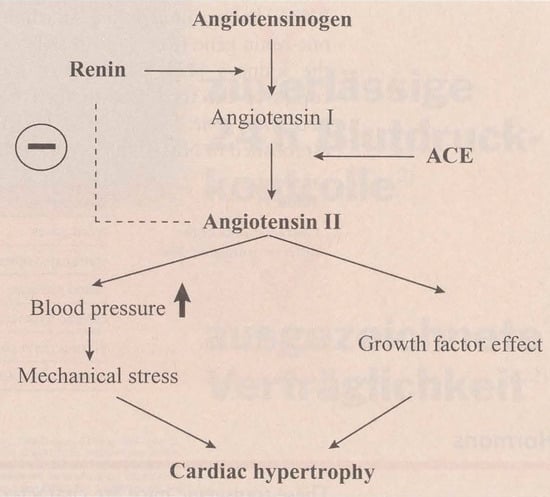
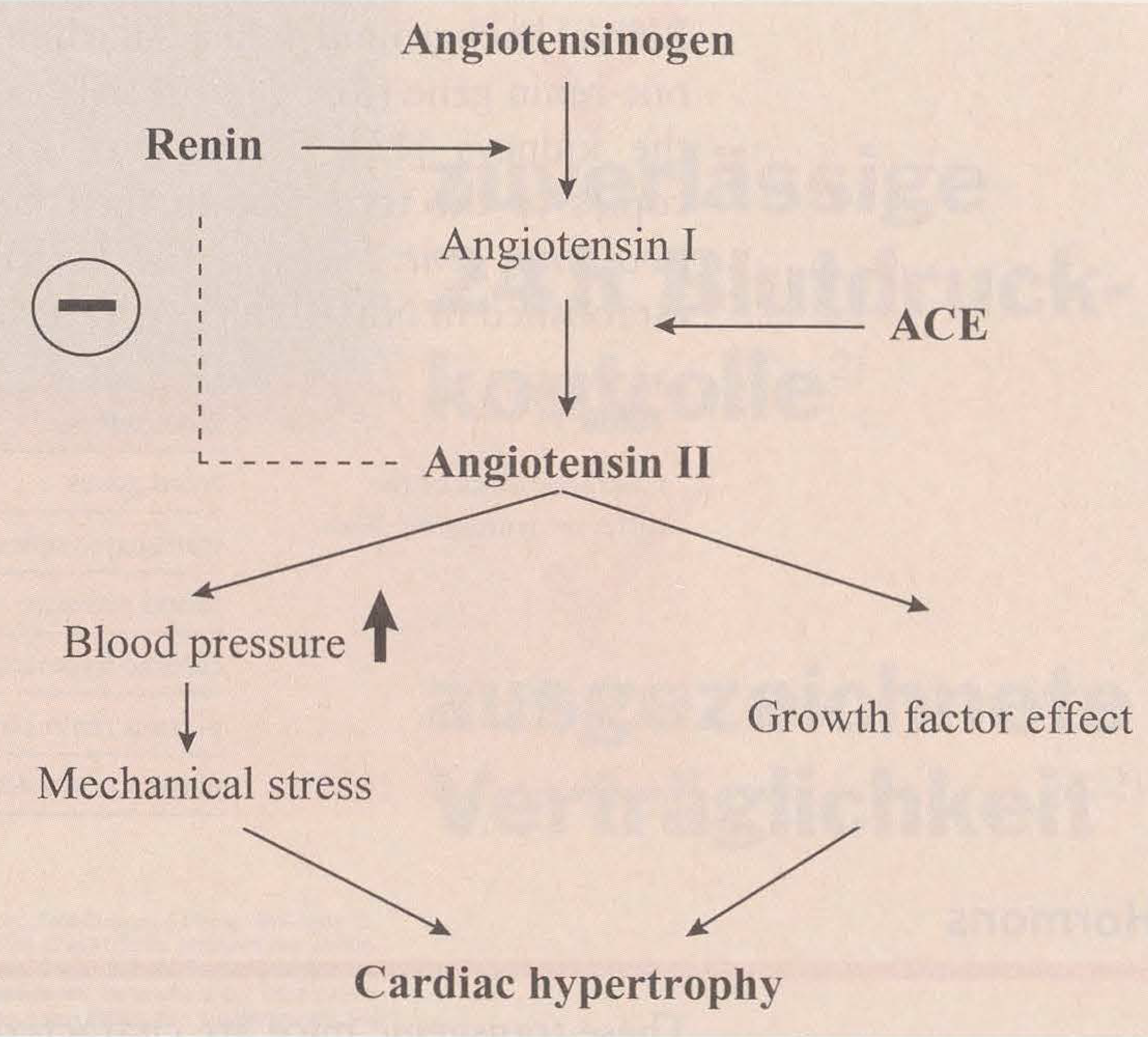
The renin-angiotensin system, and more precisely angiotensin II, is not only pivotal in the regulation of blood pressure, but also plays an important role in the pathogenesis of hyper tension. Indeed, drugs that inhibit angiotensin II production, or its binding to specific receptors, proved to be beneficial in hypertensive patients [1]. Normalisation of blood pressure is usually followed by a regression in cardiac hypertrophy [2]. It is well known that wall stress plays a major role in the development of hy pertrophy, however, indirect evidences also suggest that angiotensin II may contribute to the development of hypertrophy via its growth factor properties (Figure 1) [3,4,5,6,7,8]. Hence, the aim of our recent work [9] was to investigate whether angiotensin II could mediate the development of cardiac hypertrophy independently from hypertension.
Figure 1.
The renin-angiotensin system.
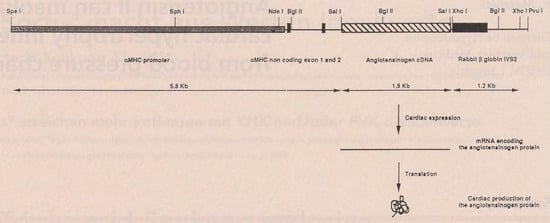
Up to now it has been difficult to study directly the growth effect of angiotensin II in vivo since any manipulation of the renin-angiotensin system tends to cause blood pressure changes. To overcome this problem, we generated transgenic mice with cardiac specific overexpression of the angiotensinogen gene. The cardiac-specific promoter of the a-myosin heavy chain (MHC) gene was used to specifically direct angiotensinogen synthesis in cardiomyocytes (Figure 2) [10,12].
Figure 2.
Schematic representation of the angiotensinogen transgene. Restriction site enzymes and fragment sizes are indicated.
Mice
Three lines of transgenic mice were generated (Table 1): (1) One-renin gene TG153-the TG153 line was produced in a (C57BL/6 × Balb/c) background, which, like humans, carry one-renin gene (Ren-1) primarily expressed in the kidneys [13]. These mice integrated 5 copies of the transgene in their genome; (2) two-renin gene TG101-the TGl0l line was established in NMRI mice, which carry an additional renin gene, Ren-2, mainly expressed in the submaxillary glands [13]. These mice integrated 30 copies of the transgene in their genome; (3) one-renin gene, TG1306-a third transgenic line, named TG1306, was created by crossing TG101 with C57BL/6 mice to generate one-renin gene animals bearing the same copy number of the transgene as TGl0l.
Table 1.
Characteristics of the different transgenic lines.
Hormons
These transgenic mice are characterised by an increased expression of the angiotensinogen gene, exclusively in the heart, which translates in an increased cardiac production of the angiotensinogen protein (Figure 2). An increase in plasma angiotensinogen concentrations, although not significant, was constantly measured in transgenic mice indicating that cardiac angiotensinogen production contributes to plasma levels in these animals.
Plasma renin concentrations are 10 to 25 times higher in two-renin gene animals than those measured in mice carrying a single renin gene. This may be due to renin secretion from the submaxillary glands being under control of different stimuli than those known to stimulate renin release from kidneys [13] and submaxillary renin secretion not suppressed by increas ing angiotensin II levels.
Plasma renin activity was also measured in transgenic mice, since renin activity depends on the level of both renin and angiotensinogen. It was not surprising to observe that transgenic TG153 animals have normal plasma renin activity despite increased plasma angiotensino gen levels. On the contrary, in transgenic TG101 mice, both increases in plasma angiotensinogen and renin leads to elevated plasma renin activity (Table 1). It is likely that in two-renin gene mice, constitutive renin secretion from the submaxillary glands leads to high plasma renin concentration and activity whereas, in one-renin gene animals, the angiotensin II-mediated feedback downregulates renin release from the kidneys and maintains normal plasma renin activity.
Haemodynamic parameters
Blood pressure remains normal in TG153 animals whereas it is elevated in TG101 mice. Hypertension in TGlOl animals correlates with increased plasma renin activity. Transgenic TG1306 mice, carrying the Ren-1 gene only, have normal blood pressure despite that they carry the same transgene copy number as TG101 mice (Table 1). These data suggest that increased plasma angiotensinogen per se is not sufficient to increase blood pressure to pathological values as long as renin secretion is reduced and plasma renin activity remains normal.
Cardiac hypertrophy
The effects of angiotensinogen overexpression on the development of cardiac hypertrophy were investigated. Hypertensive animals from the TG101 line had a significant increase in cardiac mass. In normotensive one-renin gene TG153 mice significant hypertrophy was observed in 20-week-old animals while this was not evident at 8 weeks of age. In contrast, one-renin gene TG1306 mice, carrying a high copy number of the transgene, developed significant hypertrophy already at 8 weeks while maintaining normal blood pressure (table 1). Therefore, the onset of hypertrophy appears to depend on the amount of angiotensinogen produced in the heart. Since normotensive animals with hypertrophy have normal plasma renin activity, these results also indicate that a local increase in angiotensinogen concentration is sufficient to induce a cardiac hypertrophic response.
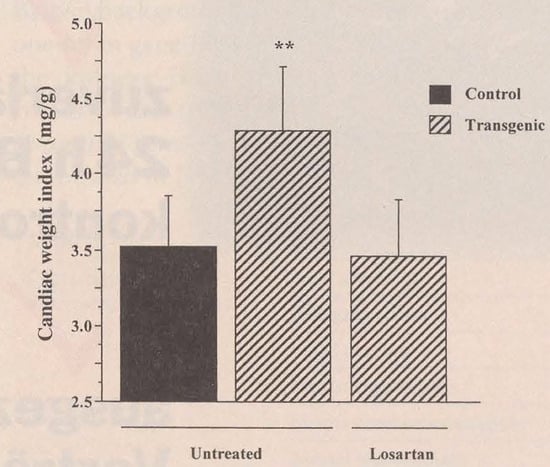
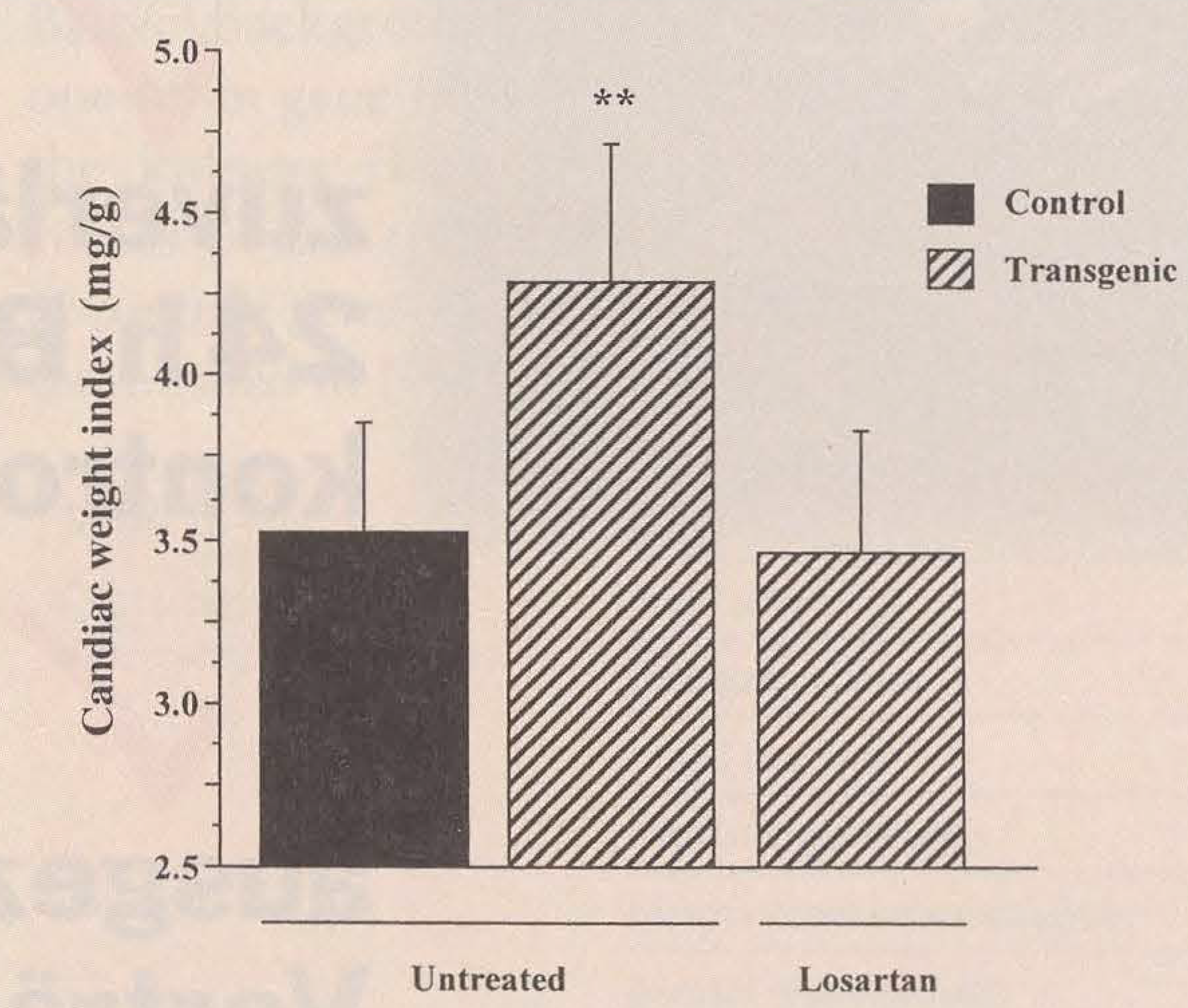
To test whether the development of cardiac hypertrophy was angiotensin II-dependent, transgenic mice from line TG 1306 were treated with an angiotensin II ATl receptor antagonist for 4 weeks. Treatment resulted in regression of cardiac mass to normal values (Figure 3).
Figure 3.
Treatment with an ATl antagonist. Male TG1306 were either treated or not with losartan administered in tap water for 4 weeks. ** p <0.01 as compared to control mice.
Conclusions
Taken together, the results of our in vivo study demonstrate, for the first time, that local pro duction of angiotensin II may contribute to the development of cardiac hypertrophy in vivo, and that the angiotensin II-mediated hypertrophic response can occur in absence of systemic hypertension.
I would like to thank]. Nussberger, T. Pedrazzini, and H.-R. Brunner for continuous support and help.
References
- Reid, A.; Morris, B.J.; Ganong, W.J. The renin-angiotensin sys tem. Ann. Rev. Physiol. 1978, 40, 377. [Google Scholar] [CrossRef] [Scilit] [PubMed]
- Dahlof, J. Effect of angiotensin II blockade on cardiac hypertrophy and remodelling: a review. Hum. Hypertens. 1995, 9, 37. [Google Scholar]
- Baker, M.; Chemin, M.I.; Wixson, S.K.; Acero, J.F. Renin angiotensin system involvement in pressure-overload cardiac hypertrophy in rats. Am. J. Physiol. 1990, 28, 324. [Google Scholar] [CrossRef] [Scilit] [PubMed]
- Baker, M.; Aceto, J.F. Angiorensin II stimulation of protein syn thesis and cell growth in chick heart cells. Am. J. Physiol. 1990, 259, 610. [Google Scholar]
- Kojima, M.; Shoiojima, I.; Yamazaki, T.; Komuro, I.; Zou, Z. An giotensin II receptor antagonist TCV-116 induces regression of hypertensive left ventricular hypertrophy in vivo and in hibits the intracellular signaling pathway of stretch-mediated cardiomyocyte hypertrophy in vitro. Circulation 1989, 89, 2204. [Google Scholar] [CrossRef] [Scilit] [PubMed]
- Ruzicka, M.; Leenen, F.H.H. Relevance of blockade of cardiac and circulatory angiotension converting enzyme for the pre vention of volume overload hypertrophy. Circulation 1995, 91, 16. [Google Scholar] [CrossRef] [Scilit] [PubMed]
- Sadoshima, Izumo S. Molecular characterization of an giotension II-induced hypertrophy of cardiac myocyres and hyperplasie of cardiac fibroblasts: critical role of the AI, re ceptor subtype. Circ. Res. 1993, 73, 413. [Google Scholar] [CrossRef] [Scilit] [PubMed]
- Crawford, C.; Chobanian, A.V.; Brecher, P. Angiotensin lf in duces fibronectin expression associated with cardiac fibrosis in the rat. Circ. Res. 1994, 74, 727. [Google Scholar] [CrossRef] [Scilit] [PubMed]
- Mazzolai, L.; Nussberger, J.; Aubert, J.-F.; Brunner, D.; Gabbiani, G.; Brunner, H.-R. Blood-pressure-independent cardiac hypertrophy induced by locally activated renin-angiotensin system. Hypertension 1998, 31, 1324. [Google Scholar] [CrossRef] [Scilit] [PubMed]
- Gulick, J.; Subramaniam, A.; Neumann, J.; Robbins, J. Isolation and characterisation of the mouse cardiac myosin heavy chain genes. J. Biol. Chem. 1991, 266, 9180. [Google Scholar] [CrossRef] [Scilit] [PubMed]
- Milano, A.; et al. Enhanced myocardial function in transgenic mice overexpressing the beta 2-adrenergic receptor. Science 1994, 264, 582. [Google Scholar] [CrossRef] [Scilit] [PubMed]
- Sigmund, D.; Gross, K.W. Structure, expression, and regulation of rhe nurine renin genes. Hypertension 1991, 18, 446. [Google Scholar] [CrossRef] [Scilit] [PubMed]
- Pedersen, B.; Poulsen, K. Agression-provoked huge release of submaxillary mouse renin to relive. Acta Endocrinol. 1983, 104, 510. [Google Scholar]

Disclaimer/Publisher’s Note: The statements, opinions and data contained in all publications are solely those of the individual author(s) and contributor(s) and not of MDPI and/or the editor(s). MDPI and/or the editor(s) disclaim responsibility for any injury to people or property resulting from any ideas, methods, instructions or products referred to in the content. |
© 1999 by the author. Attribution - Non-Commercial - NoDerivatives 4.0.