


Abstract
Introduction: It is estimated that about 20–35% of the Western population reports symptoms of food intolerances, which is a growing trend. Intolerance to histamine, a dose-dependent, non-allergic food hypersensitivity reaction, despite similar clinical manifestations, has mechanisms distinct from food allergies. Objectives: This narrative review aims to ascertain and synthesize the evidence on the role of nutrition, microbiota modulation, and food supplementation in histamine intolerance. Methods: The search was conducted between September and October 2025 in the PubMed and ScienceDirect databases, using terms related to “histamine intolerance” and considering the last 10 years. 43 scientific articles and 5 additional regulatory and guidance documents were included. Results: The clinical manifestations of histamine intolerance are heterogeneous and complex, and different responses may occur in the same individual with equal doses of histamine. In the literature, intestinal dysbiosis promotes a local and systemic increase in histamine, triggering symptoms in predisposed individuals. The low-histamine diet induced a significant reduction in cutaneous and gastrointestinal symptoms. The literature also shows that diamine oxidase enzyme supplementation is promising in the treatment of migraines and chronic urticaria, contributing to a reduction in the dose and frequency of drugs. In addition, vitamins C and B6, S-adenosylmethionine, and magnesium have been studied in therapy. Conclusions: Histamine intolerance represents a challenge in clinical practice due to its complexity, symptomatologic diversity, and the lack of consensus regarding diagnosis and treatment.
1. Introduction
It is estimated that around 20–35% of the Western population reports symptoms associated with food intolerances, and the trend appears to be increasing [1]. Although clinical manifestations of histamine intolerance (HI) can mimic those of food allergies, such as urticaria, gastrointestinal symptoms, headache, rhinitis, or even anaphylaxis-like symptoms, the two conditions are entirely different entities [2,3]. Food allergies are immune-mediated reactions, through immunoglobulin E or cellular mechanisms, triggered by proteins present in food [4,5]. Although less frequent, these reactions can range from mild symptoms to severe anaphylactic reactions [5]. In contrast, histamine intolerance, a food intolerance, is typically less severe and designated as a non-allergic food hypersensitivity reaction according to the World Allergy Organization and does not involve the immune system [4,6]. Food intolerances frequently follow a dose-dependent pattern and seem to affect women more than men [7]. This difference is often forgotten, leading to misdiagnosis and inadequate management. Moreover, histamine intolerance is often confused with irritable bowel syndrome (IBS) and other functional gastrointestinal disorders like functional dyspepsia and non-celiac gluten sensitivity (NCGS) due to overlapping symptoms [5]. In addition, growing evidence suggests that intestinal dysbiosis plays a central role in the pathophysiology of HIT, with an increase in histamine-producing bacteria and reduced microbial diversity contributing to elevated histamine levels and impaired barrier function [6,8].
Histamine (2-[4-imidazole]-ethylamine) is a bioactive amine that is synthesized from L-histidine (an essential amino acid) through a decarboxylation process by histidine decarboxylase [9,10]. In humans, two main enzymatic pathways of histamine are known: diamine oxidase (DAO) and histamine-N-methyltransferase (HNMT). DAO is a copper, vitamin C, and B6-dependent enzyme encoded by the AOC1 gene, located on chromosome 7 (7q34-36) [11,12,13,14]. It acts in the extracellular space and is found mainly in the intestines, placenta, and kidneys; its action leads to the formation of imidazole acetaldehyde, which is subsequently converted to imidazole acetic acid for excretion. HNMT is a cytosolic enzyme and therefore acts exclusively in the intracellular space; it is expressed in most tissues, particularly in the liver and kidney. Methylation of histamine by HNMT results in N-methylhistamine, which is subsequently degraded by the enzyme monoamine oxidase B (MAOB) [15]. Histamine plays essenti al physiological roles, mainly mediated by binding to four types of receptors (H1, H2, H3, and H4), which activate cells via autocrine or paracrine mechanisms [6,16,17].
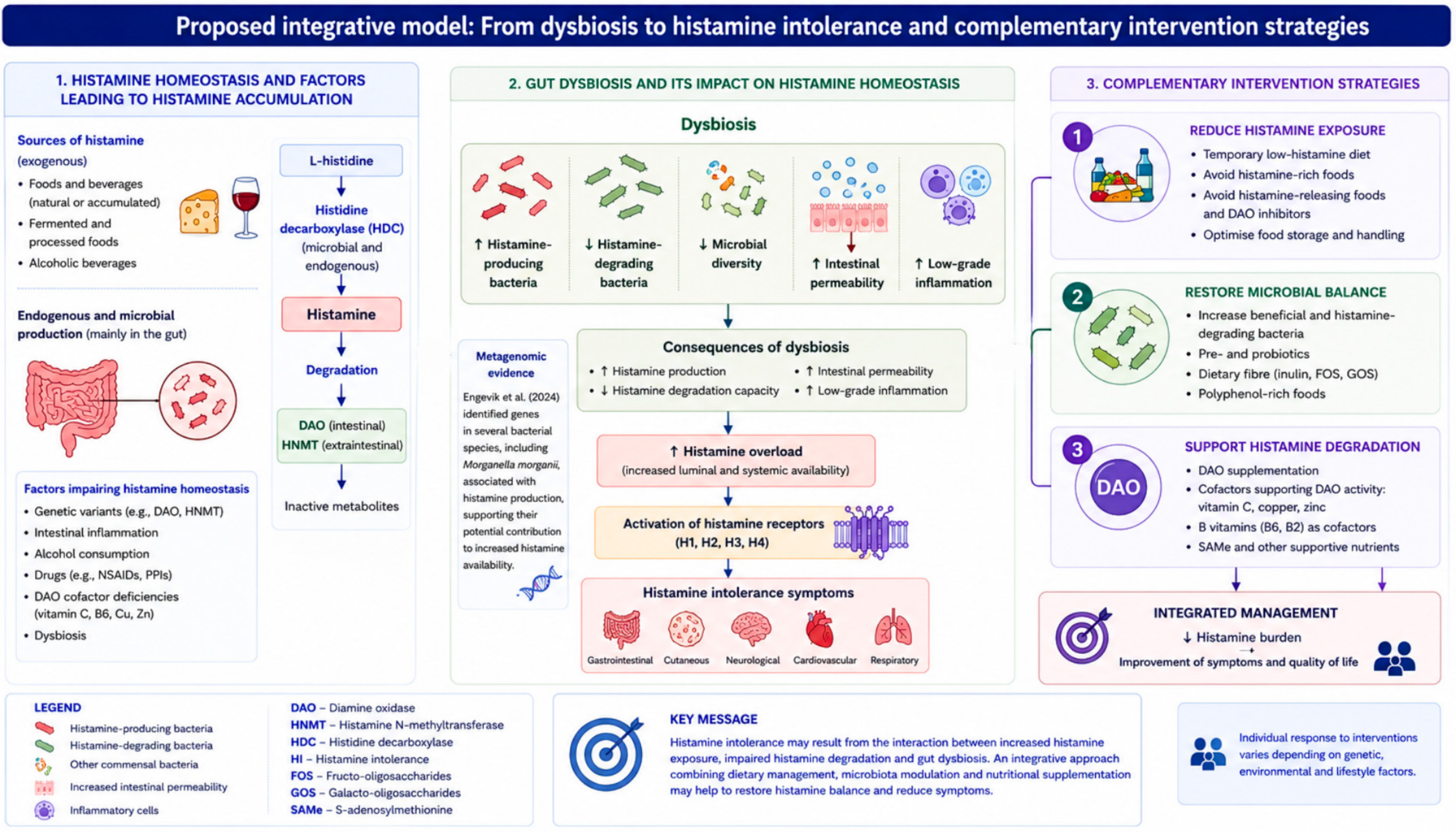
This narrative review aims to examine and synthesize existing research on the role of nutrition and food supplementation, with special emphasis on the clinical application of DAO enzyme supplements and aims to fill the gap between the relationship of gut microbiota dysbiosis and histamine levels. It will also address various diagnostic approaches to raise awareness of this topic among healthcare professionals. Figure 1 summarizes the mechanisms of histamine production, the contributing factors, and the management strategies for histamine intolerance.
Figure 1.
Towards an Integrative Model of Histamine Intolerance: From Increased Histamine Exposure to Complementary Management.
2. Materials and Methods
The bibliographic search for this review was conducted in PubMed (National Library of Medicine, Bethesda, MD, USA) and ScienceDirect (Elsevier B.V., Amsterdam, The Netherlands) between September and October 2025. The keywords “histamine intolerance”, “histamine sensitivity”, and “histamine metabolism disorder” were used together with the Boolean operators AND and OR.
The filters applied in the PubMed database included a time frame corresponding to the last 10 years (2015–2025), human studies involving individuals aged 19 years or older, and the following article types: Books and Documents, Case Reports, Classical Article, Clinical Conference, Clinical Study, Clinical Trial, Clinical Trial Protocol, Consensus Development Conference, NIH, Controlled Clinical Trial, Government Publication, Guideline, Legislation, Observational Study, Practice Guideline, and Randomized Controlled Trial.
However, two included studies employed murine microbiota models as complementary experimental approaches within research that also analyzed microbiota samples from human volunteers. Review articles and studies whose title and/or abstract were not aligned with the topic were also excluded.
Additionally, searches were conducted on the European Union platform EUR-Lex, the European Food Safety Authority (EFSA) website, and the book “Integrative and Functional Medical Nutrition Therapy”.
In total, 43 scientific articles, 3 regulatory guidance documents issued by the European Commission, 1 EFSA opinion, and 1 additional set of guidelines from medical specialty societies were included. All references were managed using EndNote software (Version 21; Clarivate Analytics, Philadelphia, PA, USA).
3. Histamine Intolerance
It is estimated that about 1% of the population is histamine intolerant [6,8,15]. However, its impact may be even greater than current estimates suggest [6,13]. HI arises in the gut, leading to an imbalance between histamine degradation and accumulation [18]. This imbalance may result from reduced activity of the main degrading enzymes—DAO in the extracellular space and HNMT intracellularly—or from excessive histamine production by gut bacteria [8,10,12,19,20]. This may be due to genetic or acquired causes such as certain drugs, alcohol consumption, or deficiencies in cofactors like vitamin B6, vitamin C, copper, and zinc [6,12,20]. Reduced DAO activity has also been observed in conditions such as chronic kidney disease, viral hepatitis, and liver cirrhosis [12]. Several small intestine pathologies, which impair mucosal integrity, result in compromised DAO activity, which correlates with the severity of mucosal destruction. Thus, DAO has been proposed as a biomarker of mucosal integrity [1,21]. Similarly, a dysbiotic gut microbiota can contribute to increased histamine levels [19]. Patients with HI often reveal an overgrowth of histamine-producing bacteria and decreased abundance of beneficial colonies, leading to increased luminal histamine production and impaired gut barrier function [8,19].
More than 50 single nucleotide polymorphisms that affect DAO enzyme activity have been identified [6,20]. These significantly influence DAO expression and activity but on their own may not be sufficient for the development of HI [12].
4. Clinical Manifestations and Diagnosis of Histamine Intolerance
4.1. Signs and Symptoms
Since histamine receptors are ubiquitous in the body, the clinical manifestations are heterogeneous and complex [8]. Substantial inter- and intra-individual variability exists in clinical presentation and intensity. The same individual may tolerate different amounts of histamine on different occasions, depending on factors such as gut microbiota composition, DAO activity at the time, cofactor status, concurrent intake of other biogenic amines, alcohol consumption, and hormonal fluctuations (particularly in women). Sensitivity varies according to the menstrual cycle, being higher in the follicular phase and decreasing in the luteal phase, when DAO levels tend to be higher [12]. During pregnancy, placental DAO production can increase up to 500-fold, which often leads to the temporary disappearance of HI symptoms in pregnant women [15]. These variants explain why identical histamine loads can trigger significantly different patterns of symptoms even in the same person [12,13].
According to the reference [3], gastrointestinal symptoms are the most frequently reported, followed by cutaneous and neurological symptoms, such as headache [3,22].
Table 1 summarizes the symptoms described according to the affected organs and systems.
Table 1.
Main signs and symptoms described, adapted from [2].
4.2. Diagnosis and Complementary Diagnostic Methods
In individuals presenting with nonspecific, non-allergic functional gastrointestinal complaints, the assessment of histamine intolerance should be considered as part of the diagnostic workup [21]. It should also be considered in the evaluation of patients with asthma, chronic urticaria, atopic dermatitis [2,13], fibromyalgia, attention deficit hyperactivity disorder [23], and migraine [22]. The diagnosis is mainly clinical, and a complete anamnesis is essential [2]. In a study by Rentzos et al., where serum DAO concentrations were measured at the baseline and during each phase of the diet (low histamine or mixed), including a control group that followed an unrestricted diet, although a significant reduction in gastrointestinal and cutaneous symptoms was observed, no consistent differences in DAO levels were identified among the different groups studied [13]. Elevated DAO values (above 16 U/mL) may be useful for ruling out HI; low values are relatively common and are not diagnostic [3]. Although a reference range for normal serum DAO has been proposed, clinical monitoring of symptom response to a histamine-restricted diet seems to be more reliable for the existence of HI [22]. Nevertheless, symptom assessment remains subjective, and symptoms are frequently reported in placebo groups [13]. Measurement of decreased urinary metabolite concentration, such as methylhistamine, could be a more objective, reliable, and non-invasive diagnostic biomarker [2].
The oral provocation test, performed in a single-blind, placebo-controlled study, has been proposed as a “gold standard” method for excluding the diagnosis. In individuals who experienced symptoms after histamine administration, such as diarrhea or facial flushing, but not after placebo, the diagnosis could be supported. However, the placebo group had a high rate of reactions (62.7%), which limits the ability to unequivocally confirm hypersensitivity, although the test may help exclude the diagnosis in many patients. Further double-blind, prospective studies with a larger and more diverse sample and a healthy control group are needed for diagnosis accuracy. Greater standardization is also required regarding the dose of histamine administered, diet design, symptom assessment and other complementary diagnostic methods [3].
5. Histamine in Food
Dietary histamine and other amines are present at significant levels in various foods (Table 2). Other biogenic amines, produced by bacterial fermentation, such as cadaverine, tryptamine, tyramine, and serotonin, among others, and/or polyamines (putrescine, spermidine, and others), can also cause adverse reactions by affecting histamine metabolism [18,24]. Foods containing other amines, as well as histamine-releasing foods, are presented in Table 2. Furthermore, the level of histamine in foods naturally increases through storage and cooking methods and varies geographically; therefore, a diet may be low in histamine but is unlikely to be histamine-free [18,25]. The cleanliness of materials and the microbial composition also influence the amount of histamine contained in the food [18]. In general, biogenic amines are thermostable; therefore, if they are already present in the food, heat treatment does not significantly degrade them. However, boiling in water can reduce the content of bioactive amines in certain types of vegetables, probably transferring them from the food to the water [8].
Table 2.
Classification of foods according to their contribution to dietary histamine exposure, reported histamine concentrations, and recommended elimination strategy during a low-histamine diet. Adapted from [8,14,20,26].
According to EFSA, bioactive amines present in food can pose a danger to human life, and it has been suggested that these amines could weaken the protective barrier against dietary histamine [9,15].
Histamine formation in foods depends on the availability of free amino acids, the presence of decarboxylase-producing microorganisms, and environmental conditions that promote microbial growth and enzymatic activity [8]. Free amino acids may be naturally present in food matrices or released during storage and processing through proteolytic reactions [18]. Histamine is generated from the amino acid L-histidine by bacterial or yeast strains possessing histidine decarboxylase activity, which explains why particularly high concentrations are frequently found in fermented and matured products such as aged cheeses, fermented vegetables, alcoholic beverages, and processed meats [8].
In this context, it is important to distinguish between foods that naturally contain histamine as part of their intrinsic composition and those in which histamine accumulates as a consequence of storage, maturation, or fermentation processes [18]. Certain foods, including tomatoes and shrimp, may contain baseline amounts of histamine irrespective of microbial activity. In contrast, fermented, aged, or improperly stored foods can accumulate substantially higher concentrations due to progressive protein degradation. During these processes, proteolysis releases free amino acids, particularly L-histidine, which can subsequently be converted into histamine by microorganisms with decarboxylase activity [8]. As a result, histamine concentrations may increase considerably depending on storage conditions, microbial contamination, and production practices [8].
Overall, current evidence supports reducing the intake of histamine-rich foods as the cornerstone of dietary management in histamine intolerance. However, recommendations regarding other dietary restrictions remain less robust and should be individualized according to clinical response to minimize unnecessary dietary limitations while maintaining nutritional adequacy [8,15].
6. Strategies for Intervention in Histamine Intolerance
6.1. Gut Microbiota and Dysbiosis as Modulatory Factors in Histamine Intolerance
The microbiota is a community of microorganisms, such as bacteria, viruses, and fungi, that cohabit each individual symbiotically. There is no universal eubiosis profile; however, some bacterial groups, such as Clostridiales, Bacteroides, Prevotella, and Bifidobacteria, have been associated with health. Moreover, environmental and lifestyle factors can alter the microbiota throughout the lifespan [27,28].
This community performs several functions, including immunological maturation and synthesis of nutrients, neuroactive molecules, and bioactive metabolites, such as histamine produced via histidine decarboxylation [19,28,29,30].
When dysbiosis occurs, the intestinal environment is imbalanced towards inflammation and the augmentation of intestinal permeability, which facilitates the translocation of pro-inflammatory molecules. This imbalance has been studied and implicated as a potential contributing factor for HI, usually associated with the reduced activity of the DAO enzyme, which may be secondary to the intestinal inflammation [19,31]. Furthermore, intestinal dysbiosis may involve a reduction in beneficial bacterial strains (Akkermansia muciniphila, Limosilactobacillus reuteri), alongside an increase in histamine-producing bacteria (Enterococcus faecalis, Bifidobacterium pseudocatenulatum, Lactobacillus gasseri, Escherichia coli, Morganella morganii and Proteus mirabillis) and a decrease in histamine-degrading bacteria, such as some bacterial strains of Escherichia coli and Klebsiella pneumoniae. These alterations, either isolated or combined, increase both local and systemic histamine, leading to the characteristic symptoms of HI in predisposed individuals [29,32].
From a metagenomic perspective, Engevilk et al. analyzed the genomes of several bacteria and identified genes associated with the production and transport of histamine precursor substrates, confirming the enhanced capacity of bacterial species such as Morganella morganii to produce histamine. Considering that M. morganii is a bacterium associated with the intestinal environment and presents a two-fold superior capacity to produce this molecule when compared to other species, dysbiosis profiles can favor the increased abundance of this bacterium and, consequently, contribute to an elevated histamine production [29].
However, elevated histamine levels may be caused by other factors, including the ingestion of histamine- or histidine-rich foods, which may increase endogenous histamine either by being a source of this molecule or by stimulating its release by granulocytes and mast cells in the intestinal epithelium, acting, therefore, synergistically with dysbiosis and DAO’s reduced activity [32]. It is also important to consider microbial metabolites, such as putrescine and cadaverine, as they can inhibit DAO’s activity, which, in turn, aggravates the symptoms [30].
Having this under consideration, complementary tools have been studied, namely probiotic supplementation. In the study by Di Cesare et al., the authors tested the impact of administering a probiotic containing strains of Lactiplantibacillus plantarum, Lacticaseibacillus rhamnosus, Limosilactobacillus fermentum, and Bifidobacterium longum in two phases over eight weeks. They found suggestive alterations of the improvement of both the microbiota’s composition and richness, as found in the alterations in the urinary and serum microbiota’s metabolites, for example, the reduction in the aminoacidic derivatives, typical of dysbiosis. These alterations were not associated with changes in microbial mass. Additionally, a reduction in histidine utilization and, consequently, in histamine formation and related symptoms was observed [28].
Nevertheless, most studies in the literature are conducted with reduced sample sizes, frequently within specific pathological conditions, such as inflammatory bowel disease, or, conversely, with healthy volunteers or using animal or in vitro models, which limits the extrapolation of results to different contexts. However, even with these limitations, the microbiota and its modulation have emerged as a potential route for the management of HI profiles. Thus, strategies that promote microbial diversity, either by increasing beneficial bacterial strains or limiting the presence of histamine-producing bacterial species, may contribute to a reduction in inflammation and, ultimately, the attenuation of the symptoms associated with HI. The temporary restriction of histamine- and histidine-rich foods and the supplementation with enzymatic cofactors or microbiota regulators are two examples of complementary strategies, with synergistic effects, that may support histamine degradation and help mitigate clinical symptoms.
6.2. Low-Histamine Diet: Principles and Clinical Application
The Low Histamine Diet (LHD) is considered the main therapeutic strategy for histamine intolerance. The response to a low-histamine diet and the reintroduction of histamine-rich foods, in addition to being a basis of clinical evaluation, is also a main form of diagnosis. Its main objective is a controlled reduction in histamine-rich foods that can raise systemic histamine levels [2]. Typically, the LHD is divided into phase 1, in which there is a 2-week dietary restriction of foods rich in histamine and other biogenic amines (Table 2); phase 2 involves the gradual reintroduction of foods excluded in phase 1, taking into account the individual’s food preferences, and an assessment of individual sensitivity to ingested histamine is made; phase 3 is considered the long-term diet, in which individual nutritional recommendations are made based on individual sensitivity to ingested histamine, taking into account exogenous risk factors and quality of life [11]. The LHD should exclude several foods based on their histamine content. In Table 2, we present a list of foods that are most frequently recommended to be excluded in the LHD. The elimination diet should also include the exclusion of foods suspected of triggering histamine release and also foods rich in other biogenic amines, since these act as competitive substrates for the DAO enzyme, compromising its ability to degrade histamine and, consequently, the effectiveness of the intestinal barrier (Table 2) [2].
The rationale for the LHD is supported by the considerable variability in histamine concentrations among foods and the mechanisms underlying its formation and accumulation [8]. While some foods naturally contain histamine as part of their intrinsic composition, others may develop substantially higher concentrations during storage, maturation, fermentation, or inadequate handling due to microbial decarboxylation of L-histidine [8]. Consequently, exposure to dietary histamine is influenced not only by food selection but also by factors such as freshness, processing methods, storage conditions, and microbial contamination [18]. This variability, together with the potential contribution of other biogenic amines that may interfere with histamine degradation, reinforces the need for an individualized dietary approach aimed at reducing the overall histamine burden while identifying each patient’s specific tolerance threshold.
From a clinical perspective, the LHD should be implemented as a structured elimination–reintroduction strategy following a comprehensive clinical assessment and the exclusion of alternative diagnoses [11]. Rather than constituting a permanent restrictive diet, its primary purpose is to evaluate the relationship between dietary histamine exposure and symptom occurrence, allowing the identification of each patient’s individual tolerance threshold [11]. Consequently, dietary management should be individualized and supervised by a qualified healthcare professional to ensure nutritional adequacy while minimizing unnecessary dietary restrictions [2].
Effects, Therapeutic Applications, and Limitations of LHD
Considering the available clinical evidence, adherence to an LHD has been reported as effective in reducing gastrointestinal, dermatological, and ear, nose, and throat symptoms [13,33,34,35,36]. A compilation of studies involving the application of LHD is presented in Table 3. LHD induced a significant reduction in cutaneous (urticaria, pruritus) and gastrointestinal symptoms compared to mixed diets [13]. In patients with Chronic Spontaneous Urticaria, LHD resulted in symptomatic improvement in 75% of individuals, with a reduction in the Urticaria Activity Score and improved quality of life [33]. A significant reduction in plasma histamine levels was observed after four weeks of LHD in patients with chronic urticaria, indicating that plasma histamine levels may be diet-dependent in these individuals [34]. In a case report, adherence to LHD significantly improved cough and throat clearing symptoms in a patient with persistent laryngopharyngeal reflux, with the Reflux Finding Score improving from 11 to 6 [36].
Table 3.
Studies evaluating the efficacy of Low-Histamine Diet (LHD) and Diamine Oxidase (DAO) supplementation in histamine intolerance.
Despite the symptomatic benefits, LHD presents challenges and limitations to be considered. Among them are inconsistencies in serum DAO, symptomatic variability, and risks of long-term restriction. In the case of inconsistency in serum DAO, it was found that in prospective and crossover clinical trials, short-term LHD did not show a significant ability to alter or raise serum DAO levels, so this measurement is considered inconclusive as a diagnostic tool or biomarker of dietary fluctuations [13]. However, in retrospective studies, it was found that strict and long-term adherence to LHD may correlate with an increase in serum DAO values, although the data are inconsistent [34]. In individuals with HI, there were no significant differences in headache severity between the LHD period and the mixed diet, reflecting symptomatic variability [13].
However, the strength of this evidence is tempered by substantial methodological limitations, including small sample sizes, a reliance on retrospective data, and the absence of standardized food lists, which complicates cross-study comparisons. In addition, the clinical utility of serum DAO as a biomarker for monitoring dietary response remains uncertain, reflecting the broader lack of validated diagnostic tools for histamine intolerance [13,35]. Furthermore, the lack of long-term randomized controlled trials leaves the optimal duration and the physiological impact of prolonged restriction largely unknown. In fact, prolonged dietary restriction, complexity and lack of concrete food lists can lead to risks including malnutrition, social isolation and a propensity for unbalanced eating patterns [26]. The long-term goal of dietary management is therefore to identify each individual’s tolerance threshold and establish the least restrictive dietary pattern capable of controlling symptoms while maintaining nutritional adequacy and quality of life. Future research should prioritize large-scale, placebo-controlled provocation studies and the development of validated diagnostic tools to establish clear tolerance thresholds.
6.3. Role of Supplementation
6.3.1. Oral DAO Supplementation: Forms and Clinical Evidence
Currently, there are two types of DAO food supplements on the market: animal-based and plant-based. Animal-based products, which are more widely marketed, contain a protein extract obtained from pig kidneys, approved as a novel food under Commission Implementing Regulation (EU) 2017/2470 [39]. The maximum authorized amount of this extract is 12.6 mg with 7% DAO per day, 0.9 mg of DAO in total. This means that, to avoid exceeding the maximum permitted dose, the recommended dosage is 4.2 mg of porcine kidney protein extract with 0.3 mg of DAO per dose, administered three times a day [39,40,41].
Initially, Commission Implementing Regulation (EU) 2018/1023 only authorized the use of porcine kidney protein extract as a Food Supplement (FS) in the form of enteric-coated, encapsulated micro pellets [41]. Subsequently, Commission Implementing Regulation (EU) 2024/2048 amended this condition, establishing that the safety and efficacy of DAO supplements should be based on the amount of enzyme, regardless of the pharmaceutical form used [40].
Plant-based DAO supplements have been more recently introduced to the market and contain legume sprouts, especially green peas (Pisum sativum) [2].
As shown in Table 3, Refs. [22] and [38] used DAO enzyme in capsules, whereas Ref. [2] used tablets. In all three studies, DAO enzyme of animal origin was used; however, Ref. [2] also used DAO of plant origin, at doses of 4.2 and 8.4 mg per tablet [2,22,38].
According to the studies mentioned, food supplements with DAO show promise in the treatment of symptoms associated with HI, especially in cases of migraine and chronic urticaria. In addition, DAO supplementation may help reduce the dose and frequency of medications such as triptans and antihistamines. DAO food supplement is safe and well tolerated, with no significant reports of adverse effects [22,38]. However, these results should be interpreted with caution, given that the current scientific evidence is still limited. Larger randomized controlled trials with standardized methodologies are required to confirm the clinical effectiveness of DAO supplementation, determine the optimal dosage, and compare the effectiveness of supplements derived from different sources, thereby supporting a more evidence-based application of this strategy in the management of HI.
6.3.2. Other Food Supplements in the Therapy of HI
Scientific evidence on food supplementation as an adjunct therapy for histamine intolerance is limited [8]. The most frequently reported supplements include vitamin C, vitamin B6, copper and zinc, as they may support histamine degradation and increase DAO [6,20]. Supplementation with probiotics has been proposed as a strategy to modulate the gut microbiota by reducing the production of the microbial enzyme L-histidine decarboxylase, i.e., by administering strains that do not produce this enzyme and, ideally, can simultaneously degrade histamine [8]. Positive effects have been reported with pancreatic enzyme supplementation, particularly in controlling gastrointestinal symptoms [20].
At the intracellular level, histamine is degraded by HNMT, which is predominantly expressed in the liver. Individuals with genetic variations that reduce HNMT activity may benefit from additional cofactor support to enhance this pathway. S-adenosylmethionine (SAMe) plays a key role in this process, as HNMT uses SAMe to convert histamine into N-methylhistamine, which is subsequently further degraded by MAOB.
If MAO-B activity is impaired due to insufficient cofactors or genetic polymorphisms, the degradation rate may decrease, potentially leading to histamine accumulation. In this context, riboflavin plays an important role, as it acts as a cofactor for MAO-B and supports the proper functioning of this enzymatic pathway.
Additionally, magnesium supplementation appears to exert protective effects by inducing relaxation of bronchial smooth muscle, reducing the histamine response through its anti-inflammatory effect, and decreasing susceptibility to developing anaphylactic reactions [42]. Current evidence suggests that food supplementation may represent a promising adjunct to dietary management of histamine intolerance [6,20]. However, clinical recommendations remain constrained by the limited number of high-quality intervention studies. Most proposed supplements are supported primarily by mechanistic evidence, with few trials specifically evaluating their effectiveness in patients with histamine intolerance. Therefore, further evidence is needed to validate the benefit, safety, and potential synergy of supplementation in the management of histamine intolerance, thereby supporting its integration into clinical practice.
Histamine intolerance (HI) is associated with an increase in histamine concentration that can result from two main sources: microbial dysbiosis, through alterations in histamine-producing and histamine-degrading bacterial strains or in overall microbial diversity, and dietary exposure, through the ingestion of histamine-rich foods, foods that potentiate histamine release, or histamine formed in food as a result of improper handling. Accordingly, complementary management strategies—including microbial modulation, dietary supplementation, and good food handling and culinary practices—may prevent or reduce this excess exposure and thereby alleviate the symptoms characteristic of HI.
7. Conclusions
HI represents a clinical challenge due to its complex nature, the diversity and non-specificity of signs and symptoms, and the lack of a validated diagnostic test and optimal management strategies [10,43]. Although genetic polymorphisms influence DAO enzyme expression, clinical heterogeneity also depends on environmental and nutritional factors, such as the histamine content in foods [12,18], and the microbiota modulation.
Unlike previous reviews, which have primarily addressed the pathophysiology or dietary management of histamine intolerance separately, this review critically examines how alterations in gut microbiota, histamine metabolism, and nutritional interventions—including DAO and other food supplement strategies—interact in the pathophysiology and management of this condition. By integrating these dimensions within a single framework, this review offers a broader and more comprehensive understanding of histamine intolerance as a multifactorial condition. Nevertheless, the available evidence remains limited by methodological heterogeneity, small sample sizes, and the lack of standardized diagnostic criteria. By identifying current evidence, limitations, and knowledge gaps, this review provides an updated foundation to support future research and a more personalized approach to clinical management.
In conclusion, HI is a multifactorial condition in which genetic susceptibility, gut microbiota, and dietary factors interact to influence symptom development. Current evidence supports a personalized nutritional approach, with a low-histamine diet remaining the cornerstone of management, while gut microbiota modulation and targeted supplementation may represent promising adjunctive strategies.
8. Future Perspectives
Future research should therefore focus on validating reliable biomarkers, establishing internationally accepted diagnostic criteria, clarifying the interplay between gut microbiota and histamine metabolism, and conducting well-designed randomized controlled trials to determine the efficacy of dietary and nutraceutical interventions and to support evidence-based, personalized management of histamine intolerance.
A future multidisciplinary approach becomes fundamental to ensure a more accurate diagnosis and personalized treatment.
Author Contributions
Conceptualization, methodology, formal analysis, investigation, resources, writing—original draft preparation: B.M., M.F., R.R. and R.S.; writing—review and editing: B.M., M.F., R.R., R.S., M.J.C., H.R. and F.R.; supervision: M.J.C., H.R. and F.R. All authors have read and agreed to the published version of the manuscript.
Funding
This research was funded by the Fundação para a Ciência e Tecnologia, grant number UIDB/50006/2025.
Institutional Review Board Statement
Not applicable.
Informed Consent Statement
Not applicable.
Data Availability Statement
No new data was generated or analyzed in support of this research. Data sharing is not applicable to this article.
Acknowledgments
This work was supported by UIDB/50006/2025 (https://doi.org/10.54499/UID/50006/2025) with funding from FCT/MCTES through national funds.
Conflicts of Interest
The authors declare no conflicts of interest.
Correction Statement
This article has been republished with a minor correction to the correspondence contact information. This change does not affect the scientific content of the article.
Abbreviations
The following abbreviations are used in this manuscript:
| HI | Histamine intolerance |
| DAO | Diamine oxidase |
| MAOB | Enzyme monoamine oxidase B |
| HNMT | Histamine-N-methyltransferase |
| EFSA | European Food Safety Authority |
| LHD | Low Histamine Diet |
| SAMe | S-adenosylmethionine |
References
- Zingone, F.; Bertin, L.; Maniero, D.; Palo, M.; Lorenzon, G.; Barberio, B.; Ciacci, C.; Savarino, E.V. Myths and Facts about Food Intolerance: A Narrative Review. Nutrients 2023, 15, 4969. [Google Scholar] [CrossRef] [Scilit] [PubMed]
- Duelo, A.; Sánchez-Pérez, S.; Ruiz-Leon, A.M.; Casanovas-Garriga, F.; Pellicer-Roca, S.; Iduriaga-Platero, I.; Costa-Catala, J.; Veciana-Nogués, M.T.; Fernández-Solà, J.; Muñoz-Cano, R.M.; et al. Study Protocol for a Prospective, Unicentric, Double-Blind, Randomized, and Placebo-Controlled Trial on the Efficacy of a Low-Histamine Diet and DAO Enzyme Supplementation in Patients with Histamine Intolerance. Nutrients 2025, 17, 29. [Google Scholar] [CrossRef] [Scilit] [PubMed]
- Bent, R.K.; Kugler, C.; Faihs, V.; Darsow, U.; Biedermann, T.; Brockow, K. Placebo-Controlled Histamine Challenge Disproves Suspicion of Histamine Intolerance. J. Allergy Clin. Immunol. Pract. 2023, 11, 3724–3731.e11. [Google Scholar] [CrossRef] [Scilit] [PubMed]
- Johansson, S.G.; Bieber, T.; Dahl, R.; Friedmann, P.S.; Lanier, B.Q.; Lockey, R.F.; Motala, C.; Ortega Martell, J.A.; Platts-Mills, T.A.; Ring, J.; et al. Revised nomenclature for allergy for global use: Report of the Nomenclature Review Committee of the World Allergy Organization, October 2003. J. Allergy Clin. Immunol. 2004, 113, 832–836. [Google Scholar] [CrossRef] [PubMed]
- Pasta, A.; Formisano, E.; Calabrese, F.; Plaz Torres, M.C.; Bodini, G.; Marabotto, E.; Pisciotta, L.; Giannini, E.G.; Furnari, M. Food Intolerances, Food Allergies and IBS: Lights and Shadows. Nutrients 2024, 16, 265. [Google Scholar] [CrossRef] [Scilit] [PubMed]
- Jochum, C. Histamine Intolerance: Symptoms, Diagnosis, and Beyond. Nutrients 2024, 16, 1219. [Google Scholar] [CrossRef] [Scilit] [PubMed]
- Afify, S.M.; Pali-Schöll, I. Adverse reactions to food: The female dominance—A secondary publication and update. World Allergy Organ. J. 2017, 10, 43. [Google Scholar] [CrossRef] [Scilit] [PubMed]
- Hrubisko, M.; Danis, R.; Huorka, M.; Wawruch, M. Histamine Intolerance—The More We Know the Less We Know. A Review. Nutrients 2021, 13, 2228. [Google Scholar] [CrossRef] [Scilit] [PubMed]
- EFSA Panel on Biological Hazards (BIOHAZ). Scientific Opinion on risk based control of biogenic amine formation in fermented foods. EFSA J. 2011, 9, 2393. [Google Scholar] [CrossRef] [Scilit]
- Shulpekova, Y.O.; Nechaev, V.M.; Popova, I.R.; Deeva, T.A.; Kopylov, A.T.; Malsagova, K.A.; Kaysheva, A.L.; Ivashkin, V.T. Food Intolerance: The Role of Histamine. Nutrients 2021, 13, 3207. [Google Scholar] [CrossRef] [Scilit] [PubMed]
- Elmore, B.O.; Bollinger, J.A.; Dooley, D.M. Human kidney diamine oxidase: Heterologous expression, purification, and characterization. J. Biol. Inorg. Chem. 2002, 7, 565–579. [Google Scholar] [CrossRef] [Scilit] [PubMed]
- Kovacova-Hanuskova, E.; Buday, T.; Gavliakova, S.; Plevkova, J. Histamine, histamine intoxication and intolerance. Allergol. Immunopathol. 2015, 43, 498–506. [Google Scholar] [CrossRef] [Scilit] [PubMed]
- Rentzos, G.; Weisheit, A.; Ekerljung, L.; van Odijk, J. Measurement of diamine oxidase (DAO) during low-histamine or ordinary diet in patients with histamine intolerance. Eur. J. Clin. Nutr. 2024, 78, 726–731. [Google Scholar] [CrossRef] [Scilit] [PubMed]
- Comas-Basté, O.; Sánchez-Pérez, S.; Veciana-Nogués, M.T.; Latorre-Moratalla, M.; Vidal-Carou, M.d.C. Histamine Intolerance: The Current State of the Art. Biomolecules 2020, 10, 1181. [Google Scholar] [CrossRef] [Scilit] [PubMed]
- Durak-Dados, A.; Michalski, M.; Osek, J. Histamine and Other Biogenic Amines in Food. J. Vet. Res. 2020, 64, 281–288. [Google Scholar] [CrossRef] [Scilit] [PubMed]
- Loy, B.D.; O’Connor, P.J. The effect of histamine on changes in mental energy and fatigue after a single bout of exercise. Physiol. Behav. 2016, 153, 7–18. [Google Scholar] [CrossRef] [Scilit] [PubMed]
- Romero, S.A.; Hocker, A.D.; Mangum, J.E.; Luttrell, M.J.; Turnbull, D.W.; Struck, A.J.; Ely, M.R.; Sieck, D.C.; Dreyer, H.C.; Halliwill, J.R. Evidence of a broad histamine footprint on the human exercise transcriptome. J. Physiol. 2016, 594, 5009–5023. [Google Scholar] [CrossRef] [Scilit] [PubMed]
- Schnedl, W.J.; Enko, D. Histamine Intolerance Originates in the Gut. Nutrients 2021, 13, 1262. [Google Scholar] [CrossRef] [Scilit] [PubMed]
- Schink, M.; Konturek, P.C.; Tietz, E.; Dieterich, W.; Pinzer, T.C.; Wirtz, S.; Neurath, M.F.; Zopf, Y. Microbial patterns in patients with histamine intolerance. J. Physiol. Pharmacol. 2018, 69, 579–593. [Google Scholar] [CrossRef] [Scilit] [PubMed]
- Maintz, L.; Novak, N. Histamine and histamine intolerance2. Am. J. Clin. Nutr. 2007, 85, 1185–1196. [Google Scholar] [CrossRef] [Scilit] [PubMed]
- Schnedl, W.J.; Enko, D. Considering histamine in functional gastrointestinal disorders. Crit. Rev. Food Sci. Nutr. 2021, 61, 2960–2967. [Google Scholar] [CrossRef] [Scilit] [PubMed]
- Izquierdo-Casas, J.; Comas-Basté, O.; Latorre-Moratalla, M.L.; Lorente-Gascón, M.; Duelo, A.; Soler-Singla, L.; Vidal-Carou, M.C. Diamine oxidase (DAO) supplement reduces headache in episodic migraine patients with DAO deficiency: A randomized double-blind trial. Clin. Nutr. 2019, 38, 152–158. [Google Scholar] [CrossRef] [Scilit] [PubMed]
- Alemany-Fornés, M.; Bori, J.; Muguerza, B.; Suárez, M. Diamine oxidase deficiency implications for health, current management, and future directions in the treatment of histamine intolerance: A review. Int. J. Biol. Macromol. 2025, 327, 147130. [Google Scholar] [CrossRef] [Scilit] [PubMed]
- Reese, I.; Ballmer-Weber, B.; Beyer, K.; Dölle-Bierke, S.; Kleine-Tebbe, J.; Klimek, L.; Lämmel, S.; Lepp, U.; Saloga, J.; Schäfer, C.; et al. Guideline on management of suspected adverse reactions to ingested histamine: Guideline of the German Society for Allergology and Clinical Immunology (DGAKI), the Society for Pediatric Allergology and Environmental Medicine (GPA), the Medical Association of German Allergologists (AeDA) as well as the Swiss Society for Allergology and Immunology (SGAI) and the Austrian Society for Allergology and Immunology (ÖGAI). Allergol. Sel. 2021, 5, 305–314. [Google Scholar] [CrossRef] [Scilit] [PubMed]
- Fischer, K.; Jones, M.; O’Neill, H.M. Prevalence of Intolerance to Amines and Salicylates in Individuals with Atopic Dermatitis: A Systematic Review and Meta-Analysis. Nutrients 2025, 17, 1628. [Google Scholar] [CrossRef] [Scilit] [PubMed]
- Jackson, K.; Busse, W.; Gálvez-Martín, P.; Terradillos, A.; Martínez-Puig, D. Evidence for Dietary Management of Histamine Intolerance. Int. J. Mol. Sci. 2025, 26, 9198. [Google Scholar] [CrossRef] [Scilit] [PubMed]
- McIntosh, K.; Reed, D.E.; Schneider, T.; Dang, F.; Keshteli, A.H.; De Palma, G.; Madsen, K.; Bercik, P.; Vanner, S. FODMAPs alter symptoms and the metabolome of patients with IBS: A randomised controlled trial. Gut 2017, 66, 1241–1251. [Google Scholar] [PubMed]
- Di Cesare, F.; Calgaro, M.; Ghini, V.; Squarzanti, D.F.; De Prisco, A.; Visciglia, A.; Zanetta, P.; Rolla, R.; Savoia, P.; Amoruso, A.; et al. Exploring the Effects of Probiotic Treatment on Urinary and Serum Metabolic Profiles in Healthy Individuals. J. Proteome Res. 2023, 22, 3866–3878. [Google Scholar] [CrossRef] [Scilit] [PubMed]
- Engevik, K.A.; Hazzard, A.; Puckett, B.; Hoch, K.M.; Haidacher, S.J.; Haag, A.M.; Spinler, J.K.; Versalovic, J.; Engevik, M.A.; Horvath, T.D. Phylogenetically diverse bacterial species produce histamine. Syst. Appl. Microbiol. 2024, 47, 126539. [Google Scholar] [CrossRef] [Scilit] [PubMed]
- de Oliveira Formiga, R.; Li, Q.; Zhao, Y.; Campos Ribeiro, M.A.; Guarino-Vignon, P.; Fatouh, R.; Dubois, L.; Creusot, L.; Puchois, V.; Amouyal, S.; et al. Immunometabolic reprogramming of macrophages by gut microbiota-derived cadaverine controls colon inflammation. Cell Host Microbe 2025, 33, 1855–1872. [Google Scholar] [CrossRef] [Scilit] [PubMed]
- Botschuijver, S.; Roeselers, G.; Levin, E.; Jonkers, D.M.; Welting, O.; Heinsbroek, S.E.M.; de Weerd, H.H.; Boekhout, T.; Fornai, M.; Masclee, A.A.; et al. Intestinal Fungal Dysbiosis Is Associated with Visceral Hypersensitivity in Patients with Irritable Bowel Syndrome and Rats. Gastroenterology 2017, 153, 1026–1039. [Google Scholar] [CrossRef] [Scilit] [PubMed]
- Bush, J.R.; Han, J.; Deehan, E.C.; Harding, S.V.; Maiya, M.; Baisley, J.; Schibli, D.; Goodlett, D.R. Resistant potato starch supplementation reduces serum histamine levels in healthy adults with links to attenuated intestinal permeability. J. Funct. Foods 2023, 108, 105740. [Google Scholar] [CrossRef] [Scilit]
- Wagner, N.; Dirk, D.; Peveling-Oberhag, A.; Reese, I.; Rady-Pizarro, U.; Mitzel, H.; Staubach, P. A Popular myth—Low-histamine diet improves chronic spontaneous urticaria—Fact or fiction? J. Eur. Acad. Dermatol. Venereol. 2017, 31, 650–655. [Google Scholar] [CrossRef] [Scilit] [PubMed]
- Son, J.H.; Chung, B.Y.; Kim, H.O.; Park, C.W. A Histamine-Free Diet Is Helpful for Treatment of Adult Patients with Chronic Spontaneous Urticaria. Ann. Dermatol. 2018, 30, 164–172. [Google Scholar] [CrossRef] [Scilit] [PubMed]
- Lackner, S.; Malcher, V.; Enko, D.; Mangge, H.; Holasek, S.J.; Schnedl, W.J. Histamine-reduced diet and increase of serum diamine oxidase correlating to diet compliance in histamine intolerance. Eur. J. Clin. Nutr. 2019, 73, 102–104. [Google Scholar] [CrossRef] [Scilit] [PubMed]
- Alnouri, G.; Cha, N.; Sataloff, R.T. Histamine Sensitivity: An Uncommon Recognized Cause of Living Laryngopharyngeal Reflux Symptoms and Signs—A Case Report. Ear Nose Throat J. 2022, 101, Np155–Np157. [Google Scholar] [CrossRef] [Scilit] [PubMed]
- Chiang, H.L.; Chen, C.H.; Koo, M.; Tsai, T.Y.; Wu, C.H. Predictors of Response to Oral Medications and Low-Histamine Diet in Patients with Chronic Urticaria. J. Immunol. Res. 2022, 2022, 5243825. [Google Scholar] [CrossRef] [Scilit] [PubMed]
- Yacoub, M.-R.; Ramirez, G.A.; Berti, A.; Mercurio, G.; Breda, D.; Saporiti, N.; Burastero, S.; Dagna, L.; Colombo, G. Diamine oxidase supplementation in chronic spontaneous urticaria: A randomized, double-blind placebo-controlled study. Int. Arch. Allergy Immunol. 2018, 176, 268–271. [Google Scholar] [CrossRef] [Scilit] [PubMed]
- Commission Implementing Regulation (EU) 2017/2470 of 20 December 2017 Establishing the Union List of Novel Foods in Accordance with Regulation (EU) 2015/2283 of the European Parliament and of the Council on Novel Foods. 2017. Available online: https://eur-lex.europa.eu/eli/reg_impl/2017/2470/oj (accessed on 27 May 2026).
- Commission Implementing Regulation (EU) 2024/2048 of 29 July 2024 Amending Implementing Regulation (EU) 2017/2470 as Regards the Specifications and the Conditions of Use of the Novel Food Protein Extract from Pig Kidneys. 2024. Available online: https://eur-lex.europa.eu/eli/reg_impl/2024/2048/oj (accessed on 27 May 2026).
- Commission Implementing Regulation (EU) 2018/1023 of 23 July 2018 Correcting Implementing Regulation (EU) 2017/2470 Establishing the Union List of Novel Foods. 2018. Available online: https://eur-lex.europa.eu/eli/reg_impl/2018/1023/oj (accessed on 27 May 2026).
- Noland, D.; Drisko, J.A.; Wagner, L. Integrative and Functional Medical Nutrition Therapy: Principles and Practices; Springer Nature: Berlin, Germany, 2020. [Google Scholar]
- Schnedl, W.J.; Lackner, S.; Enko, D.; Schenk, M.; Holasek, S.J.; Mangge, H. Evaluation of symptoms and symptom combinations in histamine intolerance. Intest. Res. 2019, 17, 427–433. [Google Scholar] [CrossRef] [Scilit] [PubMed]

Disclaimer/Publisher’s Note: The statements, opinions and data contained in all publications are solely those of the individual author(s) and contributor(s) and not of MDPI and/or the editor(s). MDPI and/or the editor(s) disclaim responsibility for any injury to people or property resulting from any ideas, methods, instructions or products referred to in the content. |
© 2026 by the authors. Licensee MDPI, Basel, Switzerland. This article is an open access article distributed under the terms and conditions of the Creative Commons Attribution (CC BY) license.