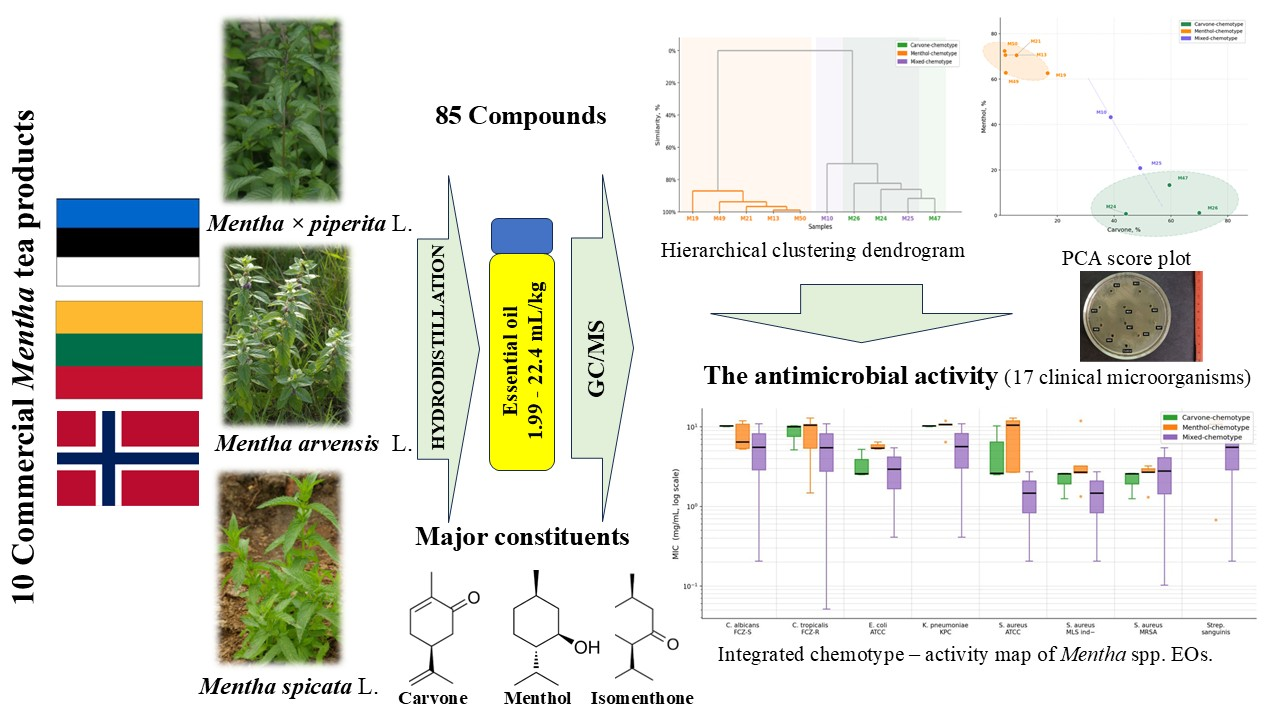

Commercial Mentha Teas as Sources of Bioactive Volatile Compounds: Chemical Composition, Chemotypes, and Antimicrobial Activity

 ,
,  , ,
, ,  , , ,
, , , 
Abstract
1. Introduction
2. Materials and Methods
2.1. Plant Materials
2.2. Hydrodistillation of EOs
2.3. Gas Chromatography-Mass Spectrometry
2.4. Bacterial Strains and Media
2.5. Antimicrobial Activity Testing
2.6. Statistical Analyses
3. Results
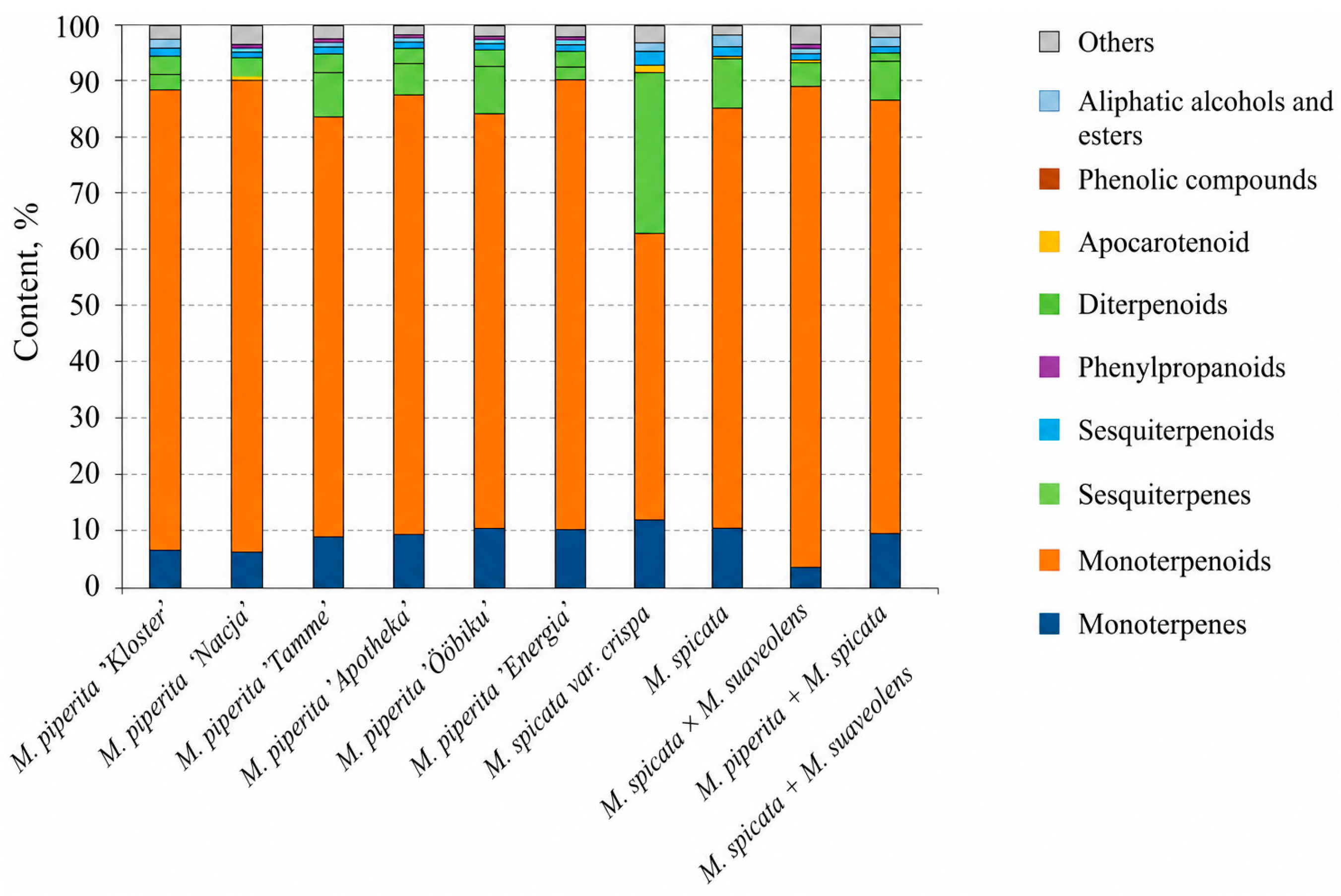
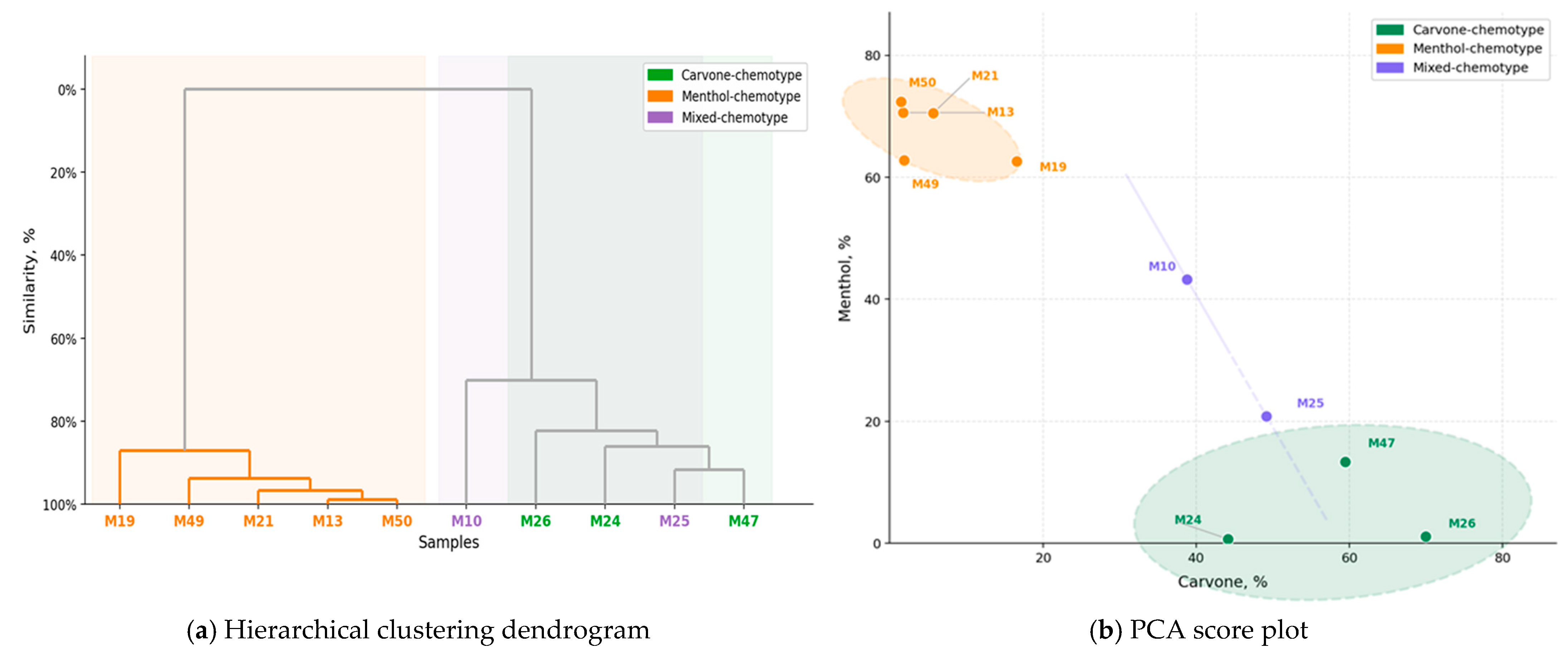
3.1. Chemical Composition of Essential Oils
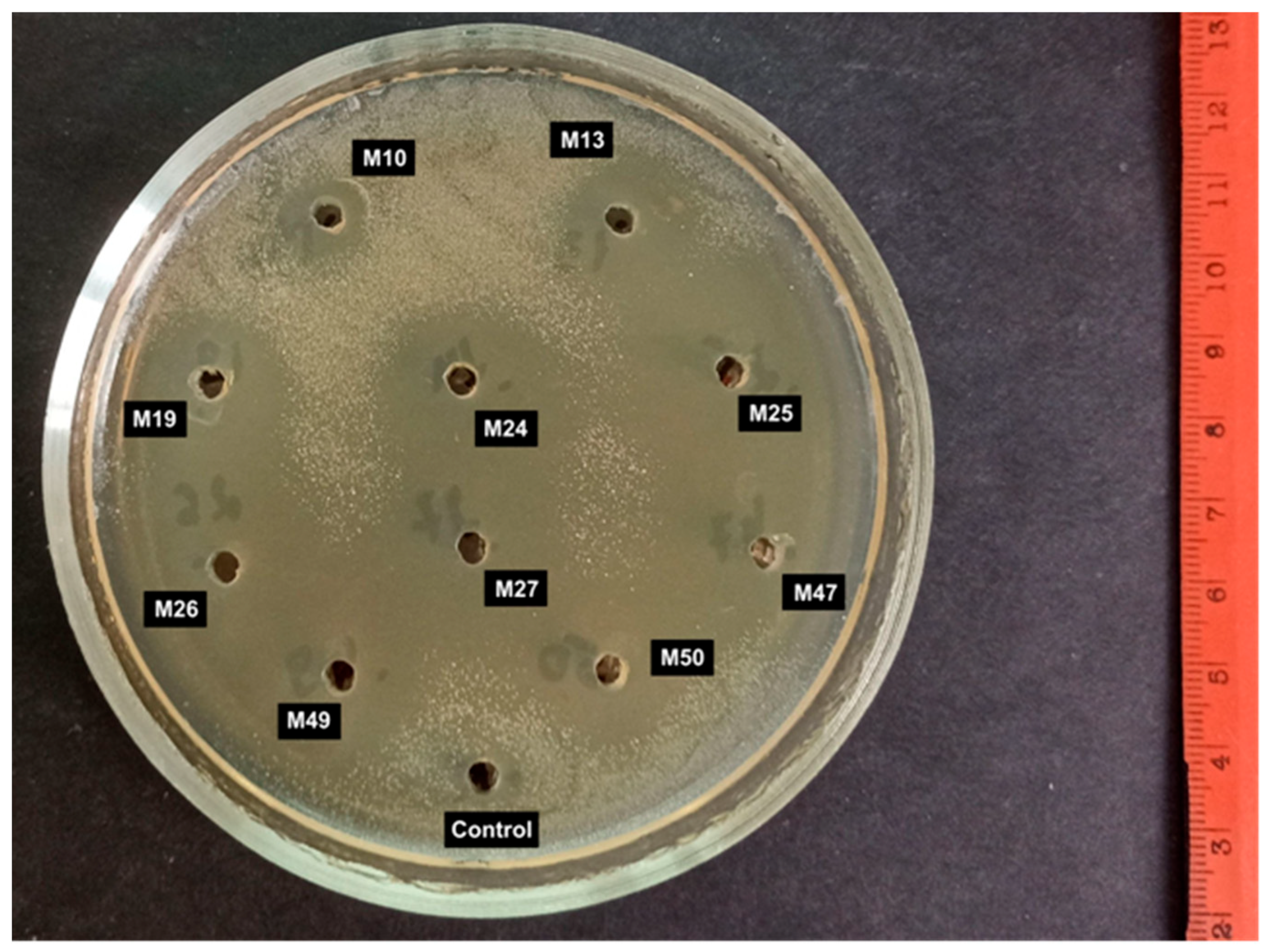
3.2. Antimicrobial Activity
4. Discussion
5. Conclusions
Supplementary Materials
Author Contributions
Funding
Institutional Review Board Statement
Informed Consent Statement
Data Availability Statement
Conflicts of Interest
Abbreviations
| M. | Mentha |
| EOs | Essential oils |
| GC–MS | Gas chromatography-mass spectrometry |
| MICs | Minimum inhibitory concentrations |
| MBCs | Minimum bactericidal concentrations |
| MFCs | Minimum fungicidal concentrations |
| IZD | Inhibition zone diameter |
| PCA | Principal component analysis |
| S | Antibiotic-susceptible strains |
| MDR | Multidrug-resistant strains |
| MRSA | Methicillin-resistant S. aureus |
| MLS | Resistance (macrolides, lincosamides, streptogramin B) |
| ESβL | Extended spectrum β-lactamases |
| TEM-β-lactamase | Resistance to penicillins and early-generation cephalosporins |
| KPC | Carbapenemase |
| FCZ-R | Fluconazole resistant |
| FCZ-S | Fluconazole susceptible |
References
- Plants of the World Online: Mentha L. Available online: https://powo.science.kew.org/taxon/urn:lsid:ipni.org:names:30016176-2 (accessed on 10 May 2026).
- Silva, H. A Descriptive Overview of the Medical Uses Given to Mentha Aromatic Herbs throughout History. Biology 2020, 9, 484. [Google Scholar] [CrossRef] [PubMed]
- Mint Oils Market Size, Share & Industry Analysis, By Application (Oral Products, Confectionary Products, Pharmaceutical Products, Tobacco Products, Fragrance Products, and Others), and Regional Forecast, 2025–2032. Available online: https://www.fortunebusinessinsights.com/mint-oils-market-104220 (accessed on 10 May 2026).
- ESCOP Monographs: Menthae piperitae folium (Peppermint Leaf), 2019. Available online: https://www.escop.com/downloads/menthae-piperitae-folium-peppermint-leaf/ (accessed on 10 May 2026).
- Alves Pereira, U.; Martins Aguilar, C.; Fernandes Dias, M.C.; Luis D’Grande, G.; Fontes Pinheiro, P.; Moreira Osório, V. Analysis of Essential Oil from Brazilian Mentha × piperita L. Commercial Samples. Rev. Virtual Quim. 2022, 14, 179–184. [Google Scholar] [CrossRef]
- Bertoli, A.; Leonardi, M.; Krzyzanowska, J.; Oleszek, W.; Pistelli, L. In Vitro Production of M. × piperita Not Containing Pulegone and Menthofuran. Acta Biochim. Pol. 2012, 59, 417–423. [Google Scholar] [CrossRef] [PubMed]
- Rayan, A.; Chadia, O.; Azzedine, E.-R.; Abdellah, M.; Abdallah, D.; Lhousseine, B. Chemical Composition of Moroccan Commercial Essential Oils of Mint: Mentha Spicata, Mentha Piperita, and Mentha Pulegium. Trop. J. Nat. Prod. Res. 2023, 7, 2708–2712. [Google Scholar] [CrossRef]
- Srivastava, E.; Mathur, P. A Comparative Analysis of Essential Oil Yield from Mentha piperita (Mint) Using Various Extraction Methods. Int. J. Innov. Res. Anal. 2024, 4, 83–92. [Google Scholar]
- Sun, Z.; Wang, H.; Wang, J.; Zhou, L.; Yang, P. Chemical Composition and Anti-Inflammatory, Cytotoxic and Antioxidant Activities of Essential Oil from Leaves of Mentha piperita Grown in China. PLoS ONE 2014, 9, e114767. [Google Scholar] [CrossRef] [PubMed]
- Sústriková, A.; Šalamon, I. Essential Oil of Peppermint (Mentha × piperita L.) from Fields in Eastern Slovakia. Hortic. Sci. 2004, 31, 31–36. [Google Scholar] [CrossRef]
- Desam, N.R.; Al-Rajab, A.J.; Sharma, M.; Mylabathula, M.M.; Gowkanapalli, R.R.; Albratty, M. Chemical Constituents, in Vitro Antibacterial and Antifungal Activity of Mentha × piperita L. (Peppermint) Essential Oils. J. King Saud Univ. Sci. 2019, 31, 528–533. [Google Scholar] [CrossRef]
- Ganosi, E.; Barda, C.; Grafakou, M.-E.; Rallis, M.C.; Skaltsa, H. An In-Depth Stability Study of the Essential Oils from Mentha × piperita, Mentha spicata, Origanum vulgare, and Thymus vulgaris: The Impact of Thermal and Storage Conditions. Separations 2023, 10, 488. [Google Scholar] [CrossRef]
- Hedayati, S.; Tarahi, M.; Baeghbali, V.; Tahsiri, Z.; Hashempur, M.H. Mint (Mentha Spp.) Essential Oil Extraction: From Conventional to Emerging Technologies. Phytochem. Rev. 2025, 24, 3157–3178. [Google Scholar] [CrossRef]
- Hudz, N.; Kobylinska, L.; Pokajewicz, K.; Horčinová Sedláčková, V.; Fedin, R.; Voloshyn, M.; Myskiv, I.; Brindza, J.; Wieczorek, P.P.; Lipok, J. Mentha piperita: Essential Oil and Extracts, Their Biological Activities, and Perspectives on the Development of New Medicinal and Cosmetic Products. Molecules 2023, 28, 7444. [Google Scholar] [CrossRef] [PubMed]
- Zhao, H.; Ren, S.; Yang, H.; Tang, S.; Guo, C.; Liu, M.; Tao, Q.; Ming, T.; Xu, H. Peppermint Essential Oil: Its Phytochemistry, Biological Activity, Pharmacological Effect and Application. Biomed. Pharmacother. 2022, 154, 113559. [Google Scholar] [CrossRef] [PubMed]
- Ngu, T.N.; Hanh, D.T.B.; Nguyen, P.D.N.; Nguyen, V.-A.T.; Lam, T.M.P.; Nguyen, T.K.A.; Nguyen, P.H.; Hoang, L.M.; To, D.C. Chemical Composition and Biological Activities of Mentha arvensis Essential Oil: In Vitro and in Silico Studies. Vegetos 2025, 1–12. [Google Scholar] [CrossRef]
- Parić, A.; Mesic, A.; Mahmutović-Dizdarević, I.; Jerković-Mujkić, A.; Žujo, B.; Bašić, N.; Pustahija, F. Bioactive Potential of Mentha arvensis L. Essential Oil. J. Environ. Sci. Health Part B 2024, 59, 584–594. [Google Scholar] [CrossRef] [PubMed]
- Gebauer, S.; Pompermayer, K.; De Oliveira, D.G.P.; Da Silva Pinto, F.G.; Rosset, J.; Bandeira, D.M.; De Souza E Silva, G.T.; De Oliveira, M.S.; Silva, G.H.; Alves, L.F.A.; et al. Mentha Spp. Essential Oils: Toxicity to Alphitobius Diaperinus, Activity against Poultry Pathogenic Bacteria, and Beauveria Bassiana Compatibility. Environ. Sci. Pollut. Res. 2024, 31, 34010–34027. [Google Scholar] [CrossRef] [PubMed]
- Kalemba, D.; Synowiec, A. Agrobiological Interactions of Essential Oils of Two Menthol Mints: Mentha piperita and Mentha arvensis. Molecules 2019, 25, 59. [Google Scholar] [CrossRef] [PubMed]
- Yu, Y.; Ma, Y.; Ouyang, Z.; Huang, L. Mentha Essential Oils: Unraveling Chemotype-Dependent Biosynthesis and Assessing Evidence for Health-Promoting Activities. Nutrients 2025, 17, 3258. [Google Scholar] [CrossRef] [PubMed]
- Ranjbar, M.; Kiani, M.; Gholami, F. Phytochemical Profiling and Biocidal Activity of Four Iranian Mentha (Lamiaceae) Species. S. Afr. J. Bot. 2023, 155, 110–117. [Google Scholar] [CrossRef]
- Taylan, O.; Cebi, N.; Sagdic, O. Rapid Screening of Mentha spicata Essential Oil and L-Menthol in Mentha Piperita Essential Oil by ATR-FTIR Spectroscopy Coupled with Multivariate Analyses. Foods 2021, 10, 202. [Google Scholar] [CrossRef] [PubMed]
- Sfaxi, A.; Tavaszi-Sárosi, S.; Flórián, K.; Patonay, K.; Radácsi, P.; Juhász, Á. Comparative Evaluation of Different Mint Species Based on Their In Vitro Antioxidant and Antibacterial Effect. Plants 2025, 14, 105. [Google Scholar] [CrossRef] [PubMed]
- Hemati, G.; Kurin, E.; Mučaji, P.; Ťažký, A.; Hajská, M.; Fialová, S.B. Chemical Diversity and Chemotypic Variation of Mentha spicata Essential Oils from Different Regions of Iran. Eur. Pharm. J. 2025, 72, 37–45. [Google Scholar] [CrossRef]
- Al-Mijalli, S.H.; Assaggaf, H.; Qasem, A.; El-Shemi, A.G.; Abdallah, E.M.; Mrabti, H.N.; Bouyahya, A. Antioxidant, Antidiabetic, and Antibacterial Potentials and Chemical Composition of Salvia Officinalis and Mentha Suaveolens Grown Wild in Morocco. Adv. Pharmacol. Pharm. Sci. 2022, 2022, 2844880. [Google Scholar] [CrossRef] [PubMed]
- Bouyahya, A.; Belmehdi, O.; Abrini, J.; Dakka, N.; Bakri, Y. Chemical Composition of Mentha suaveolens and Pinus halepensis Essential Oils and Their Antibacterial and Antioxidant Activities. Asian Pac. J. Trop. Med. 2019, 12, 117–122. [Google Scholar] [CrossRef]
- Yang, H.; Wang, C.; Zhou, G.; Zhang, Y.; He, T.; Yang, L.; Wu, Y.; Wang, Z.; Tang, X.; Chen, G.; et al. A Haplotype-Resolved Gap-Free Genome Assembly Provides Novel Insight into Monoterpenoid Diversification in Mentha suaveolens ‘Variegata’. Hortic. Res. 2024, 11, uhae022. [Google Scholar] [CrossRef] [PubMed]
- Arrahmouni, R.; Ouazzani, C.; Er-Ramly, A.; Moustaghfir, A.; Ameggouz, M.; Aabouch, F.; El-Guourrami, O.; Sadik, H.; Dami, A.; Balouch, L. Assessment of Antibacterial Activity and Toxicity of Mentha spicata, Mentha piperita, and Mentha pulegium Essential Oils. Trop. J. Nat. Prod. Res. 2025, 9, 2112. [Google Scholar] [CrossRef]
- Abbas, S.; Sultana, S.; Chishti, A.W.; Akram, M.; Shah, S.M.A.; Sareen, A.; Siddique, S.; Aftab, A. Mentha piperita: Medicinal Uses and Pharmacological Properties. Int. J. Sch. Res. Biol. Pharm. 2022, 1, 041–045. [Google Scholar] [CrossRef]
- Stringaro, A.; Colone, M.; Angiolella, L. Antioxidant, Antifungal, Antibiofilm, and Cytotoxic Activities of Mentha Spp. Essential Oils. Medicines 2018, 5, 112. [Google Scholar] [CrossRef] [PubMed]
- Fazal, H.; Akram, M.; Ahmad, N.; Qaisar, M.; Kanwal, F.; Rehman, G.; Ullah, I. Nutritionally Rich Biochemical Profile in Essential Oil of Various Mentha Species and Their Antimicrobial Activities. Protoplasma 2023, 260, 557–570. [Google Scholar] [CrossRef] [PubMed]
- Kapp, K.; Orav, A.; Roasto, M.; Raal, A.; Püssa, T.; Vuorela, H.; Tammela, P.; Vuorela, P. Composition and Antibacterial Effect of Mint Flavorings in Candies and Food Supplements. Planta Medica 2020, 86, 1089–1096. [Google Scholar] [CrossRef] [PubMed]
- Kapp, K.; Hakala, E.; Orav, A.; Pohjala, L.; Vuorela, P.; Püssa, T.; Vuorela, H.; Raal, A. Commercial Peppermint (Mentha × piperita L.) Teas: Antichlamydial Effect and Polyphenolic Composition. Food Res. Int. 2013, 53, 758–766. [Google Scholar] [CrossRef]
- Kapp, K.; Orav, A.; Raal, A.; Püssa, T.; Roasto, M.; Vuorela, H. The Antimicrobial Activity of Mint Flavour in Candies, Chocolates and Food Supplements. Planta Med. 2015, 81, PM_217. [Google Scholar] [CrossRef]
- Council of Europe. European Pharmacopoeia, 11th ed.; Council of Europe: Strasbourg, France, 2022. [Google Scholar]
- Raal, A.; Lodi, R.; Lepiku, M.; Nguyen, T.; Grytsyk, A.; Koshovyi, O. Quality and Safety Assessment of Commercial Peppermint Teas Based on Essential Oil Yield and Composition. Beverages 2026, 12, 38. [Google Scholar] [CrossRef]
- Raal, A.; Dolgošev, G.; Ilina, T.; Kovalyova, A.; Lepiku, M.; Grytsyk, A.; Koshovyi, O. The Essential Oil Composition in Commercial Samples of Verbena Officinalis L. Herb from Different Origins. Crops 2025, 5, 16. [Google Scholar] [CrossRef]
- Bergey, D.H. Bergey’s Manual of Determinative Bacteriology; Baltimore, Williams & Wilkins Co.: Baltimore, MD, USA, 1957. [Google Scholar]
- Hrytsyk, R.A.; Kutsyk, R.V.; Yurchyshyn, O.I.; Struk, O.A.; Kireev, I.V.; Grytsyk, A.R. The Investigation of Antimicrobial and Antifungal Activity of Some Artemisia L. Species. Pharmacia 2021, 68, 93–100. [Google Scholar] [CrossRef]
- Orav, A.; Kapp, K.; Raal, A. Chemosystematic Markers for the Essential Oils in Leaves of Mentha Species Cultivated or Growing Naturally in Estonia. Proc. Est. Acad. Sci. 2013, 62, 175–186. [Google Scholar] [CrossRef]
- Grigore-Gurgu, L.; Dumitrașcu, L.; Aprodu, I. Aromatic Herbs as a Source of Bioactive Compounds: An Overview of Their Antioxidant Capacity, Antimicrobial Activity, and Major Applications. Molecules 2025, 30, 1304. [Google Scholar] [CrossRef] [PubMed]
- Hacioglu, M.; Dosler, S.; Birteksoz Tan, A.S.; Otuk, G. Antimicrobial activities of widely consumed herbal teas, alone or in combination with antibiotics: An in vitro study. PeerJ 2017, 5, e3467. [Google Scholar] [CrossRef] [PubMed]
- Nowak, D.; Kłębukowska, L.; Gośliński, M. Antioxidant Properties and Antibacterial Activity of Selected Herbal Teas. Sci. Rep. 2025, 15, 41438. [Google Scholar] [CrossRef] [PubMed]
- Orav, A.; Raal, A.; Arak, E. Comparative Chemical Composition of the Essential Oil of Mentha × piperita L. from Various Geographical Sources. PEAS Chem. 2004, 53, 174–181. [Google Scholar] [CrossRef]
- Jones, A.L.; Dargan, P.I. Hepatic Toxicology. In Haddad and Winchester’s Clinical Management of Poisoning and Drug Overdose; Elsevier: Amsterdam, The Netherlands, 2007; pp. 223–247. [Google Scholar]
- Voigt, V.; Franke, H.; Lachenmeier, D.W. Risk Assessment of Pulegone in Foods Based on Benchmark Dose–Response Modeling. Foods 2024, 13, 2906. [Google Scholar] [CrossRef] [PubMed]
- Scientific Committee on Food European Commission: Opinion of the Scientific Committee on Food on Pulegone and Menthofuran. Available online: https://food.ec.europa.eu/document/download/f67c3631-7dbc-4250-927c-a00473fd920a_en?filename=sci-com_scf_out133_en.pdf (accessed on 10 May 2026).
- Reyes-Jurado, F.; Navarro-Cruz, A.R.; Ochoa-Velasco, C.E.; Palou, E.; López-Malo, A.; Ávila-Sosa, R. Essential Oils in Vapor Phase as Alternative Antimicrobials: A Review. Crit. Rev. Food Sci. Nutr. 2020, 60, 1641–1650. [Google Scholar] [CrossRef] [PubMed]
- BenchChem: Piperitone: A Comprehensive Technical Guide for Researchers. Available online: https://pdf.benchchem.com/1207/Piperitone_A_Comprehensive_Technical_Guide_for_Researchers.pdf (accessed on 10 May 2026).
- Bouyahya, A.; Mechchate, H.; Benali, T.; Ghchime, R.; Charfi, S.; Balahbib, A.; Burkov, P.; Shariati, M.A.; Lorenzo, J.M.; Omari, N.E. Health Benefits and Pharmacological Properties of Carvone. Biomolecules 2021, 11, 1803. [Google Scholar] [CrossRef] [PubMed]
- Choi, S.Z.; Choi, S.U.; Lee, K.R. Pytochemical Constituents of the Aerial Parts from Solidago virgaaurea Var. Gigantea. Arch. Pharm. Res. 2004, 27, 164–168. [Google Scholar] [CrossRef] [PubMed]
- Delgado, C.; Mendez-Callejas, G.; Celis, C. Caryophyllene Oxide, the Active Compound Isolated from Leaves of Hymenaea courbaril L. (Fabaceae) with Antiproliferative and Apoptotic Effects on PC-3 Androgen-Independent Prostate Cancer Cell Line. Molecules 2021, 26, 6142. [Google Scholar] [CrossRef] [PubMed]
- Pacciaroni, A.D.V.; De Los Angeles Gette, M.; Derita, M.; Ariza-Espinar, L.; Gil, R.R.; Zacchino, S.A.; Silva, G.L. Antifungal Activity of Heterothalamus alienus Metabolites. Phytother. Res. 2008, 22, 524–528. [Google Scholar] [CrossRef] [PubMed]
- Bassolé, I.H.N.; Juliani, H.R. Essential Oils in Combination and Their Antimicrobial Properties. Molecules 2012, 17, 3989–4006. [Google Scholar] [CrossRef] [PubMed]
- Burt, S. Essential Oils: Their Antibacterial Properties and Potential Applications in Foods—A Review. Int. J. Food Microbiol. 2004, 94, 223–253. [Google Scholar] [CrossRef] [PubMed]
- Langeveld, W.T.; Veldhuizen, E.J.A.; Burt, S.A. Synergy between Essential Oil Components and Antibiotics: A Review. Crit. Rev. Microbiol. 2014, 40, 76–94. [Google Scholar] [CrossRef] [PubMed]
- Nazzaro, F.; Fratianni, F.; De Martino, L.; Coppola, R.; De Feo, V. Effect of Essential Oils on Pathogenic Bacteria. Pharmaceuticals 2013, 6, 1451–1474. [Google Scholar] [CrossRef] [PubMed]
- Alexopoulos, A.; Kimbaris, A.C.; Plessas, S.; Mantzourani, I.; Voidarou, C.; Pagonopoulou, O.; Tsigalou, C.; Fournomiti, M.; Bontsidis, C.; Stavropoulou, E.; et al. Combined Action of Piperitenone Epoxide and Antibiotics Against Clinical Isolates of Staphylococcus aureus and Escherichia coli. Front. Microbiol. 2019, 10, 2607. [Google Scholar] [CrossRef] [PubMed]
- Rosato, A.; Carocci, A.; Catalano, A.; Clodoveo, M.L.; Franchini, C.; Corbo, F.; Carbonara, G.G.; Carrieri, A.; Fracchiolla, G. Elucidation of the Synergistic Action of Mentha Piperita Essential Oil with Common Antimicrobials. PLoS ONE 2018, 13, e0200902. [Google Scholar] [CrossRef] [PubMed]
- Samber, N.; Khan, A.; Varma, A.; Manzoor, N. Synergistic Anti-Candidal Activity and Mode of Action of Mentha Piperita Essential Oil and Its Major Components. Pharm. Biol. 2015, 53, 1496–1504. [Google Scholar] [CrossRef] [PubMed]
- Helander, I.M.; Alakomi, H.-L.; Latva-Kala, K.; Mattila-Sandholm, T.; Pol, I.; Smid, E.J.; Gorris, L.G.M.; Von Wright, A. Characterization of the Action of Selected Essential Oil Components on Gram-Negative Bacteria. J. Agric. Food Chem. 1998, 46, 3590–3595. [Google Scholar] [CrossRef]
- Coutinho, H.D.M.; Costa, J.G.M.; Lima, E.O.; Falcão-Silva, V.S.; Siqueira-Júnior, J.P. Enhancement of the Antibiotic Activity against a Multiresistant Escherichia coli by Mentha arvensis L. and Chlorpromazine. Chemotherapy 2008, 54, 328–330. [Google Scholar] [CrossRef] [PubMed]
- Coutinho, H.D.M.; Costa, J.G.M.; Lima, E.O.; Falcão-Silva, V.S.; Siqueira-Júnior, J.P. Potentiating Effect of Mentha arvensis and Chlorpromazine in the Resistance to Aminoglycosides of Methicillin-Resistant Staphylococcus aureus. In Vivo 2009, 23, 287–289. [Google Scholar] [CrossRef]
- Trombetta, D.; Castelli, F.; Sarpietro, M.G.; Venuti, V.; Cristani, M.; Daniele, C.; Saija, A.; Mazzanti, G.; Bisignano, G. Mechanisms of Antibacterial Action of Three Monoterpenes. Antimicrob. Agents Chemother. 2005, 49, 2474–2478. [Google Scholar] [CrossRef] [PubMed]
- Yap, P.S.X.; Yiap, B.C.; Ping, H.C.; Lim, S.H.E. Essential Oils, A New Horizon in Combating Bacterial Antibiotic Resistance. Open Microbiol. J. 2014, 8, 6–14. [Google Scholar] [CrossRef] [PubMed]





| No. | Product Name | Producer | Mass, Packaging, and Type of Drug | Country of Manufacture | Country Purchased From |
|---|---|---|---|---|---|
| 1 | M. piperita (M21) | ‘Kloster’ | 60 g pab, ch | Norway | Norway |
| 2 | M. piperita (M19) | ‘Natēja’ | 50 g cb, plb, ch | Lithuania | Lithuania |
| 3 | M. piperita (M25) | ‘Tamme Aiandustalu’ | 20 g pab, leaves | Estonia | Estonia |
| 4 | M. piperita (M13) | ‘Apotheka’ | 20 g cb, plb, ch | Estonia | Estonia |
| 5 | M. piperita (M49) | ‘Ööbiku talu’ | 10 g pab, leaves | Estonia | Estonia |
| 6 | M. piperita (M50) | ‘Energia talu’ | 20 g pab, ch | Estonia | Estonia |
| 7 | M. suaveolens (M24) | ‘Põhjala teetalu’ | 20 × 1.2 g cb, plb, tb, ch | Estonia | Estonia |
| 8 | M. spicata (M26) | ‘Tamme Aiandustalu’ | 20 g pab, leaves | Estonia | Estonia |
| 9 | M. spicata + M. piperita + M. arvensis (M10) | ‘Pukka’ | 20 × 1.6 g cb, tipa, ch | UK | Norway |
| 10 | M. spicata + M. suaveolens + M. piperita (M47) | ‘Tamme Aiandustalu’ | 20 g plb, ch | Estonia | Estonia |
| Compound | RI Exp | RI Lib | Content, % | ||
|---|---|---|---|---|---|
| Average | Minimum | Maximum | |||
| (E)-2-Hexenal | 849 | 854 | 0.06 | 0.03 | 0.15 |
| α-Thujene | 926 | 929 | 0.04 | 0.00 | 0.13 |
| α-Pinene | 932 | 932 | 1.11 | 0.12 | 1.76 |
| α-Sabinene | 972 | 974 | 0.81 | 0.05 | 1.30 |
| β-Pinene | 975 | 978 | 1.54 | 0.17 | 2.51 |
| 1-Octen-3-ol | 978 | 980 | 0.11 | 0.00 | 0.24 |
| β-Myrcene | 990 | 991 | 0.63 | 0.05 | 1.80 |
| 3-Octanol | 995 | 993 | 0.69 | 0.16 | 1.83 |
| α-Terpinene | 1016 | 1017 | 0.20 | 0.00 | 0.40 |
| p-Cymene | 1024 | 1025 | 0.19 | 0.02 | 0.46 |
| Limonene | 1029 | 1031 | 2.02 | 0.15 | 6.38 |
| Eucalyptol | 1030 | 1032 | 2.58 | 0.55 | 4.29 |
| (Z)-β-Ocimene | 1037 | 1038 | 0.32 | 0.00 | 0.99 |
| Benzeneacetaldehyde | 1043 | 1045 | 0.31 | 0.05 | 0.60 |
| (E)-β-Ocimene | 1048 | 1049 | 0.03 | 0.00 | 0.18 |
| γ-Terpinene | 1058 | 1060 | 0.40 | 0.00 | 0.81 |
| (E)-Sabinene hydrate | 1066 | 1070 | 1.11 | 0.03 | 2.57 |
| Isoterpinolene | 1088 | 1086 | 0.03 | 0.00 | 0.14 |
| Terpinolene | 1088 | 1088 | 0.05 | 0.00 | 0.13 |
| Linalool | 1100 | 1099 | 0.25 | 0.04 | 0.48 |
| 2-Methylbutyl isovalerate | 1108 | 1107 | 0.11 | 0.01 | 0.25 |
| 3-Octanol acetate | 1125 | 1123 | 0.24 | 0.02 | 0.81 |
| Menthone | 1154 | 1154 | 6.67 | 0.41 | 14.11 |
| Isomenthone | 1158 | 1157 | 12.44 | 0.00 | 33.85 |
| Menthofuran | 1164 | 1164 | 2.19 | 0.03 | 7.04 |
| δ-Terpineol | 1168 | 1166 | 0.33 | 0.05 | 0.45 |
| Menthol | 1173 | 1170 | 12.49 | 0.24 | 30.73 |
| Isomenthol | 1177 | 1179 | 5.31 | 0.00 | 13.64 |
| Isoneomenthol | 1186 | 1188 | 0.61 | 0.00 | 5.40 |
| α-Terpineol | 1191 | 1189 | 0.33 | 0.00 | 0.67 |
| Dihydrocarveol I | 1195 | 1192 | 0.36 | 0.00 | 1.51 |
| Dihydrocarveol II | 1195 | 1196 | 0.52 | 0.00 | 2.28 |
| Myrtenal | 1197 | 1203 | 0.34 | 0.00 | 1.63 |
| Estragole | 1199 | 1196 | 0.12 | 0.00 | 1.06 |
| trans-Dihydrocarvone | 1198 | 1201 | 1.93 | 0.00 | 8.38 |
| trans-Carveol | 1220 | 1217 | 0.03 | 0.00 | 0.32 |
| cis-Carveol | 1225 | 1229 | 0.16 | 0.00 | 0.61 |
| Citronellol | 1228 | 1228 | 0.04 | 0.00 | 0.12 |
| (Z)-3-Hexenyl valerate | 1238 | 1239 | 0.16 | 0.00 | 1.26 |
| Pulegone | 1240 | 1237 | 1.79 | 0.01 | 6.06 |
| Carvone | 1248 | 1245 | 20.23 | 0.00 | 58.14 |
| Piperitone | 1255 | 1253 | 5.22 | 0.00 | 17.71 |
| Neomenthyl acetate | 1277 | 1277 | 0.05 | 0.00 | 1.32 |
| Carvone oxide | 1278 | 1279 | 0.22 | 0.00 | 0.65 |
| Anethole | 1286 | 1287 | 0.14 | 0.00 | 1.01 |
| Thymol | 1292 | 1291 | 0.48 | 0.00 | 1.28 |
| Dihydroedulan | 1295 | 1293 | 0.36 | 0.18 | 0.71 |
| Menthyl acetate | 1295 | 1295 | 1.90 | 0.00 | 9.65 |
| Dihydrocarvyl acetate | 1309 | 1305 | 0.02 | 0.00 | 0.17 |
| Pulespenone | 1329 | 1330 | 0.18 | 0.00 | 0.77 |
| Piperitenone | 1342 | 1340 | 0.08 | 0.00 | 0.38 |
| Eugenol | 1358 | 1357 | 0.12 | 0.04 | 0.51 |
| cis-Carvyl acetate | 1364 | 1362 | 0.06 | 0.00 | 0.16 |
| Piperitenone oxide | 1368 | 1367 | 0.04 | 0.00 | 0.22 |
| Copaene | 1377 | 1376 | 0.04 | 0.00 | 0.17 |
| β-Bourbonene | 1387 | 1384 | 1.49 | 0.32 | 3.70 |
| β-Elemene | 1394 | 1391 | 0.17 | 0.06 | 0.37 |
| (Z)-Jasmone | 1399 | 1394 | 0.21 | 0.00 | 0.72 |
| α-Gurjunene | 1412 | 1409 | 0.03 | 0.00 | 0.17 |
| Caryophyllene | 1422 | 1419 | 1.34 | 0.53 | 4.13 |
| cis-β-Copaene | 1431 | 1432 | 0.23 | 0.07 | 0.58 |
| Isogermacrene D | 1447 | 1448 | 0.19 | 0.00 | 1.41 |
| trans-Muurola-3,5-diene | 1448 | 1451 | 0.44 | 0.00 | 2.97 |
| Humulene | 1456 | 1454 | 0.31 | 0.06 | 0.72 |
| (E)-β-Farnesene | 1458 | 1457 | 0.21 | 0.06 | 0.69 |
| cis-Muurola-4(15),5-diene | 1466 | 1463 | 0.94 | 0.00 | 5.38 |
| Germacrene D | 1484 | 1481 | 2.35 | 0.00 | 6.27 |
| epi-Bicyclosesquiphellandrene | 1486 | 1482 | 0.92 | 0.00 | 9.23 |
| Bicyclogermacrene | 1499 | 1496 | 0.36 | 0.06 | 0.80 |
| γ-Cadinene | 1516 | 1513 | 0.10 | 0.00 | 0.47 |
| trans-Calamenene | 1525 | 1529 | 0.47 | 0.00 | 1.40 |
| cis-Calamenene | 1525 | 1530 | 0.42 | 0.00 | 3.32 |
| δ-Cadinene | 1526 | 1524 | 0.14 | 0.08 | 0.38 |
| α-Cadinene | 1540 | 1538 | 0.10 | 0.00 | 0.48 |
| Spatulenol | 1580 | 1576 | 0.17 | 0.04 | 0.60 |
| Caryophyllene oxide | 1586 | 1581 | 0.22 | 0.02 | 0.82 |
| Viridiflorol | 1594 | 1591 | 0.36 | 0.04 | 0.72 |
| diepi-Cubenol | 1618 | 1614 | 0.22 | 0.00 | 0.80 |
| α-Cadinol | 1657 | 1653 | 0.19 | 0.07 | 0.47 |
| Aromadendrene oxide | 1676 | 1678 | 0.03 | 0.00 | 0.15 |
| ent-Germacra-4(15),5,10(14)-trien-1β-ol | 1690 | 1690 | 0.08 | 0.01 | 0.29 |
| Shyobunol | 1701 | 1699 | 0.02 | 0.00 | 0.13 |
| α-Mintsulfide | 1741 | 1742 | 0.05 | 0.01 | 0.38 |
| Farnesyl acetone | 1919 | 1918 | 0.03 | 0.01 | 0.11 |
| Phytol | 2108 | 2114 | 0.04 | 0.00 | 0.20 |
| Sample | No. | Yield of EOs, ml/kg | Content, % | |||||||||||
|---|---|---|---|---|---|---|---|---|---|---|---|---|---|---|
| Limonene | Eucalyptol | Menthone | Menthol | Isomenthone | Isomenthol | Mentho-furan | Menthyl acetate | Pulegone | Carvone | Piperitone | trans-Dihydrocarvone | |||
| M. piperita ‘Kloster’ | M21 | 13.75 | 0.30 | 2.49 | 14.11 | 15.51 | 15.20 | 13.51 | 4.54 | 2.07 | 3.93 | 0.95 | 4.16 | 0 |
| M. piperita ‘Nateja’ | M19 | 8.86 | 0.44 | 1.55 | 7.47 | 8.38 | 19.90 | 8.83 | 7.04 | 9.65 | 6.06 | 13.97 | 1.53 | 0 |
| M. piperita ‘Tamme Aiandustalu ’ | M25 | 15.58 | 0.67 | 2.50 | 11.66 | 8.61 | 0.01 | 0.01 | 0.34 | 0.26 | 0.09 | 25.88 | 15.4 | 4.44 |
| M. piperita ‘Apotheka’ | M13 | 22.40 | 1.35 | 4.29 | 4.72 | 22.19 | 30.16 | 8.25 | 4.47 | 0.76 | 0.76 | 0.01 | 1.41 | 0 |
| M. piperita ‘Ööbiku talu’ | M49 | 19.83 | 1.44 | 3.99 | 4.28 | 20.92 | 25.25 | 5.77 | 2.50 | 3.21 | 1.98 | 0.29 | 1.41 | 0 |
| M. piperita ‘Energia talu’ | M50 | 9.53 | 1.90 | 4.12 | 4.42 | 30.73 | 33.85 | 0.01 | 2.42 | 0.92 | 0.28 | 0.01 | 1.43 | 0 |
| M. suaveolens | M24 | 7.85 | 6.38 | 2.72 | 0.41 | 0.24 | 0.01 | 0.01 | 0.04 | 0 | 0.01 | 24.57 | 17.71 | 0.93 |
| M. spicata | M26 | 12.13 | 4.57 | 1.72 | 0.58 | 0.42 | 0.01 | 0.01 | 0.03 | 0.05 | 0.13 | 58.14 | 0 | 8.38 |
| M. spicata + M. piperita + M. arvensis | M10 | 1.99 | 0.15 | 0.55 | 13.17 | 14.03 | 0.01 | 13.64 | 0.33 | 1.92 | 3.72 | 37.12 | 0 | 0.36 |
| M. spicata + M. piperita + M. suaveolens | M47 | 11.65 | 2.97 | 1.88 | 5.86 | 3.87 | 0.01 | 3.11 | 0.18 | 0.14 | 0.93 | 41.41 | 9.19 | 5.15 |
| Micro- Organisms | Source | Resistance Phenotype | M. piperita ‘Kloster’ M21 | M. piperita ‘Natēja’ M19 | M. piperita ‘Tamme Aiandustalu’ M25 | M. piperita ‘Apotheka’ M13 | M. piperita ‘Ööbiku talu’ M49 | M. piperita ‘Energia talu’ M50 | M. suaveolens M24 | M. spicata M26 | M. spicata + M. piperita + M. arvensis M10 | M. spicata + M. suaveolens + M. piperita M47 |
|---|---|---|---|---|---|---|---|---|---|---|---|---|
| S. aureus | ATCC 29213 | Penicil- linase + | 11.85 ± 1.68 * | 13.55 ± 1.31 * | 11.45 ± 0.76 * | 0 | 9.90 ± 0.74 * | 8.30 ± 0.91 * | 12.54 ± 0.44 * | 12.18 ± 1.21 * | 13.68 ± 2.53 * | 9.75 ± 0.45 * |
| S. aureus | Wound pus | MLS, ind- | 22.87 ± 0.65 * | 19.61 ± 0.76 * | 24.87 ± 0.63 * | 16.78 ± 0.98 | 22.98 ± 0.87 * | 20.87 ± 0.72 * | 13.78 ± 0.60 * | 26.67 ± 0.75 * | 21.67 ± 0.40 * | 23.01 ± 1.05 * |
| S. aureus | Wound | MRSA | 20.86 ± 2.45 * | 18.78 ± 1.25 * | 24.41 ± 2.07 * | 16.52 ± 0.85 | 24.75 ± 0.86 * | 19.73 ± 0.82 * | 19.83 ± 1.78 * | 26.23 ± 0.65 * | 22.56 ± 0.92 * | 22.67 ± 0.97 * |
| α-hemolytic St. sanguinis | Oral cavity | S | 10.96 ± 0.45 * | 10.76 ± 0.75 * | 0 | 0 | 0 | 0 | 0 | 0 | 0 | 0 |
| β-hemolytic Group A St. pyogenes | Throat | S | 0 | 0 | 0 | 0 | 0 | 0 | 0 | 0 | 0 | 0 |
| β-hemolytic Group B St. agalacticae | Throat | S | 0 | 0 | 0 | 0 | 0 | 0 | 0 | 0 | 0 | 0 |
| E. faecalis | Urethra | MDR | 0 | 9.04 ± 1.31 * | 8.55 ± 0.87 * | 0 | 0 | 0 | 8.36 ± 0.94 * | 8.40 ± 0.63 * | 0 | 8.94 ± 0.77 * |
| E. coli | ATCC 25922 | S | 8.79 ± 0.76 * | 8.63 ± 0.78 * | 10.07 ± 0.51 * | 8.13 ± 1.33 * | 0 | 9.13 ± 0.75 * | 9.00 ± 0.63 * | 11.42 ± 0.86 * | 8.91 ± 0.80 * | 11.32 ± 0.86 * |
| E. coli | Urine | MDR | 8.39 ± 0.75 * | 9.39 ± 0.79 * | 10.10 ± 0.54 * | 10.27 ± 1.07 * | 8.63 ± 0.76 * | 9.07 ± 1.78 * | 0 | 10.08 ± 1.08 * | 0 | 0 |
| E. fergusonii | Stool | MDR | 0 | 9.25 ± 0.26 * | 0 | 0 | 0 | 0 | 0 | 0 | 0 | 8.72 ± 1.01 * |
| K. pneumonie | ATCC 1705 | KPC | 0 | 0 | 10.63 ± 0.58 * | 0 | 0 | 8.64 ± 0.54 * | 0 | 0 | 8.07 ± 1.09 * | 8.67 ± 1.11 * |
| K. ozaneae | Nasal swab | TEM | 0 | 0 | 8.47 ± 0.56 * | 0 | 0 | 0 | 0 | 0 | 0 | 0 |
| P. aeruginosa | Wound pus | ESβL | 0 | 0 | 0 | 0 | 0 | 0 | 0 | 0 | 0 | 0 |
| A.baumannii | Sputum | ESβL | 0 | 8.27 ± 0.39 * | 8.05 ± 0.79 * | 7.38 ± 0.80 * | 0 | 0 | 7.99 ± 0.90 * | 0 | 8.00 ± 0.41 * | 0 |
| C. albicans | Oral cavity | FCZ-S | 8.67 ± 0.43 [11.54 ± 0.39] | 9.67 ± 0.75 [12.84 ± 0.90] | 9.45 ± 0.75 [11.6 ± 1.19] | 7.22 ± 0.98 [9.77 ± 2.02] | 8.98 ± 0.43 [10.51 ± 0.15] | 9.78 ± 0.12 [12.23 ± 1.48] | 0 [8.82 ± 0.72] | 0 | 7.56 ± 0.76 [8.63 ± 0.62] | 9.88 ± 0.32 [12.23 ± 0.84] * |
| C. albicans | Oral cavity | FCZ-R | 9.98 ± 0.76 * [14.15 ± 0.96] * | 9.56 ± 0.78 * [17.28 ± 0.97] * | 8.67 ± 0.76 * [11.09 ± 0.96] * | 0 [10.25 ± 0.90] * | 8.72 ± 0.32 * [17.38 ± 1.92] * | 8.89 ± 0.78 * [11.91 ± 0.69] * | 0 [8.5 ± 0.93] * | 11.34 ± 0.98 * [22.44 ± 0.97] * | 0 [9.39 ± 0.26] * | 11.89 ± 0.54 * [15.54 ± 1.82] * |
| C. tropicalis | Sputum | FCZ-R | 0 [8.65 ± 0.89] | 8.23 ± 0.72 [10.69 ± 1.23] * | 0 [14.04 ± 1.08] * | 0 [11.87 ± 0.57] * | 0 [8.39 ± 0.78] | 0 [9.19 ± 0.94] | 0 [11.68 ± 0.44] * | 0 [11.38 ± 0.37] | 0 [9.63 ± 1.68] | 0 |
| No. | Sample | EO Concentration Before Serial Dilution, mg/mL | Antimicrobial Concentrations | |
|---|---|---|---|---|
| MIC, mg/mL | MBC, mg/mL | |||
| 1 | 2 | 3 | 4 | 5 |
| S. aureus ATCC 29213 | ||||
| 1. | M. piperita ‘Kloster’ | 1080 | 2.70 | 2.70 |
| 2. | M. piperita ‘Nateja’ | 1070 | 2.68 | 2.68 |
| 3. | M. piperita ‘Tamme Aiandustalu’ | 1090 | 2.73 | 2.73 |
| 4. | M. piperita ‘Apotheka’ | 1190 | >5.95 | >5.95 |
| 5. | M. piperita ‘Ööbiku talu’ | 1050 | >5.25 | >5.25 |
| 6. | M. piperita ‘Energia talu’ | 1290 | >6.45 | >6.45 |
| 7. | M. suaveolens | 1040 | 2.60 | 2.60 |
| 8. | M. spicata | 1000 | 2.50 | 2.50 |
| 9. | M. spicata + M. piperita + M. arvensis | 410 | 0.21 | 0.21 |
| 10. | M. spicata + M. suaveolens + M. piperita | 1030 | >5.15 | >5.15 |
| S. aureus MLS ind– | ||||
| 1. | M. piperita ‘Kloster’ | 1080 | 2.70 | 2.70 |
| 2. | M. piperita ‘Nateja’ | 1070 | 1.34 | 5.35 |
| 3. | M. piperita ‘Tamme Aiandustalu’ | 1090 | 2.28 | 2.28 |
| 4. | M. piperita ‘Apotheka’ | 1190 | >5.95 | >5.95 |
| 5. | M. piperita ‘Ööbiku talu’ | 1050 | 2.63 | 2.63 |
| 6. | M. piperita ‘Energia talu’ | 1290 | 3.23 | 3.23 |
| 7. | M. suaveolens | 1040 | 2.60 | 5.20 |
| 8. | M. spicata | 1000 | 1.25 | 5 |
| 9. | M. spicata + M. piperita + M. arvensis | 410 | 0.21 | 0.21 |
| 10. | M. spicata + M. suaveolens + M. piperita | 1030 | 2.58 | 2.58 |
| S. aureus MRSA | ||||
| 1. | M. piperita ‘Kloster’ | 1080 | 2.70 | 5.40 |
| 2. | M. piperita ‘Nateja’ | 1070 | 2.68 | 2.68 |
| 3. | M. piperita ‘Tamme Aiandustalu’ | 1090 | 5.45 | >5.45 |
| 4. | M. piperita ‘Apotheka’ | 1190 | 3.00 | 5.95 |
| 5. | M. piperita ‘Ööbiku talu’ | 1050 | 1.32 | 5.25 |
| 6. | M. piperita ‘Energia talu’ | 1290 | 3.23 | 6.45 |
| 7. | M. suaveolens | 1040 | 2.60 | 2.60 |
| 8. | M. spicata | 1000 | 1.25 | 1.25 |
| 9. | M. spicata + M. piperita + M. arvensis | 410 | 0.10 | 0.10 |
| 10. | M. spicata + M. suaveolens + M. piperita | 1030 | 2.58 | 5.15 |
| α-hemolytic S. sanguinis S | ||||
| 1. | M. piperita ‘Kloster’ | 1080 | <1.35 | <1.35 |
| 2. | M. piperita ‘Nateja’ | 1070 | >5.35 | >5.35 |
| 3. | M. piperita ‘Tamme Aiandustalu’ | 1090 | >5.45 | >5.45 |
| 4. | M. piperita ‘Apotheka’ | 1190 | >5.95 | >5.95 |
| 5. | M. piperita ‘Ööbiku talu’ | 1050 | >5.25 | >5.25 |
| 6. | M. piperita ‘Energia talu’ | 1290 | >6.45 | >6.45 |
| 7. | M. suaveolens | 1040 | >5.20 | >5.20 |
| 8. | M. spicata | 1000 | >5.00 | >5.00 |
| 9. | M. spicata + M. piperita + M. arvensis | 410 | 0.21 | 0.21 |
| 10. | M. spicata + M. suaveolens + M. piperita | 1030 | >5.15 | >5.15 |
| E. coli ATCC 25922 | ||||
| 1. | M. piperita ‘Kloster’ | 1080 | 5.40 | >5.40 |
| 2. | M. piperita ‘Nateja’ | 1070 | 5.35 | >5.35 |
| 3. | M. piperita ‘Tamme Aiandustalu’ | 1090 | 5.45 | 5.45 |
| 4. | M. piperita ‘Apotheka’ | 1190 | 5.95 | 5.95 |
| 5. | M. piperita ‘Ööbiku talu’ | 1050 | 5.25 | >5.25 |
| 6. | M. piperita ‘Energia talu’ | 1290 | 6.45 | 6.45 |
| 7. | M. suaveolens | 1040 | 5.20 | 5.20 |
| 8. | M. spicata | 1000 | 2.50 | 2.50 |
| 9. | M. spicata + M. piperita + M. arvensis | 410 | >0.21 | >0.21 |
| 10. | M. spicata + M. suaveolens + M. piperita | 1030 | 2.58 | >5.15 |
| K. pneumonie ATCC 1705 KPC β-lactamase | ||||
| 1. | M. piperita ‘Kloster’ | 1080 | >5.40 | >5.40 |
| 2. | M. piperita ‘Nateja’ | 1070 | >5.35 | >5.35 |
| 3. | M. piperita ‘Tamme Aiandustalu’ | 1090 | >5.45 | >5.45 |
| 4. | M. piperita ‘Apotheka’ | 1190 | >5.95 | >5.95 |
| 5. | M. piperita ‘Ööbiku talu’ | 1050 | >5.25 | >5.25 |
| 6. | M. piperita ‘Energia talu’ | 1290 | 6.45 | 6.45 |
| 7. | M. suaveolens | 1040 | >5.20 | >5.20 |
| 8. | M. spicata | 1000 | >5.00 | >5.00 |
| 9. | M. spicata + M. piperita + M. arvensis | 410 | >0.205 | >0.205 |
| 10. | M. spicata + M. suaveolens + M. piperita | 1030 | >5.15 | >5.15 |
| C. albicans ATCC 885-65 FCZ-S | ||||
| 1. | M. piperita ‘Kloster’ | 1080 | >5.40 | >5.40 |
| 2. | M. piperita ‘Nateja’ | 1070 | 5.35 | >5.35 |
| 3. | M. piperita ‘Tamme Aiandustalu’ | 1090 | >5.45 | >5.45 |
| 4. | M. piperita ‘Apotheka’ | 1190 | >5.95 | >5.95 |
| 5. | M. piperita ‘Ööbiku talu’ | 1050 | 5.25 | 5.25 |
| 6. | M. piperita ‘Energia talu’ | 1290 | 6.45 | 6.45 |
| 7. | M. suaveolens | 1040 | >5.20 | >5.20 |
| 8. | M. spicata | 1000 | >5.00 | >5.00 |
| 9. | M. spicata + M. piperita + M. arvensis | 410 | 0.21 | 0.21 |
| 10. | M. spicata + M. suaveolens + M. piperita | 1030 | >5.15 | >5.15 |
| C. tropicalis FCZ-R | ||||
| 1. | M. piperita ‘Kloster’ | 1080 | 5.40 | 5.40 |
| 2. | M. piperita ‘Nateja’ | 1070 | >5.35 | >5.35 |
| 3. | M. piperita ‘Tamme Aiandustalu’ | 1090 | >5.45 | >5.45 |
| 4. | M. piperita ‘Apotheka’ | 1190 | 1.48 | >5.95 |
| 5. | M. piperita ‘Ööbiku talu’ | 1050 | >5.25 | >5.25 |
| 6. | M. piperita ‘Energia talu’ | 1290 | >6.45 | >6.45 |
| 7. | M. suaveolens | 1040 | >5.20 | >5.20 |
| 8. | M. spicata | 1000 | >5.00 | >5.00 |
| 9. | M. spicata + M. piperita + M. arvensis | 410 | 0.05 | 0.21 |
| 10. | M. spicata + M. suaveolens + M. piperita | 1030 | 5.15 | 5.15 |
| Strain | Oxides | Ketones | ||||
|---|---|---|---|---|---|---|
| ρ | p | q | ρ | p | q | |
| S. aureus ATCC 29213 | +0.794 | 0.006 | 0.039 | −0.758 | 0.011 | 0.039 |
| S. aureus MLS ind− | +0.879 | 0.001 | 0.006 | −0.673 | 0.033 | 0.116 |
| S. aureus MRSA | +0.745 | 0.013 | 0.088 | −0.697 | 0.025 | 0.088 |
| S. sanguinis | +0.758 | 0.011 | 0.078 | −0.527 | 0.117 | 0.323 |
| E. coli ATCC 25922 | +0.782 | 0.008 | 0.053 | −0.697 | 0.025 | 0.088 |
| K. pneumoniae ATCC 1705 KPC β lactamase | +0.552 | 0.098 | 0.689 | −0.333 | 0.347 | 0.853 |
| C. albicans ATCC 88565 (FCZ S) | −0.564 | 0.090 | 0.344 | −0.552 | 0.098 | 0.344 |
| C. tropicalis (FCZ R) | +0.758 | 0.011 | 0.078 | −0.564 | 0.090 | 0.314 |
Disclaimer/Publisher’s Note: The statements, opinions and data contained in all publications are solely those of the individual author(s) and contributor(s) and not of MDPI and/or the editor(s). MDPI and/or the editor(s) disclaim responsibility for any injury to people or property resulting from any ideas, methods, instructions or products referred to in the content. |
© 2026 by the authors. Licensee MDPI, Basel, Switzerland. This article is an open access article distributed under the terms and conditions of the Creative Commons Attribution (CC BY) license.
Share and Cite
Raal, A.; Lodi, R.; Ilina, T.; Grytsyk, A.; Kovalyova, A.; Kutsyk, R.; Yurchyshyn, O.; Lepiku, M.; Koshovyi, O. Commercial Mentha Teas as Sources of Bioactive Volatile Compounds: Chemical Composition, Chemotypes, and Antimicrobial Activity. Nutraceuticals 2026, 6, 45. https://doi.org/10.3390/nutraceuticals6030045
Raal A, Lodi R, Ilina T, Grytsyk A, Kovalyova A, Kutsyk R, Yurchyshyn O, Lepiku M, Koshovyi O. Commercial Mentha Teas as Sources of Bioactive Volatile Compounds: Chemical Composition, Chemotypes, and Antimicrobial Activity. Nutraceuticals. 2026; 6(3):45. https://doi.org/10.3390/nutraceuticals6030045
Chicago/Turabian StyleRaal, Ain, Rasmus Lodi, Tetiana Ilina, Andriy Grytsyk, Alla Kovalyova, Roman Kutsyk, Oksana Yurchyshyn, Martin Lepiku, and Oleh Koshovyi. 2026. "Commercial Mentha Teas as Sources of Bioactive Volatile Compounds: Chemical Composition, Chemotypes, and Antimicrobial Activity" Nutraceuticals 6, no. 3: 45. https://doi.org/10.3390/nutraceuticals6030045
APA StyleRaal, A., Lodi, R., Ilina, T., Grytsyk, A., Kovalyova, A., Kutsyk, R., Yurchyshyn, O., Lepiku, M., & Koshovyi, O. (2026). Commercial Mentha Teas as Sources of Bioactive Volatile Compounds: Chemical Composition, Chemotypes, and Antimicrobial Activity. Nutraceuticals, 6(3), 45. https://doi.org/10.3390/nutraceuticals6030045