


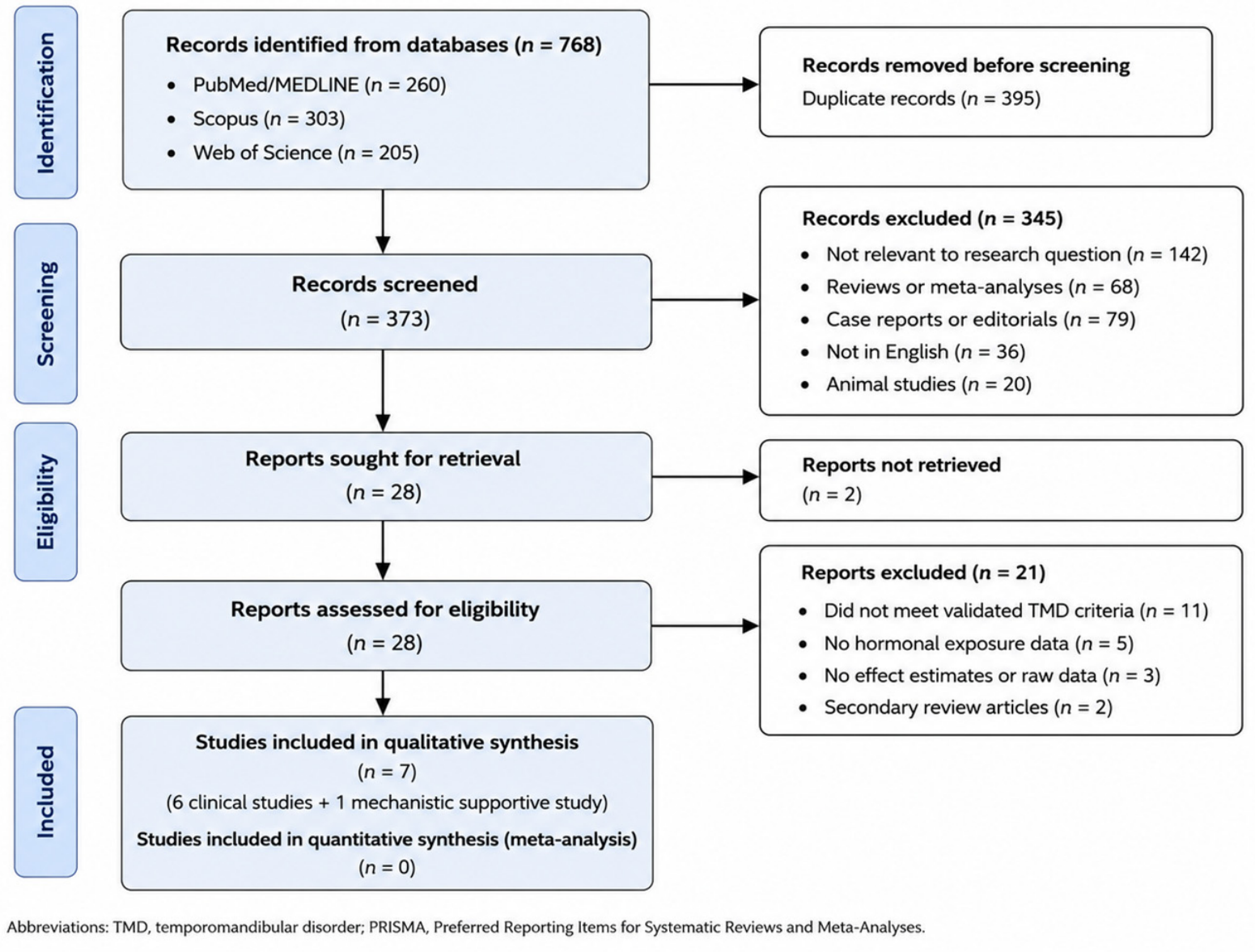
In the original publication [1], inconsistencies were identified between the databases reported in the published PRISMA flow diagram and those described in the PROSPERO registration and Supplementary Materials. To improve transparency and reproducibility, the literature search was reconstructed using the original database-specific search strategies reported in the Supplementary Materials for PubMed/MEDLINE, Scopus, Web of Science, and Google Scholar. Reconstruction of the PubMed/MEDLINE, Scopus, and Web of Science searches identified 768 records, of which 395 duplicate records were removed, yielding 373 unique records for title and abstract screening. Importantly, the reconstructed searches successfully retrieved all studies included in the final review, confirming the completeness of the original evidence base. The PRISMA flow diagram and the corresponding methodological descriptions have been updated accordingly. The number of full-text articles assessed for eligibility (n = 28) and the number of studies included in the qualitative synthesis (n = 7) remained unchanged.
A correction has been made to Section 2.3, “Information Sources and Search Strategy”:
A comprehensive literature search was conducted in three electronic databases from inception through September 2025: PubMed/MEDLINE, Scopus, and Web of Science Core Collection. In addition, Google Scholar was searched as a supplementary source to identify potentially eligible studies not indexed in the primary databases and to minimize the risk of publication bias.
The database searches were performed between September and October 2025 and included studies published through September 2025. The search strategy combined Medical Subject Headings (MeSH) terms and free-text keywords related to temporomandibular disorders, estrogen, hormonal status, and related hormonal exposures, including hormonal contraceptive use, menopausal status, menstrual cycle variation, pregnancy, and estrogen receptor polymorphisms. Search strategies were adapted as appropriate for the syntax and indexing systems of each database.
Reference lists of included studies and relevant review articles were also hand-searched to identify additional eligible studies. Full search strategies for all databases are provided in Supplementary Table S2.
A correction has been made to Figure 1 (PRISMA 2020 flow diagram of study selection). The PRISMA flow diagram has been updated to reflect the reconstructed literature search and revised record identification process.
Figure 1.
PRISMA 2020 flow diagram of the study selection process.
A correction has been made to Section 3.1, “Study Selection”, paragraph 1:
The reconstructed literature search identified 768 records across PubMed/MEDLINE, Scopus, and Web of Science databases. After removing 395 duplicate records, 373 unique records remained for title and abstract screening. Following screening, 28 full-text articles were assessed for eligibility, and 7 studies [23–29] met the inclusion criteria and were included in the qualitative synthesis. Due to substantial heterogeneity in exposures, study designs, and outcomes, no quantitative meta-analysis was performed.
The original Reference [30] has been removed. With this correction, the order of some references has been adjusted accordingly.
A correction has been made to Table 1. The description of the Gaynor et al. (2021) study has been revised to distinguish between self-reported TMD pain symptoms and examiner-classified incident TMD outcomes.
Table 1.
Characteristics of included studies.
In the original publication [1], the findings reported by Gaynor et al. (2021) did not clearly distinguish between self-reported TMD pain symptoms and examiner-classified TMD outcomes. The manuscript has been revised to clarify that the reported odds ratios refer to self-reported first-onset and concurrent TMD pain symptoms, whereas examiner-classified incident TMD was not significantly associated with hormonal contraceptive use (HR 1.36, 95% CI 0.82–2.24).
A correction has been made to Section 3.4.1, “Hormonal Contraceptive Use and TMD”, paragraph 1:
Two studies examined the association between hormonal contraceptive use and TMD [23,25]. Gaynor et al. (2021) conducted a high-quality prospective cohort study within the Orofacial Pain: Prospective Evaluation and Risk Assessment (OPPERA) study, involving 1475 women aged 18–44 years [23]. Hormonal contraceptive use was associated with increased odds of self-reported first-onset TMD pain symptoms (OR 1.37, 95% CI 1.13–1.66) and concurrent self-reported TMD symptoms (OR 1.20, 95% CI 1.06–1.35). However, hormonal contraceptive use was not significantly associated with examiner-classified incident TMD (HR 1.36, 95% CI 0.82–2.24) after adjustment for confounders. LeResche et al. (2003) reported cyclic variation in TMD symptoms across the menstrual cycle in a prospective diary study of 70 TMD-affected women, with symptoms peaking during menstruation and ovulation; however, oral contraceptive use did not significantly modify this pattern [25].
In the original publication [1], the mechanistic study regarding estrogen-induced IL-6 responses in women with temporomandibular disorders was incorrectly attributed. The correct reference (Ribeiro-Dasilva et al., 2017) has now been added as Reference [29], and the relevant text has been revised accordingly. With this correction, the order of some references has been adjusted accordingly.
A correction has been made to Section 3.4.5, “Estrogen Receptor Gene Polymorphisms and TMD”, paragraph 2:
In addition, Ribeiro-Dasilva et al. (2017) demonstrated that ex vivo estrogen stimulation of monocytes obtained from women with and without TMD included increased interleukin-6 (IL-6) production, and that these inflammatory responses were associated with pain measures among women with TMD [29]. Although this mechanistic study was not included in the main clinical synthesis, it provides important biological plausibility supporting the role of estrogen-related inflammatory pathways in TMD pathophysiology.
- 29. Ribeiro-Dasilva, M.C.; Fillingim, R.B.; Wallet, S.M. Estrogen-Induced Monocytic Response Correlates with Temporomandibular Disorder Pain: A Case Control Study. J. Dent. Res. 2017, 96, 285–291. https://doi.org/10.1177/0022034516678599.
A correction has been made to Table 3. The summary of evidence for hormonal contraceptive use has been updated to distinguish between self-reported TMD pain symptoms and examiner-classified incident TMD outcomes. The evidence summary for “Estrogen receptor gene polymorphisms/mechanistic evidence” has been updated to reflect the correct attribution of the mechanistic study to Ribeiro-Dasilva et al. (2017).
Table 3.
Summary of evidence by hormonal exposure category.
A correction has been made to Section 4.1, “Principal Findings”, paragraph 1:
This systematic review synthesized evidence from seven studies, comprising six clinical studies involving 2735 participants and one mechanistic supportive study involving 18 participants, to evaluate the association between estrogen status and temporomandibular disorders in women. The principal findings indicate that hormonal factors, particularly hormonal contraceptive use and menopausal/climacteric status, are associated with increased TMD risk and altered symptom presentation. High-quality evidence from prospective cohort and cross-sectional studies demonstrated that hormonal contraceptive use was associated with increased odds of self-reported first-onset TMD pain symptoms (OR 1.37, 95% CI 1.13–1.66) and concurrent self-reported TMD symptoms (OR 1.20, 95% CI 1.06–1.35), whereas no significant association was observed for examiner-classified incident TMD (HR 1.36, 95% CI 0.82–2.24). In contrast, climacteric status was associated with increased risk of TMJ palpation pain (OR 2.64, 95% CI 1.12–6.21), crepitus (OR 2.92, 95% CI 1.13–7.56), and degenerative joint disease (OR 2.27, 95% CI 1.05–4.91). Additional evidence supported variation in menstrual cycle-related symptoms and genetic susceptibility mediated by estrogen receptor polymorphisms. However, the limited number of high-quality studies, heterogeneity in exposure definitions, and variability in diagnostic criteria constrain definitive conclusions regarding causality and clinical implications.
A correction has been made to Section 4.2.5, “Estrogen Receptor Gene Polymorphisms”:
The association between ERα gene polymorphisms and TMD susceptibility [27] provides genetic evidence supporting a mechanistic role for estrogen signaling in TMD pathophysiology. The XbaI and PvuII polymorphisms may alter ERα expression or function, leading to differential responses to endogenous and exogenous estrogen [36]. The mechanistic findings reported by Ribeiro-Dasilva et al. [29] further support the hypothesis that estrogen modulates inflammatory responses in TMD-affected individuals through pathways involving IL-6 production. These findings suggest that genetic variability in estrogen receptor signaling may contribute to the observed heterogeneity in TMD susceptibility and symptom severity among women and may partially explain inconsistent findings across studies.
Although excluded from the main analysis due to its mechanistic (in vitro/ex vivo) design, Ribeiro-Dasilva et al. [29] provide important biological plausibility for the role of estrogen in TMD. The study demonstrated that estrogen stimulation of monocytes increased IL-6 production, which correlated with clinical pain intensity. These findings support the hypothesis that estrogen may modulate inflammatory pathways relevant to TMD pathophysiology.
The original Reference [38] has been removed.
A correction has been made to Section 4.3, “Comparison with Previous Reviews”, paragraph 1:
A 2018 review by Bueno et al. [3] concluded that evidence linking estrogen status to TMD was inconclusive, primarily due to methodological heterogeneity and small effect sizes.
In the original publication [1], there were errors in the citations supporting the following sentences:
While some investigations suggest that estrogen deficiency or absence of HRT increases TMD risk and pain severity, others report neutral or heterogeneous associations, particularly with respect to OC use [10].
The original Reference [14] has been replaced with a more relevant Reference [10]. The original Reference [14] has been removed.
The secondary peak during ovulation, when estrogen levels are highest, suggests a more complex, non-linear relationship between estrogen levels and pain, possibly mediated by rapid hormonal shifts or interactions with other neuromodulators such as serotonin and endogenous opioids [34].
The original Reference [35] has been replaced with a more relevant Reference [34]. The original Reference [35] has been removed.
With the above corrections, the order of some references has been adjusted accordingly.
The authors state that the scientific conclusions are unaffected. This correction was approved by the Academic Editor. The original publication has also been updated.
Reference
- Mazareanu, A.; Grigorov, C.; Pandea, A.; Iacob, M.; Balaiasa, D.G.; Greenbaum, T.; Konecny, P. Estrogen Status and Temporomandibular Disorders: A Systematic Review. Int. J. Environ. Res. Public Health 2026, 23, 717. [Google Scholar] [CrossRef] [Scilit] [PubMed]
Disclaimer/Publisher’s Note: The statements, opinions and data contained in all publications are solely those of the individual author(s) and contributor(s) and not of MDPI and/or the editor(s). MDPI and/or the editor(s) disclaim responsibility for any injury to people or property resulting from any ideas, methods, instructions or products referred to in the content. |
© 2026 by the authors. Licensee MDPI, Basel, Switzerland. This article is an open access article distributed under the terms and conditions of the Creative Commons Attribution (CC BY) license.