


Highlights
Public health relevance—How does this work relate to a public health issue?
- This study examines whether known environmental risk factors account for regional differences in cerebrovascular disease risk.
- We specifically focused on Jeju Island, South Korea, where the population exhibits a paradoxical cerebrovascular profile characterized by the highest prevalence of hypertension in Korea but the lowest stroke mortality nationwide.
Public health significance—Why is this work of significance to public health?
- Cerebrovascular disease is a leading cause of death and disability worldwide. Determining whether established environmental risk factors explain regional variation in cerebrovascular disease is important for identifying gaps in our current understanding of disease risk.
Public health implications—What are the key implications or messages for practitioners, policy makers, and/or researchers in public health?
- Individuals from Jeju Island were less likely to report a parental history of stroke than individuals from Seoul, even after adjustment for known cerebrovascular risk factors.
- This finding suggests that environmental risk factors alone may not fully explain regional differences in cerebrovascular disease risk across Korea and highlight the need for further research into additional contributors such as genetic variation.
Abstract
Background: Despite having one of the highest prevalences of hypertension in Korea, Jeju Island maintains the lowest rate of stroke mortality nationwide. This paradoxical cardiovascular disease health profile raises questions about the underlying factors contributing to differential stroke risk in the Jeju population. Methods: We used health data from the Korea National Health and Nutrition Examination Survey (KNHANES) to investigate whether differences in regional stroke outcomes can be explained by known environmental and behavioral health contributors to increased cerebrovascular disease risk. We applied logistic regression with backward feature selection and cross-validation to identify predictors of parental history of stroke. Results: We found that individuals from Jeju Island were less likely to report a parental history of stroke compared to individuals from Seoul. This finding persisted even after adjusting for known cerebrovascular risk factors, including age, sex, SBP, antihypertensive use, dietary sodium intake, BMI, and hematocrit. Conclusions: Our results suggest that other hidden factors may contribute to the risk of cerebrovascular disease. Given the unique genetic architecture of the island, these findings prompt future analyses to explore whether genetic variation on Jeju contributes meaningfully to their reduced stroke mortality.
1. Introduction
Jeju Island, Korea, presents a cardiovascular paradox. Compared with the Korean mainland, Jeju has one of the highest prevalences of hypertension in the country, yet the lowest stroke mortality rate nationwide. According to national health statistics, Jeju’s age-standardized stroke mortality rate was 24.3 per 100,000 in 2015, roughly 18% lower than the Korean national average of 29.6 per 100,000 [1]. This discrepancy was identified in a nationwide study that reported absolute differences in mortality but did not account for environmental or lifestyle contributors. As a result, the underlying causes of Jeju’s reduced stroke mortality remain unclear.
To investigate whether environmental and behavioral factors alone can explain differences in regional stroke outcomes, we analyzed population-level health data from the Korea National Health and Nutrition Examination Survey (KNHANES) [2]. We compared individuals from Jeju and Seoul, the two genetically and geographically distinct Korean populations [3]. We examined known contributors to increased cerebrovascular health risk, such as hypertension [4], sex, age [5], body mass index (BMI) [6], hematocrit [5], alcohol consumption, [7] smoking [8], and diet [9,10]. Through this comparison, we evaluate whether the observed regional variation in stroke outcomes can be explained by known risk factors or whether it may point to the presence of additional, unrecognized influences on population health.
2. Materials and Methods
Data for this study was obtained from the Korea National Health and Nutrition Examination Survey (KNHANES) [2], which is supported by the Korean Disease Control and Prevention Agency. We focused our analysis on participants from Jeju (reported only in the years following 2017) and Seoul, two populations that have been established as genetically distinct [3]. The distribution of participants was imbalanced across regions (Jeju n = 625; Seoul n = 5624). Because of this imbalance, we explored survey weights, matching, and normalization.
The Jeju sample comprised 625 participants with 59 parental stroke cases distributed across 24 primary sampling units (PSUs), compared to Seoul’s 5624 participants with 749 cases across 219 PSUs. This disparity resulted in a design effect (DEFF) of 5.32 for Jeju versus 1.81 for Seoul, indicating that survey weights inflated variance in Jeju by more than fivefold compared to simple random sampling—well above the threshold (DEFF > 3). This result suggests inappropriate weighting for subgroup analysis. Additional diagnostics confirmed high weight variability in Jeju (coefficient of variation = 0.87 vs. 0.49 in Seoul; maximum-to-mean ratio = 7.1 vs. 3.0) despite reasonable weight distribution across PSUs, indicating that the instability arose from fundamental sample size limitations rather than correctable weight concentration issues. Given that both regions contained sufficient outcome events for logistic regression (Jeju: 41 strokes; Seoul: 1038 strokes), and that logistic regression does not require balanced predictors across regions, the observed regional imbalance is unlikely to substantially compromise model estimation. Moreover, the number of outcome events in each region was sufficient to support reliable estimation under commonly used event-per-parameter considerations. We, therefore, present unweighted estimates as our primary analysis, acknowledging that the survey design, while appropriate for national estimates, lacks sufficient precision for robust weighted inference within the small Jeju subsample.
Our initial analysis considers regional variation in potential stroke contributors. For this, the full analytic sample was used without removing participants with missing data (Jeju n = 1106; Seoul n = 9834). Because data collected for KNHANES is self-reported, any mention of diagnostic disease remains unconfirmed. We used the following variables from the KNHANES dataset: age, sex, BMI, dietary sodium, dietary sugar, dietary fat, hypertension, hypertensive medication use, alcohol consumption, smoking, SBP, DBP, hemoglobin, parental history of stroke (reported without differentiation between ischemic and hemorrhagic subtypes or age when stroke occurred), and parental history of IHD. While individual stroke history would temporally serve as the ideal variable for analysis, such data was unavailable in the KNHANES dataset. We, therefore, used parental stroke as a proxy within our analysis. This approach is supported by the substantial genetic contribution to stroke, with heritability estimates of up to 40% depending on subtype [11] and genome-wide association studies identifying 35 loci [12] associated with stroke risk. Nevertheless, we acknowledge that parental stroke remains an imperfect proxy and may be subject to recall bias and/or false reports. For details on variable definitions and the PPI statement, see the Supplementary Materials.
For our final analysis, we consider variable association with parental history of stroke using logistic regression. For this final analytic dataset, we included only participants with complete data for the outcome (parental history of stroke) and all retained predictors (n = 625 Jeju, 5624 Seoul). We performed a feature selection analysis using both classical statistical modeling and regularization-based techniques. We developed six logistic regression models to evaluate and compare feature selection strategies. Region (Jeju vs. Seoul) was included as a predictor in all models to estimate the association between geographic region and stroke prevalence. A ‘full model’ included all candidate predictors without prior selection. From there, we performed forward selection in which variables were added sequentially to the model based on the greatest improvement in model fit (assessed by the Akaike Information Criterion). We followed this approach with backward elimination starting from the full model, sequentially removing variables. With a final stepwise selection, we combined the forward and backward procedures.
The backward and stepwise selection procedures each identified the same 8-variable model with identical AIC (3757.4), improving fit compared with the full 14-variable model (AIC 3771.3), which was, therefore, selected as the final model. Following predictor selection, we performed a LASSO regression, five-fold cross-validation, and recursive feature elimination (RFE) to identify the optimal variables with the highest association with parental stroke. Finally, we assessed multicollinearity among candidate predictors using the Variance Inflation Factor (VIF) and further evaluated retained predictors for statistical significance (p < 0.05). For additional details on variable transformations and model development, see the Supplementary Materials.
To evaluate robustness to potential regional imbalance, we re-fit the multivariable logistic regression model restricted to Seoul participants. Estimated associations for age, sex, antihypertensive medication use, and blood pressure measures were highly consistent in direction and magnitude with those observed in the full model. For example, the odds ratio for antihypertensive medication use was 1.71 (95% CI: 1.23–2.41) in the full model and 1.66 (95% CI 1.18–2.37) in the Seoul-restricted model. Similarly, the estimated association for male sex remained stable across analyses. These findings indicate that the primary associations are not driven by the larger Seoul sample.
We further examined regional heterogeneity by testing the interaction terms between region and each final-model predictor individually. The region–hemoglobin interaction was statistically significant (p = 0.045). The hemoglobin–parental stroke association was stronger in Seoul (OR = 1.33 per 1 g/dL increase) than in Jeju (OR = 1.07, 95% CI: 0.98–1.16), where the association did not reach significance on its own. Interactions between region and antihypertensive medication use (p = 0.62) or diastolic blood pressure (p = 0.84) were not significant. An omnibus likelihood-ratio test comparing the main-effects model to a model with all three interactions was non-significant (χ2 = 4.89, df = 3, p = 0.18), and AIC did not improve with the interaction terms included (3757.4 vs. 3758.5), indicating that regional heterogeneity among these predictors, while present for selected predictors, was modest, and it is limited to the hemoglobin association.
To address potential under-ascertainment of parental stroke history among younger participants, we conducted an age-restricted analysis including only individuals aged ≥40 years. Effect estimates for region, hematocrit, antihypertensive medication use, and sex were consistent in direction and similar or modestly larger in magnitude compared with the full model. As expected, given the reduced age range, the age coefficient attenuated in the restricted sample. The regional difference persisted among participants aged ≥40 years. Collectively, these sensitivity analyses support the stability of the primary findings and indicate that the observed associations are robust to regional restriction and age-based analyses, with only mild evidence of regional heterogeneity for selected covariates.
3. Results
3.1. Regional Variation in Potential Stroke Contributors
To understand the observed regional variation in stroke mortality between Jeju and Seoul, we began by investigating which environmental variables vary regionally. We first evaluated multicollinearity using a correlation matrix (Supplementary Figure S1). We found no significant pair-wise associations and thus included all variables in the subsequent analysis.
We observed multiple environmental factors that differ between regions. Among the continuous traits examined, body mass index (BMI), systolic blood pressure (SBP), and dietary intake of fat all differed between Jeju and Seoul. Jeju participants had higher BMI (23.4 ± 4.3 vs. 22.98 ± 4.1; d = −0.103) and SBP (119.7 ± 16.8 mm Hg vs. 116.6 ± 16.32 mm Hg; d = −0.185), as well as lower dietary intake of fat levels (45.79 ± 34.33 vs. 49.6 ± 34.85; d = 0.109) than in Seoul. We found no regional differences in age, diastolic blood pressure, hematocrit, hemoglobin, sugar, or sodium (Table 1).
Table 1.
Comparison of Continuous Variables between Jeju and Seoul.
Among the discrete variables, hypertension (V = 0.045), alcohol consumption (V = 0.083), and antihypertensive medication use (V = 0.020) varied by region, with higher prevalence in Jeju. These results align with previous reports [1] that indicate a higher burden of hypertension in Jeju, likely driven by elevated SBP, as DBP did not differ between regions (Supplementary Figure S2). Further, despite regional differences in parental history of stroke (V = 0.027), there was no regional difference in the rate of parental ischemic heart disease (IHD), a proxy for genetic contributions to coronary artery disease (Table 2).
Table 2.
Comparison of Discrete Variables between Jeju and Seoul.
3.2. Variable Association with Parental History of Stroke
While the lifestyle factors associated with stroke are broadly understood, population-specific risk factors may exist. To investigate this within the Jeju population, we first considered which variables were associated with and/or predictive of parental history of stroke. To do this, we first evaluated multicollinearity using generalized variance inflation factors (GVIFs). All variables remained below 2.0 (GVIF threshold for elimination > 5) and were retained in the model.
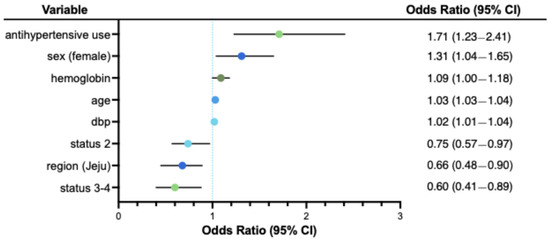
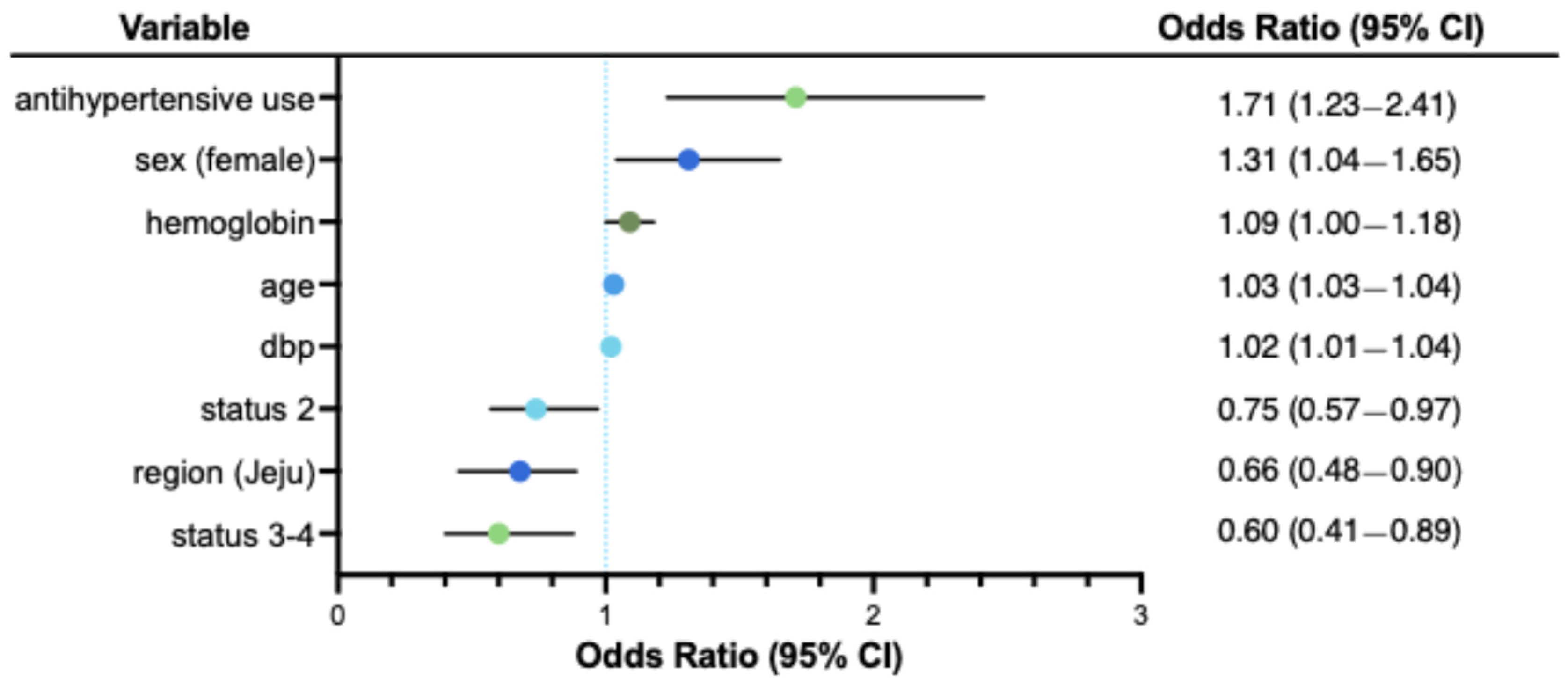
We applied logistic regression with backward feature selection (AIC: 3757.4) to identify predictors of the binary outcome for parental history of stroke. The final model retained only the eight predictors shown in Figure 1. Our results indicate that the Jeju population is associated with a 33.6% decrease in odds of a parental history of stroke, though this finding should be interpreted with caution, given the relatively modest effect size and the use of parental stroke history rather than individual stroke as the outcome. Additionally, age, antihypertensive medication use, female sex, higher diastolic blood pressure, and higher hemoglobin levels were associated with increased odds of parental history of stroke (Figure 1). In contrast, hypertension status categories 2–4 were associated with lower odds of parental history of stroke relative to the reference hypertension-status category. Dietary sodium intake did not differ significantly between regions and was not found to be a predictor of parental stroke history in our models.
Figure 1.
Adjusted odds ratios and 95% confidence intervals for predictors of parental stroke in the final logistic regression model. All predictors were statistically significant with the exception of sodium, SBP and hematocrit. Region as a predictor yielded an odds ratio most suggestive of a meaningful association.
The intercept was statistically significant (OR = 0.0006, 95% CI: 0.0001–0.0027), reflecting the estimated baseline odds when all model covariates are at their reference or zero values. LASSO and RFE independently converged on the same 4-variable “core” (region, age, antihypertensive use, DBP), providing evidence that these four associations are the most robust in the data. The four additional variables in the AIC-selected model (sex, hemoglobin, hypertension status) reflect more marginal associations (p = 0.02–0.04) that a stricter, prediction-oriented criterion did not retain.
4. Discussion
In this study, we examined regional variation in parental history of stroke among Korean adults and found that individuals from Jeju Island were less likely to report a parental history of stroke compared to individuals from Seoul. This finding persisted even after adjusting for known cerebrovascular risk factors, including age, sex, DBP, antihypertensive use, hemoglobin and hypertension status. Notably, this pattern was specific to parental stroke; no regional difference was observed in reported parental history of IHD. These results, while based on parental stroke history rather than mortality, coincide with prior epidemiological data showing lower stroke mortality in Jeju relative to Seoul [1] but additionally demonstrate that this disparity may persist even after accounting for known environmental and physiological covariates.
DBP and hypertension status were both retained as significant predictors in our model, though hypertension status showed an inverse association after adjustment for DBP and antihypertensive medication use. This pattern may reflect treatment effects among diagnosed individuals rather than a true protective effect and warrants cautious interpretation. SBP itself was not retained in the final model despite showing a stronger unadjusted regional difference. It is unclear based on these analyses if DBP is acting as a proxy for other unmeasured vascular or behavioral factors. However, its retention in the model is potentially interesting in light of previous evolutionary genomic analyses in the Jeju population, which identified variants under positive selection associated with the attenuated DBP responses observed during simulated apnea with facial submersion [3]. Although this connection remains speculative, it warrants further investigation.
Across our analyses, effect sizes were consistently modest by conventional benchmarks. Among continuous variables, Cohen’s d ranged from 0.006 (age) to 0.185 (systolic blood pressure). Among discrete variables, Cramer’s V ranged from 0.003 (parental ischemic heart disease) to 0.083 (alcohol consumption) (Table 1 and Table 2). Given our large sample size, associations of this magnitude reliably reach statistical significance without necessarily reflecting effects that are meaningful at the level of an individual patient. This distinction bears directly on our primary finding: the regional association in parental stroke history (OR = 1.51, 95% CI: 1.11–2.09) should be understood as a population-level epidemiological signal rather than a clinically actionable predictor of individual stroke risk.
These findings should be interpreted in light of several limitations. The KNHANES dataset does not report confounders such as education, income, physical activity, parental stroke subtype, age when stroke occurred, or individual stroke history that limit interpretation. The dataset also excludes several known contributors to stroke, such as air pollution with particulate matter ≤2.5 microns, behavioral variables such as emotional stress, atrial fibrillation, myocardial infarction, cholesterol, HDL, LDL, and atherosclerosis, which limits the comprehensiveness of our analysis and may contribute to unmeasured confounding of the estimated regional association with parental history of stroke. The use of parental stroke as a proxy for individual stroke risk is also not ideal and warrants additional analysis to determine whether individual stroke risk follows the patterns observed here. Further, Seoul was the only Korean region compared to Jeju for this analysis, limiting the generalizability of our analyses.
Additionally, factors such as stroke prevention and recognition education, access to healthcare, rural versus urban residence, and exposure to stroke awareness programs may contribute to regional differences in stroke risk. These factors have evolved over the duration of KNHANES and across the lifetimes of the Seoul and Jeju populations. Because they are not captured by KNHANES and are difficult to quantify retrospectively, they are not included in this analysis, although their exclusion may have influenced the observed regional associations. The KNHANES dataset also reflects a population imbalance, with only 1106 Jeju individuals compared to 9834 from Seoul between 2017 and 2022, potentially impacting statistical power. Future studies should aim to address these limitations by incorporating more balanced sampling and finer-grained environmental and behavioral data.
Despite these limitations, our results do raise important questions about potential contributors to regional differences in cerebrovascular health. Collectively, our findings suggest that Jeju Islanders may suffer less from cerebrovascular disease relative to individuals from Seoul for reasons not captured by conventional risk factors. Given the observation that parental stroke history appears lower in Jeju despite inflated hypertension prevalence, a potential disconnect between blood pressure levels and downstream disease risk, future studies should consider whether unexplored factors such as genetic variants [13] under selection in Jeju are associated with stroke risk or protection at the population level. Functional characterization of these variants, including their interactions with inflammatory and vascular pathways, will also be essential to determine clinical relevance. Additionally, future analyses should consider whether differential death due to ischemic heart disease (IHD) in Jeju and Seoul contributes to discrepancies in stroke mortality.
Supplementary Materials
The following supporting information can be downloaded at https://www.mdpi.com/article/10.3390/ijerph23091147/s1, Table S1. Comparison of Discrete Variables between Jeju and Seoul; Table S2. Comparison of estimated associations from the primary logistic regression model and sensitivity analyses; Figure S1. Correlation Matrix Heatmap Between Potentially Collinear Variables (calculated by Pearson R); Figure S2. Hypertension, SBP, and DBP by Region; Figure S3. Age distribution of both Jeju and Seoul.
Author Contributions
Conceptualization, M.A.I. and M.T.-F.; methodology, E.J.H.; software, E.J.H.; validation, E.J.H.; formal analysis, E.J.H., G.H. and M.A.I.; investigation, G.H. and M.A.I.; resources, S.K., M.A.I. and E.J.H.; data curation, S.K. and C.J.; writing—original draft preparation, G.H., E.J.H. and M.A.I.; writing—review and editing, M.T.-F., S.K. and C.J.; visualization, E.J.H. and M.A.I.; supervision, M.A.I.; project administration, M.A.I. and E.J.H.; funding acquisition, M.A.I. All authors have read and agreed to the published version of the manuscript.
Funding
This research was funded by the Office of Naval Research, grant number N00014-20-1-2556, and the National Institute of Health, NLM T15 Training Grant.
Institutional Review Board Statement
The study was conducted in accordance with the Declaration of Helsinki and approved by the Institutional Review Board of the Korea Disease Control and Prevention Agency (KDCA), Republic of Korea.
Informed Consent Statement
Informed consent was obtained from all subjects involved in the study.
Data Availability Statement
All original code will be deposited to GitHub and made publicly available as of the date of publication and can be found at https://github.com/Hernandez-J-Lab/knhanes-stroke-analysis, accessed on 20 July 2026.
Conflicts of Interest
The authors declare no conflicts of interest.
Abbreviations
The following abbreviations are used in this manuscript:
| KNHANES | Korean National Health and Examination Survey |
| DBP | Diastolic Blood Pressure |
| SBP | Systolic Blood Pressure |
| IHD | Ischemic Heart Disease |
| BMI | Body Mass Index |
References
- Kim, J.Y.; Kang, K.; Kang, J.; Koo, J.; Kim, D.-H.; Kim, B.J.; Kim, W.-J.; Kim, E.-G.; Kim, J.G.; Kim, J.-M.; et al. Executive Summary of Stroke Statistics in Korea 2018: A Report from the Epidemiology Research Council of the Korean Stroke Society. J. Stroke 2019, 21, 42–59. [Google Scholar] [CrossRef] [Scilit] [PubMed]
- Kweon, S.; Kim, Y.; Jang, M.-J.; Kim, Y.; Kim, K.; Choi, S.; Chun, C.; Khang, Y.-H.; Oh, K. Data Resource Profile: The Korea National Health and Nutrition Examination Survey (KNHANES). Int. J. Epidemiol. 2014, 43, 69–77. [Google Scholar] [CrossRef] [Scilit] [PubMed]
- Aguilar-Gomez, D.; Bejder, J.; Graae, J.; Ko, Y.; Vaughn, A.; Clement, K.; Tristani-Firouzi, M.; Lee, J.Y.; Nordsborg, N.B.; Nielsen, R.; et al. Genetic and training adaptations in the Haenyeo divers of Jeju, Korea. Cell Rep. 2025, 44, 115577. [Google Scholar] [CrossRef] [Scilit] [PubMed]
- Ettehad, D.; Emdin, C.A.; Kiran, A.; Anderson, S.G.; Callender, T.; Emberson, J.; Chalmers, J.; Rodgers, A.; Rahimi, K. Blood pressure lowering for prevention of cardiovascular disease and death: A systematic review and meta-analysis. Lancet 2016, 387, 957–967. [Google Scholar] [CrossRef] [Scilit] [PubMed]
- Boehme, A.K.; Esenwa, C.; Elkind, M.S. Stroke risk factors, genetics, and prevention. Circ. Res. 2017, 120, 472–495. [Google Scholar] [CrossRef] [Scilit] [PubMed]
- Wang, X.; Huang, Y.; Chen, Y.; Yang, T.; Su, W.; Chen, X.; Yan, F.; Han, L.; Ma, Y. The relationship between body mass index and stroke: A systemic review and meta-analysis. J. Neurol. 2022, 269, 6279–6289. [Google Scholar] [CrossRef] [Scilit] [PubMed]
- Reynolds, K.; Lewis, B.; Nolen, J.D.; Kinney, G.L.; Sathya, B.; He, J. Alcohol consumption and risk of stroke: A meta-analysis. JAMA 2003, 289, 579–588. [Google Scholar] [CrossRef] [Scilit] [PubMed]
- Shinton, R.; Beevers, G. Meta-analysis of relation between cigarette smoking and stroke. Br. Med. J. 1989, 298, 789–794. [Google Scholar] [CrossRef] [Scilit] [PubMed]
- Sasaki, S.; Zhang, X.-H.; Kesteloot, H. Dietary sodium, potassium, saturated fat, alcohol, and stroke mortality. Stroke 1995, 26, 783–789. [Google Scholar] [CrossRef] [Scilit] [PubMed]
- Fan, J.; Song, Y.; Wang, Y.; Hui, R.; Zhang, W. Dietary glycemic index, glycemic load, and risk of coronary heart disease, stroke, and stroke mortality: A systematic review with meta-analysis. PLoS ONE 2012, 7, e52182. [Google Scholar] [CrossRef] [Scilit] [PubMed]
- Bevan, S.; Traylor, M.; Adib-Samii, P.; Malik, R.; Paul, N.L.M.; Jackson, C.; Farrall, M.; Rothwell, P.M.; Sudlow, C.; Dichgans, M.; et al. Genetic heritability of ischemic stroke and the contribution of previously reported candidate gene and genomewide associations. Stroke 2012, 43, 3161–3167. [Google Scholar] [CrossRef] [Scilit] [PubMed]
- Dichgans, M.; Pulit, S.L.; Rosand, J. Stroke genetics: Discovery, biology, and clinical applications. Lancet Neurol. 2019, 18, 587–599. [Google Scholar] [CrossRef] [Scilit] [PubMed]
- Ryu, J.; Lee, C.W.; Shin, J.A.; Park, C.S.; Kim, J.J.; Park, S.J.; Han, K.H. FcgammaRIIa mediates C-reactive protein-induced inflammatory responses of human vascular smooth muscle cells by activating NADPH oxidase 4. Cardiovasc. Res. 2007, 75, 555–565. [Google Scholar] [CrossRef] [Scilit] [PubMed]

Disclaimer/Publisher’s Note: The statements, opinions and data contained in all publications are solely those of the individual author(s) and contributor(s) and not of MDPI and/or the editor(s). MDPI and/or the editor(s) disclaim responsibility for any injury to people or property resulting from any ideas, methods, instructions or products referred to in the content. |
© 2026 by the authors. Licensee MDPI, Basel, Switzerland. This article is an open access article distributed under the terms and conditions of the Creative Commons Attribution (CC BY) license.