


Highlights
Public health relevance—How does this work relate to a public health issue?
- This EtD framework directly addresses the public health burden of asbestos exposure, which is linked to life-threatening diseases such as mesothelioma. Focusing on the diagnostic test and clinical follow-up may contribute to reducing morbidity and/or mortality in exposed populations. Evidence for improved clinical outcomes from early detection remains limited.
- The findings give information to create public health strategies and policies, supporting safer environments through asbestos regulation, removal programs, and awareness campaigns. This helps protect workers, families, and communities from ongoing risks associated with legacy asbestos in buildings and industrial settings.
Public health significance—Why is this work of significance to public health?
- It establishes evidence-informed surveillance (screening and follow-up protocols) for non-malignant asbestos-related diseases, ensuring early detection and standardized care in Colombia’s healthcare system.
- Aligning clinical practice with national asbestos regulations and public health policy strengthens equity, feasibility, and long-term prevention strategies for populations still at risk from installed asbestos.
Public health implications—What are the key implications or messages for practitioners, policy makers and/or researchers in public health?
- For practitioners, the guidelines emphasize chest X-ray with ILO classification, complemented by pulmonary function tests and occupational history, as the cornerstone of early detection and monitoring—providing a standardized, low-cost approach that can be feasibly integrated into routine care.
- For policymakers and researchers, the EtD framework emphasizes the importance of aligning clinical recommendations with national asbestos regulations, assessing the cost-effectiveness of screening, and enhancing surveillance systems—ensuring equitable access, consistent implementation, and evidence-informed policy development.
Abstract
Introduction: Asbestos exposure is a well-established cause of malignant and non-malignant respiratory diseases. In Colombia, despite Law 1968/2019 banning asbestos use, asbestos in the built environment remains a risk to public health. Recent regulations (Decrees 04021/2021 and 0221/2023) mandate a national care pathway for exposed individuals, underscoring the need for evidence-based diagnostic and follow-up recommendations. Objective: The objective is to formulate clinical practice recommendations for the detection and monitoring of non-malignant asbestos-related diseases in asbestos-exposed populations within the Colombian healthcare system, using the Evidence-to-Decision (EtD) framework. Methods: A multidisciplinary working group applied the GRADE-EtD approach to three priority questions (PICO format): Optimal screening test for surveillance of asbestos-exposed individuals; appropriate follow-up for individuals with negative screening results; and follow-up criteria for those with abnormal findings. Systematic searches were performed in Medline, Embase, Cochrane Library, BVS, and Google Scholar. Eligible studies included diagnostic accuracy research, observational studies, and clinical practice guidelines in English or Spanish. Evidence quality was assessed using Joanna Briggs Institute tools and AGREE II for guidelines. Results: From 1253 records screened for Question 1, 23 studies were included; for Questions 2 and 3, two and three studies met criteria, respectively. Chest X-ray (CXR) with International Labour Organization (ILO) classification demonstrated sensitivity ranging from 0.60 to 0.94 and specificity from 0.47 to 0.88 compared with computerized tomography (CT) or High-Resolution CT (HRCT). No harm from CXR was reported in the literature. Evidence supported complementing CXR with pulmonary function testing and clinical history (including smoking and occupational exposure). In individuals with normal CXR and lung function results, follow-up every three years was advised; abnormal findings should prompt HRCT evaluation to confirm disease and guide management. Conclusions: The working group conditionally recommends CXR with ILO classification as the primary screening tool for surveillance of non-malignant asbestos-related diseases in asbestos-exposed populations in Colombia, supplemented by targeted clinical and lung function assessment. Periodic follow-up is necessary for exposed individuals regardless of baseline findings. These guidelines provide a standardized approach that aligns with national policy and can facilitate early detection and equitable care, and may be resource-efficient.
1. Introduction
Asbestos exposure has long been associated with a range of serious health conditions, including non-malignant diseases that significantly impact respiratory health. The inhalation of asbestos fibers can lead to pleural diseases like pleural plaques, diffuse pleural thickening, pleural effusions, and rounded atelectasis, parenchymal fibrosis (asbestosis), and malignant diseases such as cancers of the lung, larynx and ovary as well as malignant mesothelioma of the pleura and peritoneum [1,2]. Characteristically, all have a long latent period and offer an opportunity for early detection for effective management.
In Colombia, Law 1968 of 2019 prohibited “the exploitation, production, marketing, import, distribution or export of any variety of asbestos”. Legislation is supported by Decree 402 of 2021, promulgated in 2021 by the Ministry of Commerce, Industry, and Tourism. These are important steps but do not remove emergent health consequences from past exposures nor the risks of continued occupational, environmental, and household exposure to asbestos in the built environment. Asbestos remains, therefore, a public health problem in Colombia.
In recognition of the importance of this risk, Resolution 1786 of 2025 formally adopts the technical and operational guidelines of the Ruta Integral de Atención en Salud (RIAS) for persons, families, and communities with potential exposure to asbestos or asbestos-related diseases, establishing binding provisions for its implementation across the national territory.
This program seeks to guarantee the timely and complete management of the main health risks faced by individuals, families, and communities related to exposure to asbestos together with individualized interventions for early detection, diagnosis, and treatment for people with diseases due to asbestos exposure. This resolution defined screening as an initial intervention within the RIAS that should be covered and paid for by the healthcare system.
Robust guidelines and efficient diagnostic protocols are needed because of the widespread use of asbestos in various industries and the breadth of exposure in the community. The need extends beyond the risk of cancer and mesothelioma. Non-malignant asbestos-related diseases cause functional impairment, worsen quality of life and may cause chronic pain. Early and accurate diagnosis are essential. Detection begins with identification of exposure with a thorough occupational history together with identifying other exposures. Both increased awareness and continuous training for healthcare providers are essential to improve the recognition and management of asbestos-related diseases.
There is an important triad of issues here. Asbestos exposure is common, the consequences may be severe and there is a need for health workforce education. Developing comprehensive and evidence-informed guidelines is essential to improving the diagnosis and subsequent management of these diseases. Although better management is important, the primary objective of these guidelines is to establish an initial surveillance model focused on the early identification of non-malignant disease in exposed populations. Chest X-rays are the traditional tool for initial investigation of asbestos-related thoracic disease and more recently computerized tomography (CT), specifically High-Resolution CT (HRCT), has been used in some settings [3].
By focusing on evidence-informed practices and integrating them into clinical guidelines, healthcare systems can better address the diagnostic challenges associated with non-malignant asbestos-related diseases [4].
Whilst the harms of asbestos are seen wherever it has been mined, manufactured and installed, there are local issues pertinent to each country and its own health system.
The project aims to produce guidelines for individuals exposed to asbestos within the Colombian healthcare system, focusing particularly on three key areas:
- -
- The optimal screening test for individuals with asbestos exposure.
- -
- The necessary clinical follow-up for individuals with negative findings on screening tests.
- -
- The required clinical follow-up for individuals with positive findings on screening tests.
We use the term “screening” to refer to the process of attempting to detect asbestos-related disease within the asbestos-exposed population rather than implying the use of a comprehensive program of early identification, investigation and management of asbestos-related disease.
2. Materials and Methods
This study applied the evidence-to-decision (EtD) framework, which can be used to formulate clinical recommendations and provide decisions about the healthcare system or public health. The frameworks are based on the GRADE system to assess the robustness of recommendations [5,6,7,8]. Clinical practice guidelines (CPGs) are systematically developed statements that translate evidence into actionable recommendations to optimize patient care. EtD frameworks provide a structured, transparent methodology to guide guideline working groups in formulating these recommendations. These frameworks systematically evaluate criteria such as benefits, harms, certainty of evidence, patient values, cost-effectiveness, equity, acceptability, and feasibility. For each category, the EtD framework defined judgments according to the evidence analyzed and the working group consensus. Consensus was reached through discussion during monthly meetings. The working group was composed of methodologists and thematic advisors who were based at ADDRI, University of Sydney, Drexel University, Fundacentro and FUNDCLAS.
The working group developed three PICO questions.
- For those individuals who have had an appropriate history of asbestos exposure, should the screening evaluation simply be a chest X-ray, which is then read using the ILO classification? What are the relevant eligibility criteria for inclusion in a screening [surveillance] program [of asbestos-exposed people]?
- For those individuals with negative findings on the initial screening tool, what is the appropriate follow-up thereafter? And when is the use of CT scans appropriate?
- For those individuals with positive findings on the initial screening tool, what will be the burden and criteria for a diagnosis of asbestosis or other disease that must be met?
Searches were performed for each of the questions in the following databases: Medline—PubMed, Embase, Cochrane Library, BVS, and Google Scholar. In addition, we searched the websites of developers or compilers of clinical practice guidelines. The questions and search terms used can be found in Supplementary Material Section S1. Search strategies and details for each of the databases can be found in Supplementary Material Section S2.
For each of the questions, the references were downloaded in RIS or nbib format. These files were made available on the Rayyan software version 1.7.7 [9] where the screening by title and abstract was carried out in duplicate by the reviewers with a blind strategy. Where there was disagreement, a third reviewer was consulted and a final decision was made on a consensus basis.
The inclusion criteria for the articles were studies that satisfied all of the following: included a population with non-malignant disease related to asbestos exposure; were any of a clinical trial, diagnostic test study, cohort study, case–control study, cross-sectional study or clinical practice guideline; were published in English or Spanish; were available as full-text articles; and had any publication date. The exclusion criteria were studies that focused on malignant diseases.
The quality of the evidence was assessed using the tools of the Joanna Briggs Institute (JBI) according to the type of study design. An assessment of the quality of the evidence is presented in Supplementary Material Section S5.
3. Results
For Question 1, 1253 articles were reviewed by title and abstract, of which 84 underwent full-text review, and finally 23 articles were included. For Question 2, 91 articles were reviewed by title and abstract, of which five were reviewed in full text, and two studies were included. For Question 3, 96 articles were reviewed by title and abstract, of which seven were reviewed in full text, and three studies were included. Details can be seen in Supplementary Material Section S3. The data extraction results were checked in terms of the quality and completeness of the information extracted.
Question 1 included 23 articles, of which 11 (47.8%) were cross-sectional, five (21.7%) were diagnostic test studies, and three (13.0%) were cohort-based. A total of 44,615 patients aged from 20 to 72 years were included, the majority of participants were male, and all the participants in the studies were workers in civil and naval construction, manufacture of asbestos products, textile, electrical, mining or metallurgical industries. The quantification of asbestos exposure was reported in 14 (60.8%) studies; however, a lot of variability was observed in the way this measure was reported—by concentration of asbestos particles, type of occupational activity carried out, and duration of exposure in years.
All studies performed a chest X-ray and applied the ILO classification when reporting the findings from the images. Additionally, eight (34.7%) studies reported the use of CT as diagnostic imaging, six (26.0%) studies reported the use of spirometry and pulmonary function tests, and four (17.3%) studies reported clinical examination and obtaining a history of tobacco use. Five (21.7%) of the studies reported diagnostic test data such as chest X-ray sensitivity and specificity. All the details of this information are presented in Supplementary Material Section S4—Tables S10–S14.
For Question 2, two articles were included, a cohort study and a cross-sectional study. These studies comprised a total of 1648 patients with an age range of 41.8 to 64.5 years; 1642 out of 1648 were male. The study by Becklake and co-workers [10] included only chrysotile asbestos workers in Canada. A questionnaire, lung function measurement and chest X-ray were used. The study by Vierikko and co-workers [11] included construction workers, plumbers, real estate agents, and cleaning workers from Finland, all of whom had a CT scan. Detailed information on these studies is found in Supplementary Material Section S4—Tables S15–S17.
For Question 3, information was taken from three articles, two prospective cohort studies and one cross-sectional study; the total number of subjects included was 654 males. The studies were carried out in the United States and the United Kingdom. All articles included the ILO classification as a diagnostic criterion and only one out of three studies reported a (10-year) follow-up; the other two articles did not report follow-up times. The details of these articles can be found in Supplementary Material Section S4—Tables S18–S20.
The remainder of this section presents the findings of the working group in terms of the EtD framework.
3.1. Priority of the Problem
In Colombia, during the last decade, research was carried out that documented the magnitude of asbestos exposure and the effects on the health of workers, leading to legislative changes at the national level and prohibiting the exploitation, production, marketing, import, and export of any variety of asbestos. During the period 2010–2019, 765 people treated for asbestosis were identified in the Integrated System of Information of Social Protection (SISPRO) database, with 308 in the period 2010–2014 (40.3%) and 457 in the period 2015–2019 (59.1%) [12].
Judgment: Yes (the problem is big enough to be considered a priority).
3.2. Test Accuracy
The five diagnostic test studies were analyzed with a total sample of 4192 patients, with sensitivity data that were reported ranging from 0.60 by the study of Larson and co-workers [13] to 0.94 by the study of Suganuma and co-workers [14]. In terms of specificity, the study of Eisenhawer and co-workers [15] found a value of 0.47 and the study of Algranti and co-workers [16] reported a value of 0.88. This important variation may be related to factors that influence the performance of the test such as obesity, tobacco consumption, presence of chronic obstructive diseases and radiological technique [17]. The analysis under the methodology proposed by GRADE and the SROC curve are presented in Supplementary Material Section S6.
Judgment: Varies (the accuracy of the tests is variable).
3.3. Benefits and Harms
The systematic review included studies by Eisenhawer and co-workers [15], Matrat and co-workers [17], Miller and co-workers [18], and Suganuma and co-workers [14], with those articles concluding that chest X-ray may be an adequate initial screening test for the population with prolonged asbestos exposure. Access to this test can speed up the early diagnosis of pleural diseases. In the literature analysis, no harms associated with having a chest X-ray were reported.
Judgment: Small (the risk of harm in comparison to the benefits is small).
3.4. Certainty of the Evidence
The certainty of the evidence is presented in Supplementary Material Section S6. Diagnostic test studies were analyzed, and a low score in the JBI tool of the quality of evidence was obtained. In the systematic review, the included diagnostic test studies made comparisons with CT; however, the 18 studies included for Question 1 and the studies for Questions 2 and 3 do not describe the diagnostic performance of chest X-rays. Also, these studies have methodological shortcomings related to the study design. The low sample size and the difficulty in monitoring patients in the long term were some limitations in the body of the evidence. Another limitation was the indirectness of the evidence for Question 1. Two of the 23 studies were from South America; both were from Brazil. The remaining articles, as well as those analyzed in Questions 2 and 3, came from high-income countries. Details of the assessment of the quality of the evidence are presented in Supplementary Material Section S5.
Judgment: Very low (there is very low confidence in the certainty of the evidence presented in the studies).
3.5. Outcome Importance
Current efforts to eliminate the problem of asbestos exposure have been insufficient in most countries around the world. It is necessary to strengthen and follow up on the programs and policies implemented, such as the elimination of all types of asbestos use, i.e., the prohibition of new uses of asbestos and strict control and management of existing structures containing asbestos [19]. Surveillance programs to evaluate the presence of non-malignant diseases related to asbestos exposure respond to the need to monitor the exposed population and are designed to help in the early detection of lung diseases.
Judgment: Probably no important uncertainty or variability (the evidence supports surveillance being important if it is effective).
3.6. Balance
The balance favors chest X-rays because of the decrease in radiation to patients compared to CT [14].
Judgment: Probably favors the intervention (chest X-ray is favored over chest CT as a first-line test).
3.7. Resource Use
A search of economic studies was carried out; the terms used are presented in Supplementary Material Section S2—Table S8. The search was also carried out on the websites of government agencies or institutions related to health. Seventy-two articles were found—70 were excluded due to published language, not being related to the topic or not being an economic evaluation, leaving only two studies to be included.
In Australia, asbestos-related diseases pose a significant economic burden. Healthcare costs for asbestos-related diseases were estimated at AUD$192 million (121 million USD) and loss of quality of life was valued at AUD$10.8 billion in 2015 (6.85 million USD) [20]. In Italy, for the period from 2001 to 2018, a cost per year of hospitalization for asbestosis of 3,787,540 EUR (4,091,452 USD) was reported [21]. In Spain, the reported total cost of medical care for asbestos-related diseases was 464 million euros for the period from 2004 to 2011 [22].
In Colombia, the MinSalud report [23] mentions the treatment costs per capita of the National Cancer Institute based on the diagnosis. For example, laryngeal cancer costs approximately COP 28,957,502 (7.045 USD), mesothelioma COP 46,572,108 (11,330 USD), and lung cancer COP 93,046,553 (22,637 USD). Between 2010 and 2014, an estimated 1744 people died from lung cancer attributed to chrysotile asbestos, which generated costs of more than 160 billion COP for this type of cancer alone. However, these figures do not include other social costs such as economic compensation, loss of productivity and other non-measurable effects related to preventable loss of life. At present, no study has evaluated the cost-effectiveness of the use of chest X-rays as a surveillance method in the asbestos-exposed population, who may be considered at significant risk of developing non-malignant lung disease related to this exposure. However, because of the low cost of chest X-rays and the high cost of caring for asbestos-related lung disease, this intervention could be cost-effective.
Judgment: Do not know (there is insufficient information on economic costs and benefits and on resource use to judge the cost-effectiveness of a surveillance program in general and what should be the different components of such a program).
3.8. Equity
No relevant articles were found that addressed the question of equity in relation to surveillance of asbestos-exposed persons. However, the working group considered that the proposed intervention would not generate inequities in the Colombian health system.
Judgment: Probably increase (undertaking a surveillance program of the form recommended would probably increase equity).
3.9. Acceptability
The screening test proposed by the working group (chest X-ray) is a viable option for the Colombian context; it is easily accessible to patients and to hospitals and clinics that can provide this service. Furthermore, any risk arising from radiation from the X-ray is probably very low. This proposal is based on the consensus of subject matter and methodological experts.
Judgment: Probably yes (a surveillance program with a chest X-ray as the initial screening test should be acceptable to the persons for whom the program is designed).
3.10. Feasibility
According to working group consensus, the proposed diagnostic test is feasible to implement in the Colombian health system.
Judgment: Probably yes.
The systematic review found that using chest X-rays, larger opacities were more likely to be identified than smaller opacities. Pleural thickening, whether diffuse or circumscribed, showed high accuracy in clinical readings, with robust agreement for unilateral and bilateral thickening cases. Pleural thickening was detected in 48% of radiographs, with reading accuracy between 72% and 90%. Additionally, pleural thickening over 10 mm was linked to definitive pleural plaques, and a significant relationship was observed between the duration of asbestos exposure and the development of these changes.
The prevalence of pleural abnormalities increased in subjects with greater exposure to asbestos, especially in workers in the metallurgical industry and shipyards. People exposed to asbestos were found to be at increased risk of developing pleural thickening, with a long latency period. The analysis also showed that pleural and parenchymal changes on X-rays were associated with older age, duration of exposure and smoking.
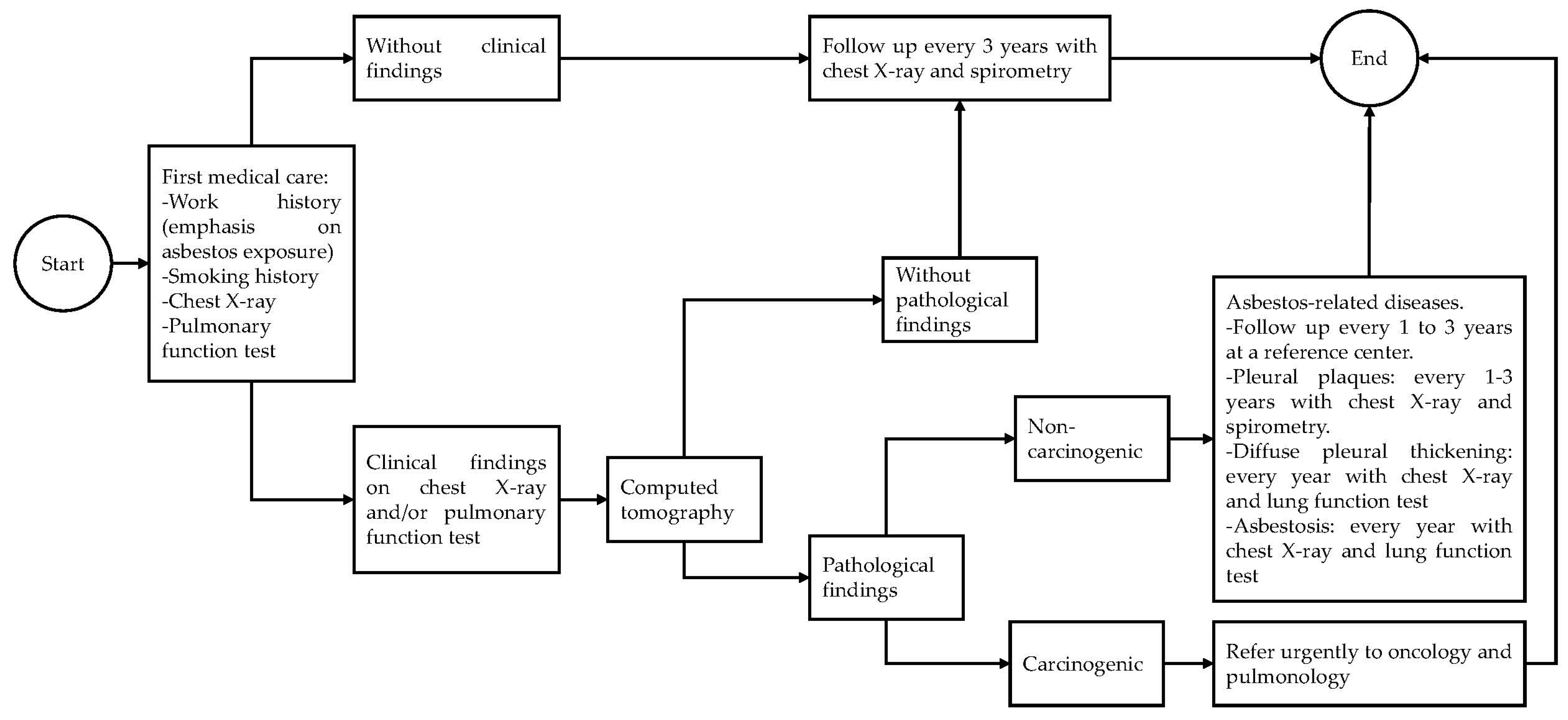
Based on these considerations, the EtD framework’s working group suggests the following conditional recommendations when undertaking surveillance of asbestos-exposed populations (Figure 1):
Figure 1.
Care program for people with known asbestos exposure. Adapted from Roza, C. et al. [24], along with the findings of the systematic literature review.
- Implement chest X-ray and its ILO classification as a screening tool for non-malignant diseases due to asbestos exposure (Question 1).
- Work together with scientific societies of radiology and pulmonology to disseminate the ILO classification (Question 1).
- Complement chest X-rays with pulmonary function tests and a medical history that includes work history and smoking (Question 1).
- In cases where the X-ray or lung function does not have pathological findings, but the person has asbestos exposure, it is necessary to continue clinical and radiological follow-up every three years (Question 2).
- In cases where the X-ray or lung function identifies pathological findings, a CT scan is necessary (Questions 2 and 3).
- In patients where the CT scan finds abnormalities, it is necessary to define whether they are due to malignant or non-malignant diseases and to follow the care program presented (Questions 2 and 3).
4. Discussion
This study considered the published literature relevant to the development of clinical practice guidelines for the surveillance of non-malignant asbestos-related diseases in asbestos-exposed people. Colombia is the focus of the guidelines but the findings should be relevant to many countries with similar health systems that also have broad exposures to asbestos. Guided by three priority questions, the main study findings were that initial screening tests should be a chest X-ray read using the ILO classification, complemented by pulmonary function testing and clinical history (including smoking and occupational exposure). Follow-up every three years is recommended for people with no abnormalities found on initial screening, with the three-year interval having been defined by consensus within the working group; further evaluation with HRCT should be undertaken for those in whom abnormalities are found, with appropriate management undertaken, dependent on the final diagnosis.
4.1. Identifying the Exposed Population
The clinical practice guidelines are explicitly for asbestos-exposed persons. It is necessary to define the population exposed to asbestos, along with the levels of exposure, from work activities, environmental exposure, and materials within the home or workplace. However, determining and defining the level of exposure required to qualify for surveillance is difficult. Decree 221 of 2023 considers people exposed to asbestos without defining how such exposure is to be determined. The risk of asbestos-related disease is directly related to the cumulative exposure to asbestos and whether a certain minimum exposure, or an exposure context (occupational or environmental), should be required before people are considered eligible for surveillance, and how such exposure should be determined, is not specified in either the decree or the relevant literature considered in the current study. Most of the relevant literature considers people exposed in an occupational context, but several authors have emphasized the importance of allowing the inclusion of environmentally exposed persons, especially in situations where environmental exposure is considerable, such as Sibate in Colombia and areas of Brazil [25,26,27,28].
4.2. Implementation Considerations
Implementing these guidelines will require coordinated efforts to enhance diagnostic facilities, involve relevant healthcare professionals and raise awareness about the risks and management of asbestos exposure. This includes involving all the actors of the Colombian health system (national government, health service provision, insurance, scientific associations, patient associations) and disseminating the content of these EtD frameworks more widely. Integration between the recommendations presented in this document, the existing RIA (the comprehensive care program) and the legal framework for asbestos is needed.
4.3. Surveillance Versus Screening
The approach proposed in these guidelines considers how surveillance of asbestos-exposed people should be undertaken if it is to be undertaken. The recommendations are based on an assumption that such surveillance will be beneficial, but it should be recognised that the available evidence is currently insufficient to support formal screening for asbestos-related disease in asbestos-exposed persons, taking into account key screening principles, as originally espoused by Wilson and Jungner [29] and more recently refined in [30]. Current evidence does not demonstrate that early diagnosis improves outcomes for asbestos-exposed patients. Treatment options are limited [31] and there are no available cost-effective disease-modifying treatments that definitively improve the quality and/or quantity of life for persons diagnosed at an earlier stage than they would have without a surveillance program. There are also potential harms arising from a surveillance program. These include additional risk arising from the radiation inherent to the use of chest X-rays and CT, especially if repeated investigations are undertaken over many years of follow-up; morbidity associated with potentially unnecessary investigation of clinical and radiological findings; and psychological concerns for patients diagnosed with an asbestos-related disease that they might otherwise not be aware of and for which effective treatment might not be available. These potential harms must be weighed against potential benefits, but the relevant evidence is not available and is unlikely to be in the medium term. In addition, it is important that the population subject to the surveillance program be informed of the potential benefits and risks arising and have an opportunity to be involved in the decision-making about it.
4.4. Strengths and Limitations
Important strengths of this study include a comprehensive structured approach to identifying the relevant literature; critical appraisal of the evidence using a well-recognised tool (the JBI tool) and application of the GRADE EtD framework. The GRADE-EtD framework helps working groups explicitly weigh factors such as certainty of evidence, cost-effectiveness, benefits and harms, equity, acceptability and feasibility, helping to ensure recommendations are both evidence-informed and contextually relevant. Studies show that guidelines using EtD frameworks are of higher quality, with more credible and implementable recommendations, compared to those without such frameworks [32,33,34].
There are also some important limitations. Most importantly, the clinical guidelines have been developed in response to the Colombian regulations that mandate a national care pathway for exposed individuals, rather than in response to clear evidence that asbestos-exposed individuals benefit from involvement in a surveillance program designed to identify non-malignant asbestos-related disease before symptoms or signs would typically cause the affected person to seek help from the health system. That clear evidence is lacking, particularly as to whether earlier diagnosis of non-malignant asbestos-related disease, and the management of the identified disorders, provides any benefit to the exposed person. Therefore, the guidelines recommend the approach that should be taken if such a surveillance program is to be instituted, rather than providing insight into whether such a program is justified, taking into account all the relevant risks, costs and benefits. The heterogeneity between studies for some of the findings, and a lack of relevant findings for some areas of importance, are reflected in the judgment of the working group that for some important areas confidence in the results was low.
The recommendations are made taking these limitations into account and need to be kept in mind where the recommendations are adopted. The summary of the EtD framework is presented in Supplementary Material Section S7. We also acknowledge that there is a need for Radiologist training if ILO classification is to be consistently achieved. If that is not achievable, there is, at a minimum, a need for a more general program of Professional Development in this important area.
5. Conclusions
Asbestos-exposed persons are at risk of developing non-malignant disease as a result of that exposure. This clinical guideline study provides conditional recommendations regarding how a surveillance program intended to identify and manage asbestos-related non-malignant disease in exposed persons should be designed and run. Colombia is the focus of the guidelines but the findings should be relevant to most countries with similar levels of development of the health system and with a significant proportion of the population having a history of asbestos exposure. The working group conditionally recommends CXR with ILO classification as the primary screening tool for surveillance of non-malignant asbestos-related diseases in asbestos-exposed populations, supplemented by targeted clinical and functional assessment and periodic follow-up.
Supplementary Materials
The following supporting information can be downloaded at https://www.mdpi.com/article/10.3390/ijerph23101301/s1. Refs. [18,35,36,37,38,39,40,41,42,43,44,45,46,47,48,49,50,51,52,53,54,55,56] are cited in the Supplementary Materials.
Author Contributions
Conceptualization, G.V., S.M., E.P.-T. and C.d.l.P.-C.; methodology, E.P.-T., C.d.l.P.-C., E.A. and A.F.; validation, E.P.-T., C.d.l.P.-C. and G.V.; formal analysis, E.P.-T. and C.d.l.P.-C.; investigation, E.P.-T. and C.d.l.P.-C.; resources, E.P.-T. and C.d.l.P.-C.; data curation, E.P.-T. and C.d.l.P.-C.; writing—original draft preparation, E.P.-T., C.d.l.P.-C. and G.V.; writing—review and editing, G.V., A.F., E.A., M.P., T.D., C.J., J.C. and S.M.; visualization, E.P.-T. and C.d.l.P.-C.; supervision, E.A., A.F., M.P., T.D., G.V. and S.M.; project administration, S.M., K.B. and G.V.; funding acquisition, G.V., K.B. and S.M. All authors have read and agreed to the published version of the manuscript.
Funding
This project was funded by the University of Cartagena, Colombia which was granted to the Asbestos and Dust Diseases Research Institute, Australia to develop Evidence-informed Clinical Guidelines for Non-Malignant Diseases Related to Asbestos Exposure in Colombia. This article is considered a product in the framework of the project ‘Formulation of an integral strategy to reduce the impact on public and environmental health due to the presence of asbestos in the territory of the Department of Bolivar,’ financed by the General System of Royalties of Colombia (SGR) and identified with the code BPIN 2020000100366. The University of Cartagena, Colombia, and the Colombia Asbestos-Free Foundation executed this project.
Institutional Review Board Statement
Not applicable.
Informed Consent Statement
This study is a secondary analysis of the published literature and does not involve human subjects or personal privacy data; therefore, informed consent was not required.
Data Availability Statement
The original contributions presented in this study are included in the article and Supplementary Materials. Further inquiries can be directed to the corresponding author.
Acknowledgments
The authors acknowledge the support and guidance from Manuel Saba, Faculty of Engineering, University of Cartagena, Colombia.
Conflicts of Interest
Author Guillermo Villamizar was employed by the Fundación Colombia Libre de Asbestos, Author Eduardo Algranti was employed by the Fundação Jorge Duprat Figueiredo de Segurança e Medicina do Trabalho. The remaining authors declare that the research was conducted in the absence of any commercial or financial relationships that could be construed as a potential conflict of interest.
References
- Kang, D.M.; Kim, J.E.; Kim, Y.K.; Lee, H.H.; Kim, S.Y. Occupational Burden of Asbestos-Related Diseases in Korea, 1998–2013: Asbestosis, Mesothelioma, Lung Cancer, Laryngeal Cancer, and Ovarian Cancer. J. Korean Med. Sci. 2018, 33, e226. [Google Scholar] [CrossRef] [Scilit] [PubMed] [PubMed Central]
- Guidotti, T.L.; Miller, A.; Christiani, D.C.; Wagner, G.; Balmes, J.; Harber, P.; Brodkin, C.A.; Rom, W.; Hillerdal, G.; Harbut, M.; et al. Nonmalignant Asbestos-Related Disease: Diagnosis and Early Management. Clin. Pulm. Med. 2007, 14, 82–92. [Google Scholar] [CrossRef] [Scilit]
- Prazakova, S.; Thomas, P.S.; Sandrini, A.; Yates, D.H. Asbestos and the lung in the 21st century: An update. Clin. Respir. J. 2014, 8, 1–10. [Google Scholar] [CrossRef] [Scilit] [PubMed]
- Wolff, H.; Vehmas, T.; Oksa, P.; Rantanen, J.; Vainio, H. Asbestos, asbestosis, and cancer, the Helsinki criteria for diagnosis and attribution 2014: Recommendations. Scand. J. Work Environ. Health 2015, 41, 5–15. [Google Scholar] [CrossRef] [Scilit] [PubMed]
- Alonso-Coello, P.; Schünemann, H.J.; Moberg, J.; Brignardello-Petersen, R.; Akl, E.A.; Davoli, M.; Treweek, S.; A Mustafa, R.; Rada, G.; Rosenbaum, S.; et al. GRADE Evidence to Decision (EtD) frameworks: A systematic and transparent approach to making well informed healthcare choices. 1: Introduction. BMJ 2016, 353, i2016. [Google Scholar] [CrossRef] [Scilit] [PubMed]
- Andrews, J.; Guyatt, G.; Oxman, A.D.; Alderson, P.; Dahm, P.; Falck-Ytter, Y.; Nasser, M.; Meerpohl, J.; Post, P.N.; Kunz, R.; et al. GRADE guidelines: 14. Going from evidence to recommendations: The significance and presentation of recommendations. J. Clin. Epidemiol. 2013, 66, 719–725. [Google Scholar] [CrossRef] [Scilit] [PubMed]
- Andrews, J.C.; Schünemann, H.J.; Oxman, A.D.; Pottie, K.; Meerpohl, J.J.; Coello, P.A.; Rind, D.; Montori, V.M.; Brito, J.P.; Norris, S.; et al. GRADE guidelines: 15. Going from evidence to recommendation-determinants of a recommendation’s direction and strength. J. Clin. Epidemiol. 2013, 66, 726–735. [Google Scholar] [CrossRef] [Scilit] [PubMed]
- Guyatt, G.; Oxman, A.D.; Akl, E.A.; Kunz, R.; Vist, G.; Brozek, J.; Norris, S.; Falck-Ytter, Y.; Glasziou, P.; DeBeer, H. GRADE guidelines: 1. Introduction-GRADE evidence profiles and summary of findings tables. J. Clin. Epidemiol. 2011, 64, 383–394. [Google Scholar] [CrossRef] [Scilit] [PubMed]
- Ouzzani, M.; Hammady, H.; Fedorowicz, Z.; Elmagarmid, A. Rayyan—A web and mobile app for systematic reviews. Syst. Rev. 2016, 5, 210. [Google Scholar] [CrossRef] [Scilit] [PubMed]
- Becklake, M.R.; Bagatin, E.; Neder, J.A. Asbestos-related diseases of the lungs and pleura: Uses, trends and management over the last century. Int. J. Tuberc. Lung Dis. 2007, 11, 356–369. [Google Scholar] [PubMed]
- Vierikko, T.; Järvenpää, R.; Autti, T.; Oksa, P.; Huuskonen, M.; Kaleva, S.; Laurikka, J.; Kajander, S.; Paakkola, K.; Saarelainen, S.; et al. Chest CT screening of asbestos-exposed workers: Lung lesions and incidental findings. Eur. Respir. J. 2007, 29, 78–84. [Google Scholar] [CrossRef] [Scilit] [PubMed]
- Camero, G.; Villamizar, G.; Pombo, L.M.; Saba, M.; Frank, A.L.; Teherán, A.A.; Acero, G.M. Epidemiology of Asbestosis between 2010–2014 and 2015–2019 Periods in Colombia: Descriptive Study. Ann. Glob. Health 2023, 89, 54. [Google Scholar] [CrossRef] [Scilit] [PubMed]
- Larson, T.C.; Franzblau, A.; Lewin, M.; Goodman, A.B.; Antao, V.C. Impact of body mass index on the detection of radiographic localized pleural thickening. Acad. Radiol. 2014, 21, 3–10. [Google Scholar] [CrossRef] [Scilit] [PubMed]
- Suganuma, N.; Kusaka, Y.; Hiraga, Y.; Hosoda, Y.; Shida, H.; Morikubo, H.; Matsumoto, T. Asbestos-related pleural abnormalities detected by chest x-ray: Fair agreement with detection by computed tomography. J. Occup. Health 2001, 43, 365–370. [Google Scholar] [CrossRef] [Scilit]
- Eisenhawer, C.; Felten, M.K.; Tamm, M.; Das, M.; Kraus, T. Radiological surveillance of formerly asbestos-exposed power industry workers: Rates and risk factors of benign changes on chest X-ray and MDCT. J. Occup. Med. Toxicol. 2014, 9, 18. [Google Scholar] [CrossRef] [Scilit] [PubMed]
- Algranti, E.; Mendonça, E.M.C.; DeCapitani, E.M.; Freitas, J.B.P.; Silva, H.C.; Bussacos, M.A. Non-malignant asbestos-related diseases in Brazilian asbestos-cement workers. Am. J. Ind. Med. 2001, 40, 240–254. [Google Scholar] [CrossRef] [Scilit] [PubMed]
- Matrat, M.; Pairon, J.C.; Paolillo, A.G.; Joly, N.; Iwatsubo, Y.; Orlowski, E.; Letourneux, M.; Ameille, J. Asbestos exposure and radiological abnormalities among maintenance and custodian workers in buildings with friable asbestos-containing materials. Int. Arch. Occup. Environ. Health 2004, 77, 307–312. [Google Scholar] [CrossRef] [Scilit] [PubMed]
- Miller, J.A.; Zurlo, J.V. Asbestos plaques in a typical Veteran’s hospital population. Am. J. Ind. Med. 1996, 30, 726–729. [Google Scholar] [CrossRef] [PubMed]
- Furuya, S.; Chimed-Ochir, O.; Takahashi, K.; David, A.; Takala, J. Global asbestos disaster. Int. J. Environ. Res. Public Health 2018, 15, 1000. [Google Scholar] [CrossRef] [Scilit] [PubMed]
- The Center For International Economics. ASEA REPORTS—The Economic Burden of Asbesto-Related Disease; Asbestos Safety and Eradication Agency: Canberra, Australia, 2018.
- Ferrante, P. Costs of asbestosis and silicosis hospitalization in Italy (2001–2018). Int. Arch. Occup. Environ. Health 2021, 94, 763–771. [Google Scholar] [CrossRef] [Scilit] [PubMed]
- García-gómez, M.; Garrido, R.U.; López, R.C.; Menéndez-navarro, A. Medical costs of asbestos-related diseases in Spain between 2004 and 2011. Ind. Health 2017, 55, 3–12. [Google Scholar] [CrossRef] [Scilit] [PubMed]
- Universidad del Valle; Ministerio de Salud y Protección Social. Análisis de las Opciones de Política Para la Exposición al Asbesto-Crisotilo y sus Consecuencias en la Salud Humana. Cali. 2017. Available online: https://www.minsalud.gov.co/sites/rid/Lists/BibliotecaDigital/RIDE/VS/PP/ENT/p3-analisis-opciones-politica-asbestos.pdf (accessed on 2 January 2025).
- Diego Roza, C.; Cruz Carmona, M.J.; Fernández Álvarez, R.; Ferrer Sancho, J.; Marín Martínez, B.; Martínez González, C.; Portal, J.A.R.; Valero, F.R.; Garrido, V.V. Recommendations for the diagnosis and management of asbestos-related pleural and pulmonary disease. Arch. Bronconeumol. (Engl. Ed.) 2017, 53, 437–442. [Google Scholar] [CrossRef] [Scilit] [PubMed]
- Buralli, R.J.; Pinheiro, R.D.C.; Susviela, L.L.; Duracenko, S.R.C.; De Capitani, E.M.; Savaris, A.; Algranti, E. The Brazilian System for Monitoring Workers and General Population Exposed to Asbestos: Development, Challenges, and Opportunities for Workers’ Health Surveillance. Int. J. Environ. Res. Public Health 2023, 20, 4295. [Google Scholar] [CrossRef] [Scilit] [PubMed]
- de la Pava-Cortés, C.; Peña Torres, E.; Driscoll, T.; Jones, C.; Coles, J.; McArdle, S.; Brislane, K.; Peters, M.; Villamizar, G.; Algranti, E.; et al. Surveillance of Non-Malignant Asbestos-Related Diseases in an Exposed Population: A Scoping Review. Ann. Glob. Health 2026, 92, 19. [Google Scholar] [CrossRef] [Scilit] [PubMed]
- Metintas, M.; Ak, G.; Metintas, S. Environmental asbestos exposure and lung cancer. Lung Cancer 2024, 194, 107850. [Google Scholar] [CrossRef] [Scilit] [PubMed]
- Merler, E.; Buiatti, E.; Vainio, H. Surveillance and intervention studies on respiratory cancers in asbestos-exposed workers. Scand. J. Work Environ. Health 1997, 23, 83–92. [Google Scholar] [CrossRef] [Scilit] [PubMed]
- Wilson, J.M.G.; Jungner, G.; World Health Organization. Principles and Practice of Screening for Disease; World Health Organization: Geneva, Switzerland, 1968. [Google Scholar]
- Andermann, A.; Blancquaert, I.; Beauchamp, S.; Déry, V. Revisiting Wilson and Jungner in the genomic age: A review of screening criteria over the past 40 years. Bull. World Health Organ. 2008, 86, 317–319. [Google Scholar] [CrossRef] [Scilit] [PubMed]
- Barnes, H.; Glaspole, I. Occupational interstitial lung diseases. Immunol. Allergy Clin. 2023, 43, 323–339. [Google Scholar] [CrossRef] [Scilit] [PubMed]
- Alonso-Coello, P.; Oxman, A.D.; Moberg, J.; Brignardello-Petersen, R.; Akl, E.A.; Davoli, M.; Treweek, S.; A Mustafa, R.; O Vandvik, P.; Meerpohl, J.; et al. GRADE Evidence to Decision (EtD) frameworks: A systematic and transparent approach to making well informed healthcare choices. 2: Clinical practice guidelines. BMJ 2016, 353, i2089. [Google Scholar] [CrossRef] [Scilit] [PubMed]
- Meneses-Echavez, J.F.; Bidonde, J.; Yepes-Nuñez, J.J.; Poklepović Peričić, T.; Puljak, L.; Bala, M.M.; Storman, D.; Swierz, M.J.; Zając, J.; Montesinos-Guevara, C.; et al. Evidence to decision frameworks enabled structured and explicit development of healthcare recommendations. J. Clin. Epidemiol. 2022, 150, 51–62. [Google Scholar] [CrossRef] [Scilit] [PubMed]
- Meneses-Echavez, J.F.; Bidonde, J.; Montesinos-Guevara, C.; Amer, Y.S.; Loaiza-Betancur, A.F.; Tellez Tinjaca, L.A.; Navarro, D.F.; Peričić, T.P.; Tokalić, R.; Bala, M.M.; et al. Using evidence to decision frameworks led to guidelines of better quality and more credible and transparent recommendations. J. Clin. Epidemiol. 2023, 162, 38–46. [Google Scholar] [CrossRef] [Scilit] [PubMed]
- Albin, M.; Engholm, G.; Fröström, K.; Kheddache, S.; Larsson, S.; Swantesson, L. Chest x ray films from construction workers: International Labour Office (ILO 1980) classification compared with routine readings. Occup. Environ. Med. 1992, 49, 862–868. [Google Scholar] [CrossRef] [Scilit] [PubMed]
- Ameille, J.; Matrat, M.; Paris, C.; Joly, N.; Raffaelli, C.; Brochard, P.; Iwatsubo, Y.; Pairon, J.C.; Letourneux, M. Asbestos-Related Pleural Diseases: Dimensional Criteria Are Not Appropriate to Differentiate Diffuse Pleural Thickening from Pleural Plaques. Am. J. Ind. Med. 2004, 45, 289–296. [Google Scholar] [CrossRef] [Scilit] [PubMed]
- Ameille, J.; Brochard, P.; Brechot, J.M.; Pascano, T.; Cherin, A.; Raix, A.; Fredy, M.; Bignon, J. Pleural thickening: A comparison of oblique chest radiographs and high-resolution computed tomography in subjects exposed to low levels of asbestos pollution. Int. Arch. Occup. Environ. Health 1993, 64, 545–548. [Google Scholar] [CrossRef] [Scilit] [PubMed]
- Bourbeau, J.; Ernst, P. Between- and within-reader variability in the assessment of pleural abnormality using the ILO 1980 international classification of pneumoconioses. Am. J. Ind. Med. 1988, 14, 537–543. [Google Scholar] [CrossRef] [Scilit] [PubMed]
- Cotes, J.E.; King, B. Relationship of lung function to radiographic reading (ILO) in patients with asbestos related lung disease. Thorax 1988, 43, 777–783. [Google Scholar] [CrossRef] [Scilit] [PubMed]
- de Klerk, N.H.; Musk, A.W.; James, A.; Glancy, J.J.; Cookson, W.O. Comparison of chest radiograph reading methods for assessing progress of pneumoconiosis over 10 years in Wittenoom crocidolite workers. Br. J. Ind. Med. 1990, 47, 127–131. [Google Scholar] [CrossRef] [Scilit] [PubMed]
- Gevenois, P.A.; de Maertelaer, V.; Madani, A.; Winant, C.; Sergent, G.; De Vuyst, P. Asbestosis, pleural plaques and diffuse pleural thickening: Three distinct benign responses to asbestos exposure. Eur. Respir. J. 1998, 11, 1021–1027. [Google Scholar] [CrossRef] [Scilit] [PubMed]
- Hayes, A.A.; Thickbroom, G.W.; Guelfi, G.R.; Musk, A.W.; van der Schaaf, A.A. Computer quantitation of gallium 67 lung uptake in crocidolite (blue asbestos) workers of Western Australia. Eur. J. Nucl. Med. 1990, 16, 855–858. [Google Scholar] [CrossRef] [Scilit] [PubMed]
- Hilt, B.; Borgerson, A.; Lien, J.T.; Langård, S. Chest radiographs in subjects with asbestos-related abnormalities: Comparison between ILO categorizations and clinical reading. Am. J. Ind. Med. 1992, 21, 855–861. [Google Scholar] [CrossRef] [Scilit] [PubMed]
- Koskinen, K.; Rinne, J.P.; Zitting, A.; Tossavainen, A.; Kivekäs, J.; Reijula, K.; Roto, P.; Huuskonen, M.S.; Dtech, A.T.; Md, M.P.R.; et al. Screening for asbestos-induced diseases in Finland. Am. J. Ind. Med. 1996, 30, 241–251. [Google Scholar] [CrossRef] [Scilit] [PubMed]
- Michaels, D.; Zoloth, S.; Lacher, M.; Holstein, E.; Lilis, R.; Drucker, E. Asbestos disease in sheet metal workers: II. Radiologic signs of asbestosis among active workers. Am. J. Ind. Med. 1987, 12, 595–603. [Google Scholar] [CrossRef] [Scilit] [PubMed]
- Oksa, P.; Huuskonen, M.S.; Järvisalo, J.; Klockars, M.; Zitting, A.; Suoranta, H.; Tossavainen, A.; Vattulainen, K.; Laippala, P. Follow-up of asbestosis patients and predictors for radiographic progression. Int. Arch. Occup. Environ. Health 1998, 71, 465–471. [Google Scholar] [CrossRef] [Scilit] [PubMed]
- Rossiter, C.E.; Browne, K.; Gilson, J.C. International classification trial of AIA set of 100 radiographs of asbestos workers. Br. J. Ind. Med. 1988, 45, 538–543. [Google Scholar] [CrossRef] [Scilit] [PubMed]
- Schaefer, C.M.; Greene, R.; Oliver, L.C.; Lanza, R.C.; Hall, D.; Lindemann, S.R.; Llewellyn, H.J.; Mccarthy, K.A.; Pile-Spellman, E.; Rubens, J.R. Screening for asbestos-related pleural disease with digital storage phosphor radiography. Investig. Radiol. 1990, 25, 645–650. [Google Scholar] [CrossRef] [Scilit] [PubMed]
- Terra-Filho, M.; Bagatin, E.; Nery, L.E.; Nápolis, L.M.; Neder, J.A.; Meirelles, G.D.S.P.; Silva, C.I.; Muller, N.L. Screening of miners and millers at decreasing levels of asbestos exposure: Comparison of chest radiography and thin-section computed tomography. PLoS ONE 2015, 10, e0118585. [Google Scholar] [CrossRef] [Scilit] [PubMed]
- Vujović, M.; Vujović, I.; Kuzmanić, I. The application of new technologies in diagnosing occupational asbestosis. Arh. Hig. Rada Toksikol. 2003, 54, 245–252. [Google Scholar] [PubMed]
- Welch, L.S.; Haile, E. Asbestos-related disease among sheet metal workers 1986-2004: Radiographic changes over time. Am. J. Ind. Med. 2009, 52, 519–525. [Google Scholar] [CrossRef] [Scilit] [PubMed]
- Becklake, M.R.; Thomas, D.; Liddell, F.; McDonald, J.C. Follow-up respiratory measurements in Quebec chrysotile asbestos miners and millers. Scand. J. Work Environ. Health 1982, 8, 105–110. Available online: https://www.sjweh.fi/show_abstract.php?abstract_id=2533 (accessed on 10 October 2024). [PubMed]
- Friedman, A.C.; Fiel, S.B.; Fisher, M.S.; Radecki, P.D.; Lev-Toaff, A.S.; Caroline, D.F. Asbestos-related pleural disease and asbestosis: A comparison of CT and chest radiography. Am. J. Roentgenol. 1988, 150, 269–275. [Google Scholar] [CrossRef] [Scilit] [PubMed]
- McMillan, G.H.; Rossiter, C.E.; Deacon, R. Comparison of independent randomised reading of radiographs with direct progression scoring for assessing change in asbestos-related pulmonary and pleural lesions. Br. J. Ind. Med. 1982, 39, 60–61. [Google Scholar] [CrossRef] [Scilit] [PubMed]
- Reger, R.B.; Cole, W.S.; Sargent, E.N.; Wheeler, P.S. Cases of alleged asbestos-related disease: A radiologic re-evaluation. J. Occup. Med. 1990, 32, 1088–1090. [Google Scholar] [CrossRef] [Scilit] [PubMed]
- Page, M.J.; McKenzie, J.E.; Bossuyt, P.M.; Boutron, I.; Hoffmann, T.C.; Mulrow, C.D.; Shamseer, L.; Tetzlaff, J.M.; Akl, E.A.; Brennan, S.E.; et al. The PRISMA 2020 statement: An updated guideline for reporting systematic reviews. BMJ 2021, 372, n71. [Google Scholar] [CrossRef] [Scilit] [PubMed]
Disclaimer/Publisher’s Note: The statements, opinions and data contained in all publications are solely those of the individual author(s) and contributor(s) and not of MDPI and/or the editor(s). MDPI and/or the editor(s) disclaim responsibility for any injury to people or property resulting from any ideas, methods, instructions or products referred to in the content. |
© 2026 by the authors. Licensee MDPI, Basel, Switzerland. This article is an open access article distributed under the terms and conditions of the Creative Commons Attribution (CC BY) license.