



Int. J. Environ. Res. Public Health, Volume 20, Issue 1 (January-1 2023) – 894 articles
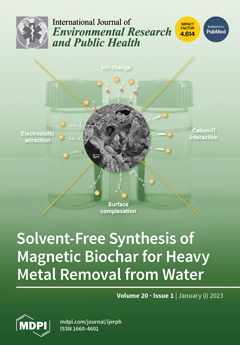
Cover Story (view full-size image):
The commonly used two-step and one-pot synthesis methods for producing biochar require the use of iron salt solutions, resulting in the undesirable consequences of energy consumption for dewatering and potential pollution risks. To address this drawback, a magnetic sewage sludge-derived biochar (MSBC-2) was synthesized by a solvent-free method in this study. The maximum adsorption capacities were 151.52 mg·g−1 for Pb2+, 109.89 mg·g−1 for Cd2+, and 74.07 mg·g−1 for Cu2+. Surface complexation, cation–π interaction, ion exchange, and electrostatic attraction mechanisms were involved in the adsorption of Pb2+, Cd2+ and Cu2+ onto MSBC-2. Overall, this study will provide a new perspective for the synthesis of magnetic biochar; MSBC-2 shows great potential as an adsorbent for heavy metal removal. View this paper
- Issues are regarded as officially published after their release is announced to the table of contents alert mailing list.
- You may sign up for e-mail alerts to receive table of contents of newly released issues.
- PDF is the official format for papers published in both, html and pdf forms. To view the papers in pdf format, click on the "PDF Full-text" link, and use the free Adobe Reader to open them.
Previous Issue
Next Issue
