


Abstract
Occupational physicians (OPs) offer a wide range of health support for employees and are confronted with varying job characteristics and demands. They monitor occupational health and safety and promote work(place)-related health measures and assessments. While helping employees to (re)gain a healthy status, their own job satisfaction as well as the investigation of their working conditions have earned limited research attention. Thus, this scoping review aims to summarize the current state of knowledge concerning OPs’ working conditions, i.e., work-related resources and stressors. PubMed, Web of Science and LIVIVO as well as grey literature were screened for relevant English or German articles until 10/2021. From a total of 1683 identified publications, we analyzed 24 full text articles that fulfilled all inclusion criteria. The overall study sample included 3486 male (54.6%), 2892 female (45.3%) and 5 diverse OPs, from which 1049 OPs worked in full-time (85.6%) and 177 in part-time (14.4%). The majority (72.4%) worked for the Occupational Health Service (OHS), 13% were self-employed, and 14.6% worked for a company/in-house service. The classification of stressors and resources was based on an inductively generated categorization scheme. We categorized 8 personal, relational and environmental resources and 10 stress factors. The main resources were support for personnel development and promotion, positive organizational policy, promoting work-life balance and other aspects of health. Key stressors were information deficits, organizational deficiency and uncertainty as well as socioeconomic influences and high professional obligations. The working conditions of OPs are still a topic with too little research attention. This scoping review reveals several starting points to maintain a healthy OP workforce and gives recommendations for action for the near future.
1. Introduction
Over the past 20 years, there has been an increasing demand for good solutions in occupational health [1]. Corporate and environmental structures have changed due to demographic developments: the workforce is aging and diversifying [2]. Along with the changing workplace conditions of employees (stronger shift towards workplace health promotion, demographic change and increase of mental illnesses), new challenges for OPs of the 21st century arise. A major challenge for occupational health services is the need for the development of structures and ways of working that maintain (1) integrity in a more commercialized environment and (2) both the quality of service and the attractiveness of the profession in the long term [3]. Higher general health status of employees is a major asset for companies to yield better productivity and competitiveness. “Occupational safety and health includes all measures which ensure and improve work safety and health protection. Operational management of occupational safety and health is responsible for identifying needs, making decisions and eventually taking measures” [4]. In general, occupational physicians (OPs) may play a crucial role for the prevention and rehabilitation of employees. Through workplace inspections and consultations with employees, most OPs have a thorough knowledge of working conditions and often a direct access to change specific work demands. However, this constellation often creates a perceived tension in the triangle employee-employer-physician with un-communicated reservations regarding the representation of interests.
Even though OPs in Germany make up a rather small proportion of all working physicians in Germany [5], their far-reaching involvement on a personal, organizational, but also political level is nevertheless evident. In Germany, the general conditions of OP service are ruled in the “Act on Occupational Physicians, Safety Engineers and Other Occupational Safety Specialists” [6]. The type of employment of an OP depends fundamentally on the respective circumstances of the company [7]. In principle, there are several employment relationships: (full or part-time) salaried OPs, freelance OPs and physicians that work for an intercompany occupational health service. A full-time OP is usually found in large companies or in companies with high-risk potentials (e.g., in a chemical plant or in the Armed Forces) to find specific measures for their requirements. Outsourced solutions use freelance OPs, often in small and medium-sized enterprises (SMEs). Working for the inter-company occupational health service, an OP may also join a registered association or an independent service company that provides the medical care.
Despite their important role as investigators of work-related risk factors and as a creator of healthy working conditions, OPs are also active employees themselves, thus, equally exposed to potential work-related risk and occupational hazards. The research indicated that agency and well-being, as well as health status, play a crucial role in the experienced quality of and satisfaction with work. Health workers are often exposed to special stresses and complain about a high burden of inadequate work conditions. They are particularly frequently affected by absenteeism due to mental disorders [8]. Their mental health and wellbeing should be of special interest not only regarding their personal health, but also as their mental health and wellbeing affects the quality of care [9,10]. Especially during the global pandemic caused by the coronavirus disease, healthcare workers were confronted with great psychological distress [11,12,13,14].
The World Health Organization (WHO) defines health as “ a state of complete physical, mental and social wellbeing and not merely the absence of disease or infirmity” [15]. Job demands that can affect employees’ mental health are, for example, leadership, organizational justice, effort-reward imbalance, atypical forms of employment, social support or job insecurity [16]. In healthcare workers, job satisfaction and subjective wellbeing is associated with workplace performance, retention, instability of available workforce and shortage of healthcare workers [17]. Moreover, heavy workloads, long shifts, a high pace, lack of physical or psychosocial safety, chronicity of care, moral conflicts, job (in)security, social support and bullying can result in psychological distress, leading to burnout, depression, anxiety disorders or sleeping disorders [10,18,19,20,21].
The idea of working conditions impacting employees’ health is not new. Two still widely used models that provide a theoretical background, are the transactional stress model and the job demand control (JDC) model. Using job satisfaction and the concept of well-being are more recent approaches in investigating work conditions.
1.1. Transactional Stress Model
To explore the OPs’ working conditions, we use the indicators “stressors” and “resources”. According to the transactional stress model of Lazarus and Launier [22] (1981), stress mainly depends on the cognitive evaluation and coping strategies that the individual may apply to process environmental stimuli. According to their model, stressors are not only reduced to external stimuli, but take also individual intrinsic factors into account. The three essential stress-relevant relationships are: harm/loss, threat and challenge. The choice of the coping strategies belongs to the most important aspect in the individual handling of stress and has a significantly greater influence on health or illness than the actual stress episodes. There are two main categories to cope with the stressors: (a) change of the stressed transaction (instrumental) and (b) the regulation of emotion (palliation). The instrumental coping has a direct influence on the stressful situation. Under the use of acquired skills and information, the problem is solved or the obstacle removed. Palliative coping, on the other hand, aims at regulative emotions such as relaxation. In the best case, negative emotions such as fear or anger should be controlled and diminished.
The selection of coping strategies described above depends on a variety of circumstances: situational context or the environment determines which form of coping is appropriate and at the same time most promising. The degree of (perceived) helplessness can also be a factor influencing the choice of coping strategies. Furthermore, Bamberg et al. [23] (2003) have demonstrated with their model that the development of stress is not merely attributable to the individual person- and condition-related factors, but is rather based on their mutual interaction.
1.2. Job Demand Control (JDC) Model
Another widely used model is the Job Demand Control (JDC) model by Karasek and Theorell [24] (1990). He conceptualized mental stress as a result from the amount and intensity of job demands and the amount (time and intensity) of work, as well as from the freedom of action and decision (latitude) of the respective employee. Karasek and Theorell understand the combination of work requirements and decision latitude as a two-dimensional model from which four different types of psychosocial perception of an occupation can result: high-strain jobs, active jobs, low-strain jobs and passive jobs. The four dimensions of the model vary between different types of psychosocial stress depending on the extent of potential work intensity and the potential scope for action. In addition, a third dimension was added to the JDC model at the end of the 1980s: the influence of social support. Karasek and Theorell predict a combination of low social support, low decision-making latitude and high decision-making potential, a low degree of decision-making freedom and, at the same time, high work demands and a high stress level for employees [24]. One of the most important conclusions of the JDC model, according to Karasek, is the possibility to improve the work-related mental health of employees without affecting the productivity of the organization: It appears that the stress of the workplace can be reduced by increasing decision-making latitude, irrespective or independent of changes in job demands. The key point lies, accordingly, in the employee’s ability to make important decisions about his or her work.
1.3. Job Satisfaction
A significant model in understanding work conditions is the concept of job satisfaction, which has been linked to both organizational behavior and physical and mental health [25]. Due to the shortage of nurses, this concept has been widely used to investigate how the nursing workforce can be stabilized. The main attributes job satisfaction gained via concept analyses show that “fulfillment of desired needs within the work setting”, “happiness or gratifying emotional responses towards working conditions” and “job value or equity” are key features impacting the overall job satisfaction. These attributes interplay with demographic, structural work characteristics and environmental variables [25].
1.4. Concept of Psychological Well-Being
Another widely used and early concept to understand work condition is the concept of psychological well-being [26,27]. Previous work has investigated its influence on vocational identity and career commitments [28,29]. Higher socioeconomic status contributes to better health and well-being and different types of work may also predict the perceived level of well-being, with work and educational experiences being the strongest predictors of well-beings, especially among older adults [30]. Linking psychological well-being to physical health, biological regulation and neuroscience delivers additional objective indicators for more general benefits [31]. Tools to assess psychological well-being have now been incorporated into many fields in order to describe challenges and transition periods such as adolescence or new job opportunities.
Staying healthy at work is highly relevant. OPs are assigned with a large number of specific tasks (e.g., including numerous legal foundations/basis, diverse employment relationships, working hours). The aim of the current scoping review is to assess the current knowledge concerning OPs’ working conditions. Which specific work-related resources and stressors have been reported? The presented resource and stress models are applied to analyze the extracted working conditions.
2. Materials and Methods
This scoping review was conducted by a multidisciplinary team with proven experience in health services research, psychology and rehabilitation science. The review process comprised (a) the identification of the research question, (b) identification of relevant studies, (c) study selection, (d) data extraction (mapping) and (e) data syntheses and reporting of results. We herein followed established reporting guidelines for scoping reviews (PRISMA P; PRISMA ScR) [32,33].
2.1. Identification of Research Question
We address the following research questions:
What are the reported working conditions for OPs, described in international publications over the last 20 years?
To what extent are work conditions described as stressors or resources in this context?
2.2. Identifying Relevant Studies, Inclusion and Exclusion Criteria
To identify relevant studies, we will follow the Population-Concept-Context (PCC) framework (see Table 1), recommend by the Joanna Briggs Institute [34] (JBI Manual for Evidence Synthesis, JBI, 2020).
Table 1.
PCC characteristics.
This review includes all types of experimental studies, observational/quasi-experimental studies, cross-sectional studies, case studies, and all types of (systematic) reviews published in German or English until the end of 10/2021. There were no restrictions concerning country or region of the world. Additionally, grey literature was hand-searched. Opinion papers, editorials and commentaries were excluded.
Since the initial search showed only a limited number of references, we decided to widen the inclusion criteria as much as possible with respect to the PCC criteria. Articles that were excluded from this study mainly focused on employee health and health professions other than OPs (e.g., general practitioners or nurses) only. Findings that provided separate information on OPs’ work conditions were still included. All articles meeting the defined criteria of the PCC framework (see Table 1) were included.
2.3. Study Selection
Included databases were Medline (PubMed), Web of Science and LIVIVO. The search strategy contained keywords and subject headings from the PCC framework. According to the JBI approach, the search strategy followed a three-step selection. An initial, limited search in set databases was conducted with following predefined keywords and index terms. The search algorithms were:
#1Population: (Betriebsärzt* OR Betriebsarzt OR Arbeitsmediziner* OR “company doctor” OR “company physician*” OR “industrial physician*” OR “company medical officer*” OR Werksarzt OR Werksärzt* OR “work* doctor*” OR “occupational health physician*” OR “occupational physician*”)
#2Outcome: (Belastungsfaktor* OR Belastung* OR Arbeitsanforderung* OR Arbeitsintensität OR Handlungsspielraum OR Tätigkeitsspielraum OR “decision latitude” OR “job demand*” OR “work demand*” OR demand* OR burden OR resource* OR “soziale Unterstützung” OR “social support” OR Beanspruchung* OR stressor* OR Stressfaktor* OR “load factor*” OR “stress factor*” OR “job related resource*” OR “work related resource*” OR workload OR “job control” OR “job stress” OR “work stress” OR Arbeitsbedingung* OR “working condition*” OR Arbeitssituation OR “work situation”)
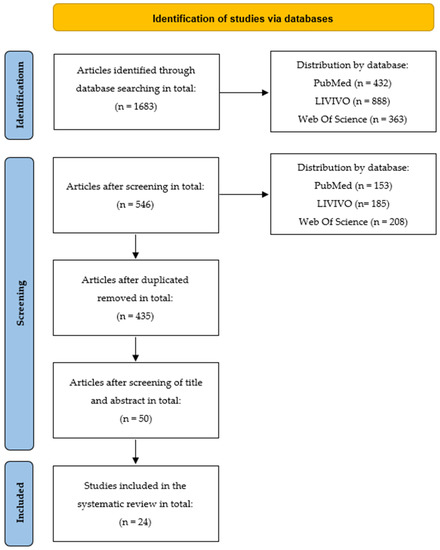
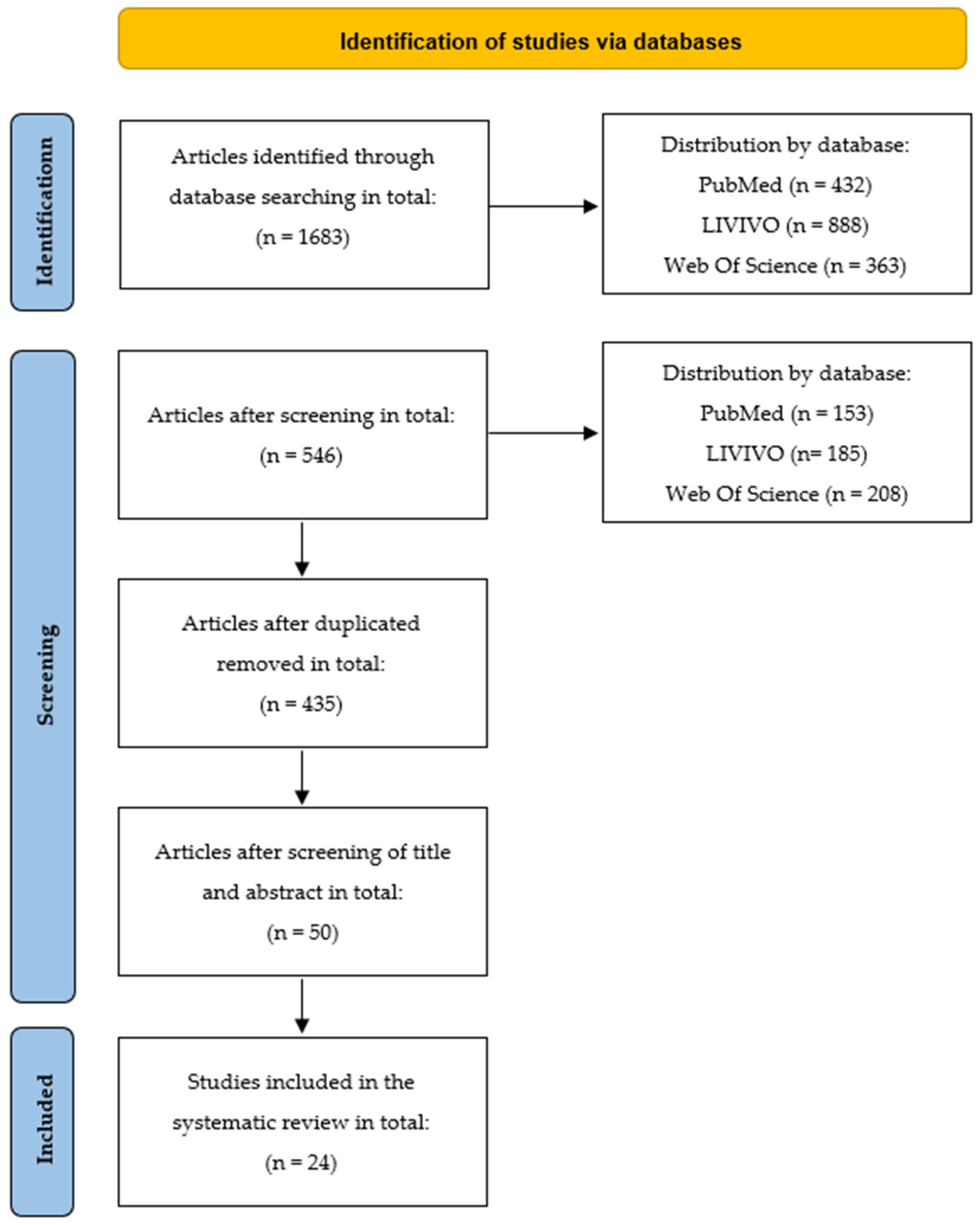
Consecutively, both algorithms were combined by the Boolean operator “AND”. Retrieved articles were screened for additional keywords and index terms. A second search including all identified keywords and index terms followed, but yielded no additional results. Following a snowball principle, reference lists of included studies were screened for additional sources. Retrieved articles were imported to Endnote X9 and exported to Rayyan (Cambridge, USA) for the title and abstract screening. First, three reviewers (E.E., L.L. and K.-E.C.) independently conducted a title and abstract screening. Disagreements were reflected and discussed in the team and solved by consensus. The full text screening followed the principles of title and abstract screening. Figure 1 illustrates the full study selection process.
Figure 1.
PRISMA 2020 flow diagram according to Page et al. [35] (2020). Flow diagram of the scoping review, which included searches of databases only.
2.4. Data Extraction (Mapping)
We used a data extraction chart in Microsoft Excel tailored to the objectives of this review (see Table 2). The chart was piloted by E.E. and adjusted by E.E., L.L. and K.-E.C. in an iterative process. Relevant data of each article were independently extracted by at least two researchers (E.E., L.L. and K.-E.C.). Results were discussed and harmonized in the overall team (E.E., L.L., K.-E.C. and P.K.) led by P.K.
Table 2.
Chart elements and associated questions leading the extractions.
2.5. Data Synthesis and Reporting
For data synthesis and reporting we used an inductively generated categorization scheme for resource and stress factors that was piloted by E.E. and adjusted by all study team members in an iterative process. E.E. synthesized and reported all relevant data (top category, description/definition, attribution and total N—assigned studies in absolute frequency) of each article. Subsequently, all results were cross-checked with P.K. for comprehensibility and consistency.
3. Results
The surveyed studies included a total of 3486 male (54.6%), 2892 female (45.3%) and 5 diverse OPs, from which 1049 OPs worked in full-time (85.6%) and 177 in part-time (14.4%). The majority (72.4%) worked for the OHS, 13% were self-employed and 14.6% worked for a company/in-house service. The average age was high (1.1% younger than 36 years, 4.7% being between 36 and 45 years old, 78.9% aged 45 to 55 years and 15.6% aged over 55 years).
Table 3 summarizes the most important extraction results of the review. Further information and the entire table of extraction results can be found in the appendix (Table A1 and Table A2). The presentation of results follows the alphabetical order of the first author’s last name. With the exception of some Japanese, Turkish and international studies, most of the found evidence were reported by European groups.
Table 3.
List of included studies and most relevant parts of data extraction.
3.1. Identified Resources
Table 4 displays identified resources of the OPs. We categorized eight resources, some of which also loaded negatively as stressors: social interaction, perceived repuation of the profession, characteristics of the emploment relationship and scope for decision-making/action (see Table 5). Other factors were only identified to be loaded positively, including aspects of health, work-life balance, opportunities for personnel development and promotion, as well as organizational policy.
Table 4.
Identified work-related resources.
Table 5.
Identified work-related stress factors.
3.2. Identified Stressors
Table 5 displays identified stress factors of the OPs. Socioeconomic factors, perspectives, information deficits, organizational complication, uncertainty factors and professional obligations were identified as stressors that had no positive loadings.
4. Discussion
Given the declining number of employed OPs, there is a need to focus on eliminating stress factors and emphasizing resources in order to increase the overall attractiveness of the occupation. We identified 8 resources and 10 stressors (personal, relational and environmental factors) for OPs. Of those, some factors loaded both positively as well as negatively (i.e., social interaction, reputation of the profession, characteristics of the employment relationship and scope for decision-making/action). Support for personnel development and promotion, positive organizational policy, promoting work-life balance and other aspects of health were the main resources. Information deficits, organizational deficiency and uncertainty were key stressors besides socioeconomic influences and high professional obligations.
The majority of the surveyed OPs worked for the OHS (72.4%). Earlier studies have found that the type of employment may cause very different working conditions for OPs (e.g., [39,58]). A direct comparison of the employment relationships shows that self-employment and/or part-time work represents a resource for OPs, whereas employment with the occupational health service and/or full-time work can be classified as a stress factor. One reason for this could be that full-time employment in the company is only an option for an OP, when the number of hours worked exceeds 1640 per year, and the hurdles for a freelance existence are too great. Freelance work is often associated with less social interaction and peer feedback. Of course, the employment relationships and the functions of the individual OPs may vary in their characteristics from country to country.
The majority of the OPs was over 45 years old (95.5%), with one in seven being over 55 years. This fits with the observation that the next generation of OPs is lacking in occupational medicine. Accordingly, the stress factors of occupational medical practice should be critically scrutinized and remedied as best as possible. Above all, the organizational difficulties, and the prejudiced assessment of the occupational profile by external parties can be counteracted with educational work.
An essential influence for the appraisal of stress or resource was the amount of decision-latitude and agency. This is because it is evident, also according to the JDC model, that the highest levels of satisfaction are found in active jobs where there are high job demands but also opportunities for the use of authoritarian actions and decisions. The Federal Institute for Occupational Safety and Health (German: Bundesanstalt für Arbeitsschutz und Arbeitsmedizin, BAuA) sees great potential for action in education and training. In particular, the steady shift from pure occupational health and safety measures toward workplace health promotion is leading to numerous new fields of application that place the occupational health professional in the foreground as a central actor [59]. Compared with other specialties, there are also many structural advantages for OPs. For example, most OPs do not have to work nights, shifts or on weekends. Their average hours worked per week are lower than those of hospital doctors [37], who work up to 59 h per week, which may in turn endanger their own health. More attention should be paid to the field of occupational medicine already in medical school: Continuing education should be subsidized and the advantages of the profession over other, clinical health professions should be discussed.
The working conditions of OPs are still a topic with too little research attention. One possible reason may be that OPs account for only 3.3 percent of all working physicians in Germany (in comparison, hospital physicians, for example, account for more than 50 percent) and thus do not justify a sufficient need for research [60]. Since OPs take a fundamental role in the diagnostics and management of employee health, a closer look at work-related stress factors as well as the resources of OPs is essential, as both occupational health systems as well as companies and their employees can benefit from healthy and satisfied OPs [47].
Psychological well-being as well as job satisfaction are widely used to identify work conditions as work-related stressors and resources [16]. Therefore, both may be key concepts to elucidate work-related stressors and resources for OPs. Since OPs work in multidisciplinary teams and are perceived as situated in a triangle between patient–employer–physician, further research would be necessary to illuminate the resulting specific demands and resources. Only if we ensure that the working conditions for OPs are appropriate, we can assume that they are also able to contribute to an adequate occupational health service, not at least in the sense of organizational health literacy.
Strengths and Limitations
To our knowledge, this scoping review is the first systematic and standardized overview of the working conditions of OPs. Our recommendations may be perceived to be not yet specific enough. Evidence-based recommendations for practice need a sufficient level of scientific knowledge. Considering our broad approach, the total amount of findings was very limited. The above-mentioned aspects demonstrate that there is a clear need for research (including prospective trials), which must be implemented in the future.
One possible limitation of our scoping review is that it mainly covers European and some Asian studies. Occupational health solutions vary across countries, of course. It would have been interesting to include more (national) grey literature such as guidelines, website information of associations and company in-house information. Moreover, language restriction may have biased our results.
5. Conclusions
The nature and characteristics of OPs’ work significantly differs from that of other medical professions due to numerous framework conditions. This scoping review delivers concrete indications for science and practice to counteract potential stress factors and strengthen resources perceived by OPs. Regarding the targeted survey of the working conditions of OPs, there is a need for a larger number of more objective procedures that are not exclusively based on a questionnaire-based, subjective self-assessment.
Only with an occupational health promotion with targeted support of Ops can the next generation of OPs can be secured. “Individual physicians will benefit, the organizations employing those physicians will benefit, and so too will the occupational health systems and the workers” [47].
Inspired by on our findings, we would like to propose the following recommendations for action for the near future:
- Drive research forward (both people- and practice-oriented);
- Secure the next generation (greater expansion and emphasis on occupational medicine in medical studies);
- Eliminate information deficits (promote continuing education in occupational medicine);
- Optimize interdisciplinary teamwork (e.g., with occupational safety specialists or family physicians);
- Eliminate prejudices (education/public relations work);
- Make capital available (discourse on a national, political level);
- Emphasize the resources of OP activities give greater priority to the issue of prevention in the company.
Author Contributions
The paper was drafted by E.E. and K.-E.C. Data was analyzed and interpreted by E.E., L.L. and K.-E.C., P.K. assisted in analysis and visualization. All authors have read and agreed to the published version of the manuscript.
Funding
The research group of K.-E.C., P.K. and L.L. is funded by the German pension insurance Berlin-Brandenburg (Deutsche Rentenversicherung Berlin-Brandenburg). The sponsor had no role in the conception, interpretation nor publication of the current article.
Institutional Review Board Statement
Not applicable.
Informed Consent Statement
Not applicable.
Data Availability Statement
The datasets used and/or analyzed during the current study are available from the study group on reasonable request. Please contact the corresponding author.
Acknowledgments
We thank Wiebke Glawe for her support in the visualization of the findings.
Conflicts of Interest
The authors declare no conflict of interest.
Abbreviations
| ANHOPS | Association of National Health Occupational Physicians |
| BauA | Federal Institute for Occupational Safety and Health (dt.: Bundesanstalt für Arbeitsschutz und Arbeitsmedizin |
| CL | Consultation Letter(s) |
| CME | Continuing Medical Education |
| COPSOQ | Copenhagen Psychosocial Questionnaire |
| FFOM | Fellow of the Faculty of Occupational Medicine |
| FOM | Faculty of Occupational Medicine |
| GP | General Practitioner(s) |
| JBI | Joanna Briggs Institute |
| JDC | Job Demand Control |
| JSOH | Japan Society for Occupational Health |
| MD | Mean Deviation |
| MHL | Manual Handling of Loads |
| MFOM | Member of the Faculty of Occupational Medicine |
| MJSS | Minnesota Job Satisfaction Scale |
| MUPS | Medically Unexplained Physical Symptoms |
| NHS | National Health Service |
| OHS | Occupational Health Service |
| OP(s) | Occupational physician(s) |
| PCC | Population Concept Context |
| PRISMA P | Preferred Reporting Items for Systematic Review and Meta-Analysis Protocols |
| PRISMA ScR | PRISMA extension for Scoping Reviews |
| RCT | Randomized Controlled Trial |
| SF-36 | Short Form 36 |
| SME(s) | Small and Medium-sized Enterprise(s) |
| UK | United Kingdom |
Appendix A
Table A1.
List of included studies and data extraction. Table A1 includes “Reference”, “Sample”, “Sociodemographic Data”, Research Design” and “Level Of Evidence”.
Table A2.
List of included studies and data extraction. Table A2 includes “Reference”, “Outcome (Objectives/Aim)”, “Results”, “Indentified Loading Factors/Stress Factors, “Identified Resources” and “Strengths and Weaknesses of Study”.
References
- Peckham, T.K.; Baker, M.G.; Camp, J.E.; Kaufman, J.D.; Seixas, N.S. Creating a Future for Occupational Health. Ann. Work Expo. Health 2017, 61, 3–15. [Google Scholar] [CrossRef] [Scilit] [PubMed]
- Clark, R.; Ritter, B. How Are Employers Responding to an Aging Workforce? Gerontologist 2020, 60, 1403–1410. [Google Scholar] [CrossRef] [Scilit] [PubMed]
- Plomp, H.N.; van der Beek, A.J. Job satisfaction of occupational physicians in commercial and other delivery settings: A comparative and explorative study. Int. J. Occup. Med. Environ. Health 2014, 27, 672–682. [Google Scholar] [CrossRef] [Scilit] [PubMed]
- Bundesanstalt für Arbeitsschutz und Arbeitsmedizin. Organisation of Occupational Safety and Health. Available online: https://www.baua.de/EN/Topics/The-changing-world-of-work-and-occupational-safety-and-health/Organisation-of-tomorrows-OSH/Organisation-of-OSH/Organisation-of-OSH_node.html (accessed on 13 May 2022).
- Bundesärztekammer. Ärztinnen/Ärzte nach Bezeichnungen und Tätigkeitsarten: Stand 31.12.2020. Available online: https://www.bundesaerztekammer.de/fileadmin/user_upload/downloads/pdf-Ordner/Statistik_2020/Tabelle_3-AErztinnen_AErzte_nach_Bezeichnungen_und_Taetigkeitsarten.pdf (accessed on 13 April 2022).
- Act on Occupational Physicians. Safety Engineers and Other Occupational Safety Specialists of 12 December 1973 (Federal Gazette I p. 1885), Last Amended by Article 3 (5) of the Act of 20 April 2013 (Federal Gazette I p. 868); Federal Ministry of Justice: Berlin/Bonn, Germany, 2013. [Google Scholar]
- Deutsche Gesetzliche Unfallversicherung. Accident Prevention Regulation: Occupational Physicians and OSH Professionals. Available online: https://www.dguv.de/medien/inhalt/praevention/vorschriften_regeln/regulation_2_en.pdf (accessed on 13 May 2022).
- Krise-Wandel-Aufbruch: Zahlen, Daten, Fakten; Knieps, F., Pfaff, H., Bas, B., Eds.; Medizinisch Wissenschaftliche Verlagsgesellschaft: Berlin, Germany, 2021; ISBN 9783954666485. [Google Scholar]
- Strauss, C.; Gu, J.; Montero-Marin, J.; Whittington, A.; Chapman, C.; Kuyken, W. Reducing stress and promoting well-being in healthcare workers using mindfulness-based cognitive therapy for life. Int. J. Clin. Health Psychol. 2021, 21, 100227. [Google Scholar] [CrossRef] [Scilit] [PubMed]
- Søvold, L.E.; Naslund, J.A.; Kousoulis, A.A.; Saxena, S.; Qoronfleh, M.W.; Grobler, C.; Münter, L. Prioritizing the Mental Health and Well-Being of Healthcare Workers: An Urgent Global Public Health Priority. Front. Public Health 2021, 9, 679397. [Google Scholar] [CrossRef] [Scilit] [PubMed]
- Di Mattei, V.E.; Perego, G.; Milano, F.; Mazzetti, M.; Taranto, P.; Di Pierro, R.; de Panfilis, C.; Madeddu, F.; Preti, E. The “Healthcare Workers’ Wellbeing (Benessere Operatori)” Project: A Picture of the Mental Health Conditions of Italian Healthcare Workers during the First Wave of the COVID-19 Pandemic. Int. J. Environ. Res. Public Health 2021, 18, 5267. [Google Scholar] [CrossRef] [Scilit]
- Cipolotti, L.; Chan, E.; Murphy, P.; van Harskamp, N.; Foley, J.A. Factors contributing to the distress, concerns, and needs of UK Neuroscience health care workers during the COVID-19 pandemic. Psychol. Psychother. 2021, 94 (Suppl. 2), 536–543. [Google Scholar] [CrossRef] [Scilit]
- Greenberg, N.; Docherty, M.; Gnanapragasam, S.; Wessely, S. Managing mental health challenges faced by healthcare workers during COVID-19 pandemic. BMJ 2020, 368, m1211. [Google Scholar] [CrossRef] [Scilit]
- Vindegaard, N.; Benros, M.E. COVID-19 pandemic and mental health consequences: Systematic review of the current evidence. Brain Behav. Immun. 2020, 89, 531–542. [Google Scholar] [CrossRef] [Scilit]
- World Health Organization. Basic Documents: Forty-Ninth Edition (Including Amendments Adopted up to 31 May 2019). Available online: https://apps.who.int/gb/bd/pdf_files/BD_49th-en.pdf#page=6 (accessed on 11 May 2022).
- Rothe, I.; Adolph, L.; Beermann, B.; Schütte, M.; Windel, A.; Grewer, A.; Lenhardt, U.; Michel, J.; Thomson, B.; Formazin, M. Mental Health in the Working World-Determining the Current State of Scientific Evidence: Determining the Current State of Scientific Evidence; Federal Institute for Occupational Safety and Health (BAuA): Dortmund/Berlin/Dresden, Germany, 2017. [Google Scholar]
- Jarosova, D.; Gurkova, E.; Ziakova, K.; Nedvedova, D.; Palese, A.; Godeas, G.; Chan, S.W.-C.; Song, M.S.; Lee, J.; Cordeiro, R.; et al. Job Satisfaction and Subjective Well-Being Among Midwives: Analysis of a Multinational Cross-Sectional Survey. J. Midwifery Womens. Health 2017, 62, 180–189. [Google Scholar] [CrossRef] [Scilit]
- Khanal, P.; Devkota, N.; Dahal, M.; Paudel, K.; Joshi, D. Mental health impacts among health workers during COVID-19 in a low resource setting: A cross-sectional survey from Nepal. Global. Health 2020, 16, 89. [Google Scholar] [CrossRef] [Scilit] [PubMed]
- Muller, A.E.; Hafstad, E.V.; Himmels, J.P.W.; Smedslund, G.; Flottorp, S.; Stensland, S.Ø.; Stroobants, S.; van de Velde, S.; Vist, G.E. The mental health impact of the COVID-19 pandemic on healthcare workers, and interventions to help them: A rapid systematic review. Psychiatry Res. 2020, 293, 113441. [Google Scholar] [CrossRef] [Scilit] [PubMed]
- Woo, T.; Ho, R.; Tang, A.; Tam, W. Global prevalence of burnout symptoms among nurses: A systematic review and meta-analysis. J. Psychiatr. Res. 2020, 123, 9–20. [Google Scholar] [CrossRef] [Scilit] [PubMed]
- Vizheh, M.; Qorbani, M.; Arzaghi, S.M.; Muhidin, S.; Javanmard, Z.; Esmaeili, M. The mental health of healthcare workers in the COVID-19 pandemic: A systematic review. J. Diabetes Metab. Disord. 2020, 1–12. [Google Scholar] [CrossRef] [Scilit] [PubMed]
- Lazarus, R.S.; Launier, R. Stressbezogene Transaktionen zwischen Person und Umwelt. Stress. Theorien, Untersuchungen, Maßnahmen 1981, 213–259. [Google Scholar]
- Bamberg, E.; Busch, C.; Ducki, A. Stress- und Ressourcenmanagement: Strategien und Methoden für die neue Arbeitswelt; Bern [u.a.]: Huber:1. Aufl.: Göttingen, Germany; Toronto, ON, Canada; Seattle, DC, USA, 2003; ISBN 3-456-83969-3. [Google Scholar]
- Karasek, R.A.; Theorell, T. Healthy Work: Stress, Productivity and the Reconstruction of Working Life; Basic Books: New York, NY, USA, 1990. [Google Scholar]
- Liu, Y.; Aungsuroch, Y.; Yunibhand, J. Job satisfaction in nursing: A concept analysis study. Int. Nurs. Rev. 2016, 63, 84–91. [Google Scholar] [CrossRef] [Scilit]
- Ryff, C.D. Happiness is everything, or is it? Explorations on the meaning of psychological well-being. J. Personal. Soc. Psychol. 1989, 57, 1069–1081. [Google Scholar] [CrossRef]
- Ryff, C.D.; Singer, B. Psychological well-being: Meaning, measurement, and implications for psychotherapy research. Psychother. Psychosom. 1996, 65, 14–23. [Google Scholar] [CrossRef] [Scilit]
- Carr, D. The fulfillment of career dreams at midlife: Does it matter for women’s mental health? J. Health Soc. Behav. 1997, 38, 331–344. [Google Scholar] [CrossRef] [Scilit]
- Strauser, D.R.; Lustig, D.C.; Ciftçi, A. Psychological well-being: Its relation to work personality, vocational identity, and career thoughts. J. Psychol. 2008, 142, 21–35. [Google Scholar] [CrossRef] [Scilit]
- Ryff, C.D.; Heidrich, S.M. Experience and Well-being: Explorations on Domains of Life and How they Matter. Int. J. Behav. Dev. 1997, 20, 193–206. [Google Scholar] [CrossRef] [Scilit]
- Ryff, C.D. Psychological well-being revisited: Advances in the science and practice of eudaimonia. Psychother. Psychosom. 2014, 83, 10–28. [Google Scholar] [CrossRef] [Scilit] [PubMed]
- Tricco, A.C.; Lillie, E.; Zarin, W.; O’Brien, K.K.; Colquhoun, H.; Levac, D.; Moher, D.; Peters, M.D.J.; Horsley, T.; Weeks, L.; et al. PRISMA Extension for Scoping Reviews (PRISMA-ScR): Checklist and Explanation. Ann. Intern. Med. 2018, 169, 467–473. [Google Scholar] [CrossRef] [Scilit] [PubMed]
- Shamseer, L.; Moher, D.; Clarke, M.; Ghersi, D.; Liberati, A.; Petticrew, M.; Shekelle, P.; Stewart, L.A. Preferred reporting items for systematic review and meta-analysis protocols (PRISMA-P) 2015: Elaboration and explanation. BMJ 2015, 350, g7647. [Google Scholar] [CrossRef] [Scilit]
- Aromataris, E.; Munn, Z. JBI Manual for Evidence Synthesis. 2020. Available online: https://synthesismanual.jbi.global, (accessed on 1 April 2022).
- Page, M.J.; McKenzie, J.E.; Bossuyt, P.M.; Boutron, I.; Hoffmann, T.C.; Mulrow, C.D.; Shamseer, L.; Tetzlaff, J.M.; Akl, E.A.; Brennan, S.E.; et al. The PRISMA 2020 statement: An updated guideline for reporting systematic reviews. BMJ 2021, 372, n71. [Google Scholar] [CrossRef] [Scilit] [PubMed]
- Alaguney, M.E.; Yildiz, A.N.; Demir, A.U.; Ergor, O.A. Physicians’ opinions about the causes of underreporting of occupational diseases. Arch. Environ. Occup. Health 2020, 75, 165–176. [Google Scholar] [CrossRef] [Scilit]
- Çakır, M.; İlhan, M.N. Occupational Physicians and Job Satisfaction in Ankara. Nobel Med. 2018, 14, 14–22. [Google Scholar]
- Demou, E.; Lalloo, D.; Macdonald, E.B. Differences in opinions of occupational physicians on the required competencies by field of practice: Results of an international Delphi study. BMC Med. Educ. 2018, 18, 62. [Google Scholar] [CrossRef] [Scilit]
- Glaser, J.; Sachse, P.; Hopfgartner, L.; Peißl, S.; Seubert, C. Bestandsaufnahme der Arbeitssituation von ArbeitsmedizinerInnen, Sicherheitsfachkräften und ArbeitspsychologInnen in Österreich: Endbericht, Innsbruck. 2015. Available online: https://www.arbeiterkammer.at/infopool/wien/Bestandsaufnahme_der_Arbeitssituation_von_ArbeitsmedizinerIn.pdf (accessed on 19 April 2022).
- Gross, S.R.; Marshall, E.J.; Wolff, K. Substance misuse among health care workers: National survey of occupational physicians. Occup. Med. 2012, 62, 254–260. [Google Scholar] [CrossRef] [Scilit]
- Gyo, C.; Boll, M.; Brüggmann, D.; Klingelhöfer, D.; Quarcoo, D.; Groneberg, D.A. Imbalances in the German public health system—Numbers of state-certified occupational physicians and relation to socioeconomic data. J. Occup. Med. Toxicol. 2016, 11, 47. [Google Scholar] [CrossRef] [Scilit]
- Hobson, J.; Hobson, H.; Sharp, R. Accompanied consultations in occupational health. Occup. Med. 2016, 66, 238–240. [Google Scholar] [CrossRef] [Scilit] [PubMed]
- Hoedeman, R.; Krol, B.; Blankenstein, A.H.; Koopmans, P.C.; Groothoff, J.W. Sick-listed employees with severe medically unexplained physical symptoms: Burden or routine for the occupational health physician? A cross sectional study. BMC Health Serv. Res. 2010, 10, 305. [Google Scholar] [CrossRef] [Scilit]
- Hoedeman, R.; Blankenstein, A.H.; van der Feltz-Cornelis, C.M.; Krol, B.; Stewart, R.; Groothoff, J.W. Consultation letters for medically unexplained physical symptoms in primary care. Cochrane Database Syst. Rev. 2010, CD006524. [Google Scholar] [CrossRef] [Scilit] [PubMed]
- Koike, S.; Isse, T.; Kawaguchi, H.; Ogawa, M. Retention among full-time occupational physicians in Japan. Occup. Med. 2019, 69, 139–142. [Google Scholar] [CrossRef] [Scilit] [PubMed]
- Lalloo, D.; Demou, E.; Pahl, N.; Macdonald, E.B. Research and teaching activity in UK occupational physicians. Occup. Med. 2020, 70, 64–67. [Google Scholar] [CrossRef] [Scilit] [PubMed]
- Lesage, F.-X.; Berjot, S.; Altintas, E.; Paty, B. Burnout among occupational physicians: A threat to occupational health systems?—A nationwide cross-sectional survey. Ann. Occup. Hyg. 2013, 57, 913–919. [Google Scholar] [CrossRef] [Scilit] [PubMed]
- Ljungquist, T.; Alexanderson, K.; Kjeldgård, L.; Arrelöv, B.; Nilsson, G.H. Occupational health physicians have better work conditions for handling sickness certification compared with general practitioners: Results from a nationwide survey in Sweden. Scand. J. Public Health 2015, 43, 35–43. [Google Scholar] [CrossRef] [Scilit]
- Moriguchi, J.; Sakuragi, S.; Takeda, K.; Mori, Y.; Muto, T.; Higashi, T.; Ohashi, F.; Ikeda, M. Activities of private clinic- or hospital-based occupational physicians in Japan. Ind. Health 2013, 51, 326–335. [Google Scholar] [CrossRef] [Scilit]
- Moriguchi, J.; Sakuragi, S.; Kitagawa, Y.; Matsui, M.; Mori, Y.; Ohashi, F.; Ikeda, M. Comparative study on the activities of part-time occupational physicians in Japan between 2008 and 2016: Effects of the stress-check program. Ind. Health 2020, 58, 287–301. [Google Scholar] [CrossRef] [Scilit]
- Moßhammer, D.; Natanzon, I.; Manske, I.; Grutschkowski, P.; Rieger, M.A. Die Kooperation zwischen Haus- und Betriebsärzten in Deutschland: Wo befinden sich Defizite und Barrieren?: Eine qualitative Analyse anhand von Fokusgruppeninterviews. Z. Evid. Fortbild. Qual. Gesundhwes. 2012, 106, 639–648. [Google Scholar] [CrossRef] [Scilit]
- Nübling, M.; Stößel, U.; Hasselhorn, H.-M.; Michaelis, M.; Hofmann, F. “Wie geht es Ihnen?” Psychische Belastungen bei der Arbeit bei Betriebsärztinnen und Betriebsärzten. In Arbeitsmedizin im Gesundheitsdienst: Tagungsband 20 des Freiburger Symposiums Arbeitsmedizin im Gesundheitsdienst; Hofmann, F., Reschauer, G., Stößel, U., Eds.; FFAS: Freiburg, Germany, 2007; pp. 197–202. [Google Scholar]
- Nübling, M.; Lincke, H.-J.; Wahl-Wachhendorf, A.; Jurkschat, R.; Panter, W. Psychosoziale Arbeitsbedingungen, Beanspruchungen und das Gesundheitsverhalten von Betriebsärztinnen und Betriebsärzten. ASU 2014, 49, 512–521. [Google Scholar] [CrossRef] [Scilit]
- Persechino, B.; Fontana, L.; Buresti, G.; Rondinone, B.M.; Laurano, P.; Imbriani, M.; Iavicoli, S. Professional activity, information demands, training and updating needs of occupational medicine physicians in Italy: National survey. Int. J. Occup. Med. Environ. Health 2016, 29, 837–858. [Google Scholar] [CrossRef] [Scilit] [PubMed]
- Rodríguez-Jareño, M.C.; Molinero, E.; de Montserrat, J.; Vallès, A.; Aymerich, M. Do workers’ health surveillance examinations fulfill their occupational preventive objective? Analysis of the medical practice of occupational physicians in Catalonia, Spain. Int. J. Occup. Med. Environ. Health 2017, 30, 823–848. [Google Scholar] [CrossRef] [Scilit] [PubMed]
- Verger, P.; Pardon, C.; Dumesnil, H.; Charrier, D.; de Labrusse, B.; Lehucher-Michel, M.-P.; Viau, A.; Arnaud, S.; Souville, M. Occupational physicians’ attitudes and practices in relation to occupational cancer prevention: A qualitative study in southeastern France. Int. J. Occup. Environ. Health 2010, 16, 320–329. [Google Scholar] [CrossRef] [PubMed]
- Zaman, A.C.G.N.M.; Bruinvels, D.J.; de Boer, A.G.E.M.; Frings-Dresen, M.H.W. Supporting cancer patients with work-related problems through an oncological occupational physician: A feasibility study. Eur. J. Cancer Care 2017, 26. [Google Scholar] [CrossRef] [Scilit]
- Verger, P.; Collange, F.; Fressard, L.; Bocquier, A.; Gautier, A.; Pulcini, C.; Raude, J.; Peretti-Watel, P. Prevalence and correlates of vaccine hesitancy among general practitioners: A cross-sectional telephone survey in France, April to July 2014. Euro Surveill. 2016, 21. [Google Scholar] [CrossRef] [Scilit]
- Barth, C.; Hamacher, W.; Eickholt, C. Arbeitsmedizinischer Betreuungsbedarf in Deutschland, Dortmund/Berlin/Dresden. 2014. Available online: https://www.baua.de/DE/Angebote/Publikationen/Berichte/F2326.pdf?__blob=publicationFile&v=5 (accessed on 13 March 2022).
- Bundesärztekammer. Ärztinnen und Ärzte mit arbeitsmedizinischer Fachkunde gemäß §§ 3, 6 UVV „Betriebsärzte und Fachkräfte für Arbeitssicherheit“ (DGUV V2) nach Landesärztekammern: Stand 31.12.2019. Available online: https://www.bundesaerztekammer.de/fileadmin/user_upload/downloads/pdfOrdner/Arbeitsmedizin/Statistik_2019_Arbeitsmedizinische_Fachkunde_Anlage_1-3.pdf (accessed on 13 April 2022).

Publisher’s Note: MDPI stays neutral with regard to jurisdictional claims in published maps and institutional affiliations. |
© 2022 by the authors. Licensee MDPI, Basel, Switzerland. This article is an open access article distributed under the terms and conditions of the Creative Commons Attribution (CC BY) license (https://creativecommons.org/licenses/by/4.0/).