The Impact of Congenital Anomalies of the Male and Female Reproductive Organs on Infertility and Recurrent Pregnancy Loss: A Review
 , , , and
Abstract
1. Introduction
2. Method
3. Sexual Development in the Fetal Period
- Chromosomal sex, established at fertilization (XX or XY);
- Gonadal sex, determined by differentiation of the bipotential gonad during weeks 6–7 of embryogenesis;
- Phenotypic Sex, Resulting from Hormonally Mediated Development of Internal and External Genital Structures [11].
Disorders of Sexual Development
4. Congenital Reproductive Tract Anomalies
5. Congenital Anomalies of the Female Reproductive Tract
5.1. Developmental Abnormalities of the Uterine Tubes
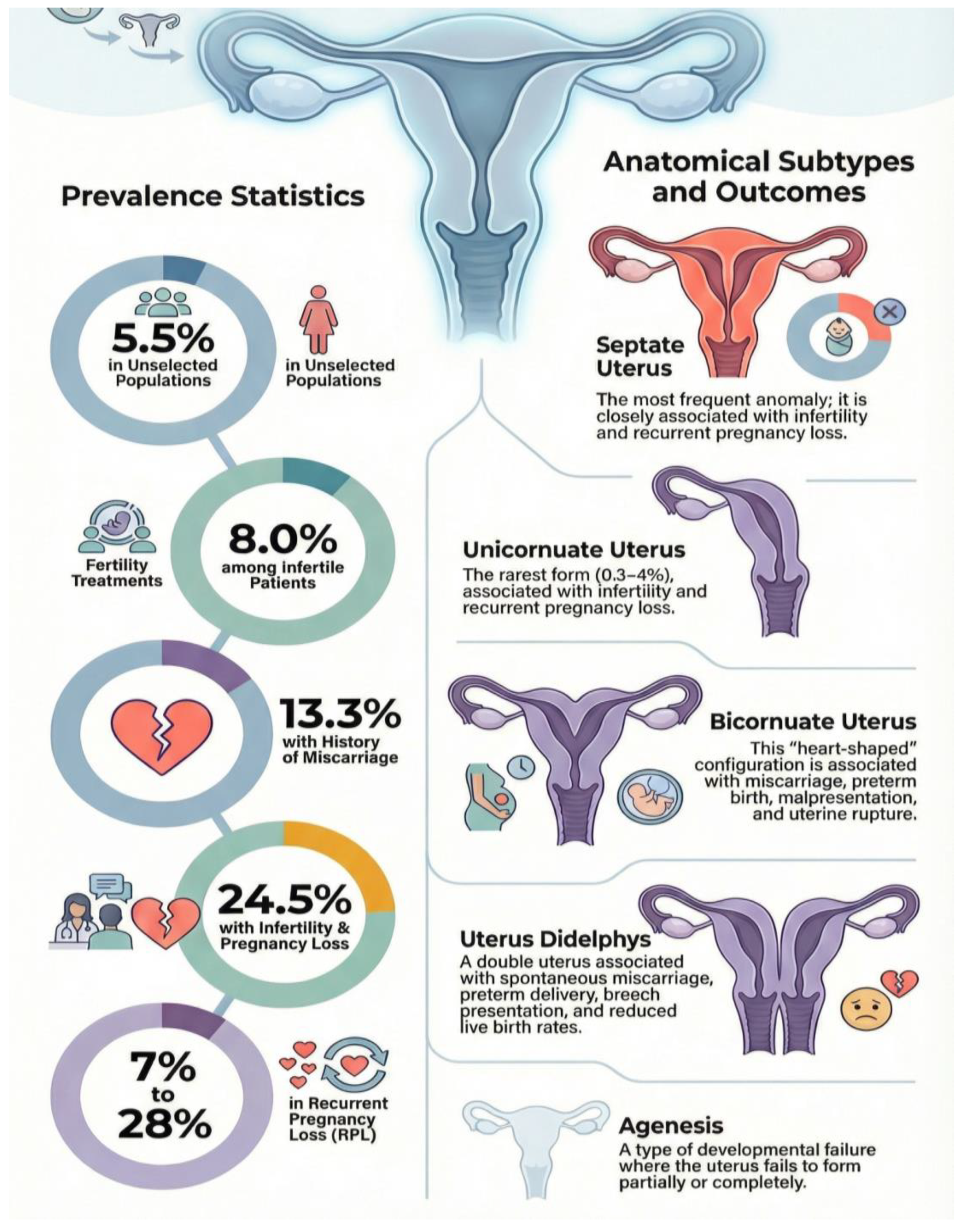
5.2. Congenital Uterine Anomalies
5.2.1. Mayer–Rokitansky–Küster–Hauser Syndrome
5.2.2. Septate Uterus
5.2.3. Unicornuate Uterus
5.2.4. Bicornuate Uterus
5.2.5. Uterus Didelphys
5.3. Congenital Cervical Abnormalities
5.3.1. Cervical Agenesis
5.3.2. Congenital Cervical Atresia and Hypoplasia
5.3.3. Isolated Cervical Aplasia
5.3.4. Cervical Incompetence
5.4. Congenital Vaginal Abnormalities
5.4.1. Congenital Vaginal Agenesis
5.4.2. Vaginal Atresia
5.4.3. Obstructed Hemi-Vagina with Ipsilateral Renal Agenesis (OHVIRA)
5.5. Anomalies of Ovarian Development
5.5.1. Ovarian Agenesis
5.5.2. Undescended Ovaries
6. Congenital Anomalies of the Male Reproductive Tract
6.1. Anorchia
6.2. Persistent Müllerian Duct Syndrome
6.3. Cryptorchidism (Undescended Testis)
6.4. Physical Factors
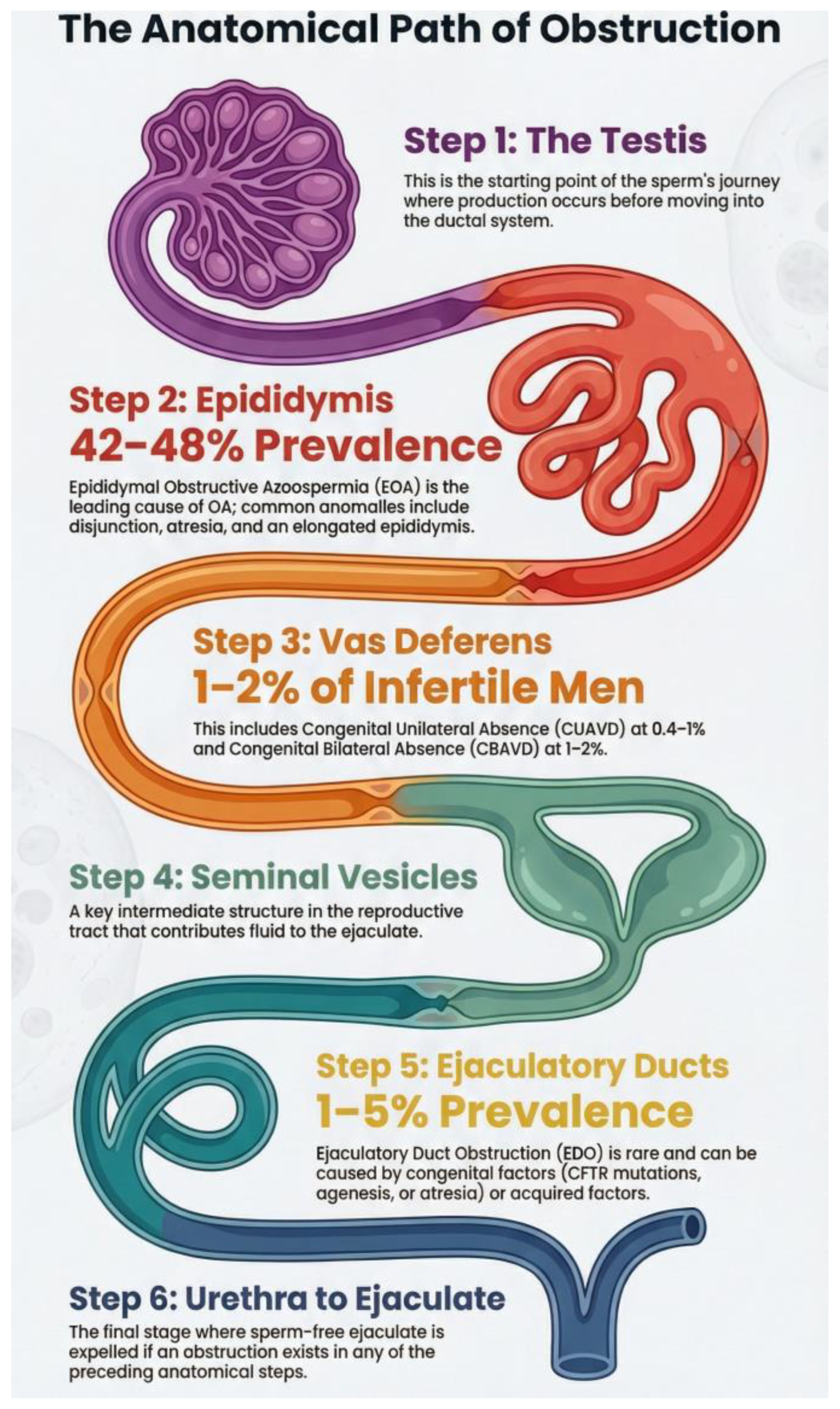
6.5. Obstructive Azoospermia and Male Infertility
6.5.1. Epididymal Anomalies
6.5.2. Congenital Absence of the Vas Deferens
6.5.3. Ejaculatory Duct Obstruction
6.6. Hypospadias
6.7. Congenital Genitourinary Anomalies as Determinants of Male Infertility and Recurrent Pregnancy Loss
7. Limitations
8. Conclusions
Author Contributions
Funding
Institutional Review Board Statement
Informed Consent Statement
Data Availability Statement
Acknowledgments
Conflicts of Interest
Abbreviations
| ADGRG2 | Adhesion G Protein-Coupled Receptor G2 |
| AMH | anti-Müllerian hormone |
| AMHR2 | anti-Müllerian hormone receptor type 2 |
| ART | Assisted reproductive technologies |
| BAMS | Bosma arhinia microphthalmia syndrome |
| CAH | Congenital adrenal hyperplasia |
| CAVD | Congenital absence of the vas deferens |
| CBAVD | Congenital bilateral absence of the vas deferens |
| CFTR | Cystic fibrosis transmembrane conductance regulator |
| CI | Cervical incompetence |
| CUA | Congenital uterine anomaly |
| CUAVD | Congenital unilateral absence of the vas deferens |
| DNA | Deoxyribonucleic acid |
| DSD | Disorders of Sexual Development |
| EDO | Ejaculatory duct obstruction |
| EOA | Epididymal obstructive azoospermia |
| FSH | Follicle-stimulating hormone |
| GU | genitourinary |
| INSL3 | Insulin-like factor 3 |
| IVF | In vitro fertilization |
| MA | Müllerian agenesis |
| MDA | Müllerian duct anomaly |
| MRI | magnetic resonance imaging |
| MRKH | Mayer–Rokitansky–Küster–Hauser syndrome |
| MURCS | Müllerian duct aplasia, unilateral renal agenesis, and cervicothoracic somite anomalies |
| MVE | Microsurgical vasoepididymostomy |
| OA | Ovarian agenesis |
| OHVIRA | Obstructed hemivagina with ipsilateral renal agenesis syndrome |
| PMDS | Persistent Müllerian Duct Syndrome |
| RPL | Recurrent pregnancy loss |
| RXFP2 | Relaxin Family Peptide Receptor 2 |
| SMCHD1 | Structural Maintenance of Chromosomes Flexible Hinge Domain-containing protein 1 |
| SRY | Sex-determining Region Y |
| TFI | Tubal factor infertility |
| UO | Undescended ovary |
| UOA | Unilateral ovarian absence |
| URA | Unilateral renal agenesis |
| US | ultrasonography |
| UTx | Uterine transplantation |
References
- Dobrzeniecki, K.; Poczta, Z.; Kacprzak, M.; Kasprzyk, A.; Kolasińska, J.; Mizgier, M.; Pisarska-Krawczyk, M.; Plagens-Rotman, K.; Kędzia, W.; Jarząbek-Bielecka, G. Human Sexual Development in the Somatic and Psychosexual Context. J. Clin. Med. 2026, 15, 1220. [Google Scholar] [CrossRef] [PubMed]
- Al-Attar, R.M.T.; Amin, Y.K. Congenital anomalies of reproductive system among infertile women attending Dr. Khawer Center for Infertility and IVF in Maternity Teaching Hospital in Erbil city: A retrospective study. Zanco J. Med. Sci. 2019, 23, 368–374. [Google Scholar] [CrossRef]
- Carson, S.A.; Kallen, A.N. Diagnosis and Management of Infertility: A Review. JAMA 2021, 326, 65–76. [Google Scholar] [CrossRef] [PubMed]
- ESHRE Guideline Group on RPL; Bender Atik, R.; Christiansen, O.B.; Elson, J.; Kolte, A.M.; Lewis, S.; Middeldorp, S.; Mcheik, S.; Peramo, B.; Quenby, S.; et al. ESHRE guideline: Recurrent pregnancy loss: An update in 2022. Hum. Reprod. Open 2023, 2023, hoad002. [Google Scholar]
- Turano, A.; Osborne, B.F.; Schwarz, J.M. Sexual Differentiation and Sex Differences in Neural Development. In Neuroendocrine Regulation of Behavior; Coolen, L.M., Grattan, D.R., Eds.; Springer International Publishing: Cham, Switzerland, 2019; pp. 69–110. [Google Scholar]
- Engel, N. Sex Differences in Early Embryogenesis: Inter-Chromosomal Regulation Sets the Stage for Sex-Biased Gene Networks. BioEssays 2018, 40, 1800073. [Google Scholar] [CrossRef]
- Moore, K.L.; Persaud, T.V.N. The Urogenital System: Development of the Genital System. In The Developing Human: Clinically Oriented Embryology; W.B. Saunders: Philadelphia, PA, USA, 2003. [Google Scholar]
- Kevin, M. Embryonic Development of Reproductive Structures: From Gonads to Gametes. Reprod. Syst. Sex. Disord. 2024, 13, 429. [Google Scholar]
- Shen, J.; Cunha, G.R.; Sinclair, A.; Cao, M.; Isaacson, D.; Baskin, L. Macroscopic Whole-Mounts of the Developing Human Fetal Urogenital-Genital Tract: Indifferent Stage to Male and Female Differentiation. Differentiation 2018, 103, 5–13. [Google Scholar] [CrossRef]
- Slaoui, A.; Benzina, I.; Talib, S.; Etber, A.; Zeraidi, N.; Lakhdar, A.; Kharbach, A.; Baydada, A. Congenital Vaginal Atresia: About an Uncommon Case. Pan Afr. Med. J. 2020, 37, 69. [Google Scholar] [CrossRef]
- Chitayat, D.; Glanc, P. Diagnostic Approach in Prenatally Detected Genital Abnormalities. Ultrasound Obstet. Gynecol. 2010, 35, 637–646. [Google Scholar] [CrossRef]
- Santamaria-Duran, N.; Suarez-Obando, F.; Rojas-Moreno, A. Disorders of Sexual Development Associated with Sex Chromosomes: An Update. Rev. Mex. Urol. 2022, 82, e05. [Google Scholar] [CrossRef]
- Witchel, S.F. Disorders of Sex Development. Best Pract. Res. Clin. Obstet. Gynaecol. 2018, 48, 90–102. [Google Scholar] [CrossRef] [PubMed]
- Lee, P.A.; Nordenström, A.; Houk, C.P.; Ahmed, S.F.; Auchus, R.; Baratz, A.; BaratzDalke, K.; Liao, L.-M.; Lin-Su, K.; Looijenga, L.H.J., 3rd; et al. Global Disorders of Sex Development Update since 2006: Perceptions, Approach, and Care. Horm. Res. Paediatr. 2016, 85, 158–180. [Google Scholar] [CrossRef] [PubMed]
- Sandberg, D.E.; Gardner, M. Differences/Disorders of Sex Development: Medical Conditions at the Intersection of Sex and Gender. Annu. Rev. Clin. Psychol. 2022, 18, 201–231. [Google Scholar] [CrossRef] [PubMed]
- Gomes, N.L.; Chetty, T.; Jorgensen, A.; Mitchell, R.T. Disorders of Sex Development—Novel Regulators, Impacts on Fertility, and Options for Fertility Preservation. Int. J. Mol. Sci. 2020, 21, 2282. [Google Scholar] [CrossRef]
- Finlayson, C.; Fritsch, M.K.; Johnson, E.K.; Rosoklija, I.; Gosiengfiao, Y.; Yerkes, E.; Madonna, M.B.; Woodruff, T.K.; Cheng, E. Presence of Germ Cells in Disorders of Sex Development: Implications for Fertility Potential and Preservation. J. Urol. 2017, 197, 937–943. [Google Scholar] [CrossRef]
- Campo-Engelstein, L.; Chen, D.; Baratz, A.B.; Johnson, E.K.; Finlayson, C. The Ethics of Fertility Preservation for Pediatric Patients with Differences (Disorders) of Sex Development. J. Endocr. Soc. 2017, 1, 638–645. [Google Scholar] [CrossRef]
- Dahiphale, S.M.; Potdar, J.; Acharya, N.; Jyotsna, G.; Desale, R.; Dahiphale, S.M. Congenital Anomalies of the Female Genital Tract: A Comprehensive Review. Cureus 2024, 16, e56753. [Google Scholar] [CrossRef]
- Christopoulos, P.; Gazouli, M.; Fotopoulou, G.; Creatsas, G. The role of genes in the development of Mullerian anomalies: Where are we today? Obstet. Gynecol. Surv. 2009, 64, 760–768. [Google Scholar] [CrossRef]
- Pervaiz, S.; Ahmad Naeem, M.; Ali, A.; John, A.; Batool, N. Frequency of Uterine Anomalies Associated with Persistent Miscarriages in Pregnancy on Ultrasound: Uterine Anomalies Associated with Persistent Miscarriages. Pak. J. Health Sci. 2022, 3, 55–58. [Google Scholar] [CrossRef]
- de Groot, J.A.; Tierney Wolgemuth, B.S.; Sanfilippo, J. Müllerian Anomalies in the Pediatric and Adolescent Population: Diagnosis, Counseling and Treatment Options. Ann. Infertil. Reprod. Endocrinol. 2019, 2, 1016. [Google Scholar]
- Vallerie, A.; Breech, L. Update in Müllerian Anomalies: Diagnosis, Management, and Outcomes. Curr. Opin. Obstet. Gynecol. 2010, 22, 381–387. [Google Scholar] [CrossRef]
- Saravelos, S.H.; Cocksedge, K.A.; Li, T.C. Prevalence and Diagnosis of Congenital Uterine Anomalies in Women with Reproductive Failure: A Critical Appraisal. Hum. Reprod. Update 2008, 14, 415–429. [Google Scholar] [CrossRef] [PubMed]
- Akdemir, A.; Ergenoglu, A.M.; Yeniel, A.Ö.; Sendag, F.; Karadadaş, N. Coring-Type Laparoscopic Resection of a Cavitated Non-Communicating Rudimentary Horn under Hysteroscopic Assistance. J. Obstet. Gynaecol. Res. 2014, 40, 1950–1954. [Google Scholar] [CrossRef] [PubMed]
- Acién, P.; Acién, M.I. The History of Female Genital Tract Malformation Classifications and Proposal of an Updated System. Hum. Reprod. Update 2011, 17, 693–705. [Google Scholar] [CrossRef] [PubMed]
- Csobonyeiova, M.; Klein, M.; Feitscherova, C.; Pavlikova, L.; Kachlik, D.; Varga, I. The Overview of Anatomical Variations and Congenital Anomalies of the Uterine Tubes and Their Impact on Fertility. Physiol. Res. 2022, 71, S35–S49. [Google Scholar] [CrossRef]
- Mert, S.A.; Dilbaz, B.; Cukurova, E.S.; Kose, C.; Ustun, Y.E. Reproductive Outcome of the Patients with Uterus Unicornis: Five-Year Experience in a Tertiary Center. Acta Medica Litu. 2022, 29, 295–303. [Google Scholar] [CrossRef]
- Passos, I.D.; Britto, R.L. Diagnosis and Treatment of Müllerian Malformations. Taiwan. J. Obstet. Gynecol. 2020, 59, 183–188. [Google Scholar] [CrossRef]
- Rezvani, M.; Shaaban, A.M. Fallopian Tube Disease in the Nonpregnant Patient. Radiographics 2011, 31, 527–548. [Google Scholar] [CrossRef]
- Israfilova, G.; Pabuccu, E.; Deniz, D.; Pabuccu, R. Congenital Tubal Anomalies: Exploring Their Relationship with Tubal Factor Infertility—An Observational-Descriptive Study. Clin. Exp. Obstet. Gynecol. 2024, 51, 91. [Google Scholar] [CrossRef]
- Pabuccu, E.; Kahraman, K.; Taskin, S.; Atabekoglu, C. Unilateral Absence of Fallopian Tube and Ovary in an Infertile Patient. Fertil. Steril. 2011, 96, e55–e57. [Google Scholar] [CrossRef]
- Ambildhuke, K.; Pajai, S.; Chimegave, A.; Mundhada, R.; Kabra, P. A Review of Tubal Factors Affecting Fertility and its Management. Cureus 2022, 14, e30990. [Google Scholar] [CrossRef]
- Abrao, M.S.; Muzii, L.; Marana, R. Anatomical Causes of Female Infertility and Their Management. Int. J. Gynecol. Obstet. 2013, 123, 10–16. [Google Scholar] [CrossRef] [PubMed]
- Chan, Y.Y.; Jayaprakasan, K.; Zamora, J.; Thornton, J.G.; Raine-Fenning, N.; Coomarasamy, A. The Prevalence of Congenital Uterine Anomalies in Unselected and High-Risk Populations: A Systematic Review. Hum. Reprod. Update 2011, 17, 761–771. [Google Scholar] [CrossRef] [PubMed]
- Carbonnel, M.; Pirtea, P.; de Ziegler, D.; Ayoubi, J.M. Uterine Factors in Recurrent Pregnancy Loss. Fertil. Steril. 2021, 115, 538–545. [Google Scholar] [CrossRef] [PubMed]
- Grimbizis, G.F.; Camus, M.; Tarlatzis, B.C.; Bontis, J.N.; Devroey, P. Clinical Implications of Uterine Malformations and Hysteroscopic Treatment Results. Hum. Reprod. Update 2001, 7, 161–174. [Google Scholar] [CrossRef]
- Triantafyllidou, O.; Papageorgiou, M.; Christopoulos, P.; Kastora, S.; Kalampokas, E.; Kalampokas, T.; Vlahos, N. Three Cases of Congenital Anomalies U2bC2V1 with Different Reproductive Outcomes: Is It a Cause of Infertility? Gynecol. Obstet. Case Rep. 2022, 8, 26. [Google Scholar]
- Paul, K.G.; Kosuri, K.C.; Bayad, H. Congenital Uterovaginal Abnormalities: Embryogenesis, Surgical Management, and Clinical Implications. Obstet. Gynecol. Sci. 2020, 63, 655–659. [Google Scholar] [CrossRef]
- Heinonen, P.K. Unicornuate Uterus and Rudimentary Horn. Fertil. Steril. 1997, 68, 224–230. [Google Scholar] [CrossRef]
- Fontana, L.; Gentilin, B.; Fedele, L.; Gervasini, C.; Miozzo, M. Genetics of Mayer–Rokitansky–Küster–Hauser (MRKH) Syndrome. Clin. Genet. 2017, 91, 233–246. [Google Scholar] [CrossRef]
- Fedele, L.; Bulfoni, A.; Salvatore, S.; Candiani, M. Fertility Options in Mayer–Rokitansky–Küster–Hauser Syndrome. Clin. Exp. Obstet. Gynecol. 2021, 48, 453–460. [Google Scholar] [CrossRef]
- Dube, R.; Kar, S.S.; Jhancy, M.; George, B.T. Molecular Basis of Müllerian Agenesis Causing Congenital Uterine Factor Infertility: A Systematic Review. Int. J. Mol. Sci. 2023, 25, 120. [Google Scholar] [CrossRef]
- Herlin, M.K.; Petersen, M.B.; Brännström, M. Mayer–Rokitansky–Küster–Hauser (MRKH) Syndrome: A Comprehensive Update. Orphanet J. Rare Dis. 2020, 15, 214. [Google Scholar] [CrossRef] [PubMed]
- Traoré, T.; Toungara, H.; Kané, F.; Sidibé, K.; Coulibaly, O.; Dao, S.; Touré, M.; Traoré, S.; Donigolo, B.; Traoré, B.; et al. Mayer–Rokitansky–Küster–Hauser Syndrome as a Cause of Infertility and Primary Amenorrhea: A Case Report. Open J. Obstet. Gynecol. 2024, 14, 1801–1806. [Google Scholar] [CrossRef]
- Brännström, M.; Johannesson, L.; Bokström, H.; Kvarnström, N.; Mölne, J.; Dahm-Kähler, P.; Enskog, A.; Milenkovic, M.; Ekberg, J.; Diaz-Garcia, C.; et al. Livebirth after Uterus Transplantation. Lancet 2015, 385, 607–616. [Google Scholar] [CrossRef] [PubMed]
- Triantafyllidou, O.; Papageorgiou, M.; Christopoulos, P.; Kastora, S.; Kalampokas, E.; Kalampokas, T.; Nikos, V. Congenital Vaginal and Complete Uterine Septum with Double Cervix (U2bC2V1) with Different Reproductive Outcomes: Is There a Need for Surgical Treatment? SN Compr. Clin. Med. 2023, 5, 66. [Google Scholar] [CrossRef]
- Lamari, I.; Ziogas, A.C.; Thanasas, I.; Kotronis, K.V.; Xydias, E.M. Spontaneous Pregnancy after Surgical Repair of Subseptate Uterus: A Case Report and Review of the Literature. Cureus 2023, 15, e43399. [Google Scholar] [CrossRef]
- Chan, Y.Y.; Jayaprakasan, K.; Tan, A.; Coomarasamy, A.; Raine-Fenning, N.J. Reproductive Outcomes in Women with Congenital Uterine Anomalies: A Systematic Review. Ultrasound Obstet. Gynecol. 2011, 38, 371–382. [Google Scholar] [CrossRef]
- Timmons, D.; Rivera Mudafort, E.; DeCherney, A. Uterine Septum: A Case Report and a Recommendation to Change the Current Guidelines. Glob. Reprod. Health 2021, 6, e49. [Google Scholar] [CrossRef]
- Turocy, J.M.; Rackow, B.W. Uterine Factor in Recurrent Pregnancy Loss. Semin. Perinatol. 2019, 43, 74–79. [Google Scholar] [CrossRef]
- Practice Committee of the American Society for Reproductive Medicine. Uterine septum: A guideline. Fertil. Steril. 2016, 106, 530–540. [Google Scholar] [CrossRef]
- Jiang, Y.; Wang, L.; Wang, B.; Shen, H.; Wu, J.; He, J.; Liu, A.; Wang, Y.; Zhang, X.; Ma, B. Reproductive Outcomes of Natural Pregnancy after Hysteroscopic Septum Resection in Patients with a Septate Uterus: A Systematic Review and Meta-Analysis. Am. J. Obstet. Gynecol. MFM 2023, 5, 100762. [Google Scholar] [CrossRef]
- Wang, L.; Yu, Y.; Zhang, Y.; Xu, J.; Han, X. Impact of Unicornuate Uterus on Third-Trimester Obstetric Outcomes in Nulliparous Women. Clin. Exp. Obstet. Gynecol. 2024, 51, 251. [Google Scholar] [CrossRef]
- Benlghazi, A.; Belouad, M.; Messaoudi, H.; Benali, S.; El Hassani, M.M.; Kouach, J. Spontaneous Successful Term Delivery in a Unicornuate Uterus: A Case Report and Literature Review. Int. J. Surg. Case Rep. 2023, 110, 108689. [Google Scholar] [CrossRef] [PubMed]
- Isono, W.; Tsuchiya, A.; Honda, M.; Saito, A.; Tsuchiya, H.; Matsuyama, R.; Fujimoto, A.; Nishii, O. Successful Management of a Noncommunicating Rudimentary Uterine Horn Pregnancy by Laparoscopic Surgery: A Case Report and Literature Review. Gynecol. Minim. Invasive Ther. 2022, 11, 7–16. [Google Scholar] [CrossRef] [PubMed]
- Simsek, E.; Durdağ, G.D.; Yağınç, D.A.; Aydın, Ş.; Şimşek, S.Y.; Aytaç, P.Ç. The Effect of Unicornuate Uterus on Reproductive Outcomes in Infertile Patients. Eur. J. Obstet. Gynecol. Reprod. Biol. 2024, 302, 38–42. [Google Scholar] [CrossRef]
- Lin, P.C. Reproductive Outcomes in Women with Uterine Anomalies. J. Womens Health 2004, 13, 33–39. [Google Scholar] [CrossRef]
- Parmar, M.; Tomar, S. Bicornuate Uterus: Infertility Treatment and Pregnancy Continuation without Cerclage: An Unusual Case. Open J. Obstet. Gynecol. 2014, 4, 981–985. [Google Scholar] [CrossRef]
- Moltot, T.; Lemma, T.; Silesh, M.; Sisay, M.; Tsegaw, B. Successful Post-Term Pregnancy in Scarred Bicornuate Uterus: Case Report. BMC Pregnancy Childbirth 2023, 23, 559. [Google Scholar] [CrossRef]
- Ikhuoriah, T.; Oboh, D.; Abramowitz, C.; Musheyev, Y. Bicornuate Uterus: A Rare Case of a Viable Full-Term Pregnancy in the Right Uterine Horn. Radiol. Case Rep. 2023, 18, 2107–2111. [Google Scholar] [CrossRef]
- Bishowkarma, S.; Ghimire, S.; Gurmaita, R.K.; Gurung, M.; Mukherjee, M.; Rijal, H. Spontaneous Rupture of Bicornuate Uterus in the Second Trimester: A Case Report. Int. J. Surg. Case Rep. 2025, 135, 111862. [Google Scholar] [CrossRef]
- Almehzaa, R.T.; Sunder, A.; Bushaqer, N. Pregnancy with a Bicornuate Uterus Complicated by Placenta Percreta and Intraperitoneal Hemorrhage. Cureus 2024, 16, e54519. [Google Scholar] [CrossRef]
- Sola-Leyva, A.; Romero, B.; Canha-Gouveia, A.; Pérez-Prieto, I.; Molina, N.M.; Vargas, E.; Mozas-Moreno, J.; Chamorro, C.; Saare, M.; Salumets, A.; et al. Uterus Didelphys: The First Case Report on Molecular Profiling of Endometrial Tissue from Both Uterine Cavities. Reprod. Biol. Endocrinol. 2025, 23, 1. [Google Scholar] [CrossRef] [PubMed]
- Ćwiertnia, A.; Borzyszkowska, D.; Golara, A.; Tuczyńska, N.; Kozłowski, M.; Kwiatkowski, S.; Cymbaluk-Płoska, A. The Impact of Uterus Didelphys on Fertility and Pregnancy. Int. J. Environ. Res. Public Health 2022, 19, 10571. [Google Scholar] [CrossRef] [PubMed]
- Slavchev, S.; Kostov, S.; Yordanov, A. Pregnancy and Childbirth in Uterus Didelphys: A Report of Three Cases. Medicina 2020, 56, 198. [Google Scholar] [CrossRef] [PubMed]
- Ogunlaja, I.P.; Abdullahi, M.O.; Olasinde, A.; Oladipo, A.A.; Abdulkadir, Z.A. Uterine Didelphys: A Rare Anomaly Unveiled at Repeat Caesarean Section in a Multiparous Woman at Term. Niger. Health J. 2025, 25, 1101–1105. [Google Scholar] [CrossRef]
- Acién, P.; Acién, M. The Presentation and Management of Complex Female Genital Malformations. Hum. Reprod. Update 2016, 22, 48–69. [Google Scholar] [CrossRef]
- Kakumbi, T.; Shayo, B.; Isaac, R.; Wangwe, P. Pregnancy Follow-Up and Delivery of Didelphys Uterus: Case Report and Review of the Literature. East Afr. Sch. J. Med. Sci. 2025, 7, 349–352. [Google Scholar] [CrossRef]
- Azinar, A.D.; Annas, J.Y.; Primariawan, R.Y.; Hardianto, G. Treatment of Cervical Agenesis with Minimally Invasive Therapy: Case Report. Gynecol. Minim. Invasive Ther. 2017, 6, 202–204. [Google Scholar] [CrossRef]
- Khoiwal, K.; Agarwal, A.; Ravi, A.K.; Chaturvedi, J. Unique Minimally Invasive Management of Cervicovaginal Agenesis. BMJ Case Rep. 2021, 14, e242862. [Google Scholar] [CrossRef]
- Siqueira, A.L.F.; Hentschke, M.R.; Wagner, M.; Kobe, L.M.; Borges, C.S.; Trindade, V.D.; Moretto, M.; Boeno, A.C.; Arent, A. Uterine Cervix and Proximal Third of Vagina Agenesis with Functional Uterus: Case Report and Literature Review. Hum. Reprod. Arch. 2019, 34, e001319. [Google Scholar] [CrossRef]
- Pires, R.; Neves, A.R.; Geraldes, F.; Águas, F. Innovating the Conservative Management of Isolated Cervical Aplasia. BMJ Case Rep. 2021, 14, e242475. [Google Scholar] [CrossRef]
- Suryawan, A.Z.; Rachim, W.; Wenas, M.; Sukarsa, M.R.A. Could We Preserve Reproductive Function in Complete Vaginal Agenesis and Cervical Agenesis? A Case Report and Clinical Perspective. SAGE Open Med. Case Rep. 2025, 13, 2050313X251324073. [Google Scholar] [CrossRef]
- Radhouane, A.; Mohamed, B.; Imen, B.A.; Aymen, F.; Khaled, N. Successful Pregnancy by IVF in a Patient with Congenital Cervical Atresia. Asian Pac. J. Reprod. 2015, 4, 249–250. [Google Scholar] [CrossRef]
- Fluker, M.R.; Bebbington, M.W.; Munro, M.G. Successful Pregnancy Following Zygote Intrafallopian Transfer for Congenital Cervical Hypoplasia. Obstet. Gynecol. 1994, 84, 659–661. [Google Scholar] [PubMed]
- Fujimoto, V.Y.; Miller, J.H.; Klein, N.A.; Soules, M.R. Congenital Cervical Atresia: Report of Seven Cases and Review of the Literature. Am. J. Obstet. Gynecol. 1997, 177, 1419–1425. [Google Scholar] [CrossRef] [PubMed]
- Lakshmy, S.R.; Rose, N. Congenital Absence of Uterine Cervix. Int. J. Reprod. Contracept. Obstet. Gynecol. 2016, 5, 3634–3636. [Google Scholar] [CrossRef]
- Bender Atik, R.; Christiansen, O.B.; Elson, J.; Kolte, A.M.; Lewis, S.; Middeldorp, S.; Nelen, W.; Peramo, B.; Quenby, S.; Vermeulen, N.; et al. ESHRE Guideline: Recurrent Pregnancy Loss. Hum. Reprod. Open 2018, 2018, hoy004. [Google Scholar] [CrossRef]
- Grimbizis, G.F.; Campo, R. Clinical Approach for the Classification of Congenital Uterine Malformations. Gynecol. Surg. 2012, 9, 119–129. [Google Scholar] [CrossRef]
- American College of Obstetricians; Gynecologists. Cerclage for the Management of Cervical Insufficiency. Obstet. Gynecol. 2014, 123, 372–379. [Google Scholar] [CrossRef]
- Kabiri, D.; Nesher, D.R.; Luxenbourg, D.; Rottenstreich, A.; Rosenbloom, J.I.; Ezra, Y.; Yagel, S.; Porat, S.; Romero, R. The Role of Vaginal Progesterone for Preterm Birth Prevention in Women with Threatened Labor and Shortened Cervix Diagnosed after 24 Weeks of Pregnancy. Int. J. Gynecol. Obstet. 2023, 161, 423–431. [Google Scholar] [CrossRef]
- Højsgaard, A.; Villadsen, I. McIndoe Procedure for Congenital Vaginal Agenesis: Complications and Results. Br. J. Plast. Surg. 1995, 48, 97–102. [Google Scholar] [CrossRef] [PubMed]
- Rabiu, A.; Ahmed, Z.D.; Garba, I.; Balogun, M.O.; Lawal, M. Congenital Vaginal Agenesis, Davydov Procedure: A Case Report and Review of the Literature. Niger. J. Basic Clin. Sci. 2020, 17, 71–75. [Google Scholar] [CrossRef] [PubMed][Green Version]
- Robinson, E.D.; Agazie, K.C.; John, D.H. Mayer–Rokitansky–Küster–Hauser Syndrome in an 18-Year-Old Female: The Radiodiagnostic Perspective. J. Med. Womens Assoc. Niger. 2021, 6, 141–145. [Google Scholar] [CrossRef]
- Robboy, S.J.; Kurita, T.; Baskin, L.; Cunha, G.R. New Insights into Human Female Reproductive Tract Development. Differentiation 2017, 97, 9–22. [Google Scholar] [CrossRef]
- Xu, S.; Zhang, J.; Wang, S.; Yang, L.; Qian, J.; Yue, S.; Zhu, D.; Yang, L.; Zhao, L.; Yang, A.; et al. MRI Features and Differential Diagnoses of Congenital Vaginal Atresia. Gynecol. Endocrinol. 2019, 35, 777–781. [Google Scholar] [CrossRef]
- Moore, K.L.; Persaud, T.V.N.; Torchia, M.G. The Developing Human: Clinically Oriented Embryology, 9th ed.; Elsevier: Amsterdam, The Netherlands, 2013. [Google Scholar]
- Lin, X.; Kang, J.; Zhu, L. Recent Advances in Vaginal Atresia: A Literature Review. Biomedicines 2025, 13, 128. [Google Scholar] [CrossRef]
- Grimbizis, G.F.; Campo, R. Congenital Malformations of the Female Genital Tract: The Need for a New Classification System. Fertil. Steril. 2010, 94, 401–407. [Google Scholar] [CrossRef]
- Kapczuk, K.; Zajaczkowska, W.; Madziar, K.; Kedzia, W. Endometriosis in Adolescents with Obstructive Anomalies of the Reproductive Tract. J. Clin. Med. 2023, 12, 2007. [Google Scholar] [CrossRef]
- Albulescu, D.M.; Ceauşescu, A.E.; Sas, L.M.; Comănescu, M.C.; Constantin, C.; Tudorache, Ş. The Herlyn–Werner–Wunderlich Triad (OHVIRA Syndrome) with Good Pregnancy Outcome—Two Cases and Literature Review. Rom. J. Morphol. Embryol. 2018, 59, 1253–1262. [Google Scholar]
- Kudela, G.; Wiernik, A.; Drosdzol-Cop, A.; Machnikowska-Sokołowska, A.; Gawlik, A.; Hyla-Klekot, L.; Gruszczyńska, K.; Koszutski, T. Multiple Variants of Obstructed Hemivagina and Ipsilateral Renal Anomaly (OHVIRA) Syndrome: One Clinical Center Case Series and Systematic Review of 734 Cases. J. Pediatr. Urol. 2021, 17, 653.e1–653.e9. [Google Scholar] [CrossRef]
- Yang, J.S.; Park, J.E.; Jo, H.C. Recurrent Vulvovaginitis as an Unusual Presentation of Diagnosed Obstructed Hemivagina and Ipsilateral Renal Anomalies (OHVIRA) Syndrome in an Adolescent: A Case Report and Review of the Literature. J. Clin. Med. 2026, 15, 440. [Google Scholar] [CrossRef] [PubMed]
- Dou, Z.; Song, S.; Gao, Q.; Guo, J.; Zhang, Y.; Yin, R.; Yan, Y.; Huang, R.; Li, L.; Zhu, L. Clinical Characteristics of 415 Patients with Obstructed Hemivagina and Ipsilateral Renal Anomaly Syndrome: A Nationwide Multicenter Retrospective Study. J. Pediatr. Urol. 2025, 12, 1731–1743. [Google Scholar] [CrossRef] [PubMed]
- Moufawad, G.; Giannini, A.; D’Oria, O.; Laganà, A.S.; Chiantera, V.; Khazzaka, A.; Maziad, G.; Nasr, E.; Geagea, V.; Jardali, M.A.; et al. Obstructed Hemivagina and Ipsilateral Renal Anomaly Syndrome: A Systematic Review about Diagnosis and Surgical Management. Gynecol. Minim. Invasive Ther. 2023, 12, 123–129. [Google Scholar] [CrossRef] [PubMed]
- Tandulwadkar, S.; Mishra, S.; Gupta, S.; Singh, A.; Singhania, S. A Rare Case of Primary Infertility with Bilateral Agenesis of Medial Part of Fimbrial End with Hypoplasia of Fimbria and Absence of Fimbria Ovarica with Septate Uterus with Bilateral Normal Ovaries. Int. J. Reprod. Contracept. Obstet. Gynecol. 2022, 11, 1316–1320. [Google Scholar] [CrossRef]
- Chen, H.A.; Grimshaw, A.A.; Taylor-Giorlando, M.; Vijayakumar, P.; Dan Li, D.; Miranda Margetts, M.; Emanuele Pelosi, E.; Alla Vash-Margita, A. Ovarian Absence: A Systematic Literature Review and Case Series Report. J. Ovarian Res. 2023, 16, 13. [Google Scholar] [CrossRef]
- AlRbeihat, R.; Hindawi, A.; Qatarneh, L.; Mahasneh, H.; Marabha, J.; Ibrahim, D.; Hazeem, R.; Salman, F. Bilateral Ovarian Agenesis and Bone Modeling Disease in a Prepuberty Girl with Primary Amenorrhea. Cureus 2024, 16, e75384. [Google Scholar] [CrossRef]
- Djakovic, E.; Anicic, R.; Zamurovic, M.; Jurisic, A.; Rajkovic, M.; Rakic, A. Unilateral Ovarian Agenesis Incidentally Diagnosed by Laparoscopy. Am. J. Surg. Clin. Case Rep. 2022, 4, 1–3. [Google Scholar]
- Shamran, S.G.; Hammood, S.A. The Relationships between Ovary Disease and Tumor Marker: A Review. Al-Kufa Univ. J. Biol. 2022, 14, 103–117. [Google Scholar] [CrossRef]
- Stefanopol, I.A.; Baroiu, L.; Constantin, G.B.; Danila, D.M.; Anghel, L.; Nechifor, A.; Tatu, A.L. Diagnostic and Management of Undescended Ovary—A Preoperative Dilemma: A Case-Based Systematic Review. Int. J. Womens Health 2022, 14, 15–27. [Google Scholar] [CrossRef]
- Wei, W.; Luo, W.; Hu, Q.; Zeng, L.; Wu, R. Undescended Ovary without Abnormal Development of Uterus and Urinary System: A Report of Four Cases. J. Ovarian Res. 2021, 14, 167. [Google Scholar] [CrossRef]
- Sinonquel, P.; Bontinck, J.; Stevens, M. Undescended Ovary and Fallopian Tube Presenting as AppendicealMucocele. Facts Views Vis. ObGyn 2018, 10, 47–50. [Google Scholar] [PubMed]
- Jiang, Z.; Shi, W.; Zhou, Z.; Li, X.; Jin, L.; Chen, H. Association between Ovarian Maldescent and Infertility: A Prospective Cohort Study. J. Ovarian Res. 2025, 18, 264. [Google Scholar] [CrossRef] [PubMed]
- Magoutas, K.; Leathersich, S.; Hart, R.; Ireland, D.; Walls, M.; Payne, M. Lower Semen Quality among Men in the Modern Era—Is There a Role for Diet and the Microbiome? Microorganisms 2025, 13, 147. [Google Scholar] [CrossRef] [PubMed]
- Punjani, N.; Lamb, D.J. Male Infertility and Genitourinary Birth Defects: There Is More Than Meets the Eye. Fertil. Steril. 2020, 114, 209–218. [Google Scholar] [CrossRef]
- Gupta, A.; Singh, R.P. External Genital Abnormalities in Male Primary School Children: Importance of Structured School Health Survey. Int. J. Community Med. Public Health 2020, 7, 1576–1579. [Google Scholar] [CrossRef]
- Fouatih, K.; Belin, F.; Lambert, A.S.; Bouligand, J.; Bouvattier, C. Pubertal Growth Spurt in Patients with Bilateral Anorchia after Testosterone Replacement Therapy. Arch. Pediatr. 2019, 26, 320–323. [Google Scholar] [CrossRef]
- Matsumoto, A.M.; Bremner, W.J. Testicular Disorders. In Williams Textbook of Endocrinology, 13th ed.; Melmed, S., Polonsky, K.S., Larsen, P.R., Kronenberg, H.M., Eds.; Elsevier: Philadelphia, PA, USA, 2016; pp. 694–784. [Google Scholar]
- Aksglaede, L.; Davis, S.; Ross, J.L.; Juul, A. Congenital Causes of Hypergonadotropic Hypogonadism: Anorchia and Klinefelter Syndrome. In Pediatric and Adolescent Andrology; Foresta, C., Gianfrilli, D., Eds.; Springer: Cham, Switzerland, 2021; pp. 121–136. [Google Scholar] [CrossRef]
- Sousa Santos, F.; Ferrinho, C.; Limbert, C.; Vasconcelos, C. Case of Newly Diagnosed Bilateral Anorchia in a 42-Year-Old Male Patient. BMJ Case Rep. 2018, 2018, bcr2018225530. [Google Scholar] [CrossRef]
- Mangaraj, S.; Choudhury, A.K.; Mohanty, B.K.; Baliarsinha, A.K. Congenital Anorchia: A Report of Two Cases and a Brief Review of the Literature. J. Integr. Nephrol. Androl. 2017, 4, 141–143. [Google Scholar] [CrossRef]
- Brauner, R.; Neve, M.; Allali, S.; Trivin, C.; Lottmann, H.; Bashamboo, A.; McElreavey, K. Clinical, Biological, and Genetic Analysis of Anorchia in 26 Boys. PLoS ONE 2011, 6, e23292. [Google Scholar] [CrossRef]
- Picard, J.Y.; Cate, R.L.; Racine, C.; Josso, N. The Persistent Müllerian Duct Syndrome: An Update Based upon a Personal Experience of 157 Cases. Sex. Dev. 2017, 11, 109–125. [Google Scholar] [CrossRef]
- Holland, A.J.; Nassar, N.; Schneuer, F.J. Undescended Testes: An Update. Curr. Opin. Pediatr. 2016, 28, 388–394. [Google Scholar] [CrossRef]
- Leslie, S.W.; Sajjad, H.; Villanueva, C.A. Cryptorchidism. In StatPearls [Internet]; StatPearls Publishing: Treasure Island, FL, USA, 2024. Available online: https://www.ncbi.nlm.nih.gov/books/NBK470270/ (accessed on 25 February 2026).
- Radmayr, C.; Bogaert, G.; Dogan, H.S.; Kočvara, R.; Nijman, J.M.; Stein, R.; Rawashdeh, F.H.; Silay, M.S.; Hoen, L.A. EAU Guidelines on Paediatric Urology 2018; European Association of Urology/European Society for Paediatric Urology: Arnhem, The Netherlands, 2018. [Google Scholar]
- Turgut, N.E.; Basar, M.M. Comprehensive Evaluation and Management of Male Infertility with Complete AZFc Microdeletion and Undescended Testicle. Urol. Case Rep. 2025, 59, 102934. [Google Scholar] [CrossRef]
- Ciongradi, C.I.; Sârbu, I.; Iliescu Halițchi, C.O.; Benchia, D.; Sârbu, K. Fertility of Cryptorchid Testis—An Unsolved Mystery. Genes 2021, 12, 1894. [Google Scholar] [CrossRef] [PubMed]
- Yu, B.; Zhang, C.A.; Chen, T.; Mulloy, E.; Shaw, G.M.; Eisenberg, M.L. Congenital Male Genital Malformations and Paternal Health: An Analysis of US Claims Data. Andrology 2023, 11, 1114–1120. [Google Scholar] [CrossRef] [PubMed]
- Patterson, K.J.K.; Graham, J.M., Jr.; Shaw, N.D. Syndrome of the Month: Bosma Arhinia Microphthalmia Syndrome. Am. J. Med. Genet. Part A 2025, 197, e64127. [Google Scholar] [CrossRef] [PubMed]
- Shin, J.; Jeon, G.W. Comparison of Diagnostic and Treatment Guidelines for Undescended Testis. Clin. Exp. Pediatr. 2020, 63, 415–421. [Google Scholar] [CrossRef]
- Babakhanzadeh, E.; Nazari, M.; Ghasemifar, S.; Khodadadian, A. Some of the Factors Involved in Male Infertility: A Prospective Review. Int. J. Gen. Med. 2020, 13, 29–41. [Google Scholar] [CrossRef]
- Kantartzi, P.D.; Goulis, C.D.; Goulis, G.D.; Papadimas, I. Male Infertility and Varicocele: Myths and Reality. Hippokratia 2007, 11, 99–104. [Google Scholar]
- Wang, Z.; Wang, X.; Song, C.; Lu, F.; Zhai, J.; Li, N.; Jiang, B.; Tan, S.; Xuan, X. Pregnancy Outcomes in Patients with Epididymal Obstructive Azoospermia after Microsurgical Vasoepididymostomy: A Systematic Review and Meta-Analysis. Front. Med. 2023, 10, 1186729. [Google Scholar] [CrossRef]
- Sadler, T.W. Langman’s Medical Embryology; Williams & Wilkins: Baltimore, MD, USA, 1995. [Google Scholar]
- Logsdon, N.T.; Gallo, C.M.; Sampaio, F.J.B.; Favorito, L.A. Epididymal Disjunction Anomalies in Undescended Testis—A Factor Associated with Spermatic Obstruction. Int. Braz. J. Urol. 2022, 48, 336–346. [Google Scholar] [CrossRef]
- Turek, P.J.; Ewalt, D.H.; Snyder, H.M., III; Duckett, J.W. Normal Epididymal Anatomy in Boys. J. Urol. 1994, 151, 726–727. [Google Scholar] [CrossRef]
- Abdelmohsen, S.M.; Osman, M.A.; Takrouney, M.H.; El Debeiky, M.; Hassan, A.B.G.; El-Aleem Shalaby, M.M.A.; Baky Fahmy, M.A. A Spectrum of Epididymis and Vas Deferens Anomalies among Children with Cryptorchidism: A Retrospective Multicenter Study. Ann. Pediatr. Surg. 2021, 17, 55. [Google Scholar] [CrossRef]
- Vieiralves, R.R. Epididymal Abnormalities Associated with Sperm Obstruction. Int. Braz. J. Urol. 2022, 48, 347–348. [Google Scholar] [CrossRef] [PubMed]
- Fang, J.; Wang, X.; Sun, X.; Cui, Y.; Diao, F.; Yang, X. Congenital Absence of the Vas Deferens with Hypospadias or without Hypospadias: Phenotypic Findings and Genetic Considerations. Front. Genet. 2022, 13, 1035468. [Google Scholar] [CrossRef] [PubMed]
- Chawla, S. Congenital Unilateral Absence of the Vas Deferens. Med. J. Armed Forces India 1999, 55, 375. [Google Scholar] [CrossRef] [PubMed][Green Version]
- Mieusset, R.; Bieth, E.; Daudin, M.; Isus, F.; Delaunay, B.; Bujan, L.; Monteil, L.; Fauquet, I.; Huydhe, E.; Hamdi, S.M. Male Partners of Infertile Couples with Congenital Unilateral Absence of the Vas Deferens Are Mainly Non-Azoospermic. Andrology 2020, 8, 645–653. [Google Scholar] [CrossRef]
- Alferayan, T.A.; Abumelha, S.M.; Al Subayyil, M.S.; Al Asmari, B.M.; Al Nahas, T.M. Congenital Unilateral Absence of Vas Deferens with Contralateral Testicular Atrophy. Urol. Ann. 2020, 12, 101–102. [Google Scholar] [CrossRef]
- Cai, Z.; Li, H. Congenital Bilateral Absence of the Vas Deferens. Front. Genet. 2022, 13, 775123. [Google Scholar] [CrossRef]
- Kaltsas, A. Cystic Fibrosis and Male Infertility: From Genetics to Future Perspectives in Assisted Reproductive Technologies. Genes 2025, 16, 994. [Google Scholar] [CrossRef]
- Zhou, Y.-H.; Dong, J.-J.; Zhi, E.-L.; Yao, C.-C.; Huang, Y.-H.; Tian, R.-H.; Chen, H.-X.; Dai, Y.-B.; Tang, Y.-X.; Liu, N.-C.; et al. Clinical Features and Microsurgical Reconstruction of Congenital Unilateral Absence of the Vas Deferens with Obstructive Azoospermia: A Tertiary Care Center Experience. Asian J. Androl. 2023, 25, 73–77. [Google Scholar] [CrossRef]
- Lin, C.H.; Huang, T.Y. Congenital Bilateral Absence of the Vas Deferens with Bilaterally Present Seminal Vesicles. Urol. Case Rep. 2020, 31, 101131. [Google Scholar] [CrossRef] [PubMed]
- Lira, F.T.; Bach, P.V.; Miranda, E.P.; Calisto, S.L.D.S.; Silva, G.M.T.D.; Antunes, D.L.; Li, P.S. Management of Ejaculatory Duct Obstruction by Seminal Vesiculoscopy: Case Report and Literature Review. JBRA Assist. Reprod. 2020, 24, 382–386. [Google Scholar] [CrossRef] [PubMed]
- Avellino, G.J.; Lipshultz, L.I.; Sigman, M.; Hwang, K. Transurethral Resection of the Ejaculatory Ducts: Etiology of Obstruction and Surgical Treatment Options. Fertil. Steril. 2019, 111, 427–443. [Google Scholar] [CrossRef] [PubMed]
- Jurewicz, M.; Gilbert, B.R. Imaging and Angiography in Male Factor Infertility. Fertil. Steril. 2016, 105, 1432–1442. [Google Scholar] [CrossRef]
- Achermann, A.P.P.; Esteves, S.C. Diagnosis and Management of Infertility Due to Ejaculatory Duct Obstruction: Summary Evidence. Int. Braz. J. Urol. 2021, 47, 868–881. [Google Scholar] [CrossRef]
- Esteves, S.C.; Miyaoka, R.; Agarwal, A. Surgical Treatment of Male Infertility in the Era of Intracytoplasmic Sperm Injection—New Insights. Clinics 2011, 66, 1463–1478. [Google Scholar] [CrossRef]
- Lv, K.-L.; Sun, W.-G.; Zhang, T.-B.; Zheng, T.; Nan, Y.-H.; Liu, Y.-F.; Zhou, Y.-F.; Wang, R. Efficacy Analysis of 26 Cases of Ejaculatory Duct Obstruction Treated by Prostatic Utricle Neck Endoscopy. Front. Surg. 2022, 9, 1031739. [Google Scholar] [CrossRef]
- Yu, X.; Nassar, N.; Mastroiacovo, P.; Canfield, M.; Groisman, B.; Bermejo-Sánchez, E.; Ritvanen, A.; Kiuru-Kuhlefelt, S.; Benavides, A.; Sipek, A.; et al. Hypospadias Prevalence and Trends in International Birth Defect Surveillance Systems, 1980–2010. Eur. Urol. 2019, 76, 482–490. [Google Scholar] [CrossRef]
- Ludorf, K.L.; Benjamin, R.H.; Navarro Sanchez, M.L.; McLean, S.D.; Northrup, H.; Mitchell, L.E.; Langlois, P.H.; Canfield, M.A.; Scheuerle, A.E.; Scott, D.A.; et al. Patterns of Co-Occurring Birth Defects among Infants with Hypospadias. J. Pediatr. Urol. 2021, 17, 64.e1–64.e8. [Google Scholar] [CrossRef]
- Rodríguez Martínez, A.D.C.; Barrientos-Villegas, S.; Mondragón, C.F.M.; Hernández, E.F.; Martínez-Sosa, I.P.; Mera, B.B.; Valderrama-Treviño, A.I. Hypospadias: A Review. Int. Surg. J. 2024, 11, 1439–1443. [Google Scholar] [CrossRef]
- Bergman, J.E.; Loane, M.; Vrijheid, M. Epidemiology of Hypospadias in Europe: A Registry-Based Study. World J. Urol. 2015, 33, 2159–2167. [Google Scholar] [CrossRef]
- Kumar, S.; Tomar, V.; Yadav, S.S.; Priyadarshi, S.; Vyas, N.; Agarwal, N. Fertility Potential in Adult Hypospadias. J. Clin. Diagn. Res. 2016, 10, PC01–PC05. [Google Scholar] [CrossRef] [PubMed]
- Halaseh, S.A.; Halaseh, S.; Ashour, M. Hypospadias: A Comprehensive Review Including Its Embryology, Etiology and Surgical Techniques. Cureus 2022, 14, e27544. [Google Scholar] [CrossRef] [PubMed]
- Zhang, L.; Wang, L.; Zhang, X.; Xu, G.; Zhang, W.; Wang, K.; Wang, Q.; Qiu, Y.; Li, J.; Gai, L. Sperm Chromatin Integrity May Predict Future Fertility for Unexplained Recurrent Spontaneous Abortion Patients. Int. J. Androl. 2012, 35, 752–757. [Google Scholar] [CrossRef] [PubMed]
- Sultana, S.; Nallari, P.; Ananthapur, V. Recurrent Pregnancy Loss (RPL): An Overview. J. Women’s Health Dev. 2020, 3, 302–315. [Google Scholar] [CrossRef]
- Anifandis, G.; Bounartzi, T.; Messini, C.I.; Dafopoulos, K.; Sotiriou, S.; Messinis, I.E. The Impact of Cigarette Smoking and Alcohol Consumption on Sperm Parameters and Sperm DNA Fragmentation Measured by Halosperm®. Arch. Gynecol. Obstet. 2014, 290, 777–782. [Google Scholar] [CrossRef]
- Jensen, T.K.; Gottschau, M.; Madsen, J.O.; Andersson, A.M.; Lassen, T.H.; Skakkebaek, N.E.; Swan, S.H.; Priskorn, L.; Juul, A.; Jørgensen, N. Habitual Alcohol Consumption Associated with Reduced Semen Quality and Changes in Reproductive Hormones: A Cross-Sectional Study among 1221 Young Danish Men. BMJ Open 2014, 4, e005462. [Google Scholar] [CrossRef]
- Krysta, W.; Dudek, P.; Pulik, Ł.; Łęgosz, P. Screening of Developmental Dysplasia of the Hip in Europe: A Systematic Review. Children 2024, 11, 97. [Google Scholar] [CrossRef]
- Białek, K.; Sadowski, M.; Adamczyk-Gruszka, O.; Młodawski, J.; Świercz, G. Level of basic hope and symptoms of anxiety and depression in women after miscarriage. Arch. Med. Sci. 2024, 20, 332–338. [Google Scholar] [CrossRef]


Disclaimer/Publisher’s Note: The statements, opinions and data contained in all publications are solely those of the individual author(s) and contributor(s) and not of MDPI and/or the editor(s). MDPI and/or the editor(s) disclaim responsibility for any injury to people or property resulting from any ideas, methods, instructions or products referred to in the content. |
© 2026 by the authors. Published by MDPI on behalf of the Lithuanian University of Health Sciences. Licensee MDPI, Basel, Switzerland. This article is an open access article distributed under the terms and conditions of the Creative Commons Attribution (CC BY) license.
Share and Cite
Petrovic, B.; Kostic, S.; Jovanovic, I.M.; Petronijevic, M.; Petronijevic, M.; Hudic, I.; Vrzic Petronijevic, S. The Impact of Congenital Anomalies of the Male and Female Reproductive Organs on Infertility and Recurrent Pregnancy Loss: A Review. Medicina 2026, 62, 812. https://doi.org/10.3390/medicina62050812
Petrovic B, Kostic S, Jovanovic IM, Petronijevic M, Petronijevic M, Hudic I, Vrzic Petronijevic S. The Impact of Congenital Anomalies of the Male and Female Reproductive Organs on Infertility and Recurrent Pregnancy Loss: A Review. Medicina. 2026; 62(5):812. https://doi.org/10.3390/medicina62050812
Chicago/Turabian StylePetrovic, Bojana, Sanja Kostic, Ivana Milan Jovanovic, Milica Petronijevic, Milos Petronijevic, Igor Hudic, and Svetlana Vrzic Petronijevic. 2026. "The Impact of Congenital Anomalies of the Male and Female Reproductive Organs on Infertility and Recurrent Pregnancy Loss: A Review" Medicina 62, no. 5: 812. https://doi.org/10.3390/medicina62050812
APA StylePetrovic, B., Kostic, S., Jovanovic, I. M., Petronijevic, M., Petronijevic, M., Hudic, I., & Vrzic Petronijevic, S. (2026). The Impact of Congenital Anomalies of the Male and Female Reproductive Organs on Infertility and Recurrent Pregnancy Loss: A Review. Medicina, 62(5), 812. https://doi.org/10.3390/medicina62050812